

Introduction
Global climate change has diverse and varied regional impacts, evident today and forecast into the future (Noble et al., Reference Noble, Huq, Anokhin, Carmin, Goudou, Lansigan, Osman-Elasha, Villamizar, Field, Barros, Dokken, Mach, Mastrandrea, Bilir, Chatterjee, Ebi, Estrada, Genova, Girma, Kissel, Levy, MacCracken, Mastrandrea and White2014), presenting challenges and opportunities for agricultural producers worldwide. Given that climate change is already affecting producers, utilizing weather and climate data can assist managers in capitalizing on new opportunities while reducing financial risks. Agricultural service providers play an important role in this context; public sector technical experts, extension professionals and private consultants all provide farmers with important information and services as they make production decisions and consider climate change.
Agricultural service providers operate across many organizations, including the USDA Farm Service Agency (FSA). The overarching mission of FSA is ‘to equitably serve all farmers, ranchers and agricultural partners through the delivery of effective, efficient agricultural programs for all Americans’ (USDA-FSA, 2017a). FSA administers disaster assistance through multiple programs, necessitating that employees interface with farmers and ranchers immediately following extreme climate and weather events. The Agency also supports the conservation of vulnerable agricultural lands with two programs containing incentives for: (a) the removal of ecologically sensitive agricultural land from production (through programs such as the Conservation Reserve Program, or CRP) and (b) conservation practices on active agricultural land (through programs such as the Continuous Conservation Reserve Program or C-CRP). Because of these core functions, in combination with their frequent and sustained contact with farmers and ranchers, FSA employees regularly deliver services that support the overlapping goals of conservation and climate-adaptation.
Considering the great impact that agricultural service providers have on agricultural communities across the USA, it is important to understand the factors that influence the intentions of these individuals to access and use climate-relevant information in their professional services. A rich body of research developed over the past decade focuses on climate change beliefs and risk perceptions of agricultural stakeholders, and if these beliefs lead to different behavioral outcomes. For our purposes, climate belief is a belief that the climate is changing in a manner sufficient to impact producer management decisions. A selection of research explores beliefs and risk perceptions among farmers (Niles et al., Reference Niles, Lubell and Haden2013; Prokopy et al., Reference Prokopy, Arbuckle, Barnes, Haden, Hogan, Niles and Tyndall2015a; Mase et al., Reference Mase, Gramig and Prokopy2016), extension professionals (Fraisse et al., Reference Fraisse, Breuer, Zierden and Ingram2009; Prokopy et al., Reference Prokopy, Carlton, Arbuckle, Haigh, Lemos, Mase, Babin, Dunn, Andresen, Angel, Hart and Power2015b; Campbell and Tomlinson, Reference Campbell and Tomlinson2016) and climate scientists (Cook et al., Reference Cook, Oreskes, Doran, Anderegg, Verheggen, Maibach, Carlton, Lewandowsky, Skuce, Green, Nuccitelli, Jacobs, Richardson, Winkler, Painting and Rice2016). While USDA employees are included in some of these studies as subsets of the populations of interest, there are no investigations that specifically target FSA employees, nor are there any that take a national approach to their assessment.
To address this gap, a nation-wide survey of FSA employees was conducted, targeting individuals who work directly with agricultural producers. In this paper, we explored two primary research questions. First, among FSA field staff, what is the relationship between climate and weather perceptions and current professional use of weather and climate data? Secondly, how well do FSA employees’ beliefs and perceptions in these areas predict their willingness to integrate more climate and weather data into their professional services in the future? To answer these questions, we developed and compared several structural equation models (SEMs) that explore relationships between variables. Conducting these analyses enabled us to develop a broader understanding of how the variables may influence the intentions regarding use of climate and weather information in the future by FSA field staff, particularly in the context of a changing climate.
Background
FSA as an agricultural boundary organization
The majority (66%) of FSA employees are located in county and state offices around the USA. To meet their mission, FSA relies upon approximately 2500 peer-elected county committee members to help administer FSA programing (USDA-FSA, 2017b). Climate adaptation, specifically managing weather-related risks through insurance, disaster relief and conservation, is within the purview of FSA programing, meaning FSA employees are well situated to support agricultural communities as the climate continues to change.
Familiarity with climate science and use of climate and weather data, including forecasts and outlooks, are important duties carried out by members of some boundary organizations (Hu et al., Reference Hu, Zillig, Lynne, Tomkins, Waltman, Hayes, Hubbard, Artikov, Hoffmann and Wilhite2006). Coined by Guston (Reference Guston1999), boundary organizations are those that serve as a conduit of information between stakeholder groups. Carr and Wilkerson (Reference Carr and Wilkinson2005) further describe how these organizations facilitate the ability of groups to retain their cultural identity while learning about the perspectives of another group. Boundary organizations can also serve as tools toward what Jasanoff (Reference Jasanoff1996) calls ‘co-production of knowledge and social order’ (1996, p. 393) or the actionability of science in both management and policy sectors. We suggest that, because of the common spaces inhabited by FSA programs and FSA county committees, FSA is an example of a boundary organization. Additionally, some farmer groups consider FSA employees a top source of soil and water conservation information (Tucker and Napier, Reference Tucker and Napier2002), and it is likely that FSA employees will interact with producers before, during and after important farm management decisions. Whether or not individuals within boundary organizations such as FSA have access to or familiarity with current climate and weather information may have implications for how they assist agricultural producers in addressing climate- and weather-related risks. Specifically, the appropriate use of climate forecasts is important for providing services related to a number of relevant agricultural decision-making processes.
Theoretical background and variable selection
The motivating factors that activate behavior are not necessarily linear but modulated through beliefs and experiences, which can lead to support for climate adaptation or mitigation actions (Niles et al., Reference Niles, Lubell and Haden2013; van der Linden, Reference van der Linden2014; Arbuckle et al., Reference Arbuckle, Morton and Hobbs2015). Structural equation modeling lends itself well to this type of analysis as it incorporates interactions between variables in its calculation of model fit. The factors considered in this study are climate belief, personal experience with extreme weather, perception of weather-related risk and the belief that producers will need to adapt to climate change in order to remain viable. It is widely accepted that many factors influence agricultural service providers’ use of climate and weather-related information (Prokopy et al., Reference Prokopy, Haigh, Mase, Angel, Hart, Knutson, Lemos, Lo, McGuire, Morton, Perron, Todey and Widhalm2013), therefore the theoretical underpinnings of our approach are derived from a number of studies. While previous research in the area of intention towards behavior change has sometimes coupled SEMs in tight alignment with theoretical models (e.g. Hansen et al. (Reference Hansen, Marx and Weber2004)), this was not our approach. Rather, we sought to draw from several theoretical frameworks utilized in previous studies that help explain relationships between belief, perceptions of risk, experiences, intentions to act and behavior change. For example, Roesch-McNally et al. (Reference Roesch-McNally, Arbuckle and Tyndall2017) combined components of the Theory of Planned Behavior (Ajzen, Reference Ajzen1991), the Reasoned Action Approach (Fishbein and Ajzen, Reference Fishbein and Ajzen2010) and the Anatomy of Adaptation Typology (Smit et al., Reference Smit, Burton, Klein and Wang2000) to examine the influence of farmers’ perceptions of weather variability on their willingness to adopt specific conservation practices as a climate adaptation response. Other studies used to inform our selection of variables took a less formal approach to using theory to guide statistical models, as in Spence et al. (Reference Spence, Poortinga, Butler and Pidgeon2011) in their use of Goal Setting Theory to address the role of personal experience of extreme events. Likewise, Haden et al. (Reference Haden, Niles, Lubell, Perlman and Jackson2012) explored personal experiences with climate change and its relative influence on exposure to risk as a motivating driver of behavior change, using Construal Level Theory as the basis of their investigation. Though they are drawn from many different theoretical frames, the studies referenced above and many more all contribute to our understanding of how adaptive decisions are made, and illustrate relevant factors that describe agricultural service providers’ intentions to use climate and weather information in service delivery with producers in the future. The findings thus are likely to inform service delivery to agricultural producers in the era of climate change.
Climate belief
According to Fishbein and Ajzen (Reference Fishbein and Ajzen2010), beliefs are a precursor to attitudes, which can ultimately lead to behavioral changes. It stands to reason that attitudes or the favorable or unfavorable appraisal of a specific behavior (Beedell and Rehman, Reference Beedell and Rehman2000) also influence behavioral intentions (Bayard and Jolly, Reference Bayard and Jolly2007). In the USA, much research conducted on the climate beliefs of agricultural advisors (and how these beliefs influence service provision) focuses on the Midwest (Prokopy et al., Reference Prokopy, Carlton, Haigh, Lemos, Mase and Widhalm2017).Footnote 1 In one such study, researchers found that agricultural advisors have varying degrees of willingness to discuss climate change with producers, and that willingness is often associated with program area (Haigh et al., Reference Haigh, Morton, Lemos, Knutson, Prokopy, Lo and Angel2015). The majority (74%) of extension professionals surveyed in the Midwest region believe that climate change is taking place, while 23% attributed the cause of modern climate change mostly to human activity (Prokopy et al., Reference Prokopy, Carlton, Arbuckle, Haigh, Lemos, Mase, Babin, Dunn, Andresen, Angel, Hart and Power2015b).
Attribution skepticism or the belief that recent climate change is not a consequence of human activities, is a barrier to discussions between advisors and producers about mitigation and adaptation practices. Several studies suggest that whether or not an individual believes in climate change and human attribution has implications for that individual's subsequent support of mitigation and adaption activities (Howden et al., Reference Howden, Soussana, Tubiello, Chhetri, Dunlop, Meinke, Howden, Soussana, Tubiello, Chhetrill and Dunlop2007; Arbuckle et al., Reference Arbuckle, Haigh, Hobbs and Knoot2013a, Reference Arbuckle, Morton and Hobbsb; Hyland et al., Reference Hyland, Jones, Parkhill, Barnes and Williams2015; Chatrchyan et al., Reference Chatrchyan, Erlebacher, Chaopricha, Chan, Tobin and Allred2017). Agricultural advisors are more likely to believe in an anthropogenic cause of climate change if they perceive that unusual weather variability is occurring, and this belief influences their perspectives on agricultural adaptation (Mase et al., Reference Mase, Cho and Prokopy2015). Further, advisors who believe in an anthropogenic role in climate change are more likely to make ‘climate-conscious recommendations’ to their clients and are more likely to agree that they should assist farmers in preparing for climate change (Mase and Prokopy, Reference Mase and Prokopy2014; Chatrchyan et al., Reference Chatrchyan, Erlebacher, Chaopricha, Chan, Tobin and Allred2017, p. 13). Other research, however, challenges the degree to which climate change beliefs or the understanding of climate science translates into either risk perception or support for adaptation behavior. For example, normative influences such as political party and social group affiliation have been shown to influence behavioral intentions (Takahashi et al., Reference Takahashi, Terracina-hartman, Sopchak and Selfa2016; Running et al., Reference Running, Burke and Shipley2017). Furthermore, Niles et al. (Reference Niles, Dynes and Brown2016) found that climate change belief was not a significant correlate of actual behavior changes at a farm level for climate mitigation and adaptation, only a driver of intention to change.
Personal experience with extreme weather
There is debate about the importance of personal experience with climate and weather-related events, specifically related to individuals’ belief that climate change is occurring and intention to change their own behavior. While some research supports the association between climate change belief and personal experience with extreme weather events (Spence et al., Reference Spence, Poortinga, Butler and Pidgeon2011; Haden et al., Reference Haden, Niles, Lubell, Perlman and Jackson2012; Akerlof et al., Reference Akerlof, Maibach, Fitzgerald, Cedeno and Neuman2013), other studies find personal experience with these events does not have significant influence (Saad, Reference Saad2015; Carlton et al., Reference Carlton, Mase, Knutson, Lemos, Haigh, Todey and Prokopy2016). The opposing findings in the above studies support the conclusion of Whitmarsh (Reference Whitmarsh2008), who finds that different weather events may have more or less influence on individuals’ intentions and behavior depending on the type of weather and the severity of impacts. For example, personal experience with floods has relatively low association with levels of climate-concern compared with personal experience with air pollution, while Spence et al. (Reference Spence, Poortinga, Butler and Pidgeon2011) show that personal experience with floods is associated with greater concern for climate impacts (Myers et al., Reference Myers, Maibach, Roser-Renouf, Akerlof and Leiserowitz2013). Among agricultural producers, personal experience with crop loss can increase perceptions of climate-related risks (Menapace et al., Reference Menapace, Colson and Raffaelli2015); however, other studies found that experience with major drought did not have significant impact on agricultural advisors’ perceptions of risk or their attitudes about adaptation (Carlton et al., Reference Carlton, Mase, Knutson, Lemos, Haigh, Todey and Prokopy2016).
Perception of weather-related risk
Behavioral intentions are driven, in part, by perceptions of climate and weather-related risks (O'Conner et al., Reference O'Conner, Bord and Fischer1999; Zahran et al., Reference Zahran, Brody, Grover, Vedlitz, Zahran, Brody, Grover, Vedlitz, Brody and Grover2006; Arbuckle et al., Reference Arbuckle, Morton and Hobbs2013b; Hyland et al., Reference Hyland, Jones, Parkhill, Barnes and Williams2015). Some evidence suggests that an individuals’ perception of the severity of climate risks is likely to outweigh the actual risks. This applies to individuals’ willingness to support climate-friendly policies and other climate-oriented actions or initiatives (Arbuckle et al., Reference Arbuckle, Morton and Hobbs2015). Niles and Mueller (Reference Niles and Mueller2016) found that perception of climate-related changes (and associated risk) are influenced by an individual's belief in climate change, their prior support for climate-related policy and the presence of practices that lessen the felt-impact of weather events (e.g. irrigation infrastructure). Political ideology can also be associated with risk perception, as well as support for climate adaptation and mitigation activities (Takahashi et al., Reference Takahashi, Terracina-hartman, Sopchak and Selfa2016; Running et al., Reference Running, Burke and Shipley2017). Kahan's (Reference Kahan2015) distinction between scientific literacy around climate change and the influence that social networks have on individuals’ belief and decision-making help to explain why access to scientific information is not the most important limitation when it comes to behavior change. Scientific literacy still plays a role, however, as Lemos et al. (Reference Lemos, Lo, Kirchhoff and Haigh2014b) show that agricultural service providers are more likely to provide producers with climate information when the service providers’ concern about long-term risks of climate change for agriculture are high.
Belief that producers will need to adapt
While the need to adapt agricultural practices to changing climate conditions is a widely accepted concept among scientists and many policymakers (Noble et al., Reference Noble, Huq, Anokhin, Carmin, Goudou, Lansigan, Osman-Elasha, Villamizar, Field, Barros, Dokken, Mach, Mastrandrea, Bilir, Chatterjee, Ebi, Estrada, Genova, Girma, Kissel, Levy, MacCracken, Mastrandrea and White2014), it is not universal, and research does not necessarily demonstrate that an agricultural producer's belief that climate adaptation is necessary will influence climate-adaptive behavior. Amongst producers, previous use or adoption of a practice or behavior can be a greater driver than belief in climate change or the need for adaption. For example, Roesch-McNally et al. (Reference Roesch-McNally, Arbuckle and Tyndall2017), show that a producer's current use of specific farm practices (e.g. no-till farming and tile drainage) is the primary factor in predicting future use of these same practices in response to projected climate impacts. Niles et al. (Reference Niles, Dynes and Brown2016) found that the strongest drivers of both intention and implementation of adaptation practices were perceived capacity and perceived likelihood of success. Despite this, the need for institutions and organizations to support agricultural adaptation remains widely discussed (Raymond and Robinson, Reference Raymond and Robinson2013), and there is evidence that producers and advisors agree on the efficacy of certain adaptation practices (Schattman et al., Reference Schattman, Mendez, Merrill and Zia2017). There is also evidence suggesting that agricultural advisors and farmers may form regional cultural cohorts, which functionally reinforce each other's world views, including those related to climate change adaptation (Prokopy et al., Reference Prokopy, Carlton, Arbuckle, Haigh, Lemos, Mase, Babin, Dunn, Andresen, Angel, Hart and Power2015b). Institutional support for climate-outreach and education can be a driver on agricultural advisors’ willingness to discuss climate change with farmers (Lemos et al., Reference Lemos, Kirchhoff, Kalafatis, Scavia and Rood2014a), potentially shifting the views of their social group, including farmers.
Hypotheses
Based on the theoretical framing of our models and the evidence of prior research, we developed the following hypothesis:
H1: Respondents’ current use of climate and weather data will predict respondents’ intentions to use such data in their future professional services.
H2: Climate belief will have less influence on respondents’ intentions to use climate and weather-related tools and information than those factors that measure perceptions of weather-related risk and personal experience with extreme weather events.
Methods
Sampling and survey administration
In fall, 2016, a team consisting of USDA Climate Hub collaborators from the US Forest Service, FSA and the University of Vermont developed a survey instrument for FSA field staff. Many survey questions were adapted, with permission, from the Survey of Agricultural Advisors developed by the U2U project (Prokopy et al., Reference Prokopy, Haigh, Mase, Angel, Hart, Knutson, Lemos, Lo, McGuire, Morton, Perron, Todey and Widhalm2013, Reference Prokopy, Carlton, Haigh, Lemos, Mase and Widhalm2017). In November, the survey was tested by four agency staff in states in different regions of the country. Adjustments to the survey were made in response to feedback from these tests. Respondent email addresses and position titles were collected from the publicly available, online USDA Service Center directory. The survey was designed to target FSA staff in all US states and territories who work directly with agricultural land managers, therefore those individuals with job titles who were unlikely to fulfill this description were removed. Additionally, survey participants were asked early in the survey whether they work directly with land managers. Only those who reported that they did so were included in our analysis. The total number of FSA staff targeted for the survey was 10,614. Institutional Review Board approval was granted through The University of Vermont under an exempt status (IRB Approval Number CHRBSS: 17-0254).
Survey recruitment followed the tailored design method for online surveys (Dillman et al., Reference Dillman, Smyth and Christian2008). FSA Deputy Administrators of Field Offices (DAFOs) in all states and territories were asked to send an introductory email to field staff explaining that the survey would be arriving by email. The first solicitation for survey participation was released three days later. Two follow-up reminders were sent one week apart. The survey was closed three weeks following the final solicitation. In total, 4621 people responded to the survey (42% response rate, calculated using RR4 methods from the American Association of Public Opinion Research). To conduct non-response bias tests, we used the wave analysis approach as described by Phillips et al. (Reference Phillips, Reddy and Durning2016). Respondents were divided into three groups based on if they responded to the first, second or third requests for participation. Responders to the third request were assumed to be representative of non-responders. We tested differences in demographic variables as well as responses to questions covering the topics of climate change belief, climate adaptation and on-farm greenhouse gas emission reductions. There was no significant difference between early and late responses to these questions. Respondents to the survey were disproportionately female (67 vs 26% male), white (86%) and non-Hispanic (87%), which does not differ significantly from the target population. The number of respondents in each state and territory reflected the population of the FSA workforce in those states and territories, as determined by reviewing the percentage of respondents in each state compared with the overall number of FSA employees targeted for our survey in each state. The average response rate by the state was 45%; the standard deviation was 14%.
The analysis presented in this paper utilizes five questions from the survey. Table 1 reports these questions, their variables, scales, means and standard deviations. Independent observed variables used in this analysis include observed weather variability, perceived weather-related risk, belief that producers will need to adapt and climate belief. We conducted a Kendell's Tau B (non-parametric test of association) to test respondents’ perceived dependence on historical weather data or weather and climate forecasts. In addition, we utilized an independent latent variable (i.e. current use of weather and climate information) in our analysis, for which we provided eigenvalue, factor loadings and the Cronbach alpha score. This variable was determined using principal component factors, which indicated a single factor solution with factor loadings significantly greater than a cut-off of 0.40 (Osborne and Costello, Reference Osborne and Costello2005). To measure similar latent concepts represented in current use of weather and climate information, we created a scale to average responses (current use of weather and climate information = 0.93) (Clark and Watson, Reference Clark and Watson1995), which had a Cronbach's alpha coefficient higher than 0.70, a generally accepted cut-off point for reliability (Nunnally, Reference Nunnally1978). We identified an intention to use weather and climate information as an observed, dependent variable, which we used to measure respondents’ intention either to continue the use of these resources in their professional service (if they already use them) or to adopt the use of these resources in the future.
Model scales and variables with measures of reliability.

SD, standard deviation.
Italics indicate sub-sections of a question (e.g. for ‘Current use of weather and climate information’ each question is italicized).
a Dependent variable.
Structural equation model
We utilized SEMs to assess the relationship between climate change experiences, belief, risk and adaptation perceptions, use of weather and climate information, and intention to use weather and climate information in the future. We developed two models to assess the variables that predict an FSA employee's intention to use weather and climate information with their farmer constituents. The first (model 1) was a conceptual model based on existing theory of climate experience and beliefs. The second (model 2) included a latent variable to assess the extent to which current use of weather and climate information is likely to predict intention to use such practices in the future. The comparison of the two models allowed us to test H1 (whether or not respondents’ current use of climate and weather information was associated with their intention to do so in the future). Both models allowed us to test H2 (that climate belief has a lower relative influence on the dependent variable than those factors that measure perceptions of weather-related risk and personal experience with extreme weather events). Models were constructed and analyzed using Stata 13 structural equation modeling (StataCorp LLC, College Station, Texas). SEMs were estimated using maximum-likelihood estimations with missing values to avoid listwise deletions of responses and with bootstrap standard errors (n = 500). Model 2 was constructed first with a confirmatory factor analysis of the latent variable construct and observed variables (Table 1), which was confirmed by a Cronbach alpha test. The addition of the latent variable to model 2 was further assessed through modification indices to add additional covariances between observed variables. FIML (full information maximum-likelihood) estimates were used to run both models, which adjusts the likelihood function so that each case contributes information on the variables that were observed (Enders and Bandalos, Reference Enders and Bandalos2001).
Results
Descriptive results
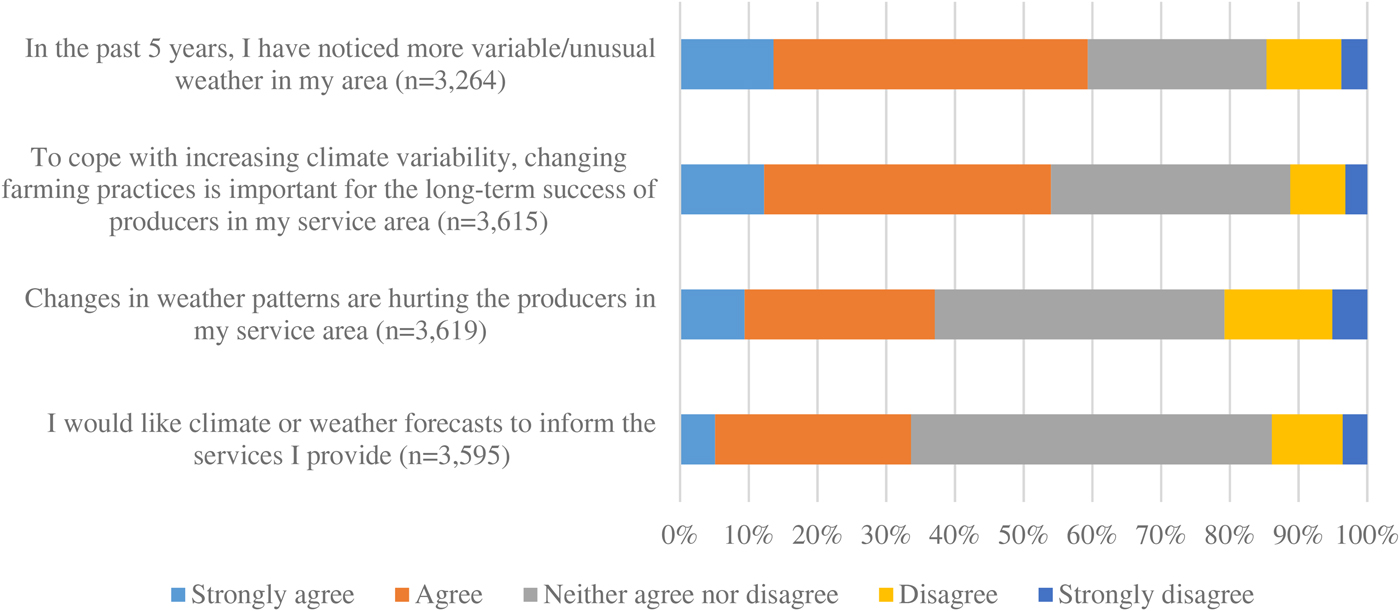
The majority (59%) of respondents agree or strongly agree that they have noticed more variable or unusual weather in their locality. Respondents were less likely to agree that changing weather patterns cause harm to producers in their area (37% agree or strongly agree). The climate-related future impacts on agricultural production that respondents reported being either concerned or very concerned about included: longer dry periods and drought (65%), increased heat stress on crops (51%), increased weed pressure (50%), increased heat stress on livestock (47%), increased insect pressure (44%), higher incidence of crop disease (43%) and more frequent extreme rain events (41%). Over half of respondents (54%) agree or strongly agree that, in order to ensure long-term success, agricultural producers will need to adapt to climate variability by changing farming practices. Approximately one-third (34%) of respondents agreed or strongly agreed that they would like climate or weather forecasts to inform the services they provide (see Fig. 1).
Responses to questions leading to the observed variables used in SEM.
The majority (77%) of respondents believe that climate change is occurring, while a minority of respondents (13%) attribute climate change primarily to human activities (the option most aligned with scientific consensus, see Cook et al. (Reference Cook, Oreskes, Doran, Anderegg, Verheggen, Maibach, Carlton, Lewandowsky, Skuce, Green, Nuccitelli, Jacobs, Richardson, Winkler, Painting and Rice2016)). A larger group (46%) of respondents believes that climate change is caused equally by human activities and environmental factors.
Respondents reported that they were more dependent on current weather conditions and 1–7-day forecasts than they were on either historical weather trends or longer-term outlooks. The Kendell's Tau B showed that use of any of these weather or climate data sets is correlated with every other data set (τB scores were between 0.453 and 0.889, all P < 0.01), meaning that individuals were either likely to use several or all these tools in their professional services, or none. To understand how FSA employees use climate and weather resources, respondents were asked to report the programmatic context in which they applied these resources, and the types of resources they use and are most familiar with. Program areas in which 30% or more of the respondents are using historical weather trends and/or forecasts in discussions with producers include: crop rotations/field assignments (32%), crop/variety choices (35%), purchasing crop insurance or enrolling in the Non-insured Crop Disaster Assistance Program or NAP (51%) and planting or harvesting schedules (42%).
Structural equation model
Model 1 (Fig. 2) utilized four observed variables: observed weather variability, perceived weather-related risk, belief that producers will need to adapt and climate belief. Model 2 (Fig. 3) incorporated a latent variable derived from respondents’ current use of weather and climate information. Model 1 (χ2/df = 1), had a CFI of 0.999 and a RMSEA of 0.034. Model 2 (χ2/df = 37), had a CFI of 0.992 and a RMSEA of 0.043. While the model R 2 values and fit statistics show that they are both good models, Model 1 has a lower AIC score (ΔAIC = 48,583; ΔBIC = 48,793). Further, the additional complexity of the latent variable to Model 2 contributes only a marginal increase in the explained variability (R 2) of the dependent variable, from 0.229 to 0.291, suggesting that the latent variable only predicts about 6% of the variability in the dependent variable. Thus, the addition of the latent variable does not contribute greatly to our efforts to understand why FSA employees may or may not wish to use weather and climate data during service provision. This finding disproves H1, which anticipated that the latent variable would enhance the model. In other words, whether or not an FSA employee currently uses weather and climate information in their professional services is not a good predictor of whether they intend to do so in the future. In the following section, as we investigate the influence of select variables, we will report statistics from model 1 unless specifically noted otherwise.
Significant pathways in model 1 with standardized coefficients.

Significant pathways in model 2 with latent variable and standardized coefficients. A full model including non-significant pathways can be found in the Supplementary Materials (Fig. S1).

Climate belief
Overall the model predicts 19% of the variance for climate belief (R 2 = 0.194), with both observed weather variability (β = 0.336, P < 0.001) and perceived weather risk (β = 0.141, P < 0.001) positively associated with climate belief. Respondents who believed in climate change, and who were in greater agreement with the scientific consensus on its causes, were more likely to believe that on-farm adaptation is necessary in order for farms to remain viable in the future. However, the relative influence of climate belief in the model is low. This confirms H2, which anticipated that individuals’ beliefs (associated with sense of self and social position) would have less influence than variables not associated with climate belief. In model 2, there was no significant relationship between climate belief and current use of climate and weather data.
Perceptions of weather-related risk and observed weather variability
The model predicts 57% of the variance for perceptions of weather-related risk (R 2 = 0.567). This variable has a strong positive influence on the belief that producers will need to adapt (β = 0.365, P < 0.001), intention to use climate and weather information (β = 0.266, P < 0.001) and climate belief (β = 0.141, P < 0.001). This implies that respondents who believe that changing weather patterns cause harm to producers in their area are more likely to believe in climate change, agree that adaptation is necessary, and intend to use weather and climate information in the future. This variable is highly correlated with observed weather variability (β = 0.644, P < 0.01). Respondents who reported noticing more variable weather in their region in the past 5 years are more likely to believe in climate change (β = 0.336, P < 0.001), believe that producers will need to adapt (β = 0.339, P < 0.001), and agree that variable weather is causing harm to producers in their area (β = 0.644, P < 0.001).
Belief that producers will need to adapt
The model predicts 49% of the variance for the belief that producers will need to adapt (R 2 = 0.491). This variable has a direct influence on intention to use climate and weather information in the future (β = 0.241, P < 0.001). In addition, climate belief had a positive effect on the belief that producers will need to adapt (β = 0.123, P < 0.001). While climate belief had a relatively weak direct influence on the dependent variable (β = 0.054, P < 0.001), the model suggests that the climate belief is moderated through the belief that producers will need to adapt. The finding that the latter variable explains more variation within the model and has a stronger association with the dependent variable than climate belief is unexpected because the statements that generated both variables include the term climate change, while other statements used less contested terms such as weather variability and weather forecasts.
Discussion
The results of the comparison between models 1 and 2, as well as the relatively stronger fit statistics in Model 1, illustrate three important findings. First, the latent variable included in model 2, which described respondents’ current use of weather and climate information, did not lead to improved model fit. Model 2 describes an important relationship between respondents’ current use of climate and weather information and their intention to do so in the future (β = 0.258, P < 0.001). However, the comparison between the two models implies that not using weather and climate data in the present may not be a barrier to doing so in the future, indicating potential opportunities to increase the awareness and the current use of weather and climate information amongst appropriate FSA field staff. Additionally, 34% of respondents reported that they would like to use climate and weather tools in the future. Therefore, we reject H1, and find that respondents’ current use of climate and weather data does not predict respondents’ intentions to use such data in future professional services.
Secondly, we clarified the role and level of importance that climate change belief plays in anticipating the intentions of FSA employees to use climate and weather data in the future. The majority (64%) of survey respondents believe that climate change is occurring. Fewer survey respondents (13%) correctly attributed the cause of modern climate change to human activities than the general population in the USA has in similar surveys (Howe et al., Reference Howe, Mildenberger, Marlon and Leiserowitz2015). The Yale Climate Opinion polls (Marlon et al., Reference Marlon, Howe, Mildenberger and Leiserwitz2016) report that 37% of US citizens agree that climate change is primarily caused by human activity. The 2016 Gallup Poll reported that 65% of US citizens believe that warming temperatures are the effect of human pollution (Saad and Jones, Reference Saad and Jones2016). Although the results of these studies and our own are not directly comparable, noting the different outcomes is a useful exercise as we develop a better understanding of agricultural stakeholders as a subset of the US population. While earlier research shows that lesser degrees of climate skepticism are associated with pro-environmental behavior (Poortinga et al., Reference Poortinga, Spence, Whitmarsh, Capstick and Pidgeon2011), Hornsey et al.’s research (Reference Hornsey, Fielding, Mcstay, Reser and Bradley2016) suggests that attribution skepticism may not be a barrier to climate-related pro-environmental behavior as previously assumed.
In support of this emerging framing of the relationship between climate skepticism and climate change related behavior or intentions, we found that whether or not an FSA employee accurately identifies the causes of climate change has less impact on their desire to use climate and weather data than other factors. Therefore, we accept H2, and find that climate belief has less influence on FSA employees’ intentions to use climate and weather-related tools and information than those factors that measure perceptions of weather-related risk and personal experience with extreme weather events. In addition, we found a non-significant relationship between climate change belief and current usage of climate and weather information. These findings provide valuable insights for those engaged in communication of climate science with non-scientific audiences. Beliefs, including climate belief, are strongly associated with an individual's social and cultural identity rather than their level of knowledge (Kahan, Reference Kahan2015). Our findings suggest that, as long as the topic of communication between scientific experts and land managers is related to adaptation, there is ample common ground available when discussing technical and applied approaches for climate change risk reduction.
While belief in climate change may not predict an individuals’ intention to use climate and weather data in the future, it may signal other behaviors or belief systems that influence service provision. For example, belief about climate change and its underlying causes is associated with differing levels of support for climate mitigation policies (Niles et al., Reference Niles, Lubell and Haden2013; van der Linden et al., Reference van der Linden, Leiserowitz, Feinberg and Maibach2015) and variation between agricultural stakeholders’ support for climate adaptation measures (Arbuckle et al., Reference Arbuckle, Morton and Hobbs2013b, Reference Arbuckle, Hobbs, Loy, Morton, Prokopy and Tyndall2014). In the context of agricultural service providers, attribution skepticism may not be an impediment to the use of climate and weather-related tools and resources. However, increasing access to scientifically grounded climate information may enable a broader understanding of climate change causes and consequences among some agricultural service providers, leading to more support for additional adaptation and mitigation activities.
Thirdly, we found that respondents’ perceptions of weather-related risk and observed weather variability are highly correlated. As previously discussed, the role that personal experience plays in developing an individuals’ sense of weather-related risks is explored (and questioned) in several studies. Our study supports the position articulated in Menapace et al. (Reference Menapace, Colson and Raffaelli2015), Spence et al. (Reference Spence, Poortinga, Butler and Pidgeon2011) and Scannell and Gifford (Reference Scannell and Gifford2013), that observed weather variability (interpreted as personal experience with weather variability) and its close relationship with perceptions of weather-related risk influences the intentions of FSA employees to use climate and weather information in the future.
Our findings also echo research pertaining to several Midwestern US states, where it was shown that agricultural advisors were open to greater incorporation of weather and climate information into their services (Prokopy et al., Reference Prokopy, Haigh, Mase, Angel, Hart, Knutson, Lemos, Lo, McGuire, Morton, Perron, Todey and Widhalm2013). With the likely opportunity that FSA field staff are open to increasing their professional use of climate and weather data, the question then becomes, how? It is important to recognize that not all climate and weather information is equally useful to agricultural service providers. Agricultural service providers will benefit the most from professional development opportunities that introduce them to information and resources that are (a) unfamiliar to them and (b) relevant to their customers’ production decisions (Hayman et al., Reference Hayman, Crean, Mullen and Parton2007).
Conclusion
Given the unique organizational structure of FSA, in combination with the importance of the services this agency provides to US producers, employees of this agency play an important role in providing information and support to land managers. Greater integration of weather and climate information into relevant FSA programs and services may be an opportunity for enhanced service provision and program efficacy. Findings from this study show that FSA respondents’ perceptions of weather-related risk in combination with their personal observations of weather variability help predict if an individual is likely to use weather and climate information in the future. The belief that producers will have to adapt to climate change in order to remain viable is a significant predictor of whether respondents intend to use climate and weather information in the future, and there is a notable willingness on behalf of FSA field staff to do so. While important, climate belief has relatively less influence on respondents’ intentions to use this information. Our study disproves the hypothesis that current use of weather and climate-related tools predicts respondents’ intention to use these tools in their professional services in the future. Overall, our work implies that there are ample opportunities to increase employee exposure and proficiency with relevant sources of weather and climate information.
Supplementary material
The supplementary material for this article can be found at https://doi.org/10.1017/S1742170517000783.
Acknowledgements
USDA Climate Hubs leadership, staff and Executive Committee. FSA employees who contributed their time to reviewing the survey, providing feedback on survey questions and thoughtfully responding. We specifically would like to thank Rich Iovanna and Mary Carey for their assistance and consideration; two anonymous reviewers and the guest editor of this special issue.


 Open access

