

Archaeological fieldwork around the world is not only enabled by labor but structured through it (Mickel Reference Mickel2019; Riggs Reference Riggs2017). These labor relations not only shape the production of archaeological knowledge but also reflect wider social, economic, and political configurations (Holley-Kline Reference Holley-Kline2022). Research on contract archaeology, Indigenous participation, and community-based approaches shows that excavation is not merely a technical or scientific procedure: it is a collaborative form of work embedded within local economies, seasonal rhythms, and institutional hierarchies (Bandović Reference Bandović2019). Recent scholarship has drawn sustained attention to this frequently overlooked dimension of archaeological practice, demonstrating how seasonal, project-based, and localized labor arrangements influence both the pace of fieldwork and the kinds of knowledge that emerge from it (Baysal Reference Baysal2024; Kolhatkar Reference Kolhatkar2025).
Yet the workers who sustain this practice have long remained marginal in disciplinary narratives. This article addresses a broader problem of structural exclusion within archaeological practice: although locally recruited workers are indispensable to fieldwork and knowledge production, their participation rarely translates into stable institutional incorporation or recognized professional status. Although archaeological work may offer participants a sense of “honor” or “value” (Everill et al. Reference Everill, Bennett and Burnell2020), they are still frequently described as “invisible workers” (Rosner Reference Rosner2024), “ghosts between the lines” (Troilo Reference Troilo2024), or, in the Chinese context, as “grassroots laborers eclipsed by narratives of fame and prestige” (Xu Reference Xu2015). Emerging debates on archaeological labor now foreground issues of hierarchy, ethics, and equity in knowledge production, pointing to the ways in which labor invisibility, uneven recognition of embodied expertise, and institutional boundaries are reproduced within archaeological practice (Flewellen et al. Reference Flewellen, Dunnavant, Odewale, Jones, Wolde-Michael, Crossland and Franklin2021; Green et al. Reference Green, Green and Góes Neves2003; Hamilakis Reference Hamilakis2015; Meyers et al. Reference Meyers, Horton, Boudreaux, Carmody, Wright and Dekle2018). Within these broader conversations, the Chinese case is particularly instructive: long-standing institutional structures, strong state involvement, and the continued dependence on locally hired workers in rural and remote settings have remained unchanged for decades.
This article approaches local labor not as contextual background to excavation but as a constitutive dimension of archaeological practice itself. Drawing on practice-based approaches in archaeology and heritage studies (Edgeworth Reference Edgeworth2006; Hamilakis Reference Hamilakis2015; Lucas Reference Lucas2012), fieldwork is understood here not as a neutral technical procedure but as a socially organized practice encompassing everyday field operations, the production of archaeological knowledge, and the institutional routines through which authority and participation are structured over time. Archaeological labor therefore operates simultaneously as a social, epistemic, and institutional process that differentiates participants through unequal access to skills, employment stability, and institutional recognition (McGuire and Walker Reference McGuire and Walker1999; Mickel Reference Mickel2021). By examining how locally hired workers are recruited, organized, and sustained within long-term field projects in China, this study analyzes labor arrangements as mechanisms through which archaeological knowledge is produced, professional hierarchies are maintained, and heritage governance is enacted in everyday practice (Meskell Reference Meskell2018; Smith Reference Smith2006). To capture how these dynamics unfold, the article traces the emergence of distinct labor trajectories among villagers engaged in archaeological work in Chengcun, treating these trajectories not merely as occupational categories but as outcomes of participation in historically situated archaeological practice (Lave and Wenger Reference Lave and Wenger1991). While studies of archaeological labor in Europe and the Middle East have emphasized precarity under contract-based systems, the Chinese case examined here highlights a different configuration, in which long-term dependence on locally embedded rural labor coexists with strong state institutionalization. Situating Chengcun within these comparative discussions allows the article to contribute to broader debates on labor segmentation, professional recognition, and participation in archaeological practice.
Historical Institutionalization of Archaeological Labor in China
Early Differentiation of Archaeological Labor
The century-long development of archaeology in China is also a history of labor becoming progressively institutionalized, stratified, and incorporated into state management (Falkenhausen Reference Falkenhausen1993; Xia Reference Xia1963). When Western expeditions first entered China, linguistic and logistical challenges led foreign investigators to rely heavily on local guides and assistants. These intermediaries worked across translation, guidance, and technical support, forming a type of “mediating labor.” Chiang Ssu-yeh is a well-known figure in this early phase, largely because he assisted Aurel Stein in removing manuscripts from Dunhuang (Stein Reference Stein1921). Although such assistants were indispensable to fieldwork, their status remained ambiguous: central to exploration, yet marginal to scientific authorship and often entangled in the political tensions of the period (Zhang Reference Zhang2013).
A more formalized mode of archaeological work began to take shape in the 1920s, when Johan Gunnar Andersson and his Chinese collaborators conducted systematic excavations in Henan Province and elsewhere (Andersson Reference Andersson1923; Johansson Reference Johansson2016). Under this model, early practitioners such as Bai Wanyu advanced from skilled laborers proficient in field techniques to independent field specialists, marking the emergence of the first generation of professional archaeological workers in China (Romgard Reference Romgard2021). Chinese-led field archaeology, with explicit research aims and institutional support, was consolidated at the Anyang site of Yinxu. Between 1928 and 1937, the Institute of History and Philology at Academia Sinica conducted large-scale excavations that became foundational to Chinese archaeology. Photographs from this period document the workers’ presence and labor (Figure 1; Li and Feng Reference Li and Feng2012). A later compilation of Shi Zhangru’s notes records the biographical sketches of 147 personnel involved in these campaigns, preserving rare detail on more than a hundred workers whose labor sustained this formative stage (Shi Reference Shi2017).
Group photograph of the staff at the commencement of China’s first independently conducted archaeological excavation (1928; Li and Feng Reference Li and Feng2012:6).

Figure 1 Long description
A group of 34 men is standing outdoors in two rows. The back row consists of men in uniform, while the front row includes men in varied attire. They are positioned on a dirt ground with trees visible in the background, suggesting a natural setting. The men are standing in a straight line, facing forward.
Contemporaries were aware of the close cooperation between trained scholars and local workers. In 1934, Teng Gu, sent by the government to observe the Yinxu project, remarked on the shared sense of purpose he perceived between them (Teng Reference Teng2003). Yet archaeological labor was not always harmonious. Its vulnerability was clear during wartime disruptions and periods of inadequate site protection (O’Neil Reference O’Neil1948; Peixotto et al. Reference Peixotto, Klehm and Eifling2021). In 1937, several technicians at Zhoukoudian, a famous Peking Man archaeological site near Beijing, were killed by invading Japanese forces (Jia Reference Jia1999). In 2008, a trench collapse at a Xi’an excavation caused the deaths of three temporary workers (China News Service 2008). Some incidents left long-term trauma among surviving colleagues (Jia Reference Jia1988), while others spurred improvements in governmental safety regulations (National Cultural Heritage Administration 2010).
Institutionalization and Labor Stratification
Since the mid-twentieth century, Chinese field archaeology has operated through relatively stable institutional units. Excavation teams typically combine professional archaeologists from heritage institutions with locally recruited workers (Wang and Ucko Reference Wang, Ucko, Ucko, Hubert and Lin2007), many of whom participate seasonally (Chang Reference Chang1977). This arrangement enables large-scale projects but produces discontinuous work histories, uneven skill development, and differentiated relationships between formal staff and temporary laborers (Chen Reference Chen2023).
The terminology for field laborers has shifted over time, reflecting evolving institutional distinctions. Categories such as mingong (local temporary labor) and jigong (experienced project-based workers) formalize differences in skill, mobility, and recognition. Although some workers may gain reclassification or limited access to institutional payrolls, upward mobility remains uncertain and uneven, and entry into the formal system does not necessarily ensure stable career progression (Zan and Bonini Baraldi Reference Zan and Baraldi2013). Despite the centrality of labor to archaeological work, “archaeological excavator” did not become an official occupation within China’s cultural heritage system until 2015. In 2024 the category was further divided into “archaeological survey worker” and “archaeological excavation worker.” The delayed institutional recognition stands in stark contrast to workers’ long-standing presence and their essential contribution to archaeological practice.
Since the early twenty-first century, broader changes in heritage governance, local economies, and community participation have reshaped the organization of archaeological labor (Jameson and Musteaţă Reference Jameson and Musteaţă2019). The expansion of rescue excavations, the momentum of World Heritage nominations, and the rise of public archaeology have created greater opportunities for diverse local groups to engage with archaeological projects (Wei and Shi Reference Wei and Shi2016; Wei and Zhao Reference Wei and Zhao2017). Chinese media have also reported on these dynamics, noting that labor conditions are shaped not only by distinctions between professional and nonprofessional workers, or between permanent and temporary staff, but also by project budgets, welfare schemes, and decisions made by excavation leaders (Hu Reference Hu2015; Xing Reference Xing2022). These factors produce shifting opportunities, vulnerabilities, and highly individualized work trajectories.
A more contextualized understanding of archaeological practice (Kehoe Reference Kehoe and Christenson1989)—as recent scholarship internationally has advocated—requires closer attention to labor, livelihoods, and lived experience (Holley-Kline and Mickel Reference Holley-Kline and Mickel2024; Wong and Palá Gutiérrez Reference Wong and Palá Gutiérrez2025). Situating these concerns within China’s distinctive, state-led framework clarifies how archaeological knowledge is produced and how its labor foundations have been structured, contested, and transformed over time. The Chengcun case that follows examines how these historically sedimented arrangements are enacted at the village level, where long-term participation reveals differentiated pathways of skill accumulation, mobility, and institutional incorporation.
Field Site and Method
Field Context: Chengcun within a Stratified Labor System
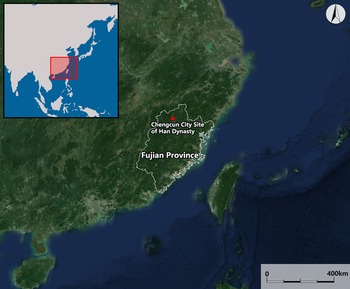
The Chengcun City Site of the Han Dynasty in Mount Wuyi, Fujian, has been excavated continuously since 1958, forming one of the longest-running archaeological field trajectories in southeastern China (Zhang Reference Zhang1985). As a major provincial excavation base and part of the Mount Wuyi World Heritage property (inscribed in 1999), the site operates within a stable yet evolving heritage framework (Figure 2). The Chengcun City Site is managed by a permanent, site-based institution under provincial-level heritage administration. Archaeological work at the site is primarily conducted through research-driven excavation projects organized as seasonal campaigns rather than continuous fieldwork. Funding is mainly derived from state-approved excavation projects authorized by the National Cultural Heritage Administration, supplemented by project-based research support, reflecting a typical operational model for large archaeological sites in China. Its long-term excavation history and institutional embedding have produced a layered labor structure that brings together professional archaeologists, skilled workers, seasonal laborers, university students, and heritage administrators within a single, continuous field setting.
Map of the location of the Chengcun City Site of the Han Dynasty (map prepared by the authors).

Figure 2 Long description
A map highlighting the Chengcun City Site of the Han Dynasty located in Fujian Province, China. The site is marked on the map with a label. An inset map in the top left corner shows the location of Fujian Province within a larger regional context, marked by a red rectangle. A scale bar at the bottom right indicates a distance of 400 kilometers.
Research Approach and Methods
Consistent with the practice-based theoretical framework outlined above, this study employs ethnographic methods to examine archaeological fieldwork as an ongoing social practice. The methodological design therefore focuses on documenting everyday interactions, labor organization, skill transmission, and institutional negotiation through which archaeological practice is enacted and reproduced.
Field Setting and the Researcher’s Positionality
Fieldwork was conducted in the Chengcun site area between 2020 and 2025. The research did not involve continuous residence; rather, we adopted a “semi-long-term ethnographic” strategy, scheduling field visits flexibly according to research needs. Each concentrated field stay lasted no fewer than 15 days, with the duration adjusted to specific project phases, for example, two months during the archaeological park application period and approximately half a month during the Spring Festival season. The research covered key temporal contexts, including the agricultural production cycle, excavation seasons, and major traditional festivals. Field visits were conducted regularly throughout each year of the research period, ensuring sustained temporal engagement across multiple excavation cycles.
On the excavation team, we took part in flotation, sampling, and feature recording, and assisted with daily coordination, which allowed close observation of the interactions among skilled workers, hired laborers, and archaeologists in task allocation, work rhythms, and the transmission of practical knowledge (Lucas Reference Lucas2012; Shanks and McGuire Reference Shanks and McGuire1996). Simultaneously, we worked as an interpreter within the heritage management office, participating in site narration, visitor reception, and community engagement. This dual role provided access to both trench-level labor organization and institutional decision-making (Bendix et al. Reference Bendix and Peselmann2012).
At the same time, institutional affiliation initially generated moments of hesitation and partial disclosure in interviews, particularly when conversations touched on tensions between official narratives and local experiences. Extending the duration of fieldwork over five years, however, allowed relationships with migrant laborers and skilled workers to develop beyond formal research settings. Sustained collaboration in daily work and social interaction created conditions in which more nuanced—and at times obliquely expressed—perspectives could emerge. Reflexive attention to these shifting relational dynamics informed both data interpretation and writing, prompting ongoing consideration of how positionality shaped not only access but also the framing of knowledge. Labor practice is understood here as a social space in which institutional roles and hierarchical distinctions are continuously negotiated, reproduced, and at times subtly reconfigured for all those involved, without presuming that differences in status have simply disappeared.
Data Collection: Interviews, Observation, and Documentary Sources
Participant observation focused on documenting concrete organizational practices through which labor hierarchies were enacted in daily work. Particular attention was paid to task allocation, supervision structures, wage distribution, skill training moments, safety responsibilities, and interactions during moments of conflict or decision-making. Observations were recorded in detailed fieldnotes immediately following work sessions and were used to trace how authority, expertise, and institutional recognition were differentially distributed across occupational strata.
This study draws on 22 semi-structured interviews and corresponding fieldnotes directly related to labor organization, skill differentiation, and institutional experience, which constitute a central component of the empirical material. A total of 16 participants were involved, six of whom were interviewed multiple times to enable longitudinal follow-up.
The interviewees included four skilled workers, nine hired laborers engaged in excavation work, one project director, and two heritage staff members affiliated with museum or heritage management institutions. Individual interviews averaged approximately 50 minutes in duration, with several in-depth interviews exceeding 90 minutes. These interview materials were embedded within sustained field immersion, daily workplace interactions, and systematically maintained field diaries throughout the research period. Informal conversations were documented in fieldnotes and used to contextualize and triangulate formal interview accounts. All interviews were conducted with informed consent, and identifying details have been anonymized to protect participant confidentiality.
The analysis involved cross-positional comparison across occupational roles within the excavation hierarchy. The interview guide was organized around three analytical dimensions: first, work trajectories and everyday practices, including pathways into archaeological labor and routine task organization; second, skill acquisition and knowledge transmission, focusing on processes of learning, embodied techniques, and perceptions of existing training arrangements; and third, labor perceptions and institutional experiences, addressing contractual conditions, remuneration, workplace risks, and perceptions of authority and decision-making (Table 1). In addition to field data, this study draws on site-specific archives, local documents, and institutional records to trace the evolution of archaeological practices and related policy shifts since 1958.
Interview Sample by Occupational Position and Employment Status.

Table 1 Long description
The table provides data on interview samples categorized by occupational position and employment status, highlighting the number of participants, gender distribution, and years of experience. Hired laborers have the highest number of participants at 9, with a gender distribution of 6 males and 3 females, and experience ranging from 2 to 7 years. Skilled workers, with 4 participants, have the longest experience range of 40 to 45 years and consist of 3 males and 1 female. The project director category has only 1 male participant with 15 years of experience. Heritage staff includes 2 male participants with experience ranging from 9 to 25 years. Employment status varies, with skilled workers on project-based terms, hired laborers on daily wages, and both project directors and heritage staff in institutional roles.
Analysis focused on recurring patterns related to work trajectories, skill acquisition, and institutional experience across both formal interviews and participant observation. Themes were developed through close reading of the material and comparison across occupational roles within the excavation hierarchy, without relying on predefined categories. Through this process, three distinct labor trajectories were identified, reflecting patterned differences in access to skills, employment stability, and decision-making authority.
Entry Opportunities and Local Social Networks
In China, archival records show that as early as 1935 the demand for archaeological labor had already reached 300 workers (Xia Reference Xia2011). A large-scale excavation model—characterized by a small number of archaeologists supervising a substantial local workforce—has continued to the present. When archaeological fieldwork enters a locality, the team must usually rebuild its labor force by combining veteran and newly recruited workers, most of whom are farmers from nearby villages (Hu Reference Hu1955). This structural arrangement—routine yet rarely examined analytically—forms the institutional backdrop against which local residents enter archaeological labor. It asks how villagers gain access to excavation work and how recruitment mechanisms, social networks, and livelihood calculations shape who is included (Murphy Reference Murphy2002). Entry is not merely a starting point of employment but a key moment in the production of labor stratification (Pun and Lu Reference Pun and Lu2010).
Villagers’ entry into archaeological work rarely occurs through formal recruitment channels. Instead, it is deeply embedded in local social structures organized around territoriality, kinship, and acquaintance networks—the classic characteristics of a “familiar-face society” (Chen and Xu Reference Chen and Qin2025; Fei et al. Reference Fei, Hamilton and Zheng1992; Yan Reference Yan2003). When an archaeological team arrives, the initial labor recruitment is typically coordinated by the village Party secretary or influential local intermediaries. Relying on their communication with the excavation team, their prestige within the village, and their cross-lineage mobilization capacities, they disseminate the information across existing social circles. This reliance on local networks has also been widely observed in many national-level development projects, infrastructure construction, and cultural heritage programs (Oakes Reference Oakes2005).
Drawing on field interviews conducted between 2020 and 2025, this study finds that many workers joined the excavation through relatives or acquaintances from the same village. For example, one newly recruited laborer was hired after being introduced to the site by his brother-in-law, an experienced worker on the excavation team (Participant A, 2022). Generational composition has also shifted significantly. Whereas excavation crews in earlier decades were composed largely of teenagers, contemporary participation in Chengcun is dominated by villagers over 50, as younger residents increasingly pursue migrant labor elsewhere. Entry into archaeological work is thus shaped by life-course position and mobility constraints. This recruitment logic produces what may be described as a “familiar-face enclave” within the excavation site. New workers bring not only physical labor but also a social structure that is trustworthy and easy to manage. In the relatively closed excavation project at Chengcun in 2023, all workers in the field were verified to be acquaintances from the same village.
Economic pragmatism remains the primary motivation for participation. For middle-aged and elderly villagers, excavation work offers predictable daily wages during agricultural slack seasons while allowing proximity to home and continued engagement in household responsibilities. Archaeological labor thus functions as a locally embedded strategy for managing livelihood risk. Younger villagers, by contrast, often treat the work as temporary or exploratory, reflecting different mobility aspirations and life-course expectations.
Initial expectations often diverge from the meticulous reality of excavation work. As one worker noted, “I thought we would immediately dig up treasures. But the first few days were all drawing grids and scraping the grass layer” (Participant B, 2022). This gap between imagination and routine labor marks the transition from outsider curiosity to structured participation. Over time, some workers reinterpret their participation as involvement in uncovering local history, expressing pride in bringing out ancestors’ objects. Others, however, articulate a strictly instrumental orientation toward the work. As one laborer stated, “I’m not interested in the stories behind the artifacts. I just work for the wage” (Participant C, 2024). These divergent orientations suggest that inclusion in archaeological practice does not produce a uniform sense of meaning among workers. Instead, participation is interpreted through different moral and practical frameworks, even as the division of labor remains largely unchanged.
Three Labor Trajectories: Typologies from Long-Term Participation
This section analyzes long-term participation in archaeological work at Chengcun through three distinct labor trajectories that have emerged over the past four decades. These trajectories are not anecdotal life stories but patterned outcomes of structured participation within the heritage regime.
The first trajectory reflects partial professionalization, in which sustained engagement in excavation enables certain laborers to accumulate technical expertise and assume the informal status of “technicians,” though without full institutional recognition. The second trajectory consists of seasonal circulation between agricultural production and archaeological employment, characterized by economic pragmatism and limited skill mobility. The third trajectory involves transition from site-based manual labor into positions within local cultural or heritage institutions, representing a rare but significant pathway of institutional incorporation.
Placing these three trajectories side by side helps reveal how the national heritage regime, when implemented locally, generates differentiated labor opportunities, structures of skill accumulation, and possibilities for social mobility. These trajectories are not merely personal choices; rather, they are the product of interactions among institutional openings, local social networks, emotional attachments to place, and pragmatic considerations (Bourdieu Reference Bourdieu1990; Kipnis Reference Kipnis2016; Zhang Reference Zhang2002).
From Early Laborers to “Technicians”: An Initiated Yet Unfinished Path of Professionalization
In the history of archaeological excavations in Chengcun, the earliest participating villagers formed the original “core labor group.” In the absence of a formal training system, they acquired operational skills through long-term collaborative work with archaeological teams, a process that may be understood as a form of local professionalization (Hamilakis Reference Hamilakis2014; Shanks and McGuire Reference Shanks and McGuire1996).
Participant D (2023) represents this generation. He recalled how small teams of villagers worked intensively alongside archaeologists, gradually mastering skills such as soil identification, drilling, and recognizing wuhua tu (mottled soil). Over time, these competencies differentiated them from ordinary wage laborers. Archaeologists reportedly intended to “take this group of local technicians out” to other sites for further development. As he described, with visible pride: “We worked on the palace city and the cemetery area. Back then, we were known as the ‘Eight Jingangs of Chengcun Archaeology.’”Footnote 1 Such narratives echo similar formations elsewhere in Chinese archaeology, where groups of locally trained workers—such as the “Ten Brothers” at Yinxu (Li and Li Reference Li and Li2019) or the “108 Generals” at Zhouyuan (Tang Reference Tang2005)—became semi-recognized technical cohorts within excavation systems.
Yet despite the real possibility of professionalization, the pathway did not fully materialize. The informant could have become a formal professional by being “taken out” to other sites but chose to remain in the village owing to family obligations, thereby missing the institutionalized channel for formal training. His skills continued to be mobilized—he was repeatedly invited back to “guide” during later excavations—but this remained an informal and noninstitutionalized form of professionalization. At the age of 30, he injured his leg during a survey in the mountains, sustaining a serious injury that required a long period of recovery. He emphasized that before the 1980s China lacked rural pension systems, and farmers relied entirely on “self-reliance” for security. He could only seek rudimentary treatment at the township clinic, because he could not afford a major hospital.
Unlike Participant D, Participant E (2023)—also among the first generation of excavation workers—successfully converted long-term field experience into formal institutional status. Through sustained participation in provincial excavation projects, he was incorporated into the state system in 2001 and moved beyond the rank of technician. Even after retirement, he continues to serve on excavation sites as a mentor and supervisor. His trajectory illustrates that professionalization was possible but highly selective (Figure 3).
The technician (Participant E), who began as a farmer, came to be regarded as “a highly respected senior excavation technician in Fujian archaeology” (photo courtesy of the Fujian Minyue State Capital Site Museum).

Figure 3 Long description
Two men are engaged in an archaeological excavation. They are kneeling on the ground, surrounded by scattered rocks and using tools to work on the site. One man is wearing a blue shirt and the other a dark shirt. Various tools are visible around them and a tarp is partially covering the area.
Existing scholarship similarly notes that archaeological labor can facilitate technical transformation through on-site training and selective cultivation of local workers. Existing studies document training classes designed to develop drilling, surveying, restoration, and soil-recognition skills, enabling some workers to circulate across excavation sites (Wang Reference Wang2021). Such training created pathways for increased mobility and participation in fieldwork (Xu Reference Xu2020).
Yet mobility and professional incorporation were not determined by technical competence alone. In rural contexts, labor decisions remained embedded in enduring family obligations and land attachment. As Participant D (2024) remarked, local custom dictates that one must “prepare a coffin from birth,” requiring a dedicated room within the household. Such practices reflect a deeply rooted orientation toward place and intergenerational responsibility. These obligations subtly constrained the capacity to detach from the village and pursue intersite mobility, thereby shaping who could convert field expertise into institutional status.
Seasonal Migrant Workers: Circulating between Agriculture and Archaeology
The second trajectory involves the largest, yet least visible, group: seasonal migrant workers who shift between agricultural tasks and archaeological excavation. Their movements follow the agricultural calendar, forming a typical “part-time farming, part-time wage labor” pattern. This arrangement endures because it aligns with rural life: wages are immediate, the worksite is nearby, and one can withdraw when the farming season begins. For many households, this flexibility provides an important and dependable addition to household income. As several respondents explained, they joined the excavations because they could “earn a little during the slow season,” “stay close to home,” or work in conditions perceived as “cleaner than jobs outside” (Figure 4).
A women’s work team participating in archaeological excavations during the agricultural off-season (photo courtesy of the Fujian Minyue State Capital Site Museum).

Figure 4 Long description
Five women are engaged in an archaeological excavation. They are spread across the site, each focused on digging and examining the ground. The site is uneven, with visible trenches and exposed earth. Some women are crouched down, while others are standing, using tools to assist in their work. The area is shaded by a canopy and a fan is positioned nearby, suggesting efforts to manage the heat. The women are wearing hats for sun protection and the site is surrounded by ropes and stakes marking the excavation boundaries.
Institutionally, this labor force forms the operational backbone of most excavations in China. Yet its high replaceability limits meaningful skill accumulation. Archaeological institutions tend to be reluctant to invest in training and instead rely on the constant availability of “usable labor.”
Seasonal trajectories in Chengcun are not uniform. For some, excavation is a short-term income buffer; for others, repeated participation cultivates familiarity with excavation routines, creating increasing dependence on excavation income and making it difficult to return to agriculture. The experience of Participant F (2022), a villager in his thirties, illustrates this shift. He began excavating in his early twenties merely to “earn some pocket money,” but as agricultural returns declined, he came to rely on the excavation as his main income. When fieldwork concluded in 2021, the contrast was stark: “A whole year of farming can’t match three months on the site,” he remarked.
Although still young, he hoped to secure a stable position within the heritage management office. However, he believed that his limited educational background and lack of examination credentials effectively barred him from entering a formal post. “People like us can’t pass those exams,” he explained. At the same time, income from excavation work had become increasingly insufficient to support his household expenses.
Faced with rising financial pressure, he eventually left for construction work in Africa with several fellow villagers, while his wife and child remained at home. He described the decision as “reluctant, but necessary.” His case illustrates a form of structural constraint: repeated participation in archaeological labor generates expectations of stability, yet formal incorporation depends on educational credentials and examination systems beyond the reach of many rural workers. When income from excavation and diminishing agricultural returns can no longer sustain family reproduction, outward migration becomes a compelled choice.
In archaeological practice in China, the uncertain meanings carried by such terms as “technician” or “entering the system” show how institutional categories remain unstable and are continually reinterpreted locally. Rural labor mobility is also shaped by nested village structures, where family obligations, place-based attachment, and low-cost social reproduction sustain a pattern of circular and seasonal mobility (Lu Reference Lu2007). This dynamic reflects broader patterns of project-based and loosely integrated labor in archaeological practice (Beck Reference Beck2021).
From the perspective of local labor structures, this circular movement reveals three features of archaeological labor in Chengcun. First, the seasonal character of excavation enables a “reversible mobility” between fieldwork and agriculture, but this mobility rarely leads to a cumulative professional trajectory. Second, as rural labor becomes increasingly mobile and aging accelerates, reliance on local workers has grown even stronger, yet institutional pathways for participation have not expanded accordingly. Third, villagers’ growing dependence on excavation income elevates the role of archaeological work within the local economy, leading to abrupt income gaps and heightened social pressure once excavations cease.
Transformers: Local Pathways from Archaeological Labor to Heritage Governance
The third trajectory involves a transition from site-based participation to positions within local heritage governance. Unlike technicians who advanced through accumulated field skills, individuals in this category entered archaeological work from relatively independent positions in village society—such as schoolteachers or locally appointed cadres—and gradually shifted toward administrative or cultural roles.
Participant G (2024) exemplifies this pathway. Born into a farming household, he later became a village schoolteacher and eventually a full-time heritage administrator. His involvement began peripherally—assisting archaeological teams with coordination, documentation, and communication—rather than through manual excavation. Over time, sustained interaction with archaeologists embedded him within heritage networks and reoriented his occupational trajectory. As he explained, long-standing pride in the village’s historical significance and repeated exposure to excavation work gradually deepened his commitment to heritage affairs.
This transition involves not only occupational change but also a restructuring of social identity. Such individuals embody the authority of the national heritage system while remaining deeply rooted in local society, where they continue to be regarded as “one of us.” Participant G (2024) repeatedly emphasized that “we have gone through the most chaotic periods,” and thus he was often the first to mediate unresolved disputes over land acquisition or conflicts involving outside actors. As he recounted: “Sometimes people block the road. Most of the time, I go persuade them first; if needed, I bring in the village cadres.” His position illustrates what Huang (Reference Huang2005) describes as the “dual identity” and “collaborative relationships” through which local elites navigate between the state and the village.
This case also points to a broader phenomenon: archaeological labor generates a new category of local cultural workers. Their life histories form the fine-grained textures through which heritage institutions take root at the local level. Through sustained participation in excavation, museum work, and site interpretation, they convert archaeological labor into community identity and cultural capital (Brito Reference Brito2024). Their practices constitute an ongoing site where state–local relations are renegotiated, materially and symbolically, through the everyday labor of heritage governance.
Institutional Implications of Labor Trajectories: Structural Constraints and Localized Coping Logics
Structural Limits of Localized and Seasonal Labor Systems
Long-term fieldwork at the Chengcun City Site reveals a set of structural tensions embedded in the organization of archaeological labor in contemporary China. These tensions are not reducible to local contingencies; rather, they emerge from the intersection of rural livelihood strategies, fragmented institutional arrangements, and a fieldwork regime structured around short-term, project-based employment (Bowlus and Sicular Reference Bowlus and Sicular2003; Knight and Song Reference Knight and Song2003). While such arrangements allow archaeological projects to synchronize with village temporalities and mobilize local participation efficiently, they simultaneously reproduce forms of labor precarity, uneven skill consolidation, and constrained professional horizons (Arendt Reference Arendt2013). The following discussion identifies several interrelated patterns that structure the everyday realities of field labor and shape the long-term trajectories of those who sustain archaeological practice on the ground.
At the level of everyday field operations, the first tension arises from the seasonal logic that governs the availability of fieldworkers. Agricultural schedules continue to define when villagers can or cannot join excavation teams. Labor is abundant in the late autumn and winter months, yet thins dramatically during spring plowing or when opportunities for short-term migrant work emerge. Archaeology thus remains, for many workers, a supplementary livelihood between farming and wage labor rather than a sustained occupation. As a result, the composition of work teams is continuously reconfigured, with individual workers rotating in and out across seasons instead of whole-team replacement. This pattern requires continual reinvestment in basic training and constrains the formation of a stable, technically mature workforce. Comparable issues have been noted in archaeological labor systems elsewhere—van Oeveren (Reference van Oeveren2025) discusses the precarious nature of “excavation laborers” in the Netherlands, while McGuire and Walker (Reference McGuire and Walker1999) highlight the difficulty of maintaining skilled field crews under intermittent employment conditions—but the effects are intensified in rural China, where land responsibilities, kinship expectations, and seasonal migration exert strong pressures on labor mobility. This cyclical instability situates archaeological labor within broader patterns of rural livelihood diversification, where households strategically oscillate between subsistence agriculture, migrant work, and temporary cultural employment.
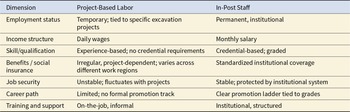
At the level of knowledge production, the second tension concerns the gap between skill acquisition and formal recognition. Many long-term fieldworkers at Chengcun have developed considerable technical competence, including in trench-cleaning, stratigraphic observation, artifact recovery, and site maintenance. Their expertise is widely acknowledged in practice: team leaders often rely on them to stabilize daily operations, resolve subtle stratigraphic situations, or handle fragile materials. Yet this accumulated knowledge rarely translates into institutional status or a recognizable professional identity. The absence of a credentialing system or clear advancement pathway is reflected in a recurring sentiment across interviews: “I can do this, but this is all I can do.” As scholars have argued, field labor often operates through embodied knowledge that is essential and yet undervalued within formal archaeological hierarchies. In the Chinese context, this misalignment between practical competence and institutional visibility turns experienced fieldworkers into a highly relied on yet structurally marginal group (Table 2; Edgeworth Reference Edgeworth2006).
Structural Differences between Project-Based Labor and In-Post Staff.

Table 2 Long description
The table compares project-based labor and in-post staff across various employment dimensions. Project-based labor is characterized by temporary employment tied to specific projects, daily wages, and irregular benefits, leading to unstable job security and limited career advancement. In contrast, in-post staff enjoy permanent positions with monthly salaries, standardized benefits, and stable job security, supported by a clear promotion ladder. Training for project-based labor is informal and on-the-job, whereas in-post staff receive structured institutional training. These differences highlight the disparity in job stability, income, and career development opportunities between the two groups.
At the institutional level, the third tension emerges from the structural gap between two distinct logics of valuation within Chinese archaeology. On excavation sites like Chengcun, workers gain recognition through demonstrated competence—the ability to read stratigraphy, to identify subtle features, to handle finds with care—skills accumulated through years of hands-on practice. Yet when opportunities arise for stable employment in heritage parks or cultural institutions, entry is governed by credential-based criteria: educational qualifications, formal examinations, graded titles. As a result, many local workers who have developed deep familiarity with a site through years of excavation find themselves with no clear place within the heritage sector they have helped sustain (Mickel Reference Mickel2021).
A further complication stems from the temporal gap between national policy mandates and local institutional implementation. Even after the establishment of the heritage park at Chengcun, by the third year following its designation as a National Archaeological Site Park the number of formally established institutional positions had not increased. This “institutional lag,” common across large-site management in China, produces prolonged uncertainty for workers, who move between excavation projects, temporary park work, and agricultural labor without clear expectations regarding long-term prospects. The result is a labor system that remains structurally fragile even when substantial public investment is directed toward heritage development. Comparable mismatches between national heritage regimes and local execution have been analyzed in studies of Chinese heritage governance more broadly (Li et al. Reference Li, Krishnamurthy, Roders and van Wesemael2020), underscoring the systemic nature of such gaps. According to a field director, the high turnover rate among workers rendered the purchase of individual insurance practically impossible, and archaeological site insurance was not offered by any insurer.
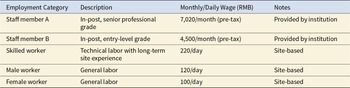
The materialization of this dual structure is evident in wage differentiation. According to publicly available information from an archaeological management unit in China in 2021 (Table 3), formally appointed staff received stable monthly salaries under the institutional payroll system, whereas site-based workers were remunerated on a daily basis, with additional stratification by skill level and gender. Rather than reflecting purely technical distinctions, this income hierarchy mirrors the broader segmentation between authorized positions and project-based labor.
Comparative Wage Levels by Employment Category (2021).

Table 3 Long description
The table compares wage levels across different employment categories in 2021, showing significant disparities. Senior professionals earn 7,020 RMB per month, while entry-level staff earn 4,500 RMB monthly. Skilled workers receive 220 RMB daily, whereas male and female general laborers earn 120 and 100 RMB per day, respectively. The data indicates higher wages for in-post staff compared to site-based workers, with a notable gender wage gap among general laborers. These figures reflect pre-tax earnings and are institution or site-based, suggesting potential variations in net income.
Across these domains—seasonal labor rhythms, incomplete professionalization, informal arrangements, and implementation delays—a structural pattern becomes evident. Field archaeology depends on the accumulated expertise of rural technicians, yet the fiscal and staffing architecture of heritage governance provides limited mechanisms to stabilize or formally recognize their participation. This segmentation is not incidental but institutionally reproduced.
Reworking Structure from Within: Stabilization and the Making of Labor Continuity
Informal Stabilization in Project-Based Work
Project-based archaeological work unfolds within administrative and fiscal parameters that do not always align with the temporal and social realities of field operations. In remote areas such as Chengcun, where excavation workers are predominantly older rural residents embedded in dense acquaintance networks, labor relations are shaped as much by familiarity and long-term cooperation as by formal contracts.
When a worker was injured on-site, for example, financial assistance was provided privately by the team leader rather than through project funds. This response did not simply reflect procedural restriction: it was embedded in a moral economy of collaboration in which personal responsibility and reputational considerations carried weight. Similarly, under the current funding regime—where special-purpose allocations often arrive in the latter half of the fiscal year—project expenditures for the first half must frequently be managed in advance. Excavation schedules are further interrupted by agricultural obligations such as tea harvesting and rice transplantation, which draw workers back to village production at critical moments.
Project leaders rely on flexible coordination to maintain continuity without suspending operations. Core workers whose livelihoods combine agriculture and archaeology may be temporarily reassigned to maintenance, cleaning, or contracted agricultural tasks within the heritage park during idle periods. Interviews with team leaders from other regions consistently emphasized concerns not about wage sufficiency—given the broader policy support for heritage work—but about worker belonging, safety protocols, confidentiality responsibilities, and the absence of stable accident insurance coverage.
These practices do not dissolve institutional segmentation. Instead, they illuminate the practical spaces in which it is negotiated. The reliance on personal advances, informal task reallocation, and discretionary coordination indicates that certain dimensions of risk management and worker protection remain weakly routinized at the project level. Such patterns become visible not in formal regulations but in the everyday adjustments through which projects are kept operational.
Labor Continuity and the Gradual Narrowing of Mobility
If localized adjustments enable short-term stabilization, labor continuity over time follows a cumulative logic (Lave and Wenger Reference Lave and Wenger1991). Many rural technicians participate intermittently in excavation projects over multiple years, moving between seasonal agricultural production and site-based employment. One female worker, for example, joined three excavation campaigns over three consecutive years, primarily undertaking feature cleaning. One project took place in early June, while two were conducted in the latter half of the year. During the spring months from March to May, when tea harvesting and rice transplantation structured village labor demands, she returned to agricultural work. In the second half of each year, she proactively contacted the local heritage management office to inquire about new projects. During intervals without excavation, she also participated in site park environmental remediation and short-term landscaping work for the site museum.
Through this circulation between trench work, farming, and auxiliary heritage tasks, excavation gradually became a recurring yet bounded component of her livelihood. Although technical familiarity accumulated across campaigns, the recognition of these competencies remained largely project-bound and discretionary, with limited channels for conversion into stable professional status. What appears as flexible supplementary employment thus solidifies into a patterned trajectory in which repeated participation deepens skill while leaving mobility prospects comparatively narrow.
Workers often describe their situation in pragmatic terms—“Well, this is how it goes”—suggesting an awareness of both accumulated experience and constrained horizons. Over time, expectations adjust to this segmented structure. Excavation work becomes a recurrent but bounded domain of participation: a source of income and practical identity, yet seldom a pathway to stable status within the formal heritage apparatus.
Segmentation is thus consolidated not only through administrative categories but through repetition. Season after season, project after project, the circulation between village fields and archaeological trenches stabilizes a layered labor order. By tracing these trajectories ethnographically, the analysis reveals how institutional design, fiscal timing, and local moral obligations intersect in ways that are rarely visible in policy frameworks alone. The segmented system persists not simply because it is mandated but because it is continuously enacted and accommodated in practice.
These dynamics are rooted in the specific institutional configuration of China’s state-administered heritage system, where credential hierarchies, project-based financing, and localized recruitment intersect. At the same time, the tensions identified here—between formal qualification and embodied expertise, between recurrent participation and limited upward mobility—extend beyond this particular setting. Similar frictions have been observed in other project-based archaeological systems, where field labor remains indispensable yet unevenly recognized within professional structures (Everill Reference Everill2009; Schlanger and Aitchison Reference Schlanger and Aitchison2010). Tracing labor trajectories over time makes visible how inclusion in fieldwork does not necessarily translate into structural incorporation, echoing critiques of the uneven recognition of field labor within the discipline (Mickel Reference Mickel2021). In comparative perspective, these dynamics also resonate with long-standing discussions of the divide between manual excavation and interpretive authority (Berggren and Hodder Reference Berggren and Hodder2003). In this sense, the Chengcun case underscores the institutional constraints that shape participatory practice, suggesting that practical expertise may remain project-bound when channels of formal recognition are limited.
Recent policy developments have begun to address some of these structural constraints. The introduction of occupational standards for excavation workers in 2024, along with formalized systems of skill evaluation and certification, establishes a graded pathway linking work experience, credentialing, and potential advancement. In principle, this framework creates opportunities for upward mobility and even limited integration with professional technical personnel.
However, the effectiveness of these reforms in practice remains uncertain. The certification system presupposes sustained participation, cumulative experience, and access to formal credentials. By contrast, the labor trajectories documented in this study are characterized by seasonal intermittency, project-based engagement, and reliance on embodied rather than formally accredited skills. As a result, while institutional pathways for advancement are being established, the extent to which rural excavation workers can realistically access and navigate these pathways remains constrained by existing patterns of labor organization and livelihood strategies.
Conclusion
By examining long-term participation in archaeological fieldwork at the Chengcun City Site of the Han Dynasty, this study approaches labor as a constitutive dimension through which archaeological practice is organized. Tracing entry mechanisms, everyday work arrangements, and divergent labor trajectories demonstrates that archaeology operates through historically formed relations of recruitment, skill transmission, and institutional differentiation, not solely through technical procedures.
The three labor trajectories identified in Chengcun demonstrate that participation in archaeology unfolds within a segmented system shaped simultaneously by rural livelihood strategies and state-led heritage governance. While some workers accumulate substantial technical expertise through prolonged engagement, access to institutional recognition, employment stability, and professional mobility remains uneven. Professionalization thus emerges not as a linear transition from manual labor to expertise, but as a contingent outcome produced at the intersection of family obligations, educational credentialing, project-based funding, and localized opportunity structures.
Viewed from the perspective of labor, archaeological knowledge production is inseparable from the social organization of work. Skills essential to excavation—such as stratigraphic interpretation, feature stabilization, and material handling—are often embodied, collectively learned, and sustained through long-term collaboration, yet remain only partially visible within formal disciplinary hierarchies. The persistence of project-based employment and seasonal participation reproduces a structural distinction between those who generate field knowledge and those formally authorized to represent it.
The Chinese case makes these dynamics particularly visible. Long-term reliance on locally recruited rural labor within a strongly institutionalized heritage system exposes the gap between national heritage expansion and the limited incorporation of site-based workers into stable professional frameworks. Chengcun illustrates a broader pattern in which large-scale archaeological practice globally relies on localized labor regimes whose contributions remain unevenly recognized.
Reconsidering archaeology through labor thus shifts analytical attention from institutions alone to the everyday practices through which authority, expertise, and heritage governance are materially enacted. Seen from the trench rather than the administrative structure, archaeology emerges not simply as scientific investigation but as an ongoing negotiation of work, belonging, and institutional participation sustained through the lives and labor of those who make excavation possible.
Acknowledgments
We are grateful to the local workers and technicians at the excavation sites whose participation made this research possible, and to the Minyue State Capital Site Museum for its long-term support. Particular thanks are due to Lu Lieyan of the Chongqing Cultural Relics and Archaeology Research Institute for his assistance during the writing process. We further thank the editor and three anonymous reviewers for their constructive comments and valuable suggestions. No permit was required for this research. The authors used DeepSeek-V3 for Spanish-language editing of the abstract.
Funding Statement
This research was partially supported by the Xiamen University Fieldwork Foundation (2020GF001).
Data Availability Statement
The data supporting the findings of this study consist of fieldnotes and interview materials collected during archaeological fieldwork. Due to privacy and ethical considerations, these materials are not publicly available but may be obtained from the corresponding authors upon reasonable request.
Competing Interests
The authors declare no competing interests.




 Open access

