

Cultural resource management (CRM) was born out of multiple legislative changes in the 1960s and 1970s concerning environmental and cultural resources and became a bona fide industry in the 1980s (Green and Doershuk Reference Green and Doershuk1998; Tainter Reference Tainter and Bintliff2006). Most pertinent to CRM in the United States, the National Historic Preservation Act (NHPA) was enacted in 1966 to provide guidance and requirements for archaeological and historical sites and objects (ACHP 2014). Section 106 of the law requires that federal agencies overseeing projects that may affect cultural resources consider the effects of their actions on historic properties before proceeding with any project using federal funds or permitting or that is conducted on federal lands (King Reference King2004). In the beginning, many of these federal projects were conducted by universities, but as the industry grew in the late 1970s and early 1980s, many independent CRM firms were created (Green and Doershuk Reference Green and Doershuk1998; King Reference King2020:5). Currently, these firms conduct most of the CRM projects in the United States, and CRM accounts for an estimated 80%–90% of the paid positions in archaeology (Green and Doershuk Reference Green and Doershuk1998; Milanich Reference Milanich1982; Sebastian Reference Sebastian, Sebastian and Lipe2009; Zeder Reference Zeder1997).
As more firms were created, the competition between firms to win Section 106 projects increased, and intermittent economic growth and decline over the last 50 years have led to ebbs and flows in available CRM work, especially for entry-level field technicians. Historically, field technicians have been hired as contractors on a project-to-project basis, meaning that there are rarely opportunities for permanent, full-time employment (although this has been slowly changing in the last two decades). At times, getting any work at all can be difficult. After finishing my master’s program in 2009, for example, I was planning to work in CRM for a few years before pursuing a PhD. Unfortunately, it was in the middle of an economic recession, and I applied to more than 100 positions before ever getting an interview. I remember sending in my application for a field technician position and immediately getting an email reply stating something to this effect: “Thank you for your application. We have received over 300 applications for only four positions, and we selected the first four qualified applicants.” Thankfully, times are much better now for field technicians: there are currently more open positions than qualified applicants in the United States.
These ebbs and flows have intermittently fueled the two-pronged competitive nature of CRM wherein (1) firms are competing for limited projects and (2) technicians are competing for limited positions. Both have had considerable influence on the culture of CRM. The competition for projects has routinely forced many firms to take a “low-ball” approach to bidding on projects, which then resulted in underfunded projects with very restricted deadlines. As the industry became more competitive over the years, firms accepted increasingly less funding to do the same (or a greater) amount of work. It is no secret that “funding agencies and land managers always prefer CRM programs that are as inexpensive as possible” (Tainter Reference Tainter and Bintliff2006:448).
As a result, technicians have often been underpaid and overworked so that projects could be completed within scope and budget. For example, Green and Doershuk (Reference Green and Doershuk1998:138) call out two such examples of overwork: in one case, a single field technician reportedly excavated, screened, and recorded 100 shovel tests per day; in another case, a crew of four people managed to complete a staggering 5,824 shovel tests in 19 days, amounting to approximately 77 shovel tests per day per person. Moreover, having more technicians than available jobs made technicians disposable and easily replaceable, often leading to abuse (Fitting Reference Fitting and Green1984; Garrow Reference Garrow1993; Green and Doershuk Reference Green and Doershuk1998; McGuire Reference McGuire, Osborn and Hassler1987). These and numerous other examples demonstrate some of the unhealthy, and frankly toxic, working conditions that generations of technicians have dealt with just to stay gainfully employed.
Although this was a harsh reality of our field for many decades, thankfully, change has been well underway for some time. Some CRM firms now have protocols in place to protect their staff from unhealthy situations both in the office and in the field. In addition, the CRM market has been relatively steady since the end of the 2007–2009 recession in the United States, which has decreased the field’s hypercompetitive nature (though firms are now competing for qualified staff).
Fortunately, the CRM industry is currently booming, and this is not anticipated to change over the next decade (Altschul and Klein Reference Altschul and Klein2022; Crowley Reference Crowley2025; White Reference White2025). In 2022, Altschul and Klein forecasted that, with the introduction of the Infrastructure Bill, there would be an increase of $1 billion in CRM activities in the United States, leading to 8,000 new archaeological jobs in CRM. Even with the federal cuts and changes to legislation since February 2025, implementation of the Infrastructure Bill remains firmly in place, and CRM work has not slowed down significantly (Airlie House Revisited Workforce Training Working Group 2025; Crowley Reference Crowley2025, White Reference White2025). As such, the outlook for CRM jobs over the next 5–10 years is consistent with the forecast of Altschul and Klein (Reference Altschul and Klein2022). Now more than ever, when qualified archaeologists are in the position to be more selective about which companies they work for, CRM firms need to demonstrate that they value the people over the work if they want to successfully recruit and retain qualified staff.
The attitude and behaviors of leadership can have a profound effect on the overall atmosphere and feeling of the workplace. I was extremely fortunate to have arrived as the lab director at Augustana University Archaeology Lab (Augustana), which already had an excellent staff of four people who were hardworking and inclusive: they welcomed me and my ideas wholeheartedly. There had been a long history, however, of less inclusive and welcoming practices at the lab that had left a lingering, palpable feeling of discomfort and uncertainty. Because of that, I felt a certain uneasiness from some of the staff when I arrived, and I tried my best to immediately alleviate their concerns. One way I did this was by asking for individual meetings with staff to ascertain what the biggest needs were for the lab. Most of these meetings resulted in requests for updated equipment, but some staff members requested greater transparency and clearer expectations from leadership, as well as increased leadership and professional development opportunities.
What follows is a case study, based on my personal experiences, demonstrating how I worked with my staff to implement a shift in culture at Augustana by leading by example, setting clear expectations and protocols, and creating professional development and leadership opportunities for staff, all of which resulted from a people-centered mindset. These protocols are not only applicable to small university or CRM settings but may be implemented at multiple scales across the field.
Leading Change from within the Lab: A Case Study
Augustana was established in 1982 as a CRM firm and research institution. Since that time, it became a regional leader in archaeological research and was well respected in the CRM community within the Northeastern Plains long before I arrived on the scene. Even so, the lab had an unfortunate history (as do many such archaeological institutions) of not putting people first, which led to an almost complete lack of protocols, clear expectations, or regulation within the lab. For example, there were no written protocols that dictated what benchmarks a staff member needed to meet to move to the next professional level. What that next professional level looked like was also unclear. As such, solidifying people-centered policies and protocols was my top priority when I arrived.
I served as the director of the lab from 2023 to 2025, and these two years were some of the most personally and professionally gratifying of my 20-year career in archaeology. This is due almost completely to the staff and students I worked with while there. Before we proceed, I want to make it clear that, although I was directing the lab, I can in no way take full responsibility for the positive changes instituted during my tenure. This was, in every way, a collaborative effort that could not have succeeded without like-minded colleagues and students who also had a vision for a healthy, safe, and happy working environment.
During my time at Augustana, approximately 90% of CRM contracts were direct, noncompetitive offers from engineering firms and federal agencies within the states of South Dakota, Minnesota, Iowa, and Nebraska; we occasionally won contracts in Kansas as well. As such, most of our projects did not require bids or formal proposals. Further, the university only provided funding for lab staff who also taught classes (there were two of us), amounting to between 5% and 7% of our annual budget. All other expenses, including employee benefits (health insurance, retirement funds, etc.), were paid for from revenue earned through lab contracts. We employed between four and seven full-time archaeologists over that two-year period, along with four seasonal and part-time staff. Many part-time staff members were recently graduated Augustana students looking for some experience before entering the workforce or applying for graduate school. In addition, students were hired as interns to complete fieldwork each summer and to assist with other lab duties throughout the academic year. Our summers were incredibly busy, but work was also consistent during the winter months (when we could not do fieldwork).
Field technicians comprise the majority of CRM practitioners, because they are the ones completing most of the archaeology fieldwork. Traditionally, the life of a field technician has been very transient, with most projects happening away from home for long periods of time. In fact, a survey of field technicians conducted in the early 2000s revealed that 70% did not have a permanent home when not on the road for field projects (Berggren and Hodder Reference Berggren and Hodder2003:423). This can lead to burnout and cause people to leave the field altogether. Part of our success with maintaining work–life balance was due to the fact that most of our contracts were small, usually requiring less than a week of fieldwork to complete, and much of the work was local, so staying in hotels away from home was kept to a minimum. This structure facilitated greater work–life balance within the lab than many employees of larger firms are afforded during the busy field season.
Establishing People-Centered Protocols
Research has demonstrated that creating and maintaining healthy working environments improves not only the overall atmosphere of the workplace but also employee morale, creativity, productivity, and efficiency (Arifin Reference Arifin2024; Plas and Lewis Reference Plas and Lewis2000). Even though protocols should be in place that support the entire team, individual needs, such as health-related work modifications or parenting or caregiving responsibilities, should also be considered and accommodated whenever possible. I agree with Plas and Lewis (Reference Plas and Lewis2000:36) who state that “in a person-centered organization, attention to the team is not considered more important than attention to individual effort and well-being.” Keeping this in mind is essential not only to retaining excellent employees but also to ensuring excellence in work outputs and deliverables. As such, I focused on creating formal and informal people-centered protocols relating to safety, work–life balance, and lab and field culture. It was also imperative that my expectations were clear and transparent to eliminate confusion.
Safety has multiple meanings in archaeological research. First, it includes field and lab work practices that prevent bodily harm or deterioration in physical health. Second, it should inhibit threats to the employee’s mental and emotional health. Both have historically been problematic in archaeology (Clements Reference Clements2021; Cross Reference Cross and Insoll2007; Farrell-Banks Reference Farrell-Banks2018; Heath-Stout and Kinkopf Reference Heath-Stout and Kinkopf2022; Langley and Abbott Reference Langley and Abbott2000; Wilkie Reference Wilkie2023), whereas the second can become detrimental to all archaeological professionals laboring in toxic or unsafe working conditions.
When I began as lab director in February 2023, I was surprised to find that there were no policies or protocols in place: there was no sexual harassment policy (outside the university-wide policy), and no safety policies for either the field or lab. I immediately began working with the Title IX office to create a sexual harassment policy that reinforced the university’s policy while including archaeology-specific language. Sexual harassment has been a significant problem in archaeology (and many other field-based disciplines) and has only recently gained widespread attention (Bradford and Crema Reference Bradford and Crema2022; Cobb and Hawkins Reference Cobb and Hawkins2025; Coltofean-Arizancu Reference Coltofean-Arizancu, Gaydarska, Plutniak, Mary, Hlad, Algrain and Pasquini2023; Coto-Sarmiento et al. Reference Coto-Sarmiento, Pérez, Yubero Gómez, Gutiérrez, Cobb and Hawkins2025; Martinez et al. Reference Martinez, Coto-Sarmiento, Anés, López Martínez, Pérez, Yubero Gómez, Pritchard and Edwards2023; Meyers et al. Reference Meyers, Horton, Boudreaux, Carmody, Wright and Dekle2018; Muckle Reference Muckle2014; Radde Reference Radde2018; VanDerwarker Reference VanDerwarker and Gellar2025; Voss Reference Voss2021a, Reference Voss2021b; Wade Reference Wade2020). To support our efforts to promote and maintain a safe workplace for everyone, I also organized a yearly sexual harassment training with the Title IX office that was tailored to archaeological field and lab situations. My goal was to make it immediately clear that any form of harassment, sexual or otherwise, was unacceptable from staff, students, or volunteers working at the lab, all of whom were required to sign the policy before beginning work there. Because sexual harassment has also been a serious issue in archaeological field schools (Bradford and Crema Reference Bradford and Crema2022; Colaninno et al. Reference Colaninno, Lambert, Beahm and Drexler2020, Reference Colaninno, Beahm, Drexler, Lambert and Sturdevant2021; Emerson Reference Emerson2021; Lambert and Colaninno Reference Lambert and Colaninno2023; Wade Reference Wade2020), I required my field school students to sign this policy. Over the next two years, I also worked with lab staff to create a safety manual for both field and lab work: the staff were the primary authors of this document.
Leading by Example
There is little point in establishing people-centric protocols unless leadership is also going to abide by them. As such, “practice what you preach” is the motto I tried to live by as director. I did not expect my staff to complete more work than I did nor to work in a manner that was not also expected of me. For example, as a parent, I often needed to leave the office early to pick my young children up from school, and on those days, I usually finished my workday at home. Working from home was also a courtesy that I allowed my staff to do as needed (for reasons related to illness, weather, caregiving, etc.), and I found that this policy was very rarely abused. This policy is also important for people with chronic illnesses or disabilities because it limits commute time, excessive noise, and distractions, allowing for a comfortable work environment. In that same vein, I encouraged my staff to use their vacation and sick time as needed (according to Augustana policies). I never required that they tell me what they were using that time for. All I required was that they notify me in sufficient time in advance whenever possible (though with sudden illnesses, of course, this is not possible), so that we could schedule field projects accordingly. My philosophy is that they earned that time, so it is theirs to do with as they wish.
In my experience, one of the most important components of leading by example is not to expect perfection from everyone all the time, unless you as a leader can also always be perfect. People are not mechanical. We are sentient and flawed, and every single one of us is guaranteed to make a mistake (or two, if we are talking about me). Instead, expect ethical, well-researched, and complete work. Further, instead of taking a top-down approach wherein staff are reviewed by leadership but not vice versa, have other staff review your own work as a leader as well. This not only builds confidence in your staff’s abilities but also builds their confidence in your workmanship—and as a leader, you are more than likely to learn a few skills from your staff. For example, I always asked my associate director to review my reports and many of my proposals. This person is a far more skilled technical writer and editor than I am, and I am not ashamed to admit that. In another instance, I was in the field with a junior staff archaeologist who showed me how to use a hand auger for the first time. Just because you oversee a group of people does not mean that you should assume that you are more skilled than they are at all the tasks you may complete. I have learned a great deal from junior staff (and even students) over the years, but that learning cannot happen if leadership is not open to that kind of exchange. Basically, there is absolutely zero room for ego if you want to be an effective and respected leader.
Importance of Professional Development
CRM firms have historically struggled with providing professional development opportunities for their staff, primarily because of the budgetary constraints of archaeological contracts. Fortunately, there has also been a significant shift in this mentality in recent years, with many CRM practitioners presenting not only at regional and CRM-focused conferences (such as the American Cultural Resources Association [ACRA]) but also at national conferences, such as the Society for American Archaeology (SAA). These opportunities are important for bridging the arbitrary divide that has long existed between so-called academic archaeology and CRM: it also allows for greater collaboration between archaeologists from these two sectors.
From my own experience and anecdotally, I have learned that an increasing number of CRM firms are also providing more training opportunities for their staff and opportunities to complete or participate in independent research projects (though I believe there is still a great deal of work to be done in that regard). In doing so, staff feel more valued, especially in CRM where field technicians in particular can sometimes feel like they are little more than hired labor (Berggren and Hodder Reference Berggren and Hodder2003). Training can also help staff advance into more specialized positions, which is a significant benefit to the firm itself.
When I arrived at Augustana, there were no such opportunities in place. The university had provided all university staff with a professional development fund when I arrived in 2023, but due to budgetary issues, this fund was eliminated in 2024. Even when funding was available, the requirements were fairly restrictive, making it difficult for archaeology staff to obtain grants for meaningful professional development opportunities. To compensate for this, I implemented a professional development fund that allotted a certain dollar amount for each staff member (regardless of rank) that they could use each fiscal year on any activity, equipment, or supplies that would benefit them as a practitioner of archaeology. This funding was taken out of the revenue that the lab brought in each year (and thus not supplied by the university) and amounted to approximately 2% of the annual budget. To compensate for this and other costs, such as new equipment and outreach activities, we increased our lab rates by approximately 5% each year. Because lab rates were quite low when I arrived and had not been raised for many years, these increases did not negatively affect the amount of work we brought in each year. I realize, however, that this may not be the case for every CRM/archaeological firm; as such, this should be approached on a case-by-case basis.
Because staff members had varied professional interests, this funding could be used for anything from purchasing books and equipment to attending conferences or technical training. They could also use this fund to buy out time to work on publications or research projects that are not funded through our CRM contracts. In addition, staff had the option to donate any unused professional development funds to other staff members who might need extra funding in any given year. Staff used these funds in a variety of creative ways. In 2024, one staff member used a portion of their funds to purchase an annual membership to Coursera so that they could take courses in Excel and other programs that would increase their skills and add to the efficiency of our workflows. In 2025, another staff member used their funds to attend a week-long geophysical training to increase not only their personal understanding of these methods but also potential services that could be offered to clients. In both instances, the training also benefited the lab by expanding our pool of skillsets, services, and potential clientele. If the amount of funding needed exceeded the annual professional development allotment (which was occasionally the case for conferences and other travel-related professional development), staff could use vacation time to cover their salaries.
In addition, new staff who had limited engagement or experience with Section 106 were required to participate in a remote Section 106 training. The costs for this training were paid for by the lab and did not decrease the individual professional development allotment for those staff members. Further, staff sometimes had the opportunity to attend local conferences without having to dip into their professional development fund. For example, in 2023, Augustana volunteered to assist with managing the Plains Anthropological Conference in Rapid City, South Dakota. All staff members were allowed to go as long as they volunteered in some capacity, and all travel expenses were paid.
Providing professional development funding for staff is not only beneficial to individual staff members but also provides time and space for positive interactions between members of your institution and outside researchers or institutions, which both increase the recognition (and potentially, the reputation) of your institution and allow for networking that can lead to additional collaborations or archaeological contracts. In many ways, getting your staff out into the world and interacting with archaeologists from other institutions can be financially beneficial to your institution.
Proof of Progress
Although much of this case study has been anecdotal and experience-based, we do have metrics to support the assertion that, along with other factors such as large projects and increased lab rates, implementing these changes contributed to more positive staff experiences, an increased workload, and increased productivity for the lab. These data include qualitative data from exit interviews and quantitative data from yearly revenue and hiring. This article is primarily reflective because I did not collect direct quantitative data for this study during my time at Augustana.
Exit Interviews and Annual Performance Reviews
Between 2023 and 2025, two full-time employees and two part-time employees left the lab for other opportunities, including graduate school and other employment. I developed an exit interview to gather feedback from employees to determine whether any problems led to their exit and to assess any patterns of negative feedback that might have been given. This data would be used to continue to improve lab policies, protocols, and the working environment. I personally administered this exit interview to three of the four staff members who left the lab during my tenure. Although I asked several questions, the one at the heart of this case study is, “How would you describe the work environment at the Archaeology Lab?” In all three cases, former employees described having experienced an overall positive working environment, stating that they felt open to share their opinions and suggestions and that the lab was a “fun” place to work. One employee had worked at the lab before my arrival and suggested that they now felt comfortable bringing concerns forward because they felt confident that they would be addressed; that was because I had implemented a feeling of safety and had demonstrated that I was genuinely interested not only in the lab’s success but also in the success and happiness of each and every staff member.
Perhaps more importantly, all three staff members addressed areas for improvement, especially where fieldwork was concerned. This was especially important for me to hear: because I rarely completed fieldwork with the staff, many of these issues were not ones I would have been aware of had they not been brought to my attention. For example, several staff members suggested that it was not always clear who would be doing what tasks for a given project (e.g., preparing maps for fieldwork, collecting and organizing needed equipment, etc.). To alleviate this, we implemented a set of standard operating procedures that outlined what tasks the Principal Investigator was responsible for and how those tasks should be delegated to junior staff. I admit that all three of these staff members had developed an excellent rapport with me, which may have had an unintended positive effect on the exit interviews. Yet, I assured them that their confidentiality would be protected, which I believe contributed to their honest responses. For example, I did not include staff members’ names on their exit interviews, and when any information was shared with other senior staff (such as the department chair), it was done anonymously. Again, having open dialogue while working with these staff and creating an atmosphere of safety also would have contributed to these staff members feeling comfortable to share their honest responses.
Finally, Augustana University had implemented standardized yearly performance reviews before my arrival at Augustana, so lab staff were already familiar with these. After individuals were hired, they were given their first performance review three months after their start date. At that point, I worked with each staff member to set individualized goals for the remainder of the year. These goals were highly dependent on the experience of each staff member and their specific career goals. For example, one staff member who was very new to CRM but had extensive archaeological experience in academia had a goal to become proficient in Section 106 legislation and report writing. Another staff member who had experience in CRM but wanted to expand their research portfolio set a goal to write and submit one peer-reviewed manuscript (supported by professional development funds).
Pathways to Promotion
When I arrived at the lab, there was no job ladder that described what different positions were attainable at the lab or what steps were necessary for promotion. From speaking with longtime staff, promotion was done on an ad hoc basis in the past. I immediately began creating job descriptions and steps, along with benchmarks for each. For example, instead of having only one “Staff Archaeologist” position, I created Staff Archaeologist 1, 2, and 3 positions. In general, a Staff Archaeologist’s primary role is to complete fieldwork, write small reports or sections of larger reports, and to communicate with landowners and members of the public. The responsibilities of a Staff Archaeologist would now vary based on whether they were at the 1, 2, or 3 level. A Staff Archaeologist 1 was an entry-level position appropriate for a staff member who has recently been granted their undergraduate degree and has limited field experience. A Staff Archaeologist 2, however, would have 6–12 months of experience in CRM and would be capable of leading small projects. Finally, a Staff Archaeologist 3 was capable of leading small- to medium-sized projects and working completely independently. In short, they would have all the requirements needed to be a Senior Archaeologist I without the advanced degree to do so. Experience and degree requirements were outlined for each job step. I also worked with the university administration to create a pay scale, increasing with each step. In this way, promotion possibilities were much clearer, and goals could be incorporated into yearly reviews that would move a staff member toward promotion. In addition, having clear job descriptions and steps increased transparency in the hiring process.
Yearly Revenue
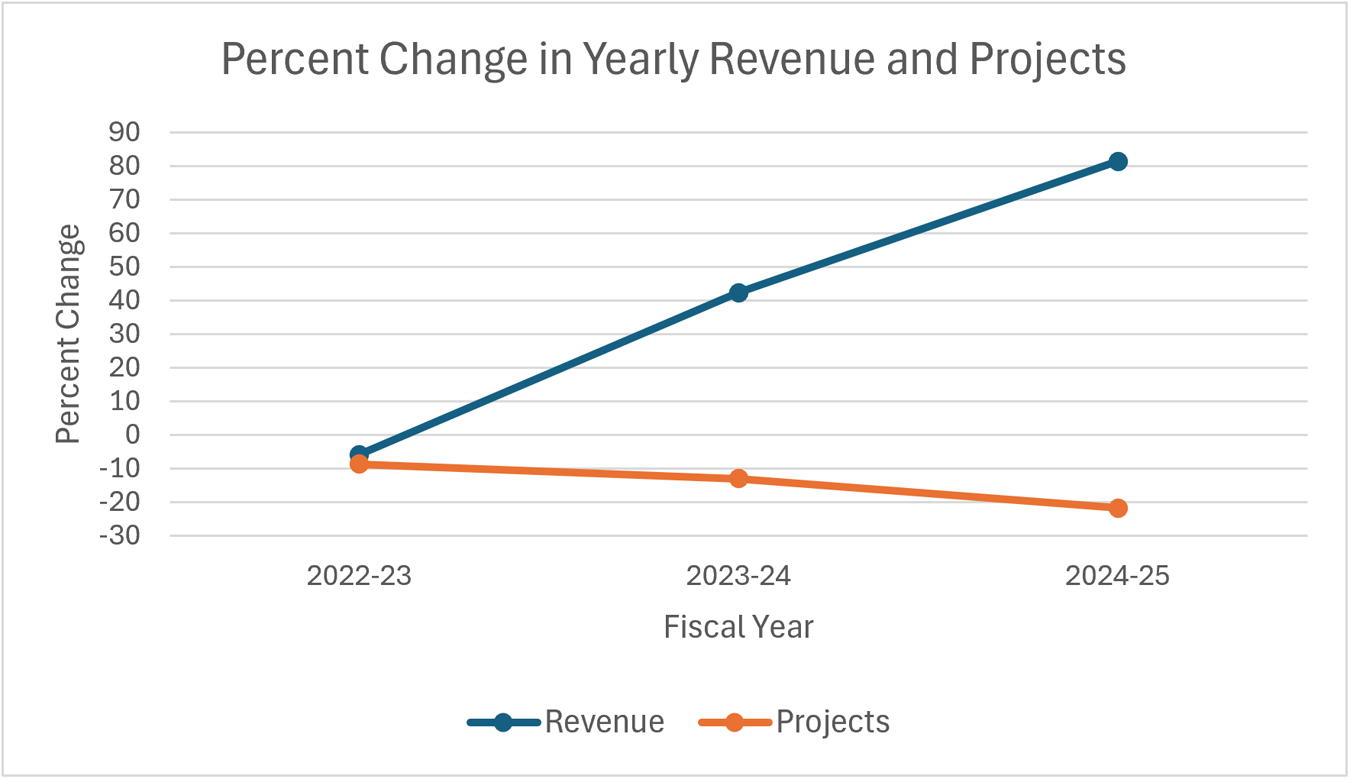
Yearly lab revenue data from four fiscal years (2021–2022, 2022–2023, 2023–2024, and 2024–2025) demonstrate the increase in productivity that the lab experienced between 2023 and 2025 (Figure 1). To protect the business interests of the lab, I do not share the raw data but only increases/decreases in revenue and the number of total projects per year. Between the 2021–2022 and 2022–2023 fiscal years, the lab saw a 6% decrease in revenue and a 9.5% decrease in the total number of projects completed (Figure 1). This was an especially difficult year, because the lab was lacking a director for approximately four months between the previous director’s departure and my arrival. The following fiscal year (2023–2024) saw a growth of 33.8% in revenue, even though the total number of projects decreased by 5%. We also increased our rates by approximately 5% midway through the 2023–2024 fiscal year, accounting for some of this growth. Finally, the 2024–2025 fiscal year produced a 16.7% growth in revenue and an 11% decrease in total number of projects. Once again, two large projects supported a significant portion of the overall revenue during that fiscal year, limiting the need for additional projects. We also increased our rates again by another 5% at the beginning of the 2024–2025 fiscal year, accounting for a portion of the increase in revenue.
Changes in yearly lab revenue between 2021 and 2025.

Figure 1 Long description
A line graph showing percent change in yearly revenue and projects over three fiscal years: 22-23, 23-24 and 24-25. The x-axis is labeled 'Fiscal Year' and the y-axis is labeled 'Percent Change'. The graph includes two lines: one for 'Revenue Change' and another for 'Project Change'. In fiscal year 22-23, revenue change is slightly above zero percent, while project change is slightly below zero percent. In 23-24, revenue change increases significantly to around 35 percent, while project change remains slightly negative. By 24-25, revenue change reaches approximately 75 percent and project change remains slightly negative.
The lab generated an overall increase of 70.8% in terms of revenue, even though there was an overall decrease in yearly projects between 2021 and 2025. This reflects not only the inclusion of larger projects and increased rates but also increased productivity and efficiency at the lab generated by newly implemented workflows and policies that created a healthy, team-driven work atmosphere.
Conclusion
CRM has long suffered from toxic and sometimes abusive working conditions (Fitting Reference Fitting and Green1984; Garrow Reference Garrow1993; Green and Doershuk Reference Green and Doershuk1998; McGuire Reference McGuire, Osborn and Hassler1987; Simeonoff et al. Reference Simeonoff, Matsuda, Perry and Charolla2026). Very little has been published on this issue, however, possibly out of fear of retribution or blacklisting. After all, CRM is a relatively small field, and we all seem to be only a couple degrees away from every other CRM practitioner. Further, a recent survey by Simeonoff and coworkers (Reference Simeonoff, Matsuda, Perry and Charolla2026) demonstrates that we still have a long way to go, with respondents asking for improvements such as greater industry oversight; more mentoring; formalized expectations surrounding behavior, conduct, and workload; increased pay; more competitive benefits; better communication; and unionization.
In this article, I presented my experiences leading a small CRM firm and my recommendations for creating healthy working environments by putting people first. In doing so, not only do you provide a safe place where your employees want to be but also productivity and the quality of work increase when employees are happy. Once again, I want to acknowledge that this work was feasible because I had a dedicated, ethical, and positive staff who wanted the same things from their professional lives that I did. I also recognize that this is by no means the only way to successfully create positive working environments within CRM. Leaders should be cognizant of the composition of their staff and create protocols that are most relevant and helpful to the group that they are leading. Finally, although I led these initiatives, they would not be successful if most of the lab staff were not putting them into daily practice. As such, the credit is more theirs than mine.
Acknowledgments
I am beyond grateful to Kristen (KC) Carlson, my supervisor at Augustana for her leadership, support, and guidance. I knew from the minute we met during my interview that we were going to become fast friends, and I am lucky to now consider you family. I also want to thank Trent Trombley, assistant professor of anthropology at Augustana, for spending numerous hours talking through many of the ethical issues raised in this article. I will forever miss having you right across the hall. More than anything, however, I want to thank my incredible staff at Augustana, including Margaret (Maggie) Berestyuk, Austin Buhta, Sydney Denekamp, Katie Jenkins, Danny Kenyon, Shannon McCormick, Gina Palefsky, Shae Pfenning, and Rosemary Lieske Vides, for your hard work and unrelenting support of our shared goals for the lab. Our success has been in every way a collective effort, and I will forever appreciate each and every one of you. I cannot wait to see how you grow the lab and build on the foundation that we created together.
Funding Statement
This research received no specific grant funding from any funding agency, commercial, or not-for-profit sectors.
Data Availability Statement
No original data were used in this article.
Competing Interests
The author declares none.

 Open access

