


Like its Roman and Mongol analogues, the primarily land-based, horse-run postal system was a crucial instrument of the Ottoman Empire.Footnote 1 This relay communications infrastructure comprised hundreds of post stations that provided fresh horses, food, water, and a place to rest for circulating couriers who connected Belgrade to Baghdad, Crimea to Cairo. Starting in the 1690s, a set of administrative reforms reorganized this postal system, creating new streams of information that flowed from myriad provinces to the imperial capital.Footnote 2 For the first time, administrators based in the capital (henceforth, “bureaucrats”) were privy to a wealth of mundane operational detail. They created new types of fiscal registers that recorded, among other things, the names of every administrator who visited a post station (henceforth, “officials”), the size of their entourage, and where they were headed; and each station’s annual expenditure, the number of horses stationed there at any one time, and the villages that provisioned these stations in lieu of taxes. Despite this expanding monitoring capacity, a series of imperial decrees from 1690 to 1833 revealed that horses were consistently missing from multiple post stations, delaying official communications that were vital for the everyday operations of empire, especially during wartime. Bureaucrats could not understand why this was happening.
This confusion is expressed in their frequently shifting diagnoses that accused a range of officials of taking horses for their own uses. In 1690, for instance, a decree issued in the name of Sultan Suleiman II (r. 1687–1691) addressed the problem of missing horses and stranded couriers by blaming “everyone,” from provincial governors to circulating officials of various ranks, for “taking as many horses from post stations as he wished.”Footnote 3 A year and a half later, another decree accused couriers specifically of taking more horses than were allowed them.Footnote 4 In 1696, two decrees identified a range of officials who used post station horses for “unimportant and trifling matters and even for their own affairs.”Footnote 5 Three decades on, the provincial postmasters were blamed.Footnote 6 This shifting cast of culprits and the accompanying, fitful narrative of missing horses evolved over the century, culminating in vivid descriptions in late eighteenth-century reports of imposter couriers and private transportation networks that systematically siphoned horses away from post stations to cater to merchants.Footnote 7 Something was afoot.
Shifting Cast of Culprits Identified by Decrees.

This essay seeks to explain both the Ottoman bureaucracy’s evolving struggle to grapple with this problem, as well as the enduring problem of missing horses itself. To elucidate these two arcs of change and continuity, I examine a series of fifty-one imperial decrees and reports about these missing horses and make three arguments. In the first section, I outline the bureaucrats’ perception of and attempts to fix the problem by rationing horses and strengthening enforcement. In the second, I show that a shadow economy had mushroomed around post stations where moonlighting officials were diverting horses toward profit-making ventures. In the third, I read the implications of later decrees backward in time to explain why bureaucrats did not recognize—at least not in writing—this “shadow economy,” a term I use to refer to the market demand for horses and the involvement of a range of officials to serve that demand using post-horses that technically belonged to the Ottoman state. I will argue that a blinkered informational order frustrated bureaucrats’ efforts to recognize the root problem, and this difficulty was compounded by the profound economic and social transformations of the eighteenth century. In the fourth section, I consider the social consequences of commercial forces in Ottoman society and contemporary France and articulate the stakes of this study with respect to the growth of what Francesca Trivellato has labeled “more anonymous market exchanges.”Footnote 8
To elaborate, I suggest that this shadow economy had existed at least since 1690, the date of the earliest imperial decree studied in this paper. The clue for this is a formulaic phrase that peppered multiple early decrees: “using horses for personal affairs.” Decrees invariably noted that officials “using horses for personal affairs” was one reason for insufficient post-horses, but, in the early period, they meted out no punishments for such behavior. Indeed, the phenomenon of using horses for non-official uses was an accepted, customary entitlement that officials long enjoyed—this is corroborated by contemporary narrative sources, notably Evliya Çelebi’s travelogue. I argue that these “personal affairs” likely included commercial activities, that officials had long been participating in and constituted an economy that shadowed the Ottoman postal system and leeched off it. Things changed in the late eighteenth century, when bureaucrats began explicitly condemning a range of moonlighting activities in decrees and reports. These activities included officials ferrying merchandise while on duty as well as elaborate networks of former officials who provided private transportation services for merchants. Such activities could not have materialized overnight and must have been going on for some time before bureaucrats belatedly understood the significance of allowing officials to “use horses for personal affairs.” Only then did they abandon the formulaic phrase of “personal affairs,” which disappeared from decrees and reports, and replace it with explicit references to merchandise and profit-making. Through the sources, I infer that Ottoman bureaucrats changed their mindset, as the “structure of reference and attitude” that informed their decision-making shifted due to changing economic and social circumstances.Footnote 9
Yet, even as bureaucrats began to explicitly condemn and punish moonlighting officials, they did not connect disparate reports of misbehaving officials, who ranged from couriers and postmasters to provincial governors. Instead, they responded to each report separately and individually, like contemporary Qing administrators who struggled to synthesize dissonant information streaming in from diverse frontiers.Footnote 10 The “missing horses” were only “missing” from the perspective of these bureaucrats who did not see the forest for the trees and therefore failed to diagnose the macroeconomic problem for what it was. Blind to the shadow economy, they could not curtail its operations.
Those tempted to attribute these goings-on to “corruption,” a trope whose shadow looms large in Ottoman historiography, have cause to reconsider.Footnote 11 The problem of enforcement across vast, relay communications systems was intrinsic to their design and endemic to the limitations of a pre-industrial state. For instance, the cursus publicus in the Roman Empire had experienced similar problems where relay station resources were “illegally usurp[ed] by private persons” and suffered “extravagant use by officials.”Footnote 12 Imposters trying to “pass off” as officials at post stations were also found in the Mongol and Russian empires.Footnote 13 What needs to be explained here, thus, is not simply the fact that non-authorized officials and private persons were accessing post station resources,Footnote 14 but the particular ways in which they accessed those resources, for what purpose, and what this meant in the eighteenth-century Ottoman Empire. To merely classify these actions as corruption misses elemental changes in the status-based and status-conscious Ottoman social order.
Indeed, these changes in the Ottoman social order map onto broader questions within economic history and the history of capitalism regarding how, historically, societies moved toward “more anonymous market exchanges.”Footnote 15 While the phenomena of markets and shadow economies were not new and have a long history,Footnote 16 the particular ways in which market exchanges were performed, and the specific arenas of life where they occurred, changed over time.Footnote 17 This essay zooms in on one such transformation in one part of the eighteenth- and nineteenth-century Ottoman Empire and connects this with the rise of anonymity in market exchanges.
This mystery of missing horses affords a rare vantage point into Ottoman bureaucratic logic, empire-wide commercial change, as well as its subtler social consequences. An important source of power and mode of transportation in the pre-industrial world, the horse transformed into an “interlinked” commodity attached to a range of other commodities that it helped to transport, connecting producers to consumers.Footnote 18 Like a color dye used to trace flows in scientific and medical experiments, these missing horses help us to see the diachronic diffusion of commercial actors and forces across hierarchy, space, and the pages of bureaucratic documents whose idiosyncratic language betrayed—even as it obscured—traces of shadow market transactions and shifts in the social order.
fixing the problem of missing horses
According to a chronological reading of the imperial decrees, bureaucrats in the capital tried to fix the problem of missing horses by rationing horse usage and strengthening enforcement. The rationing approach began with a short ad hoc phase before entering a longer systematic phase. During the ad hoc phase (1690–1710s), horse quotas were randomly assigned to certain official ranks. During the systematic phase (1710s–1800s), imperial bureaucrats produced detailed horse-rationing lists that catered to a larger set of official ranks, which were periodically updated.
The ad hoc phase began with the aforementioned 1690 decree by Sultan Suleiman II, the earliest known decree that identifies the problem of missing horses and initiates the strategy of rationing them among officials according to rank.Footnote 19 Its primary diagnosis is that administrative oversight led to some officials being issued more horses than others, and it decreed that henceforth only stamped papers (mühürlü kāğıdlar) from governors of certain provinces—specifically, Baghdad, Basra, Egypt, Erzurum, and Van—were admissible at post stations, and for no more than two horses each. This decree did not explain why these governors were chosen or indicate any punishments for violations. Only post station administrators were reprimanded for their carelessness (‘adem-i taḳayyüdleri) in inspecting courier orders (menzil aḥkāmları). They were urged to check the sultan’s monogram (ṭuğra) for their authenticity (ṣıḥḥati). This indicates that imperial bureaucrats had information that expired or counterfeit ( sāḫte ) courier orders were in circulation.
Example of Sultan Mahmud I’s monogram (ṭuğra) found on a courier order, dated 1743 (H. 1156). Source: BOA, Topkapı Sarayı Müzesi Arşivi Evrak (TS.MA.e) 891/31.

The rest of the decrees in the ad hoc phase followed this same pattern. For instance, one issued in December 1691 by Sultan Ahmed II (r. 1691–1695) declared that, henceforth, only courier orders issued by the Egyptian Governor would be admissible. The reason given was that a range of Anatolian officials had continued to disobey the earlier decree by Sultan Suleiman II by issuing stamped papers for their subordinates to obtain horses at post stations despite lacking the authority to do so, which had resulted in horse shortages.Footnote 20 It did not explain why it singled out the Egyptian Governor for special dispensation. Another decree, in February 1695, singled out a different official rank: the Chief Imperial Gatekeeper (ḳapıcıbaşı).Footnote 21 Henceforth, all entourages which included a Chief Imperial Gatekeeper could get at most five horses, and all entourages which did not could obtain a maximum of three horses. No reason was given as to why this rank was chosen and not some other.Footnote 22 Read together, these early imperial decrees reveal a brief, ad hoc phase of the administration’s responses to missing horses, when bureaucrats intervened narrowly, either by restricting the officials who could issue stamped papers for post stations, or by introducing piecemeal horse quotas that targeted certain official ranks.
The systematic phase proper began in 1713, when imperial bureaucrats introduced the first horse-rationing list that allocated quotas according to official rank (table 1). These quotas indicated the maximum number of horses an official of a stipulated rank could obtain from any post station in the empire. Revised lists were issued to all the provinces in 1717, 1735, and 1789 (table 2).Footnote 23 These decrees contained formulaic reminders to postmasters that, should they encounter officials whose ranks were not included in the new list, they must verify the imperial post station orders that the couriers had with them to determine the number of horses they were eligible to use.
Horse-Rationing List from a Report (telḫīs), 1713
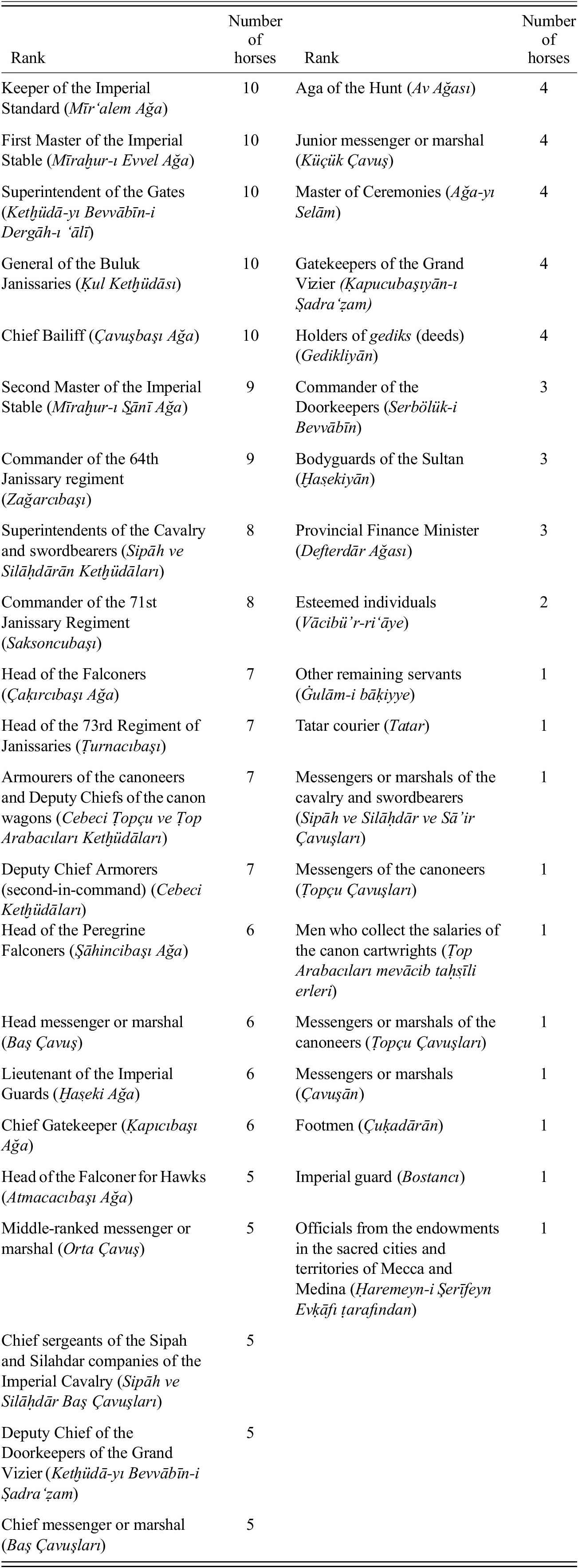
This list has been rearranged to reflect a descending order of hierarchy. Sources: Cemal Çetin, Ulak yol durak: Anadolu yollarında padişah postaları (Menzilhaneler) (İstanbul : Hikmetevi Yayınları, 2013), 222. Drawn from BOA, Cevdet Nafia 16/761 (21 Receb 1125/13 Aug. 1713) and BOA, D.MKF (Mevkufât Kalemi Defterleri) 28079 (27 Receb 1125/19 Aug. 1713).
Horse-Rationing Lists, 1717, 1735 and 1789

This list has been rearranged to reflect a general descending order of hierarchy. Sources: For 1717, Çetin, 222–23, KŞS 47, p. 250/29.jpg and MAD 8464, p. 9/4.jpg. Wherever Çetin’s text diverges from the sources, I have followed the copy of the imperial decree preserved in Konya’s Judicial Register; for 1735, Yücel Özkaya, 18. Yüzyılda Osmanlı Toplumu (Istanbul: Yapı Kredi Yayınları, 2008), 297; for 1789, GRGSA IAM OJC 001 F157 6–7.jpg. I have omitted some minor offices from the table.
If we compare these horse-rationing lists across the eighteenth century, we find notable revisions were made to include new ranks, phase out old ranks, and revise horse quotas. For example, janissary agas of the third rank, as well as a group of cannoneers, armorers, cavalry, sword-bearers, military cartwrights, and agas of the inner court were new additions in 1717. The subjects of the Crimean Khan, on the other hand, were left out of the new list issued in 1789 given that the Russian Empire had annexed the Crimean khanate in 1783. While no reasons were given for these revisions across the years, it is possible that the quotas were modified to support officials’ changing duties and responsibilities.
The principle of reconfiguring access to horse resources underpins the journey from the ad hoc phase to the systematic phase of the eighteenth century. By producing ever-more comprehensive horse-rationing lists, bureaucrats appeared to enhance imperial control at ever-more granular degrees.
Enforcement Challenges
Bureaucrats in the imperial capital may have created comprehensive horse-rationing lists, but they faced multiple challenges in enforcing them. This section demonstrates the processual nature of enforcement, with an emphasis on the active feedback loops necessary to keep bureaucrats apprised of the effects their policies were having on the ground. It also shows how bureaucrats in the capital could find it difficult to distinguish local officials’ genuine misinterpretations of new regulations from willful violations. Ultimately, these enforcement challenges reveal the Ottoman state’s responsiveness to feedback from the ground.
First, bureaucrats had to ensure that postmasters across diverse provinces held the correct interpretation of the latest decree. To that end, they inserted reminders and repeated earlier directives in decrees. For instance, in November 1702, they reminded postmasters that only agents bearing decrees with the sultan’s monogram (ṭuğralu fermān) were allowed horses.Footnote 24 The decree restated that this rule applied both to paying Ottoman officials and those who had their fees waived, while those with mere orders (buyuruldu) from provincial governors and with expired dates (tārīḫ-i ‘atīḳ) were to be denied horses.
Once the content of the policy was clarified, there were still problems of implementation, such as overzealous enforcement. In September 1719, a decree condemned postmasters who overzealously interpreted imperial directives and denied horses to couriers. It had been an established rule (ḳā‘ide-i ḳadīme) that courier orders were only valid for three months after the date of issue, after which they became invalid (müteṣaḥḥıf’ül-‘amel).Footnote 25 However, couriers were sometimes slightly delayed (birāz müddet-i meks̱ ve tevaḳḳuf) in executing official matters, and there were instances where postmasters refused them free horses, claiming that three months had lapsed since the courier orders’ issuance (yediñizde olan menzil aḥkāmıñ tārīḫleri üç aydir deyü menzilcileriñ ba‘żıları bārgīr vermeyüb). The decree condemned such behavior and accused postmasters of using such excuses to charge hourly fees for the horses. It commanded that, henceforth, postmasters should provide horses to couriers delivering important messages who were on their return journeys after three months had lapsed. This would seem to contradict and override the earlier established rule.
Conversely, there was also a problem of lack of enforcement. In September 1723, an imperial decree noted disapprovingly that some postmasters would not actually verify the number of horses stipulated in the imperial decree, but instead provide as many horses to incoming officials as they had arrived with (emr-i şerīf iḫrāc ve naẓar olmaḳsızın ḳaç bārgīr ile varmış ise yine ol miḳdār bārgīr verilmek).Footnote 26 This one-for-one exchange of old horses for new ones had become customary, rendering the written word of the decree irrelevant in ground-level post station operations. Postmasters apparently ignored it and gave officials acquiring as many horses as they desired (emr-i şerīfe muġāyir diledüği miḳdārı ziyāde bārgīr almağla varub gelince). To combat this, the decree of 1723 reiterated the requirement that all postmasters record the numbers of horses given to each visiting official, which would be submitted to the imperial bureaucracy for verification (taṭbīḳ).Footnote 27 The imperial decree by itself might have had little power to enforce compliance, but by insisting on a paper trail and its forwarding to imperial bureaucrats, postmasters could be held accountable for their actions.Footnote 28 Today the archives hold many such records, called in‘āmāt defteri.
Postmasters were not always to blame for the imperfect implementation of policies. Couriers and officials sometimes pulled rank and intimidated postmasters into defying imperial orders. In 1732, couriers were reprimanded for requesting more horses than they were eligible for, against imperial orders. These couriers were not satisfied (ḳanā‘at etmeyüp) with the number of horses that their own courier orders had allotted them, and would act in various oppressive ways (nice gūne ta‘addīler eyledikleri).Footnote 29 New, austere quotas faced resistance from prevailing entitlements. The imperial decree came down firmly on the new regime, roundly chastised such behavior, and ordered couriers to abide by the numbers stipulated in their imperial orders. But, as if cognizant of a delicate balance that it had to strike, the decree included a reminder that postmasters were not to use this excuse to deny services to officials and cause delays.
These difficulties of enforcement indicate the conflicts of interest between postmasters and circulating couriers that bureaucrats had to adjudicate belatedly from afar. The couriers brought the overzealous and over-charging postmasters to the attention of imperial bureaucrats, while it was probably postmasters or local villagers who complained to the bureaucrats about couriers demanding too many horses. This diversity of problems revealed the difficulty of implementing policies at the grassroots level, which afforded local actors a degree of maneuvering space.
To push the analysis of these bureaucrat-produced narratives further, it is unclear how many of these implementation difficulties were genuine: were postmasters interpreting imperial policy overzealously when they denied couriers their rightful number of horses, or were they making an excuse while supplying a separate transportation service on the side for extra money? The same could be asked of postmasters who did not enforce imperial policies while citing local customs. Even couriers and officials could be suspect. Why, for example, were couriers dissatisfied with the numbers of horses they were eligible to have, and why did they pressure postmasters into giving them more? What use did couriers have for extra horses? Were they accompanied by other, unnamed individuals? Perhaps these couriers were simply insisting upon retaining certain privileges they had enjoyed in the past, which involved pursuing their own commercial interests on the side. The latter becomes more probable when we re-read earlier sources in conjunction with subsequent imperial decrees, which reveals a more complicated reality that invites us to reinterpret this section’s procedural violations differently.
moonlighting officials in the shadow economy
The previous section has shown that Ottoman bureaucrats expended much energy in rationing horse usage according to official rank and in strengthening the enforcement of such regulations. In this section, I focus on reports of price-gouging postmasters, imposters, and errant officials and show that bureaucrats responded to each incident separately without integrating reports of willful violations within a single analytical framework. Furthermore, I read the implications of later decrees backward in time and argue that the shadow economy that leeched off the postal system had likely existed since 1690.
Over time, bureaucrats became aware of a range of improper actions that resulted in missing horses and delayed imperial communications. Sometimes, as shown in the previous section, bureaucrats attributed these improper actions to procedural violations, such as misinterpretations of imperial orders. At other times they directly condemned local actors for committing what were, from their perspective, substantial violations.
One such substantial violation concerns post stations overcharging officials to use horses. For instance, in April 1724, a courier complained that multiple postmasters he encountered on the road charged him between 20 to 30 akçe per horse per hour, instead of the standard rate of 10 akçe.Footnote 30 It is pertinent that such price-gouging behavior occurred at multiple post stations, indicating a systemic pattern rather than individual exceptions. There are numerous other examples: In February 1731, an investigation into Konya’s post stations cited reports of postmasters along the Anatolian middle route charging couriers twice the standard price (iki ḳat ücret) for horses, and the investigator (mübāşir) found the Konya postmaster guilty of the crime of overcharging.Footnote 31 The following November, a third decree condemned the unchecked covetousness (ṭama‘-ı ḫām) of postmasters in Rumelia.Footnote 32 It revealed that some, attracted by profits (cerr-i nef‘ ve celb-i menfa‘atlar), had been giving post-horses to people without imperial orders. Over the next two years imperial decrees singled out postmasters from specific locations—Turhal, Tokat, Kangal, Alacahan, Hasançelebi, Hısnıpatrik, Malatya, İzoli, Harput, Ergani, Diyarbekir, Mardin, Nusaybin, Cizre, Musul, Karakuş, Erbil (Andava), Altınsuyu bridge, Kirkük, Tavuk, Tuzhurmatı, and Kefri—for pocketing for their own use money (ekl ü bel‘)earmarked for post station management (kendü havālarına ḫarc u ṣarf).Footnote 33 All this occurred during the empire’s ongoing war with Iran in the 1730s.
The problem of overcharging persisted even in times of relative peace. About a decade later, in August 1740, an imperial decree condemned the inflated fees being charged for horses as well as extra payments levied in the name of fringe services by service personnel who helped operate the post stations.Footnote 34 A month later, another decree observed the same problems of profit-seeking (celb-i menfa‘at), bankrupt behavior (müflis), and treachery (ḳallāş), but this time among the urban notables (a‘yān-ı vilāyet) and individuals from the ‘askerī class.Footnote 35 Seventeen years later, in November 1757, postmasters were again excoriated for charging several times more than the standard rate (bir ḳaç ḳat ücret ṭaleb).Footnote 36
These written condemnations of illicit behavior and embezzlement had appeared for the first time in imperial decrees in the 1730s, when bureaucrats began to blame individual postmasters for seeking profits, using a slew of formulaic expressions such as the aforementioned “cerr-i nef‘,” “celb-i menfa‘atlar,” and “müflis.” However, such comments cannot by themselves tell us why such motives might have become so prevalent across the empire during this period, from Rumelia to Anatolia and northern Iraq. Only by reading and analyzing these decrees together, beyond the formulaic condemnations of widespread greed, can we grasp the systemic drivers that changed people’s economic behaviors.
There are two possible reasons for the raised prices, which are not mutually exclusive: inflation, and a competing demand for horses. Ongoing wars could have created short-term price fluctuations, prompting postmasters across multiple provinces to charge more for horses.Footnote 37 The state-mandated hourly rate of 10 akçe per horse was likely not keeping pace with actual post station expenditures and living costs. Set in 1696, that nominal rate remained unchanged for well over a century, until it was raised to 60 akçe (20 para) in August 1824.Footnote 38 Then, over the following decade, it was steadily increased: in 1826 to 90 akçe (30 para),Footnote 39 and in 1830 to 120 akçe (40 para).Footnote 40
Hourly Rates of Post Horses for Officials

Hourly Rate per Horse (in akçe) from 1696 to 1830.

The trend of these price increases—a slow rise and then a relatively big jump in the nineteenth century—was also observed in the prices for sea transportation in Istanbul, and both were likely linked to dramatic inflation during that later period.Footnote 41 However, the eighteenth century also witnessed gradual inflation, which may have prompted postmasters to take matters into their own hands and raise prices themselves, given that they would have had to deal with the real effects of inflation in their everyday lives.
Official Fixed Prices (narḫ) for Sea Travel within Istanbul (all prices in akçe) 1

1 Nejdet Ertuğ, Osmanlı döneminde İstanbul deniz ulaşımı ve kayıkçılar [Istanbul sea transportation and boatmen in the Ottoman period] (Ankara: Kültür Bakanlığı, 2001), 154.
The second possible reason for the raised prices is competing demand for horses. This possibility is strengthened by evidence from other decrees issued in the final decade of the eighteenth century, and we need to read their implications backward in time.
In 1793, an imperial decree lamented that for some time post stations along the middle and left routes in Rumelia had been harassed into providing horses to “rogues” (ḫaẕele) who operated transportation services (taḥmīl ve naḳl-i emvāl) for Jewish and Christian merchants and their merchandise, gaining profits through trickery and deceit (kār-ı mekr).Footnote 42 These “rogues” included expelled (maṭrūdlar) Tatar couriers and officials who had formerly served viziers, and they procured post station horses illicitly by deceitfully wearing the special courier fur caps (ḳalpaḳ) that served as an identifying marker. Beyond ruses like this, they operated as a well-organized gang. Even when postmasters knew that they were not authorized persons in service of the Ottoman sultan, they reluctantly (nāçār) acquiesced to their demands out of fear (ḫavfıyla) of retaliation. Although imperial bureaucrats did not identify individual rogues, they did list their places of origin: twenty men came from Yenişehir, ten each from Thessaloniki (Selanik) and Sofia, and one or two from other, unidentified provinces. Given their level of sophistication, these networks and services must have existed for some time before the 1790s, since the gangs were unlikely to have emerged overnight as fully formed entities.
Such commercial transportation services that leeched off state horses were also found in the Anatolian provinces.Footnote 43 In November 1794, a sultanic decree addressed officials along the Anatolian middle route and chided couriers who moonlighted as transporters of merchandise (tüccār mālı), saying the practice greatly burdened the people.Footnote 44 Years later, in July 1820, it was reported that couriers traveling from Istanbul to Baghdad and back would customarily carry merchandise (tüccār yükü) on behalf of traders. An order banned such transportation between Istanbul and Baghdad, saying that these overly large loads (ziyāde yük) borne by couriers resulted in delays in delivering official correspondence.Footnote 45 Sometimes the merchandise was so heavy that the horses carrying it died, which drew condemnations.Footnote 46
The ruse of masquerading as official couriers was also common in the Arab provinces, for a range of reasons, including the mundane motivation of being able to travel with greater speed. In Damascus, Ottoman officials and the men in their service understood that they could pose as couriers by wearing special courier fur caps. In this way, they could more easily obtain fresh horses and carry on with their journey with less hassle, because local postmasters could not differentiate (farḳ ve temyīz olunmayub) between frauds and bona fide couriers.Footnote 47 Other imperial decrees attest to merchandise transporters, voivodes, and revenue farmers who masqueraded as official couriers so that they could travel faster (sür‘at içün).Footnote 48 These decrees demonstrated that such interlopers—who included genuine officials—were knowledgeable about Ottoman official regulations regarding uniforms and that they were able to procure them. Other reports of bandits robbing couriers of their clothes and belongings show that the paraphernalia of authentication could and did fall into the wrong hands.Footnote 49 More important is that some of these interlopers were actually Ottoman officials, men in their service, or former officials. By the late eighteenth century, bureaucrats were aware of such incidents but continued to respond to each as if they were stand-alone cases.Footnote 50
Looking collectively at the range of profit-yielding transactions I have mentioned, we can start to see the outlines of a shadow economy that intimately depended on the Ottoman post station infrastructure. It included price-gouging postmasters with reports of imposter couriers, organized gangs who provided private transportation services, and legitimate officials who were transporting commercial merchandise on the side while traveling for work, a practice that had become widespread enough that the authorities had to issue an order banning it.
Figure 2.

These broadly defined groups did not necessarily work in tandem, scattered as they were across the variegated Ottoman geography. What connected their discrete activities was a commonly shared economic landscape, where a strong market demand for horses and the transportation services they could provide competed with the official demand that nominally paid the rate of 10 akçe per hour per horse. This alternative source of market-driven demand, which likely came from private merchants, appears to have paid a higher rate, thereby attracting both postmasters and circulating couriers.
anatomy of a value shift within a blinkered informational order
If a shadow economy had indeed existed since 1690, why did Ottoman bureaucrats not perceive it and write about it? There are a few levels to my explanation. First, profound changes in the economic and social landscape of the eighteenth century form an important background context. Second, imperial decrees and reports reveal an idiosyncratic pattern of appearances (and subsequent disappearances) of a formulaic phrase, “using horses for personal affairs.” This pattern suggests that bureaucrats only belatedly saw moonlighting as unacceptable and punishable. Third, despite this belated recognition, bureaucrats did not connect individual reports of moonlighting officials to see the situation systemically, so they overlooked the overall shadow economy. Like contemporary Qing administrators, Ottoman bureaucrats operated within a fragmented, blinkered informational order.
Commercial Expansion and Changing Social Boundaries in the Eighteenth-Century
Economic life in the eighteenth-century Ottoman Empire was marked by increasing commercial activity and increasing consumption. Scholars have shown that the empire became increasingly integrated into the world market and enjoyed economic expansion until around 1760, which brought about significant social and cultural changes.Footnote 51 These changes ranged from diet (artichokes, tomatoes, and cauliflowers appeared for the first time) and fashion (the appearance of a greater variety of silks) to the urban, built environment of the imperial capital (a “construction boom” in Istanbul ushered in an era of “architectural and decorative flamboyance”).Footnote 52 Yet, this expansion took place in the context of severe military and financial crises. In addition to the Ottomans’ military defeat by the Habsburgs and their allies that resulted in the Treaty of Karlowitz (1699), this long century saw the costly Russo-Turkish War (1768–1774), which forced the Ottomans to increase public borrowing through the release of tax-farm shares (eshām).Footnote 53 These two contrasting themes have led scholars to reach conflicting verdicts regarding the nature of eighteenth-century Ottoman power: while some view the empire as undergoing administrative decentralization and characterize this as a period of crisis (due to their emphasis on military defeats externally and political turbulence internally), others, especially historians of consumption, art, and architecture, have emphasized the quickening circulation of goods, as well as the revitalization of imperial power and elite patronage, especially after Istanbul was restored as the imperial capital in 1703.Footnote 54 However, I view these tensions in the bifurcated historiography to be misplaced, since military defeats and a financial crisis could coexist with an expanding commercial sector.
In this period, the status-based and status-conscious Ottoman society witnessed significant social changes, with status understood in plural terms of rank, occupation, tax status, gender, place of origin, and so forth. Increasing migration into towns created pressure on existing urban trades to allow newcomers to participate.Footnote 55 Commoners from non-elite backgrounds began to enter what were formerly elite arenas, such as the imperial bureaucracy and the space of literary production.Footnote 56 This trend was also observed in postal administration: eighteenth-century imperial decrees emphasized that competent men should be appointed as postmasters, even if they did not have ‘askerī (tax-exempt) status.Footnote 57 This empire-wide phenomenon of social mobility continued into the nineteenth century, which in some provinces saw the rise of new “rural middle classes” and the consolidation of urban merchant families who secured political power.Footnote 58
These profound social changes eroded erstwhile status hierarchies and bureaucrats responded with new rules.Footnote 59 New clothing laws, for instance, were used as “disciplinary tools” to reassert political control and maintain social order.Footnote 60 Even the use of public baths became subject to increasingly strict regulations that imposed a complete segregation of different confessional communities.Footnote 61 Elyse Semerdjian explains this intensity as anxious reactions to “new global consumption patterns” and an accompanying “perception of moral decline.”Footnote 62
The commercial world in which Ottomans partook was also transformed. With the rise of Smyrna (Izmir) alongside Aleppo as trading hubs, and with the northward shift in Ottoman trading partners from Venice, Dubrovnik, and France toward the Russians and the Habsburgs, opportunities emerged for newcomers to participate in regional and longer-distance commerce.Footnote 63 Scholars have noted, for instance, that competition from new groups of overland traders and trade fairs in the Balkans contributed to the demise of the Adriatic port city, Dubrovnik, after 1700.Footnote 64 Other kinds of actors also emerged on the commercial scene, such as forwarding agents and muleteers in the Balkans, and “part-time” Aleppine merchants (i.e., unspecialized merchants) who traded local manufactures such as soap, rice, and cloth for regional consumption, and not just long-distance transit goods (such as Iranian silk) that were transported via large caravans.Footnote 65 During the eighteenth century, local production of cotton, olive oil, soap, and textiles fostered stronger trade and manufacturing links between cities and the hinterlands.Footnote 66
I submit that the horse transportation offered by moonlighting officials in the shadow economy catered to new logistical demands resulting from a reordering of commercial patterns and trading routes over the eighteenth century. Since domestic trade constituted a sizeable portion of commodity exchanges up until the late Ottoman Empire, and because much of this trade still depended on overland transportation to link major commercial markets, it is reasonable to suppose that officials transported commercial goods on behalf of merchants.Footnote 67
Again, the phenomenon of moonlighting officials engaging in commercial enterprise is not new, but it likely acquired new scale and intensity in this period. Scholars have observed that, starting in the sixteenth century, a “double movement” occurred between ‘askerī officials and commoner merchants: janissaries became increasingly involved in commerce, while greater numbers of artisans and commoners entered the ‘askerī janissary ranks to gain protection, access to credit, and other privileges.Footnote 68 From the mid-seventeenth century onward, many office-holders faced more acute financial need given that they had to independently finance their large households and retinues, especially while they were in between appointments and receiving no income.Footnote 69 Examples abound of such entrepreneurial officials, such as a cavalry officer who founded a soap factory dynasty,Footnote 70 or janissaries who engaged in moneylending and invested in agricultural estates (çiftlik), animal farms (ḳışlaḳ), as well as beehives that produced honey for Ottoman and foreign markets.Footnote 71 Jurists, dragomans, and governors, too, took part in moneylending or borrowed on credit while serving in their official roles, forging business partnerships across religious lines and with European consuls and merchants.Footnote 72
Despite this fervent activity, the normative position that officials should steer clear from the realm of commerce endured in intellectual writings until the late eighteenth century. For instance, the seventeenth-century historian Mustafa Naima noted with approval that the grand vizier Derviş Mehmed Paşa (ca. 1590–1655) undertook successful commercial activities and accumulated immense wealth as a result. Since such actions constituted a “serious departure” from classical Ottoman political theory, Naima defended the vizier’s actions. In mounting such a defense, he inadvertently revealed the powerful grip of the more conventional view.Footnote 73 We see this again in the late eighteenth century, when the statesman Ahmed Vâsıf Efendi (ca. 1735–1806) likewise contradicted the classical view. While he upheld strict boundaries between distinct professional spheres such as commerce and soldiering, and identified a moral order that such boundaries maintained, he nevertheless advised wealthy statesmen to establish a merchant marine to protect the empire’s interest.Footnote 74 In sum, the normative position that commerce and officialdom should remain separate continued to powerfully influence some bureaucrats, even as there was mounting evidence of greater commercial involvement by officials on the ground.
The Mysterious Phrase of “Using Horses for Personal Affairs”
This normative position that officials should abstain from commerce likely endured and shaped bureaucrats’ responses to the problem of missing horses. Operating on this premise, I read the implications of later imperial decrees backward in time to infer, through the pattern of appearances of one formulaic phrase, a slow shift in bureaucrats’ mindset about long-held official entitlements regarding horse usage for personal affairs. This approach to reading sources is inspired by Edward Said’s mode of “contrapuntal reading,” where a full consideration of “the enabling circumstances of [a text’s] commission and composition” reveals “a structure of reference and attitude, a web of affiliations, connections, decisions, and collaborations.”Footnote 75 Said read the forgotten colonial context back into texts such as Jane Austen’s Mansfield Park (1814), where the role of slave-run sugar plantations in Antigua was structurally fundamental to the wealth enjoyed by the protagonists but curiously absent in the text except for a few, incidental and passing references.Footnote 76
In the Ottoman case, a contrapuntal reading of these decrees and reports reconstructs the “structure of reference and attitude” that motivated bureaucrats. I show how early eighteenth-century moonlighting officials who used horses for commercial activities on the side were implicitly mentioned in the sources using variations of a vague formula: these officials were using horses for “their own personal affairs,” a customary entitlement that was disapproved of but never punished. Indeed, narrative sources such as Evliya Çelebi’s famous travelogue show, for instance, that the use of post station horses for personal affairs was acceptable behavior in the seventeenth century, when couriers delivered private letters alongside official correspondence. More pertinently, high-ranking officials in the mid-seventeenth century pursued profitable commercial activities while enjoying generous waivers on customs duties and transportation charges.Footnote 77 Given this evidence, I argue that this vague phrase likely referred to officials engaging in commercial transportation from at least 1690 and therefore underpinned the enduring missing-horses problem.
The first incarnation of the phrase “using horses for personal affairs” appears in the earliest decree examined in this paper, of 1690, which noted that “everyone was taking as many horses as he wished from the post stations.” The tone of the decree appeared to be one of mere annoyance, and no penalty was issued for such actions. Instead, local administrators were reminded to inspect courier orders rigorously and clarify which officials could and could not access horses in post stations.Footnote 78 Using the passive voice, the decree found that provincial officials were given more horses than they were supposed to receive, and thereby placed agency, indirectly, on those running post stations rather than on provincial officials (eyālet ve elviyede olan beğlerbeği ve sancaḳbeği ve mütesellimleriñ kāğidlar ile menzil bārgīri verilüb). We can infer from such phrasing that postmasters bore the burden of responsibility for guarding horse resources, and conversely that officials using horses was an accepted norm.
In 1696, the phrase pops up again in a decree issued by Mustafa II, which noted that his officials used post station horses for “unimportant and trifling matters and even for their own affairs (umūr-i mühimmeden ġayrı cüzvi ve kendü maṣlaḥatlarıyçün daḫi).”Footnote 79 It did not elaborate on the nature of these personal affairs, but said that a wide range of officials behaved in this way, suggesting that such usage of horses was commonplace: “military commanders in the various sectors, viziers charged with the defense of the frontiers or holding provincial appointments, and other beylerbeys and sancaḳ-bey[s] and their deputies” (ser‘askerler ve serḥadd-i manṣūreler muḥāfaẓasında ve ṭaşra manṣıblarında olan vüzerā-yı ‘iẓām ve sā’ir mīr-i mīrān ve mīr-i livā ve mütesellimleri).Footnote 80
The phrase is used again in internal reports and subsequent decrees until 1830; these repeatedly noted that officials with proper courier orders were using post station resources for their own affairs (kendü umūr içün/ kendü maṣāliḥiyle).Footnote 81 None of the decrees specify the nature of those affairs.
Sometimes, an unexpected variation of this formulaic phrase exposes the shadow economy. A decree dated 1787 referred to those using horses “for their own affairs” but, crucially, identified them as “the sorts of people who were travelers, contractors, and merchants” (kendü maṣāliḥler ile īyāb ve ẕehāb iden yolcı ve mültezim ve tüccār maḳūlelerini). These occupational titles strongly imply that those undertaking travel and commerce were, in fact, using post-horses.Footnote 82 Among these, only the mültezim may be regarded as an official.
Since the late seventeenth century, “using post station resources for their own affairs” was the formulaic, bureaucratic expression used in imperial decrees that avoided specifying what exactly officials (and non-officials) were using post-horses for, but affirmed that they were, indeed, using them, for commercial transportation activities.Footnote 83 Significantly, in the late eighteenth century, these phrases continued to appear alongside decrees that explicitly condemned officials for undertaking commercial activities, suggesting there was a transitional period during which the categorical distinction of “using horses for commercial activities” was still emerging as something to be censured, but had not yet been consolidated.
This is the lean evidentiary base that I have assembled to infer a slow mindset shift on the part of Ottoman bureaucrats. Connecting this shift with the background context of profound economic and social transformations, I submit that intensifying commercial forces affected not only imperial subjects but also Ottoman bureaucrats and officials, thereby reconstituting the culture and society of the rule-making administration itself. As economic change and social change had mutual, recursive effects on each other, the old, customary entitlements that Ottoman officials enjoyed likely gave them advantages in their money-making pursuits, which, in turn, belatedly came to the attention of bureaucrats who began to explicitly police such entitlements.
A Blinkered Informational Order
However, even as bureaucrats condemned and punished moonlighting officials, they did not connect individual reports of such behavior so as to view the problem systemically. I argue that this may be attributed to an informational order that frustrated bureaucrats’ visibility of the shadow economy.
Bureaucrats in Qing China faced an analogous problem of a fragmented informational order, which offers an instructive comparand to the Ottoman case. From 1750 to 1860, the Qing bureaucracy accumulated discrete sets of information about different frontiers in the empire and developed “segmented, regionally specific strategies.”Footnote 84 However, the lack of a “single language” and “unifying matrix” to parse these localized sets of information would later have grave consequences for the empire’s security.Footnote 85 Crucially, Qing bureaucrats only belatedly realized that the British trading in Guangzhou (referred to as the “Yingjili”) were the same people referred to in documents as the “Pileng” in India.Footnote 86 Because they could not integrate distinct pieces of information from different frontiers and translate them into coherent knowledge, the Qing were slow to react to foreign developments and consequently suffered the unexpected and devastating impact of the Opium War (1840–1842).
In comparison, the stakes were lower for Ottomans and their missing horses, but there were similar features. In the Ottoman Empire, the 1690s reforms of the postal system catalyzed increased flows of information to the imperial bureaucracy in the capital, but these flows were received, processed, understood, and responded to separately and discretely. This segmented attention, described by one historian as Ottoman scribal officials’ “craftsman-like” fixation on “documents as ends in themselves,”Footnote 87 is also evident in the disjointed narratives advanced by different genres of sources: fiscal registers provide increased information about post station expenditures and show a gradual increase in number of horses maintained there, but imperial decrees tell of chronic horse shortages at post stations and stranded couriers (see table 5) This discrepancy between what fiscal registers claimed and what decrees revealed points to a gap in the Ottoman informational order where bureaucrats did not translate abundant, discrete information into meaningful knowledge.
Gradual Increase in Horse Supply at Post Stations, 1690–1761

Sources: Amasya: KK 2742, 41.jpg; MAD 10492 115.jpg; MAD 4106, 123.jpg. Diyarbekir: KK 2742, 43.jpg; MAD 10492 142.jpg; MAD 4106, 145.jpg. Aleppo: KK 2742, 36.jpg; MAD10492, 64.jpg; MAD 4106, 60.jpg.
Earlier I demonstrated the difficulty bureaucrats faced in distinguishing between genuine procedural violations, where local officials misinterpreted imperial regulations, and substantial violations, where local officials demonstrated more willful and intentional disobedience. Yet the sources show that each report of trouble was treated separately with little reference to other cases. This segmented administrative attention would have been further exacerbated by changes in administrative personnel and the ebbing of institutional memory over time.
Certainly, one might argue that individual Ottoman bureaucrats were actually aware of the shadow economy even if they did not put it in writing. Perhaps bureaucrats knew the political costs of eliminating official entitlements but were uncertain how effective such a policy would be in recuperating horses at post stations. This sort of loss aversion and status quo bias could have prevented them from confronting the shadow economy.Footnote 88 Nevertheless, this essay focuses on the actual actions that the Ottoman bureaucracy undertook as manifested in written documents. Hewing closely to the available written sources suggests that Ottoman bureaucrats simply did not respond to discrete violations as if a broader shadow economy existed, or that they might have perceived one.
The explanation of a blinkered informational order, which draws inspiration from Matthew Mosca’s analysis of the Qing bureaucracy, poses interesting questions about early modern information and communication. While important studies have focused on how information “flows” connected transregional and global spaces and how information transformed as it diffused, the cases of the Ottoman and Qing bureaucracies demonstrate the idiosyncratic challenges of communication within a specialized network belonging to a single political system.Footnote 89 European regimes, too, faced information management challenges: old regime France struggled to contain its illicit economies, and in Central Europe the quantitative spirit of administrative science (kameralwissenschaft) introduced a particular sort of structural blindness into the bureaucratic vision, reducing, for instance, complex forest ecosystems to simplistic categories and numbers.Footnote 90 Many early modern bureaucracies, European and not, faced challenges in managing and interpreting information, and of course such challenges still exist today.Footnote 91
An interesting question concerns how Ottoman bureaucrats would have comprehended the tectonic shifts underpinning eighteenth-century economic life and political power—what we now know as the rise of European industry and capitalism that would fundamentally reorder the world. Would these bureaucrats, who managed the mundane, everyday operations of empire, have perceived these shifts in their routine work? And in what forms would these shifts have been manifested? Even if they did not perceive them, could their writings unintentionally reveal these winds of change, perhaps along the lines of the contrapuntal reading I offered earlier?
toward anonymous market exchanges: what ottoman post-horses tell us about one property of capitalism
If capitalism is “intrinsically historical” and, “far from being given all at once, its properties emerge over time,” how would this emergence have been experienced, and how would historical sources capture it?Footnote 92 One property of capitalism is the increased anonymity of market exchanges.Footnote 93 Anonymity entails the stripping away of many layers of social identities—rank, occupation, religion, gender, et cetera—until what remains are relatively more standardized, individual units differentiated mainly, but not only, by the amount of money each has. Old status hierarchies had to morph, though they certainly did not flatten, enduring to the present day in transmogrified form.Footnote 94
Tracking the status of the horse sheds some light on this social reconfiguration. Post-horses changed from being an imperial resource, a type of “public good” whose use and access were officially regulated by rank, into a “fictitious commodity” whose use and access were officially broadened to become mediated by both rank and money.Footnote 95 This was a radical shift. By “public good” I mean that post-horses were “produced and distributed neither by market mechanisms nor through personal relationships, but in a political-social space.”Footnote 96 After all, Ottoman post-horses were originally tax obligations borne by villagers as part of a long-standing social compact between ruler and subject. While money certainly was sometimes used to obtain post-horses before the eighteenth century, such payments did not have official sanction. (I am not referring here to animal and horse markets, which I regard as separate phenomena.)
In 1817, that changed. De facto non-official use of post-horses received de jure status when bureaucrats officially implemented a pay-per-use system open to all, both officials and ordinary imperial subjects. For a fee of 54 akçe (18 para) per horse per hour, private individuals could access post stations and post-horses.Footnote 97 Ottoman officials traveling without legitimate courier orders paid a rate of 10 akçe per hour per horse. With this policy, bureaucrats appeared to acknowledge that competing demand for horses had to be accommodated. This official acceptance of money as a medium of exchange alongside the “currency” of social rank was striking.
A social order in which money was officially fungible, with post-horses that had become commodities, was something new in the Ottoman context; it was a new kind of “fiction” that required significant work and was not a natural or frictionless process. If we view capitalism as constituting a set of “practices and institutions that created the conditions for more anonymous market exchanges,” then this 1817 policy may be understood as one tiny step toward the partial leveling of official rank and imperial subject in the Ottoman status hierarchy.Footnote 98 This was the stripping away of several layers of social difference—tax-paying status, rank, occupation—in the specific context of procuring post-horses.
That said, this step in the transfiguration of an earlier social order and status hierarchy did little to ameliorate the problem of missing horses, which persisted beyond 1817. In 1833, an imperial decree complained that couriers were being delayed because they could not find horses.Footnote 99 One possible interpretation is that while state recognition of competing demand may have solved the problem of violations superficially, it could not solve the more fundamental problem of scarcity. Demand still outstripped supply, and while the Ottoman state had given up its monopsonistic status to allow private usage of its horses, it was not the most competitive buyer in the market for horses. In other words, the century-long struggle to regulate the Ottoman postal system and its horse resources—which involved policing identity via monograms, dates, ranks, quotas, passes, uniforms—now moved to a different phase when a new political economy fundamentally rewrote the terms of access to these formerly exclusive resources.
This issue of changing economic and social orders and their mutually recursive influences have been explored by historians of Europe, some of whom have made explicit links between commercial capitalist development and changes in social hierarchies. According to one scholar, the spread of the commodity form “fostered a vigorous growth of abstract forms of social relations” in eighteenth-century France. These experiences of abstraction made “the notion of civic equality both conceivable and attractive by the 1780s,” a notion that underpinned the French Revolution.Footnote 100 Other scholars, however, have been cautious of overestimating the early modern acceptance of an egalitarian social order and emphasize the tenacity of social status. For them, social status was “the cardinal principle of Old Regime hierarchies” and an enduring determinant of individual and group identities that arguably persists in some ways in today’s putatively meritocratic systems.Footnote 101 Both views, even as they disagree on the nature of social status in 1780s France, recognize that social orders and economic life profoundly influence each other.
This case study of missing horses builds upon the Ottoman historiography where scholars have explored changes in the social order in political and economic terms. Some have historicized the rise of nineteenth-century Tanzimat-era participatory politics by looking at seventeenth-century collective contracts; some by contextualizing nineteenth-century religious populism within the dramatic upending of the elite-commoner hierarchy; and many others by looking at the consolidation of ethno-religious and confessional identities as commercial activity intensified.Footnote 102 With more case studies, a clearer picture of how the Ottoman social order transformed and what precisely “anonymity” entailed within it may be obtained. Such an analysis would have to explain if, and how, the spread of the commodity form affected the enduring grip of older status hierarchies that had patterned social relations and underpinned economic transactions for generations.
This essay can only point toward these research directions, but it does highlight some broader implications of commercial forces and the persistent demand for horses. First, these commercial transportation services provided by the shadow economy can help us understand overland commerce, which remained substantial during the nineteenth century.Footnote 103 In-depth studies have expanded our knowledge about long-distance or caravan trade.Footnote 104 What has received less attention is short- and medium-distance trade, and more importantly, the logistics of such trade; for instance, Nabulsi soap and textile merchants who traded with towns in modern Syria, Lebanon, and Egypt.Footnote 105 In addition, the town fairs and intermediate marketing centers which Suraiya Faroqhi has described for the Balkans and Anatolia in the sixteenth and early seventeenth centuries likely continued into the eighteenth century with the help of horse transportation.Footnote 106
Second, the increased demand for horses could also indicate increased tourism, though it is unclear how many horses this might have involved. Scholars have noted a new, eighteenth-century breed of “athletic equestrian traveler” in the form of more British travelers and East India Company officials embarking on the “Great Desert Caravan Route” toward India via the Syrian desert.Footnote 107 Indeed, the illicit transportation services referenced in the reports I have drawn upon here utilized Ottoman post station routes that overlapped in places with caravan and pilgrimage routes.Footnote 108
Third, the foregoing evidence indicates that the Ottoman state played an important role in stimulating regional commerce and travel by virtue of providing necessary infrastructure, albeit unintentionally.Footnote 109 Strengthened imperial supervision of the sprawling post station network did result in more horses being conscripted from Ottoman villages and allocated to individual post stations over time (see table 5). From the perspective of interlopers, this meant more horses to pilfer for private uses. In other words, capacity for private transportation expanded in tandem with the Ottoman bureaucracy’s expansion of its own communication network’s capacity because the former was parasitical on the latter.
In sum, the transformation of a widespread custom of officials using imperial horse resources for non-official uses first into an explicit ban and then into an empire-wide pay-per-use policy mirrors a series of shifts in the Ottoman economic and social orders. For the historian trying to detect these shifts, this new order “[did] not appear suddenly in its fullness,” but was described in the sources using the language of older “codes,” “terms,” and “concepts,” such as the mysterious phrase of “personal affairs.”Footnote 110 The mix of late eighteenth-century decrees, with some retaining the use of this phrase and others explicitly outlawing moonlighting officials, exposes the unsteady restructuring of the bureaucrats’ frame of understanding. As scholars working on contraband and informal trade in the early modern Atlantic have shown, the changing boundaries of the licit and the illicit are indicative of broader shifts in power, social, and economic dynamics.Footnote 111 The phenomenon of moonlighting officials in the shadow economy exemplifies these very shifts and shows that the heart of the Ottoman Empire—its bureaucracy—was not spared the commercializing effects of the eighteenth century.Footnote 112 It also reveals bureaucracy to be an unexpectedly profitable site for the study of the history of capitalism.Footnote 113
conclusion
This paper has traced the problem of missing horses as described, engaged, and grappled with within a series of imperial decrees. I have explored the ping pong back and forth between the imperial bureaucracy and provincial officials regarding post-horse usage, from verifying courier orders with the sultan’s monogram, checking orders with specific dates, enforcing horse quotas and in authenticating proper courier uniforms. These successive changes are the collective outcomes of ongoing iterative bureaucratic processes that maintained monitoring capacity, extracted information from the provinces, and translated that feedback into administrative actions, again and again. That interlopers continually adjusted their methods of infiltrating post stations to pilfer horses testifies to the persistence of a non-official, market demand for horses, and also to the relative effectiveness of Ottoman enforcement policies that forced them to innovate. Bureaucrats may not have addressed the root of the problem, but they did manage to address its symptoms. Instead of the outright opposition to imperial authority posed by bandits, aggrandizing provincial governors, or rebellious subjects, this essay showcases two “enemies” who were more abstract: the first was a shifting social and economic order and the associated value system; the second was the bureaucracy itself, which struggled to grasp this transformation within its existing informational order. In 1817, the non-official use of post-horses was finally allowed, which demolished the barrier in the status hierarchy between official and subject and advanced a small step toward “more anonymous market exchanges” within the specific context of post stations. Yet continued horse shortages pointed toward a more fundamental problem of scarcity in an era where overland circulations, mobilities, and commercial activities were intensifying.
In many ways, the mystery of the missing horses remains mysterious, not unlike black holes—inferred but not seen.Footnote 114 Key questions remain: What kinds of commercial merchandise were horses used to transport? What did the “‘post-horse market” look like in the nineteenth century after it was opened up to “private” consumers? Amidst these unknowns one thing remains certain: the enduring importance of the horse. Even the arrival of the telegraph did not immediately topple the horse-run post station system, which persisted until the twentieth century.Footnote 115 No wonder, then, that the horse was such a coveted resource across the eighteenth century, and that the chronic absence of horses spoke volumes about the discontinuities that continually rewrote the order of the day.


 Open access

