

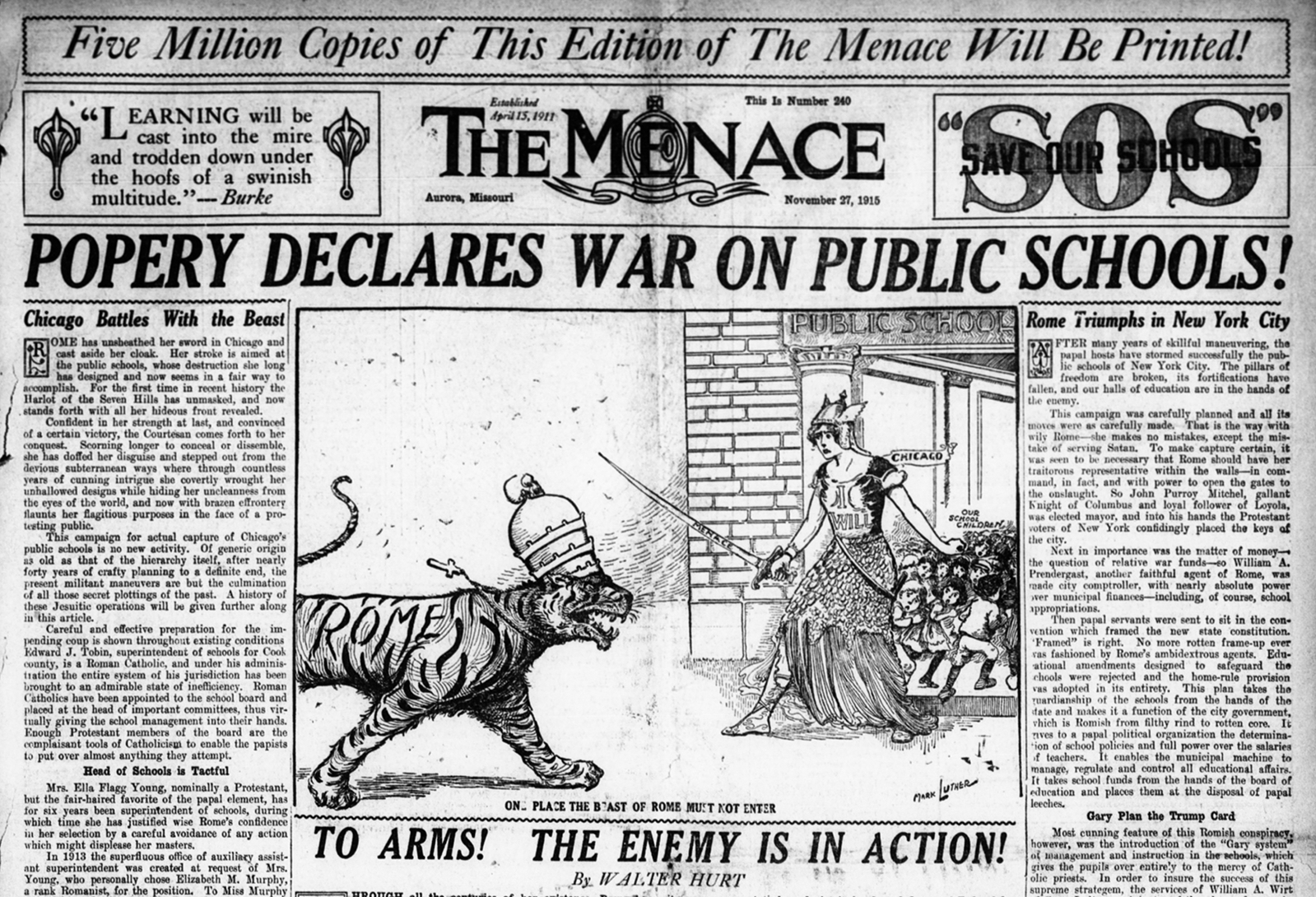
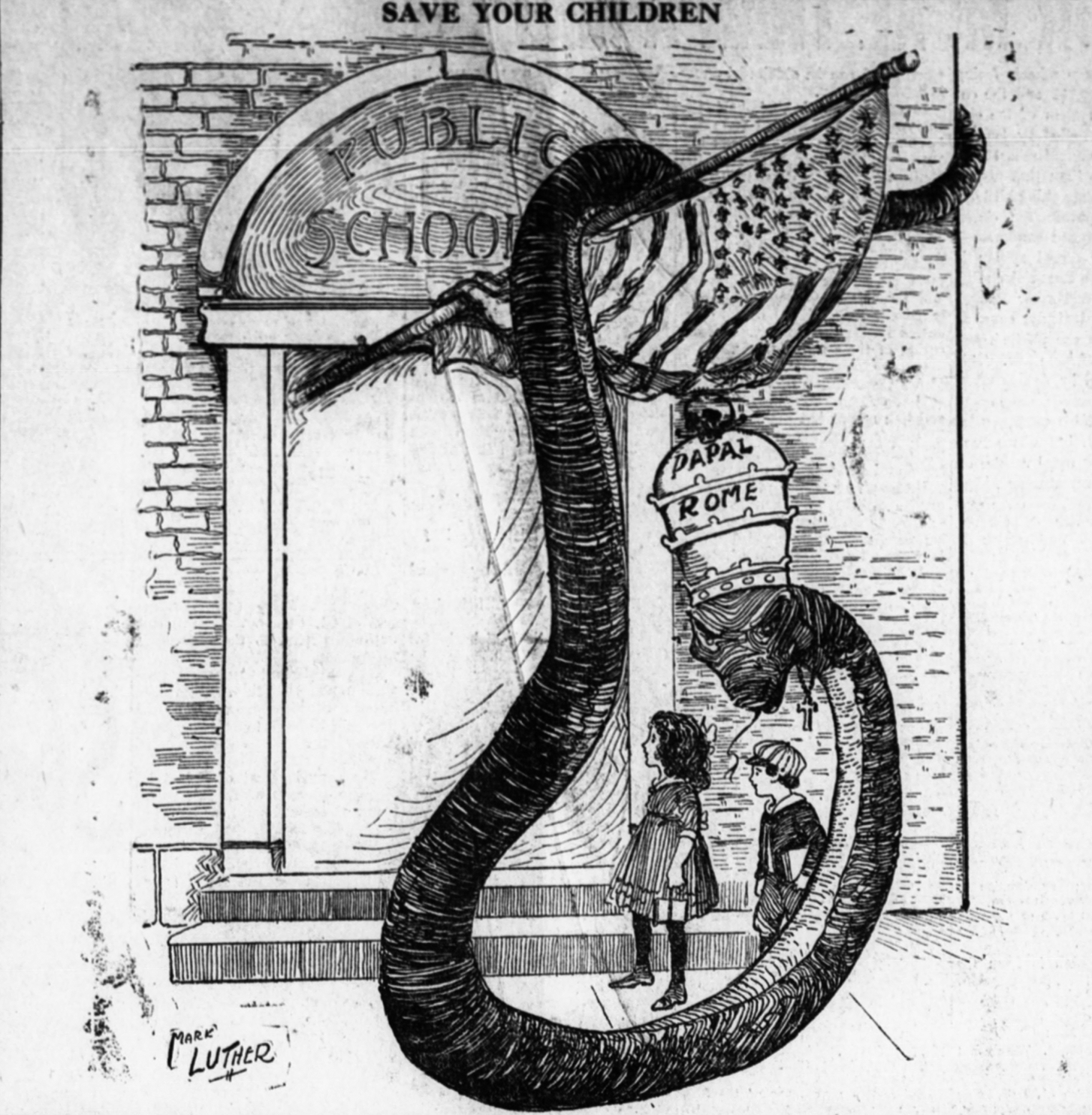
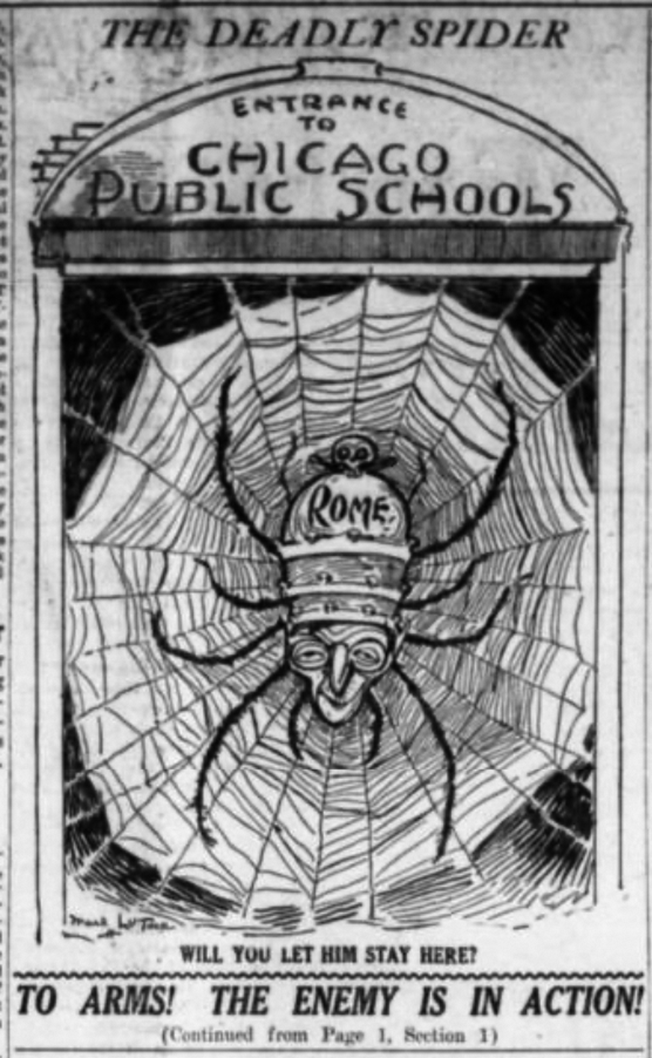
In November 1915, The Menace, a nativist newspaper based in Missouri, issued an “S.O.S.” to its 1.65 million readers about a “campaign for actual capture of Chicago’s public schools” that supposedly was the result of “forty years of crafty planning” by the Archdiocese of Chicago.Footnote 1 (Figure 1) The editorial alleged that a group of women primary school teachers, organized as the Chicago Teachers’ Federation (CTF) and formally affiliated with the Chicago Federation of Labor (CFL), was not a true union. Under the “masterful” control of Margaret Haley, their business manager and a well-known Catholic, they were “a cog in the papal machine of conquest,” founded to take over the school system, and “skilled in all Romish skullduggery.”Footnote 2 The Menace dismissed the Protestant religious affiliation of CTF president Ida Fursman as irrelevant, framing her as under the “domination” of Haley. The editor vehemently declared that “Miss Haley IS the Federation, and she also is an integrant [sic] part of the Romish fabric of intrigue.”Footnote 3 In The Menace’s depiction, Haley served at the whim of Archbishop of Chicago, installing Catholic teachers in every public school, ensuring Catholic women’s admittance to the normal schools, and bending the few remaining Protestant teachers to her will.Footnote 4 (Figures 2 and 3) The Menace saw a potential solution to the pernicious influence of Catholic women in public schools in a legal battle, dubbed the “Loeb Affair” by the press, taking place between the CTF and the Chicago School Board. By paying attention to how rhetoric surrounding the Loeb Affair relied on the combination of sexism and religious prejudice illustrated in The Menace’s treatment of Margaret Haley, this article argues that the pairing of anti-Catholicism and a fear of women’s power came together to undermine the unionization efforts of Progressive Era teachers.
Front page (detail) of the “S.O.S” issue of The Menace, November 27, 1915, addressing public education in Chicago and other cities where the editor believed the Catholic Church was attempting to control the public schools. Original in State Historical Society of Missouri, Columbia, Missouri. This image courtesy Library of Congress, Washington, D.C.

Figure 1. Long description
A scanned newspaper front page with a masthead at the top reading THE MENACE in large black letters. Above the masthead, a banner states Five Million Copies of This Edition of The Menace Will Be Printed. To the right of the masthead is a large graphic reading S O S SAVE OUR SCHOOLS. Below the masthead, a full-width headline reads POPERY DECLARES WAR ON PUBLIC SCHOOLS in bold capital letters.
The body of the page is divided into three columns. The left column is titled Chicago Battles With the Beast and contains text. The right column is titled Rome Triumphs in New York City and contains text.
The center of the page features a large political cartoon. On the left, a large tiger with the word ROME written across its striped flank and wearing a papal tiara on its head lunges toward the right. On the right, a woman wearing a crown labeled CHICAGO and a sash reading I WILL stands defensively in front of a building labeled PUBLIC SCHOOL. She holds a sword labeled THE MENACE and shields a group of small children cowering behind her. A caption below the cartoon reads TO ARMS! THE ENEMY IS IN ACTION! by Walter Hurt. A small line of text at the very bottom of the cartoon area reads ON... PLACE THE BEAST OF ROME MUST NOT ENTER.
The “S.O.S.” issue of The Menace contained several other cartoons, all signed by an artist, “Mark Luther.” Original in State Historical Society of Missouri, Columbia, Missouri. This image courtesy Library of Congress, Washington, D.C.

Figure 2. Long description
A black and white political cartoon. At the top, a headline reads SAVE YOUR CHILDREN. The background features the arched entrance of a brick building labeled PUBLIC SCHOOL. A massive, dark, textured serpent is coiled in an S-shape across the center of the frame. The top of the serpent's body is wrapped around an American flag on a pole. The serpent's head, positioned on the right side, wears a tiered papal tiara labeled PAPAL ROME. A small cross hangs from the serpent's neck. The serpent's mouth is open with a forked tongue protruding, facing toward two small children standing at the bottom center. The children, a girl in a dress and a boy in a cap holding a book, look up at the creature. The artist signature, Mark Luther, is located in the bottom left corner.
The “S.O.S.” issue of The Menace contained several other cartoons, all signed by an artist, “Mark Luther.” One dealt specifically with Chicago schools. Original in State Historical Society of Missouri, Columbia, Missouri. This image courtesy Library of Congress, Washington, D.C.

The Loeb Affair began while the CTF leaders were away on summer break. In August 1915, the Chicago school board’s new president, real estate developer Jacob M. Loeb, passed a rule that prohibited teachers from belonging to labor unions.Footnote 5 The rule, later referred to as the “Loeb rule,” targeted the mostly female grade school teachers, and it required the 3,869 CTF members—over half of the city’s 6,740 teachers—to sign an oath disavowing labor affiliation before they could receive their paychecks.Footnote 6 Loeb framed his objection to labor affiliation as an effort to ensure teacher quality and efficiency, but Haley believed his true motivation was to eliminate the CTF so he could cut salaries.Footnote 7 The CTF’s fight to maintain their labor affiliation continued until May 1917, when the day-to-day concerns of women who relied on their teaching salaries for subsistence overwhelmed more idealistic desires for nationwide teacher unionization.
Loeb did not mention religious affiliation in his initial ambush on the CTF, yet press coverage centered on Haley’s identity as a Catholic woman and the CTF’s Catholic affiliation by extension.Footnote 8 Even the Chicago-based, pro-worker periodical The Day Book, which protested that school fight as one between big business and ordinary people rather than between Catholics and Protestants, perpetuated the impression that the Loeb Affair was, at heart, about religion in public schools by constantly reporting the anti-Catholic rhetoric about Haley and the CTF.Footnote 9 Chicago officials took accusation about collaboration between the CTF and the Catholic Church seriously enough that the school board launched hearings into the rumors, drawing attention away from the issue of whether women teachers had the right to unionize. These rumors reframed the Loeb Affair from a conflict over salaries, pensions, and union membership into an endeavor to wrest the Chicago Public Schools system from the Catholic Church’s control.
In coverage of the conflict, Haley embodied the peril of Catholic women teachers, who were doubly intolerable in the eyes of the Protestant middle class. They were intolerable, first, as women who rejected the idea that teaching was simply an extension of the private sphere that women should be willing to do for low pay. Instead, Haley advocated for primary school teaching to be treated as a career with salaries equal to those of men that would allow working-class women to support themselves.Footnote 10 They were intolerable again because of their membership in the Catholic Church, an institution whose global nature had long drawn some to question the loyalty of its members.Footnote 11 During nearly two years that Haley and the CTF fought to maintain their formal affiliation with labor, inflammatory rhetoric about religious affiliation permeated the coverage of the Loeb Affair. The outrage emerged out of fears about power of unmarried, Catholic women to shape the minds of the next generation—a significant threat in a society that viewed education as necessary to form good citizens and as central to the continued existence of a democracy.Footnote 12
Previous scholarship on the Loeb Affair has overlooked the significance of how union-busters routinely paired gendered language and anti-Catholic rhetoric. In scholarship on Haley and the CTF, the Loeb Affair has appeared as part of the larger history of labor struggles and as a significant example of the difficulties teachers experienced in labor organizing because of their position as women. Marjorie Murphy’s Blackboard Unions discusses the Loeb Affair as an early example of how teaching—a female-dominated and ill-paid profession—made gender difference a central issue of a union movement.Footnote 13 More recently, Diana D’Amico frames the failure of CTF unionization as an example of how male labor leaders like Samuel Gompers let down women workers because of gender and class differences.Footnote 14 Finally, in School Reform, Corporate Style: Chicago, 1880–2000, Dorothy Shipps de-emphasizes gender and interprets the Loeb Affair primarily as part of a larger effort by Chicago’s big business to reform schools from above.Footnote 15 Little attention, however, has been given to the rhetorical role of religion in the episode, even in scholarship focused more closely on Haley.Footnote 16 By failing to consider class, gender, and religion as intersecting identities, the existing scholarship has flattened the complexity of an instance where Catholic women carried the double burden of their sex and their membership in a “foreign” church.Footnote 17 Without considering the role of gendered religious rhetoric—as well as religious tensions more broadly—scholars present an incomplete view of the tools that business interests used to combat union efforts to better working conditions and wages.
This article concentrates on the anti-Catholic rhetoric used to publicly disparage Haley and other Catholic women, which eventually contributed to the CTF’s disaffiliation from formal organized labor. After a survey of the Loeb Affair’s place in broader instances of education and anti-Catholicism, the article provides a brief biographical sketch of Margaret Haley before considering how the main figures involved in the Loeb Affair—Haley, Loeb, and their respective supporters—used gendered language as weapons to support or destroy the CTF. The article then moves on to examine how, as the conflict continued, newspapers increasingly drew a connection between the CTF and the Catholic Church. The work concludes by exploring how gendered panic and religious anxiety came together in school board meetings and how Haley attempted to mitigate the religious accusations.
In their adversaries’ eyes, the Catholic women of the CTF seemed doubly intolerable. These women’s very presence in public schools threatened to introduce Catholicism into a space that Protestants viewed as their domain, and these women also had the temerity to expect just compensation for their work.Footnote 18 Whatever the initial motivation of the Loeb Rule, anti-Catholicism became the weapon to defeat the economic and equality claims of women who demanded to be treated as professionals rather than as proxy mothers.Footnote 19 From this viewpoint, the Loeb Affair figures not only as a loss for organized labor and teacher organizing, but it also illustrates Progressive Era beliefs about competing ways of performing womanhood, the role of religion in public schools, and the ever-present fear of Catholic power. For the Loeb Affair’s duration, men in the press and on the school board accused Haley and the women she represented not only of being masculine and money-hungry, but also of being agents of the Catholic Church intent on taking over the public schools.Footnote 20
Catholic Women in the Public Schools
Loeb proposed his union-busting rule amid rising nativist fears about the power of Catholic women in Chicago, who had their first opportunity to vote in the mayoral election in April 1915.Footnote 21 In the weeks before the mayoral contest between Democratic nominee Robert Sweitzer and Republican nominee William Hale Thompson, a pamphlet circulated by a local nativist group, the American Public School Federation (APSF), spread reports that Catholic priests were encouraging their female parishioners to vote. The pamphlet implored Protestants to vote “for a mayor who is an American citizen and does not take orders from Rome.”Footnote 22 The same pamphlet warned that Catholic women also threatened society from inside the public-school classroom, stating that the majority of the female teachers were Roman Catholics. The APSF cautioned that these women intended “to make the ‘Public School System Catholic.’”Footnote 23 Within the context of the Midwest legacy of the American Protective Association and the formation of the second Ku Klux Klan, which was founded in Georgia the same year as the Loeb Affair and expanded its violence and prejudice to include Catholics and Jews, the religious rhetoric used in this union-busting effort must be taken seriously. While scholars typically associate Klan violence in the Midwest with the 1920s, the prejudice and conflict with so-called “hyphenated Americans” predated the Klan’s official arrival in the Midwest and provided fertile ground for it to take root.Footnote 24
The influx of Catholic women into public schools was hardly the product of a nefarious Vatican or archdiocesan plot that nativists imagined it to be. Nevertheless, Protestant fears about Catholic teachers’ influence in majority-Catholic Chicago were not exactly unfounded.Footnote 25 In 1909, the Archdiocese of Chicago comprised 1.15 million Catholics—the majority of whom lived in the city, which at the time had a population of nearly 2.2 million.Footnote 26 By 1908, Catholic young women who had attended Catholic high schools dominated the classes of Chicago’s normal schools.Footnote 27 These young women and their families recognized the upward mobility offered by the teaching profession, and they chose to prioritize it even as Protestant high schools emphasized preparing young women for motherhood as a “civic responsibility.”Footnote 28 By the time of the Loeb Affair, at least a third of the teachers identified as Catholic—a number that would grow to an estimated seventy percent by 1920.Footnote 29 Chicago’s demographics meant it was a city where Catholic women held real power to shape future generations and politics, making it a particularly illuminating space to examine how the men whose interests they threatened used these women’s religious and gender identity as weapons against them.
The Menace special issue on the Loeb Affair, as well as that publication’s broader dedication to chronicling Chicago’s battle with the “beast” of Catholicism, illumines the connections between fears of women’s power, unions, and Catholic control that came to characterize the entire event.Footnote 30 While press treatment of Haley is a particularly salient example of how these factors coalesced during the Progressive Era, it was certainly not an isolated event. The Menace followed what nativists perceived to be the encroachment of the Catholic Church on public schools in states like New York, Minnesota, and New Mexico.Footnote 31 In Minnesota, Archbishop of St. Paul John Ireland launched two schools, modeled on underfunded public schools in Poughkeepsie, New York, where local school boards rented out Catholic parochial schools for a small fee. This process allowed Catholic schools to function as public schools with taxpayer funding while maintaining their existing staff of primarily Catholic nuns. The arrangement was short lived, and it dissolved under press pressure after two years.Footnote 32 The Menace warned that Bishop Ireland sought to establish normal schools so that he could provide more “vestal virgins” as teachers with the goal of controlling the future generation.Footnote 33 Protestant outrage surrounding women religious teaching in public school or parochial schools receiving taxpayer support might be expected in the time period, but the Loeb Affair coverage centers on a more unusual situation: uproar over lay women in public schools. The danger no longer came only from within the convent but also from unmarried laywomen adorned in ordinary clothes.
The Loeb Affair is one milestone in the longer history of Protestant and Catholic disputes over education that had raged, with varying degrees of violence, since the Antebellum era.Footnote 34 Haley and other members of the CTF were far from the first Catholic women to face this kind of gendered anti-Catholic rhetoric. In the Early Republic and Antebellum period, another group of teachers, Ursuline nuns in Louisiana and Massachusetts, drew the ire of Anglo-Americans, who saw their financial security, extensive property, independence from male authority as a challenge to American Protestant gender norms.Footnote 35 In 1834, the conflict even escalated to violence when an angry mob burned to the ground the order’s convent in Charlestown, Massachusetts. In this instance, class, gender, and religious anxieties came together to foment violence.Footnote 36 The public school system, as it emerged in the 1840s and 1850s, served as a foil to convent and parochial schools, with Protestant school teachers presented as the opposite of power-hungry Catholic women religious teachers.Footnote 37 In the case of Progressive Era Chicago, the public school system had failed to fulfill that goal; once again, education lay in the hands of Catholic women teachers. A closer look at the Loeb Affair illustrates the very real-life consequences of this kind of anti-Catholic rhetoric while also revealing the centrality of women and gender to anti-Catholicism. Just as in the 1840s, the mere fact that Catholic women held real power in schools intensified the anti-Catholicism from mere vitriol in newspapers to actual action against them.
Despite the more than fifty years that had elapsed, the rhetorical connections between anti-Catholicism directed at women in the 1840s and the Progressive Era still held power. As historian Justin Nordstrom argues, the “Menace repackaged anti-Catholic tropes from the 1840s in ways that would appeal to a Progressive Era audience,” marrying “themes of progressivism, masculinity, and nationalism” with “the broader framework of America’s long-standing anti-Catholic traditions.”Footnote 38 Anna Lowry’s 1914 tour to promote her pamphlet Rome’s Awful Persecutions of Anna M. Lowry harkens back to the days of the 1836 bestseller The Awful Disclosures of Maria Monk. Footnote 39 Newspaper headlines like “Ex-Nun Anna Lowry Coming to Buffalo to ‘Expose’ Convents,” as well as the court case surrounding her allegations against the Catholic Church, underscore the persistence of antebellum anti-Catholic rhetoric during the Progressive Era.Footnote 40 Rather than the anti-Catholic literature of the Antebellum era, the Progressive Era had the muckraking-style news coverage to the same end—warning against the danger of letting single, Catholic women teach children.
While Haley was not a member of a religious community, the resonance between these earlier examples and the events of the Loeb Affair adds to the historical understanding of how anti-Catholicism emerged in conflicts over women and education, bringing the discussion out of the expected focus on women religious and the expected time period of Antebellum America. Unlike in the more overtly religiously motivated antebellum examples, the women of the CTF had entered public school classrooms instead of convents. Rather than using their habits and roles as Brides of Christ to defend their status as unmarried women, the Catholic laywomen of the CTF turned to secular tools—the courts and labor organizing—to argue for respect for their status as workers, equality with men, and autonomy in their schools. Examining the Loeb Affair through the lenses of gender and religion reveals that early twentieth-century nativists viewed Catholic laywomen as just as threatening as their more easily recognizable counterparts.
Our Joan of Arc, Margaret Haley
By the time of the Loeb Affair, Margaret Haley, the daughter of Irish-Catholic immigrants and a former grade school teacher, was a known entity among Chicago unionists and labor organizers around the nation.Footnote 41 Born near Joliet, Illinois, in 1861, Haley was raised with her Irish-Catholic mother’s emphasis on the value of education, and she turned her hand to teaching at the age of sixteen when her father’s financial troubles required her to contribute income to the family budget.Footnote 42 A few years later, she found a teaching position at the Hendricks School on Chicago’s South Side, a neighborhood later immortalized in Upton Sinclair’s The Jungle (1906). Haley would teach there for sixteen years before leaving teaching in 1900 to take a full-time position with the Chicago Teachers’ Federation.
Haley’s work on behalf of Chicago teachers began in December 1899. When Chicago public schools adjourned for Christmas, Haley used her brief freedom to instigate what newspapers would later call a “crusade against a condition of monopoly, dishonesty[,] and grief almost beyond belief.”Footnote 43 Haley initiated a legal battle against Chicago’s big businesses, suing the notorious Pullman Company and fifteen other utility and railroad companies for evading property taxes. Haley won her case, forcing Chicago companies to pay $600,000 in back taxes, a portion of which went directly to school funding. After higher salaries for women teachers failed to materialize, Haley, with the help of Catherine Goggin, another Catholic woman, formally affiliated the recently organized CTF with the CFL and the American Federation of Labor (AFL), making the CTF the first group of labor-affiliated teachers.Footnote 44 Unions and suffragists dubbed Haley “the Teachers’ Joan of Arc” for her efforts to gain higher pay for primary source teachers, and she toured the United States speaking about labor organizing and promoting worker reforms and women’s suffrage.Footnote 45
Like many other working-class Catholic women of Irish descent at the turn of the century, Haley chose to remain unmarried and turned to teaching as the best-paying occupation for Catholic women. This decision was not only sanctioned by Progressive Era ideals about the New Woman but also by Irish Catholic gender norms.Footnote 46 The harsh realities of the Irish potato famine, the costs of marriage, and the key role that single Irish women played as the first immigrant in chain migration all led to singleness as a viable life choice even for women born a generation or two later.Footnote 47 Haley exemplifies the thousands of Irish Catholic women who also eschewed marriage. However, at a time when the American Catholic Church dedicated itself to answering the mandate from the Third Plenary Council in Baltimore (1884) that every Catholic parish must have a school and Catholic parents must send their children to Catholic schools, Haley and the other Catholic women teachers opted against entering religious life and offered their teaching efforts to the public school system.Footnote 48 In doing so, they rejected the Protestant Cult of True Womanhood, which elevated marriage and motherhood, as well as the Catholic celebration of the work of consecrated virgins.
Haley’s autobiography, which she completed shortly before her death, sheds light on how Catholicism functioned as a guide rather than as a binding authority in her life. Haley gave credit to Rev. Thomas Edward Shields, noted Catholic progressive who wrote on philosophy, education, and teacher training, for the “widening of her mind” to the need for teachers to have academic freedom.Footnote 49 Shields spoke at a Catholic summer school in Madison, Wisconsin, where Haley drew inspiration from female educators from across the Midwest. She also praised Catholic schools, particularly those run by the Dominican nuns, whose schools she called “years ahead of the public school system” because of how they fostered independence. Gesturing to the Americanist bent of her Catholicism, Haley added that Shields came from the Archdiocese of St. Paul, in Minnesota, where Archbishop John Ireland “fought a great battle for the Americanization of the people he shepherded.”Footnote 50 By positioning herself with the church’s more liberal wing, Haley aligned herself with an American Catholicism that was friendlier toward labor and supported more active roles for women.Footnote 51
One particular anecdote recounted in Haley’s autobiography highlighted the relationship between her faith and her feminist activism. When asked to side with a Democratic politician who wanted Haley to stop agitating for teachers’ rights because they “were all Irish Catholics and ought to stand together,” Haley replied, “I’d be damned if I’d stand with any Catholic, Irish or Dutch or anything else, who’d defend procedure like that of the State Board.” However, she clearly saw her actions as consistent with her identity as an Irish Catholic: “I’m putting that down now not only because” independence of thought has “always been my creed” but also because “it’s the creed of so many others of my faith and race.”Footnote 52 Haley understood her positionality as an Irish Catholic woman not as something that required her to bow to the influence of men in her ethnic and religious group, but rather as an ideology that supported her outspokenness.Footnote 53
As the Loeb Affair illustrates, Haley’s Catholic identity and her insistence on standing up for her beliefs made her a common target of both the school board and the anti-Catholic press. Non-Catholics repeatedly accused Haley of being a pernicious agent of the bishop throughout her decades of activism in Chicago. These brief biographical anecdotes illustrate how Haley understood her position as an unmarried lay woman occupying a liminal space between Catholic elevation of consecrated life and Protestant celebration of married life. As many upwardly mobile Catholics increasingly embraced Protestant ideals of womanhood as markers of respectability, working-class Catholic women—faced with the harsh realities of a low pay and a school system that prohibited married women from the profession—took a different approach.Footnote 54 Haley remained a lifelong Catholic, but she turned to women’s rights and unionism as tools to navigate the difficult nature of a woman’s life in the Progressive Era.
Religion up in Front of the School Board
Issues of religious affiliation surfaced in the summer of 1915 before the Loeb Rule had even passed. By then, allegations of Haley’s interference in the public school system had been building for several years. In 1913, a newspaper account accused Chicago superintendent of schools Ella Flagg Young of allowing Haley to run the school systems and to dictate her words in interviews.Footnote 55 Two years later, the same allegations reappeared in a Chicago newspaper, in which editors claimed that Chicagoans had long known that the CTF, which they referred to as “the well-known religious ring,” had used the “weak-kneed administration of Mrs. Young” to dictate teacher appointments according to their “sectarian” interests.Footnote 56 In July 1915, the Baldwin Commission, a state investigation into public school finances, made the connection official and launched an inquiry into Haley and superintendent Young.Footnote 57
This investigation was made possible, in part, because adversaries could use stereotypes about women’s fragility and incompetence to paint Young as easily led by a strong personality like Haley. During Young’s testimony before the Baldwin Commission, she felt the need to disabuse the school board of the notion that she was a Catholic.Footnote 58 Young expressed her reticence to publicize that she was not a Catholic because it might have appeared disrespectful to Catholics, but the outlandish nature of the claims had forced her to address them. Newspaper reports said that Young had an altar in her hotel room, attended daily Mass, and that she had a son who was a Catholic priest.Footnote 59 The childless and unmarried Presbyterian hoped that by clarifying her religious affiliation, the commission could return to issues of teacher pay and how to best use taxpayer money to support the public schools. Even in the case of a non-Catholic woman, religious rhetoric could be used to inflame passions and distract from efforts to gain equal pay.
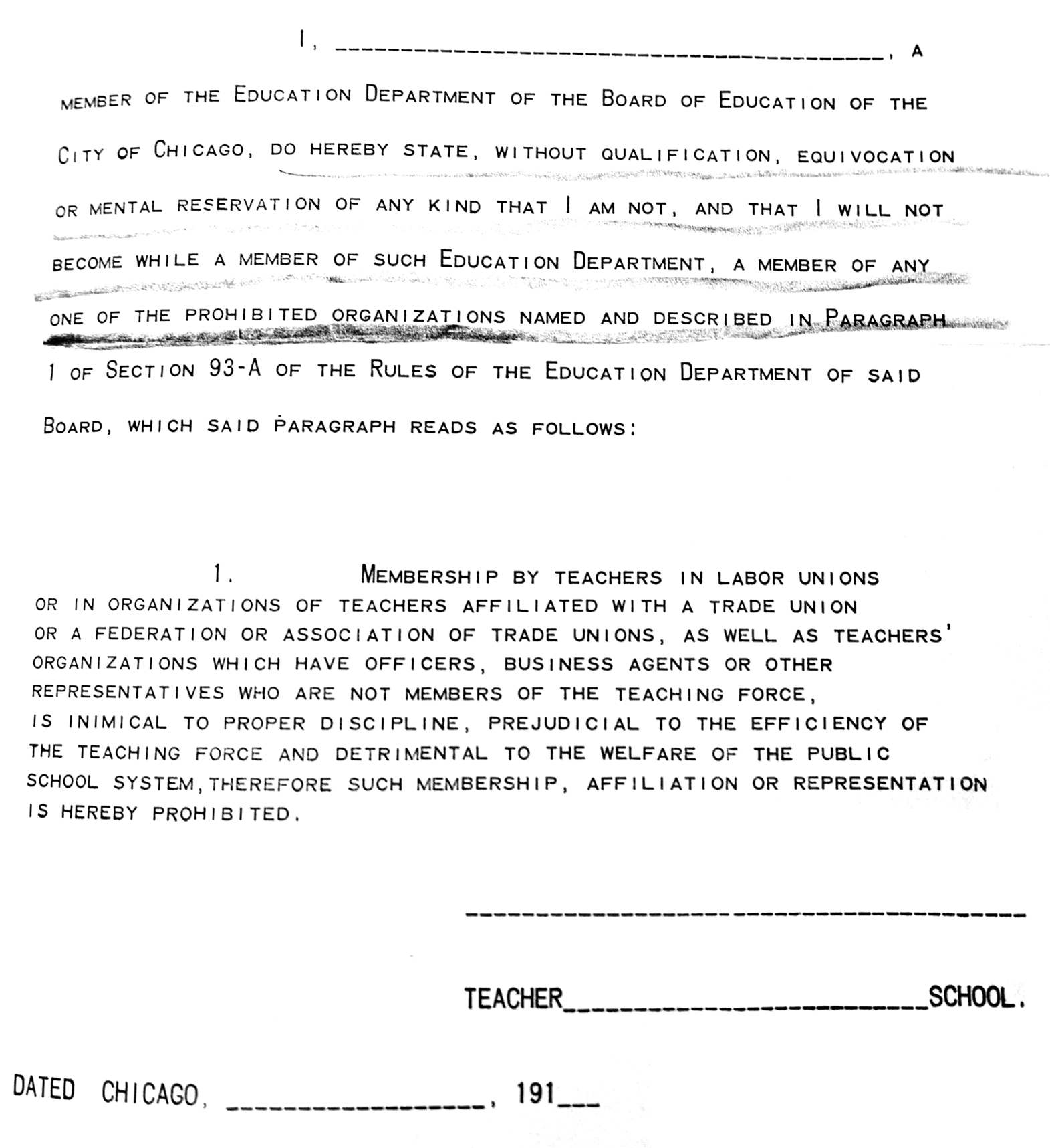
Young’s entreaty for the board to move past the religious issue fell on unreceptive ears, and so the board turned to questioning Haley. The Day Book reported in September 1915 that Haley had declined to answer questions about her religious affiliation.Footnote 60 Rather than engaging with accusations about the CTF and Catholicism or pointing out the anti-Catholicism in the Loeb Affair, Haley turned to the courts to counter Loeb’s attack. With the help of attorney Isaiah T. Greenacre, who had represented the CTF in its suits against tax evasion in 1899, Haley filed an injunction against the Loeb Rule that, while it forced the school board to amend its wording, did little to ameliorate the issue.Footnote 61 Subsequent appeals failed, and the school board presented the CTF’s 3,869 members with a pledge to sign.Footnote 62 Haley turned to the courts again in hopes of blocking the rule, and she warned her teachers not to sign the oath. In a pamphlet reminding teachers to persevere in rejecting the Loeb Rule, the CTF and its legal team assured its members: “Your interest, Teachers, and the interests of the children, will be sacredly guarded now as in the past.”Footnote 63 The pamphlet included no mention of anti-Catholicism. (Figure 4)
The text of the Loeb Rule as saved in the Chicago Teachers’ Federation collection. Correspondence: July–Sept. 1915, box 43, Chicago Teachers’ Federation Records, Chicago History Museum, Chicago, Illinois.

Figure 4. Long description
The document is a typewritten form with blank lines for signatures and dates.
At the top, a line begins with ‘I,’ followed by a long dashed line and the letter ‘A’.
The first paragraph states: ‘MEMBER OF THE EDUCATION DEPARTMENT OF THE BOARD OF EDUCATION OF THE CITY OF CHICAGO, DO HEREBY STATE, WITHOUT QUALIFICATION, EQUIVOCATION OR MENTAL RESERVATION OF ANY KIND THAT I AM NOT, AND THAT I WILL NOT BECOME WHILE A MEMBER OF SUCH EDUCATION DEPARTMENT, A MEMBER OF ANY ONE OF THE PROHIBITED ORGANIZATIONS NAMED AND DESCRIBED IN PARAGRAPH 1 OF SECTION 93-A OF THE RULES OF THE EDUCATION DEPARTMENT OF SAID BOARD, WHICH SAID PARAGRAPH READS AS FOLLOWS:'
Below this, a centered number ‘1.’ precedes the text of the rule: ‘MEMBERSHIP BY TEACHERS IN LABOR UNIONS OR IN ORGANIZATIONS OF TEACHERS AFFILIATED WITH A TRADE UNION OR A FEDERATION OR ASSOCIATION OF TRADE UNIONS, AS WELL AS TEACHERS’ ORGANIZATIONS WHICH HAVE OFFICERS, BUSINESS AGENTS OR OTHER REPRESENTATIVES WHO ARE NOT MEMBERS OF THE TEACHING FORCE, IS INIMICAL TO PROPER DISCIPLINE, PREJUDICIAL TO THE EFFICIENCY OF THE TEACHING FORCE AND DETRIMENTAL TO THE WELFARE OF THE PUBLIC SCHOOL SYSTEM, THEREFORE SUCH MEMBERSHIP, AFFILIATION OR REPRESENTATION IS HEREBY PROHIBITED.’
At the bottom of the page are signature and date lines. A long dashed line is followed by ‘TEACHER’ and another dashed line ending in ‘SCHOOL.’. The final line reads ‘DATED CHICAGO,’ followed by a dashed line and ‘191___’.
Gender and the Schools
Neither Haley nor Loeb felt content with leaving the union’s fate to the courts. While avoiding the topic of religion, each appealed to the public for support in speeches that centered on the proper roles and sphere of women. These public debates, as recorded by stenographers, reported in newspapers, and saved in the archives of the Chicago Teachers’ Federation, took place in the first months after the Loeb Rule passed and demonstrate how both sides contested the virtue of women who worked outside the home and involved themselves in labor struggles.
Loeb’s arguments about the role of labor organization had an undeniably gendered nature. After detailing the “frenzied feminine finance” of the CTF, by which he meant the ways women teachers did not understand the budget and only looked out for their own financial benefit, Loeb turned to praising the Federation of Men teachers. He declared that he did not oppose the CTF because it was “a labor organization.” Rather, he opposed the CTF because of its “pernicious” influence. Drawing upon the connections between masculinity and unions, Loeb expressed his support for the Federation of Men teachers, whom he said had “acted gentlemanly and squarely.”Footnote 64 The next day, Loeb denounced the CTF as “bad” and “in the grip of Margaret Haley.”Footnote 65 He repeatedly denied the agency of CTF members, whom he said Haley guided through coercion and manipulation.Footnote 66 The problem here seemed to be Haley’s very womanhood and her trespass upon the management of institutions that middle and upper-class men such as Loeb believed they should control.Footnote 67 Loeb spoke better of the male teachers, and the school board also paid these teachers significantly better. Whereas female elementary teachers earned a starting pay of $550 a year that topped out at $850 after six years, male elementary school teachers started at $900 and reached their maximum salary of $1,000 after only two years.Footnote 68 In this way, rhetoric and finances each vividly illustrate the lack of respect that the school board had for the female teachers.
In an August 1915 speech before the Chicago Federation of Labor, Haley quoted from a transcript of Loeb’s statements to the Senate commission on the Chicago Public Schools where he articulated how he viewed a labor slugger versus a lady labor slugger. Quoting Loeb, Haley declaimed: “the labor slugger will go out and hit a man over the head with a lead pipe, and he’s got a chance of recovery, but the lady slugger has a poisoned tongue and assassinates a man’s reputation, from which he cannot recover.”Footnote 69 According to Haley, Loeb went on to accuse the women of assassinating the character of male members of the school board. Newspaper reports confirmed Haley’s characterizations of Loeb’s comments about women union members.Footnote 70
Haley responded to the assertion vehemently, noting that the “the ‘lady slugger labor slugger’ phrase” was “printed from New York to San Francisco in the papers,” and it had given the nation a bad impression of Chicago’s women teachers.Footnote 71 In September, Haley once again censured Loeb and the school board for besmirching the reputation of those teachers.Footnote 72 Haley said the CTF aimed to “find out whether it is a criminal act to destroy an organization” and to defame the character of that organization’s members. She asked whether “four thousand public school teachers, women in this city, to whom the people have invested their dearest charges, the children” could be defamed without “redress in law.” Haley insisted that teachers deserved fair wages equitable with those of men, and she rejected the idea that female teachers had been lured away from their duty by the special interest of profit, declaring that their “first interest and last interest is the children.”Footnote 73 While accepting the argument that women were naturally well-suited to care for children, Haley rejected the idea that requesting a fair wage would undermine or corrupt their womanly abilities.
Haley and Loeb’s supporters also used gendered language to defend their stances on the Loeb Rule. School board member William Rothman, whom Haley identified in her autobiography as an “ancient enemy,” used arguments about the proper sphere of women to paint the CTF in a negative light.Footnote 74 Like Loeb, Rothman declared that the school board had no issue with organized labor, but he questioned the propriety of women belonging to a union.Footnote 75 In a speech given to the County League of Women’s Clubs, Rothman argued that involvement in politics corrupted women’s ability to care for children. The CTF threatened the “preservation of civilization” by endangering the public schools, which he framed as “the great melting pot into which run the streams of little boys and girls from the home of immigrants.” He faulted the teachers who, by requesting pay increases and reduced overtime, demonstrated the “half-hearted” nature of their teaching—a “service that she grudgingly gives, only so many hours and minutes per day for so many dollars and cents a day.”Footnote 76 This argument reflected the idea of a wife’s work never being done, illustrating how the devaluation of women’s labor in the home undermined women’s professional positions in the workforce.
Rothman’s argument also reproduced discussions about whether women could be considered workers. He argued that teaching was a proper occupation for women because, like the home, it was a non-profit institution. Unlike factories, public schools should attract those motivated by the desire to do good rather than the desire to earn a wage. In decidedly religious language reminiscent of the altar of nation rhetoric used during the Civil War to justify the sacrifice, Rothman declared, “[S]he is the high priestess, serving upon the altar of the public school.”Footnote 77 Ironically, non-Catholic members of the school board wanted teachers to surrender their interests for the good of children—an expectation strikingly similar to how Catholic bishops relied on and sometimes coerced the unpaid labor of women religious to keep parochial schools running and solvent.Footnote 78
Haley’s supporter, John H. Walker, a prominent Illinois labor leader from the turn of the century until the Great Depression, framed the men who attacked the CTF as not fulfilling their masculine role of protecting women. Calling upon middle-class manly virtues, Walker asked, “Can there be anything lower than a man who will make his living as a cowardly assassin of women’s characters in order to serve an interest” and drag “women down in the mud?”Footnote 79 Walker’s reference to the condition of women echoed Progressive Era rhetoric that used gender difference and the position of women to pass protective labor laws. While Loeb’s supporters disparaged the CTF for violating the norms of womanhood, Haley’s supporters faulted the male school board members for failing to fulfill the manly role of protecting the so-called weaker sex.
Catholic Power in the Public Schools and Public Perception
As Haley and Loeb debated the Loeb Affair in gendered terms, Chicagoans reframed it as a religious contest. A particularly strident letter to the editor published in The Day Book illustrates how nativists blamed the public-school budget shortage on Catholics. The anonymous author declared that, if the city removed church influence, there would be “money enough to pay everything and give the teachers a good raise in pay, and, after all, it is [the] pay they want.”Footnote 80 Midwest nativists like this one blamed a myriad of problems on Catholic graft rather than the greed of robber barons.
Concerns about Catholic influence also seeped into the labor debate, casting the conflict as one about Catholic power rather than teachers’ rights and wages. A letter to the editor, signed by a Chicagoan named W. H. Miller, suggested that the central issue lay with the assumption that Catholics controlled unions in Chicago. In the pages of The Day Book, Miller declared that the CTF was “owned, backed and run by the Catholic Church in the efforts to ‘Make America Catholic.’” In fact, he stated that it was a “well known” fact “that every labor organization in America is dominated by the Catholic church.”Footnote 81 Miller’s belief that the Catholic Church in Chicago held labor under its sway possibly came from the friendly relationship that often existed between churches with working-class congregations—among which Catholic parishes were often the most prominent—and labor in the Gilded Age and Progressive Era.Footnote 82 Reinforced by Pope Leo XIII’s Rerum Novarum (1891), Chicago Catholics in the early twentieth century forged a bond with the more conservative American Federation of Labor, which disavowed socialism.Footnote 83 The religious rhetoric surrounding the Loeb Affair shows the connections—both perceived and real—between labor and Catholicism that led to people like Miller to deduce Catholic control. In a postscript, Miller suggested that The Day Book was under the Catholic Church’s sway, insinuating that the denomination funded the paper as long it discussed Catholicism positively. “[If] you think you would lose patronage by publishing the attached letter, then please return to me and I will use it elsewhere,” concluded Miller, emphasizing the idea that the Catholic Church used material wealth to control society.Footnote 84
The Menace also explored this connection in its issue dedicated to the Loeb Affair, which included an article titled “Catholics Fool Labor Unions in School Fight” that faulted organized labor for supporting the CTF.Footnote 85 The nativist periodical denied that the CTF was a real union, noting that nothing about it identified it with trades, so “such association must be for some ulterior reason.” The Menace contended that teachers could not be formally affiliated with labor with “propriety” because teachers ought to represent the broader community’s interests not the “profit” of individuals. Turning to an anti-Catholic argument, the article’s author added that “the rank and file of the labor unions are being shamefully befooled” because “their romish leaders” have induced them “to fight the battle of an organization of Catholics and an unrighteous cause.” Naming the CTF, the editorial argued, “It is managed sole[ly] in the interest of Rome and to aid her attempts to acquire complete control of public schools.” They underscored their claim by pointing to the Catholic faith of the president of the CFL, John Fitzpatrick.Footnote 86 Comparing the CTF and CFL to New York City’s notorious Tammany Hall, the article blamed “this Catholic element” for labor’s mistakes and said that Rome would “wreck the labor unions as well as the school” if these efforts were allowed to continue.Footnote 87 While The Menace purported to be on the side of organized labor, its editorial used allegations of Catholic affiliation to undermine two of the most influential labor organizations in Chicago.
In December 1915, Haley took to the pages of her eponymous bulletin to lament that the school unionization debate had been turned into a religious matter. “Public opinion is confused,” wrote Haley. “For into this profound democratic struggle has been injected a false issue, that of religion.” In Haley’s mind, this was a battle between big business and the working class. She continued, “the big Catholics are at one purpose with the Big Protestants and the Big Jews.” Still, she identified that “a ripple of the anti-papal panic has upset some. To them[,] it has been made to appear that the fight is one for religious freedom in the schools, a delusion which is the tradedy [sic] of it all.”Footnote 88 Haley recognized that the debate had shifted toward a focus on religious affiliation rather than the exploitation of workers, illustrating the utility of stoking fears about the pernicious Catholic efforts to infiltrate schools that had motivated violence and discord since the Antebellum era. Even while integrating themselves into secular society, Haley and the other Catholic members of the CTF experienced discrimination because of their faith. Newspaper reports indicate that the non-Catholic public also viewed the CTF’s non-Catholic members as suspect and dangerous because of their association with Catholics.Footnote 89
The “Fire of Religious Prejudice”
When the issue of the Loeb Rule returned to the school board in 1916, the focus on religious affiliation had only intensified. In June, the school board had declined to renew the contract of sixty-eight teachers, citing that some teachers were “inefficient” while others were guilty of “insubordination.” The number included the CTF’s president, secretary, and directors, two board members, as well as Haley’s niece and sister.Footnote 90 Religion and gender immediately rose to the forefront as an explanation. The Day Book’s editor reported that the real reason behind the layoffs was that “Big Business” hated the CTF because they were a group of women who advocated for a living wage. To hide their real motivation, Big Business had fanned “the fire of religious prejudices” to make “Protestant parents believe that the Catholic church was trying to control the school system, and that the Catholic church controlled the Teachers’ Federation.” A few pages later, the publication reported that Loeb fired the teachers because he “didn’t agree with the religion or labor union habits of a big part of them.”Footnote 91 The Loeb Affair had been so thoroughly reframed as an issue of religious affiliation that even The Day Book could not consistently report on it as a conflict over wages.
For her part, Haley declined to discuss religion during a council session that papers reported centered on religion. In testimony given before the city council’s investigation in July 1916, Haley spent two hours detailing her objections to Rothman’s treatment of teachers and the Board’s failure to renew the contracts of sixty-eight well-qualified Chicago teachers. Yet the outspoken Haley refused to broach the topic of religion.Footnote 92 In fact, throughout the Loeb Affair, with the exception of the regrets expressed in her Bulletin, Haley left it to others to speak out about the Catholic Church’s role in the CTF. Absent her own words on the topic, one can only offer conjecture regarding her motivation. Was Haley reticent to deny the role of Catholicism in her own life and those of the CTF’s Catholic members, or did she simply see financial issues as more important to the debate? She might also have feared that addressing the allegations would only cause the CTF further harm.
While Haley remained silent, popular perception of the Loeb Rule as religiously motivated pervaded the session. During the same meeting, Elizabeth De Velde, a member of the anti-Catholic organization the Guardians of Liberty, alleged that three teachers “had a permit to conduct” catechism classes on public school property that was quickly revoked when it was brought to the attention of officials. One of these teachers, asserted De Velde, had since become a nun.Footnote 93 On the other side of the debate, Parker H. Sercombe, the editor of Chicago radical reform journal To-Morrow and former statistician for the school board, testified to the anti-Catholicism among school board members.Footnote 94 He said that “his successor” had “threatened to have the leaders of the Teachers’ federation, the anti-Thompson teachers, and the Catholic teachers dismissed.” Sercombe’s successor had “the death of the federation” as a “constant daily theme with him,” and he referred to Catholic teachers as “those with crosses on their backs,” suggesting that their identity as Catholics marked them as targets for removal.Footnote 95
One board member, the recently appointed Max Loeb—who, despite the shared surname, was not related to Jacob Loeb—agreed with Haley that the religion question had been brought into the Loeb Affair to arouse outrage from the public, but he continued to discuss it. At the time of his appointment, a Jewish newspaper praised the appointment of Max Loeb as evidence of Mayor Carter Harrison’s “admirable determination” to free the schools from “Haleyism and clericalism in the operation of the schools.” The Sentinel trusted Max Loeb would “fight for the exclusion of religious politics from the schools” and could “be relied upon to support the efforts so bravely made by Jacob M. Loeb.”Footnote 96 By 1916, Max Loeb had not met these expectations. In a statement, Loeb declared himself “absolutely free from either pro-Catholic or anti-Catholic prejudices” because of his identity as a Jew. Because of those credentials, he hoped people would believe him when he said that “after [a] diligent search,” he had been unable to “one scintilla of evidence to show that the Catholic Church controls the Teachers’ Federation.” He concluded that the “religious question” had been “dragged in by the heels” to “justify an arbitrary, ruthless and cruel procedure.”Footnote 97 Max Loeb clearly reframed the Loeb Affair as being about breaking union power rather than about breaking Catholic power.
Privately, one school board member, Dr. Clemensen, demonstrated that ill feeling toward Jacob Loeb personally did not equate with support for the CTF. Albertine Raven, one of the sixty-eight teachers, wrote to Haley an account of her interview with Clemensen. Despite being “tired of Loeb’s domination,” Clemensen still believed that women teachers had no right to be affiliated with labor because they should not willingly be “placed on the level with barbers, bar-tenders, hod carriers, etc.” Clemensen also shared his belief that the CTF oppressed “a considerable minority of teachers.” He claimed that one CTF teacher had told him, “I had to join. Teachers in my school said[,] ‘The Federation is a Catholic institution, you are a Catholic, therefore, you should join it.’” Craven concluded her letter with an observation: “The things that seemed most intensified were his hatred of Mrs. [Ella Flagg] Young, of you [Margaret Haley] and labor organizations.”Footnote 98 Here also criticisms of women’s assertiveness, union membership, and fears about Catholicism appeared alongside one another.
Labor-affiliated sources continued to discuss the fabricated connection between religion and the union. Ed Nockels, Secretary of the Chicago Federation of Labor, framed Jacob Loeb as manipulating the debate over the CTF for his “own aggrandizebent [sic].” Nockels alleged that, in order to get support from both Protestants and Catholics, Loeb “relit the fires of religious controversy” and played “both ends against the middle.” Nockels related how Loeb purportedly said that he “discharged the 68 teachers” not as an act of “hostility toward union labor,” but because he had “to do it to prevent domination of the schools by the Catholic church.” Nockels also asserted that Jacob Loeb framed Margaret Haley as a tool of Archbishop of Chicago George Mundelein, saying that she called on the Catholic leader “at frequent intervals” to receive instructions on how to proceed. Nockels’s speech went on to reject that Haley took instructions from the archbishop, and he presented Loeb as unscrupulous, writing that “Catholic Aldermen do not hear Loeb’s anti-Catholic utterances, which are reserved for non-Catholic ears.” In Nockels’s conception, Loeb was guilty of “intrigue and plotting.”Footnote 99
To the very last weeks of the fight against the Loeb Rule, the people of Chicago discussed it as a religious matter.Footnote 100 One alderman contended that the firing of competent teachers could not have taken place if not for the use of religious panic to “cover up their real objects.” He argued that many of those who had voted for the Loeb Rule initially had done so because they saw it as an opportunity to free themselves from “Catholics[,] whose presence they resent,” but they found later they had been deceived when many of the fired teachers turned out to not be Catholic. He declared that “[t]he religious end of the outrage is bunk, used to further the interests of big businessmen.”Footnote 101 Another school board member called the “religious question” a “controversy [that] has been stirred up in the dark,” adding that it was “permeating” the entire city government. He concluded, “Someone is making political capital out of religious feeling. It is up to this council to get to the bottom of this rotten mixture of politics and religion that has been going on in this town for a year or more.”Footnote 102 These comments signal that religious conflict shaped not only the school board but Chicago politics more broadly, suggesting that fear of Catholic power may have permeated the general political context in Chicago at the end of the Progressive Era more than previously understood.
Conclusion
Repeated attempts by the Chicago Teachers’ Federation, organized labor, and their supporters on the Chicago School Board proved insufficient to destabilize the Loeb Rule. On May 21, 1917, Margaret Haley removed her 3,869 members from the Chicago Federation of Labor and from the American Federation of Teachers. This removal allowed the dismissed teachers to be reinstated in Chicago public schools with the tenure protection of the newly passed Otis Bill, but it also meant the end of fifteen years of formal labor affiliation for female teachers in Chicago.Footnote 103 Scholars have marked how Haley’s defeat in the Loeb Affair left the American Federation of Teachers a “shell organization of less than one thousand members” nationally and set back the progress of teacher organization.Footnote 104 Others have understood the failure of Haley’s struggle for women’s social, economic, and political equality as an example of the radical feminist promise of early organizing that gave way to the “conservative vision of the professional teacher” as an extension of the domestic sphere.Footnote 105 Each of these interpretations sees sexism and the restrictive nature of gender norms at the root of the failures, but they have all failed to see how anti-Catholic rhetoric inflamed fears about female power and further undermined unionizing efforts. The debate over labor arguably hinged as much on religious belief and the proper place of women as it did on wages and workers’ rights.
The focus of this article, which has stressed public perception of Catholic women, leaves another facet of the religious debate unexplored: the interactions between Catholic and Jewish identity. While newspapers framed the issue as a Catholic infiltration into Protestant public schools and created a Protestant-Catholic dichotomy, the primary actors in this story are Catholic women and Jewish men. While it is beyond the scope of this analysis, a closer look at how the Jewish experience in Progressive Era America and Jewish conceptions of masculinity and femininity impacted the religious and gendered dynamics of the Loeb Affair would be a beneficial avenue of further research. The tone of discussions about Jewish men in labor sources implies that anti-Semitism might have motivated some union members just as anti-Catholicism motivated some of those who attacked the CTF.
Despite the real religious identities of the men and women involved, the mode of attack employed by the opponents of the Chicago Teachers’ Federation reveals contemporary popular perception of the event and the continued utility of using anti-Catholic rhetoric. Just as anti-Catholicism and gender anxiety had the power to distract from class tensions during the Early Republic and Antebellum era, the double burden of Catholicism and assertive womanhood could be used to undercut labor organizing during the Gilded Age and Progressive Era.Footnote 106 Haley’s opponents singled out the CTF’s weaknesses: their contestation of Protestant gender norms and Margaret Haley’s well-known Catholic faith. Acting out of Irish Catholic working-class understandings of what it meant to be a woman that did not preclude respectable women from earning a living wage, Haley fought for economic equality for single women, but her supposedly unwomanly actions and her Catholic faith came together to confirm all of the allegations about the threat of Catholic women. In doing so, the CTF drew attacks from business interests and anti-Catholics alike. Whatever the initial motivation of the Loeb Rule, anti-Catholicism became the weapon to defeat the economic and equality claims of women whose lives and reform efforts challenged depictions of teaching as simply an extension of the private sphere.
Acknowledgments
I wish to thank Kathleen Sprows Cummings, Linda Przybyszewski, Daniel Graff, Joshua Specht, and Andrew Bellamy for their constructive criticism and encouragement across multiple revisions. Thank you also to the anonymous reviewers for their invaluable feedback.

 Open access

