




Introduction
This article explores social changes that occurred when copper-base artefacts entered exchange circuits in Southeast Asia. It centres on the prehistoric settlement of Ban Non Wat, located in a topographic bottleneck in the Upper Mun Valley of north-east Thailand, now 280km from the coast. Excavations between 2002 and 2010 uncovered a settlement that incorporated 700 burials in 13 mortuary phases from hunter-gatherers to the late Iron Age. The six consecutive Bronze Age phases and their associated grave goods provide a key source of information for the advent of metallurgy at Ban Non Wat, and within the region more generally (Higham & Kijngam Reference Higham and Kijngam2012). As Stutz and Tarlow (Reference Stutz, Tarlow, Stutz and Tarlow2013: 7) have stressed, “the burial of the dead is a powerful arena through which relationships of status, power, and inequality in a living society can be structured”. Here, mortuary information from the Bronze Age sequence at Ban Non Wat is examined and integrated with precise dates (some accurate on a generational level) and new and vital information on the chaîne opératoire of copper casting (Cawte Reference Cawte, Higham and Kijngam2012). Through such analyses, the treatment in death of those individuals who were among the first to have encountered metal in prehistoric Southeast Asia may be elucidated.
Until the excavation of Ban Non Wat, analysis of the timing and impact of the adoption of copper-base metallurgy in Southeast Asia was based on small excavations and unsettled chronologies. In the handful of known sites associated with this period, the dead were interred with modest offerings that centred on pottery vessels and personal ornaments, augmented very occasionally with a copper-base artefact, crucibles and casting moulds. No site provides evidence for the separation of social elites within burial grounds. Consumer settlements are some distance from sources of copper and tin ore, and the consensus is that the inexorable spread of the knowledge of copper smelting and casting from the north did so in the context of small, socially undifferentiated and autonomous communities (O'Reilly Reference O'Reilly2003).
Recent dating initiatives have placed the transition into the Bronze Age in the late second millennium BC (Higham & Higham Reference Higham and Higham2009; Higham et al. Reference Higham2015; Pryce et al. Reference Pryce2018; Cadet et al. Reference Cadet2019; Higham et al. Reference Higham2020; Yao et al. Reference Yao2020). As Martinón-Torres and colleagues (Reference Martinón-Torres2007) have emphasised, exposure to an exotic substance can have unexpected consequences. Thus, the sheen of the brass aglets worn on the shoelaces of early European explorers of Cuba so attracted indigenous elites that they willingly exchanged gold to obtain them. It is with this in mind that the impact of the transmission of copper-base artefacts along exchange routes into Southeast Asia is explored here.
Ban Non Wat
Ban Non Wat is strategically located in the upper reaches of the Mun River in north-east Thailand, on the eastern side of a pass that formed a choke point on a major trade route bringing valuables—including marine shell jewellery, marble ornaments and copper-base axes—to Khorat Plateau communities (Figure 1). Excavations at Ban Non Wat focused on a large square in the centre of the site and smaller areas across the settlement (Higham & Kijngam Reference Higham and Kijngam2012).
Map of central and north-east Thailand showing sites mentioned in the text. 1) Ban Chiang; 2) Ban Na Di; 3) Non Nok Tha; 4) Ban Lum Khao, 5) Ban Non Wat; 6) The Khao Wong Prachan copper mines; 7) Ban Prasat; 8) Vilabouly (figure by C.F.W. Higham made using GeoMapApp (www.geomapapp.org) after Ryan et al. Reference Ryan2009).

Thirteen phases defined on the basis of occupation, mortuary and industrial data have been identified by multiple radiocarbon determinations. The sequence began with late Pleistocene occupation by hunter-gatherers dating to about 18 000 BP (Higham & Thosarat Reference Higham and Thosarat2019). This was followed with human burials interred in the flexed position characteristic of indigenous hunter-gatherers, dating to the early second millennium BC (Higham & Higham Reference Higham and Higham2009). At about the same time, the arrival of rice farmers is evidenced by extended inhumation graves and occupation contexts that incorporate typical Neolithic ceramics. The ability to distinguish between the indigenous hunter-gatherers and incoming farmers has been aided by the recovery of DNA at several sites (Lipson et al. Reference Lipson2018; McColl et al. Reference McColl2018). Unfortunately, DNA has not yet been successfully recovered from human bone at Ban Non Wat. A second Neolithic phase dating to 1250–1050 BC followed, before six successive Bronze Age occupation and mortuary phases between c. 1050 and 450 BC. There was then a transition into the period when iron was introduced. Excluding the Iron Age, 374 graves were examined and nearly all of them were intact (Table 1). This study will concentrate on that part of the sequence spanning Neolithic 2 to Bronze Age phases 1 and 2.
The dates and artefacts associated with the burials of Ban Non Wat and Ban Lum Khao.

Most of the 38 Late Neolithic burials were dispersed, apart from those where a male and female were interred alongside each other (Figure 2). Arrangement of the skeletons indicates that the dead were wrapped tightly, probably with fabric, before being placed within narrow graves. Mortuary offerings generally comprised between one and four pottery vessels. One male was interred with pig bones, and five other adults with fish remains. A bivalve shell, seen as a symbol of fertility or rebirth, accompanied two individuals, and three burials contained between one and five shell beads each. Infants were interred in cord-marked, lidded jars. This mortuary tradition with its sparse funerary offerings portrays the social milieu of the community prior to the period when the first copper-base artefacts were encountered.
The distribution of Neolithic 2 burials in the main square of Ban Non Wat (figure by author).

Bronze Age 1 (1050–1000 BC)
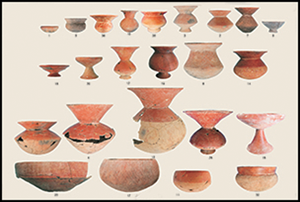
Despite an indigenous transition to Bronze Age 1, seen in the continuation of almost identical forms of pottery vessels from those of Neolithic 2 (Figure 3), mortuary rituals in this period are markedly different. The seven Bronze Age 1 graves so far identified were dug much deeper than their predecessors and differed in shape and style. Burial 569, for example, was recognised as a rectangular grave cut at 2.92m below datum, but a wooden coffin was identified at a depth of 3.65m, formed with a pointed prow as in a boat. Fourteen pottery vessels had been placed in the grave (Figure 4). The young to mid-aged female wore 2382 shell beads and a marine shell bangle. Pigs’ limb bones lay outside the coffin, beyond the head. Bivalve shells had been placed near each hand and a socketed copper-base axe lay on her left shoulder.
The pottery forms of Ban Non Wat Neolithic 2, Bronze Age 1 and Bronze Age 2 (figure by author).

The graves of adults and a child from Bronze Age 1 of Ban Non Wat, together with the copper-base socketed axes found in the burials (photographs by author).

The young adult male in burial 446 had been covered with a shroud incorporating gastropod shells within a rectangular coffin. In addition to several pottery vessels, fish bones, a bivalve shell and about 100 shell disc beads, he was interred with a socketed copper-base axe. Shells also covered the two-year-old infant in burial 453, together with 17 pottery vessels, pig bones, bivalve shells and shell beads. This infant wore three marine shell bangles on each arm and a socketed copper-base axe lay between its ankles. The burial of a 10-year-old child follows the same pattern, including a copper-base axe and 13 pottery vessels. Burial 470, a young female, was interred in a wooden coffin with nearly 1000 shell beads and a copper-base axe. There were also two infant jar burials in a phase that probably lasted no more than one or two generations.
Bronze Age 2 (1000–900 BC)
There are 33 Bronze Age 2 burials divided here into four groups that previously have been reviewed as a single unit based on their stratigraphic relationships (Figure 5, see also online supplementary material (OSM)). One objective of this new analysis is to clarify any distinctions between these groups that might reflect chronological change or suggest behavioural differences consistent with there being more than one social group buried in this area during this time period.
The distribution of Bronze Age 1 graves (circled in red) and Bronze Age 2 graves in the main square of Ban Non Wat (figure by author).

Bronze Age 2 sees a surge in the number of pot forms included in burials; rising from three in Bronze Age 1 graves to 24 (Figure 3). Made of local clay, these vessels are of outstanding quality in the variety of forms and decoration (Sarjeant Reference Sarjeant, Higham and Kijngam2012; see also Figure 6). There is continuity with preceding phases in the types of pots used for cooking. Others could have been designed for displaying food, storing and serving quantities of liquids or as large decorated food bowls and drinking vessels.
Examples of the sophisticated decoration and symbolism on Bronze Age 2 pots from Ban Non Wat. B & C) paintings by Dr W. Wiriyaromp; D) shows an ancestral face; E) a frieze of dancers; G) womb-like shape with a snake in applique, symbol of rebirth; H & I) different views of the lid of a mortuary jar with a design resembling childbirth. Not to scale (figure by author).

The dead also wore an unprecedented quantity of jewellery. Shell beads were encountered in their thousands and many would originally have been threaded as necklaces and belts. Their presence over the skull might indicate that they were also sewn onto hats or shrouds (Figure 7). Long shell beads and earrings were worn and bangles were fashioned from exotic Tridacna and Trochus shell, species that are adapted to clean and clear tropical coral reefs that would have been located much further south than the present coast of Central Thailand. Marble used in earrings and bangles probably came from the Phetchabun range (Figure 1). To date, no other site from this period in Southeast Asia has demonstrated such a range and quantity of copper-base artefacts placed as mortuary offerings. Numerically, the socketed axe dominates but there are also awls, chisels and bells worn as anklets.
Beaded skulls are always associated with very rich burials. A) burial 571, male, group 3; B) burial 466, male, group 2; C) burial 443, male, group 1; D) burial 105, female, group 4; E) burial 293, infant, group 2 (photographs by author).

Infants were interred in womb-shaped ceramic jars (Figure 6G), which were often decorated with an appliqué band in the form of a snake—an image widely symbolic of regeneration today—and coloured blood red inside. The interior surface of the lid of one jar also contained an image reminiscent of childbirth (Figure 6I).
Faunal remains placed in the graves of this period are dominated by pig, with occasional cattle and a complete domestic chicken skeleton. Fish remains were often contained in pottery vessels. Such provision of food for the dead reinforces not only the suggestion of a belief in some form of resurrection, but also that mortuary rituals involved feasting.
Group 1
Three young males were interred in a row (burials 443, 445 and 455), all supine with arms by their sides and heads orientated to the south. Archaeothanatological analysis indicates that they were wrapped in shrouds and placed within clay and wooden coffins (Figure 8). A row of pots was positioned upright against the coffin of burial 455, with further pots beyond the head and feet. All three individuals wore marble bangles and between 19 and 40 Trochus shell bangles on the upper left arm. A copper-base axe was located beyond the head of burial 445 and there was a copper-base awl with a whetstone beyond the ankles. The axe with burial 455 lay by the right knee, beside 25 copper-base bells.
Male burials from Ban Non Wat Bronze Age 2. Top row) group 3; bottom left) three graves of group 1; bottom right) group 2 (photographs by author).

Three infants were interred supine in disproportionately large graves to accommodate clusters of between seven and 28 pottery vessels (Figure 9). The youngest, aged 3–9 months, wore an anklet of copper-base bells. The other two died when between 1–2 and 2–4 years of age and all three were buried with fish bones, bivalve shells and between four and 470 shell disc beads each. A fourth infant, 9–12 months at death, was contained in a lidded pottery vessel covered in curvilinear red painted lines unique to this site, suggesting a high level of social and cognitive sophistication (Figure 6F).
Infant burials and a juvenile burial from Ban Non Wat Bronze Age 2. Top row) first three are group 1, second two are group 3; bottom row) group 2 (photographs by author).

Group 2
The burials of three males, three females and four infants cluster to the south-west of group 1. Burial 197, containing a mid-adult to old adult male, is particularly large and wealthy. The body was interred centrally in a broad coffin surrounded by 35 pots. These vessels bore much more decoration than those from group 1, with one depicting dancers (Figure 6E). Three copper-base chisels and an awl were found beyond the head, together with a socketed axe on the left shoulder and another by the right hand. Nearly 10 000 shell beads were distributed over the body, suggesting the presence of a sequined shroud (Figure 8).
The mid-adult male in burial 290 was interred in a wooden coffin accompanied by three copper-base socketed axes and a chisel, 25 Trochus, two marble earrings and 15 pots. Burial 466, containing an old adult male, is distinguished by a layer of shell beads over the cranium and mandible that supports evidence of interment under a shroud (Figure 7B), but also included 38 bangles of shell and two of marble. The burial of a young to mid-adult female included 6090 shell beads in a band across the abdomen, interpreted as a belt, and 21 pots, eight of which have such distinctive painted designs that they might have come from a single highly skilled potter (Figure 10, burial 456). Another young female was buried wearing 11 Trochus bangles, five shell earrings and shell beads on her head (burial 464).
Female burials from Ban Non Wat Bronze Age 2. Top row) burial 93 is group 3, next three are group 2; bottom row) group 4 (photographs by author).

All four group-2 infants were interred supine in graves far larger than was necessary to contain the body (Figure 9). The grave of a 2–4-year-old (burial 293) was 4.5m long to accommodate the 13 pottery vessels beyond the head and feet. The infant wore a Tridacna shell bangle on each wrist, and the head and upper body were covered with regularly spaced shell disc beads. Two bivalve shells covered the left hand. The 3m-long grave of burial 302 contained a 1–2-year-old with 23 pottery vessels. One of these was decorated with a stylised human face (Figure 6D). This infant wore five shell bangles, and shell beads covered the cranium and upper torso—the latter item interpreted as a necklace. Burials 457 and 458—containing infants of less than one year and five years old, respectively—share many of the features of burials 293 and 302 in terms of the layout of the grave, placement of the pots and the presence of bivalve shells. Both burials contained a socketed copper-base axe lying beyond the head and a large marble bangle. Shell beads were also found in strings over the head and body of the infant in burial 457.
Group 3
Group-3 graves contained four males, one female, one adult, one adolescent and two infants. Burials 20 and 90, both containing males, lay within the same very large grave but at different depths (Figure 8). Both burials had previously been partially exhumed and the bones then replaced. Eighty-two pottery vessels lined the edges of the grave for burial 90 and ran down the centre between the two skeletons. Other artefacts associated with burial 90 had been dispersed and none can be associated with burial 20. The wealth of burial 90 is attested by the 30 Trochus bangles, two marble bangles and just over 9000 shell beads included within it. A copper-base axe also lay beside the femur that had been severed to exhume the body, and a chisel had been relocated when the body was removed.
Burial 93, that of a mid-adult female, lay 4m east of the double male grave. The skeleton had been exhumed and then reinterred with the skull balanced on top of the other bones (Figure 10). Some of the 34 pots included in the burial remained upright, presumably placed in a row against the coffin, others clustered beyond the location of the head. Personal ornaments included 1802 shell beads and two shell bangles.
Burial 553 contained the remains of a mid-adult that had been exhumed, apart from the skull, then reinterred. Both processes must have been undertaken carefully because all 42 of the pots that lined the coffin remained upright and in place. Nearly 1000 shell disc beads, four Trochus shell and one marble bangle were recovered, together with a copper-base socketed axe.
In burial 571, an old adult male lay supine within a wooden coffin. The body had been wrapped in a shroud that survives in fragments and shell disc beads adorned the cranium (Figure 7A). Forty pots lay beyond the head and feet of this individual. A cowrie shell lay beside the right knee and 53 Trochus-shell bangles and one of marble were worn on the arms. A copper-base socketed axe was also found beyond the head.
The skeleton of the old adult male in burial 570 was found intact although some bones had been disarticulated as would occur in a wide coffin (Figure 8). Eighteen pots were found on both sides of the grave and beyond the head. Three whetstones lay by the left femur. Some of the bones and one of the whetstones were covered in white fibres suggesting the use of a shroud or wrapping during burial.
Burial 236 contained a 15-year-old adolescent with 13 pots beyond the head and feet, 17 Trochus-shell bangles and 848 disc beads. A copper-base bell lay beside the left hand. A 2–4-year-old infant in this group included 11 pottery vessels beyond the head and one beyond the feet, a large marble bangle on each wrist and 10 Trochus bangles (Figure 9).
Group 4
Two adult females were interred within the same grave (burials 105 and 106), one still intact, the other partially exhumed. Both had been buried in wooden coffins and many of the 88 pottery vessels within the grave had been lined upright against them. A large amount of red ochre was placed beyond the heads of these two females. The old adult in burial 105 wore eight Tridacna-shell bangles and two marble bangles on one arm and five Tridacna and one marble bangle on the other. Twenty-two shell earrings were found and 19 410 shell disc beads were worn as necklaces, belts and over the skull and much of the body. Many of the pots had contained fish. Shell beads also covered the individual from burial 106, many of the 9660 shell beads were dispersed and associated with the relocated upper-body bones but those on the lower limbs were still arranged in rows. A copper-base socketed axe lay beside the right foot.
The young adult female in burial 178 was probably wrapped in a shroud and placed within a wooden coffin. Twenty-nine pottery vessels were placed beyond her head and she wore 39 Trochus-shell, four Tridacna-shell and two marble bangles, three shell earrings on each ear and a shell disc bead necklace and belt. A socketed copper-base axe was found next to the head.
The copper
Understanding the impact of metal at Ban Non Wat requires its technical analysis in conjunction with the evidence from crucibles, moulds and casting furnaces for the chaîne opératoire. Three of the 10 early artefacts analysed contained about 1–2.5 per cent tin and most were left as cast (Pryce Reference Pryce, Higham and Kijngam2012; Pryce et al. Reference Pryce2014). This means that they would have been too soft to be effective in the tasks usually associated with axes, although the conjunction of a whetstone with an awl does suggest their use. As Pryce (Reference Pryce, Higham and Kijngam2012) has noted, even a copper axe would be of some use but it would work-harden very quickly and such hardening would be observable in the microstructure. To continue using a work-hardened copper axe, it would need to be annealed—a process of heating and cooling to remove hardness—but Ban Non Wat axes with visible microstructures were as cast.
Analysis of lead isotopes within some of the early artefacts shows that they were not cast with ore from the three known copper mines in Southeast Asia, suggesting instead that they might have been imported from a more remote source such as northern Vietnam or southern China (Pryce Reference Pryce, Higham and Kijngam2012). The earliest copper-base artefacts at Ban Non Wat are copper with minimal tin, while in contrast the many crucibles, which are later in the sequence, were used to cast tin bronzes (Cawte Reference Cawte, Higham and Kijngam2012). The appearance of the crucibles coincides with the use of clay-lined furnaces for bringing bronze to melting point. Moreover, a Bronze Age 4 male was interred with multiple clay moulds for casting axes and bangles. Therefore, there were two distinct phases in the uptake of copper-base technology: the initial exchange from remote production centres, associated with Bronze Ages 1–3A, was later complemented by on-site founders who cast axes, spears and bangles from—presumably imported—copper and tin ingots.
Discussion
Four groups of graves belonging to the Bronze Age 2 burial sequence at Ban Non Wat were formed within the span of about a century. These burials have previously been discussed and published as one unit in the sequence (Higham & Kijngam Reference Higham and Kijngam2012); here, their possible relationships are explored in greater depth. Three scenarios are possible: the burials may be contemporary, each representing separate social groups with their own defined area within a cemetery; or the groups might be sequential; or they are a combination of both, with one group preceding the others.
Nuanced differences between the burial rites of the groups are identifiable. Group-1 graves were aligned with those of the preceding Bronze Age 1 phase, with no instances of exhumation or excessive grave size and a smaller number of pot forms, suggesting that this group might represent the earliest inhumations of the Bronze Age 2 phase. In group 2, the distribution of the three males, three females and four infants might suggest the interment of three siblings with their respective partners and infants in a mortuary event lasting a few years. Alternatively, group 2 might represent sequential burial of three generations of the same descent group or family spanning the full century of the Bronze Age 2 phase (see Table 1).
Four adult burials in group 3 were exhumed, and this group also includes two relatively rich burials, both of males. Graves were large and deep with many exotic offerings included. In group 4, three females were interred with equally wealthy and intensive rituals. If the groups are chronologically distinct, the more intensive nature of the group-3 and group-4 mortuary treatment—which is seen in larger graves and incidences of exhumation—suggests that these individuals were buried later than those in groups 1 and 2.
The richness of graves is, of course, a relative measure. About 100m to the north-east, we excavated an area including three Bronze Age 2 graves with mortuary offerings confined to a handful of pots and bivalve shells. This contrast suggests that there were two contemporary burial grounds, one rich and the other relatively poor. Excavations at Ban Lum Khao, approximately 15km east of Ban Non Wat, have revealed a Bronze Age 2 cemetery containing 92 graves. The dead were far poorer than their contemporaries at Ban Non Wat (Table 1; O'Reilly Reference O'Reilly, Higham and Thosarat2004). Ban Prasat is a large, moated settlement a further 10km to the east. Excavations there have identified Bronze Age 2 graves that closely match the elite, wealthy burials of Ban Non Wat (Monkhonkamnuanket Reference Monkhonkamnuanket1992). There is therefore a regional pattern in the Upper Mun Valley of very wealthy burials contrasting with nearby markedly poorer burial grounds.
Did the opulence of the Bronze Age 2 individuals in the main square continue? Bronze Age 3A graves overlie those of Bronze Age 2 in a group of seven females, five males and one infant. There was no decline in mortuary wealth, some individuals wore an even greater weight of exotic shell ornaments than their predecessors. The male in burial 201 wore 65 Trochus-shell and two marble bangles, the female in burial 262 was interred with 23 682 shell beads and the old adult female in burial 154 had 62 Trochus-shell and three marble bangles. But the number of copper-base artefacts declined to just one socketed axe, five anklets with small rings and, within the burial of the infant, 30 anklet-bells. With Bronze Age 3B the number of grave goods declined sharply. There were fewer pots and only three marble and 79 Trochus-shell bangles across the 20 graves.
Bronze Age 4 burials cover the excavated area in four groups (Smith et al. Reference Smith, Davies and Higham2015). Copper-base artefacts from the 134 graves are virtually absent. One adult male was interred with 29 clay moulds for casting socketed axes and multiple simultaneous bangles (Higham Reference Higham2008), yet no bangles were included in Bronze Age 4 burials. In addition, for the first time there was a regular occurrence of grey clay, clay anvils and burnishing stones within the graves, reflecting the growing recognition of individuals for their craft skills.
No single model explains the relationship between copper-base metallurgy and society (Roberts Reference Roberts, Roberts and Thornton2014; Radivojević et al. Reference Radivojević, Roberts, Marić, Cvetković and Rehren2021). Each regional relationship needs to be assessed on its own evidence. Very rarely can a single site such as Ban Non Wat have exercised such a transformational effect on our need to investigate the possible impact of copper-base metallurgy on a prehistoric community. Until the excavation of Ban Non Wat, the evidence for social change in the Southeast Asian Bronze Age came almost exclusively from Ban Chiang, Ban Na Di, Non Nok Tha and Ban Lum Khao, four sites with “low levels of social ranking” (White & Pigott Reference White, Pigott and Wailes1996: 157). Three of these sites are located in the far north of the Khorat Plateau, remote from natural exchange routes and all of the excavations were too small to obtain reliable social information. At Ban Non Wat an enclave of extremely wealthy graves has been identified. Pottery vessels are a consistent component of the mortuary offerings and inclusion of the earliest copper-base artefacts within burials is associated with a proliferation in the form and quantity of pots and a huge increase in the number of exotic shell and marble ornaments.
For at least two centuries, coinciding with the advent of copper-base artefacts, the intensity of the rituals surrounding death and burial at Ban Non Wat demonstrably increased. Graves are larger and deeper during this time, bodies are interred in wooden or clay coffins and the quantity and range of mortuary offerings—be they of local manufacture or acquired through long-distance exchange—surges. Infants were interred with considerable wealth, including axes, though these are more likely to have been symbols, like the Cuban aglets, of familial status rather than useful tools. The placement of the socketed axes within the burials of infants makes it unlikely that they were hafted. For example, the axe with burial 457 lay flat under a pottery vessel 70mm from the human skull and flanked on the other side by pots (Figure 10). Inclusion of large numbers of pottery vessels associated with food and drink within the graves suggests that mortuary rituals for the elite involved feasting, while the exhumation and reburial of some individuals poses the possibility that ancestors were recalled and honoured by the living.
More than one explanation for the social changes reflected in the treatment of the dead at Ban Non Wat may be proposed. The relative wealth of the individuals buried within the central cemetery is unparalleled in contemporary sites in Southeast Asia. The provision of food for the dead, the number of pottery vessels and their many new forms, the spiritual dimensions reflected in art and bivalve shells, the exhumation of the ancestors and tightly nucleated sets of graves provide a prehistoric text requiring exegesis. The interpretation advocated here draws on Brian Hayden's conclusion that “aggrandizing personalities occur in all human populations of self-reproducing size” (Hayden Reference Hayden1998: 18). Aggrandisers are “people who are ambitious; socially, politically, and economically aggressive and acquisitive” (Hayden Reference Hayden1998: 18) and only a few are needed to effect marked social change.
One possibility, then, is that by taking advantage of their location on a choke point for exchange, aggrandisers in a descent group at Ban Non Wat began patronising innovative potters and dominating access to marine shell, marble and copper artefacts as exotic symbols of wealth and status. There is no suggestion of a direct and causative link between copper and the attainment of status, but rather that the novelty and rarity of copper was identified as one of several avenues, along with exotic shell and marble ornaments and ceramics, to display social success. According to Clark and Blake (Reference Clark, Blake, Brumfiel and Fox1994), this system has inbuilt insecurity: failure to maintain complex ceremonials and feasting can be terminal for the social elite in question. In contrast to remote sites such as Ban Chiang, the Upper Mun Valley commands a strategic and beneficial link between central Thailand, with its copper mines and access to marine resources, and the broad expanse of the Khorat Plateau; a situation that was open to exploitation by aggrandising individuals in the Early Bronze Age.
It appears that the rise of a lineage of aggrandisers did not lead to entrenched, hereditary social inequality, however. By Bronze Age 3B–4, the initial novelty of copper had waned. Production at the mines increased, seen in the opening of new shafts at Vilabouly in Laos (Cadet et al. Reference Cadet2019) and the consumer sites now included founders who cast bronze axes, spears and bangles in small workshops with clay-lined furnaces, locally made crucibles and clay moulds. It is a conundrum that while bangles and socketed bronze axes were cast locally in the Bronze Age 4 phase, none have been recovered from associated graves or occupation contexts.
Conclusion
Extensive excavations at Ban Non Wat have documented a cultural sequence that spans the transition from the late Neolithic into the early Bronze Age. Multiple radiocarbon dates from charcoal, shell and rice grains, subjected to Bayesian modelling, have placed this transition in the eleventh century BC (Higham & Higham Reference Higham and Higham2009). There is a growing consensus that knowledge of the properties of copper and tin, and expertise in their mining and casting, spread south from Northwest China and the Central Plains of the Yellow River. The first socketed copper-base axes to reach Ban Non Wat probably travelled along established exchange routes, some from the north and others from the copper mines of Central Thailand.
At Ban Non Wat, there was a seamless transition from the late Neolithic into the initial Bronze Age in which bronzes were regarded as a rare novelty and employed, along with exotic marble, shell and ceramic artefacts, to advertise the social status of aggrandising individuals. This was followed by a second phase in which bronzes were locally cast as ornaments, tools and as weapons for hunting, conflict, or both, but hardly ever placed with the dead to signal social status.
Acknowledgements
I wish to thank the Fine Arts Department of Thailand for their permission to excavate Ban Non Wat, my co-director Rachanie Thosarat, many colleagues and the villagers of Ban Non Wat for their welcome and co-operation. Nancy Tayles and her team are thanked for identifying the age and sex of the human remains. Oli Pryce first suggested the ritual rather than practical use of copper-base axes to me, and Hayden Cawte's pioneering reconstruction of the chaîne opératoire at Ban Non Wat has been invaluable. I am most grateful to two anonymous reviewers for their constructive comments.
Funding statement
I thank the Marsden Fund of New Zealand and Earthwatch and its Research Corps for funding the excavation of Ban Non Wat.
Supplementary material
To view supplementary material for this article, please visit https://doi.org/10.15184/aqy.2024.11.


 Open access

