



Protein quality has an important role in increasing satiety compared with carbohydrates and fats(Reference Soenen and Westerterp-Plantenga1). Additionally, protein can decrease the postprandial glycaemic response in healthy(Reference Luscombe-Marsh, Noakes and Wittert2) and type 2 diabetic individuals(Reference Frid, Nilsson and Holst3). However, not all protein sources modulate satiety to the same degree. Although data are still limited, animal proteins appear to be superior to plant proteins in this regard(Reference Phillips, Chevalier and Leidy4).
Likewise, whey protein (WP) seems to be the most effective animal protein source for increasing satiety, due to its amino acid composition, which is high in branched-chain amino acids (BCAA)(Reference Krissansen5). BCAA stimulate the secretion of anorexigenic hormones, including insulin, leptin, cholecystokinin, peptide YY and glucagon-like peptide-1(Reference Bendtsen, Lorenzen and Bendsen6,Reference Veldhorst, Nieuwenhuizen and Hochstenbach-Waelen7) and have an insulinotropic effect, decreasing postprandial glucose levels.
Considering the relevance of amino acids in the production of anorexic hormones, the influence of proteins with a low biological value on appetite has been widely investigated(Reference Giglio, Schincaglia and da Silva8–Reference Boirie, Dangin and Gachon10). Hydrolysed collagen has low amounts of BCAA, tryptophan and lysine(Reference Phillips11) and provides peptides that are absorbed into the small intestine, considered to be rapidly digested, similarly to WP(Reference Boirie, Dangin and Gachon10). In fact, hydrolysed collagen may have a potent dietary insulinotropic effect through its stimulation of incretins produced in the intestine, such as GLP-1, which would favour the release of insulin and are important in appetite control and satiety(Reference Rubio, Castro and Zanini9). To date, no studies have investigated the effects of acute supplementation with hydrolysed collagen on appetite or glucose and leptin concentrations in healthy individuals.
Given the potential effects of animal proteins such as WP and hydrolysed collagen on satiety and the possible influence of amino acid composition on digestion kinetics and appetite control, our hypothesis was that WP supplementation would reduce the appetite more than hydrolysed collagen in healthy women. Therefore, the primary outcome of this study was to compare the effect of acute supplementation of WP or hydrolysed collagen on feelings of hunger, desire to eat and full stomach feeling, evaluated through the Visual Analog Scale (VAS), as well as post-intervention energy consumption. The second outcome was to determine if WP or hydrolysed collagen consumption influence leptin and glucose concentrations in healthy women.
Methods
Design and study population
This was a randomised, double-blind and crossover pilot study which enrolled ten healthy adult women. The research was carried out at Laboratory for Research in Clinical and Sports Nutrition at the Faculty of Nutrition of the Federal University of Goiás, where they were evaluated through an anamnesis, anthropometric measurements and biochemical tests. Blood samples were collected at the Clinical Research Unit of Hospital das Clínicas, Federal University of Goiás.
The research was advertised through flyers, social media and email. Participants were selected according to the inclusion criteria. The inclusion criteria were female gender, BMI between 18·5 and 24·9 kg/m2 and age between 18 and 59 years. The exclusion criteria were diagnosis of autoimmune diseases or use of immunosuppressive drugs; clinical diagnosis of diabetes, thyroid dysfunction, chronic kidney disease or liver disease; bariatric surgery prior to the research; alcoholism; use of drugs that alter appetite or body weight (appetite suppressants) in the last 12 months; attendance at food restriction programmes or use of nutritional supplements in the last 12 months; manifestation of a feverish state in the weeks of the research and failure to follow the protocol stipulated for data collection or refusal to carry out any of the proposed evaluations. This study was conducted according to the guidelines laid down in the Declaration of Helsinki, and all procedures involving human patients were approved by the Brazilian Registry of Clinical Trials with Universal Trial under the number U1111–1248–2611 (https://ensaiosclinicos.gov.br/rg/RBR-6gy3ss). Written informed consent was obtained from all patients before any research procedures.
Sample size
As this was a pilot study, no sample size was calculated.
Intervention
Participants were allocated to ingest either 40 g of concentrated WP (containing 160·7 calories, 25 g protein, 10 g carbohydrates and 2·3 g lipids, Maxtitanium®) or 40 g of hydrolysed collagen (containing 164·7 calories, 26 g protein, 10 g of natural flavoured maltodextrin and 2·3 g of refined oil, GELITA Bioactive Collagen Peptides®, German), with one week of washout between tests. The nutritional composition of the supplemented drinks was described in a previous study(Reference Giglio, Schincaglia and da Silva8). The order of the interventions was randomised using the https://www.randomizer.org, removing the possible biases of equal intake of supplements on the same day (Fig. 1).
Design of study (a) and experimental protocol (b). Cheese bread is a typical Brazilian snack.
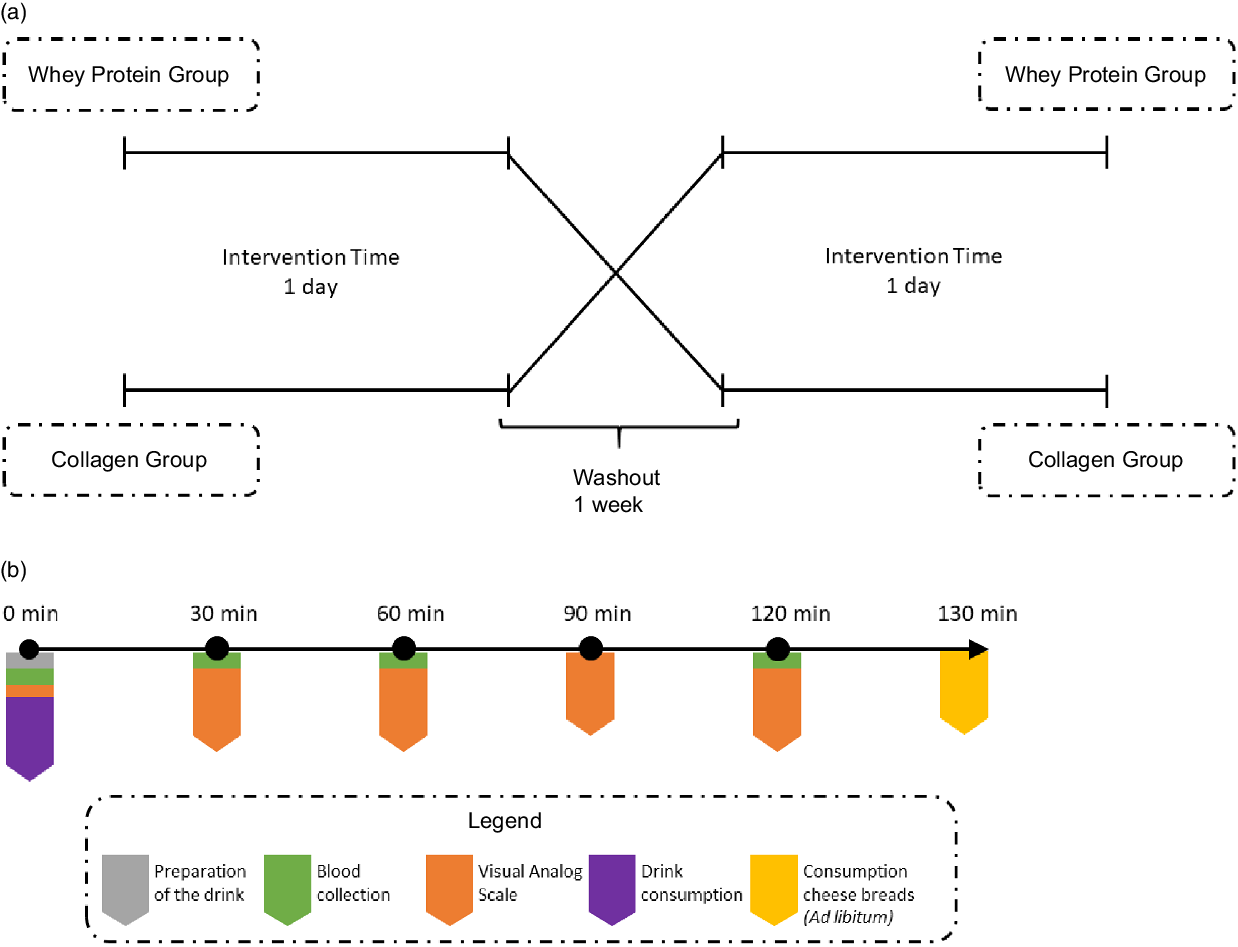
Both supplements were diluted in 200 ml of filtered water with 50 ml of concentrated passion fruit juice to mask the flavour of any supplements and were always offered in the morning (08.00–09.00) after an overnight fast. Cups containing the drink were blinded by staff researchers who were not involved in the study with the objective of the participants and researchers not identifying the solution that was offered.
Participants were instructed to maintain their usual diet the day before the test and to fast for 8 hours prior to collection.
Participants were instructed to maintain their usual diet the day before the test and to do 8 hours of fasting until the beginning of the collection.
Appetite assessment
To assess the degree of hunger, satiety and feeling of a full stomach, the VAS was applied at every time point evaluated (0, 30, 60, 90 and 120 min) (Fig. 1). The VAS is an effective tool for the assessment of appetite and consists of a subjective scale ranging from zero to 100. A paper was delivered, and the participants were instructed to mark with pen a vertical line at the point that best represented their feeling at the time. The point marked by the participant was measured with a ruler, from the left end (minimum score 0 mm) to the right (maximum score 100 mm), to determine the scores(Reference Meek, Kelly and Xue12,Reference Flint, Raben and Blundell13) .
After they had consumed one of the two supplements, participants were offered five pieces of cheese bread in 130 min (Fig. 1), and if they wanted more, it was offered ad libitum. Cheese bread is a typical Brazilian breakfast snack made with parmesan cheese and powdered sour mix. The offered portions were all taken from the same batch, standardised in size and weight. Each participant’s intake was quantified for later calculation of energies and macronutrients using Dietpro Version 5.0 software, Viçosa, Minas Gerais, Brazil, USDA Database.
Usual dietary intake was assessed by three 24-hours food records collected before the intervention as a means of evaluating habitual energy intake before both interventions.
Hormonal markers that regulate appetite (leptin and glucose) were measured in the plasma blood. All measurements were made before and after ingestion of WP or hydrolysed collagen (Fig. 1). Blood samples were collected via arterial puncture in EDTA tubes by a trained person and stored at −80ºC for subsequent quantification of leptin and glucose concentrations by the ELISA technique, using the Human Leptin DuoSet ELISA DY398 kit (R & D Systems) and the Labtest Diagnostica S. A. (Glucose Liquiform), respectively (online Supplementary Table 1 and 2).
One hundred twenty minutes after taking the supplement, participants answered a question asking which supplement they thought they had taken. This question was intended to assess whether the participants were able to identify the supplement they were taking, confirming the blinding of the study.
Anthropometric and body composition evaluation
Anthropometric assessment (weight, height and bioelectrical impedance analysis) was performed 2 weeks before data collection. Participants were weighed without shoes and wearing light clothing. They were to stand upright in the centre of the platform, with their feet parallel, their arms extended along their bodies and their heads erect, looking straight ahead. For height measurement, the same procedure was followed, but with the heels and buttocks lightly against the wall. A digital anthropometric scale (Filizola®) with a precision of 0·1 kg for weight and 0·1 cm for height was used.
Bioelectrical impedance analysis was performed with the SECA® device (model mBCA 525) while individuals were fasting and lying down. Electrodes were connected to the dorsal surface of the foot and ankle (between the medial and lateral malleoli), hand and wrist (between the radius and the ulna), and then the reading was performed with the equipment, and the data provided by bioelectrical impedance analysis (fat mass, fat-free mass, skeletal muscle mass, total body water, extra water and visceral fat) were recorded.
Statistical analyses
All data were typed using Excel® software, with double entry. The Shapiro–Wilk test was performed to verify the normality of the data. The results were expressed as mean and standard deviation or median and interquartile range.
Two-way ANOVA adjusted for individual variation (crossover study) was performed. The blinding of the study was assessed using the χ 2 test on the subjects’ hits and errors when asked which drink they were ingesting.
Statistical analyses were performed using the R Studio® software. The level of significance was set at 5 %.
Results
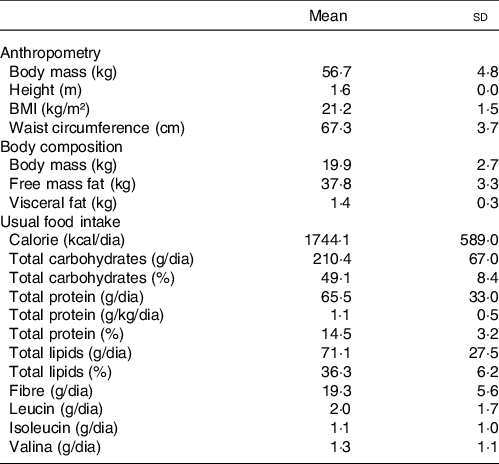
Ten volunteers, with a mean age of 22·4 years, completed the study (Fig. 2). The anthropometric, body composition and habitual food intake characteristics are demonstrated in Table 1.
Flow chart of the study.

Anthropometric characteristics, body composition and habitual food intake of the participants
(Mean values and standard deviations, n 10)
The VAS for appetite sensations did not differ between groups at baseline (online Supplementary Table 3).
There was no difference between treatment groups (P = 0·983) regarding hunger sensation (Fig. 3(a)). In addition, no difference was found between the groups with regard to desire to eat (P = 0·326) (Fig. 3(b)) and the feeling of a full stomach (P = 0·567) (Fig. 3(c)).
Feeling of hunger (a), desire to eat (b) and full stomach (c). The variations in feelings of hunger, desire to eat and a full stomach between treatments (Collagen × Whey) were evaluated by two-way ANOVA (adjusted for individual variation). Values are expressed as mean ± standard error of the mean.

Food consumption of cheese bread 2 hours after consumption of a beverage containing WP or collagen was not different between treatments (P = 0·168). In addition, there was no difference (P = 0·167) in energy consumption (WG: 479·16 ± 105·21 kcal v. CG: 457·38 ± 112·47 kcal), total carbohydrate (WG: 45·14 ± 9·91 g v. CG: 43·09 ± 10·60 g), protein (WG: 6·73 ± 1·48 g v. CG: 6·43 ± 1·58 g) and lipid intake (WG: 32·47 ± 7·13 g v. CG: 30·10 ± 7·62 g).
Leptin concentrations differed between treatments (P = 0·002). The time × treatment interaction at 60 minutes showed a higher leptin concentration in CG compared with WG (15·9 ± 5·19 v. 12·5 ± 3·16 ng/ml; P = 0·006, respectively) (Fig. 4(a)). There was no difference in blood glucose between the groups (P = 0·577) (Fig. 4(b)).
Plasma concentrations of leptin (a) and blood glucose (b). The variations in plasma leptin and glycaemia concentrations between treatments (Collagen × Whey) were evaluated by two-way ANOVA (adjusted for individual variation). Values are expressed as mean ± standard error of the mean. The differences found are highlighted with *(P < 0·05).

In regard to the blinding of the study, in the WG 70 % (n 7) of the participants were able to identify the supplementation ingested. In the CG 50 % (n 5) identified it. There was no difference between the groups (P = 0·180).
Discussion
Acute supplementation with hydrolysed collagen increased leptin levels in comparison with WP but had no effect on appetite measured by feelings of hunger, desire to eat, full stomach feeling (VAS) or energy consumption. In addition, this was the first study to investigate the acute effect of hydrolysed collagen supplementation compared with WP, using the same amount of protein, on concentrations of hormones related to appetite.
Evidence suggests that increasing the protein intake in the diet can decrease serum leptin concentrations(Reference Arciero, Ormsbee and Gentile14,Reference Woo, Song and Kang15) . However, studies evaluating this effect from the isolated consumption of certain types of protein, such as collagen and WP, are scarce. An experimental study showed that the consumption of collagen(Reference Woo, Song and Kang15) decreased serum leptin in rodents fed a high-fat diet. Knowing that leptin secretion is proportional to the amount of adipose tissue but that its serum increase is accompanied by a reduction in its sensitivity, it is suggested that the reduction of leptin release in individuals with excess adiposity may contribute to the return of its functionality, reflecting a change in the energy balance by reducing food intake and increasing the energy expenditure of adipose tissue(Reference Hussain and Khan16).
Likewise, overweight and obese individuals who received a high-protein diet associated with energy restriction for 28 days showed a decrease in leptin concentrations(Reference Arciero, Ormsbee and Gentile14). On the other hand, in an acute crossover study carried out with eutrophic, overweight and obese men, no difference was found in leptin concentrations in individuals with excess adiposity, but in eutrophic men who consumed a normocaloric and high-protein diet, there was a smaller leptin/ghrelin ratio(Reference Adamska-Patruno, Ostrowska and Goscik17). This result corroborates the findings of our study, in which healthy women had a lower concentration of leptin after acute consumption of WP, which suggests that, to obtain a leptin reduction in individuals with excess body fat, it is necessary to consume a high-protein diet for a longer period. Although we found increased leptin secretion at 60 minutes, there was no difference in satiety and appetite. The collagen beverage has a lower leucine content than WP.
Additionally, it is known that leucine may affect adipocytes, causing them to secrete more leptin after a meal test. In contrast, the CG ingested a lower leucine content, since the collagen drink has a lower leucine content than WP(Reference Lynch, Gern and Lloyd18), suggesting that blood levels of BCAA may have changed during the intervention period(Reference Pedroso, Zampieri and Donato19). However, we are unable to quantify the blood BCAA concentrations. Thus, further chronic studies are warranted to investigate the relationship between the leucine and leptin in humans.
Data from our study also point out that the type of protein consumed may have different effects on the concentration of leptin in humans, although the difference found in leptin was not large enough to affect subjective ratings of appetite. In this sense, we note that women who consumed collagen, a protein of low biological value, showed increased leptin concentrations, in contrast to observations in rodents(Reference Woo, Song and Kang15). However, as in the study conducted in mice, a high-fat diet was offered. It is not known whether collagen would reduce the leptin concentrations in overweight and obese women, and further studies with overweight subjects are needed to assess this issue.
Regarding the effects of satiety due to protein intake, although milk protein has the soluble characteristic of rapid absorption when compared with other amino acids such as casein, its ease of digestion can have an influence on hormonal release and also on the individual’s satiety(Reference Boirie, Dangin and Gachon10). In our study, in which the supplement was consumed through a drink (passion fruit juice), there was a reduction in the sensation of hunger at different assessment time points according to VAS, with no difference between the type of protein consumed, whether collagen or WP. This finding suggests that regardless of the type of protein, if there is high protein consumption, there will be satiety, as observed in the study of Weigle et al., in which the offer of a high-protein diet over 12 weeks increased the sensitivity of leptin in the central nervous system, increasing the sensation of satiety(Reference Weigle, Breen and Matthys20).
However, considering that only collagen increased the leptin concentration, the absence of a difference between the types of proteins consumed (high × low biological value) with respect to satiety may be due to the low reliability of the instrument used to assess satiety, the VAS. In this sense, the results of the study of Flint and collaborators (2000), which evaluated the reproducibility of VAS to assess satiety, were contradictory, demonstrating the difficulty in its determination since there is no objective measure of satiety to compare with the VAS tool(Reference Flint, Raben and Blundell13).
The main limitations of our study included (i) the liquid consistency of the supplementation, which may have influenced the perception of appetite (VAS); (ii) the limitations of blinding, despite our attempt to mask the flavour; (iii) the absence of evaluation of ghrelin and GLP-1 concentrations, both appetite-related hormones; (iv) evaluation of only healthy women, which does not allow extrapolation of data for men or overweight individuals and (v) the absence of a sample size calculation, considering that this was a pilot study. The major strengths of the present study included (i) its crossover design; (ii) monitoring of habitual food intake and (iii) novelty, as it was the first study to assess the effect of acute consumption of collagen and WP on blood leptin concentrations.
Conclusion
In healthy women, acute supplementation with hydrolysed collagen increased leptin levels when compared with WP but had no effect on appetite measured by feelings of hunger, desire to eat, the feeling of a full stomach (VAS) or energy consumption. Therefore, the applicability of collagen in the loss of body mass and the evidence of improvement in leptin sensitivity after collagen consumption reinforce the idea that further studies are needed to evaluate the effects of collagen in the short- and long term in overweight women.
Acknowledgements
Laboratory for Research in Clinical and Sports Nutrition at the Faculty of Nutrition of the Federal University of Goias, and Clinical Research Unit of Hospital das Clínicas, Federal University of Goias for giving up space to collect data. Whey protein and collagen were donated by Max titanium (Supley Laboratório de Alimentos e Suplementos Nutricionais, Matão, SP, Brazil).
No grant was received for this study.
G. M. F. Duarte, K. V. de F., A. C. B. M., B. M. G., R. C. F. and G. D. P. contributed to the design of the research; G. M. F. D., K. V. de F., A. C. B. M., B. M. G. and R. C. F. contributed to the acquisition and analysis of the data; G. M. F. D., K. V. de F., A. C. B. M., B. M. G., R. C. F., P. C. B. L., J. F. M. and G. D. P. contributed to the interpretation of the data and A. C. B. M., B. M. G., R. C. F., P. C. B. L., J. F. M., and G. D. P. drafted the manuscript. All authors critically revised the manuscript, agree to be fully accountable for ensuring the integrity and accuracy of the work and read and approved the final manuscript.
There are no conflicts of interest
Supplementary material
For supplementary material/s referred to in this article, please visit https://doi.org/10.1017/S0007114521003160



