

Introduction
In the span of eight years, the notwithstanding clause in section 33 of the Canadian Charter of Rights and Freedoms has been invoked a dozen times by five provinces. Reacting to this resurgence, the Supreme Court of Canada has agreed to hear two cases to determine the precise legal effect of section 33. These developments have intensified the debate over how often governments should use the clause. At the centre of that debate is the “limited use norm”: the idea that the notwithstanding clause should be reserved for exceptional or extraordinary circumstances and only as a last resort. This norm reflects the dominant view in academic, media, governance and public discourse regarding the clause’s legitimate use. Indeed, many law professors have portrayed the increasing use of the clause since 2018 as a betrayal of this norm (Letter to Ontario Premier Ford, 2024; The Notwithstanding Clause—Only in the Last Resort, 2018; Warick, Reference Warick2023). Some go so far as to position the use of the notwithstanding clause as “radical overkill” equivalent to dropping a nuclear bomb in a war (Leeson, Reference Leeson, Howe and Russell2001: 320–1).
The scholarly case for the limited use norm rests on three principal claims. The first is that the Charter’s framers, chiefly Pierre Trudeau, Jean Chrétien and their allies, designed the notwithstanding clause to be invoked sparingly as a safety valve of sorts for exceptional circumstances (Bakht and Collins, Reference Bakht and Collins2024; Mailey, Reference Mailey2019). The second claim is that rare use has become entrenched through political practice. The clause has remained mostly dormant outside of Quebec and legislators themselves feel constrained by a rare use norm (Salvino, Reference Salvino2022). The third claim is that section 33’s internal safeguards, like its five-year renewal requirement, impose meaningful barriers that make frequent invocation politically costly (Kavanagh, Reference Kavanagh2023; Weinrib, Reference Weinrib1990).
This article reevaluates these arguments by reviewing the archival record. Based on letters, memoranda, briefing notes, primary and secondary accounts, legislative debates and newspaper coverage, I challenge the coherence of the academic arguments supportive of the limited use norm. The evidence scholars cite for the limited use norm is selective and rooted in contested notions of constitutional understanding. While this analysis is not the first to raise doubts about the limited use norm (Newman, Reference Newman, Sigalet, Webber and Dixon2019b: 223–6; Sigalet, Reference Sigalet2022a: 207–9, Reference Sigalet2022b, Reference Sigalet2024: 90), it builds upon this scholarship by providing additional evidence and reflection on its historical support.
The contested nature of these arguments reflects the fact that patriation itself was a negotiation between multiple, and at times, competing, voices (Brodie, Reference Brodie, Harder and Patten2015). Those in favour of the notwithstanding clause tended to hold an understanding of the federation that emphasized provincial rights while those opposed to it tended to promote pan-Canadian nationalism. The notwithstanding clause and its legitimacy is contested because Canadian sovereignty is contested. Too often, however, proponents of the limited use norm reflexively adopt pan-Canadian nationalist assumptions without recognizing the provincial rights contribution to creating the notwithstanding clause. By recovering this neglected counter-narrative, I show that the notwithstanding clause and the norms surrounding its use are swept up in broader debates about the country’s core identity.
In what follows, I review and periodize the use of the notwithstanding clause over time, describe the limited use norm, outline the three core arguments of its proponents in the scholarly literature and critically evaluate these arguments against the documentary record. I conclude that the evidence scholars cite in support of the norm of limited use is incomplete and selectively assembled. The claim that the notwithstanding clause was intended to be rare, exceptional or a last resort is a contested account that reflects the very contestation at the heart of the Canadian Constitution itself.
Periodizing the Use of the Notwithstanding Clause
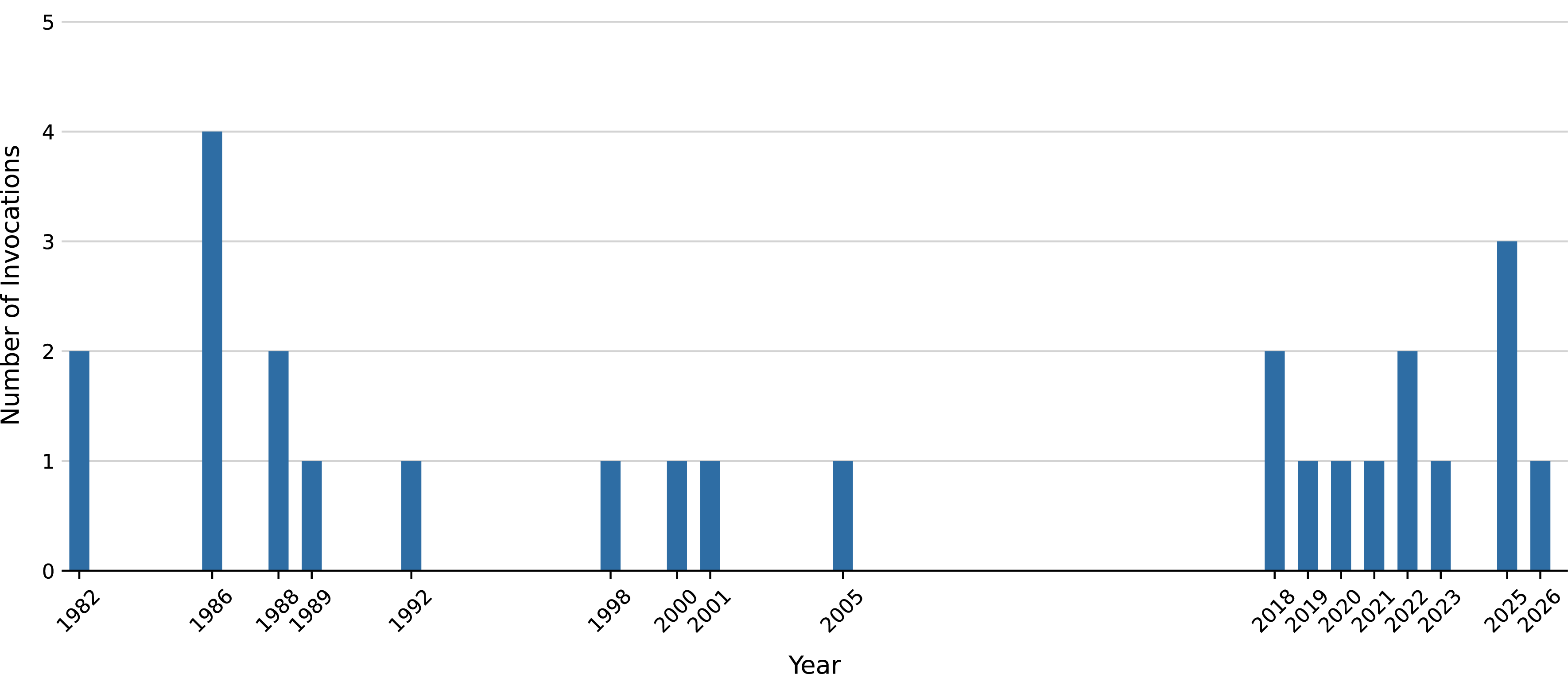
Figure 1 illustrates the historical trends in the use of the notwithstanding clause by displaying the number of unique invocations each year from the enactment of the Charter in 1982 to 2026. In the span of 45 years, the notwithstanding clause has been invoked 26 times.Footnote 1 From this data, I divide the history of the notwithstanding clause into three distinct periods: its initial use (1982–1987), its decline (1988–2017) and its current renewal (2018–present). The notwithstanding clause began as a popular constitutional tool, especially in Quebec where 8 of the first 10 uses of the clause occurred. Quebec initially used the notwithstanding clause to shield all its statutes from Charter scrutiny as a form of protest against patriation (Weinrib, Reference Weinrib1990: 544). The clause was also used more narrowly to protect gender-based pension rules, historical denominational education rights and agricultural subsidies for young farmers (Rousseau and Côté, Reference Rousseau and Côté2017: 390–8; Salvino, Reference Salvino2022: 20–3). During this early period, the only English-speaking provinces or territories to use the notwithstanding clause were the Yukon and Saskatchewan. In neither case was the notwithstanding clause necessary. The Yukon use was never brought into force while the courts ruled the Saskatchewan legislation Charter-compliant (Salvino, Reference Salvino2022: 32–7). In this first period, attention to the notwithstanding clause was minimal and Quebec was the driving force behind its invocation (Kahana, Reference Kahana2001: 259–68).
Unique Invocations Per Year (1982–2026).
Sources: Apart from my own coding, data came from Kahana (Reference Kahana2023), Lawlor and Crandall (Reference Lawlor and Crandall2023), Rousseau and Côté (Reference Rousseau and Côté2017) and Salvino (Reference Salvino2022).

A turning point came in 1988, when Quebec invoked the notwithstanding clause to reinstate restrictions on English commercial signs after the Supreme Court struck down similar legislation. The use was controversial, sparking intense backlash from anglophone Canada, including cabinet resignations, protests and the collapse of the Meech Lake Accord (Monahan, Reference Monahan1991: 159–65). Following this negative reaction, the notwithstanding clause entered a period of decline. Throughout the 1990s, there was only one low-profile use by Quebec. The only other province to attempt to use the clause was Alberta, and both cases ended in failure, either because of public opposition or because the issue was outside the province’s jurisdiction (Kahana, Reference Kahana2001: 271–2). Between 2002 and 2017, the notwithstanding clause was used only once.
Starting in 2018, the notwithstanding clause’s use increased such that between 2018 and 2026 it was invoked on average over once a year. Even more remarkably—and unlike during its initial phase—this current revival of the notwithstanding clause is being driven by several provinces, not just Quebec. Of the 12 occasions the notwithstanding clause has been invoked in this period, two came from Saskatchewan, three from Ontario, four from Quebec, one from New Brunswick and two from Alberta. And unlike more distant uses of the notwithstanding clause, these invocations have addressed highly salient political issues (Béland et al., Reference Béland, Lecours and Schmeiser2021; McDougall, Reference McDougall and Macfarlane2025; McGregor et al., Reference McGregor, Anderson and Pruysers2021). This post-2018 resurrection of the clause challenges the limited use norm. In practice, the notwithstanding clause is becoming normalized, both in Quebec and the rest of Canada.
The Notwithstanding Clause’s Limited Use Norm
Scholars who subscribe to the norm of limited use argue that the notwithstanding clause should be used rarely, only in extraordinary circumstances such as when it is a last resort to correct truly egregious judicial errors. The bulk of the scholarly literature appears to agree with this position (Bakht and Collins, Reference Bakht and Collins2024: 13; Beaulac, Reference Beaulac2025: 60; Dodek, Reference Dodek2016: 56; Kahana, Reference Kahana2001: 278, Reference Kahana2002: 272; Kavanagh, Reference Kavanagh2023: 336; Leckey, Reference Leckey2019: 3; Mailey, Reference Mailey2019: 11; Salvino, Reference Salvino2022: 13, Reference Salvino2023: 874, Reference Salvino and Biro2024: 401; Weiler, Reference Weiler1984: 82–4; Weinrib, Reference Weinrib1990: 568, Reference Weinrib2001: 741, Reference Weinrib2016: 82). These scholars advance the limited use norm in two related but distinct senses. Some treat it as a normative claim—an argument that the clause ought to be used rarely, grounded in assertions about what the framers intended (Kavanagh, Reference Kavanagh2023: 352). Others treat it as an empirical claim—that constraints on frequent use of the notwithstanding clause have developed through political practice and textual restraints (Salvino, Reference Salvino2022: 56–7). Their arguments in support of both senses of the limited use norm can be grouped into three categories: (1) appeals to framers’ intent, (2) reliance on political practice and finally, (3) textual interpretations of section 33 itself. I outline each of these lines of reasoning and then critique them in turn.
Framers’ Intent
Scholarly proponents of limited use place great weight on the words of a few Charter framers, specifically the statements of Justice Minister Jean Chrétien, former Prime Minister Pierre Trudeau, New Brunswick Premier Richard Hatfield, Ontario Premier Bill Davis, Ontario Attorney General Roy McMurtry and Saskatchewan Attorney General Roy Romanow (Kavanagh, Reference Kavanagh2023; Mailey, Reference Mailey2019; Salvino, Reference Salvino2022, Reference Salvino2023, Reference Salvino and Biro2024). Importantly, Chrétien, McMurtry and Romanow were the negotiators of the so-called “Kitchen Accord,” the compromise that some say brought the notwithstanding clause into the Charter leading to the patriation of the Constitution. Caitlin Salvino stresses Chrétien’s speech in the House of Commons introducing the Charter to demonstrate the historical authenticity of the limited use norm. In that speech, he described the notwithstanding clause as a “safety valve” that would be “unlikely ever to be used except in non-controversial circumstances” (Chrétien, Reference Chrétien1981: 13043, as quoted in Salvino, Reference Salvino2023: 847–8). Chrétien added that the notwithstanding clause would likely be used only in “absurd situations” due to political difficulty, procedural hurdles and the lack of use of notwithstanding clauses in other Canadian human rights legislation (Canada, 1981a: 2, 1981b: 2–3; Chrétien, Reference Chrétien1981: 13042–3).
The invocation of the framers’ intent by proponents of the limited use norm has been criticized for its skewed reliance on framers opposed to the notwithstanding clause (Sigalet, Reference Sigalet2022a: 208–9, Reference Sigalet2022b, Reference Sigalet2024: 88). The excessive emphasis on Chrétien, Trudeau, other officials in the federal camp, or provincial officials who supported Trudeau’s pan-Canadian vision such as Davis and Hatfield, ignores the contributions of provincial premiers who were, after all, the notwithstanding clause’s strongest champions. Chrétien and Trudeau only reluctantly agreed to the notwithstanding clause to break the deadlock with the provinces and only after Premiers Davis and Hatfield had threatened to withdraw their support had Trudeau refused to compromise (Trudeau, Reference Trudeau1993: 323–4). Trudeau then forced the provinces to water down the notwithstanding clause by imposing a five-year limit and renewal process in exchange for the application of the notwithstanding clause to the Charter’s fundamental freedoms (Leeson, Reference Leeson2011: 70; Romanow et al., Reference Romanow, Whyte and Leeson1984: 211; Strayer, Reference Strayer, Harder and Patten2015: 90). Trudeau resisted the notwithstanding clause and hoped for its eventual abolition because it violated his “sense of justice” that basic rights should be entrenched beyond the reach of legislatures (Graham, Reference Graham2011: 218; Trudeau, Reference Trudeau1983: 27292, Reference Trudeau1993: 322).
As Trudeau’s justice minister, Chrétien was not particularly supportive of the notwithstanding clause either. He made sure language, education and mobility rights were excluded from the notwithstanding clause’s purview and attempted to do so for fundamental freedoms as well (Axworthy, Reference Axworthy2007; Romanow et al., Reference Romanow, Whyte and Leeson1984: 210). He maintained that a notwithstanding clause was unnecessary because minorities needed to be protected from the majority and any “legal absurdities” arising from judicial interpretation could be corrected through the amending process (CICS, 1980: 25).
Davis and McMurtry were early supporters of Trudeau’s entrenched Charter. Ontario was one of two provinces to support unilateral patriation of the Constitution. Although Davis and McMurtry eventually supported a notwithstanding clause, this was only done late in the process to find a compromise with the dissenting provinces. In the words of Davis, the notwithstanding clause “was something you would rather not have, because you could guess as to who might use it. But my approach was that it may be a way to break the deadlock” (Graham, Reference Graham2011: 159). They also supported limiting the notwithstanding clause so that it would not apply to section 2’s fundamental freedoms (Leeson, Reference Leeson2011: 66, 69).
Finally, Premier Hatfield of New Brunswick opposed the notwithstanding clause for much of the negotiations (Brosseau and Roy, Reference Brosseau and Roy2018: 4; Salvino, Reference Salvino2023: 847n12). He reluctantly agreed to the notwithstanding clause but warned “don’t ask any more of me. I’ve given all my clothes away” (Graham, Reference Graham2011: 216). Whether it was Trudeau, Chrétien, McMurtry, Davis or Hatfield, all of these framers shared a common pan-Canadian understanding of the country that saw the notwithstanding clause as “undesirable because it is a provision that could seriously undermine the efficacy of the Charter if it were invoked too frequently” (Canada, 1981a: 3; Tassé, Reference Tassé1980: 9).
What is missing from this account is any serious engagement with the framers who wanted a notwithstanding clause. By placing heavy emphasis on the views of anti-notwithstanding clause forces during the negotiations, proponents of limited use gloss over the important contributions of the resistant premiers to the notwithstanding clause’s creation. Although Salvino’s account shows the compromise reached was the outcome of a tug-of-war between the federal government and the premiers, the role of the provincial side is downplayed (Salvino, Reference Salvino2023: 873–4). The minimization of the premiers’ influence is not unique to Salvino (Leeson, Reference Leeson2011: 81–3). According to the historical narrative of the followers of the limited use norm, the “Kitchen Accord” meeting between Chrétien, McMurtry and Romanow replaces the premiers’ efforts as the crucial turning point for the negotiations. For example, Salvino credits Chrétien as “The key original drafter of the notwithstanding clause” because of his role in the “Kitchen Accord” meeting (Reference Salvino2023: 874). Characterizing Chrétien as the “key” drafter of the notwithstanding clause is factually wrong because it was the insistence of the provincial premiers that led to the notwithstanding clause’s inclusion in the “Kitchen Accord.”
Regardless, the importance of the “Kitchen Accord” to the notwithstanding clause’s creation is itself contested. The idea of a notwithstanding clause was part of the constitutional discussions long before that meeting took place. The notwithstanding clause appeared in several proposals and draft charters throughout the 1979–1981 period (Adams and Bower, Reference Adams and Bower2022: 133–6). Premiers Peter Lougheed, Allan Blakeney and Brian Peckford also dispute the central role of Chrétien, McMurtry and Romanow in cementing the final deal (Blakeney, Reference Blakeney2008: 188–9; Graham, Reference Graham2011: 193–4; Peckford, Reference Peckford2012: 252–64). According to them, the details of the November Accord were worked out not during the “Kitchen Accord” meeting, but through a series of discussions between delegates from the resisting provinces (Romanow et al., Reference Romanow, Whyte and Leeson1984: 208–9). By solely invoking the contested perspective of those who did not support the notwithstanding clause, the proponents of the limited use position present an incomplete picture of framers’ intent that privileges the pan-Canadian perspective of the country. Followers of this pan-Canadian vision hoped that entrenching universal rights in the Charter would undermine place-based cleavages and weaken provincial identities in favour of a common national citizenship (Cairns, Reference Cairns1992: 49–50; Morton, Reference Morton1995: 178–83; Trudeau, Reference Trudeau and Graham1998: 79). Given their centralizing ambitions for the Charter, it is not surprising Trudeau or Chrétien hoped the notwithstanding clause would be rarely used. Otherwise, it might challenge uniform rights interpretations by federally appointed judges. This selective favouring of the pan-Canadian narrative does not comport with an understanding of patriation as a joint venture between the federal and provincial governments.
The framers’ intent justification for the limited use norm weakens considerably when we explore the intentions of the notwithstanding clause’s supporters, namely Manitoba Premier Sterling Lyon, Saskatchewan Premier Allan Blakeney and Alberta Premier Peter Lougheed. The notwithstanding clause would never have made it into the final Charter had it not been for the efforts of these Western premiers. They made the notwithstanding clause a condition for agreeing to patriate the Constitution. As Lougheed says “We never would have signed the Constitution without the notwithstanding clause” (Billingsley, Reference Billingsley2002: 333n6). The decisive role of these premiers leads Dwight Newman to locate the clause’s meaning in the accounts of Lougheed and Blakeney (Reference Newman, Sigalet, Webber and Dixon2019b: 218–9). From these accounts, Newman concludes that the purpose of the notwithstanding clause was to protect rights beyond those enumerated in the Charter and to create a mechanism through which legislatures may participate in the interpretation of rights (Reference Newman, Sigalet, Webber and Dixon2019b: 219).
The following review of the historical materials coheres with Newman’s conclusions but lays further emphasis on the lack of consensus over the limited use norm. The opposed premiers vigorously objected to any attempt by the federal camp to entrench a bill of rights (Romanow et al., Reference Romanow, Whyte and Leeson1984). Their strategy was not completely defensive either. Inspired by his own province’s Bill of Rights, Lougheed first suggested the idea of a notwithstanding clause in February 1979 (Strayer, Reference Strayer, Harder and Patten2015: 90) and again in September 1980 (Lougheed, Reference Lougheed1981a: 1502, Reference Lougheed1998: 2). Blakeney also proposed a notwithstanding clause in the 1978–1979 period of negotiations and in the summer of 1980 (Brosseau and Roy, Reference Brosseau and Roy2018: 2; Romanow et al., Reference Romanow, Whyte and Leeson1984: 45). These efforts led to the November 1981 compromise: a slimmed down charter that included a notwithstanding clause (Graham, Reference Graham2011: 158; Leeson, Reference Leeson2011: 42, 60). For these reasons, while the “Kitchen Accord” deal may have been crafted by the hands of Chrétien, Romanow and McMurtry, the minds behind their pen strokes were Blakeney, Lougheed and Lyon (Graham, Reference Graham2011: 193–4; Romanow et al., Reference Romanow, Whyte and Leeson1984: 208–9). If anyone should be recognized as the “key original drafter of the notwithstanding clause,” it would be these three premiers collectively, not Chrétien. Their perspectives are thus at least as legitimate as those of anti-notwithstanding clause framers in determining the original intentions behind the clause.
What were the original intentions of these premiers? In short, the archival evidence suggests Lyon, Blakeney and Lougheed were concerned primarily with the preservation of Canada’s tradition of parliamentary sovereignty. They felt strongly that important matters of public policy should be made by elected legislatures rather than appointed courts. They said as much in legislative debates, at the constitutional negotiating table and in their own writings. On May 12, 1981, Premier Lyon stated in the Manitoba legislature that he opposed an entrenched Charter because it would transfer legislative power to judges who could then “do what judges in Canada have never been asked to do, that is to make judicial legislation” (Lyon, Reference Lyon1981: 3538). This would reduce judicial impartiality and independence, undermine legislative responsibility over social issues and make it harder to develop new rights due to the inflexibility of constitutional entrenchment (CICS, 1980: 23–4). The attorney general of Manitoba, G.W.J. Mercier echoed these statements on behalf of Lyon in his concluding remarks to the November constitutional conference when he said that elected legislatures in Canada had the right “to identify, define, protect, enhance, and extend the rights and freedoms Canadians enjoy” (Secretariat of the Conference, 1981: 115).
Premier Blakeney highlighted the inclusion of the notwithstanding clause in his closing remarks as well, stressing that it created a balance of “the protection of rights with the existence of our institutions which have served us so well for so many centuries” (Secretariat of the Conference, 1981: 125). In the Saskatchewan legislature, Blakeney expressed that “we still have strong doubts as to whether a bill of rights should be entrenched in the constitution in a way which puts court decisions beyond the reach of any parliament or legislature” but that those doubts would be alleviated by the notwithstanding clause, which permits “parliaments and legislatures to make ultimate social decisions” (Blakeney, Reference Blakeney1981a: 134). Blakeney articulated similar notions before the Special Joint Committee on the Constitution (Canada, Reference Blakeney1980: 39).
While emphasizing parliamentary sovereignty, Blakeney, as a social democrat, also believed a rights document that enforced only negative freedoms would be used by conservative forces to block progressive legislation, just as the American Supreme Court did during the infamous Lochner era (Blakeney, Reference Blakeney1980: 16, Reference Blakeney2008: 180–1; Morley, Reference Morley2006; Romanow et al., Reference Romanow, Whyte and Leeson1984: 110). Blakeney feared that judicialization of politics would make Canadian society more adversarial than cooperative and more individualistic than communitarian. This would benefit the rich at the expense of minorities and the poor (CICS, 1980: 24). In contrast, the notwithstanding clause would uphold ordinary people’s dignity by inviting them to participate in public decision making. In the words of Newman (Reference Newman, McGrane, Whyte, Romanow and Isinger2019a: 81), Blakeney’s notwithstanding clause “asks citizens to live out their lives in dignity rather than merely telling them about dignity.” Blakeney also believed the Charter was incomplete, purposefully excluding many moral, social and economic rights that were meant to be protected legislatively (Blakeney, Reference Blakeney2010: 4–6; Newman, Reference Newman, McGrane, Whyte, Romanow and Isinger2019a: 75–7). The notwithstanding clause was thought of as a necessary safeguard because it would better ensure that democratically accountable lawmakers could protect positive, progressive rights when they came under attack by regressive courts (Blakeney, Reference Blakeney2010: 7; Gruending, Reference Gruending1990: 196; Hiebert, Reference Hiebert, Kelly and Manfredi2009: 111–17). Blakeney, like Lyon and Lougheed, venerated parliamentary sovereignty; for it was that system that passed the most important progressive reforms of the twentieth century. For Blakeney and other social democrats, the modern welfare state was living proof that legislatures, rather than courts, were the engines of social progress.
Premier Lougheed’s attitude largely echoes the philosophies of Lyon and Blakeney. In his closing remarks to the successful 1981 conference, Lougheed expressed that “the supremacy of the elected people” must be able to “respond through their elected legislature to the interpretation of what might come over the years ahead to decisions of the courts in interpreting a Charter of Rights” (Secretariat of the Conference, 1981: 128). Aside from the amending formula, meeting this requirement through the notwithstanding clause was Alberta’s highest priority during negotiations (Lougheed, Reference Lougheed1981a: 1502, Reference Lougheed1981b: 1677–8, Reference Lougheed1998: 17). Lougheed also clarified that the purpose of the notwithstanding clause was “to maintain the supremacy of the legislatures across this country and to avoid many of the defects of the American system” (Lougheed, Reference Lougheed1981a: 1502).
Lougheed’s most explicit rejection of the limited use position occurred during an interaction with Alberta New Democrat Leader Grant Notley. In the exchange, Lougheed was asked whether the notwithstanding clause should be used only for miscarriages of justice or also for broader reasons like policy differences between the legislature and the courts (Notley, Reference Notley1983: 1731). Lougheed replied that “it was far beyond the issue of a miscarriage of justice. It would be when major matters of public policy were being determined by the court as a result of an interpretation of the Charter” (Lougheed, Reference Lougheed1983: 1731). Notley again pressed Lougheed to abide by the limited use position and Lougheed again rejected it: “Very definitely, it’s a matter of public policy. The supremacy of the Legislature needs to prevail, as I mentioned on November 6, 1981, over the decisions or conclusions of non-elected judges. That’s the view I expressed, and that’s the view contained in the Constitution” (Lougheed, Reference Lougheed1983: 1732). This exchange reveals Lougheed’s belief that the legislature could legitimately invoke the notwithstanding clause “far beyond” mere miscarriages of justice but also in major matters of public policy affected by court decisions.
For Lougheed, one major matter of public policy he thought the notwithstanding clause could protect was property rights since it was not entrenched in the Charter (Lougheed, Reference Lougheed1982: 697). For Blakeney, a whole series of policy areas lay outside the reach of courts such as the right to unionize, abortion and sectarian education (Blakeney, Reference Blakeney1980: 14, Reference Blakeney1981b: 400–2). Blakeney believed socioeconomic issues should be resolved through the political process, even if this led to outcomes he disapproved of. For example, although he was in opposition at the time and supported union rights, he did not question the legitimacy of Saskatchewan’s Progressive Conservative government invoking the notwithstanding clause in 1986 to force striking public servants back to work (Morley, Reference Morley2006).
Other policy areas also justified including sections under the notwithstanding clause: section 2’s fundamental freedoms might restrict advertising or pornography regulations; sections 7–14 legal rights could import problematic American jurisprudence relating to illegally obtained evidence; and section 15’s equality rights provision represented a developing area of law where courts might create new prohibited grounds of discrimination requiring legislative exceptions (Canada, 1981a: 2–3, 7, 1981c: 7). For example, Blakeney’s address to the Special Joint Committee on the Constitution warned that section 15 might be interpreted to find public funding of denominational schools a violation of discrimination on the basis of religion (Blakeney, Reference Blakeney1980: 17; Canada, 1980: 15). This warning was well-founded. In 2017, the Saskatchewan Court of Queen’s Bench ruled that providing funding for non-Catholic students to enrol at Catholic schools violated sections 2(a) and 15 of the Charter and could not be justified under section 1 (Good Spirit School Division No. 204 v Christ the Teacher Roman Catholic Separate School Division No. 212, 2017). Saskatchewan’s government responded by invoking the notwithstanding clause to ensure school choice and stability for students and parents (Salvino, Reference Salvino2022: 37–9) and the case was ultimately overturned on appeal (Saskatchewan v. Good Spirit School Division No. 204, 2020).
Lougheed’s announcement on November 17, Reference Lougheed1983, that his government would invoke the notwithstanding clause should the Supreme Court constitutionalize the right of hospital workers to strike under section 2(d) of the Charter proved to be equally prescient (Lougheed, Reference Lougheed1998: 10). At the time, the Supreme Court refused to interpret the right to strike as a protected activity under freedom of association (Reference Re Public Service Employee Relations Act (Alta.), 1987). Yet, three decades later, in Saskatchewan Federation of Labour v. Saskatchewan, the majority of the Court overruled its own precedent and granted “constitutional benediction” to the right to strike by reading it into section 2(d) (2015: para 3). Ontario in 2022 and Alberta in 2025 responded to this constitutionalization by shielding back-to-work legislation with the notwithstanding clause (Alberta, 2025b; Ontario, 2022). There were, thus, numerous areas of law the framers thought prudent to include under the notwithstanding clause for fear that the courts would develop those areas in an unpredictable or harmful fashion.
Neither Lougheed nor Blakeney wavered in holding favourable views towards the notwithstanding clause (Bauch, Reference Bauch1989; Fife, Reference Fife1999; Morley, Reference Morley2006). In fact, in the post-Charter era, Lougheed and Blakeney wanted the notwithstanding clause to be used more frequently (Tibbetts, Reference Tibbetts2002). Lougheed said “politicians should not be afraid to invoke the clause,” blaming a “misunderstanding” among lawyers, civil libertarians and media outlets for making “people nervous about” using it (Fife, Reference Fife1999). By 2002, he felt that the Supreme Court had “gone too far” in appropriating the responsibilities best left to legislatures (Slobodian, Reference Slobodian2002). In Blakeney’s case, he believed “it would be a good idea if governments began to use the notwithstanding clause a little more frequently” (Fife, Reference Fife1999). He regretted in a 2006 interview that too often legislators find less transparent ways of challenging Charter decisions than invoking the notwithstanding clause. He would rather “they took on the courts on principle” (Morley, Reference Morley2006). Two cases that deserved to be challenged “on principle,” according to Blakeney, were RJR-MacDonald Inc. v. Canada (Attorney General) (1995), which constitutionalized commercial advertising as part of freedom of expression, and Chaoulli v. Quebec (Attorney General) (2005), which opened the door to constitutionalizing a right to private health care insurance to protect the life and security of the person (Blakeney, Reference Blakeney2005, Reference Blakeney2008: 200–2; Morley, Reference Morley2006). Because the notwithstanding clause was not employed to resolve cases like these, both Lougheed and Blakeney expressed surprise and disappointment at its lack of use (Billingsley, Reference Billingsley2002: 338n25). Lyon did not disclose his opinions about the use of the notwithstanding clause in specific cases because he was a judge on the Manitoba Court of Appeal from 1986 to 2002.
By sidelining the views of these three provincial premiers while stressing the opinions of the opponents of the notwithstanding clause, the defenders of the limited use norm construct a distorted original understanding of the notwithstanding clause. Lougheed, Blakeney and Lyon saw the notwithstanding clause as preserving parliamentary sovereignty. Crucially, there is no usage of the language of the limited use norm in any of their statements. They never used words or phrases like “exceptional,” “last resort,” “rare use” or “absurd situation.” As such, even though the notwithstanding clause emerged from a negotiated settlement among divergent constitutional visions, the framers of the Constitution most essential to its creation did not subscribe to the limited use norm.
A further problem is the selectiveness of some critics’ use of originalist reasoning to establish a norm limiting the use of the notwithstanding clause. In Canada, the living tree doctrine, first enunciated in Edwards v. Canada (Attorney General), has largely overshadowed originalism as the preferred method of constitutional interpretation. In that case, Lord Sankey likened Canada’s Constitution to a “living tree capable of growth and expansion within its natural limits” (1930: 136). The Supreme Court of Canada took up the “living tree” metaphor and dismissed originalist constitutional interpretation in Charter cases starting with the B.C. Motor Vehicle Reference (1985: 50–3). Since 1985, originalism has been “either ignored or denigrated in Canada” (Dodek, Reference Dodek2008: 334). Although framers’ intent has been part of the Supreme Court’s repertoire of interpretive techniques, such uses have been, in the words of law professor Adam Dodek, “episodic, inconsistent, and unpredictable” (Reference Dodek2008: 335). While most legal scholars seem to have celebrated the Court’s rejection of originalism in favour of liberal and generous interpretations, their treatment of section 33 suggests this rejection is at best opportunistic. Those that have rejected originalist interpretations of other sections of the Charter appear to have no difficulty in supporting an originalist interpretation of section 33 to impose normative limits on the exercise of the notwithstanding clause (Salvino, Reference Salvino2023: 894–5).
One objection to my analysis is that the intentions of the premiers should be given less weight than the intentions of federal actors such as Trudeau and Chrétien. James Kelly excludes the premiers as framers because they failed to have their intentions entrenched in the Charter. However, an important exception to this exclusion is the notwithstanding clause because Kelly recognizes the instrumental role of the premiers in its creation (Kelly, Reference Kelly2005: 87–8; also see Whyte, Reference Whyte2007: 81). If his definition of “framers” is correct then the major framers of the notwithstanding clause at least include Lougheed, Blakeney and Lyon. Regarding that clause, they had their intentions almost entirely entrenched in the Charter notwithstanding the efforts of Trudeau and Chrétien.
Another objection is that the entire enterprise of determining original intentions is misplaced in Canada, a country whose jurisprudence is said to be incompatible with originalism (Binnie, Reference Binnie, Huscroft and Brodie2004; Hogg, Reference Hogg1987). This incompatibility is exaggerated. Much of the Supreme Court’s reasoning in Charter cases is consistent with originalism (Oliphant and Sirota, Reference Oliphant and Sirota2016; Sirota and Oliphant, Reference Sirota and Oliphant2017). Moreover, on the dominant originalist approach—original public meaning rather than original intent—the federal framers’ hope for rare use cannot generate a binding norm because it never made its way into the text of section 33. The premiers’ intent is, however, directly relevant precisely because those intentions foreclosed attempts to impose limits on section 33.
In sum, those who advance the limited use norm as a normative claim attach great importance to the words of anti-notwithstanding clause framers. Ironically, had those same anti-notwithstanding clause framers had their way, a norm to limit the invocation of the notwithstanding clause would not have been necessary because the notwithstanding clause would not exist. Considering the views of Lougheed, Blakeney and Lyon provides a fuller picture. These premiers intended for the notwithstanding clause to reassert parliamentary sovereignty as needed: invoked when the courts acted erroneously, delved too deeply into moral, social and economic policies they had no competence to rule on or when the interpretation of Charter rights by the courts conflicted with non-Charter rights. By identifying this alternative, and much neglected, narrative of the original intentions behind the notwithstanding clause, this analysis offers a reappraisal to the claims of proponents of the limited use norm that such a norm existed at the drafting of section 33. Indeed, no consensus emerged sufficient to create a shared understanding among actors about the clause’s intended frequency.
Political Practice
Advocates of limited use also look to accumulated political practice to argue that it has consolidated into a binding norm. According to Philippe Lagassé, norms “are morally-binding rules of proper conduct” that regulate behaviour within a constitutional context (Reference Lagassé2019: 3). Unlike conventions, norms are usually contested and lack firm precedents or widespread agreement (Lagassé, Reference Lagassé2019: 4). It is in this empirical sense that some scholars see the limited use norm as having hardened from an observable pattern of behaviour into a binding expectation that the notwithstanding clause be used sparingly. Salvino sees such a “crystallization” of the norm of limited use, at least outside of Quebec, because the notwithstanding clause has been invoked only eight times in the other provinces over the last 40 years (Salvino, Reference Salvino2022: 56). She goes on to show that a rare use norm has been present in the rhetoric of legislators both supporting and opposing the use of the notwithstanding clause. She quotes the ministers of justice from Saskatchewan and Alberta as saying that the notwithstanding clause should be used in a “careful,” “limited” and “responsible” fashion (Salvino, Reference Salvino2022: 56). Salvino adds that the use of the notwithstanding clause has been subject to backlash and withdrawal, supporting her claim of rare use (Salvino, Reference Salvino2022: 57). This empirical and contextual evidence of an accumulated practice leads Salvino to conclude that the limited use norm has crystallized into a morally binding expectation that politicians outside Quebec have largely felt bound by (Salvino, Reference Salvino2022: 57–8).
The argument that political practice demonstrates the entrenchment of the limited use norm faces six issues. First, those eager to declare the notwithstanding clause’s exceptionality tend to hive Quebec off from the rest of Canada, often with little justification (Billingsley, Reference Billingsley2002: 345). Although Quebec has a uniquely rich history with the clause, marked by a tendency to invoke it to protect its parliamentary autonomy and distinctive identity (Côté and Rousseau, Reference Côté and Rousseau2020; Rousseau and Côté, Reference Rousseau and Côté2017), these rationales are not exclusive to that province. As I have shown, the architects of the notwithstanding clause were similarly interested in preserving their provinces’ parliamentary sovereignty. Quebec’s goal of protecting its provincial autonomy is not so different from the goals of the English-speaking provinces that have used the clause (Hiebert, Reference Hiebert, Goodyear-Grant and Hanniman2019; Newman, Reference Newman, Sigalet, Webber and Dixon2019b; Sigalet and Snow, Reference Sigalet and Snow2025). Still, it is easy to understand why believers in the limited use norm would prefer to exclude Quebec: it refutes their claim of rare historical use so thoroughly. The Quebec National Assembly has invoked the Charter’s notwithstanding clause 14 times, more than all other legislatures combined (Rousseau and Côté, Reference Rousseau and Côté2017: 424–31). This number is even larger if renewals are counted. These uses represent an unbroken chain of 45 years of persistent use. If we include the notwithstanding clause in the Quebec Charter of Human Rights and Freedoms, political practice stretches back further still since the Quebec Charter’s notwithstanding clause was invoked to protect 12 different pieces of legislation from 1976 to 1981 (Rousseau and Côté, Reference Rousseau and Côté2017: 424–5). Followers of the limited use norm separate Quebec from the rest of Canada only, it seems, to keep “the Canadian ideal to which they subscribe intact” (Rocher, Reference Rocher2019: 651). This separation is artificial since English-speaking provinces invoke the notwithstanding clause for some of the same reasons as Quebec.
Aside from arbitrarily cabining off Quebec from the rest of Canada, the limited use norm suffers from a second conceptual difficulty: proponents offer no definition of “rare use.” For Kavanagh and Salvino, the limited use norm is an expectation, borne out of political and legal practice, that political actors themselves have largely followed. Yet neither provides clear criteria for measuring rarity. The most concrete standard either offers is that section 33 should be treated as a measure of “last resort” (Kavanagh, Reference Kavanagh2023: 352; Salvino, Reference Salvino2022: 11). But “last resort” in relation to what? Judicial decisions? Pressing public policy concerns? Even if this were clear, a government may claim it has no other option or that the situation is so dire or pressing that the notwithstanding clause must be invoked, but these claims are not easily subject to objective verification. For example, the governments of Ontario and Alberta both claimed that their use of the notwithstanding clause to end education strikes was necessary to ensure stability for students and parents (Alberta, 2025a; Ontario, 2022: 1). Critics argued that the invocation of the notwithstanding clause was hardly a last resort (Braley-Rattai, Reference Braley-Rattai2022; Clarke, Reference Clarke2025). Ultimately, determining whether the use of the notwithstanding clause is a “last resort” in these cases involves making a normative judgement. Proponents of the limited use norm leave us wondering what number of uses is considered “rare,” and they likewise fail to say which, of the existing uses, if any, meet their test of being a “last resort.”
Third, there is a difference between using the notwithstanding clause “responsibly” and “carefully” and using it “rarely.” One could, for example, carefully and responsibly use a legislative tool on a frequent basis; to be “responsible” and “careful” is not mutually exclusive with occasional use of the notwithstanding clause. Lougheed himself wanted rigorous legislative and public scrutiny over the use of the notwithstanding clause and proposed amendments to that effect (Lougheed, Reference Lougheed1981a: 1508, Reference Lougheed1998: 16–18). This did not mean, however, that he thought it should be used only rarely.
Fourth, Salvino’s analysis of the legislative debates that occurred in Saskatchewan, Alberta and Ontario is not a complete picture. For example, Salvino makes reference to Saskatchewan Minister of Justice Sid Dutchak saying that the notwithstanding clause should be used “in a careful, limited, and responsible fashion” (Salvino, Reference Salvino2022: 36). However, this does not consider what Dutchak says right before this statement: “Publicly accountable legislators must be the final arbiters of matters of essential economic and social policy. This is entirely consistent with our centuries-old constitutional and legal history, and I submit that our new charter should not be read outside of this contextual framework” (Dutchak, Reference Dutchak1986: 4342). Dutchak only thought the notwithstanding clause should be “limited” so far as legislators are able to decide economic and social policy rather than courts.
In the case of Alberta, although some members objected to the use of the notwithstanding clause in its Marriage Amendment Act (2000) because they felt it should be used cautiously and in a limited fashion, others supported its use and rejected the existence of a norm of limited use. The sponsor of the bill, Member of the Legislative Assembly (MLA) Victor Doerksen, cited former Saskatchewan Premier Blakeney, former Premier Lougheed’s Reference Lougheed1998 paper on the notwithstanding clause, former Manitoba Attorney General Mercier and Professor Janet Hiebert’s essay Wrestling with Rights in arguing that the framers of the notwithstanding clause intended it to be used to preserve parliamentary sovereignty: “the use of the notwithstanding clause is a legitimate and in fact intrusive mechanism whereby Parliament and the Legislatures can assert their will in matters of important public policy” (Doerksen, Reference Doerksen2000a: 60, Reference Doerksen2000b: 288). Another MLA, Paul Langevin, supported using the notwithstanding clause because it “fulfills the original intent of the inclusion of the notwithstanding clause” to ensure major matters of public policy are controlled by elected representatives rather than the courts (Langevin, Reference Langevin2000: 321).
With respect to Ontario, there is little evidence that legislators channelled the limited use norm in passing the Protecting Elections and Defending Democracy Act (2021). There is however evidence of pushback against the assertion of a limited use norm. Attorney General and sponsor of the bill Doug Downey did so forcefully:
Speaker, we will hear critics say section 33 is sacrosanct and should be left in its glass case. They think it is the chesterfield covered in plastic you can’t sit on at your grandparents’ house. And all the while, these last 40 years, the rest of the charter has been interpreted as a living tree that has been encouraged to bloom. It is inconsistent that section 33 should wilt. The provinces were clear at the time that the charter would not have been ratified without it … That is because it is core to the balance that was struck in favour of democracy and the special role that Legislatures play in a federation as the embodiment of the will of the people. (Downey, Reference Downey2021: 14101)
These statements provide a fuller picture of legislative sentiment that complicates Salvino’s narrative.
Fifth, although some uses of the notwithstanding clause have encountered public resistance, most have not. Premiers Ford, Higgs, Legault and Moe faced no electoral penalties for encouraging the use of the notwithstanding clause.Footnote 2 Tellingly, in none of their re-elections was the notwithstanding clause a major concern for voters (Pal, Reference Pal2024: 564–5).
Finally, while some (Mailey, Reference Mailey2019; Salvino, Reference Salvino2022) reference the infrequency of the clause’s use outside of Quebec as evidence of the limited use norm, the actual pattern of uses outside Quebec suggests an erosion of the norm. Although the notwithstanding clause was invoked only four times outside Quebec between 1982 and 2017, since 2018 alone, it has been invoked eight times in English-speaking provinces.Footnote 3 To put it simply, there cannot be a crystallization of the norm of limited use if the notwithstanding clause is increasingly being invoked. Even if there was a limited use norm that developed outside of Quebec, the post-2018 practice no longer appears to conform to it. Far from crystallizing, the political practice scholars cite as evidence of limited use has eroded significantly since 2018 and was never as uniform as they suggest. For all these reasons, the use of political practice to construct a track record of faithful compliance with the limited use norm is more apparent than real.
Textual Safeguards
Apart from framers’ intent and political practice, another way to interpret a provision’s meaning is through close examination of its text. There are several contemporary scholars who justify the notwithstanding clause’s rarity through a textual analysis of the internal limits in section 33. Salvino argues there are two categories of safeguards within the notwithstanding clause’s text that limit its use: (1) democratic accountability through the legislative process and (2) democratic accountability through the electoral process. As for the first set of safeguards, section 33(1) requires that the notwithstanding clause be passed through a majority vote of “an Act of Parliament or of the legislature” and that it be “expressly declar[ed].” These requirements mean that notwithstanding clause bills need “to proceed through all stages of the legislative process in a manner that encourages transparent and fulsome debate on its merits” (Salvino, Reference Salvino2023: 888). These legislative accountability mechanisms also add “an element of transparency to notwithstanding clause invocations. The legislative process requirement notifies other legislators, the media, and the public of the intended notwithstanding clause invocation and enables them to respond in various ways” (Salvino, Reference Salvino and Biro2024: 407).
As for the second set of electorally based safeguards, there is a five-year sunset requirement for renewals of notwithstanding clause laws and the immunity of democratic rights found in sections 3–5 of the Charter (as well as language rights in sections 16–23) from the notwithstanding clause’s application. These internal limits are meant to “increase the visibility of the notwithstanding clause during elections, elevating it as a key issue to be considered by voters … This design of political risk assumes that an unjustified invocation of the notwithstanding clause will be viewed unfavourably by the electorate who value individual constitutional rights” (Salvino, Reference Salvino and Biro2024: 411). Salvino describes these internal safeguards as having “significantly narrowed” the scope of the notwithstanding clause as a tool of parliamentary supremacy (Salvino, Reference Salvino2023: 874). Likewise, Lorraine Weinrib and Aileen Kavanagh describe section 33’s textual safeguards as significantly restricting the invocation of the notwithstanding clause (Kavanagh, Reference Kavanagh2023: 338; Weinrib, Reference Weinrib1990: 554, Reference Weinrib2016: 82). According to Weinrib, the terms of section 33 “set down extraordinary conditions for the exercise of legislative power” (Weinrib, Reference Weinrib1990: 569). These conditions ensure that invoking or considering using the notwithstanding clause “attracts public engagement and close media coverage and debate” (Weinrib, Reference Weinrib2016: 95). Other than its internal textual limits, section 33 is placed under the heading “Exception where express declaration,” which seems to suggest that it is an exception to the general workings of the Charter. Weinrib interprets the placing of section 33 under this heading as meaning that the use of the notwithstanding clause is a departure from the norms embodied in the Charter (Weinrib, Reference Weinrib1990: 568; also see Beaulac, Reference Beaulac2025: 61; Kavanagh, Reference Kavanagh2023: 339).
This textual analysis of section 33’s internal safeguards was one of the ways Chrétien rationalized his sense that the notwithstanding clause would not see much daylight. These safeguards include that a law specifies which part of the Charter it applies notwithstanding that specific provision and the automatic expiration date and possibility of renewal after five years. Chrétien saw these safeguards as ensuring “that it will be politically very difficult for a government” to use the notwithstanding clause “without very good reason” and without “public debate on the desirability” of its continuing effect (Chrétien, Reference Chrétien1981: 13042–3). The thought was that these safeguards would prevent the use of the notwithstanding clause in an omnibus capacity and that any potential invocation would have to be fully vetted by Parliament or the provincial legislatures. Legislative debate would act as a focal point for public and media scrutiny, and the five-year sunset provision would ensure continued public discussion of the desirability of renewing the notwithstanding clause (Canada, 1981a: 4). The federal position going into the November negotiations was that these procedural safeguards would make it so difficult to invoke the notwithstanding clause that it would only be used “in the most exceptional and deserving situation” (Kirby, Reference Kirby1981: 4).
Although these textually based arguments might have appeared compelling in 1982, over four decades of hindsight shows these safeguards have not meaningfully constrained the use of the notwithstanding clause. Salvino acknowledges that, in practice, the democratic accountability mechanisms internal to the text of section 33 have mostly failed to achieve either legislative or electoral accountability. The legislative safeguards often result “in little to no deliberation or consideration of the use of the notwithstanding clause” (Salvino, Reference Salvino and Biro2024: 407). The electoral safeguards have not kept governments accountable through the ballot box because elections do not focus on the use or proposed use of the clause nor have governments been damaged severely by invoking the notwithstanding clause (Mailey and Peach, Reference Mailey and Peach2024: 58–9; Pal, Reference Pal2024: 564–5).
Most uses of the notwithstanding clause have also garnered minimal media attention (Kahana, Reference Kahana2001: 256), a far cry from the expectation of some that uses of the notwithstanding clause would be “subject to all the publicity, transparency and justificatory requirements embedded in the legislative process” (Kavanagh, Reference Kavanagh2023: 338). Even when the notwithstanding clause does get attention, the simplistic, inaccurate and overtly partisan way it is often covered undermines the media’s ability to inform the public (Macfarlane, Reference Macfarlane2008: 311–15; Nicolaides and Snow, Reference Nicolaides and Snow2021: 70–3; Snow and Nicolaides, Reference Snow, Nicolaides, Macfarlane and Puddister2022: 129–30). As the Supreme Court interpreted in Ford v. Quebec (1988) the letter and form requirements of the notwithstanding clause are easy hurdles to pass and do not demonstrate an intent to make use of the notwithstanding clause exceptional (Tushnet, Reference Tushnet1995: 290). The five-year sunset condition has not acted as an extraordinary restriction on legislative use of the notwithstanding clause, nor is there any other dispositive textual evidence to support the view that the notwithstanding clause is to be used exceptionally (Newman, Reference Newman, Sigalet, Webber and Dixon2019b: 223; Sigalet, Reference Sigalet2022a: 208). The documentary record also reveals that there were efforts to place even more textual safeguards on the use of the notwithstanding clause than were present in the final accord. Some at the negotiating table wanted to limit the notwithstanding clause further by requiring a supermajority of 60 per cent or more legislative support for its invocation (Goldenberg, Reference Goldenberg1981: 2; Kirby, Reference Kirby1981: 4). This supermajority safeguard was not adopted; the notwithstanding clause requires only a bare majority for passage. In short, the textual safeguards of section 33 have neither significantly narrowed nor imposed extraordinary fetters on the use of the notwithstanding clause.
Overall, none of section 33’s textual limits are as cumbersome as federal officials thought they would be or as some contemporary scholars say they are. Certainly, the mere requirement that the legislature specify which section number of the provisions of the Charter the law applies to, has not automatically aroused public or media attention. Nor have reenactments of the notwithstanding clause resulted in continued public discussion. Attention has arisen, not because of any of the textual requirements under section 33, but because of the substance of the law itself. If the legislation is controversial and easily understandable, it will likely provoke public attention. If the legislation is uncontroversial and complex, the internal textual safeguards of section 33 have not been able to manufacture public attention (Kahana, Reference Kahana2001: 274–5).
These political realities show that open and substantive deliberation over the invocation of the notwithstanding clause is an ideal, not a constitutional or even conventional, requirement, let alone a political reality. There is nothing in the text of section 33 that disallows the legislature from rushing through a notwithstanding clause without substantive debate. An examination of the number of days between first reading and royal assent shows that half of the notwithstanding bills tabled since 2018 were passed with minimal legislative deliberation, typically in under a month and often in under a week.Footnote 4 There are of course examples of the legislative process achieving the sort of accountability and oversight that some would like to see, such as Alberta Premier Ralph Klein’s quick withdrawal of the notwithstanding clause to limit compensation to past victims of forced sterilization after public backlash (Kahana, Reference Kahana2001: 271–2; Salvino, Reference Salvino2022: 40–1). However, other examples—including historical ones such as the Saskatchewan legislature’s passage of the notwithstanding clause in 1986 in a two-day sitting (Salvino, Reference Salvino2023: 889)—demonstrate that lengthy deliberation has never been the norm.
Regarding public opinion’s relationship with the invocation of the notwithstanding clause, Kavanagh claims very few proposed uses of the notwithstanding clause have been successful, in part because of the “formidable” public outcry against their use (Reference Kavanagh2023: 334–5, 348). Yet, of the 12 proposed uses of the notwithstanding clause since 2018, only one of these, Ontario’s Keeping Students in Class Act, was repealed due to public pressure (Rushowy, Reference Rushowy2022). Public backlash has not severely hampered governments’ ability to invoke the notwithstanding clause. Careful legislative consideration might be an ideal but does not translate into a widely accepted normative requirement. As such, a textual analysis of section 33 does not support the limited use norm. Political practice suggests that the formal safeguards present in section 33 place minimal restrictions on the use of the notwithstanding clause by the legislature. As an empirical matter, the notwithstanding clause has been and can be used “lightly, hastily, covertly or without due legislative deliberation” (Kavanagh, Reference Kavanagh2023: 349).
Discussion and Conclusion
The case for the notwithstanding clause’s limited use norm in the academic literature rests on shaky foundations. As I have shown, the arguments scholars advance for this norm rest on an incomplete understanding of the provision’s original design. This has implications for the nature of the notwithstanding clause, Canadian constitutionalism and contextual politics today. The resistant premiers’ counter-narrative supports the proposition that the notwithstanding clause emanated from a theoretically coherent effort to reconcile the tradition of parliamentary democracy with the protection of rights through judicial review rather than a necessary last-minute concession to premiers resistant to the entrenchment of rights (Cameron, Reference Cameron, Huscroft and Brodie2004: 141; Dodek, Reference Dodek2016: 53). The notwithstanding clause did not simply keep on life support a dying system of parliamentary supremacy; it created an innovative model of rights protection that sought to more equally balance legal and political views of constitutionalism than either American-style judicial supremacy or British-style parliamentary supremacy. Rights entrenchment and judicial review encourage respect for civil liberties and compensate for legislative blind spots, while retaining final say for elected representatives infuses the advancement of human rights with democratic participation, deliberation and responsibility (Gardbaum, Reference Gardbaum2013; Hiebert, Reference Hiebert, Kelly and Manfredi2009; Newman, Reference Newman, Sigalet, Webber and Dixon2019b). Just as the notwithstanding clause represented an adaptation in the human rights field, it was also in keeping with deeply rooted Canadian constitutional principles including pluralism, democracy and federalism (Newman, Reference Newman and Biro2024). Critics are wrong to view the notwithstanding clause as an unprincipled power grab by the premiers because it was a part of the Canadian constitutional discussion for well over 20 years before patriation and reflects an enduring and considered faith in parliamentary democracy to protect rights (Adams and Bower, Reference Adams and Bower2022: 126–32; Newman, Reference Newman, Sigalet, Webber and Dixon2019b: 231).
Reassessing the conflicting accounts of the notwithstanding clause’s exceptionalism is also more broadly significant for what it means for and reveals about Canadian constitutionalism. The notwithstanding clause’s contested origins, meaning and purpose reflect patriation as a shared endeavour between actors with different visions of the country (Brodie, Reference Brodie, Harder and Patten2015: 31). Advocates of the limited use norm skirt the complexity of Canadian constitutional development by relying only on the pan-Canadian perspectives of Trudeau, Chrétien, Davis and McMurtry while ignoring the provincial rights perspective of the country offered by Lougheed, Lyon and Blakeney. At the heart of the provincial rights view of the Charter is the belief that the notwithstanding clause upholds provincial and federal parliamentary sovereignty (Newman, Reference Newman, Sigalet, Webber and Dixon2019b; Sigalet and Snow, Reference Sigalet and Snow2025).
This analysis of the scholarly arguments for the limited use norm also shows the ways “original intent” can be strategically deployed by political actors to reshape the constitutional status quo. Since at least Confederation, original intent has acted to promote one’s constitutional vision against contrasting visions. Proponents of the provincial rights movement saw the purpose of the British North America Act as creating a federal state in Canada. By expanding provincial powers, they saw their goals as aligned with the aspirations of the original Confederation settlement (Vipond, Reference Vipond1991). Opponents of decentralization also resorted to original intent. Critics of the Judicial Committee of the Privy Council’s decentralizing jurisprudence saw it as out of step with the original aims of the Founding Fathers (Cairns, Reference Cairns1971).
Just as original intent has been a part of the debate over Canada’s federal origins, today it influences competing notions of judicial power. Those supportive of the Charter’s influence on Canadian society tend to highlight the transformative intentions of its architects (Kelly, Reference Kelly2005; Weinrib, Reference Weinrib1999). The Supreme Court has also incorporated originalism into its jurisprudence (Oliphant and Sirota, Reference Oliphant and Sirota2016; Sirota and Oliphant, Reference Sirota and Oliphant2017). Proponents of the limited use norm present their views as representative of a shared understanding among framers. Yet this elides that there was no shared understanding when it came to the notwithstanding clause. The clause, and its hoped-for infrequency, were contested. While Trudeau and Chrétien believed it would be limited to exceptional circumstances, the framers who advocated for the notwithstanding clause’s inclusion saw it as necessary to ensure legislatures retained ultimate sovereignty over political and social matters. Just as the scholarly case for the limited use norm insufficiently accounts for Canada’s diverse constitutional visions, it also neglects competing claims of those at patriation.
Recognizing this historical contestation is especially important in the context of ongoing litigation against laws invoking the notwithstanding clause. The Supreme Court of Canada has recently agreed to hear two such challenges. In the first, English Montreal School Board v. Attorney General of Quebec (2025), the federal government argues that the notwithstanding clause is a temporary measure that cannot indefinitely affect Charter rights (Fraser, Reference Fraser2025: 7–8). In the second, Saskatchewan v. UR Pride (2025), plaintiffs want the Supreme Court to declare the law unconstitutional even if its operation remains protected by the notwithstanding clause while the Saskatchewan government maintains that the use of the notwithstanding clause preserves its legislative autonomy. Engaging with scholarly arguments for the limited use norm and drawing attention to its textual and historical foundations can contribute to a more informed understanding of the dispute over the notwithstanding clause’s limits.
While some notwithstanding clause scholars do not see clear historical evidence of how often the drafters of the provision thought it would be used (Billingsley, Reference Billingsley2002: 338), others present a narrative of the notwithstanding clause as exceptional and rare, either in a normative or empirical sense (Salvino, Reference Salvino2022, Reference Salvino2023). Drawing on memorandums, reports, transcripts, legislative debates, newspaper articles and first-hand accounts, I have critically reviewed the scholarly arguments that the provision is subject to a limited use norm. I have organized these arguments into three categories—framers’ intent, political practice and text—and found limitations in each. Use of framers’ intent is selective because the perspectives of the premiers supportive of the notwithstanding clause, namely Blakeney, Lougheed and Lyon, are largely absent. These premiers designed the notwithstanding clause to protect the tradition of parliamentary sovereignty. To that end, they did not imagine the notwithstanding clause would be used rarely. Arguments based on political practice do not take Quebec’s experience into account and are contradicted by recent practice. Finally, textually based arguments do not reflect the notwithstanding clause as it is practised in the real world, since section 33’s safeguards are no more than pro forma requirements.
In part because of these shortcomings, the case for treating limited use as an entrenched norm is difficult to sustain. Whatever purchase the limited use norm once had appears to have weakened since 2018 as more provinces have started to invoke or threaten to invoke the notwithstanding clause. This resurgence of the notwithstanding clause is not surprising in light of the counter-narrative offered by Blakeney, Lougheed and Lyon. While the notwithstanding clause’s meaning has always been contested, those most instrumental to the notwithstanding clause’s creation saw it as a legitimate tool to maintain parliamentary sovereignty over public policy. By paying attention to those supportive of the notwithstanding clause and their vision of the Constitution we can better understand the current resurgence and (re)legitimization of the notwithstanding clause by provincial governments.
Supplementary material
The supplementary material for this article can be found at https://doi.org/10.1017/S0008423926101152
Acknowledgements
I wish to thank Andrew McDougall, Robert Schertzer, Dave Snow, Michael Scott, Charles Dumais and the Journal’s anonymous reviewers for their helpful feedback on previous drafts. I also thank Janique Dubois for her able editorial assistance as well as the Social Science and Humanities Research Council of Canada for helping fund this research.
Competing interests
The author declares none.


 Open access

