

INTRODUCTION
Organizations play a significant role in voter mobilization. In Japanese politics, candidates’ personal support organizations, k ōenkai, have been the main focus in the study of vote mobilization (Curtis Reference Curtis1971; Carlson Reference Carlson2006; Krauss and Pekkanen Reference Krauss and Robert J. Pekkanen2011). By contrast, the role that national organizations such as interest groups and labor unions play in vote mobilization has received less attention. While k ōenkai have played a role in vote mobilization in the electoral districts in the House of Representatives elections, national organizations have been more important in the nationwide district of the House of Councillors, which uses the open-list proportional representation (OLPR) system (Köllner Reference Köllner2002; Maclachlan Reference Maclachlan2004; Maclachlan Reference Maclachlan2014).
Among national organizations, the electoral clout of interest groups in supporting the ruling Liberal Democratic Party (LDP) is well known. However, the main focus of previous studies has been clientelism—the exchange of policy benefits for interest groups in return for supporting the LDP—rather than mechanisms of vote mobilization by organizations (e.g. Scheiner Reference Scheiner2006; Scheiner Reference Scheiner, Kitschelt and Wilkinson2007; Horiuchi and Saito Reference Horiuchi and Saito2010). Except for several prominent interest groups supporting the LDP, notably Japan Agricultural Cooperatives (JA) and the Post-masters’ Association, organizations and mechanisms of vote mobilizations have not been explored sufficiently (George Mulgan Reference George Mulgan2005; Machlachlan Reference Maclachlan2014).
The electoral clout and vote mobilization capacities of national organizations supporting opposition parties have also received insufficient attention. Labor unions have played an active role in mobilizing votes for the opposition parties. However, there are variations in the vote mobilization capacities among labor unions. Some unions, such as the Confederation of Japan Automobile Worker's Unions (JAW), have mobilized enough votes to get their sponsored candidates elected to the House of Councillors. Other unions, such as the Japanese Federation of Textile, Chemical, Food, Commercial Service and General Workers’ Union (UA Zensen), have been less successful. In this article, I explore vote mobilization by labor unions and examine the variable success among labor unions.
Labor unions are losing members in many democracies, and Japan is no exception. The organization rate of labor unions in Japan declined from around 56 percent in 1950 to 17 percent in 2017 (Ministry of Health, Labor and Welfare). The decline in union membership is one reason for the weakening of social democratic parties. However, this article demonstrates that the vote mobilization capacity of unions does not necessarily depend upon the number of members. Even when membership declines, unions can maintain their electoral clout.
In this article I analyze the votes of candidates sponsored by two industrial unions in the Japanese Trade Union Confederation (Rengō), JAW and UA Zensen, in the open-list proportional representation (OLPR) tier of House of Councillors elections since 2001. JAW has been effective in organizing votes, while UA Zensen has been less so. The OLPR system makes it possible to measure the union's ability to mobilize votes.
The OLPR system in Japan was introduced in the 2001 House of Councillors election and operates as a nationwide proportional representation system. Voters can vote either for a party or for one of the candidates nominated by a party. A party's total vote is the party vote plus the sum of each of its candidates’ votes. The number of votes received by sponsored candidates nationwide is observable, and it serves as a good measure of an organization's capacity to mobilize votes.
In this article, I argue that “organizational ability” is more significant in determining the vote mobilization capacities of national organizations than the size of membership. Enterprise unions (kigy ō betsu kumiai) are company-level associations formed by corporations, and they are the basic unit of labor unions in Japan. Enterprise unions in the same industrial sectors form industrial unions (sangy ōbetsu r ōdō kumiai), which span across companies (Fujimura Reference Fujimura2012, 6–7). In the House of Councillors elections, each industrial union selects candidates from among their members and sponsors them. They then must collect enough votes to make their candidates win. In an electoral campaign, enterprise unions are the basic units for mobilizing votes, and an enterprise union's organizational capacity is thus key to collecting enough votes for candidates sponsored by industrial unions.
An enterprise union's organizational capacity is influenced by whether it operates company towns: industrial unions composed of enterprise unions with company towns have a higher capacity to mobilize votes. Company towns endow unions with organizations consisting of dense networks and roots in local communities, which facilitate the mobilization, coordination, and monitoring of votes. In company towns, company facilities and human resource such as employees, subcontractors, and their families are concentrated. Company towns themselves are tightly knit communities of union members.
The historical prevalence of company towns varies by industrial sector. In Japan, labor-intensive heavy and chemical industries have developed company towns, while those in services and distribution have not. Over time, however, cross-sectoral mergers have created industrial unions whose constituent units vary in terms of the prevalence of company towns. For example, JAW is more organizationally homogeneous than UA Zensen. JAW is an industrial union formed solely of enterprise unions in the automobile industries. Historically, automobile industries have tended to develop company towns, including most enterprise unions in JAW. Toyota is perhaps the best example of a firm with company towns. The Federation of All Toyota Workers’ Unions (hereafter Toyota Union) takes advantage of company towns in vote mobilization.
On the other hand, UA Zensen is a heterogeneous industrial union, with variation in the prevalence of company towns. UA Zensen includes enterprise unions in a variety of industrial sectors such as chemical, textile, food, distribution, and service. Some companies in the chemical and synthetic-fiber industries have company towns, but most companies in the food, distribution, and service industries do not. UA Zensen thus has less vote mobilization capacity than JAW, but, as I will show below through analyses of the enterprise unions of Toray Industries, Asahi-Kasei, and Teijin Limited, those UA Zensen enterprise unions mobilize more votes in their company towns than in non-company towns.
This article is organized as follows. I first explain the roles of organizations in vote mobilization and propose three hypotheses to explain variations of vote mobilization capacities drawn from the current literature. Second, I explain variations among labor unions in vote mobilization capacities in the House of Councillors elections since 2001. Third, I examine the different vote mobilization capacities of two industrial unions, JAW and UA Zensen. Fourth, I turn to the analysis of enterprise unions. I examine Toyota Union in company towns and discuss how Toyota Union develop organizations and mobilize votes. After showing the impact of company towns on vote mobilization by comparing votes in company towns and non-company towns, I examine enterprise unions with company towns in UA Zensen. Finally, I draw my conclusions.
NATIONAL ORGANIZATIONS AND VOTE MOBILIZATION IN JAPAN
National organizations play a significant role in the OLPR system of the House of Councillors elections. The OLPR electoral system in use since 2001 makes “organizational votes” an effective way to win seats. There are 242 seats in the House of Councillors. In each election, half of them, 121 seats, are subject to election and 48 of those 121 are elected from the OLPR tier. Voting in the OLPR tier occurs in a single nationwide district. Voters can vote either for the party or for one of the candidates nominated by a party. A party's total vote is the party plus the sum of each of their candidates’ votes. Winners are decided in two steps: first the number of seats for each political party is allocated according to the party's total vote, then the winners are decided, based on the number of votes obtained by each candidate. Candidates therefore need to collect personal votes to secure a win under this system. A candidate normally needs over 100,000 personal votes to win a PR seat. The average number of votes won by the lowest winning candidate by the Democratic Party of Japan (DPJ) between 2001 and 2013 was a bit fewer than 120,000.Footnote 1 The average votes for the lowest winning Liberal Democratic Party (LDP) candidate during the same period was around 130,000.
Sponsored candidates are quite the opposite of endorsed candidates. Endorsement involves the party nominating a candidate and then asking an organization to endorse him or her. Sponsoring a candidate involves the organization selecting the candidate and asking the party to nominate him or her. Labor unions sponsor one or two of their members in the OLPR. Each industrial union grooms politically minded workers as potential sponsored candidates and selects actual election candidates from among them. These candidates thus have widespread name recognition within the organization and represent the interests of their organization in the Diet.
What, then, explains variations of vote mobilization capacities among national organizations? Two hypotheses can be drawn from the current literature: 1) the size of the organization and 2) whether organizations developed as part of a state program under the supervision of the bureaucracy.
In the first hypothesis, the explanation lies simply in the number of members. A large organization would be able to develop organizations and mobilize more votes than a small one, and many point to the size of the organization to explain its electoral clout. For instance, large membership explains the electoral clout of the National Rifle Association (NRA) in the United States and Japan Agricultural Cooperates (JA) in Japan (Kenny, McBurnett, and Bordua Reference Kenny, McBurnett and Bordua2004, 335; George Mulgan Reference George Mulgan2005, 265). Therefore, larger unions should have higher vote mobilization capacities than smaller unions.
A second hypothesis emphasizes the significance of “organization.” Effective organizations coordinate member votes through education, socialization, and politicization (Flanagan Reference Flanagan and Flanagan1991, 146; McDermott Reference McDermott2006; Kerrissey and Schofer Reference Kerrissey and Evan Schofer2013). In addition, organizations monitor whether members actually go to the polls. In these processes, both formal organizations, such as companies and unions, and informal organizations and networks, such as families and neighborhoods, play important roles (e.g. MacAllister, et al. Reference MacAllister, Johnston, Pattie, Tunstall, Dorling and Rossiter2001; Rosenstone and Hansen Reference Rosenstone and Hansen2002; Abrams, Iversen, and Soskice Reference Abrams, Iversen and Soskice2010).
One particular version of this second hypothesis is that organizations under the guise and support of the government are particularly capable of mobilizing votes. Interest groups such as JA and post-masters support the governing party, the LDP, and have developed under the guidance and support of government agencies such as the Ministry of Agriculture, Forestry, and Fisheries (MAFF) and the Ministry of Posts and Telecommunications (George Mulgan Reference George Mulgan2000, 438–439). This process of development endows them with organizations with intricate networks and roots in local communities (George Mulgan, Reference George Mulgan2000, 438–439). While these organizations were not created for an electoral purpose, their geographical ubiquity and historical presence give them advantages in vote mobilization.
These two hypotheses might help to explain the vote mobilization capacities of some organizations, especially interest groups supporting the LDP. But they are not convincing explanations of variations in vote mobilization capacities of labor unions supporting an opposition party. First, some smaller organizations have been more successful in mobilizing votes than those with larger membership. For instance, the Federation of Electric Power Related Industry Worker's Union of Japan (Denryoku Sōren) with around 210,000 members and the JAW with around 770,000 members are both considerably smaller than UA Zensen with around 1,600,000 members. However, Denryoku Sōren and JAW have succeeded in mobilizing more votes than UA Zensen since the introduction of the OLPR in 2001. The size of membership does not determine organizational clout in the electoral sphere.
Second, because labor unions have supported opposition parties, the development of union organizations did not follow the same path as that followed by interest groups supporting the LDP. Nevertheless, some labor unions have succeeded in electing their candidates in the OLPR.
This article proposes a third explanation of the variation in vote mobilization capacities among labor unions: organizational homogeneity of enterprise unions in terms of operating company towns. Similar to the second hypothesis, this third hypothesis emphasizes the significance of “organization” in enterprise unions. As discussed above, enterprise unions are company-level associations and are the basic unit of labor unions in Japan. Vote mobilization by each enterprise union is the key for an industrial union to collect a large number of personal votes for its sponsored candidate. Unlike interest groups supporting the LDP such as JA and postmasters’ organizations, organizations of enterprise unions have not been developed as a part of state program under the supervision of the bureaucracy. Enterprise unions develop organizations for vote mobilization by different means and methods, with company towns being the most prominent.
A “company town” is a town whose economy and development rely on a specific large company (Nakano Reference Nakano2009). Companies contribute to the economy by providing employment and by increasing the tax revenues of the local government (Nihon Keizai Shimbun, May 18, 2015). Company towns endow unions with organizations consisting of dense networks and roots in local communities that are effective in vote mobilization. Company resources such as factories, subcontractors, employees, and their families are concentrated in company towns. In the workplace, the company facility, such as a factory or office, is the basic unit. Interactions among employees in clubs and regular meetings in the workplace expand these networks. Outside the workplace, many employees and their families live in these towns. The more enterprise unions with effective organizations there are, the greater the capacity of the industrial union has to collect votes for their sponsored candidates.
Importantly, due to their sectoral origins, industrial unions vary in the extent to which their member enterprise unions operate company towns. Historically, Japanese company towns were formed in labor-intensive industries in the heavy and chemical industries, such as automobiles and steel (Nakano Reference Nakano2009, 1). Other types of industries such as distribution and service do not have company towns. Therefore, when industrial unions are composed of enterprise unions from sectors where company towns are commonplace, their collective capacity to organize votes is greater.
In this article, I demonstrate the importance of company towns by comparing two private-sector industrial unions: the successful JAW and the unsuccessful UA Zensen. JAW is organizationally homogeneous, comprising only enterprise unions in the automobile industry. Furthermore, as can be seen by the Toyota Union, most of the enterprise unions in JAW have company towns. On the other hand, enterprise unions in UA Zensen are organizationally heterogeneous, belonging to a wide variety of industries, few of which have company towns. Empirically, I show that JAW's sponsored candidates have better success in elections than those from UA Zensen, although the latter's candidates win more votes in the few municipalities that have company towns than those without.
Although the path followed to develop union organizations differs from the path followed by many interest groups supporting the LDP, company towns endow unions with organizations that have similarly advantageous structures. My article demonstrates that the structural features of organizations are significant for vote mobilization, providing a pathway to electoral success even when membership size is relatively small.
VARIATIONS OF VOTE MOBILIZATION CAPACITIES AMONG LABOR UNIONS
As discussed in the previous section, under the OLPR system, “organizational votes” have played a significant role in electing sponsored candidates to the House of Councillors of the OLPR (Köllner Reference Köllner2002; Maclachlan Reference Maclachlan2014). The hallmark of the organizational vote is that it varies little and is reliable even when the party is relatively unpopular. From 2004 through 2010, the DPJ was the primary alternative to the LDP. It defeated the LDP in the 2007 House of Councillors election and, by winning the 2009 House of Representatives election, it became the ruling party in 2010. As shown in Table 1, from 2001 and 2013, the number of the DPJ candidates who won PR seats rose and fell, but the number of union-sponsored winners remained relatively constant. In 2004, 2007, and 2010, the proportion of union-sponsored candidates dropped because the DPJ drew votes from a broader range voters and more non-union sponsored candidates were elected, but unions provided a solid base of reliable votes throughout.
The Number of the DPJPR seats and Union Candidates

Data From: Asahi Shimbun, various years.
The All-Japan Prefectural and Municipal Workers Union (Jichirō), JAW, the Japan Teachers’ Union (JTU), the Electoral Electronic and Information Union (Jōhō Rōen), and The Federation of Electric Power Related Industry Worker's Unions of Japan (Denryoku Sōren) have regularly sponsored candidates. These unions have strong electoral and policy ties with the DPJ, the primary social democratic party in the period of observation. Candidates sponsored by these five unions have maintained their seats and have been the top personal vote-getters for the DPJ in the PR tier. Jichirō and JTU are industrial unions in the public sector, while the other three unions operate in the private sector. Table 2 shows the number of members and the number of votes won by their sponsored candidates. Some unions mobilize a higher percentage of their membership than others. Denryoku Sōren is only the tenth largest in the Japanese Trade Union Confederation (Rengō),Footnote 2 with 214,413 members, but in 2001, 2004, and 2016 their sponsored candidates finished first among all DPJ candidates in the PR tier. From 2004 to 2016, these candidates averaged more personal votes than members votes, indicating that they drew votes from non-union members as well. Jichirō, the second largest union, with 806,987, and JAW, the third largest with 770,067, also have consistently mobilized a high percentage of their membership to win seats.
The Number of Membership of Votes Won by Sponsored Candidates

Data From: Asahi Shimbun, various years. “HoC” refers to upper house or House of Councillors.
Among these five industrial unions, the one clear case of unions that are less able to mobilize their members is UA Zensen. With 1,534,354 members, UA Zensen is the largest of the 49 industrial unions that belong to Rengō. UA Zensen started to sponsor candidates in the 2004 election, but they have not been able to mobilize enough of their membership to win consistently. Indeed, they failed to win a seat in 2013. UA Zensen's internal candidates had less than 10 percent of their members’ votes in 2010, 2013, and 2016. It is thus clear that electoral success is based more on organization than on membership. I now turn to a comparative analysis of JAW, which is highly successful in mobilizing votes, and UA Zensen, which is less so.
VARIATIONS IN VOTE MOBILIZATION CAPACITIES BETWEEN JAW AND UA ZENSEN
JAW and UA Zensen are both industrial unions formed by enterprise unions in the private sector. Both were members of the Japanese Confederation of Labor (Zen Nihon Sō Dōmei) (JCL), and both are currently members of Rengō. They have similar political backgrounds, both having supported the DPJ since 1997. Moreover, they both have sponsored candidates in the Diet. Despite these similarities, JAW mobilizes more votes than does UA Zensen.
Established in 1972, JAW is an industrial union formed of enterprise unions in the automobile industry. It currently has around 767,000 members and consists of 12 enterprise unions. JAW is the third largest of 49 industrial unions in Rengō. Prior to Rengo's founding, JAW was a member of the JCL and supported the Democratic Socialist Party (DSP). After a major reform of the House of Representatives electoral system and the dissolution of the DSP in 1994, JAW switched its support to the New Frontier Party (NFP). When the NFP also dissolved, in 1997, JAW shifted their political support to the DPJ. Since the House of Councillors election in 1974, JAW's sponsored candidates have won seats in the national district or PR tier under their supporting parties. Since the 1998 House of Councillors election, JAW has sponsored its candidates under the DPJ's banner.
In recent years, JAW has had two members belonging to the DPJ in the House of Councillors: one candidate from the Toyota Union, and one from a different union, such as that of Honda and Nissan. Naoshima Masayuki of the Toyota Union held the seat from 1992 to 2016, when he retired. Hamaguchi Makoto of Toyota was nominated as his successor in 2016 (Asahi Shimbun, January 16, 2015). Ikeguchi Shuji, of the Honda labor union, maintained a seat from 2001 to 2007. In the 2013 election, Isozaki Tetsuji of Nissan took over the JAW seat.
By contrast, UA Zensen is the industrial union formed of enterprise unions from various industries that gradually merged, including chemical, textile, food, distribution, and service. The core base of UA Zensen is the Federation of All Chemical Industry Unions (Zenseni Dōmei) formed in 1964. In 2002, Zensen Dōmei, Japan Chemical, Service and General Labor Union (CSG Federation), and Japan Chemical and Service Industry Union formed UI Zensen (Mainichi Shimbun, September 20, 2002). In 2012, the Japan Federation of Service and Distributive Workers Unions (JSD), with around 210,000 members, merged with UI Zensen, changing its name from UI Zensen to UA Zensen. Following this merger, UA Zensen became the largest group in Rengō, with 1,641,955 members (Rengo Website). Zensen Dōmei started to sponsor candidates nominated by the DSP starting in the 1962 House of Councillors election. Like JAW, Zensen Dōmei shifted its support to the NFP in 1994, following the dissolution of the DSP, and it has supported the DPJ since 1997. In the 2001 House of Councillors election, Zensen Dōmei sponsored Yanagisawa Mitsuyoshi, who was nominated by the DPJ, but he was defeated. Since the 2004 House of Councillors election, UA Zensen (UI Zensen until its name change in 2012) has sponsored candidates nominated by the DPJ.
In spite of all these similarities, there are variations in vote mobilization capacities between JAW and UA Zensen. I argue that their organizational homogeneity, in particular the proportion of enterprise unions with company towns, explains much of the difference between JAW and UA Zensen. JAW is organizationally homogeneous; it is formed solely of enterprise unions in the automobile industries, and 11 of 12 enterprise unions have company towns. Toyota City in Aichi Prefecture is a company town of Toyota Automobile. Kanda Town in Fukuoka Prefecture is a company town of Nissan Automobile. Suzuka City in Mie Prefecture is Yamaha Automobile's company town. The combination of enterprise unions’ homogeneity and operation of company towns endows JAW with high vote mobilization capacities.
On the other hand, UA Zensen is organizationally heterogeneous, and few of its enterprise unions have company towns. In fact, 1,351 of 2,407 enterprise unions in UA Zensen are in the distribution and service industry, and these do not develop company towns (UA Zensen Website). The number of union members in both industries is around 1,340,000 (UA Zensen Website), which is almost 85 percent of the UA Zensen membership. Furthermore, UA Zensen includes enterprise unions from such industries as the chemical and textile industries, only some of whose corporations, such as Toray and Teijin, have company towns. By taking advantages of company towns, these enterprise unions are more successful in vote mobilization than enterprise unions without company towns in UA Zensen. The UA Zensen case shows that the organizational homogeneity of enterprise unions, in terms of operating company towns, plays a significant role in increasing the vote mobilization capacities of industrial unions.
In the next section, I analyze vote mobilization by enterprise unions and the impact of company towns on their vote mobilization capacities. I will begin with an analysis of the ways enterprise unions develop organizations for vote mobilization in company towns by examining the case of Toyota Union.
TOYOTA UNION AND ORGANIZING VOTES IN COMPANY TOWNS
Toyota Union was formed in September 1972 and currently has around 335,000 members, making it the largest enterprise union in JAW (JAW website). Toyota-group companies and related companies also joined Toyota Union (Toyota Union website). One of the JAW-sponsored candidates in the House of Councillors has always been from Toyota Union. Naoshima Masayuki maintained a seat from 1992 to 2016. Since 2016, Hamaguchi Makoto has that seat.
In Aichi Prefecture, Toyota City and neighboring cities are company towns of Toyota Automobile Company (Nakano Reference Nakano2009, 1). Toyota City has a total of 1,241 factories employing 101,943 workers (Toyota City website). Of this total, 316 factories and 86,343 workers are in the automobile industry (Toyota City website). In 1986, 70 to 80 percent of the population of Toyota City was employed by Toyota and Toyota-group companies (Asahi Shimbun, July 7, 1986). At least 50,000 of the employees of Toyota and Toyota-group companies lived in Toyota City and Miyoshi City in 2003 (Asahi Shimbun, September 13, 2003). Furthermore, company towns of the automobile industry are also home to subcontractors who manufacture automobile parts (Nihon Keizai Shimbun, April 4, 2017). The automobile industry thus accounts for almost 85 percent of workers employed in the manufacturing sector in Toyota City (Toyota City website).
Union organizations build intricate networks and put down roots in local communities. Although these organizations were not originally developed for electoral purposes, company towns endow Toyota Union with the structural features needed to mobilize votes for sponsored candidates. Networks are developed both inside and outside the workplace. Within the workplace, intricate networks develop among union members. Toyota uses a team-based working system (kumi seido) (Delbridge Reference Delbridge2003, 5). Within a factory, employees are divided into teams. Each team consists of around 20 people and has a group leader; above them, a factory leader manages these teams (Ihara Reference Ihara2003, 36–37). Across each workplace, employees form social groups based on their teams and their role in the company. For instance, factory leaders get together in a social group of factory leaders (k ōch ōkai) and team leaders get together in their own social groups (hanch ōkai). All such groups hold meetings or seminars regularly (Asahi Shimbun, July 7, 1986). These position-based social groups form dense and extensive networks among union members, which serve to strengthen the hierarchical structure of the union.
Many social groups related to Toyota exist outside the work place. High school graduates working for Toyota formed Hōseikai with 24,000 members (Asahi Shimbun, July 7, 1986). Around 7,000 Toyota employees graduated from Toyota Technical Skills Academy, which is run by Toyota organized a group called H ōy ōkai, an organization formed by around 9,300 mid-career Toyota employees (Asahi Shimbun, July 7, 1986). Each group holds informal gatherings and training sessions (Asahi Shimbun, July 7, 1986). The company organizes and runs 35 clubs in order to promote smooth human relations and encourage employees to get to know one another (Toyota website). In addition, company events such as festivals and sporting events are held both at the factory level and for the company as whole (Asahi Shimbun, July 7, 1986).
In company towns, companies penetrate neighborhoods. Employees working together tend to live in the same neighborhoods. Toyota provides some of its employees with company-owned apartments and houses. In 2001 there were 36 company-owned apartments and 6 houses (Toyota website). Neighborhood organizations are also significant for expanding networks into the families of employees. For instance, Toyota employees have formed Yutakakai, a group similar to the neighborhood associations that form a significant part of civil society in Japan (Pekkanen Reference Pekkanen2006; Haddad Reference Haddad2012). Yutakakai sponsors events for employees’ families (Asahi Shimbun, July 7, 1986).
The union also monitors its members. Toyota Union encourages its members to use the early voting system (kijitsumae tōhy ō) (Asahi Shimbun, June 24, 2004; Nihon Keizai Shimbun, July 4, 2011). In each factory, union leaders check whether employees and their family members have voted, and they collect documents certifying that the person has indeed voted (Aera, July 12, 2010). The local electoral committees that administer early voting in Toyota City have come to expect Toyota Union members to ask for the proof of voting document, and they ensure they have many of the forms available (Aera, July 12, 2010). Such mobilization efforts result in high turnout. In the 2003 general election, turnout for early voting in Aichi eleventh district was 22.6 percent, almost twice as high as other districts in Aichi Prefecture (Asahi Shimbun, June 24, 2004).
Unions also put a great deal of effort into educating their members about their sponsored candidates. Education plays a significant role in coordinating members to vote for their sponsored candidates. To make the union candidate's name known, JAW candidates often visit work places and attend morning meetings with key union members and/or local politicians in factories (Asahi Shimbun, June 10, 2004). In the morning, they often stand at the gates and greet employees as the come to work. Unions distribute leaflets, and newsletters feature the names of the sponsored candidates through the network (Aera, July 12, 2010). For instance, in the 2010 House of Councillors election, Toyota Union sent newsletters to around 310,000 union members (Asahi Shimbun, November 29, 2010). Outside the workplace, neighborhood organizations play a role in educating family members of employees. For instance, Yutakakai both sponsors seminars for employees’ wives and also functions as an electoral campaign machine for Toyota candidates (Asahi Shimbun, July 7, 1986).
The union also encourages members to join the candidate's support organization, the kōenkai, and encourages them to invite their families and friends as well. For instance, in the 1992 House of Councillors election, Toyota Union set a quota for each union member to recruit ten people to join the Naoshima kōenkai (Asahi Shimbun, July 24, 1992). Local politicians also help expand the candidates’ kōenkai. They are incorporated into the kōenkai and support expanding membership by introducing the candidate to key figures in their areas and supporters (Krauss and Pekkanen Reference Krauss and Robert J. Pekkanen2011, 3; Curtis Reference Curtis1971, 128; Scheiner Reference Scheiner2006, 71–73). The Aichi Prefectural Assembly has four members from Toyota Union in four electoral districts: Toyota City, Kariya City, Okazaki City, and Anjyō City, all of which are Toyota company towns. These local politicians play a role in expanding the kōenkai, and they coordinate and mobilize votes in their electoral districts.
Toyota Union has developed organizations and dense social networks capable of effectively coordinating union members and mobilizing their votes for the candidates sponsored by JAW. In the next section, I compare the unions’ ability to organize voting in company towns—where companies and factories locate—with that in non-company towns, and I examine the differences.
VOTE MOBILIZATION CAPACITY OF TOYOTA UNION IN COMPANY TOWNS AND NON-COMPANY TOWNS
In this section I analyze the voting for JAW-sponsored candidates in the PR tier of the House of Councillors election since 2001, comparing company towns to non-company towns. The 2001 election was the first to use the OLPR system, making it possible to collect data on the number of votes received by each candidate at the municipal level. My primary independent variables will be the presence or absence of Toyota and Toyota-group factories and facilities. I find strong correlations between the municipalities with Toyota and its related companies, indicating the presence of an organized vote. This shows that unions effectively organize votes in company towns.
Toyota has 12 factories in Aichi Prefecture (Toyota website). Seven of these factories, employing 21,574 people not including Toyota-group companies, are located in Toyota City, and three factories are in neighboring Miyoshi City. The other two factories are located in Tahara City and Hekinan City.
Table 3 shows the percentage of votes that JAW-sponsored candidates from the DPJ have obtained in the PR tier of the House of Councillors election since 2001 in Toyota's company towns of Toyota City, Miyoshi City, Tahara City, and Hekinan City, as well as the average from all other municipalities in the nation.Footnote 3 Three points are clear from this Table. First, JAW candidates obtained a much higher percentage of votes in these four cities than the national average. The national average of votes for JAW candidates’ from 2001 to 2013 was 0.20 percent. In Toyota city, the percentage was almost 35 times that amount. Even in Tahara City, where the percentage was lowest among these four cities, the percentage for the JAW candidate was almost 10 times higher than the nationwide average.
Percentage of PR votes for JAW candidates in the House of Councillors Election in Toyota Factories Locations
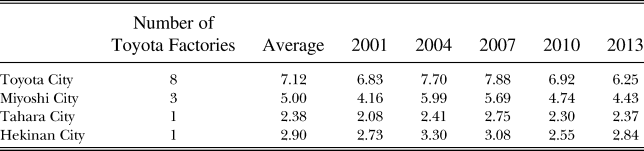
Data From: Data of number and locations of Toyota factories are collected from Toyota Website. The percentage of PR votes = the number of votes obtained by JAW candidates ÷ the number of eligible voters in that municipality.
Second, the percentage of PR votes for JAW candidates was higher in those municipalities with the greatest number of Toyota factories. Between 2001 and 2010, Toyota City, with its seven factories, held the highest percentage among the four company towns of PR votes for JAW candidates. The Toyota City average was 7.12 percent; it was followed by Miyoshi City, with the average of 5.0 percent. Tahara City and Hekinan City had slightly lower averages. The average of Tahara City was 2.38 while the average of Hekinan City was 2.90. This outcome shows that cities with more factories have more PR votes for JAW candidates. Toyota City's average of 7.12 percent is the highest in Aichi Prefecture. Miyoshi City's 5.0 percent is the second largest.
The third point to be made is that the vote varied little between elections, even though the JAW candidate was not always a Toyota Union candidate. In 2004 and 2010, Naoshima from Toyota was the nominee, but in the other years the nominee came from other JAW unions. Stability of the vote is a hallmark of organized votes.
In Table 4, I perform a similar analysis for Toyota-group companies. There are 15 Toyota-group companies (Toyota website),Footnote 4 with factories located in 15 cities and towns (Toyota website). The average of the percentage of votes for JAW candidates in these 15 cities and towns is 2.10 percent. The average percentage of votes in these 15 areas combined, from 2001 to 2013, is higher than the national average of 0.20 percent.
Percentage of PR votes for JAW candidates in the House of Councillors Elections in Toyota Group Companies Factories Locations

Note: Futaba Industrial Co. Ltd, which has seven factories in Chiryu City, Okazaki City, and Kōda Town, is not a Toyota-group company. However, it is a Toyota-group company. Toyota is the major stakeholder of Futaba with 12%. For this reason, the data includes locations of Futaba. Information about Futaba is collected from Futaba company's website.
Data From: Data of locations of Toyota-group companies’ factories are collected from Toyota and 15 group companies’ websites. The percentage of PR votes = the number of votes obtained by JAW candidates ÷ the number of eligible voters in that municipality.
The city with the largest number of factories is Kariya City, which has the factories of seven group companies. And, indeed, Kariya City has the highest percentage of PR votes for JAW candidates in these 15 cities and towns. The average vote percentage in Kariya City from 2001 to 2013 was 4.70 percent. Leaving aside Kariya City, in four of the 15 cities and towns, JAW candidates had more than 2.80 percent. In three cities, Anjyō, Chiryu, and Takahama City, the average of the PR votes was over 3.3 percent. In Ōfu, Nishino, and Okazaki City and in Nukanotabe County, JAW candidates had over 2.80 percent on average. The percentage of votes for Non-Toyota JAW candidates in the 2001, 2007, and 2013 did not differ much from the Toyota JAW candidate in the 2004 and 2010 elections.
It is clear that JAW PR candidates get more votes in municipalities where more Toyota and Toyota-group companies are located. Toyota Union has organizational votes in company towns. Next, I examine how much percentage JAW candidates obtained in areas without Toyota and Toyota-group companies’ facilities. If the percentages of votes are higher in places with Toyota and Toyota-group companies’ factories than in places without them, this could show that Toyota Union has influenced the voting. Table 5 shows the average percentage of PR votes for JAW candidates in three types of locations: those with Toyota factories, those with Toyota-group companies’ factories, and those with no Toyota or Toyota-group companies’ factories.Footnote 5
The Average percentage of PR Votes for JAW Candidates

Data From: I identified in which municipalities Toyota and Toyota-group companies locate based on Toyota and Toyota-group companies’ websites. The percentage of PR votes = the number of votes obtained by JAW candidates ÷ the number of eligible voters in that municipality.
Table 5 demonstrates that JAW candidates receive more votes in municipalities where Toyota and Toyota-group companies were located. Since 2001, municipalities with Toyota factories have had the highest average percentage of votes: 4.23 percent. The next highest average—1.74 percent—is found in locations that hold Toyota-group companies’ factories. In areas with no Toyota or Toyota-group factories, the average vote percentage for JAW candidates was 0.6 percent. The average percentage was below 1 percent in every election. Thus, Toyota Union has organizational votes in places where Toyota, Toyota-group, and Toyota-group companies are located. In non-company towns, Toyota Union has almost no organizational votes.
In sum, Toyota Union has indeed been able to organize a significant number votes and to deliver those votes to JAW candidates in company towns. We can add that JAW-sponsored candidates obtained a relatively high percentage of votes in the company towns of other enterprise unions.Footnote 6 For instance, in Kanda Town in Fukuoka Prefecture, a company town of Nissan Automobile, the average percentage of PR votes for the JAW candidates from 2001 to 2013 was 3.22 percent. In 2013, the percentage of PR votes was 6.15 percent. Another example is Suzuka City in Mie Prefecture which is a company town of Yamaha Automobile. The average percentage of PR votes for the JAW candidates from 2001 to 2013 was 2.5 percent. In 2001, the percentage of PR votes was 4.10 percent.
VOTE MOBILIZATION CAPACITIES OF UA ZENSEN ENTERPRISE UNIONS IN COMPANY TOWNS
Unlike JAW, enterprise unions in UA Zensen are organizationally heterogeneous. UA Zensen was formed from enterprise unions in various industries that do not have company towns. A few large companies in the chemical and textile industries have company towns, but companies in food, service, and distribution industries do not. As in the case of Toyota Union, those enterprise unions in UA Zensen that have company towns mobilize more votes for sponsored candidates. To confirm that enterprise unions in UA Zensen can mobilize more votes in company towns, I examine three enterprise unions of companies in the chemical and synthetic fiber industry.
Toray Industries has 45,800 employees, and their main manufacturing base in Ōtsu City in Shiga Prefecture (Toray Website). In Shiga Prefecture, from 1971 to 1989, Fujii Tsuneo, of Toray Union, held a seat in the House of Councillors. Kawabata Tatsuo, also of Toray Union, maintained a seat in the House of Representatives from 1986 to 2017. There are two members of UA Zensen in the prefectural assembly and two in the Ōtsu City assembly.
Asahi-Kasei, with 30,313 employees, has its main manufacturing base in Nobeoka City and factories in Hyūga City in Miyazaki Prefecture (Asahi-Kasei Website). Though the number of subcontractors is not large, Asahi-Kasei is a core of the local economy (Nihon Keizai Shimbun, August 18, 2016). Asahi-Kasei has invested around 14,000,000 yen (around 128,000 USD) in Nobeoka City (Nihon Keizai Shimbun, August 18, 2016), and it also has factories and a laboratory in Moriyama City in Shiga Prefecture. Currently, in Miyazaki Prefecture, there are no UA Zensen Diet members elected in electoral districts. However, from 1976 to 2003, Yonezawa Takashi, of Asahi-Kasei, held a seat in the House of Representatives. The vote mobilization capacity of Asahi-Kasei was a driving force in Yonezawa's nine consecutive electoral victories (Asahi Shimbun, May 20, 2015). Until the early 1980s, Asahi-Kasei Union mobilized almost 45 percent of eligible voters in Nobeoka City (Nihon Keizai Shimbun, December 6, 1983). UA Zensen members have two seats in the Miyazaki prefectural assembly and one in the Miyazaki city assembly. In Nobeoka City, seven of 29 city assembly members are from UA Zensen.
Finally, Teijin has 19,292 employees (Teijin Website), and Matsuyama City in Ehime Prefecture is one of its core bases. Teijin started building factories in Matsuyama City in the 1950s. Currently, Teijin has two factories and five laboratories in Matsuyama City (Teijin Website). In the electoral districts of Ehime, no Diet members sponsored by UA Zensen have been elected, and UA Zensen has no Prefectural Assembly members. However, UA Zensen has one member in the Matsuyama City Assembly.
Because of the limited availability of information about these three companies and their company towns, I cannot examine these cases in as much detail as I did the Toyota case. However, these three enterprise unions have similarities with the Toyota Union in JAW. Groups exist inside and outside the workplace, and interactions among them develop dense networks. For instance, Asahi-Kasei Union formed an association of employees’ wives (Sotohebo Reference Sotohebo2007, 271–272). In addition, Asahi-Kasei Union formed groups (of about five union members each) based on residential area, thus forming links with local residents such as farmers and fishermen (Sotohebo Reference Sotohebo2007, 272; Nihon Keizai Shimbun, December 6, 1983). Furthermore, they planned various events such as shows and festivals to expand support for their sponsored candidates (Sotohebo Reference Sotohebo2007, 272).
In addition to employees, the social groups organized by the union may be made up of subcontractors and local businesses. In Asahi-Kasei, subcontractors form associations based on the type of subcontracting they do, and they support sponsored candidates from Asahi-Kasei (Sotohebo Reference Sotohebo2007, 275–276). For instance, subcontractors engaging in installation work formed the Asahi-Kasei Cooperation Association (Sotohebo Reference Sotohebo2007, 275). Subcontractors dealing materials formed the Asahi-Kasei Mutual Prosperity Association (Sotohebo Reference Sotohebo2007, 276). Local residents who are not employees, such as farmers, fishermen, and local merchants, also joined residential area groups formed by Asahi-Kasei Union (Sotohebo Reference Sotohebo2007, 272; Nihon Keizai Shimbun, December 6, 1983).
Finally, there are local politicians from unions, as in the Toyota case. All three enterprise unions have their sponsored local politicians in city and prefectural assembly elections. Asahi-Kasei and Toray also had a sponsored candidate elected to the lower house. Local politicians take responsibilities in mobilizing votes in their area. In the workplace, the factory or office manager performs that task. Union members play key roles in mobilizing votes, by visiting every house in their area and providing materials such as leaflets or stickers of their sponsored candidates (Nihon Keizai Shimbun, December 6, 1983). Leaders take responsibility for creating activities that will expand support (Nihon Keizai Shimbun, December 6, 1983).
Table 6 shows the percentage of votes obtained by UA Zensen candidates in the PR of House of Councillors from 2001 to 2013, in the company towns of these three companies and non-company towns in Shiga, Ehime, and Miyazaki Prefectures.Footnote 7 The national average of PR votes for UA Zensen-sponsored candidates from 2001 to 2013 was 0.14 percent. In each case, vote mobilization in company towns is much higher than the national average. Furthermore, the number of PR votes in company towns is higher than in non-company towns. For example, in Miyazaki Prefecture, the average number of PR votes in Nobeoka City is 3.69 percent, and in Hyūga City the average is 0.94 percent. In non-company towns, the average is 0.24 percent. The average in Nobeoka City is thus almost 15 times higher than in non-company towns, and in Hyūga City, the average is almost 4 times that of non-company towns.
Percentage of PR votes in Shiga, Ehime, and Miyazaki Prefecture

Data From: Data about company facilities is collected from companies’ website of Toray, Teijin and Asahi-Kasei. The percentage of PR votes = the number of votes obtained by UA Zensen candidates ÷ the number of eligible voters in that municipality.
CONCLUSION
In this article I have tried to fill two gaps in the literature. First, I examined the electoral clout of labor unions, the largest interest groups that support the opposition parties, supplementing studies of interest groups that support the LDP. Second, I focused on variations in vote mobilization capacity among unions. I find that some labor unions are capable of mobilizing enough votes to elect one of their members to the House of Councillors. The unions that mobilize more votes are not necessarily the ones with the largest membership. Organization is the key. More homogenous unions, and especially those with company towns, allow unions to develop the kinds of organizations and dense networks in their communities that have been noted as keys to vote mobilization by organizations such as JA and the Postmasters associations that support the LDP.
I analyze the voting for union-sponsored candidates by comparing two private-sector unions: JAW, an organizationally homogeneous union, and UA Zensen, a more organizationally heterogeneous union. UA Zensen has more members but mobilizes fewer votes than JAW. In both cases, unions mobilize more votes in company towns than in non-company towns. Company towns endow unions with organizations consisting of dense networks and roots in local communities, which work effectively in vote mobilization. JAW is formed only of enterprise unions in the automobile industries, most of which operate and take advantage of company towns in vote mobilization. On the other hand, enterprise unions in UA Zensen are in various industries such as chemical, textile, food, distribution, and service. Though some enterprise unions, such as Toray, Teijin, and Asahi-Kasei in the chemical and textile industries, have company towns, many do not.
Comparison of JAW and UA Zensen shows that the vote mobilization capacities of industrial unions are increased by a combination of two factors: company towns and enterprise unions. Furthermore, my findings demonstrate that the vote mobilization capacity of an organization depends less on the number of members who belong to that organization than on the effectiveness with which those members are organized. Therefore, declining union memberships need not imply declining electoral clout.
I have made progress in understanding variations in the clout of private-sector unions, but much remains to be done. Most notably, among the five unions that have consistently elected sponsored candidates, two, the All-Japan Prefectural and Municipal Workers Union (Jichirō) and the Japan Teachers’ Union (JTU), are public-sector unions that do not have company towns. Their members are spread evenly across the county, yet they have been successful in electing their sponsored candidates to the House of Councillors. The question of how these public-sector unions mobilize votes is a topic for future research.



