

Introduction
Working beyond full pension age (FPA) – or extended working lives – is a growing phenomenon in ageing populations worldwide (Léime et al. Reference Léime Á, Ogg, Rašticová, Street, Krekula, Bédiová and Madero-Cabib2020). Over the last two decades, research shows that older people prolong work in a variety of labour force statuses. These include standard full-time salaried jobs and, increasingly, non-standard forms of employment, such as self-employment, as well as flexible, temporary, part-time and bridge jobs (Cahill et al. Reference Cahill, Giandrea and Quinn2015; Wahrendorf, Akinwale et al. Reference Wahrendorf, Akinwale, Landy, Matthews and Blane2017). While this trend affects both men and women, research indicates significant gender disparities in late-life employment. Compared to men, women often experience unstable employment and insufficient pension resources due to care-giving responsibilities that interrupt labour market participation earlier in life (Léime and Street Reference Léime Á and Street2019). These gendered inequalities are particularly pronounced in liberal welfare regimes, where market-based solutions shape pension systems and income support for family care is both limited and targeted.
In recent years, a specific group of countries has displayed a comparatively higher prevalence of older workers, along with strong gender stratification in later-life employment. As will be discussed, these countries –England, Switzerland, the United States and Chile – share one main feature: they are close to the liberal, market-oriented welfare regime, characterised – especially during the life of the current generation of older workers –by a combination of greater deregulation of labour markets with scarcer public family support. The interplay between these structural features and lifecourse dynamics is likely to shape employment trajectories differently for men and women.
Building on recent global research suggesting that individuals’ working status in later life is fundamentally shaped by experiences across the lifecourse, we adopt a gendered lifecourse perspective. This perspective helps us understand how long-term employment and family dynamics influence extended working lives within national contexts that have faced similar market-oriented reforms. Additionally, considering prior studies indicating that women are more likely than men to encounter unfavourable employment situations in later years, we incorporate a gender perspective to explore potential differences in how lifecourse trajectories shape late-life employment outcomes.
The article begins with a theoretical background section discussing the notion of liberal welfare regimes and extended working lives in these contexts, with a focus on gender inequalities. We then outline the rationale for studying four liberal-oriented countries from Europe and the Americas, address research gaps and pose our research questions. Next, we describe the cross-national life-history data and longitudinal methods employed in the study. The Results section presents bivariate and multivariate findings, followed by a discussion of how these findings advance knowledge on gendered patterns of employment beyond FPA in liberal regime countries.
Background
Working life extension is largely attributed to the fiscal pressures of retirement, particularly in the global context of increasing healthy life expectancy and decreasing fertility rates. Consequently, in line with international organisations’ recommendations, since the early 2000s, policy makers and decision-makers in Western countries have advocated for institutional measures that encourage employment in old age. These measures include the progressive removal of early retirement incentives, the introduction of lifelong training programmes and anti-age discrimination policies, and the raising of legal retirement ages (Ebbinghaus Reference Ebbinghaus2021; Léime et al. Reference Léime Á, Ogg, Rašticová, Street, Krekula, Bédiová and Madero-Cabib2020).
As a result of these policies, the labour force participation rate of individuals aged 55–64 in Western nations has grown significantly. Additionally, a moderate increase has been observed in those aged 65+. Among the member countries of the Organisation for Economic Co-operation and Development (OECD), the labour force participation rate for people aged 55–64 rose from 50.0 per cent to 64.3 per cent between 2000 and 2019, just prior to the global impact on employment of the Covid-19 pandemic. For those aged 65+, participation grew from 9.1 per cent to 15.8 per cent during the same period (OECD 2023).
Although working beyond FPA is a global phenomenon, this trend is significantly more pronounced in countries such as the United States (US), the United Kingdom (UK), Switzerland and Chile (see Figure 1). These countries differ in multiple dimensions, including economic and institutional development, religious and cultural traditions, and the expansion and consolidation of democracy. However, and despite these differences, these countries share an important feature as they are predominantly classified as liberal or market-oriented welfare regimes, by the welfare state literature (Baumann and Madero-Cabib Reference Baumann and Madero-Cabib2021; Baumann, Cabib et al. Reference Baumann, Cabib, Eyjólfsdóttir and Agahi2022; Baumann, Froidevaux et al. Reference Baumann, Froidevaux and Cabib2022; Calvo et al. Reference Calvo, Madero-Cabib and Staudinger2018; Hofäcker et al. Reference Hofäcker, Schröder, Li and Flynn2016; Kuitto and Helmdag Reference Kuitto and Helmdag2021; Lain Reference Lain2017; Wahrendorf, Zaninotto et al. Reference Wahrendorf, Zaninotto, Hoven, Head and Carr2017). These countries are ‘predominantly’ liberal because they may not belong exclusively to a single welfare regime category at any time or throughout history, but different regime orientations tend to coexist within a given nation over time (Macmillan and Shanahan Reference Macmillan and Shanahan2021).
Labour force participation rate among individuals aged 55–64 (A) and 65+ (B).

The notion of liberal welfare state regime
Welfare regimes were originally used to classify advanced Western economies based on their level of protection and decommodification – that is, the degree to which welfare is provided through non-market mechanisms. Over time, this concept has evolved to frame policy discussions globally (Gough and Wood Reference Gough and Wood2004; Rudra Reference Rudra2008). Decommodification, as a measure for classifying social policy frameworks, has been useful because it allows for the analysis of specific policies across different dimensions while also considering broader macro-level trends in social spending and access to benefits. Tying together different levels of analysis, liberal welfare regimes share an orientation characterised by reliance on market mechanisms, promoting individual autonomy and choice, and targeted state support, rather than a set of uniform policies.
Given this orientation, liberal welfare regimes have incentivised work and self-reliance in old age. While individual factors – such as good health, higher education or economic needs – are often linked to post-retirement work, liberal regimes are thought to encourage continued employment through various policy measures. These include tax incentives (such as gradual pension deductions and higher returns for deferring pensions), flexible hiring conditions for older workers, the ability to combine pension and work income, non-mandatory retirement and extending the legal retirement age.
However, these policy orientations have evolved within societies where cultural norms and social structures are already established. In this context, Latin American countries, including Chile, have often been compared to Mediterranean or Southern European welfare regimes, or even described as informal or maternal welfare regimes due to the significant role that extended families – particularly women within them – play in providing care (different classifications can be found in Barrientos Reference Barrientos2009; Blofield and Martínez Franzoni Reference Blofield and Martínez Franzoni2015; Holland AC 2017; Huber and Bogliaccini Reference Huber, Bogliaccini, Castles, Leibfried, Lewis and Obinger2010; Pribble Reference Pribble2011). Unsurprisingly, compared to the UK, Switzerland and the US, Chile has seen a slower expansion of female participation in the workforce, especially in formal jobs. This is largely because women often provide unpaid care for young children or elderly dependents within the household, which frequently leads them to exit the labour market in either early or later stages of adulthood, depending on their care-giving responsibilities (Provoste Reference Provoste and Calderón2013).
Extended working lives in liberal regime countries
In the past 40 years, research on welfare regimes has expanded in two significant ways. First, it has broadened its regional focus to include more countries worldwide. Second, it has examined cross-country differences in greater detail, as nations have adapted and modified their social security policies during this period. This means that national systems have evolved and enacted policies that could have been categorised under a different welfare regime in the past. The four countries mentioned – the US, the UK, Switzerland and Chile –have been subject to academic scrutiny on both fronts. Despite being categorised as liberal welfare regimes, they differ widely in terms of history, culture and the social policies enacted over the past century. Despite their differences, they began to converge, on the one hand, in the rise of market-friendly reforms implemented since the 1980s and, on the other, in post-retirement work policies in recent years.
For example, both the US and the UK are often labelled as liberal regimes due to their emphasis on limiting the state’s role in social protection and promoting policies focused on enhancing human capital and productivity. However, this characterisation mainly reflects the impact of liberal reforms in the 1980s, which shifted these countries away from more solidaristic social policies (Gerstle Reference Gerstle2022). Similarly, Chile’s social security system was modelled on the Bismarckian (conservative) welfare regime between the 1920s and 1970s, only adopting a more liberal orientation after the market-driven reforms of Pinochet’s dictatorship in the 1980s (Mesa-Lago Reference Mesa-Lago1986). Switzerland, meanwhile, has followed a more stable policy trajectory, but its classification as a liberal regime has been debated. While Esping-Andersen categorised Switzerland as liberal due to its targeted assistance programmes, others note similarities with Christian Democratic or conservative regimes (Castles et al. Reference Castles, Leibfired, Lewis and Obinger2010; Huber and Stephens Reference Huber and Stephens2001; Kriesi and Trechsel Reference Kriesi and Trechsel2008).
The comparatively higher prevalence of extended working lives in liberal-oriented countries has been explained by two reasons. Firstly, the type of welfare state regime shapes access to and the generosity of public pensions, which in turn shape the prevalence, duration and nature of extended working lives, as individuals navigate the constraints and opportunities provided by their respective national policies (Ebbinghaus Reference Ebbinghaus2021; Fasang et al. Reference Fasang, Aisenbrey and Schömann2013; Madero-Cabib et al. Reference Madero-Cabib, Corna and Baumann2020). In liberal countries, since means-tested public pensions are rarely generous, occupational and private pension schemes are crucial for securing a basic standard of living during retirement (Madero-Cabib and Fasang Reference Madero-Cabib and Fasang2016; Worts et al Reference Worts, Corna, Sacker, McMunn and McDonough2016).
The four countries analysed in this study – England, Switzerland, the United States and Chile – exhibit some diversity in their pension systems despite their classification as predominantly liberal welfare regimes (Borsch-Supan and Miegel Reference Borsch-Supan and Miegel2001). England features a strong tradition of occupational pensions, particularly among men, which provide defined benefit plans offering relatively stable retirement income. Switzerland operates under a mixed system combining public pensions and mandatory occupational savings, ensuring broad coverage and reducing reliance on late-life work. In the United States, employer-based pensions and private savings dominate, leaving individuals with interrupted employment histories vulnerable to financial precarity in retirement. Chile took a more radical approach by promoting private savings and fully adopting a definite-contribution system with private pension administrators, established under Pinochet’s dictatorship.
However, regardless of these differences, pension schemes in these countries tend to offer relatively low pension replacement rates given their sensitivity to employment trajectories. Consequently, individuals without continuous employment pathways display limited saving capacities to fund a generous pension (Ginn et al. Reference Ginn, Street and Arber2001). The average net pension replacement rate for both men and women in 2019 across the four liberal-oriented countries of interest was lower than the average of OECD countries (OECD 2023). Extended working lives in liberal countries are often symptomatic of insufficient pension resources and incentives to bolster private pension savings (Baumann, Cabib et al. Reference Baumann, Cabib, Eyjólfsdóttir and Agahi2022; Baumann, Froidevaux et al. Reference Baumann, Froidevaux and Cabib2022; Baumann and Madero-Cabib Reference Baumann and Madero-Cabib2021; Canales et al. Reference Canales, Salinas and Biehl2021; Fasang et al. Reference Fasang, Aisenbrey and Schömann2013).
Secondly, the heightened proportion of older workers in liberal countries is because welfare regimes affect the type of labour market policies that shape employment attachment both in adulthood and in old age. Although the UK, the US and Switzerland have more explicit policies promoting post-retirement work, Chile has also seen a rise in post-retirement employment, despite the absence of strong institutional incentives (Cabib Reference Cabib2025). These policies, in turn, influence the likelihood of individuals remaining active during their old age. The countries examined introduced market-oriented social insurance reforms in the 1970s and 1980s to deregulate labour markets and flexibilise employment and unemployment protection (Aisenbrey and Fasang Reference Aisenbrey and Fasang2017). By deregulated labour markets, we refer to measures such as eliminating rigidities in collective bargaining, reducing hiring and firing costs, and undermining programmes aimed at reintegrating the unemployed (Macmillan and Shanahan Reference Macmillan and Shanahan2021, Reference Macmillan and Shanahan2022). We also refer to flexibilisation measures, including the growth of temporary (fixed-term) contracts and non-standard job arrangement trajectories (Erlinghagen Reference Erlinghagen2019; Kalleberg Reference Kalleberg2012). In the US and the UK, these measures were mostly introduced under the Reagan (1981–1989) and Thatcher (1979–1990) administrations, respectively. In Chile, they were implemented under Pinochet’s dictatorship (1973–1990), while in Switzerland, they came gradually and much later than in the US, the UK and Chile (Eichenberger Reference Eichenberger2019; Macmillan and Shanahan Reference Macmillan and Shanahan2021, Reference Macmillan and Shanahan2022; Madero-Cabib et al. Reference Madero-Cabib, Biehl, Sehnbruch, Calvo and Bertranou2019).
Deregulation and flexibilisation measures in liberal countries have led to relatively fewer individuals following a working pattern characterised by continuous, full-time employment throughout adulthood. Instead, a high diversity of employment trajectories can be observed (Aisenbrey and Fasang Reference Aisenbrey and Fasang2017; Madero-Cabib and Fasang Reference Madero-Cabib and Fasang2016; Van Winkle and Fasang Reference Van Winkle and Fasang2017). In terms of employment measures in old age, liberal regimes typically induce ‘employment maintenance’ measures through markets (Hofäcker et al. Reference Hofäcker, Schröder, Li and Flynn2016). These measures involve flexible retirement policies aimed at eliminating mandatory retirement and encouraging extended working lives, in both standard and non-standard forms of employment. Recent longitudinal studies conclude that flexible labour market conditions in later life have led to an increasing proportion of individuals remaining active beyond FPA in these countries (Baumann and Madero-Cabib Reference Baumann and Madero-Cabib2021; Baumann, Cabib et al. Reference Baumann, Cabib, Eyjólfsdóttir and Agahi2022; Baumann, Froidevaux et al. Reference Baumann, Froidevaux and Cabib2022; Cahill et al. Reference Cahill, Giandrea and Quinn2015; Calvo et al Reference Calvo, Madero-Cabib and Staudinger2018; Lain Reference Lain2017; Madero-Cabib et al. Reference Madero-Cabib, Corna and Baumann2020; Scherger Reference Scherger2021; Tang and Burr Reference Tang and Burr2015)
Gender inequalities in extended working lives across liberal countries
Research shows important gender differences in employment and family trajectories among older workers worldwide (Grødem and Hippe Reference Grødem and Hippe2021; Léime et al. Reference Léime Á, Ogg, Rašticová, Street, Krekula, Bédiová and Madero-Cabib2020; Loretto and Vickerstaff Reference Loretto and Vickerstaff2015; Wildman Reference Wildman2020). The normative expectation that women will provide unpaid family care throughout their lives often results in a higher likelihood of staying outside the labour market or working part-time during adulthood. Consequently, this increases their likelihood of experiencing disadvantaged and precarious forms of employment and insufficient pension resources in old age (Léime and Street Reference Léime Á and Street2017, Reference Léime Á and Street2019; Moulton and Scott Reference Moulton and Scott2016).
Combining welfare regime and gender perspectives, recent studies further point that disadvantaged employment statuses in old age are more prevalent among women in liberal regime countries (Madero-Cabib et al. Reference Madero-Cabib, Le Feuvre and König2023; Schmitz et al. Reference Schmitz, Naegele, Frerichs and Ellwardt2023). This is mainly because, together with facing greater labour market deregulation, the current generation of older individuals in liberal-oriented countries grew up in a traditional male breadwinner and female care provider model. Institutionally, this model led to relatively low levels of (1) eligibility, (2) duration and (3) compensation for public family benefits aimed at addressing family and care needs, including family and child allowances, public childcare, public eldercare and parental leave benefits (Cooke and Baxter Reference Cooke and Baxter2010; Grunow and Aisenbrey Reference Grunow and Aisenbrey2016; Macmillan and Shanahan Reference Macmillan and Shanahan2021).
Gender plays a critical role in shaping the experience of extended working lives within liberal welfare regimes. These regimes, characterised by market-oriented policies and limited public support for family care, often exacerbate cumulative disadvantages faced by women over the lifecourse. For instance, women’s greater likelihood of unpaid care-giving responsibilities – whether for children or ageing relatives – reduces their time in the formal labour market, leading to fewer opportunities for continuous full-time employment and lower pension contributions in old age (Grunow and Aisenbrey Reference Grunow and Aisenbrey2016; Léime and Street Reference Léime Á and Street2019). This dynamic often results in a higher prevalence of part-time and precarious employment among women compared to men in later life (Cooke and Baxter Reference Cooke and Baxter2010).
In contrast, men’s employment trajectories, characterised by higher rates of continuous full-time work, often provide more stable access to occupational pensions and private savings. However, even within liberal regimes, considerable cross-national variation exists in how gender influences late-life employment (Madero-Cabib et al. Reference Madero-Cabib, Le Feuvre and König2023). For example, countries like England and Switzerland have introduced flexible retirement policies that encourage part-time work among women, while the United States and Chile exhibit stronger traditional gender norms, contributing to lower female workforce participation rates in later life (Baumann, Cabib et al. Reference Baumann, Cabib, Eyjólfsdóttir and Agahi2022; Baumann, Froidevaux et al. Reference Baumann, Froidevaux and Cabib2022).
Older people in these countries rely on traditional family structures characterised by early marriage and parenthood, and sometimes multi-generational households, or turn to expensive market-based solutions to meet their care-giving needs. Previous research underscores the combined effect of labour market deregulation and scarce support for family care to explain the gender stratification of later-life employment in liberal nations (Fasang et al. Reference Fasang, Aisenbrey and Schömann2013; Madero-Cabib and Fasang Reference Madero-Cabib and Fasang2016; Madero-Cabib et al. Reference Madero-Cabib, Le Feuvre and König2023; Schmitz et al. Reference Schmitz, Naegele, Frerichs and Ellwardt2023; Worts et al Reference Worts, Corna, Sacker, McMunn and McDonough2016).
Research gaps
Despite robust evidence, our understanding of gendered extended working lives and their determinants in countries closely aligned with the liberal welfare regime remains limited due to two factors. If not addressed, these will constrain both theoretical and practical advancements in understanding how gendered lifecourse dynamics interact with regime-level influences to shape extended working lives.
First, due to the limitations of available data, studies on extended working lives across liberal countries have, until now, predominantly examined the determinants of later-life employment through a cross-sectional approach (Grødem and Hippe Reference Grødem and Hippe2021; Léime and Street Reference Léime Á and Street2017, Reference Léime Á and Street2019; Loretto and Vickerstaff Reference Loretto and Vickerstaff2015; Madero-Cabib and Kaeser Reference Madero-Cabib and Kaeser2016). While these studies provide robust and informative findings, the analysis of cross-sectional data has led researchers to overlook the cumulative impact of individuals’ characteristics and experiences that unfold across lives. Lifecourse studies emphasise that inequalities in social, financial, behavioural and wellbeing conditions among older adults are strongly shaped by inter-individual divergences across socio-economic, health, psychological and cultural characteristics originating early in life (Corna Reference Corna2013; Hoven et al. Reference Hoven, Dragano, Blane and Wahrendorf2018). Addressing this gap is essential to uncover how early-life dynamics interact with later-life employment outcomes, particularly within the liberal welfare regime, which emphasises market reliance and individual responsibility.
Only a handful of studies have explored the determinants of extended working life in liberal countries through a lifecourse approach (Madero-Cabib and Biehl Reference Madero-Cabib and Biehl2021; Schmitz et al. Reference Schmitz, Naegele, Frerichs and Ellwardt2023; Wahrendorf, Zaninotto et al. Reference Wahrendorf, Zaninotto, Hoven, Head and Carr2017; Wildman Reference Wildman2020). These studies, which often focus on single-country examples, highlight that old age working status is shaped primarily by divergent characteristics in employment and family life domains. For example, individuals with prolonged periods in physically or mentally demanding occupations, interrupted career paths, persistent informal care-giving duties or intergenerational household responsibilities are more likely to extend their working lives in precarious labour force statuses. These findings underscore that employment and family histories are crucial enablers or restrictors of extended working lives and shape the diversity of post-retirement employment statuses.
Data limitations lead to a second research gap. Most comparative research relies on data from a single liberal welfare state or, at most, two liberal countries (see, for example, Baumann and Madero-Cabib Reference Baumann and Madero-Cabib2021; Lain 2016; or Schmitz et al. Reference Schmitz, Naegele, Frerichs and Ellwardt2023). This narrow focus limits the generalisability of findings and risks homogenising contexts that, while similar, differ in their approaches to welfare provisions that shape employment in old age. Such an oversight is problematic because it overlooks the diversity in how gender and social characteristics influence extended working life patterns across liberal regimes. For example, while market-oriented reforms are a common feature of liberal welfare regimes, their design, implementation and outcomes vary significantly, potentially altering the influence of gendered lifecourse trajectories on extended working lives (Madero-Cabib et al. Reference Madero-Cabib, Corna and Baumann2020, Reference Madero-Cabib, Le Feuvre and König2023).
By addressing these two gaps, our study significantly contributes to the literature by uniquely integrating a lifecourse perspective with a cross-national comparative approach. This integration deepens our understanding of how gendered employment and family trajectories shape extended working lives and how these trajectories differ across various liberal welfare regimes. Such an approach provides a more nuanced and generalisable framework for analysing the relationship between individual lifecourse dynamics and structural contexts. Importantly, institutional differences – such as variations in pension systems, labour market flexibility and gender norms – can either amplify or mitigate the influence of gendered life trajectories. However, this research advances the broader field by highlighting the importance of considering both longitudinal lifecourse patterns and cross-national diversity, addressing limitations in prior studies that have often focused on single-country or cross-sectional analyses.
Current study
Building on the previous insights, our study takes a significant step towards closing existing research gaps on the gendered lifecourse determinants of extended working lives in liberal regime countries. While there is consensus about the combined relevance of liberal regime policies and gendered employment and family trajectories in adulthood for shaping employment in later life, we could not find a single cross-national study simultaneously addressing these dimensions. Drawing on exceptionally rich, harmonised life history data, we explore the association between employment and family patterns in adulthood and work status beyond FPA among men and women in four countries that researchers in the welfare state literature characterise as adhering to the liberal, market-oriented regime: two from Europe (England and Switzerland) and two from the Americas (the United States and Chile).
Specifically, we aim to understand whether work statuses beyond FPA in each of these national settings – regardless of the aggregate differences between them shown in Figure 1 – are consistently driven and explained by similar employment and family histories in adulthood. Additionally, we want to explore whether men and women are affected differently by employment and family pathways concerning their work status in later life. To provide a more comprehensive approach to this phenomenon, we focus on three dimensions of extended working lives: (1) the prevalence of work beyond FPA, (2) the duration of work beyond FPA and (3) the diversity of work statuses beyond FPA (i.e. whether people are employed in a full-time or a part-time job).
Therefore, our study addresses two exploratory research questions (RQs):
• RQ1: Is the prevalence, duration and diversity of extended working lives across four liberal regime countries in Europe and the Americas driven by similar employment, partnership and fertility trajectories across adulthood?
• RQ2: Is the prevalence, duration and diversity of extended working lives across the four countries driven by different employment, partnership and fertility trajectories for men and women?
To ensure an accurate comparison, considering the different methodological designs of the national longitudinal surveys used (explained later), we focused on individuals born between 1944 and 1954 and reconstructed their employment and family trajectories from age 15 to 65, considering the latest indicator of work status observed for each individual.
Methods
Data
We carefully harmonised data from four surveys focused on older populations. We used the Swiss panel of the Survey of Health, Ageing and Retirement in Europe (SHARE) for Switzerland (CH), the Health and Retirement Study (HRS) for the United States (US), the English Longitudinal Study of Ageing (ELSA) for England (EN) and the Life Course and Vulnerability among Older People in Santiago (EVDA) survey for Chile (CL) (see Madero-Cabib and Cabello-Hutt Reference Madero-Cabib and Cabello-Hutt2022).
Retrospective lifecourse data
We first harmonised employment, partnership and fertility histories using retrospective and representative lifecourse data. For Switzerland, we used data from SHARELIFE, a retrospective life history survey integrated into the third and seventh waves of the panel (2008/9 and 2017), which documented histories in various life domains. The HRS included a Life Histories module, which retrospectively measured different areas of the lifecourse in 2015 and 2017, while ELSA incorporated a retrospective life history module in 2007. Finally, the EVDA included a life history component in 2019.
Samples
The sample for this study included individuals born between 1944 and 1954, with information on employment, partnership and fertility histories from age 15 to 65 and information on work status in later life. This resulted in samples of 4,006 individuals from the US, 3,083 from England, 1,143 from Switzerland and 802 from Chile.
Measures
Dependent variables: prevalence, duration and diversity of extended work
To measure work in later life, we considered and harmonised work indicators up until the latest observation of all participants in the panel surveys HRS (2018), ELSA (2017) and SHARE (2017), while for EVDA we considered the single observation available in 2019.
1. Prevalence of work beyond FPA age (0 = ‘did not work after full pension age’; 1 = ‘worked after FPA for at least one year’).
2. Duration of work beyond FPA (number of years worked after FPA).
3. Work-time basis beyond FPA (1 = ‘worked after FPA in a full-time job’; 2 = ‘worked after FPA in a part-time job’; 3 = ‘worked after FPA in both a full-time and a part-time job’; 4 = ‘did not work after full pension age’).
Because FPA varies across countries and genders, we accounted for these differences in constructing our measure. In Chile, the FPA is 65 for men and 60 for women. In Switzerland, the FPA is 65 for men and 64 for women. In Ireland, the FPA is 66 for both genders. In England, the FPA for men is 65, while for women it depends on their birth year: women born in or before 1950 have an FPA of 60; those born in 1951 have an FPA of 61; those born in 1952 have an FPA of 62; those born in 1953 have an FPA of 63; and women born in 1954 or later have an FPA of 65, matching that of men. In the United States, the FPA is 66 for individuals born before 1960 and 67 for those born in 1960 or later.
Independent variables: employment, partnership and fertility trajectories in adulthood
The harmonised retrospective data of life histories included the following categories. For the employment domain, we categorised each person as employed full-time, employed part-time or out of the labour force, including people doing unpaid labour at home, the unemployed, students, disabled people and other categories. For the family domain, we categorised each person according to their partnership and fertility history. We categorised people as single, married, divorced/separated and widowed, and as having no children, one child, two children or three or more children.
Using this harmonised retrospective data, collected through life calendars where individuals reported the years in which changes occurred in the domains of employment, partnership and fertility, we constructed a pseudo-panel for each country. This pseudo-panel simulates longitudinal data by treating these self-reported life changes as annual observations. We focused on ages 15 through 65, creating a sequence of 51 yearly states for each individual in each domain. These sequences provide a comprehensive account of individuals’ lifecourse transitions, capturing their employment, partnership and fertility histories over time. These sequences were analysed and grouped using sequence and cluster analyses, as detailed in the Analytical Strategy section.
Although these trajectories are treated as categorical variables in our analysis, the categories themselves encapsulate the dynamic nature of life histories by summarising similar patterns of transitions and states across the lifecourse. This approach allows us to effectively represent the cumulative and complex nature of employment, partnership and fertility pathways as single indicators in regression models, thereby facilitating the examination of their association with extended working lives.
Control variables
To address the potential for different social and health characteristics to select individuals into particular life trajectories, we controlled for the following lifetime health indicators: (1) childhood self-reported health (1 = ‘poor’, 2 = ‘fair’, 3 = ‘good’, 4 = ‘very good’, 5 = ‘excellent’ or 6 = ‘varied to a great extent’); (2) school interruption due to health problems (1 = ‘yes’, 0 = ‘no’); (3) diagnosis of heart problems before age 35 (‘yes’, ‘no’); (4) diagnosis of heart problems before age 50 (‘yes’, ‘no’); (5) diagnosis of diabetes before age 35 (‘yes’, ‘no’); (6) diagnosis of diabetes before age 50 (‘yes’, ‘no’); and (7) current self-reported health (1 = ‘poor’, 2 = ‘fair’, 3 = ‘good’, 4 = ‘very good,’ 5 = ‘excellent’). We focused on the lifetime diagnosis of heart problems and diabetes due to the high prevalence of these two chronic diseases and also because of data availability. Additionally, we adjusted our analyses for (8) age, (9) educational level (‘less than upper secondary’, ‘upper secondary and vocational training’, ‘tertiary’) and (10) marital status at the time of the interview (‘married’, ‘registered partnership’, ‘separated’, ‘divorced’, ‘widowed’, ‘never married’).
Analytical strategy
Our analytical strategy comprises three stages. First, we constructed employment, partnership and fertility trajectories in each country using sequence analysis (Berglund et al. Reference Berglund, Nielsen, Reichenberg and Svalund2023), a data reduction technique for longitudinal data that enables comparing and classifying longitudinal data into representative types of similar pathways or ‘sequences’ in the employment, partnership and fertility domains (see Supplementary Material for an in-depth explanation of this technique, including robustness checks).
Second, using bivariate association techniques, we estimated the relationship between employment, partnership and fertility trajectories and the three dependent variables. Third, we estimated multivariate linear and logistic regression models to predict the probability of reporting each dependent outcome in each country, adjusting the models for the control variables.
To estimate how the associations between employment, partnership and fertility trajectories and outcomes of extended working life varied between men and women, we employed regression models with interaction terms between types of life trajectories and gender. We present our results using predicted probabilities of reporting each dependent variable.
We conducted the sequence analysis in R using the TraMineR package (Gabadinho et al Reference Gabadinho, Ritschard, Müller and Studer2011) and all bivariate and multivariate analyses in Stata.
Results
Descriptive statistics
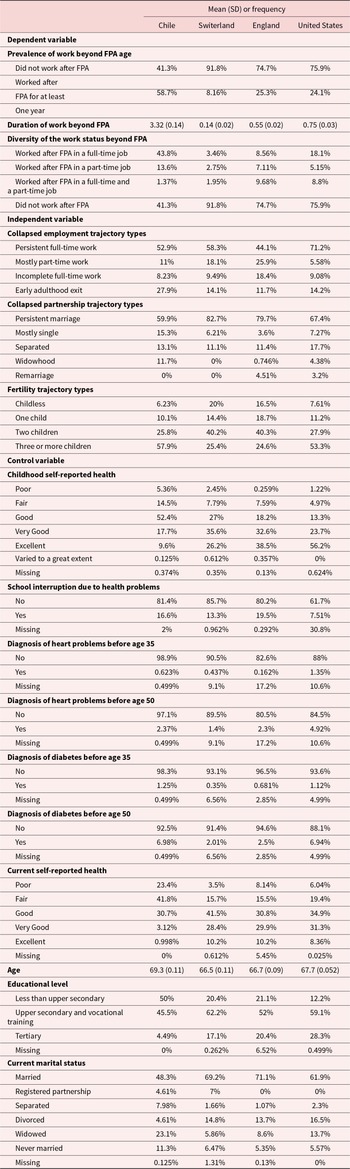
Figure 2 and Table 1 present the frequency and mean values of the dependent variables for the whole sample, men and women, across the four countries. Overall, we observe stark differences across countries in the prevalence of work after FPA and the proportion of people working full-time, with less pronounced differences in terms of part-time work and number of working years. Specifically, while 60 per cent of Chileans worked at least one year past FPA, only about a quarter of individuals in England and the US, and just 10 per cent in Switzerland, did so. Regarding the number of years worked beyond FPA, Chile tends to show higher averages than the rest of the countries. Additionally, in the US and Chile, more people worked full-time than part-time, while in England and Switzerland these proportions are similar.
Mean values of dependent variables by country and sample (from left to right: values for the whole sample in black, values for the female sample in grey, values for the male sample in white).

Dependent, independent and control variables (SD = standard deviation)

Considering gender differences, both in Chile and in the US, the prevalence of late-life work is notably higher among men than women. We observe the opposite trend in England. Among those who extended their working life on a full-time basis, men have higher averages than women in Chile and the US, but not in England and Switzerland. Once again, Chile exhibits the largest difference between men and women. In contrast, part-time work is more common among women than men in all countries but Chile. Finally, only England and the US display gender differences in the number of years worked after FPA: while women extend their careers slightly more than men in England, we observe the opposite trend in the US.
Representative types of employment, partnership and fertility
Supplementary Figure 1 in the Supplementary Material shows the standardised values of the four statistical criteria and the rationale used to select the number of representative types of trajectories in each of the three domains in each country. Based on this information, we identified different trajectory types that are representative in the four countries, and some that are representative only in three, two or one country. Supplementary Figures 2, 3 and 4 describe in detail all these trajectory types. Overall, these patterns illustrate the experience of diverse employment, partnership and fertility statuses, in different orders and phases throughout the lifecourse. However, for the sake of simplicity and straightforward comparison between countries, we have collapsed the trajectories in the three domains as follows.
First, in the employment domain, we worked with four collapsed trajectories:
1. ‘Persistent full-time work’ covers individuals who worked with no interruptions on a full-time basis their entire adulthood.
2. ‘Mostly part-time work’ aggregates types involving either continuous or interrupted part-time work over adulthood, occurring or not after a period of full-time work.
3. ‘Incomplete full-time work’ combines erratic careers of full-time employment or anticipated and permanent exits from the labour market after working full-time.
4. ‘Early adulthood exit’ covers individuals who left the labour force around age 25 and remained consistently out of the labour force.
Second, in the partnership domain, we used five collapsed trajectory types:
1. ‘Persistent marriage’ comprises individuals getting married in different stages of early or mid-adulthood, and who remain in that status over their entire adulthood.
2. ‘Mostly single’ refers to individuals who stayed unmarried their whole life.
3. ‘Separated’ combines early or late adulthood separated or divorced individuals who continue in that status until the latest observation period.
4. ‘Widowhood’ indicates people who experienced the death of a married partner at different points of adulthood and who did not remarry.
5. ‘Remarriage’ includes individuals who married more than once in different phases of the lifecourse.
Finally, in the fertility domain, we worked with the original four trajectories:
1. ‘Childless’ are individuals who never had children.
2. ‘One child’ are individuals who had only one child.
3. ‘Two children’ are individuals who had two children.
4. ‘Three or more children’ are individuals who had at least three children.
In Table 1, we show the prevalence of these trajectory types as well as information for all dependent and control variables.
Bivariate analysis: lifecourse trajectories and extended working lives
Employment trajectories and extended working lives
Supplementary Figure 5 shows bivariate associations with 95 per cent confidence intervals between employment trajectories and four key dependent indicators of extended working lives. In each graph, a vertical dashed line indicates the country average for each variable.
First, we observe that in all countries, the trajectory type ‘Early adulthood exit’ shows the lowest prevalence of work after FPA. Except for Switzerland, in the rest of the countries, all trajectory types show highly similar frequencies of extended employment. In Switzerland, ‘Incomplete full-time work’ shows a similarly low prevalence as ‘Early adulthood exit’.
In relation to work-time basis, we observe that in Chile, England and the US, ‘Persistent full-time work’ and ‘Incomplete full-time work’ are the trajectory types associated with the highest prevalence of full-time employment beyond FPA (in Switzerland, there are no significant differences across employment trajectory types). We observe that the only trajectory type significantly associated with part-time work after FPA in Chile, England and the US is ‘Mostly part-time work’. In Switzerland, there are no significant differences across employment pathways.
Finally, regarding the duration of extended working lives, the type ‘Mostly part-time work’ is the trajectory that peaks the highest in the number of years of work after FPA in Chile, England and Switzerland. It is among the highest in the US.
Partnership trajectories and extended working lives
One of the main results from Supplementary Figure 6 is that, except for England, there are no stark differences across partnership trajectories when it comes to the prevalence, work-time basis and duration of extended working lives. For example, in all countries, contrasting partnership patterns such as ‘Persistent marriage’ and ‘Separated’ show similar frequencies of work after FPA, full-time employment after FPA and number of years worked after FPA. However, a particularity observed in England and the US is that the type ‘Mostly single’ reaches the lowest levels in both the prevalence and the duration of extended working lives.
Fertility trajectories and extended working lives
Supplementary Figure 7 indicates no clear pattern across countries between fertility trajectories and extended working lives’ dimensions. In Chile and England, for instance, ‘Childless’ is the trajectory type with the lowest prevalence of work and the lowest average number of years worked beyond FPA, while ‘One child’ shows the opposite trends. However, this is not the case for Switzerland or the US, which show almost no differences across fertility trajectory types.
Multivariate results: gender differences in the association between lifecourse trajectories and extended working lives
This section presents adjusted regression models with interaction terms between life trajectory types and gender over dependent variables. For simplicity, we focus on significant results and present them in figures. However, regression tables with all results are available upon request.
Employment trajectories by gender and extended working lives
Regarding extended working lives prevalence, Figure 3 shows that only in England there are significant gender differences across employment trajectories. Specifically, women in ‘Persistent full-time work’, ‘Mostly part-time work’ and ‘Incomplete full-time work’ are much more likely to prolong their careers in later life.
Adjusted regression models with interaction terms between employment trajectories and gender, over extended working lives variables (male estimation indicated with the dotted line, female estimation indicated with the dashed line; ‘1. FT Wo’ = persistent full-time work; ‘2. PT Wo’ = mostly part-time work; ‘3. FT In’ = incomplete full-time work; ‘4. EA Ex’ = early-adulthood exit).

Concerning full-time employment after FPA, values for both men and women do not seem to greatly differ across employment trajectories in each country. The only exception is again England, with the types ‘Persistent full-time work’ and ‘Incomplete full-time work,’ where women are more likely to keep working full-time than men. On the other hand, regarding working part-time, men and women tend to show little or no difference across employment trajectories in each country. Only among English people following the ‘Mostly part-time work’ trajectory type do women seem more likely to keep working on a part-time basis than men.
Finally, regarding the duration of extended working lives, we observe that in both Chile and England, women from the trajectories ‘Persistent full-time work’ and ‘Mostly part-time work’ are more likely than their male counterparts to work longer beyond FPA. This gender difference also occurs for the trajectory ‘Incomplete full-time work’ in England. For Switzerland and the US, once again, we do not observe clear gender differences across employment trajectories.
Partnership trajectories by gender and extended working lives
Figure 4 indicates some gender differences across partnership trajectories, especially in Chile and England, but in opposite directions. Specifically, among those who followed the type ‘Persistent marriage’ over their lives, men are more likely to extend their working lives in Chile, whereas women are more likely than men to do so in England. Additionally, in England, ‘Separated’ women are more prone to work beyond FPA than men in the same pathway. In the rest of the countries and trajectory types, we do not observe significant gender differences in the prevalence of extended working lives.
Adjusted regression models with interaction terms between partnership trajectories and gender, over extended working lives variables (male estimation indicated with the dotted line, female estimation indicated with the dashed line; ‘1. Er Mar’ = persistent marriage; ‘2. Ms Sin’ = mostly single; ‘3. Sep’ = separated; ‘4. Wid’ = widowhood; ‘5. Re Mar’ = re-marriage).

When it comes to work–time basis, we observe that women in Chile and the US classified in the trajectory type ‘Persistent marriage’ are more likely than their male counterparts to work in a full-time job beyond FPA. In England, among those in ‘Persistent marriage’ and ‘Widowhood’ types, women are significantly more likely than men to work later in life in a part-time job. Otherwise, in the rest of the countries and types, values for both genders are quite similar.
Finally, regarding the duration of extended working lives, we observe that England seems to be the only country that shows consistent gender differences, as women are more likely than men to work longer past pension age in the trajectory types ‘Persistent marriage’, ‘Separated’ and ‘Widowhood’.
Fertility trajectories by gender and extended working lives
Regarding the prevalence of work beyond FPA, Figure 5 shows significant gender differences across fertility trajectories only in Chile and England, but once again in the opposite direction. In Chile, men classified in the trajectory types ‘One child’, ‘Two children’ and ‘Three or more children’ are more likely to extend their working lives than their female counterparts, whereas in England, women in these trajectory types are more likely than men to do so.
Adjusted regression models with interaction terms between fertility trajectories and gender, over extended working lives variables (male estimation indicated with the dotted line, female estimation indicated with the dashed line; ‘CH 0’ = childless; ‘CH 1’ = one child; ‘CH 2’ = two children; ‘CH 3+’ = three or more children).

Concerning the working time basis in extended working lives, we observe some gender differences in Chile and the US. In Chile, men who had ‘One child’, ‘Two children’ and ‘Three or more children’ are more prone to work in a full-time job beyond FPA than women classified in these trajectory types. Similarly, men in the US clustered in the trajectory ‘Three and more children’ also tend to work more in full-time jobs than women. Regarding part-time employment, the only significant gender differences appear in England, where women classified in the types ‘One child’, ‘Two children’ and ‘Three or more children’ are more likely to work part-time beyond FPA than men who followed these pathways.
Finally, results for the duration of extended working lives suggest gender differences only in England, as women who followed the trajectories ‘One child’ and ‘Two children’ work longer than their male counterparts. However, no gender differences are noticed across fertility trajectories in the other countries.
Discussion
Working life extension is a growing phenomenon in ageing populations worldwide and one of the most significant labour market transformations in recent decades. Liberal regime countries, those characterised by market-oriented welfare systems providing limited social protection, display a comparatively higher prevalence of older workers together with a strong gender stratification of later-life employment. Our findings build upon past research and reveal significant variations by country, gender and lifecourse trajectories, advancing current knowledge on gendered patterns of employment beyond FPA in liberal regime countries.
Cross-country differences
First, our results show that later-life employment patterns exhibit considerable variation by country. About 60 per cent of Chileans worked after reaching the legal age of retirement, in stark contrast to about 25 per cent in England and the US, and only 10 per cent in Switzerland. This diversity suggests that country-specific factors play a crucial role in shaping employment patterns in later life. Factors such as the generosity of public pensions, the availability of private pension schemes and labour market policies are known to significantly influence these patterns (Cabib Reference Cabib2025; Ebbinghaus Reference Ebbinghaus2021; Fasang et al. Reference Fasang, Aisenbrey and Schömann2013). In addition, cultural norms associated with work and family formation may shape working live trajectories, leading to the decision to take up work past retirement age (Cabib et al. Reference Cabib, Yopo Díaz, Biehl, Cereceda, Ormeño and Ortiz2024).
Cross-country differences in post-retirement work are too significant to be explained solely by market-friendly policies and the emphasis on individual agency typically associated with liberal welfare regimes. As expected, given the presence of more mixed and solidaristic pension systems, post-retirement work is less common in Switzerland and the UK than in Chile. However, the rates of post-retirement work in England and the US are quite similar, with about a quarter of people continuing to work after reaching retirement age.
The observed differences in extended working lives across countries are also shaped by the structure and generosity of their pension systems. For instance, the high prevalence of post-retirement work in Chile reflects the inadequacies of its privatised pension system, which often leaves retirees with insufficient income, particularly among women and those with interrupted work histories. Conversely, the lower rates of late-life work in Switzerland can be attributed to its robust occupational and public pension systems that provide greater financial security. In England, occupational pensions play a critical role, especially for men, reducing the necessity for extended working lives. Meanwhile, in the United States, reliance on private pensions and Social Security creates uneven outcomes, with those lacking continuous employment trajectories more likely to extend their working lives. These findings highlight the critical role of pension systems in shaping later-life employment and underscore the need for policies that address disparities in pension adequacy across and within liberal welfare regimes.
Additionally, in Chile while the higher levels of post-retirement work may be driven by insufficient pension income and material scarcity, some people continue working due to strong labour market attachment and for personal fulfillment (Cabib Reference Cabib2025; Madero-Cabib and Biehl Reference Madero-Cabib and Biehl2021). This trend also reflects gendered patterns in working lives, as men tend to work more than women after retirement age. This is particularly true in Chile and, to a lesser extent, the US, where post-retirement work is often full-time and follows a trajectory similar to the individual’s earlier career.
Gender differences
Second, gender differences in later-life employment patterns are particularly notable in England and Chile. In England, women tend to extend their working lives more than men, while men do so more in Chile and the US. This finding aligns with previous research indicating that women in liberal welfare regimes often adopt part-time work strategies throughout adulthood to balance work and family responsibilities (Grødem and Hippe Reference Grødem and Hippe2021; Loretto and Vickerstaff Reference Loretto and Vickerstaff2015). In Chile, the higher prevalence of extended working life among men may reflect stronger prevalence of traditional gender norms, expectations on male breadwinners and the necessity to continue work to secure adequate retirement income in old age (Canales et al. Reference Canales, Salinas and Biehl2021).
One interesting difference is that while marriage tends to reinforce traditional gender roles in Chile, in England long-term marriage seems to enable women to continue working after retirement age. Additionally, separated women tend to work more than men after retirement age, suggesting two potential drivers for women in England: labour market attachment and material constraints.
Thus, mixed evidence regarding partnership and fertility domains raises new questions on the role of families in providing care and meeting the financial demands of retirement in market-oriented welfare regimes. Our findings reveal that partnership and fertility trajectories do not significantly influence the prevalence, duration or diversity of later-life employment across the four countries studied. For instance, we could have expected that, in the absence of generous financial support, being married or having children would consistently predict extended working lives, but it is not the case with our findings. This opens new avenues for research into intergenerational solidarity and the role of family structures in shaping later-life employment.
Our study highlights the relevance of stratification mechanisms in explaining later-life work. In particular, employment trajectories shape extended working lives. More than partnership and fertility trajectories, it seems that past work trajectories deeply influence work past pension age. Continuous full-time employment throughout adulthood is strongly associated with continued full-time work beyond FPA. This could point to labour market attachment mechanisms, including habituation or active engagement, as well as economic or material needs. In a similar vein, those with erratic or part-time employment histories are more likely to work part-time in later life. This continuity between past trajectories and the type of extended work life paves the way for new research avenues and bears implications for public policy in liberal countries.
On the one hand, those in past trajectories in full-time jobs are likely to develop strong labour market attachment, enjoy some saving capacity and generally be economically better off than those who followed more erratic patterns. In a way, this could point to new inequalities among those who extend working lives, particularly among those in more economically rewarding and those in more disadvantageous trajectories.
On the other hand, this finding might point to support policies aimed at improving the working lifecourse of those with more erratic trajectories, either by enhancing their chances of retiring or by improving their employemnt prospects beyond the legal retirement age. This pattern, then, emphasises the critical role of stable employment in securing financial resources for retirement and underscores the need for policies that support continuous employment throughout the lifecourse.
In addition, these findings might complement qualitative work on uncertainty regulation and the extension of work beyond the legal age of retirement (Cabib et al. Reference Cabib, Yopo Díaz, Biehl, Cereceda, Ormeño and Ortiz2024). Though driven by adulthood employment trajectories, attachment to the labour market after FPA may display expansive and adaptive individual strategies not only to manage exogenous precarity, that is, to react to adverse labour circumstances but, more importantly, to exercise a significant degree of choice to lead meaningful working lives by taking risks and options given preferred levels of endogenous uncertainty.
Despite the crucial role of stratification mechanisms, our comparative approach reveals nuanced differences in how employment trajectories influence later-life work across liberal welfare regimes. Compared to the other countries, in Switzerland, employment trajectories do not significantly affect the type of work after FPA. This suggests that country-specific labour market policies and social security systems play a crucial role in shaping employment trajectories which then influence later-life work (Madero-Cabib et al. Reference Madero-Cabib, Corna and Baumann2020).
The influence of past trajectories on later-life work is also shaped by gender stratification. While part-time work is more prevalent among women in all four countries, the reasons behind this trend may vary. In England, women are more prone to extend their careers most likely due to the flexibility of part-time work, which allows them to manage household and care-giving responsibilities. In contrast, in the US and Chile, the higher prevalence of later-life employment among men could reflect traditional gender roles and the necessity of continued work to secure financial stability in retirement.
Limitations
Despite the significant insights provided by our study, several limitations must be acknowledged. First, our reliance on retrospective life history data, while rich, is subject to recall bias and may affect the accuracy of the reported employment, partnership and fertility histories. Additionally, the harmonisation of data across different national surveys, although meticulously conducted, may still lead to common inconsistencies due to varying survey methodologies and question formulations.
Second, our study focuses on a specific cohort born between 1944 and 1954, which limits the generalisability of our findings to other cohorts who may experience different socio-economic and policy environments. Future research should explore whether our findings hold for younger cohorts facing different labour market and retirement conditions.
Third, while this study provides important insights into the role of lifecourse trajectories in shaping extended working lives, it does not include direct measures of pension systems or individual pension income. This limits our ability to quantitatively assess the specific impact of pensions on late-life work outcomes. Future research incorporating detailed pension data – such as the proportion of income derived from state, occupational or private pensions – could further elucidate the mechanisms linking welfare regimes and extended working lives.
Finally, while we control for several health and socio-economic factors, our analysis may not fully capture the complex interplay between these factors and extended working lives. Future studies should incorporate more comprehensive measures of health, socio-economic status and access to social security benefits to provide a more nuanced understanding of the determinants of extended working life.
Contributions
This research contributes to advance our understanding of extended working lives in liberal regimes in the following ways. First, just as individual lifecourse dynamics influence post-retirement work, it is also important to consider how welfare regime dynamics – specifically how incentives and constraints provided by liberal welfare regimes have changed – affect the decision to continue working. In this context, the UK and Switzerland have a longer tradition of mixed and solidaristic policies, which, along with cultural norms and higher levels of affluence, may explain their relatively lower levels of post-retirement work.
However, the rate of post-retirement work in England, in particular, is quite similar to that in the US. This could be due to cultural norms emphasising individualism and the value of work, as well as a stronger history of individual savings and asset accumulation. Chile, which is less economically developed and offers more targeted support, also challenges the liberal label by having minimal policy measures to promote work in old age.
More interestingly, the lifecourse factors associated with post-retirement work, such as material constraints and labour market attachment, could be extended to explain these dynamics in liberal welfare regime countries. Labour market attachment appears to play a role in both Chile and the UK, but in different ways. In Chile, men tend to remain in the workforce, consistent with their past career trajectories. In England, it is often women who continue working, in contrast to past work trajectories and even when they have financial support from stable partners.
In the future, it will be valuable to analyse how specific policies interact with individuals’ past trajectories to explain post-retirement work. Factors such as insufficient income support, better health or strong labour market attachment throughout one’s career may encourage continued work after retirement despite the nature of the welfare regime.
Conclusion
In conclusion, this article provides a comprehensive study of how employment, partnership and fertility trajectories shape later-life work in liberal regime countries. Our findings suggest that if liberal welfare regimes affect post-retirement-age work, it is primarily through labour market and work trajectories. This underscores the role of stratification mechanisms as well as more conventional explanations of pension generosity in shaping employment later in life. Furthermore, our comparative perspective reveals that while liberal regimes share certain characteristics, they also exhibit significant diversity in how extended working lives manifest and are influenced by lifecourse trajectories. Future research should continue to explore these nuances to inform policies that promote financial security and wellbeing in retirement.
Supplementary material
The supplementary material for this article can be found at https://doi.org/10.1017/S0144686X25100147.
Financial support
This work was supported by Agencia Nacional de Investigacion y Desarrollo (ANID), through the following grants: ANID/FONDECYT/REGULAR/Nº1220080, ANID/FONDAP/Nº15130009, ANID/PAI/Nº77200004 and ANID/FONDECYT/INICIACION/Nº11230532.
Competing interests
The authors declare that they have no known competing financial interests or personal relationships that could have appeared to influence the work reported in this article.
Ethical standards
We used publicly available secondary data, therefore no ethical approval was required. We used the following publicly available secondary data: the Survey of Health, Ageing and Retirement in Europe for Switzerland; the Health and Retirement Study for the United States; the English Longitudinal Study of Ageing for England; and the Life Course and Vulnerability among Older People survey for Chile.




 Open access

