

Introduction
One of the most robust empirical regularities in the study of democratic politics is that religious attendance predicts political participation. Across dozens of studies in Western democracies, individuals who attend religious services more frequently are more likely to vote, contact officials, and engage in civic activities (Djupe and Gilbert, Reference Djupe and Gilbert2009; Putnam, Reference Putnam2000; Putnam and Campbell, Reference Putnam and Campbell2010; Verba et al., Reference Verba, Schlozman and Brady1995; Wald et al., Reference Wald, Owen and Hill1988). Yet, this consensus conceals a deeper ambiguity: the evidence comes overwhelmingly from Christian-majority democracies, disproportionately the United States, where Protestant congregational governance provides unusually structured opportunities for civic skill-building (Verba et al., Reference Verba, Schlozman and Brady1995). It is therefore impossible to determine from Western data alone whether the attendance–participation link reflects Protestant civic culture, Christian political mobilization, internalized religious belief, or a more general feature of communal religious life.
Disentangling these explanations requires evidence from a fundamentally different religious context. Taiwan provides an unusually powerful test case for three reasons. First, the island’s dominant religious traditions—Buddhism, Taoism, traditional folk religion, and I-Kuan-Tao—operate with fundamentally different organizational structures than Western churches: they emphasize practice and ritual participation rather than lay governance and doctrinal instruction, creating a natural experiment for decomposing mechanisms (Huang, Reference Huang2009; Laliberté, Reference Laliberte2004; Madsen, Reference Madsen2007). Second, over 80% of Taiwan’s population practices religion, but the religious landscape is characterized by extraordinary pluralism and what scholars term both syncretism—the institutional blending of Buddhist, Taoist, and Confucian elements in folk religious practice—and polytropy—the individual practice of engaging with multiple religious traditions without blending them (Clart, Reference Clart, Pokorny and Winter2018). Many Taiwanese visit Buddhist temples on some occasions and Taoist shrines on others, participate in folk religious festivals organized by neighborhood temples, and do not draw sharp boundaries between traditions in their daily lives (Madsen, Reference Madsen2007). Third, religion in Taiwan is socially significant but lacks the systematic, partisan “Religious Right” equivalent found in the United States, allowing us to isolate religious effects from polarization dynamics.
These features make Taiwan an ideal “critical case” (Eckstein, Reference Eckstein, Greenstein and Polsby1975) for testing the portability of the attendance–participation link. If the relationship holds in a context where the dominant religions lack Protestant-style congregational governance, where religious identity is fluid rather than fixed, and where no systematic religious mobilization apparatus exists, then the mechanism driving the link must be more general than the civic skills or mobilization accounts propose—pointing instead toward the social capital that arises from any regular communal gathering.
Using pooled data from the Taiwan Election and Democratization Study (TEDS) across three election years (2008, 2016, and 2020), this article provides the first systematic, multi-wave analysis of the relationship between religion and political participation in Taiwan. We test four hypotheses derived from competing theoretical mechanisms, employing harmonized controls for party identification and national identity across all waves to address the deep entanglement of religion, ethnicity, and partisanship in Taiwanese politics.
Our findings indicate that religious attendance is a robust, positive predictor of political participation across all model specifications, surviving strict partisan controls. However, religious affiliation has no independent effect, and the attendance–participation slope is denomination-invariant. Decomposing participation into voting and campaign activities reveals that the attendance effect operates primarily through campaign engagement—the kinds of participatory acts that require social resources—rather than the low-cost act of voting. Religious belief intensity, measured in the 2008 wave, shows no independent association with participation beyond attendance frequency. This configuration of findings strongly supports a generalized social capital mechanism over civic skills, mobilization, or psychological belief-oriented alternatives. By demonstrating that the attendance–participation link replicates in a religiously pluralistic, non-Protestant East Asian democracy, this study shows that the social infrastructure of democratic engagement can be cultivated through a much wider range of institutional forms than previously recognized.
Literature review
The western consensus and its limitations
The Western literature identifies three primary mechanisms linking religion to political participation. The civic skills hypothesis argues that congregations function as “schools of democracy” where members acquire transferable competencies—public speaking, organizing meetings, and managing budgets—through committee work and lay governance (Verba et al., Reference Verba, Schlozman and Brady1995). This mechanism is explicitly tied to Protestant congregational structures, which distribute organizational responsibilities more broadly than Catholic parishes or secular organizations. The mobilization hypothesis emphasizes that religious organizations act as political communities where clergy and peers directly recruit members for political causes, producing highly denomination-specific participation patterns (Djupe and Gilbert, Reference Djupe and Gilbert2009; Wald et al., Reference Wald, Owen and Hill1988). The generalized social capital hypothesis posits that regular communal religious participation builds networks of trust and norms of reciprocity that naturally spill over into political engagement, regardless of theology or internal governance (Putnam, Reference Putnam2000; Putnam and Campbell, Reference Putnam and Campbell2010).
Because American Protestantism simultaneously provides civic skills, mobilization, and social capital, adjudicating between these theories from Western data alone is inherently limited. The three proposed mechanisms were developed in and tested against the same institutional environment, making it impossible to determine which mechanism actually drives the observed relationship. Comparatively few studies have attempted cross-national tests. Lam (Reference Lam2006) provides a rare cross-national analysis showing that religious involvement predicts voluntary association membership across diverse societies but does not disaggregate mechanisms. Norris and Inglehart (Reference Norris and Inglehart2011) examine religion and politics across a broad range of countries but focus primarily on values and attitudes rather than participatory behavior. Omelicheva and Ahmed (Reference Omelicheva and Ahmed2018) examine the impact of faith on political participation across multiple religious traditions, finding that the relationship varies by type of participation and religious context. Jiang (Reference Jiang2022) investigates the Australian case, finding that religious attendance continues to predict political participation even in an increasingly secular society, suggesting the relationship is not contingent on high religiosity environments.
The psychological and belief-oriented model
Beyond the three structural mechanisms, a fourth theoretical tradition emphasizes the psychological and motivational dimensions of religious belief. This model, developed extensively by Driskell et al. (Reference Driskell, Embry and Lyon2008), Glazier (Reference Glazier2020), and Jang et al. (Reference Jang, Brown, Witvliet, Leman, Johnson and Bradshaw2023), posits that internalized religious beliefs—including transcendent accountability (the sense of being answerable to a higher power), moral obligation, and religiously grounded civic duty—can independently motivate political engagement. The mechanism operates through the content of belief rather than the structure of religious organizations: individuals who hold stronger religious convictions may feel a greater ethical imperative to participate in public life, regardless of their organizational involvement.
The empirical evidence for this model is mixed. Jang et al. (Reference Jang, Brown, Witvliet, Leman, Johnson and Bradshaw2023) find that “transcendent accountability” and “religiopolitical awareness” partially mediate the relationship between religiosity and political participation, suggesting that belief content matters above and beyond organizational involvement. Glazier (Reference Glazier2020) demonstrates that religion has a differential impact on political activity versus community engagement, with belief-related variables predicting some forms of participation but not others. Yi et al. (Reference Yi, Hu and Zeng2024) report that religious belief influences voting behavior among urban residents in China, though through mechanisms distinct from organizational involvement. Driskell et al. (Reference Driskell, Embry and Lyon2008) find that both religious tradition and participation independently predict civic engagement, suggesting that belief and practice may operate through complementary channels.
This model generates a distinct prediction for Taiwan: if psychological and belief-oriented mechanisms drive political participation, then religious belief intensity—independent of attendance frequency—should predict participation, and the effect should potentially vary by tradition (since different religions cultivate different orientations toward civic life). Testing this prediction requires a measure of religious belief strength, which we construct from available TEDS items.
Religion and political participation in non-Christian East Asia
The limited evidence from non-Christian East Asian democracies provides suggestive but incomplete guidance. Studies of Japanese new religious movements have documented political mobilization (most notably Soka Gakkai’s relationship with the Komeito party), but systematic analyses of attendance effects across traditions are scarce. In South Korea, the relationship between Christianity and democratization has received extensive attention, but the country’s religious landscape—with its strong Christian minority—more closely resembles Western cases than Taiwan’s pluralistic environment. Indonesia, with its Muslim majority and official recognition of six religions, presents a different configuration, where religious attendance operates within a framework of state-sanctioned religious identity. Taiwan’s case thus fills a significant gap: a religiously plural democracy where no single tradition dominates and where the dominant traditions bear little organizational resemblance to Western congregations. The Chinese-language literature on Taiwanese religion reinforces this distinctiveness, documenting the deep embeddedness of temple networks in local social life (Lin, Reference Lin2008), the sociological dynamics of folk religion communities (Ding, Reference Ding2013), the civic dimensions of Buddhist organizations like Tzu Chi (Ding, Reference Ding1999), and the broader political transformations of Taiwan’s religious landscape (Chi, Reference Chi2021).
Theoretical framework
Taiwan’s religious landscape
Taiwan’s religious landscape is characterized by extraordinary diversity and a high degree of both syncretism and polytropy—a distinction worth clarifying. Syncretism refers to the institutional blending of doctrines, rituals, and deities from different religious traditions into a single hybridized practice; this is characteristic of Taiwan’s folk religion, which draws on Buddhist, Taoist, and Confucian elements at the organizational level. Polytropy, by contrast, describes the practice of individual believers engaging with multiple religious traditions without blending them—visiting Buddhist temples on some occasions and Taoist shrines on others, maintaining distinct relationships with each (Clart, Reference Clart, Pokorny and Winter2018). Both phenomena are pervasive in Taiwan, meaning that self-reported religious affiliation captures something quite different from denominational identity in the American sense: identifying as “Buddhist” or “Taoist” often reflects a primary orientation rather than an exclusive commitment.
Scholars have documented how Taiwan’s religious organizations engage with political life, revealing remarkable organizational and political diversity. At one end of the spectrum, major Buddhist organizations like Tzu Chi and Fo Guang Shan cultivate massive lay followings with strong norms of civic voluntarism while strictly maintaining partisan neutrality (Huang, Reference Huang2009: Madsen, Reference Madsen2007). Even within Buddhism, however, political orientations vary: Tzu Chi’s emphasis on compassionate non-involvement contrasts with Fo Guang Shan’s more engaged public presence, and some lay Buddhist associations carry Mainlander ethnic associations that implicitly connect to pan-blue political sympathies. This pattern of high civic engagement without uniform political entanglement challenges traditional mobilization theories.
Representing the opposite pole, the Presbyterian Church in Taiwan fits the Western mobilization model. Historically active in Taiwan’s democratization, the church maintains close ties with the Democratic Progressive Party (DPP) and the broader Taiwanese independence movement (Kuo, Reference Kuo2009; Rubinstein, Reference Rubinstein, Cheng and Brown2006). However, Protestantism in Taiwan also encompasses politically quietist evangelical congregations with no such ties. If political mobilization is the primary mechanism linking religious attendance to political participation, this effect should be strongest among Presbyterians—and the intra-denominational variation should produce heterogeneous effects within the Protestant category.
Traditional folk religion and Taoism present a third pattern. Taiwan’s dense network of roughly 12,000 registered temples serves as the anchor of local associational life.Footnote 1 The category “Taoism” itself is complex, encompassing both elite Taoist clergy and temples and the vast network of community temples officially registered as “Taoist” but functionally practicing syncretic folk religion. While some temple networks have historically aligned with Kuomintang (KMT) local factions through patron-client relations to mobilize electoral support (Laliberté, Reference Laliberte2004; Sher et al. Reference Sher, Pien, O.’Reilly and Liu2024), the vast majority function as apolitical sites of community sociability. These patron-client linkages are important because they represent a “hybrid mechanism”—simultaneously embodying social capital (community ties, trust) and limited political mobilization (factional recruitment)—that complicates a purely structural interpretation.
Finally, I-Kuan-Tao (Yiguandao) offers an organizational form with no Western parallel. Rather than utilizing congregational churches or open-access temples, this syncretic movement operates through hierarchical master-disciple networks in small, often private “Buddha halls” (fotang) (Schubert, Reference Schubert2022). These intimate study groups generate dense social ties without congregational governance or overt political mobilization, placing them closer to the apolitical end of the spectrum (Clart, Reference Clart, Pokorny and Winter2018). I-Kuan-Tao provides a critical theoretical benchmark: if attendance at these intimate gatherings predicts political participation at the same rate as attendance at other traditions, the explanation cannot be attributed to any specific organizational feature or overt political orientation.
Three structural mechanisms and their predictions for Taiwan
Each of the three structural mechanisms generates distinct predictions about what we should observe in Taiwan’s non-Protestant religious context.
The civic skills hypothesis (Verba et al., Reference Verba, Schlozman and Brady1995) predicts that the attendance–participation link should be weak or absent in Taiwan, because the dominant religions offer few structured opportunities for committee-based skill-building. Taiwanese Buddhism emphasizes individual practice and hierarchical teacher–student relationships. Taoist temples are managed by small hereditary or appointed boards. Folk religion involves ritual participation, not organizational governance. If we nonetheless find a strong attendance effect, it would challenge the civic skills hypothesis—or at minimum demonstrate that the mechanism must operate through channels far broader than congregational committee work.
The mobilization hypothesis (Djupe and Gilbert, Reference Djupe and Gilbert2009; Wald et al., Reference Wald, Owen and Hill1988) predicts strong denominational differences—significant interaction effects between affiliation and attendance. Specifically, the Presbyterian Church should show a stronger attendance–participation slope, while Buddhist organizations that explicitly avoid politics should show a weaker slope. If the attendance effect is instead uniform across denominations, it argues against mobilization as the primary mechanism.
The generalized social capital hypothesis (Putnam, Reference Putnam2000; Putnam and Campbell, Reference Putnam and Campbell2010) predicts that attendance should predict participation regardless of denomination and that interaction terms should be null. Taiwanese temples, Buddhist lay organizations, I-Kuan-Tao study groups, and Christian churches all provide—through different institutional forms—the essential ingredient: regular opportunities for communal gathering, face-to-face interaction, and the formation of community ties.
The psychological belief-oriented model adds a fourth prediction: if internalized belief drives participation, then religious belief intensity should predict participation independently of attendance, and the effect might vary by tradition (since different religions cultivate different orientations toward civic engagement).
These mechanisms are analytically distinct but may empirically overlap. Folk religion temple networks, for example, may simultaneously generate social capital through community ties and facilitate limited political mobilization through patron-client linkages. Our empirical tests, therefore, identify the predominant mechanism rather than claim exclusivity—the mechanism that best explains the overall pattern across Taiwan’s remarkably diverse religious landscape.
Religion, ethnicity, and partisanship: the confounding problem
Any analysis of religion and political behavior in Taiwan must contend with the deep entanglement of religious identity, ethnic cleavage, and partisan politics. Taiwan’s population comprises several major ethnic groups—Hoklo, Hakka, Mainlanders, and Indigenous Austronesian peoples—each with distinct historical experiences, political tendencies, and religious patterns. The Hoklo majority is most closely associated with traditional folk religion and Taoism. Mainlander communities have their own Buddhist and Christian institutions. Indigenous communities have high rates of Christian (especially Presbyterian and Catholic) affiliation. These ethnic-religious correlations intersect with Taiwan’s central political cleavage: the KMT–DPP divide and the broader question of national identity (Kuo, Reference Kuo2009).
Beyond these structural considerations, religion in Taiwan also functions as an identity marker: Presbyterian affiliation is inseparable from Taiwanese nationalist identity, certain Buddhist organizations carry Mainlander ethnic associations, and folk religion temple participation signals rootedness in local Hoklo communities. These identity-marking functions mean that religious affiliation may proxy for ethno-political identity rather than capturing independent religious effects. The most consequential overlap is between Presbyterianism and support for Taiwanese independence and the DPP. If Presbyterian attendance predicts higher political participation, it may reflect political mobilization embedded in an independence-supporting community rather than civic effects of religious life. Similarly, if folk religion temple attendance predicts participation, it may reflect patron-client networks of local KMT-affiliated factions. We address these confounds directly by including harmonized measures of party identification, national identity, and ethnicity as controls.
Hypotheses
Drawing on the theoretical framework, we derive five hypotheses. H1 is a standard directional hypothesis; H2 and H3 are predicted nulls whose confirmation supports social capital by ruling out alternatives; H4 tests temporal stability; and H5 tests the belief-oriented model.
Hypothesis 1: Higher religious attendance is associated with higher political participation, net of controls.
Hypothesis 2: Religious affiliation is not associated with political participation after controlling for attendance and covariates.
Hypothesis 3: The positive effect of religious attendance on political participation does not vary significantly by religious affiliation (interaction terms are null).
Hypothesis 4: The attendance–participation association is stable across the three elections studied.
Hypothesis 5: Religious belief intensity does not independently predict political participation beyond attendance frequency.
H2, H3, and H5 deserve emphasis because they are theoretically diagnostic. If affiliation matters or slopes vary by denomination, the results favor mobilization. If belief intensity matters independently, the results favor the psychological model. If all three null hypotheses are confirmed alongside a strong attendance effect, the evidence points decisively toward generalized social capital.
Data and methods
Data source
We draw on the TEDS, a post-election survey administered after each election by a consortium of Taiwanese universities under the auspices of the Election Study Center at Taiwan Chengchi University. TEDS employs stratified multi-stage probability sampling of the adult population (aged 20 and older) and conducts face-to-face interviews, yielding high response rates and high-quality data. We pool three waves—2008, 2016, and 2020—producing a combined sample of 5,275 respondents (2008: N = 1,905; 2016: N = 1,690; 2020: N = 1,680).Footnote 2 Pooling across three election cycles spanning twelve years allows us to assess stability across different political contexts—including both KMT-led (2008) and DPP-led (2016, 2020) administrations—while increasing statistical power for smaller religious groups.
The analytic sample varies across specifications depending on control variable availability. Baseline models yield approximately 3,730 respondents after listwise deletion; models with political controls yield approximately 3,565 respondents.
Dependent variables
Our primary dependent variable is an additive count index of political participation (Vote_Behavior) aggregating two dimensions: voting (up to three ballots: presidential, legislative district, and party-list) and campaign activities drawn from the TEDS survey (up to 14 activities, including reading campaign materials, attending rallies, volunteering, persuading others, and donating). The index has a mean of 4.25 (SD = 2.49), with overdispersion (variance-to-mean ratio = 1.45) and 6.9% structural zeros (364 cases reporting no participation).Footnote 3
Following Jang et al. (Reference Jang, Brown, Witvliet, Leman, Johnson and Bradshaw2023) and Yi et al. (Reference Yi, Hu and Zeng2024), who demonstrate that religion differentially affects distinct participation dimensions, we additionally decompose the dependent variable into (a) voting—a count of ballots cast (mean = 2.88, SD = 1.30, range 0–3 in typical cases); and (b) campaign activities—a count of non-voting participatory acts (mean = 1.37, SD = 1.55). This decomposition allows us to test whether the attendance effect operates through the low-cost act of voting (which may be driven more by duty and habit) or through higher-cost campaign engagement (which requires the social resources that communal religious participation theoretically provides).
Key independent variables
Religious attendance. Our core independent variable is the frequency of attendance at religious services (Religious_Attendance), measured identically across all three waves on a six-point ordinal scale: 1 = never, 2 = once a year, 3 = two to eleven times a year, 4 = once a month, 5 = two or more times a month, and 6 = once a week or more. The distribution is heavily right-skewed: 47.4% report “never” attending, and the overall mean is 2.16 (SD = 1.47). We enter this variable as a continuous predictor, consistent with standard practice (Putnam and Campbell, Reference Putnam and Campbell2010; Smidt et al., Reference Smidt, den Dulk, Penning, Monsma and Koopman2008).
A measurement equivalence concern warrants discussion. The TEDS item asks about frequency of attending religious services at religious venues, referring to in-person communal attendance at temples, churches, shrines, or other religious venues—not individual prayer, home devotion, or online participation. While “attending religious services” may carry different normative frequencies across traditions—weekly mass for Catholics versus occasional temple visits for folk religion practitioners—the broad frequency scale accommodates these differences by capturing relative intensity within each tradition. If measurement non-equivalence were severe, we would expect the attendance slope to differ across traditions, but the denomination-invariant slopes we observe suggest the measure captures something comparable across traditions.
Religious affiliation. Respondents report their religious affiliation from categories reflecting Taiwan’s religious landscape. We construct dummy variables for six categories, with “no religion” as the reference: Buddhist (n = 1,683), Taoist (n = 1,373), traditional folk religion (n = 358), Protestant (n = 239), I-Kuan-Tao (n = 90), and Catholic (n = 40). Muslim respondents (n = 3) and “other” (n = 29) are excluded due to insufficient cell sizes.
A coding difference across waves warrants note: the 2016 and 2020 surveys code non-religious respondents as a distinct affiliation category, whereas the 2008 survey filtered respondents through a prior item on religious belief; respondents reporting no religious beliefs (n = 396) were not asked the affiliation question and appear as missing. We address this through a sensitivity analysis restricting the sample to 2016–2020 waves only.
Religious belief intensity. For the 2008 wave only, we construct a religious belief intensity variable from the item “How devout are you in your religious faith?”, coded on a three-point ordinal scale among religious respondents: 2 = not very devout, 3 = somewhat devout, 4 = very devout (N = 1,462 valid responses). This variable is unavailable in the 2016 and 2020 waves, constraining our test of the psychological/belief-oriented model to the 2008 subsample.
Eastern religion aggregate. To address the concern that Taiwan’s syncretic and polytropic religious practices render fine-grained denominational categories unreliable, we construct an aggregate “Eastern religion” dummy (= 1 for Buddhist, Taoist, folk religion, and I-Kuan-Tao; = 0 for no religion, Protestant, and Catholic) and test both its main effect and its interaction with attendance.
Control variables
All models include sociodemographic and political engagement controls standard in the participation literature. Political interest captures how frequently the respondent discusses politics (Verba et al., Reference Verba, Schlozman and Brady1995). Election salience measures concern with the election outcome. Political efficacy is an ordinal measure (1–4) tapping agreement that ordinary people can influence government (mean = 2.69, SD = 0.70). Media consumption is a seven-point frequency scale of election media exposure (Norris and Inglehart, Reference Norris and Inglehart2011). Education is coded on a 13-point scale (Brady et al., Reference Brady, Verba and Schlozman1995; mean thinsp;= 8.32, SD = 3.31). Household income is measured in deciles (mean = 4.60). Age is recorded as the respondent’s birth year in the local calendar; for the 2020 wave, we use the correctly coded variable rather than the default age variable, which contains birth month due to a data coding error. Gender is coded 1 = male, 0 = female (Schlozman et al., Reference Schlozman, Burns and Verba1994). Marital status is coded as 1 = married, 0 = otherwise (Putnam, Reference Putnam2000). All models include year fixed effects (2008 as a reference). Cross-wave scaling differences in political interest and election salience are absorbed by these years’ fixed effects.
To address the confounder between religion and partisanship, we construct harmonized party identification from the TEDS survey, yielding dummies for KMT, DPP, minor parties (reference: independents), and national identity dummies for “both Taiwanese and Chinese” and “Chinese” (reference: Taiwanese).
Analytic strategy
We employ three model specifications for the combined participation index: ordinary least squares (OLS) for interpretability and comparability with existing literature (Jones-Correa and Leal, Reference Jones-Correa and Leal2001), negative binomial regression for overdispersed count data (Cameron and Trivedi, Reference Cameron and Trivedi2013), and zero-inflated negative binomial (ZINB) for the 6.9% structural zeros (Lambert, Reference Lambert1992; Vuong, Reference Vuong1989). Substantive conclusions are invariant across all three specifications. For the decomposed dependent variables (voting and campaign activities), we report OLS models. All standard errors are robust to heteroscedasticity.
We note that our cross-sectional pooled design cannot resolve potential endogeneity: religious attendance and political participation may be jointly determined, and politically engaged individuals might select into religious communities. Our estimates should therefore be interpreted as associations rather than causal effects. Two features of our results mitigate this concern: the stability of the attendance coefficient across specifications with and without political controls and the denomination-invariant pattern (which would require different partisan groups to select into diverse religious traditions at similar rates). We identify instrumental variable and panel designs as priorities for future research.
Results
Attendance predicts participation; affiliation does not
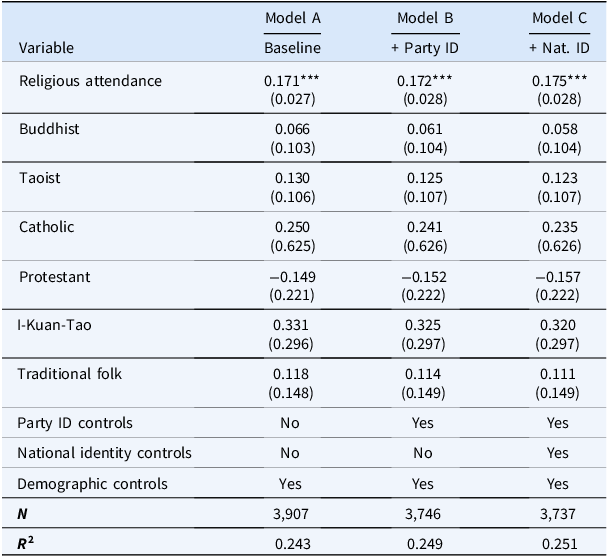
Table 1 presents the core models. Religious attendance is a strong, positive predictor of political participation, and its coefficient is virtually unchanged whether or not we control for partisanship and national identity: it moves only from 0.171 in the baseline model to 0.175 with full political controls (Model C: SE = 0.028, p < 0.001; N = 3,737), a shift of less than 3%. The attendance–participation relationship is therefore not an artifact of partisan or identity confounding. This confirms Hypothesis 1.
Religious attendance, affiliation, and political participation (OLS)

Table 1 Long description
A table comparing the impact of religious attendance and affiliation on political participation across different models. The table has 11 rows and 4 columns. The columns are labeled Model A Baseline, Model B + Party ID, and Model C + Nat. ID. The rows are labeled with different variables: Religious attendance, Buddhist, Taoist, Catholic, Protestant, I-Kuan-Tao, Traditional folk, Party ID controls, National identity controls, Demographic controls, N, and R squared. Each cell contains values representing coefficients and standard errors. Notable trends include the consistent positive impact of religious attendance across all models, with coefficients around 0.171 to 0.175. Other religious affiliations show varying impacts, with I-Kuan-Tao having the highest positive coefficient around 0.331 to 0.320, and Protestant showing a negative coefficient around -0.149 to -0.157. The table also indicates whether Party ID controls and National identity controls are included in each model.
Note: Robust standard errors in parentheses. Reference category for affiliation is no religion. Demographic controls comprise political interest, election salience, political efficacy, media consumption, education, income, age, gender, and marital status. All models include year fixed effects. Full coefficients for all covariates appear in Online Appendix Table B1. † p < 0.10, *p < 0.05, **p < 0.01, ***p < 0.001.
Religious affiliation, by contrast, has no independent association with participation in any specification (Hypothesis 2). No denomination differs significantly from the non-religious reference group; the largest coefficient, for I-Kuan-Tao, is far from conventional thresholds (β = 0.320, p = 0.27). Partisanship is itself a substantial predictor—KMT, DPP, and minor-party identifiers all participate more than independents (p < 0.001)—but it enters additively and leaves the attendance coefficient intact. Religious social capital and partisan mobilization are thus distinct, non-competing pathways to engagement. National identity adds nothing once partisanship is controlled. Full coefficients for every covariate and all three model specifications appear in Online Appendix Table B1.
The attendance effect is denomination-invariant
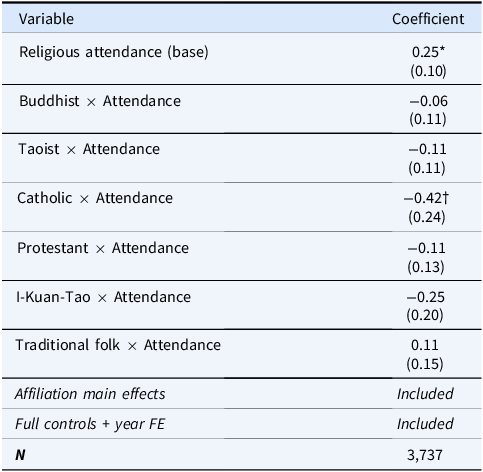
If denomination-specific mobilization drove the attendance effect, the attendance slope would differ across traditions. It does not. Table 2 reports the attendance × affiliation interactions: of the six estimable terms, five are statistically indistinguishable from zero, confirming Hypothesis 3. The slope for the no-religion reference group (β = 0.25, p < 0.05) is shared across Buddhists, Taoists, Protestants, I-Kuan-Tao adherents, and folk-religion practitioners alike. The lone exception is the Catholic interaction (β = −0.42, p < 0.10), which rests on only 40 respondents and runs opposite to the mobilization prediction; we treat it as exploratory. The pattern is identical under negative-binomial and zero-inflated specifications (Online Appendix Table B3).
Attendance × affiliation interactions (OLS)

Table 2 Long description
A table with two columns: Variable and Coefficient. The table has 10 rows, including a header row. The first column lists different variables related to religious attendance and its interactions with various affiliations. The second column provides the corresponding coefficients and standard errors in parentheses. The variables include Religious attendance (base), Buddhist × Attendance, Taoist × Attendance, Catholic × Attendance, Protestant × Attendance, I-Kuan-Tao × Attendance, Traditional folk × Attendance, Affiliation main effects, Full controls + year FE, and N. The coefficients and standard errors are listed as follows: Religious attendance (base) 0.25 (0.10), Buddhist × Attendance -0.06 (0.11), Taoist × Attendance -0.11 (0.11), Catholic × Attendance -0.42 (0.24), Protestant × Attendance -0.11 (0.13), I-Kuan-Tao × Attendance -0.25 (0.20), Traditional folk × Attendance 0.11 (0.15), Affiliation main effects Included, Full controls + year FE Included, N 3,737.
Note: Robust standard errors in parentheses. Each interaction term tests whether the attendance slope for that affiliation differs from the no-religion reference group. Muslim excluded (N = 3). Full coefficients and negative-binomial/ZINB replications appear in Online Appendix Table B3. † p < 0.10, *p < 0.05, **p < 0.01, ***p < 0.001.
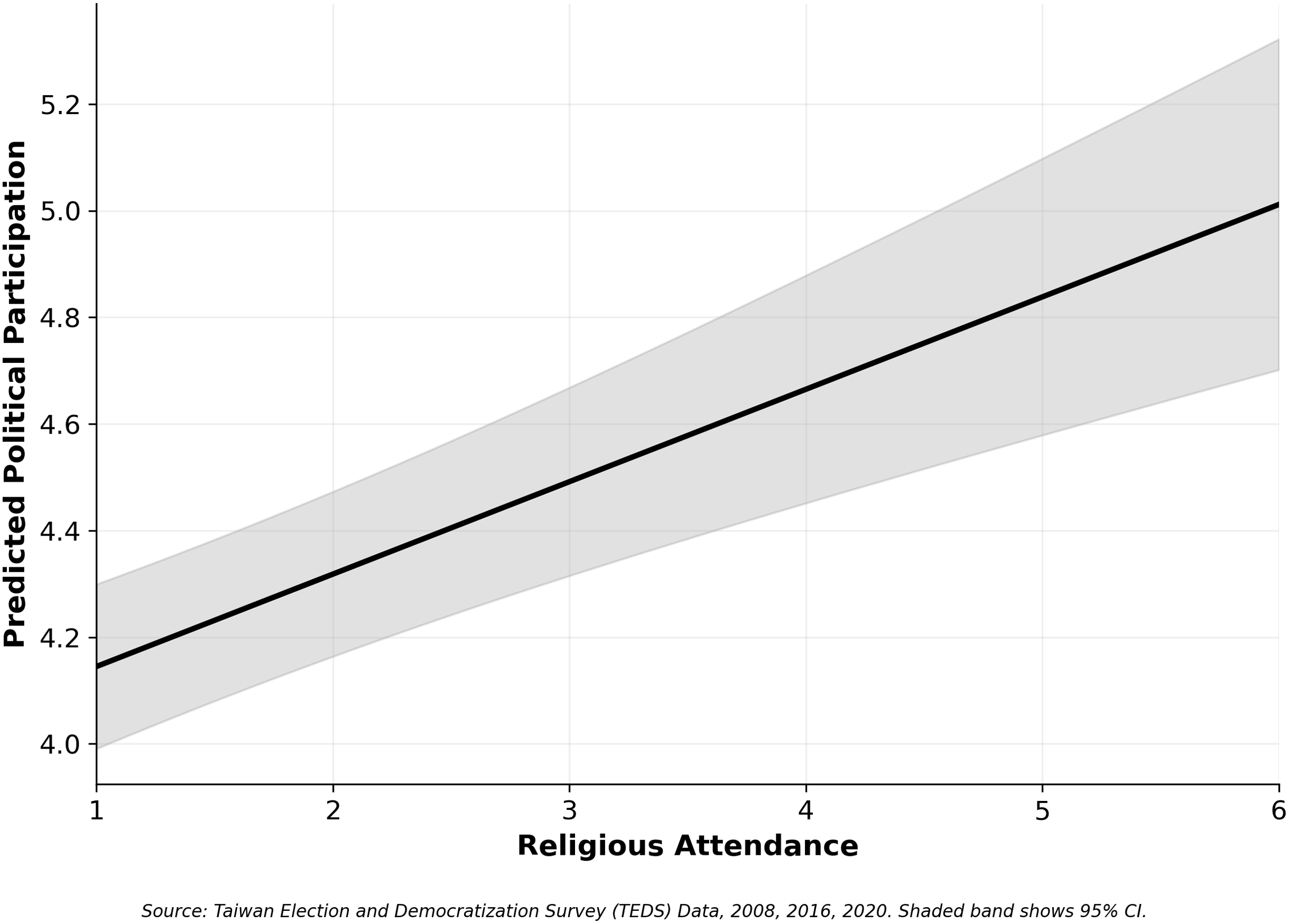
Figures 1 and 2 make the result visual. Figure 1 plots the pooled attendance–participation relationship, which is positive and approximately linear with tight confidence intervals.
Predicted political participation by religious attendance (pooled).

Attendance–participation slopes by affiliation.

Figure 2 overlays the affiliation-specific slopes. For every major tradition the gradient is positive and the lines are effectively parallel; intercepts differ only modestly, reflecting the small, non-significant affiliation differences from Table 1. The visual parallelism corroborates the formal interaction tests: the attendance effect is denomination-invariant.
Robustness and additional analyses
Four additional analyses probe the robustness of the core findings and adjudicate among mechanisms. We summarize the key takeaway of each here; full tables appear in the Online Appendix.
Voting versus campaign activities
Decomposing the dependent variable shows that attendance predicts both dimensions of participation but operates more strongly through campaign activity (β = 0.103, p < 0.001) than through voting (β = 0.072, p < 0.001). This is what a social-capital account predicts: communal religious life most readily facilitates the network-dependent acts—persuading others, attending rallies, volunteering—rather than the low-cost, duty-driven act of casting a ballot (Glazier, Reference Glazier2020; Jang et al., Reference Jang, Brown, Witvliet, Leman, Johnson and Bradshaw2023). Full models appear in Online Appendix Table B4.
Eastern-religion aggregate
Because Taiwan’s religious landscape is syncretic and polytropic, fine-grained denominational categories may be unreliable. Collapsing Buddhist, Taoist, folk-religion, and I-Kuan-Tao respondents into a single “Eastern religion” indicator changes nothing: neither its main effect (β = 0.121, p = 0.17) nor its interaction with attendance (β = 0.046, p = 0.39) approaches significance (Online Appendix). Neither fine nor coarse affiliation categories predict participation beyond attendance itself.
Religious belief intensity
Using the 2008 wave, where a belief-intensity item is available, we test the psychological/belief-oriented model. Belief intensity has no independent association with participation once attendance is controlled (β = −0.009, p = 0.94), and neither its interaction with attendance (β = 0.091, p = 0.18) nor with the Eastern-religion indicator (β = 0.160, p = 0.56) is significant (Hypothesis 5; Online Appendix Table B5). A single-item, single-wave measure has limited power, so we read this as suggestive rather than decisive, but it offers no support for belief content as an independent driver in this context.
Temporal stability
The attendance effect is stable across the three elections (Hypothesis 4). Year fixed effects are large—participation is higher in 2016 and 2020 than in 2008, consistent with post-sunflower mobilization and heightened cross-strait tension—but they shift the intercept, not the slope. Figure 3 displays the attendance–participation gradient for the four largest traditions across 2008, 2016, and 2020; the slopes are positive and similar in every year, regardless of which party held the presidency. The complete year-specific marginal-effects plots for all affiliations appear in Online Appendix Figures C1–C3.
Attendance–participation slopes by affiliation across three elections.

Figure 3. Long description
Panel A: Line graph titled None. The x-axis represents Religious Attendance ranging from 1 to 6. The y-axis represents Predicted Participation ranging from 2 to 8. The graph shows three lines representing election years 2008, 2016, and 2020. The lines indicate that predicted participation increases with religious attendance, with the 2020 line showing the steepest increase. Panel B: Line graph titled Buddhist. The x-axis represents Religious Attendance ranging from 1 to 6. The y-axis represents Predicted Participation ranging from 2 to 8. The graph shows three lines representing election years 2008, 2016, and 2020. The lines indicate a moderate increase in predicted participation with religious attendance, with the 2020 line showing the highest values. Panel C: Line graph titled Taoist. The x-axis represents Religious Attendance ranging from 1 to 6. The y-axis represents Predicted Participation ranging from 2 to 8. The graph shows three lines representing election years 2008, 2016, and 2020. The lines indicate a slight increase in predicted participation with religious attendance, with the 2020 line showing the highest values. Panel D: Line graph titled Protestant. The x-axis represents Religious Attendance ranging from 1 to 6. The y-axis represents Predicted Participation ranging from 2 to 8. The graph shows three lines representing election years 2008, 2016, and 2020. The lines indicate a moderate increase in predicted participation with religious attendance, with the 2020 line showing the steepest increase.
Non-random missingness in 2008
Finally, because the 2008 wave filtered non-religious respondents through a prior belief item, we re-estimate the core model on the 2016 and 2020 waves alone (N = 2,641). The attendance coefficient is, if anything, slightly larger (β = 0.200, p < 0.001), and affiliation remains null, confirming that the findings are not driven by the 2008 missingness pattern.
Discussion
The results provide a consistent answer to each empirical question and allow us to adjudicate among competing theoretical mechanisms with unusual clarity.
Ruling out civic skills and mobilization
The civic skills account cannot explain why the attendance effect is robust and statistically indistinguishable across Buddhists, Taoists, folk religion practitioners, and I-Kuan-Tao adherents—traditions where the administrative tasks necessary for civic skill building are concentrated among a small elite rather than distributed broadly to the average ritual attendee. If civic skills were the primary mechanism, we would expect either a weak overall effect (because Taiwanese religions provide few skill-building opportunities) or significant interaction effects (because traditions vary in their provision of such opportunities). We observe neither.
The mobilization account fails on multiple fronts. First, if denomination-specific political recruitment drove the effect, affiliation would matter independently and interaction terms would be significant—neither is true. Second, if religious attendance were merely a proxy for partisan mobilization, controlling for party identification would attenuate the attendance coefficient—instead, it remains virtually identical. Third, the intra-denominational political heterogeneity that characterizes Taiwanese religions (politically cautious Tzu Chi versus more engaged Fo Guang Shan within Buddhism; politically active Presbyterians versus quietist evangelicals within Protestantism) is averaged across our affiliation categories, which would attenuate mobilization effects—yet the null affiliation finding persists even at this aggregated level.
The social capital mechanism
Only the generalized social capital account is consistent with every feature of our results. Regular communal religious participation cultivates networks, trust, and civic norms that facilitate political engagement regardless of theology, organizational form, or partisan alignment. The decomposition of participation into voting and campaign activities provides additional support: the attendance effect operates primarily through campaign activities (β = 0.103) rather than voting (β = 0.072). Campaign activities—persuading others, attending rallies, volunteering, and joining organizations—are precisely the participatory acts that require social resources: knowing people who are politically active, being embedded in networks that transmit political information, and experiencing social pressure to participate. Voting, by contrast, is a relatively private, low-cost act driven more by duty and political interest. This differential pattern is consistent with Glazier (Reference Glazier2020), who finds that religion more strongly predicts “active” forms of political engagement that require interpersonal connection.
The belief-oriented model
The null finding for religious belief intensity adds an important dimension. While Jang et al. (Reference Jang, Brown, Witvliet, Leman, Johnson and Bradshaw2023) find that transcendent accountability partially mediates the religion–participation link in the U.S. context, we find no independent effect of belief intensity in Taiwan’s 2008 wave. This may reflect genuine cross-cultural differences: Taiwan’s dominant religions emphasize orthopraxis (correct practice) over orthodoxy (correct belief), and the connection between religious conviction and civic duty may be weaker in traditions that do not emphasize a personal relationship with a morally demanding deity. Alternatively, the single-item belief measure may lack the sensitivity to detect effects that would emerge with multi-dimensional belief batteries. We treat this as a suggestive null finding rather than a definitive rejection of the belief-oriented model.
Hybrid mechanisms and temple networks
An important qualification concerns the patron-client mobilization embedded in some folk religion temple networks. As Laliberté (Reference Laliberte2004) and Sher et al. (Reference Sher, Pien, O.’Reilly and Liu2024) document, certain temples have historically served as nodes of KMT factional organization, and some temple networks actively mobilize voters during elections. Our results do not deny the existence of such mobilization; rather, they suggest that it does not constitute the predominant mechanism explaining the overall attendance–participation relationship. The folk religion × attendance interaction is non-significant, meaning that attendance at folk religion temples does not predict participation at a significantly different rate than attendance at Buddhist monasteries, I-Kuan-Tao study groups, or Christian churches. Whatever mobilization occurs through temple networks, it is either too localized to shift the aggregate slope or is offset by equally effective (but non-mobilization) pathways through social capital in other traditions.
Temporal context
The significant year effects—higher overall participation in 2016 and 2020 compared to 2008—likely reflect two contextual developments. First, the 2014 Sunflower Movement catalyzed a new wave of political activism, expanding the repertoire of campaign activities and activating younger cohorts who had previously been politically disengaged. Second, the 2020 election occurred against the backdrop of the Hong Kong incidents and increased mainland China’s external pressure, which elevated election salience to unusual levels. Both factors shifted the intercept (overall participation level) but not the attendance slope, consistent with H4: the religious social capital mechanism operates independently of election-specific political contexts.
The clean separation of religious and partisan effects
The independence of religious and partisan effects deserves emphasis. Both attendance and party identification are strong, significant predictors of participation, but they operate additively. People who attend religious services regularly develop civic capacities that function independently of their partisan commitments. This challenges accounts that treat religious political engagement as merely an extension of partisan polarization, revealing multiple, independent sources of democratic participation in Taiwan.
Conclusion
This study set out to test whether the well-established link between religious attendance and political participation—documented extensively in Western, predominantly Christian democracies—holds in Taiwan, an East Asian democracy whose major religious traditions bear little organizational resemblance to the Protestant congregations that generated the original finding.
Five findings stand out. First, religious attendance is a positive, robust predictor of political participation (H1 confirmed), with a coefficient remarkably stable across model specifications and control sets. Second, religious affiliation has no independent association with participation (H2 confirmed); none of Taiwan’s major traditions differs significantly from the non-religious reference group. Third, the attendance–participation slope is denomination-invariant (H3 confirmed). Fourth, the relationship is temporally stable across three elections spanning twelve years (H4 confirmed). Fifth, religious belief intensity does not independently predict participation beyond attendance (H5 confirmed), though this test is limited to the 2008 wave.
These findings contribute to the comparative study of religion and political participation in three ways. First, they demonstrate that the attendance–participation link is not contingent on Protestant congregational structures or Christian civic culture—it operates through a more portable, universalist social capital mechanism. This revises the dominant Western framework by showing that the social infrastructure of democratic engagement can emerge from any institutional form that brings people together in regular communal activity. Second, by testing and failing to find support for the psychological/belief-oriented model in the Taiwanese context, the study suggests that the motivational content of religious belief may be less important for civic engagement than the structural fact of communal participation—at least in traditions that emphasize practice over doctrine. Third, the decomposition of participation into voting and campaign activities reveals that religious social capital specifically facilitates the kinds of participatory acts that require interpersonal networks, providing a more precise specification of the mechanism.
These findings have implications for understanding the social infrastructure sustaining democratic participation. Religious organizations across diverse traditions—temples, monasteries, shrines, and churches—serve an important, previously underappreciated function as sites of civic engagement. As Taiwan’s democracy matures, recognizing this civic role may help policymakers and civil society advocates appreciate the democratic dividend of associational life in all its forms, including religious gatherings.
Several limitations warrant acknowledgment. First, our pooled cross-sectional design cannot establish causality; future panel studies tracking individuals over time would strengthen causal inference. Second, measurement equivalence of the attendance item across traditions remains a concern, despite the mitigating evidence of invariant slopes. Third, we lack network-level data that would allow direct observation of the social capital mechanism—the trust, norms, and information flows that theoretically mediate the attendance–participation relationship. Fourth, the religious belief intensity test is limited to the 2008 wave with a single item, constraining our ability to definitively evaluate the psychological/belief-oriented model. Fifth, as a single-country study, generalizability to other East Asian democracies requires further testing.
Several directions for future research emerge. First, multi-country East Asian comparisons—incorporating Japan, South Korea, and Indonesia—would test whether the denomination-invariant social capital mechanism operates across different religious and political configurations. Second, qualitative and ethnographic research on temple-level political dynamics could illuminate how social capital and factional mobilization coexist at the organizational level. Third, panel designs tracking religious behavior and political participation over time would address the endogeneity concern. Fourth, richer belief batteries measuring multiple dimensions of religious conviction—transcendent accountability, moral obligation, and religiously grounded civic duty—would provide a more definitive test of the psychological/belief-oriented model in East Asian contexts. Finally, given the increasing importance of digital religious participation (online services, streaming Dharma lectures), future studies should examine whether virtual communal engagement generates similar social capital effects.
Supplementary material
The supplementary material for this article can be found at https://doi.org/10.1017/S1755048326100418.
Financial support
This research is funded by Fundamental Research Funds for the Central Universities of Jinan University (23NJYH04).
Competing interests
The authors declare none.
Liang Jiang is an associate professor of political science specializing in immigration studies, political behavior, political communication, and politics and religion. He currently works at the School of International Studies/Academy of Overseas Chinese Studies, Jinan University, China.


 Open access

