


Statement of Research Significance
Research Question(s) or Topic(s): This study examined recovery time courses of egocentric and allocentric peri-personal visuospatial and personal neglect; whether initial severity predicts recovery and defines patient clusters; and how subtypes interrelate throughout the first 12 weeks post-stroke. Main Findings: Significant improvements occurred across all neglect subtypes, mainly between weeks 3 and 5 post-stroke, followed by a plateau. Higher initial severity predicted greater impairment at later timepoints. Cluster analysis identified near-normal, mild, and moderate-to-severe baseline subgroups with distinct recovery trajectories. Moderate-to-strong correlations emerged only between egocentric and allocentric neglect at week 3 and with pooled data. Study Contributions: Unlike prior research, this study examined recovery across multiple neglect subtypes, revealing that recovery time courses in visuospatial and personal neglect parallel those of motor and language recovery, supporting a shared, time-limited recovery window. Findings emphasize the value of early severity stratification and comprehensive assessment using multiple neglect tests.
Introduction
Spatial neglect is a post-stroke cognitive disorder involving asymmetric attention to space, most often manifesting as reduced awareness of stimuli opposite the lesion and, less frequently, reduced awareness on the same side (Fellrath et al., Reference Fellrath, Blanche-Durbec, Schnider, Jacquemoud and Ptak2012; Heilman & Valenstein, Reference Heilman and Valenstein1979; Van der Stigchel & Nijboer, Reference Van der Stigchel and Nijboer2010). Rather than being a uniform condition, neglect encompasses various subtypes that differ in their affected reference frames (egocentric/viewer-centered, allocentric/object-centered), processing stages (sensory (visual/auditory/tactile), representational, or motor), and spatial domains (personal, peri-personal, or extra-personal space) (Demeyere & Gillebert, Reference Demeyere and Gillebert2019; Williams et al., Reference Williams, Kernot, Hillier and Loetscher2021). Prevalence estimates range from 18% to 80%, reflecting differences in assessment methods, stroke location and severity, and the timing of post-stroke evaluation (Esposito et al., Reference Esposito, Shekhtman and Chen2021; Williams et al., Reference Williams, Kernot, Hillier and Loetscher2021).
The disorder’s heterogeneity poses significant challenges for establishing standardized diagnostic and therapeutic frameworks that address the full spectrum of neglect. Moreover, the limited evidence for the effectiveness of current cognitive interventions (Bowen et al., Reference Bowen, Hazelton, Pollock and Lincoln2013) may, at least in part, stem from variable treatment responses across subtypes (Carter & Barrett, Reference Carter and Barrett2023). A better understanding of how distinct subtypes recover could help refine interventions by identifying whether some follow predictable recovery trajectories while others rather remain resistant to improvement over time. Such insights may also guide the timing of treatment, aligning rehabilitation with subtype-specific periods of heightened recovery potential (Bernhardt et al., Reference Bernhardt, Hayward, Kwakkel, Ward, Wolf, Borschmann, Krakauer, Boyd, Carmichael, Corbett and Cramer2017).
Prior studies that examined neglect recovery within the first six months post-stroke (i.e., the period of greatest expected recovery (Bernhardt et al., Reference Bernhardt, Hayward, Kwakkel, Ward, Wolf, Borschmann, Krakauer, Boyd, Carmichael, Corbett and Cramer2017)) have largely focused on peri-personal visuospatial neglect assessed with conventional tools such as cancellation or line bisection tasks (Cassidy et al., Reference Cassidy, Lewis and Gray1998; Jehkonen et al., Reference Jehkonen, Ahonen, Dastidar, Koivisto, Laippala, Vilkki and Molnár2000; Jehkonen et al., Reference Jehkonen, Laihosalo, Koivisto, Dastidar and Ahonen2007; Levine et al., Reference Levine, Warach, Benowitz and Calvanio1986; Nijboer et al., Reference Nijboer, Kollen and Kwakkel2013; Overman et al., Reference Overman, Binns, Milosevich and Demeyere2024; Samuelsson et al., Reference Samuelsson, Jensen, Ekholm, Naver and Blomstrand1997; Stone et al., Reference Stone, Patel, Greenwood and Halligan1992). Most of these demonstrate that the greatest improvements occur within the first 12 – 14 weeks post-stroke, followed by a gradual plateau (Cassidy et al., Reference Cassidy, Lewis and Gray1998; Jehkonen et al., Reference Jehkonen, Ahonen, Dastidar, Koivisto, Laippala, Vilkki and Molnár2000; Jehkonen et al., Reference Jehkonen, Laihosalo, Koivisto, Dastidar and Ahonen2007; Levine et al., Reference Levine, Warach, Benowitz and Calvanio1986; Nijboer et al., Reference Nijboer, Kollen and Kwakkel2013; Overman et al., Reference Overman, Binns, Milosevich and Demeyere2024; Samuelsson et al., Reference Samuelsson, Jensen, Ekholm, Naver and Blomstrand1997; Stone et al., Reference Stone, Patel, Greenwood and Halligan1992). However, while informative, their narrow focus on (mostly egocentric) peri-personal visuospatial neglect overlooks potential differences in recovery time courses across other neglect subtypes (e.g., allocentric or personal neglect), or other dimensions of the disorder, such as its temporal aspects (e.g., spatial reaction times). Moreover, prior research indicates that initial egocentric visuospatial neglect severity is a significant predictor of neglect recovery (Marchi et al., Reference Marchi, Ptak, Di Pietro, Schnider and Guggisberg2017; Moore et al., Reference Moore, Gillebert and Demeyere2021; Stone et al., Reference Stone, Patel, Greenwood and Halligan1992). Yet, it is not known whether this relationship generalizes to other neglect subtypes or dimensions or how its predictive value evolves over the subacute recovery phase. Furthermore, recovery may not be uniform across individuals; some may exhibit distinct patterns of improvement or persistent deficits depending on their initial severity profile.
Another limitation of current literature lies in the limited understanding of how neglect subtypes relate to one another during recovery. While behavioral and neural dissociations between subtypes have been established (Chechlacz et al., Reference Chechlacz, Rotshtein, Bickerton, Hansen, Deb and Humphreys2010; Demeyere & Gillebert, Reference Demeyere and Gillebert2019), in the early post-stroke period, deficits are often diffuse due to widespread network disruption or diaschisis (Feeney & Baron, Reference Feeney and Baron1986). This raises the possibility that different subtypes may initially co-occur before diverging into the dissociable patterns. Therefore, examining how correlations between subtypes change during recovery can provide a complementary perspective to dissociation studies, capturing transient overlaps that static dissociation analyses alone cannot explain. However, these temporal dynamics during recovery remain unexplored.
Thus, key fundamental questions remain unanswered: Do different neglect subtypes follow similar recovery time courses? Is initial neglect severity a universal predictor of recovery? And do neglect subtypes covary over time? To address these, this exploratory, non-hypothesis-driven study prospectively investigated the time course of recovery of neglect during the first 12 weeks post-stroke (i.e., early subacute post-stroke phase (Bernhardt et al., Reference Bernhardt, Hayward, Kwakkel, Ward, Wolf, Borschmann, Krakauer, Boyd, Carmichael, Corbett and Cramer2017)). A comprehensive battery of assessments was employed to capture variations in recovery courses across neglect subtypes. The study had three objectives:
-
1. To examine the recovery time courses of egocentric and allocentric peri-personal visuospatial neglect (both spatial and temporal aspects), as well as personal neglect, during the first 12 weeks post-stroke,
-
2. To evaluate whether initial neglect severity is a predictor of their time courses of recovery, to identify distinct clusters based on this initial severity, and to examine transitions between these clusters over time;
-
3. To investigate how the subtypes interact over time.
Material and methods
Study design and setting
This longitudinal cohort study is part of a larger research project, entitled TARGET (Temporal Analyses of hemiplegic Gait and standing balance Early post sTroke; see (Schröder et al., Reference Schröder, Saeys, Yperzeele, Kwakkel and Truijen2022 ). This study was approved by the Medical Ethics Committee of the University Hospital Antwerp (No. 18/25/305; Belgium Trial Registration No. B300201837010 and BUN B3002021000098). Additional approval was obtained from the medical ethics committees of the other clinical sites. All procedures were conducted in accordance with the principles of the Declaration of Helsinki. The study protocol was designed in accordance with the STROBE guidelines (von Elm et al., Reference von Elm, Altman, Egger, Pocock, Gøtzsche and Vandenbroucke2008) and was registered online (ClinicalTrials.gov ID NCT05060458).
Participants
Individuals admitted to one of the four cooperating acute hospitals (Universitair Ziekenhuis Antwerpen, GZA Sint-Vincentius, GZA Sint-Augustinus, Algemeen Ziekenhuis Geel) and 2 rehabilitation facilities (RevArte, AZ Monica), all situated in the larger Antwerp region, Belgium, after an acute stroke were screened for participation between August 2020 and May 2024. For eligibility, they had to meet the following criteria: (1) CT and/or MRI confirmed first-ever unilateral ischemic or hemorrhagic supratentorial stroke, (2) aged between 18 and 90 years, (3) (corrected to) normal visual acuity, (4) premorbid independence in daily life activities (i.e., modified Rankin Scale score of 0 – 1), (5) no prior diagnosis of pre-stroke neurological disease, (6) no severe cognitive or communication deficits that interfere with understanding instructions and procedures. This was determined during recruitment interviews by consulting with the eligible person and/or their caregiver(s), assessing the person’s capacity to comprehend instructions and participate in the study, and (7) ability to provide written informed consent. All participants received usual care including physical, occupational, speech, and neuropsychological therapy, depending upon individual needs.
Protocol, data collection, and outcome measures
Recruitment and screening were performed by EE, CvdW, and JS together with the (para)medical staff employed at the stroke units and rehabilitation facilities. During intake at 3 weeks post-stroke, the participants’ sex, age, and stroke information (type: ischemic/hemorrhagic; affected side: left/right) as well as clinical severity of lower limb motor impairment (Lower Limb Motricity Index) (Demeurisse et al., Reference Demeurisse, Demol and Robaye1980) and functional mobility (Rivermead Mobility Index) (Collen et al., Reference Collen, Wade, Robb and Bradshaw1991) were noted. Serial measurements of neglect were employed at weeks 3, 5, 8, and 12 post-stroke onset. A trained assessor (EE or CvdW) administered all follow-up assessments of the same participant.
Peri-personal visuospatial neglect tests
Broken hearts test (BHT)
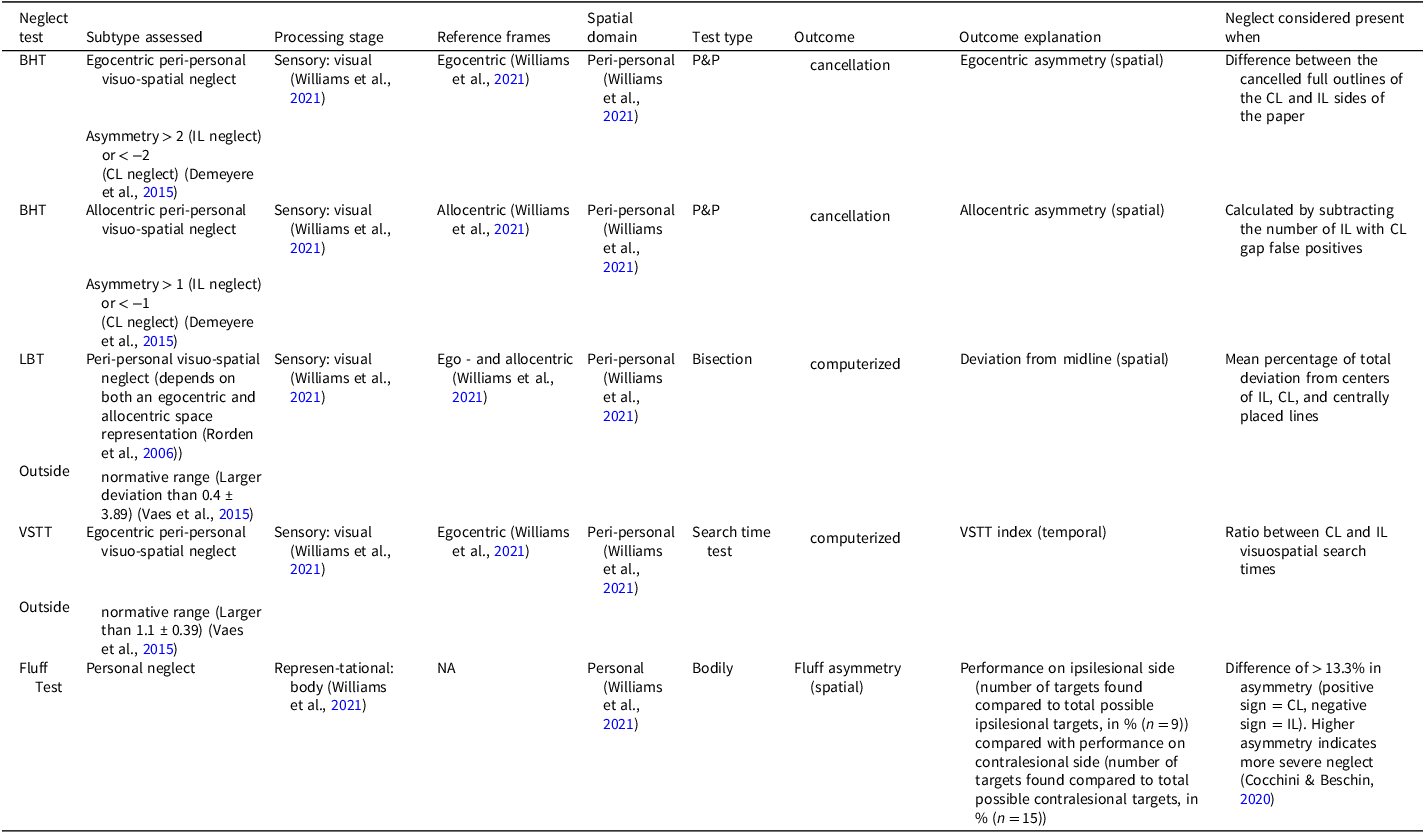
We used the BHT, part of the Oxford Cognitive Screen (Demeyere et al., Reference Demeyere, Riddoch, Slavkova, Bickerton and Humphreys2015), or its variation (Apples test) (Bickerton et al., Reference Bickerton, Samson, Williamson and Humphreys2011). These three parallel versions were varied across time points to reduce learning effects. Participants had to cancel complete hearts/apples (n = 50) among distractors with left- or right-sided gaps (n = 50 each). The test was presented on standardized A4 landscape sheets and had to be completed within three minutes (Demeyere et al., Reference Demeyere, Riddoch, Slavkova, Bickerton and Humphreys2015; Demeyere et al., Reference Demeyere, Riddoch, Slavkova, Jones, Reckless, Mathieson and Humphreys2016). For more details and outcome measures, see Table 1.
Neglect tests and their corresponding characteristics, outcome measures and cut-off scores

Abbreviations: BHT = broken hearts test, CL = contralesional, IL = ipsilesional, LBT = line bisection test, NA = not applicable, P&P = paper-and-pencil test, VSTT = visuospatial search time test
Computerized Schenkenberg line bisection test (LBT)
Participants bisected 20 horizontal lines using their less-affected hand. Lines were presented centrally or shifted left/right, with equal peripheral starting points (Vaes et al., Reference Vaes, Lafosse, Nys, Schevernels, Dereymaeker, Oostra, Hemelsoet and Vingerhoets2015). The test was administered using the Metrisquare DiaDiag software (www.metrisquare.com) on a Wacom® tablet (40 × 65 cm) (Vaes et al., Reference Vaes, Lafosse, Nys, Schevernels, Dereymaeker, Oostra, Hemelsoet and Vingerhoets2015). For more details and outcome measures, see Table 1.
Computerized visuospatial search time test (VSTT)
The VSTT consists of 16 consecutive grids containing 20 different stimuli centered around one stimulus in the middle, presented in a green square (Vaes et al., Reference Vaes, Lafosse, Nys, Schevernels, Dereymaeker, Oostra, Hemelsoet and Vingerhoets2015). The participant had to cross out a stimulus identical to the central stimulus as quickly as possible. Directly afterwards, the next grid was shown with a different central stimulus, and in this way, the task continued. The task recorded ipsilesional and contralesional search times, using the same DiaDiag software and Wacom® tablet (40 × 65 cm) (Vaes et al., Reference Vaes, Lafosse, Nys, Schevernels, Dereymaeker, Oostra, Hemelsoet and Vingerhoets2015). For more details and outcome measures, see Table 1.
Personal neglect test
Fluff test
Fifteen targets were placed on the contralesional side of the body (six on the arm, six on the leg, and three on the trunk) and nine on the ipsilesional side (six on the leg and three on the trunk). Participants were blindfolded and unaware of the targets being attached, as placement occurred during a separate sensory (tactile) test not included in this study. They were then instructed to remove all targets using their less-affected hand (Cocchini & Beschin, Reference Cocchini and Beschin2020). If motor deficits (e.g., limited trunk control) interfered with target removal, the examiner assisted with positioning (e.g., supporting a seated posture) while minimizing sensory feedback on the limbs and trunk. For details on outcome measures, see Table 1.
Statistical analyses
Analyses included participants with at least two consecutive follow-up assessments. Individuals with missing data between intermediate timepoints (e.g., weeks 3 – 8) were excluded, though dropouts before week 12 were permitted.
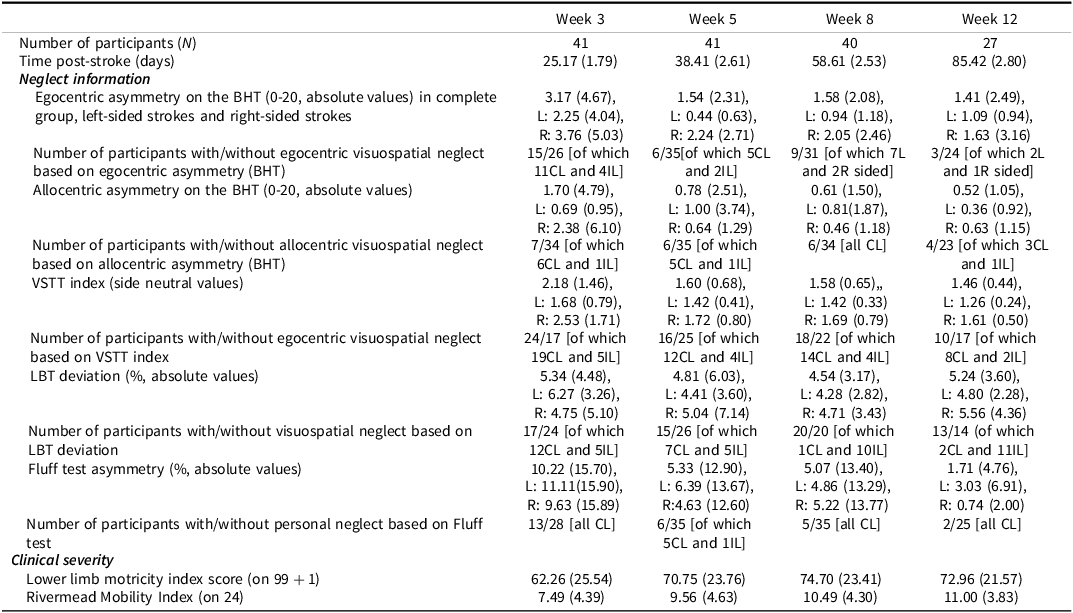
Demographic, clinical, and neglect outcome variables (BHT egocentric and allocentric asymmetry, VSTT index, LBT deviation, Fluff test asymmetry) were summarized as means ± SD at weeks 3, 5, 8, and 12 (Table 2).
Demographic and clinical characteristics of the participants at each timepoint

Abbreviations. BHT = Broken Hearts Test; CL = contralesional; IL = ipsilesional; L = left; R = right. Unsigned/absolute values were used for the parameters presented. Values are mean (standard deviation).
Objective 1: Recovery time courses
We first analyzed data from the entire cohort, regardless of whether participants met predefined cutoffs for neglect at baseline (week 3, see Table 1) to capture the natural symptom variability in a clinically representative population and avoid a strict baseline dichotomy that could obscure meaningful fluctuations in severity across the spectrum of impairment. Because longitudinal effects in the full sample are likely driven by those with initial neglect, also test-specific subgroup analyses restricted to individuals with clinically significant impairment (i.e., outside normative ranges) at baseline were performed.
For each neglect outcome, linear mixed models (LMMs) were fitted with TIME (categorical: weeks 3, 5, 8, 12) as a fixed effect and a subject-specific random intercept for repeated measures. To further examine the effect of lesion laterality, given that neglect is typically more frequent and severe after right-hemisphere lesions (Cazzoli et al., Reference Cazzoli, Kaufmann, Rühe, Geiser and Nyffeler2025; Esposito et al., Reference Esposito, Shekhtman and Chen2021), additional LMMs were conducted in those with clinically significant neglect, including lesion side and its interaction with TIME as fixed factors.
To prevent misinterpreting directional shifts over time (e.g., from ipsilesional to contralesional and vice versa) as improvement or deterioration of neglect, absolute/side-neutral values were used for each dependent variable. Model assumptions were checked via histograms, Q-Q plots, and residuals-versus-predicted plots. Due to violations, BHT allocentric, BHT egocentric, VSTT index, and LBT deviation were log-transformed; a constant of 1 was added to BHT asymmetry scores prior to transformation to handle zeros. Post-hoc Tukey’s HSD tests estimated changes (regression coefficients β) across the full period (weeks 3 – 12) and individual epochs (weeks 3 – 5, 5 – 8, 8 – 12). Log-transformed β estimates were back-transformed using Exp(β). These analyses were performed using JMP Pro® version 16.
Objective 2: Baseline severity and clustering
The same LMM structure was applied to the entire cohort, with baseline neglect severity (absolute score at 3 weeks) and its interaction with TIME as additional covariates.
Cluster analysis was conducted in R (version 2025.09.1) using the mclust package. For clustering, only baseline measurements of the VSTT index and BHT egocentric asymmetry were included (absolute/side-neutral values) and standardized. These were chosen to capture core dimensions of neglect represented in the largest subsamples of our cohort (both spatial and temporal bias of egocentric neglect). Gaussian finite mixture models with different covariance structures (VVE, VEV, VVV, EEE, EVV) were fitted, with optimal model selection based on Bayesian Information Criterion (BIC) and Integrated Completed Likelihood (ICL). Longitudinal trajectories were examined by linking cluster assignments from week 3 to subsequent timepoints, and individual progress was visualized in plots with cluster-colored trajectories, where arrows indicated change between sessions. Cluster characteristics were summarized with means ± SD for continuous variables and proportions for categorical variable (See Supplementary material).
Objective 3: Associations between neglect outcome measures
Spearman correlations assessed associations between neglect measures across pooled timepoints and at each timepoint. Non-parametric methods were used due to non-normal data distributions. Correlation matrix heatmaps were generated, and coefficients were interpreted as: ≤ .30 (no meaningful relationship), .30 – .50 (moderate), .50 – .70 (good), >.70 (very good) (Portney, Reference Portney2020). Bonferroni correction adjusted the significance threshold to α = .005 (α = .05/10 correlations). Analyses used JMP Pro® version 16.
Results
Participants
A total of 210 potentially eligible individuals were screened, of which 42 were enrolled. Of these, 41 successfully participated in at least two serial measurements and were included in the analysis (Figure 1).
Screening, recruitment and follow-up flowchart.

Descriptive data
Participants had a mean age of 59.2 ± 15.6 years; 17 (41.5%) were female, 11 (26.8%) had left-sided strokes, and 33 (80.5%) ischemic strokes. Mean time post-stroke was 25.3 ± 2.0 days at week 3, 38.4 ± 2.6 at week 5, 58.6 ± 2.5 at week 8, and 85.4 ± 2.8 at week 12.
Table 2 presents mean absolute/side-neutral scores for all neglect measures, the number of participants outside unimpaired ranges (per subtype) and with ipsilesional or contralesional neglect, and clinical severity scores (Lower Limb Motricity Index, Rivermead Mobility Index).
A dropout rate of 32.5% occurred from 8 weeks post-stroke onward (Figure 1). To evaluate potential bias, neglect severity was compared between those who completed all sessions and those who dropped out after week 8 with the Wilcoxon signed rank test. This showed no significant differences in neglect severity between completers and dropouts across timepoints for any neglect measure. Full statistical details are provided in Supplementary Table 1.
Objective 1: Time course of visuospatial peri-personal neglect and personal neglect recovery
Figure 2 illustrates individual recovery time courses across different tests. As indicated in Figure 2 and Table 2, the mean values for all tests fall outside unimpaired ranges at week 3. By 5 weeks, most scores returned to within normal limits, except for LBT deviation and Fluff test asymmetry. (See also Figure 3 in the section ‘Objective 3: Association between Neglect Outcomes over Time’, for mean ± SD with corresponding correlation heatmaps over time)
Individual time courses of recovery for each neglect test, presented by lesion side.
Note. Individual trajectories are shown as lines, with solid blue lines representing participants with right-sided lesions and dotted red lines representing participants with left-sided lesions. Grey bands indicate the normative (non-impaired) performance range.

Clusters that emerged from the Gaussian finite mixture model, with longitudinal trajectory from week 3 to 12.
Note. Three initial severity clusters are shown, with color-coded cluster membership at week 3. Arrows indicate individual changes between week 3 and 12.

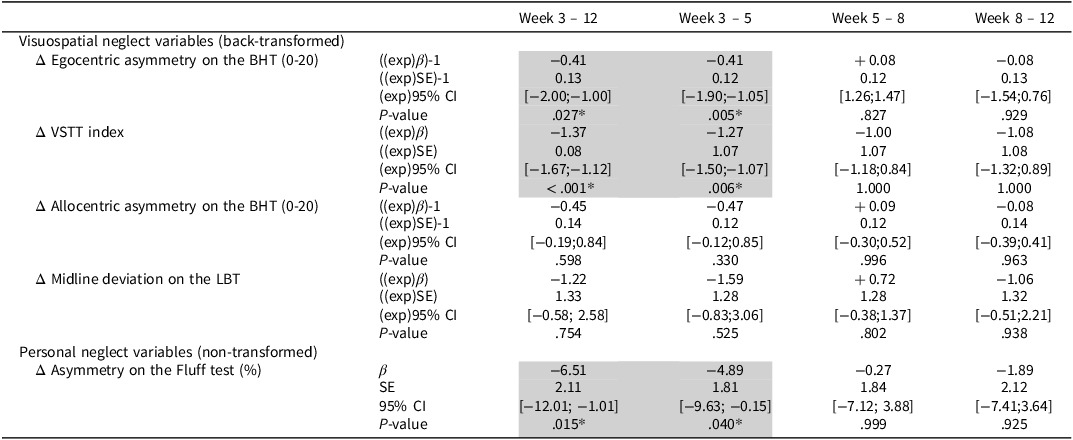
We first examined neglect severity across the full cohort. Egocentric visuospatial neglect severity (BHT egocentric asymmetry, VSTT index) significantly decreased between weeks 3 and 12 post-stroke (BHT: Exp(β)-1 = −0.41, 95%CI [−0.99, −0.01], P = .049; VSTT index: Exp(β) = −1.35, 95%CI[−1.65, −1.10], P = .001). Post-hoc analysis revealed a significant decrease in severity between weeks 3 and 5 only (BHT: Exp(β)-1 = −0.41, 95%CI [−0.90, −0.05], P = .017; VSTT index: Exp(β) = −1.24, 95%CI [−1.65, −1.05], P = .006). No significant changes were observed beyond this period. Additionally, visuospatial neglect severity did not decrease over time when assessed using BHT allocentric asymmetry (P = .453) or LBT deviation (P = .315) (Table 3).
Linear mixed model results for neglect outcomes across the full period (weeks 3–12) and individual epochs

BHT = Broken Hearts Test, CI = confidence interval, LBT = Line Bisection Test, SE = standard error, VSTT = Visuospatial Search Time Test, Δ = difference, β = estimate, (exp)β = back-transformed value, *P < .05.
Personal neglect severity (Fluff Test asymmetry) decreased significantly from weeks 3 – 12 (β = –6.51, 95%CI [–12.01, –1.00], P = .014), driven by improvement between weeks 3 – 5 (β = −4.89, 95% CI [−9.63, −0.15], P =.014), with no further changes thereafter (Table 3).
Subgroup analyses: Individuals outside normative ranges at week 3
Additional analyses focused on test-specific subgroups (i.e., participants with baseline scores outside normative ranges) to evaluate recovery in individuals with clinically significant neglect at 3 weeks post-stroke. These show significant decrease in neglect severity (weeks 3 – 12) for BHT egocentric asymmetry (Exp(β)-1 = −4.80, 95%CI [−8.09, −1.52], P = .002), BHT allocentric asymmetry (Exp(β)-1 = −8.15, 95%CI [−15.15, −1.14], P = .019), VSTT index (Exp(β) = −1.04, 95%CI [−1.79, −0.29], P = .003), and Fluff Test asymmetry (β = –2.58, 95%CI [−4.06, −1.10], P = .001). Post-hoc analyses revealed significant decreases between weeks 3 and 5 for BHT egocentric asymmetry ((Exp)β-1 = −4.27, 95%CI [−7.13, −1.41], P = .002), BHT allocentric asymmetry ((Exp)β-1 = −8.24, 95%CI [−14.36, −2.12], P = .006), VSTT index (Exp(β) = −0.73, 95%CI [−1.40, −0.05], P = .029), and Fluff test asymmetry (β = −6.05, 95%CI [−28.91, −1.27], P = .019), with a plateau afterwards. No significant decrease was observed for LBT deviation (P = .208).
Regarding lesion-side effects within this subset, none were observed for BHT egocentric asymmetry, LBT deviation, or Fluff test asymmetry. However, for BHT allocentric asymmetry, right-hemisphere lesions were associated with larger asymmetry (F = 18.29, p = .008; Exp(β)=0.66, p = .008), without a time interaction. For the VSTT index, a significant time × lesion side interaction was found (F(3, 60.8) = 2.9, p = .048), with participants with left-sided lesions showing lower (i.e., better) VSTT index scores at 3 weeks (Exp(β)= −0.81, p = .012) than right-sided lesions, whereas no significant differences were observed at 5 or 8 weeks.
Objective 2: Influence of initial neglect severity on neglect recovery time courses and cluster analysis
Initial neglect severity significantly interacted with TIME for BHT egocentric asymmetry (F = 9.49, P < .0001), BHT allocentric asymmetry (F = 25.14, P < .0001), VSTT index (F = 8.97, P < .0001), and Fluff Test asymmetry (F = 13.00, P < .0001). Higher initial severity predicted higher BHT egocentric and allocentric asymmetry and VSTT index scores at 12 weeks (Exp(β–1) = 0.07, 95%CI [0.03, 0.12], P = .002; Exp(β–1) = 0.05, 95%CI [0.01, 0.08], P = .008, and Exp(β) = 1.29, 95%CI [1.20, 1.39], P < .0001, respectively), and higher Fluff test asymmetry at 5 Exp(β–1) = 0.05, 95%CI [0.02, 0.08], P = .002) and 8 weeks (Exp(β–1) = 0.04, 95%CI [0.01, 0.07], P = .014)). Adding initial neglect severity to the model did not influence LBT deviation (P = .770).
Cluster analysis indicated that a VEV model, allowing variable cluster volume and orientation but equal shape, provided the best fit (BIC = −147.09; ICL = −148.76). Three clusters were identified: Cluster 1 (n = 20) showed mild neglect (VSTT index M = 1.73, SD = 0.60; BHT egocentric asymmetry M = 2.20, SD = 1.15), Cluster 2 (n = 9) showed moderate-to-severe deficits (VSTT M = 4.17, SD = 1.79; BHT egocentric asymmetry M = 9.33, SD = 6.87), and Cluster 3 (n = 10) demonstrated near-normal performance (VSTT M = 1.29, SD = 0.17; BHT egocentric asymmetry M = 0). As shown in Figure 3, those in Clusters 1 and 3 generally showed either modest improvement (Cluster 1 → 3) or stable near-normal performance (Cluster 3). In contrast, Cluster 2 showed recovery, with nearly all individuals moving toward the performance range of Cluster 1 by week 12 (See Supplementary Material for more details on cluster characteristics and epoch-by-epoch trajectories).
Time courses of recovery per neglect test with correlation heatmaps per timepoint.
Note. Mean (standard deviation) recovery time courses are shown for each neglect test, separately for participants with left-sided and right-sided lesions. At each timepoint, a correlation heatmap is included, showing correlation strength and significance between the neglect tests.

Objective 3: Association between neglect outcomes over time
Figure 4 shows time courses of neglect for each outcome measure (mean ± SD), including correlation heatmaps per timepoint. At 3 weeks post-stroke, a strong correlation was observed between the VSTT index and BHT allocentric asymmetry (ρ = 0.54, P < .001), and a moderate correlation between the VSTT index and LBT deviation (ρ = 0.33, P = .002). At 5, 8, and 12 weeks, no significant or meaningful correlations were found.
Across all timepoints, statistically significant (α = 0.005) moderate correlations were observed between the VSTT index and BHT egocentric (ρ = 0.38, P < .001) and allocentric asymmetry (ρ = 0.45, P < .001). Remaining correlations were not significant (P > .005) (Figures in Supplementary Files).
Discussion
This prospective study examined recovery time courses of neglect subtypes during the first 12 weeks post-stroke, the role of initial neglect severity, and associations between neglect subtypes over time. Results show that egocentric peri-personal neglect (BHT asymmetry, VSTT index), allocentric peri-personal neglect (BHT asymmetry), and personal neglect (Fluff Test asymmetry) improved between weeks 3 and 5, after which recovery plateaued. In contrast, line bisection deviation showed no recovery overall. Higher baseline severity predicted poorer outcomes across multiple neglect subtypes, though effects were modest. Cluster analysis based on this initial severity identified three groups (near-normal, mild, moderate-to-severe) that followed distinct recovery trajectories, with initially more impaired individuals showing gradual improvement, yet rarely reaching near-normal performance by week 12. Correlations between some neglect measures were present early but disappeared after 5 weeks.
Time courses of recovery across neglect subtypes
Analyses demonstrated recovery of egocentric peri-personal neglect within the first 12 weeks post-stroke, with the most pronounced improvements in the first five weeks, after which recovery plateaued. This aligns with Stone et al. (Reference Stone, Patel, Greenwood and Halligan1992), who also examined visuospatial neglect recovery over the first 12 weeks post-stroke, though they reported stabilization later, around week 8. The parallel improvements in spatial (BHT) and temporal (VSTT) dimensions of egocentric visuospatial neglect suggest that reductions in spatial attentional bias are accompanied by faster visuospatial information processing in the neglected hemispace. Moreover, it shows that both a paper-and-pencil cancellation test (BHT) and digitized task (VSTT) are equally informative for monitoring recovery. Personal neglect followed a similar time course, whereas allocentric neglect showed significant recovery only in the subgroup of participants with clinically relevant impairments at baseline. In both cases, improvements were confined to weeks 3 to 5, followed by a plateau. The observed recovery time courses mirror those reported for motor and language deficits (Duncan et al., Reference Duncan, Goldstein, Horner, Landsman, Samsa and Matchar1994; Kwakkel et al., Reference Kwakkel, Kollen and Twisk2006; Lazar et al., Reference Lazar, Minzer, Antoniello, Festa, Krakauer and Marshall2010), underscoring a critical early phase in which recovery is most pronounced and supporting the existence of a time-limited window of recovery that extends across neurological domains.
Additional analyses considering lesion side revealed that right-hemisphere lesions were associated with greater allocentric asymmetry over time and more pronounced early search time deficits, consistent with prior research showing more severe visuospatial deficits in right-hemisphere lesions (Chechlacz et al., Reference Chechlacz, Rotshtein, Roberts, Bickerton, Lau, Humphreys and Baron2012), although lesion effects were limited to specific tasks.
In contrast, LBT deviation did not show change over time. This differs from Nijboer et al. (Reference Nijboer, Kollen and Kwakkel2013), who reported gradual recovery up to 14 weeks post-stroke. The discrepancy likely reflects methodological differences: our four assessments versus their 11, a digitized large-screen LBT (40 × 65 cm, 20 lines) versus their paper version (A4, 10 lines), and our smaller sample with milder baseline deviation (13 – 20 participants, mean 5° vs. 52 participants, mean 7°) (Nijboer et al., Reference Nijboer, Kollen and Kwakkel2013). Moreover, despite selecting the subgroup of individuals with neglect symptoms at baseline and thereby reducing baseline variability in our study, LBT scores remained highly variable across timepoints, which may have contributed as well by masking potential recovery at the group level.
Influence of initial neglect severity on recovery and cluster analysis
Greater initial neglect severity predicted more severe egocentric, allocentric, and personal neglect at later timepoints, whereas LBT deviation remained unaffected by this. These findings align partly with previous work showing baseline severity as a prognostic factor for egocentric neglect recovery (Marchi et al., Reference Marchi, Ptak, Di Pietro, Schnider and Guggisberg2017; Margaret J. Moore et al., Reference Moore, Gillebert and Demeyere2021; Stone et al., Reference Stone, Patel, Greenwood and Halligan1992). We also observed a similar effect in allocentric neglect, contrasting with Moore et al. (Reference Moore, Gillebert and Demeyere2021), who reported no such relationship despite using the same test. Baseline severity further predicted outcomes in personal neglect, suggesting that its prognostic value may extend across neglect subtypes. Nevertheless, effects were modest: initial severity explained only a small proportion of variance in later test scores.
Cluster analysis provides a complementary perspective, suggesting that initial neglect severity may meaningfully differentiate patient subgroups. Takamura et al. (Reference Takamura, Fujii, Ohmatsu, Morioka and Kawashima2021) similarly used multivariate clustering to identify behavioral subgroups within the neglect population, though their cross-sectional approach focused on lateralized versus non-lateralized attention deficits. Our longitudinal approach extends this work by examining how neglect subgroups evolve over time based on lateralized spatial and temporal characteristics, providing additional insight into individual recovery. Individuals with initially severe deficits tended to shift toward the mild cluster by week 12 but remained distinct from the near-normal cluster. Conversely, those with milder initial impairments progressed toward near-normal performance. These findings demonstrate that early severity may capture clinically relevant heterogeneity in recovery and suggest that normalization rarely occurs in those with severe initial deficits.
Correlations between neglect subtypes over time
Despite mostly similar recovery time courses of the neglect subtypes, significant correlations between their measures were generally absent, particularly beyond five weeks post-stroke. Moderate-to-strong correlations were observed only between egocentric and allocentric peri-personal neglect measures, and only when all timepoints were pooled or at 3 weeks post-stroke, when neglect severity and between-subject variability were greatest. Beyond 5 weeks, when many participants had recovered to unimpaired ranges, correlations were no longer detectable. This indicates that neglect subtypes may overlap shortly after stroke, likely reflecting shared vulnerability to diffuse disruption (Feeney & Baron, Reference Feeney and Baron1986), but become increasingly distinct as recovery progresses, in line with evidence for their dissociable nature (Guilbert, Reference Guilbert2023; Williams et al., Reference Williams, Kernot, Hillier and Loetscher2021).
Strengths and limitations
This study’s primary strength is its longitudinal design with fixed timepoints relative to stroke onset, aligning with Stroke Recovery and Rehabilitation Roundtable recommendations (Bernhardt et al., Reference Bernhardt, Hayward, Kwakkel, Ward, Wolf, Borschmann, Krakauer, Boyd, Carmichael, Corbett and Cramer2017). This approach controls variability in post-stroke timing. The incorporation of both traditional and digitized assessment tools for neglect further strengthened our approach, though several considerations merit discussion regarding our findings.
The modest sample size (n = 42) and 32.5% dropout rate from week 8 onward reflect common challenges in longitudinal stroke research. Dropouts were primarily attributed to difficulties rescheduling follow-up sessions after discharge and COVID-19 restrictions limiting outpatient access. Yet, most dropouts occurred after recovery had plateaued, and post-hoc analyses confirmed no differences in early neglect severity between completers and dropouts, suggesting minimal impact on our core findings.
Our assessment timeline, beginning 3 weeks post-stroke, may have missed very early improvements, and the lack of detailed neuroimaging data (e.g., lesion location and size) prevented examination of their impact on recovery. These limitations stemmed from our recruitment setting, as most participants were enrolled in rehabilitation facilities after acute hospital discharge, where access to acute neuroimaging data was rarely accessible to the research team. This highlights the need for future work to integrate acute-phase imaging or lesion-symptom mapping approaches. Moreover, the lack of systematic monitoring of rehabilitation content and dosage (occupational, physical, and neuropsychological therapy) across hospitals prevented evaluation of how therapy variations might impact outcomes. Moreover, our stroke sample was relatively young (mean age 59.2 years) in comparison to the average age for stroke reported by prevalence studies (Béjot, Reference Béjot2023; Li et al., Reference Li, Baek, Sanchez, Morgenstern and Lisabeth2018; Retho et al., Reference Retho, Tasseng, Consigny, Le Bourhis, Leblanc, Jourdain, Merrien, Rouhart, Viakhireva-Dovganyuk, Goas, Lavenant, Bruguet and Timsit2023). This limits the generalizability of our findings to older stroke populations, as younger individuals could exhibit faster or more complete recovery trajectories, greater neuroplasticity, or different responses to rehabilitation (Yoo et al., Reference Yoo, Hong, Jo, Kim, Park, Shin and Lim2020).
We used asymmetry scores for BHT metrics, as they are clinically interpretable and widely applied. Yet, they lack the granularity of alternative measures such as Centre of Cancellation (Rorden & Karnath, Reference Rorden and Karnath2010) and proportional allocentric scores (M. J. Moore et al., Reference Moore, Gillebert and Demeyere2021), which more sensitively capture spatial distribution and can distinguish qualitatively different cancellation patterns that yield similar asymmetry values. In addition, neglect subtypes were assessed with a targeted set of validated tests, reflecting the broader design of the TARGET project (Schröder et al., Reference Schröder, Saeys, Yperzeele, Kwakkel and Truijen2022), which primarily focused on motor recovery. While this approach does not capture the full complexity of neglect, it enabled us to identify meaningful recovery patterns and subtype-specific trajectories within a protocol that remains feasible and implementable in clinical contexts.
Implications for clinical practice and future research
This study shows that most participants appeared to have recovered from neglect by 5 weeks post-stroke. However, because conventional assessments may overlook more subtle, persistent symptoms (Menon-Nair et al., Reference Menon-Nair, Korner-Bitensky, Wood-Dauphinee and Robertson2006), this should not be taken as evidence of complete resolution. Instead, it may highlight limitations in the sensitivity of these assessments. Future research on neglect recovery should therefore employ more fine-grained and/or ecologically valid assessments to capture potential residual symptoms. Although not evaluated in our study, digital platforms can enhance sensitivity by automatically computing advanced metrics (e.g., Centre of Cancellation, proportional allocentric indices) and by capturing continuous performance. Eye-tracking may provide a further complement in detecting residual impairments and compensatory scanning strategies that endpoint scores alone cannot (Embrechts et al., Reference Embrechts, De Boi, Schatteman, Nijboer, Truijen and Saeys2025). Moreover, our test battery primarily assessed neglect at the body function level of the International Classification of Functioning, Disability and Health (ICF) (WHO, 2001; Williams et al., Reference Williams, Kernot, Hillier and Loetscher2021), rather than at the activity level where real-life performance occurs (Williams et al., Reference Williams, Kernot, Hillier and Loetscher2021). Future research should therefore incorporate assessments with higher ecological validity, such as the Catherine Bergego Scale (Azouvi, Reference Azouvi2017), which evaluates neglect during activities of daily living. Innovative approaches using virtual or augmented reality offer promising avenues for simulating complex, dynamic real-world scenarios, enabling assessment across multiple reference frames and spatial dimensions under more naturalistic task demands (Cavedoni et al., Reference Cavedoni, Cipresso, Mancuso, Bruni and Pedroli2022).
Finally, to better understand factors influencing recovery, future studies should recruit larger, more diverse samples that include balanced representation across biological sex, age, neglect severity, and left- versus right-lateralized presentations. This will allow systematic investigation of the patient- and task-specific variables that differentiate individuals who, for example, achieve full recovery from those who exhibit persistent deficits.
Conclusion
This study demonstrated significant recovery in egocentric and allocentric peri-personal visuospatial neglect and personal neglect during the first 12 weeks post-stroke. Most improvement occurred within the initial 3 – 5 weeks, after which it plateaued, mirroring trajectories reported for motor and language impairments (Duncan et al., Reference Duncan, Goldstein, Horner, Landsman, Samsa and Matchar1994; Kwakkel et al., Reference Kwakkel, Kollen and Twisk2006; Lazar et al., Reference Lazar, Minzer, Antoniello, Festa, Krakauer and Marshall2010). This supports a shared, time-limited recovery window across neurological domains.
Initial neglect severity modestly predicted later outcomes, with greater initial impairment linked to more severe deficits later on. Cluster analysis identified near-normal, mild, and moderate-to-severe baseline severity groups, each following distinct recovery trajectories. Participants in the higher-severity cluster showed often transitioned to the milder cluster, while those within the mild cluster tended to migrate toward the near-normal cluster.
The absence of strong correlations between neglect subtypes underscores their distinctiveness and highlights the need for assessment using multiple neglect measures to capture the disorder’s heterogeneity.
Supplementary material
The supplementary material for this article can be found at https://doi.org/10.1017/S1355617725101689.
Data availability
The data supporting the findings of this study are available from the corresponding author, EE, upon reasonable request.
Acknowledgements
The authors thank Prof. Dr Erik Fransen (StatUA, UAntwerpen) for the statistical guidance.
Funding statement
This work was supported by the BOF University Research Fund under a DOCPRO Grant [40,180], a post-doc FWO grant [1232425N] and a doctoral FWO grant for strategic basic research [1S64819N]. Open access funding provided by Utrecht University.
Competing interests
The authors declare that they have no conflict of interest.




 Open access

