“Across the Great Wall we can reach every corner in the world” read the first email sent from China in 1987; twenty years later this phrase was displayed on the desktop login screen for QQ mail, owned by a large homegrown tech company, Tencent.Footnote 1 Once cautiously reserved for officials and academics, the Chinese internet had become part of a vibrant digital economy serving the largest internet population in the world.
The introduction of the internet to China posed a challenging puzzle to the Chinese Communist Party (CCP). The internet reduced the costs of coordination and communication and shifted control and power from centers to individuals (Saltzer, Reed, and Clark Reference Saltzer, Reed and Clark1984; Blumenthal and Clark Reference Blumenthal and Clark2001). In addition, the internet’s global connectivity increased the migration of information by more people to more places than ever before, transcending national boundaries and speeding up global information flows (see, for example, Castells Reference Castells1996).Footnote 2 These features made the internet ideal for innovation and economic growth because it supported experimentation by increasing the rewards for success and reducing the costs of potential failure (see, for example, Lessig Reference Lessig1999). At the same time, it also increased opportunities and choices among individuals to organize, thus facilitating and shaping collective action (see, for example, Castells Reference Castells1996; Benkler Reference Benkler2006; Shirky Reference Shirky2008; Castells 2010; Bimber, Flanagin, and Stohl Reference Bimber, Flanagin and Stohl2012; Bennett and Segerberg Reference Bennett and Segerberg2013). As in many other states, this posed a core question to the Chinese leadership: How can the state reap the economic benefits of interactive digital technology that requires a certain degree of openness while also inhibiting its politically destabilizing effects? Surrounding the discussion about the Chinese internet, two prominent explanations have emerged in public and scholarly discourse that give contradictory answers to this puzzling question.
The first explanation praises digital innovation and the rapid growth of China’s tech industry, moving China from being a copycat to being a frontrunner. Early on, the internet was primarily aimed at promoting initiative, innovation, and economic growth and the country became famous as an imitator regarding digital innovation. For example, social media such as Weibo were inspired by the US-based Twitter or incorporated features of WhatsApp and Facebook, as in the case of WeChat (Yang Reference Yang2012; Davis and Xiao Reference Davis and Xiao2021). Yet since about 2016 Chinese internet companies are no longer dismissed as copycats of Google, Twitter, and Amazon; now Facebook is imitating features of WeChat and Mark Zuckerberg is studying Chinese (Fannin Reference Fannin2019).Footnote 3 China’s vibrant startup scene in Shenzhen, Hangzhou, Beijing, Shanghai, and second-tier cities are breaking boundaries with their own innovations built for smartphones, such as mobile wallet, mobile shopping in groups, mobile video streaming with life commentary, and bike sharing. New innovations, such as TikTok or WeChat, are being adopted outside of China, while Facebook, Google, Twitter, Wikipedia, and Dropbox do not operate inside the Great Chinese Firewall.Footnote 4 China has become what Lindtner (Reference Lindtner2020) called a “prototype nation” – a viable, successful alternative to the established American advantage in digital innovation.
Chinese leaders legitimized digital entrepreneurs and supported the shift toward creative digital innovation. Chinese leaders visit hackerspaces to draw attention to the startup scene (Lindtner Reference Lindtner2020). The state has become an important capital investor and facilitated the evolution of digital entrepreneurship, rather than directly managing the economy (Wang Reference Wang2015; Chen and Rithmire Reference Chen and Rithmire2020; Zhang and Yuan Reference Zhang and Yuan2023). Under Xi Jinping the CCP’s thirteenth five-year plan aimed to boost economic development by fostering digital innovation, entrepreneurship, research, and patents to become a technological and scientific powerhouse by 2050 – the 100th anniversary of the CCP. “Made in China 2025” defined specific areas, such as robotics, new energy vehicles, biotech, power equipment, and aerospace in which national companies were meant to become tech champions, closing the gap in technology leadership. The “Internet Plus” plan built up national companies in mobile internet, big data, cloud computing, and the Internet of Things. A state-led $15 billion China New Era Technology Fund invested in cutting-edge startups (Fannin Reference Fannin2019). Building up this innovative capacity required not only a relaxation of control but also open support for ideas that challenged conventional wisdom and existing paradigms.
In contrast, the second explanation emphasizes state control. From the beginning China adopted a territorial-based approach toward governing the internet: China has promoted the regulation of the internet within national borders by establishing a separate web infrastructure. Besides constructing the well-known Chinese firewall, the central government has ensured that the backbone of China’s national internet remains in the hands of Chinese companies (Pan Reference Pan2017).Footnote 5 The Chinese internet remains embedded in the Chinese political system, and through this institutional infrastructure the CCP manages digital technology. With such a territorial-based approach toward digital governance the CCP aims to move Chinese society into the digital age while also maintaining stability.
While key decisions toward this overall approach were made under President Jiang Zemin, China has tightened control over the internet over time. Most observers agree that China has moved from greater openness under Hu Jintao toward stricter control under Xi Jinping. Hu Jintao managed the internet as a participatory space by openly bargaining and mediating the relationship between citizens and government, with companies as intermediaries. A buzzword during this period referred to this phenomenon as “public opinion supervision” (yulun jiandu). In contrast, Xi Jinping adopted a series of legal and regulatory measures to strengthen state capacity and tighten cybersecurity. This was in line with Xi’s broader strategy toward tying leadership within the party to him as a person (Shirk Reference Shirk2018). Xi Jinping secured a third term as president in 2023, breaking with a prior agreement among party leaders to step down after two consecutive terms. By the start of his third term China had become “the worst abuser of internet freedom for the ninth consecutive year,” according to Freedom House.Footnote 6
How can we make sense of these two seemingly contradictory explanations of greater openness to reaping the economic benefits of digital transformation while also increasing political control? We argue that strong state control alone cannot fully explain how China manages the internet. While the Chinese government has powerful means to exert control over platforms, large technology companies also have agency to shape policies. These companies operate based on data-driven business models, which means that the companies’ profitability is affected by user choices. In this context, these companies have to cater to the bottom line of citizens – the threshold at which they change their behavior or even switch platforms. As a result, we observe that large technology companies tend to censor less and are more resistant to sharing their user data with the state and competitors. Such actions make these platforms more attractive to the majority of internet users who prefer reduced censorship and greater data protection. Maintaining this balance of bottom-up influences in combination with top-down control aligns with the interest of the government in sustaining economic growth and political stability. China’s digital governance has an underlying logic that this book aims to explain.
Addressing the Digital Dilemma
China is not the only state facing this “digital dilemma”: While widespread internet and social media access can propel economic growth, it can also facilitate the organization and viral spread of protest movements, potentially threatening regime stability (see, for example, Howard, Agarwal, and Hussain Reference Howard, Agarwal and Hussain2011; Gohdes Reference Gohdes2023).
Although much of this discussion started in the context of authoritarian regimes, the digital dilemma is now also debated in liberal democracies. After the 2016 Brexit referendum and the 2016 US presidential election of Donald Trump, public and scholarly discourse shifted from optimistic assessments of social media strengthening democracy toward depicting social media as a destabilizing force and a threat to popular sovereignty (Farrell and Drezner 2007; Rheingold Reference Rheingold2007; Coleman and Blumler Reference Coleman and Blumler2009; Shirky Reference Shirky2011; Miller and Vaccari Reference Miller and Vaccari2020). In this discussion, social media are seen as contributing to disinformation, hate speech, the invasion of privacy, the rise of populism, and the erosion of trust in democratic institutions (Deibert Reference Deibert2019; Iosifidis and Andrews Reference Iosifidis and Andrews2020; Persily Reference Persily2019; Zuboff Reference Zuboff2019; Müller and Schwarz Reference Müller and Schwarz2020). The growth of social media was enabled by a laissez-faire approach to regulation in the United States and Europe (until 2020), which was considered to encourage technological innovation and economic growth (Schaake Reference Schaake2020). While the United States – home to platforms with the largest global user base – is at the center of this discussion, the conversation has entered policy debate in many other countries. Discussions arising from the role of WhatsApp in supporting the election of Jair Bolsonaro in the 2018 Brazilian presidential elections or Facebook’s involvement in exacerbating violence against the Rohingya in Myanmar (Gianan Reference Gianan2020) have brought the regulation of social media platforms into public discourse and policy circles worldwide.Footnote 7
While the digital dilemma is not confined to authoritarian regimes, states differ in their attempts to address it. In contrast to liberal democracies, authoritarian governments often harness the power of digital technologies to engage in repression by tracking and cracking down on online activists and employing surveillance mechanisms to monitor and stifle protests before they go viral (Drezner Reference Drezner2010; Gohdes Reference Gohdes2023). While such measures to restrict free access to the internet can help quell dissent and stifle nascent protest movements, prolonged blockages can impede economic growth, which also has negative implications for regime stability (Ko, Lee, and Jang Reference Ko, Lee and Jang2009; Drezner Reference Drezner2010; Howard, Agarwal, and Hussain Reference Howard, Agarwal and Hussain2011; Kerr Reference Kerr2014). To reap the benefits of digitalization, a balance needs to be struck between openness and control.
This book explores how the Chinese state has managed this challenge under two consecutive leaderships: Hu Jintao (2003–2013) and Xi Jinping (2013–). We seek to understand how the digital governance of platforms is organized and how various forms differ in terms of how the state, platform firms, and citizens can shape outcomes in these processes and dynamics. We also introduce what we call popular corporatism and explain how it differs from the more familiar command and control that builds on strong, hierarchically organized, state-centered logics. In popular corporatism, government, business, and users do not share power within one institutionalized framework, as in other works on corporatism that have engaged with the organization of societal interests into singular associations that represent and mediate their members’ interests (Schmitter Reference Schmitter1974; Cawson Reference Cawson1985). Instead, the actors are tied to each other via mutual relationships; influence may go in both directions: from the state, to platforms, to users, and the other way around. Our work ties thus to earlier research by Oi (Reference Oi1992), Walder (Reference Walder and Walder1998), Duckett (Reference Duckett2001), and Ang (Reference Ang2016) which refers to corporatism in the sense that the state becomes a strategic corporate player, much like a corporation or private firm. The central government plays the most important role – similar to the CEO of a large corporation – directing overall strategic development and setting goals and ambitions. Our primary interest is in the less familiar partnership between the central government and technology companies, whereby citizens’ “bottom line” – referring to their preferences over privacy, data security, access to information, and overall user experience that drive their engagement and use of a platform – are collected through their interactions on these platforms and fed back to the central government. We trace digital governance during two decades of leadership under Hu Jintao and Xi Jinping, which has produced an interesting mix of commercial and political logics that we seek to compare and critically evaluate in this book.
To advance understanding of digital governance we bring scholarly discussions in political communication into conversation with those taking place in political economy. In scholarship on political communication, platforms in authoritarian regimes are often overlooked as independent actors. Explicitly or implicitly, researchers assume that intermediaries are mere instruments following orders by authoritarian rulers. Theories thus often overlook the independent role of platform firms. Meanwhile, research in political economy increasingly pays attention to platform firms originating in authoritarian regimes (Farrell and Newman Reference Farrell and Newman2019a). Prominent players in this discussion are large Chinese tech companies, such as Huawei, Alibaba, and Tencent, that also operate internationally (Shen Reference Shen2018; Chorzempa Reference Chorzempa2022). These works concentrate on the state–business relationship with citizens as data producers often playing a marginal role. We took inspiration from research that transcends conventional dichotomies and integrates multiple actors, ranging between commercial and nonprofit platforms to different kinds of state and civil society actors (deLisle, Goldstein, and Yang Reference Ang2016; Han Reference Han2018; Yang and Wang Reference Yang and Wang2021; Zhang Reference Zhang2021). Building on these works, we develop a framework that addresses the complementary gaps in scholarly discussions in political communication and political economy.
In doing so, we extend prior research on the relationship between companies and authoritarian states in the digital sphere. We are not the only ones who conclude that the Chinese state does not always dictate policies to companies in the realm of digital development. For instance, Chinese blog service providers and websites vary significantly in how they review and delete sensitive content (MacKinnon Reference MacKinnon2009; King, Pan, and Roberts Reference King, Pan and Roberts2014). Tech companies do not always comply with state requests and may even resist them (Lagerkvist Reference Lagerkvist2012; Han Reference Han2018; Gallagher and Miller Reference Gallagher and Miller2021). Building on these earlier works, we argue that such variation is not random but relates to companies’ technical expertise, infrastructure, data, and reach which grant them influence. Platform firms differ from other types of companies in that their value is created in “connecting” rather than “selling” (Evans and Schmalensee Reference Evans and Schmalensee2016). Their business model is not structured around selling a product but rather around the data that is created through user interactions on the platform (Evans and Schmalensee Reference Evans and Schmalensee2016; van Dijck, Poell, and de Waal Reference Dijck, Poell and de Waal2018; Williams Reference Williams2018; Nieborg, Poell, and van Dijck Reference Nieborg, Poell, van Dijck, Flew, Holt and Thomas2022). When technology companies integrate their unique resources into state structures, they can leverage the state’s dependence on them to resist demands by the state. Our argument thus contrasts with the concept of outsourcing (Hou Reference Hou2020; Liu Reference Liu2024), which views media and tech companies as instruments. Instead, this book advances research by Huang and Tsai (Reference Huang and Tsai2022) and Pearson, Rithmire, and Tsai (Reference Pearson, Rithmire and Tsai2021) by providing a more nuanced account of the agency of platform firms in their partnerships with the state. The book thus situates platforms within the broader debate on the developmental state in Asia. Starting with Japan, followed by the four Asian tigers (South Korea, Taiwan, Singapore, and Hong Kong) and, more recently, China and Vietnam, political elites exercised a close partnership with business through formal or informal relationships, which enabled rapid economic growth (Wong Reference Wong2004; Stubbs Reference Stubbs, Jarvis and Carroll2017; Nem Singh and Ovadia Reference Nem Singh and Jesse Salah2018).
The book also expands current understandings of the relationship between platforms and citizens in authoritarian states. Building on research on human–computer interaction and communication, we regard the platform architecture and users as co-producers of data. We advance current understandings of such co-production by developing profiles for internet users that engage in such data production. Little is known about when and why Chinese citizens produce different kinds of user data across platforms. User data are particularly attractive to states, because they can be reused for political purposes (Farrell and Newman Reference Farrell and Newman2023). Especially in authoritarian states citizens are particularly concerned about potential repercussions of their participation on platforms. Building on research by Chen and Cheung (Reference Chen and Cheung2018) and Chong (Reference Chong2019), we demonstrate that Chinese citizens are concerned about political control and privacy protection on platforms when deciding whether and how to use platforms. Yet those privacy concerns move to the background as platforms offer informational, social, and financial benefits to keep users engaged. Our empirical findings thus resonate with critical arguments about corporate influence in media by Postman (Reference Postman1985), Chomsky and Herman (Reference Herman and Chomsky1988), Zuboff (Reference Zuboff2019), and others. Nonetheless, we add additional nuance to such critiques. While positive incentives draw users to platforms, users may engage less or move to alternative platforms when given choices. In this way, users signal their bottom line to platforms through the actions taken on the platform. In authoritarian contexts, this dynamic may lead to conflicts with demands from political elites, thus motivating noncompliance and resistance by platforms.
Finally, our argument has implications for the relationship between citizens and political elites in authoritarian states. Much prior research has concentrated on political and civil society activists who may mobilize collective action and destabilize authoritarian states. Here we shift the focus toward the broader public and average citizens living under authoritarian rule. Despite inequalities in terms of data production, the vast majority of internet users volunteer at least metadata when they follow online political discourse. Many also share financial data that seems politically safe but can be reused for political purposes. Even without actively producing content, their online experiences shape their political views about the Chinese state. We show that even safe and seemingly apolitical forms of online participation have important implications for public support of the government and its policies. The state gains greater support when citizens experience digital governance as partially open, diverse, and less politicized. For both – state and the broader public – partial liberalization is more desirable than complete control.
The book thus expands the discussion on sustained authoritarianism beyond the focus on seemingly democratic institutions, such as elections, dominant parties, legislatures, law and courts, public consultation, and civil society (see, for example, Schedler Reference Schedler2002; Brownlee Reference Brownlee2007; Gandhi Reference Gandhi2008a; Boix and Svolik Reference Boix and Svolik2013; Teets Reference Teets2014; Truex Reference Truex2016; Stromseth, Malesky, and Gueorguiev Reference Stromseth, Malesky and Gueorguiev2017; Hurst Reference Hurst2018; Mattingly Reference Mattingly2019). Building on prior research on the role of media and digital technology as quasi-democratic institutions (Stockmann Reference Stockmann2013, Reference Stockmann, Goldstein and deLisle2015; Repnikova Reference Repnikova2017; Gueorguiev Reference Gueorguiev2021), our focus here is on digital participatory spaces.
Digital participatory spaces rely on the online participation of citizens, which create digital traces of citizens’ opinions, networks, and behavior; these data can be exploited for monitoring, observing, controlling, and manipulating citizens. These are different from other participatory institutions because they are run by profit-driven corporations instead of government bureaucracy (Pistor Reference Pistor2020). In contrast to traditional media, they are run by tech developers, software engineers, managers, public relations teams, and lawyers, relying on citizens to produce valuable information. Although these companies do not design commercial platforms with the primary aim to exploit such data for political purposes, data can be reused for political purposes.
Citizens’ personal data alleviate an information problem faced by authoritarian rulers (Wintrobe Reference Wintrobe1998a, Reference Wintrobe, Borner and Paldam1998b; Bellin Reference Bellin2012; Xu Reference Xu2021; Gohdes Reference Gohdes2023).Footnote 8 User data may be used to gather feedback about policies, and to monitor, observe, and manipulate the behavior of citizens. However, such voluntary participation requires partial liberalization. Many scholars have highlighted the inherent risks posed by such participatory institutions to political stability. Concepts like responsive authoritarianism, populist authoritarianism, inclusive authoritarianism, bargained authoritarianism, and contentious authoritarianism all emphasize elements of this same phenomenon (see, for example, X. Chen Reference Chen2012; Stockmann Reference Stockmann2013; Lee and Zhang Reference Lee and Zhang2013; Tang Reference Tang2016; Dickson Reference Dickson2016; Heurlin Reference Heurlin2016; Chen and Xu Reference Chen and Xu2017a; Gallagher and Miller Reference Gallagher and Miller2021; Gueorguiev Reference Gueorguiev2021). Here, we lay out how China’s partial liberalization in digital governance aids the state in supporting digital innovation and economic growth while also sustaining authoritarianism.
Why China?
It is important to understand China’s approach toward digital governance because China is often used as an implicit or explicit comparison in policy and scholarly debates about how to address the digital dilemma. French President Emmanuel Macron, German President Frank-Walter Steinmeier, and Mark Zuckerberg alike frame the discussion about how to regulate big tech by citing China as example of what ought to be avoided in liberal democracies.Footnote 9 Columbia Law School Professor Anu Bradford (Reference Bradford2023) refers to the American, Chinese, and emerging European models evolving as “digital empires.”
Indeed, China’s approach toward internet control has already started to serve as example for other authoritarian regimes. Since 2014 China has been organizing the World Internet Conference in Wuzhen with attendance by representatives from Russia, Pakistan, Kazakhstan, and Kyrgyzstan, among others.Footnote 10 In 2012, Iran announced plans to build a national internet separate from the globally accessible World Wide Web, similar to China.Footnote 11 In 2019, Russia took steps to implement a law aimed at establishing internet sovereignty by building the technological infrastructure for a Russian firewall.Footnote 12 North Korea is cautiously opening up the internet following China’s lead.Footnote 13
Under Xi Jinping’s Digital Silk Road initiative, China has begun to actively promote itself as a model for other states in order to build China’s cyber superpower (wangluo qiangguo).Footnote 14 Despite the controversy around US-led security concerns about Huawei as a provider of 5G networks, Chinese entities have invested over 17 billion USD in Europe, Latin America, Africa, and Southeast Asia. Investments aim to connect China with the world via fiber optic cables and telecommunication networks, build data and research centers, contribute to smart and safe city projects, and promote Chinese e-commerce and mobile payment technologies.Footnote 15 Chinese actors also promote digital solutions to Africa via digital partnerships with universities, research and development labs, and training.Footnote 16
This begs the question: What is the Chinese model? Before laying out our argument in more detail, we first comment on our approach toward studying digital governance to clarify how our findings differ from those relating to other modes of governance.
Approach toward Digital Governance
Our approach toward understanding digital governance in China builds on earlier understandings of internet governance, broadly defined at the World Summit on the Information Society (WSIS) in 2001 as the principles, norms, rules, and decision-making procedures that shape the evolution and utilization of the internet.Footnote 17 We prefer the term digital governance, because the internet does not cover all existing aspects of digital developments. Digitized information is recorded in a binary code of combinations of zeros and ones, also called bits. There are many forms of digital technology, such as cellular phones, communication satellites, cars and the Internet of Things that go beyond the internet as a global system of interconnected computer networks.Footnote 18
Our digital governance approach is based on the relationship between three types of actors – the state, companies, and ordinary citizens. The importance of these three actors has been emphasized in definitions of the so-called multistakeholder model of governing the internet by the United Nations (UN). According to the United Nations Working Group on Internet Governance formulation of 2005, governments are tasked with policy-making and implementation, coordination, and oversight; industry players are expected to self-regulate within the limits of the law, develop best practices, and participate in the government policy-making process; and civil society organizations are supposed to raise awareness of key issues, mobilize citizens, and encourage social responsibility, particularly with respect to marginalized groups (WGIG 2005). This self-regulatory approach grants a high degree of autonomy and flexibility to technology companies and is, as of 2025, still reflected in most national-level regulations affecting social media and e-payment platforms.
In liberal democracies, such circumstances are often achieved by legal regulations that provide a framework for digital transformations, because they operate within a rule of law system whereby everyone, including policy-makers, law-enforcement officials, or judges, are subject to the constitution and law. Until the European Commission started to take initiative to clarify and increase supervision of tech companies as part of the Digital Services and Digital Markets Act Package in 2022, most liberal democracies followed the US-based approach toward self-regulation of tech companies. According to the US model of digital governance, the role of government is reduced toward creating the overall context within which digital transformation takes place; companies are the predominant players in charge of implementing legal regulations; users give feedback on how companies implement laws via, for example, user-reporting mechanisms.
Self-regulation of big US-based tech companies has been criticized for lacking accountability and transparency, promoting monopolization, and placing commercial over public interests (Greenpeace 2017; Landwehr, Borning, and Wulf Reference Landwehr, Borning and Wulf2019).Footnote 19 As public criticism about problems such as misinformation, extremism, polarization, violence, intrusion into privacy, and platform power has grown, even Mark Zuckerberg has publicly requested: “please regulate us!”Footnote 20 When Elon Musk of X (formerly Twitter), Sundar Pichai of Alphabet (formerly Google), Mark Zuckerberg of Meta (formerly Facebook), Bill Gates as the founder of Microsoft, Sam Altman of OpenAI, and others were invited to US Congress in 2023, there was agreement that the US government should strengthen regulation.Footnote 21 This exemplifies a broader trend where many governments have taken actions to strengthen their control over information flows since about 2016 (Haggart, Tusikov, and Scholte Reference Haggart, Tusikov and Scholte2021). With the second Trump administration US tech companies, such as X and Meta, have taken a u-turn back to supporting greater autonomy in decision-making by companies.Footnote 22 The EU is developing a new approach different from the US and China, focusing on regulating processes rather than content (Bradford Reference Bradford2023).
What then is the role of the state in China? Much of the public and scholarly debate has settled on a top-down hierarchical understanding of the state, which uses companies as instruments to control society. George Orwell’s novel 1984 is frequently cited in discussions about China, with the term “Big Brother China” gaining popularity on Google search starting in 2013, according to Google Trends.Footnote 23 In the society Orwell describes, citizens are under constant surveillance by security cameras, televisions, and microphones. People are constantly reminded by the slogan “Big brother is watching you.” News headlines like “The Communist Party thinks China’s prolific censors are not enough” or “China’s robot censors crank up as Tiananmen anniversary nears” reinforce the perception that the state imposes tight and uniform control over tech companies, leaving little room for companies to influence outcomes.Footnote 24 Similarly, based on careful examination of the literature, we find that such a top-down command-and-control interpretation of Chinese digital governance has become the dominant paradigm in scholarly discourse.
In contrast, we argue that the prevailing command-and-control understanding of the Chinese model has given the Chinese state too much credit for governing digital transformation. Our argument thus resonates with Angela Zhang’s (Reference Zhang2024) legal analysis of China’s pyramid model in anti-trust, data, and labor enforcement. Our view is also in line with Lei (Reference Lei2023), who sees technological development as a “gilded cage.” Our argument complements these important works by focusing more on the agency of platform firms and users tied together by business models. Similar to Pei (Reference Pei2024), we conclude that some elements of China’s digital governance evoke George Orwell’s “Big Brother.” However, we also detect elements reminiscent of Aldous Huxley’s Brave New World, where citizens are bought off with pleasure to disregard grievances under strong state control. Yet, neither of these totalitarian understandings fully explain how China addresses the digital dilemma. Only partial liberalization can aid the state in growing the digital economy and earning citizens’ trust. Next, we lay out our main argument.
The Logic of Popular Corporatism
We have selected the term popular corporatism not to argue that China’s digital governance is purely bottom-up, but to draw attention to the importance of corporations and citizens in a discourse largely dominated by top-down understandings, which place the state at the center. In popular corporatism, each of the three actors – the state, corporations, and citizens – are subject to both top-down and bottom-up mechanisms, allowing them to exert influence over one another. At the top of the hierarchical relationship, the Chinese state can employ coercion and financial incentives to shape the behavior of platform firms. However, political elites lack the expertise to independently craft and drive digital innovation that appeals to a wide range of citizens. Officials often lack knowledge about the commercial logics embedded in digital technologies. The state is interested in growing the digital economy while also keeping the political system stable. Gradually, China has developed a solution to this challenge. Instead of solely directing corporations and citizens, political elites have partnered with technology companies to promote digital development.
A partnership provides opportunities for platform firms to become consultants and insiders. As consultants, platform firms offer technical expertise, infrastructure, data, and reach as informational and organizational resources. As insiders, platform firms take over governance tasks, such as promoting the government’s achievements online or building digital infrastructure, in exchange for payment. Platform firms have an interest in developing such partnerships, because they offer opportunities for profit and policy influence in favor of their business interests. In an authoritarian state, consultants and insiders operate within a governance system in which the state can impose its will through coercion and financial incentives. Yet, the state does not always choose to do so. Similar to the CEO in a giant corporation, the state signals whether a policy is implemented in a more controlled or open governance mode, rather than imposing it. The open mode is critical for advancing the state’s goal to promote digital innovation and maintain regime stability. Depending on circumstances, such as, for example, during the Covid-19 pandemic, the state may also rely on a top-down governance mode.
We use the term “popular” to describe the corporatism mode, because citizens pose limits to the partnership. The majority of Chinese citizens prefer privacy protection and value greater space and diversity of political discussion online. These preferences shape their choice of platform and online behavior, forming what can be understood as the “bottom line” of citizens. Platform firms learn about this bottom line through users’ actions on their platforms. For example, a person might choose to post less political content online or decide to leave the platform altogether. Such data are collected through co-production by platforms and citizens. Recommender systems on platforms aim at maximizing activity of certain target groups by nudging them with economic, informational, and social incentives. For platform firms, the aggregated data of user behavior serves as important informational and organizational resources. Thus, from the perspective of the firm, an individual’s actions may seem insignificant, but deviations from average user activity is crucial. As a result, only the bottom line of large groups of target users play a role in the stance platform firms take vis-à-vis the state.
The resulting dynamics between the state and platform firms are characterized not only by symbiosis and collusion but also by contention. On the one hand, the state–business partnership serves mutual interests. The government grants market access, favorable policies, and substantial subsidies to large profit-driven platform firms. In return for these profit-making opportunities, companies like Tencent, Sina, Alibaba, and Baidu assist the state in managing online political discourse and building a social credit system (SCS). Platform firms seek to maximize profits without pushing for political liberalization. On the other hand, the interests of platform firms do not always align with the state, particularly when government demands contradict the bottom line of their target users. For instance, reusing user data for political purposes does not always serve profit-making goals of platform firms, nor does it always align with the preferences of large proportions of citizens. As a result, platform firms leverage their consultancy and insider status to negotiate greater space for political discourse and resist demands by the state to share user data.
Not all platforms enjoy the same privileges, leading to a complex mix of governance logics and outcomes across platforms and regions. We observe bottom-up mechanisms at work when the state signals an open process either by loosening control over the internet (as in the case of online opinion supervision under Hu Jintao in Chapter 3) or by choosing not to intervene at first and then involving companies in policy implementation (as in the case of commercial credit ratings in Chapter 6). We also detect a certain division of labor among technology companies in terms of their insider roles in public opinion management (Tencent and Sina in Chapter 3) and the SCS (Alibaba and Tencent in Chapter 6). Smaller technology firms such as Sina may gain insider status when their target audience is deemed particularly important for political stability (Chapter 3). And citizens are offered reduced choice as in the case of commercial social credit rating (Chapter 6). This observation suggests that there are many digital Chinas inside China. We argue that China’s digital governance is less cohesive than often depicted. Yet, this diverse mix is of great importance for China’s digital governance to address the digital dilemma. Only partial liberalization can serve the dual goals of economic growth and political stability.
Why? Chinese understandings of political trust are based on moral expectations of the central government that imply at least partial liberalization. In Chapter 5 we find that too much control exerted over online political discourse does not serve stability maintenance. When users perceive social media platforms as more open and diverse, they also tend to have greater trust in the central government. Furthermore, for most citizens a primarily financially oriented SCS is acceptable, but its use of a political tool is not. In Chapter 8, we take advantage of cross-regional variation within China in terms of how the SCS has been implemented. In communities where people’s experience with commercial credit rating is more financial in nature, individuals are more likely to believe that the chances of their data being used for political purposes is low. Therefore, they become more supportive of the state’s involvement in the SCS. Political stability requires at least partial liberalization.
These favorable implications for regime stability rest on important preconditions. We do not regard popular corporatism to be unique to China or Chinese technology firms. In fact, any authoritarian state may employ popular corporatism to govern US-based, Chinese, or any other platform firms originating outside their jurisdiction. However, the logic of popular corporatism requires political elites to use economic resources and other privileges as means to exert influence over platform firms. We elaborate on potential application of popular corporatism to other contexts beyond China in more detail in Chapter 9.
This argument has emerged out of over ten years of in-depth research on governance of social media and the SCS. Next, we lay out why we focus on these digital participatory spaces and how we collected data to provide evidence for the argument.
Focus on Social Media and the Social Credit System
Earlier we outlined our understanding of digital participatory spaces. Social media and the SCS are examples of digital participatory spaces that operate within what Benkler (Reference Benkler2006) called the content layer of the internet. This content layer is comprised of content and other types of data that is produced, shared, and exchanged by users within a digital network.Footnote 25
The first part of the book focuses on the governance of social media platforms in order to understand the logics of China’s information control. Social media allow users to connect, communicate, and interact with each other, often by posting, sharing, or co-producing content (Correa, Hinsley, and de Zúñiga Reference Correa, Hinsley and Gil de Zúñiga2010). They facilitate digital communication among citizens, allowing rulers to gather feedback on policies and collect information about citizen preferences (Gunitsky Reference Gunitsky2015; Dickson Reference Dickson2016; Meng, Pan, and Yang Reference Meng, Pan and Yang2017). We study data production that is important for monitoring, manipulating, and controlling online political discourse by distinguishing between two key groups: discussants and lurkers. Discussants post or comment online and generate political content. Lurkers actively seek information and thus acquire an understanding of the members, rules, and language of an online community (see, for example, Nonnecke and Preece Reference Nonnecke and Preece2001; Ellison et al. Reference Ellison, Triệu, Schoenebeck, Brewer and Israni2020). In these overlapping processes they both produce meta data as a by-product, while discussing also generates content data. We develop profiles of discussants and lurkers because they provide insights into the kinds of citizens who voluntarily contribute social media data on political discourse.
The second part of the book concentrates on the governance of the SCS as an important example of digital surveillance.Footnote 26 We note a discrepancy between what outside observers associate with the term “social credit system” and what Chinese ordinary citizens associate with the term. While scholarship on the SCS highlights credit ratings by local governments and blacklisting by the central government (see, for example, Brussee Reference Brussee2023),Footnote 27 we focus on Alibaba’s Sesame Credit and Tencent Credit.Footnote 28 As shown in Chapters 6 and 7, these credit ratings dominate public knowledge about and use of the SCS.Footnote 29 Commercial credit ratings serve as a powerful surveillance instrument as they monitor financial transactions of users and provide incentives for users to modify their behavior in order to strategically increase scores. Some say commercial credit ratings are not connected to the SCS, but we say they are, as they link its economic and sociopolitical aspects. Technology companies’ digital innovations played a major role in inspiring its digital innovation and enforcement.
Careful empirical analysis presented in the remainder of the book identifies Tencent, Sina, Alibaba, and Baidu as key players in the governance of social media and commercial social credit ratings. Due to lack of transparency we are unable to fill in the black box of actual user data analyzed by platforms and exact conversations between political elites and platform firms. However, we use common sense to outline expected relationships in Chapter 2 and test them based on the best data available in remaining chapters. Next, we explain how we went about empirical data collection.
Studying Platform Firms and Internet Users in China
Most authoritarian regimes limit access by foreign researchers and change their policies regarding access over time, as happened under Xi Jinping. During this project we faced much uncertainty as to whether we would be able to pull it off. While we could interview project managers in major tech firms in 2015, our ability to update our knowledge was hampered by the zero-Covid policy. Even before the Covid pandemic, we had to substantially revise the full questionnaire for our 2018 survey three times to adjust to changing political climates. When the survey finally went into the field, there were many poor and remote areas that were difficult to reach by transportation. We are extremely grateful to the researchers, interviewers, and students in China who traveled long distances to sampled locations, some of which were even off the grid on Google and Baidu maps.
Fortunately, we did manage to pull this project off. Our evidence on Chinese tech companies stems from a combination of qualitative interviews with project managers in tech companies and procurement notices identifying Tencent, Sina, Alibaba, and Baidu as the sole qualified tenders. Because these firms are reluctant to share personal user data, we rely on high-quality, nationally representative surveys to study participation of internet users. To allow for systematic comparison we analyze two surveys that were conducted ten years apart and very similar in design – the China Survey (CS 2008) and the China Internet Survey (CIS 2018). Both surveys were conducted via face-to-face conversations with experienced and trained interviewers affiliated with a research institute in China, resulting in high response rates of 72 and 67.1 percent, respectively.Footnote 30 Both were sampled based on the global positioning system (GPS) sampling technique. GPS sampling randomly selects the geographical location of respondents, thus including migrant workers, a large social group excluded in most surveys using list-based sampling in China (Landry and Shen Reference Landry and Shen2005). GPS sampling also allows us to link the geospatial location of respondents with business data by Alibaba on the integration of local communities at the county level into its financial ecosystem (Guo et al. Reference Guo, Wang, Cheng, Li, Wang, Wei, Kong, Zhang, Ruan and Sun2019). Thus, we are able to capture the full spectrum of citizen experiences with various forms of digital governance, ranging from state-dominated to company-dominated.
Together these surveys constitute a breakthrough in the study of the Chinese internet. So far, the main source on Chinese cyberspace has come from the China Internet Network Information Center (CNNIC) under the supervision of China’s Cyberspace Administration of China (wangxinban), the main regulator of Chinese internet policy. Based on telephone surveys, CNNIC conducts regular reports on Chinese internet users. A search on Social Science Citation Index between 1945 and 2019 shows that roughly 20 percent of articles on the Chinese internet cite CNNIC reports (385 out of 2,005). In addition, internet surveys based on quota samples are manifold, but only in exceptional cases do researchers post-stratify based on random samples of the whole internet population. According to our survey data, only 3 percent of internet users report having participated in online surveys for payment. They tend to be younger, more educated, wealthier, and more likely to be migrant workers and located in eastern China (Stockmann and Luo Reference Stockmann and Luo2025a). To our knowledge, our data constitute the first nationally representative face-to-face surveys on internet use in China.
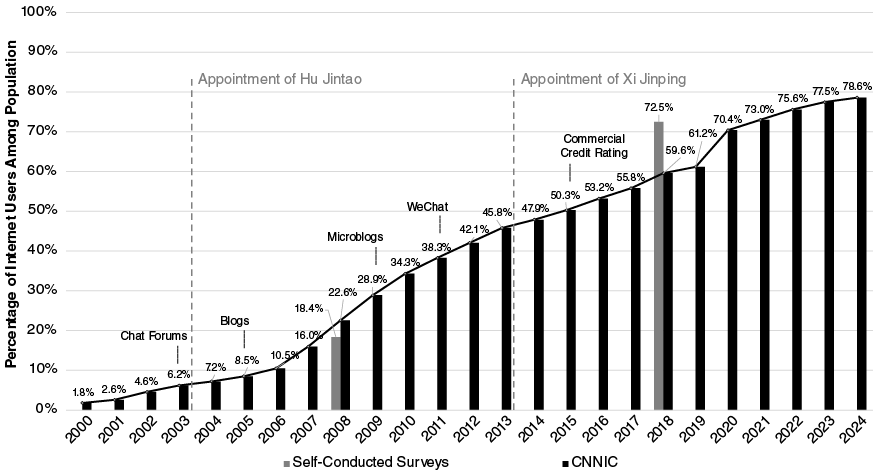
Figure 1.1 highlights when our surveys were conducted in relation to the development of new types of platforms during Hu Jintao and Xi Jinping’s leaderships. The black bars illustrate official data about the percentage of internet users from CNNIC. The survey data we use in this book is indicated in gray bars. Chat forums, blogs, and microblogs were copycats from American counterparts, while WeChat and Commercial Credit Rating represent new type of platforms. To better understand these participatory digital spaces we focus on in this book, we conducted semi-structured interviews with twenty experts in 2015; these were academics and product managers of social media companies, including Tencent, Sina, and Baidu. In 2022 we also had background conversations with three former and current employees of Alibaba. These interviews were invaluable to understand the company side of the equation.
Percentage of internet users and the emergence of new types of platforms during the tenures of Hu Jintao and Xi Jinping.

Figure 1.1 Long description
The y-axis represents the percentage of internet users while the x-axis represents the respective years, from 2000 to 2022. The chart also highlights important moments in time for the development of the internet in China. Important moments in time are, in chronological order: the emergence of chat forums around 2003, the appointment of Hu Jintao as president in 2003, the emergence of blogs in 2005, the emergence of microblogs in 2009, the founding on WeChat in 2011, the appointment of Xi Jinping as president in 2012, and the initiation of commercial social credit ratings in 2015.
Critics of surveys conducted in nondemocracies argue that face-to-face surveys do not produce reliable results about political expression, because people living under authoritarian rule have incentives to hide their true beliefs. Political sensitivity is, of course, a concern for anyone studying Chinese politics, but there are three reasons to be confident that this bias is not driving the results of the research findings presented here.
First, we started with qualitative interviews in which it is possible to build more trust and presumably obtain more truthful answers. Taking an inductive approach, we conducted semi-structured qualitative interviews with ninety-two users in 2015 and 2016, varying in terms of gender, education, age, and region. In our semi-structured interviews, we asked users how they used social media to communicate with each other or share information about politics. Based on these interviews, we developed survey questions which were pretested several times before finalizing the survey questionnaire.
Second, while social desirability bias is obviously an important concern that must be addressed in surveys in China and other authoritarian contexts, we are confident that this bias does not significantly distort the results presented here. Survey research in China detects response bias for some but not all politically sensitive questions. For example, King et al.’s (Reference King, Murray, Salomon and Ajay2004) study of political efficacy in China reveals large bias when using vignettes, and list experiments reveal evidence for response bias regarding questions on political trust (Tang Reference Tang2016; Robinson and Tannenberg Reference Robinson and Tannenberg2019).Footnote 31 But such bias does not appear to be driven by political fear (X. Lei and Lu Reference Lei and Lu2017; Stockmann, Esarey, and Zhang Reference Stockmann, Esarey and Zhang2018). Based on a careful examination of survey data conducted under similar circumstances as the surveys used in this book, Ren (Reference Ren2009) found that Chinese who are concerned about political sensitivity tend to choose the nonresponse category rather than reporting biased responses. In both surveys, the number of respondents excluded from statistical analysis due to nonresponse is very small, strongly reducing the likelihood that the research findings would change if all respondents had reported their true opinions. To make sure that respondents felt comfortable answering survey questions, we have conducted extensive qualitative interviews and pretests to phrase questions in nonsensitive ways (see online appendix for details). We are therefore confident that response bias due to political sensitivity does not strongly obstruct our findings.
Finally, if it was true that most respondents do not report their true opinions, modify their responses, and opt for nonresponses, we would expect that respondents underreport their engagement in political talk. However, our findings contradict this expectation. We discover that respondents self-report active participation in political discourse. These results are counterintuitive and do not support the valid concern that most respondents report opinions that they believe are politically desirable within the Chinese political system.
Overall, this book provides needed information about the perspective of citizens on online participatory spaces in China. While we cannot fully overcome challenges posed by reduced opportunities for outside observers to conduct fieldwork in China, we provide important facts that observers of China, including policy-makers, journalists, and academics, have so far been speculating about, often resulting in incorrect assumptions. Careful process-tracing provides insights into causal mechanisms and strengthens arguments about the direction of relationships (see, for example, Beach Reference Beach2016). The logic of popular corporatism unravels as we trace the interaction between the state, platform firms, and citizens during the leaderships of Hu and Xi.
Overview of Chapters
To give us a foundation for our inquiry, this book opens with an explanation of the analytical framework that ties the state, companies, and citizens together. We first present what we call the command-and-control structure whereby platform firms are intermediaries that follow and implement the policies of the state. We then present the popular corporatism structure, which emphasizes the important role of platform firms. According to this alternative framework, large profit-driven platform firms have bargaining power against the state. That implies they not only refuse to comply or act without being authorized by the state but also wield influence over the design and implementation of policies. The source of such business power stems from data that is voluntarily produced by citizens, thus providing users with a certain degree of influence over governance outcomes. We then lay out why popular corporatism has more positive implications for regime support compared to command and control, thus addressing the digital dilemma outlined earlier. As will be shown in the remainder of the book, China has transitioned from command-and-control to popular corporatism during the leaderships of Hu Jintao and Xi Jinping. However, both forms are still present and vary across region and types of platforms.
Chapters 3, 4, and 5 focus on social media platforms. Chapter 3 examines the relationship between the state and platform firms over two consecutive leaderships. Even under the more tightly controlled rule of Xi Jinping, Chinese state authorities were dependent on Sina and Tencent who became consultants and insiders. Relying on procurement data we elaborate on the state’s reasoning to rely on Tencent and Sina as the only corporations that have the expertise and resources to provide key services to the state when managing online public opinion.
Chapter 4 engages with co-production of data on political information on social media. We examine who produces political content and who creates meta data as a byproduct of their lurking activity on social media. To develop profiles of discussants and lurkers, we investigate privacy concerns and motivations. We find that Chinese users have similar motivations as users in nonauthoritarian contexts and contribute to data production despite privacy concerns. We then assess to what extent citizens are offered choices by examining the role of the Great Chinese Firewall and comparing different platforms. We find that only about 12 percent of internet users jump the Great Chinese Firewall to seek political information. We also compare the three most popular platforms regarding technological design and show that Weibo and Baidu Tieba facilitate more production of political content compared to WeChat.
Chapter 5 explores implications of data production on citizens’ support for the regime. We reveal the wide range of experiences that citizens across China have regarding the management of online political discourse. The extent to which people see political discourse as open and diverse varies greatly among internet users. We find that positive experiences strengthen popular support for the regime. When users perceive the online discourse as more open and more diverse, they express greater trust in the central government. We probe these findings across different types of content, platforms, and over time.
Chapters 6, 7, and 8 turn to the SCS as an important digital innovation. Chapter 6 explores the relationship between government and companies in developing commercial credit ratings targeting citizens. Procurement notices reveal a dependency of the Chinese state on Alibaba for development of technological infrastructure, particularly in information architecture such as cloud computing and software systems incorporating artificial intelligence. We then explain the origins of social credit rating of individual citizens and differentiate between local government credit ratings and commercial credit ratings. We find that Alibaba developed financial credit rating as early as 2008 before the central government announced plans for an SCS in 2014. Tech companies offered solutions to policy problems and played a crucial role in their execution of the financial part of the SCS under the leadership of the People’s Bank of China. The Chinese state developed commercial credit ratings in partnership with platform firms like Alibaba and Tencent and significantly leveraged on these platform firms’ expertise and resources. They resisted state requests for centralized data-sharing and received more lenient treatment compared to other companies.
Chapter 7 turns to citizens’ provision of data to develop Alibaba and Tencent’s commercial credit ratings as the most popular. We start by laying out these platforms’ regional variation and find that surprisingly less developed provinces are taking the lead in their development. We then investigate privacy and financial motivation as possible explanations. We find that financial motivations override privacy concerns, enabling people to overcome socioeconomic inequality in applying for loans through traditional banking, a situation that persisted during the Hu era. We also detect that people living in communities that are more integrated into Alibaba’s e-financial services are almost certain to be data producers on commercial credit-rating platforms. We argue that bundling with e-commerce platforms leads people to associate commercial credit rating as a financial rather than political tool.
Chapter 8 investigates trust in the central government with respect to implementing the SCS. As such, this chapter complements Chapter 5, which focused on general political trust, by focusing on support for a specific digital policy. This focus also allows us to tap into how citizens evaluate the state–company relationship with respect to the SCS. We find that citizens are highly supportive of state compared to company involvement. The remaining chapter explores potential explanations. We find that media exposure, social interaction, and potential network effects play important roles. However, high levels of state support can only be fully understood once taking into account how people experience policy implementation on the ground. Since people experience the SCS as a financial rather than political tool, the state–business partnership is seen as promoting economic growth rather than political oppression. Paradoxically, Alibaba’s partnership with the state strengthens issue-specific trust in the state.
Chapter 9 concludes with a discussion of how China’s model of digital governance applies to China after Covid and after the anti-trust campaign. We identify areas of future research on digital governance in China and discuss China’s potential to function as a role model for other states as the world is currently undergoing a trend toward digital authoritarianism. Since the logic of popular corporatism is not unique to China, we discuss implications for understanding the role of Chinese, Russian, and US-based technology companies in authoritarian contexts. We close the book with an eye on liberal democracy where policy-makers are inventing new ways to address the digital dilemma. We highlight one key lesson for liberal democracy that can be learned from China’s digital governance.
While writing this book, we noticed a growing demand from policy-makers and journalists for information about how to deal with China’s rapid digital transformation and its greater impact in the world. When one of the authors had the honor of joining German President Steinmeier’s 2018 trip to China, conversations with German journalists and policy-makers circled around this question. The first Trump administration accelerated this trend when the Chinese telecom giant Huawei became a centerpiece in the escalating trade dispute between the US and China.Footnote 32 Conversations about how to deal with China’s increasing digital presence abroad have been a recurring topic since. Following India’s ban of TikTok in 2020, the US Congress voted in 2024 in favor a divestment bill that could lead to the ban of TikTok due to concerns about the Chinese government’s possible access to data.Footnote 33 These conversations are going to become more salient as China’s digital economy continues to grow. In this debate, many observers have offered opinions, but few have offered empirical evidence of how China’s digital governance operates. This book aims to contribute to these public discussions as well as policy debates by providing new, empirically tested perspectives on digital governance in China and beyond.