

Introduction
Governments in a considerable number of Organisation for Economic Co-operation and Development (OECD) countries are either raising or considering raising the public pension age (Boulhol et al. Reference Boulhol, Lis, Queisser, Bloom, Sousa-Poza and Sunde2023; OECD 2021). Automatic adjustment mechanisms, such as linking the public pension age to increases in average life expectancy, are seen as effective measures to address the challenges posed by an ageing population. Raising the public pension age not only alters the financial incentives for early retirement but also gradually reshapes societal norms regarding the appropriate retirement age (Riekhoff Reference Riekhoff2024).
A notable aspect of current pension reforms is their one-size-fits-all approach, which gives only limited consideration to the diversity among older workers and their ability to work longer. For instance, while life expectancy may rise on average, the rate of increase might not be uniform across different socio-economic categories. Krekula and Vickerstaff (Reference Krekula, Vickerstaff, Nıleime, Ogg, Rasticova, Street, Krekula, Bediova and Madero-Cabib2020) argue that policy makers tend to homogenize older workers as a single, undifferentiated group, overlooking the significant disparities that exist between various socio-economic strata. By treating a ‘privileged life course’ (p. 31) as the standard, these types of pension reform downplay the fact that ‘wear and tear’ generated by physically demanding occupations may differ across the population, despite improvements in work safety.
Raising the public pension age abruptly and substantially is not without its challenges. Both the Italian pension reform of 2011 (Serrano‐Alarcón et al. Reference Serrano‐Alarcón, Ardito, Leombruni, Kentikelenis, d’Errico, Odone, Costa and Stuckler2023) and the Dutch pension reform of 2012 (Van Dalen et al. Reference Van Dalen, Henkens and Oude Mulders2019) show that such measures can be effective in an administrative sense, but may also have negative side effects that become apparent in increasing health deterioration, as not everyone is equally capable of extending their working life in a productive and sustainable manner. Older workers vary significantly in their capacity to extend their working lives, particularly those in physically demanding jobs. These workers may have legitimate concerns about increasing public pension ages, as the likelihood of reaching retirement in good health decreases when they are compelled to work for additional years (Vanajan Reference Vanajan2022). Employers may also be worried about increasing the public pension age, as they expect that their employees may become less productive when the retirement age is set too high (Van Dalen et al. Reference Van Dalen, Henkens and Oude Mulders2019). Vermeer et al. (Reference Vermeer, Mastrogiacomo and Van Soest2016) and Joulain et al. (Reference Joulain, Mullet, Lecomte and Prèavost2000) show that there is some support for lower retirement ages for demanding occupations.
However, establishing specific public pension ages that account for the physical demands of various jobs presents a major challenge. Governments must make the case that conventional policy measures and initiatives cannot correct the fact that workers in physically demanding jobs face lower (healthy) life expectancy. What these early retirement programmes for physically demanding jobs offer is a possibility to enjoy retirement at an earlier date to compensate for the risks of their job. But should these health risks not be internalized in work practices within the firm and/or included in the price of products or services? And should policy makers be wary of not only the intended consequences of special retirement programmes for specific jobs but also the unintended consequences? As Zaidi and Whitehouse (Reference Zaidi and Whitehouse2009) noted, the risks of demanding or arduous jobs can also be dealt with by well-targeted conventional social policies (disability and unemployment programmes) instead of special pension programmes that apparently owe ‘more to institutional resistance to change than their usefulness’ (p. 4). The difficulty in designing these special retirement programmes in practice is that it remains difficult to prove the health impact of specific work characteristics as a reliable input for determining retirement ages for different occupations. Judgements must be made about the work capacity of older workers. This capacity depends partly on the level of physical demands of the occupation of workers as well as their health status. The latter element may relate to individual lifestyle and/or health choices of employees as well as the working conditions offered by employers. This distinction between job-related and individual factors is a fundamental empirical puzzle, yielding so far different answers (compare with Ravesteijn et al. Reference Ravesteijn, van Kippersluis and van Doorslaer2018). Based on the current state of knowledge and country experiences in determining retirement ages for different occupations, the OECD (2023) has come to the conclusion that selecting job characteristics for the scope of these retirement programmes is not uncontroversial. Not only are the health and mortality impacts of work conditions difficult to prove but covering ‘a specific condition is strongly influenced by what is perceived as fair’ (OECD 2023, p. 122). Whether fairness plays such a large role in practice is an open question and one that we will deal with in this article. We will specifically pose two questions: What is a fair or reasonable retirement age for those working in physically demanding jobs? And what can be ascribed to the responsibility of the individual and what to the character of work (and hence also to the responsibility of the employer)? We present a study on the question of whether workers in different occupations – ranging from highly to less physically demanding jobs – should in the eyes of the general public be entitled to a lower pension age than the standard public pension age and get the full benefit or be required to work to a higher age to get the full benefit, respectively. In other words, we study whether and to what extent people support a redistribution of pension rights based on the level of physical demand involved in various jobs, from low to high. It is important to also be aware that people may let their judgement be clouded by age stereotypes; hence, we will also account for the possibility of age stereotypes impacting their judgements.
This study contributes to the literature in three ways. First, we study how age norms about a reasonable retirement age can differ, offering an alternative perspective to the one-size-fits-all approach in public pension policies. It is well known that informal age norms, defined as shared judgements or expectations about an appropriate retirement age, can have a significant impact on the behaviour of employees and managers within organizations, as well as the general age norms prevailing in society (Karpinska et al. Reference Karpinska, Henkens and Schippers2013; Settersten and Hagestad Reference Settersten and Hagestad1996). We examine whether there is an asymmetry in assessing retirement ages differentiated by occupations and how large possible differences are. Are physically demanding occupations more likely to receive support for a lower retirement age compared to less demanding occupations? And are those working in less physically demanding occupations expected to work longer than the standard public pension age? In case of small differences in early retirement ages, it is possible to detect a sign that special programmes for specific occupations may no longer be tenable in the eyes of the general public.
Second, we consider both work-related and non-work-related factors in our models when examining the precursors of different public pension age norms. We frame the concept of a ‘reasonable or fair retirement age’ in a context that offers a wide variety of occupations and separate it from other factors such as the health status of the older worker in question and their involvement in informal care-giving, which may impact their working conditions (Oldenkamp et al. Reference Oldenkamp, Bültmann, Wittek, Stolk, Hagedoorn and Smidt2018).
Third, people’s dispositions towards older workers can affect their judgements about retirement age norms. Widespread stereotypical views about the quality of older workers are not always positive and can translate into discriminatory practices and attitudes (Ng and Feldman Reference Ng and Feldman2008). These negative stereotypes may fuel support for lower public pension ages for older workers (Oude Mulders Reference Oude Mulders2020).
The case of the Netherlands is of particular interest as the public pension age was planned to be gradually raised by discretionary steps from 65 to 67 over the years 2013-2023 and from that time onwards the pension age would be automatically linked to the average life expectancy at age 65: a one year increase in life expectancy would lead to a one year higher pension age. And a lower life expectancy at age 65 would not lead to a lower public pension age, and the pension age would remain fixed at the latest change. However, various changes of plans have led to a stop-go process in the raising of the public pension age. In 2015 the public pension age was increased faster than initially planned to generate lower budget deficits. Public pressure mounted and in 2019 this plan was revoked and it was also agreed to make the life expectancy linkage less strong by a factor 2/3: a one-year increase in the average life expectancy at age 65 leads to an eight-month-higher public pension age.
Policy dilemmas in offering specific pensions for physically demanding jobs
A recent OECD (2023) overview of special pension provisions for those working in arduous or hazardous jobs distinguished four categories: (1) 15 countries (Austria, Belgium, Chile, Columbia, Estonia, Finland, France, Greece, Italy, Norway, Poland, Slovak Republic, Slovenia, Spain and Türkiye) offering pension provisions for a large number of jobs; (2) eight countries (Czechia, Germany, Hungary, Japan, South Korea, Latvia, New Zealand and Portugal) providing early retirement options based on hazardousness or arduousness for a limited number of jobs; (3) four countries (Canada, Ireland, Israel and the US) offering special pension provisions for public safety and security jobs that are considered hazardous (police, military and firefighters); and (4) 11 countries (Australia, Costa Rica, Denmark, Iceland, Lithuania, Luxembourg, Mexico, the Netherlands, Sweden, Switzerland and the UK) that do not provide any early retirement options for hazardous or arduous jobs within mandatory pension systems. Some countries have special arrangements at the level of sector of industry, but not as part of the public pension system. For example, in the Netherlands there are collective wage agreements for specific sectors, like the building industry, that allow employees to retire at most three years earlier than the public pension age. This option is financed out of a special sectoral fund.
The debate about offering special retirement programmes for physically demanding jobs is complex. Governments and firms struggle with moral issues as well as practical considerations in striking a balance in offering such programmes, and a considerable number of countries have so far refrained from making special pension arrangements in light of the immanent pros and cons. Complex judgements have to be made in defining such jobs and granting rights at the firm or sectoral level; such decisions involve not only rules from the past and the economic structure of the economy but also moral and ethical considerations. It is often hard to determine whether health deterioration or declining work capacity is an individual responsibility or a responsibility of the employer. Workers in physically demanding jobs tend to have poorer health and lower life expectancy, but attributing this fully to the demanding or arduous nature of work is difficult. Empirical research shows that factors like income, education and lifestyle play a large role in driving health outcomes and not so much the hazardous nature of jobs (Runge et al. Reference Runge, van Zon, Bültmann and Henkens2021). A different line of thought in pension policy design in dealing with occupation-specific ageing is to offer fair pension policy by focusing not only on early retirement but also on later retirement and equalizing lifetime contribution:benefit ratios. Grossmann et al. (Reference Grossmann, Schünemann and Strulik2024) show how changing the incentives, that is, equalizing pension benefits and contributions over the lifetime for groups of blue-collar and white-collar workers, can bring about the situation where blue-collar workers can retire earlier than the standard retirement age and white-collar workers at a later date. In short, it helps to focus on the pension reform problem in a symmetrical way, whereas it is common practice in policy discussions to focus solely on early retirement routes as the ‘fair’ way out, and not delayed retirement.
The viewpoint of not offering early retirement options for specific jobs is often based on the belief that work conditions should be such that these special arrangements should not be necessary. Instead, policies should focus on regulation towards prevention of injury, ill-health or stress arising from work (Zaidi and Whitehouse Reference Zaidi and Whitehouse2009). This stance is also made quite explicit in the policy proposals of the OECD, which include ‘health and safety regulations to limit risks, informing about the remaining risks; lifelong learning and reskilling to allow for job mobility into healthier jobs; and disability insurance’ (OECD 2023, p. 96). In short, in an ideal world an early retirement programme covering the risks of a demanding job should not be necessary and in specific cases or circumstances should be covered by disability insurance. And even if there is a preference to differentiate retirement ages, consideration should be given to the possible unintended consequences of offering such special retirement programmes. Vandenberghe (Reference Vandenberghe2021) has assessed what the retirement age would be for a set of European countries if they were to differentiate the retirement age to compensate for health differences between occupations (compare with Deeg et al. Reference Deeg, De Tavernier and De Breij2021). He shows that the high degree of differentiation of retirement ages needed to equalize expected health at the moment of retirement can have serious unintended consequences. Such an ex ante equalization policy fails to match a significant portion of the full distribution of health statuses. Hence, it can lead to the ex post situation of there being no retirement for people in poor health, as well as to people in good health going for early retirement (see also Zwick et al. Reference Zwick, Bruns, Geyer and Lorenz2022 on this point).
The presence of early retirement programmes for specific jobs is often a remnant of past decisions to deal with the negative side effects of demanding jobs. Firms and sometimes governments will invoke specific arrangements to soften the decline in work capacity and income at higher ages for specific jobs, also in response to increases in the public pension age. A study among Dutch employers revealed that 82 per cent were in favour of early retirement programmes for physically demanding jobs (Van Dalen et al. Reference Van Dalen, Henkens and Oude Mulders2019).
The current societal call for early retirement options for workers in demanding jobs is also made more pressing by a changing demographic context in which these workers are more likely to encounter double responsibilities in the form of informal care in pre-retirement years. Depending on prevailing traditions about care for (grand)parents or the limits of (formal) health-care systems, informal care responsibilities may become more prominent and visible. Current insights reveal that informal care responsibilities are mainly carried out by socio-economically disadvantaged groups within Europe. Few pension systems allow for pension rights based on informal care work, but quite a number of countries offer paid leave. This suggests that employers do recognize the importance of offering a sustainable work–life balance, although entitlements vary starkly across countries in terms of duration, eligibility criteria and generosity of compensation (Rocard and Llena-Nozal Reference Rocard and Llena-Nozal2022, p. 47).
Theoretical background
Deviating from the public pension age norm
Norms are inherently social and constructed from individual conceptions. Individuals have their own ideas of how things should or should not be, or when specific life events, like marriage, leaving home and retirement, should occur in a person’s lifecourse. When these individual ideas are aggregated across groups of individuals, they form social norms, with social sanctions tied to deviations from the norm (Radl Reference Radl2012; Riekhoff Reference Riekhoff2024; Settersten and Hagestad Reference Settersten and Hagestad1996). Retirement age norms reflect individual experiences and personal values about when it is appropriate to retire; they are influenced by observed attitudes and behaviours in people’s social networks but also by established rules and regulations in the pension system (Radl Reference Radl2012; Van Erp et al. Reference Van Erp, Vermeer and van Vuuren2014). Either retirement age norms can specify a standard age at which workers are expected to retire, or such norms can be expressed as a range with lower and upper age limits for retirement (Liefbroer and Billari Reference Liefbroer and Billari2010). Radl (Reference Radl2012) and Riekhoff (Reference Riekhoff2024) analysed the average retirement age norms in 14 European countries using the European Social Survey. Retirement age norms for men were relatively close to, and in some countries even higher than, the public pension age. For women, retirement age norms were considerably lower, and in no country did they exceed the age of 65. Over time, retirement age norms are on the rise. Many developed countries, especially in Europe, used to have a strong ‘early exit culture’, where it was common and widely accepted for individuals to retire well before the public pension age. It was common for older workers to retire early to create job opportunities for younger workers (Hofäcker and Unt Reference Hofäcker and Unt2013). With the elimination of early retirement options and the closure of exit routes to early retirement, the norm with respect to the age at which older workers should retire seems to have increased in many countries. Special early retirement arrangements for workers in physically demanding or hazardous jobs reflect different societal norms for the retirement of older workers in these jobs. Following pension reforms in OECD countries, the special schemes for workers in demanding or arduous jobs have been reduced considerably in scope (OECD 2023). Pension rules have also become more uniform with the objective to increase risk-sharing and provide a fairer treatment of all workers. In such an environment it has become harder to justify special rules for demanding jobs.
In this study, we argue that these retirement age norms may depend on both work-related and non-work-related factors, like chronic health conditions and informal care responsibilities. Empirical studies often find strong correlations between the physically demanding nature of a job and a worker’s health and mortality. The implicit assumption is that the job or profession is the primary cause of health issues. However, causality can also run in the opposite direction, as individuals with specific health issues may end up in specific occupations. Ravesteijn et al. (Reference Ravesteijn, van Kippersluis and van Doorslaer2018) demonstrated that, for a sample of German employees tracked over 29 years, 60 per cent of the association between health and occupation could be attributed to selection effects. In other words, a decline in health cannot always be attributed solely to a person’s profession, and separating the effects of occupation and health may be important. With respect to non-work-related factors we also take account of the robust empirical evidence that shows that the prevalence of chronic health conditions limiting work ability increases with age (Hilderink et al. Reference Hilderink, Plasmans, Poos, Eysink and Gijsen2020). As labour participation rates rise across the population, the prevalence of chronic health conditions in the workplace is also likely to increase, affecting older workers and organizations, besides the impact of the physical demands of the jobs (Boot et al. Reference Boot, Deeg, Abma, Rijs, van der Pas, van Tilburg and van der Beek2014; Vanajan Reference Vanajan2022).
In addition to occupational and health effects, other factors may play a role in determining norms about public pension ages. Extending the working life may also depend on the duration (working hours, career length) of exposure to physical and mental working conditions. Cumulative exposure to adverse working conditions is an important source of health disparities (Fletcher et al. Reference Fletcher, Sindelar and Yamaguchi2011). Given that the effects of physical and mental work demands may accumulate over time, we assume that the age at which people started their working life as well as the number of working hours – full-time or part-time – will affect norms about the public pension age. We hypothesize that norms regarding an appropriate public pension age will be lower for workers in physically demanding jobs, workers with chronic health conditions and those with long and full-time working careers.
Furthermore, informal care responsibilities are elements that may weigh heavily on older workers as they approach their retirement age. Recent research shows that combining paid work with care-giving obligations to close relatives can be highly burdensome for older workers (Grünwald et al. Reference Grünwald, Damman and Henkens2021) or can have substantial implications for income or wages, in particular for female care providers who keep on working (Van Houtven et al. Reference Van Houtven, Coe and Skira2013). Difficulties in balancing work and care-giving may arise because care-givers need to allocate their personal resources, such as time, physical energy and psychological energy, between work and care-giving (Voydanoff Reference Voydanoff2004). Current working care-givers face dual pressures: the expectation to participate in paid labour until much older ages than previous generations and societal norms to provide informal care to family members as well as diminished expectations of publicly financed care. People should expect fewer services from the government but engage more as informal care-givers in their social networks. We hypothesize that the demands of informal care by working care-givers will be perceived in addition to the physical demands of their regular job and hence the general view will be that (working) informal care-givers should have a lower public pension age than non-care-givers.
Age, productivity and stereotypical views
In macro-level studies there seems to be consensus that an ageing population is associated with a negative effect on labour productivity (Feyrer Reference Feyrer2008; Tang and MacLeod Reference Tang and MacLeod2006). At the firm level, most results indicate that an ageing workforce does not need to inhibit firm productivity, and that age diversity in the workforce or in teams plays an important role in counteracting productivity decline (Backes-Gellner and Veen Reference Backes-Gellner and Veen2013; Börsch-Supan et al. Reference Börsch-Supan, Hunkler and Weiss2021; De Meulenaere et al. Reference De Meulenaere, Boone and Buyl2016). At the individual level, findings on the relationship between age and productivity are mixed. Ng and Feldman (Reference Ng and Feldman2008) evaluated the relationship between age and ten dimensions of job performance based on 380 empirical studies. They found that age was unrelated to core task performance, creativity and performance in training programmes, but that there were positive correlations with a range of pro-social types of behaviour in the workplace. The literature shows that the relationship between age and productivity is difficult to establish on the basis of empirical data. For instance, productivity assessments are often based on perceptions that might by biased by ageist attitudes, that is, a stereotypical and often negative bias against older adults. Extensive evidence suggests that stereotypical views of older workers are widespread (Henkens Reference Henkens2005; Oude Mulders Reference Oude Mulders2020; Taylor and Walker Reference Taylor and Walker1994). Van Dalen et al. (Reference Vanajan2010) showed that employers’ attitudes towards older workers reflect two dimensions: hard and soft skills. Soft skills encompass qualities that can be characterized as ‘organizational citizenship behaviour’, that is, pro-social behaviour that is not job-specific but supports the broader organizational environment in which jobs are performed (Ng and Feldman Reference Ng and Feldman2008; Van Dalen et al. Reference Vanajan2010). In contrast, hard skills encompass mental and physical capacity, willingness to learn new skills and adapt to new technologies, and flexibility. The impacts of stereotypical beliefs on employer policies are mixed. For example, Oude Mulders (Reference Oude Mulders2020) found that when Dutch employers were more positive about older workers’ soft qualities, they favoured older workers relatively more for hiring and offering training than those lacking those soft qualities. This study did not find similar associations for the hard skills. Jensen et al. (Reference Jensen, De Tavernier and Nielsen2024) found no relationship between employers’ age-related stereotypes and their preferences for retaining or recruiting older workers in Denmark. Van Dalen et al. (Reference Vanajan2010) found that age stereotypes held by employers and employees are remarkably similar. Both employers and employees share most of the prevailing stereotypical views, though employers rate the productivity of older workers generally lower than that of younger employees. Norms regarding the appropriate retirement age may be strongly influenced by beliefs about the capabilities of older workers in general. We posit the hypothesis that those who hold less positive stereotypical views about the productivity of older workers are more supportive of lower public pension ages in general and even more so for workers in physically demanding jobs.
Method and data
Survey
To answers our research questions, we combine survey research and a vignette study. The survey was conducted to gather information about stereotypical views regarding older workers, whereas the vignettes were created to assess which public pension age people would consider reasonable in specific situations. The survey was conducted using the LISS panel (Longitudinal Internet studies for the Social Sciences) in November 2018. The LISS panel is based on a representative sample of the Dutch population who are interviewed weekly on a wide range of topics. The panel is based on a true probability sample of households, drawn from the population register by Statistics Netherlands. It consists of 5,000 households, comprising approximately 7,500 individuals of 16 years and older. Self-registration is not possible; participation is invite-based only and participants are paid for their time in answering questions. Participants without access to the internet are provided with the necessary equipment to ensure coverage of the population that does not have internet access. This distinguishes the LISS panel from other online panels where panel members often can register themselves and where non-internet users are absent. For this study we randomly selected 2,714 panel members above the age of 16 and invited them to participate in our survey; 2,136 of them took part, resulting in a participation rate of 79 per cent. The LISS panel provides us with background characteristics of the respondents such as age and education. The average age of the respondents is 52.7 years (SD = 17.8). Distributions by age, gender and education are presented in Table 1. No selective non-response was detected based on education, gender and urbanization. Younger respondents were slightly less likely to participate in the study.
Descriptive statistics of respondents’ characteristics

(a) Notes: Hard skills were based on a five-point scale for the following separate skills for employees of 60 years and older: flexibility, willingness to train and physical capacity, resistance to stress, and new technology skills. Answer categories were 1 = not applicable, 2 = applicable to a limited extent, 3 = somewhat applicable, 4 = applicable and 5 = highly applicable.
(b) Soft skills were based on a five-point scale for the following separate skills for employees of 60 years and older: social skills, management skills, loyalty and reliability. Answer categories were 1 = not applicable, 2 = applicable to a limited extent, 3 = somewhat applicable, 4 = applicable and 5 = highly applicable.
SD: standard deviation.
Vignette design
A vignette experiment was designed to be combined with survey questions This type of experimental method is particularly well-suited for exploring the underlying structure of human judgements in social contexts (Wallander Reference Wallander2009). The typical procedure in vignette experiments involves presenting participants with a description containing information about a situation, followed by soliciting their judgements or their choice. Vignette studies, also known as conjoint analyses, are extensively utilized in the social sciences (Kapteyn et al. Reference Kapteyn, Smith and Van Soest2007; Rouvroye et al. Reference Rouvroye, van Dalen, Henkens and Schippers2024; Van Dalen and Henkens Reference Van Dalen and Henkens2018) because of the ease with which researchers can elicit preferences that depend on the various dimensions of a situation, or in our case an older worker. Values for vignette factors are randomized to ensure that each combination of values is equally likely. Vignette dimensions are orthogonal, allowing for the separation of variables that are often correlated in practice, thus avoiding multi-collinearity (Di Stasio Reference Di Stasio2013). It is common to request participants to rate multiple vignettes to enhance the reliability of estimates and facilitate the assessment of both between-subject and within-subject effects (Wallander Reference Wallander2009).
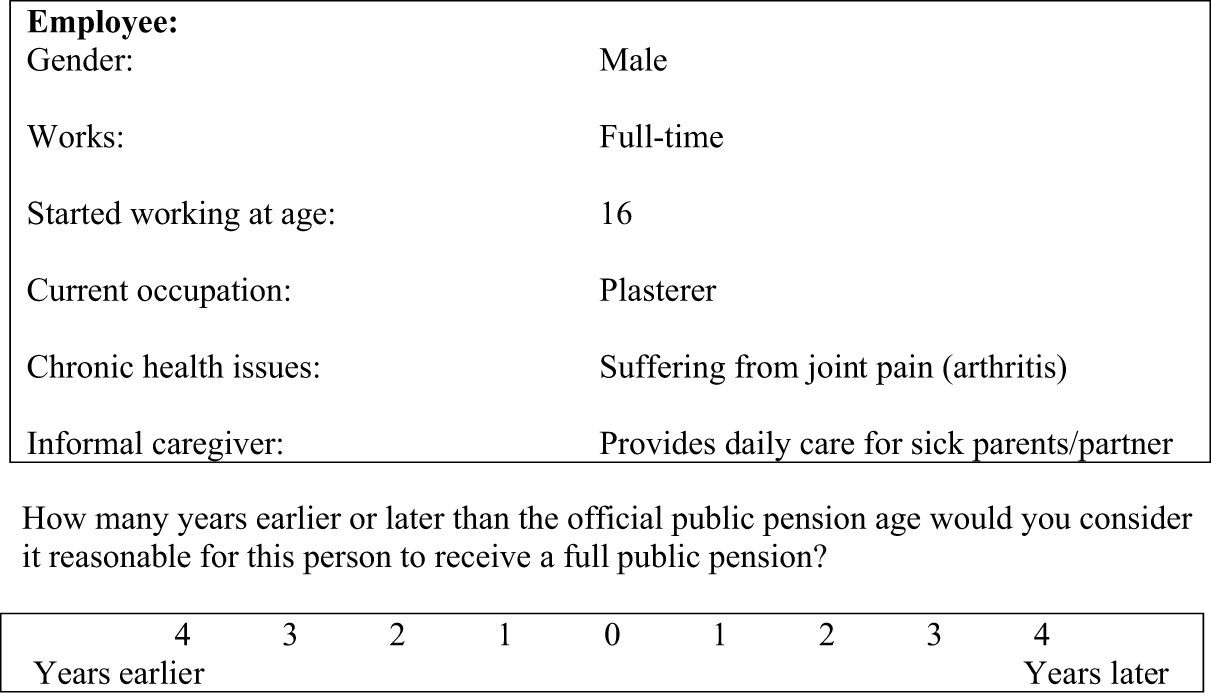
Respondents in our survey were asked to evaluate what they considered to be a reasonable public pension age for individual workers with different characteristics. Each respondent was shown five profiles of fictional 60-year-old workers, each with specific attributes relevant to the discussion of demanding occupational regulations. After viewing a profile, respondents were asked: ‘How many years earlier or later than the standard public pension age do you believe it is reasonable for this person to receive a full state pension?’ Respondents could choose from nine answer options, ranging from four years earlier than the standard public pension age, to four years later. Hence this set-up offers a test of fairness that is framed in symmetrical manner in line with the study of Grossmann et al. (Reference Grossmann, Schünemann and Strulik2024). We included 29 different professions to detect whether the level of physical demand ordered by profession generates different public pension ages. The selection of professions was based on a study by Ravesteijn et al. (Reference Ravesteijn, van Kippersluis and van Doorslaer2018) who examined the relationship between health and physically demanding occupations for 307 professions, resulting in a balanced group of professions categorized as having heavy, medium and light physical demands. An example of a physically heavy occupation is a concrete worker in the building industry. An example of a physically light occupation is a government policy advisor, and an example of a medium heavy occupation is a primary school teacher. The other characteristics used in the vignette descriptions include gender, part-time or full-time employment, the age at which individuals started working, the provision of informal care to sick or disabled parents or partners, and the presence of one of the following chronic health conditions: (1) arthritis, (2) cardiovascular disease, (3) psychological disorders, or (4) diabetes. An example of a vignette is presented in Figure 1.
Example of a vignette used in the study.

Given all possible combinations of the variables and their respective categories, a set of 4,640 unique vignettes was created (i.e. 2 x 2 x 4 x 29 x 5 x 2). These vignettes were randomly allocated among the respondents. None of the vignettes contained an impossible combination of the factors. Each respondent was asked to rate five vignettes in order to prevent cognitive overload and fatigue effects in making the evaluations (Sauer et al. Reference Sauer, Auspurg, Hinz and Liebig2011). A total of 2,136 respondents rated 10,297 vignettes. Each vignette contained one specific profession out of a total of 29 professions. We chose a variety of light, medium and highly physically demanding occupations based on the aforementioned analysis of Ravesteijn et al. (Reference Ravesteijn, van Kippersluis and van Doorslaer2018). To make it manageable for a vignette study, we restricted to a limited number (29) in order to collect a substantial number of observations for each individual occupation. Table 2 provides a statistical descriptive overview of all the relevant variables used within the vignettes.
Frequency distribution of the characteristics of the older worker that appear in the vignettes as evaluated by respondents

Notes: The percentages in this table represent the frequency with which the characteristics randomly appear in the vignettes. Hence, in the case of gender, men and women are equally represented in the vignettes; and, for example, with respect to chronic health conditions, 50 per cent of the vignette descriptions contain no chronic health conditions, arthritis and cardiovascular disease each appear in 13 per cent of the vignettes and psychological disorders and diabetes each appear in 12 per cent.
In the vignettes, real jobs titles are shown based on estimated categorization reported in the appendix of Ravesteijn et al. (Reference Ravesteijn, van Kippersluis and van Doorslaer2018). For completeness we list them here per category: (1) ‘heavy’ physically demanding jobs are street paver, construction worker, plasterer, fireman/woman, plumber, carpenter, painter, nurse, baker, cook; (2) ‘medium’ physically demanding jobs are policeman/woman, train driver, electronic technician, primary school teacher, cashier, laboratory technician, piano tuner, librarian, computer technician; and (3) ‘light’ physically demanding jobs are accountant, dentist, professor, journalist, interpreter/translator, lawyer, broker, government policy advisor, architect, judge.
Measuring stereotypes about older workers
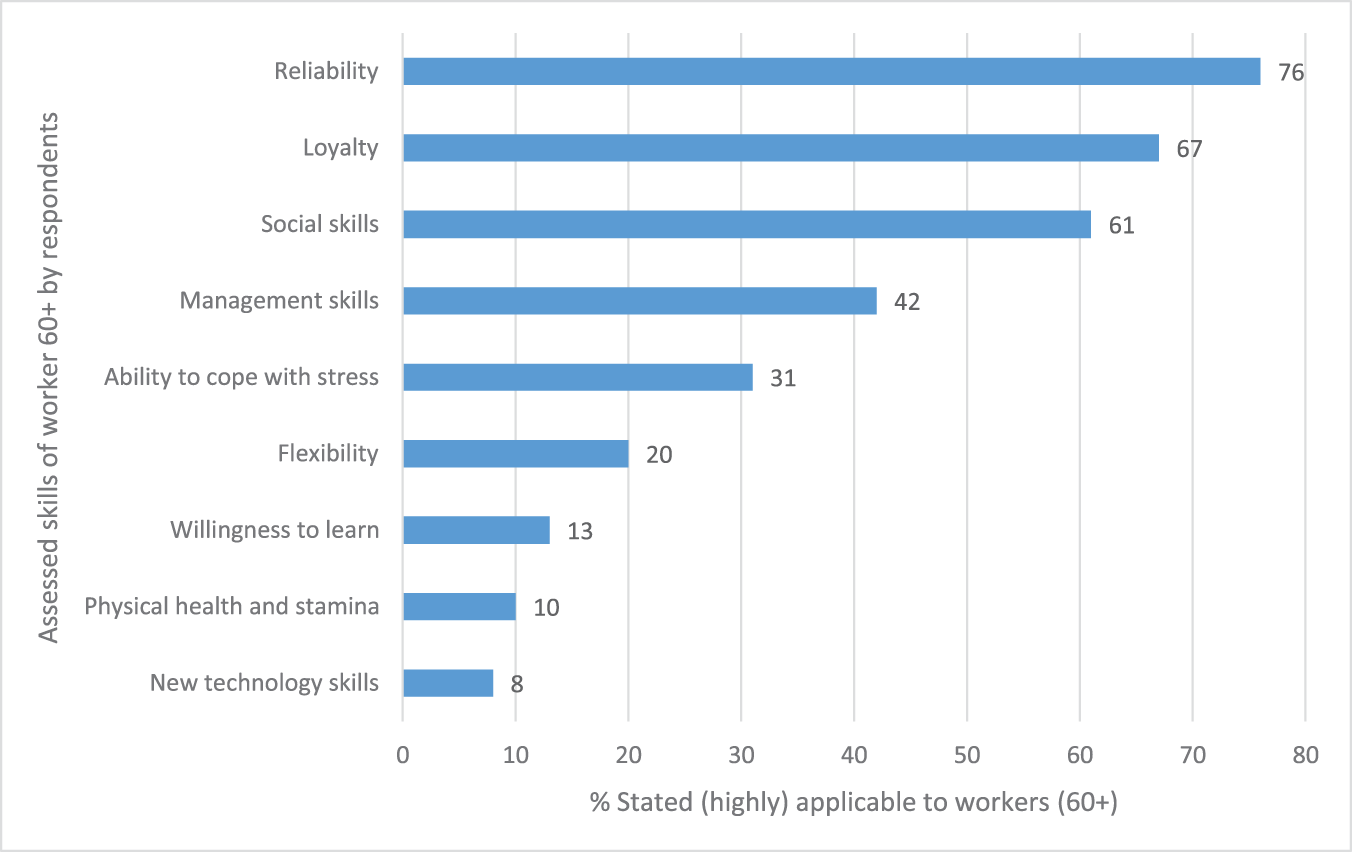
In order to assess the extent to which respondents held stereotypical views of older workers, they were each given a list of nine characteristics of older workers. We asked: ‘To what extent do the following characteristics apply to workers in general, aged 60 or older?’ The characteristics presented were social skills, commitment to the organization, management skills, reliability, flexibility, willingness to learn, physical capacity, resistance to stress, and new technological skills. Figure 2 shows how the presented characteristics were rated by respondents.
Assessment of respondents’ belief that specific skills are applicable to workers aged 60 years or older (% respondents stating that these skills are (highly) applicable).

Based on a confirmatory factor analysis, two factors were selected: soft and hard skills (for an elaborate discussion of the scale development, see Van Dalen et al. Reference Vanajan2010). The soft skills scale consisted of the following four items: social skills, commitment to organization, management skills and reliability (Cronbach’s alpha = 0.78). The hard skills scale was based on five items: flexibility, willingness to learn, physical capacity, resistance to stress, and new technology skills (Cronbach’s alpha = 0.79). The descriptive statistics of stereotyped views of respondents can be found in Table 1.
Analyses
Our vignette study data have a hierarchical structure by design; observations are therefore not independent (Wallander Reference Wallander2009). Multi-level analysis was used to deal with the hierarchical structure of the data (Hox Reference Hox2010). Models were estimated using two levels: (1) variables at the level of respondents (stereotypical beliefs about the productivity of older workers, and the age, sex and education of the respondent); and (2) variables regarding the items in the vignettes. For this the jobs in the vignettes contained 29 different job titles. And to offer a more or less balanced distribution of jobs, we used three categories of jobs, namely, those with (1) light physical demands, (2) medium physical demands and (3) high physical demands. Cross-level interaction terms were estimated between stereotypical views and physically demanding jobs.
Results
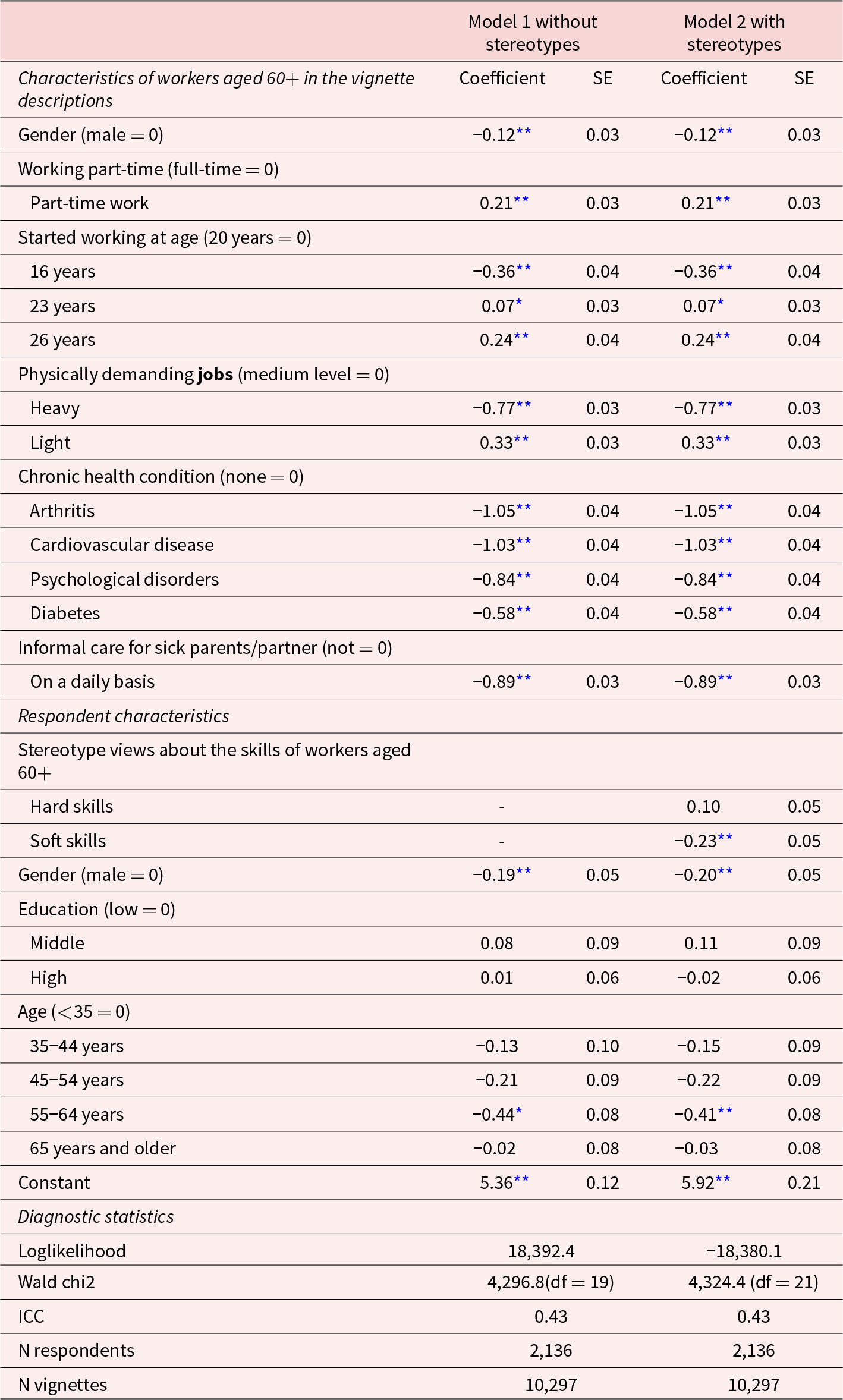
To estimate the assessment of public pension ages for workers with jobs that differ in terms of physical demand, two multi-level models have been estimated. Model 1 in Table 3 includes the vignette items related to the older worker under evaluation. Model 2 also adds the stereotypical views of respondents about older workers as predictors in the explanatory model. The coefficients in these models are unstandardized effects of the vignette variables and can therefore be interpreted in terms of years with respect to a lower or a higher public pension age. For instance, the findings in the first column reveal that individuals who started their working careers at the age of 26 are, on average, expected to continue working 0.24 years longer than those who started their working careers at age 20. The focus of many pension policy discussions (compare with OECD 2023) is the offering of a specific retirement age for a job with specific physically demanding characteristics. Our results indicate that the assessed public pension ages for workers in jobs that are considered physically demanding are approximately nine months lower (coefficient −0.77 multiplied by 12 months) than for workers in jobs with a medium level of physical demands. Workers with physically light jobs are expected to work four months longer (coefficient = 0.33 multiplied by 12 months).
Multi-level regression analyses explaining age norms about the public pension age; number of years workers should work longer (+) or shorter (−) than the statutory retirement agea

(a) Notes: The coefficients corresponding to the values of variables can be interpreted as years; for example, workers with arthritis can retire 1.05 years earlier than someone who has no chronic health issues.
SE: standard error. ICC: intraclass correlation coefficient.
Significance levels * p < 0.05, ** p < 0.01.
Respondents also prefer a lower public pension age for older workers who have to deal with chronic health conditions: for workers diagnosed with arthritis (coefficient = 1.05) or cardiovascular disease (coefficient = 1.03), the preferred public pension ages are approximately one year lower than the standard public pension age. Furthermore, being involved in giving daily informal care for sick or disabled parents or a partner is also associated with a lower public pension age covering almost a reduction of one year (coefficient = 0.89). The effect of gender is relatively small (−0.12), pointing to slightly lower retirement ages for women.
Model 2 demonstrates that the conclusions with respect to the vignette items remain the same when controlling for the respondents’ stereotypical views about the skills of workers aged 60 and older. Model 2 provides support for the hypothesis that negative stereotypes about older workers’ abilities to deal with physically demanding work conditions (low score on the hard skills stereotype measure) favour a slightly lower public pension age (one or two months). However, contrary to our hypothesis, Model 2 brings to light that positive stereotypes about the soft skills of older workers (like trustworthiness and loyalty to the organization) are associated with support for a lower public pension age.
An important question is whether stereotypical views towards older workers also affect how people view the possibility of lower retirement ages for employees in physically demanding jobs. For this we tested interaction effects between stereotypical views on hard skills (e.g. physical capacity) and physically demanding jobs. The results indicate that those respondents with negative views about older workers’ hard skills (e.g. physical and technical demands) are more likely to support lower retirement ages for physically demanding jobs than those who have positive views about older workers’ hard skills (coefficient = −0.13, t = 2.51, p < 0.05). Those respondents with negative views about the hard skills of older workers support 1.31-year lower retirement age for physical demanding jobs compared to physically light occupations. Those who have positive views about hard skills support only 0.79 years earlier retirement than physically light occupations. Demographic background characteristics, such as the age and education of respondents, do not play a major role in explaining differences in assessing the appropriate public pension age for different jobs. Respondents in their forties and fifties are somewhat more supportive of lower public pension ages, and the same holds true for female respondents. Additional analyses were explored to see whether interaction effects exist between respondents’ characteristics and the elements presented in the vignettes. The primary question here was whether the assessment of physically demanding working conditions differs by age and gender. The results (not included in Table 2) demonstrate that the effects of physically demanding occupations are more pronounced for respondents over the age of 55. These age categories appear to be more sensitive to the need for lower retirement ages for those in physically demanding jobs than younger respondents. Furthermore, we tested whether having chronic health conditions and being an informal care-giver increased the support for lower retirement ages for physical demanding occupations. This appeared not to be the case. These interaction terms proved to be positive (0.14, p < 0.05 for interaction with care-giving; 0.37, p < 0.01 for interaction with chronic conditions), indicating that when someone is both a care-giver (or in poor health) and in a physically demanding occupation, the support for a lower retirement age is less than expected based on the individual effects. This result suggests that the general public may see physically demanding work or informal care-giving as a valid reason for early retirement, but when both apply to the same individual, they seem to assume that one justification is sufficient, leading to a lower than expected level of support.
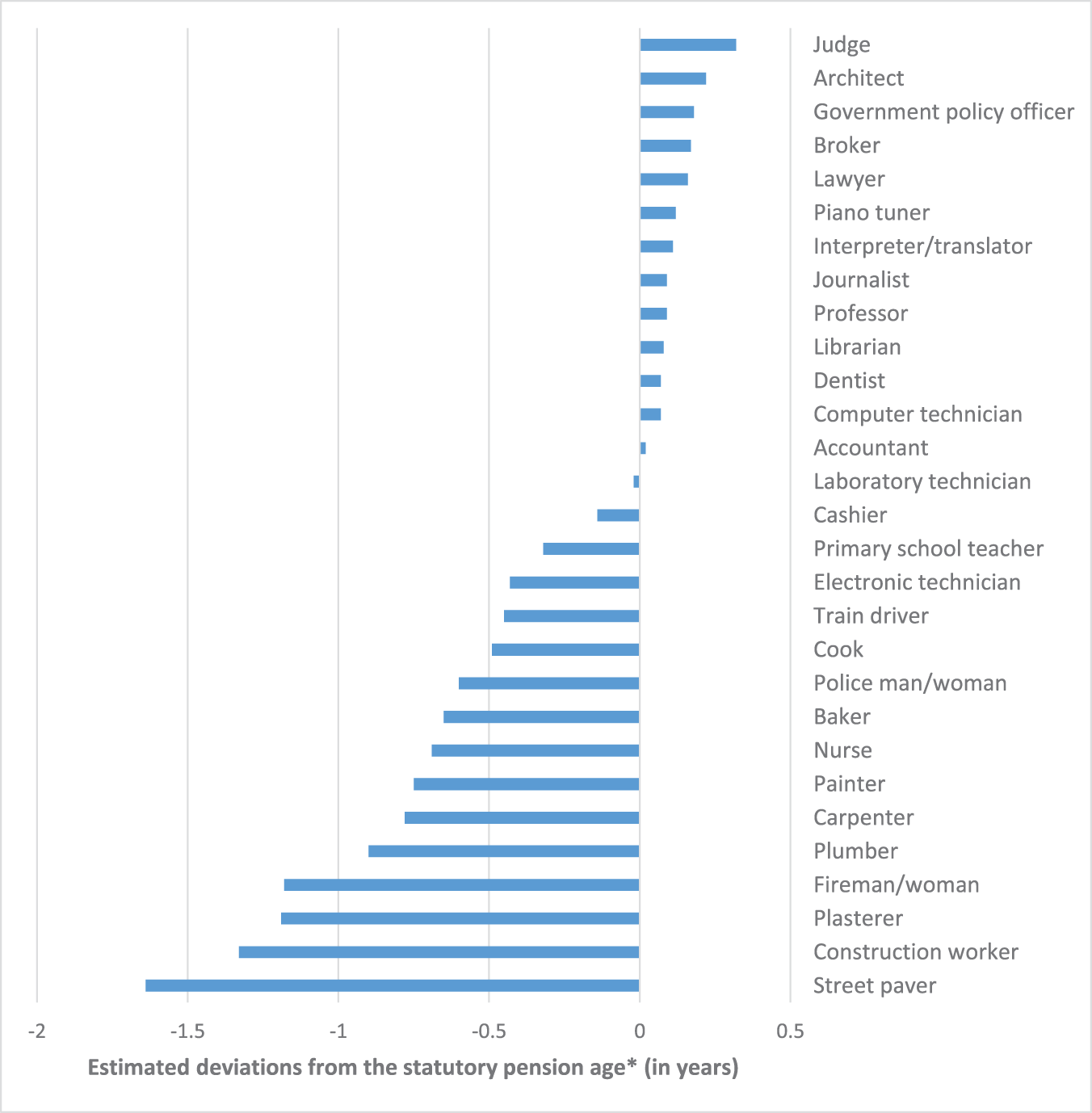
The assessments of appropriate public pension ages for a wide variety of jobs are illustrated in more detail in Figure 3. This figure presents the outcomes of an alternative model that includes 29 different jobs from the vignettes as predictor variables in the model. The results demonstrate that public pension age norms for jobs differ significantly, even within categories of jobs classified as physically heavy or light. The assessments by the respondents broadly validate the ranking of the difficulty of occupations as computed by Ravesteijn et al. (Reference Ravesteijn, van Kippersluis and van Doorslaer2018). Remarkably, for many office jobs, people believe that public pension ages can be slightly higher than they currently are. The highest expected public pension age is observed for judges, architects and government policy advisors, while the lowest public pension age is granted for construction workers, concrete workers, plasterers and street pavers. The difference in the assessment of fair retirement age between the lightest and the most physically demanding jobs is, however, relatively modest, amounting to approximately two years, ranging from an earlier retirement of 1.6 years for street pavers to a delay in the retirement age of 0.3 years for judges.
Estimated support for lower or higher public pension ages for different occupations.

Conclusion and discussion
The public pension age has been increased in quite a number of developed countries (OECD 2023, ch. 3) and is envisioned to be increased even further. The Netherlands is one of the forerunners by linking the public pension age to life expectancy at age 65. This relatively abrupt increase sparked intense public debates in the Netherlands regarding the ramifications of these reforms, especially for individuals with physically demanding or hazardous jobs. A notable point of contention in this debate can be found in the absence of differentiation in public pension ages depending on the physical demands of jobs. In this study, we assessed the strength of support for either early or delayed retirement from the standard public pension age and how these assessments are influenced by various factors that are part of an ageing society. By means of a survey in combination with a vignette study, we found that various factors, such as the age at which older workers started their career, the presence of chronic health conditions and involvement in informal care obligations for parents or partners, all impact how people assess what they consider to be a reasonable public pension age. Notably, significant differences exist between physically demanding and light occupations. People generally expect workers in less physically demanding occupations to continue working slightly longer than the standard public pension age, and older workers with highly physically demanding occupations to retire considerably earlier.
While it may be challenging to accommodate the revealed diversity of assessed public pension ages in actual practice, our study shows that the issues faced by older workers who have to manage the challenges of working longer are taken seriously by many Dutch citizens. The preference for a differentiation in higher and lower pension ages offers food for thought. By framing the support for specific jobs in our experiment in a balanced manner – showing not only early retirement but also late or delayed retirement – we found that preferred public pension ages by occupation offer a natural way out of financing early retirement programmes. This is so because the workers with jobs that are deemed ‘light’ should have – in the eyes of Dutch citizens – a slightly higher public pension age. These jobs are dominated by highly educated people (judges, professors, lawyers) with high earning power. Workers with highly physically demanding jobs (e.g. plasterer, cook or carpenter) often have less earning power and can – in the public eye – retire earlier than the official public pension age. In addition to this budgeting problem, differentiating retirement ages by jobs may also enlarge the opportunities for working longer for workers in less physically demanding jobs, thereby lessening the shortfall in labour supply in ageing and sometimes declining populations. Currently the presence of mandatory retirement ages in the Dutch pension system substantially restrains older workers with ambitions to extend their careers (Oude Mulders Reference Oude Mulders2019). And the fact that public pension ages are expected to slowly keep on rising will intensify the imperative to provide support for individuals who must continue working in physically demanding occupations despite health limitations. Investing in technology and implementing personnel policies like phased/partial retirement or demotion could help alleviate the challenges faced by employees in the later stages of their careers (Henkens Reference Henkens2022; Van Dalen and Henkens Reference Van Dalen and Henkens2018). Another approach is the creation of ‘age-friendly’ jobs within companies, a trend observed in the US labour market and various other countries, as highlighted by Acemoglu et al. (Reference Acemoglu, Mühlbach and Scott2022) and Kooij et al. (Reference Kooij, Nijssen, Bal and van der Kruijssen2020).
The modest range of early retirement ages for specific occupations is also in contrast to some calculations of ‘desired’ ages of retirement, which suggest a far stronger differentiation of retirement ages (compare Deeg et al. Reference Deeg, De Tavernier and De Breij2021; Vandenberghe Reference Vandenberghe2021). One possible reason why the support for special early retirement programmes is weaker than initially thought may have to do with the fact that the ‘wear and tear’ work is a responsibility of both employees and employers, and less of society at large. Another reason may be that the Netherlands is a country, together with Switzerland and Sweden, where elderly men and women show far less deterioration of health over their lifecourse than other European countries (compare with Abeliansky and Strulik Reference Abeliansky and Strulik2018) and that this is reflected in the modest differentiation in retirement ages. But it may also be the case that the general public expects that history may repeat itself: social welfare programmes, like disability programmes, have been prone to being misused in the past. In fact, introducing a specific early retirement programme may also be used by those in a specific occupational group who could reach a normal retirement age in good health without the programme, but who will simply use the special programme as an easy and generous exit route. The Dutch welfare state has a history of misuse of disability programmes as a substitute for unemployment programmes (De Jong and Aarts Reference De Jong and Aarts2016; Koning and Lindeboom Reference Koning and Lindeboom2015; Koning and Van Vuuren Reference Koning and Van Vuuren2010). To reinstate special programmes may reignite a second ‘Dutch disease’ and may perhaps be a reason why the general public in the Netherlands is hesitant about granting pension rights to specific groups.
Our findings also shed light on the prospect that stereotypes about older workers can influence support for different retirement ages. Respondents with positive stereotypes about the soft skills of older workers, such as reliability and loyalty to the organization, tend to favour a lower statutory retirement age. Respondents with negative stereotypes regarding the hard skills of older workers tend to support a lower public pension age in general but even lower retirement ages for physically demanding occupations. The effect of stereotypical views about older workers on the support for different public pension ages could also have adverse implications. Introducing lower public pension ages for demanding jobs could, for example, reinforce negative stereotypes about the productivity of older workers in these specific jobs.
This study has some noteworthy strengths. The study employs a multi-level research methodology combining survey research and a vignette study, enabling us to separate effects of jobs and occupations from health conditions and informal care-giving responsibilities. Furthermore, the current study takes into account the impact of stereotypical views on retirement age norms, offering a better understanding of how general perceptions about older workers influence assessments about the appropriate retirement ages for specific jobs. But, despite its strengths, we should also take into account some limitations of this study. Vignette studies, while useful, inherently simplify complex real-life scenarios. The macro-economic financial consequences of lower public pension ages for workers performing physically demanding work have not been made explicit. Support among the population might be lower if they become aware of the fiscal consequences. Furthermore, the study was carried out in the Netherlands, which may limit the generalizability to other country contexts. The Netherlands is one of the forerunners in increasing the public pension age and linking it to life expectancy. As a result, respondents might be more supportive of differentiating pension ages than in countries with lower retirement ages. However, the most notable outcome of our vignette study is that the stated ‘fair’ public pension ages for the 29 different occupations are quite limited in size: for most highly physically demanding jobs this amounts to about one year earlier retirement, which is small compared to the retirement options that are generally granted in most European countries that have special pension provisions for arduous jobs; these provisions often reduce the minimum pensionable age by five or more years (see OECD 2023, p. 111).
As a final note, policy makers in ageing societies are facing a significant conundrum in striking a delicate balance between pension reforms that encourage the extension of working lives and reforms providing early retirement to compensate for the ‘wear and tear’ that may be part and parcel of demanding occupations. Keeping it simple and fair will be the biggest challenge as special retirement programmes for specific jobs are fraught with practical and moral problems that may perhaps be larger than the initial problem they are intended to solve. This study underscores that the right to early retirement is seen as fair by the general public not only owing to the diverse occupational challenges that older workers face but also as a response to challenges of ageing societies. It is highly likely that (informal) care-giving responsibilities towards partners and family will become increasingly visible and will clash with formal responsibilities towards employers. Workers who have to fulfil both formal and informal obligations at higher ages run the risk of burnout, making it necessary for employers and workers to think of solutions that alleviate the pressures coming from these two spheres without immediately resorting to early retirement programmes.
Author contributions
The authors shared equally in conceptualization, data generation, data management, analysis, writing the first draft, editing and finalizing.
Financial support
This work was supported by a grant from Instituut Gak and Netspar.
Competing interests
The authors declare no competing interests.
Ethical standards
The study did not require approval. The data collection was done by Centerdata through its LISS panel (Longitudinal Internet studies for the Social Sciences). The panel is based on a true probability sample of households, drawn from the population register by Statistics Netherlands. It consists of 5,000 households, comprising approximately 7,500 individuals of 16 years and older. We describe our sampling plan, all data exclusions (if any), all manipulations and all measures in the study. All data, analysis code and research materials are available upon reasonable request. Data were analysed using Stata, version 17.1. This study’s design and its analysis were not pre-registered.



 Open access

