


Introduction
“Living in peace and harmony with local princes” is a necessary condition for Atlantic trade that has its roots in the violence structured and governed by its actors.Footnote 1 The arrival of the Portuguese on the coasts of Senegambia in 1444 was the origin of the reshaping of the political map and the political fragmentation of Senegambia, supported by the resurgence of violence, which is the lifeblood of the Atlantic trade.Footnote 2 On the issue of widespread violence, Toby Green argues that “the continuities between trans-Saharan and Atlantic long-distance trades facilitated the intensification of violence that was heralded by Atlantic trade and that contributed significantly to political and social changes in Western Africa.”Footnote 3 Between the seventeenth and the nineteenth century, Senegambia, one of the regions most privileged by European maritime trade, did not escape the mercantile violence of the Europeans and the State violence exercised by its chiefs to meet the European demand for slaves and local trade products such as gum, ivory, gold, water, and food. This region, which was highly coveted by European traders, is located between the Senegal River to the north and the Gambia River to the south, which allowed Europeans to establish important trade relations not only with the states on the Atlantic coast but also with those located in the hinterland, while opening up communication routes with the Niger Valley and the Gajaaga in the eastern part of Senegambia.Footnote 4 According to Curtin “Senegambia was a key region in this maritime pattern. It was the closest sub-Saharan region to Europe. In the early centuries of the slave trade, it was the largest single contributor to the repopulation of the New World. The twin water route [Senegal and Gambia Rivers] to the interior gave Senegambia a deep commercial hinterland, reaching to the upper valley of the Niger.”Footnote 5
Atlantic trade was evolving in an environment of competition, jealousy, and brutality. In an environment where each European trading power expected to hold a commercial monopoly, diplomacy became a fundamental issue for establishing commercial partnerships. The Atlantic slave trade relied on the art of negotiation and was nourished by diplomacy, which became an essential fact of European mercantile policy in Africa. Diplomacy was not just a matter for professional diplomats such as ambassadors or accredited special delegations. Traders, trading clerks, “Maitres de langue”,Footnote 6 and local notables such as the Alquiers, who did not have “diplomatic functions,” are involved in negotiation.Footnote 7 In Senegambia, a “diplomat” was nothing more than a person trusted by the king who was able to defend the political and economic interests of his leader and his state. It was a person who had to have experience in communicating with the Europeans and in the functioning of the Atlantic trade. In Fuuta-Tooro, for example, the Camalingo played the role of diplomat.Footnote 8 In the Wolof and Sereer states of Senegambia (Kajoor, Bawol, Waalo, Siin, Saloum), the Alquier, who was in constant contact with the Europeans, could fulfill the functions of “diplomat-negotiator.” Precolonial diplomacy was exercised not only through official trips or visits and treaties (peace, alliance, trade) but also through palavers, which are customary assemblies where matters concerning the political, economic, social, and cultural life of the community are debated and discussed. Negotiation is an art that requires special attention. It must be entrusted to discreet men who have patience and the ability to listen. Moreover, in the instructions given to Jean Baptiste Colle, French commander of the Galam trading post,Footnote 9 one can read the following: “when we are in a place where we are not the strongest, the look of a fox, which is not unknown to him, is better than that of the lion.”Footnote 10 These words reflect exactly the approach that a diplomat must adopt in order to convince his colleagues and eventually succeed in his mission. A state that succeeds in having a good foreign diplomacy, is one that can secure many commercial opportunities that can directly impact its wealth. Treaties and palavers are negotiated to obtain peace, flourishing trade, and land possessions.
I am interested in the palavers and treaties concluded between the French and the local sovereigns that raise issues of trade, land cession, peace, and customs during the time of the Atlantic slave trade in the Senegambian space (1679–1815).Footnote 11 This region was the birthplace of the first French settlement – Saint Louis – in sub-Saharan Africa in 1659. The treaties represent a form of reincarnation of the sovereignty of Senegambian states. Indeed, European powers at the time of the slave trade accepted their African counterparts on an equal footing and recognized the sovereignty and independence of African societies and states.Footnote 12 There are specific studies on treaties in precolonial Africa notably in the MaghrebFootnote 13 and in sub-Saharan Africa.Footnote 14 Monographic studies on Senegambia at the time of the Atlantic slave trade briefly address some some precolonial treaties related to security and defense issues.Footnote 15 However, the historical literature seems to be interested in the period of the end of the slave trade, notably the treaties of protectorates and capitulations that will serve as legal proof for the European colonial powers to assert their African possessions during and after the Berlin Conference of 1884. Thus, through a series of pressures and promises, the Europeans obtained a delegation of sovereignty that legalized the occupation. This is the meaning of the protectorate treaties that legitimize the partition of Africa.Footnote 16 My study is based on archival sources and travel reports. It intends to shed new light on this dark part of the history of diplomatic relations between the French and local chiefs in Senegambia.
This article discusses the role of diplomacy through palavers and treaties as formal exchange models based on negotiation, representation, and intelligence abroad in order to understand its importance in French trade in Senegambia.Footnote 17 I will also study the means by which diplomacy was exercised in order to try to understand the interest it represented for the French and the local sovereigns. Therefore, to better understand the impact of diplomacy on trade, I will study in the next section the “informal diplomacy” through palavers. Then I will study the economic and defensive stakes of trade and land cession treaties. Finally, in the last section, I will focus on the peace and alliance treaties between the French and the chiefs of Fuuta-Tooro. This alluvial state experienced an Islamic revolution in 1776 and was in permanent conflict with France.
Informal Diplomacy: Palavers and the Questions of Trade Customs
Europeans accommodated themselves to African negotiation practices. The palavers were moments where informal diplomacy was exercised, far from the formal European diplomacy which was the universe dedicated to ambassadors and delegations duly accredited to conclude peace treaties on behalf of their sovereign. We prefer the term “informal diplomacy” to “unofficial” diplomacy, which is diplomacy that necessarily took place without the consent of the sovereign or state.Footnote 18 Indeed, far from the metropolis, the French trading companies and the French royal administration that succeeded each other in managing the Senegal concession enjoyed the support of the French king and acted on his behalf.
In Africa, palavers were moments of societal and political discussion between elites and notables from the same village or from neighboring villages. These strong and decisive moments were most often held under a large palaver tree, usually located in the center of the village, which was a traditional gathering place. In the eighteenth century, it was very common to see agents of trading companies palavering with local chiefs to find solutions to problems arising from trade and customs. The diplomacy of the palaver is different from that of the more official treaties and more framed by actors who decide by mutual agreement to fix their fate on a piece of paper preceded by their signature. Thus, the word given is a proof frozen in time. On the other hand, the words of a palaver evaporate in the air. They are not fixed and consequently, they are often violated by the actors. This explains the innumerable palavers between the actors of the trade.
On 19 February 1731, following a conflict between Levens, director of the Compagnie des Indes, and the Brak king of Waalo, a palaver was established to not only regularize the trade, but also to set the amount of customs.Footnote 19 At the end of this palaver, some important points have been retained. Indeed, once trade is re-established, the Alquier of Brak leaves immediately to call the merchants. On the side of the Compagnie des Indes (the Company), the ships destined to trade in gum were sent to the port of call of the Desert. As for the customs of the Brak, his wives, Membrosse, Guiodin, Mustapha, the great griot and the servants, they would be paid only when the Brak had repaid the hundred oxen and five captives of the Company stolen by his subjects. The French authorities of the Company used to retain the customs of the local rulers to induce them to pay their debts or to reimburse goods belonging to the Company that they had acquired by theft or plunder. In addition, two months after the opening of the trade, the Company would have to pay the customs of the other Waalo dignitaries, namely the Mantel and Guiogo. The customs of the Alquier of Brak, Jambar, Beyebers and Betoubé would be paid on the spot at the Desert trading post.Footnote 20
Just as the problems with the customs seemed to be settled, on 11 March 1731, in the middle of the gum trade, the subjects of the Brak asked the Company’s agents for the custom of the man named Gamon, whose request was rejected after much palaver. The Company’s agents threatened to return the boats from the river until the Brak respected the terms of the 19 February 1731 trade palaver. Nevertheless, it was necessary for the Company to grant a “Bonjour,” or a present of 12 pints of brandy, to Gamon to prevent him from disturbing the trade of Sieur Rochette, agent of the Compagnie des Indes, who was in the middle of a gum trade campaign.Footnote 21 Without this gift, Gamon could have interrupted Sieur Rochette’s trade by attacking his ship or by forming a blockade on the Senegal River to prevent him from moving to other trading locations. The giving of diplomatic gifts was very present in diplomatic games in Senegambia and everywhere on the West African coast. At the “Côte des Esclaves” in Allada (present-day Benin) the Company hoped, through gifts, to gain favor with its sovereign, secure a share of the local slave trade from Dutch competitors, and obtain trade privileges.Footnote 22 In the palaver, the priorities of the local leaders conflicted with the French objectives, especially with regard to trade and security, which were the fundamental principles of the payment of trade duties. But, in the end, they all had the same needs: to benefit from the financial rewards of trade. However, sometimes the nature of the needs is driven by economic, political, and social realities. For example, in times of war or rivalry between European merchants, palaver was a means by which the actors of the trade tried to satisfy their needs (commercial exclusivity, war materials). In 1737, the Fuuta-Tooro was in the midst of a civil war. The Compagnie des Indes revealed that Sieur Aubry, an agent of the Company, who had gone to trade on the Senegal River, “was in Guiol [Fuuta] and had a long palaver with the Siratic king of Fuuta and that after several disputes and extravagant demands from this king, he managed to pay him his custom with an increase of 2 barrels of powder of £20 each, two ordinary rifles and two double-shot pistols.”Footnote 23 All that the king of Fuuta needed during this palaver were weapons and ammunition to face the tense political and social context of his country.
The local rulers never stopped making demands or threats to the French in order to get some goods from them. They knew that if they insisted, they would get what they wanted because the Company was always in fear of losing a gum or slave trade because of a request for some trade goods. These forced demands should be understood within the political logics of trade to which European and African actors were subjected, even if they sometimes tried to find a way out. Greed, violence, and cunning were the visible face of a system in which the profits were to be shared between different commercial and political actors, which was the rule in the trade with the Atlantic market. Often, during the palaver, the Company refused to give in to the demands of the local rulers and threatened to use force to dissuade them. Sieur Andon, a clerk of the India Company, reported that the payment of the custom of Tonca Tüabo, king of Galam, was made with great difficulty.Footnote 24 Indeed, the king wanted to be paid more than he was entitled to receive. Finally, after a long palaver that Sr. Andon considers as “a thousand debates,” Tonca was obliged to give in to the Company’s threats of war.Footnote 25 It was not easy to pay the customs. The French were often forced to palaver for several hours in the hope to convince the local chiefs, who were always determined to earn more or to demand that they attack merchant ships, interrupt trade, and block the Senegal River.
The palavers involved actors in the trade who had different cultural approaches and diplomatic practices, which materialized in the culture of writing (Europeans) and orality (local rulers). The pragmatic European vision based on writing as a means of commercial organization (commercial convention, fixing prices, and commercial taxes) and of anticipating the future clashed with the slowness of the Senegambian diplomatic culture, which revolved around orality, whose forgetting, repetition, and patience constituted its fragility. The palavers required a great deal of time, which did not suit the Europeans who were in a hurry to fill their cargoes with slaves or gum in order to sell them as quickly as possible in America or Europe – depending on the type of merchandise – so as to be able to liquidate their debt and calculate their profit. It was a whole mercantile and capitalist organization that supported European traders in Africa. This European conception of trade was different from the African one, which evolved in the informal. The palavers were moments of debate, of difficult and very stressful decision making for the European actors. For example, in some of the palavers, the Moors sometimes asked the Europeans for supererogatory customs or forced gifts.Footnote 26 The fear of missing the trade because of English competition pushed the French to “grant the Moors all their claims.”Footnote 27 England was the main rival of France in Senegambia, which ventured to the “rubber coast” to deal with the Moors by offering them exorbitant prices and customs. There was no police force in the markets to secure the traders and enforce the tariffs.
The palavers were also occasions where security measures concerning the trade were taken. The parties involved discussed security measures to be taken to counter possible fraud committed on the customs by the French trading clerks of the Compagnie des Indes. The report of Le Juge, director of the Compagnie des Indes, provides information on the fraudulent actions of the trading clerks and other employees of Senegal.Footnote 28 Numerous cases of prevarication were often mentioned in the correspondence of the Compagnie des Indes. French clerks in charge of paying the customs of the local sovereigns often diverted a part of the goods to their profit without the director of the Company being informed. The Judge alludes to the extortion of customs by the Company’s employees: “The custom of Damel [title of the king of Kajoor] was paid in my presence. I measured the canvas after delivery and found the reduction in aune … Mr. Levens, who was informed, told me that he had never ventured to make this reduction.”Footnote 29 This same report confirms the misappropriation of goods by the clerk Petain through these words: “Mr. Petain is in charge of paying the custom of Brak and that of Siratick on which about 700£ of last year’s merchandise was reduced on the faith of Sr. Grobert who assured us that he had seen him pay the same amount for three years, without having thought it appropriate to warn him because he wanted to be honored with this reduction before he left for France.”Footnote 30 The misappropriation of customs by the French staff of the East India Company was in response to their need to increase their financial capital at the expense of the local rulers. The king of Fuuta-Tooro was aware of the reduction of his annual custom in 1732. However, the following year, 1733, he accepted his royalty, but he did not refrain from making “complaints about the cutting of his custom and exorbitant demands: 22 muskets, 4 pistols, a saber, 3 pieces of black cloth, a pound of amber, 20 pounds of gunpowder, 20 pounds of shot lead, 100 flints.”Footnote 31 This demand, considered exorbitant by the Company, was to compensate for the goods cut from the annual custom of Fuuta. Thus, to ward off any fraud, the Moors chiefs took the trouble to discuss with the director of the Company to advise him of the extortions previously committed on their customs. In this way, they hoped to warn the director so that he would take the necessary measures to ensure that such cases of prevarication did not occur again in the future. “Palabres de traite” were occasions for local chiefs to complain about the behavior of certain agents of the Compagnie des Indes who often abused their customs. Generally at the end of the palaver, if both parties agreed, the payment of customs was done in a sometimes diplomatic protocol.
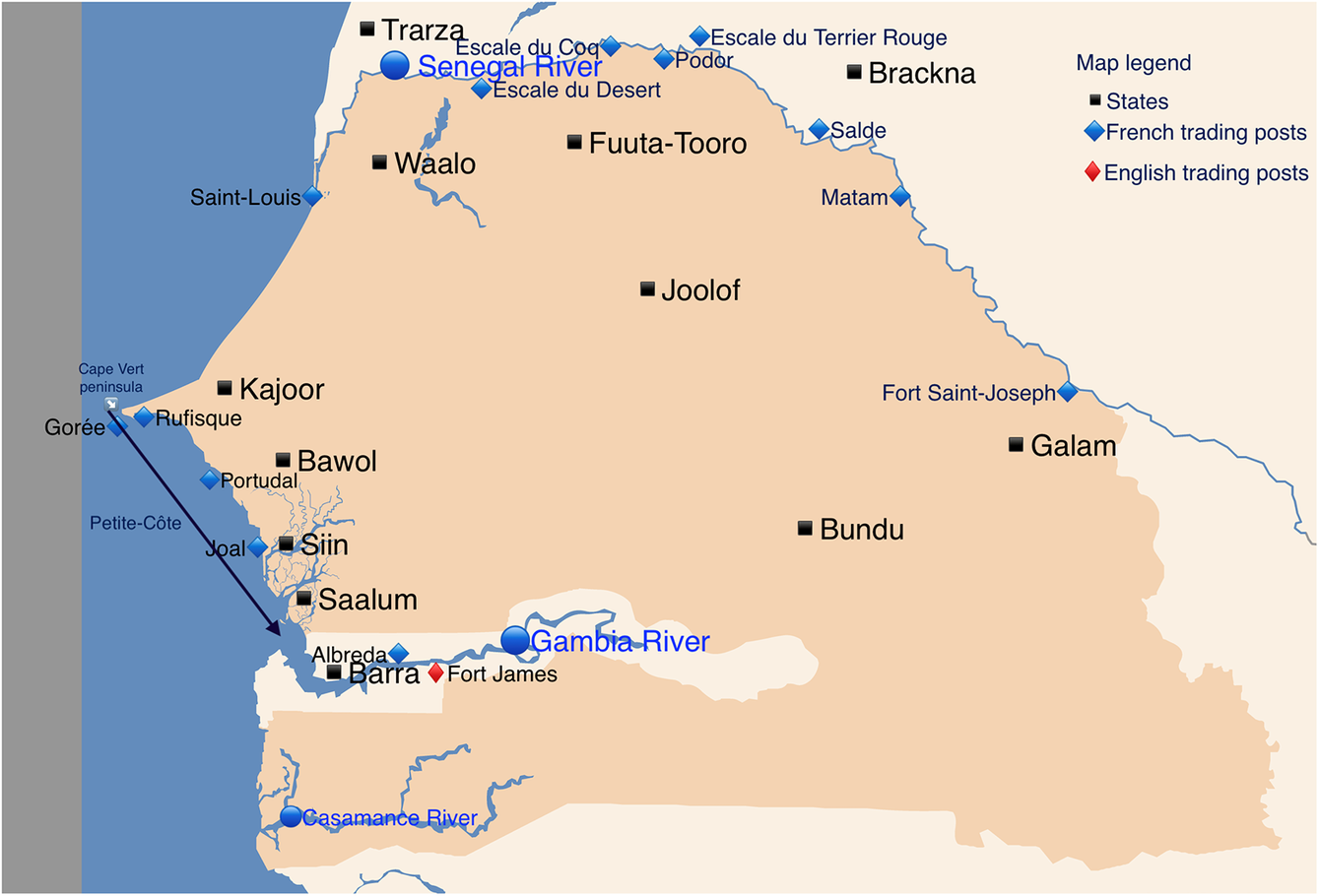
However, in addition to palavers, treaties played an important role in French pre-colonial diplomacy in Senegambia. In order to secure a commercial monopoly, France deemed it necessary to sign treaties with the local sovereigns. Thus, from 1679, the date of the first treaty concluded in Senegambia between the French and the sovereigns of the States of the Petite-Côte (see Figure 1), to the date of 1815, which marks the prohibition of the slave trade, several Euro-African treaties were concluded.Footnote 32 I classify them in Table 1 and I will make a more detailed analysis in the following sections.
French and English trading posts in Senegambia, seventeenth to the nineteenth century.
Treaties between France and Senegambia local sovereigns (1679–1806)
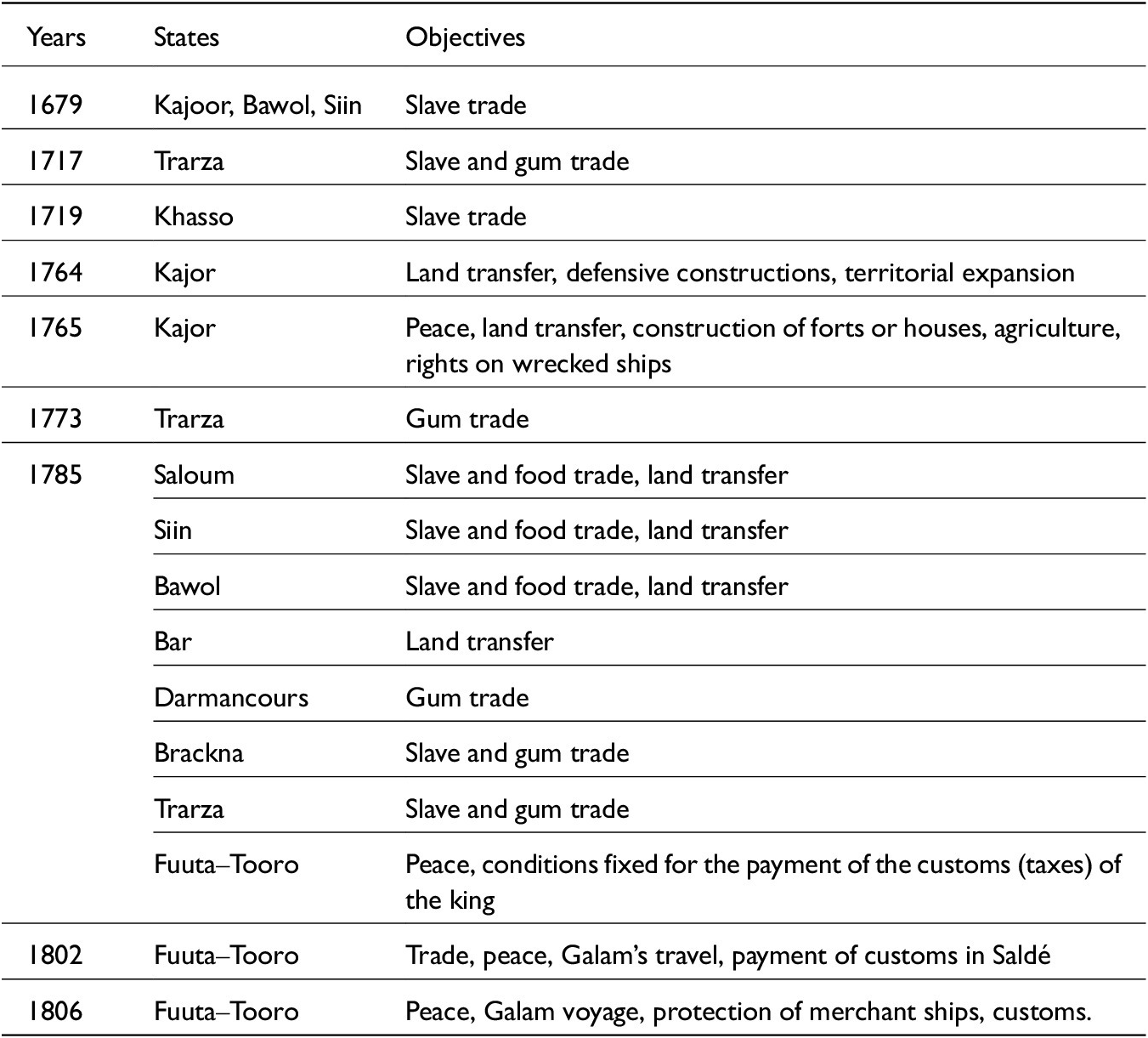
Sources. See ANOM: 17 DFC 76, Gorée N°23, “Mémoire sur le département de Gorée et le traité fait par M. Ducasse, avec divers Rois nègres,” Non daté ; 131 MIOM 1, Traité carton 1, Sénégal, Traité avec les Trarza 29 juillet 1717; C6 22, Copie du traité de paix conclu avec le Sénégal et le pays des Foules le 4 juin 1806; C6 21, Traité d’alliance et de commerce entre le gouverneur Lasserre et Almami, 4 février 1802. ANS: 13G7, Traité avec le Khasso, 1719; 10D1/0060, “Traité avec le roi de Saloum,” le 8 février 1785; 13G4, “Acte de convention faite entre Mr Blin, commandant de Gorée, agissant au nom du comte de Repentigny, gouverneur général à la côte d’Afrique et Biram Paté, dit Barbessin, prince souverain du royaume de Joal,” 25 mars 1785; 13G4, “Acte de conventions faite entre le Roi Tin Prince souverain des Royaumes de Portudal et de Baol, et le Général Repentigny au nom de très Haut et très puissant Prince Louis XVI, Roi des François,” 15 mai 1785; 13G 2, “Traité conclu entre le citoyens JBL Durand, Directeur de la Compagnie, sous les auspices et la protection immédiate de Monsieur Le Comte de Repentigny, Gouverneur du Sénégal et de ses dépendances et les marabouts Darmankours au sujet de la gomme,” 02 mai 1785; 13G 2, “Traité conclu entre Hamed Moctar roi des Brackna et le citoyens JBL Durand, Directeur de la Compagnie, sous les auspices et la protection immédiate de Monsieur Le Comte de Repentigny, Gouverneur du Sénégal et de ses dépendances,” 10 mai 1785; 13G 2, “Traité conclu entre Ali Coury roi des Trarza et le citoyens JBL Durand, Directeur de la Compagnie, sous les auspices et la protection immédiate de Monsieur Le Comte de Repentigny, Gouverneur du Sénégal et de ses dépendances,” 26 mai 1785; 10D1/0060, “Traité avec le roi de Saloum,” le 8 février 1785; 10D1/0060, “Palabre de Traité fait entre le Roi de France et celui de Bar,” le 31 mars 1785.
Diplomacy at the Service of the Economy: Trade and Defense in Interaction
The “Ducasse treaties” with the sovereigns of the Petite-Côte (Kajoor, Bawol, and Siin) can be considered as the first treaties concluded by the French in Senegambia. These rulers refused the monopoly that the French wanted to exercise over trade in the Petite-Côte area. After the conquest of Gorée in 1677 by the Maréchal d’Estrées, the sovereigns who controlled the trade in their respective markets of Rufisque (Kajoor), Portudal (Bawol), and Jaol (Siin) had the firm intention of continuing to trade with the English and Dutch. Thus, in order to monopolize the trade, Ducasse waged war against them by forcing treaties with the following clauses:
-
1 That the dry land of the sea shore of his Kingdom, which contains about thirty miles, and six miles deep before in the land of his States, would remain in property and seigniory to the French Company of Senegal and Cape Verde.
-
2 That the clerks of the Company would be the only ones in possession of all the trade of his country, to the exclusion of those of any other nation.
-
3 That the French would never pay any tribute nor customs to the King nor his successors.
-
4 That the French could only sell the iron bar for the value of six hides, and the other goods in proportion.
-
5 That as a guarantee of the treaty, two of the King’s relatives would remain on the island of Gorée and would be sent there immediately.
[The Company of Senegal found itself master and in possession of the lands of the coast of the sea from the Kingdom of Cayor [Kajoor] to the borders of that of Bour Sine [Siin] in the Department of Gorée, which is almost 50 miles long and 6 miles deep inland.
[All the above facts were reported before the judges of the Admiralty of Le Havre, on October 13, 1679, by Mr. Ducasse, on his return from the concession, and he then took an interest in the new Company of Senegal that the King formed on July 2, 1681.Footnote 33
A close study of the clauses of this treaty provides insight into these “particular moments of contact and violence between cultures.”Footnote 34 The Atlantic trade was based on the violence and intimidation to which the actors were subjected. The Company relied on its strength to build “its own legal frameworks,”Footnote 35 which allowed it to acquire land so that it could prevent the Dutch and English from trading on the Lesser Town. But diplomacy devoid of negotiation and mutual respect for the laws and customs of the actors involved was bound to fail. The Ducasse treaties were never respected by either the local chiefs who allowed their subjects to trade with the English from time to time, or by the French who continued to pay trade duties to the elite of the Lesser Antilles.
At the beginning of the eighteenth century, the gum trade along what I call the “gum coast” in Arguin and Portendick in Trarza (Mauritania) as well as on the banks of the Senegal River and its numerous “gum stops” (Donnay, Le Coq, Terrier Rouge) constituted an important source of wealth for the French and the European interlopers who ventured into these trading areas exclusively reserved for the French. The French never wanted to share the gum trade with the English and Dutch who regularly visited the “gum coast.” In 1717, the director of the Company, André Brüe, concluded a treaty with the king of the Trarza Alichandora, who promised to guarantee the Company a monopoly on the gum trade and all other goods within his territory.Footnote 36 Two years after having obtained the commitment of the Trarza, France hoped to monopolize the slave trade in Galam. Indeed, the Company had always suffered from competition from the English in Gambia who kept attracting slave traders from Galam. To save the French trade, the director of the Compagnie des Indes, Saint-Robert, concluded a treaty in 1719 with Segadua, the king of Khasso, to convince the king of Galam, Tonka Niamé, his tributary, to “divert the Negro merchants from bringing their captives to Caignoux and to divert them from taking the Gambia route.”Footnote 37 This trade agreement was never honored by the Galam authorities, who struggled to enforce the treaty’s clauses on slave traders who continued to trade with the British in Gambia at the expense of the French. Any hope of monopolizing the slave trade in Senegambia became a mission impossible for the French administrators.
From the creation of the trading post of Saint-Louis in 1659 until the beginning of the English occupation of Senegambia in 1758, French trade went quite well in the whole region. The Seven Years’ War from 1758 to 1763 had extensions outside Europe.Footnote 38 The island of Gorée and Saint-Louis were occupied by the English in 1758–63 and 1758–79, respectively. The war affected trade and security. Senegambia had always attracted the covetousness of European maritime powers and was a place of rivalry between France and England in the eighteenth century. In 1763, after the restitution of Gorée to the French, the use of diplomacy became a major issue for trade and the defense of French interests. The French royal administration took over the political and administrative management of the French possessions in Senegambia from the Compagnie de commerce. It no longer wished for these possessions to fall into the hands of the enemy, in this case the English. The French navy also decided to implement a policy of military presence. New treaties were concluded for the creation of forts.Footnote 39 The security of the Gorée trading post, the only French commercial establishment on the coast of Senegambia, seemed to be a necessity for the French authorities. However, behind this desire to fortify their establishments, there were other realities, such as territorial expansion through a system of territorial appropriations, which was progressively concretized by the transfer of land in several treaties in the nineteenth century.Footnote 40 In 1764, the governor of Gorée, Poncet de la Rivière, deemed it necessary to conclude a treaty with the Alquier of Kajoor. The latter ceded to the French “the points of Daccard [Dakar] and Bin”Footnote 41 where they wished to install coastal batteries crossing their fire with those of Gorée.Footnote 42 However, the Damel of Kajoor refused to recognize the treaty and claimed that the Alquier did not have the power to intervene in a transfer of sovereignty, particularly in the area of land.Footnote 43 Governor Chevalier de Mesnager, successor to Poncet de la Rivière, showed his commitment to continue the 1764 treaty through diplomatic negotiations with the Damel Makodu Kumba Jareng. The latter confirmed the agreements of the 1764 treaty in a new treaty in 1765.Footnote 44 If the governor of Mesnager succeeded in convincing the Damel to accept the treaty, it was because he applied the instructions of his superiors who advised him: “To live well with the natives of the country and, far from stirring up any war between them, to take advantage, on the contrary, of all the opportunities to reconcile them in order to enjoy greater consideration among them.”Footnote 45 France had two objectives in this treaty:
-
– To ensure the defense and trade of the island of Gorée located not far from the Cape Verde peninsula.
-
– To extend its territorial expansion in the Kajoor in order to control the point and the bay of Yoff, two important areas for the Damel because of the plundering of ships that frequently ran aground in this bay.
The Damel had felt that his interests were threatened. He decided to cede to the French the lands located on the Cape Verde peninsula, the coastline, from Mamelles to the coast of the village of Mbao, which could be useful in strengthening the defense of the island of Gorée. However, the lands located on the point and the village of Yoff were not ceded, precisely because of the possibility of plundering ships that ran aground there, the right of wreck considered in Kajoor as an ancestral right.Footnote 46 The treaties of 1764 and 1765 were only “paper treaties.” They were never observed by the sovereigns of Kajoor who continued to practice the right of wreckage until the second half of the nineteenth century.
Confined to Gorée where the possibilities of trade were almost nil, the French tried to trade on the “gum coast,” which was under English domination. The English occupation of Saint-Louis from 1758 to 1779 did not prevent the French from continuing to trade gum. In 1773, Abbé Demanet concluded a treaty with the Moors rulers of the “gum coast.” Article 1 of the treaty states that the king of Trarza recognizes
the incontestable right of ownership, that his most Christian Majesty has on the fortresses of Arguin & Portendic, & on the three forests of gum named Sahel, Lesbia & d’Alfatack in virtue of the acquisitions, that she made to the predecessors of the said Princes, notably on July 29, 1717, ratified and confirmed by the treaty of March 6, 1723, as much for the real and exclusive property of the said places, as for the trade also exclusive, that the French nation has on the extension of the said places.Footnote 47
The 1717 and 1723 treaties were concluded in a period marked, on the one hand, by strong rivalry between France and Holland for control of the gum trade in Arguin and Portendick and, on the other, by strong pressure from the Brackna on the Trarza. These two treaties were intended to ensure both a monopoly of gum for France and the protection of the Trarza against the Brakna.Footnote 48 The treaty of 1717 was logically ignored by the Moors, as France did not fulfill its obligations to the Emir of Trarza. The promised goods were not delivered, the ships did not arrive in Portendick.Footnote 49 After the treaty of 1717, Alichandora, the ruler of Trarza had written a letter to the West India Company (WIC) in which he promised that he would not sign any more treaties with another Christian nation except Holland.Footnote 50 But faced with pressure from Brakna, he decided to conclude the treaty of 1723 with France.
France justified its right to trade at the ports of Arguin and Portendick by the treaties of 29 July 1717 and 6 March 1723, which gave it possession of these two ports. Thus, a problem of “international law” arose between two European powers exercising their influence on a territory outside of Europe. All negotiations between the English and the French could not take place without the approval of the chiefs of Trarza. Indeed, the diplomacy of the Atlantic could not, however, be summed up in the negotiations of the European courts. It was also a local affair that mobilized European actors and local sovereigns who thus broadened the scope of their interactions.Footnote 51 International law recognized precolonial African law even if it was not codified by legal texts. The relations between the two continents, and particularly between France on the one hand and the African sovereigns on the other, were established on an equal footing.Footnote 52 At the same time as the European powers were fighting over legal titles for the transfer of territorial rights, the African rulers as holders of these titles could to some extent influence the outcome of the negotiations and even choose the European power with which they wished to conclude a treaty.Footnote 53 This is what happens with the Trarzas chiefs. The French relied on the bait of customs (trade taxes) to convince them to observe the treaties previously concluded (29 July 1717 and 6 March 1723) so that they could trade. They knew that the English paid a custom of “two pieces of blue cloth, a firearms and a bar of various goods for a measure of gum from eight to nine hundred weight.”Footnote 54 The French were trying to lean on the competition by paying them a more interesting custom than the English are paying. It was about “sixty guineas, sixty firearms, a barrel of one hundred pounds of powder, one of one hundred pounds of bullets & to the two sovereign chiefs, one piece of each goods of the assortment of trade.”Footnote 55 By increasing the value of customs, France showed its desire to control the monopoly of the gum trade, the only important branch of commerce in Senegambia. In this way, it hoped to regain the important place it still had in this trade during the first half of the eighteenth century.
In 1779, Saint-Louis was reconquered by France. In the same year, Gorée, ceded to France in 1763 by the Treaty of Paris, fell a second time to the English. However, at the time of the Treaty of Versailles in 1783, England officially ceded all its possessions in Senegambia to France. When France took over Senegal, trade was anything but flourishing. The slave trade dropped in the Gorée dependencies. In northern Senegambia, Fuuta-Tooro, following the Toorodo Revolution of 1776, had a king who not only prohibited the slave trade in his lands, but also caused a number of obstacles to French ships traveling to Galam for the trade. Attacks on ships were very frequent despite the large number of peace treaties between France and the Fuuta-Tooro. In the south of Senegambia, French trade had to face English competition. The English did not hesitate to deal with the state of Saloum, which had always been a French dependency of Gorée. The English certainly based themselves on the Treaty of Versailles of 1783 to deal in the south of Senegambia. Indeed, Article 9 of the said Treaty of Versailles grants the exclusive privilege to the French to trade only in the Senegal River and its dependencies, that is, the northern part of Senegambia.Footnote 56 The treaty does not mention the fate of the southern Senegambia trading posts that depend on Gorée. Thus, the English were allowed to use the Saloum River, a state near Gambia, Siin, and sometimes Bawol to trade in food and captives. To avoid missing the trade with these states, on 8 February 1785, Governor de Repentigny undertook a diplomatic tour with the aim of reviving French trade weakened by the English occupation of 1758 to 1779. He signed a treaty with the king of Saloum who was to grant “ease, help and protection to French merchants.”Footnote 57 De Repentigny signed two other treaties on 25 March 1785 with Siin,Footnote 58 a neighboring state of Saloum, and on 15 May 1785 with BawolFootnote 59 in order to extend French influence in the southern region and to fight against English competition. These two treaties were important for the French of Gorée who obtained most of their supplies from Joal, the main trading post of Siin, and Portudal, the trading post of Bawol. The King of Siin promised France that Joal would be the place to find trade in all the products of the country in exchange for goods from Europe, and for his part he would do his utmost to make it flourish while promising to ensure the safety of all French traders. The king of Bawol also promised to do everything possible to make trade profitable and to ensure freedom and security for French merchants.
The French trade would not be easy without the acquisition of new land for the construction of forts and trading posts. In order to make trade convenient, it was imperative to control the space, to defend it in order to be “sovereign.” Therefore, it was necessary to include the question of land in the conventions. Thus, the treaties concluded with the States of Saloum, Siin, Bawol and Bar mention land ownership in return for annual taxes. The acquisition of land was a determining factor in the process of conquering space. It allowed France to extend its commercial influence and to acquire new markets. Faced with English competition, France had to not only dominate and protect its already acquired possessions, but also conquer others through negotiation.
The fundamental stake of the French trade is the control of the gum and slave route in northern Senegambia. The French authorities hoped, through a wise and active administration, to double the trade in a short period of time.Footnote 60 It was in this context that de Repentigny delegated to Jean-Baptiste-Léonard Durand, the general manager of the gum Company, the power to conclude three treaties of alliance and trade. The first was concluded on 2 May 1785 with the Darmankours marabouts who were active in the gum trade.Footnote 61 The second was ratified on 10 May with the BracknaFootnote 62 and the third on 26 May with the Trarza.Footnote 63 Unlike the first treaty, the latter two encouraged not only the gum trade, but also the trade in slaves, ivory, and various other trade products. In the first treaty, Article 1 stipulates that the marabouts:
Swear and promise never to have directly or indirectly any communication with the English; they further swear and promise to use all practicable means to intercept and totally suppress the trade that the English could make in Portendick, either with the Darmenkours marabouts themselves, or with any other nation, or private individuals who would pass for this purpose in their country.Footnote 64
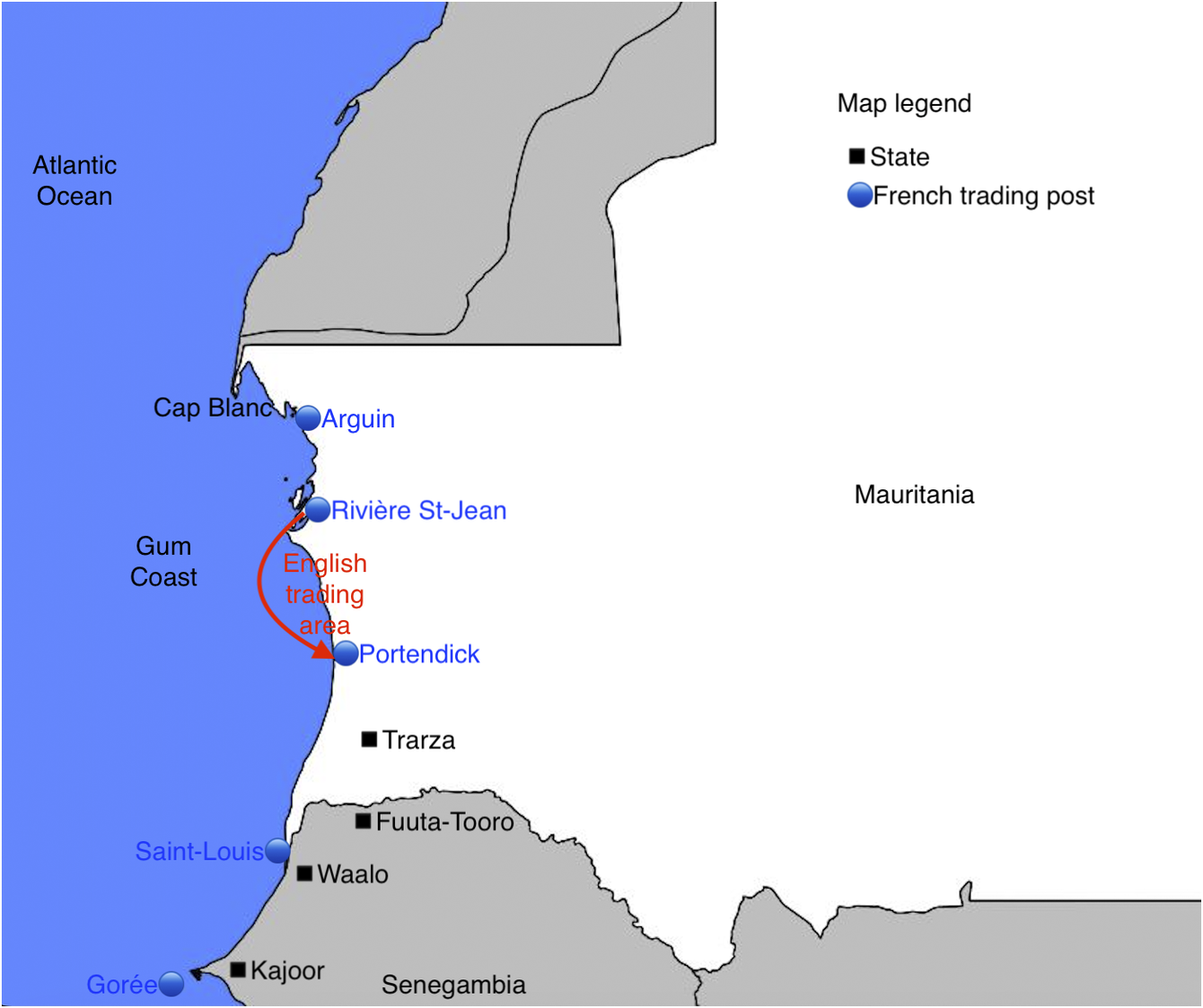
Jean-Baptiste-Léonard Durand intended to keep the English away from the “gum coast.” So, to obtain satisfaction and the respect of the promise of the Darmankours, he decided in Article 2 of the said treaty to offer “a gratuity in addition to the customary one, all the times that they will stop gum in the way of Portendick and will make it lead to the Desert, so that the Company can be assured that it will not be sold in Portendick.” This same article is repeated in the treaty of 10 May with the Brackna and that of 26 May with the Trarza, who must also avoid trading with the English at Portendick. Indeed, in Article 10 of the Treaty of Versailles of 1783, King Louis XVI of France guaranteed the king of England possession of James Fort and the Gambia River. The King of France also agreed to allow the English to trade gum from the mouth of the St. John River to Portendick Bay and Fort (see Figure 2).
Map of the “gum coast.”
Note: The area between the Rivière Saint-Jean John and Portendick is the trading zone authorized to the English according to Article 11 of the Treaty of Versailles of 1783.
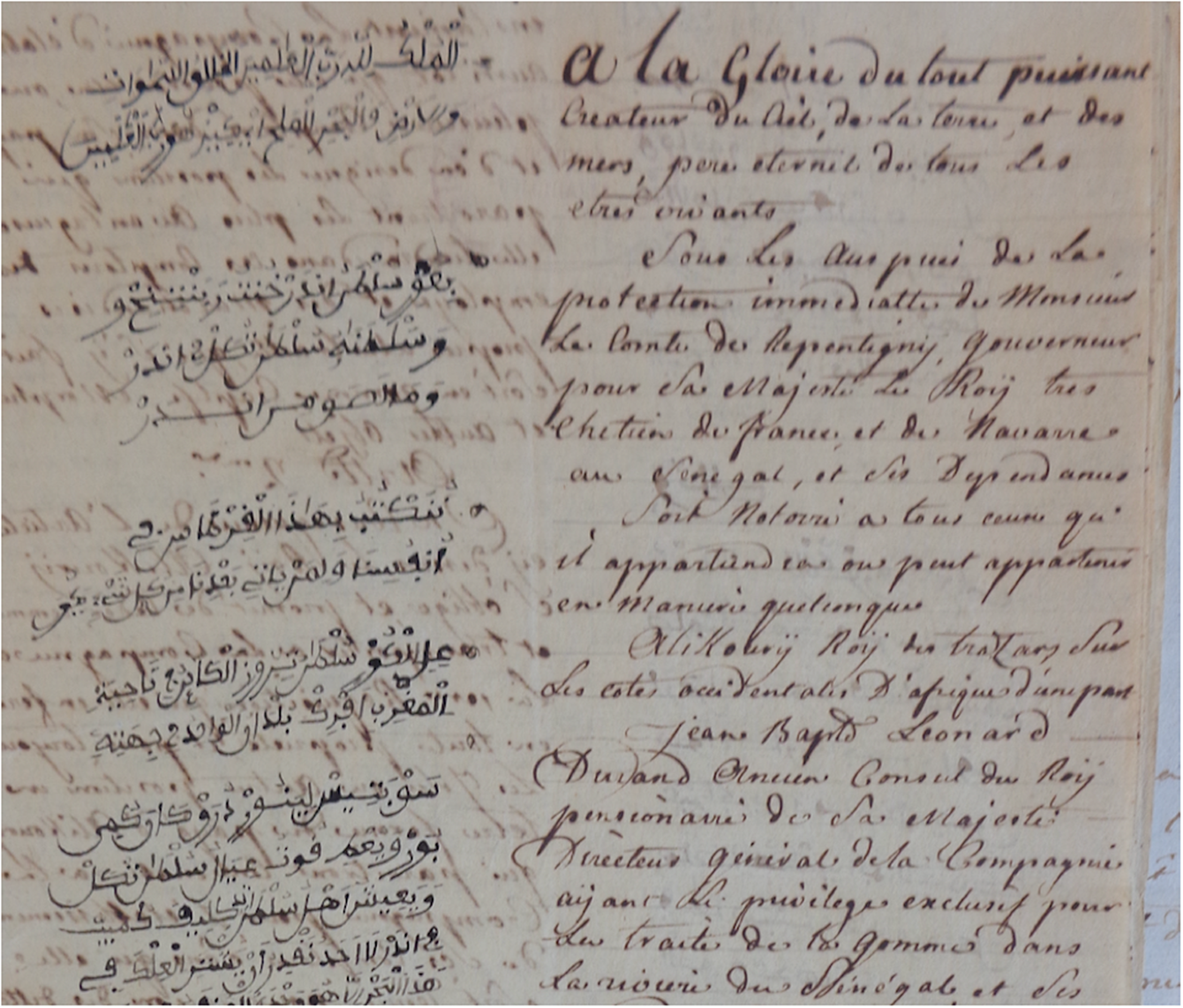
Copy of the treaty of 26 May 1785 between France and Trarza, translated into Arabic.
However, the French intended to circumvent Article 10 of the Treaty of Versailles, which authorized the English to trade in gum on the Portendick coast. Indeed, Article 3 of the treaty of 10 May 1785 and Article 4 of the treaty of 26 May 1785 prohibited the Trarza and Brackna from trading gum with the English at Portendick. In agreement with its former allies, the Trarza and the Brakna, the French intended to relocate the gum trade to the Desert stopover on the Senegal River. Following these series of treaties concluded with the local sovereigns, relations between France and certain Senegambian states were apparently stable. This stability was due to the increase in annual taxes in 1785 (Table 2), probably linked to political and commercial agreements.
Annual customs 1783–1786
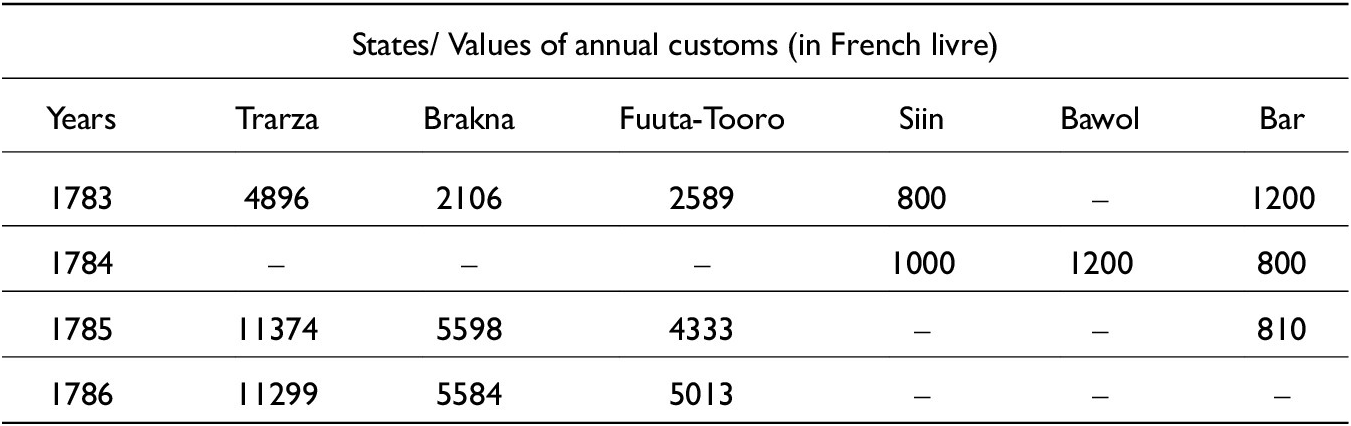
Sources. ANOM, C6 18, “Projet d’une administration économique pour le Sénégal et ses Dépendances,” Sénégal 1783; ANOM, C6 19, “Etat des dépenses locales au Sénégal et dépendances pendant l’année 1786,” 15 février 1787. These same customs were renewed for 1787; Jean-Baptiste-Leonard Durand, Voyage au Sénégal, fait dans les années 1785 et 1786, 2 vols. (Paris: Dentu 1802), vol. 1, 148 and vol. 2, 377; Christian Schefer, Instructions Générales données de 1763 à 1870 aux gouverneurs et ordonnateurs des établissements Français en Afrique occidentale, 2 vols. (Paris: Librairie ancienne Honoré Champion, Edouard Champion, 1921), vol. 1, 122.
From 1785 until 1809, the date of the second British occupation of St. Louis, in southern Senegambia, both local rulers and French administrators observed the clauses of the treaties. In the states of Kajoor, Bawol, Siin, and Saalum, the trade was carried out smoothly and in the best interests of the French. Indeed, the treaties allowed French traders to do a good deal of captive trading. For example, in 1786, the trade at Gorée and Petite-Côte yielded 300 captives. In Gambia, the French trade was estimated at 700 captives and that of Saalum at 1,800 captives.Footnote 65 With regard to the redistribution of annual customs, the French authorities mentioned at the end of the treaties the list of local personalities supposed to receive the customs and the value in kind of their customs to avoid crises and internal dissensions and family rivalries for the accession to power.Footnote 66 Article 11 of the treaty with Trarza in 1785 specified the payments owing not to twenty-three specified individuals other than the emir as Curtin claims,Footnote 67 but to forty-five individuals including the emir.Footnote 68 The custom of each individual was measured in relation to his power and his political and social rank. At the end of the treaty, “a supplement to the articles of the customs in addition to what has been settled” was added in the treaty for the mention of four individuals on the list of the rights of the customs. This shows that these individuals, undoubtedly not powerful, were forgotten in the distribution of the customs. The Emir of Trarza was trying to do what was necessary to satisfy his entourage by distributing insignificant goods in order to avoid internal crises that could disturb the stability of his country.Footnote 69 This democratization of customs within the aristocratic families only allowed for a part of the trade and was not a guarantee of commercial peace in the long term. For example, a few months after the ratification of the treaty between France and Fuuta-Tooro (31 March 1785), in December 1785, “the tampsirs [Tamsir], not very happy with the distribution of customs, made by the Almamy, were at the rock, waiting for all the ships to return.”Footnote 70 The rock is an excellent place to plunder the ships returning from Galam. It was necessary that the Laptot Scipion, after having fiercely opposed the attacks of the Fulani of Fuuta, agreed to grant “to the tampsirs thirty pieces of guinea, fourteen two-shot rifles, fourteen barrels of gunpowder and ten fine rifles” so that the convoy could navigate quietly on the river waters of Fuuta in the direction of Saint-Louis.Footnote 71 In 1785, the necessary measures were taken to ensure that the clauses of the treaties were clear, understandable, and accessible to all actors, especially the local chiefs of Trarza and Fuuta-Tooro, who did not understand the French language.
France translated into Arabic the treaties it had concluded with the Emirate of Trarza and Fuuta-Tooro. These two states had many marabouts and learned men who spoke Arabic. The translation of the treaties into Arabic demonstrated the willingness of the actors to be clear and honest about their commitments. However, it was not a guarantee that the clauses would be respected. For example, the treaty between France and Fuuta-Tooro of 31 March 1785 was violated by the Fuuta chiefs who had sworn to secure the French ships and to accept the established commercial rights.Footnote 72 Unlike the South, the political situation in the North remained tense. The Trarza and Brackna were more concerned with war than with disrupting French trade. In the theocratic state of Fuuta-Tooro, French trade was affected by the problem of freedom of navigation on the Senegal River. Peace seemed to be imminent between France and Fuuta, which was considered the granary of Saint-Louis.
Peace and Alliance Treaties: A Necessity for River Trade in Fuuta-Tooro
Most of the conflicts that broke out between the French and local chiefs were related to the payment of customs and navigation on the Senegal River. Fuuta-Tooro was among the states most affected by conflicts. An inevitable passage for the river travel of French traders from Saint-Louis to the Galam country and the main supplier of millet to the city of Saint-Louis, the Fuuta was in constant disagreement with the French authorities in Saint-Louis. The occasions of conflict were extremely numerous and result either in looting or in prohibitions of the Galam expedition.Footnote 73 In 1785, among the treaties concluded by Governor de Répentigny during his diplomatic tour of Senegambia, only the one ratified with Almamy referred to the peace between Fuuta and France.Footnote 74 Indeed, it was a question of solving the problems related to customary payments and navigation on the Senegal River. It was agreed between the actors that in the future the village of Saldé would be the place where Almamy’s customs would be paid. Almamy promised that he would no longer demand forced customs from French traders. To better protect the traders from the looting of his subjects, he promised to leave Saldé only after the convoy had sailed.Footnote 75 However, the treaty was not enforced by the Fuuta authorities. Nevertheless, Almamy swore that he would respect all the conditions of the treaty to the letter with these words:
I, Tamsir, undertake in the name of the King and his successors, by virtue of the powers he has given me and in the name of all his subjects in the land of the Foulhs, to keep faithfully and steadfastly all the conditions mentioned in the present treaty, which I accept in the name of the King to the fullest extent, and which I find to be very wise and reasonable, and I swear before God, who knows the depths of people’s hearts, that this treaty will be executed in its entirety, just as it has been read to me and explained to me in a very clear manner, and that the translation into Arabic is exactly the same.Footnote 76
Despite these fine words filled with promises and good faith, in 1787 Almamy demanded an increase in the amount of the custom per ship, thus violating the clauses of the treaty. Outraged by Almamy’s reaction, the French did not give in to his request and the Galam expedition was cancelled. The Fuuta continued to impose its laws on the French who made the trip to Galam. In fact, for security reasons, Almamy Abdul refused to allow Commander Picard to pass through his states in 1802, at the very moment when he was threatened by a coalition formed by the Kaarta, the Xaaso and the Bundu.Footnote 77 He feared that Picard was an emissary from Saint-Louis who was supplying arms to his enemies. The city of Saint-Louis, the capital of the Senegalese concession and the residence of the governor, suffered the consequences of Almamy’s repeated actions. Indeed, the city depended on Fuuta for food supplies, especially millet, which was the staple food of the population of Saint-Louis. In 1800, the city had 8,000 inhabitants, including 1,000 Europeans.Footnote 78 In 1819, the population was estimated at 9,000, distributed as follows: Whites and Mulattoes 1,000, free or freed Negroes 3,000, and enslaved Negroes 5,000.Footnote 79 Thus, given the significant increase in the number of inhabitants of Saint-Louis, the city would have difficulty resisting a millet embargo in the long term. On 4 February 1802, France signed a treaty with Almamy to “establish between the two nations … trade relations in the Senegal River that would be advantageous to both peoples, especially for the supply of millet to Senegal and the safety and celerity of the Galam expeditions.”Footnote 80 The treaty was intended to restore peace between the two states. Indeed, in the preamble to the treaty, Governor Lasserre insisted on the desire to “put an end to all the complaints that have arisen in recent years both from the French and from the subjects of the King Almamy and to establish a lasting peace between the two nations”Footnote 81 which should guarantee freedom of navigation on the river. This was one of the conditions for the payment of customs. Almamy undertook for himself and his successors to give free passage to the fleet that went up to Galam, to use all his power and credit with his neighboring princes to divert the caravans that usually left to Gambia, either during the rest of the year, and in this case, he would make them take the road to Podor, where the French government intended to re-establish the fort and the stores, which would thus be always supplied with the necessary goods for the trade.Footnote 82 The French relied on Almamy’s support to thwart British rivalry in Gambia. Indeed, many local merchants preferred to sell their captives to the English in Gambia, who offered them good prices and good quality goods. The problems related to the control of the trade by the right of visit that Almamy carried out on slave ships to free Muslim slaves were abolished by Article 9, which stipulated “that no ship, decked or not decked, will be stopped to make searches. But the commander of the fleet will receive on board, or whoever is most convenient, the trusted persons that Almamy will have chosen to send to Senegal to witness the disembarkation of the captives. Thus, any Fulani captive reported by Almamy’s envoys would be exchanged “piece for piece, value for value.”Footnote 83 The clauses of the treaty are favorable to the French who want to free themselves from the tutelage judged oppressive of Almamy on the river navigation and on the commercial transactions.Footnote 84 For Almamy, agreeing to such clauses would mean the loss of his sovereignty over his own country. However, faced with threats from the coalition of Kaarta, Xaaso, and Bundu states, he agreed to ratify the treaty. A year after the treaty, Almamy reversed his decision. He continued to board slave ships returning from Galam to free Muslim captives. Almamy violated the clauses of the 1802 treaty which forbade him to claim more customs except those agreed with him and not to stop the convoy at the port of Saldé to search the ships. So, we understand that he never agreed to the conditions demanded by Saint-Louis. Indeed, the sovereignty of his state was at stake. It was simply a conflict of interest where each party sought to protect its own interests. The French defended their freedom to trade slaves. As for Almamy, he wanted to protect his Muslim subjects from slavery and to fill his coffers by increasing the rights of passage on the river as he pleased in the name of the principle of sovereignty.
A few years after the treaty, the Fuuta resumed its sabotage actions against French traders. Several accounts state that Almamy Abdul, King of Fuuta, systematically forbade the French to trade in his country:
Almamy persists in defending the export of millet; Almamy forbids us to go and trade in his country; Almamy and all the people of his country have not decided that we should not trade in millet;Footnote 85
Almamy persists in imperiously demanding what is not due to him, Almamy no longer wants to let us pass to go to Galam, Almamy believes that we fear him and acts insolently.Footnote 86
The French administration deemed it necessary to wage war on the Almamy so that he would immediately cease the trade embargo and the claiming of unpaid trade taxes. Between 1804 and 1806, France was at war with Almamy, depriving the inhabitants of Saint-Louis of millet. Voices were raised for the restoration of peace. Jean-Baptiste-Léonard Durand, ex-director of the Gum Company (1785), writes:
Nothing is more urgent than to end this war; and to achieve this, we must come to what we should have done in principle, negotiate with Almamy. We must undoubtedly maintain dignity in this negotiation, solemnly obtain the restitution of the removed field pieces; but above all, we must restore peace and good understanding; put the bounty in our interests, by means of a few sacrifices in goods which he always needs: we must calculate less the value of the gifts which we will make to him, than the advantages of an honourable, solid and lasting peace.Footnote 87
At the end of the war, on 4 June 1806, a peace treaty was concluded between “Blanchot, commander for his Imperial Majesty, on the one hand, and Sidy Ely, son of Moxtar Agrisse, chief of the Brackna tribe in charge of Almamy’s powers, on the other hand, and in the presence of Amadoucey, a notable inhabitant of Toro, who was sent by Almamy, and the mayor of the town of Senegal.”Footnote 88 The treaty was concluded in a context marked by the weakness of Almamy Abdul represented by a notable from Toro and the strengthening of diplomatic relations between Fuuta and Brackna. Moreover, in 1786, during the war between Brackna and Trarza, Fuuta supported Brackna by sending a contingent of 400 warriors. The mayor of Saint-Louis took part in the negotiations. In fact, since l764, the city of Saint-Louis had a mayor who played the role of intermediary between the French governor and the free traders who made the trip to Galam. The clauses of this peace treaty, certainly put in place in haste, dealt essentially with customs, one of the causes of the conflicts between Saint-Louis and the Fuuta-Tooro. Article 1 stipulates that “The French Government will pay annually the custom of use to almamy that the voyage of Galam is done or not….” This custom of use was the annual custom paid by the French government to all the sovereigns of the Senegambian states involved in the Atlantic trade. Thus, Commander Blanchot agreed to the “renewal of customs.”Footnote 89
When the Almamy was deposed, his successor Moctar Kady Diata (Moxtar Kudeeje) confirmed the treaty of 4 June 1806. On 1 April 1808, a few articles relating to the Muslim slave trade were added to the peace treaty. They were finally confirmed by “Youssoufa, chief of the Muslims of the country of the crowds.”Footnote 90 It was agreed in the additional articles that regardless of the annual voyage of Galam, the Senegalese ships would be free to trade captives in the Fuuta throughout the year. Almamy was also forbidden to have captives recognized as Muslims seized on board the ships. However, it was permitted to have a representative in each village who was able to recognize Muslim captives before they were sold.Footnote 91 France thus intended to resolve the problem of Muslim captives in the Fuuta as it had wished in the peace treaty of 4 February 1802. Almamy Youssoufa was obliged to accept the confirmation of these additional articles, not because “Fuuta had entered a new era of instability due to the triumph of the particular interests of the ruling class over the general interest,” but because Blanchot’s punitive expeditions had weakened the country militarily and economically by placing its elites in a subordinate position in political relations with Saint-Louis.Footnote 92
Conclusion
Settled in Saint-Louis in the north, in Gorée in the center-west, and in Gambia in Albreda in the south, the French maintained commercial relations with the local sovereigns. These relations gave rise to long diplomatic negotiations. Generally, the negotiations were concluded by simple verbal agreements (palavers) or by the conclusion of treaties. Until the second half of the eighteenth century, more precisely in 1763, with the regime of the monopoly companies, the French succeeded either by force or by negotiation in living in peace and trading with the local populations. The violence of the slave trade, the political, economic, and social instability of the slave states as well as the disregard of previous agreements (fraud, increases in the price of goods and trade taxes) by the European and African actors, led to conflicts and breaks in the trade. From 1763 onwards, the French administration took over the political and commercial management from the Compagnies de commerce. The date of 1785 can be considered as the beginning of the era of treaties between France and the local sovereigns. The economic context in which French commerce found itself required a diplomacy of contact with the local chiefs. The objectives of the treaties (peace, land cession, and trade) had a significant relationship with the trading economy. The treaties were intended not only to revive the slave and gum trade, but also to resolve conflicts over the increase or reduction of customs. The multiplication of treaties demonstrates that their clauses were not respected by the actors concerned. Very often, the violation of treaties had direct links to issues of security of trade, particularly navigation on the Senegal River, and customs. The second English occupation of Saint-Louis from 1809 to 1817, the banning of the slave trade in 1815, and the recapture of Saint-Louis in 1817 inaugurating the era of “legitimate trade” did not bring significant changes in diplomatic relations between France and the local sovereigns. Questions of peace, trade, taxes, and conflicts punctuated the daily life of the actors of the trade by placing themselves at the heart of political debates. The conflictual context remained the same until the beginning of the colonial conquest in 1854.


 Open access

