




Introduction
Innovations in bioarchaeological analyses have dramatically enriched our ability to recreate individual life histories, particularly in combination with well-studied historical contexts. From historical figures, such as Richard III (King et al. Reference King2014), Tutankhamun (Hawass et al. Reference Hawass2010) and the Romanovs (Gill et al. Reference Gill1994), to serendipitous discoveries such as Ötzi (Hoogewerff et al. Reference Hoogewerff2001), it is now possible to explore, in detail, an individual's ancestry and their mobility and diet over the course of their life. Despite this, studies combining multiple analytical methods—osteology, ancient DNA (aDNA) and multi-isotope analyses—remain rare for many key historical time periods. The continued spread and growth of Christianity in Europe through the eighth to tenth centuries AD, its adoption as a key pillar of political power and a coincident explosion of ‘relic fever’—where human remains associated with Christ and his disciples were coveted by religious institutions across the continent—make this period particularly pertinent for such studies.
Santiago de Compostela in northern Spain became one of the key spiritual centres in the Christian world following the purported discovery of the tomb of St James the Apostle there in the first half of the ninth century AD (López Alsina Reference López Alsina2013; Pérez-Ramallo et al. Reference Pérez-Ramallo2022a, Reference Pérez-Ramallo2023). Pilgrims from diverse social strata and disparate areas of Europe travelled great distances to visit the relics (Martínez García Reference Martínez García2020). Before long, Santiago de Compostela was competing directly with Rome and Jerusalem for visitors and spiritual relevance, elevating it to one of Christianity and Catholicism's three major religious centres (López Alsina Reference López Alsina2013). Historical sources from the eleventh and twelfth centuries AD recorded an oral tradition about the discovery of the tomb (e.g. Historia Compostelana, a twelfth-century document recording the most relevant events of the period of government of the Compostelan bishop and archbishop Diego Gelmírez, at the head of the Church of Compostela; cf. Campelo Reference Campelo and Suárez1950), in which one man played a particularly important role in catapulting Santiago to religious prominence. It is described that between the years AD 820 and 830, following directions from a local hermit and after days of fasting and meditation, the bishop of Iria Flavia, Teodomiro, received a revelation that the remains of St James the Apostle—who had been martyred by beheading in Jerusalem between the years AD 41 and 44 (López Alsina Reference López Alsina2013; Pérez-Ramallo Reference Pérez-Ramallo2021)—were located in an abandoned cemetery in what is now Santiago de Compostela. Following excavation of the remains, King Alfonso II of Asturias and his court marched from Oviedo to the site, creating the first pilgrimage route of Camino de Santiago (the so-called Primitive Way) (Figure 1) (López Alsina Reference López Alsina2013).
Map of the northwestern Iberian Peninsula showing the Primitive Way of the Camino de Santiago (green dashed line), and the location of Santiago de Compostela, Iria Flavia and Oviedo (figure by authors).

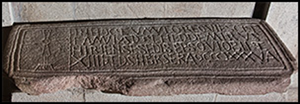
Despite the role of Teodomiro in the history of global Christian pilgrimage, the story of St James's discovery was viewed as a mixture of fact and fiction for centuries, with many doubting the existence of this bishop from Iria Flavia (Carro Otero & Varela Ogando Reference Carro Otero and Varela Ogando1982; Guerra Campos Reference Guerra Campos1982). However, in 1955, a team led by the archaeologist Manuel Chamoso Lamas, undertaking rescue work on the floor of the Cathedral of Santiago de Compostela discovered an inscribed tombstone referring to the bishop Teodomiro (Figure 2) and, beneath it, the fragmentary remains of an elderly male individual, who was quickly assumed to be Teodomiro himself (Chamoso Lamas Reference Chamoso Lamas1957; Guerra Campos Reference Guerra Campos1982). Nevertheless, these claims were challenged decades later, after osteoarchaeological reassessment concluded that the bones were those of an elderly female buried in a different tomb altogether (Carro Otero & Varela Ogando Reference Carro Otero and Varela Ogando1982). Here we combine osteoarchaeological analysis, radiocarbon (14C) dating, multi-isotope analysis and aDNA analysis in the first multi-strand study of these remains. Our results lend support to the argument that this individual is likely to be Bishop Teodomiro, emphasising the vital role of the archaeological sciences in elucidating the identification of historical figures, whether by affirmation or refutation (King et al. Reference King2014; Kostova et al. Reference Kostova, Popkonstantinov, Schroeder, Willerslev, Sultanov, Kazan and Higham2020), and, when undertaken within an ethical framework, in enriching our understanding of the past and the individuals who inhabited it.
Tombstone or lid of the sarcophagus of Bishop Teodomiro of Iria Flavia discovered by Chamoso Lamas in 1955. The inscription on it reads: IN HOC TVMVLO REQVIESCIT FAMULUS DI THEODEMIRVS HIRIENSE SEDIS EPS QVI OBIIT XIII KLDS NBRS ERA DCCCLXXXV (In this tomb rests the servant of God Teodomiro, Bishop of the See of Iria, who died on the 13th of the Kalends of November in the year 885) (© Fundación Catedral de Santiago).

Archaeological and historical context
The bishopric of Iria Flavia was one of the few that remained following the Islamic conquest of the Iberian Peninsula (AD 711–726) (Rodríguez Reference Rodríguez2010; López Alsina Reference López Alsina2013). The north-western Iberian Peninsula witnessed the migration of priests from other parts of Hispania in the second half of the first millennium AD (Pérez-Ramallo et al. Reference Pérez-Ramallo2022a), and the ‘discovery’ of St James gave regional rulers a figurehead for asserting claims of territorial cohesion. This was a mechanism of union with the rest of the Christian kingdoms of western Europe, and a symbol of the fight against the Califate of Al-Andalus (Sulai Capponi Reference Sulai Capponi2006; Portela Silva Reference Portela Silva2009; López Alsina Reference López Alsina2013). Nevertheless, beyond the legends collected centuries later about Teodomiro's divine revelation and subsequent discovery of the supposed remains of St James—as well as two of the Apostle's disciples, Theodosius and Athanasius—little is known about the bishop's life. Indeed, the discovery of the inscribed tombstone beneath the cathedral floor in 1955 was the first time his existence became more confidently accepted (Figure 2) (Chamoso Lamas Reference Chamoso Lamas1957; Carro Otero & Varela Ogando Reference Carro Otero and Varela Ogando1982; Guerra Campos Reference Guerra Campos1982).
This stone not only confirmed the existence of an individual elsewhere recorded as being crucial in shaping the Christian geography of western Europe, it also provided an exact date for his death (20 October AD 847). A 0.80m layer of rubble fill from the destruction of the basilica of Alfonso III (AD 872–1075) separated the tombstone from a collection of disarticulated human bones that appeared to be a secondary deposition, moved from its original place of burial (Figures 3–5) (Chamoso Lamas Reference Chamoso Lamas1957). Initial interpretation of this deposit, as the product of the disturbance of tombs following the construction of a new religious centre in the twelfth century (Guerra Campos Reference Guerra Campos1982), is corroborated by more recent research carried out at the medieval necropolis of Santiago Cathedral (Pérez-Ramallo et al. Reference Pérez-Ramallo2022a). This construction also impacted the tomb of Teodomiro, relocating his remains and possibly elevating the tombstone to match the new height of the cathedral floor and better indicate the resting place of the bishop (Figure 3) (Chamoso Lamas Reference Chamoso Lamas1957). Historical sources and recent archaeological research document that members of the population with a high religious or socioeconomic status were buried in the same area, hence the inclusion of further tombstone lids from other historical and religious personalities (Guerra Campos Reference Guerra Campos1982; Pérez-Ramallo et al. Reference Pérez-Ramallo2022a) (Figure 4).
Digitisation of the stratigraphic profile drawing by Chamoso Lamas (Reference Chamoso Lamas1957). A) south façade of the Basilica of Alfonso III; B) tombstone or lid of the sarcophagus of Bishop Teodomiro; C) base of the south façade of the Basilica of Alfonso III; D) first fragment of decorated bone plaque; E) second fragment of decorated bone plaque; F) rubble fill following the destruction of the Basilica of Alfonso III; G) tombstone or sarcophagus lid covering the ossuary; H) ossuary pit where the supposed remains of Teodomiro were found; I) brick tomb (figure by authors).

Digitalisation of the map made by Chamoso Lamas (Reference Chamoso Lamas1957) of the place where the tombstone or sarcophagus lid of Bishop Teodomiro was found. A) tombstone or sarcophagus lid of Bishop Teodomiro of Iria Flavia (died AD 847); B) tombstone or sarcophagus lid of Vidramirus (died AD 1058); C) tombstone or sarcophagus lid of Anastasius (died AD 985) (figure by authors).

Current state (November 2021) of the place where the supposed remains of Bishop Teodomiro were found in a secondary position (photograph by Patxi Pérez-Ramallo).

In 1955, after a meticulous extraction, the bones were subjected to an osteological study by Professor Carreró, who concluded that they probably came from an old adult male (Chamoso Lamas Reference Chamoso Lamas1957). This, together with the archaeological context and the discovery of the sarcophagus cover, led Chamoso Lamas and his collaborators to proclaim that these were the remains of Teodomiro of Iria Flavia (Chamoso Lamas Reference Chamoso Lamas1957; Guerra Campos Reference Guerra Campos1982). Almost 30 years later, however, an osteological reassessment based on photographs taken during the previous study—since access to the bones had not been permitted—concluded that the remains were actually those of a 50–70-year-old woman. This reassessment argues that the remains were in a primary position, rather than in a secondary position as suggested by Chamoso Lamas in 1955. Therefore, they relate to an anonymous tomb, not to an ossuary where the bishop's remains were probably placed during the construction of the Romanesque cathedral (Carro Otero & Varela Ogando Reference Carro Otero and Varela Ogando1982). Since this reassessment, controversy regarding the identification of the tomb and the human remains associated with it has persisted. Here, we present the first analysis of the bones combining osteological and biomolecular techniques, with the aim of establishing a detailed biological profile of the individual and providing new insights into their chronology, geographical origin, diet and social status. Comparison of these data with the available historical and archaeological context will help to clarify whether these remains belong to the discoverer of the supposed tomb of St James the Apostle in Santiago de Compostela (Galicia, Spain).
Materials and methods
We performed a renewed osteoarchaeological analysis of the human bones associated with Teodomiro's tombstone (NCS200), discovered in 1955, estimating the minimum number of individuals and the age and sex of the uncovered remains. Two incisors, a premolar and a rib were taken for stable isotope analysis, radiocarbon dating and aDNA analysis. Full descriptions of the methods and background to these analyses are in the online supplementary material (OSM).
Osteoarchaeological analysis
Macroscopic observation of the bones was conducted using the naked eye and a magnifying lens. However, the analysis was limited by the number of conserved bone elements; only 39 of the remaining 90 elements were identifiable. Furthermore, the bones, though relatively better preserved than those of other individuals from the same medieval necropolis (Pérez-Ramallo et al. Reference Pérez-Ramallo2022a), exhibited signs of taphonomic changes, with abrasion/erosion scores ranging between 1 and 2 (McKinley Reference McKinley, Brickley and McKinley2004) (Figure 6). The minimum number of individuals represented by the bones is confirmed as one (after White Reference White1953) and determination of biological sex and estimations of age were made using established morphological criteria of the skull and tooth wear (Brothwell Reference Brothwell1981; Meindl & Lovejoy Reference Meindl and Lovejoy1985; Buikstra & Ubelaker Reference Buikstra and Ubelaker1994; Walker Reference Walker2008). We used broad ranges for age estimation following Buikstra & Ubelaker (Reference Buikstra and Ubelaker1994): young adult (20–35), middle adult (35–49) and old adult (>50). The full list of remains can be found in the OSM.
Bone elements preserved from individual NCS200. Image taken in the Cathedral of Santiago de Compostela in November 2019. The remains could only be examined for a few hours as a result of the transfer of the remains and the remodelling of the interior of the church (photograph by Patxi Pérez-Ramallo).

Radiocarbon dating
One rib fragment was used to establish an absolute chronology for the individual and to compare the result with historical and archaeological sources (e.g. Historia Compostelana), which state that Teodomiro was a bishop of Iria Flavia from AD 819, at the earliest, until 847 (Rodríguez Reference Rodríguez2010), the year of his death as indicated by his sarcophagus lid (Figure 2). This sample was analysed at the Oxford Radiocarbon Accelerator Unit (ORAU), Oxford, UK. The full protocol and standards used are reported in the OSM. Radiocarbon determinations were calibrated using OxCal v4.4 and the IntCal20 calibration curve (Bronk Ramsey Reference Bronk Ramsey2017; Reimer et al. Reference Reimer2020).
Stable isotope analysis
A rib fragment was sampled for carbon (δ13C) and nitrogen (δ15N) bone collagen stable isotope values, and the enamel of the lower right first premolar was sampled for oxygen (δ18Oap) and carbon (δ13Cap) isotopic values of tooth bioapatite, to provide information regarding the social status and geographic origin of individual NCS200 (Pérez-Ramallo et al. Reference Pérez-Ramallo2022a). Stable isotope analysis was undertaken at the Max Planck Institute of Geoanthropology, Jena, Germany. A summary of the methods, protocol and standards used is available in the OSM.
Ancient DNA
Genetic variation among humans in Europe shows strong geographic structuring that has been present since at least the Iron Age (Novembre et al. Reference Novembre2008; Antonio et al. Reference Antonio2024). By comparing genome-wide data from archaeological and modern individuals it is possible to make inferences about human origins, migrations and admixture in the past (Patterson et al. Reference Patterson2012). Such analysis is robust as it reflects hundreds of thousands of genetic markers that can also provide information regarding phenotypic traits (e.g. Jobling et al. Reference Jobling, Hurles and Tyler-Smith2013), but generational reshuffling and drift make tracing kinship beyond eight generations using genomic data almost impossible. Here, we use genomic data to confirm the sex of this individual (after Skoglund et al. Reference Skoglund, Storå, Götherström and Jakobsson2013), and to investigate their possible geographic origins. Both upper right incisors were sampled in the aDNA facilities at the Centre for Palaeogenetics (CPG), Stockholm University, Sweden. The full protocol and standards used are reported in the OSM.
Results
Osteoarchaeology, stable isotopes and radiocarbon dating
The results of the osteoarchaeological analysis demonstrate that the human remains belonged to a single individual identified as an old adult male with a gracile build. Assessments of ectocranial suture closure (Meindl & Lovejoy Reference Meindl and Lovejoy1985) and dental wear (Brothwell Reference Brothwell1981) provide age estimations of 45.2±12.6 and >45 years, respectively. The radiocarbon dating results suggest that the bones date to the period cal AD 673–820 (Table 1). The stable isotope analyses of NCS200 yielded values of +10.2‰ for δ15N, –19.6‰ for δ13C, –2.9‰ for δ18Oap and –10.8‰ for δ13Cap (Table 1, Figures 7 & 8).
δ13C, δ15N, δ18Oap and δ13Cap stable isotope ratios, collagen quality indicators and radiocarbon dating results for NCS200.

δ13C and δ15N of NCS200 and the fauna and humans analysed in the medieval necropolis of the cathedral of Santiago de Compostela (NCS), and the Rocha Forte castle (RF) in Santiago de Compostela (Pérez-Ramallo et al. Reference Pérez-Ramallo2022a). S-NCS – samples from coetaneous individuals to NCS200 buried at the medieval necropolis of Santiago de Compostela in tombs with similar characteristics (figure by authors).

δ13Cap and δ18Oap of NCS200 and the fauna and humans analysed in the medieval necropolis of the cathedral of Santiago de Compostela (NCS), and the Rocha Forte castle in Santiago de Compostela (Pérez-Ramallo et al. Reference Pérez-Ramallo2022a). S-NCS – samples from coetaneous individuals to NCS200 buried at the medieval necropolis of Santiago de Compostela in tombs with similar characteristics (sarcophagus) (figure by authors).

Whole genome analysis
We generated whole autosomal genome data for individual NCS200, at a coverage of 1.8x. The average fragment length and deamination patterns at both ends of each read confirm the ancient nature of the genomic data (Table 2). Mitochondrial (Green et al. Reference Green2008) and X-chromosome (Korneliussen et al. Reference Korneliussen, Albrechtsen and Nielsen2014) contamination estimates indicate that the levels of contamination are negligible (Table 2). The biological sex of the individual is determined to be male (after Skoglund et al. Reference Skoglund, Storå, Götherström and Jakobsson2013).
Summary of sequencing statistics, contamination estimates and uniparental marker haplogroup assignment.

We projected NCS200 together with published Iberian and Canary Island individuals from the Iron Age to the late medieval period (Rodríguez-Varela et al. Reference Rodríguez-Varela2017; Olalde et al. Reference Olalde2019) onto the first two principal components of modern west Eurasian and north African populations using the dataset 1240K+HO from the Allen Ancient DNA Resource (v. 54.1.p1; Mallick et al. Reference Mallick2024) (Figure 9A). Results of this principal component analysis indicate that NCS200 lies outside modern European variation towards the direction of modern north African populations and close to Roman Iberians, south Iberian Visigoths and Iberian Islamic individuals (Figure 9A). Unsupervised ADMIXTURE analyses (see OSM) confirm these observations (K=5), where NCS200 has similar levels of the European-like (purple), north African-like (orange) and Middle East/Caucasus-like (blue) components as other Roman Iberians, south Iberian Visigoths and Islamic Iberians (Figure 9B). The relatively high percentage of north African-like components in these groups, compared to Iron Age Iberians, north Iberian Visigoths, and Iberian Carolingians, suggests that their ancestors may have received north African gene flow during the Roman period or, more recently, during or after the Islamic conquest.
Genetic data from individual NCS200 and other ancient individuals (Rodríguez-Varela et al. Reference Rodríguez-Varela2017; Olalde et al. Reference Olalde2019). A) data projected onto the first two principal components of modern West Eurasians; B) admixture analyses (figure by authors).

Discussion
Given the osteoarchaeological assessment of a 45 years plus age at death, an assumption that the remains correspond to Teodomiro could mean that he was appointed bishop at an early stage. A minimum age of 30 was expected for the nomination of a bishop, although it was not usually respected (e.g. Saint Rosendo, bishop of Mondoñedo; Sáez Reference Sáez1948). Isotopic values for NCS200 were compared with those obtained from other individuals (n = 25) from the medieval necropolis of the Cathedral of Santiago de Compostela (ninth to twelfth centuries AD) (Figure 7). These individuals produced a δ15N isotopic range of +8.7 to +12.3‰ (mean ± SD = +10.9±0.8‰), a δ13C range of –20.0 to –16.0‰ (mean ± SD = –17.8±0.8‰) and a δ13Cap range (n = 17) of –14.2 to –6.4‰ (mean ± SD = –10.2±2.2‰) (Pérez-Ramallo et al. Reference Pérez-Ramallo2022a). NCS200 falls towards the lower end of both carbon and nitrogen ranges, suggesting a mixed C3 plant and animal protein-based diet, with consumption of marine and/or C4 plant proteins but with a lower input of animal proteins than would be expected for the social status afforded a bishop (see Pérez-Ramallo et al. Reference Pérez-Ramallo2022b).
The δ18Oap of NCS200 (–2.9‰) falls within the local range (–4.2 to –2.9‰; mean ± SD = –3.6±0.6‰; Pérez-Ramallo et al. Reference Pérez-Ramallo2022a) (Figure 8). The enamel of the lower right first premolar begins to develop between two to three years of age and is fully formed by 6–7 years (AlQahtani et al. Reference AlQahtani, Hector and Liversidge2010). Teodomiro would have resided in Iria Flavia, approximately 20km south-west of the Cathedral of Santiago de Compostela (Figure 1), at least since his appointment as bishop in about AD 819. If NCS200 is indeed Teodomiro, our results would imply that he also spent his early years in the area, or at least in the wider region of northern Spain with similar δ18Oap values. While the broad scale of δ18O variability must urge caution in assigning specific locations to given sampled individuals, and would ideally be cross-checked with strontium isotope analysis, we might carefully suggest a life history for NCS200 focused around this part of the Iberian Peninsula.
Individuals from the Santiago de Compostela sample previously classified as local religious and social elites produced δ15N values ranging between +11.4 to +12.3‰ (mean ± SD = +11.9±0.4‰), δ13C values ranging from –18.4 to –17.2‰ (mean ± SD = –17.6±0.5‰) (Figure 7), and δ13Cap values between –14.2 and –8.7‰ (mean ± SD = –11.3±2.3‰) (Figure 8) (Pérez-Ramallo et al. Reference Pérez-Ramallo2022a). The δ15N and δ13C values for NCS200 are lower than other individuals buried in the same area of the necropolis, although it should be noted that many of these individuals date to later periods in the history of Santiago de Compostela. The measured δ15N and δ13C values for individuals with a similar date to NCS200 and also buried in stone sarcophagi—δ15N (n = 2) values of +10.3‰ and +10.3‰; δ13C values (n = 2) of –20.0 and –18.4‰, and δ13Cap values (n = 5) ranging between –14.2 to –8.4‰ (mean ± SD = –11.8±2.3‰) (Figures 7 & 8)—are much more comparable to the values for NCS200, perhaps indicating the need to consider particular social and historical contexts in such comparisons.
Archaeological and isotopic values from Santiago de Compostela suggest that the economic context of the second half of the ninth century AD was much humbler than that of the eleventh or twelfth centuries (Pérez-Ramallo et al. Reference Pérez-Ramallo2022a). It is also possible that NCS200 followed the rules of Saint Fructuous—present in the north-west of the peninsula since the middle of the seventh century AD—which stated that a monk's diet should focus on bread and wine, accompanied by vegetables, legumes and fruits, with a strict avoidance of meat, especially from quadrupedal animals (Andrade Cernadas Reference Andrade Cernadas2009).
Several factors must be considered when interpreting the radiocarbon dating results, which are crucial to the potential identification of NCS200 as Teodomiro. First, the sample dated was a rib fragment, which has a rapid bone turnover rate of 10–15 years (Bartelink & Chesson Reference Bartelink and Chesson2019). Therefore, the collagen used for dating was formed between 10 and 15 years before the death of NCS200. In addition, direct or indirect consumption of marine proteins can result in a ‘reservoir effect’, with the resultant reduced 14C concentrations of aquatic consumers leading to ‘older’ radiocarbon age determinations (Keaveney & Reimer Reference Keaveney and Reimer2012; Cook & van der Plicht Reference Cook, van der Plicht, Elias and Mock2013; Jull et al. Reference Jull, Burr and Hodgins2013; Reimer et al. Reference Reimer2013; Fernandes et al. Reference Fernandes, Grootes, Nadeau and Nehlich2015). The δ15N, δ13C and δ13Cap results for NCS200 hint at the possibility that marine proteins may have formed a portion of their diet (Table 1, Figures 7 & 8), albeit a smaller portion than for some high social status individuals at the same site (Pérez-Ramallo et al. Reference Pérez-Ramallo2022a).
As a result, we cannot exclude the impact of the marine reservoir effect or bone turnover on the radiocarbon analysis results. Therefore, while the calculated age (cal AD 673–820) is close to, but not precisely the same as, the documented year of Teodomiro's death (AD 847), it is consistent with NCS200 being Teodomiro if such impacts are taken into account. Moreover, Teodomiro is likely to have been one of the first people buried in the surroundings of the first chapel, which was built by order of Alfonso II (AD 820/830–872) within a sparsely populated area that only later went on to experience growth (López Alsina Reference López Alsina2013; Pérez-Ramallo et al. Reference Pérez-Ramallo2022a). The radiocarbon result confirms that, to date, NCS200 is the oldest-dated individual in the entire medieval necropolis of the Cathedral of Santiago de Compostela (Pérez-Ramallo et al. Reference Pérez-Ramallo2022a).
The aDNA results confirm that NCS200 is male, resolving the historic osteological uncertainty and aligning with an identification as Teodomiro. From a historical perspective, several hypotheses are compatible with the genetic ancestry of NCS200 if the assumption is made that this individual is Teodomiro. During the High Middle Ages, Galician bishops were members of the social aristocracy, and in charge of interacting with the monarch (Portela Silva Reference Portela Silva2009). Teodomiro's genetic origin could come from demographic interactions that may have occurred between the Hispano-Roman and Visigothic elites, or even from mixing between Christian and Islamic elites after the conquest in the south/central regions of Iberia. It has been suggested that several of the individuals analysed in the necropolis of the Cathedral of Santiago and identified as non-local based on strontium and stable oxygen isotope analyses, may have come from the central and southern Iberian Peninsula (Pérez-Ramallo et al. Reference Pérez-Ramallo2022a). Historical documents mention individuals emigrating from north Africa and Al-Andalus to the north-west of the peninsula, such as Bishop Odoario, who restored the nearest see of Lugo in the eighth century AD and was originally from north Africa (Carriedo Tejedo Reference Carriedo Tejedo2022). Therefore, it is possible that Teodomiro's ancestry is connected to the emigration of Christians from Al-Andalus into the Kingdom of Asturias, highlighting the complexity of ancestry among the elites and clergy of the Christian kingdoms which blurs assumed social distinctions between Christians and Muslims.
Conclusions
Application of a combination of bioarchaeological techniques is helping to unravel many of the issues surrounding the possible remains of Bishop Teodomiro, whose very existence was debated until the discovery of his tombstone. Despite the limitations, and the caution that must be exercised in interpreting our results, these data support the possibility that the human remains found in association with the inscribed tombstone under the floor of the Cathedral of Santiago de Compostela in 1955 are those of Bishop Teodomiro. Osteoarchaeological, aDNA and stable isotope analyses suggest that the remains are those of an elderly adult male individual, who probably grew up in the area around Santiago de Compostela or in a place of geographical or climatic proximity—something expected from a bishop who resided nearby at Iria Flavia (Padrón). Dietary isotope values for NCS200 suggest a low intake of animal protein, similar to contemporaneous individuals from tomb burials at the necropolis the Cathedral of Santiago de Compostela, which could reflect the humble situation of the place after the discovery of the supposed remains of St James the Apostle, or else the following of monastic rules limiting the consumption of meat. Radiocarbon dating results, although not overlapping with the recorded date of death (AD 847), confirm the age of the remains and, given the potential for the confounding influence of a marine reservoir effect and/or bone turnover, are broadly consistent with the possibility of NCS200 being Bishop Teodomiro.
Whole genome sequencing revealed a significant north African contribution to the ancestry of NCS200, which could correspond to a Roman north African ancestry or more recent Al-Andalus admixture. The latter hypothesis would highlight the complex social and demographic interactions of Christian and Islamic populations in the Iberian Peninsula between the eighth and ninth centuries AD. Further archival research, aDNA and strontium isotope analyses of additional individuals are required to distinguish between these possibilities. Our results further highlight the importance of ethical considerations when examining human remains of historical personages and the ways in which narratives built around them may reflect social constructs from the present as easily as those from the past. Through respectful treatment, close incorporation of historical and archaeological data, and application of multidisciplinary approaches within a framework of cooperation with local institutions and clear, question-driven research, we can begin to reveal more details about the lives of people in the past.
In this case, the data support the existence of the historical figure of Teodomiro, so relevant within the phenomenon of the Camino de Santiago as the discoverer of the tomb of St James the Apostle and two of his disciples. This information will contribute directly to the conservation of the remains and promote a special place of worship in the Cathedral of Santiago, enriching visits to the temple and the city, as Teodomiro represents a key figure not only for the history of Santiago de Compostela, Galicia, but also for Spain, Europe and Catholicism. Nevertheless, our research highlights the potential complexity of his background and signifies another example of the interaction of archaeological science with religious traditions to help verify or resolve faith-related historical questions and develop more nuanced insights into past individuals. We hope to demonstrate that historians and archaeologists with a focus on religion in the past should see bioarchaeology as a complementary, rather than a contradictory, avenue of investigation.
Data availability
Genomic data deposited in the European Nucleotide Archive (ENA), accession number (PRJEB65358).
Acknowledgements
The authors extend their special gratitude to the Oxford Radiocarbon Accelerator Unit (ORAU), University of Oxford; Jo Sindre Eidshaug, NTNU, for his help; the Fundación Catedral de Santiago and the Cathedral of Santiago de Compostela for allowing access to the samples and, for their support throughout the research, special thanks to Daniel Lorenzo Santos and Dr Ramón Yzquierdo Peiró.
Funding statement
This project has been supported by a grant to Patxi Pérez Ramallo funded by the European Union-Next Generation EU, Margarita Salas Fellowship, Ministerio de Universidades, University of the Basque Country UPV/EHU. Patxi Pérez-Ramallo and Patrick Roberts would also like to thank the Max Planck Society for funding for this project. The authors acknowledge support from the National Genomics Infrastructure in Stockholm funded by Science for Life Laboratory, the Knut and Alice Wallenberg Foundation and the Swedish Research Council, and SNIC/Uppsala Multidisciplinary Center for Advanced Computational Science for assistance with massively parallel sequencing and access to the UPPMAX computational infrastructure. We used resources from projects NAISS 2023/23-75 and NAISS 2023-22-156. This research was supported by the Swedish Research Council project ID 2019-00849_VR and ATLAS (Riksbankens Jubileumsfond).
Supplementary material
To view supplementary material for this article, please visit https://doi.org/10.15184/aqy.2024.91.


 Open access

