


By pitting individuals [and companies] against one another within the survival-of-the-fittest atmosphere, narrators of the traditional approach to capitalism foster the notion of competition as a prerequisite to capitalist society … The focus on competition rather than cooperation is mistaken.
Great problems demand great solutions, rationally achieved by cooperation.
Nordic companies demonstrate a distinct approach to stakeholder cooperation that has proven effective in addressing complex sustainability challenges. The cooperative Nordic business ethos forms the foundation of what R. Edward Freeman and I term the “Nordic cooperative advantage” – defined as the “general tendency for companies in a Nordic context to implement a value-creating strategy based on cooperating with their stakeholders that results in robust value creation for the companies and their stakeholders.”Footnote 1
Tackling sustainability challenges like those represented by the SDGs demands effective stakeholder engagement, and the willingness and ability of Nordic companies to cooperate with their stakeholders has produced remarkable results in sustainability performance. Denmark-based firms have been recognized as the “World’s Most Sustainable Company” five times between 2005 and 2024 in the Global 100 list – more than any other nation, despite Denmark’s small size.Footnote 2 The 2024 Time and Statista list included 12 percent Nordic-based companies versus 23 percent US-based firms in its top 500. Adjusted for size, Nordic companies were over five times more likely to be recognized for their sustainability performances.Footnote 3
The Nordic approach distinguishes itself by embedding cooperation into corporate practice rather than treating stakeholder engagement as merely additive to strategy. This distinction, rooted in unique historical and institutional developments, produces comparatively strong sustainability outcomes.
Theoretical Foundations: The Rhenman Stakeholder Framework
The Swedish Institute for Administrative Research (SIAR) formalized the theoretical foundations of Nordic stakeholder engagement in the early 1960s, articulating principles embedded in Nordic business culture.Footnote 4 Under Eric Rhenman’s leadership, SIAR developed conceptions of cooperative business-society relationships taught across the Nordic region and beyond. The institute’s influence attracted global thought leaders like Henry Mintzberg, who later described this period as “a kind of golden age in Swedish management writing.”Footnote 5
Rhenman’s 1964 work Företagsdemokrati och Företagsorganisation introduced the Swedish term interessent (meaning “somebody having an interest”).Footnote 6 When this work was translated and published in English in 1968 as Industrial Democracy and Democracy Management, interessent was explicitly translated to “stakeholder,” marking the first appearance of the term. “Stakeholder” appeared in management literature accessible to scholars worldwide, predating any American publications.Footnote 7
The Rhenman Stakeholder Framework
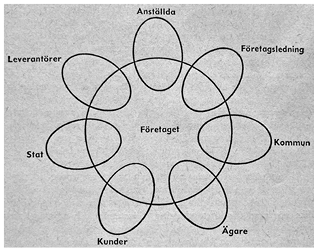
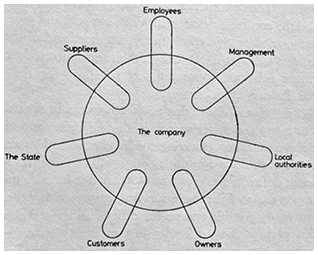
Rhenman’s stakeholder framework departed from the corporate-centric view of business by conceptualizing the firm as a network of mutually dependent relationships. His stakeholder map – first published in Swedish in 1964 (see Figure 6.1) and translated into English in 1968 (see Figure 6.2) – was the first visualization of a stakeholder map to appear in management literature worldwide.
Stakeholder map (Rhenman, 1964).
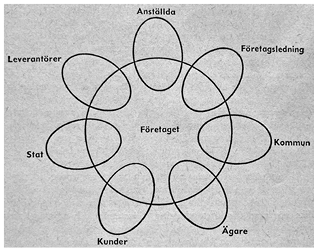
Figure 6.1 Long description
This conceptual diagram is the original 1964 stakeholder map developed by Eric Rhenman. It consists of eight interlocking ovals arranged in a circular formation around a central oval labeled Företaget, the company.
Surrounding the company are the following stakeholder groups, clockwise from top:
- Anställda, employees in English
- Företagsledning, corporate management in English
- Kommun, municipality in English
- Ägare, owners in English
- Kunder, customers in English
- Stat, state in English
- Leverantörer, suppliers in English
Each stakeholder group is shown in an oval that overlaps partially with the central company oval and with its neighboring ovals, visually representing the interdependence between the company and its various stakeholders, as well as among the stakeholders themselves. This non-hierarchical and interconnected layout reflects Rhenman’s Nordic stakeholder philosophy, emphasizing mutual responsibility and cooperation rather than competition.
Stakeholder map (Rhenman, 1968).
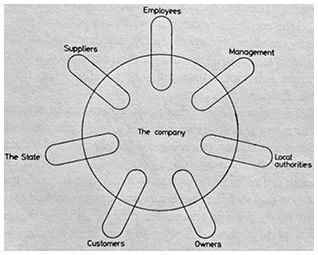
Figure 6.2 Long description
Conceptual diagram presents Eric Rhenman’s 1968 stakeholder map. A large circle labeled The company is placed at the center. Radiating outward from the central circle are seven capsule-shaped ovals, each partially overlapping with the company and pointing outward toward labeled stakeholder groups.
Clockwise from the top:
- Employees
- Management
- Local authorities
- Owners
- Customers
- The State
- Suppliers
Each stakeholder is connected to the company with partial overlap, suggesting mutual dependency. The design reflects a circular, nonhierarchical arrangement, visually underscoring the idea that stakeholders and the company are interdependent rather than the company being dominant or separate.
This visualization preserves the cooperative ethos of Rhenman’s 1964 version while offering a cleaner, more symmetrical layout adapted for the English-language publication Industrial Democracy and Democracy Management.
Rhenman’s stakeholder maps depicted the company and its stakeholders through a series of overlapping ellipses, visually emphasizing the interdependence and mutual interests between the firm and its stakeholders. Rather than placing the corporation at the center of a hub-and-spoke model, as most subsequent visualizations would do, Rhenman’s framework portrayed an interconnected network where the company existed as one node within a broader web of relationships.
This visualization reflected core Nordic cultural values, emphasizing cooperation and mutual interdependence over hierarchy and competition. Throughout the 1960s, 1970s, and 1980s, Rhenman’s stakeholder framework achieved what scholars have termed “hegemonic status” in Nordic management academia, fundamentally shaping how Nordic companies approached stakeholder relationships.Footnote 8 Rhenman’s theoretical contributions emerged from and reinforced distinctly Nordic cultural values prioritizing cooperation over competition.
The 1979 publication of Porter’s “Five Forces” model highlighted the stark contrast between Nordic and American approaches. While Rhenman emphasized cooperation and mutual value creation, Porter’s deeply influential framework cast stakeholders as competitive threats to be managed. This fundamental difference shaped how managers viewed relationships with suppliers and employees – as either cooperative partners or sources of competitive tension.
This stark contrast in approaches reflected deeper cultural and philosophical differences in how businesses understood their stakeholder relationships. While Porter’s model reinforced an adversarial mindset, Rhenman’s framework suggested that stakeholder relationships represent opportunities for collaborative problem-solving and shared value creation.
Nordic versus US Corporate Models: Key Structural Differences
The Nordic cooperative advantage stems from institutional structures and cultural norms that differ from the US model in power distribution, long-term orientation, and stakeholder relations. These differences explain why voluntary US commitments to stakeholder capitalism often fail.
While US governance concentrates power in shareholders and executives, Nordic structures distribute it across stakeholders through three mechanisms: enterprise foundations buffering market pressures, codetermined governance giving labor formal voice, and institutionalized stakeholder engagement processes.
The long-term orientation between these corporate models reveals another crucial distinction. US companies operate under intense capital market pressures for quarterly performance metrics, leading to what management scholars have termed “short-termism.” In contrast, Nordic companies benefit from institutional structures – particularly enterprise foundations – that buffer against such short-term pressures. These foundations, holding majority voting rights in perpetuity, enable corporate governance oriented toward long-term value creation and sustainable business practices. This institutional protection, combined with cultural expectations of corporate stewardship, facilitates the pursuit of ambitious sustainability initiatives that short-term market pressures might otherwise curtail.
The models further diverge in their fundamental conceptualization of stakeholder relationships. US companies, influenced by Porter’s competitive forces framework, traditionally approach stakeholder relationships through a lens of power dynamics and potential conflict. Nordic companies, drawing from Rhenman’s theoretical foundations, institutionalize stakeholder cooperation through formal mechanisms and cultural norms that emphasize mutual value creation. This orientation toward cooperative stakeholder engagement helps explain the documented outperformance of Nordic companies on quantitative sustainability metrics compared to their US counterparts.
Nordic Companies: Stakeholder Approach in Practice
The theoretical principles of the Nordic cooperative advantage – institutional support for stakeholder engagement, cultural norms favoring cooperation, and structures enabling long-term thinking – manifest distinctly in corporate practice. The following case studies illustrate how these principles translate into organizational behavior and strategic decision-making. Each case demonstrates different aspects of how Nordic institutional structures and cultural norms enable companies to pursue stakeholder cooperation more effectively than their global counterparts. Particularly noteworthy is how these companies connect stakeholder engagement to concrete sustainability outcomes aligned with the SDGs.
The case selection reflects three key considerations: sector diversity and associated sustainability challenges, distinctive manifestations of stakeholder cooperation, and contributions to specific SDGs. We begin with Ramboll, which exemplifies the core elements of Nordic capitalism discussed throughout this book. The subsequent cases then explore specific aspects of the Nordic cooperative advantage in greater detail.
Rambøll
Denmark-based Ramboll exemplifies Nordic stakeholder cooperation through both structure and practice. The company is almost entirely owned by the Ramboll Foundation, an enterprise foundation ownership model common across the Nordic region that supports long-term value creation anchored in ethical commitments. As the Ramboll Foundation affirms in Our Legacy, it is “deeply rooted in the Nordic tradition,” a tradition of social cohesion, equality, trust, and respect for human dignity. These values reflect the humanistic outlook of Ramboll’s founders, Børge Johannes Rambøll and Johan Georg Hannemann, who believed business should serve society and its employees.Footnote 9 Through an approach of “purposeful ownership,” the Ramboll Foundation safeguards the company’s long-term orientation while embedding it in a higher-order purpose of responsibility, providing an archetypal example of the Nordic cooperative advantage.Footnote 10
Ramboll’s ownership structure through the Ramboll Foundation enables the patient capital and long-term orientation characteristic of Nordic firms. The foundation describes this as “purposeful ownership,” which helps buffer against short-term market pressures, allowing Ramboll to make decisions aligned with its expressed purpose of creating “sustainable societies where people and nature flourish.” The foundation structure supports Ramboll’s commitment to reinvesting profits into research, employee welfare, and sustainability initiatives rather than maximizing short-term shareholder returns.Footnote 11
Democracy is embedded in Ramboll’s governance structure, with employees having direct representation on the board through democratic elections. This reflects the Nordic understanding that capitalism functions better when power is distributed throughout an organization rather than concentrated at the top. Through this democratic structure, employees have a meaningful voice in strategic decisions that affect both their work and the company’s broader societal impact.
The company’s approach to sustainability exemplifies how democratic capitalism can effectively address complex challenges through stakeholder cooperation. Rather than treating sustainability as an add-on CSR initiative, Ramboll has embedded sustainability throughout its business model and operations through four “Unifying Sustainability Themes”: decarbonization for net zero, resilient societies and livability, resource management and circular economy, and biodiversity and ecosystems. These themes directly support multiple SDGs, including SDG #11 “Sustainable Cities and Communities,” SDG #13 “Climate Action,” and SDG #15 “Life on Land.” Its “Partner for Sustainable Change” strategy demonstrates how companies can systematically engage stakeholders to drive progress on these sustainability goals while maintaining business success. For example, Ramboll actively works to decarbonize industries, improve infrastructure resilience, and restore ecosystems while generating strong financial returns.
Ramboll’s humanistic leadership approach manifests in how it engages employees and broader society. The company emphasizes creating an inclusive workplace with a sense of belonging that reflects its commitment to society. This approach connects to Nordic leadership norms of cooperation, democracy, and power-sharing. Ramboll’s Nordic-rooted approach and structure are emerging as a source of inspiration beyond the region, showing how principles of cooperation, inclusivity, and long-termism – reinforced by the enterprise foundation ownership model – can inform firms globally. While grounded in the Nordic tradition, these values and this ownership model can be adapted and applied in diverse contexts around the world.Footnote 12
The company’s success – growing to over 18,000 employees while maintaining its Nordic values – demonstrates how stakeholder-centered Nordic capitalism can scale internationally while advancing sustainable development. As we examine other Nordic companies, Ramboll provides a compelling example of how Nordic cultural values, ownership structures, and leadership practices combine to enable both business success and societal progress.
IKEA
While Rambøll demonstrates the comprehensive integration of Nordic stakeholder principles, IKEA shows how these principles can be applied to specific global challenges. The company’s evolution illustrates three key manifestations of the Nordic cooperative advantage: Its flat-pack design innovation (1956), its systematic approach to addressing child labor through stakeholder partnerships, and its circular economy initiatives developed through collaborative innovation.Footnote 13
In the 1990s, when confronting the potential of child labor supply chains, IKEA recognized it lacked the competencies and credibility to address this challenge alone. It initiated cooperative partnerships with NGOs like Save the Children, governmental agencies like UNICEF, and suppliers. The Harvard case study “IKEA’s Global Sourcing Challenge” documents how IKEA tackled these issues through its commitment to stakeholder cooperation. Its efforts directly support SDG #8 “Decent Work and Economic Growth.”
Facing criticism about throwaway culture in the 2010s, IKEA committed to full circularity by 2030, partnering with the Ellen MacArthur Foundation and launching its Buy Back & Resell program. This transformation extends to responsible sourcing: as a founding member of the Forest Stewardship Council (FSC), IKEA achieved 98 percent FSC-certified or recycled wood usage by 2020. These initiatives directly support SDG #12 “Responsible Consumption and Production” and SDG #13 “Climate Action.”Footnote 14
LEGO
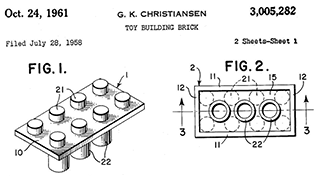
Founded in 1932 in Billund, Denmark, LEGO revolutionized toy manufacturing with the introduction of its interlocking brick system in 1958, for which the US patent is shown in Figure 6.3, a system that remains compatible across generations.
LEGO US Patent.
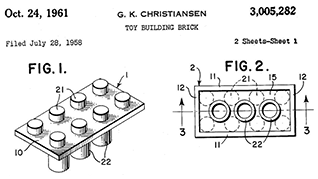
Figure 6.3 Long description
This U.S. patent diagram, filed July 28, 1958, and granted on October 24, 1961, Patent No. 3,005,282, illustrates the design of LEGO's interlocking brick system.
- Left panel, which is figure 1: A perspective view shows a rectangular brick with eight cylindrical studs on top and three internal tubes extending downward. The studs are labeled 21, and the internal tubes are labeled 22. The underside of the brick includes the familiar hollow structure that allows for secure interlocking with other bricks.
- Right panel, which is figure 2: A top-down sectional view of the same brick shows the spatial layout of the three internal tubes labeled 22, aligned beneath the top studs labeled 21. The outlines of eight top studs are also faintly visible, reinforcing the brick's regular 2x4 layout. The diagram is labeled G. K. Christiansen as the inventor and titled Toy Building Brick. It visually documents the engineering of LEGO's foundational design, which remains compatible across generations.
LEGO was born out of a broader Nordic cultural tradition that places high value on childhood as a protected and formative stage of life. Across the Nordic region, play is recognized as a vital foundation for cognitive, social, and emotional development. This ethos is embedded in LEGO’s very name – leg godt, meaning “play well” – and is aligned with Nordic ideals of supporting a good childhood.Footnote 15
LEGO’s approach to innovation and stakeholder engagement reflects core elements of Nordic business culture. This is particularly evident in three key areas: its child-centered development philosophy, its open approach to innovation, and its engagement with critics as partners. The Mindstorms case exemplifies this approach to stakeholder engagement.
When LEGO launched its Mindstorms robotics series in 1998, a hacker cracked the console’s code and posted it, prompting negative commentary on LEGO’s online platform. Rather than issuing lawsuits and shutting down its online platform, LEGO engaged with stakeholders – hackers and customers alike – to create value together.Footnote 16 LEGO adopted an approach of Open Innovation, where external contributors are invited into the innovation process through cooperative engagement and mutual value creation.Footnote 17 This catalyzed a dynamic ecosystem of user-generated content, educational tools, and entrepreneurial activity – and contributed to significant successes for the company.Footnote 18
LEGO products have since become foundational in many schools and learning environments, reinforcing the company’s alignment with SDG #4: Quality Education. In 2020, Forbes declared, “LEGO is probably the biggest education company on Earth,”Footnote 19 and LEGO consistently ranks at the top of corporate responsibility rankings.Footnote 20
Norsk Hydro
Founded in 1905, Norsk Hydro exemplifies the transformation of potentially adversarial relationships into partnerships addressing complex challenges. Operating in regions with significant human rights challenges, the company rejected the typical Western extractive approach in favor of a sustainable operating model emphasizing community engagement.
In 2002, Rolf Lunheim, Norsk Hydro Vice President of Corporate Social Responsibility (CSR), established an innovative partnership with Amnesty International. These organizations shared the goal of improving human rights conditions within the communities in which Norsk Hydro operates. Amnesty International offered Norsk Hydro its expertise by training employees on effectively handling human rights dilemmas in these communities.
Respecting human rights cuts across virtually all the SDGs,Footnote 21 and Norsk Hydro’s partnership with Amnesty International ensures it holds itself accountable to these goals. The current Norsk Hydro CEO describes Amnesty International as a “sparring partner” with whom the company “can discuss the dilemmas we face in a constructive way.”Footnote 22
Coop Danmark
Established in 1896, Coop Danmark has become Denmark’s largest consumer goods retailer, serving one-third of Danish households as members. Its cooperative structure embeds stakeholder principles through democratic ownership and control, with employees frequently participating as members.
Since the mid 1800s, cooperatives have been widely used across the Nordics to organize for-profit companies. The success, scale, and pervasiveness of Nordic cooperatives were the focus of US authors Frederic Howe in Denmark: A Cooperative Commonwealth (1921) and Denmark: The Coöperative Way (1936), and Childs in Sweden: The Middle Way (1936; Chapter 4). Howe remarked that “power is diffused” in Denmark and attributed cooperatives’ pervasiveness as a fundamental reason. He contrasted this to the US with its ever-increasing number of large corporations, accumulating increased concentrations of power and operating in an extractive manner to maximize shareholder profits.Footnote 23 Upon reading Childs’s book, US President Franklin D. Roosevelt sent a presidential commission to the Nordics in 1936 to study cooperatives’ role and draw potential lessons to inform American capitalism. Roosevelt was concerned about the growing concentration of power among a few large US corporations. He saw the cooperative structure as a promising means to disperse power throughout society consistent with democratic principles.Footnote 24
Coop Danmark’s cooperative approach with suppliers challenges traditional extractive relationships. While Western corporations typically source raw materials cheaply from developing regions and perform profitable value-added activities in their home countries, Coop Danmark seeks to create value with supplier communities. This represents a fundamental shift from extractive to cooperative supply chain relationships. In 2011, it began piloting several initiatives in partnership with raw material suppliers – farmers and small-scale cooperatives – in various locations across Africa to determine how it could encourage more value-added activities “at the source.” Coop Danmark recognized the power dimensions of the supply chain where the small farmers had little to no power compared to the large multinational corporations that were purchasing their raw materials. As a democratically organized cooperative, Coop Danmark wanted to address this and support the communities from which their products originated. It also desired to shorten its value chains, increase quality, and strengthen supplier relations through heightened cooperation.
In 2015, Coop Danmark established the African Coffee Roasters organization in collaboration with Kenyan coffee cooperatives, local NGOs, the Danish Embassy, and the Industrialization Fund for Developing Countries. In 2016, this organization built its first roasting facility and began commercial production as Kenya’s certified organic coffee roasting facility. As of 2018, this facility represented $8 million of value-added activities performed in Kenya, directly supporting SDG #8 “Decent Work and Economic Growth.”Footnote 25
After facing significant financial challenges, in 2024, Coop Danmark restructured its ownership in partnership with OK amba, another Danish cooperative. OK became the majority shareholder while Coop Danmark retained its cooperative character through shared governance with Coop amba. This alliance secured the necessary capital for Coop Danmark to continue its operations while maintaining its commitments to democratic ownership and stakeholder engagement.
Carlsberg
Carlsberg is a Danish brewery founded near Copenhagen in 1847 by J. C. Jacobsen. Named for Jacobsen’s son Carl, Carlsberg has become the world’s fourth-largest beer company.Footnote 26 Innovation, cooperation, and openness are keys to its success. In 1883, Emil Christian Hansen, head of the Carlsberg Research Laboratory’s physiology department, made a groundbreaking discovery that led to radical innovations in the brewing industry. Previously, brewing beer often resulted in undrinkable concoctions due to a certain amount of wild yeast in the pitching yeast. Hansen developed a method to isolate a single cell of good yeast and propagated it to make quality beer from every brew. This process would become known as Saccharomyces Carlsbergensis. Beer sickness was a widespread problem, and Carlsberg elected to give away the pure yeast to other local brewers. (This openness directly benefited the launch of new technology in a completely different field: insulin production.)
But Carlsberg did not rest on its laurels of scientific advancement. In 1909, Danish chemist Søren Peter Lauritz Sørensen developed the pH scale, which measures whether a substance is acidic or basic, at Carlsberg Laboratory. A phenomenal development to ensure beer consistency and quality, Carlsberg elected to share the pH scale with the world.Footnote 27 It did not have a business case for doing so – sharing would not lead to more profits in the foreseeable future or provide a competitive advantage – but Carlsberg recognized the significant societal benefits elsewhere, so it shared its scientific development. While making a business case would likely not have been possible then, Carlsberg Laboratory has since become world renowned, attracting the best scientific talent globally.
Presently, Carlsberg continues to innovate in the same spirit of cooperation. In 2015, Flemming Besenbacher, Chairman of the Carlsberg Foundation, publicly announced at the WEF in Davos that Carlsberg would attempt to develop a fully biodegradable paper beer bottle. Carlsberg knew that 40 percent of its carbon footprint was related to packaging materials and that incremental changes to existing packaging would not significantly reduce it. Besenbacher displayed a pilot fiber bottle at the WEF to make a public commitment without knowing how Carlsberg would produce a market-ready bottle – he just knew they had to do it. Facing numerous innovation challenges in developing such a package to ensure food safety, shelf life, withstanding pressure, and biodegradability,Footnote 28 Carlsberg looked for partners.
Carlsberg is not alone in having the bulk of its carbon footprint from packaging, which directly relates to SDG #12 “Responsible Consumption and Production” and SDG #13 “Climate Action.” Instead of looking to “own” resultant innovations, Carlsberg desired to lead the development of a sustainable package that could be used across the entire industry. Therefore, Carlsberg invited worldwide collaboration partners to help create a new sustainable bottle in the spirit of Open Innovation.Footnote 29
Open Innovation is contrasted with the competitive “go it alone” approach characterized by many corporate R&D departments and associated laboratories shrouded in secrecy. Carlsberg developed a partnership with innovation experts ecoXpac and Danish Technical University, supported by Innovation Fund Denmark. Soon after, packaging company BillerudKorsnäs joined the efforts, resulting in the paper bottle company Paboco® – a joint venture between BillerudKorsnäs and bottle-manufacturing specialist Alpla. Paboco® enabled more partners to join the efforts, including The Coca-Cola Company, The Absolut Company, and L’Oréal, thus significantly increasing the potential impact.Footnote 30
Chesbrough, Marcel Bogers, and I coauthored a case study using the Carlsberg example to define the concept of “Sustainable Open Innovation.”Footnote 31 Maximizing profits was not a primary driver behind Carlsberg’s efforts to develop the green fiber bottle. Instead, the company adopted a long-term stewardship approach. Carlsberg is a publicly traded corporation with a unique governance structure in which the associated Carlsberg foundation holds majority voting rights in perpetuity. The Carlberg foundation ownership structure enables Carlsberg to take a much longer-term view than typical US public corporations.Footnote 32
Novo Nordisk
Novo Nordisk, the world’s largest insulin producer, emerged from the 1989 merger of two Danish firms established in the 1920s. Now headquartered near Copenhagen, the company leads in diabetes care and stakeholder engagement. In 2012, Corporate Knights named it the most sustainable company in the world.Footnote 33
Novo Nordisk’s work with the innovative Cities Changing Diabetes took the stakeholder approach to a new level. Rather than focusing solely on treatment, the company partnered with cities to prevent diabetes before it occurs. Cities Changing Diabetes is a global partnership initiated by Novo Nordisk that brings together city governments, public health institutions, and community organizations to address the root causes of chronic diseases like type 2 diabetes. Rather than focusing solely on treatment, the initiative targets social and environmental factors that shape urban health outcomes and supports lifestyle changes through measures like healthier food options and increased opportunities for physical activity.
A company operating under a shareholder-centric model would likely avoid such efforts, fearing they could undermine short-term profitability, as Novo Nordisk makes the bulk of its profits selling insulin. However, by adopting a stakeholder approach, Novo Nordisk focuses on how its core competencies can create value for stakeholders first. In doing so, it fosters stronger collaborations with stakeholders that present the potential to realize new business opportunities in the future as a service provider for better health rather than solely a product seller.
In 2024, Cities Changing Diabetes was renamed Cities for Better Health to mark the program’s ten-year anniversary and to reflect its expanded focus beyond diabetes to broader chronic disease prevention and health equity in urban communities.
A majority of Novo Nordisk’s voting rights are held in perpetuity by an associated enterprise foundation, the Novo Foundation, as is the case with Carlsberg. Such a structure to enable longer-term thinking by protecting against the ills of short-termism enable these companies to experiment with approaches that may not have clear immediate term business cases. In its 2024 article, “Why Are Nordic Companies So Successful?” The Economist identified the enterprise foundation ownership model as a primary reason for Novo Nordisk and other Nordic firms’ success it makes it easier for management to invest in their respective companies’ long-term success.Footnote 34
Novo Nordisk’s A shares carry ten times the voting rights of B shares; the Novo Nordisk Foundation holds 75 percent of the company’s voting rights and 28 percent of its market value, giving it majority control. The company remains accountable to the stock market while benefiting from a stable, long-term owner. The Foundation’s mission is to provide “a stable basis” for Novo Nordisk, protecting management from the ills of short-termism and enabling greater discretion to pursue initiatives that serve the long-term interests of both the company and society.
Ørsted
The Danish-based energy company Ørsted is a global leader in renewable energy. Ørsted was named the world’s most sustainable company in 2020 by Corporate Knights Global 100,Footnote 35 and it regularly ranks as the most sustainable energy company. Ørsted is the first energy company globally to have its net-zero greenhouse gas (GHG) commitment validated by the Science Based Targets initiative.Footnote 36
Ørsted reduced GHG emissions by 96 percent by 2023 compared to the base year 2006.Footnote 37 In Denmark alone, Ørsted accounts for more than half of the country’s GHG emission reductions from 2006 to 2018.Footnote 38 Ørsted directly supports Denmark’s strong national-level performances in SDG #7 “Affordable and Clean Energy,” which aims to ensure access to affordable, reliable, sustainable, and modern energy for all, and directly supports its efforts in SDG #13 “Climate Action” focusing on climate action.
Ørsted’s rapid sustainability transition is nothing short of revolutionary. It demonstrates what can be achieved by a company in relatively short order when a commitment is made, and a good strategy is developed and executed. Former Ørsted CEO Mads Nipper remarked, “In the late 2000s we were one of the most coal intensive power generators in Europe with an expanding oil and gas production business. But we took a strategic decision to become a green energy company, as we were convinced it was the right approach strategically, financially and environmentally.”Footnote 39
Ørsted put its money where its sustainability mouth was. It phased out all capital expenditures (CAPEX) funds in legacy business investments in fossil fuel-based energy production. CAPEX is the money a company deploys to acquire, upgrade, and maintain its physical assets, including property, plants, buildings, technology, and equipment. Ørsted committed itself to a strategic path where CAPEX is now nearly 100 percent invested in renewable energy production. As direct result, Ørsted’s carbon efficiency gains are dramatic: from 462 grams CO2 per kWh in 2006 to 58 grams in 2021, with a projected 10 grams by 2025 – representing a 98 percent reduction in emissions per energy unit.Footnote 40
The largest source of greenhouse gas emissions from human activities is burning fossil fuels, with energy production and consumption accounting for 73 percent of the world’s GHG emissions (industry 24 percent, buildings 18 percent, transport 16 percent).Footnote 41 Ørsted’s dramatic efficiency improvements directly address the need for a significant worldwide reduction in CO2.
When Ørsted embarked upon its green energy transition almost two decades ago, it had to take a leap of faith and commit to a revolutionary transition without knowing how to achieve it. In 2021, Ørsted published the White Paper Our Green Business Transformation: What We Did and Lessons Learned.Footnote 42 It includes seven key lessons.
Lesson number one is: “Confront your reality.” Ørsted embraced that the world is changing and needs changing; therefore, Ørsted must change. Ørsted defined a sustainable vision, engaged and cooperated with its many stakeholders, achieved alignment around its sustainable vision, and mobilized action. Considering Porter’s Five Forces terminology, Ørsted did not approach its “buyers” or “suppliers” or any of its other many stakeholders primarily as competitors. Instead, Ørsted’s approach was firmly rooted in cooperation consistent with the Nordic cooperative advantage.
The Danish government established smart policy Ørsted describes as vitally important for its transition to green energy. The policies enacted in Denmark created the markets that encouraged innovation and future-oriented technologies and drove efficiencies that fueled Ørsted’s transition from its fossil-fuel past. Markets are not immutable natural laws like gravity (Chapter 3), but are constructed through policies and reflections of the actors in society with the power to influence such policies. From Ørsted’s reflections on lessons learned:
Ørsted was able to undergo its green transformation, and learn these lessons, partly due to the existence of a supportive policy environment. In particular, there was sufficient visibility and certainty of offshore wind policy support and capacity volumes to allow investment and innovation at scale, which led to a virtuous cycle of technology maturity and reducing costs. The success of such an ‘ambition loop’ is an additional policy learning that could be applied to other technologies and industries.Footnote 43
The Danish government needed to institute smart policies that established the markets necessary to drive innovations and efficiencies. Today, Ørsted is positioned as the global leader in green energy production. As the world of ESG (environmental, social, and governance) investing continues to mature, Ørsted will enjoy significant profits as a by-product of its sustainability commitments. The strategic decision to transition to green energy production was a long-term play for Ørsted. Attention to short-term profit maximization would have prevented Ørsted from making the long-term investments necessary to achieve its status as a global sustainability leader.
Volvo
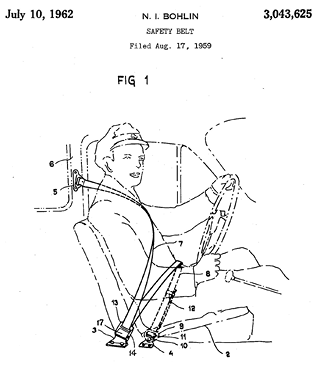
Swedish automotive company Volvo pioneered safety innovations, including the three-point seatbelt, as shown in the original US patent in Figure 6.4. This innovation is considered the world’s most important traffic safety development and is estimated to have saved more than one million lives since its launch in 1959.Footnote 44 Volvo immediately realized the potential societal benefits of its innovation if it were rapidly adopted across the automobile industry. So, rather than consider its innovation a “competitive advantage,” Volvo shared it with all automakers (similar to Carlsberg with the PH scale).
Volvo 3 Point Seatbelt US Patent.
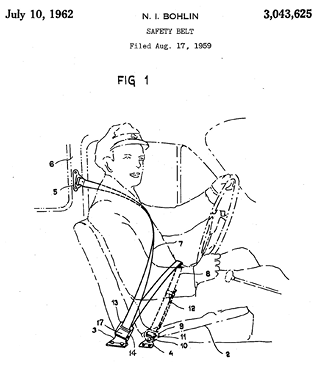
Figure 6.4 Long description
This U.S. patent diagram, filed August 17, 1959, and granted July 10, 1962, Patent No. 3,043,625, illustrates the original design for the 3-point seatbelt developed by Swedish engineer Nils Bohlin at Volvo.
The drawing features a driver seated in a car, wearing a shoulder and lap belt combination. The belt system extends diagonally across the torso and horizontally across the pelvis, securing into a central locking mechanism near the seat base.
The belt’s attachment points, guiding mechanisms, and buckle system are labeled with reference numbers, highlighting the integrated design that allowed for both comfort and security. For instance, labels 5 and 6 refer to the upper belt anchor point on the car frame, and 13 represents the shoulder harness extending across the chest.
This visualization documents Volvo’s safety innovation, which was openly shared with the auto industry to accelerate adoption and maximize societal benefit, an act that has saved over a million lives and remains a defining example of corporate responsibility.
While Volvo typically protects its innovations, it determined that the societal benefits of the three-point seatbelt were too significant to restrict. By forgoing potential short-term competitive advantages and profits, Volvo demonstrated a cooperative approach that ultimately enhanced its global reputation as a leader in safety. This decision has contributed to both the company’s market position and its organizational culture, where safety innovation remains a source of pride among employees.
… and Many, Many More
Many more compelling Nordic companies exist dedicated to a stakeholder approach and demonstrating strong sustainability performances. Danish-based Vestas is the world’s largest wind turbine company and was named the world’s most sustainable company in 2022 by Corporate Knights, just ahead of Ørsted at #2. Danish-based Chr. Hansen Holding – producer of natural solutions for food, beverage, nutritional, pharmaceutical, and agricultural industries – held the distinction of Corporate Knights most sustainable company in 2019,Footnote 45 and took second place in 2020. Neste (Finland), always near the top of the Corporate Knights list, has developed renewable diesel fuel reducing GHG emissions by about 90 percent, and sustainable aviation fuel reducing GHG emissions by about 80 percent compared to fossil fuels. Skandinavisk (Denmark), a certified B Corp in the fragrance and personal care industry, is another standout. Skandinavisk’s vision reads as an ode to the Nordic region – describing it as a place where trust, equality, respect, life balance, and “everyday moments of shared happiness” reflect a deliberate way of living in harmony with nature and with one another.Footnote 46 EQT (Sweden) similarly expresses how its Nordic heritage has shaped its stewardship approach to business, unique for the private equity industry with a reputation for being extractive corporate raiders. Grundfos (Denmark), Houdini (Sweden), Ericsson (Sweden), MAX Burgers (Sweden), Novonesis (Denmark), Storebrand (Norway), Tetra Pak (Sweden), and Too Good to Go (Denmark) are further examples of leading Nordic companies worthy of further exploration, among so many more.Footnote 47
These company examples reveal several consistent patterns in how Nordic institutional structures enable superior stakeholder engagement and sustainability performance. First, they show how enterprise foundations enable longer-term strategic horizons. Second, they demonstrate how institutionalized stakeholder engagement processes lead to more innovative solutions to complex challenges. Third, they illustrate how distributed power structures facilitate more effective cooperation with diverse stakeholder groups.
The success of these approaches raises important questions about the role of language and cultural frameworks in enabling stakeholder cooperation. While institutional structures provide the foundation, the way organizations conceptualize and discuss stakeholder relationships plays a crucial role in enabling effective cooperation.
Language and Metaphors
Nordic companies’ language reflects cultural norms that shape corporate behavior. While American firms default to competitive and military metaphors, Nordic companies distinguish when cooperation or competition serves best. For sustainability challenges requiring collaboration, they typically refer to industry players as “peers” rather than “competitors,” revealing a distinct conception of business relationships.Footnote 48
Metaphors We Live By shows how such language choices shape thinking and action. While warfare metaphors foster adversarial mindsets toward stakeholders, cooperative language creates institutional environments that favor collaboration, enabling more effective responses to sustainability challenges.Footnote 49
Beyond Corporate Social Responsibility
The Nordic stakeholder approach fundamentally differs from American CSR. Where CSR often serves as a voluntary add-on, the Norwegian concept of samfunnsansvar embeds stakeholder engagement within core institutional structures, revealing how context shapes corporate responsibility.
The distinction emerges clearly in the Norwegian concept of samfunnsansvar, which offers important theoretical insights into how institutional contexts shape corporate responsibility. The following analysis of this concept, drawing from my ongoing conversations with Norsk Hydro’s Vice President of Corporate Social Responsibility, Rolf Lunheim, while I was a US Fulbright Scholar to Norway in 2005–2006, illuminates the crucial differences between US and Nordic approaches to corporate responsibility.
Rolf told me about the traditional Norwegian expression, samfunnsansvar, used before the CSR expression started to gain traction in the Nordics. He translated samfunnsansvar as “the responsibility of business in society.”Footnote 50 He explained to me Norsk Hydro’s cooperative partnership with Amnesty International to tackle human rights challenges and how this helped fulfill the company’s societal responsibility. Samfunnsansvar was not like CSR in the US, he said, which he described as most often a sideshow to how a company goes about making its money. Rolf said US CSR often focuses on philanthropy, like when an oil company donates to the local youth soccer league or organizes a volunteer effort to clean up a park. He explained that the ongoing cooperation with Amnesty International changed how Norsk Hydro did business and engaged with stakeholders, allowing it to serve societal interests better.
Samfunnsansvar is about a company’s commitment to ongoing stakeholder engagement. It establishes the structures and processes to disperse power. According to Rolf, it is not fully democratic, yet it represents a significant step toward operating more democratically than the usual American approach.
The academic article, “Ye Olde CSR: The Historic Roots of Corporate Social Responsibility in Norway,” by Øyvind Ihlen and Heidi von Weltzien Hoivik supports Rolf’s offerings.Footnote 51 The authors document that the expression CSR was not explicitly mentioned in a Norwegian newspaper until 1999. Samfunnsansvar remains a better descriptor for how Norwegian companies consider their role in society than CSR. The authors explain how Norwegian companies see themselves as situated within society amongst a constellation of stakeholders. They contrast the Nordic approach with a US tendency for companies and business leaders to discuss the business sector as somehow operating separately from society. In the US, discussions are often framed as business and society, which implies a separation, in contrast to Nordic discussions framed as business in society. The authors highlight how the language differs: “One can distinguish between countries when looking at how companies view their interdependence, either as ‘business in society’ or ‘business and society.’”
Samfunnsansvar rejects the separation thesis at the societal level. The separation thesis has been traditionally discussed between the individual and organizational levels, rejecting the idea that individuals can somehow detach their ethics from what they do at the organizational level – that is to say, the companies at which they work. Samfunnsansvar moves it to the societal level, rejecting the separation between business and society.Footnote 52 This is reflected in how Nordic companies see themselves as situated within society amongst a constellation of stakeholders. They contrast with the US tendency for companies and business leaders to discuss the business sector as somehow operating separately from society. In the US, discussions are often framed as business and society, which implies a separation, in contrast to Nordic discussions framed as business in society.
Samfunnsansvar extends far beyond US philanthropic CSR, encompassing fundamental business responsibilities like “responsible tax.” The Nordic expectation that companies pay their fair share – backed by public pressure – starkly contrasts with US corporate tax practices and illustrates deeper differences in how business responsibility is conceived.
Large corporations in the US frequently pay no taxes with relatively little public outcry. For example, despite posting substantial profits, Amazon, Chevron, General Motors, Haliburton, and IBM paid $0 in federal taxes in 2018. Years of lobbying efforts by US big business interests, like the Business Roundtable, have successfully slashed taxes paid. Many self-described capitalists in the US maintain that low to no taxes are a hallmark of capitalism.Footnote 53
US corporations show off their corporate philanthropic acts. However, these donations are significantly less than the taxes they would pay if they were paying even what an individual would pay commensurate with their earnings. In his book Supercapitalism, Robert Reich suggests determining how responsible a company is by paying attention to its public policy and lobbying efforts – not its CSR efforts. Many US companies direct their lobbying efforts to reduce or eliminate taxes paid.Footnote 54 Furthermore, US philanthropy has no democratic accountability because executives and their associated foundations direct the money to their choosing. As Rolf pointed out to me, these are not democratically elected public officials, and the democratic deficit in society grows, the more philanthropy is relied upon to serve the public’s needs.Footnote 55
Structuring the Stakeholder Approach
When the most influential voices of American capitalism called for US companies to shift from the shareholder to the stakeholder approach in 2019 at the Business Roundtable, they were essentially calling for US companies to act more like Nordic companies. But polite requests to change behavior are not enough. The Nordic experience demonstrates that achieving stakeholder capitalism requires both cultural and structural changes.
Many well-intentioned US business leaders committed to stakeholder-driven companies ultimately failed. O’Toole chronicles these stories in The Enlightened Capitalists, where “Strong ethical compasses guided their decision making with regard to meeting the diverse needs of their constituencies: customers, employees, shareholders, suppliers, host communities, the broader society and the natural environment.” For US companies, O’Toole argues, attempting to serve stakeholders beyond shareholders is like swimming upstream – American capitalism’s current eventually pulls most toward shareholder primacy.Footnote 56
Patagonia is widely heralded as an exceptional case of a stakeholder approach in US business. Its environmental stewardship and comprehensive employee benefits – from paid parental leave to childcare to assurances of living wages – demonstrate stakeholder commitment in practice.Footnote 57
Patagonia’s founder, Yvon Chouinard, is a primary reason why Patagonia is a stakeholder company. His book, The Responsible Company: What We’ve Learned from Patagonia’s First 40 Years, with coauthor Vincent Stanley, chronicles Patagonia’s efforts to adhere to a stakeholder approach (Chapter 4).Footnote 58 Patagonia has voluntarily assumed greater responsibilities for its stakeholders, which includes assuming short-term financial burdens to protect the natural environment and offering benefits to employees that bring high costs. Under Chouinard’s watch, Patagonia became the exceptional fish swimming upstream against the current of American capitalism.
But why must a company swim against the current to be a stakeholder company? In its 2019 declaration that the corporation’s purpose must change from shareholder primacy to the stakeholder approach, the Business Roundtable’s association of US CEOs acknowledged that a change is needed (, Chapters 2–4).Footnote 59
To realize sustainable capitalism, the company’s purpose must be to create value for its stakeholders in a manner that supports sustainable development, which means meeting the needs of the present without compromising the ability of future generations to meet their own needs. Realizing sustainable capitalism involves practicing stakeholder capitalism.
We have a choice ahead to achieve that necessary shift of corporate purpose. We can hold up a company like Patagonia as an example of a stakeholder company and attempt to convince US companies to swim upstream against the current of American capitalism. However, as O’Toole chronicled, we are not likely to achieve stakeholder capitalism en masse; with history as our guide, most companies will ultimately fail. Or, we can focus on the current of the stream. Rather than expend efforts to get every fish to be that exceptional case, like Patagonia, we can consider why the current flows in the direction of shareholder capitalism. Why not direct the stream’s current toward stakeholder capitalism, whereby every fish follows a stakeholder approach by default?
The stakeholder approach is not achieved in the Nordics through volunteerism and philanthropy but, instead, it is structured. Policy changes are necessary for structuring the stakeholder approach – and here, the Business Roundtable and US business leaders can look to the historical developments of the Nordics. Throughout the twentieth century, Nordic business leaders and pro-business conservatives have been champions of stakeholder capitalism, actively working to ensure fair wages are paid to employees and systems are in place to support the well-being of all Nordic citizens. Nordic business leaders were initially pressured by threats of socialism in the late 1800s, into the early 1900s. They would realize for themselves the benefits that come from being part of building a society that works for everyone, not just the powerful few. In her 2020 book, Reimagining Capitalism, Henderson highlights successes in Denmark and lessons for the US, particularly emphasizing the active role that Danish business leaders played in supporting the stakeholder approach, including strong labor unions and democratic principles.Footnote 60
Yes, you read that correctly: Big business in Denmark actively worked to help establish a strong and effective organization for labor unions. The result was the national collective bargaining system that has served business interests well across the Nordics through an efficient structuring of conflict resolution. Furthermore, the Danish business community and conservatives saw the benefits of a well-functioning, educated labor pool and not tying healthcare to employment. Labor economist and historian Walter Galenson’s book, The World’s Strongest Trade Unions: The Scandinavian Labor Movement, documented the benefits of trade unions to Nordic societies.Footnote 61 Galenson noted in 1998 that approximately 90 percent of Swedish employees were members of a labor union, compared with 15 percent in the US.
Nordic business leaders have worked to avoid saddling Nordic companies with demands that would take attention away from their core business activities. Furthermore, Nordic policymakers desired a more flexible workforce where laborers were not at risk of clinging to a job for “benefits” but were continually training and could change employers or become entrepreneurs without fear of losing benefits. Stakeholder capitalism in the Nordics works so well, thanks to the ongoing support of Nordic business leaders. Anu Partanen and Trevor Corson made this point in their 2019 New York Times special feature “Finland Is a Capitalist Paradise” (Chapter 4):Footnote 62
The Nordic nations as a whole, including a majority of their business elites, have arrived at a simple formula: Capitalism works better if employees get paid decent wages and are supported by high-quality, democratically accountable public services that enable everyone to live healthy, dignified lives and to enjoy real equality of opportunity for themselves and their children. For us, that has meant an increase in our personal freedoms and our political rights – not the other way around.
If US companies and their leaders supported paying their fair share of taxes – rather than evading and fighting taxes at every turn – and demanded efficient public services for those precious tax dollars, US society could benefit dramatically. Writing of the importance of paying one’s fair share of taxes, Ørsted CEO Mads Nipper offered:
5,340,426,528 DKK (~$850 million). This is the corporate tax paid by Ørsted in Denmark in 2019. Let there be no doubt that the single most important contribution of our company is to be a global catalyst for a world that runs entirely on green energy, but one of the many other important societal contributions of companies like ours is tax.Footnote 63
These essential words by a Nordic business leader to advocate for simply paying one’s fair share of taxes would be near revolutionary for a US business leader to proclaim.
Nordic leadership in sustainability is supported through the efficient delivery of universal programs directly addressing many SDGs. Universal access to healthcare directly supports SDG #3 “Good Health and Well-Being.” Universally subsidized childcare and universal access to education through university directly supports SDG #4 “Quality Education.” Importantly, these universal programs depend on the vibrant Nordic economies and availability of good jobs, directly tied to SDG #8 “Decent Work and Economic Growth.”
The success of the Nordic model stems from companies and their business leaders acknowledging their civic duties, including paying their fair share of taxes. This reciprocal relationship strengthens the Nordic social contract: Businesses invest in the society that nurtures them, while the society creates an environment where businesses can thrive sustainably.
The Nordic model features uniquely cooperative labor relations, with about 70 percent union membership reflecting deep-rooted collective bargaining culture. Unlike contentious US labor relations, Nordic unions and employers maintain continuous dialogue and mutual respect, ensuring more equitable distribution of prosperity.
The enterprise foundation ownership model is a vital element of Nordic stakeholder capitalism, providing structural support for long-term thinking and stakeholder orientation. This ownership structure, where foundations hold majority voting rights in perpetuity, creates systematic insulation from short-term market pressures. Controlling over 70 percent of Denmark’s stock exchange capitalization and extending to private firms, these foundations enable companies like Novo Nordisk, Carlsberg, and Ramboll to prioritize long-term stakeholder interests over short-term financial pressures. This institutional feature directly contributes to Nordic companies’ superior sustainability performance.
Parting Reflections
The Nordic cooperative advantage demonstrates that effective stakeholder capitalism requires both structural foundations and cultural support. The contrast between American capitalism’s profit maximization and Nordic companies’ stakeholder orientation reveals three key insights:
First, meaningful stakeholder cooperation demands robust democratic structures, not just good intentions. Nordic companies engage with stakeholders through formalized dialogue processes and governance structures, including employee board representation and enterprise foundation ownership. These structures also buffer against the ills of short-termism, which can prevent meaningful stakeholder engagement. This stakeholder cooperation fundamentally depends on dispersed power. The Nordic cooperative advantage emerges from business environments where power is distributed through strong labor unions and universal social safety nets, where employees are not dependent on employers for basic needs like healthcare. This balanced distribution of power creates conditions for constructive cooperation.
Second, language reflects and also profoundly shapes business behavior and culture. American business discourse centers upon hypercompetitive language, including a prevalence of warfare metaphors that depict the world as a series of zero-sum affairs, needlessly emphasizing conflict. Nordic companies tend to frame interactions through cooperative paradigms, such as discussing industry peers and employer–labor union relationships framed in a cooperative spirit. Sustainability challenges demand effective cooperation, which the cooperative language and cooperative strategic posture of Nordic companies help facilitate.
Third, the purpose of the firm has fundamentally different definitions in American versus Nordic capitalism. The so-called Friedman doctrine, which defines the firm’s purpose solely as maximizing profits for shareholders, has been a cornerstone of American capitalism rooted in neoliberalism since the 1980s. In Nordic capitalism, the firm’s purpose is to create value for its stakeholders.
Corporations are a primary tool of capitalism, and Nordic companies corporations offer a compelling benchmark for their American counterparts. Yet they, too, must continue to evolve to meet the lofty demands of realizing sustainable capitalism. While the Nordic stakeholder-oriented approach moves us closer to that goal, fully realizing sustainable capitalism requires an even more ambitious definition of the firm’s purpose: to create value for its stakeholders within planetary boundaries. This definition aligns with the dual imperatives of sustainable development – meeting the needs of the present while safeguarding the ability of future generations to meet their own needs.

 Open access