


It was no accident that the “delicious” Sultana raisins produced near Heraklion on the Greek island of Crete in the late 1930s might remind someone of those in the grape’s “motherland” (ana vatan) of Urla, over 300 kilometers northeast in the Republic of Turkey near Izmir.Footnote 1 After all, the vines on Crete had been planted and cared for by “grape-growing Greek Orthodox refugees” (bağcı rum muhacirleri) hailing from around Izmir. The places were separated by a sea, nationalism, and a legacy of demographic engineering involving the transfer of over 1.5 million people and the killing of thousands. As Chris Bayly has written of the paradox of this period, “Broad forces of global change strengthened the appearance of difference between human communities. But those differences were increasingly expressed in similar ways.”Footnote 2 The rooting of the same grapes alongside the “uprooting” of apparently nationally distinct people is one material example of this dynamic.Footnote 3
The history of the Aegean region’s agroecological integration stretches back millennia, but these connections overlapped with political disintegration in distinct ways in the late nineteenth century. At this time, one of the Ottoman Empire’s foremost dilemmas was how to fend off nationalist challenges within its territories and imperialist usurpations from without, all the while negotiating the empire’s incorporation into the world economy. The 1870s proved to be a key juncture in these dynamics. By 1875, the empire had defaulted on its loans and would subsequently be subject to a foreign-led debt commission. The disastrous Russo-Ottoman War of 1877–1878 culminated in the Treaty of Berlin, which dictated formal recognition of de facto independence of Montenegro, Romania, and Serbia as well as autonomy for Bulgaria and Habsburg occupation of Bosnia Herzegovina. During the same decade, the Mediterranean world was afflicted by the microscopic aphid-like blight of grapevines known as phylloxera. It had gradually made its way from the United States to Europe, helped by people and their steamships, railways, grape monocultures, and, perhaps most importantly, their reverence for European grapes that were, unbeknownst to them, infested. The invasion of Europe first catalyzed grape cultivation around Izmir, then—by the time of phylloxera’s arrival in the late 1880s—killed it, and then—thanks to pragmatic responses to the grapevine affliction—promoted it once again. At the same time, newly independent or semi-sovereign states harnessed the threat of phylloxera to protect their local economies from Ottoman grapes, years before those who tended the vines of Heraklion caught the attention of the Turkish Ministry of Agriculture.
The late nineteenth and early twentieth centuries was a period of “hypermobility,” not just for people but also for non-human stowaways, and state infrastructures endeavored to manage both.Footnote 4 Border regimes and passports were instituted in the settler states in the Pacific to control Asian labor and spread to the rest of the world in a piecemeal fashion.Footnote 5 These policies built on a history of epidemic disease and the practice of quarantine, which led, as Alex Chase-Levenson has described, to a remarkably consistent policy of quarantine through much of the western Mediterranean that in demarcation of Europe and the “Middle East” overlaps with “the hardest Mediterranean borders today.”Footnote 6 But in the late nineteenth century quarantine shifted as new understandings of disease invited interventions that help to answer Charles Maier’s question of territoriality: “How did this spatial sheltering of group life emerge, flourish, and then perhaps decay?”Footnote 7 Agricultural commodities and their pests figured prominently in practices of territoriality. Indeed, the first border structures between the United States and Mexico were built not to control humans but to manage ticks that spread Texas cattle fever.Footnote 8 Moreover, the pathologization and control of Asian human migration to the United States overlapped with newfound concerns with plant pests with origins in Asia.Footnote 9 Against the invasion of phylloxera came what David Quammen has called “the first international attempts to regulate the trade in plants.”Footnote 10 The pest instigated passport-like documentation of the origins of grapes, raisins, and vines for export.
If this was the context for the arrival of the sick vines of Europe to the “sick man of Europe,” the hackneyed moniker for the weak Ottoman Empire proved deceptive. Attacked by the tiny creatures from the West, the empire responded with law and American rootstock. This approach would have important implications for the Ottoman and newly post-Ottoman world, as well as the world raisin market. Eager to both protect its grapes and be part of international law, the Ottoman Empire enacted measures similar to those imposed in the rest of Europe. Because phylloxera came from the United States by way of Europe, the surest way of overcoming it was to plant American rootstock—which was relatively protected from the bug—or graft American vines with local ones. Phylloxera may have been called the “Tamerlane of the insect world,”Footnote 11 but in a reversal of the European tendency to blame the Ottomans for the disease—what Nükhet Varlık has called “epidemiological Orientalism”—phylloxera came from the West, and so, too, did the solution.Footnote 12 This approach caused controversy, particularly in France but also elsewhere, where many growers saw it as a violation of the terroir. Yet it seems to have been less controversial in the Ottoman Empire, perhaps because the grapes there were overwhelmingly used to produce raisins rather than wine.
Nevertheless, the efforts to control phylloxera were to have political consequences. As part of protectionist measures implemented across the region, and the Aegean in particular, various state officials in post-Ottoman polities like Bulgaria, Greece, Romania, and Serbia found in phylloxera a ready-made justification for protecting their grape markets: “the excuse of phylloxera,” fumed Ottoman officials again and again. In other words, Ottoman officials had adopted aspects of international law on plant traffic in the name of phylloxera prevention and civilization, but subsequently saw these same measures applied—spuriously, they insisted—to undermine Ottoman economic power.Footnote 13 This is to say that in giving a pretext for the formation of national economies, phylloxera bolstered the newly formed borders with the Ottoman Empire; it helped put the post in post-Ottoman.
Grapevines across the Aegean offer a unique vantage on the environmental history of empire. This is not a story of environment abetting empire, or commodities integrating national space as some pathbreaking works of U.S. environmental history have detailed.Footnote 14 Nor is this an account of “empire by nature” or “imperial ecology” as some key early works of Ottoman environmental history elaborated.Footnote 15 The Mediterranean has long been considered as a unified space, whether by way of ecologies or otherwise.Footnote 16 The grape ecologies of the Aegean offer a way to account for the formation of borders across the region grounded in “resource-extraction frontiers” that were at once ecological and economic, which Jurgen Osterhammel has identified as emerging in the late nineteenth century.Footnote 17 As Kate Brown writes of the surprisingly similar spatial grid in Kazakhstan and Montana, grape vines across the Aegean can be used for “stitching together territories that have been violently taken apart.”Footnote 18
The vines also offer a new perspective on the end of the Ottoman Empire. Recent scholarship has significantly expanded the demise of the Ottoman world beyond 1923, locating enduring shards of it in commercial networks across greater Syria, smugglers around Aleppo, or revolutionary military officers in the interwar Arab world.Footnote 19 In these places, scholars have argued, the Ottoman Empire lived on even after it was no longer on the political map. Yet, to understand these processes in the Aegean and the Balkans requires more interrogation of what exactly post-Ottoman meant since it took different shapes in Bulgaria, Greece, Romania, and Serbia. Leyla Amzi-Erdoğdular has examined this issue most clearly in the case of Habsburg Bosnia Herzegovina (1878–1908). With the territory under Austro-Hungarian control but formally remaining Ottoman, ironies abounded, among them that Ottoman Bosnians suddenly required passports to get home.Footnote 20 While varying in its specific meaning depending on the place, “post-Ottoman” in the Aegean world refers to the different ways that formerly Ottoman states tried to define their status in what Amzi-Erdoğdular calls the sovereign “gray areas” alongside the still existing Ottoman domains.Footnote 21 With respect to grapes and phylloxera, people used the commodity and specter of its pest to create national economies. They did so before articulations of economic hegemony and markets instigated by the “national economy” in 1908 and after.Footnote 22 Turkish coffee—albeit referred to by different national modifiers depending on place—offers one glimpse of Ottoman legacies still present today, but grapes and raisins played an even more direct role in the making of these places and dynamics of connection and disconnection.Footnote 23 Their presence across the Aegean not only reflected integration but also the historical process of division. They also persisted. Early twenty-first-century Smyrna might have been, in the words of Marie-Carmen Smyrnelis, “a forgotten city,” but it was nevertheless “synonymous” with “the famous Smyrna grapes.”Footnote 24
With the unmixing of people that accompanied the end of empire, the monoculture of grapes may be thought of as vines of nationalism, rooted in soil and protected from the former imperial overlord by international law. Scholarship has moved away from nationalist framings of eternal difference and has exposed how the undoing of the Ottoman Empire in the Balkans and Aegean came about through processes of law, violence, and sectarianism.Footnote 25 Grapes offer a perspective both distinct from and related to these existing histories. At many points in the 1890s and first decades of the 1900s, the Ottoman Minister of Forests, Mines, and Agriculture Selim Melhame decried protectionist measures taken by countries against Ottoman produce from across the Aegean as based not on the reality of phylloxera, but rather “the excuse of phylloxera.” Such measures were a product of what Tasos Kostopoulos has called the “agrarian radicalism” at the heart of many Balkan nationalist movements.Footnote 26 As Christine Philliou has described, a look at Ottoman successor states beyond national boundaries and across area studies reveals the “paradoxes of national master narratives,” simultaneously “unique” and “generic and universal.”Footnote 27 Accordingly, we can look beyond lists of nationalist uprisings and the still often separate historiographies they spawned, and examine instead the tiny insect that afflicted the viticultural slopes stretching up from azure Aegean coastlines. When we do, we find that phylloxera created rifts between these places that were both connected and divided by their vines’ shared fate.
“Every man’s mind absorbed in sweet-meat”
As Faruk Tabak observed, the quintessential Mediterranean crops of the vine and olives were not timeless parts of the landscape, but the product of early modern transformations of the region. As enslaved labor and plantations of the Atlantic world supplied cereals and cotton to the Mediterranean, the incentive to grow these crops on the region’s plains dwindled, and much cultivation shifted to the hillsides.Footnote 28 Although Braudel suggested Islam was an obstacle to the vine, the plant largely rested in place during the Ottoman conquests, thanks in no small part to, as François Georgeon has noted, “the massive usage by Muslims themselves of fresh grapes or raisins,” consumed as such or turned into the molasses known as pekmez. Footnote 29 Interior entrepots like Bursa and Aleppo faded, while ports like Izmir on the Aegean boomed.Footnote 30 Meanwhile, the fruits of the vines made their way back across the Atlantic world. In Florida in 1768, the quixotic Andrew Turnbull founded New Smyrna—inspired by the antiquated English-name for Izmir—as part of what was then the largest colony ever initiated in North America. He brought with him not only Maria Gracia (his wife and the daughter of an old Smyrna merchant) and a smattering of Greeks, Minorcans, and Italians (constitutionally suited to Florida’s tropical climate, he incorrectly reasoned), but also cuttings of grape vines.Footnote 31 Though this colony found little success, Izmir raisins had more, appearing for sale in Boston, for example, as early as 1785.Footnote 32 All the while Izmir flourished as a polyglot outlet of commerce, becoming home to significant Armenian, Greek, Jewish, Turkish, and European communities.
By the nineteenth century grape production was central to the region’s economy, taking the place once held by cotton.Footnote 33 The Scottish novelist Charles MacFarlane noticed raisin production when in the 1820s he traveled west of Izmir to Çeşme, which today is an upscale resort town. His viticultural awe was such that he could not complete a sentence without exclaiming about the region’s distinctive dried fruits:
I found all the world engaged with raisins! There was scarcely room to land on the little quay, for the casks of fruit lying there for embarkation: the narrow streets were throned with hamals [porters], camels, mules, and asses, all carrying raisins … and in the lower part of the wooden house where I was accommodated … were regiments of casks, barrels, mountains of raisins, and about a hundred half-naked, bawling fellows, (Turks, Greeks, and Jews,) picking and packing raisins. If at Smyrna I had found every man’s mind absorbed in sweet-meat, here it was worse … even the indolent, clock-work moving Turks seemed to be infected with the raisin fever … bawling and swearing the most expressive oaths, and all about raisins.Footnote 34
In one of many connections between western Anatolia and the western United States, the Sultana variety of grape was brought to California in 1861 by the Hungarian “father of California viticulture” Agoston Haraszthy.Footnote 35 The variety was prominent enough to merit a town being named after it: Sultana, California, near several Central Valley towns that advance competing claims to being “raisin capital of the world.” However, it is more commonly known in the United States as Thompson’s Seedless, renamed in 1872 in honor of someone with more of an eye toward marketing. (Not all agreed with the decision: “It seems hardly necessary … to change the euphonious and appropriate name by which it has been known,” complained one American agricultural publication).Footnote 36
Adding to the grape’s power was the fact that Izmir was already the center of the Anatolian export economy. In the words of one consul, it was “one of the most magnificent harbors in the world” and “the commercial capital of Asia Minor.”Footnote 37 After boom years for cotton coinciding with the American Civil War and the global cotton shortage that ensued, some cultivators around Izmir switched to vineyards.Footnote 38 According to some accounts, the 1858 Ottoman land code incentivized this process, since cultivators could gain title to “dead land” (mevat) by working it for a certain period of time.Footnote 39 The vine also spread along with new railway networks that connected Izmir with the interior.Footnote 40 Cultivators adjusted to account for European tastes by planting more of the Sultana variety, exported around the world for consumption as a raisin rather than for wine production. “It would not be an exaggeration,” as Onur İnal has argued, “to say that what the banana meant for tropical lands was denoted for Western Anatolia by … the grape.”Footnote 41
“A European calamity”
Phylloxera, native to North America, first appeared in European vineyards in the early 1860s. As it made its way across the continent, it moved via different means and occasioned different political responses. In Portugal, the phylloxera traveled along the railway that had been built to export the country’s grapes and wine to the rest of the world.Footnote 42 In Germany, visions of foreigner and pest converged to such a degree that vineyards near the border with France were destroyed.Footnote 43 But the most devastating blow was to France, which between 1870 and 1880 lost almost half of its wine production to the insect. While there was initially some ambiguity as to whether the insect was the cause or an effect, a consensus gradually developed around the former. Accordingly, the insect received the Latin name Phylloxera vasatrix: devastator of vines.Footnote 44
Cures ranged from absurd to unappealing. The French Academy of Science offered a reward of 300,000 francs for any solution. They received various suggestions of substances that might be effectively applied, including but not limited to shrimp bouillon, garlic peels, and goat’s urine.Footnote 45 The classicists of the Mediterranean also chimed in, insisting, as they would, that Strabo had in fact solved the problem nearly two millennia before in book 7, chapter 5 of his geography (the prize committee did not agree).Footnote 46 Other substances such as carbon disulfide proved more reliable, but were also expensive and they could kill the plant along with the pest.Footnote 47 Another method was to submerge a vineyard in water so as to drown the insects over the winter season.Footnote 48 But the most common and effective response came from recognition that phylloxera had originated in America and that therefore American vines were mostly immune to the insect’s ravages. When cultivators planted vines with American rootstock or grafted their local vines onto American rootstock, the resulting vines were resistant to phylloxera.Footnote 49 Despite the effectiveness of this approach, many growers, particularly in France but also in the Russian Empire and Hungary, feared that adopting it would mean forfeiting their claims to the authenticity of their terroir.Footnote 50
As phylloxera marched across Europe it spurred novel and intrusive forms of international action emblematic of the period’s interconnectivity. Delegates from Austria-Hungary, France, Germany, Portugal, Spain, and Switzerland gathered in Lausanne in August of 1877 for what they described as “the first purely agricultural international congress” to discuss the insect that had a created “a European calamity.”Footnote 51 As if to underscore the power of the scourge, phylloxera appeared in Neuchâtel—just 70 kilometers away from Lausanne—shortly before the gathering.Footnote 52 The main product of the conference was an agreement known as the Bern Convention of 1878 stipulating that produce should have certificates stating whether or not phylloxera was present at the point of origin.Footnote 53 It was, as Stéphane Castonguay has suggested, a novel shift to “construing crop protection as an international problem” in late nineteenth-century Europe.Footnote 54
The insect’s impact was not limited to those countries. While the Ottoman Empire was not formally a part of these phylloxera agreements, it quickly took action to apply the measures within its own domains. The grand vizier informed the provinces of the Archipelago, Aydın, and Crete that the importation of trees and plants from Europe would be banned for fear of “destruction” that had accompanied “the spread of the disease of phylloxera to France and its presence in America.”Footnote 55 A month later, memos at the Council of State described in detail phylloxera’s life cycles (see figure 1) and acknowledged the absence of phylloxera in the Ottoman domains (“praise be to God”).Footnote 56
Progression of phylloxera. Vasita-i Servet, 26 Temmuz 1296 (7 August 1880), 128.
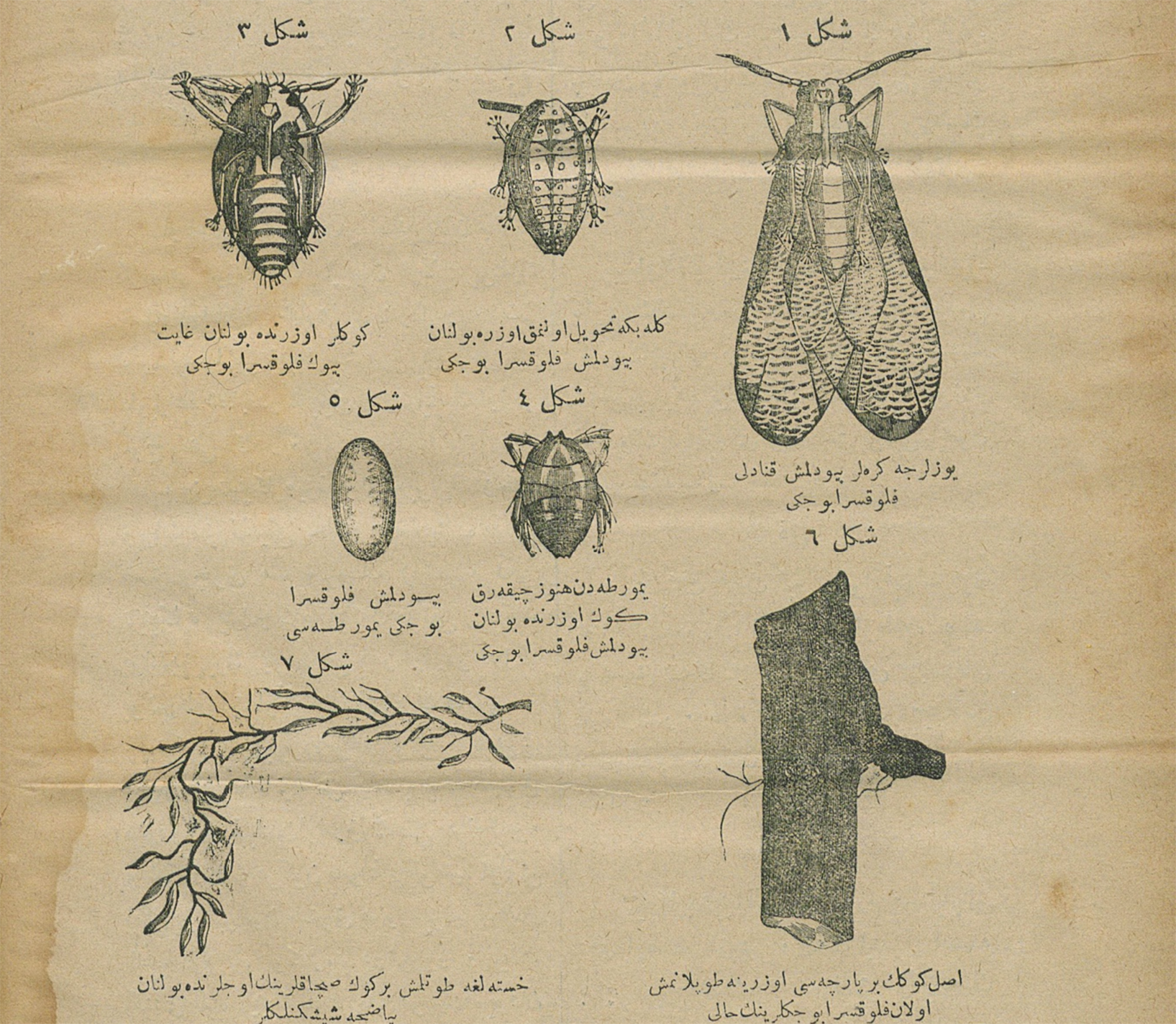
The memo also explicitly treated the Bern Convention agreements and instituted them for the Ottoman Empire in the form of a nine-item law. It banned the import of plant products from phylloxera-stricken places, mandated reporting of suspicions of phylloxera to government officials, provided guidelines for forming investigative committees, and established a procedure for indemnifying those whose vineyards were destroyed.Footnote 57 Thus, as plant pests crossed borders, so too did legal statutes that laid down groundwork for what would become known as international law.
“Plus ça change”
It is unclear how phylloxera made its way to the Ottoman Empire. But by the summer of 1885, reports echoed throughout Istanbul of the arrival of “the terrible aphid of the vine.”Footnote 58 French reports blamed their own subjects for importing a diseased vine and then making all efforts to conceal the presence of the disease.Footnote 59 But the most public debut of the sick vines in Istanbul came from reports of the Ottoman war hero and Egyptian Extraordinary Commissioner Gazi Ahmet Muhtar Pasha, from the Asian shores of the Sea of Marmara in Erenköy.Footnote 60 After a “meticulous inspection” by Ottoman agricultural officials, they confirmed that the ailment was present in nearby neighborhoods of Kadıköy, too.Footnote 61 When the British delegation in Istanbul sent specimens to the French, those arbiters of the terror of the vine responded that they were “the most magnificent examples of Phylloxera vasatrix that they had ever had the occasion to admire.”Footnote 62 Istanbul’s agriculture inspector, for his part, requested more microscopes.Footnote 63 Others took a less observational approach: they burned the afflicted vines.Footnote 64
While the phylloxera’s presence was only announced in 1885, it was suspected that the insects had been in the empire for several years previously (they had, for example, reached the Crimea by 1879).Footnote 65 As elsewhere, observers reckoned that the “germ of the evil” was the importation of vines from abroad.Footnote 66 In response, Greece banned the import of all plant material and produce from Anatolia, Bulgaria, Crete, Cyprus, Egypt, Ottoman Europe, and Samos.Footnote 67 Ottoman officials banned the export from Istanbul of vines, trees, grapes, fruits, vegetables, and flowers to any other part of the empire.Footnote 68 The state later amended this order such that it only included plant matter and excluded “fruits, grains, vegetables, potatoes, onions and all other produce,” which had played no role in the spread of the disease.Footnote 69
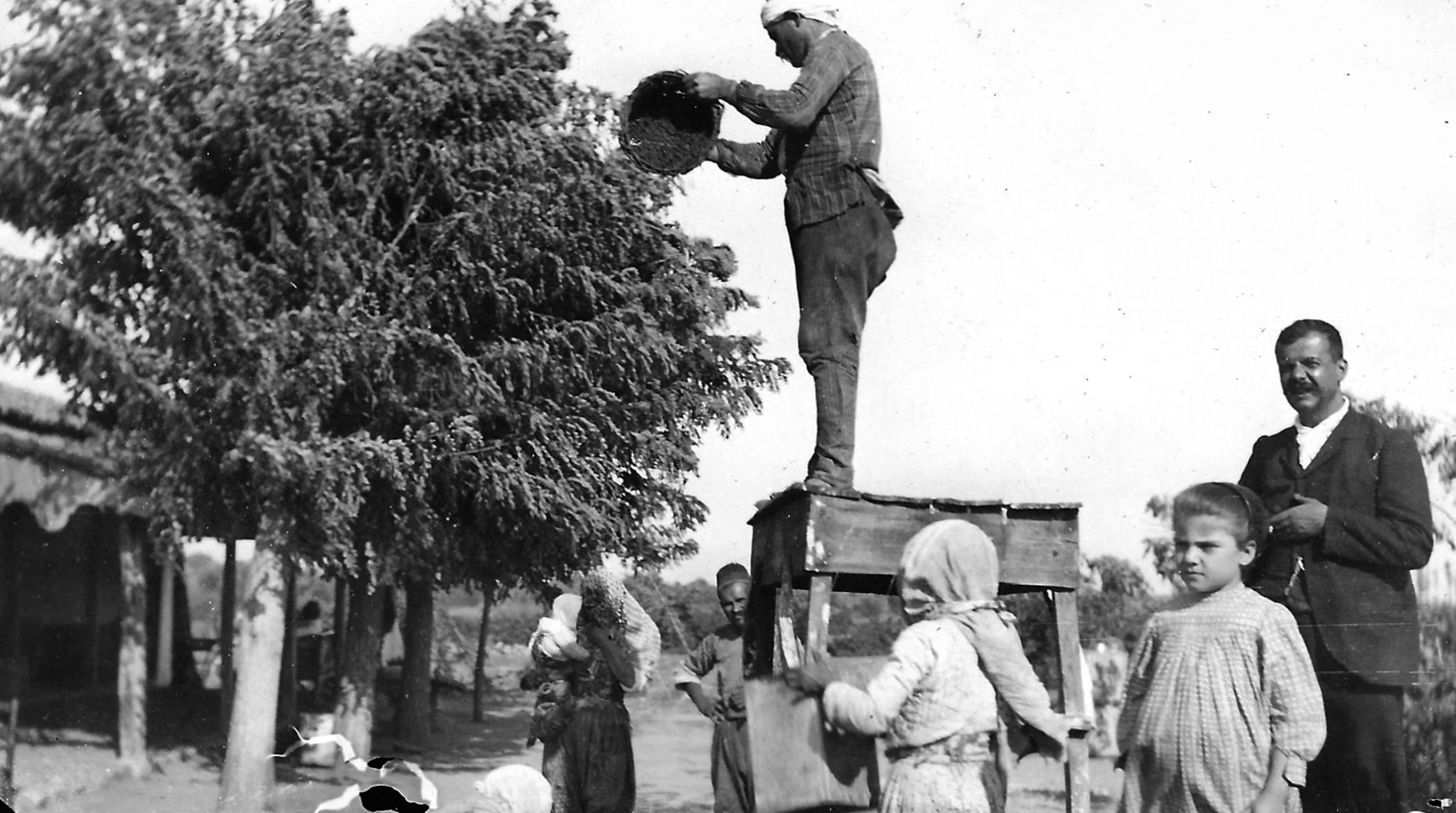
As devastating as the phylloxera was in Istanbul, it was a still greater threat to Izmir, where grape production and raisin exports comprised a much larger portion of the economy. That had been the case for decades, as Izmir had exported the valued sweetener of desserts and baked goods far and wide across a world still without mass-produced candy.Footnote 70 The power of its produce even caught the eyes of the fig and grape growers of the emerging agricultural powerhouse of the Central Valley of California. George Roeding—later hailed as the Fig King of Fresno for his integrative Calimyrna brand of the fruit—visited Izmir and left us photos of its countryside during this period (see figure 2).Footnote 71 But further west the reliance on the vine had grown still more tangled in phylloxera’s wake. As France sought to make up for its shortfall, the production of wine in Ottoman Europe and the Aegean ramped up, although it remained overshadowed by much smaller countries like Romania and Bulgaria and undermined by exorbitant taxation.Footnote 72 Raisin production benefitted from the dire straits of the French wine industry. Of the Jewish community in the town of Tire—referred to by locals as “little Safed” after the town in Palestine—one writer noted that “their fortune is due, in large part, to the ravages caused by phylloxera.”Footnote 73 Tire’s famous black raisins “had increased in value considerably over the previous years.” Lacking grapes, French winemakers even began importing raisins for wine production.Footnote 74 A similar pattern obtained in Izmir’s province of Aydın as a whole, where a reporter wrote, “A large part of our province is found to be covered with vines,” which, of course, meant that phylloxera would be “the ruin of cultivators.”Footnote 75
Workers harvest raisins at Karaburun. Roeding Collection, California Nursery Historical Park (Math/Science Nucleus).
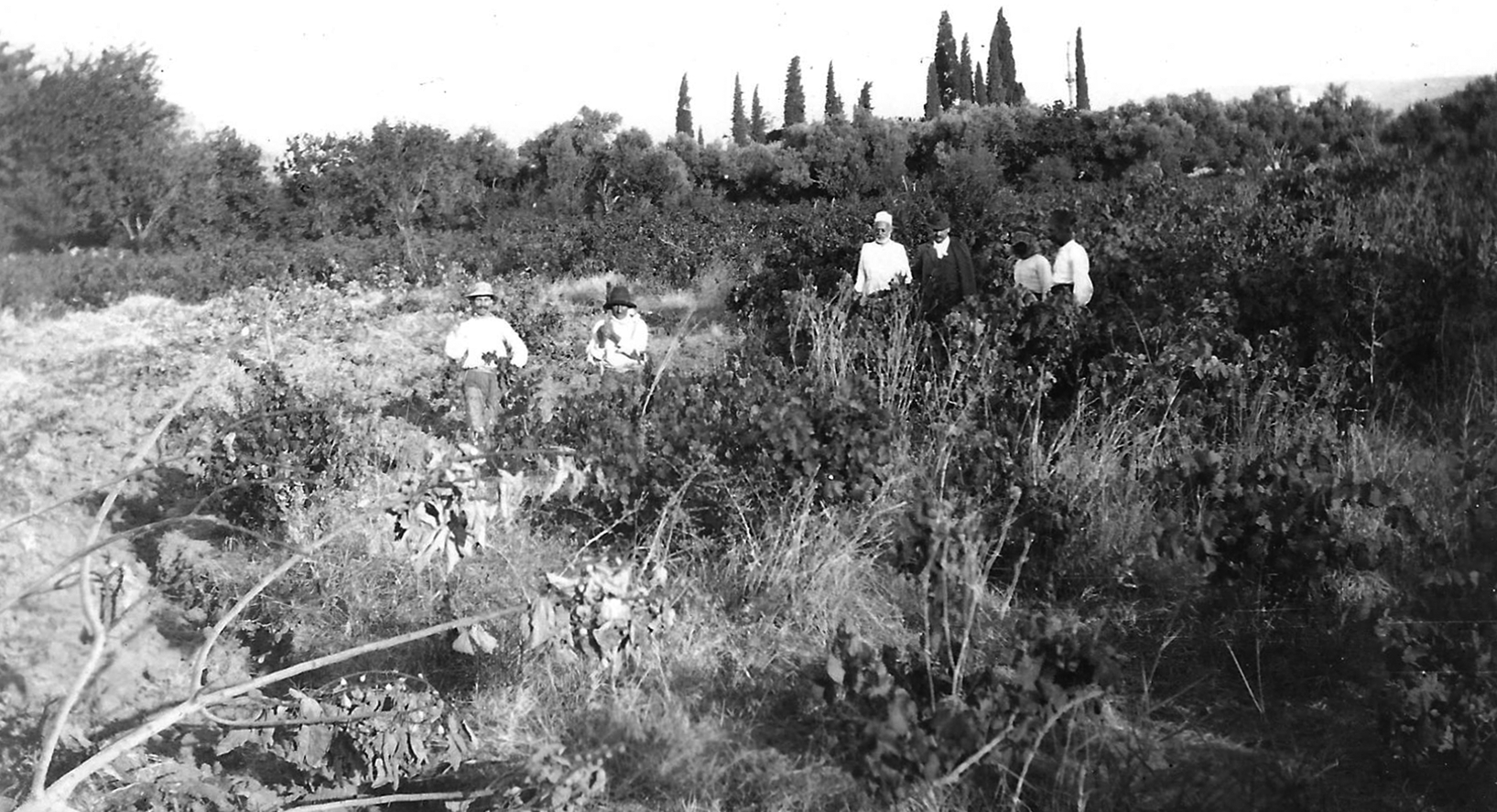
Their fears came true in June of 1888 when reports appeared of an “unknown but terrible evil” in the vineyards of Kukluca.Footnote 76 Subsequent tests revealed that “it has antennae with three joints, and spots of pigment indicate the place of the eyes which are large and protruding,” while “an organ with three extendible branches constitutes the active means of suction.” It was, in other words, the “devastating insect” of phylloxera.Footnote 77 Later inspections found them across from the railway station at Paradiso (today Şirinyer) as well as at Kadifekale among vines belonging to Emin Bey, president of the municipal council.Footnote 78 Military cordons of gendarmes appeared around the afflicted vineyards and officials began burning the “vines infected by this terrible microbe,” the language of pests and disease converging.Footnote 79 Yet with 2,000 to 2,500 dunams of land (1,878–2,349 square kilometers) struck by the insect (see figure 3), some estimated that “the scourge has already reached such proportions that there was no longer any hope of fighting it.”Footnote 80
Sultana vines dying of phylloxera near Karşıyaka, Izmir, 1901. Roeding Collection, California Nursery Historical Park (Math/Science Nucleus).
Like in Istanbul, people in Izmir suspected the culprit was foreign rootstock, and perhaps also foreign people. Suspicion fell on the Tepecik winery run by the German Ignace Müller and Oscar Samma, a Levantine Catholic from an Albanian family, who were rumored to have concealed the French origins of their vines by importing them through Germany. (Of the import of foreign roots, the French-language newspaper Stamboul presciently wrote in 1883, “What will be the fate of viticulture? It is not necessary to be a great prophet to guess.”Footnote 81) According to other reports, these “German” vines were so attractive to local vine-growers that they “stole them [from Tepecik] and replanted them in their own grounds” and “whenever they were transplanted the disease has appeared.”Footnote 82 More generally, the major site of the initial outbreak around Bornova and Buca was known to be home to a large population of Levantines, Europeans who enjoyed consular protection to benefit from the attractive tax regime of the capitulations and generally “lived,” as one American consul put it, “the lives of merchant princes.”Footnote 83
The Ottoman state took the threat seriously and responded with its cadre of agricultural experts. As the minister of commerce and public works wrote, “the single measure to defend against phylloxera” was the “grafting (telkih) of local grapes on American rootstock.”Footnote 84 A center for such activities had been established in Istanbul at Erenköy, along with several others in Izmir.Footnote 85 Most of the American rootstock samples came not from the United States, but from France, where they had finally taken root after the initial staunch rejection of them as a betrayal of the local terroir. The produce from the plots of American rootstock in Izmir—supervised by Beghian Efendi and Zakaryan Efendi—proved to be of exceptional quality, and samples were distributed free of charge to growers in Izmir and sent along to the sultan himself.Footnote 86 But these successes were no reason to rest easy. The minister stressed that recently phylloxera had appeared at Topkapı, long the site of the palace of the Ottoman sultans.Footnote 87 The minister feared that the jump to the European shores of Istanbul foreshadowed devastation further afield in the portions of Ottoman Europe still reportedly free of the bug.
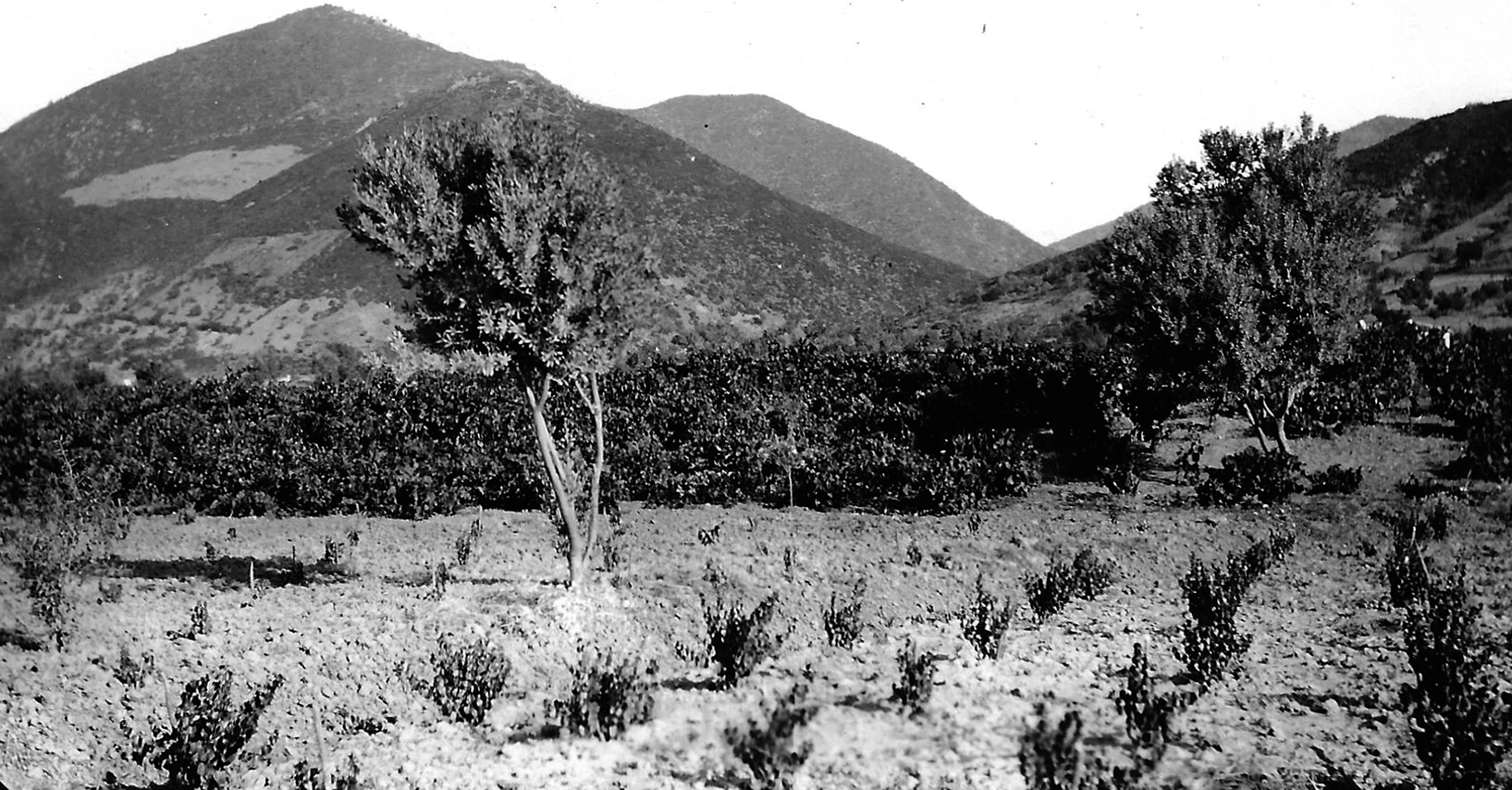
Solutions were imperfect. Replanting the vines with American rootstock or grafts of it required precision. Only particular species such as Vitis solonis, V. riparia, and V. rupestris (see figure 4) could survive both phylloxera and the “sometimes excessive heat” of a place like Izmir.Footnote 88 But beyond the horticultural challenges were economic ones. A vine took about five years to produce grapes. State payments of indemnities of “ten Turkish pounds per dunam” could soften the blow of years of investment and labor without produce, but only partially.Footnote 89 While some newspapers such as Phare du Bosphore insisted that phylloxera was a means for “parasites of the budget”—state officials and agricultural experts—to make money, Stamboul took the opposite position.Footnote 90 It criticized the state’s approach of surrounding phylloxera-stricken vineyards with cordons of gendarmes.Footnote 91 The newspaper complained that their “Martini rifles” were no good against “infinitesimally small” enemies like phylloxera. According to “the men of science,” it asserted, carbon disulfide or even petroleum would be more effective.Footnote 92 But those treatments were costly, and despite funds derived from taxes the state began to levy on Izmir raisin exports in 1888, one report summarized the challenges of fighting phylloxera as “plus ça change, plus c’est la même chose (money, money, and more money).”Footnote 93
Vitis rupestris replanted at Narlıdere near Izmir, 1901. Roeding Collection, California Nursery Historical Park (Math/Science Nucleus).
As phylloxera spread, it infected vines that had been planted in direct response to the higher demand caused by devastation further west in the Mediterranean. The Scottish traveler William Cochran dated the expansion of viticulture to about 1860, but especially “since the phylloxera pest became prevalent in France.”Footnote 94 To this same rough time span he attributed a process by which those whom he called “thrifty, intelligent Greeks have fairly bought out the Turks,” who had previously owned the majority of vineyards near Izmir.Footnote 95 But of course plenty of Muslims continued to produce raisins, as recalled by the Aydın-born Greek leftist Dido Sotiriou, who touched on the topic in her famous novel Farewell Anatolia. Based on the memories of her protagonist, Anatolian farmer Manolis Axiotis, a young Greek man from the countryside, quits his job as an assistant to a Greek raisin merchant in Izmir after seeing him fleece one too many honest, toiling Muslim raisin farmers.Footnote 96 Whether Muslim or Christian, the grape-growers of Izmir transformed the region. In 1874, officials called for a highway to be built between Urla and its pier so as to ease the transport of over 100,000 kantars of grapes a year that had to rely on a road unfit for animals, let alone a cart.Footnote 97
That was not the only place where grape production changed the landscape. In the early 1880s, the region around Bornova had been like a “jungle, and useless” but it transformed into a land “clothed with vines, belonging, in every instance, to families who were once the poorest peasants.”Footnote 98 Raisins took off with expansion of cultivation and the help of migrant laborers who seasonally left the Archipelago to work Izmir’s fields.Footnote 99 Within the span of some fifteen to twenty years, one Ottoman account suggested, vineyards had increased eight to ten times as rocky land (sengistan) had been transformed into vineyards.Footnote 100 During this period the dried fruits of this labor acquired a reputation in Europe not only as those that “bakers put in their cakes” but as products from which wine could be produced and sold at a moderate price that would appeal to the French poor and working classes.Footnote 101 As “Turkish grapes invaded the markets of Europe,” their price jumped fourfold.Footnote 102 It was for these reasons that even several years into the phylloxera outbreak the city of Izmir itself was “in effect surrounded by an opulent belt of vines.”Footnote 103
The situation changed in 1892, however, when France instituted the Méline tariff against foreign grapes and the very next year produced for the first time as much wine as it had before phylloxera.Footnote 104 In Izmir, the French tariffs amounted to, in the words of one newspaper, “another phylloxera,” which delivered “the coup de grâce to our grapes.”Footnote 105 Across the Aegean in Corinth, export of raisins to France for wine production had left “the merchants of Morea literally rolling in gold.”Footnote 106 But they, too, struggled with the new economic conditions.Footnote 107 The mid-1890s saw expositions where multiple countries vied to consolidate their tenuous position as grape-producers alongside a post-phylloxera France. Perhaps the clearest expression of this grape glut race to the bottom was the Spanish delegation’s slogan at a gathering in Bordeaux: “Haremos de Espagna la bodega del mundo!” (Let us make Spain the cellar of the world!)Footnote 108
In the Ottoman Empire, the expansion of cultivation was also a vehicle of inequality. As Önder Eren Akgül has argued, the process involved the most important capitalist actor in the empire: Sultan Abdülhamid II and his property holdings (Emlâk-ı Hümâyun İdaresi). The impact of phylloxera on the empire was so bad that some decided “to root up all their vines and to plant onions.”Footnote 109 But Sultan Abdülhamid II seems to have had no taste for onions. As phylloxera destroyed vineyards, the sultan’s Property Holdings Administration swooped in to replant and extend viticulture, which the institution achieved not only by acquiring land but by siphoning off the dispossessed smallholders’ horticultural expertise within sharecropping arrangements. An instance of what Akgül terms “disaster ecology,” the institution “transformed the phylloxera … into an economic opportunity.”Footnote 110
Grape Power Politics
As France dried up as a location for Ottoman grape and raisin exports thanks to tariffs, merchants looked closer to home, in the various post-Ottoman states clustered around the Aegean.Footnote 111 But the sovereign and semi-sovereign states made this task difficult. As the American consul in Izmir observed, the “ravages of this dreaded insect” meant that “it will be some years before this section will regain its old-time prestige as a raisin producing country.”Footnote 112 Grape growers apparently agreed. By one account, “a great number” of Ottoman growers—their vineyards destroyed by phylloxera—turned their land into vegetable gardens.Footnote 113 But they found their new businesses challenged by imports from Greece, independent of the empire as of 1832. As a report in Stamboul suggested, “With vegetables of every sort being imported from Greece in the province of Izmir, these poor peasants cannot profit from the produce of their lands.”Footnote 114 The state of affairs made it all the more galling that Greece had “for many years” banned the import of “lumber as well as fresh vegetables and fruits being exported from the coasts of Anatolia.”Footnote 115 They did so, in the memorable words of Ottoman Minister of Forests, Mines, and Agriculture Selim Melhame, thanks to the “excuse of phylloxera” (filoksera bahanesi). Melhame was a colorful character who would play a significant role in the empire’s fight against phylloxera over the next decade and beyond. As Jens Hanssen has argued, Melhame was emblematic of the technocratic elites associated with Abdülhamid II. They had roots in the provinces but their eyes on horizons far away. Born in Beirut and briefly a junior clerk at the state archives, he was bound for bigger things. He married into the Crespin family, known for restructuring Ottoman debt during the Crimean War, and by 1893 took up the aforementioned ministerial position, through which he was supposed to protect and develop the Ottoman Empire’s natural resources.Footnote 116
It was from this post that Melhame complained of the “excuse of phylloxera” in 1897. By preventing access to Greek markets, such policies in the name of phylloxera hurt “Ottoman commerce” (ticaret-i Osmaniye).Footnote 117 The Ottoman foreign minister weighed in later that spring, suggesting that, according to the law, so long as “products were brought from areas free of phylloxera and were given a certificate by a scientific official, their import could not be opposed by any government.”Footnote 118 Significantly, such pronouncements occurred as Greece and the Ottoman Empire were fighting a brief war sparked by civil war in Ottoman Crete. The conflict resulted in minimal changes of either territory or discussion of phylloxera. In December of 1897, Melhame again protested “the excuse of phylloxera.”Footnote 119 As much as he viewed the measures as a flimsy pretext, though, the Greek policies did notably succeed in keeping phylloxera out of large parts of the country’s vineyards until well into the twentieth century.Footnote 120 In May of 1899, Melhame sounded the alarm again. He noted that “some foreign countries and especially Greece” utilized “the excuse of phylloxera” to cause harm to “Ottoman commerce,” all while the empire allowed the same countries to send their apples, potatoes, and onions to the Ottoman Empire.Footnote 121
Phylloxera also proved to be a threat through which the sovereignty of Bulgaria and the autonomous province of Eastern Rumelia (Şarki Rumeli) could be worked out. In 1878—the same year of the first international phylloxera agreement—the Treaty of Berlin established the principality of Bulgaria formally under the suzerainty of the Ottoman Empire, as well as the autonomous Ottoman province of Eastern Rumelia that stretched to Bulgaria’s southeast and included both Plovdiv and the Maritsa River.Footnote 122 In 1885, Eastern Rumelia and Bulgaria were united through a bloodless coup. Thus, the regions were among the many semi-autonomous entities of the Ottoman Empire, a status that, though initially recognized as “a form of imperial administration,” eventually became considered “a stepping-stone to independence.”Footnote 123 Grapes offer a view into what semi-autonomy looked like with respect to commerce and plant disease. In 1905, the customs director noted that he had received reports of phylloxera around Plovdiv.Footnote 124 Yet for customs officials in nearby Salonica, “it was unknown which places whether foreign countries or exceptional provinces like Bulgaria and Egypt” had it. The customs administration therefore reiterated that every import of vegetables without a certificate attesting it to be free of phylloxera would be “categorically” rejected. Later that year the customs director clarified that plant material could not be imported from these regions to the rest of the Ottoman Empire without such a certificate, though cheese and butter were exempt.Footnote 125 While grapes did not figure prominently in Bulgaria’s commerce with the rest of the empire, the measures underscored the way in which phylloxera instigated debates about which products could go where in the empire’s semi-autonomous holdings.
Serbian officials—formally independent of the Ottomans as of 1878—seemed even more eager to use whatever means at their disposal to prevent Ottoman grapes from entering their borders. As of August of 1903, the Ottoman embassy in Belgrade reported that “our merchants” required forms attesting to how their grapes were free of phylloxera as was the case “every year before the grape season.”Footnote 126 But the Ministry of Foreign Affairs was “not able to obtain the real information” on the matter when queried by Serbian officials,Footnote 127 and so had to wait for reports from each individual district. The word from Edirne was that the area was phylloxera-free, but Skopje officials noted that Kosovo province lacked the agricultural specialists to make such a pronouncement and they were waiting for one to arrive from nearby Salonica.Footnote 128 While admitting this shortcoming, Melhame insisted that phylloxera only appeared in areas that did not export their grapes to Serbia, namely around Istanbul and Izmir.Footnote 129 Although they were eventually able to provide the necessary information, that did not stop the Serbian government from taking measures regardless of phylloxera several years later. With “heavy customs duties” slapped on grapes by Serbia, the typical export of 60,000 lira from Tikveš in Salonica province was spoiled, hurting both local merchants and Ottoman fiscal health because the treasury could not collect the tithe on the crop given the impact of the customs duties.Footnote 130 And yet, Serbian products could still enter the Ottoman domains freely, as merchants could easily see from the railroad freight traffic coming from there. The Ottoman grand vizier suspected it was the work of “tricksters” (desisekaran) among the customs officials on the border.Footnote 131 Yet protection of the grape crop also aligned with strands in Serbian politics aimed much more broadly at supporting peasant agriculture.Footnote 132 It was all another way in which grape power politics became manifest on the borders of the Ottoman Empire.
Romania went the furthest in threatening international legal action to protect its own grape stock. Free of Ottoman rule from 1878, the kingdom also boasted robust economic relations with the imperial domains of which it had been part, most notably in relation to grapes. As late as 1894, Melhame even arranged to send Ottoman grapes to Romania to help them replant their vineyards after phylloxera.Footnote 133 Beginning in the early 1900s, Ottoman merchants took advantage of their connections in Romania and, significantly, of lower taxes on wine there, as the Ottoman ambassador to the kingdom Hüseyin Kazim described it, “to import into Romania great quantities of fresh grapes with which they make wine.”Footnote 134 The Romanians were concerned that the Romanian wine made from Ottoman grapes posed “serious competition to the local wine-making industry,” and so their government and customs regime tried to end the practice. In addition to changing requirements on the packaging of grapes, they at various times forbade Ottoman grapes entering the kingdom for fear they would spread phylloxera, blackroot, and cholera.Footnote 135 As elsewhere, Ottoman officials saw the policy as “subterfuge … to stop the entry of our grapes” and “to ruin the business of the importation of the Ottoman grape.”Footnote 136 When they objected, insisting, for example, that “the disease of blackroot did not exist in Turkey,” Romanian officials argued that their hands were tied, since they were “regulated by laws that the Government had to observe strictly,” and moreover that the Ottoman Empire could not actually be sure that “in the entirety of its vast empire [disease] could not creep in at some ordinary place on the vine.”Footnote 137 When Ottoman officials suggested that such measures violated the Ottoman-Romanian Convention on trade, the Romanians asserted that imported grapes for wine production—sometimes already squeezed—could not possibly fall under the customs category of “fresh fruits.” Moreover, they said, if the Ottomans continued complaining, Romania was willing to take their case to The Hague in the name of defending its sanitary measures.Footnote 138 Here we see international law on plant disease clearly being employed as a cudgel for undoing imperial economic connections and protecting a nascent national grape economy.
Ottoman officials also complained that reporting mechanisms unfairly faulted entire provinces for phylloxera though the range of the pest was quite limited. In the fall of 1907, for example, phylloxera appeared in “one or two points in the vineyards of Kapıcılar,” a village outside of the city of Salonica. But Selim Melhame knew that the outbreak would not simply be considered to have occurred at “one or two points in the vineyards of Kapıcılar.”Footnote 139 Instead, as had happened so many times before, “Serbia and other neighboring countries” would “attempt to ban the import into their countries of the agricultural products of” not just those one or two vineyards but from all of “Salonica, Bitola, and Kosovo provinces with the excuse of phylloxera and the intention of protecting their domestic products.” In other words, an outbreak in a few vineyards would be grounds for blanket bans on imports from much of Ottoman Europe. Melhame called on agricultural officials to undertake mapping to better control outbreaks and avoid such expansions of scale.
While some governments relied on illusions of phylloxera, there was no denying the devastating impact the insect had wrought over more than two decades in the empire. All across the grape-growing areas of the eastern Mediterranean, from Bitola in today’s North Macedonia all the way to Palestine, grape producers found their earnings in decline, so much so that “many peasants” substituted mulberries for grapes as they sought riches in silk.Footnote 140 In Urla, west of Izmir toward Çeşme, where in 1874 they had called for a better highway to transport grapes to the coast, raisin production fell by 84 percent due to phylloxera.Footnote 141 As the agricultural official Zakarayan Efendi summed up, by 1907 some 550,000 dunams of vineyards had been destroyed in the Izmir region because of phylloxera.Footnote 142 There remained 200,000 dunams of local rootstock while about 300,000 dunhams of American rootstock had been planted. The insect had spread all along the empire’s shores from west to east to include various districts of Kosovo, Salonica, Edirne, Çatalca, Istanbul, Bursa, Aydın, the Archipelago, Beirut, and Jerusalem.Footnote 143 In other words, phylloxera neatly followed the Ottoman shoreline from the northern Aegean all the way to the eastern Mediterranean.Footnote 144 From this geography, phylloxera repeatedly sparked disputes about the place of post-Ottoman states alongside a still-existing Ottoman Empire.
Reflecting on this state of affairs, Selim Melhame took stock of phylloxera control efforts more broadly. It had been fifteen years since the first phylloxera law in the Ottoman Empire, enough time so that “phylloxera no longer remained in vineyards that it had first appeared in.”Footnote 145 But in areas where it newly appeared, appropriate measures such as immediately eradicating and burning the roots did not occur. As a result, “Its spread widened day-by-day and in most places of the Sublime Domains [phylloxera] conquered the vineyards.” In recognition of these conditions, he called for institution of new legal measures that would directly borrow from the 1878 Bern Convention’s phylloxera laws with their emphasis on “stopping the spread” of the disease and use of “American rootstock.” In doing so, he hoped to “prevent the interruption of Ottoman commerce and the demise of viticulture (bağcılık).”
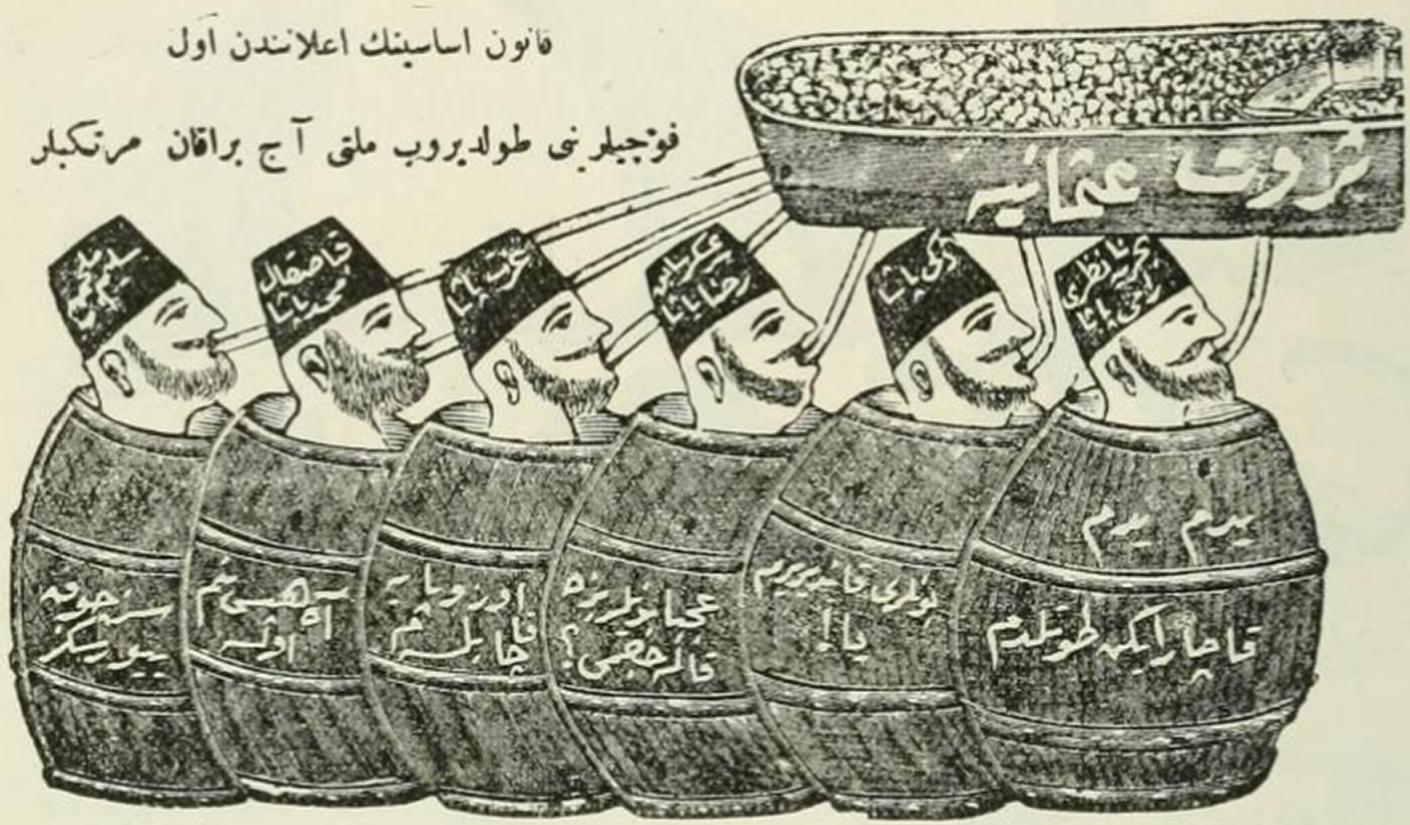
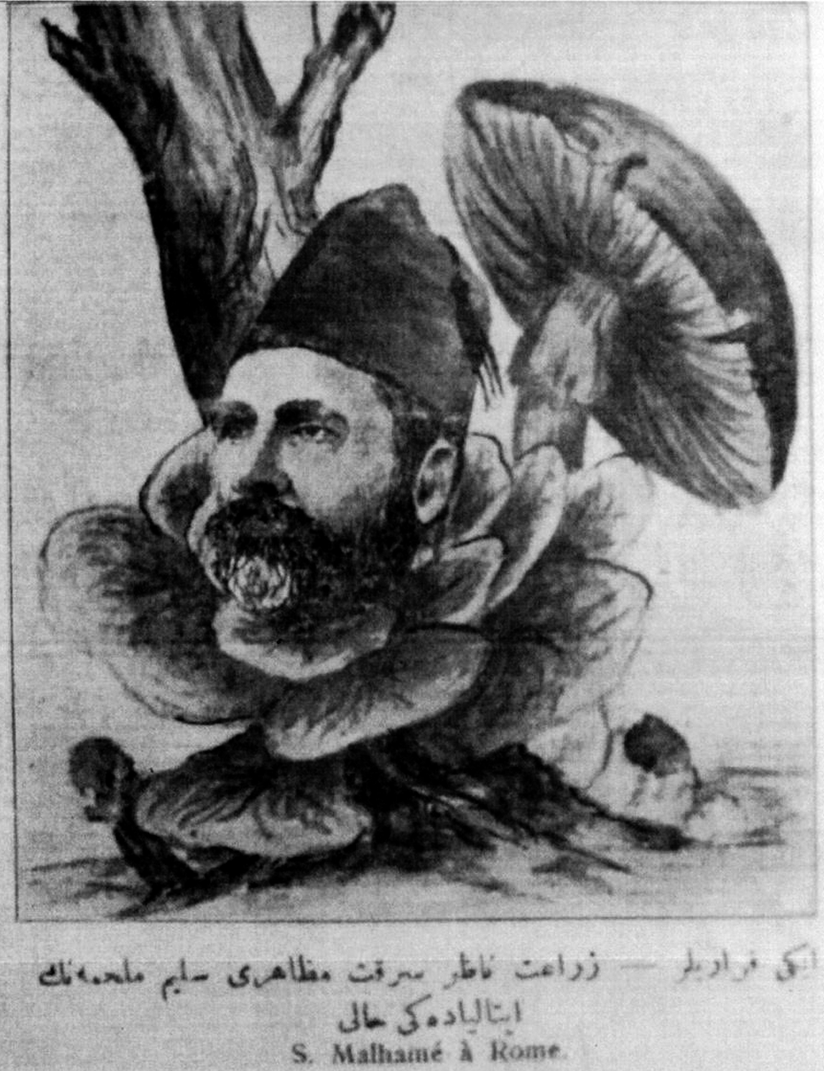
Whether Melhame’s proposals would have stamped out the opportunistic invocations of the “excuse of phylloxera” we cannot know, because of the tumult of the 1908 Constitutional Revolution, which reinstated the constitution and the Ottoman parliament. A month after Melhame’s last memos on phylloxera, he found himself, with other higher-ups in the Hamidian administration, suspected of corruption and taking flight from Istanbul. He absconded to San Remo, where he lived out the rest of his life among his extended family of Italian royals. Subsequently, Melhame—who had fought the microscopic phylloxera for over a decade—was lampooned by Istanbul’s popular press as a parasite, a “microbe of the nation” chewing on the Ottoman flag (figure 5). Still more like the phylloxera, he was portrayed as a force sucking up Ottoman wealth from below (figure 6), and even as a growth on a plant (figure 7).
“Microbes of the nation.” Papagalos, 4 August 1908, reprinted in Revue du Monde Musulman 6 (September-December 1908): 162.

Sucking down “Ottoman wealth.” Selim far left. Revue du Monde Musulman 6 (September-December 1908): 164.
Servet-i Fünun, 26 October 1908, 380.
“Ask no questions, and hear no lies” (Üzümünü ye, bağını sorma)
In the wake of the revolution that ousted Selim Melhame as a phylloxera-like force sucking life from the Ottoman economy, reinstated the constitution and parliament, and eventually dethroned Abdülhamid II, discussions of phylloxera appear familiar and quite in contradiction of the Turkish proverb “üzümünü ye, bağını sorma,” which literally means “eat your grape, don’t ask about its vineyard.” Rather than follow the adage to “ask no questions and hear no lies,” many continued to make challenging inquiries about grapes and their vines. In Çeşme, the president of the local chamber of agriculture and commerce warned that their land was no good for anything but viticulture, and accordingly phylloxera had left the region’s forty-five thousand people in desperate straits.Footnote 146 Some emigrated to places like the United States, while others held out hope that the new constitutional regime would ease their plight. At the same time, newly independent Bulgaria continued to express concern regarding both grapes and vineyards, and in September of 1908 it stipulated that to enter the country grapes coming from Salonica and Kosovo needed certificates attesting to the absence of phylloxera in their place of origin.Footnote 147 By the spring of 1909, the arrangement had shifted to paying a fee of 6 francs to secure a Bulgarian commercial agent’s attestation that the region of export was free of the scourge.Footnote 148 By year’s end, reports suggested Bulgaria was refusing any Ottoman fruits even with a certificate.Footnote 149
Further afield, Ottoman merchants faced impacts from actions of their once-Ottoman neighbors. In March of 1909 the Smyrna Dried Fruit Importers’ Association of London called for the Ottoman state to institute a tax on exported raisins to raise funds for a marketing campaign promoting the Sultana variety.Footnote 150 The merchant Leon Zorayan further explained that such a campaign was necessary because the Sultana “no doubt suffers from Greek competition,” which had benefitted from a marketing scheme funded by the Greek state “to our great detriment.”Footnote 151 Subsequent Ottoman correspondence on “our grapes” agreed that “although the grapes of Izmir are superior in terms of variety, taste, and preciousness they could not compete with Greece’s Corinth grapes” for years, largely because the former were never advertised.Footnote 152 This may well have been the case, but another aspect was that throughout the 1890s Greek grapes were protected from Ottoman competition via “the excuse of phylloxera.”
When Ottoman officials tried to address these challenges, they found debate derailed by disputes over whether they were really European or not. They did so in light of a new phylloxera law, which—in a continuity with the pre-revolutionary period—was precisely the type of law that Selim Melhame had proposed, mimicking existing codes in Europe. Rıza Bey—the writer of the phylloxera law and deputy representing the Thracian district of Drama—insisted that he was simply establishing the same policies as those operating in “civilized domains.”Footnote 153 Indeed, the phylloxera law he proposed was the same as those implemented by “European governments.” If parliament made changes to the law, he warned, they could risk having Ottoman exports to the rest of Europe entirely cut off. Europe became operationalized in the debates as many insisted that the Ottoman Empire simply lacked the administrative capacity to enact such measures. “Where are the officials, sir? In Europe there are scientific experts everywhere, however we do not have that here, sir” (fakat bizde yok efendim).Footnote 154 Later, another deputy insisted, “In Europe, everywhere there are scientific committees, scientific officials.”Footnote 155 In an attempt to quell the conflicts, a representative of the Ministry of Forests, Mines, and Agriculture emphasized the significance of discussing not simply any law, but “an international law” (beyneddüvel bir kanundur) and his concomitant hope that Ottomans might see the virtue in accepting it. ʿAbd al-Hamid Zahrawi—the curmudgeon from Hama—pithily objected, “Our people are not like the people of Europe” (Ahalimiz Avrupa ahalisi gibi deǧildir).Footnote 156 Whether or not this was true, the division between these places had been significantly impacted by the implementation of protection measures ostensibly against phylloxera but in service of post-Ottoman grape economies.
Meanwhile, members of the Ottoman government used phylloxera to praise the state and imagine a profitable future. A report from the foreign minister to the Ottoman ambassador in London Tevfik Pasha (and erstwhile foreign minister and grand vizier), for example, noted how over the previous thirty years “the disease of phylloxera” had “completely devastated” the raisin industry, which he described as the “most vibrant element of the wealth and commerce” of the province of Aydın.Footnote 157 But because of how the government had taken “prudent financial and scientific measures,” they had been able to “revive and renew the vineyards with American rootstock.” No less a figure than the agronomist, newspaperman, and state official Hüseyin Kazim—previously caught in arguments over grapes in Romania as the Ottoman ambassador there—offered a similar pronouncement in a reference work intended “to always be beside every farmer.”Footnote 158 Kazim admitted that phylloxera was “the worst vine disease” and that it had “completely wiped out” vineyards “in many parts of our country.”Footnote 159 He also declared that thanks to grafting with American rootstock “grape-growing was rescued from danger.” Yet for the Ottoman foreign minister, the health of vineyards did not necessarily mean success. Because France, Germany, England, and other countries waved customs duties on Corinth grapes, there was no way even the Ottoman Empire’s prized products—the seedless Sultana most significantly—could compete. The conditions created an “economic crisis” that repeated year after year like “an insalubrious chronic disease.” The analogy of disease compounded the actual disease, which had helped the Greek economy protect its own grapes from those across the Aegean.
Sour Grapes
As James Giesen has argued of the boll weevil in the southern United States, “The pest’s greatest consequence was not the many stands of cotton it devoured, but rather the real explanatory power that people found in the weevil.”Footnote 160 Phylloxera had a similar life. From its discovery in the Ottoman Empire in 1885 to the eve of World War I, phylloxera ravaged the empire’s vineyards and devastated the working people who made their living there. Yet that was not all. As an object of interstate commerce and scientific knowledge, and as a material reality as well as convenient pretext, many found a reason to invoke “the excuse of phylloxera.” Phylloxera in France made grapes and raisins a means of getting rich quick—and briefly—along the Aegean. The insect’s expansion also fueled debates about the place of European law in Ottoman law as well as science in governance. At the same time, phylloxera opened up opportunities for large landholders—Sultan Abdülhamid II most notably—to scoop up threatened properties, landless wage laborers, and—if they replanted with American rootstock—cushy tax breaks. Particularly after the French market for Ottoman raisins disappeared following 1892, newly post- or—in the case of Bulgaria—quasi-Ottoman states’ economies and borders took shape as part of a customs regime that concerned itself with the provenance of batches of raisins and grapes. In response to these disingenuous invocations of phylloxera and international law, the Ottoman state looked for other outlets such as the United Kingdom. There, too, they saw competition from other Aegean grapes whose existence owed to the repeated invocations of phylloxera in the 1890s and early 1900s.
Phylloxera continued to play an explanatory role in deliberations over place, plants, and economy in the wake of the devastation of World War I. As the Greek army occupied Izmir, University of Athens professor Andre Andreadis marshaled grapes and phylloxera to argue for an expansive territorial vision of Greece in the New York Times in 1919.Footnote 161 “When a few years ago phylloxera attacked the vineyards in Asia Minor,” Andreadis explained, “the fatalist Turk attributed it to Kismet and took no protective measures. The Greeks, however, introduced American plants and saved the situation.” Of course, Andreadis was omitting quite a bit here, but the vine continued to bolster arguments about place, in this case irredentist visions of Greece extending alongside the vines radiating out of the port of Izmir. Andreadis may have been relying on well-worn racist stereotypes, but he was correct about the political economy of grape production and distribution, which was largely in the hands of Greek laborers and merchants and had declined in conjunction with their dispossession during the war years. The American consul echoed Andreadis’s racist explanation: “The culture of the vine, especially since the introduction of American plants and the appearance of various cryptogamous diseases … demands intelligent sustained and farsighted attention, qualities not met with in the Turkish peasant.”Footnote 162 As Kemalist forces pushed the Greek armies out of Anatolia, they witnessed destruction. Some of it was due to war, but they largely blamed phylloxera for the “calamity” that had brought the vineyards to the verge of “destruction and ruin.”Footnote 163 Accordingly, they extended the phylloxera laws, providing for the distribution of American rootstock (“scientifically proven to fight phylloxera”) and granting tax exemptions for those who replanted their vines.
While some tried to use phylloxera to explain what they saw, others responded to the shocks to supply chains caused by war and phylloxera. In the wake of the Greek army’s occupation of Anatolia and its expulsion, the city of Izmir horrifically burned to the ground in September of 1922. Tens of thousands died, and still more fled as refugees, their last glimpse of their home city reduced to embers stolen from the water. The long-distance taste for Izmir’s grapes ensured that the catastrophe was felt in crass ways elsewhere. As London’s Daily Telegraph put it, “These are the days in which the prospects for the Christmas pudding are being eagerly watched … and fire, and destruction, and chaos could not, from the commercial point of view, have come to Smyrna at a worse time of the year.”Footnote 164 Other producers eyed the opportunity. Expanded production in South Africa and Australia held out the possibility of an “All-British plum pudding.”Footnote 165 In the meantime, growers elsewhere swooped in to ensure that British holiday pudding did not go sans raisins. One newspaper noted, “Since the days of the Crusaders, England got her raisins from Asian Minor.”Footnote 166 Enter California raisins and the Thompson’s seedless variety (Sultanas in all but name), which “made a remarkable invasion of England” at around the same time. The Treaty of Lausanne of 1923 put an end to the hostilities that had prevailed in Anatolia since 1914, laying the groundwork for the Republic of Turkey we know today. As Özkan Keskin has observed, the treaty’s one hundredth article maintained the laws on phylloxera control put in place during the Ottoman Empire.Footnote 167
In retrospect, the “excuse of phylloxera” acquired still another meaning: forgetting the tremendous changes to the region’s population. As of 1904, a list of exporters of raisins from Izmir to the United States included no shortage of Armenian, Greek, and Levantine families.Footnote 168 In contrast, a 1923 list of “merchants engaged in the export of grapes” from Izmir specified that they were “Turkish,” with some of them likely refugees from the Balkans.Footnote 169 As Ellinor Morack has argued, a large number of vineyards were acquired as abandoned property in this period, and they also suffered for lack of the skilled labor required to care for them.Footnote 170 One newspaper columnist resorted to a rhyming adage to make this point: “bakarsak bağ olur, bakmazsak dağ olur” (if we look after them, they are vineyards, and if we don’t, they become wilderness).Footnote 171 This process was part of a broader one in which the holdings of those killed or forced to leave became distributed among newly arrived Muslim refugees or local people, as the “dowry” or “start-up capital” of the Republic of Turkey.Footnote 172 Although officials made some efforts to match refugees’ specialties with the agriculture of the regions in which they were settled, newcomers in some cases uprooted vines and replaced them with crops they knew like tobacco or wheat.Footnote 173
But this was not simply a story of Izmir being deprived of laborers who knew how to care for vines and produce raisins. Those forced to leave took with them what they knew, and perhaps vines as well, as Naci Aday observed in 1938 when he compared the deliciousness of Sultana raisins from Crete with those from Izmir.Footnote 174 Those who left Izmir in the population exchanges found themselves denigrated upon arrival to Greece in agricultural (and sexual) terms as “Turkish seed” (Turkosporoi), aptly described by Philip J. Pauly in a different context as “politico-horticultural concepts.”Footnote 175 For all of the similarities in the agroecologies of Crete and Izmir, though, Crete’s grape growers did not have to deal with one significant constituent of the late Ottoman landscape: phylloxera. Those same strict Greek policies that Ottoman officials had so often complained about had succeeded in keeping it out of much of the country’s south.Footnote 176 Moreover, the grapes of Izmir, as well as Ottoman laborers, traveled further than Crete; by the mid-twentieth century, California had far surpassed Turkey in raisin production, even if it had not totally displaced it, and the president of the California Grape Growers Council was the Bitlis-born Arpaxat Setrakian.Footnote 177
While some acknowledged this history, others left it out. A 1930 article in the Istanbul daily newspaper Cumhuriyet omitted the legacy in answer to the headline question of “Why is our wine-making industry backward?”Footnote 178 Of Turkey’s 1.1 million tons of grapes produced in 1935, only 1.2 percent was used for wine production (as opposed to over 90 percent in countries like France, Italy, and Spain).Footnote 179 “However much the phylloxera that spread in Ottoman Europe and then to Anatolia after the Balkan Wars destroyed our grape-growing,” the article explained, the sad state of the industry was also attributable to “apathy and ignorance.”Footnote 180 By this account, the situation was caused by disease and national backwardness, both problems that were ripe for the new nation of Turkey to solve. The article was silent about the many who had grown grapes over the decades but were now gone, and said nothing of how phylloxera had helped constitute the different nations as they emerged from the Ottoman Empire. Countries like Greece, Serbia, Bulgaria, and Romania had used “the excuse of phylloxera” to firm up their borders and protect their grape industries. In the Republic of Turkey, phylloxera became an excuse for forgetting how, in part, the nation had come about.
Acknowledgments
I am grateful for feedback from the Ottoman History Workshop at Vanderbilt University and the UCLA History Department Brown Bag Series. I thank Önder Eren Akgül, David Blackbourn, William Caferro, Teresa Goddu, Emily Greble, Jonathan Karp, Eric Moses Gurevitch, Leor Halevi, Miloš Jovanović, Koh Choon Hwee, Owen Miller, Ramazan Hakkı Öztan, Uğur Zekeriya Peçe, Graham Auman Pitts, Tasha Rijke-Epstein, Jacob Roberts, Mark Sanchez, Samira Sheikh, Arianne Sedef Urus, and the anonymous CSSH reviewers for their helpful suggestions. I am also appreciative of the archival labor of Joyce Blueford and Chloe Cardenas at the California Nursery Historical Park and research help from Hamid İncidelen. Thanks to the editors of CSSH and Managing Editor David Akin for making the editorial process smooth. Unless otherwise noted, all translations are my own.


 Open access

