

What does it mean to identify as “American” and how does American identity shape political views on justice, protest, and appeals about American values? This article explores the theoretical assumptions of superordinate identity theory, examining how an overarching American identity influences attitudes among Black and white Americans toward the Black Lives Matter (BLM) movement. At the heart of our research is a question central to renowned political scientist Paula D. McClain’s scholarship: What frameworks are best suited to capture the broad-ranging dynamics of racial politics in the United States? McClain’s research challenged the limitations of the Black–white racial paradigm and extended theoretical frameworks to reflect more accurately the historical, contextual, and sociopolitical interactions across racial and ethnic groups in the United States. McClain and colleagues (McClain and Stewart Reference McClain and Stewart1995; McClain and Carew Reference McClain and Carew2017) have called on the discipline to explore more nuanced, historically grounded analyses of group identities and political behavior, encouraging us all to “get along.”
This article explores the theoretical assumptions of superordinate-identity theory, examining how an overarching American identity influences attitudes toward the Black Lives Matter movement among Black and white Americans.
By drawing on McClain’s research, we recognized that even as “American identity” is embraced broadly, it is not universally experienced. Although our study focuses on Black and white Americans, it reflects the political realities of our time and the enduring racial hierarchy steeped into the nation’s political history. McClain’s work implores us to develop conceptually rich and historically situated research to account for our nation’s contemporary realities, including the various experiences of racial and ethnic groups (McClain Reference McClain2021a; McClain and Tauber Reference McClain and Tauber2025). With this directive, we explored how Americans’ attachments to an American identity influence their views of justice movements, such as Black Lives Matter (BLM). Using data from the 2016 Collaborative Multiracial Post-Election Survey (CMPS) (Bareto et al. Reference Bareto, Frasure-Yokley, Vargas and Wong2017), we tested the idea that a shared national identity fosters shared political views. Bridging the study of race, American values, and American identity, this analysis investigates a modern-day “American Dilemma,” harkening to Myrdal’s (Reference Myrdal1944) critical assessment of race relations in the United States, and the reconciliation of American ideals and practices—a long-trodden aspiration of historically marginalized racial and ethnic groups (Omi and Winant Reference Omi and Winant1994).
A MODERN “AMERICAN DILEMMA”
Myrdal (Reference Myrdal1944) noted that despite the popular avowal of democracy in America, widespread practices of racial discrimination against Black Americans operated in stark contrast to democratic principles. Today, this tension is embodied in how Americans respond to justice movements such as Black Lives Matter that seek to hold the nation accountable to its professed values.
Americans ostensibly value protest; pivotal moments in American history are rooted in activism and contestation—for example, the Boston Tea Party, the American Revolution, the Abolition movement, suffrage movements, and the Civil Rights Movement. Concepts of justice, equality, and protest also represent core values associated with an “American ethos” and identity (McClosky and Zaller Reference McClosky and Zaller1984). We recognize the tendency to romanticize these social movements from the vantage point of the present while overlooking how deeply contested they were in their own time. Much like these earlier movements, the movement for Black Lives must contend with competing narratives of meaning and legitimacy. Each of these struggles carried at least two dominant narratives—one urging a reconciliation of American identity with principled democratic values, and another asserting that such values already were fulfilled, often in defense of entrenched and institutionalized social hierarchies. If these historical links between contestation and the American creed endure, we reasonably might expect protests to be closely tied to expressions of American identity.
Black Lives Matter continues to elicit a variety of interpretations ranging from support to ambivalence and opposition (Horowitz and Livingston Reference Horowitz and Livingston2016; Tillery Reference Tillery2017). Some interpretations view Black people as undeserving targets of racism at the hands of law enforcement, whereas other interpretations characterize Black people as likely perpetrators of unlawful actions, deserving of police reprimand. The movement follows patterns of racial protests over time (Lebron Reference Lebron2017; Taylor Reference Taylor2016; Thompson and Thurston Reference Thompson and Thurston2018), with support spiking during peaks of protest activity and receding in the following months. Black Americans’ support for Black Lives Matter has been relatively sustained over time, but white Americans have expressed mixed support (Horowitz, Cox, and Hurst Reference Horowitz, Cox and Hurst2025).
During Summer 2020, in the wake of the George Floyd murder protests, support for Black Lives Matter peaked across groups and was as high as 60% (Samuels Reference Samuels2021). By the next year, support had fallen 10 percentage points and trust in law enforcement had increased by 13% (Samuels Reference Samuels2021). Traditional predictors of protest support including partisanship, age, and generation do not fully explain these dynamics (Board et al. Reference Board, Spry, Nunnally and Sinclair-Chapman2020). By 2021, many white millennials believed Black Lives Matter encouraged violence against police. Across generations, white Americans have been less likely than other groups to acknowledge that police killings of Black Americans are not isolated incidents but instead part of a larger systemic problem (Cohen Reference Cohen2021).
These disjunctures of opinion between supporters and non-supporters of the Black Lives Matter movement lead to a motivating question: How do racial identities and a superordinate “American” identity influence attitudes toward protest activity in the United States?
CAN AMERICAN IDENTITY OVERRIDE RACIAL FISSURES ON AN APPEAL TO AMERICAN VALUES?
We consider “American identity” to be a superordinate identity—one that all Americans may claim to some extent by way of their shared connection to American politics, history, values, and culture. A more specific American political identity is premised on American values (e.g., capitalism, democracy, egalitarianism, individualism, the Protestant work ethic, freedom, and popular sovereignty), which McClosky and Zaller (Reference McClosky and Zaller1984) referred to as an “American ethos.” Protest is a feature of popular sovereignty alongside the franchise, freedom of speech, freedom of assembly, and the right to petition the government—all rights found in the US Constitution.
Despite common acknowledgment of normative values within American democracy and strong expressions of American identity across large swaths of the population, conceptions of American identity also are intertwined with biases about “who” is American. Moreover, perceptions of “Americanness” are often relegated to racial categorizations, with greater attributions to white than non-white persons (Huyser et al. Reference Huyser, Pérez, Ybarra, Hellwege and Sanchez2018; Schildkraut Reference Schildkraut2014). Because these perceptions are influenced by race, it may be the case that evaluations of protest are influenced—at least in part—by who is protesting and whose appeals to American values are perceived as legitimate. Previous studies describe how the merits of protest are perceived differently across racial groups (Horowitz and Livingston Reference Horowitz and Livingston2016), but theories of superordinate identity suggest that attitudes could be unified through common expressions of a shared identity (Sherif et al. Reference Sherif, Harvey, White, Hood and Sherif1961).
Superordinate-identity theory posits that shared group identities can reduce intergroup conflict by fostering a collective “we” (Sherif et al. Reference Sherif, Harvey, White, Hood and Sherif1961). However, this theory is based on the assumption that group members interpret the superordinate identity in similar ways. In the case of American identity, we argue that this premise is incorrect.
We suggest that American identity, although it is a superordinate identity encompassing multiracial populations in the United States, may be structured differently across racial groups because their experiences and expectations about American democracy are different. We used public perceptions of the Black Lives Matter movement to evaluate the limitations of superordinate identity among Black and white Americans. We tested whether shared American identity is associated with different attitudes toward Black Lives Matter across racial groups. We expected American identity to influence attitudes toward Black Lives Matter in opposing directions because the conceptual meaning of American identity may differ for Black and white Americans.
LIMITATIONS OF A SUPERORDINATE AMERICAN IDENTITY: “IDENTITY-MEANING”
Protests and demonstrations have been an important source of social change throughout US history, and participants often claim such activities advance the values at the core of the American ethos. Black and white Americans even report similarly strong feelings of “American” identity in surveys (Bareto et al. Reference Bareto, Frasure-Yokley, Vargas and Wong2017). If theories of superordinate identity hold, we might expect similarly strong expressions of an American identity to overcome differences in preference by providing a set of shared goals that benefit everyone in the superordinate group (Chowdhury, Jeon, and Ramalingam Reference Chowdhury, Jeon and Ramalingam2016; Gaertner and Insko Reference Gaertner and Insko2000; Sherif et al. Reference Sherif, Harvey, White, Hood and Sherif1961).
If the presence of a shared identity leads to greater cooperation and the pursuit of shared objectives among the encompassed subgroups, can American identity be an effective means of unifying public opinion regarding Black Lives Matter or protest movements more broadly? We argue that the answer to this question lies in recognizing that American identity will not influence political attitudes in the same direction across subgroups if the groups do not share a common definition or prioritize the same values associated with American identity.
Early studies on superordinate identities (e.g., Sherif et al. Reference Sherif, Harvey, White, Hood and Sherif1961) focused on turning “us” versus “them” into “we,” and argued that whereas minimal distinctions were sufficient to cause divisions between groups, superordinate goals could unite groups and overcome biases. Such studies attempted to imitate the types of intergroup conflicts encountered in the real world, but they have been subject to criticism. Early studies often featured school-age research participants yet claimed to provide generalizable results such that broad theories about intergroup conflict could be advanced. These studies also imposed simulated group categories and artificial competition to claim that group categorization was sufficient to produce prejudice and that superordinate goals could overcome intergroup bias.
In reality, the types of conflicts that often arise between groups, such as disputes over the merits of Black Lives Matter, are situated within known historical, social, and political contexts that may be more difficult to overcome (Thompson and Thurston Reference Thompson and Thurston2018). In contrast to early research suggesting that an ascribed superordinate categorization was sufficient to change the attitudes and behaviors of conflicting groups, subsequent research emphasized the need to contextualize identity and account for the social and political dimensions that influence how identities become interpreted and incorporated into political consciousness (Chowdhury et al. Reference Chowdhury, Jeon and Ramalingam2016; Dawson Reference Dawson1994; Gaertner, Dovidio, and Bachman Reference Gaertner, Dovidio and Bachman1996; Tate Reference Tate1994).
HYPOTHESES: APPLYING OUR THEORY TO ATTITUDES ABOUT BLACK LIVES MATTER
The influences of racial and American identities led to the following two hypotheses about perceptions of Black Lives Matter:
H1: Among white respondents, American identity will have a negative relationship with attitudes toward Black Lives Matter.
H2: Among Black respondents, American identity will have a positive relationship with attitudes toward Black Lives Matter.
Our theory and hypotheses reflect that previous studies have not reached a consensus regarding the influence of superordinate identities on the political attitudes of subgroups because they failed to explain how groups conceptualize the meaning of a superordinate group identity. This oversight results in potentially naïve interpretations about the influence of identity on important political outcomes.
DATA AND METHODS
We used data from the 2016 CMPS, a national survey of 10,145 US adults conducted from December 2016 to February 2017 (Frasure et al. Reference Frasure, Wong, Vargas and Bareto2022). The CMPS is especially well suited for studies of identity and racial attitudes because it includes large oversamples of nonwhite respondents (Bareto et al. Reference Bareto, Frasure-Yokley, Vargas and Wong2018). Respondents were recruited from various sources including the national voter-registration database and several online sampling platforms. We limited our analysis to Black (N=2,819) and white (N=892)Footnote 1 respondents.Footnote 2 Additional results from exploratory and confirmatory factor analyses examining the latent components of American identity that differ across Black and white respondents are in online appendix A (Spry and Nunnally Reference Spry and Nunnally2026).
RESULTS
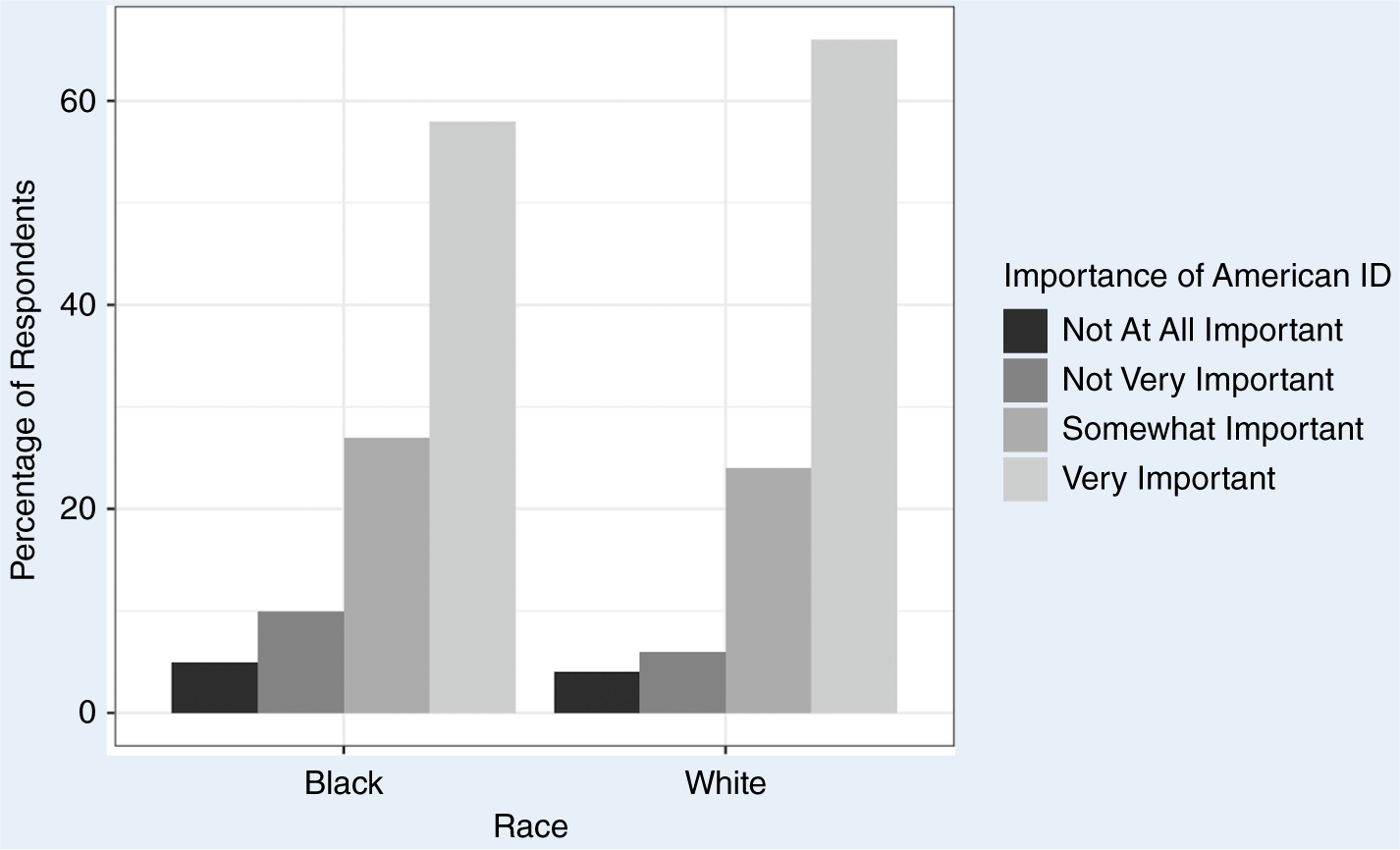
Figure 1 demonstrates that expressions of American identity are strong across racial groups. American identity was measured by asking: “How much is being American an important part of how you see yourself: very important, somewhat important, not very important, or not at all important?” Across both groups, at least 85% of respondents stated that being American was somewhat or very important to them. Specifically, 58% of Black respondents and 66% of white respondents stated that being American was a “very important” part of how they perceive themselves. Despite this similar strength of American identity, the two groups differed starkly in their attitude toward Black Lives Matter: 70% of Black respondents supported Black Lives Matter (41% “strongly”) and only 26% of white respondents “somewhat” or “strongly” supported the movement. Almost 40% of white respondents opposed the movement and 30% were neutral.
Importance of American Identity by Racial Group

Figure 1 Long description
The y-axis is labeled Percentage of Respondents with increments of 20 from 0 to 60. The x-axis is labeled Race with two categories: Black and White. A legend titled Importance of American I D defines four shades of gray from darkest to lightest: Not At All Important, Not Very Important, Somewhat Important, and Very Important.
For the Black racial group:
* Not At All Important is approximately 5 percent.
* Not Very Important is approximately 10 percent.
* Somewhat Important is approximately 27 percent.
* Very Important is approximately 58 percent.
For the White racial group:
* Not At All Important is approximately 4 percent.
* Not Very Important is approximately 6 percent.
* Somewhat Important is approximately 24 percent.
* Very Important is approximately 66 percent.
Both groups show a trend where the majority of respondents consider American identity to be Very Important, though the percentage is higher among White respondents.
AMERICAN IDENTITY AND SUPPORT FOR BLACK LIVES MATTER
This section tests the central hypothesis of our study: American identity does not function uniformly across racial groups. We argue that the meaning of American identity varies by subgroup, leading to divergent political attitudes—even when identity strength is similarly high. We used ordinary least squares (OLS) regression to assess whether expressions of American identity were associated with support for Black Lives Matter and whether this association differed by race.
Support for Black Lives Matter (coded in the direction of “support”) was measured by asking: “From what you have heard about the Black Lives Matter movement, do you strongly support, somewhat support, somewhat oppose, or strongly oppose the Black Lives Matter movement activism?” Race allowed respondents to choose as many racial categories as applicable from a list. We specifically focused our analysis on Black and white attitudes.
American identity (coded in the direction of “important”) asked: “How much is being American an important part of how you see yourself: very important, somewhat important, not very important, or not at all important?”
We included several control variables. Gender asked respondents to self-categorize as female, male, or other. Our dichotomized gender variable coded female respondents as “1” and all other respondents as “0.” A continuous age variable accounted for generational differences in support for Black Lives Matter. Because the Movement for Black Lives seeks to advance specific policies that may be of broad interest to Democrats (e.g., criminal justice reform), we controlled for partisanship. A Democrat dichotomous variable coded Democrats as “1” and all other affiliations as “0.” Independent coded Independents as “1” and all other affiliations as “0.” Republicans coded Republicans as “1” and all other affiliations as “0.” We included various combinations of the partisanship variables to test for differences in opinion, recognizing that Independent represents detachment from either party but also that “leaners” toward either party could be present in this category (Hajnal and Lee Reference Hajnal and Lee2011; McClain and Carew Reference McClain and Carew2017; McClain and Stewart Reference McClain and Stewart1995; White and Laird Reference White and Laird2020).Footnote 3
We also controlled for general attitudes toward protest activity. Support for protest measured how effectively respondents believe nonviolent protest activities solve social problems using a 4-point scale, where “1” was “least effective” and “4” was “most effective.” The Neighborhood percent Black variable asked respondents to estimate the percentage of Black residents that they perceive to live in their neighborhood from 0% to 100%. Although the neighborhood variable was not an objective measure of propinquity, it helped us to assess whether respondents had close interactions with Black neighbors in their daily life. Finally, we controlled for self-reported annual household income.
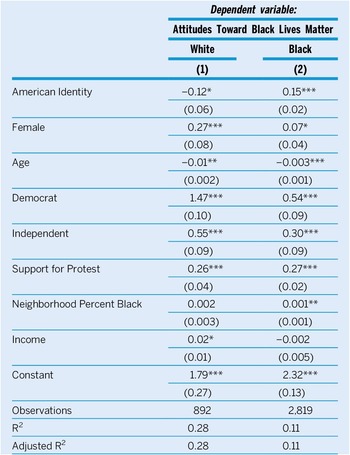
Table 1 presents results from the OLS model for white and Black respondents including controls. Consistent with our hypothesis, American identity was positively associated with support for Black Lives Matter among Black respondents but was not statistically significant among white respondents.
Regression of Attitudes Toward Black Lives Matter on American Identity for Black and White Respondents, Model 1

Table 1 Long description
The table presents regression coefficients and standard errors in parentheses for two models. The dependent variable is Attitudes Toward Black Lives Matter.
* American Identity: White respondents show a negative coefficient of minus 0.12 (p < 0.1), while Black respondents show a positive coefficient of 0.15 (p < 0.01).
* Female: White respondents 0.27 (p < 0.01); Black respondents 0.07 (p < 0.1).
* Age: White respondents minus 0.01 (p < 0.05); Black respondents minus 0.003 (p < 0.01).
* Democrat: White respondents 1.47 (p < 0.01); Black respondents 0.54 (p < 0.01).
* Independent: White respondents 0.55 (p < 0.01); Black respondents 0.30 (p < 0.01).
* Support for Protest: White respondents 0.26 (p < 0.01); Black respondents 0.27 (p < 0.01).
* Neighborhood Percent Black: White respondents 0.002 (not significant); Black respondents 0.001 (p < 0.05).
* Income: White respondents 0.02 (p < 0.1); Black respondents minus 0.002 (not significant).
* Constant: White respondents 1.79 (p < 0.01); Black respondents 2.32 (p < 0.01).
Summary statistics at the bottom indicate:
* Observations: 892 for White respondents and 2,819 for Black respondents.
* R super 2: 0.28 for White respondents and 0.11 for Black respondents.
* Adjusted R super 2: 0.28 for White respondents and 0.11 for Black respondents.
Note: *p<0.1; **p<0.05; ***p<0.01.
For white and Black respondents, Democratic partisanship was the strongest indicator of support for Black Lives Matter, although both Democratic and Independent partisanship attachments were associated with more support than Republican partisanship. Belief in the effectiveness of protest also was associated with support.
Among white respondents, both self-categorization as female and income also were associated with support for Black Lives Matter. Age was negatively associated with support, and neighborhood composition was not statistically significant. For Black respondents, neighborhood composition was associated with support for Black Lives Matter. Age was negatively associated with support and income was not statistically significant.
To test the moderating role of race on the relationship between American identity and attitudes toward Black Lives Matter, we estimated an OLS model with an interaction term between race (0=Black, 1=white) and American identity. We used an expanded set of controls to assess whether our core findings held when we accounted for additional dimensions of identity and political engagement.
Linked fate asked respondents how much they agreed with the following statement: “What happens to [people in the respondent’s own racial group] will have something to do with what happens in your life,” where “1” indicated “yes” and “0” indicated “no.”
We included three measures of political efficacy. First, Racial group members have a say measured internal group efficacy by asking: “How often would you say [respondent’s racial group] have a say in how government handles important issues,” where “1” indicated members of the respondent’s racial group “never have a say” and “5” indicated having a say “all the time.” Second, “What people like me think” measured personal internal efficacy by asking how much respondents agreed or disagreed with the statement: “Public officials don’t care much about what people like me think,” where “1” indicated that they “strongly disagreed” (suggesting high internal efficacy) and “5” indicated that they “strongly agreed” (suggesting low internal efficacy). We expected low internal efficacy to be associated with stronger support for Black Lives Matter because collective action may be viewed as a more viable course of political action than individual acts (e.g., voting and contacting representatives). Third, Public officials help my group measured external group efficacy by asking: “How often would you say public officials work hard to help [respondent’s racial group],” where “1” indicated that members of the respondent’s racial group “never have a say” and “5” indicated that they have a say “all the time.” A low sense of external efficacy may enhance the need to find political voice through social movements.
Fourth, we assessed whether respondents had ever recorded police misconduct by asking: “Have you ever used the camera on your mobile device to record police misconduct?,” where “1” indicated that the respondent had “never documented police misconduct,” “2” indicated that they had recorded police misconduct “once,” and “3” indicated that they had recorded police misconduct “more than once.” Given that Black Lives Matter emphasizes police accountability, we expected that those who had documented police injustice would be more supportive of Black Lives Matter.
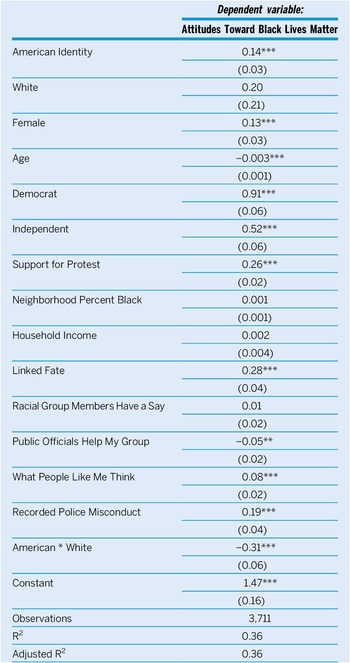
The results in table 2 reveal that the interaction term (i.e., “American identity * white”) is statistically significant, supporting our hypothesis that not only are white respondents less supportive than Black respondents of Black Lives Matter, but that American identity also predicts support in opposite directions across the two racial groups. As white respondents expressed stronger American identity, movement support decreased. For Black respondents, stronger American identity corresponded to greater support for Black Lives Matter. American identity was the only variable in our model that predicted attitudes toward Black Lives Matter in opposite directions by race. Our theory that the conceptual meaning of American identity varies across racial subgroups found empirical support in these results.
Regression of Attitudes Toward Black Lives Matter on American Identity with Race * American Identity Interaction, Model 2
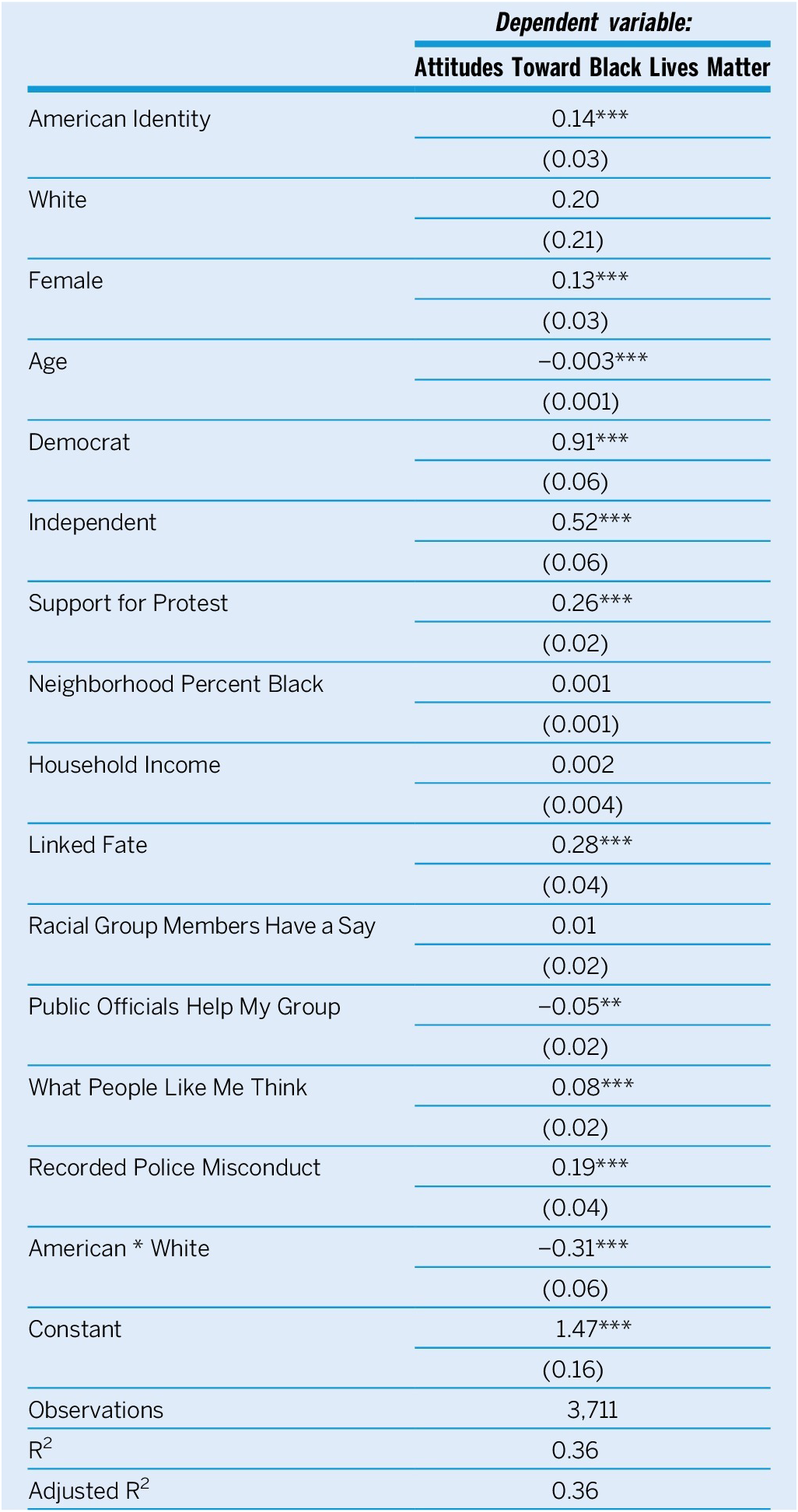
Table 2 Long description
A regression table for Model 2 with Attitudes Toward Black Lives Matter as the dependent variable. The table lists coefficients followed by standard errors in parentheses.
* American Identity: 0.14 triple star (0.03)
* White: 0.20 (0.21)
* Female: 0.13 triple star (0.03)
* Age: minus 0.003 triple star (0.001)
* Democrat: 0.91 triple star (0.06)
* Independent: 0.52 triple star (0.06)
* Support for Protest: 0.26 triple star (0.02)
* Neighborhood Percent Black: 0.001 (0.001)
* Household Income: 0.002 (0.004)
* Linked Fate: 0.28 triple star (0.04)
* Racial Group Members Have a Say: 0.01 (0.02)
* Public Officials Help My Group: minus 0.05 double star (0.02)
* What People Like Me Think: 0.08 triple star (0.02)
* Recorded Police Misconduct: 0.19 triple star (0.04)
* American star White interaction: minus 0.31 triple star (0.06)
* Constant: 1.47 triple star (0.16)
Model Statistics:
* Observations: 3,711
* R squared: 0.36
* Adjusted R squared: 0.36
Note: star p < 0.1; double star p < 0.05; triple star p < 0.01.
Note: *p<0.1; **p<0.05; ***p<0.01.
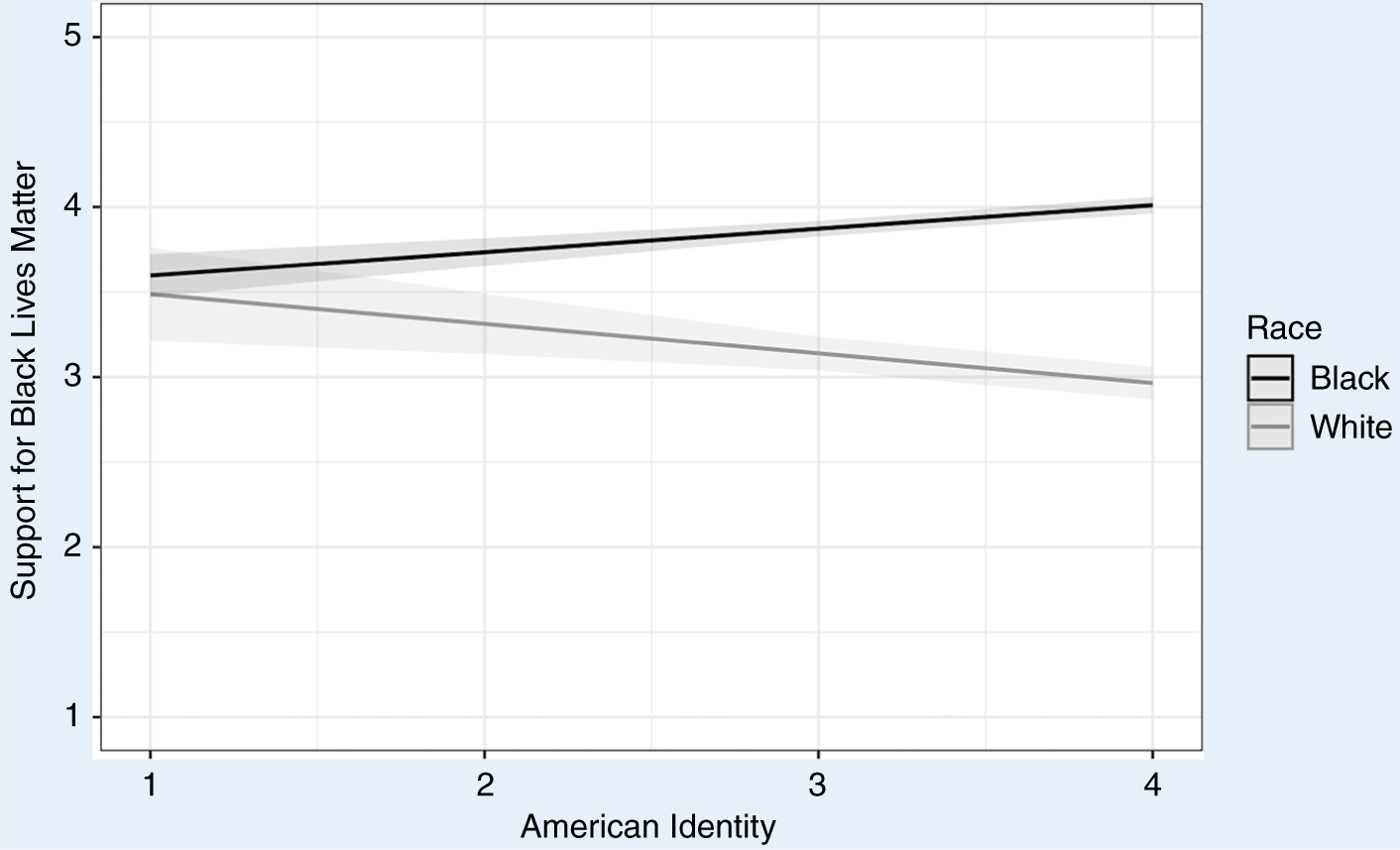
Figure 2 illustrates the divergent influence of American identity using the same set of controls as in model 2 but by estimating separate regressions for Black and white respondents rather than using an interaction term between race and American identity. (Regression results from this model are included in online appendix B.) For Black respondents, stronger associations of American identity were linked to greater support for Black Lives Matter, whereas for white respondents, the relationship between American identity and attitudes toward Black Lives Matter was not significant at the 95% confidence level. Although these findings do not confirm the theoretically anticipated divergence in how a superordinate American identity operates, they do suggest that American identity may be exerting distinct pressures on Black and white respondents.
Predicted Values of Support for Black Lives Matter

Figure 2 Long description
The X axis is labeled American Identity with a scale from 1 to 4. The Y axis is labeled Support for Black Lives Matter with a scale from 1 to 5. A legend to the right identifies two groups: Black, represented by a black line, and White, represented by a grey line. Both lines include light grey shaded confidence intervals.
* The black line for Black respondents starts at approximately 3.6 on the Y axis when American Identity is 1 and shows a steady linear increase, reaching 4.0 when American Identity is 4.
* The grey line for White respondents starts at approximately 3.5 on the Y axis when American Identity is 1 and shows a steady linear decrease, falling to just below 3.0 when American Identity is 4.
The two lines intersect near the American Identity value of 1.5, after which they diverge significantly.
When expressions of American identity are weak, levels of support for Black Lives Matter may appear similar across groups. As American identity strengthens, however, these starting values increase for Black respondents and do not appear to consistently influence white respondents. A naïve interpretation of superordinate-identity theory might overlook this divergence and suggest a shared orientation, but our results indicate otherwise. We also note that this model may represent a conservative estimate, given the oversampling of Black respondents relative to white respondents in the CMPS and the gender skew in the sample. This may account for both a stronger reflection of support for Black Lives Matter and weaker associations with American identity than what might be observed in the US population (Van Berkel, Molina, and Mukherjee Reference Van Berkel, Molina and Mukherjee2017). Tables 3 and 4 reveals the magnitude and direction of the partisanship effect on Black Lives Matter support, which is larger than that of American identity. Although the effect of partisanship warrants attention, we focused on the more easily obscured finding: the modest but inconsistent influence of American identity.
Regression of Attitudes Toward Black Lives Matter on American Identity with Democrat * American Identity, Independent * American Identity, and Female * American Identity Interaction Terms, Model 3

Table 3 Long description
A regression table with two columns for the dependent variable Attitudes Toward Black Lives Matter: (1) White and (2) Black.
Key coefficients (standard errors in parentheses):
* American Identity: White -0.06 (0.16); Black 0.31*** (0.11).
* Linked Fate: White 0.26 (0.44); Black 0.64*** (0.16).
* Democrat: White 1.16* (0.60); Black 0.33 (0.37).
* Independent: White 0.85 (0.58); Black 0.49 (0.38).
* Female: White 0.33 (0.42); Black 0.58*** (0.15).
* Age: White -0.004* (0.002); Black -0.002 (0.001).
* Support for Protest: White 0.20*** (0.04); Black 0.26*** (0.02).
* Neighborhood Percent Black: White 0.002 (0.003); Black 0.001 (0.001).
* Household Income: White 0.02* (0.01); Black -0.001 (0.005).
* Racial Group Members Have a Say: White -0.03 (0.05); Black 0.02 (0.02).
* Public Officials Help My Group: White -0.17*** (0.05); Black 0.004 (0.03).
* What People Like Me Think: White -0.09** (0.04); Black 0.14*** (0.02).
* Recorded Police Misconduct: White 0.29** (0.12); Black 0.15*** (0.04).
* American * Linked Fate: White -0.05 (0.12); Black -0.10** (0.04).
* American * Democrat: White 0.07 (0.16); Black 0.03 (0.10).
* American * Independent: White -0.09 (0.16); Black -0.09 (0.11).
* American * Female: White -0.01 (0.12); Black -0.15*** (0.04).
* Constant: White 2.22*** (0.68); Black 0.88** (0.40).
Model Statistics:
* Observations: White 892; Black 2,819.
* R super 2: White 0.32; Black 0.17.
* Adjusted R super 2: White 0.30; Black 0.17.
Note: * p < 0.1, ** p < 0.05, *** p < 0.01.
Note: *p<0.1, **p<0.05, ***p<0.01.
Regression of Attitudes Toward Black Lives Matter on American Identity with Republican * American Identity, Independent * American Identity, and Female * American Identity Interaction Terms, Model 4

Table 4 Long description
A regression table with two columns representing dependent variable models for White (1) and Black (2) respondents. The rows list independent variables with coefficients and standard errors in parentheses.
Key findings for White respondents (Model 1, N = 892):
* American Identity: 0.003 (0.14).
* Republican: -1.16* (0.60).
* Support for Protest: 0.20*** (0.04).
* Recorded Police Misconduct: 0.29** (0.12).
* R-squared: 0.32.
Key findings for Black respondents (Model 2, N = 2,819):
* American Identity: 0.34*** (0.05).
* Linked Fate: 0.64*** (0.16).
* Female: 0.58*** (0.15).
* Support for Protest: 0.26*** (0.02).
* American * Independent interaction: -0.13*** (0.05).
* American * Female interaction: -0.15*** (0.04).
* R-squared: 0.17.
Statistical significance is indicated by asterisks: * p < 0.1, ** p < 0.05, *** p < 0.01.
Note: *p<0.1, **p<0.05, ***p<0.01.
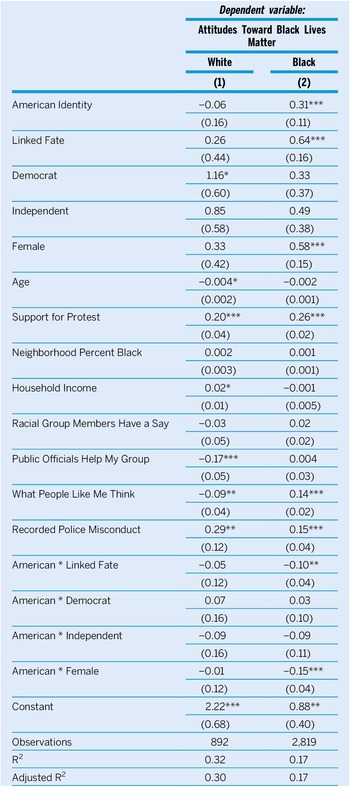
Given our interest in American identity, table 3 further tests the potential interrelated effects of partisanship and American identity by estimating separate regressions for each racial group using the same controls as in table 2 and by including interaction terms between American identity and partisanship as well as gender and linked fate.Footnote 4 Table 3 also shows interactions for Democrats and Independents, holding out Republicans. For Black respondents, only the interaction terms between American identity and linked fate and between American identity and gender were significant. Increased linked fate and being a Black woman were associated with decreased support for Black Lives Matter as American identity increased. Interaction terms did not reach significance for white respondents.
In table 3, for white respondents, the feeling that “public officials help my group” and the belief that public officials care “what people like me think” were associated with decreased support for Black Lives Matter. Belief in the effectiveness of protest and experiences recording police misconduct were associated with increased support. American identity, alone, did not produce a statistically significant effect.
For Black respondents, linked fate, being female, a belief in protest effectiveness, and personal internal efficacy were associated with stronger movement support. However, the negative linked-fate interaction indicated that among Black respondents who expressed linked fate, stronger American identity corresponded to weaker support for Black Lives Matter compared with those who did not express linked fate.
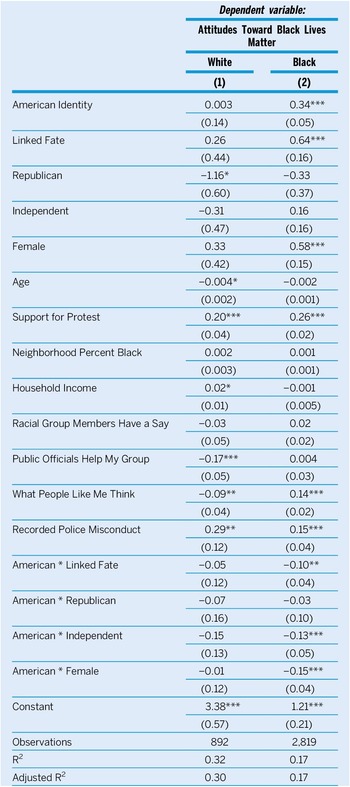
To understand better the role of partisanship, we replicated table 3 using interactions for Republicans and Independents, with Democrats as the reference category. The findings shown in table 4 complicate the relationship among race, partisanship, American identity, and support for Black Lives Matter.
In table 4, the interaction terms for American identity are not statistically significant for white respondents. Being a Republican, believing that public officials help their racial group, and the belief that “public officials don’t care about what people like me think” were associated with decreased movement support. Belief in the effectiveness of protest and experience in recording police misconduct were positively associated with support. Republican and Independent partisanship were not statistically significant at the 95% confidence level. We note specifically that for white respondents, the efficacy measures of believing public officials “help my group” and care “what people like me think” detracted support from the movement, implying that when white respondents view public officials as working on their behalf, they may be more inclined to see Black Lives Matter as a contradiction to a system that already is operating as intended.
For Black respondents in table 4, the interactions between American identity and linked fate and between American identity and Independent were significant and negative, indicating that stronger American identity is associated with weaker support for Black Lives Matter when Black respondents expressed stronger linked fate or when they were politically Independent. This finding also suggests that American identity may diminish the positive effect of linked fate on Black Lives Matter support that otherwise would enhance support for a movement focused on racial justice. Black Independents showed less support than Black Democrats; only the interaction between Independent partisanship and American identity was associated with decreased support compared to Democrats. American identity, linked fate, being female, belief in the effectiveness of protest, and internal personal efficacy were positively associated with movement support. Belief about whether public officials care “what people like me think” had different effects on movement support: among Black respondents, it increased but support decreased among white respondents. Age was not statistically significant. The distinctive attitudes between Independents and Democrats suggest that American identity may surface ideological orientations regarding working “inside” versus “outside” of the system for political change. However, we cannot determine whether these attitudes reflect specific views about tactics within the broader movement.
Our findings cast doubt on the working of American identity as a superordinate force, revealing that it inconsistently influences attitudes across the two racial groups (see tables 3 and 4) and, at times, drives beliefs in opposing directions altogether (see table 1). For white respondents, associations between American identity and Black Lives Matter support sometimes even dissolve. Taken together, these findings suggest that a superordinate American identity may not lead to unified views. These results motivated our deeper inquiry into the latent values associated with American identity (see online appendix A).
Using exploratory factor analysis, we identified the following three underlying dimensions of American identity:
-
• valuing democratic principles in theory (i.e., voting, protest, and contacting a representative)
-
• experience with democratic practices (i.e., experiences with inequality)
-
• personal experiences with discrimination and/or exclusion (i.e., feelings of belonging, outsider status, and exclusion)
A confirmatory factor analysis then examined whether these dimensions were expressed differently for Black and white Americans. We found that for Black respondents (see online appendix table A8), valuing protest as a democratic principle and feeling like an “outsider” in the United States exert a stronger influence on latent expressions of American identity. For white respondents, feeling like an “outsider” and belief in the effectiveness of contacting elected representatives influenced latent expressions of American identity. For white respondents, a belief in the effectiveness of protest had a weaker role (see online appendix table A9). Although factor analyses cannot establish causality, they illuminate the tensions between two competing conceptions of America: (1) an ideal America characterized by citizenship and democratic values; and (2) an experienced America shaped by identity and personal realities. An ideal America likely would lead to the argument made by Sherif et al. (Reference Sherif, Harvey, White, Hood and Sherif1961). An experienced America, as described by McClain and Stewart (Reference McClain and Stewart1995), at times imposes different realities for Black and white Americans.
With continued research, a causal narrative may differentiate these dynamics and point toward additional remedies for a nation fraught with division but also sustained by a history of struggle and progress. We can imagine, for example, an experiment similar to that of Perez and Hetherington (Reference Perez and Hetherington2014) using a vignette to prime a superordinate American identity and measuring outcomes related to protest attitudes and other democratic values across racial groups. This approach would provide additional evidence for our conclusion that American identity operates unevenly across racial groups and that superordinate-identity theory requires deeper contextualization.
DISCUSSION
Through our analyses, we found support for a theory of identity-meaning. American identity is not a uniform, overarching attachment that yields cohesive attitudes across subgroups. Instead, it operates as a contested symbolic category. Among white respondents, American identity matters less than expected and does not appear to have a consistent influence on attitudes toward Black Lives Matter. For Black respondents, the movement espouses civic values concurrent with Black conceptions of American identity—particularly the view that protest is an important part of achieving democratic progress. However, American identity also decreases support for Black Lives Matter when it interacts with linked fate and gender (i.e., Black women less than Black men) (see tables 3 and 4) and being an Independent compared to a Democrat (in table 4 only).
Linked fate often unites Black Americans in ways that support efforts on behalf of the Black racial group (Dawson Reference Dawson1994); however, in this case, Black respondents felt less connected to a movement centering on Black racial group advancement when American identity interacts with linked-fate attitudes. Linked fate often is treated as another type of “superordinate” mechanism believed to unify attitudes; however, we interpreted our findings as a demonstration that linked fate also may have different consequences depending on how individual respondents interpreted the notion of shared life chances (Davenport, Iyengar, and Westwood Reference Davenport, Iyengar and Westwood2022; McClain et al. Reference McClain, Carew, Walton and Watts2009).
Our findings underscore the need for research strategies that more closely approximate the ways that social identities operate at the individual and group levels, as McClain et al. (Reference McClain, Carew, Walton and Watts2009) suggested. These advances will clarify the relationship between social identity and outcomes including attitudes toward protest, candidate choice, mobilization, and political preference. Especially in the context of minoritized group protest, it is important to understand who perceives themselves as “American” and whose appeals and civic action on behalf of American values are viewed as valid.
To contextualize our data, the findings from the 2016 CMPS provide even more clarity about the attitudes underlying support for movements and perceptions of American democratic values. A deeper understanding of the contours and content of American identity may lead to interventions that will promote justice and civic equality by helping individuals who otherwise are opposed to social movements (e.g., Black Lives Matter) to view the appeals of those movements as complementing and not detracting from American values. Such interventions have the potential to bridge the gap between the practices of democratic values and expressions of American identity.
In retrospect, our 2016 data foreshadowed the troubling democratic retrenchments we are witnessing in the present. At that time, we struggled to characterize the illiberal tendencies reflected in US public opinion; currently, they read as early markers of an accelerating turn toward exclusionary and authoritarian politics (Gerschewski Reference Gerschewski2020; McClain Reference McClain2021b; Smith Reference Smith2026). We interrogated these developments through the fundamental question that McClain has long posed: “Can we all get along?”
Our research suggests that Americans’ commitment to democracy remains deeply contingent on who is participating, how they protest, and whether their demands align with dominant norms. These conditions complicate the promise of a truly inclusive multiracial democracy. As McClain’s research reminds us, realizing that promise requires continual, critical engagement across the shifting terrain of race, identity, and power in American politics.
Our research suggests that Americans’ commitment to democracy remains deeply contingent on who is participating, how they protest, and whether their demands align with dominant norms.
TOWARD A THEORY OF IDENTITY-MEANING
Whereas the mechanism through which identity influences attitudes is generally understood (Spry Reference Spry, Druckman and Green2021; Tajfel and Turner Reference Tajfel, Turner, Worchel and Austin1986), existing studies have not fully explained why for some identities, a wide range of attitudes can be present for an issue area relevant to that group. This paradox is especially puzzling in light of studies claiming that superordinate identities can overcome subgroup differences to encourage groups with previously opposing goals toward solidarity and cooperation. Given the results of our study, we suggest that when the underlying dimensions of a superordinate identity vary by subgroup, the attitudinal implications of that identity also will vary. Shared identity labels may mask distinct conceptualizations of what that identity entails: its history, values, and context.
We should expect neither subgroup attitudes to be equally responsive to the influence of a superordinate identity nor subgroup attitudes to respond in the same direction. Given the pronounced effects of partisanship operating differently for Black and white Americans’ support of Black Lives Matter, it also may be useful to consider partisanship as another form of superordinate identity to which groups attach and engage distinctly with politics. These distinct attachments may shape how groups conceptualize partisanship and configure affect in cross-racial, bipartisan, and intra-partisan coalitions in even more complex ways.
A theory of identity-meaning, as we propose, delves into the sublayers and subtexts of identities bringing methodology into closer alignment with the theoretical underpinnings of race and ethnic politics. Although this article reveals the divergence in political attitudes specifically, online appendix A provides preliminary evidence about the latent factors that compose American identity that differ across Black and white respondents—which is a possible explanation for the diverging influence of American identity. The persistence of these racial divides is evident in more recent data. Four years after the 2016 CMPS data examined in this study and during a pivotal year for Black Lives Matter protests, the 2020 CMPS revealed stark racial differences. Whereas majorities of Black (62%), Latino (57%), and Asian (54%) respondents viewed Black Lives Matter as “effective” in its protests, only 34% of white respondents agreed that Black Lives Matter “protests and demonstrations are effective in bringing change” (Frasure et al. Reference Frasure, Wong, Bareto and Vargas2021). We echo McClain’s (2016) call for the discipline to continue investigating the contours of identity to bring us closer to a democracy that reconciles commitments to justice and equality through a contextually rich understanding of racial and ethnic politics.
A theory of identity-meaning, as we propose, delves into the sublayers and subtexts of identities bringing methodology into closer alignment with the theoretical underpinnings of race and ethnic politics.
SUPPLEMENTARY MATERIAL
To view supplementary material for this article, please visit http://doi.org/10.1017/S1049096526102133.
ACKNOWLEDGMENTS
This article emerged from conversations at the 2018 Black Politics Workshop organized by Lorrie Frasure and Tyson King-Meadows. We are grateful to the organizers of and participants in this gathering for their foundational insights and valuable feedback that strengthened this study. We also are grateful to our colleagues who provided feedback throughout several iterations of this article, as well as feedback received from presentations at the University of Tennessee Knoxville, Brandeis University, Brown University, and the University of Pennsylvania. Shayla C. Nunnally, a former student of Paula D. McClain, thanks her especially for her tutelage and mentorship of other former students within the discipline.
DATA AVAILABILITY STATEMENT
Research documentation and data that support the findings of this study are openly available at the PS: Political Science & Politics Harvard Dataverse at https://doi.org/10.7910/DVN/9IZ3AB.
CONFLICTS OF INTEREST
The authors declare that there are no ethical issues or conflicts of interest in this research.