


Introduction
Toxodontidae (Notoungulata) is one of the most diverse endemic clades of South American native ungulates that occurred from the Oligocene to the Late Pleistocene (Madden, Reference Madden1990; Nasif et al., Reference Nasif, Musalem and Cerdeño2000; Bond et al., Reference Bond, Madden and Carlini2006). They are represented by medium- to large-sized terrestrial herbivores that are characterized by their specialized anterior dentition (high-crowned, heteromorphic incisors and tusk-like i3), which evolved from high-crowned to ever-growing cheek teeth since the middle Miocene (Madden, Reference Madden1990, Reference Madden1997; Bond et al., Reference Bond, Madden and Carlini2006).
South American toxodontids are presently classified into two subfamilies (Nasif et al., Reference Nasif, Musalem and Cerdeño2000): Nesodontinae and Toxodontinae. Nesodontines represent the oldest subfamily, recorded in Patagonia (Argentina) from the late Oligocene (Deseadan) to the middle Miocene (Friasian and Colloncuran), the late Oligocene (Deseadan) of Bolivia, and the early Miocene Chucal Fauna in Northern Chile (Croft et al., Reference Croft, Flynn and Wyss2004).
In the Neogene of Argentina, toxodontines are well represented in the northwestern provinces of Tucumán and Catamarca (Moreno and Mercerat, Reference Moreno and Mercerat1891; Rovereto, Reference Rovereto1914; Riggs and Patterson, Reference Riggs and Patterson1939; Marshall and Patterson, Reference Marshall and Patterson1981; Nasif et al., Reference Nasif, Musalem and Cerdeño2000; Bonini et al., Reference Bonini, Reguero and Candela2011; Bonini, Reference Bonini2014), and the west-central provinces of San Luis, San Juan, and Mendoza (Cuyo Region; Rovereto, Reference Rovereto1914; Pascual, Reference Pascual1965; Contreras and Baraldo, Reference Contreras and Baraldo2011; Forasiepi et al., Reference Forasiepi, Martinelli, De La Fuente, Dieguez and Bond2011, Reference Forasiepi, Cerdeño, Bond, Schmidt, Naipauer, Straehl, Martinelli, Garrido, Schmitz and Crowley2015). The latest record of this family corresponds to the Late Pleistocene, in archeofaunal contexts (Madden, Reference Madden1990, Reference Madden1997) of Argentina, Brazil, Uruguay, Peru, Bolivia, Ecuador, Venezuela, and Colombia (Nasif et al., Reference Nasif, Musalem and Cerdeño2000; Bond et al., Reference Bond, Madden and Carlini2006). Toxodontines also have been recorded in North and Central America in the latest Pleistocene (Lundelius et al., Reference Lundelius, Bryant, Mandel, Thies and Thoms2013; Rincón, Reference Rincón2011).
In this contribution, we present the first description of a toxodontid from the Jujuy Province, adding to the other northwestern Argentinean Neogene records (Fig. 1.1). The studied specimen, JUY-P 49, had been previously mentioned as a possible new taxon by Reguero et al. (Reference Reguero, Bonini, Candela and Solís2011). We present herein its taxonomic and phylogenetic affinities, and discuss the temporal and biogeographic implications of the group.
Map showing the geographical position of localities mentioned in the text: (1) Neogene localities of Argentina with record of Xotodon: (a) Monte Hermoso, Xotodon prominens and X. ambrosettii; (b) Huayquerías de San Carlos, X. major; (c) Paraná riverside cliffs, Entre Ríos, X. foricurvatus and X. doellojuradoi; (d) San Gregorio, San José, Uruguay, “X. smaltatus”; (e) Valle de Santa María and Puerta de Corral Quemado, X. cristatus; (f) Maimará, X. maimarensis n. sp.; (2) detail of Quebrada de Humahuaca, type locality of Xotodon maimarensis n. sp.

Geologic setting
The late Miocene–early Pliocene Maimará Formation (Salfity et al., Reference Salfity, Brandan, Monaldi and Gallardo1984) represents a continental sequence cropping out along the intermontane Quebrada de Humahuaca Basin in the Eastern Cordillera of the southern Central Andes of NW Argentina (23°–24° S) (Fig. 1.2). The Maimará Formation unconformably overlies the older lithologies exposed in the basin, including the Proterozoic Puncoviscana Formation, and is overlain by at least 250 m thick sediments corresponding to the Tilcara Formation (Pingel et al., Reference Pingel, Strecker, Alonso and Schmitt2013).
The most complete section of this unit is exposed in the Quebrada de Maimará, west of Maimará town (23º37'S, 65º24'W), Jujuy Province, ~35 km south of Humahuaca town, 2800 m.a.s.l. (Fig. 1.2), where the succession thrusts eastward over Pliocene conglomerates (Salfity et al., Reference Salfity, Brandan, Monaldi and Gallardo1984; Pingel et al., 2013). The ca. 250 m thick (ranging from 35 m to 330 m) Maimará Formation at Quebrada de Maimará is composed of interbedded arkosic sandstone and conglomerates intercalated with at least seven volcanic ash layers. The deposits show an upwardly coarsening sequence developed in an ephemeral fluvial system under arid and semi-arid conditions (Galli et al., Reference Galli, Coira, Candela, Alonso, Reguero, Abello, de los Reyes and Voglino2012). The original locality data provided with specimen JUY-P 49 indicates that it was surface collected by Dr. R. Loss on 5 January 1950, ~50 m to the West of the Nacional Route 9 close to the southern valley of Quebrada Maimará, stratigraphically located a few meters above the horizon represented by reddish-brown finer-grained clays and siltstones where other fossils were found (Berman, Reference Berman1989; Pujos et al., Reference Pujos, Candela, Galli, Coira, Reguero, de los Reyes and Abello2012; Abello et al., Reference Abello, De Los Reyes, Candela, Pujos, Voglino and Quispe2015). This horizon is located between two basal massive tuffs correlated with 10HUM02 and 10HUM21 of Pingel et al. (Reference Pingel, Strecker, Alonso and Schmitt2013, fig. 2B), dated at ~5.06 and ~5.9 Ma, respectively. Although the occurrence of the better-preserved fossils is restricted to fine-grained sand between the two basal tuffs of the sequence, additional fossils were also recovered from the overlying conglomeratic horizon. Considering the stratigraphic provenance of JUY-P 49 and the correlation between the associated tuffs of the section at Quebrada de Maimará with those dated by Pingel et al. (Reference Pingel, Strecker, Alonso and Schmitt2013, fig. 3A-C; see Figs. 2.1–2.2), we infer that the age of JUY-P 49 would be near the late Miocene–early Pliocene boundary.
(1) Simplified Cenozoic chronostratigraphy of the Humahuaca Basin area (modified from Abello et al., Reference Abello, De Los Reyes, Candela, Pujos, Voglino and Quispe2015), showing Maimará and Tilcara formations and 206Pb/238U zircon ages obtained from several volcanic ashes in Humahuaca Basin volcanic rocks (Pingel et al., 2013). (2) Stratigraphic section at Quebrada de Maimará (modified from Abello et al., Reference Abello, De Los Reyes, Candela, Pujos, Voglino and Quispe2015) showing the most basal tuffs of the section, modified from Pujos et al. (Reference Pujos, Candela, Galli, Coira, Reguero, de los Reyes and Abello2012).

Materials and methods
Phylogenetic Analysis
A parsimony analysis of the matrix (see Supplementary Data) was carried out using TNT 1.1 (Goloboff et al., Reference Goloboff, Farris and Nixon2008). We performed the analysis to evaluate the phylogenetic relationships of the studied specimens within Toxodontinae, mainly based on the phylogeny presented by Forasiepi et al. (Reference Forasiepi, Cerdeño, Bond, Schmidt, Naipauer, Straehl, Martinelli, Garrido, Schmitz and Crowley2015). We selected the same taxa used by these authors as outgroups, namely two Notohippidae (Rhynchippus spp. Ameghino, Reference Ameghino1897 and Pampahippus arenalesi Bond and Lopez, Reference Bond and López1993) and two Leontiniidae (Leontinia gaudryi Ameghino, Reference Ameghino1895 and Scarritia canquelensis Chafee, Reference Chafee1952). However, in this analysis, the ingroup includes all currently recognized species of Xotodon: X. foricurvatus (Ameghino, Reference Ameghino1885); X. doellojuradoi Frenguelli, Reference Frenguelli1920; X. prominens Ameghino, Reference Ameghino1888; X. cristatus Moreno and Mercerat, Reference Moreno and Mercerat1891; X. ambrosettii Rovereto, Reference Rovereto1914; and X. major Rovereto, Reference Rovereto1914. It is worth mentioning that X. smaltatus Kraglievich, Reference Kraglievich1932, was based only on a transported lower incisor found on the beach of San Gregorio (San José, Uruguay). Kraglievich (Reference Kraglievich1932) recognized other three toxodonts at the same locality, also very poorly represented. Years later, Mones (Reference Mones1975) described a juvenile mandibular fragment as Xotodon cf. X. smaltatus, but later the same author regarded this species as a nomen nudum (Mones, Reference Mones1986). Due to the scarce and few significant remains, we prefer to exclude X. smaltatus from this analysis until new material could ascertain its taxonomic validity. In turn, the holotype of Xotodon foricurvatus has been lost, but a cast of this specimen (MLP M-192) is deposited at MLP, along with two lower molar casts (MLP M-200 and MLP M-202) assigned to this taxon. We added a third state to character 26 because some taxa exhibit a smooth posterolingual groove in P3–P4 (262).
The data matrix (see Supplementary Data) comprises 31 terminal taxa and 59 morphological (cranial and dental) characters, treated as non-additive. We conducted a heuristic search with Tree Bisection Reconnection (TBR) using 100 random addition sequences and saving 20 trees per round. Subsequently, we performed a new TBR search, saving the new trees. With this methodology, we obtained 27 most parsimonious trees of 192 steps with a consistency index (CI) of 0.43 and a retention index (RI) of 0.67. Then, we carried out searches under implied weights (k3–k100) and from k6 the program provided two most parsimonious topologies, which better established the relationships of the Xotodon clade. These trees are discussed in the corresponding section and compared with previous results (Forasiepi et al., Reference Forasiepi, Cerdeño, Bond, Schmidt, Naipauer, Straehl, Martinelli, Garrido, Schmitz and Crowley2015).
In the case of the analysis of radiation of the genus Xotodon, the incompleteness of the fossil record means that minimum divergence times must be established through the calculation of ghost lineages (Norell, Reference Norell1996), which extend the temporal range of a lineage (a species) prior to its appearance in the fossil record based on information from its sister lineage. Calibrated phylogenetic trees were obtained using a script that takes into account the chronostratigraphic information for fossil taxa in TNT (it calculates MSM*, GER, and provides a calibrated topology in nexus format). We identified “ghost lineages” following the methodology proposed by previous authors (Pol and Norell, Reference Pol and Norell2001), considering the age of the first appearance of each terminal taxon in the fossil record as the only relevant temporal information (Pol et al., Reference Pol, Norell and Siddall2004).
Repositories and institutional abbreviations
The specimen JUY-P 49 is represented by an incomplete right mandibular ramus with poorly preserved dentition, part of the symphysis with the incisors (i3 broken) and canines, and a small fragment of the left ramus without teeth. This specimen is housed in the Museo de Geología Mineralogía y Paleontología (MGMyP), Instituto de Geología y Minería, Universidad Nacional de Jujuy, Argentina. JUY-P 49 was found by Dr. R. Loss on January 5, 1950, in the outcrops of Maimará Formation, in the Quebrada de Maimará west of Maimará town (Fig. 1.2). Morphometric and taxonomic studies included direct comparisons with material assigned to several species of Neogene toxodontids deposited in various national institutions, and bibliographical research focused on South American Toxodontidae (e.g., Madden, Reference Madden1990, Reference Madden1997; Saint-André, Reference Saint-André1993; Nasif et al., Reference Nasif, Musalem and Cerdeño2000; Bond et al., Reference Bond, Madden and Carlini2006, and Forasiepi et al., Reference Forasiepi, Cerdeño, Bond, Schmidt, Naipauer, Straehl, Martinelli, Garrido, Schmitz and Crowley2015). FMNH-P, Field Museum of Natural History, Vertebrate Paleontological Collections, Chicago, USA; JUY-P, Museo de Geología, Mineralogía y Paleontología, Instituto de Geología y Minería, Universidad Nacional de Jujuy, San Salvador de Jujuy, Argentina; MACN, Museo Argentino de Ciencias Naturales “Bernardino Rivadavia”, Buenos Aires, Argentina; MLP, Museo de La Plata, La Plata, Argentina; MMP, Museo Municipal de Ciencias Naturales “Lorenzo Scaglia”, Mar del Plata, Argentina; PVL, Facultad de Ciencias Naturales e Instituto Miguel Lillo, Sección de Paleovertebrados Lillo, San Miguel de Tucumán, Argentina.
Systematic paleontology
Anatomical abbreviations
c, canine; i, incisor; m, molar; p, premolar.
Class Mammalia Linnaeus, Reference Linnaeus1758
Order Notoungulata Roth, Reference Roth1903
Suborder Toxodontia Owen, Reference Owen1853
Family Toxodontidae Gervais, Reference Gervais1847
Subfamily Toxodontinae Trouessart, Reference Trouessart1898
Genus Xotodon Ameghino, Reference Ameghino1887
Type species
Xotodon foricurvatus (Ameghino, Reference Ameghino1885), “Mesopotamiense” (lower member of the Ituzaingó Formation, late Miocene), Entre Ríos Province, northeast Argentina (Brunetto et al., Reference Brunetto, Noriega and Brandoni.2013).
Other species
Besides the type species, X. doellojuradoi, X. prominens, X. cristatus, X. major, and X. ambrosettii (see Fig. 1.1). See comments above on the taxonomic validity of X. smaltatus.
Generic diagnosis
(after Pascual et al., Reference Pascual, Ortega Hinojosa, Gondar and Tonni1966): Toxodontid with skull high and compressed, narrow palate and quite excavated. Highly compressed premolars, arranged in closed series; P1 crescent-shaped, with labial convexity, with a layer of labial and lingual enamel; P2 with a convex labial face. Upper molars with the anteroposterior diameter very oblique with respect to the direction of the jugal series; postero-lingual lobe shorter than Hemixotodon; M3 without lingual groove, and enamel almost reaching the postero-labial side. Lower molars with lingual enamel extended anteriorly and the anterolingual column short and prominent.
Xotodon maimarensis new species
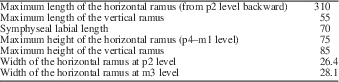
Figures 3.1–3.3, 4.1–4.3, Tables 1, 2
JUY–P 49, mandibular fragment, holotype of Xotodon maimarensis n. sp.: (1) lateral view; (2) occlusal view; (3) ventral view. Scale bar=5 cm.

Drawing of the holotype of Xotodon maimarensis n. sp. indicating mandibular and dental features used in the text: (1) lateral view; (2) occlusal view; (3) ventral view. Scale bars=5 cm; (4) schematic lower tooth morphology and terminology. Abbreviations: af, anterior fold; c, canine; ec, entoconid; e-hf, ento-hypoconid fold; ecd, ectolophid; f, fossa; hr, horizontal ramus; hyd, hypoconulid; i, incisor; kc, keeled chin; lee, lateral expanded edge; lf(h), labial fold (hypoflexid); m, molar; mc, metaconid; m-ef, meta-entoconid fold; p, premolar; pc, paraconid; prc, protoconid; s, symphysis; Ta, talonid; Tr, trigonid.

Mandibular measurements (mm) of Xotodon maimarensis n. sp. (JUY-P 49, holotype).
Lower cheek teeth dimensions (mm) of Xotodon maimarensis n. sp. (JUY-P 49, holotype) and other species of Xotodon. L=Length, W=width, *=approximately.

Holotype
JUY-P 49: incomplete mandible with right horizontal ramus with all teeth, symphysis with all incisors, and a small fragment of the left ramus without teeth. Maimará Formation (late Miocene–early Pliocene), Jujuy Province, northwestern Argentina.
Diagnosis
Lower incisors more procumbent than in X. cristatus, X. major, and X. prominens; symphysis long and narrow with slight divergence of its lateral borders; chin angle lower than in Xotodon major, X. cristatus, and Calchaquitherium mixtum, rather different from Mixotoxodon larensis and Toxodon sp.; chin bulging at the level of p2–3, which continues anteriorly in a short labial keel more marked than in X. major; the bulge limits strong lateral concavities.
Occurrence
Maimará Formation (late Miocene–early Pliocene), outcropping at the west of National Route 9 and Maimará town (23°37'27''S, 65°24'48''W), Quebrada de Maimará, Jujuy Province, Argentina. Note that the most fossiliferous levels at Quebrada de Maimará, where we recently collected the first vertebrates with precise stratigraphic provenance for this formation (Pujos et al., Reference Pujos, Candela, Galli, Coira, Reguero, de los Reyes and Abello2012; Candela et al., Reference Candela, Bonini, Tonni, Reguero, Abello and Rasia2013; Abello et al., Reference Abello, De Los Reyes, Candela, Pujos, Voglino and Quispe2015), are located between the most basal tuffs of the section that outcrops west of Maimará town.
Description
The mandible is high, with short diastemata anterior and posterior to the canine and p1. In lateral view (Figs. 3.1, 4.1) the incisors appear procumbent. The horizontal ramus is higher at the level of p4–m1 than posteriorly (Table 1), and its ventral margin is straight, without a ventral projection. The alveolar margin is slightly divergent with respect to the ventral margin from m3 to p2–3. At p3–4 level, the horizontal ramus is narrow and projects ventrolaterally in a little expanded edge.
In occlusal view (Figs. 3.2, 4.2), the symphysis is completely fused, narrow and long, forming a well-developed U-shaped channel, barely widening forward; the posterior end of the symphysis reaches the level of p3–4.
In ventral view (Figs. 3.3, 4.3), both hemimandibles converge at the level of the ventrolateral expansion, forming a bulging chin that continues ahead into a centered short keel (Fig. 3.3), which would correspond to the “keeled chin” sensu Madden (Reference Madden1990, Reference Madden1997). From this level, the symphysis widens and becomes labially flattened.
Concerning preserved dentition (Figs. 3, 4; Table 2), the incisors are heteromorphic, as in the most advanced Toxodontidae (Bond et al., Reference Bond, Madden and Carlini2006). The i1 and i2 are small and triangular in cross section, labio-lingually compressed, with an enamel band covering the mesial and labial sides and a narrow lingual enamel band near the mesial corner. The i3 are tusk-like and deeply implanted. They are subtriangular, mesially wide and with distally directed apices, with a round vertex (Fig. 3.2). The lingual enamel band is larger than the labial one, covering approximately three quarters of the lingual side; the mesial side lacks enamel.
The canine and the premolars are broken. The canine is separated from i3 and p1 by a short diastema; it is oval in cross section and bears a narrow enamel band on its labial side. The p1 is laterally compressed and approximately similar in size to p2 and p3 (Table 2). The p2 is separated from p1 by a short diastema; the posterior portion of p2 is broken, and is flattened transversally. Enamel covers the labial and lingual sides, both of which are smoothly concave. The p3 is similar to p2, but it is not possible to ascertain whether it has an enamel band. The p4 is the largest of the premolar series (Table 2). It is antero-posteriorly elongated, with lingual and labial enamel, and bears a smooth fold on the labial side.
The molars are euhypsodont (sensu Mones, Reference Mones1982). Their crowns, typical of advanced toxodontids (Bond et al., Reference Bond, Madden and Carlini2006), are long and narrow, with a wide and labially convex trigonid and a long talonid that constitutes more than half of the molar (Figs. 3.2–4.2). These teeth present some characteristics indicated by Pascual et al. (Reference Pascual, Ortega Hinojosa, Gondar and Tonni1966) for Xotodon, such as the lingual enamel extended anteriorly, the paraconid extended laterally and anteroposteriorly short, and m1–2 with a slight lingual convexity. In addition, they present four columns and two lingual sulci as in Dinotoxodon Mercerat, Reference Mercerat1895 or Toxodon, but they differ from these genera in depth of the sulci, outline of the columns, and contact between them. The labial side is completely covered by enamel in m1–3 and exhibits a deep and wide fold, posterior to the level of the anterior lingual fold.
In the m1–2 the meta-entoconid fold is deeper, closer, and directed more obliquely forward than the ento-hypoconid fold. The lingual enamel starts at the level of the anterior fold and reaches the posterior end of the hypoconulid, which is slightly extended lingually. The postero-labial angle of these teeth is well marked.
In m3, the talonid is longer than in m1–2, and the ectoloph bears a smooth concavity opposite to the ento-hypoconid fold. The postero-labial angle is more open than in m1–2, as a regular convexity.
Etymology
Named after Maimará, a small town located in Tilcara Department, Jujuy Province, Argentina; the name is an Omaguaca (native language) word meaning “falling star.”
Remarks
Considering the generic characteristics mentioned above, JUY-P 49 is compared primarily with the species of Xotodon, as well as with other advanced toxodontines.
The angle between the symphysis and the ventral margin of the horizontal ramus in JUY-P 49 is ~35°, similar to Posnanskytherium Liendo Lazarte, Reference Liendo Lazarte1943, and a bit lower than in Xotodon major (MACN PV 8570, ~45º). Xotodon cristatus has a more upraised symphysis, ~60º, similar to Calchaquitherium mixtum Nasif, Musalem, and Cerdeño, Reference Nasif, Musalem and Cerdeño2000 (~58º), which also is greater than in JUY-P 49. Toxodon Owen, Reference Owen1837 and Mixotoxodon larensis Van Frank, Reference Van Frank1957 present a very small angle (~20°) and protruding symphysis, and clearly differ from JUY-P 49 by the convex ventral profile of the horizontal ramus.
Regarding the mandibular features, JUY-P 49 shows a labial keel located at a basal position of the symphysis similar to, but less marked than, that observed in the other species of Xotodon. It differs from Calchaquitherium mixtum, in which the keel is thinner and more proximally placed. In addition, the symphysis of JUY-P 49 has a flattened surface anterior to the keel, as in C. mixtum, Posnanskytherium desaguaderoi Liendo Lazarte, Reference Liendo Lazarte1943, X. major, X. cristatus, and X. prominens.
The presence of a completely fused, U-shaped symphysis constitutes a similar feature to that observed in X. cristatus, X. major, and C. mixtum, but in these species the symphysis is shallower and more elevated. In addition, the posterior border of the symphysis reaches the level of p3–4 similar to X. cristatus, X. prominens, and X. ambrosettii.
The greatest height of the horizontal ramus of JUY-P 49 occurs at the same level as in C. mixtum. The lack of a ventral projection differentiates JUY-P 49 from Dinotoxodon paranensis (Laurillard in d’Orbigny, Reference d’Orbigny1842), Pericotoxodon platignathus Madden, Reference Madden1997, Gyrinodon quassus Hopwood, Reference Hopwood1928, and Hoffstetterius imperator Saint-André, Reference Saint-André1993.
The morphology of i1 is similar to that observed in X. prominens, whereas it differs from X. major by the absence of a lingual concavity and lesser labiolingual compression. The i2 differs from those of X. major, X. prominens, and X. cristatus because in these species it is crescent-shaped and presents a lingual concavity. The enamel bands of i1 and i2 show a similar arrangement to that in the species of Xotodon, as well as in Mixotoxodon larensis, Calchaquitherium mixtum, and Pericotoxodon platignathus. The i3 of JUY-P 49 is more rounded mesially and less compressed bucco-lingually than in X. major and X. prominens. Moreover, the lingual enamel band is broader than the labial one, as it occurs in X. cristatus, X. major, Pericotoxodon platignathus, Palyeidodon obtusum Roth, Reference Roth1899, Hoffstetterius imperator, and Calchaquitherium mixtum.
The presence of a diastema between i3 and p1 occurs in the species of Xotodon as well as in Pericotoxodon platignathus, Toxodon platensis Owen, Reference Owen1837, Hoffstetterius imperator, Trigodon gaudryi, and Hyperoxotodon speciosus (Ameghino, Reference Ameghino1887). Although the species of Posnanskytherium present a lingually extended short paraconid that lacks enamel, they differ from JUY-P 49 in lacking an ento-hypoconid fold.
The p1 is oval in cross section (Figs. 4, 5) as in Xotodon cristatus, X. major, and C. mixtum, differing from X. prominens, in which this tooth is transversely compressed.
Schematic occlusal views of right c–m3 series: (1) Xotodon maimarensis n. sp. (JUY–P 49, holotype); (2) Xotodon major (MACN PV 8578, holotype); (3) Xotodon doellojuradoi (MLP 52-X-6-21, holotype); (4) Xotodon foricurvatus (MLP M-202); (5) Xotodon ambrosettii (MACN 7965, holotype); (6) Xotodon prominens (MACN 7708); (7) Xotodon cristatus (MLP 12-1672, holotype). Scale bar=10 cm.

The p2–3 of JUY-P 49 are transversely compressed as in other species of Xotodon, and differ from Calchaquitherium mixtum, in which the p1 is oval in cross section and similar in size to p2–3.
The p4 is proportionally similar to that of species of Xotodon and to C. mixtum, while its labial sulcus is less marked than in C. mixtum and X. ambrosettii, and similar to the condition in X. major and X. cristatus.
The lower molars exhibit an anterior fold, which is placed anterior to the level of the labial groove, as in Xotodon, Toxodon, and other toxodontids.
The metaconid of the m1 (Figs. 4, 5) is slightly more concave than in X. doellojuradoi, X. ambrosettii, X. cristatus, and X. major. The meta-entoconid fold is more developed than the posterior ento-hypoconid, as in most of species of Xotodon, except X. prominens, in which both folds are barely marked. The entoconid is more developed than in X. prominens and X. major. The hypoconulid does not protrude lingually with respect to the metaconid as in X. doellojuradoi. The posterior labial edge is more angular than in the other species of Xotodon, and is particularly different from those of X. cristatus and X. prominens. The posterior margin of the tooth is labio-lingually orientated, differing from the other species of the genus. The labial concavity opposite to the ento-hypoconid fold is less marked than in X. major and X. ambrosettii.
The hypoconulid of m2 is more compressed anteroposteriorly than in the other species of Xotodon, and is somewhat extended lingually as in X. doellojuradoi and X. major. Moreover, the ento-hypoconid fold is deeper than in X. prominens, X. ambrosettii, and X. major, and similar to the specimen FMNH-P 14516 assigned to Xotodon sp.
The m3 of JUY-P 49 is very similar to that of X. doellojuradoi and differs from the other species of Xotodon in the greater development of the ento-hypoconid fold, although it can also be well developed in X. cristatus. However, as in other toxodontines (e.g., Pericotoxodon, Gyrinodon, Calchaquitherium, Mixotoxodon, and Hoffstetterius), the ento-hypoconid fold is less developed than the meta-entoconid fold.
Concerning size (Table 2), the p3–p4 of JUY-P 49 are smaller than homologous teeth of the other species of Xotodon, but their dimensions are approximate due to their incompleteness; the precedent teeth are approximately similar in size. Molars are shorter than in X. major and X. cristatus, and closer to the remaining species.
According to the preceding description and discussion, the assignment of JUY-P 49 to Xotodon is based on the mandibular morphology (angled chin and straight ventral profile), the enamel of molars extended anteriorly, and paraconid of these teeth projected lingually. However, the specimen differs from known species of Xotodon in the lesser upraised and relatively longer symphysis and, especially, in the presence of a bulging chin; the bulge limits strong lateral concavities (strong ventro-labial narrowing at p2–3 level) and continues anteriorly in a short median keel. Other differences occur in cheek teeth, in which the m1 has the metaconid hardly more concave than in X. doellojuradoi, X. ambrosettii, X. cristatus, and X. major; the posterior border of the tooth is labio-lingually orientated, in contrast to the other species; the hypoconulid of m2 is more compressed anteroposteriorly; and the m3 has the ento-hypoconid fold more developed. We consider these differences enough to justify that JUY-P 49 represents a new species of Xotodon, X. maimarensis n. sp.
Discussion
Phylogenetic position of Xotodon maimarensis n. sp
As mentioned above, two topologies were obtained under implied weights (k6–k100). Given that the only difference between them occurs in the Xotodon clade, we just present here the first topology complete (Fig. 6.1) and the Xotodon clade (node 20) of the second tree (Fig. 6.2), where the position of X. maimarensis n. sp. changes.
Phylogenetic relationships of Toxodontidae derived from the analyses performed under implied weights (k=6): (1), first topology obtained; (2), detail of the variation in the second topology within the Xotodon clade.

We follow primarily the phylogeny presented by Forasiepi et al. (Reference Forasiepi, Cerdeño, Bond, Schmidt, Naipauer, Straehl, Martinelli, Garrido, Schmitz and Crowley2015), except for this analysis, 14 characters were re-codified for Xotodon spp. (0, 1, 3, 11, 16, 26, 33, 38, 39, 41, 43 50, 52, 57) after a new revision of some specimens (X. cristatus: MLP 12-1672, holotype, and MACN PV 8093; X. major: MACN PV 8578, holotype). Although the main relationships among major clades were recovered, we identified some differences with the abovementioned work. The topology (Fig. 6.1) differs from the phylogeny of Forasiepi et al. (Reference Forasiepi, Cerdeño, Bond, Schmidt, Naipauer, Straehl, Martinelli, Garrido, Schmitz and Crowley2015) in the outgroup relationships in that Rhynchippus appears separated from the leontiniids Scarritia and Leontinia, and an additional synapomorphy (21, 91, 172) supports this branch. The monophyly of Toxodontidae (node 1) is supported by seven synapomorphies (01, 201, 291, 351, 371, 393, 471) instead of two, and the relationships between Adinotherium and Nesodon are supported by five synapomorphies (node 2: 61, 71, 150, 161, 181) instead of two. Another difference appears in node 4 (node 5 in Forasiepi et al., Reference Forasiepi, Cerdeño, Bond, Schmidt, Naipauer, Straehl, Martinelli, Garrido, Schmitz and Crowley2015), which includes all Toxodontinae (sensu Nasif et al., Reference Nasif, Musalem and Cerdeño2000), because it appears as a new synapomorphy (182: check teeth hypsodont, without roots). A synapomorphy also adds to node 5: presence of a diastema behind i3 (411). In contrast, only one synapomorphy supports node 6: P2 without groove or fossette (241). This node splits into two major clades. The first one (node 7) is supported by the absence of upper canine (221); along this clade, Posnanskytherium desaguaderoi represents the first divergence, occupying a more basal position than in the previous analysis. The previously recovered relationships among Andinotoxodon bolivariensis, Dinotoxodon paranensis, Toxodon platensis, Gyrinodon quassus, Ocnerotherium intermedium, and Hoffstetterius imperator are maintained. The second major clade (node 13) is supported by: sigmoid zygomatic arch (61), occipital condyles projecting backward (71), and P3–4 without groove or fossette (261). This clade includes Nonotherium hennigi as the sister group of two minor clades (node 14: 50). One of these, supported by three synapomorphies (node 15: 210, 231, 251), is formed by [Pericotoxodon platignathus ((Paratrigodon euguii, Trigodon gaudryi) (Pisanodon nazari (Calchaquitherium mixtum, Mixotoxodon larensis)))].
The other one, supported by m1–m2 with well-developed anterior fold (node 20: 470), groups the species of Xotodon. In node 21 of the first topology (Fig. 6.1), X. ambrosettii appears as the sister group of X. maimarensis n. sp., which represents the sister group of the clade (X. prominens, X. major, X. cristatus). This relationship varies, however, in the second topology (Fig. 6.2) because X. maimarensis n. sp. results in the sister group of the clade formed by X. ambrosettii, X. prominens, X. major, and X. cristatus in node 21, although the relationships among these four species are not resolved. In both cases, the phylogenetic position of X. maimarensis n. sp. supports the taxonomic interpretation of JUY-P 49 as a new species of the genus Xotodon.
Radiation of the genus Xotodon
Xotodon was widely distributed during the Neogene in Argentina, and it was the most diversified Neogene Toxodontidae. The new species of Xotodon increases the knowledge on the radiation of Toxodontinae in northwest Argentina. The oldest known records of Xotodon come from late Miocene beds in northeast Argentina (Entre Ríos Province). The two species recorded from these beds, X. foricurvatus and X. doellojuradoi, are only known by mandibular fragments and isolated teeth. The relatively limited Huayquerian fossil record does not indicate by itself the occurrence of a radiation during this time. However, when the obtained phylogenetic hypotheses are calibrated against the geological age of fossil taxa, a basal radiation of Xotodon is revealed by the presence of three ghost lineages that must have originated during the late Miocene (in addition to the two species recorded for this age; Fig. 7). These ghost lineages provide a minimum estimate for the age of the major diversification of Xotodon that predated the Miocene/Pliocene boundary (5.3 Ma).
Chronostratigraphic calibration of the phylogenetic analysis. Abbreviations: Huayq., Huayquerian; Ma, mega annum; Marpl., Marplatan; Mh., Montehermosan; Piacen., Piacenzian; S. Am., South American.

Conclusions
The complete study of the toxodontid specimen JUY P–49 from the Maimará Formation (late Miocene–early Pliocene), Jujuy Province, northwestern Argentina, indicates that it should be identified as a new species of the genus Xotodon. Xotodon maimarensis n. sp. exhibits some general characters of the genus, such as the lingual enamel extended anteriorly, the paraconid extended laterally and anteroposteriorly short, and m1–2 with a slight lingual convexity. However, JUY P–49 also has some characteristics that distinguish it as a new species: symphysis long and narrow with the slight divergence of its lateral borders; strong procumbence of lower incisors and deeply implanted i3; chin angle lower than in X. major and X. cristatus, and bulging labial keel limiting strong lateral concavities. The phylogenetic analysis provided two topologies that support the taxonomic interpretation of the specimen JUY P–49 as pertaining to the genus Xotodon. Our results indicate that the major diversification of Xotodon predated the Miocene/Pliocene boundary (5.3 Ma). The new species increases knowledge of the diversity and radiation of this group of notoungulates in northwest Argentina.
Acknowledgments
We thank the anonymous reviewers and Editor of the Journal for their critical and valuable comments that improved the quality and clarity of this paper. Thanks to B. Coira and C. Galli for their support during fieldwork at Quebrada de Humahuaca. We particularly thank A. Rivero for her valuable assistance during our work at the Museo de Geología, Mineralogía y Paleontología (Instituto de Geología y Minería, Universidad Nacional de Jujuy) and S.H. del Pino for his help during the calibration of Xotodon clades. We also thank D. Voglino and G. González for illustrations.
Accessibility of supplemental data
Data available from the Dryad Digital Repository: http://doi.org/10.5061/dryad.3111m



