

Introduction
In administrative and political decision-making processes in Greenland, comparisons are often drawn with Denmark, Norway, and Sweden (Scandinavia). Also, comparisons are made with the Faroe Islands and Iceland, both of which, like Greenland, are island communities in the North Atlantic with small populations and a colonial history with Denmark.
With Greenland as a case, the article explores how this politics of comparisons that takes certain logics and forms of knowledge for granted (Abildgaard, Reference Abildgaard2022; Jonsson, Reference Jonsson, Jacobsen, Andreasen and Rygaard1996) overlooks crucial contextual conditions. Through unfolding the concept of island operation, the analysis reveals that Greenlandic socio-spatial conditions differ radically from the countries with which Greenland is often compared. The concept can be used to qualify the development of alternative governance necessary to establish a more sustainable development.
Bjørst, drawing on Strauss and Quinn (Reference Strauss and Quinn1997), asserts that comparisons are central to cultural meaning-making, which underlines that comparisons become important in terms of navigating with the nation building strategy. Comparisons are significant as landmarks that frame the direction and the policy actions, thereby producing realities (Ren & Jóhannesson, Reference Ren and Jóhannesson2023). This emphasises the need to be careful when choosing comparisons and inspirations.
The comparison and transfer of knowledge and models is related to the colonial relationship between Denmark and Greenland over the last 300 years (Bjørst, Reference Bjørst2022; Jonsson, Reference Jonsson, Jacobsen, Andreasen and Rygaard1996). The comparisons can be seen as a “habit that speaks to the expectations within the Danish Realm regarding social benefits, healthcare, infrastructure, and business models” (Bjørst, Reference Bjørst2022, p. 4), which locks Greenland into a Danish oriented conceptualisation of Greenlandic identity (Grydehøj, Reference Grydehøj2016). The discussions about what is economically and politically feasible are, therefore, conditioned to a large degree by Danish expectations, which again recreates a dependency on Danish expertise (ibid). Hence, the continuous comparisons hinder taking the outset in both the challenges and resources connected to the local context and bringing forwards other forms of knowledge that can support new ways of addressing economic development, welfare, and nation building. In the struggle for increased autonomy, there is a need for greater clarity about how the choice of comparisons and the subsequent application of technologies, knowledge, and governance instruments affects the assessment of the existing economic structures and scopes opportunities for development.
To this end, we use selected characteristics and include statistical data to demonstrate that the Greenlandic socio-economic structures differ distinctly from the Scandinavian, Icelandic, and Faroese ones. Then, by unfolding the concept of island operation, we identify central contextual aspects that need to be considered when organising governance, business development, and service provision in Greenland and, therefore, livelihoods and living conditions. In this way, we aim to stimulate a discussion to identify the conditions and values in Greenland that can challenge current problematic policies and establish more beneficial comparisons and inspirations for developing sustainable strategies.
The analysis aims to contribute to the discussion about how policy approaches and management tools that are exchanged across societies must fit the local contextual conditions. This critical analysis of comparison has relevance for societies that share geographical and cultural conditions with Greenland that must navigate with complex path dependencies to create new pathways. With the concept of island operation, the analysis contributes to island studies and studies within the field of microstates by combining issues of scale with other socio-spatial conditions.
In the next section, we introduce the framework for analysing the conditions for comparisons and exploring the Greenlandic context. From this, we propose the concept of island operation as an input to the discussion of microstate economy and island studies to better understand certain contextual conditions.
The analysis begins in “Greenland’s trade balance” by examining the current trade balance, which can be seen as the outset for the policies deployed. In “A very small population in a huge area – the basis for island operation”, we present the central empirical conditions for Greenland’s development and show that the small population, huge area, and the geographical, topographical, and climatic conditions together create what we label as an island operation context. “Greenland’s export and mono-economic dependency” explores Greenlandic foreign trade and reveals how it differs from the other countries. In the continued analysis of the implications for business development, we focus on the labour market in “Island operations and a modest domestic market challenge the market economy” and “The significance of island operation for the labour market” and demonstrate that the island operation situation has major consequences for operating services and developing businesses and that there is an ongoing import of labour. In “The level of education and the island operation”, we focus on educational profiles, which leads to the analysis in “The challenges connected with imported labour”, which concludes that the imported labour is costly and creates challenges in terms of a lack of knowledge of local conditions and a continuous loss of knowledge. In the concluding discussion in “Discussion and conclusion”, we draw up the challenges for comparing and transferring approaches and tools and assert that the island operation concept can be used as a framework for understanding and adapting to the local context.
Analytical frame – a trajectory of comparisons overlooking island operation conditions
Whereas Iceland has been an independent nation since 1944, Greenland and the Faroe Islands are self-governing areas within the Danish Realm. With Self-Government, Greenland is perceived as a nation in several policy areas and is represented in some UN bodies and other countries. Geographically, Greenland is defined as the world’s largest island (the size of central Europe). At the same time, with a population of only 56,000 inhabitants, Greenland is among the smallest of nations.
Most of the population has a vision of further autonomy and ultimately the establishment of an independent state (Breum, Reference Breum2018) and sustainable development in Greenland must be seen in relation to a nation-building process (Bjørst, Reference Bjørst2022). For many decades, the trade deficit together with an annual block grant from the Danish state have been regarded as major challenges for realising this vision. To enhance autonomy, many initiatives have been taken to increase the utilisation of the resources of the sea and various minerals deposits and the potential for hydropower. Additionally, the development of tourism has been prioritised.
In these efforts, economic features and values are often compared with Denmark, for example, in terms of the basis for decision-making for national priorities and action plans, in consultancy analyses and reports and scientific articles (see, e.g. Det rådgivende udvalg vedrørende Grønlands Økonomi, 2007; OECD, 1999; Paldam, Reference Paldam1994; Rambøll, 2014; Rambøll, 2022; Strukturudvalget, 2005). Furthermore, approaches, analytical methods, and decision-making tools are transferred to Greenlandic policies and practices.
A trajectory of comparisons creating organisational dependency
The comparisons are related to the historical development of Greenland and path dependencies that have evolved through this. The transition process that started with the colonial introduction of Christianity, trade, permanent settlements alongside the associated technologies were significantly escalated with the modernisation process after World War II. Through a series of socio-technical solutions and business efforts, the Danish welfare society was introduced to Greenland very rapidly (Danielsen, Andersen, Nielsen, & Knudsen, Reference Danielsen, Andersen, Nielsen and Knudsen1998; Hoffmann, Hendriksen, & Jørgensen, Reference Hoffmann, Hendriksen, Jørgensen, Friedrich, Hirnsperger and Bauer2022; Taagholt & Steenfos, Reference Taagholt and Steenfos2012). And institutional structures are largely copies of those in Denmark with a democratically elected national parliament and an associated departmental system, municipalities, etc. In this way, Greenland as part of the Danish Realm was basically developed in line with the Scandinavian welfare state model with its associated health and education structure and social safety nets, just as the Greenlandic economy is a market economy together with a large public sector and state-owned enterprises.
Although the Danish-led process of modernisation contributed to improved health and living conditions, it also led to a series of problems, and the process has been criticised for its lack of adaptation to local practices and values and dialogue with the Greenlandic people (Forsoningskommissionen, 2017). The closure of settlements, relocations, and centralisation in cities with apartment blocks and modern work life, etc., spurred the critique that contributed to the Greenlanders’ demand for increased independence, which was initiated with Home Rule in 1979 and Self-Government in 2009 (Dahl, Reference Dahl1986; Hertling, Reference Hertling1977; Lauritzen, Reference Lauritzen1989; Lynge, Reference Lynge1970; Selvstyrekommissionen, 2008).
Still, the Greenlandic Self-Government largely continues making decisions based on a framework of reference that overlooks or underestimates the Greenlandic context. A central example is related to the infrastructure that was constructed during the modernisation process by the Danish founded Greenland’s Technical Organization (GTO). After Home Rule was established, GTO was renamed in Greenlandic, Nunatek. Soon after, based on the neoliberal currents, Nunatek was divided into a rather large number of joint-stock companies that are wholly or partly owned by the Greenlandic Self-Government and a few “net managed” companies, which are also owned by the Self-Government. The aim for this policy is for the individual company to optimise its services within its own core area to achieve efficiency and consequent savings. However, the subsequent lack of coordination and shared use of resources across the sectors has created a series of suboptimisations and results in deteriorating living conditions and business initiatives in most settlements (see, e.g. Hendriksen & Hoffmann, Reference Hendriksen and Hoffmann2016b; Reference Hendriksen and Hoffmann2018b).
Comparisons are also drawn with Scandinavia, primarily the northern parts of Norway and Sweden (e.g. Karlsdottir, Olsen, Harbo, Jungsberg, & Rasmussen, Reference Karlsdottir, Olsen, Harbo, Jungsberg and Rasmussen2017; Nordregio, 2010a; Nordregio, 2011; Reffstrup & Christiansen, Reference Reffstrup and Christiansen2017). In doing so, the comparisons cover areas with scattered and isolated populations and localities with a climate that tends towards the Arctic, which seems to resemble Greenland’s conditions. Also, in connection with current business development, comparisons are often made with Iceland and the Faroe Islands, which, due to their location in the northern Atlantic, small populations and the important role played by their fishing industries share common features with Greenland (e.g. Bertelsen, Justinussen, & Smits, Reference Bertelsen, Justinussen, Smits, Jensen and Hønneland2015; Grunfelder, Norlén, Randall, & Gassen, Reference Grunfelder, Norlén, Randall and Gassen2020; Karlsdottir et al., Reference Karlsdottir, Olsen, Harbo, Jungsberg and Rasmussen2017; NIRAS, 2007). However, these comparisons are also problematic. For example, the regulation of fishing, which has been inspired by Icelandic models for many years, has a neoliberal focus on private property rights, that transcends Greenlandic cultural traditions, overlooks the importance of the regional mixed-subsistence economy, and focuses on efficiency through centralisation (Delaney, Reference Delaney2016; Hendriksen et al., Reference Hendriksen, Nielsen, Jacobsen, Poppel, Hoffmann and Jørgensen2023; Hendriksen & Nielsen, Reference Hendriksen and Nielsen2024; Nielsen, Reference Nielsen2001; Nielsen et al., Reference Nielsen, Hendriksen, Jacobsen, Hoffmann, Jørgensen and Poppel2023; Nielsen et al., Reference Nielsen, Hendriksen, Hoffmann, Jacobsen, Poppel and Jørgensen2024).
This continuing comparison is in line with the fact that development strategies are historically embedded in political institutions that have their roots in colonial institutions and exploitation. Also, foreign investments and techno-economic paradigms determine the constraints and the potential for economic and social policies (Jonsson, Reference Jonsson, Jacobsen, Andreasen and Rygaard1996, p 133). Hence, we highlight the need for Greenland to explicitly deal with this path dependency to develop a sustainable future. In this article, we focus on sustainability as the efforts to claim a national sovereignty and govern the nation’s own natural and human resources in ways that constitute a meaningful future for the Greenlandic population. To this end, we develop the concept of island operation to understand and include contextual Greenlandic conditions in order to reflect existing strategies and qualify the pursue of alternatives.
The concepts of island operations
In the literature, the concept of “island operation” is used to describe standalone energy supply technologies (see e.g. Akhmatov & Eriksen, Reference Akhmatov and Eriksen2007). As is the case with the concept of “island mode” the concept focuses on the technical aspects of standalone facilities or micro grids (see e.g. Kittner, Reference Kittner and Walsh2023) and not the wider socio-economic connections. Drawing on previous analyses of infrastructure and development in Greenland (Hendriksen, Reference Hendriksen2013; Hendriksen & Hoffmann, Reference Hendriksen and Hoffmann2016b; Reference Hendriksen and Hoffmann2018a, Reference Hendriksen and Hoffmann2018b; Hoffmann, Hendriksen, & Jørgensen, Reference Hoffmann, Hendriksen, Jørgensen, Friedrich, Hirnsperger and Bauer2022), we develop the concept of island operations to contribute to the field of island studies in order to increase the understanding of how the micropolities (Grydehøj, Reference Grydehøj2018) based on the perspective of scale can be developed to include other socio-spatial aspects. This contributes to the discussion of how certain island contexts affect markets, infrastructure, and thereby competences and livelihoods.
With the concept of “Micropolities”, Grydehøj (Reference Grydehøj2018) argues that Greenlandic conditions resemble those of other political entities which have small populations or are island areas. Defining micropolities as territories with less than 100,000 inhabitants (ibid., p. 71), this is seen as an important characteristic of the Greenlandic conditions in terms of development. From this perspective, Grydehøj (Reference Grydehøj2018) stresses that comparisons based on scale are problematic. When, for example, a critique of expenditure on the construction of new airports in Greenland is based on a comparison with expenditure on Danish infrastructure projects. Such a critique makes Denmark a baseline for what can be considered “normal” and overlooks the need for Greenland invest in infrastructure in a nation building process (ibid, p. 81).
Jonsson (Reference Jonsson1995) and Nielsen (Reference Nielsen2001) also use the small number of inhabitants to show that Greenland faces challenges due to several of the parameters often included as characteristics of microstates. For example, Greenland’s mono-economic dependency, a limited domestic market and heavy dependence on imports means that exports must be very large to ensure a balance of trade (Nielsen, Reference Nielsen2000). However, more scholars underline that smallness per se is not a source of disappointing economic development, and a series of microstates with similar small populations do not at all suffer from the same economic challenges (Gibson & Nero, Reference Gibson and Nero2007; Grydehøj, Reference Grydehøj2011). Nielsen (Reference Nielsen2001) extends his analysis of Greenland as a microstate by pointing to that Greenland is a microstate with a very large hinterland (Nielsen, Reference Nielsen2001), although he does not elaborate on the consequences of this contextual condition in relation to organising the services, the livelihood, or the economy. We suggest the concept of “island operations” to add to the understanding of the “complexities of island spaces” (Ganini & Nielsen, Reference Ganini, Nielsen, Ganini and Nielsen2020, p. 4) in conjunction with the discussions on microstate economy to differentiate between the conditions of microstates. With this concept, we take a place-based approach to economy and governance and highlight more complex interrelations between the microscale of the population and additional socio-spatial characteristics of Greenland, and other societies organised as island nations.
We follow up on Grydehøj (Reference Grydehøj2018), who draws on the archipelago character of Greenlandic settlements to explain why infrastructure is expensive. Furthermore, he asserts that this characteristic makes it particularly difficult for Greenland to be dedicated to the Nordic welfare state model (ibid., p, 79). We point to that this specific context not only challenges the provision of services, but it also conditions a series of other aspects connected with the governance of natural and human resources and the development of businesses and hence livelihoods.
The concept of island operations combines the very small number of people with the huge and diverse geography. The fact that the population is dispersed into 71 settlements of between 14 and 19,000 inhabitants (Statistics Greenland, 2022), all of which are small in an international context with no roads or other physical infrastructure connecting them, means that Greenland can be considered a community of small islands communities. The large geographical distances together with the difficult terrain mean that the transportation infrastructure is only based on sailing or aviation. Furthermore, the artic climate has a significant influence on the modes of transportation depending on the season, and large parts of the country are not navigable for parts of the year due to the presence of ice. Therefore, central to the concept of island operations is the fact that it is not possible to commute between various settlements on a daily basis, and all settlements have to have their own harbour, helipad/airport, power and water supply, and their own social infrastructure such as a shop, a school, and healthcare (Hendriksen, Reference Hendriksen2013; Nordregio, 2010a, 2010b).
In the following sections, we use the concept of island operations to examine the problems with the current politics of comparison as this particular socio-spatial context creates special conditions for organising infrastructure services for the citizens, the labour market, and business activities. It demands specific socio-technical solutions and competences in establishing and operating the infrastructure for the many settlements which have rather different local climatic conditions. Furthermore, island operation means that traditional market economy dynamics do not work as intended, because the settlement do not have a sufficiently large population base to support market-based mechanisms. In particular, market price formation and competition are challenged, something which Boserup pointed out as early as 1963 (Boserup & Svendsen, Reference Boserup and Svendsen1963). The lack of economies of scale have also been emphasised from different perspectives in more recent publications (see, e.g. Andersen, Reference Andersen2015; Arnaut, Reference Arnaut and Høgedahl2021; Christensen, Reference Christensen2016; Jonsson, Reference Jonsson1995).
Other contextual conditions are linked to the significant cultural differences between the populations (Bjørst, Reference Bjørst2008; Jonsson Reference Jonsson, Jacobsen, Andreasen and Rygaard1996; Lynge, Reference Lynge1970; Nielsen, Reference Nielsen2001). However, to delimit the scope of this article, we do not include cultural aspects but point to the need for further analysis of both the challenges in connection with, for example, the dominant manpower strategies and the potentials of different forms of knowledge and practices (Jonsson, Reference Jonsson, Jacobsen, Andreasen and Rygaard1996; Knudsen, Reference Knudsen2016), which are currently suppressed because of the dominant business approaches.
Methods
The article draws on our previous research, which includes field studies conducted in almost all the 71 Greenlandic cities and smaller settlements, and interviews and conversations with professional and politicians from local and central public administrations, various infrastructure companies, and private and government-owned companies, the result of which are published in earlier studies (e.g. Hendriksen, Reference Hendriksen2013; Hendriksen & Hoffmann, Reference Hendriksen, Hoffmann and Knudsen2016a, Reference Hendriksen and Hoffmann2016b; Reference Hendriksen and Hoffmann2018a, Reference Hendriksen and Hoffmann2018b; Hoffmann et al., Reference Hoffmann, Hendriksen, Jørgensen, Friedrich, Hirnsperger and Bauer2022; Hoffmann & Jørgensen, Reference Hoffmann, Jørgensen and Knudsen2016). The data collected for the analysis is based on research conducted in connection with the project, Future Arctic Lives, where we had the opportunity to conduct an additional study on both research and policy literature and collect more statistical data. Hence, the article draws on a literature study of policy reports from a series of commissions (e.g. the Fisheries Commission (Fiskerikommissionen, 2009; 2021), The Structural Reform (Strukturudvalget, 2005), the Tax and Welfare Commission (Skatte og Velfærdskommissionen, 2010), the Transport Commission (Transportkommissionen, 2011) and the regular reports published by Greenland’s Economic Council (e.g. Grønlands Økonomiske Råd, 2012). The data collected also include a large statistical study of the fishery in Northern Greenland including the catch from individual fishermen and settlements and an assessment of the consequences of a new fishing regulation (Hendriksen, Reference Hendriksen2024; Hendriksen et al., Reference Hendriksen, Nielsen, Jacobsen, Poppel, Hoffmann and Jørgensen2023; Hendriksen & Nielsen, Reference Hendriksen and Nielsen2024; Nielsen et al., Reference Nielsen, Hendriksen, Jacobsen, Hoffmann, Jørgensen and Poppel2023; Nielsen et al., Reference Nielsen, Hendriksen, Hoffmann, Jacobsen, Poppel and Jørgensen2024). Furthermore, we include detailed statistical data obtained from Statistics Greenland and the national statistical databases of the included countries and the Faroe Islands. Since the Covid-19 pandemic affected the individual countries’ economies from 2020 onwards including exports and imports, we use economic data from 2018 to 2019 to obtain a more accurate picture of the differences between the countries. Thus, in the sections below, comparison is both a method and an object of study. We conduct a thorough comparison of socio-economic indicators to investigate if the socio-economic comparisons are constructive. And we elaborate on how the concept of Island Operations helps to understand crucial contextual conditions in Greenland.
Greenland’s trade balance
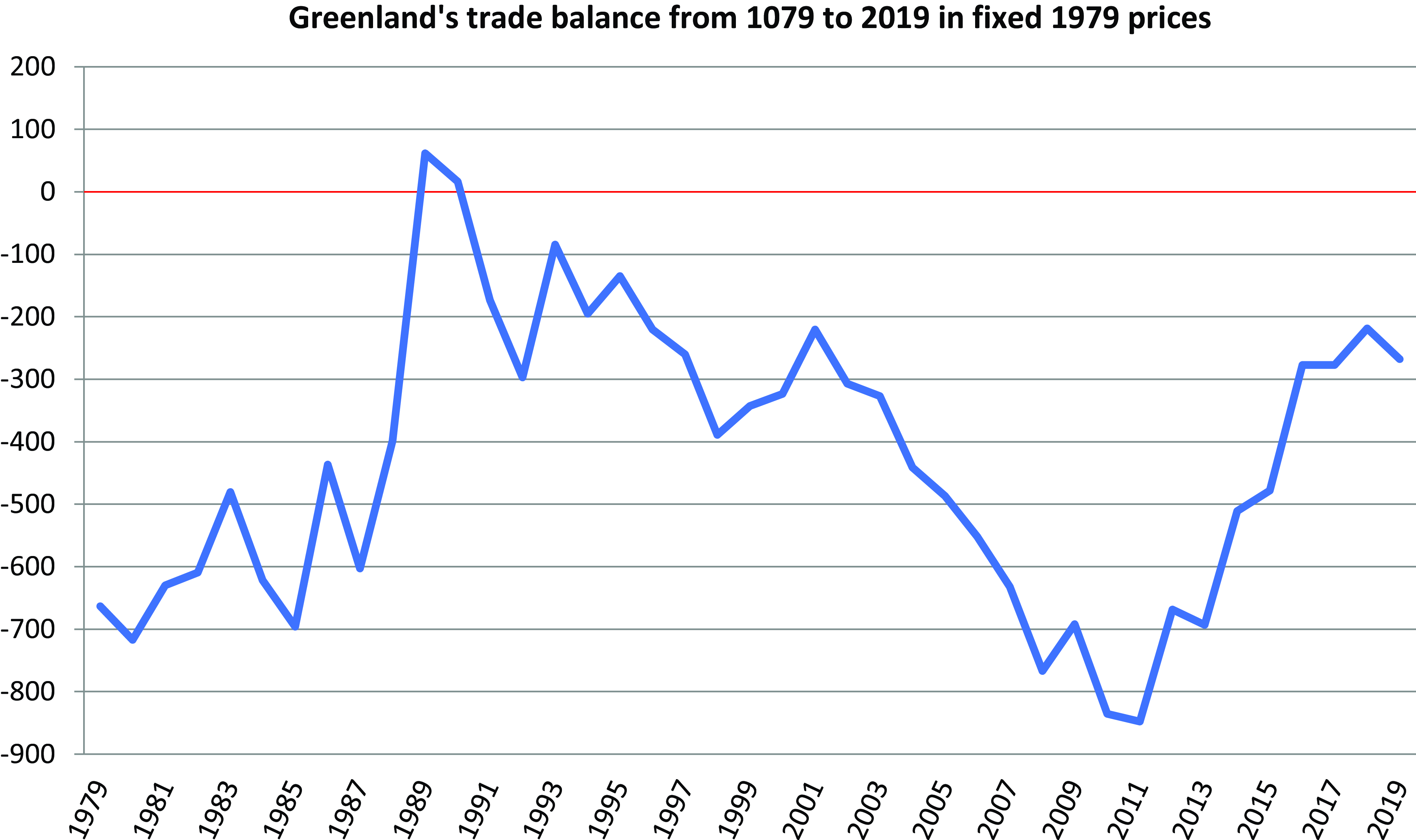
We start the analysis with the trade balance. Compared to the other countries in this analysis, Greenland’s trade balance suggests a very gloomy reality. Generally, a country’s financial headroom for imports depends on the value of its exports. In 2018, Denmark, Norway, and Iceland had a significant trade surplus (Statistics Denmark, 2022; Statistics Iceland, 2022; Statistics Norway, 2022; Statistics Sweden, 2022), while the Faroe Islands had a smaller surplus (Statistics Faroe Islands, 2022). In contrast, Sweden had a modest deficit in 2018, but when viewed over a longer period, Sweden has a positive trade balance (Statistics Sweden, 2022). Greenland had only a small surplus for two years since Home Rule was implemented in 1979, cf. Fig. 1. Otherwise, Greenland has had a significant trade deficit throughout the period including 2018; a trend that has continued in recent years (Statistics Greenland, 2023).
The Greenland trade balance from Home Rule in 1979 to 2019 shown in fixed 1979 prices (1000 Dkk)(Statistics Greenland, 2022).
The trade balance deficit is supplemented by what is labelled as “an annual block grant” from the Danish state, which in 2019 was DKK 3.9 billion (Statistics Greenland, 2023). The block grant, which is a traditional way of aligning expenses in the Danish Realm, was one of the outcomes of the negotiations with the Danish Government about Home Rule (1979) and Self Rule (2009) and is meant to cover the expenses connected to the tasks taken over by Greenland. The Danish state still handles some responsibilities such as the police, the judiciary, fisheries inspection, sea rescue, geographical mapping, defence, and sovereignty enforcement, the costs of which amounted to DKK 1.2 billion in 2017 (Statistics Greenland, 2022).
The Faroe Islands are also part of the Danish Realm and similarly receive an annual block grant from the Danish state. In 2023, this was DKK 0.69 billion (Statistics Denmark, 2024). The Faroese Government declined index regulation of the block grant and decided to reduce the grant based on the ambition to become more independent. Also, in Greenland, the block grant is considered to demonstrate that the country is dependent on Denmark. The block grant is often equated to approximately half of Greenland’s public expenditure, and the negative trade balance together with reliance on the block grant to maintain societal welfare is most often considered the most significant challenge to Greenland becoming autonomous.
A very small population in a huge area – the basis for island operation
With a population of only 56,000 inhabitants, the ratio between the area and population size results in an extremely low population density with only 0.025 inhabitants per km2 (Nordic Co-operation, 2023b). This makes Greenland the most sparsely populated nation in the world.
In relation to the countries with which Greenland is often compared, there are noticeable differences in terms of population density, even though both Norway, with 5.2 million inhabitants and a population density of 17 per km2, (Nordic Co-operation, 2023d) and Sweden, with 10 million and a population density of 22 per km2 (Nordic Co-operation, 2023e), are defined as sparsely populated in an international context. Iceland’s population is only 338,000, and its population density is 2 people per km2 (Nordic Co-operation, 2023c), which makes Iceland a more relevant basis for comparison, even though the size of the countries’ population density differs by a factor of almost 100. The Faroe Islands have 52,000 inhabitants, and its population is, therefore, comparable in size to Greenland’s, but its population density is 36 people per km2 (Nordic Co-operation, 2023f). Finally, in terms of population density, Denmark stands out with 5.7 million inhabitants and 132 inhabitants per km2 (Nordic Co-operation, 2023a).
However, for Greenland, it is not the extremely low population density per se that defines the context. As discussed above, the large distances between the settlements, the topographical and climatic conditions, and the fact that there is no physical infrastructure between the settlements create a special island operation condition. Moreover, the fact that it is not possible to sail for long periods of the year in large parts of the country strengthens the island operation conditions. Hence, island operations in Greenland does not simply condition the activities and livelihoods in the individual settlements but also the societal development.
While there may also be long distances between settlements and climatic challenges in parts of the other countries, they are far from being on the same level. The lack of road connections, on the other hand, is a condition that Greenland shares with other settlements in Nunavut, Nunavik, Labrador (Canada), parts of the Northwest Territories and Siberia (Jungsberg et al., Reference Jungsberg, Turunen, Heleniak, Wang, Ramage and Roto2019). Although parts of the remainder of the Arctic, which also has island operation characteristics, have some form of self-government, they are part of nation states and have an economic and/or infrastructural link to them. The small national population and the island operation conditions are, therefore, of decisive importance for Greenland’s socio-economic structure.
Greenland’s export and mono-economic dependency
In this section, we explore the ways in which Greenland’s foreign trade differs noticeably from the Scandinavian countries and Iceland. While there is a certain similarity with the Faroe Islands, Faroese trade gives a significantly better result. First, we focus on the export of goods and, second, on services of which tourism is an important sector.
Export of goods
Despite several attempts to establish the oil and mining industry and thus the export of minerals, Greenland’s primary income from exports has been from fish and shellfish since the introduction of Home Rule in 1979 (Committee for socially beneficial utilisation of Greenland’s natural resources, 2014). In 2019, fish and shellfish accounted for 92% of the total value of export of goods (Statistics Greenland, 2022). This results in extreme economic vulnerability to fluctuations in world market prices and stock sizes, which are not only affected by national fishing pressure, but also by international fishing pressure outside the Greenlandic 200 nautical mile limit.
At the same time, there is a significant mono-economic dependency on individual species with shrimp accounting for 45.5%, halibut 26.5%, and cod 9% of the total value of export of goods in 2019. Together, these three species account for 81% of the total export of goods (ibid.). This dependence on individual species exacerbates the already significant vulnerability.
Most seafood exports are unprocessed raw materials. There have been relatively modest fluctuations in the degree of processing for each of the individual species, which is partly connected to fluctuations in world market prices. Another decisive factor is the extent to which the societal infrastructure and organisation of the labour market support local refinement (Hendriksen & Hoffmann, Reference Hendriksen and Hoffmann2018b). In 2019, unpeeled frozen shrimp accounted for 52.5% of the value of shrimp exports, whole frozen fish accounted for 80% of the value of halibut, while whole frozen fish equated to 78% of the export value of cod (Statistics Greenland, 2022). The modest degree of processing means that a significant part of the value added by processing takes place outside Greenland; hence, the income and taxation base are not optimally utilised.
Greenland’s mono-economic goods exports differ markedly from Denmark and Sweden, where the largest single product groups are machinery and means of transport, which account for 26% and 41% of total exports, respectively. These figures span a wide range of highly specialised and processed products (Statistics Denmark, 2022; Statistics Sweden, 2022). Fifty-three percentage of Norway’s export income comes from oil and natural gas, which implies potential vulnerability (Statistics Norway, 2022), but a significant part of the oil income is tied up for later use through the Government Petroleum Fund, which had a reserve of over NOK 15 trillion in 2019 (Norges Bank Investment Management, 2023).
In the case of Iceland, the export of fish and shellfish makes up 40% of total exports of goods, while industrial products make up 53%. However, since aluminium accounts for 72% of exports of industrial products or 38% of total exports, mono-economic dependence on the sea’s living resources combined with aluminium production can be identified. In relation to fish and shellfish, however, there is a decisive difference to Greenland in that Iceland only exports around 19% as unprocessed raw materials (Statistics Iceland, 2022). For the Faroe Islands, on the other hand, there is similar mono-economic dependence on the sea’s living resources as in Greenland since the Faroe Islands’ export of fish and shellfish contributed 93% of the total value of exports in 2018. However, a significant difference is that 70% of the total exports comprises processed seafood products including farmed salmon (Statistics Faroe Islands, 2022).
In relation to exports of goods and the consequences of mono-economic dependency, the conditions for a comparison seem to be best in relation to the Faroe Islands, which, like Greenland, are highly dependent on the export of fish and shellfish. However, there are several crucial differences. The Faroe Islands have a significantly higher export income from fish and shellfish. Measured per capita, this equated to around DKK 144,000 in 2018, while for Greenland, it was around DKK 62,000 (Statistics Faroe Islands, 2022; Statistics Greenland 2022). This difference partly reflects the fact that the Faroe Islands have a larger fishery with greater species diversity, and partly that the Faroe Islands, in contrast to Greenland, have a significant aquaculture sector. In addition, as previously mentioned, most of Greenland’s exports are unprocessed seafood, while in the case of the Faroe Islands, the majority is processed, which means that a higher proportion of the value added from processing goes to the Faroe Islands.
Export of services
For many nations, services form an important part of total trade with the outside world. This is also the case for Greenland, where services contributed 26.5% of total exports in 2019. However, there was a significant deficit of 34% on trade in services (Statistics Greenland, 2022). To supplement the income from fishing, for decades, Greenland has been trying to build a tourism industry, which represents the largest contributor to the export of services.
Nevertheless, it is not possible to determine the size or economic importance of tourism in Greenland because Statistics Greenland uses the World Tourism Organization’s (UNWTO) definition of tourists. Although this in principle enables comparison with other countries, this is not the case for Greenland. According to the UNWTO definition, a tourist is a person who stays for more than one day and less than one year in another country. In relation to Greenland, the challenge of the UNWTO definition is that a very large share of the passengers on foreign flights who have permanent residence outside Greenland come to work for a shorter or longer period as consultants, tradesmen, health personnel, teachers, etc. Thus, they do not count as tourists and cannot be defined as business tourists, who can be valuable to the economy in more ways. This is not least because expenses including travel, accommodation, and salaries for the relatively large group of short-term employees, to a very large extent, are paid by Greenland’s public or private sector, but this group of employees pays tax in their home country, for example, Denmark and the Faroe Islands. What proportion of those registered as tourists according to the UNWTO definition are short-term workers is not known, but a conservative estimate is 50%.
Based on the UNWTO definition, there was a gradual growth in the number of foreign passengers flying to Greenland from 76,000 in 2008 to 87,000 in 2019 (Statistics Greenland, 2022). During this period, there was probably no significant change in the distribution between visitors who come to work and actual tourists. In addition to tourists who arrived by aircraft, 46,633 cruise ship tourists were registered in 2019 (Statistics Greenland, 2022). Some of the cruise ship tourists fly to and from Greenland in which case they are included in the figure for foreign passengers by plane. Studies indicate that the economic contribution of cruise ship tourism to society is relatively modest because most of the passengers’ consumption is included in the price of the cruise (Karlsdottir & Hendriksen, Reference Karlsdottir and Hendriksen2006). Therefore, the economic importance and the number of jobs created in connection with tourism is modest. There is also a need to further investigate the extent to which tourism, including cruise ship tourism, contributes to the economy and sustainability of the individual local communities.
There is a big difference between the Greenland’s export of services and that of the Scandinavian countries, which have a much more diversified composition. In Denmark, the export of services accounted for 42% of total exports in 2018, and there was a surplus of 9% (Statistics Denmark, 2022). Sweden had a modest surplus of 2.4% (Statistics Sweden, 2022) and Norway, due to the Government Petroleum Fund, had a significant surplus when the financial sector is included, while there was a deficit of 5% without the financial sector (Statistics Norway, 2022). For Iceland, a large surplus of approximately 35% in 2018 is seen on international trade in services of which air passengers and travel (tourists) make up the majority (Statistics Iceland, 2022). The Faroe Islands, on the other hand, had a deficit of 19% in the calculation of trade in services (Statistics Faroe Islands, 2022). Therefore, the situation is more like Greenland’s even though the Faroe Islands have succeeded in developing its tourism industry in the last decade.
In conclusion, in relation to the export of goods and services, the Faroese mono-economic export of fish and shellfish is more diversified and results in double the income per inhabitant. Furthermore, a comparison with the Scandinavian countries and Iceland only contributes to the understanding of the Greenlandic economy to a very limited extent. In the following sections, we discuss the labour market in more detail and emphasise that the island operating structure is a decisive characteristic that affects both production for the domestic market and the structure of the labour market.
Island operations and a modest domestic market challenge the market economy
The island operation presents special challenges for the domestic market. The Scandinavian countries, Iceland and the Faroe Islands, generally have good conditions for a market economy. In Greenland, the opportunities for market economic price formation are minimal because of the modest number of inhabitants in the individual Greenlandic settlements combined with a very limited and costly transport infrastructure between the settlements.
The prerequisite for a functioning market economy is a sufficiently large market and thus a customer base that allows several providers of a given product or service group to operate. Furthermore, if there is a well-functioning transport infrastructure between settlements, providers from one settlement can contribute to market competition in another thereby enhancing the customer base. However, as research has indicated for decades, the Greenlandic transport infrastructure generally does not support market competition between settlements, and natural monopolies arise in vital areas (Aage, Reference Aage2003; Det Rådgivende Udvalg vedrørende Grønlands Økonomi, 1998; 2007; Grønlands Økonomiske Råd, 2012; Hendriksen, Reference Hendriksen2013; Lyck, Reference Lyck1999; Nielsen, Reference Nielsen2000; Reference Nielsen2001; NIRAS, 2010; OECD, 2011; Paldam, Reference Paldam1994; Skatte og velfærdskommisionen, 2010; Thomasen, Reference Thomasen1999). The problem of a limited customer base represents a challenge to market economic price formation in all Greenlandic cities and the smaller settlements.
Furthermore, the consequence of the very modest market for most settlements is that the range of goods is extremely limited, which is why an internet-based import has developed. The exchange of goods takes place primarily as container-based ship transportation via Denmark. In Nuuk, containers are reloaded to smaller ships, which sail to Greenland’s other cities. Then freight to the smaller settlements are then reloaded again and transported further on by local ships. The exceptions to this set up are Ittoqqortoormiit on the east coast and Qaanaaq and the smaller settlements in the very north, which are chartered directly from Denmark and only have two annual calls, as well as Tasiilaq and the associated smaller settlements on the east coast, which are primarily chartered from Iceland.
Due to the very modest market and the geographical and climatic conditions, the self-government owned Royal Arctic Line has a natural and concessionary monopoly on container shipping. In 2017, Royal Arctic Line handled 873,000 m3 of cargo. Of this, 49% was from Denmark to be shipped to Greenlandic destinations, 38% was from Greenland to Denmark, which included fish and shellfish. Only 15% was internal freight between settlements in Greenland (Royal Arctic Line, 2018, 2019). The only alternative to the sea transportation of goods is air freight, of which Air Greenland has most of the market share. In 2017, only approximately 6% of Air Greenland’s turnover was air freight (Air Greenland, Reference Greenland2018). The majority of airfreight is fresh food and spare parts.
Apart from fish and shellfish and local catches from the hunting of marine mammals, birds, caribou, and muskox, which have a relatively high importance in terms of the subsistence economy (Poppel, Reference Poppel2015), production for the domestic market is limited. Therefore, virtually all goods are imported. Even in construction, apart from stone, sand, and water, all materials are imported via Denmark. Moreover, although Greenland is an exporter of seafood, retail stores sell semi-finished or finished products based on Greenlandic raw materials, which are processed and packaged outside Greenland. Still, in most cities, there are sales points for locally caught fish, etc., and in southernmost Greenland, 38 sheep farmers with a total of 18,000 sheep and a caribou farm with 3,000 domestic caribou and a slaughterhouse (Statistics Greenland, 2022) produce for the domestic market. There have also been some short-term attempts to establish the local processing of meat and fish for the domestic market. Finally, in many settlements, the production of handicrafts primarily for tourists can be identified, although it is of modest importance for the national economy.
Even though small and relatively isolated communities are also present in Norway and Sweden, and even though some of their smallest local communities, especially in the north, face challenges in relation to market economic price formation, none of the Scandinavian countries face a similar challenge in the form of a small domestic market at the national level in the same way. For Iceland, roughly the same applies as for the Scandinavian countries as more than half of the population lives in or within commuting distance of the capital, Reykjavik, and there is a reasonably well-functioning road network between the settlements. Moreover, Iceland has a much larger agricultural production than both Greenland and the Faroe Islands, and it includes vegetable production, which is supported by geothermal energy, for the domestic market and a smaller export to Greenland’s east coast. The Faroe Islands also face challenges in relation to the size of the domestic market and the location; hence, transportation costs affect prices. However, today the Faroe Islands are connected by bridges and tunnels, which has created much better conditions for market-oriented policies. As early as 2008, Hovgaard and Kristiansen pointed to the fact that residence in the Faroe Islands had become a mobile practice: “today you can live in one place, work in another place, buy commodities in a third, pursue leisure activities in a fourth and go to church in a fifth” (Hovgaard & Kristiansen, Reference Hovgaard, Kristiansen, Bærenholdt and Granås2008, p. 66 in Ganini & Nielsen, Reference Ganini, Nielsen, Ganini and Nielsen2020). The citation very clearly contrasts with the challenges connected to the island operation situation in Greenland.
The fact that market forces do not work as intended in Greenland naturally influences price formation in an upward direction, to which must be added the consequences of the costly transportation infrastructure and the crucial need for public service provision.
The significance of island operation for the labour market
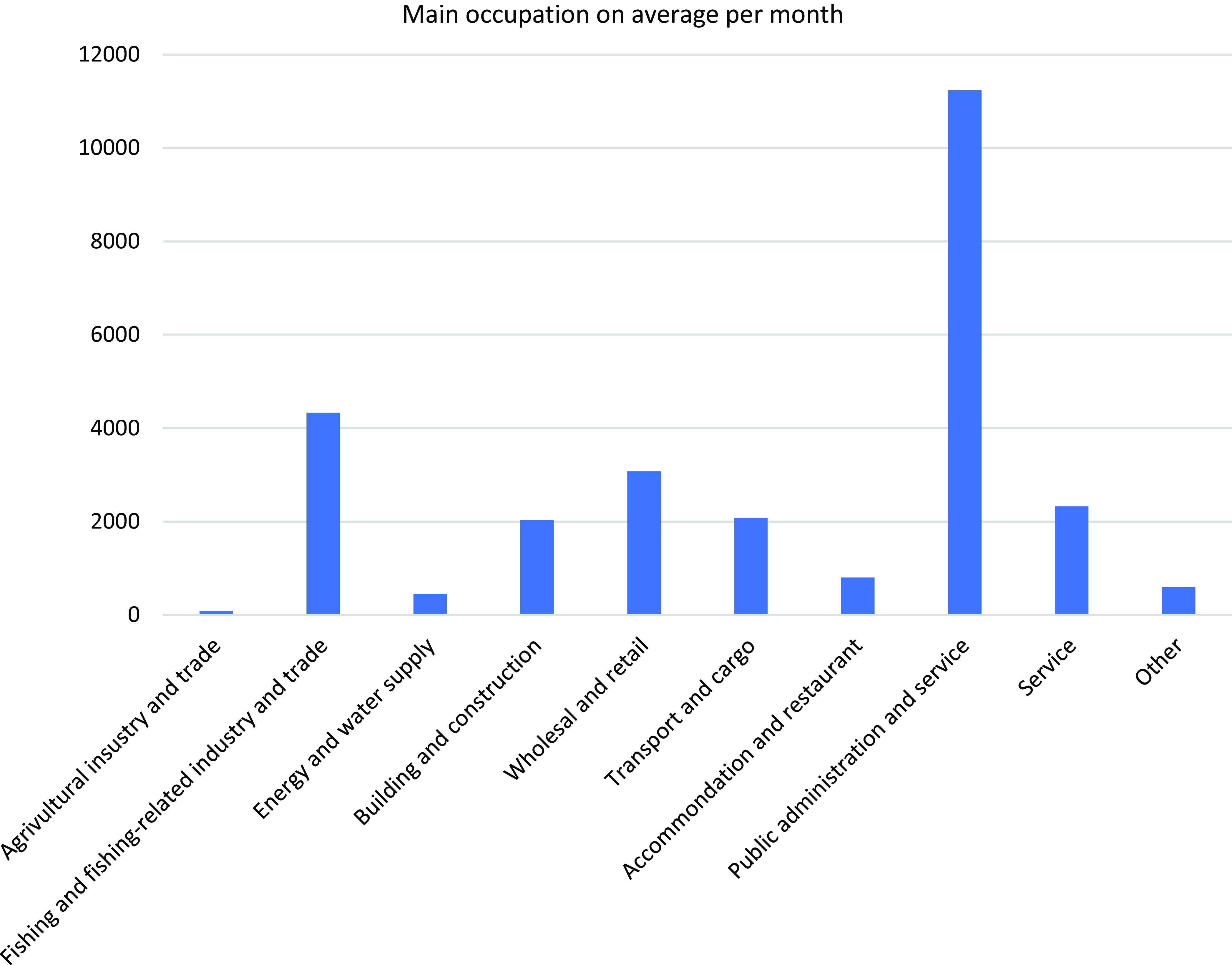
Greenland’s island operation conditions with limited transportation infrastructure, which means that each settlement is dependent on its own supply infrastructure, education, etc., combined with the modest domestic market production, means that public administration and services are dominant and account for 42% of total employment. Looking at Fig. 2, it should be noted that much infrastructure such as electricity and water supply, container and freight transportation by ship, airports, most aircraft and helicopter operations, oil supply and trade, etc., are assigned to government-owned companies, which is why the employment within these infrastructure areas can be included as a public service. Hence, the public sector is much larger than shown in the figure. Similarly, the government owns the retail chain, KNI Pilersuisoq, which is obligated to supply all the small cities and settlements for which it receives a subsidy. Therefore, this part of the retail trade can be recognised as a public service, in which case the public sector would account for around 50% of the total workforce.
Average monthly main occupation among permanent residents 2019 (Statistics Greenland, 2022). As mentioned above, a large part of infrastructure companies can be included in public service, which is why public administration and service are larger than shown.
In 2019, the average number of employees per month was 26,991 (Statistics Greenland, 2022), which included an estimated 2,700 self-employed individuals working in several industries (Statistics Greenland, 2022). By far the largest group of self-employed people are dinghy fishermen operating in the inland fishery. In 2019, 2,133 individuals had a commercial fishing licence (Statistics Greenland, 2022) and, thus, had the right to land fish and sell them to factories and to sell the catch of birds, fish, and marine and land mammals on the domestic market. Of the total, approximately 500 had an annual income of less than DKK 50,000 (Statistics Greenland, 2022), primarily because a large part of the catch is consumed at home or is sold through private channels and is, therefore, not registered (Hendriksen, Reference Hendriksen2013; Poppel, Reference Poppel2015). Some of those who are periodically employed in the fishing fleet also have a commercial fishing licence and periodically fish and catch as self-employed, which means there is a certain overlap between wage earners and self-employed. In total, fishing with associated industry and trade as well as fishing contributes to 16% of employment (Greenland Statistics, 2022). Many families, especially in smaller cities and settlements, have a mixed income that combines fishing with the steady income from the spouse working in the local fishing industry or in the social and technical infrastructure services with cleaning or teaching, etc.
The construction industry, which had an average of 2,025 permanent employees in 2019 (Statistics Greenland, 2022), experiences seasonal fluctuations with high activity in the summer and reduced activity in the winter months. This means that, at times, there is a significant influx of additional labour to the construction industry from outside Greenland, which is not included in the calculation. Approximately 80% of all construction activity is financed by either the self-government or the municipalities, and most materials are imported via Denmark. Finally, in 2019, an average of 93 people were employed in the raw material extraction sector including local quarries and gravel pits. Despite many years of effort to develop Greenland’s raw materials and mining industry, mining has had a very modest socio-economic significance in recent decades (Statistics Greenland, 2022; Udvalget for samfundsgavnlig udnyttelse af Grønlands naturressourcer, 2014).
Greenland’s dependency on imported labour
All of Greenland’s settlements have problems with securing qualified labour in vital areas because there is a lack of human resources in several specialisations at the individual settlements or at the national level and commuting is not possible.
In the larger cities, there are most often some local citizens with a medium education and skills to handle generalist tasks within their respective professions. Correspondingly, in the large cities, there are people with academic qualifications, but they too end up as generalists in their field due to the composition of tasks.
Therefore, in all settlements, for urgent and more complicated tasks or long-term tasks of a more strategic nature, the necessary specialist skills are seldom available. This is part of the explanation as to why so many specialists are flown in, primarily from Denmark, to undertake a series of tasks or as short-term supplements.
For the smaller settlements, the need for specialised labour decreases to some extent. However, at the same time, the opportunities to maintain specialisations locally decrease. Nevertheless, there is an increasing need for a range of skills to handle technical and social infrastructure such as electricity and water supply and education and healthcare. Due to the island operation conditions, the quality of the technical infrastructure, healthcare, and education is completely dependent on the local workforce. This need for local skills is further faced with the processes of centralisation.
For example, one of the aims of the municipal reform from 2009 was to create larger professional environments, especially in the social and technical fields (Strukturudvalget, 2005). Inspired by the Danish municipal reform of 2007, Greenland’s former 18 municipalities were merged into four geographically huge municipalities of which the largest was Qaasuitsup Municipality in the north, was larger than France. Similar to the Danish reform, it was based on the idea of achieving efficiency and homogeneity in the administration by pooling knowledge in larger units (Strukturudvalget, 2005). While the new municipal cities have gathered more competences, the re-organisation has created a decisive brain drain in the former municipal cities. Since commuting is not possible, the centralisation of work functions means that not only the skilled person, but also the whole family including the often well-educated spouse must relocate. In this way, the municipal reform has impacted the competence pool in the former municipal cities, which again has impacted on the operation of services and the level of entrepreneurship in these cities and their associated settlements. Furthermore, it has led to a lack of knowledge in the centralised administration about conditions in other cities and settlements, which means that a series of planning decisions, budget prioritisations and case handling regarding these areas are less qualified (Hendriksen & Hoffmann, Reference Hendriksen and Hoffmann2016b).
Consequently, centralisation operates as a vicious circle, which increasingly causes people with resources to look for jobs, housing, and better services elsewhere.
For several less specialised tasks such as a simple repair or renovation of a local power plant, the necessary competences can be found within Greenland. However, while a breakdown of a power plant or a cold storage can be handled relatively easily by a professional from a nearby city in the countries with which Greenland is often compared including Iceland and the Faroe Islands, this is not feasible in the same way in Greenland because of the large distances, the inclement climate, and the inadequate transportation infrastructure. It often takes days or even weeks to travel from a major city to one of Greenland’s smaller cities or settlements. This is why all power plants have at least one backup engine, but if a breakdown does occur, it often necessitates an extremely expensive helicopter charter, assuming the weather permits, because if a power plant is out of operation for just a few hours in the winter, pipelines begin to freeze resulting in ruptures, and such a breakdown can have fatal consequences. Therefore, securing the necessary professional expertise for the 71 settlements requires a targeted effort.
Major construction projects such as the current construction of three large new airports requires both specialised skills and a sizable workforce, which necessitates the import of temporary labour. The possible exploitation of mineral deposits or energy resources will also need the import of temporary labour. The Government of Greenland has established a formal mine worker education. This is a long-term strategy, since only so far few has passed and, the Greenlandic workforce will still not be sufficient if more mining projects should be realised.
The problem of a lack of local competences in more specialised areas is exacerbated by the relative lower level of formal education in Greenland than in the other countries, which we analyse in the following section.
The level of education and the island operation
In this section, we firstly discuss the general level of education in Greenland. This is followed by an analysis of the education level of the imported workforce.
A prerequisite for a welfare state is sufficient competences in all necessary professional areas and in relation to the individual local communities. In this regard, Greenland faces challenges due to the generally low level of formal education in that:
-
• 52% of the population aged 25 to 64 years, including people not born in Greenland, only have primary school as their highest level of education.
-
• 4% have a secondary education.
-
• 28% have a vocational education including supplementary courses.
-
• 13% have a short or medium higher education incl. a bachelor’s degree, etc.
-
• 4% have a master’s degree or Ph.D. (Statistics Greenland, 2022).
When only looking at the younger population aged 25 to 34 years including people not born in Greenland, a small improvement can be identified as only 48% have primary school as their highest education (Statistics Greenland, 2022). The fact that there are primary schools in all settlements demonstrates a huge organisational power of the Greenlandic society. But because of the island operation, children in most small settlements are forced to move quite long distances at a very young age (approximately 13 years old) to continue their schooling.
In the hunting of marine mammals, birds, caribou, musk ox, and coastal fish as well as fish processing, competences is needed, which is often characterised as informal and acquired competences (Knudsen, Reference Knudsen2016). In this respect, the Greenlandic educational deficit is more nuanced because the acquired informal skills in relation to hunting and fishing are vital for the individual practicing his or her business activities as well as for Greenland’s livelihood. In contrast, for ship’s mates, engineer officers, etc., working in offshore fishing and the management of fish factories, there are requirements for formal competences, which are not found to a sufficient extent in Greenlandic society.
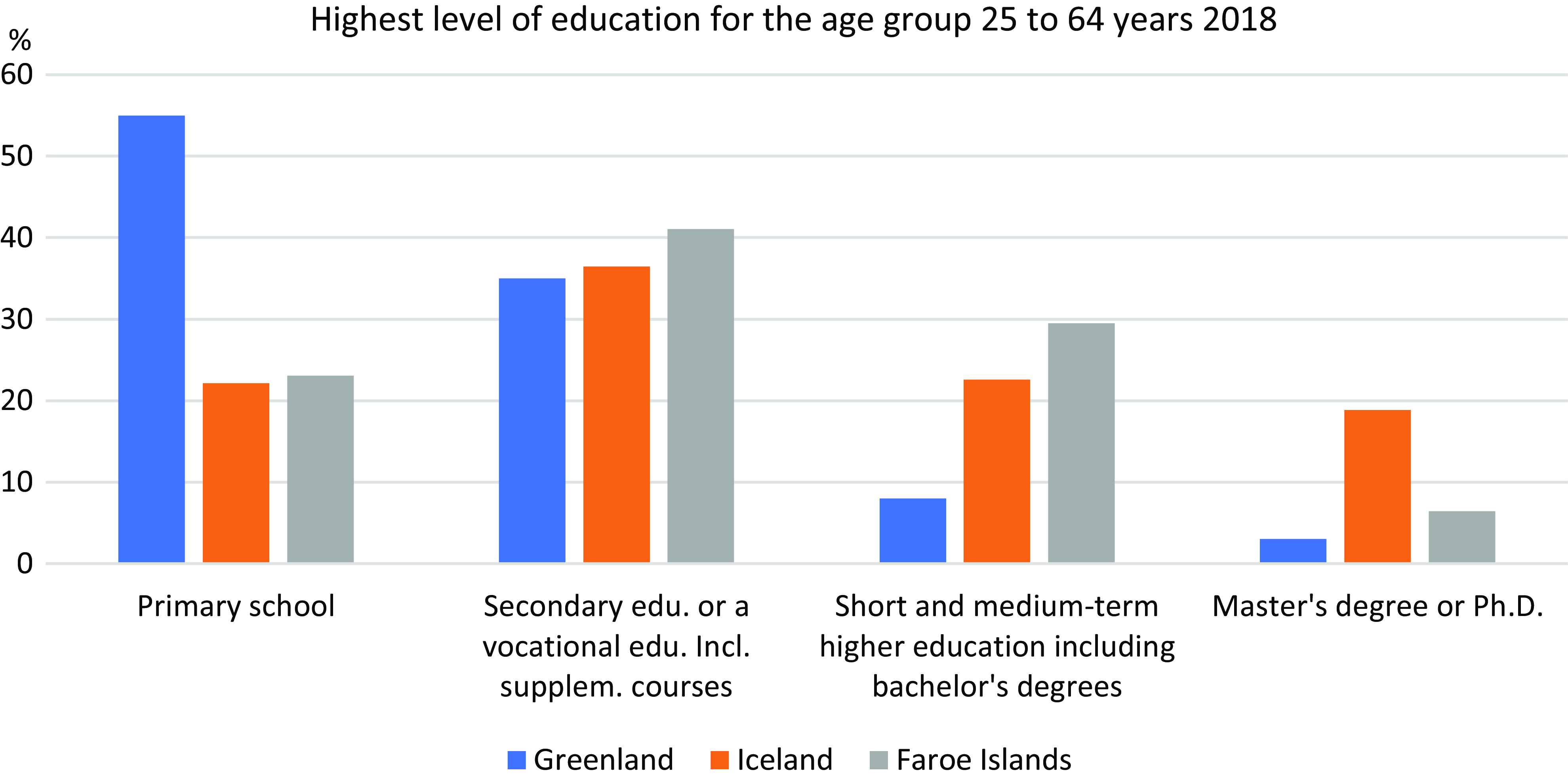
The Scandinavian countries and Iceland are characterised by a well-developed education system and a generally very high level of education (Nordic Statistics, 2023). As can be seen in Fig. 3, a significantly smaller proportion of the population in Iceland and the Faroe Islands only have primary school as their highest level of education.
Highest level of education 2018 for the age group 25 to 64 years in Greenland, Iceland, and the Faroe Islands. In the figure, the secondary education is merged with the vocational education including supplementary courses because lack of differentiated data regarding Iceland (Greenland Statistics, 2022; Iceland Statistics, 2022; Statistics Faroe Islands, 2022).
The challenges connected with imported labour
As previously mentioned, to ensure the necessary skills for the society to function, Greenland has a large proportion of imported labour. In 2019, more than 13% of the population aged 25 to 64 years were born outside Greenland (Statistics Greenland, 2022).
As can be seen in Fig. 4, the imported workforce has a significantly higher level of education. The imported labour with primary school as their highest education mainly comprises people from Eastern European countries and Asia, who work as unskilled workers in hotels, restaurants, and fish factories. Nineteen percentage of the population group who were not born in Greenland have a vocational education compared to 24% of those who were born in Greenland. To this, however, must be added the many craftsmen who are imported from outside Greenland during the summer season. In contrast, 23% of the group who were not born in Greenland have a short or medium higher education including a bachelor’s degree, whereas the figure is only 10% of those born in Greenland. Nineteen percentage of those imported to work in Greenland have a master’s degree or a Ph.D., while the figure is only 1% of the population aged 25 to 64 years born in Greenland (ibid.). It should be noted that some of those who define themselves as Greenlanders were born in Denmark to Greenlandic parents.
The highest level of education for people for the age group 25 to 64 years born outside of Greenland vs. born in Greenland (Greenland Statistics, 2022).

At the same time, there is a clear tendency for the imported workforce with medium- or long-term training to be employed in the government, the education and health sectors, municipal administrations, government-owned infrastructure companies or private consultancy companies that have the public sector as their primary customer. This means that there is a predominance of outsiders in the large cities, primarily Nuuk, where those who were not born in Greenland make up 24.5% of the population aged 25 to 64 years, while the national figure is 13%.
The educational profile of the Greenlandic workforce implies that the imported workforce, predominantly Danes, occupies a relatively large proportion of the management positions and thus has a significantly greater influence on decision-making at the political and administrative levels. Hence, while the politicians are mainly Greenlanders, a Danish academic elite still dominates the public and private sectors in Greenland (Bertelsen et al., Reference Bertelsen, Justinussen, Smits, Jensen and Hønneland2015; Bjørst, Reference Bjørst2022; Grydehøj, Reference Grydehøj2018).
Most of this group of highly educated, imported workers are employed in the largest cities, and not many get the chance to experience the outer regions and smaller settlements or obtain substantial knowledge of the local conditions. Another challenge concerning the imported workforce is that the majority only stays for a short time. This implies a very rapid turnover of staff in many key positions in society, which results in a lack of continuity and a significant loss of knowledge (Bertelsen et al., Reference Bertelsen, Justinussen, Smits, Jensen and Hønneland2015). The lack of knowledge of Greenland’s societal structure and cultural context amongst the imported professionals or external advisers often leads to decision-making being based on a frame of reference, which does not match the reality in Greenland (Grydehøj, Reference Grydehøj2018, Reference Grydehøj2016; Hendriksen & Hoffmann, Reference Hendriksen, Hoffmann and Knudsen2016a).
Our analysis shows that public investment in infrastructure is prioritised in cities which have a relatively large number of foreign academics, primarily Nuuk. For example, from 2010 to 2019, 15 times as much was invested in public infrastructure per inhabitant in Nuuk than in Upernavik (Government of Greenland, 2010–2019), even though the population of the Upernavik region contributes substantially more to the country’s export income, and Upernavik and the region’s nine smaller settlements do not have basic services such as tap water in homes. In addition, only an extremely small proportion of the imported workforce speak or understand Greenlandic, which means a relatively large share of the population cannot communicate directly with key employees in administration, healthcare, etc.
The possibility of recruiting qualified external labour is greatly influenced by the economic conditions in the potential applicants’ home country. To enable recruitment, Greenland has been forced to make the positions at least as attractive than similar positions in, for example, Denmark. This inevitably leads to an upward spiral in wages and employment conditions, which puts pressure on Greenland’s economy.
In conclusion, the establishment of a welfare society is not currently supported by an adequate level of education in Greenland, which means that external employees occupy important positions, and have a disproportionate influence on decision-making. The Greenlandic University, Ilisimatusarfik, established in 1989, the Arctic Engineering Programme from 2000, and several other educational opportunities were developed to change the situation over time.
Discussion and conclusion
On several crucial and interrelated parameters such as economic development and socio-economic structures, Greenland differs from the countries with which the country is most often compared.
In Greenland, the institutional structures are very similar to the corresponding structures in Iceland and the Scandinavian countries, particularly Denmark. However, when it comes to the decisive economic structures, which for Greenland include, among others, extreme mono-economic dependence, low importance of market forces and high dependence on imported trained labour, comparisons do not provide an accurate picture.
The Faroe Islands seem to share mono-economic dependence; however, a crucial difference is that the Faroe Islands derive twice as much export income from seafood per capita, which is primarily due to aquaculture and a significantly greater degree of processing, while most of Greenland’s exports are unprocessed raw produce in the form of frozen seafood. Therefore, Greenland loses the added value from processing.
In terms of population, there is greater similarity between Greenland and Iceland and the Faroe Islands. However, there is a significant difference in population density. Furthermore, the most decisive difference between Greenland and the Scandinavian countries, Iceland, and the Faroe Islands seems to be the fact that all settlements in Greenland function as island operations, which means that nowhere is it possible to commute daily or maintain the constant transportation of goods. At the same time, the island operation and the lack of a market mechanism contribute to the fact that there is virtually no other production for the domestic market than the subsistence economy based on hunting and fishing and a modest sheep farming, which is why almost all consumer goods are imported. This is central to the economic structures and means that, for example, the market economy management mechanisms do not function in vital areas and are effectively absent for most settlements, which presents a challenge to price formation. This, together with the high transportation costs, results in higher prices. Iceland and the Faroe Islands are also highly dependent on imported goods, although the connected infrastructure and the subsequent improved market dynamics in these countries contribute to better performing economy.
An important difference between Greenland and Scandinavia, Iceland, and the Faroe Islands is the level of formal education, which in Greenland is significantly below that of the other countries. However, informal and acquired forms of knowledge and competences are hidden in the statistics, which means that the Greenland’s education profile is more nuanced. In summary, Greenland’s economy differs significantly from those of Denmark and Scandinavia. To a certain extent, specific conditions are comparable with Iceland and the Faroe Islands, although there are still substantial differences.
The fishery policy in the light of island operation conditions
The concept of island operations can be used to understand the conditions for exploiting the resources in Greenland and why the current neoliberal policy has more radical systemic consequences for Greenland than it does for the other countries in this analysis.
Greenland must navigate specifically with the systemic challenges to develop its production and export in the face of global competition. Almost all products are much more expensive to produce and transport out of Greenland than many other places. As the excavation of minerals also seems to be more complicated, growing global deficits and/or some countries desire to increase security of supply are needed to enhance Greenland’s mineral export. Also, energy reserves in the form of hydropower have raised hopes in Greenland for industrial production. However, despite investments being made in infrastructure in Greenland, Iceland won the competition to attract large aluminium production. Internet-based services could, in principle, overcome some of the difficulties connected with transportation, but competences would have to be developed. This raises the question of how to add more value to fish and shellfish, which are currently sold unprocessed.
The island operation conditions do not in themselves hinder local fishery or fish processing; on the contrary, the settlements are localised in relation to the exploitation of the living natural resources. For example, at present, 70% of the halibut in North Greenland is caught by 950 fishermen and taken to approximately 18 local fish factories or first sales (Hendriksen, Reference Hendriksen2024). These local fishermen use long lines and can catch the fish that stay close to the glaciers from dinghies in the summer and from the ice in the winter. This form of fishing is the foundation for most northern settlements as it supplies local families with jobs in the fishing industry and maintains hunter-fisher livelihoods.
We assert that, due to the island operation conditions, the new Fisheries Act (Inatsisartut, 2024) has a radical effect not only on jobs in the fishing industry but also on settlement patterns and other livelihoods. The act focuses on reducing the total number of fishing quota, thereby enhancing the sustainability of the fishery. However, this is coupled with the introduction of Individual Tradable Quotas, which represent a neoliberal principle promoted as an effective way of organising the coastal fishery (Fiskerikommisionen, 2021). Our analysis (Hendriksen, Reference Hendriksen2024; Hendriksen et al., Reference Hendriksen, Nielsen, Jacobsen, Poppel, Hoffmann and Jørgensen2023; Hendriksen & Nielsen, Reference Hendriksen and Nielsen2024; Nielsen et al., Reference Nielsen, Hendriksen, Jacobsen, Hoffmann, Jørgensen and Poppel2023; Nielsen et al., Reference Nielsen, Hendriksen, Hoffmann, Jacobsen, Poppel and Jørgensen2024) shows a risk that the number of dinghies will be reduced drastically, for example, the Bank of Greenland does not favour investment in the smaller settlements, which means it will not be possible for locals to buy up quotas when fellow fishermen put them up for sale (Hendriksen & Nielsen, Reference Hendriksen and Nielsen2024). Therefore, in time, the quotas will be gathered in fewer hands, and with a high quota ceiling of 2.5%, this may eventually lead to very few quota owners (worst case, as few as 40). This will result in the use of larger fishing vessels that are able to transport fish over greater distances, which again will lead to the closure of local factories.
Furthermore, because of the island operation conditions, where commuting is not possible, the fishermen and women who leave the fishery will either be dependent on social welfare or must relocate to the large cities – along with their families. The Fishery Commission (2021) suggests relocating to jobs in the mineral and construction sectors. However, at present, there are very few jobs in the mineral industry and the need for labour in the construction industry will decline as the construction of new airports is soon to be completed. Additional challenges that are not mentioned in the report are how develop the desire or the necessary competences of the fishermen to perform the jobs in the other industries, or how to find jobs for their spouses that will have to relocate as well. Furthermore, the report does not discuss the resulting radical change in settlement patterns, or the significant housing deficit in the large cities and the time and investment needed to build new homes and enlarge existing infrastructure, etc. In this way, this sectorial focus on “efficient” fisheries policy does not sufficiently take Greenland’s island operation conditions into consideration. Further it threatens what is considered a culture-bearing profession and livelihood, which is based on traditional knowledge and unique competences and which many Greenlanders find attractive. The sustainability of the economy should not only refer to the economy per se but also to an economy aligned with the population’s competence profiles and perception of what constitutes a meaningful life and society (Nielsen, Reference Nielsen2001). Furthermore, the policy may disregard the potential of valuing Greenland’s national resources more highly by establishing an exclusive fishery that is more sustainable because of it being based on long lines and not trawls and drifting nets. The centralisation may also overlook the geopolitical value of inhabiting the whole of Greenland.
The complex interplay between the island operation conditions and the competence profile of the small population creates very special conditions, which make comparisons between Greenland and the other countries discussed in this paper, and the subsequent transfer of knowledge and tools, problematic. Therefore, we conclude that the fact that Greenland compares itself with Denmark and the rest of Scandinavia and, in recent decades, increasingly with Iceland is a significant part of the explanation for the continuing problems in the form of a vulnerable economy and continued centralisation, which makes it difficult to establish the sustainable use of both natural and human resources.
The comparisons contribute to the continuation of what Jonsson (Reference Jonsson, Jacobsen, Andreasen and Rygaard1996) labels organisational dependency, which is historically embedded in the colonial past, but also a hyper-colonial present. If Greenland wants to utilise its local resources, create livelihoods that the population finds attractive, and deal with the geopolitical challenges, then they need to reflect on this path dependency and find other models for comparison and integrate much more carefully the local conditions.
To this end, the concept of island operation, which represents a place-based and interdisciplinary concept that can be applied to address economy and governance and highlight the complex dynamics of the micro-population and other socio-spatial characteristics, has been presented. This should be deployed to further discus and research approaches to sustainability in the context of Greenland that can bridge the current discussions on an autonomous economy and the governance of natural resources with the population’s knowledge profiles and cultural values to develop a meaningful societal welfare.
Our analysis point to a major research gab on identifying and developing ways that can challenge the current neoliberal governance approaches. A major change highlighted by the research is how the settlement structure is under heavy pressure leading towards centralising, but the derived consequences of this ongoing depopulation of large regions in Greenland are unexplored. There is a need to not only research how this affects the liveability, the businesses potentials and the geopolitical situation, but also to identify alternatives. While there is relevant literature on alternative ways of governing the natural resources (e.g. LIFE, 2016; Ostrom, Reference Ostrom1990), this should be related to other sustainability aspects, for example, the need to integrate substance economy and indigenous knowledge systems (e.g. Ford, Falk, & Tesar, Reference Ford, Falk and Tesar2018; Jacobsen, Dyremose, Qunanian, & Raakjær, Reference Jacobsen, Dyremose, Ounanian and Raakjær2023). Especially in the face of island operation, there is a need to investigate the organisation of infrastructure services and business development, for example, how to develop technology and governance models that can accommodate the contextual condition and find ways to benefit from this in future developments.
Acknowledgements
We would like to thank all the people that have shared their knowledge with us in Greenland and beyond. Furthermore, we thank our colleagues at Future Arctic Lives together with the Danish Innovation Fund and the Biodiversa programme, who created the frames for us to engage in this writing. Finally, we will mention our thankfulness to the reviewers who took the time and effort to review and constructively contribute to develop the article.
Financial support
This work was carried out in the project FutureArcticLives supported by The Danish Innovation Fund and the EU programme BioDivERsA 2019 (Grant 0156-00020B).
Competing interests
The authors declare that there are no conflicts of interest.


 Open access

