




1 Introduction
Several languages show double determination structures in some form (e.g. Greek, Balkan languages; Joseph Reference Joseph2019). One such structure that occurs in English dialects is a ‘double demonstrative’ (e.g. Bernstein Reference Bernstein1997): the NP is introduced by a demonstrative determiner, followed by a locative adverb here or there. We will refer to this form with the label DDEMO_NP. English DDEMO_NPs show doubling to the extent that both demonstrative determiners and locative adverbs are deictic expressions. Their primary function is to point to a concrete referent in the spatial context, establishing a joint focus of attention (e.g. Diessel Reference Diessel2006: 469).Footnote 1 The examples in (1) show uses of DDEMO_NP with four attested demonstratives from rural UK dialects.Footnote 2 Names in parentheses indicate the speakers’ pseudonyms followed by the speaker’s age at the time of the recording and birth date.

Rupp & Tagliamonte (Reference Rupp and Tagliamonte2017/2019, Reference Rupp and Tagliamonte2022) documented the occurrence of DDEMO_NPs in York, UK (York English Corpus (YEC); Tagliamonte Reference Tagliamonte1996–8, Reference Tagliamonte1999–2001) and in Ontario, Canada (CDA) (Ontario Dialects Corpus (ODP); Tagliamonte Reference Sali2003–6, Reference Tagliamonte2007−10, Reference Tagliamonte2010−13, Reference Tagliamonte2013−18). In both locales, the doubled construction is obsolescent: tokens were few and restricted to individuals born in the late nineteenth and early twentieth centuries.
In this study, we step back from the matter of obsolescence to probe the grammatical development of DDEMO_NP. For this purpose, we expand the analytic context from a study of the obsolescent doubled forms only, to include single demonstratives. This strategy enables us to compare the different functions of each demonstrative form within the grammatical system and to ask the following questions:
-
1. What is the role of doubling in English demonstratives?
-
2. How and why did a doubled demonstrative construction emerge in English dialects, i.e. what type of grammatical change(s) can be discerned within the demonstrative system of English?
-
3. What does the trajectory of change in demonstratives reveal about language change more generally?
To this end, we augment the available linguistic evidence to include the Freiburg Corpus of English Dialects (FRED; 2000−5), the ROOTS Corpus (Tagliamonte Reference Tagliamonte2001–3) and the British Dialect Archive (Tagliamonte Reference Tagliamonte2000–1).
The grammatical development of double demonstratives may be elucidated by the linguistic cycle (Jespersen Reference Jespersen1917; Van Gelderen Reference Gelderen2011). This framework views grammatical change as a cyclic evolutionary path, consisting of successive processes that lead to replacement of an old form by a new one with the same function. In the ‘Cycles’ framework, doubling constituents have been explained, at least in an initial phase, as ‘strengthening’ a ‘weak’ grammatical item. However, current work on both double negation (Hansen Reference Hansen, Narrog and Heine2011) and double demonstratives in Norwegian (Vindenes Reference Vindenes2018) has questioned this view, arguing that doubling may happen for other reasons, e.g. for discourse-pragmatic purposes. This perspective allows for the possibility that doubling is just one manifestation of change within the systemic evolution of linguistic features.
2 Theoretical background
In the extant literature, doubling has been explained in two ways: (i) ‘strengthening’ a ‘weak’ grammatical item in a linguistic cycle, and (ii) a discourse-pragmatic strategy.
2.1 The role of doubling in the linguistic cycle
The linguistic cycle is best known for the development of sentential negation marking across languages. Otto Jespersen (Reference Jespersen1917) described it as a ‘cyclic’ process: first, a previously robust negation marker combines with another negation marker; second, the newer negation marker (gradually) replaces the original one; and then it too is replaced at a later point in time. Central to the cyclic process is phonological weakening whereby a marker loses force and another marker is required to ‘strengthen’ it. For example, in Middle French the negative marker ne emerged, then co-occurred with pas and is now thought to be in the process of being replaced by pas in a yet newer stage in the cyclic process. Similarly, in Middle English, ne was replaced by not. In both cases, there is a period of co-occurrence: ne … pas, ne … not. Other grammatical categories also show this ordered type of change, e.g. articles (Lyons Reference Lyons1999: 326–30), agreement and future markers (Van Gelderen Reference Gelderen2011).
Demonstratives, too, are thought to undergo cyclic change (Greenberg Reference Greenberg, Greenberg, Ferguson and Moravcsik1978; Diessel Reference Diessel1999: 150; Van Gelderen Reference Gelderen2011: chapter 6). The common assumption is that the cycle begins with the loss of deictic features which causes the demonstrative to change into a more neutral determiner. The neutral determiner can only function as a demonstrative again when the form is ‘strengthened’ by a ‘doubler’ that adds deixis. Greenberg (Reference Greenberg, Denning and Kemmer1990: 226) wrote: ‘specific demonstratives, as they become bleached of deixis by anaphoric uses, are constantly being replaced by new demonstratives usually formed from the older ones by the addition of new deictic elements, reduplication, etc. These in turn lose their deictic force to be replaced by others.’ One example of this is French. French has demonstrative forms cette and ce(t) that differ from definite articles but are distance-neutral; to convey situational deixis, they must be combined with the spatial adverbs ici ‘here’ or là ‘there’. These adverbs contribute the indexical meaning to the demonstrative and determine its proximal/distal interpretation, e.g. ce livre ‘DEM book’ vs. ce livre-là ‘that book (DEM book there)’ (Diessel Reference Diessel1999: 37). In Germanic, doubled demonstratives have been reported for German (Diessel Reference Diessel1999: 38) and colloquial Swedish and Norwegian (Julien Reference Julien2005: 117). The degree to which reinforcement is compulsory depends on the extent to which DEM has lost its deictic features. For some languages, DEM has been characterized as ambiguous between a definite article and a demonstrative (see Diessel Reference Diessel1999: 37–8). However, even in these, less transparent cases ‘it is evidently the adverbial part of the complex demonstrative that carries the deictic force’ (Julien Reference Julien2005: 117), not DEM. Next to disambiguation through the addition of deictic markers, such DEMs may be disambiguated through emphatic stress in demonstrative contexts.
Van Gelderen (Reference Gelderen2011: chapter 6) envisages that DDEMO_NP in English emerged for similar reasons, in a supporting role ‘strengthening’ a weakened demonstrative. Van Gelderen points out the occurrence of a phonologically reduced determiner in English dialects, often labelled Definite Article Reduction (DAR) (e.g. Jones Reference Jones, Upton and Wales1999). Tagliamonte & Roeder (Reference Tagliamonte and Roeder2009) studied the reduced determiner in the city of York, as in (2a, b).

Rupp (Reference Rupp2008) has argued that DAR is better analysed as a reduced form of the demonstrative þæt, the nominative neuter singular in the historical distal demonstrative paradigm (and is therefore best re-coined ‘Demonstrative Reduction’ or DR instead).
Consistent with this, Van Gelderen (Reference Gelderen2011: 24–5) notes: ‘[Another stage] of the cycle can be found in the history of English … the renewal of the demonstrative by a locative’, and ‘Standard English never develops into a stage where the article is weakened and needs a new reinforcement, but … [m]any varieties (both in Britain and the US) also continue the trend … and renew demonstratives’. She cites, among others, the following example from the British National Corpus to support her analysis: ‘… Used to have to be very rather experienced in them days to do this here net mending (BNC – FYD 72; 112)’ (Reference Gelderen2011: 26).
However, one of the difficulties in assuming this motivation and trajectory for DDEMO_NP in English is that demonstratives in English have not lost the capacity to express deixis. As Roehrs (Reference Roehrs2010: 234) states: ‘It seems clear that demonstratives in English are deictically specified and spatial elements.’ Therefore, whilst the main trend in the Linguistic Cycle is one of reduction, this cannot be what motivates doubling in English DDEMO_NP. Rather, English DDEMO_NP shows an expansion of forms. Lyons (Reference Lyons1999: 657) concluded that ‘one should look for other explanations for demonstrative reinforcement than a “need for strengthening”’. Roehrs proposes that ‘doublers’ can have one of two functions: they either specify the deixis feature if a demonstrative lacks one, as in French, or they ‘– quite literally – reinforce the deixis of demonstratives’ (Reference Roehrs2010: 234) [our italics], as in English.Footnote 3 But the question is what does ‘quite literally reinforce’ entail?
Vindenes (Reference Vindenes2018) postulates that the motivation for doubling lies in discourse strategies of the speaker.Footnote 4 She interprets Roehrs’ ‘literal’ reinforcing use as an ‘extra signal’ that repeats, emphasizes, or makes the deictic meaning more specific (Reference Vindenes2018: 647, 662). This is most obvious in the canonical exophoric/situational use of the demonstrative that identifies a referent in the physical context: ‘Locative expressions may perhaps not seem “emphatic” in their basic meaning, but they are nevertheless used in contexts where one can naturally add emphasis. The sources of items [i.e. locative adverbs our addition] reinforcing demonstratives … indicate that reinforcement of these expressions happens in contexts … where the speaker emphasizes the specific location of an element in space.’ Hansen (Reference Hansen, Narrog and Heine2011) has also challenged the view of doubling as a process in cyclic change, in research on double negation structures in French. She notes that the idea that doubling serves expressive purposes goes back to Meillet (1912: 140; cited in Hansen Reference Hansen, Narrog and Heine2011: 572.) Hansen (Reference Hansen, Narrog and Heine2011: 572) writes: ‘At an intuitive level, the pragmatic difference [between doubled and basic structures our addition] seems to have to do with somehow emphasizing – or, to use Meillet’s term, “intensifying” negation.’ Hagège (Reference Hagège1993: 150), too, has envisaged doubling in linguistic cycles as an ‘expressive device’.
In what follows, we will show that the DDEMO_NP-type double demonstrative in English dialects is used in discourse-pragmatic functions other than situational emphasis and these seem related to the specific structure of English DDEMO_NP.
2.2 The structure and function of DDEMO_NP
There are many accounts of the syntactic structure of double demonstratives (e.g. Bernstein Reference Bernstein1997; Kayne Reference Kayne2007; Leu Reference Leu2007; Roehrs Reference Roehrs2010). We will draw heavily from Rauth & Speyer’s (Reference Rauth and Speyer2021) analysis of the structure of DDEMO_NP in German Rhine and Moselle Franconian dialects. Rauth & Speyer (Reference Rauth and Speyer2021: 7–8) propose that the DDEMO_NP construction derives from a structure in which a locative adverbial follows the noun, which we label DDEMO_NP_EXT, via a pronominal variant without a noun, which we label DDEMO_LOC. The development they have in mind has been adapted for English in (3):

DDEMO_NP_EXT occurs in English dialects as well as more mainstream varieties and typically involves a reinforced situational sense. Regarding DDEMO_LOC, Rauth & Speyer (Reference Rauth and Speyer2021) envisage that through frequent use the demonstrative and the locative adverb may be reanalysed from a juxtaposed unit into an integrated one, taking into account that frequently co-occurring elements may become grammatically ‘chunked’ (Bybee Reference Bybee, Joseph and Janda2003; Trudgill Reference Trudgill2011: 114−15). In syntax, chunking in double demonstratives corresponds to the locative adverb becoming part of the demonstrative structure, forming a demonstrative phrase. Subsequently, the complex demonstrative phrase may be deployed prenominally to mark NPs in the DDEMO_NP construction. Studies have formalized the structure of DDEMO_NP in various ways, but what many of them have in common is that t/here is part of an IndexP that also contains the demonstrative. Thus, the structural difference is that t/here in DDEMO_NP_EXT is considered a freestanding, peripheral reinforcer, schematically: [DP [DP this book] Adv t/here]; in contrast, in DDEMO_NP, t/here is an intrinsic part of the demonstrative, schematically: [DP [IndP this here][NP book]]. Following Vindenes (Reference Vindenes2018: 662), ‘[i]tems reinforcing demonstratives … tend to receive focal stress in emphatic contexts’ and they can also be intensified by words like right. This is, therefore, possible with t/here in the DDEMO_NP_EXT example (4a) adapted from Kayne (Reference Kayne2007: chapter 4) (see also Roehrs Reference Roehrs2010: 260) but not with t/here in the DDEMO_NP construction (4b).

Rauth & Speyer (Reference Rauth and Speyer2021: 17) envisage that reanalysis of DDEMO_LOC into DDEMO_NP entails loss of locative features from the adverb t/here, which then turns into a neutral (or unspecified) functional indexical item that is available to express other meanings. Note in this relation that in English DDEMO_NP, the demonstrative and the locative adverb have not fully coalesced, unlike, for example, double demonstratives in Afrikaans (e.g. hierdie ‘this here (here-that)’; Raidt Reference Raidt and van Marle1993: 289) and Pennsylvania German (Putnam Reference Putnam2006). Rather, English DDEMO_NP seems to be a construction where ‘[t]he chunking of a demonstrative with a reinforcing item leads to decreased compositionality, although analyzability may still be maintained; that is, a language user would still be able to identify the component parts’ (Vindenes Reference Vindenes2018: 648). This configuration allows for the possibility that the component parts DEM and t/here each contribute meaning to the function of English DDEMO_NP, a point to which we will return.
Vindenes (Reference Vindenes2018: 660) postulates that double demonstratives in the first instance reinforce spatial deixis (exophoric/situational reference) and then may come to be used in demonstrative functions that convey less concrete spatial meaning. What are these other demonstrative functions? The non-situational uses are endophoric/discourse-pragmatic in nature and have been reported to comprise the following (see e.g. Diessel Reference Diessel1999: 6 for an overview). First, a discourse-old, hearer-old discourse-anaphoric use that points to a referent in the previous discourse. Second, a discourse-new, hearer-old recognitional use, in which the speaker signals to the hearer that ‘you know what I am talking about’ (Vindenes Reference Vindenes2018: 649). The recognitional use may express affective meanings or attitudinal stances toward the referent. In our earlier studies (Rupp & Tagliamonte Reference Rupp and Tagliamonte2017/2019, Reference Rupp and Tagliamonte2022), we observed these three uses commonly associated with demonstratives in DDEMO_NP in the York English Corpus (YEC) and in the Ontario Dialects Project (ODP). In addition to this, we observed a fourth, indefinite usage of DDEMO_NPs that was restricted to proximate demonstratives, especially this here. Note that in this usage this is an alternative to the indefinite article a: it introduces discourse-new, hearer-new referents. Consider (5−6). Bolding refers to the referent chain in the discourse.
York, UK

Ontario, CDA

An indefinite use of demonstratives is best known from ‘simple’ this demonstratives and has been called indefinite this (Prince Reference Prince, Joshi, Webber and Sag1981). Cheshire (Reference Cheshire1989: 52−4) has argued that demonstrative this may be deployed with indefinite NPs for specific purposes. One use is to indicate to the hearer that the referent will become a focal topic in the ensuing discourse. Another is to orient the addressee in a narrative (scene-setting). Additionally, speakers may express their subjective involvement in what they are reporting and invite the hearer to share their perspective, a strategy similar to using the historical present. The examples in (7a–c) illustrate indefinite this-usage in these three contexts. Bolding refers to the referent chain in the discourse.

In addition to our finding of indefinite this usage of DDEMO_NP in the YEC and the ODP, Harris (Reference Harris1967: 93) previously documented it for proximate DDEMO_NP forms in the dialect of South Zeal, Devon: /ði:z ji:r/ ‘this here’ and /ðez ji:r/ ‘these here’. He writes: ‘the forms are used … in the sense of “a” or “a certain”’. Other than for DDEMO_NP in English dialects, indefinite usage has hardly been reported for double demonstratives in the existing literature, and in some cases even claimed to be impossible (Leu Reference Leu2015: 24).Footnote 5
In summary, the doubler in double demonstratives can be explained in three different ways: first, it could be a strengthening element, supplying and specifying deictic features (e.g. double demonstratives in French). This is the Cycles scenario. Second, it could be a reinforcer that emphasizes deixis (e.g. DDEMO_NP_EXT, DDEMO_LOC in English). Third, where simple demonstratives are prevalent and fully ‘functional’, the doubler could be an indexical element, associated with various discourse-pragmatic functions (e.g. DDEMO_NP in York English and Ontario English dialects).
3 Data and method
To gain further insight into rates of discourse-pragmatic usage of English DDEMO_NP, and the question of why DDEMO_NP should have emerged to take on these discourse-pragmatic functions at all, we need to compare the doubled constructions with the single demonstrative constructions in the same data and assess whether the doubled forms privilege any of the attested discourse-pragmatic functions over the single forms. For more substantiating evidence, we also need to augment the data source for the study of DDEMO_NP to a broader range of UK dialects.
3.1 Adding new data to the analysis
This study is based on British dialect data found in the Freiburg English Dialect Corpus (FRED),Footnote 6 the Roots of English corpus (ROOTS; Tagliamonte Reference Tagliamonte2001–3) and the British Dialect Archive (Tagliamonte Reference Tagliamonte2000–1). The FRED corpus comprises 2.5 million words from nine dialect areas across the UK. These materials are ideal for capturing the state of the English language among the generations of individuals growing up before World War I. However, it is important to keep in mind that close to 40 percent of these data come from southwest England and the majority are elderly men, as is typical of dialectological studies. The ROOTS and British Dialect Archive comprise together over 1 million words from multiple regions across the UK. These materials were collected in the late 1990s and early 2000s from sociolinguistic interviews conducted with the oldest generation in each community at the time, often by local fieldworkers (Tagliamonte Reference Tagliamonte2013). The data comprise a balance between men and women in rural communities. As with the FRED archive, most individuals do not have higher education. Henceforth, we will refer to the combined corpora simply as ‘the UK data’. With the FRED materials from more southerly regions, the ROOTS data from more northerly regions and a smattering of other localities in the British Dialects Archive, the data comprise coverage of regional dialects of England, yielding a glimpse into the state of the English language in the UK across the twentieth century.
3.2 Adding new methodology to the analysis
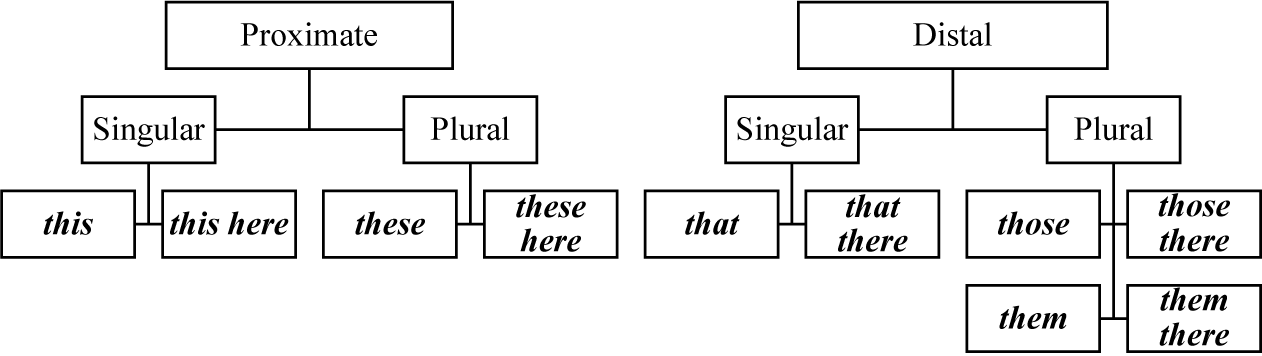
A second advancement to the study of the demonstrative system is to extend the methodological approach. We first examine the overall distributions of forms in the system as a whole and then proceed to accountable comparative analysis of the specific area of the target system where alternation of forms occurs. This method requires strict consistency in circumscribing the contexts in which each form occurs across data sets. The contemporary English demonstrative system comprises a complex set of functional contrasts and variants, as in figure 1.
Graphic visualization of the English vernacular demonstrative system

As figure 1 shows, the overarching contrast is between proximate and distal meaning and a distinction between singular and plural. Moreover, and critically, the English system comprises a healthy system of single demonstrative alternates. The critical question is thus: how do the doubles operate with the singles in the same system?
3.2.1 Circumscribing the linguistic variable
Identifying the doubled forms, i.e. DDEMO_NP, is relatively straightforward due to the obvious doubling of the construction’s components. In contrast, the problem for the analyst is that extracting all the single demonstratives in the data would be a gargantuan task given their frequency in English grammar. However, the principle of accountability (Labov Reference Labov1966: 49; Reference Labov1969: 737−8, fn. 20) allows for focusing on the relevant forms within a carefully delimited set within the grammatical system.
Rupp & Tagliamonte (Reference Rupp and Tagliamonte2017/2019, Reference Rupp and Tagliamonte2022) have already established that most double demonstrative occur in a specific grammatical context – the proximate singular, as in (8a). Note the alternation with a single demonstrative, as in (8b).

We use this fact to justify targeting both the double and single proximate demonstratives as in (8b), from the same individuals who used the doubled forms. We distinguish the single demonstrative in this functional space with the label DEMO_DET this. Including DEMO_DET this enables us to close the set that defines the linguistic variable (Labov Reference Labov1994: 400) to the proximate singular sector of the demonstrative system, enabling us to compare the two forms (double and single) within the same functional niche among individuals who use both.
3.2.2 Extraction of the relevant forms
First, we employed the extraction strategy used in earlier research on double demonstratives (Rupp & Tagliamonte Reference Rupp and Tagliamonte2017/2019, Reference Rupp and Tagliamonte2022). We extracted the string ‘demonstrative + t/here’ (which provided this here, that there, these here and them there), restricting the data to tokens of singular proximate contexts followed by a noun, e.g. this here house. Second, we read through the transcripts of all individuals who used double demonstratives and extracted the single demonstratives in proximate contexts before a NP, e.g. this other man. We excluded examples such as DDEMO_LOC without a noun, e.g. see how fast you can cut this here. We also discarded cases where the NP was followed by the adverb here: ‘this + NP + here’, which have a different structure and function, i.e. DDEMO_NP_EXT (see section 2.2). This procedure provided 254 DDEMO_NP tokens and 843 DEMO_DETs for a total of N=1,097.
Due to the nature of the data, which comprises conversations of vernacular speech from socially stratified populations, it is possible to assess the distribution of forms according to broad social characteristics of the individuals using them. Accordingly, each token was coded for gender of the individuals (perceived at time of interview), their birth date, age at the time of interview and community of origin.
Each token was also coded for several grammatical factors. Pragmatic function was categorized into situational, discourse-anaphoric, recognitional and indefinite this function. Because usage of indefinite this has been associated with subject-NPs and animate subjects (e.g. Levey, Klein & Taha Reference Levey, Klein, Taha, Beaman, Buchstaller, Fox and Walker2020), we also coded the grammatical function of the demonstrative NP (subject, object, complement of a preposition, other) and its animacy in three categories (human, animate, inanimate NP) (see Rupp & Tagliamonte (Reference Rupp and Tagliamonte2022: 73–5) for exemplification of these factors and justifications for coding these contextual nuances). In the current study, we further subdivided the grammatical function of the subject into canonical subject, existential subject, doubled subject and it-cleft, and subdivided the grammatical function of the object into canonical object, double object and fronted object. This strategy permitted assessment of the following factors: (a) vernacular uses such as doubled subjects (e.g. Tagliamonte & Jankowski Reference Tagliamonte and Jankowski2019); (b) strategic subject and object positioning for discourse-pragmatic effects, such as deploying existential sentences for introducing new referents, it-clefts for focusing, and fronting for discourse prominence (e.g. Downing Reference Downing2015: 211−12, 230, 238). These categories are illustrated in (9a−d). Bolding refers to the referent chain in the discourse.

Summarizing, our goal is to gain more insight into the nature of doubling in English DDEMO_NP in what is otherwise a fully functioning demonstrative system.
4 Results
4.1 Overall distribution
The FRED, ROOTS and British Dialect Archive corpora combined provided a total of 254 double demonstratives, i.e. DDEMO_NPs. The paucity of this feature is comparable to the York English (YEC) and Ontario English (ODP) data (Rupp & Tagliamonte Reference Rupp and Tagliamonte2017/2019; Reference Rupp and Tagliamonte2022).
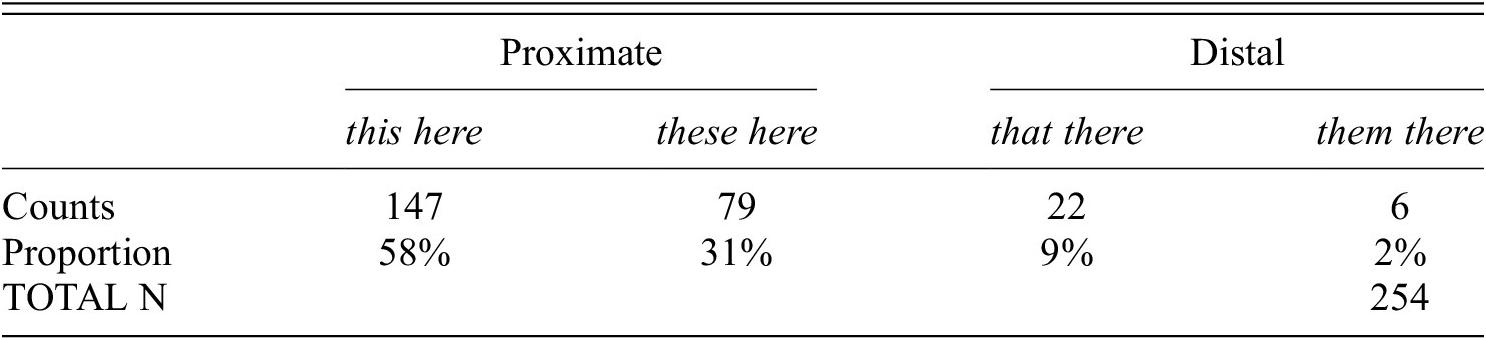
Table 1 shows the distribution of the 254 double demonstratives (DDEMO_NP) by type in the UK data.
Distribution of DDEMO_NP in UK dialects

DDEMO_NPs occurred the most in the proximate singular with this here (58%), followed by the proximate plural form these here (31%); together making up no less than 89% of the DDEMO_NP tokens. The plural forms occurred with the distal demonstratives that there (9%) and them there (2%) much less frequently, constituting only 11% of the tokens. The same was true in the YEC study (Rupp & Tagliamonte Reference Rupp and Tagliamonte2017/2019), where from the scant 16 DDEMO_NP tokens, the most frequent form was this here (N=6) and these here (N=3). Similarly, in Ontario dialects, the proximal type stood out: this here (67%) and these here (15%) (Rupp & Tagliamonte Reference Rupp and Tagliamonte2022). Further, the DDEMO_NP tokens from Devon presented by Harris (Reference Harris1967: 89) suggest the same pattern. In contrast, studies of DDEMO_NPs in Norwegian and other languages have reported a larger number of distal forms at the expense of proximal forms (Vindenes Reference Vindenes2018: 649, citing Diessel Reference Diessel1999: 188). Therefore, there is parallelism across dialects in Canada and in the UK: this here is the dominant doubled form. This suggests that individuals may deploy DDEMO_NP for a shared function. In earlier research on English in Ontario, Rupp & Tagliamonte (Reference Rupp and Tagliamonte2022) argued that that function was to mark discourse-new, hearer-new referents (‘indefinite this here’). The question now is to study the comprehensive UK data to determine if the doubled forms are used to mark a similar discourse-pragmatic meaning in these materials.
4.2 Distributional analysis: social and regional factors
First, it is important to contextualize the use of the double demonstratives in time, space and social context. The nature of the corpora makes this possible because it comprises people with varying social characteristics. There are at least three dimensions we can probe for further information: date of birth of the individual, which offers an apparent time perspective; gender, which combined with date of birth offers insight into change in progress; and geographic location, which offers insight into the diffusion of change.
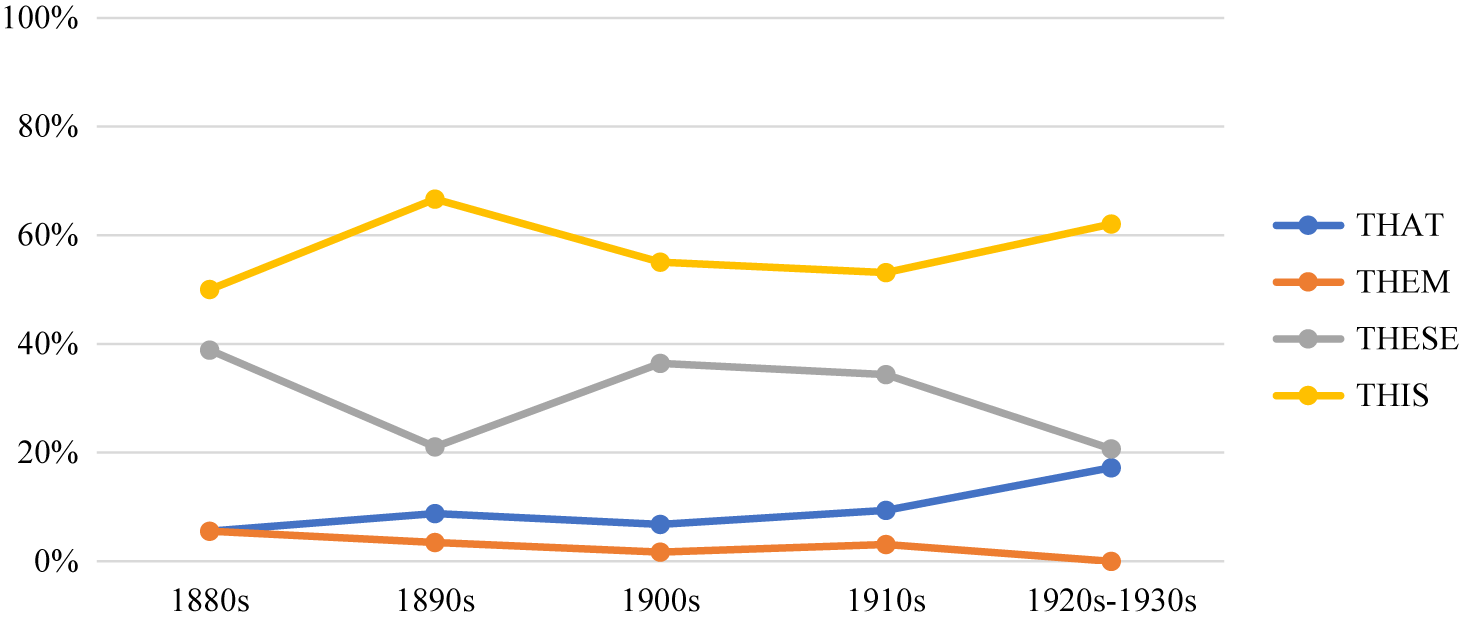
Figure 2 shows the overall distribution of DDEMO_NP in the demonstrative system as a whole by decade of birth of the individuals. Individuals born after 1930 are not included because they do not use double demonstratives. The figure shows that that proximate forms are the most frequent across decades; this here dominates at each time point followed by the plural form these here. The distal forms that there and them there are much least frequent. Moreover, the relative proportion of the different types of doubled forms remains stable across the late nineteenth and early twentieth centuries.
Distribution of double demonstrative types by date of birth of the individuals

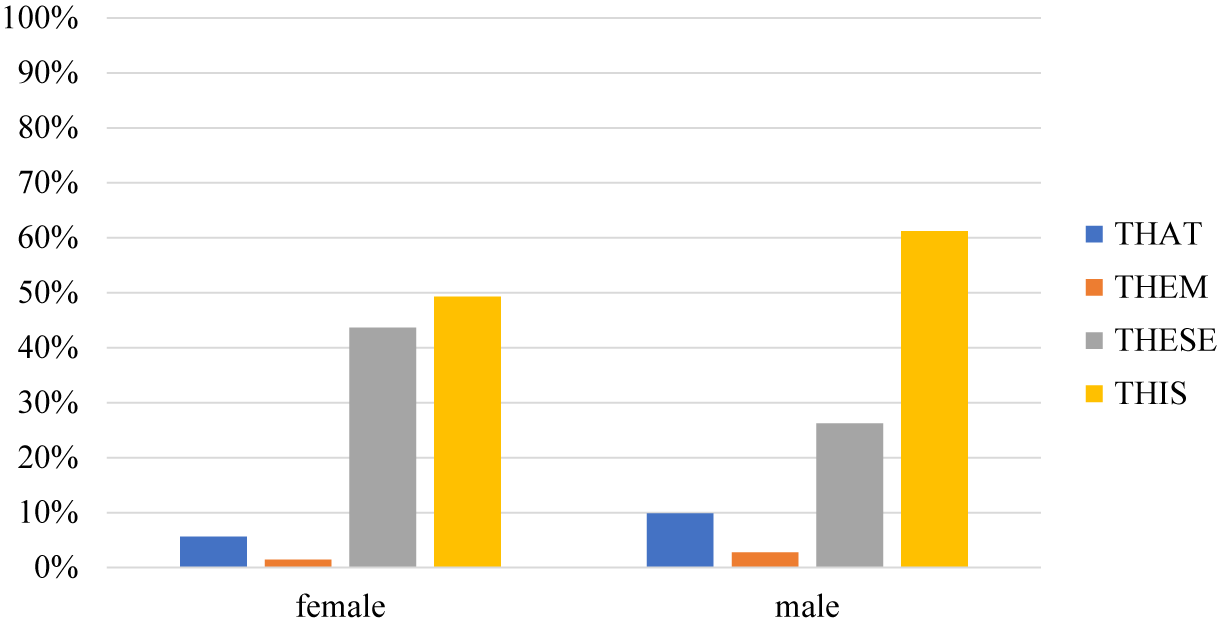
Figure 3 shows the distribution of DDEMO_NP by gender of the individuals. It shows that the relative proportion of the doubled types is parallel between men and women, with the nuance that women use proportionally more of the form these here.
Distribution of double demonstratives by gender of the individuals

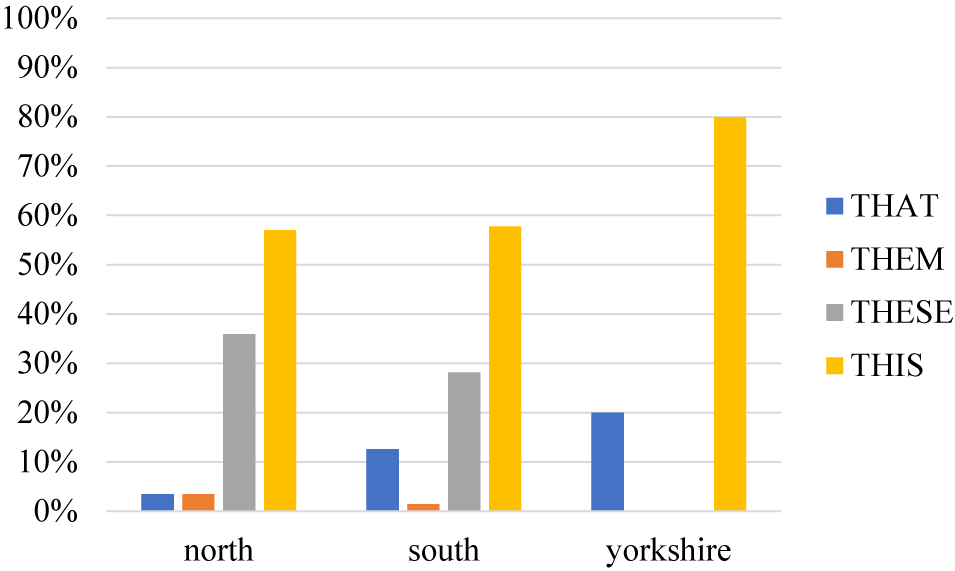
Figure 4 shows the proportion of DDEMO_NP by region of habitation of the individuals. It shows that the north and south of the UK are largely parallel regarding the proportion of the different doubled demonstrative types. Again, the proximal forms this here and these here are dominant, particularly this here.
Proportion of DDEMO_NP by region of habitation of the individuals

The combined findings from generational, gender and regional patterns show consistent parallelism by form, suggesting that the function(s) of double demonstratives may be a feature of the English language generally rather than a localized dialect feature.
4.3 Distributional analysis: linguistic factors
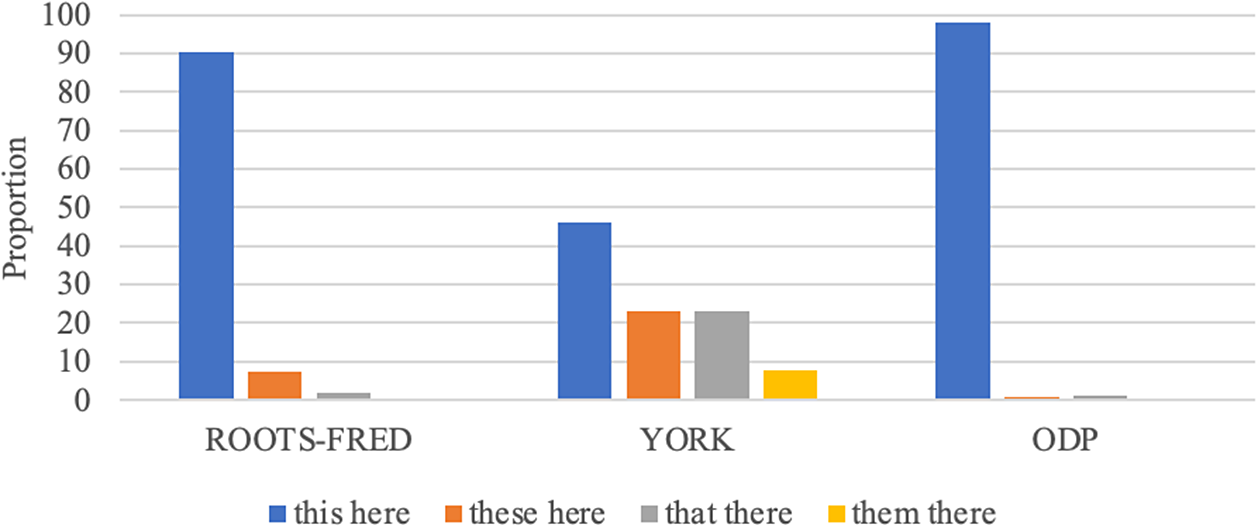
Rupp & Tagliamonte (Reference Rupp and Tagliamonte2017/2019, Reference Rupp and Tagliamonte2022) reported a preponderance of the form this here in York, England, and in Ontario, Canada, respectively. In addition to this evidence, we can now affirm that the same result obtains in other areas of the UK. Figure 5 synthesizes these findings, by displaying the distribution of forms across the three datasets under investigation.
Proportion of DDEMO_NP across datasets

Figure 5 highlights the cross-variety correspondence in relative frequency of forms; the same hierarchy is found across the board. This here dominates, then these here; then that there and them there. Due to the parallel distributional findings affirming the strong representation of this here across datasets, we now turn to an accountable method, including DEMO_DET this for the same individuals who used DDEMO_NP this here.
4.3.1 Pragmatic function
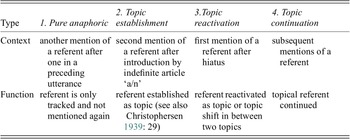
Pragmatic function reveals a noteworthy result for the UK data with respect to discourse-anaphoric uses for DDEMO_NPs, namely a high rate of 25%, as compared to only 2.6% in Canada (CDA) (Rupp & Tagliamonte Reference Rupp and Tagliamonte2022: 194). The question arising is why would this rate be so high in the UK? To find out, we distinguished four subtypes of discourse-anaphoric function based on the reported literature. Diessel (Reference Diessel1999: 96) argued that anaphoric demonstratives are frequently not mere tracking devices, but ‘often used to indicate a referent that is somewhat unexpected and not currently in focus of attention’. Following Ferrazzano (Reference Ferrazzano2013: 114ff.), this usage is thought to derive from demonstratives being inherently contrastive, indicating ‘(i) that the referent in question contrasts with similar members of the contrast set in a particular way, and/or (ii) that the referent contrasts with some other more salient referent’. In contrast, ‘the referent of an immediately preceding clause’ and ‘continuing topics’ are known to often be tracked by ‘third person pronouns, … [and] definite articles’ (Diessel Reference Diessel1999: 99). Table 2 (based on table 61 in Diessel Reference Diessel1999: 98) describes the four anaphoric subtypes that can be used after a referent has been introduced in the discourse: (pure) discourse-anaphoric, topic establishment, topic reactivation and topic continuation.
Discourse-anaphoric uses distinguished after introduction of a referent

The four discourse-anaphoric uses are illustrated in (10a−d). Bolding refers to the referent chain in the discourse.

All tokens were coded for the four discourse-anaphoric functions in (10a–d).
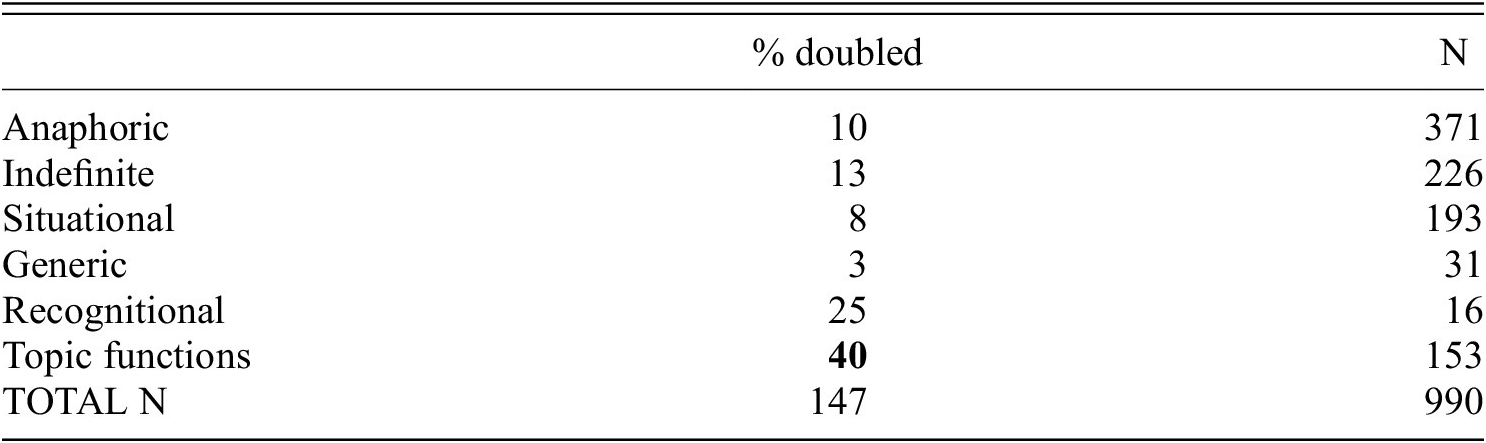
Table 3 shows the proportion of DDEMO_NP this here (double) out of all DDEMO_NP this here plus DEMO_DET this (single) by pragmatic function: situational, (pure) discourse-anaphoric, recognitional, indefinite this (see section 2.2) and topic establishment, topic reactivation and topic continuation. Because the latter three functions are all related to the topicality of a referent, and because of the relatively small number of DDEMO_NP tokens, we collapsed these three uses in a pragmatic category labelled ‘topic functions’. In addition, we coded for generic reference, where the referent-NP was understood generically, as in you’d st- well stand up against the wall and then this here girl’d throw a ball and you’d just hit it like that (NTT_006, 81, 1902).
Proportion of DDEMO_NP this here by pragmatic function

Table 3 shows that when discourse-anaphoric usage is partitioned by subtype, in the UK data doubling is most frequent in topic functions (40%, N=153). A chi-square test contrasting these topical uses compared to the other functions combined confirms that this difference is significant at the p. <.05 level.
The results for the comparison between DDEMO_NP and DEMO_DET by pragmatic function in the UK data in table 3 compare favourably to the findings in the Canadian data by Rupp & Tagliamonte (Reference Rupp and Tagliamonte2022). The Ontario speakers in the ODP also had relatively high rates of doubling in recognitional and ‘indefinite this’ usage in DDEMO_NP of the type this here. What stands out in the UK data is the higher frequency of DDEMO_NP this here in functions that involve specific ways that topics are signalled/flagged in the discourse: topic establishment, topic reactivation and topic continuity.
4.3.2 Grammatical function
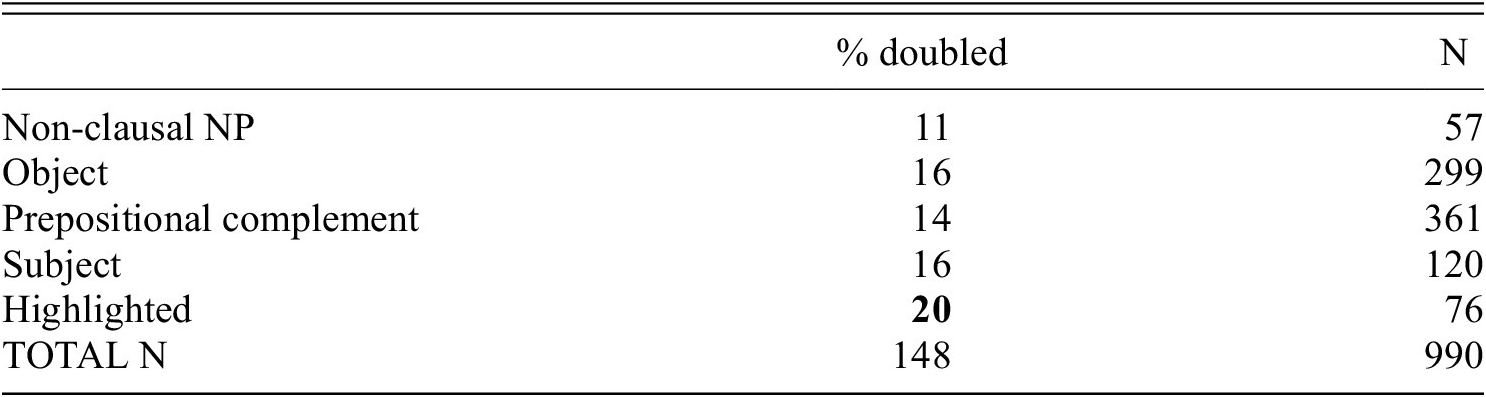
We also considered the proportion of DDEMO_NP this here out of all DDEMO_NP and DEMO_DET this contexts by grammatical function. Recall that we subdivided the grammatical functions of subject and object to also include vernacular uses like doubled subjects and discourse-strategically placed arguments such as existential subjects for introducing new referents and fronted objects for discourse prominence (e.g. Downing Reference Downing2015: 211–12, 230, 238). Because of the low number of tokens of these constructions overall, we collapsed these categories into an overarching ‘highlighting’ category. We were particularly interested in whether the discourse-pragmatic functions of topic and ‘indefinite this’ would correlate with the grammatical highlighting constructions. We excluded 107 tokens that were not arguments (e.g. adjuncts).
Table 4 shows the proportion of DDEMO_NPs this here by grammatical function.
Proportion of DDEMO_NP this here by grammatical function

It shows that highlighted functions do not lead to much more doubling overall compared to individual grammatical functions, suggesting that this here is not a generalized grammatical ‘highlighting’ device. A chi-square test of the contrast between highlighted contexts and all others proves to be non-significant (p <.29). Doubling must be used for some more specific function.
4.3.3 Animacy
Topics tend to be human (see e.g. Levey et al. Reference Levey, Klein, Taha, Beaman, Buchstaller, Fox and Walker2020). Since in the UK data we found DDEMO_NPs used in various topic-related functions (e.g. establishing a new topic, reactivating a previous topic), DDEMO_NPs can be expected to show higher rates with human subjects. Table 5 tests this hypothesis by plotting the proportion of DDEMO_NP this here out of all DDEMO_NP plus DEMO_DET this by animacy.
Proportion of DDEMO_NP this here by animacy

It confirms that doubles are more frequent in animates and humans compared to inanimates, aligning with the findings of Levey et al. (Reference Levey, Klein, Taha, Beaman, Buchstaller, Fox and Walker2020). A chi-square test contrasting animate/human with inanimates confirms that this difference is significant at the p. <.05 level.
In summary, when the doubled demonstratives are viewed as a proportion of all proximate singular contexts, i.e. DDEMO_NP + DDEMO_DET, they show (i) relatively high rates in the discourse-pragmatic topic functions; and (ii) animate subjects have higher rates of doubling than inanimates. Taken together, these findings provide accountable evidence that one of the major functions of the doubled forms is to mark animate referents that (re)establish topics or continue to be topics in the subsequent discourse.
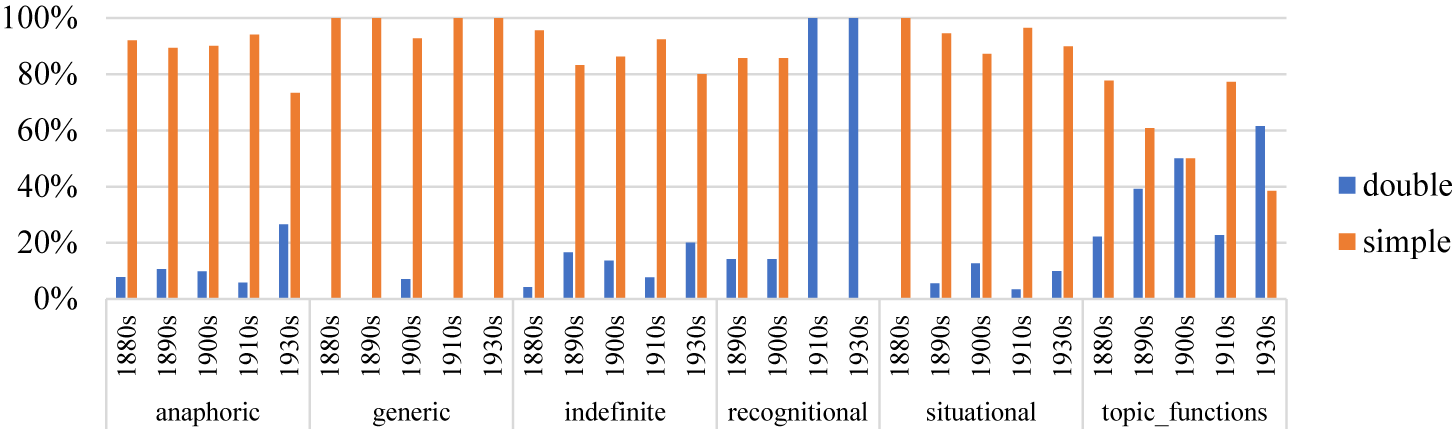
The next question is to determine whether there is a developmental trajectory to these patterns. Figure 6 examines the distribution of DDEMO_NP this here and DEMO_DET this by pragmatic function by decade of birth of the individuals. It confirms that doubled constructions are used by individuals with birth dates across the late nineteenth century and into the twentieth century. The (pure) discourse-anaphoric, situational, and indefinite functions for both simple (DEMO_DET) and double (DDEMO_NP) demonstratives are relatively stable. The apparent heightened use in recognitional contexts for the 1910s and 1930s is an anomaly caused by a low number tokens in these decades (N=2). The most striking finding is a notable rise in use of DDEMO_NPs across decades in topic functions. While the numbers are too low to permit statistical tests in each decade it appears that the use of doubling for topic functions is not only frequent but also rising from the late 1880s into the early twentieth century.
Proportion of DDEMO_NP this here by pragmatic function by decade of birth of the individuals

5 Discussion
We now return to the research questions that we posed at the beginning of the article. The first question was to explain the role of doubling in English DDEMO_NP. Together, the Canadian (CDA) (Rupp & Tagliamonte Reference Rupp and Tagliamonte2022) and UK data from the current study permit a consistent comparative perspective across two major varieties of English. From this, we can conclude that the emergence of English DDEMO_NP was not due to repair because English demonstratives, unlike their counterparts in other languages, have never lost deictic specification. Rather, doubling is deployed for discourse-pragmatic purposes. Earlier accounts of doubling phenomena in demonstratives or elsewhere in the grammar have suggested that doubling is used for emphasis or that it makes for more explicit communication (see section 2.1). However, in English DDEMO_NPs, the doubler cannot bear stress.Footnote 7 Further, in both CDA and the UK there is a preponderance of proximal DDEMO_NP forms, namely this here, rather than more uniform usage of all the demonstrative types, suggesting that this particular form has a more specific use than a doubling feature deployed for general emphasis or clarity. In CDA, Rupp & Tagliamonte (Reference Rupp and Tagliamonte2022) found frequent use of DDEMO_NP this here for marking discourse-new, hearer-new referents, relative to the same function with DEMO_DET this and as compared to other pragmatic functions (situational use etc.); a function that in the literature is best known from the simple proximate demonstrative and known as ‘indefinite this’ (Prince Reference Prince, Joshi, Webber and Sag1981). For the UK, we found, most notably, that DDEMO_NP this here is used in topic-related functions that involve specific ways that topics are signalled/tracked in the discourse: topic establishment, topic reactivation and topic continuity (see table 3). Adding to Harris’ (Reference Harris1967) findings for Devon, we also found evidence of indefinite this usage of DDEMO_NP in the UK corpora. A new and important result of our study is that while indefinite this is commonly assumed to originate in North America (e.g. Perlman Reference Perlman1969: 76),Footnote 8 we have demonstrated that it was already present in DDEMO_NP in the UK at the same time as migrations to North America in the 1800s.
The second question was: how and why did a double demonstrative construction emerge in English dialects, i.e. what type of grammatical change(s) can be discerned within the demonstrative system of English? We posit that DDEMO_NP is a case of Breban’s (Reference Breban and Meurman-Solin2012) complexification of the determiner paradigm. Breban has shown that over the course of history of English, simple determiners lost specific discourse-pragmatic functions to give way to more general meanings. For example, she reports on the historical development of discourse-pragmatic functions associated with the (in)definite articles the and a(n) in English. While in present-day English, the and a(n) are markers of identifiability, in earlier stages in the history of English, they had discourse-pragmatic functions of the type that we have been discussing in relation to DDEMO_NP; among them the function of introducing discourse-new, hearer-new referents or marking topic shift (Reference Breban and Meurman-Solin2012: 273–80). Breban argues that a language may compensate for the loss of discourse-pragmatic functions in determiners in two ways: either they are supplanted by other lexical items, or they evolve into what she calls ‘complex determiners’ that ‘express a combination of functions’ (Reference Breban and Meurman-Solin2012: 271). An example of the second strategy in Standard English is the complex determiner ‘a certain [lady]’; the indefinite article a(n) is no longer used for introducing specific indefinite referents and this gap has been filled by adding ‘certain’. The second strategy is also what we have observed to be operational in the UK and CDA DDEMO_NP data where the complex determiner this here is deployed for marking discourse-new, hearer-new referents or for topics.Footnote 9
In Rupp & Tagliamonte (Reference Rupp and Tagliamonte2022), we proposed that the indefinite this function in DDEMO_NP this here derives from the pointing/signalling meaning of the adverb here. Sankoff & Brown (Reference Sankoff and Brown1976: 638ff.) argued for a similar extended use of the expression ia (‘here’) in Tok Pisin. Sankoff & Brown demonstrated that ia, which derived from the English lexical items here, underwent a grammatical development from a spatial adverb to a demonstrative, a relative pronoun, and a discourse-pragmatic marker or ‘bracketing device’ that individuals deploy to mark additional information that characterizes a new referent (as with parentheticals). Regarding the nature of this grammatical development Sankoff & Brown (Reference Sankoff and Brown1976: 639) say: ‘the fact that the … functions are expressed by the same form on the synchronic level, in Tok Pisin as in many other languages, is understandable in terms of the close semantic analogy between the … uses, without assuming any directionality’. In the case of DDEMO_NP this here, we suggest that through its pointing/signalling attribute, here is also responsible for topic-related functions of English DDEMO_NP; it identifies topics in discourse. Note that the topic usage of DDEMO_NP seems semantically analogous to indefinite this usage which introduces new referents in discourse. The difference is essentially whether the NP is marked on the first reference ((re)introduction of a referent, discourse-new, hearer-new, or topic after a hiatus) or second reference (establishment or continuation of a topic after it has been introduced). Therefore the generalization is a drive to produce a function that introduces an NP that becomes a topic or continues to be a topic. This analysis receives support from Ariel’s (Reference Ariel1988) Accessibility Theory (Ariel p.c. 17 July 2023). Following Accessibility Theory, structurally extensive forms are suitable for marking referents that have low accessibility because they provide enriched information. In English DDEMO_NP, the enriched information is provided by here which signals/flags a low accessibility noun such as a discourse-new hearer-new referent and a reintroduced topic.
Finally, what does the trajectory of change in demonstratives reveal about language change more generally? One critical finding is that doubling need not be a substitute for reduction; rather it may show an increase of analytical form that is independently motivated. We were able to derive this insight because of the nature of the English demonstrative system in English. As we discussed in section 2.1, in many languages the doubled element is required to indicate deictic properties that have been lost from the demonstrative. In English, however, the demonstrative retains its deictic properties, providing a patent signal that the doubled forms are taking on some other function in the grammar.
Further, we have contributed new knowledge to a linguistic development, the emergence of indefinite this. The prevailing idea in the literature is that indefinite this derived from the topic-establishment use of the simple demonstrative this, e.g. There was a young woman in the school and this woman was an amazing teacher (Wald Reference Wald and Klein-Andreu1983: 100–2 and Levey et al. Reference Levey, Klein, Taha, Beaman, Buchstaller, Fox and Walker2020). Proponents of this view have pointed out that the topic-establishment use of DEMO_DET this was already present in Chaucer (Wald Reference Wald and Klein-Andreu1983: 101, Tanabe Reference Tanabe2003: 85–6). However, this scenario does not explain why there is little documentation of indefinite this before 1940 (Levey et al. Reference Levey, Klein, Taha, Beaman, Buchstaller, Fox and Walker2020: 362). Diessel (Reference Diessel1999: 139) has pointed out that among the demonstrative uses of DEMO_DET this, the specific indefinite use is ‘strictly different’ from other uses; ‘indefinite this does not function to orient the hearer in the speech situation or in the universe of discourse; rather, it provides particular processing instructions’. Similarly, Ionin (Reference Ionin2006: 177) has drawn a distinction between the (standard) deictic use of this and referential this (this ref) and postulates that the referential use is not an extension of the deictic use. She argues that this view is supported by the fact that ‘demonstratives in most languages do not have a referential indefinite reading’ (p. 179), citing Lyons (Reference Lyons1999: 77) that it ‘is not common cross-linguistically’.
Rupp & Tagliamonte (Reference Rupp and Tagliamonte2022) provided historical evidence that indefinite this usage in DDEMO_NP predates the attestation of simple indefinite this, concluding that DDEMO_NP this here must be the source of the indefinite this function, rather than the simple demonstrative (DEMO_DET) this. The current UK study adds further support for this perspective. First, UK individuals born in the late nineteenth century use DDEMO_NP in indefinite this function.Footnote 10 Second, the UK individuals in this study show an increasing use of DDEMO_NP this here in topic-related functions but no concomitant change can be observed in their deployment of indefinite this (figure 6). This patterning is not suggestive of development of (first mention) indefinite this from (second mention) ‘topic-establishment this’, neither in DDEMO_NP nor more generally. Rather, the comparison of the UK and CDA individuals demonstrates that DDEMO_NP may specialize into different functions: in this case ‘topic-related this here’ in the UK and ‘indefinite this here’ in CDA.Footnote 11 The comparative approach we have adopted here has captured this specialization in progress. In support of this interpretation, Vindenes (Reference Vindenes2018: 649) has argued that demonstratives in Norwegian may ‘specialize’ in various manners. She calls this ‘functional split’. For example, in present-day Norwegian, double demonstratives with a short and frequently stressed, adverbial her/der element are used for situational reference, while constructions with an unstressed, inflected her(re)/der(re) element have specialized to recognitional meaning. More generally, language typology reveals that in many languages the doubler in double demonstratives carries ‘more meaning than just the emphasizing the deictic function’ (Vindenes Reference Vindenes2018: 655). For example, Roehrs (Reference Roehrs2010: 264) notes that in Icelandic double demonstratives, the doubler ‘seems to have a special function that might be characterized as a discourse particle meaning “you know”’. Vindenes cites Franz (Reference Franz1997: 62), who claims that in the Algic language Blackfoot, individuals add suffixes to demonstratives to express, amongst other things, ‘diminutive’ meaning. Lander (Reference Lander2020: 24) reports that in Swiss German, a reinforced proximal demonstrative ‘is a contrastive element expressing discourse-salience, i.e. “the other”’. Therefore, the evidence suggests that many different types of meaning may emerge from doubling demonstratives.
Several broader methodological, analytic and theoretical points can be made. First, and perhaps most importantly, double demonstratives in a ‘healthy’ demonstrative system provide an exceptionally good opportunity to more fully understand the relationship among synchronically layered forms. Second, an accountable quantitative approach can expose how an obsolescing feature, i.e. the double demonstrative in English, is evolving, providing a notable opportunity to more fully understand how doubled forms develop. More generally, our research suggests that much can be discovered about language by identifying, documenting and studying obsolescing features because they offer key insights for understanding the complexity and internal mechanisms of linguistic systems.


 Open access

