Book contents
- Frontmatter
- Contents
- List of Figures and Tables
- Preface
- Acknowledgments
- Introduction
- 1 Violence and Law, Gender and Law
- 2 When Men Killed Men
- 3 Sexual Violence
- 4 Homicidal Women and Homicidal Men: A Growing Contrast
- 5 Bad Wives: Drunkenness and Other Provocations
- 6 Bad Wives II: Adultery and the Unwritten Law
- 7 Establishing Intention: Probing the Mind of a Wife Killer
- Conclusion: The New “Reasonable Man” and Twentieth-Century Britain
- Index
1 - Violence and Law, Gender and Law
Published online by Cambridge University Press: 24 July 2009

Book contents
- Frontmatter
- Contents
- List of Figures and Tables
- Preface
- Acknowledgments
- Introduction
- 1 Violence and Law, Gender and Law
- 2 When Men Killed Men
- 3 Sexual Violence
- 4 Homicidal Women and Homicidal Men: A Growing Contrast
- 5 Bad Wives: Drunkenness and Other Provocations
- 6 Bad Wives II: Adultery and the Unwritten Law
- 7 Establishing Intention: Probing the Mind of a Wife Killer
- Conclusion: The New “Reasonable Man” and Twentieth-Century Britain
- Index
Summary
Violence and Law
In nineteenth-century England, the problem of violence, the meanings of gender, and the workings of law were all assuming more prominent places in culture and consciousness. As they did, the three converged on one issue in particular – that of more effectively controlling male violence, particularly in order to better protect women. Of course, such a morally and politically stigmatized concept as “violence” is not simply descriptive of an objective set of actions but, particularly at its margins, subject to multiple, changing and often competing definitions. In some definitions, violence has not needed to be physical (it might, for example, be verbal, in the form of threats or insults, or the “mental cruelty” as cited in divorce law); in others, the infliction of physical pain and even injury has not necessarily been violence (in medical procedures or in the punishment of children, until very recently). New forms of “violence” are continually discovered, while behavior considered “violent” may in time cease to be so labeled.
Even today, in a climate of opinion more hostile to the use of physical coercion perhaps than any previous era, views still differ on when (legal) force becomes (illegal) violence. The banning in ever more jurisdictions of physical punishment of children, the establishment of the crime of marital rape and the controversies in legal cases concerning consensual sexual violence illustrate the difficulty even in one period of finding universal agreement on the definition or boundaries of violence.
Information
- Type
- Chapter
- Information
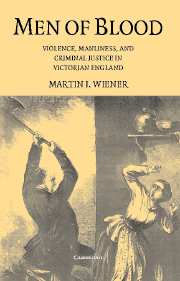
- Men of BloodViolence, Manliness, and Criminal Justice in Victorian England, pp. 9 - 39Publisher: Cambridge University PressPrint publication year: 2004
Accessibility standard: Unknown
Why this information is here
This section outlines the accessibility features of this content - including support for screen readers, full keyboard navigation and high-contrast display options. This may not be relevant for you.Accessibility Information
Accessibility compliance for the PDF of this chapter is currently unknown
and may be updated in the future.
- 1
- Cited by