Book contents
- Frontmatter
- Contents
- List of Figures and Tables
- Preface
- Acknowledgments
- Introduction
- 1 Violence and Law, Gender and Law
- 2 When Men Killed Men
- 3 Sexual Violence
- 4 Homicidal Women and Homicidal Men: A Growing Contrast
- 5 Bad Wives: Drunkenness and Other Provocations
- 6 Bad Wives II: Adultery and the Unwritten Law
- 7 Establishing Intention: Probing the Mind of a Wife Killer
- Conclusion: The New “Reasonable Man” and Twentieth-Century Britain
- Index
4 - Homicidal Women and Homicidal Men: A Growing Contrast
Published online by Cambridge University Press: 24 July 2009

Book contents
- Frontmatter
- Contents
- List of Figures and Tables
- Preface
- Acknowledgments
- Introduction
- 1 Violence and Law, Gender and Law
- 2 When Men Killed Men
- 3 Sexual Violence
- 4 Homicidal Women and Homicidal Men: A Growing Contrast
- 5 Bad Wives: Drunkenness and Other Provocations
- 6 Bad Wives II: Adultery and the Unwritten Law
- 7 Establishing Intention: Probing the Mind of a Wife Killer
- Conclusion: The New “Reasonable Man” and Twentieth-Century Britain
- Index
Summary
Another form growing sympathy for “women's wrongs” took in the Victorian criminal courts was a fading of the powerful fears and horror earlier evoked by female killers, in contrast to the hardening attitudes towards violent men. When Thackeray fictionalized in 1839 the early eighteenth-century life of the burned husband-murderer Catherine Hayes, he intended a rebuttal to “Newgate novel” romanticization of criminals; nonetheless he treated her far more gently and sympathetically than her contemporaries had done. In Thackeray's novel, her fall starts with being seduced by a wicked aristocrat and is entrenched by being forced into loveless marriage and then by poverty: he admitted to his mother that “you see the author had a sneaking kindness for his heroine, and did not like to make her utterly worthless.”
Even the far most common mode of women's violence – against their own, often illegitimate, newborns – increasingly came to be blamed on men. In representations of infanticide between the mid-eighteenth and the mid-nineteenth century there was a marked increase in the use of what Christine L. Krueger has called “cover stories of natural innocence and melodramatic seduction” derived from fiction to save murdering mothers from the harsh fate decreed by the law. The early nineteenth-century popularity of the scenario of bad men seducing and abandoning naïve women encouraged magistrates, judges, and juries to look for an evil man behind the poor unmarried girl discovered with a dead newborn.
Information
- Type
- Chapter
- Information
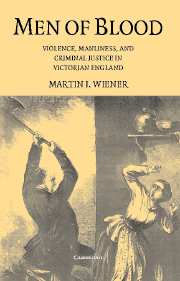
- Men of BloodViolence, Manliness, and Criminal Justice in Victorian England, pp. 123 - 169Publisher: Cambridge University PressPrint publication year: 2004
Accessibility standard: Unknown
Why this information is here
This section outlines the accessibility features of this content - including support for screen readers, full keyboard navigation and high-contrast display options. This may not be relevant for you.Accessibility Information
Accessibility compliance for the PDF of this chapter is currently unknown
and may be updated in the future.