




1. Introduction
Plural sets of entities such as “the children,” “three apples,” or “some pens” can be represented as either groups or collections of individuals. Out of context, a sentence with a plural subject entity, such as “the children carry a ladder,” can receive either a collective reading if the predicate refers to the plurality as a whole (all the children carry the same ladder together), or a distributive reading if the predicate relates to the atomic members of the plurality (each child carries a different ladder). According to lexical theories of plurals (Link, Reference Link, Portner and Partee1983, Reference Link1987), certain predicates inherently lead to a distributive interpretation since they apply solely to individuals (e.g., “to smile”, “to have brown eye”), while others convey only a collective meaning as they refer to groups as a whole (e.g., “to gather”, “to meet”). Nevertheless, mixed predicates such as “to carry something” or “to be heavy” are considered ambiguous due to their capacity to accommodate both interpretations, as in the example above. The speaker can decide to make the interpretation linguistically explicit by adding a distributive quantifier such as “each” or “every” in English, or, for instance, the adverb “together” to convey the collective meaning, or to leave the ambiguity linguistically unresolved.
1.1. Formal theories and adults’ interpretations
In Link’s theory of plurals, singular terms denote singular individuals, and plural terms denote sums of individuals; when a plural term interacts with a mixed predicate, to interpret the sentence as distributive, the semantic representation should include a covert Distributive operator D, reported in 1) (see Link, Reference Link, Portner and Partee1983, Reference Link1987, for the original proposal, and Brisson, Reference Brisson1998 and Champollion, Reference Champollion2019 for a review), which implies that, for each entity y such that y is a subset of the sum x and is atomic, then the property P is applied to y. Consider the example above, “the children carry a ladder”: if the D operator is present in the logical form, the sentence receives a distributive reading (2a); if it is not, then the sentence yields a collective reading (2b).Footnote 1 If we define complexity in terms of the number of logical operators included in the representation, then the distributive representation is more complex than the collective counterpart. As previously mentioned, the D operator may be realised overtly, such as with a universal quantifier as “each,” or it may be left silent, and lexical ambiguity arises.

Numerous accounts have supported the existence of the Distributivity operator, enriching the original proposal with novel perspectives (e.g., Champollion, Reference Champollion2016; Landman, Reference Landman1989; Lasersohn, Reference Lasersohn1995; Roberts, Reference Roberts1987; Schwarzschild, Reference Schwarzschild1996). Furthermore, not only has the D operator been theorised by the majority of linguistic theories of plurals, but it has also been attributed to a psychological reality in psycholinguistic studies. Several experiments have shown that adults prefer the collective meaning when presented with an ambiguous sentence without any linguistic or contextual cue that could help disambiguate it (Dotlačil & Brasoveanu, Reference Dotlačil and Brasoveanu2021; Frazier et al., Reference Frazier, Pacht and Rayner1999; Ussery, Reference Ussery2007). Frazier et al. (Reference Frazier, Pacht and Rayner1999) presented their participants with transitive sentences such as:

Participants had to read them and answer yes/no comprehension questions while their eye movements were recorded. Results revealed a processing slow-down only when the sentence’s meaning was disambiguated by the presence of a distributive expression (“each”) after the predicate, but not when the disambiguating expression was a collective one (“together”). These results indicated that, out of context, participants commit to a collective interpretation and revise it only when they find evidence for a distributive one. Hence, the distributive reading seems to be more complex not only formally but also in terms of processing. Further studies with adult participants, either investigating offline preferences (Pagliarini et al., Reference Pagliarini, Fiorin, Dotlačil, Biller, Chung and Kimball2012; Syrett & Musolino, Reference Syrett and Musolino2013; Ussery, Reference Ussery2007) or measuring online processing costs (Dotlačil & Brasoveanu, Reference Dotlačil and Brasoveanu2021), supported this claim.
1.2. Children’s preferences differ from semantic theories and adults’ tendencies
Claims from the semantic literature and evidence from psycholinguistic studies with adult participants align. However, when we look at children’s behaviour, the findings are unexpected. If, on the one hand, children seem not to have an adult-like knowledge of distributive quantifiers until 7/9 years of age (Brooks & Braine, Reference Brooks and Braine1996; Pagliarini et al., Reference Pagliarini, Fiorin, Dotlačil, Biller, Chung and Kimball2012), on the other hand, when there are no linguistic cues that disambiguate an ambiguous sentence, they seem to prefer the distributive interpretation or to accept it to the same extent as the collective one. This result has been found with various quantity expressions in subject position unmarked for distributivity, such as numbers (e.g., “three children,” Musolino, Reference Musolino2009; Syrett & Musolino, Reference Syrett and Musolino2013) and definite plurals (e.g., the Italian i bambini, “the children,” Pagliarini et al., Reference Pagliarini, Fiorin, Dotlačil, Biller, Chung and Kimball2012), but also with non-distributive universal quantifiers, such as the quantifier alle in Dutch (Rouweler & Hollebrandse, Reference Rouweler and Hollebrandse2015) and the quantifier kol with plural agreement on the noun in Hebrew (Shetreet & Novogrodsky, Reference Shetreet and Novogrodsky2020).
Across several studies, children from 3 to 13 years of age have been administered different comprehension tasks, such as Truth Value Judgement Tasks, picture selection, drawing or act-out tasks in a variety of languages: English (Musolino, Reference Musolino2009; Syrett & Musolino, Reference Syrett and Musolino2013), Italian (Pagliarini et al., Reference Pagliarini, Fiorin, Dotlačil, Biller, Chung and Kimball2012), Dutch (Bosnić & Spenader, Reference Bosnić, Spenader, Brown and Dailey2019; Mognon et al., Reference Mognon, Hagen, de Koster, Hendriks, Gong and Kpogo2022; Rouweler & Hollebrandse, Reference Rouweler and Hollebrandse2015), Serbian (Bosnić & Spenader, Reference Bosnić, Spenader, Brown and Dailey2019; Kneževic, Reference Kneževic2015); Hebrew (Shetreet & Novogrodsky, Reference Shetreet and Novogrodsky2020). Results are mixed: some studies conclude that children have a clear preference for the distributive interpretation, as in Syrett and Musolino (Reference Syrett and Musolino2013) for English, Kneževic (Reference Kneževic2015) for Serbian or Rouweler and Hollebrandse (Reference Rouweler and Hollebrandse2015) for Dutch, while others reveal that children accept both collective and distributive pictures matching a sentence unmarked for distributivity, such as Pagliarini et al. (Reference Pagliarini, Fiorin, Dotlačil, Biller, Chung and Kimball2012), or draw both kinds of pictures matching a sentence that adults consider collective, as in Shetreet and Novogrodsky (Reference Shetreet and Novogrodsky2020) for Hebrew.
Although different studies have yielded varying results, and children speaking different languages have been shown to interpret ambiguous sentences as distributive to various extents – consider, for instance, a study comparing Dutch and Serbian children in an act-out task which found that Dutch children favour a distributive interpretation more often than the Serbian counterparts (Bosnić & Spenader, Reference Bosnić, Spenader, Brown and Dailey2019) – one claim seems to hold firmly, that children do not show the adult-like preference for the collective reading of an ambiguous sentence. Altogether, these results cast doubts on the greater difficulties claimed to be associated with the distributive reading. It is striking that children do not prefer the interpretation considered more effortless to understand by adults, as they usually acquire earlier those linguistic structures that are easier to understand or produce for adults (see Guasti et al., Reference Guasti, Vernice and Franck2018; Phillips & Ehrenhofer, Reference Phillips and Ehrenhofer2015, among others). Thus, based on the previous literature, we would expect children to display the same preference as adults – i.e., to prefer the collective interpretation, given that the distributive one is more complex. However, this prediction has not been supported so far.
1.3. Alternative proposals to semantic theories
Another side of the semantic literature on atomic phrasal distributivity proposes that collective and distributive interpretations of plural DPs do not differ in terms of semantic operators (Landman, Reference Landman1989, Reference Landman2000; Lasersohn, Reference Lasersohn1995; see Dotlačil, Reference Dotlačil2010 for a review). Building on Link’s work, Landman revisited the denotation of the entities interacting with a mixed predicate and proposed that, if the plural set is represented as a sum of individuals, then the predicate is interpreted as distributive; if, instead, the plural set is represented as a group, then the sentence is read as collective. In this framework, the distributive form includes the ∗ operator, comparable to the D operator, which distributes the predicate over the individual members of the sum (4a). However, the novelty of this approach lies in the fact that the collective representation includes another operator, which transforms a sum into a group, making the atomic entities no longer accessible (4b).

This proposal suggests that the semantic representation of distributivity is not more complex than that of collectivity, at least in terms of the number of operators included. Building on this idea, Dotlačil (Reference Dotlačil2010) suggested that principles of conversation can explain the limited occurrence of distributive interpretations: adults reason that an utterance such as “the boys are pushing a table” cannot be attributed to a distributive meaning because, if this were the speaker’s intention, the speaker would have opted for a more informative sentence such as “each boy is pushing a table.” Since this was not the case, adults assign the sentence a collective interpretation. However, children do not have fully developed pragmatic abilities (see Barner et al., Reference Barner, Brooks and Bale2011; Foppolo et al., Reference Foppolo, Guasti and Chierchia2012; Noveck, Reference Noveck2001) and cannot generate this conversational implicature (Pagliarini et al., Reference Pagliarini, Fiorin, Dotlačil, Biller, Chung and Kimball2012); hence, they accept both interpretations of an ambiguous sentence. This account brings into the debate the crucial contribution of the interface between semantics and pragmatics; nonetheless, it does not answer the question regarding the semantic forms underlying distributive and collective interpretations, but it rather treats them as assumptions.
Beyond the two main sets of findings discussed here and in the previous section, another feature that crosses the two approaches has been shown to play a role. When discussing sets and atoms, we must consider that sets of different sizes are not represented similarly by the human mind. A large body of the literature on numerical cognition shows us that humans, already from the very early stages of their development, perceive quantities through two different systems, one dedicated to approximate magnitudes and one specific for exact quantities (e.g., Coubart et al., Reference Coubart, Izard, Spelke, Marie and Streri2013; Feigenson et al., Reference Feigenson, Dehaene and Spelke2004). The two cognitive systems are characterised by different properties, which go beyond this paper’s aims, but one feature that is worth considering in this research refers to the fact that exact quantities present atomic members which are immediately recognisable to the human eye (i.e., within the subitising range), while approximate magnitudes are perceived more as groups in which the individuals are no longer relevant. As some previous studies have suggested, this seems to parallel the distributive/collective distinction. Suppose small sets are labelled with an exact numerical quantifier, such as “three girls”; in that case, participants may focus on the idea that the same property described by the predicate applies to each individual, therefore preferring the distributive interpretation over the collective one (Syrett & Musolino, Reference Syrett and Musolino2013). According to this hypothesis, another study found that children behaved more adult-like and chose a collective picture to match an ambiguous sentence with definite plurals if the number of agents involved in the action was increased (Patson & Hupp, Reference Patson and Hupp2018). From this overview, further research is needed to confirm the semantic theories and to explore the cognitive factors that can influence the assignment of a distributive or collective reading to an ambiguous sentence. In this respect, some new insights can be gained by investigating the realm of production.
2. Aims of the study
This study examines the acquisition of distributive and collective readings from a novel perspective. While previous studies have primarily focused on the comprehension and interpretation of ambiguous sentences, we tackle the topic in a new way, to our knowledge never explored before – i.e., through an experiment investigating the production of linguistic expressions of distributivity and collectivity by children and adults. Within the idea that language can be a mirror of the mind and that children may transparently express their thoughts, at least sometimes (Guasti et al., Reference Guasti, Alexiadou and Sauerland2023; Sauerland & Alexiadou, Reference Sauerland and Alexiadou2020), we are interested in how they describe pictures depicting plural transitive actions, either performed collectively or distributively. Therefore, we design an experiment with three main objectives.
First, we propose that analysing the verbal use of specific linguistic expressions may provide valuable insights into the underlying nature of these expressions. Previous literature on acquisition (e.g., Van Hout, Reference Van Hout, Greenhill, Hughes, Littlefield and Walsh1998) indicates that children tend to favour a transparent mapping between concepts and their linguistic encodings, with a preference for linguistic structures that unambiguously convey the intended meaning. Following this perspective, children may sometimes produce elements present in their semantic representation when translating concepts into verbal expressions (Guasti et al., Reference Guasti, Alexiadou and Sauerland2023). In line with this hypothesis, our study investigates whether linguistic production can reveal the underlying semantic representation, aiming to identify which formal linguistic theory is supported by the language patterns of children and adults.
Secondly, we believe that for children to understand the two linguistic structures and to develop a preference for one, they should understand the contrast between the two from a linguistic and cognitive point of view. By looking at the previous literature, it is not clear whether children have complete knowledge of the linguistic labels associated with the concept of representing sets of atoms as individual parts of a group or as a whole (e.g., Brooks & Braine, Reference Brooks and Braine1996); furthermore, it has not been established that they grasp the difference between the two interpretations on a cognitive level, as this concern has not been targeted explicitly previously. To shed light on these questions, we present participants with pictures in different contexts, which require or do not require explicit disambiguation in terms of the distributive/collective distinction. In this way, we aim to investigate whether children are sensitive to the ambiguity between a collective and a distributive scene even when the contrast is not depicted.
Finally, we described previously that the number of agents engaged in transitive actions influences participants’ interpretation of ambiguous sentences (Patson & Hupp, Reference Patson and Hupp2018), with a larger set size prompting children toward a collective reading. Hence, as a third objective, we explore whether the numerosity of the agents influences the production of expressions marking distributivity or collectivity by presenting pictures with different numbers of agents, inside or outside the subitising range, that is, the threshold between exact and approximate magnitudes.
3. Methods
Participants saw two pictures side by side and were invited to describe them. Through a factorial 3x2 design, we created our trials by manipulating the Contrast Type factor (the relation between the two pictures in the trial) within subjects and the Numerosity factor (the number of agents in the pictures) between subjects. We pre-registered our study on the OSF platform [https://doi.org/10.17605/OSF.IO/5CFYZ] and stored our materials, datasets, and analysis as Supplementary Materials on Zenodo.
3.1. Participants
We included 51 adults and 51 preschoolers, Italian native speakers. Since no production studies were run on this topic, to the best of our knowledge, the participant size was decided based on previous comprehension studies, aiming at having the average number of data points they obtained by considering the number of participants and experimental trials (Brooks & Braine, Reference Brooks and Braine1996; Musolino, Reference Musolino2009; Pagliarini et al., Reference Pagliarini, Fiorin, Dotlačil, Biller, Chung and Kimball2012). We enrolled adult participants on the online platform Prolific (www.prolific.com) by applying for the final dataset the following inclusion criteria: they did not have certified linguistic or auditory difficulties, Italian was their first language, and they were not exposed to two or more languages from birth. Children were tested in a preschool in the metropolitan area of Milan (Italy), and we applied the same inclusion criteria as for adults, checking demographic variables and linguistic history through a questionnaire addressed to parents. Children’s non-verbal reasoning assessed through Raven’s Coloured Progressive Matrices (CPM; Raven et al., Reference Raven, Raven and Court2003) was in the normal range (average percentile score = 89.23; SD = 10.99), and thus their cognitive abilities were adequate. After applying our inclusion criteria, the final samples comprised 51 adults (F = 25; M = 26; age in years M = 27.96, SD = 11.4) and 44 children (F = 28; M = 16; age in months M = 64.57, SD = 4.87, range = 4;9–6;2).
3.2. Material and stimuli
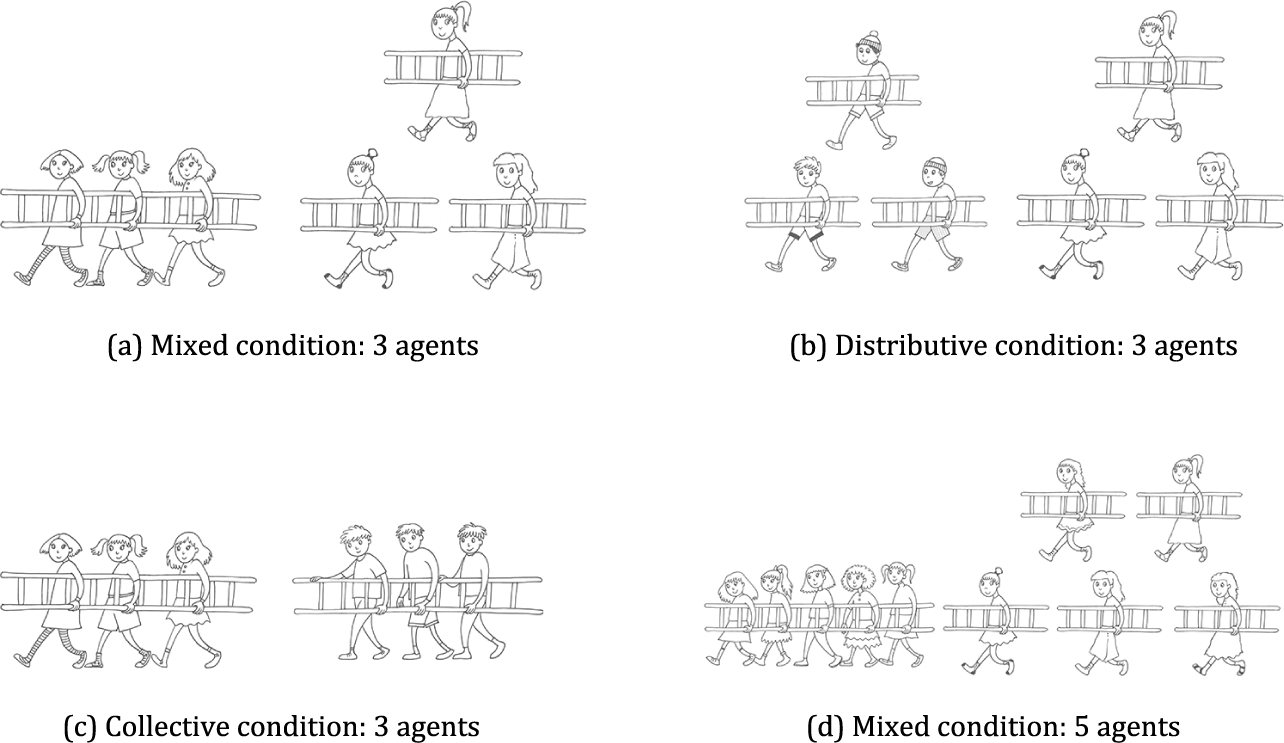
Our pictures were black-and-white drawings of some agents performing transitive actions. The collective pictures displayed all the agents acting on the same object together, while the distributive pictures displayed each agent acting on a different object. We selected from the existing materials in the literature four transitive actions that were known to preschoolers and sufficiently ambiguous between a collective and a distributive interpretation, and we created the pictures according to our experimental needs. Our scenes could be described as girls/boys carrying a ladder, girls/boys pulling a sledge, girls/boys holding a balloon, and bears/crocodiles lifting a box. We designed the experiment by building three blocks of trials based on the type of contrast existing between the two pictures in each trial, and we thus obtained three experimental conditions: (1) mixed, in which the two pictures in the trial represented the same action, one carried out collectively and the other distributively (Figure 1a), (2) distributive, in which the two pictures represented the same action distributively but with different agents (Figure 1b), and (3) collective, with two collective pictures (Figure 1c). Each scene was presented under all the conditions. Furthermore, to test whether a different number of agents could influence the descriptions produced, we built the task in two versions, one with three agents in the pictures (Figure 1a–c) and a second one with five agents (see Figure 1d for an example). Half of the participants saw a version of the task, while the other half saw the other. With this design, we obtained a total of 24 experimental trials, divided into two lists based on the numerosity of the agents.
Example trials by condition.
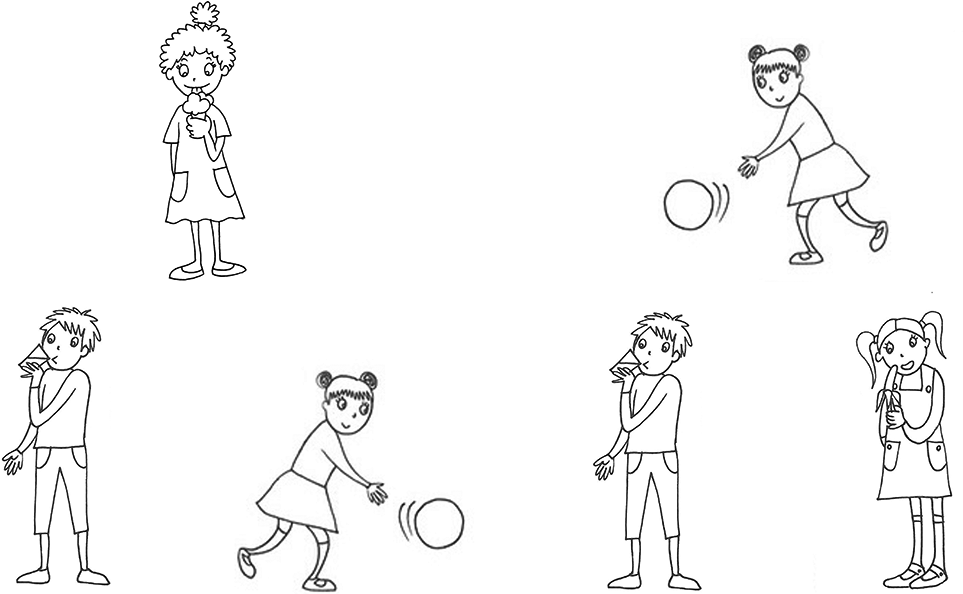
We included 12 filler trials consisting of two side-by-side black-and-white pictures, each with two or three agents engaging in different individual transitive actions, such as a boy drinking water or a girl eating a banana. These trials served two purposes: (1) to hide the experiment’s aim from adult participants and (2) to lighten children from the task’s demands by allowing them to produce more straightforward sentences. We present an example of a filler trial in Figure 2. Each participant completed a total of 24 trials: 12 experimental and 12 filler.
Example filler trial in the production task.
3.3. Procedure
Each participant saw two pictures side by side and was asked to provide two verbal descriptions, one per picture. A recorded voice asked Cosa succede qui? (“What happens here?”), while the left picture was highlighted with a green circle; after the participant’s reply, the same voice asked E qui? (“And here?”), with the picture on the right highlighted. The elicitation question was kept as neutral as possible to avoid any potential influence on the answer. Each trial was preceded by a screen displaying the objects contained in the following screen’s pictures, with the recorded voice saying Guarda qui! (“Look at here!”); this screen was used to maintain the children’s attention. Adults and children were presented with the same task, which allowed a fair comparison between the two age groups; the only differences in the children’s experiment were the presence of a penguin puppet in the task, who asked the elicitation questions, and a slightly different question on the filler items. The elicitation question for adults was the same as the one in the experimental trials, and they had to describe all the individual actions. Since a small group of children tested in a preliminary pilot study showed signs of fatigue in describing the filler trials exhaustively, we decided to adapt the task to their needs and ask them to describe only one action per picture. The elicitation question was then modified into Cosa fa il/la [personaggio]? (“What does the [character] do?”). The procedure was semi-automatic, as the participant (or the experimenter) pressed a button to proceed to the following trial and implemented it with the Labvanced software (Finger et al., Reference Finger, Goeke, Diekamp, Standvoß and König2017). The order of trial presentation and the position (left/right) of the pictures in the trial were all randomised. The experimenter tested each child individually in a quiet room at their preschool. Children were tested in two experimental sessions, the first with the Raven’s Matrices and the second with our production experiment.
3.4. Sentence coding
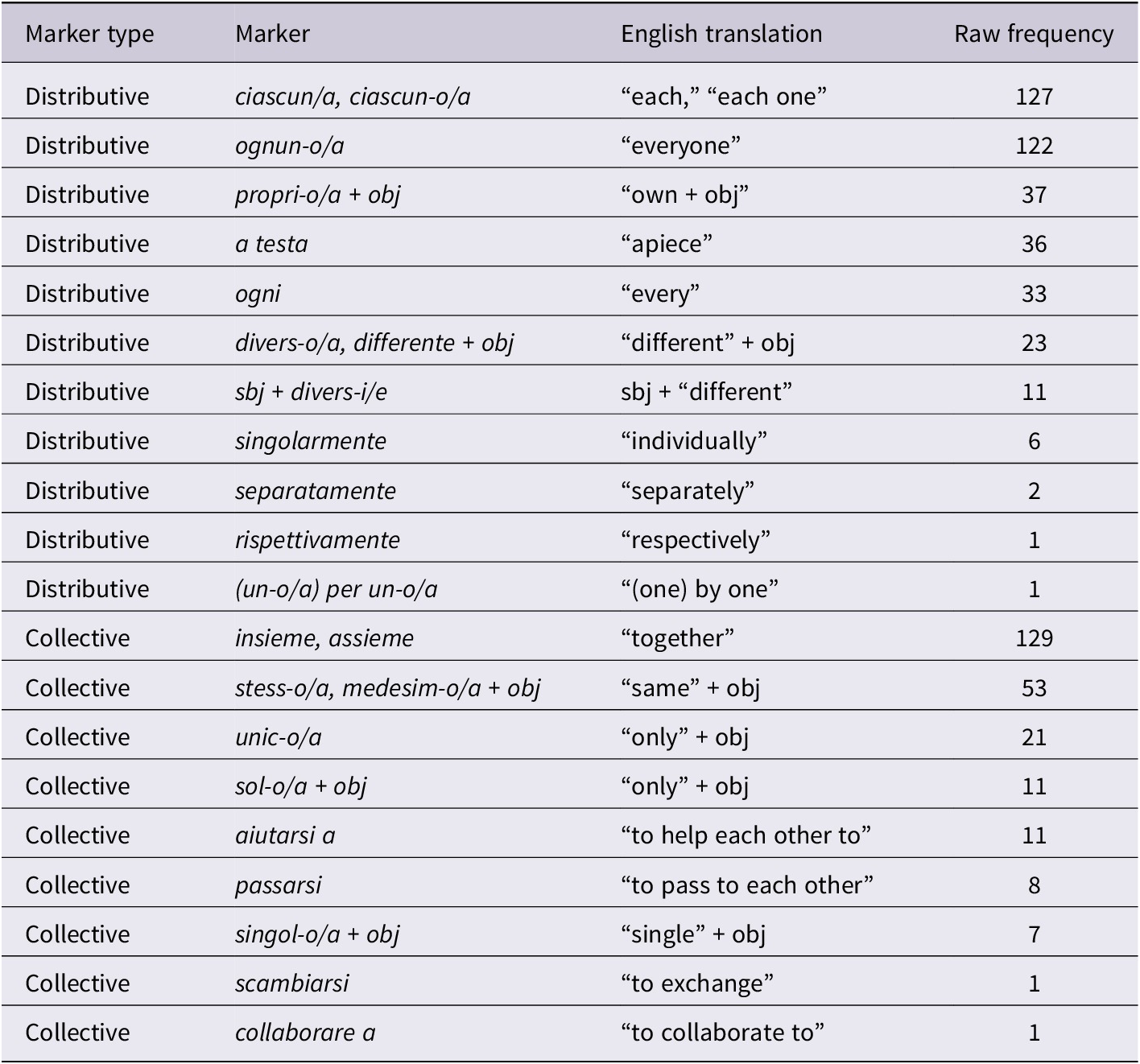
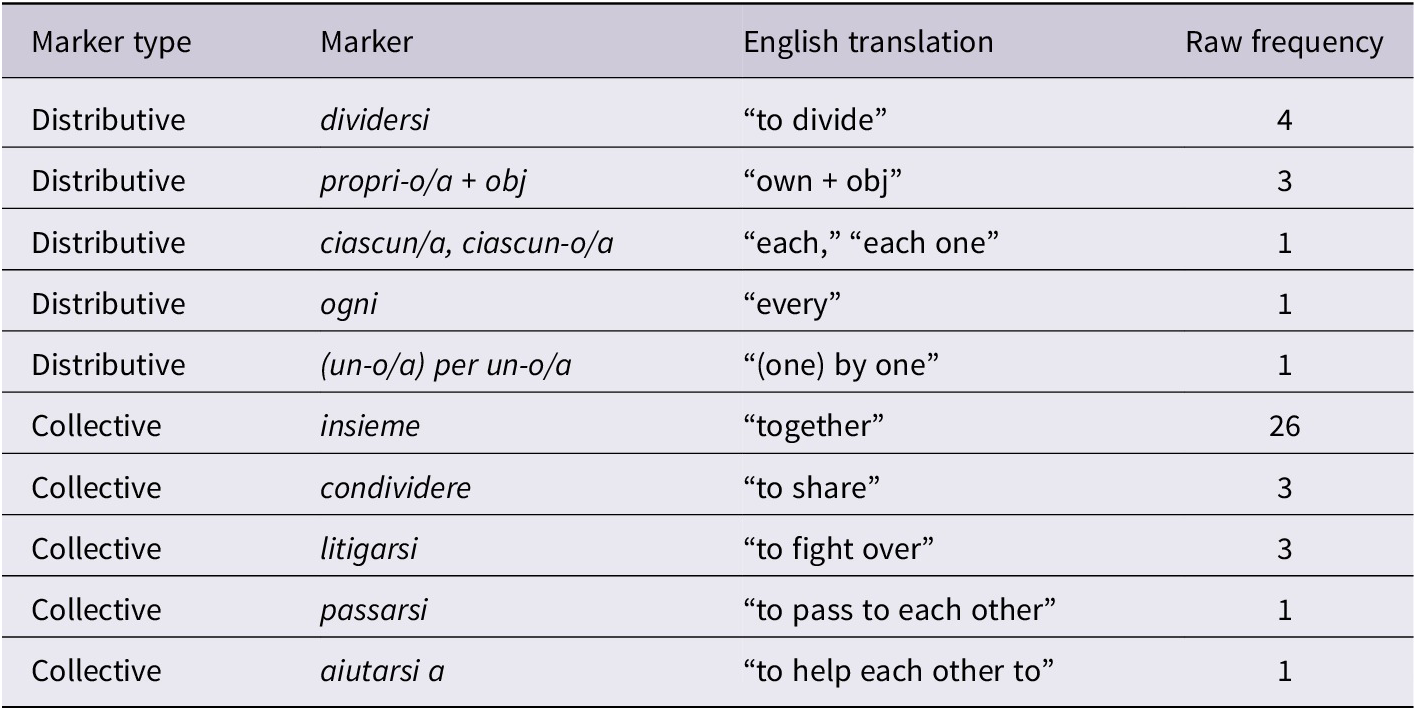
For each experimental trial, participants produced two sentences, one per picture. We coded each sentence as 1 if it included a linguistic expression for distributivity, 2 if it included a linguistic expression for collectivity and 0 if it did not include any of these expressions. We considered linguistic markers for distributivity or collectivity those reported in the literature (e.g., Brooks & Braine, Reference Brooks and Braine1996; Pagliarini et al., Reference Pagliarini, Fiorin, Dotlačil, Biller, Chung and Kimball2012) and those linguistic expressions that occurred in the dataset exclusively with distributive or collective pictures. Table 1 reports the complete list of distributive and collective markers we selected, with their English translation. Instances of a sentence coded for distributivity would be le ragazze tirano ciascuna una slitta (“the girls are pulling a sledge each”) or i ragazzi tengono il proprio aquilone (“the boys are holding their own kyte”); examples of a sentence coded as collective would be instead le ragazze tirano una slitta insieme (“the girls are pulling a sledge together”) or i ragazzi tengono lo stesso aquilone (“the boys are holding the same kyte”).
Distributive and collective markers considered in the coding procedure (“obj” and “sbj” stand for the object and the subject of the sentence, respectively). a

a Following previous literature claiming that the quantifier “all” is independent from the distributivity-collectivity distinction (Brisson, Reference Brisson2003; Lasersohn, Reference Lasersohn1995), we did not include the quantifier tutti (“all”) among our linguistic markers. In line with this claim, adults and children considered it appropriate to describe both collective and distributive sentences (Shetreet & Novogrodsky, Reference Shetreet and Novogrodsky2020), and the same pattern was found in our data
3.5. Data analysis
Data were analysed using mixed-effects logistic regression models with the R Statistical Software (R Core Team, 2021). To explore the effect of our manipulations on the spontaneous production of distributive and collective markers, we ran the analyses on the dependent variable “Linguistic Marking”, a dichotomous variable with the value of 0 if none of the two pictures in the trial was marked and the value of 1 if at least one received a marked description (see ¶3.4). We chose this operationalisation to conduct mixed logistic regression models for binomial distributions. In accordance with Barr et al. (Reference Barr, Levy, Scheepers and Tily2013), we fit two maximal models, one for adults and one for children.Footnote 2 We included in our models the interaction between “Contrast Type” – i.e., the conditions in which the two pictures were paired in each trial (coded on the three levels mixed/distributive/collective) – and “Numerosity of agents” (three/five) as fixed effects. Variance related to participants and trials was accounted for by including participant ID and trial as random effects. In the case of convergence problems and singular fit, we simplified the random structure by eliminating the effects with the lowest variance step by step. Before running our models, we conducted exploratory regression analyses to see whether our demographic variables – age, gender, and educationFootnote 3 – affected the dependent variable, Linguistic Marking. We also evaluated other potential covariates, such as the position of the picture in the trial (left/right), trial order, the status of the preceding trial (experimental/filler), and non-verbal reasoning skills (only for children). Post-hoc analyses were performed to explore significant effects further, and a Bonferroni correction for multiple comparisons was applied. Finally, in order to explore whether children and adults tended to use linguistic markers more when describing a distributive or a collective picture, we focussed on answers given to the “mixed” condition of Contrast Type. A further mixed-effects logistic regression was run, including the Picture Type (distributive/collective) as a fixed effect and participants and trials as random intercepts.
4. Results
First, we inspected what linguistic expressions adults and children produced to mark distributivity and collectivity across the whole dataset. Adults produced a total number of 641 markers (399 distributive, 242 collective), while children produced only 44 (10 distributive, 34 collective). Table 2 shows the raw frequency of markers produced by adults, and Table 3 shows those produced by children.Footnote 4
List of distributive and collective markers produced by adults, ordered by raw frequency
List of distributive and collective markers produced by children, ordered by raw frequency
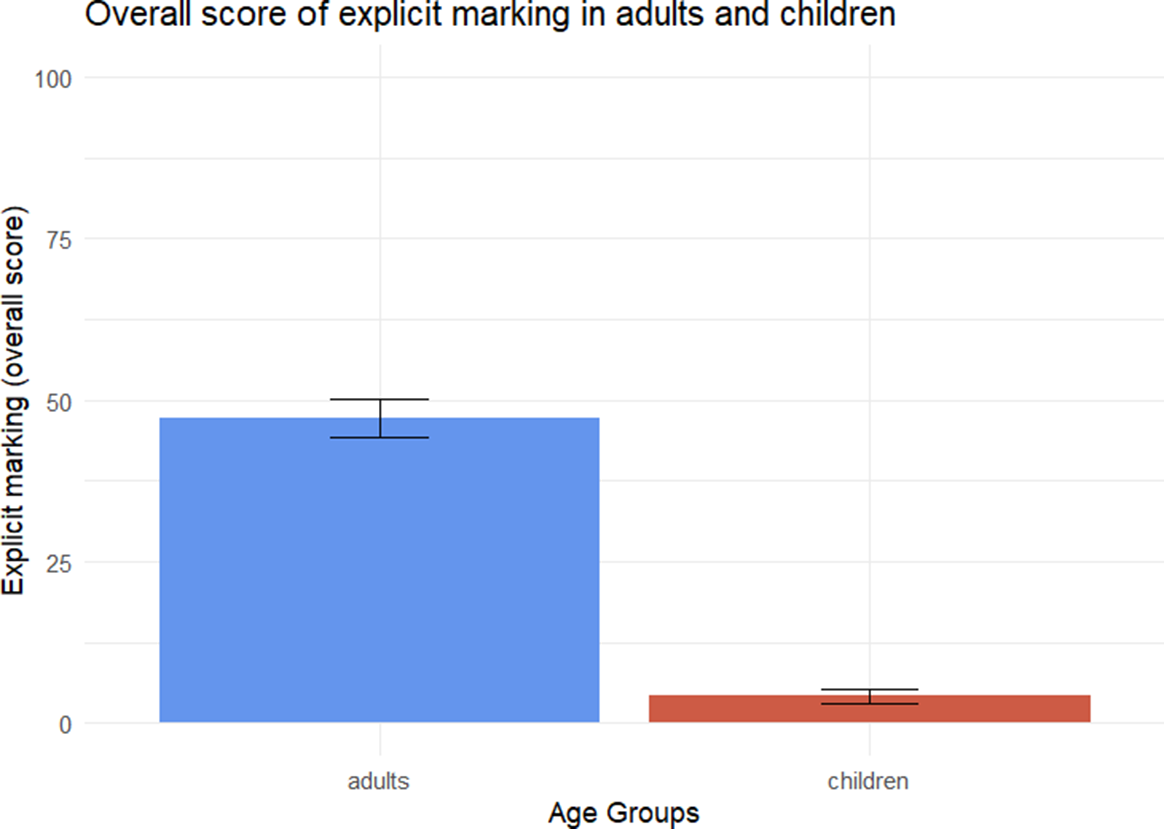
Then, for each participant, we calculated an overall score of linguistic marking by summing all the descriptions marked for distributivity or collectivity over the total number of sentences produced in the experimental trials, independently from the condition. We observed that adult participants produced a greater extent of linguistic expressions for distributivity and collectivity across the whole dataset (M = 47.30%; SE = 2.94) than the group of children, who almost did not produce any linguistic marker (M = 4.17%; SE = 1.03). Figure 3 reports the percentage of linguistic marking per age group.
Overall score of explicit linguistic marking (i.e., the proportion of descriptions marked for distributivity or collectivity out of the total sentences produced) by age group. The bars display the standard error.
For our exploratory analysis, we employed mixed-effects regression models with Linguistic Marking as the dependent variable, our demographic variables and covariates as fixed effects, and participants as random intercepts. We ran separate models, one for each fixed effect and age group. From this analysis, we did not find any significant relation between Linguistic Marking and our demographic variables – age, gender, and education – or other potential covariates – the position of the pictures in the trial (left/right), or the status of the preceding trial (experimental/filler) – in either the adult or the children sample (see our Supplementary Materials on Zenodo for the specific results). Hence, we did not include these variables in the subsequent analyses. As suggested by a reviewer, we conducted an additional analysis to rule out any potential effect of filler trials on experimental trials. Specifically, we ran a mixed logistic regression model with Linguistic Marking as the dependent variable and the interaction between Picture Type (distributive/collective) and Preceding Trial Type (experimental/filler) as fixed effects. We included participants and trials as random intercepts. This analysis did not yield any significant result, confirming that filler trials did not impact the production of distributive and collective markers in experimental trials. We included the analysis script in our Supplementary Materials. Instead, we found an effect of trial order for adult participants (β = 0.059, SE = 0.014, z(595) = 4.267, p < 0.001) but not for children (β = −0.001, SE = 0.028, z(503) = 0.021, p = 0.983). To include the trial order in the adults’ main model as a covariate, we needed to exclude the items’ random intercepts to avoid convergence problems. Since the results were similar to the model without the covariate but with the items’ random intercept, we decided to exclude the trial order from the final model for a fair comparison with the model on children’s data. Finally, scores in the Raven’s matrices did not seem to be related to children’s production either (β = −0.035, SE = 0.026, z(503) = −1.340, p = 0.180).
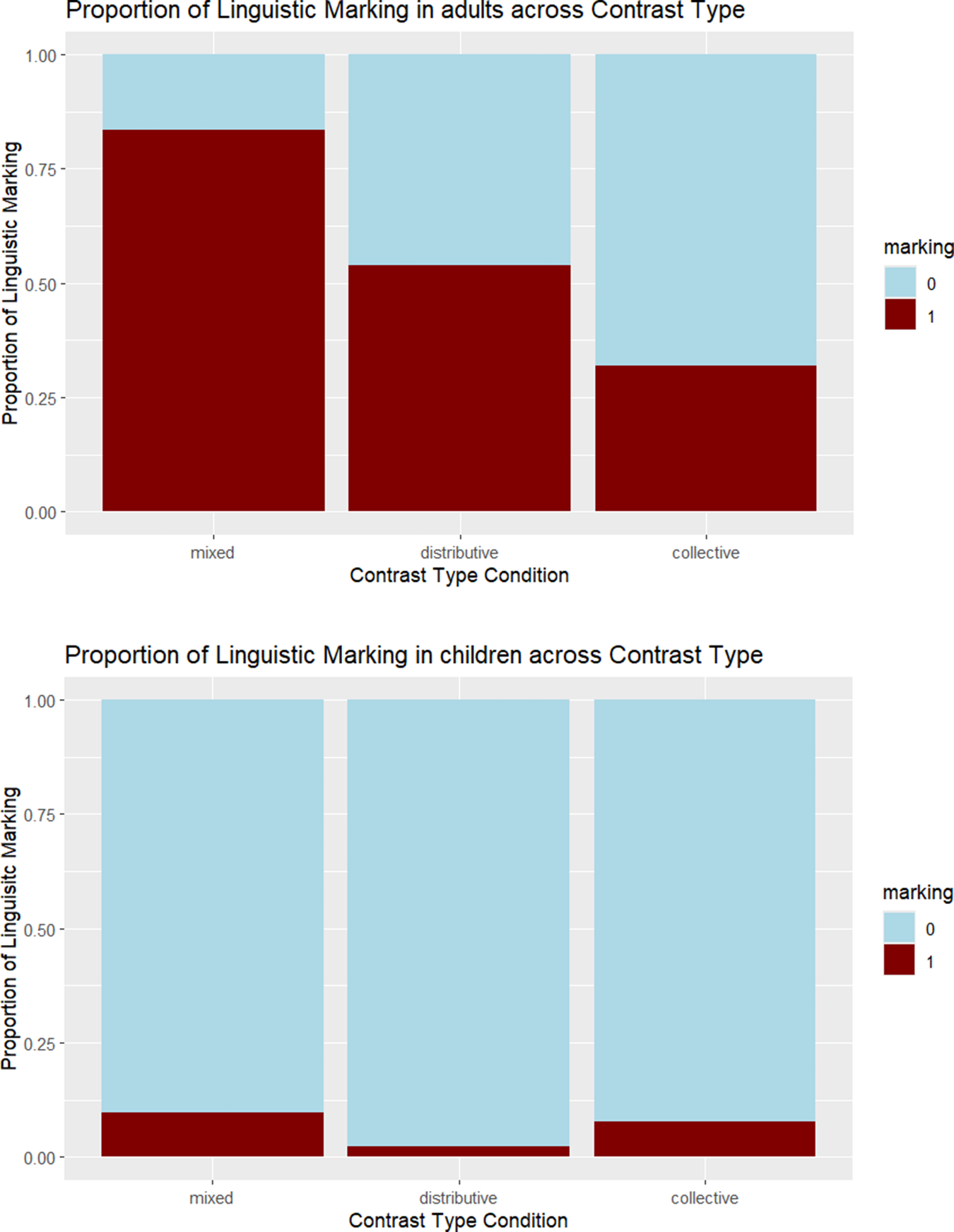
Concerning our main analysis, we conducted two mixed-effects logistic regression models, one for adults and one for children. We included in our models the interaction between Contrast Type (mixed/distributive/collective) and Numerosity (three/five) as fixed factors, and participants and trials as random effects. We found a significant effect of Contrast Type both for adults (χ 2(2) = 93.402, p < 0.0001) and children (χ 2(2) = 7.34, p = 0.025), but a non-significant effect of Numerosity (adults: χ 2(1) = 0.355, p = 0.551; children: χ 2(1) = 0.053, p = 0.817) and its interaction with Contrast Type (adults: χ 2(2) = 5.140, p = 0.077; children: χ 2(1) = 1.056, p = 0.590). When unpacking the comparisons between conditions in the Contrast Type factor in the adults’ data, we found that the mixed condition received more linguistic marking than both the collective (adjusted p < 0.0001) and the distributive condition (adjusted p < 0.0001) and the distributive condition presented more linguistic marking than the collective one (adjusted p < 0.0001). In the children’s data, we observed more linguistic marking in the mixed condition than in the distributive one (adjusted p = 0.018), but no significant difference between the mixed and the collective condition (adjusted p = 0.660) or the collective and the distributive ones (adjusted p = 0.109). Figure 4 illustrates the proportion of Linguistic Marking across the three conditions, separately for adults and children. Specifically, adults produced 167 trials marked in the mixed condition (175 distributive markers, 115 collective markersFootnote 5), 106 in the distributive one (224 distributive markers in total), and 63 in the collective one (127 collective markers); children marked instead only 16 trials in the mixed condition (4 distributive markers, 13 collective markers), 4 in the distributive one (6 distributive markers), and 13 in the collective one (21 collective markers).
Proportion of Linguistic Marking for Age Group and Contrast Type.
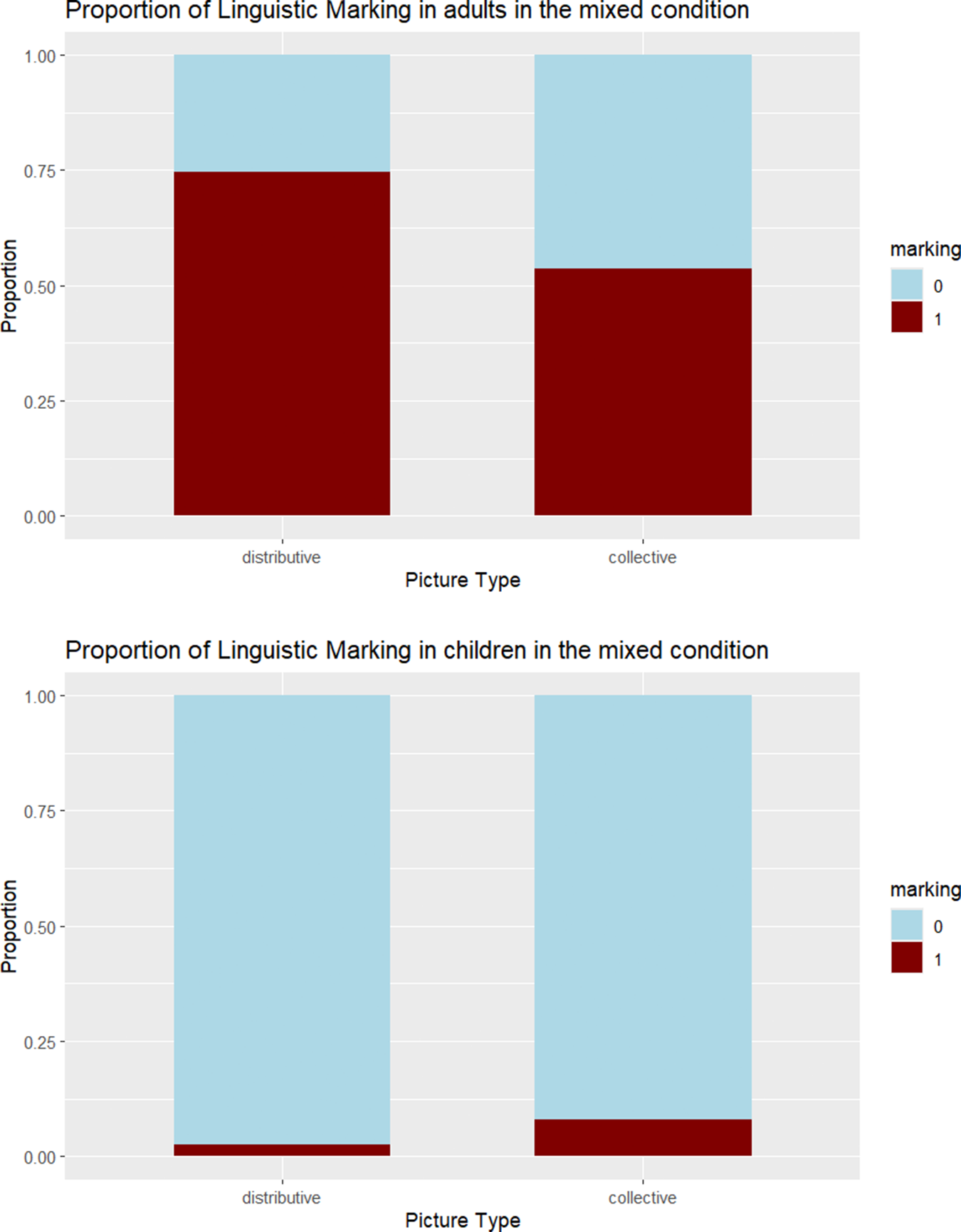
These patterns were confirmed when looking at the descriptions of the single pictures within the mixed condition by conducting two additional mixed-effects logistic regression models (i.e., one for adults and one for children), with Picture Type (distributive/collective) as a fixed effect and participants and trials as random intercepts. We found that adult participants preferred to linguistically mark the description of the distributive picture over the collective one (χ 2(1) = 24.84, p < 0.0001), while children preferred to mark the collective description (χ 2(1) = 4.619, p = 0.032). Figure 5 illustrates the proportion of Linguistic Marking across distributive and collective pictures in the mixed condition. Specifically, adults produced 149 linguistic markers when describing distributive pictures and 107 when describing collective ones; children produced instead only 4 markers for distributive pictures and 13 for collective ones.
Proportion of linguistic marking for age group and picture type.
4.1. Individual analysis and some observations on children’s data
As explained above, five-year-old children produced very few linguistic markers: only 15 out of 44 children produced at least one marker of collectivity or distributivity, and the children who expressed linguistic marking tended to have very few percentages of marking scores, calculated over the total of the pictures described in each Contrast type condition (i.e., 8, since we had four trials per condition and two descriptions per trial), as Table 4 shows. Furthermore, children did not seem to be consistent in their linguistic marking, as only one child in the total sample produced a linguistic marker in all three Contrast Type conditions. However, even though only one child who produced markers in the distributive condition marked descriptions also in the mixed one, 8 children out of 9 who expressed markers in the collective condition showed the same marking behaviour in the mixed condition.
The distribution of children who expressed linguistic marking by Contrast Type condition. The first column indicates the Contrast Type condition, the second the number of children who produced at least one linguistic marker in that condition, and the last three columns refer to the number of children who produced linguistic markers within 50%, 25%, and 12.5% of the trials. No child produced a linguistic marker in more than half the trials

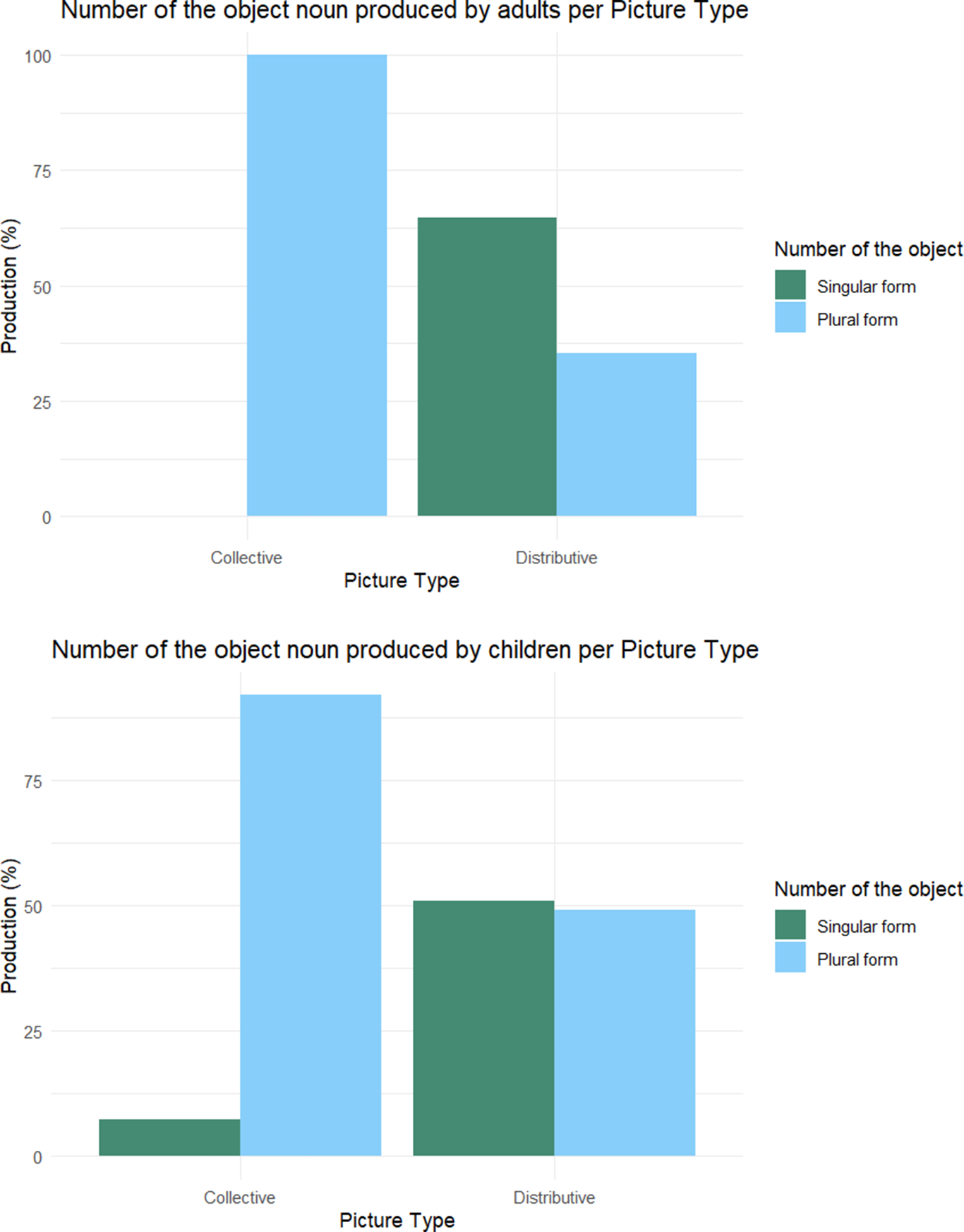
We examined whether children used some alternative strategies to distinguish between collective and distributive pictures. We focused only on the mixed condition, that is, the trials in which the contrast between the two pictures was explicit, and we isolated the datapoints in which no linguistic marker was produced. This resulted in the selection of 16.18% of the adults’ data and 84.66% of the children’s data. The difference is not surprising, as adults predominantly produced marked sentences, whereas children tended to leave their descriptions unmarked. We explored different patterns, such as the type of subject or object (numeral, definite plural, indefinite…) children used, but only a few strategies seemed consistent and worth mentioning. First, children tended to produce numerals in subject position if the numerosity of the agents was 3, compared to 5, as a mixed logistic regression confirmed (χ 2(1) = 6.155, p = 0.013). However, this effect was not modulated by the picture type, either collective or distributive. A similar and more pronounced pattern was found in the adults’ data (χ 2(1) = 11.055, p < 0.001). Then, we observed qualitatively that some children tended to use the singular form of the object noun (e.g., le bambine portano UNA SCALA , “the girls are carrying A LADDER”) to describe the collective picture and the corresponding plural form for the distributive one (e.g., le bambine portano DELLE/LE SCALE, “the girls are carrying SOME/THE LADDERS”). A similar pattern was found in the adult data, as Figure 6 shows, but with a greater usage of the plural form when describing the distributive picture.
Singular/plural form of the object noun produced by adults and children.
5. Discussion
This study compared adults’ and children’s production of linguistic expressions conveying distributive and collective meaning as an entry into their underlying semantic representation. Participants were presented with two pictures and had to describe both; the pictures depicted distributive or collective transitive actions performed by plural agents in three conditions. Our results with adult participants seem to align with the previous literature, both from a semantic and a psycholinguistic point of view. In previous comprehension experiments (e.g., Dotlačil & Brasoveanu, Reference Dotlačil and Brasoveanu2021; Frazier et al., Reference Frazier, Pacht and Rayner1999), adults preferred attributing a collective interpretation to an ambiguous sentence. Similarly, in this production study, they tended to consider an ambiguous sentence sufficient to describe collective scenes. Still, they needed to add lexical disambiguators, especially distributive quantifiers such as ciascuno (“each”), to distributive descriptions independent of the numerosity of the plural set. This finding seems to corroborate the existence of a Distributivity operator, which is added to the semantic representation of a sentence with a plural subject to convey that the predicate refers to the individual atomic members of the plurality. In this respect, our study corroborates previous results in favour of the psycholinguistic status of the distributive operator.
Moreover, as a reviewer interestingly pointed out, our findings align with the pragmatic account advanced by Dotlačil (Reference Dotlačil2010) and further developed by other authors (de Koster et al., Reference de Koster, Hendriks and Spenader2021; Grinstead et al., Reference Grinstead, Padilla-Reyes and Nieves-Rivera2021; Pagliarini et al., Reference Pagliarini, Fiorin, Dotlačil, Biller, Chung and Kimball2012). According to this account, the distributive reading of plural DP expressions (e.g., “the girls are carrying a ladder”) is degraded in the adult language system because plural DP expressions trigger a conversational implicature: in the example above, a hearer would infer that it is not the case that each girl is carrying her own ladder; otherwise, the speaker would have produced a more informative sentence with “each.” Similarly, it is consistent with this account that adults aimed to be informative in production by marking distributivity rather than collectivity, especially when the two types of pictures were directly compared. Finally, regarding our exploratory question on whether different set sizes could play a role in the description of the pictures, we did not find any reliable difference, suggesting that the numerosity of the set is not crucial in producing distributive or collective expressions.
By contrast, preschool children’s linguistic production indicates that at this age they are not fully sensitive to the need to express markers to disambiguate the two readings. As we can observe from Table 3, they produced almost no distributive quantifiers, suggesting that these markers are not yet acquired by the age of five, at least in the production domain. Furthermore, children’s limited production was not influenced by the numerosity of the agents in the pictures, thus showing that while larger plural sets enhance a collective and adult-like interpretation in comprehension tasks, they do not have a similar effect on production. It is very complex to establish at what level of the concept-to-form mapping children have encountered difficulties. They might have found it demanding to (1) recognise the difference between distributive and collective pictures, (2) understand the necessity to disambiguate them, or (3) retrieve the appropriate linguistic labels. As for the first point, some evidence suggests that children recognised the difference between the two types of pictures: our qualitative analysis of what children produced indicates that they sometimes used a plural or singular form of the object to describe distributive or collective pictures, respectively (“the girls carry ladders” vs. “the girls carry a ladder”). Although, in so doing, they were describing what they saw (the distributive picture presented three or five ladders, while the collective one depicted only one ladder), these choices hint that children differentiated the two pictures, and they might have used plural morphology as a precursor of distributivity, as other authors suggested previously (Syrett & Musolino, Reference Syrett and Musolino2013). This hypothesis seems to be further supported by our qualitative data with adults, who often used the plural form of the object noun to describe the distributive picture in the mixed condition when they did not produce markers. However, it is important to note that such unmarked trials were rare, as adults predominantly produced marked sentences, either collectively or distributively – most often the latter. Therefore, given that our study did not investigate this idea directly, future research is strongly needed to find evidence for the distributive meaning of plural forms.
As for the second point, that is, recognising that it was necessary to disambiguate the two descriptions, we can say that children produced very few linguistic markers overall. In this respect, our setup might not sufficiently support the necessity to express unambiguous expressions. As a matter of fact, our task instruction was “Describe what you see.” Children had no reason to be particularly informative in distinguishing between distributive and collective actions, as an unmarked and ambiguous sentence was sufficient to respond to the prompt. Our question was enough for adults: when presented with a distributive picture, they inferred that, without overtly expressing the concealed distributive operator (Brisson, Reference Brisson1998; Champollion, Reference Champollion2016; Link, Reference Link, Portner and Partee1983, Reference Link1987), a potential hearer could associate the sentence with a collective (default) meaning. Following this reasoning, they decided to produce a univocal distributive sentence. Children were likely not able to think similarly and behave accordingly. Nevertheless, one aspect of our design promoted children’s production of linguistic markers. Although children generally tended not to mark the descriptions, they did so when the contrast between distributive and collective pictures was explicit in the mixed condition, and, in particular, they produced collective markers. This finding suggests that they benefited from the explicit contrast between pictures and recognised the difference between them, as suggested earlier, but were inconsistent in their marking behaviour.
The proportion of collective expressions was higher than that of distributive ones across the whole experiment, even when the context did not necessarily require them. One reason may be that children distinguished the two readings, knew the collective expressions, and used them but did not master the distributive markers (e.g., Pagliarini et al., Reference Pagliarini, Fiorin, Dotlačil, Biller, Chung and Kimball2012). If this were the case, the problem may be at the lexical level, as suggested in our point (3) above. In any event, collective markers may be a way to display their ability to distinguish the two readings by marking the one for which they have the labels available. This finding may hint at the semantic theory claiming that the two logical forms are distinguished by two different operators; in the effort to convey the form-to-meaning mapping transparently, children expressed only the collective markers because they still had a limited vocabulary for distributive expressions. Nevertheless, the limited data children produced in our study do not allow us to provide a firm conclusion on the semantic theories we outlined above. Our results show that preschool children at the age of five still have not acquired distributive quantifiers, at least in the production domain. Furthermore, even though some evidence suggests that at this age they are sensitive to pragmatic factors to a certain extent – as shown by their tendency to produce more markers in the mixed condition when the two pictures required explicit disambiguation – they likely still struggle to recognise the need to be informative and to use the appropriate linguistic labels effectively. In light of this, further research is needed to address two crucial issues: to understand what challenges five-year-old children face, either cognitive, pragmatic, or lexical, and to look at older children who may have overcome such difficulties to collect insights on the semantic representations underlying distributive and collective structures.
6. Conclusion
For the first time, we investigated the distributive and collective interpretations of plural subject sentences by exploring the realm of production. We studied adults’ and children’s free descriptions of distributive and collective pictures to gain insight into the underlying semantic representations and compared the results with previous studies on comprehension. Our results indicate that adults’ production aligns with their comprehension: they assigned a collective meaning to ambiguous sentences in previous comprehension studies, and similarly, here they considered an ambiguous sentence sufficient to express a collective meaning, but they added linguistic expressions to convey the distributive reading. Instead, children in the last year of preschool use very few linguistic markers of distributivity or collectivity, yet they do so in some selective ways. Our study paves the way for additional investigations, such as the analysis of the pragmatic and lexical limitations five-year-olds face or the comparison with older children who might have overcome such challenges.
Data availability statement
All data and statistical analysis scripts are available at: https://zenodo.org/records/14853185.
Acknowledgements
We thank Andrea de Varda, Letizia Raminelli, Aurore Gonzalez, Aron Hirsch, and all members of the LeibnizDream project for their valuable discussions and insights on the ideas presented in this paper. We would also like to thank the audiences at WoSSP2023, BUCLA-8 and Going Romance 37 for their helpful comments and questions. Finally, we are grateful to the two anonymous reviewers for their thoughtful suggestions, which greatly improved the quality of this work.
Author contribution
For the purposes of the Italian Academy, Chiara Saponaro (CS) takes responsibility for the content of this paper. Specifically, CS and MTG conceived and designed the study; CS prepared the experimental materials; MR collected the data; CS and DC analysed the data; all authors discussed the results; CS drafted the manuscript; DC and MTG revised the draft through multiple rounds of revisions; MTG provided financial funding. All authors have approved the manuscript before submission.
Funding statement
This paper is part of a project that has received funding from the European Research Council (ERC) under the European Union’s Horizon 2020 research and innovation programme (grant agreement number: 856421).
Competing interests
The authors declare none.


 Open access

