

On 23 February 1711, Thomas Huddlestone, a merchant's apprentice in Livorno, Italy, penned a letter home to Cambridge, addressed to his mother but intended for the attention of both of his parents.Footnote 1 In it, he explained his predicament concerning his relationship with his employer, Mr Miglionicci. ‘I see lately a letter of Mr Miglioniccis dated Ye 29th December, full of such injurious expressions Yt Ye can't imagine what a Confusion they put me in’, he wrote in anxious haste. His employer had accused Thomas of overspending his wages and his parental allowances and he ‘signifies a great mistrust of my integrity’. ‘Oh God, oh most respect'd Dear Parents, must I think myself so far in Ye Disgrace, yet you're even capable of suspect'g my Honesty’, he implored. The tone of the letter then heated up. ‘Yes yes tis’ Miglionicci Yt seeks my disquiet, tis’ he Yt robs me of my repose, tis’ he Yt spakes injuries of me, tis’ he Yt Spolies me of my reputation…[I] take him both for a malicious & madman.’ These interpersonal problems carried far more significance for Thomas’ prospects ‘for less Yn £40 per annum I can not maintain myself in Y post…tis’ now Yr time y[ou] must decide or determine Ye whole course of my Dwelling in Ye World.’
Thomas was the younger son of Henry and Mary Huddlestone, gentry landowners of Sawston Hall, Cambridge. He had been sent to Livorno one year earlier to establish himself as an independent merchant and make his own way in the world. We know very little about the circumstances under which Thomas was sent to Italy or his fate after his apprenticeship. All that remains of his experiences are a series of thirty-seven letters to his parents between 1710 and 1711, each one anxiously explaining his desperate situation and prospects, his poor treatment at the hands of his employer, and his pleas for their assistance.
Thomas's plight was a common one in gentry families. Under the system of primogeniture, younger sons inherited only a small portion of the ancestral estate and, from the late seventeenth century, very rarely any land. They were positioned near the apex of social and gender privilege, but often reached adulthood fairly certain of a landless existence, uncertain of inheriting the resources to maintain this status, anxious about their capacity to earn their own livings and dependent on the honour of their families. A host of contemporaries worried about younger sons, as individuals and as a problematic existential category, ranging from Shakespeare to Locke, Hobbes to Defoe, Burke and Paine to Austen and Trollope.Footnote 2 For many of these writers, primogeniture seemed to run contrary to normative caring family relationships. Ideas of sibling equality contrasted with ‘legal practices and co-existing social norms’ which placed them in ‘a hierarchy based upon gender, birth order, and marital status’.Footnote 3 Similarly, parents and guardians themselves spilled much ink in deliberating their fate because the successful disposition of non-inheriting children was vital for the family's reputation. Younger sons were a nexus of anxieties.
Our purpose is not to elucidate the history of younger sons, who have been treated elsewhere.Footnote 4 Our focus, instead, is on gender and emotions, specifically masculinity and anxiety as they were expressed in family correspondence concerning younger sons in their late adolescence, as they embarked on their careers and sought to establish themselves in the world. For Joan Thirsk, ‘younger son meant an angry young man, bearing more than his share of injustice and resentment’.Footnote 5 Rather than focus directly on anger, which has been examined elsewhere by Linda Pollock, we are interested in the emotion of anxiety exchanged across the family in an economy of emotions and the way this throws light on notions of masculinity and the masculine identities of our younger sons.Footnote 6
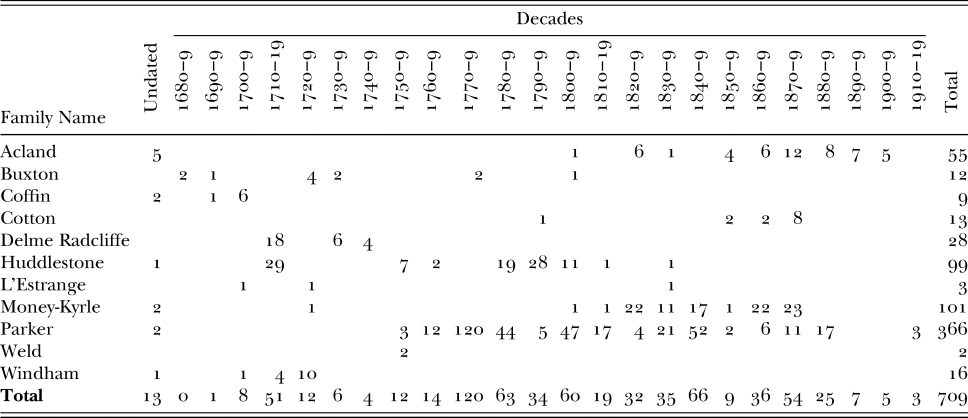
The correspondence we use for this research is an archive of feeling replete with rich seams of evidence relating to emotions and masculinity.Footnote 7 We draw on 734 family letters concerning younger sons across our period exchanged between members of eleven gentry families (see Table 1) between the late seventeenth and the late nineteenth centuries. Tables 2 and 5 illustrate that letters concerning younger sons were distributed quite evenly across the period 1690–1900, although some families are better represented than others. The surviving evidence is only a tiny, and slightly random, selection of the original flows of familial correspondence in which the opinions of younger sons were better represented.
Estimated acreage and annual income of families in study, 1883
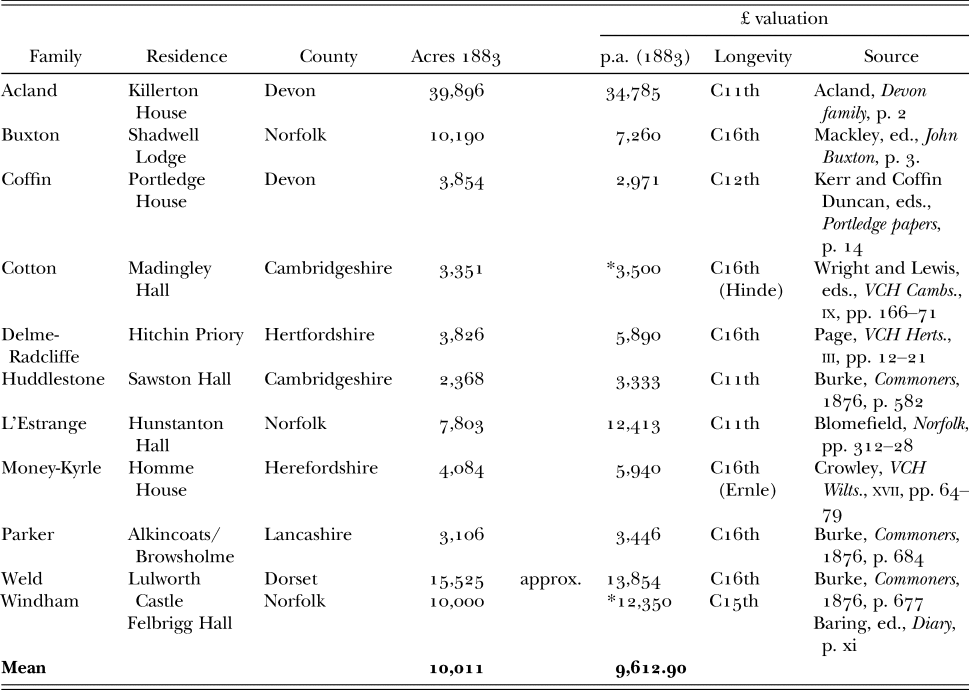
* Valuation given in William Windham lunacy case, 16 Dec. 1861, WKC 4/29/7, NRO.
Sources:
A. Acland, The story of a Devon family (Exeter, 1981)
Mrs H. Baring, ed., The diary of the Right Hon. William Windham, 1784–1810 (London, 1866)
F. Blomefield, An essay towards a topographical history of the county of Norfolk (London, 1809)
J. Burke, The commoners of Great Britain and Ireland (London, 1834) and (London, 1876)
D. A. Crowley, ed., A history of the county of Wiltshire, xvii: Calne (London, 2002)
J. Hargreaves, ‘Lister, John (1845–1933), Oxford dictionary of national biography (Oxford, 2004)
R. J. Kerr and I. Coffin Duncan, eds., The Portledge papers (London, 1928)
D. and S. Lysons, Magna Britannia, vi: Devonshire (London, 1822)
A. Mackley, ed., John Buxton, Norfolk gentleman and architect: letters to his son,1719–1729, Norfolk Record Society, 69 (Norwich, 2005)
W. Page, ed., A history of the county of Hertford, iii (London, 1912)
A. P. M. Wareham and A. F. Wright, eds., A history of the county of Cambridge and the Isle of Ely, x (London, 2002)
A. P. M. Wright and C. P. Lewis, eds., A history of the county of Cambridge and the Isle of Ely, ix (London, 1989)
Distribution of number of letters concerning younger sons by type of sender and recipient
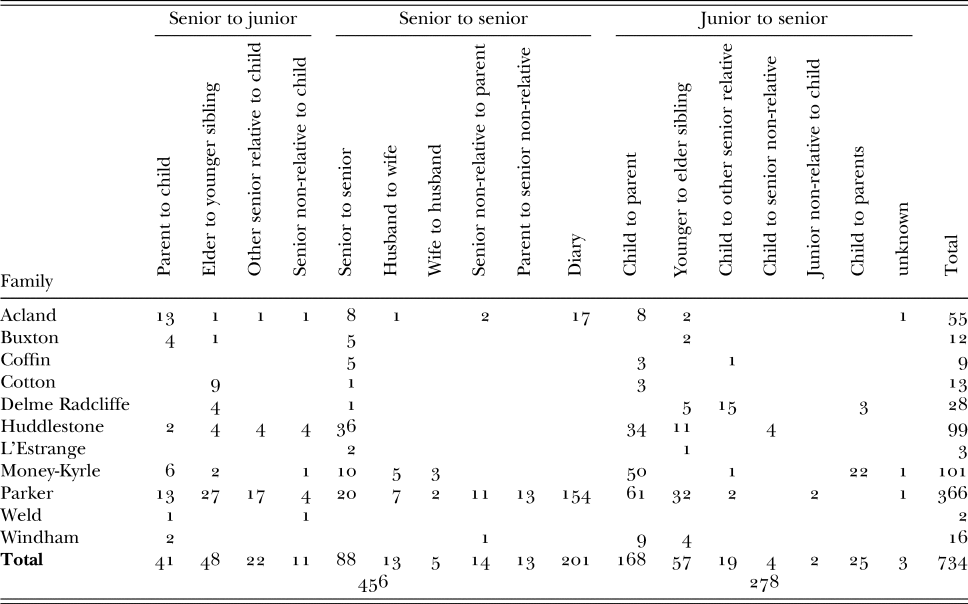
The dynamics of family life, and the hidden selectivity of family archives, mean that, as Tables 3 and 4 show, some pivotal life events are much better documented than others, something James Daybell and Andrew Gordon note is a wider problem in collections of correspondence.Footnote 8 This reflects wider trends in which surviving letters often represent periods of change and crisis more strongly than periods of equilibrium.Footnote 9 But it also emphasizes the pivotal nature of these periods in their lives. To a certain extent, we should expect to read anxiety in correspondence. Epistolary cultures were ‘suffused with anxiety’ because of the separation of writer–reader, the lack of non-verbal communication, and tensions around paralanguage and prosody.Footnote 10 Similarly, the ‘sentimental letter’ of the eighteenth century was expected to be awash with feeling.Footnote 11 The anxieties on show in the letters considered here were, however, more specifically focused around tensions of masculinity and were more than an outcome of the medium of communication or modes of expression, important though these were.
Younger sons – number of mentions of main life-course themes in correspondence
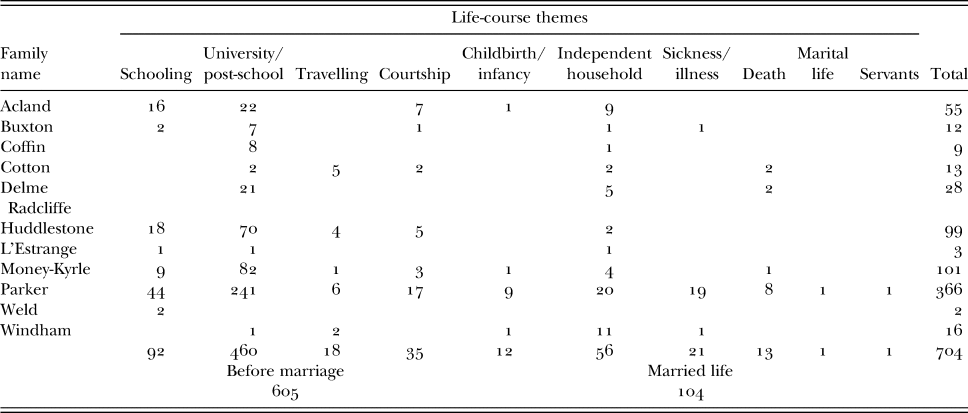
Younger sons – number of mentions of main life-course subjects in correspondence
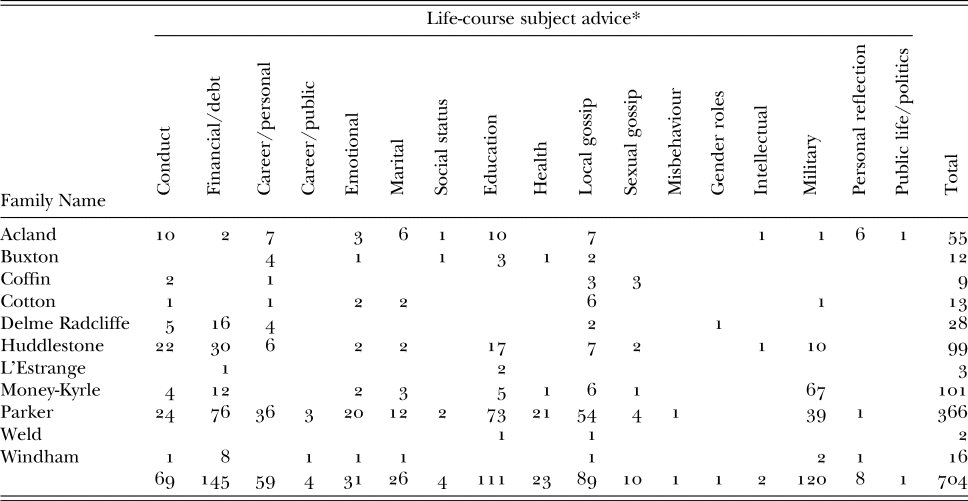
* Each letter could mention a variety of subjects. However, any letter included in the database was coded with one primary ‘life-course subject’, as it related to ideas or experiences of gentry masculinity. Therefore an individual letter will appear only once in the database.
Chronological distribution of number of letters to/from younger sons
We do not make wider generalizations about the complete life-cycle of younger sons because we emphasize this moment as one of the pivotal moments in the making of manhood. The early adult anxieties of these younger sons mark moments of acute sensitivity both about their immediate socio-gender status, but also about their capacity to attain the full prerogatives of patriarchal masculine identity in the future. The acuteness of the experience of emotions is linked to the goal-relevance of that emotion and situation.Footnote 12 This explains why the expressions of emotion in the letters of younger sons such as Thomas Huddlestone were sometimes so intense. Several levels of anxiety converged at this time, and resulted in the ‘overt action’ of explaining them through correspondence with their families.Footnote 13 Thereafter, younger children gained some kind of settlement, and the flows of correspondence often diminished as they, and their elder brothers, developed their own family concerns, often achieving the very masculine accomplishments that had caused them such anxieties as young men. We begin by examining the history of emotions and explaining our broader arguments. The second section explores the anxieties of parents and guardians responsible for the destiny of younger sons and for the honour of the family. In the third section, we examine the anxieties of younger sons themselves.
I
Historians are quite comfortably positioned these days in the study of emotions and we are, apparently, in the midst of an ‘emotional turn’.Footnote 14 It is now widely recognized that emotions have a history, that they are socially and culturally constructed, have changed over time, and have driven change by mediating and conducting power.Footnote 15 Most scholars would question the ‘essentialist’ argument that emotions are ‘hard-wired’ and universal biological and physiological processes, unchanging through time and culture. Most suggest that emotions are cognitive, not separate from ‘reason’ but part of what William Reddy refers to as a ‘think-feel’ process of ‘cogmotion’.Footnote 16 Whilst emotions are thought to be an anthropological constant, the experience and interpretation of them is culturally varied.Footnote 17 Equally, historians now take emotions seriously as objects of historical enquiry. They are no longer the ‘trivial by-products of rational class based responses to material interests’.Footnote 18
Emotions are, however, elusive and this poses methodological challenges for historians. No type of research, not even psychoanalytical research, can observe, test, or identify emotions directly.Footnote 19 The very terminology we use to describe emotions gives meaning to them but is also flawed, never fully capturing their real flavour, ‘expressions’ but not ‘feelings’.Footnote 20 As Peter and Carol Stearns argued, as historians we are studying ‘emotionology’ – the rhetoric of emotions – rather than the emotions themselves.Footnote 21 But emotion words are connected to emotions and the mediation of those emotions, such as the correspondence we use in this article, has provided a gateway for historians to contribute to the subject. The way emotions are mediated has become our research target. Textual and visual sources containing ‘emotion words’ and ‘emotion talk’ are connected to emotions, providing insights into the minds and feelings of people in the past, breathing new significance into seemingly mundane situations.Footnote 22
Our focus in this article is on anxiety. This emotion can be defined as an ‘elevated state…a psychic condition of heightened sensitivity to some perceived threat, risk, peril or danger’.Footnote 23 Symptoms can manifest as either physiological, such as breathing problems, heart palpitations, and stomach aches, or psychological, such as unease, concern, dismay, alarm, dread, or terror. Acute anxiety or ‘pathological anxiety’ can manifest as a variety of disorders including phobias, obsessive compulsive disorders, or stress disorders. Anxieties can also be existential, a concern about one's place in the world, or the nature of the universe. Anxiety is generally seen as distinct from fear because anxiety is not attached to a definite and observable object, person, or situation.Footnote 24 So anxiety is connected to unknown threat, anticipated threats to life, health, and status, a ‘state of suspicion without trust’, or a ‘restless, agitated, never-consummated search for something that may not exist, a state in which certainty is always suspended’.Footnote 25 This distinction should not be stretched too far. Anxiety for one person or culture can be experienced as fear by others and the boundaries are often situationally specific.Footnote 26
Anxiety need not be an unpleasant or an unwanted experience. As Reddy has noted, there can be a ‘hedonic tone’ to emotions.Footnote 27 We might consider the Spartan experience and ‘toughening’ that gentry men went through at public schools as a source of anxiety welcomed and intended on the part of their parents, which was perhaps elicited in parental assessments of their experiences later in life.Footnote 28 For our younger sons, the ‘unknown’ at the heart of their anxieties was their future status and the level at which they could depend on their parents and guardians to help them achieve respectability.
Historians of masculinity have readily engaged with anxiety, often with a focus on masculine status within patriarchal structures. They have recognized that patriarchal dominance came at a price. Masculine power produced anxieties in men as they struggled to attain ‘full masculinity’, to exert their dominance over other men and women, and as they struggled to assert their identities within the patriarchal order.Footnote 29 Changing structural conditions, such as domestic employment opportunities or conditions within the empire, as well as changing values attached to masculinity and the home, also produced tensions and social anxieties at different points in history.Footnote 30
For these historians, ‘anxiety’ was periodic, a product of specific circumstances leading to a ‘crisis of masculinity’. However, studies more squarely focused on the nature of anxiety as a psychological and emotional condition have suggested that it could be a persistent product of the patriarchal system rather than a momentary lapse in masculine dominance. In his analysis of the epistemological and existential anxieties within patriarchal masculinities in the sixteenth and early seventeenth centuries, Mark Breitenburg asserted that masculine anxiety was ‘a necessary and inevitable condition’, generated by ‘the fissures and contradictions of the patriarchal system’.Footnote 31 Gentry younger sons were still, collectively, part of the very wealthy elite, who gathered the largest social and gender dividends from the inequalities of patriarchal power. However, Breitenburg's work demonstrates that this makes them particularly apposite historical subjects, because ‘it follows that those individuals whose identities are formed by the assumption of their own privilege must also have incorporated varying degrees of anxiety about the perpetuation or potential loss of that privilege’.Footnote 32 They were, as Raewyn Connell and James Messerschmidt describe, a ‘subordinate’ group of men.Footnote 33 Their anxieties seem to have stemmed from the ‘anticipated threat’ of being trapped in that subordinate position.Footnote 34 Their experiences were also shaped by emotional subordination within the patriarchal family, ongoing throughout the generations.
Breitenberg is quite unusual amongst historians of emotions (and masculinities) in that he emphasizes continuity over change.Footnote 35 Levels of diachronic variation have been one of the central debates in this field since it first began. Most historians, building on the shift from essentialism to constructivism, emphasize change in emotions subject to various forces. Peter Stearns favoured social and economic forces, Reddy stressed the power of politics and the search for liberty, Jan Plamper and Thomas Dixon both look to ideas and theories of emotions.Footnote 36 Specific periods witnessed, it has been suggested, particular emotional styles. The eighteenth century, for instance, was perhaps a time of more extenuated emotions and cultures of feeling.Footnote 37 However, for some there is more space for continuity. Barbara Rosenwein notes that it is possible for emotional communities not to change, but to ‘remain “stuck” in one mode that goes on for generations’. She argues that emotions were reinvented across generations of communities, rather than invented in specific periods.Footnote 38 We find evidence for this in our research.
On the basis of the correspondence we have three main arguments. First, an emotional economy of anxiety, generated by various members of the family, surrounded the lives of younger sons and was focused on their successes and failures, both potential and realized. This was a result of the way that the vectors of masculinity, social status, and familial responsibilities worked upon them, and concerned their families, during this key point in their lives. We draw on key theories in the history of emotions in interpreting our findings. The gentry were an emotional community with ‘their own particular values, modes of feeling, and ways to express those feelings’.Footnote 39 Younger sons were a subordinate community within it, in much the same way that the gentry siblings in Lisa Toland's research were.Footnote 40 Their emotional subordination grew out of their subordination as men. They stretched the boundaries of acceptable emotions and masculinities due to their liminal subordinate position. The system of primogeniture, perhaps akin to an ‘emotional regime’, shaped not only the materiality of their lives but also the contours of their feelings, issues previously hidden amongst studies focused on the legal and financial aspects of primogeniture and gentry family life.Footnote 41
Secondly, we find continuities in the anxieties experienced by younger sons and their families. They were ‘stuck’ as Rosenwein suggests, in a historical pocket of anxiety formed in particular spaces and as a result of specific circumstances. We argue that the persistence of the estates system and of primogeniture produced continuity in the types of emotions younger sons expressed, untethered from ‘early modern’ and ‘modern’ periodization or periodic crises of masculinity.Footnote 42 The emotion words connected to younger sons used by guardians and the sons themselves remained remarkably consistent within this emotional economy. These words either explicitly expressed anxiety or were the products of anxious thoughts surrounding masculinity and primogeniture. Guardians spoke of ‘chance’, ‘hazards’, and ‘endeavour’, ‘ruin’, ‘disgrace’, ‘respectability’, and ‘independence’. These were pregnant with potential success or failure. As such, they expressed anxiety surrounding the unknown, an ‘uneasiness or trouble of mind’ both for their children and surrounding their own experiences of parenting or guardianship.Footnote 43 For younger sons themselves, emotion words were more direct. ‘Unhappy’, ‘unease’, ‘dismay’, ‘destitution’, ‘suffering’, ‘dejected’, ‘indebted’, ‘wretched’, and ‘disgraced’ littered their letters. Words of potentiality, such as ‘fortune’, ‘man’, ‘independence’, ‘honesty’, and ‘reputation’ also appeared, many of them shared with their guardians. But ‘manliness’ was always just out of reach, as was ‘independence’ and ‘reputation’. Their anxieties reflected their emotional subordination just as their limited resources reflected their material subordination to the wealth and favours of the families. This perspective does not align well with interpretations which give prominence to periodic ‘crises of masculinity’.Footnote 44
But younger sons were not passive recipients of their fate. We argue thirdly that younger sons used emotions as ‘emotives’ in order to deal better with their feelings, achieve their objectives, and establish themselves as men in the world. Their letters were ‘doing emotional work’.Footnote 45 They reflect both a lack of ‘emotional autonomy’ and attempts to navigate their emotional lives and find ‘emotional liberty’, to be more in control of their own emotions.Footnote 46 Expressions of anxiety and distress were part of what Joanne Begiato (Bailey) has termed a ‘feeling rhetoric’.Footnote 47 These were intended to elicit emotional responses in their parents, to urge them to relieve distress as a claim to virtue as much as a parental urge to care and nurture. For their part, parents and guardians used correspondence and emotions within letters to control the emotions of younger sons, sometimes using anxiety as a means of shaping behaviour, always sublimating them to the honour and wealth of the family.
We treat the anxieties we identify with caution. We should not assume that letters reflect ‘real’ feelings, rather we should recognize that they were instruments for self-fashioning and attempts to fashion others.Footnote 48 Equally, elite letter writers adhered to classical templates and epistolary forms in their correspondence, shaping the way they expressed themselves.Footnote 49 We might expect young men, released from the immediate supervision of their families, to claim virtue whilst enjoying the spendthrift ways of wayward sons. But the emotions expressed by them are valuable insights into wider values of personal merit, personal autonomy and economic self-sufficiency shared with seniors and parents. They also reveal features of the emotional economy at work amongst the landed gentry. This provided a common language of ‘virtue’ on which this familial discourse about ‘the performance of one's gendered identity’ could be based, but one that particular family members might inflect in subtly different ways. Younger sons could transfer injunctions towards masculine autonomy, self-command, authority, and ‘honourable’ behaviour to commercial settings, other emotional communities, where they had to work for a living, and obey masters.Footnote 50 They could also invoke these values to try to justify or excuse disobedience or failure. Within these mechanisms, though, they and their loved ones frequently expressed their anxieties.
II
Anxieties surrounding the lives of younger sons began with their parents and guardians. Seniors projected their authority, and sought to achieve their parental objectives, partly by planting and fostering their sons’ anxieties. From an early age, younger sons were told repeatedly that their adult masculine autonomy depended on their ability to become financially self-sustaining. Like their elder brother and sisters, younger sons were taught a range of social accomplishments. For example, the Huddlestone family ensured that their son Thomas received tuition from ‘Mr Cook the dancing master’. But they prepared him for an apprenticeship in London in the 1750s, by sending him to a private academy to ‘improve his handwriting, & arithmatick’. Social accomplishments were regarded by the next generation of the family as ‘not very essential’ to a ‘younger son intended for business’.Footnote 51 When Edward Weld Sr wrote to his second son, John, at school he guessed John's elder brother, Edward Jr, ‘goes on with the spinett and improves’ but warned that James should ‘not lose too much time about those things and endeavour to keep your place you have already got in your school and rise higher if you can…You will find great advantage hereafter when you are grown up and appear in the world.’Footnote 52
There was general agreement among the families in our sample that the ‘duty’ of a younger son was to minimize his cost to the core family, particularly in adulthood. As James Windham, fourth and youngest son of Katherine Windham, put it in 1723, once they had received their portions younger children ‘now must shift as well as they can, fortune sure will never leave them that are willing to get a livelihood’.Footnote 53 Gentry families often constructed this as a pivotal test of masculine character, upon which the rest of the life-course depended. In 1726, John Buxton noted that now that his ten-year-old younger son George had gone to school, ‘he will now begin to think he is born for some employment, & that he must by industry & study endeavour to qualifie himself’.Footnote 54 The window of opportunity was relatively narrow, because a decade later another correspondent advised that the now nineteen-year-old George was too old to train as an attorney.Footnote 55
Parents and guardians immersed themselves in the emotional economy of younger sons, deploying emotional challenges and expecting commensurate emotional reactions. Elizabeth Parker articulated the significance of industry starkly when she wrote on behalf of her father to her wayward brother Robert Parker in 1808. After Robert gave up his legal apprenticeship to join the army, Elizabeth expostulated that her father ‘with giving you an Education and placing you in the situation you was in had flattered himself in a few years you would have done for yourself without any assistance from him’.Footnote 56 The inference was that by shying away from the career intended for him Robert, had failed a test of masculine character by showing inadequate patience and perseverance.
Although assistance could be extensive, it was normally limited and the results depended not only on the industry of the younger sons but also on luck and chance. Anxieties surrounding the unknown futures of their sons, unseen threats to their status, were prevalent in the thoughts of parents and guardians. This too was an emotional economy in which anxieties were shared and exchanged. As Edward Radcliffe observed in a letter to his father in 1712 about the fate of his younger brothers, ‘for after the dice is thrown, its then too late, they must take their chance’.Footnote 57 In 1702, John L'Estrange, younger brother of Sir Nicholas L'Estrange of Hunstanton, Norfolk, prayed ‘to God’ that his two nephews would both be ‘comforts to you their parents and profitable members of the community’.Footnote 58 Edmund Prideaux was gloomy about the prospects of his nephew, Richard Coffin, as a merchant's apprentice in London because of the inherent risks involved, as he explained in a letter to his sister, Anne Coffin.
when all imaginable care is taken in plasing a young man great hassards doe attend it, the Master may dye in his apprenticeship, then the young man's fortune is blasted, the young man may take ill courses, and may loose his Master's favour, then hee is ruined that way, and the young man may dye in his apprenticeship, then the money is lost; and I must tell you beside now adayes, where one young man comes to good, two doe miscarry for this is an avaricious age, and many young men are ruined by falling into ill company.Footnote 59
While younger children acknowledged their responsibility to minimize the financial burden they placed on their family, there was also an understanding that family connections gave seniors and siblings a responsibility to assist each other, and that this was part of their masculine duties. Primogeniture allocated real property but not other types of capital or entitlements. It was a ‘messy’ system and there was plenty of room for negotiation, argument, and anxiety.Footnote 60 Younger sons could be quick to remind seniors of their duty to find them a livelihood, if they felt that it was being ignored and this could produce tensions over primogeniture between gentry siblings within which emotions were working hard. In 1714, with his future prospects as a factor in Aleppo endangered by a lack of capital, Edward Radcliffe admonished his elder brother Ralph, that
I can not believe you can concieve it consistent with justice & reason, that fortune, time, and hopes of success of an unhappy younger brother should be all sacrificed to the neccessity of an elder who by the expiration of your life is made intirely easie in his circumstances, and the younger meaning my self still remains destitute almost of subsistence unless at this present time put into a methode to improve your generous favors.Footnote 61
Here, the words ‘justice’, ‘fortune’, ‘unhappy’, ‘destitute’, and ‘subsistence’ were the anxiety words and these were juxtaposed purposefully with the ‘easie’ nature of the elder brother's life. With equal purpose, Joseph Windham promised his mother Katherine that he would relate to his siblings ‘as Joseph did to his brothers in Egypt, what I mean is to Aid & assist them all I can with money or any other help’.Footnote 62
Anxieties surrounding the honourable behaviour of guardians were based in fact because some were keen to manipulate the subordinate status of younger sons for their own benefit. The masculine duty of care could persist through life, and even after death, but always within sight of the ‘correct station’ for younger sons. After the death of John Parker in reduced circumstances, in 1830, his eldest brother, Thomas Parker, took on the guardianship of John's family. Thomas mixed a desire to help his ‘poor relations’, with a strong sense that they were definitely on a lower social level, so that expenditure could be minimized accordingly. He found them a house, but noted that, ‘in selecting Skipton for Mrs. John's future residence I had no motive other than the probability of procuring a House at a lower rate than West Clough and there being a good Grammar School for the children’.Footnote 63 This was appropriate to ‘Mrs. John's very limited income’. When a younger brother in the sibling group, Edward Parker, took over the guardianship after Thomas's death, he remained equally clear about his right to control the fate of his dependent nieces and nephews. In 1834, he wrote to his sister-in-law having heard that she could not afford to keep a female domestic servant, and reminded her that, ‘it is due to my Brother John's memory and his Children and your respectability to have one’.Footnote 64 Almost a decade later, when Mary Ann Parker indicated that she wanted to remove her sons from school, Edward indicated that the move would reflect adversely on his own good name and noted the dangers attendant on young men's lives, expressing anxieties surrounding their reputation but weighing this with the honour of the family: ‘I should consider myself highly blameable as their Uncle, Guardian and Trustee to hazard the morals of youths of their ages in running uncontrolled in the Streets of the Populous Manufacturing Town of Burnley.’Footnote 65
Not surprisingly, throughout the sample and across the period it is evident that gentry families taught their younger sons that their success or failure as elite men depended on their ability to attain and maintain financial independence, because they would undermine their patriarchal masculinity if they slipped into economic and social client status. This was another source of anxiety for parents. For example, as late as the 1890s the Acland family expressed a preference for the likely heir, Francis Dyke Acland (the eldest son of a younger son), to be trained in a profession, rather than live on his childless uncle's landed estate. The latter was less desirable, ‘no doubt it is a dependent position, and one wishes he could have had an independent position, and earn his own living in the main for the time’.Footnote 66
As has been noted elsewhere, gentry families exerted conscious, concerted pressure to ensure that sons acquired the characteristics of personal, masculine autonomy, partly by placing them in situations of mild moral and physical hazard at public schools.Footnote 67 Thereafter, they reinforced these lessons by reiterating that younger sons would only attain full male adulthood when they realized this personal, moral autonomy through the successful pursuit of financial self-sufficiency. Such imperatives weighed heavily on the whole family. For many of these young correspondents, this goal appeared to be always slightly out-of-reach, and intensified the sense that their identities as men were constantly at risk or unstable, subject to unseen forces. Indeed, families sought consciously to engender this insecurity, in order to motivate their sons to ‘succeed’, indicating that anxiety was used as a tool, a test of masculinity. Instability was not just inherent in the formation of male identities, but actually exploited by seniors in order to secure these patrilineal imperatives. Anxieties produced ‘emotional suffering’ for the whole family but were purposefully transferred to their sons within the emotional regime of primogeniture. These anxieties were seen, therefore, as productive, but they could reach a tipping point, as the following section shows.
III
Younger sons were generally keen to reassure parents and seniors that they had received and understood their messages. Indeed, younger children sometimes internalized these precepts in ways that even injured them or threatened the wider familial ‘honour’. Robert Parker, younger brother of Thomas Parker, was so keen to minimize his dependence on his eldest brother that he refused medical treatment on his gouty, gangrenous foot, which led to his final, fatal illness. This decision, his brother John made clear, was driven by anxiety about his position in the family and his responsibility to the family. John wrote ‘No Man would have suffered so much, without medical advice as he did (shame be it mentioned) but for fear of expence.’Footnote 68
The psychological burden of this desire to be self-sufficient produced anxieties surrounding indebtedness but more generally about uncertain futures and unseen threats. Life at the imperial periphery was a particularly troubling one in this regard, geographical distance adding to general anxieties. In the 1720s, Edward Bankes, who had been set up in Bombay by his brother, John of Kingston Lacy, expressed concern at the limited opportunities there. He wrote in subordinate terms, acknowledging that his elder brother had ‘my interest very much at heart’ but he believed John should know his circumstances and wrote that ‘it will be my advantage as well as my duty not to screen anything from you’.Footnote 69 ‘I believe I have as much ambition to get an Estate as anybody, and ever so dejected when there is no prospect of Ever Compleating it’, he wrote. He asserted that Madras and Bengal held far more promise and ‘money may be got in a very Quick manner’.Footnote 70 Bombay was far less lucrative, as he made clear:
young Gentlemen never will be able to get fortunes which renders the place so bad…I cannot help often Reflecting how wretched a Thing it will be for me to Live in this Part of the World so Long & to so Little purpose without the Pleasure of seeing my Relations, or my native Countrey.Footnote 71
Three years later, Edward's anxiety had eased after John arranged for him to move to Calcutta. ‘To the Longest Day of my Life I shall Esteem myself Indebted to You for the Care and Regard You have ever had for me’, he wrote. Still, though, Edward knew he bore a significant responsibility of his own. This carried with it ongoing anxieties and the continued use of emotions in exchanges between the brothers. He remarked that ‘I hope I shall behave myself so as to Deserve it.’Footnote 72
In later periods, the contexts for younger sons’ careers changed from mercantile to military occupations but the anxieties surrounding finances and prospects remained, expressed as gloominess and, perhaps, depression. Edward Money-Kyrle's life on the margins of gentility as a junior army officer in India later in the nineteenth century exemplified these problems. Even before he had set sail for India Edward expected difficulties in seeking promotion.Footnote 73 Once there his pessimism grew. ‘Until the end of 1843’, he wrote, ‘I have given up all my pay except the most trifling pittance, for the liquidation of my debts.’ Only a ‘windfall’ could save him, short of waiting twenty-four years for his major's pension of £300 per annum and he emphasized that his position ‘prays upon my mind more than I can possibly tell you’.Footnote 74 He signed off ‘Your Unhappy Son’.Footnote 75 Conditions in the empire had shifted between these periods but the liminal condition of the younger son, and associated emotion words, remained.
Thirty years later, second-son John Parker expressed similar anxieties in a letter to his mother from Sandhurst. He was in such financial straits that he wrote:
I am perfectly wretched about it, and it is not owing to my own recklessness that I am short of money as I have been most economical…I lie awake at night thinking & scheming how to mend my affairs, but I see nothing before me but a hopeless blank. The little ambition I once had has almost disappeared, and my life is all a dream from which I strive hard to awake but cannot.Footnote 76
Loneliness may have exacerbated his hopelessness, but his life as a ‘dream’, a drama beyond his immediate influence, encapsulated his loss of control, both over his material fortunes and his emotions. The lack of emotional liberty was as significant in the melancholy of younger sons as their lack of financial clout and social status. But they used their emotions in the expectation they would arouse ‘feelings’ in their parents and guardians in a search for empathy.
The experiences of Thomas Huddlestone, the apprentice in Livorno in the early eighteenth century discussed earlier, and of two generations of the Parker family between 1770 and 1810, reveal that money worries were often indicators of deeper anxieties that continued financial dependence would lead to a failure to attain full masculine autonomy. As Huddlestone's apprenticeship ended, he pleaded with his parents for money to establish himself as a merchant in Italy. He assured them that he was fully aware that they had other children to provide for, and of their wish that he lived as frugally as possible. However, he emphasized how strongly he associated failure as a man with continued financial dependence, if not on them, then on an Italian employer:
if after all I must end my days in Servitude, why was I ever flatt'd in hopes of becoming a man by merchandising if I must never set up business…if once a man is Sallaried here by another it is an eternal discredit to him and disables him for ever from setting up of himself or making his fortune,…if I once serve for a sallary I shall be no more look'd upon by either Merchant or Gentleman, but be rekon'd amongst ye rascally fellows of ye Town.Footnote 77
Similarly, when John Parker's London hosiery partnership with his brother Robert Parker failed in 1783, he wrote to their eldest brother Thomas Parker that he had lost his ability to determine his own future, again stressing a loss of control. He wrote, ‘how I get on from day to day I know not; which makes me the most unhappy Man alive’.Footnote 78 His sense of helplessness and loneliness deepened when his worst fears were realized and the business finally folded. ‘My Brother and I are now left in the wide world to do the best we can for ourselves.’Footnote 79 Edward Cotton expressed frustration and anxiety in 1791, whilst heavily indebted in the West Indies, when he was offered the post of collector of customs at Grenada. ‘Could I raise £1000 I would be perfectly free to move anywhere in the three kingdoms’, he wrote, but ‘cannot I by any means beg borrow or steal it [despite] having good security to offer.’Footnote 80 Faced with failure, he recognized his impending separation from the social group and gendered identity into which he had been born.
Apprenticeship was part of this journey to autonomy for some sons, particularly in the eighteenth century, and exposed a deep tension in newly emancipated schoolboys who associated masculine adulthood so strongly with personal autonomy. Richard Coffin reported positively to his mother, in 1698, that he had ‘no reason to dislike my master, who is very kind to me, I sit at table with him and I am put to do no servile work, as you told me I must expect’.Footnote 81 For many others, repeated bouts of insubordination to their masters alleviated the anxiety created by the imposition of ‘servile’ status.Footnote 82 In the 1790s, Henry Huddlestone wrote to his elder brother Richard of the benefits of having secured independence as a solicitor, noting that ‘I think that being my own master has contributed much to my being in better health for I own that I could not have stood it much longer.’Footnote 83 No doubt Henry referred to his mental health as well as his physical condition.
In 1808, Robert Parker left his master because (as a gentleman) he felt unable to ‘bear reproach undeserved without reply,…but time perhaps may bring me to sustain injuries without retaliation’.Footnote 84 Once again, the desire to exercise elite moral and behavioural autonomy overwhelmed the necessity that the apprentice should submit to criticism as a subordinate, the decline of status serving to produce anxiety. Significantly, Robert exchanged a legal apprenticeship for a minor commission in the army, in the hope that he would be able to live in a manner more compatible with such notions of honour – a hope that proved sadly mistaken, since he died the following year in the disastrous amphibious operation at Walcheren.Footnote 85
Perhaps because of the experience of his late brother Robert Parker as an apprentice, and unfortunate soldier, Edward Parker was much more explicit some years later with his nephew Richard Parker about the fate that awaited him as a Liverpool merchant's clerk: ‘From what I learn you will have to be bound an apprentice for 3 or 5 years & will have to work [underlined]. Many of the Houses preferring Working Clerks [underlined] to Gentleman's Son even with a large premium.’Footnote 86 Eventually, Richard opted for a career at sea, apparently even after receiving the captain's caution that ‘he must not expect a Sailor's Life to be a Bed of Roses’.Footnote 87
Later, in agonizing over whether or not to take up a family-owned rectory (and a career in the church), Arthur Acland admitted to his father that he had subconsciously equated adult autonomy with ‘marrying and doing all kinds of important acts not exactly without reference to home but quite independently of home’.Footnote 88 The thwarted lives of these younger sons, their lack of material and emotional autonomy, and their complaints showed what could happen when they failed to overcome the inequalities built into patrilineal and patriarchal inheritance practices within these gentry families.
The country house and estate was also always just out of reach. In order to fulfil their allotted dynastic purpose, these young men were destined to remain as ‘visitors’ rather than residents, and alienation from land, a key component of gentry status, was becoming a far more acute issue in our period. Gentry families adopted the strict settlement much more widely in the period after 1660, and its form changed in the eighteenth century. Previously, provision for younger sons had often been in the form of land, whether as an estate in perpetuity, and estate for life, or a lease of a part of the family estate. By the eighteenth century, provision was far more likely to be as a cash settlement.Footnote 89 Such systems ran counter to the growing emphasis on equality within families and between siblings during the eighteenth century, perhaps exacerbating the anxiety, anger, and jealousy felt by younger sons.Footnote 90
The absence of land and of ready access to these activities emphasized a physical and symbolic distance from social and family origins, producing anxieties surrounding fractured social and dynastic identities expressed often as whimsical reminiscences. Much like the siblings in Toland's research on leave-taking, separation produced melancholy emotions.Footnote 91 Joseph Windham noted, wistfully, that, ‘if I was in the country again I should fancy myself in Parradise but that does not belong to younger brothers’.Footnote 92 In India, Edward Money-Kyrle daydreamed about returning to Whetam. ‘What a blessed and happy day that will be, if I ever set eyes upon its walls again, ah! It will be by far the most delightful day of my life.’Footnote 93 These meditations were whimsical and ‘memories’ and ‘fantasies’ of home speak of the emotional power of it during the age of domesticity.Footnote 94 But they were also emotives, using nostalgia through correspondence as a relief from anxiety (and sometimes boredom) much like the letters written home from the front during the First World War studied by Michael Roper.Footnote 95
Like many younger sons returning to their family's estates, when ‘at home’ John Parker engaged with as much enthusiasm as his eldest brother in the local social world of hunting, coursing, dancing, drinking, and music.Footnote 96 During his apprenticeship and unsuccessful business career in London, John was occasionally able to hunt with his London (tradesmen) cousins at their small estate at Waltham Abbey.Footnote 97 Even so, he was keen to criticize his younger brother Robert Parker's fondness for field sports. Writing during Robert's visit home to his eldest brother Thomas Parker, John advised Thomas that ‘you shou'd keep him more to Books Accounts, Writing & c. than I'm afraid he practices[,]…as he certainly wou'd find a greater benefit acrue from them than so much Hunting’.Footnote 98 Many other younger sons were often able to return to enjoy rural sports on a regular basis and to practise some of the wider social accomplishments generally reserved for their elder brothers, but did so on the whims of the family, rather than as their inherent ‘rights’, bereft as they were of sufficient land and income.Footnote 99
Fleeting participation in these pastimes could exemplify the cultural, and emotional, dependence of younger sons and the shortfall in their masculinities, their liminal membership of the ‘leisured elite’. As Susan Broomhall has noted, emotions are ‘socially and culturally coded experiences that could include or exclude particular individuals within or from certain sociabilities’.Footnote 100 Whilst siblings were connected in a habitus: ‘a pool created by friendship, mutual interests and concerns, compatible world views, and accepted manners of behaviour’, younger sons feared exclusion because they were at the liminal edges of that habitus.Footnote 101
IV
Defined as ‘a product of social relations, including status, wealth, property rights and communal and familial relations’, anxiety has much to reveal in terms of gender and emotions as well as the landed gentry as an emotional community.Footnote 102 Anxiety played a significant role in shaping the masculinities of younger sons. Their letters reveal these anxieties, expressed as emotions saturated with concerns over status and rights. They also represent emotional efforts to determine better their fate. They were penned within the context of broader familial anxieties about younger sons’ chances of attaining patriarchal prerogatives, which recurred in each generation, and in which parents and seniors took on the collective role of John Tosh's ‘anxious father’, concerned with these issues at each stage of the sons’ life.Footnote 103 Parents and guardians also, at times, purposefully generated anxiety, as a test of masculinity and as a call to action for younger sons. The gentry as an emotional community dealt collectively and anxiously with the problem of younger sons.
In general, younger sons expressed themselves more forcefully, with more ‘feeling’ in their expressions. Although strong emotions were the ‘right of governing men’ and also, perhaps, an echo of childish impulses, they needed to be kept in check and younger sons stretched the boundaries of the types of emotional styles amongst the gentry, serving to underline their subordinate position within that community.Footnote 104 Their anxious outbursts rubbed against their polite masculine training in self-control and self-management, their ‘anxiety to understand, master, and encourage the links between the domains of form and morals’.Footnote 105 This further disrupted their own emotional equilibrium and mental well-being.Footnote 106 But it also served the purpose of arousing anxiety in their parents and guardians.
There were shifts over time in the focus of the anxieties surrounding younger sons’ career choices. Wallis and Webb have demonstrated that the costs of capitalizing a mercantile or retail business dwarfed those of urban apprenticeship.Footnote 107 Consequently, from the turn of the nineteenth century, military life and the law appeared more congenial than urban retail trade. Crucially, neither military service nor professional training involved the formal period of subordination built into apprenticeship. This seems to have resolved one powerful contradiction between younger sons’ expectations of gendered adult autonomy, and the material reality of being a dependent in someone else's household.
However, although the choices and sites of careers altered over time, the persistence of the strict family settlement ensured that their predicaments remained similar for 200 years. The situation only changed significantly in the third quarter of the nineteenth century, when the agricultural depression, legislation to break property entails, and increases in inheritance tax destabilized the estates system and caused eldest sons more frequently to regard their inheritance as a burden. The agonizing of John Parker at Sandhurst looked rather different in the next generation, when his family had inherited the Browsholme estate.Footnote 108 His only son Robert wrote about his father's early career in terms that suggest that the grass was always greener when sons were contemplating their futures in his time and he painted a far more positive picture of his father's life than of his own ‘wretched’ experiences:
when you went into the Army you were a 2nd son, with possibly no chance of succeeding to Browsholme. You knew that you would get your allowance and probably no property to worry about. Therefore you were absolutely free to go into the Army, and did not need to think of anything but your own future.Footnote 109
As the fortunes of the gentry declined, perceptions of the disparity in the life-chances of elder and younger sons appears also to have diminished, perhaps for the first time since the emergence of the strict settlement in the sixteenth century.
This, in turn, suggests that we should consider the importance of continuity in the history of emotions more carefully. We must recognize the constructed nature of emotions, subject to cultural variation and change over time. Ours is certainly not an argument for ‘essentialism’. But where emotional regimes such as primogeniture persisted, and there was relative continuity in the status of emotional communities such as the landed gentry, we should expect to find continuity in the economy of emotions such as anxiety. The vectors of elite masculinity and the social status and familial responsibilities of the landed gentry all remained largely stable across this period. Primogeniture allocated material worth and life-chances, mediated relations between the individual and the family, and determined to some extent the nature of elite masculinities for younger sons. Breitenberg's argument concerning the inevitable associations of masculinity and anxiety further reinforces the significance of continuity.
We might expect such levels of continuity amongst landed elites given their relatively stable and secure situation in the social structure across this period. As Joanna Bourke has argued, emotions such as anxiety are about far more than the preoccupations of an individual mind. They ‘are an expression of power relations’ and they ‘link the individual with the social in dynamic ways’.Footnote 110 Anxieties collect within ‘cultural symptom pools’ according to social and cultural parameters.Footnote 111 The social and cultural boundaries of the lives of younger sons and the gentry as a whole remained remarkably stable for much of this period. In this sense, they are somewhat unrepresentative. But younger sons provide an important control group for measuring male anxieties surrounding patriarchy, autonomy, and independence, with implications for groups living beyond the boundaries of the landed estate. All young men stood on the precipice of success or failure in their young adulthood, measured in relation to the wealth and status of their families. Younger sons’ anxieties were focused around particular issues and challenges, but they were male anxieties at their core.
While such existential concerns emphasize Breitenburg's point that masculinity remained, in part, ‘the never-consummated search for something that may not exist’, these patriarchal dividends appeared to be very real building blocks of elite male identity. The anxieties of gentry younger sons illustrate not just the timeless quality of late adolescent angst, but a very apparent fear that failure to attain these attributes could lead to the dissolution of their social, gender, and personal identities as a whole. Primogeniture created goal-conflict in our younger sons as they experienced the ‘liminal’ nature of emotions, existing at the thresholds of the individual and the social.Footnote 112 They were ‘navigating’ between the two high priority goals of establishing themselves as elite men and contributing to the honour, survival, and flourishing of the family and their estates, all the while attempting to maintain values of personal masculinity such as honour and self-control. This involved emotional suffering.Footnote 113
While the younger sons of the gentry cannot represent all men, their subjective experiences of this sensitive point in the life-course expose important features of the reproduction of masculine identities more generally. They demonstrate that adult masculinity was always an uneasy state, because it depended upon the perpetuation of inequalities of authority and power, which required the reproduction of symbolic, cultural, and material subordination to maintain the accustomed gender norms. If masculinity is given force and significance from ‘a series of hierarchical relations to what it can subordinate’, then younger sons were continually inhabiting partial and unfinished versions of this gender identity.Footnote 114 Our research suggests that although masculine identities often existed in ‘crisis’, this state was existential rather than episodic, normative rather than formative, and productive of anxieties that fed into a lively economy of emotions amongst the landed gentry.


 Open access

