

Introduction
Why do some (post-)imperial countries reconcile themselves to post-war or post-decolonisation territorial loss, while others do not? This question has renewed salience amid Russia’s full-scale invasion of Ukraine in 2022 – an action that many observers construed as an effort to resuscitate the imperial authority that Moscow once had over Ukraine. For their part, leaders of the French Third Republic accepted the loss of Alsace and Lorraine following defeat in the Franco-Prussian War. In contrast, during the interwar period, German and Hungarian leaders wished to reassert control over those territories that their countries lost in the treaties that settled the First World War. What explains this variation?
In this article, we analyse revanchism. We conceive revanchism in terms of preferences about political territoriality that, if translated into policy, directly impinge upon the sovereignty of at least one other state. We argue that (post-)imperial states – that is, modern countries that recently had colonies or other extraterritorial possessions – are more likely to be revanchist when their political system exhibits a pronounced continuity in the composition of their political elite despite suffering territorial reduction.Footnote 1 After all, those (post-)imperial states that lose territory through war or decolonisation might experience a major domestic political crisis during that process. Such tumult could bring about a significant degree of elite discontinuity. However, this upheaval can end with elite continuity where, even after the turnover of specific individuals in key government positions, members of the governing elite retain their privileged status in society. Because these individuals were socialised when the old territorial order prevailed, they carry with them certain beliefs about territory and foreign policy. (Post-)imperial states that feature much elite continuity will display a stronger preference for revanchism than those states that do not.
Of course, we cannot explain whether a (post-)imperial state acts in a revanchist manner with exclusive reference to elite composition. Going about revanchism in practice often means war, an interactive and complex process that varies in form and intensity. We thus abstract away the military balance, which itself can depend on the size of the territory in question or the state controlling that ‘lost’ territory. Accordingly, when salient, revanchist ideas offer a permissive condition that elites draw on selectively, and possibly inconsistently, to justify aggression.
Our article proceeds as follows. The first section conceptualises revanchism, discusses its significance, and advances our main argument. The second section operationalises our notion of elite continuity. The third section illustrates our argument by discussing contemporary Russia. Using discursive evidence and latent indicators of elite attitudes towards the desirability of reclaiming lost territory, we demonstrate that elite continuity helps account for Russia’s revanchism, thereby complementing other possible explanations. Our article engages primarily in theory development, with contemporary Russia constituting a theory-building case study. In the concluding discussion section, we highlight the applicability of our theory to other cases.
Revanchism in the study of International Relations
Though the term ‘revanchism’ sees wide use in popular discourse, particularly with reference to Russia, International Relations scholars give the term little attention.Footnote 2 Drawn from the French word for revenge (revanche), the term referred initially to those French nationalists keen on reversing the loss of Alsace and Lorraine to Germany following defeat in the 1870–1 Franco-Prussian War. With time, revanchism has come to mean not only a desire to overturn current arrangements, but also a desire to restore a status quo that purportedly once existed.
Revanchism is not identical to revisionism or irredentism. Revisionist states are interested in improving their own position, acquiring additional territory, or altering international institutions to extract greater benefits.Footnote 3 Yet revanchism is primarily concerned with lost territory – specifically, territory once controlled by the (post-)imperial state. Whereas imperialism involves asserting new territorial control, revanchism does not denote an interest in claiming additional territory never previously controlled. Revanchism is reasserting territorial control once had. Finally, irredentist states seek foreign territory based on co-ethnicity – to make members of a common ethnic group living abroad subject to its jurisdictional and sovereign authority by taking the territory where they live.Footnote 4 Co-ethnicity may not necessarily be the revanchist basis for recapturing foreign lands. Our definition of revanchism thus only encompasses states that were metropoles that had exercised jurisdictional and administrative authority over territory now controlled by other sovereign actors.
We cast revanchism as a preference, not a strategy, that concerns the territoriality and the sovereignty of other states.Footnote 5 Strategy may be correlated with military spending and national power, whereas preferences relate to the first-order beliefs of the foreign policy executive. As Andrew Moravcsik writes, ‘preferences are by definition causally independent of the strategies of other actors and, therefore, prior to specific interstate political interactions, including external threats, incentives, manipulation of information, or other tactics’.Footnote 6 By casting revanchism as a preference, we concede that it is not a sufficient explanation of why states go to war. We cannot fully explain behaviour. Decisions to wage war reflect many factors, ranging from perceived windows of opportunity to the military balance to anticipated weather patterns. However, because revanchism might be pronounced for a particular set of elites, the existence of these sentiments means that members of the foreign policy executive can instrumentalise them to mobilise other elites for their initiatives abroad. The salience of revanchist ideas provides a permissive condition that elites use selectively, possibly inconsistently, to justify aggression abroad. Revanchism may be either active or latent.Footnote 7 The movement to active revanchism will depend on those contextual factors that shape war-making.
By defining revanchism as a preference regarding territory once controlled, the set of potential revanchists narrows because, with our conceptualisation, they can only be those states whose main predecessors – the previous imperial state – governed directly and formally those territories that are no longer under their sovereign control due to war or some other decolonising event. The universe of cases in which modern (post-)imperial states lose territory and then engage in revanchist actions appears in Appendix I (Table A1). Accordingly, for the sake of analytical feasibility, our proposed theory does not cover every instance of territorial loss suffered by any political organisation.
Elite continuity and post-imperial states
Why might some (post-)imperial states have revanchist preferences and not others? We argue that one oft-ignored explanation for revanchism concerns the political elite and the continuity in its make-up during or in the immediate aftermath of a process of territorial loss. This territorial loss could result from war or some decolonisation process. We define elites as the minority of individuals who occupy leading political positions, wield power, and influence policymaking.Footnote 8 Our unit of analysis is thus the elite class: our theory emphasises that, regardless of whether specific individuals are in government, members of the elite will have similar views on key issues precisely because they have the same pedigree.
Elite continuity matters for four reasons. First, elite continuity enables certain substantive beliefs to endure and to retain salience over their alternatives. Substantive beliefs are the ‘norms and value orientations’ occupying ‘the analytic dimension that lies between deep philosophical beliefs about human nature and more narrow beliefs about what set of policies will maximize short-term interests’. Substantive beliefs ‘guide state behavior and shape the agenda from which elites choose specific policies’.Footnote 9 Studies find that politicians’ belief systems endure for decades.Footnote 10
Second, intra-elite socialisation can allow those substantive beliefs to persist across cohorts.Footnote 11 Elites can act as gatekeepers to political offices and key economic sectors; they can create material incentives for those individuals interested in their own professional advancement to support the substantive beliefs extolled by the elite.Footnote 12 Elites can also recalibrate media and educational institutions, thereby imparting more effectively their preferred values to newer cohorts without over-relying on coercion or material incentives. By holding sway over educational institutions where elites receive their schooling and training, especially in their younger, more formative years, older elites can ensure that their beliefs and ideological convictions remain dominant despite profound changes in the geopolitical environment, the political institutions making up their own country, or both. Studies show that intra-elite socialisation during the Cold War sustained US elites’ beliefs amid major global changes.Footnote 13 Being raised under communism has influenced popular ideas and perceptions in post-communist countries.Footnote 14 By implication, a major discontinuity in the political ruling class likely would indicate a break from the previous regime, with the beliefs associated with that regime losing their privileged status.Footnote 15 Amid elite continuity, beliefs are not fixed. They can change over time, but that change will probably be evolutionary and proceed slowly.
A third and related reason is that those elites who are also parents will impart their values and identities to their own children. Those children will be in a more privileged position, so that they are more likely to occupy leadership positions when they are older than those who do not have elite backgrounds.Footnote 16 Studies have uncovered significant evidence of intergenerational transmission of political values, if not partisan identities.Footnote 17 These findings should be unsurprising: many children spend significant time with their parents, who, through frequent discussions over the years, can socialise their children into adopting similar notions about how the world works. Moreover, children are likely to face the same material circumstances as their parents and so could have similar socio-economic motives for preferring the same ideology as well.Footnote 18 All elites eventually grow old and die, but they can preserve their own value systems over time through their children.
Fourth, elite continuity matters because it constrains which leaders can assume power in any given political system. Recall that elites can mould institutions and be their gatekeepers. Moreover, any political system has a selectorate – the ‘set of people in the polity who can take part in choosing a leader’ – and a winning coalition – the ‘quantity of selectors whose support the leader must retain to remain in office’.Footnote 19 In democracies, winning coalitions are larger, thereby diluting the ability of political elites to shape popular discourse and opinion. In autocracies, the political elite should have relatively more influence. Still, even if a leader has an outsized impact on the decision-making process because the political system is personalistic, that leader still needs the consent and the support of elites to implement policy.Footnote 20 Individual leaders are important, especially if they have personal characteristics that shape their diplomacy.Footnote 21 However, they are not drawn randomly from society and so may reflect broader elite interests and values.
Elite continuity should thus be associated with revanchism. In those (post-)imperial, territorially reduced states where elites socialised in the previous regime retain power, those elites carry forward their substantive beliefs about their country’s international role and constitutional arrangements, how world politics operates, and the relationships that their country should have with other countries. They regress to the previous constitutional order and so see the loss of territorial control to other sovereign actors as a temporary setback that must eventually be remedied. Their experience of territorial loss as a political class may make them prone to feel aggrieved and thus anxious to restore that control.Footnote 22
In contrast, states that have experienced a sharper disruption in elite composition relative to their territorially larger predecessor should demonstrate a much weaker penchant for revanchism. Their elites might have very different substantive beliefs about political order. Indeed, these elites may have had leading intellectual and cultural roles in the previously imperial society but were nevertheless political outsiders. They may be more open to alternative norms and ideals than those with a pedigree in the previous imperial regime. Of course, revanchist ideas may still circulate amid elite discontinuity. Extensive political science research highlights how policy concepts can survive major political change.Footnote 23 Our position is that policy ideas – particularly those relating to the territorial order – are far more likely to remain salient if the composition of their carriers – the elites – stays relatively intact. Note that we do not assume that all elites will hold the exact same beliefs with equal intensity. Like-minded individuals can still disagree on tactics, after all. Rather, we argue that certain beliefs will dominate among them.
We operationalise revanchism as a preference by considering different pieces of evidence. One relates to whether the elites – our unit of analysis – accept the revised territorial order. Do governing elites conclude some sort of settlement that formalises the losses? Even if a formal settlement exists, do members of the elite – in government or not – accept it as legitimate, or do they hope to repatriate that lost territory? Revanchism, with its clear connotations of revenge, implies a greater willingness to develop and to use military force.Footnote 24 We thus examine discursive evidence and latent indicators of elite attitudes towards the desirability of reclaiming lost territory. Statements made by members of the elite, especially those published prior to any outwardly aggressive behaviour, can reveal revanchist attitudes towards previously controlled territory (and the peoples living in it). Studies have established a strong, positive correlation between verbal aggressiveness and aggressive behaviour at both the individual and group levels.Footnote 25 Before committing acts of aggression, group leaders often express anger, contempt, and disgust towards their opponent outgroups.Footnote 26 They generally adopt more polarising, violent rhetoric during wartime than during peacetime.Footnote 27 In the event of war, these elites may be too set in their own territorial aims that they cannot respond to adverse battlefield information, thereby foreclosing a war-terminating outcome and a negotiated settlement until a major shift in leadership takes place.Footnote 28
No one factor can determine whether a country that experiences significant territorial change will exhibit elite continuity or not. Instead, as Valerie Bunce observes in her assessment of post-communist transition in East Central Europe, a large host of variables will likely influence the political change that a country might experience.Footnote 29 These variables can include the maturity and organisation of the political opposition, nation-building tradition,Footnote 30 the timing of anti-government or nationalist mobilisation, the depth of economic reform, and the historical and sociological constraints on democratisation.Footnote 31 Sometimes turnover in elite composition can take years. For example, monarchists kept power in the early years of the French Third Republic before experiencing elite replacement on the part of those Republicans who had few, if any, ties with the Second Empire.Footnote 32 Strategic defeat in a major war could prompt a successful revolutionary moment, as in the case of the Tsarist Russia and the pre-Bolshevik Provisional Government. However, revolution might not succeed under similar circumstances. The failure of the German Revolution of 1918–19 allowed many elites to retain privileged access despite the political upheaval that German society experienced in the aftermath of the First World War.Footnote 33 In theory, elite continuity and discontinuity could be endogenous to several underlying factors, but we argue that the contingency that often marks regime change and territorial reduction would complicate any effort to model those factors systematically.
The case of contemporary Russia
We illustrate our argument with a theory-building case study of Russia. As the main inheritor of the Soviet Union, it is at least post-imperial.Footnote 34 Because our goal is to demonstrate the plausibility of the argument, we select on the dependent variable. We proxy elite continuity in Russia by focusing on, first, the share of the individuals in the leading political positions and influence policymaking in the new (post-)imperial state (that is, Russia) who have worked within the power structures of the previous imperial state (that is, the Soviet Union); and, second, the backgrounds of key decision-makers. The more ancient regime elites who remain in power, the more elite continuity.
Many analysts call Russia ‘revanchist’ to describe its aggression towards Ukraine without theorising deeply about that concept.Footnote 35 Observers highlight revanche as a key motivation for Putin as well as ‘a very extensive … unseen layer of people’.Footnote 36 Crucially, Russian leaders have expressed revanchist preferences. The military campaign that Russia launched in 2022 consisted of the attempted conquest of Kyiv, the forcible annexation of Ukrainian territory, and the destruction of Ukrainian cultural patrimony. These efforts indicate active revanchism. However, the revanchist preferences of the Russian elites pre-date the invasion.
Consider the following discursive evidence. In 2005 during his annual address to the Federal Assembly, Russian president Vladimir Putin claimed that ‘the collapse of the Soviet Union was a major geopolitical disaster of the century’.Footnote 37 In 2021, he lamented the 1991 break-up of the Soviet Union as ‘the disintegration of historical Russia under the name of the Soviet Union’.Footnote 38 In his view, Ukraine was a historical part of Russia lost as a result of the Soviet break-up. Tracing Putin’s speeches about Ukraine makes this clear. At the 2008 NATO summit in Bucharest, Putin told then-US president George W. Bush that ‘Ukraine is not even a country’. He also claimed at the NATO–Russian council that Ukraine was an artificial state, with ‘seventeen million Russians’ living in southern and eastern Ukraine.Footnote 39 He similarly described Russians and Ukrainians as ‘one people’ in his March 2014 speech to the Russian Duma announcing the annexation of Crimea.Footnote 40 In July 2021, eight months prior to the full-scale invasion, Putin published an essay arguing that Ukrainians and Russians – as well as Belarusians – are historically one nation, that the present-day Ukrainian state occupies Russian lands, and that Ukrainian national identity is the product of foreign intrigues.Footnote 41 In a speech given on 21 February 2022, Putin declared that modern Ukraine was artificially created.Footnote 42 Beyond Putin, deputy chairman of the Security Council – and former president – Dmitri Medvedev in his 2021 essay charged that Ukrainian leaders have no actual national identity.Footnote 43 Shortly before the full-scale invasion, former presidential advisor Vladislav Surkov wrote an essay that cast Russia’s western – that is, Ukraine’s eastern – borders as illegitimate.Footnote 44 The thread connecting this revanchist rhetoric is that Ukraine is an artifice grafted by foreign enemies onto what has historically been Russian territory (even if under the name of the Soviet Union), and that this territory must be taken back.
We move the literature on Russian revanchism forward by using our case study as a theory-building case. Our selection on the dependent variable allows us to demonstrate what we argue to be a connection between elite continuity and revanchist preferences.Footnote 45 We show that long-standing revanchist ideas, especially regarding Ukraine, were a permissive condition that Russian elites used selectively, even inconsistently, to justify aggression. We do not explain why Russia chose to escalate its war against Ukraine in 2022, let alone attack it in 2014. Nor does our argument mean that other influences on Russian foreign policy behaviour are unimportant. After all, foreign policy outputs often have many inputs. Our goal is modest: we show that scholars have overlooked elite continuity, both as an attribute of the post-Soviet Russian political system and as a key contextual variable for Russian foreign policy. Some explanations of Russian aggression abroad that emphasise NATO enlargement, domestic crisis, or Putin’s own operational code make more sense if we incorporate elite continuity.
In showing the persistence of revanchism from President Boris Yeltsin’s time into the Putinist present, our argument is not about the tactics and strategies involved in pursuing revanchism. Yeltsin and Putin confronted different international and domestic circumstances that we must abstract away.
Elite continuity in Russian politics
Despite the collapse of the Soviet system, the Soviet ruling class – the nomenklatura, which comprised only 1–3 per cent of the Soviet population – survived and retained leading positions under the new regime. The nomenklatura system, developed by the Bolsheviks in the 1920s to ensure centralised control over Soviet society, was a list of particularly important positions and offices that required the approval of the Central Committee of the Communist Party of the Soviet Union (CPSU) for promotion into them. This list included all significant positions in government and state bodies, as well as top managerial positions in cultural, media, educational, and other spheres, including heads of universities, research institutes, factories, chief engineers, and newspaper editors.Footnote 46 To become a member of the nomenklatura, one had to meet a strict selection criteria – have the ‘right’ background and know the ‘right’ people – and undergo consistent indoctrination through a system of special educational institutions and programmes.Footnote 47 This indoctrination was further reinforced by a threat of losing nomenklatura status, which in turn would mean losing privileges (from special food stores and medical services, cars, and dachas to the ability to travel abroad) unavailable to ordinary Soviet citizens. These incentives helped foster a set of ideological beliefs, ensured the obedience and loyalty to the regime, and made the nomenklatura relatively monolithic in nature.Footnote 48
The collapse of the Soviet Union did not eliminate the influence of the nomenklatura members in post-Soviet Russia. Many nomenklatura elites survived inside the power vertical.Footnote 49 A true rotation of the Russian ruling elite never occurred. Elite renewal was mostly absent in early post-Soviet Russia.Footnote 50 Almost all the officials who served in top foreign policymaking and security bodies had begun their careers in the CPSU, the Soviet government, or both. An overwhelming 80 per cent of Russia’s political elites in 1993 were former CPSU members. Elite continuity was pronounced in top ruling circles, especially in the Presidential Administration, government, and regional leadership, where roughly 75–80 per cent of elite members had origins in the Soviet nomenklatura.Footnote 51 Likewise, much of the Soviet government bureaucracy that handled foreign policy and national security was absorbed almost wholesale into the Russian Federation’s new structures.Footnote 52 These proportions contrast greatly to how post-communist transition proceeded elsewhere. Former party members comprised less than a third of the political stratum in Poland and Hungary, 44.3% in Estonia, 66.8% in Latvia, and 47.2% in Lithuania.Footnote 53 That other countries that had single-party systems exhibited more elite turnover than Russia suggests that the nature of the previous political system does not determine the future extent of elite continuity.
The continuity of those Russian elites with nomenklatura backgrounds persisted under Putin. By the early 2000s, the national and regional political elites in Russia (State Duma, Federation Council, and regional governments) were largely recruited from the former middle and higher leadership in the CPSU.Footnote 54 In 2010 and 2020, Putin-regime elites with Soviet nomenklatura origin (i.e. people with personal backgrounds in nomenklatura and their children) constituted approximately 60 per cent of top political elites.Footnote 55 The absolute majority of the top-100 Putin-era elites in 2020 were born in the 1950s and 1960s. They were in their late twenties and thirties when the Soviet Union collapsed. About 50 per cent of this group started their careers in Soviet nomenklatura; most held either managerial positions in Komsomol or lower-level nomenklatura positions. Children of individuals with Soviet nomenklatura backgrounds constituted an additional 10 per cent.Footnote 56
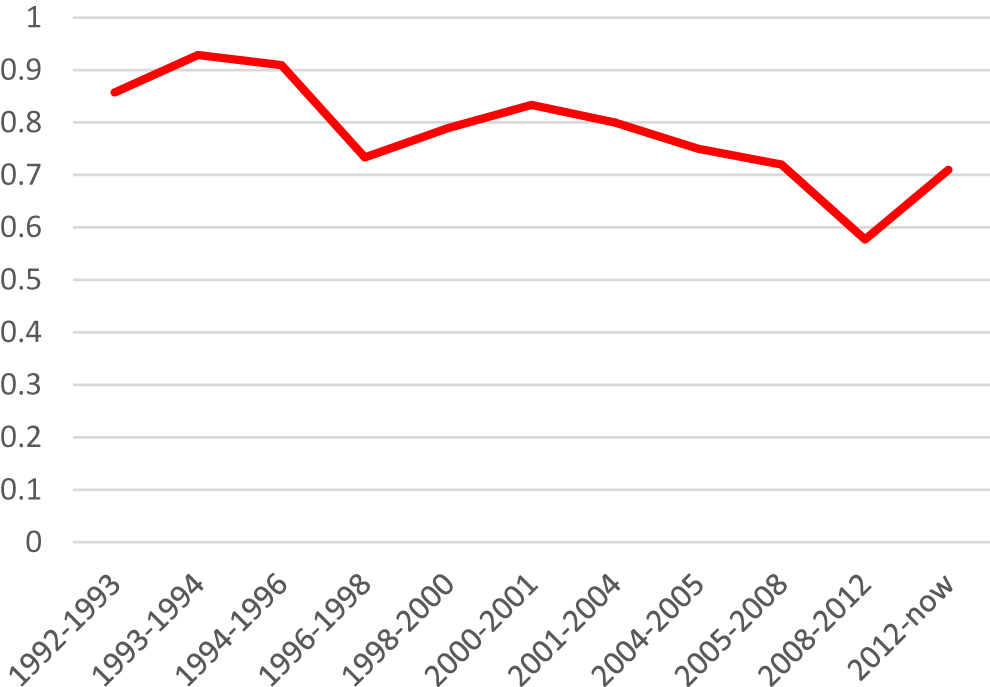
Figure 1 provides our estimates for the share of nomenklatura-linked elites in each consecutive Security Council, an autonomous body within the Presidential Administration ‘responsible for managing the formulation and execution of Russia’s security-related policies’.Footnote 57 Chaired by the Russian president, this deliberative body comprises members who are there ex officio (i.e. the minister of defence). Created in 1992, the Security Council brings the top foreign policy and national security officials together to deliberate and to prepare decisions for the president to implement. We use these individuals’ career tracks in the late Soviet Union to estimate their nomenklatura background (see Appendix II for details). Over the last 30 years, the elites who originated from the Soviet nomenklatura have constituted a large majority (60–90 per cent) in each Security Council (and about 80 per cent on average across 30 years).
The share of permanent members with nomenklatura backgrounds in each of the Security Councils. All consecutive Security Councils included.
Some might object to our examination of the entire Security Council because only Putin and a small subset of Security Council members influence key foreign policy decisions like the 2014 annexation of Crimea and the 2022 full-scale invasion of Ukraine.Footnote 58 Yet those specific members often include minister of foreign affairs Sergei Lavrov, former minister of defense Sergei Shoigu, and former Security Council secretary Nikolay Patrushev, who all had nomenklatura roots.Footnote 59
As we argue below, this persistence of elites with nomenklatura backgrounds at the top of Russia’s power hierarchy helps account for their revanchist foreign policy outlook. Most of the officials placed in Russia’s highest foreign policymaking and security bodies had worked for the Soviet regime before 1991.Footnote 60 Their socialisation in the Soviet nomenklatura shaped their foreign policy vision. Educational institutions fashioned in the Stalinist years created a relatively closed system that hived off the nomenklatura from most of society, instilling and reproducing particular beliefs about politics and administration that would inform graduates throughout their professional careers.
For these people used to commanding non-Russian societies, the transfer of hegemonic status to the Russian state felt natural. As former nomenklatura apparatchiks acquired medium- and high-level administrative posts in the new Russian system, their basic understanding of foreign policy persisted.Footnote 61 Accordingly, despite some influx of younger elites who have come of age after the Soviet Union disintegrated, their foreign policy preferences and perceptions of Russia’s legitimate place in the world tended to replicate certain Soviet beliefs.
An enduring belief system
Revanchism has at least been latent among members of the Russian elite precisely because of the continuity in elite composition. In the discussion below, we show that those revanchist preferences expressed in the run-up to the full-scale invasion of Ukraine thus have a long pedigree.
In the early 1990s, Russia’s liberal Westernisers attempted to espouse a more pro-Western foreign policy. However, the pro-Western euphoria of the early 1990s among President Boris Yeltsin’s colleagues was exceptional, brought about by the excitement of political change and the struggle against Mikhail Gorbachev. Although the composition of the Russian political elites largely remained unchanged following the collapse of the Soviet Union, Yeltsin also brought to the top a small group of liberal-democratic reformers, most of whom had non-nomenklatura backgrounds.Footnote 62
Yet at most levels of government and public institutions, the nomenklatura remained in power and showed scant interest in reforms. With the Bosnian conflict erupting in 1993, the Russian position towards Serbia and the Bosnian Serbs clashed with that of the United States and its European allies. Russian nationalists, such as Yeltsin’s advisers Sergei Stankevich and Andranik Migranyan, Communists, and the newly elected, far-right nationalist Liberal Democratic Party became increasingly vocal. These groups originated in the Soviet nomenklatura.Footnote 63 Their beliefs markedly differed from those of Yeltsin’s early reformers.
One basic idea espoused by this group was that Russia needed to re-establish its great power status by reclaiming control of, and ownership over, parts of the former Soviet Union.Footnote 64 During the Cold War, Moscow was the pole of the bipolar world that led the socialist camp. In the post–Cold War era, Moscow now had to preserve as much of what it once had, if not retain a decisive role in shaping the transformation of the international order. Accordingly, having ‘lost’ East Central Europe to the West, Moscow hoped to claim at least its special rights for the newly independent states that the former Soviet Union had absorbed. The term ‘near abroad’ captures the special status of this region. This term describes the non-Russian post-Soviet space, implying that these countries were not ‘as foreign’ as others and, therefore, may be subject to different rules or treatment – that is, a sphere of influence.Footnote 65 The foreign policy thinking remained influenced by the Soviet tendency to view allies and partners in paternalistic terms, where friends and followers are virtually synonymous. Since the Soviet Union collapsed, Russia’s security services had sought to maintain control over the former Soviet republics.Footnote 66 For much of this period, issues relating to post-Soviet countries remained under the main control of the Presidential Administration (rather than the Ministry of Foreign Affairs).Footnote 67 Russian elites also thought that in preserving a sphere of influence over the territories that made up the former Soviet Union, they were acting defensively and not offensively, even if the restored and newly independent states that emerged now had international legal rights.Footnote 68
Because of its special role in Russian history and strategic location vis-à-vis Europe, Russian elites from all parts of the political spectrum prioritised control over Ukraine.Footnote 69 Arguably, their focus on Ukraine may be due to their personal and ethnic Russian origins. They were more attuned to how a relatively large ethnic Russian population found itself within Russia’s borders, particularly in Crimea (with it being about 70 per cent Russian) as a result of Russian colonisation.Footnote 70 Soon after Ukraine declared independence in August 1991, Yeltsin’s then press secretary Pavel Voshchanov made territorial claims against it. More liberal politicians with nomenklatura ties espoused similar ideas. Thus, in 1992, Vladimir Lukin, who worked in the Ministry of Foreign Affairs in the late Soviet Union but later became a leading member of the liberal Yabloko Party, initiated the first votes in the Russian parliament that advocated using the Black Sea Fleet to pressure Ukraine regarding Crimea.Footnote 71 In 1992 and 1993, the Russian Supreme Soviet passed two resolutions claiming that the 1954 transfer of Crimea to Ukraine was invalid and Sevastopol was part of the Russian Federation. Russian diplomats between 1992 and 1993 intimated that Western countries had no need to upgrade their facilities in Kyiv given that the days of Ukrainian independence were numbered.Footnote 72 Even Yeltsin, formerly a candidate to the Soviet Politburo, asked for Crimea to be returned to Russia in one of his conversations with the then-president of Ukraine, Leonid Kravchuk.Footnote 73 Until 1997, Yeltsin personally resisted signing a basic treaty with Ukraine that would formally renounce all territorial claims. Under his rule, Russia also insisted on keeping its Black Sea Fleet headquartered in Ukraine’s Sevastopol, which often created tensions between the two countries.Footnote 74
Beyond Ukraine, these revanchist ideas also covered other areas of the former Soviet Union. For example, Yeltsin was reluctant to withdraw Red Army soldiers from the Baltic countries.Footnote 75 Moreover, although his power struggle against Gorbachev led to him dissolve the Soviet Union, Yeltsin then immediately attempted to restore Russia’s control over its former territories by creating the Commonwealth of Independent States (CIS), which he called the only alternative to the ‘further uncontrolled decay of the Union’.Footnote 76 He also claimed that the CIS was necessary ‘to quickly reinforce centripetal tendencies in the decaying Union, to stimulate a treaty process. The CIS offered at the time the only chance of preserving a unified geopolitical space.’Footnote 77 Russia attempted to support ‘loyal leaders’ in Transnistria and Abkhazia. It forced Moldova and Georgia to join the CIS in return for a Russian-brokered peace and assistance in areas of contested control.Footnote 78 Even Andrei Kozyrev, the Westernising foreign minister – albeit one with nomenklatura links – declared at a December 1992 meeting of the Conference on Security and Co-operation in Europe (CSCE) that ‘the area of the former Soviet Union cannot be considered as a zone where CSCE norms fully apply. It is a post-imperial space where Russia has to defend its interest by all possible means, including economic and military ones.’Footnote 79 Kozyrev’s advisor Galina Sidorova admitted that ‘there is a psychological barrier preventing us from treating other CIS members as absolutely independent’.Footnote 80
The notion of Russian primacy in the CIS was popular with Yeltsin and the Russian government throughout the 1990s. The General Staff of the Russian Armed Forces unveiled a draft military doctrine in May 1992 that, as one observer noted, ‘was based on the assumption that the Commonwealth was going to be a cohesive military entity’.Footnote 81 Though Russia’s military doctrine would be subsequently modified, Kozyrev declared in an October 1993 interview with Izvestia that ‘in the future, our foreign policy will continue to defend Russia’s vital interests, even in these cases where it is contrary to the interests of the West and to the interests of our partners within the CIS and the former Soviet republics’.Footnote 82 In 1995, Yeltsin issued a presidential decree titled the ‘The Establishment of the Strategic Course of the Russian Federation with Member States of the CIS’. As Andrei Tsygankov explains, this decree had its intellectual pedigree in reports produced by Yevgeny Primakov-led Foreign Intelligence Service (Primakov was a former Chairman of the Soviet of the Union). This decree envisioned how Russia would assume a leadership role among former Soviet countries by way of political and economic integration.Footnote 83
Raising the stakes involved with lost territory are beliefs about international competition. In the 1990s, many Russian elites were aggrieved that Russia had become subordinate to the West and abandoned its traditional ally in Serbia, thus compelling Yeltsin to adopt a more assertive stance on NATO’s operations in Yugoslavia. Yeltsin adviser Sergei Stankevich, for example, even claimed that NATO’s 1999 air campaign against Yugoslavia would make it impossible for Russia to be a partner to the West.Footnote 84 As NATO enlargement in East Central Europe proceeded in the mid-to-late 1990s, Russian elites concluded that NATO had effectively ‘conquered’ large territories that until very recently had been dominated by Moscow.Footnote 85 Influencing this belief was a Soviet vision that the major Western powers were exploiting Russian weakness to advance their own interests. Sergei Rogov, director of the Russian Academy of Sciences’ USA and Canada Institute, argued that Russia’s acceptance of Washington’s global leadership had ‘led to a situation whereby Russia is presented with faits accomplis’.Footnote 86 Vladimir Lukin suggested that if NATO were to incorporate former Soviet republics, then Russia should position tactical nuclear weapons in Kaliningrad.Footnote 87 Published recordings of his negotiations with Bill Clinton in 1999 hint at the extent of Yeltsin’s ambition. In his conversation with the US president, he said: ‘I ask for one thing: give Europe to Russia. The United States is not in Europe. Europe should be the business of Europeans. Russia is half European and half Asian.’Footnote 88
This foreign policy outlook differed sharply from those held by individuals without nomenklatura backgrounds, mainly the liberals in Yeltsin’s government such as Galina Starovoitova, Sergey Shakhray, Boris Nemtsov, and Anatoly Chubais.Footnote 89, Footnote 90 They shared pro-Western views and advocated stronger Russia’s integration with the West. For example, early on, Yeltsin-aligned liberals attempted to develop a vision for Russia’s Europeanness and civic society, offering Russia’s deeper integration into Europe.Footnote 91
Interchangeability of elites
Because of elite continuity and the persistence of key substantive beliefs, the importance of any one leader is easy to exaggerate. Putin has a significant impact on Russian politics due to the centralisation of Russian state power. Many thus focus on him to the exclusion of other elites.Footnote 92
Yet many members of the Russian elite in the 1990s shared those revanchist attitudes that Putin would express much later.Footnote 93 Besides Putin, most plausible contenders for the Russian presidency in 1999 had nomenklatura backgrounds. They all supported a combative approach in the post-Soviet region, whether or not they had KGB links as Putin did.Footnote 94 As prime minister (1998–9), Yevgeny Primakov sought to enhance Russia’s influence in the former Soviet space.Footnote 95 When giving his first news conference as foreign minister, Primakov said, ‘despite the present difficulties, Russia was and is a great power and its foreign policy should correspond with that’.Footnote 96 Both Primakov and Sergey Stepashin (prime minister, May–August 1999) argued that Russia must reassert itself as a great power, reorient its foreign policy towards other former Soviet republics, and establish some distance between itself and the West.Footnote 97 Yuri Luzhkov, the mayor of Moscow, actively favoured a more assertive policy in the post-Soviet space.Footnote 98 Luzhkov also raised Russian claims to Crimea and Sevastopol. Communist Party leader and second-place presidential contender in the 1996 presidential election Gennady Zyuganov prioritised stopping NATO’s eastward expansion in his foreign policy agenda and focused on possible countermeasures, such as the creation of a forward security zone on former Soviet, non-Russian territory.Footnote 99 He also advocated restoring Russia’s great power status by reunifying Russia with Ukraine and Belarus.
In sum, even when Russia’s system was much more democratic and before Putin became president, revanchist ideas proliferated among Russian elites and correlated strongly with nomenklatura backgrounds. Focusing too much on Putin as being the single main driver of Russian revanchism ignores the elite context in which his substantive beliefs developed.Footnote 100
Other arguments
We argue that revanchism is a fundamental preference because it reflects substantive beliefs about territory once controlled. Other popular arguments about Russian policy towards its Western neighbours instead argue that any such rhetoric is strategic and instrumental, whether to go about international competition more effectively or to manage a domestic political crisis.
Some argue that what appears to be revanchist rhetoric is simply normal great power politics. From this perspective, Russia has a bona fide desire to establish a security zone in the face of growing external pressures. These pressures are mostly manifest in NATO’s inclusion of countries once part of the Warsaw Pact (e.g. Poland) or the Soviet Union itself (i.e. the Baltic countries). Russian belligerence towards its neighbours – Ukraine and Georgia, mainly – is thus a response to Western perfidy and abuse. In this view, the United States never accepted Russia as a potential stakeholder in the international order after the Cold War, reneging on alleged promises not to enlarge NATO while extolling values that the Kremlin finds dangerous and politically unacceptable.Footnote 101 This argument works with our emphasis on the latent revanchism of the elites. If Russian leaders lean towards revanchism, they are more likely to regard NATO enlargement into Moscow’s former zones of control as threatening. This observation illuminates why the Kremlin much more peacefully accepted Finland and Sweden joining NATO than Ukraine and Georgia having their own membership prospects.Footnote 102
Other observers may yet argue that the Kremlin engages in active revanchism out of a sense of political opportunism to instigate crises that divert citizens’ attention away from internal difficulties. Politicians might try to gain support as they face challenging political circumstances. They could dig up or invent revanchist histories and so have an incentive to launch diversionary conflicts.Footnote 103 Lilia Shevtsova observes that Russia’s war against Georgia in 2008 ‘marked the revival of the old tactic of rallying the population around a common foreign enemy, thus distracting them from their real problems’.Footnote 104 Scholars write that, after he became president again in 2012, the strength of the political opposition worried Putin. Accordingly, ‘to mobilize his electoral base and discredit the opposition, Putin recast the United States as an enemy’ and so interpreted events in Ukraine in late 2013 and early 2014 through this lens.Footnote 105 Similarly, given the latent revanchism of Russian elites, they could have been more likely to be provoked by what they viewed as US interference in the ‘near abroad’ – Russia’s rightful (from their perspective) sphere of influence.
These arguments work alongside our proposed framing. Elite continuity as a permissive condition helps explain the willingness of elites to support a war – a risky proposition for any regime. Elite continuity can contextualise why Russian elites might see NATO enlargement into specific countries as a threat or why they might resort to revanchism in order to sidestep domestic challenges. Revanchist ideas – expressed in the 1990s – prefigure much of the anti-Ukrainian rhetoric broadcast by Russian leaders in 2021 and thereafter. The perseverance of those ideas reflects the continuity in the composition of the Russian elite and the belief system that they would have as regards to matters of territoriality.
In emphasising elite continuity, we do not imply that different leaders with similar elite profiles will make identical tactical or strategic choices, let alone hold identical beliefs with the same intensity. Yeltsin faced different circumstances from those faced by Putin: the former had fewer military capabilities or economic resources at his disposal and had to depend more on cooperation with Russia’s Western neighbours to elicit much needed economic assistance. Nor do we claim that Yeltsin would have endorsed Putin’s actions against Ukraine. Rather, we argue that members of Yeltsin’s circle were disinclined to see Ukraine as a sovereign actor worthy of territorial integrity – an attitude shaped by a common elite background. Indeed, Yeltsin’s government had trouble accepting the revised post-1991 territorial order given its hesitation to withdraw Red Army forces from several post-Soviet states and to recognise Ukraine’s international borders.
Discussion and conclusion
Our contributions are several-fold. We conceive revanchism as a foreign policy preference to restore a lost territorial status quo. We then argue that (post-)imperial states are more likely to become revanchist following territorial losses when a new regime is characterised by pronounced elite continuity despite the political transition that territorial contraction often entails. Institutional change in a country’s domestic politics might not matter for foreign policy if the change in elite cadre is low. Our study thus moves beyond examining individual leaders, something that many analyses of foreign policy tend to do. Contemporary Russian foreign policy illustrates our argument. In analysing the composition and foreign policy preferences of Russian elites, this theory-building case demonstrates the salience of certain beliefs, including the notion of spheres of influence being foundational to international politics and a sense of ownership of Ukraine.
Though they warrant deeper study due to the range of potential confounding factors, other possible cases fit our explanation. For example, despite having experienced political revolution in late 1918 around the time of its military defeat, the German Reich saw much elite continuity with the Kaiserreich. Historian Woodruff Smith states plainly that ‘a great many of the founders of the Weimar Republic … were former Weltpolitker’.Footnote 106 Junkerdom – the landed gentry based east of the Elbe River – kept its monopoly on top positions in the military and the public administration.Footnote 107 Perhaps no data point highlights the elite continuity better than former field marshal Paul von Hindenburg having the presidency – constitutionally the most powerful position in the German Reich – for the period between 1925 and 1934.Footnote 108 Key personnel and power in diplomatic decision-making in the German Reich – chief among them, the president, the chancellor, foreign affairs minister, and the defence minister – had held positions of influence under the Kaiserreich. The 1919 Treaty of Versailles caused much grievance due to the restrictions placed on the German military and the allied occupation of the Rhineland as well as the war guilt clause and the associated issue of reparations. Nevertheless, the German Reich was not simply revisionist: it was revanchist insofar as a key complaint concerned the loss of territory, especially as regards to the eastern border with Poland. For example, Reichswehr chief of staff Hans von Seeckt (former wartime chief of staff to Field Marshal August von Mackensen) was not only committed to regaining the lost territories but also to the destruction of Poland as a state, having favoured the Bolsheviks in the Polish–Soviet War.Footnote 109 Besides the border with Poland, German leaders expressed an interest in repatriating the districts making up Eupen-Malmédy that Belgium acquired after the First World War.Footnote 110 Moreover, the German Foreign Office aimed to restore Germany’s colonial rights in what once was German East Africa, a suggestion that provoked Sir Eyre Crowe’s comment that it was ‘incorrigibly foolish’.Footnote 111 This stated interest in rekindling Germany’s colonial ties in Africa highlights that the desire for territorial recovery was not merely irredentism as regards to ethnic Germans in neighbouring countries but revanchism more broadly.
Another example is the Kingdom of Hungary, which emerged from the First World War as an independent state no longer joined with Cisleithania in the Austro-Hungarian Empire. It lost almost three-quarters of its pre-war size following the 1919 Treaty of Saint-Germain and the 1920 Treaty of Trianon.Footnote 112 Undoing the post-war territorial settlement became a national and official preoccupation throughout the interwar period. Correlated with this revanchism was elite continuity. Many key political leaders of interwar Hungary had links with the erstwhile Habsburg regime. Admiral Miklós Horthy was regent and head of state, having exercised significant influence over domestic and foreign policy. He had briefly been the commander-in-chief of the Fleet of the Austro-Hungarian Navy in 1918. His longest-serving prime minister and head of government was Count Istvan Bethlen. Bethlen came from a noble family and had been a member of the overwhelmingly ethnically Hungarian House of Representatives between 1901 and 1918.Footnote 113
The opposite is also appears to hold: when a (post-)imperial state experiences major elite turnover, revanchism is less likely. A possible example is the French Third Republic, which experienced major turnover from the Second Empire, albeit in a process that took time. Stephen Hanson writes that ‘French democracy did not emerge “all at once” in a single revolutionary moment but instead required sustained attention by the republican leadership to the building of key institutions such as political parties, a democratic bicameral parliament, and a democratic executive branch – in a bitter political struggle that took nearly a decade to win’.Footnote 114 In the French Third Republic, none of the key elite members who influenced main foreign policy decisions (the president and the minister of foreign affairs in particular) held any authoritative, pro-regime positions in the Second Empire. Most of the 28 ministers of foreign affairs between 1875 and 1914, including Léon Gambetta, Charles de Freycinet, and Jules Ferry, had a republican affiliation.Footnote 115 In accordance with our theory, French Third Republican leaders were largely not revanchist. Historian Bertrand Joly argues that despite some cultural appeals to repatriate the lost territories of Alsace and Lorraine, ‘France never wanted the Revanche, not even in the first months that followed the defeat [to Prussia]’.Footnote 116 President Adolphe Thiers – who had been a vocal critic of Second Empire policies – himself stated that ‘people who speak of revenge, of revanche, are fools, charlatans of patriotism whose declamations remain without echo’.Footnote 117 Proclaimer of the French Third Republic, Léon Gambetta (prime minister, 1881–2) renounced any effort to recover the lost territory or to abrogate the 1871 Treaty of Frankfurt with Germany using military force. When French Republicans fully came to power by the end of the 1870s, they presided over a foreign policy centred on rapprochement with Germany.Footnote 118 Their attitudes towards those lost provinces were at best ambivalent: they regretted losing Alsace and Lorraine but abjured the use of military force to recover them. French leaders did not care much for revanchism. Even French nationalist opinion regarding Alsace and Lorraine is easy to exaggerate, with one historian noting that ‘hardly fifteen years after the big shock of 1871, [French] nationalism was less and less focused on the “Revanche”’.Footnote 119 To be sure, given that space constraints preclude a deeper study of the French case, confounding factors could be at play.
Another case of non-revanche is post-1945 Germany. Although de-Nazification was eventually reversed in the bureaucracy, many West German foreign policy leaders in the 1950s and 1960s – Konrad Adenauer, Willy Brandt, and Walter Hallstein – were outsiders to the previous Nazi regime. For most of the Cold War, West German foreign policy was not revanchist, especially when Neue Ostpolitik came to define it once Brandt became chancellor in 1969. This policy recognised European borders and normalised diplomatic relations between West Germany and its Soviet bloc neighbours.Footnote 120
Other cases are admittedly more ambiguous. One such case is Kemalist Turkey, which arguably saw elite continuity with the Ottoman Empire despite the Young Turks Revolution.Footnote 121 Mustafa Kemal Atatürk did command the Ottoman Seventh Army during the First World War, but he also had been briefly imprisoned for his anti-monarchist activities against Sultan Abdulhamid. Interwar Turkish foreign policy did not have aggressive, revanchist aspirations. It did not seek to achieve greatness by regaining lands once ruled by the Ottomans, even in the areas still inhabited by considerable Turkish minorities.Footnote 122 That said, one can argue that Atatürk had already overturned the short-lived 1920 Treaty of Sèvres and restored control over Eastern Anatolia. Revanchism was possibly a more passing phenomenon for post-Ottoman Turkey because of Atatürk’s early successes. Elite continuity also characterised the post-1919 First Austrian Republic. However, instead of revanchism, pan-Germanism became a dominant political idea among the conservative right.Footnote 123 Pan-Germanism smacked of revanchism, but the point should not be pressed. Still, one unambiguous exception is post-1945 Japan, because a substantive continuity of elites in power did not result in revanchism. Military occupation and Cold War politics likely dispelled revanchist attitudes.
These ambiguities suggest future avenues of research. We advance no claims about when exactly states might act in a revanchist fashion and so aggress against their former possessions. That would require a theory of war. Foreign policy and war are never the product of one factor, however elite continuity might matter. Research regarding revanchism should address how and when revanchist preferences affect war initiation and military escalation. Of course, such a theory of war must grapple with complexity: many known and unknown factors may be operative, and these factors could shape decisions in a non-linear manner. Moreover, we offer no strong theory about the very direction of revanchism or its primary target.Footnote 124 For example, we do not explain why the Russian case focuses more on attitudes about Ukraine than those on Central Asian or Baltic countries. We speculate that this focus may be due to the perceived ethnic links in Ukraine on the part of Russian elites. Yet we concede that a deeper connection may exist between those perceptions and the role that Ukraine has for conservative Russian national identity.Footnote 125 Finally, our argument might be most relevant for those (post-)imperial states that had land empires as opposed to maritime ones. Territorially reduced (post-)imperial states are, by definition, weaker and smaller than their predecessors. They possess fewer military capabilities and thus fewer means for going about conquest than they had previously. Reasserting political control over territories located overseas is much more demanding – and possibly harder to imagine – than it is for territories located directly adjacent on land: hence why many Western European countries like the United Kingdom might not have pursued revanchist policies despite exhibiting high elite continuity.
With these limitations in mind, our analysis illuminates how states go about foreign policy change. That elite continuity is correlated to states’ more revanchist policy orientations implies that elite disruption may produce a different foreign policy. This observation leaves some hope for the future of Russia’s foreign policy if elites with different backgrounds and preferences were ever to acquire power. However, one implication of our study is that, barring a significant transformation of the elite class, Russia will remain hostile towards Ukraine and its Euro-Atlantic partners for the foreseeable future.Footnote 126
Supplementary material
The supplementary material for this article can be found at https://doi.org/10.1017/eis.2024.28.
Acknowledgements
This article has strongly benefited from comments by Rachel Epstein, Stephen Hanson, Maria Popova, Brian Taylor, and anonymous reviewers. We are deeply thankful for all their comments. Any remaining errors are our own.
Maria Snegovaya (PhD, Columbia University) is Senior Fellow with the Europe, Russia, and Eurasia Program at the Center for Strategic and International Studies (CSIS) and an Adjunct Professor at Georgetown University’s Walsh School of Foreign Service.
Alexander Lanoszka (PhD, Princeton University) is Associate Professor at the University of Waterloo as well as Visiting Professor at the College of Europe in Natolin, Poland. His most recent book is Military Alliances in the Twenty-First Century (Polity, 2022).


 Open access

