





Introduction
Adversity in childhood has been shown to negatively impact a range of psychosocial outcomes throughout the lifespan (Felitti et al., Reference Felitti, Anda, Nordenberg, Williamson, Spitz, Edwards and Marks1998; Hughes et al., Reference Hughes, Bellis, Hardcastle, Sethi, Butchart, Mikton, Jones and Dunne2017). The effect of multiple childhood adversities has predominantly been assessed using cumulative risk scores, which was popularized by Felitti et al. (Reference Felitti, Anda, Nordenberg, Williamson, Spitz, Edwards and Marks1998). High cumulative adversity scores have since been associated with several poor outcomes including internalizing disorders, suicidality, and depression (Sahle et al., Reference Sahle, Reavley, Li, Morgan, Yap, Reupert and Jorm2021), sexual risk taking, problematic alcohol and drug use, interpersonal and self-directed violence (Hughes et al., Reference Hughes, Bellis, Hardcastle, Sethi, Butchart, Mikton, Jones and Dunne2017), disability-adjusted life years (Bellis et al., Reference Bellis, Hughes, Ford, Rodriguez, Sethi and Passmore2019), sleep problems and disorders (Kajeepeta et al., Reference Kajeepeta, Gelaye, Jackson and Williams2015; Yu et al., Reference Yu, Liu, Yang, Chen and He2022) in adulthood, and contact with the criminal justice system in adolescence (Graf et al., Reference Graf, Chihuri, Blow and Li2021). However, many of the studies investigating the impact of adversity on development employ cross-sectional methods using adult participants, and overlook the effects exerted by adversities on developmental processes.
Previous theories have aimed to describe the developmental processes affected by adversities, and how negative consequences unfold during development. For instance, in their theory on interpersonal development, Belsky et al. (Reference Belsky, Steinberg and Draper1991) argued that stressors in the context of familial and childrearing systems increase the risk of subsequent internalizing and externalizing problems due to the development of insecure attachments which fundamentally change relationships with parents, peers, and potential romantic partners. Subsequent theories have characterized the effects of adversities being “biologically embedded” through allostatic load, which alters biological systems responsible for physiological stability in childhood and is sustained in adulthood (Danese & McEwen, Reference Danese and McEwen2012). Both theories imply that sustained, cumulative stressors exert greater pressures on development and lead to worse outcomes in later life. However, socioecological theories of environmental effects on human development suggest that the effects of stressors vary as a function of the developing child and the environment in which the processes take place (e.g., Bronfenbrenner, Reference Bronfenbrenner1977; Bronfenbrenner & Morris, Reference Bronfenbrenner, Morris, Lerner and Damon2006). Some recent research has begun to demonstrate the different effects of adversities in and outside of the household. For instance, it has been found that physical abuse and emotional abuse are important predictors throughout childhood and adolescence, whereas family-related adversities are more important in 2–9-year old children and peer-related adversities in 10–17-year old children (Turner et al., Reference Turner, Finkelhor, Mitchell, Jones and Henly2020). These findings have recently been supported using network analysis and person-centred approaches. A key assumption of both is that the relationships between specific adversities is critical to understanding the effects of adversities. Network analysis achieves this by modeling associations between specific adversities. For example, using the Avon Longitudinal Study of Parents and Children cohort study data, Pollman et al. (Reference Pollmann, Fritz, Barker and Fuhrmann2022) revealed that while specific adversities such as emotional abuse exerted significant influence throughout childhood (1–11 years) and adolescence (11–23 years), categories of adversity such as housing and educational challenges became more salient during adolescence. On the other hand, the person-centred approach uses latent class analysis to identify unobserved groups defined by patterns of co-occurring items. For example, Hales et al. (Reference Hales, Debowska, Rowe, Boduszek and Levita2023) found the presence of distinct latent classes of adversities such as community (e.g., bullying victimization and adverse neighborhood) and household (e.g., physical discipline and emotional abuse) adversities in a sample of 10-year-old children. Specifically, children in the community class had worse psychosocial functioning (e.g., higher levels of interpersonal problems) compared to children in the household class. These emerging research findings amongst the successful application of the person-centred approach to child maltreatment research (e.g., Debowska et al., Reference Debowska, Willmott, Boduszek and Jones2017) has led some researchers to label cumulative adversity scores as an oversimplistic means of estimating the effects of multiple adversities on outcomes (Lacey & Minnis, Reference Lacey and Minnis2020). However, some research adopting latent class analysis has found evidence for the importance of a cumulative risk of adversities in young people aged 1–17 (e.g., Haahr-Pedersen et al., Reference Haahr-Pedersen, Hyland, Hansen, Perera, Spitz, Bramsen and Vallières2021), which seems to suggest the importance of continuing to investigate adversities from a cumulative risk perspective. The investigation of how adversities inside and outside of the household affect key developmental outcomes, in concert with investigating the effects of cumulative adversities, will further contribute to this growing research area.
One key issue in the broader ACEs literature is a lack of prospective, longitudinal research that investigates directionality. Specifically regarding child maltreatment, theorists have suggested that reverse causation in the form of disruptive or difficult behavior might inadvertently increase the likelihood of adverse rearing conditions such as abuse (Belsky, Reference Belsky1993; Jaffee et al., Reference Jaffee, Strait and Odgers2012). However, studies are rarely designed to test the sustained exposure to adversities and subsequent effects on development, or reciprocal effects. It is crucial to understand how adversities impact different stages of child development. Adversities experienced in middle childhood may have different effects on development than adversities experienced throughout adolescence due to different developmental issues that are relevant at that point in time. For instance, the impact of adversities may take a different form after puberty due to a greater emphasis on developing loyal friendships and heterosexual relationships (Sroufe & Rutter, Reference Sroufe and Rutter1984).
Adolescence is thought to be a critical period for the onset of several mental health problems (Uhlhaas et al., Reference Uhlhaas, Davey, Mehta, Shah, Torous, Allen, Avenevoli, Bella-Awusah, Chanen, Chen, Correll, Do, Fisher, Frangou, Hickie, Keshavan, Konrad, Lee, Liu, Luna, McGorry, Meyer-Lindenberg, Nordentoft, Öngür, Patton, Paus, Reininghaus, Sawa, Schoenbaum, Schumann, Srihari, Susser, Verma, Woo, Yang, Yung and Wood2023), which underscores the importance of detecting risk factors during developmental stages. To that end, prior studies have sought to examine temporal associations by utilizing prospective childhood data. For instance, Font and Berger (Reference Font and Berger2015) found a bidirectional relationship between ages 3 and 9, such that maltreatment at age 3 was associated with greater behavioral problems at age 5 and these behavioral problems were reciprocally associated with greater maltreatment exposure. Another recent study found that the bidirectional relationship between adverse childhood experiences (ACEs) and anxiety and depression was evident between ages 5 and 9, but that ACEs had a unidirectional relationship with aggression (Zhang & Mersky, Reference Zhang and Mersky2020). These findings move beyond the simplistic view of unidirectional longitudinal effects and illustrate the importance of investigating bidirectional relationships when considering childhood adversities. Elsewhere, adolescent anxiety and depression symptoms mediated the relationship between ACEs and somatic symptoms at ages 12, 14, and 16 (Lee et al., Reference Lee, Oxford, Sonney, Enquobahrie and Cato2022). This together with recent findings that antisocial behaviors may precede familial and parenting problems in middle childhood (Piotrowska et al., Reference Piotrowska, Stride, Maughan, Ford, McIntyre and Rowe2023) underscores the imperative for further longitudinal analyses investigating temporal precedence and the bidirectional interplay between adversity and psychosocial outcomes. Importantly, the scarcity of comprehensive longitudinal studies impedes our ability to understand the dynamic relationship between adversities and psychosocial outcomes across the developmental spectrum. The use of repeated measures longitudinal data will help to unpick the transactional processes operating at various levels of the broad ecologies within which children develop.
Current study
To that end, this study uses the UK Household Longitudinal Study (UKHLS; University of Essex, 2020), a general population household dataset that provides repeated measures of adversities and psychosocial outcomes (i.e., internalizing and externalizing problems, delinquency, and life satisfaction) between ages 10 and 15. Our study was designed to address two key aims. First, we undertook analysis of both cumulative adversity and distinct subtypes of adversity scores. We aimed to investigate both the cumulative impact of adversities, and the differing impacts of adversity subtypes (encompassing both non-household and household adversities) on psychosocial outcomes. The classification of these two subtypes was informed by prior research that identified these subgroups in this dataset (Hales et al., Reference Hales, Debowska, Rowe, Boduszek and Levita2023), and research that highlighted distinct effects of non-household and household adversities on outcomes during different developmental stages (Pollman et al., Reference Pollmann, Fritz, Barker and Fuhrmann2022; Turner et al., Reference Turner, Finkelhor, Mitchell, Jones and Henly2020). Second, we explored the dynamic longitudinal relationships between adversities and psychosocial outcomes during key transitional periods, from childhood to early adolescence through to mid-adolescence. To achieve this objective, we employed cross-lagged panel models (CLPM), which allowed us to consider autoregressive effects and investigate bidirectionality and temporal precedence within these associations between adversities and psychosocial outcomes, and subtypes of adversity and psychosocial outcomes (as well as relationships between different subtypes of adversities). As some of the more severe adversities (i.e., physical and emotional abuse) are not collated at multiple timepoints in our dataset, we have opted to include a broader range of adversities (e.g., sibling victimization, and quarrelsome relationships with parents) to explore these bidirectional relationships in the crucial developmental period of 10–15 years old.
Method
Protocol pre-registration
The rationale and procedure were pre-registered online at OSF (https://osf.io/wrjaq), with minor deviations. Initially, we intended to use deciles to calculate ordinal scales (0–3) for financial struggles and maternal psychological distress, but opted for standard deviations to better fit a normal distribution. Additionally, instead of using all four “difficulties” subscales of the SDQ, we computed internalizing and externalizing subscale scores, reducing models from twelve to eight, aligning with SDQ modeling guidelines (Goodman et al., Reference Goodman, Lamping and Ploubidis2010). Finally, we initially planned to include variables representing quarrelsome relationships with stepparents and having few close friends, but these were dropped after peer review.
Data and sample
We used data from three waves of the UKHLS dataset (University of Essex, 2020) regarding children aged 10–15, N = 1405. In this dataset, participants were recruited using stratified sampling to represent the general population of the UK. Oral consent was given by participants at each wave, adult participants received £10 vouchers and children received £3 vouchers for their participation. Data pertained to waves three, five, and seven, when children were aged 10–11, 12–13, and 14–15 respectively, meaning that there were two-year intervals between selected waves. From wave three to five, there was a retention rate of 71.7%, and from waves five to seven a retention rate of 79.2%. This meant that participants who completed all three waves of interest was n = 798. We only report on cases that provided demographic data at all three timepoints, the sample used for analysis was n = 646. Despite considerable dropout at timepoints two and three combined, attrition analysis did not reveal bias in terms of participants who missed measurement occasions at either wave 2 or 3 based on sex, ethnicity, gross household income, or any of the adversities measured in this study.
Data were accessed from https://ukdataservice.ac.uk/ in November 2019 after End User License access was granted. Codebook, sampling, and data collection procedures are available via https://www.understandingsociety.ac.uk. The University of Sheffield Research Ethics Committee approved a self-declaration to confirm the data are preexisting, robustly anonymized, and the project is unlikely to cause offense to data providers.
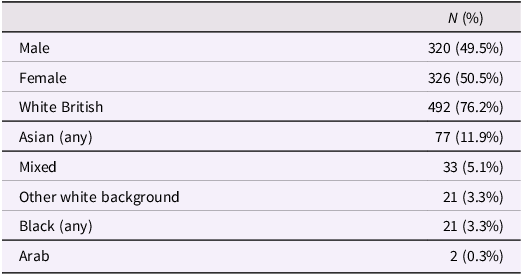
The baseline demographics of the sample (Table 1) were broadly representative of the UK population. There was a balanced representation of male (49.5%) and female (50.5%) children, and participants were predominantly from a White British (76.2%) background, which is close to the proportion of white people living in England and Wales as reported in the 2011 census (80.5%; Office for National Statistics [ONS], 2011). Additionally, the mean (£33,972) and median (£37,788) annual gross household labor income in our sample was comparable to the gross income at the time (£37,456; Office for National Statistics [ONS], 2013).
Demographic characteristics of sample
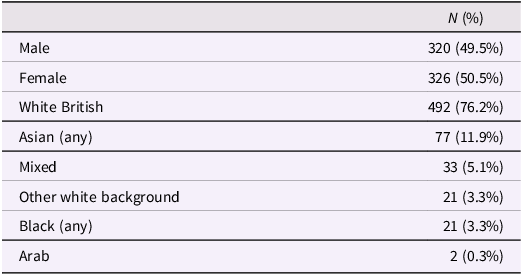
Note. These are the demographic characteristics for the sample used for analysis, n = 646.
Measures
Adverse childhood experiences
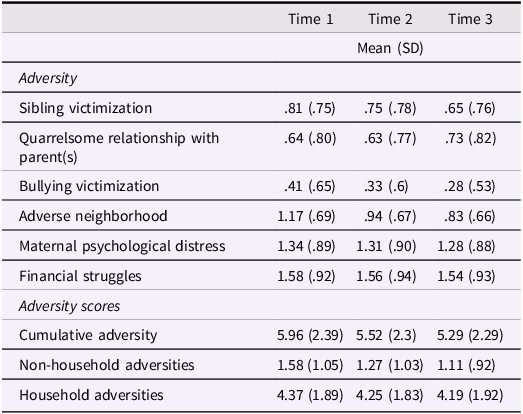
The adversities used in this analysis were repeated measures at all three timepoints, measured concurrently with putative outcome measures. Adversity items were measured on a scale of 0 to 3. Where adversities had multiple contributing items, a mean score was used to avoid unbalanced contributions to the summed variables (see below). Descriptives for the adversity scores are shown in Table 2.
Descriptive statistic individual and sum scores of adversity groups
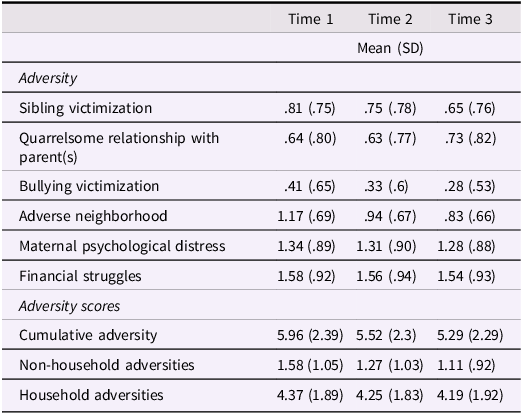
Note. Maximum score for cumulative adversity is 18, maximum score for community adversity is 6, maximum score for household adversity is 12. At all timepoints, n = 646.
Items were primarily adapted from child self-report measures. We calculated mean scores for variables that are derived from multiple items to avoid unbalanced contributions. Sibling victimization was measured from four items concerning bullying experiences among siblings (Wolke & Skew, Reference Wolke and Skew2012). These items pertained to how often siblings perpetrated physical violence, theft, name-calling, and teasing. Response options for all four items were “never,” “not much (1–3 times in the last 6 months),” “quite a lot (more than 4 times in the last 6 months),” and “a lot (a few times every week).” Responses were coded from 0 to 3, summed and divided by four to arrive at a single score. If participants reported not having a sibling, the variable was coded as 0 to reflect the absence of this adversity. Quarrelsome relationship with parents was adapted from two items pertaining to how frequently participants quarreled with their mother and father. Response options were “hardly ever,” “less than once a week,” “more than once a week,” and “most days.” Items were coded from 0 to 3, summed and divided by 2. Participants could also respond “don’t have a [father/mother],” which was coded as 0. Bullying victimization was adapted from two items concerning bullying experiences, pertaining to how often participants experienced physical bullying and bullying in other forms at school (Wolke & Skew, Reference Wolke and Skew2012). Response options were “never,” “not much (1–3 times in the last 6 months),” “quite a lot (more than 4 times in the last 6 months),” “a lot (a few times a week)” on a 0–3 scale. Items were summed and divided by two to create a single score. Adverse neighborhood was adapted from two items addressing how much the participant worried about being a victim of crime, and how safe they felt walking alone in the area after dark (Hales et al., Reference Hales, Debowska, Rowe, Boduszek and Levita2023). Item responses for the first item ranged from “not a worry at all,” “an occasional doubt,” “a bit of a worry,” “a big worry,” and for the second item ranged from “very safe,” “fairly safe,” “a bit unsafe,” “very unsafe,” respectively, each on a 0–3 scale. Responses were summed and divided by two.
Two adversities were not measured via child self-report. Maternal psychological distress was estimated using the parent-reported General Health Questionnaire (GHQ; Goldberg & Williams, Reference Goldberg and Williams1988) which ranged from 0 to 36. Financial struggles was estimated using the total gross household labor income (monthly), which was reported in the household survey. Both maternal psychological distress and financial struggles were continuous integers that were recoded into a 0–3 scale using the mean ( ${\rm{\overline x}}$
) and standard deviation (σ). For example, values greater than
${\rm{\overline x}}$
) and standard deviation (σ). For example, values greater than ${\rm{\overline x}}$
+ σ, values greater than
${\rm{\overline x}}$
+ σ, values greater than ${\rm{\overline x}}$
but smaller than
${\rm{\overline x}}$
but smaller than ${\rm{\overline x}}$
+ σ, values below
${\rm{\overline x}}$
+ σ, values below ${\rm{\overline x}}$
, and values below
${\rm{\overline x}}$
, and values below ${\rm{\overline x}}$
− σ. For those with higher scores on the GHQ were coded to have a higher score of maternal psychological distress, and those with higher total gross household labor income had lower scores on financial struggles.
${\rm{\overline x}}$
− σ. For those with higher scores on the GHQ were coded to have a higher score of maternal psychological distress, and those with higher total gross household labor income had lower scores on financial struggles.
Cumulative, non-household and household adversity scores
Three adversity scores were calculated. The first summary score was a cumulative risk score, which was a summary of all six adversities detailed above with a possible range of 0–18. The pre-defined subtypes of adversity, non-household and household subtypes, were computed based on previous research indicating different effects of non-household and household adversities (e.g. Hales et al., Reference Hales, Debowska, Rowe, Boduszek and Levita2023; Turner et al., Reference Turner, Finkelhor, Mitchell, Jones and Henly2020). The non-household risk score was computed by summing the scores of bullying victimization and adverse neighborhood with a possible range of 0–6. The household risk score was computed by summing sibling victimization, quarrelsome relationship with parents, financial struggles, and maternal psychological distress with a possible range of 0–12.
Internalizing and externalising problems
Self-report scores from the Strengths & Difficulties Questionnaire (SDQ; Goodman, Reference Goodman1997) were used to derive internalizing problems and externalizing problems at all three timepoints. This scale is used as a screening tool to help early detection, prediction, and treatment planning for mental health problems. The SDQ contains five subscales which measure emotional problems (e.g., “I worry a lot”), peer problems (e.g., “I am usually on my own”), conduct problems (e.g., “I am often accused of lying or cheating”), hyperactivity (e.g., “I am constantly fidgeting”), and prosocial behaviors. Each item has response options of “not true,” “somewhat true,” and “certainly true” regarding how the participant sees themselves as a person. Internalizing and externalizing subscales (0–20) were calculated as recommended by Goodman et al. (Reference Goodman, Lamping and Ploubidis2010). The internalizing problems score had a Cronbach’s α coefficient that over time ranged from .70 to .74; while the externalizing problems score had a Cronbach’s α coefficient that ranged from .75 to .79 over time.
Delinquency
The youth questionnaire contains individual items concerning delinquent behaviors such as vandalism, shoplifting, fighting, and bullying perpetration. From these, a delinquency score was calculated to summarize self-reported delinquent behaviors at all three timepoints. Each item was measured using different response options but were converted into a sum score to estimate general delinquency. For vandalism and shoplifting, responses ranged from “never,” “once or twice,” “several times,” “often.” For fighting, responses ranged from “none,” “once,” “2–5 times/6–9 times,” “10 or more times.” For bullying perpetration, both physical and other forms had response options ranging from “never,” “not much (1–3 times in the last 6 months),” “quite a lot (more than 4 times in the last 6 months),” “a lot (a few times every week).” Responses were re-coded into 0–3 scales where 0 was never and 3 was the most frequent for that item which resulted in a possible range of 0–20. The Cronbach’s α for delinquency ranged from .65 to .96. While there is some overlap with the externalizing problems scale (e.g., both contain items on fighting and stealing), the delinquency score was calculated to represent serious conduct issues occurring in the past month while the SDQ externalizing scale is a combination of conduct and hyperactivity problems reflecting emergent mental health problems.
Life satisfaction
The youth questionnaire contains a visual 1–7 scale where children rate their happiness about specific aspects of life such as family, friends, appearance, school, schoolwork, and life as a whole at all three timepoints. We calculated a life satisfaction score by summing these item responses. Responses were reverse coded for ease of interpretation so that higher scores indicated greater life satisfaction. Item responses were on a scale from 1 to 7 (from “not at all happy” to “completely happy”), resulting in a possible range of 6–42. The Cronbach’s α for life satisfaction ranged from .74 to .79. The same scale has been used elsewhere to plot trajectories of adolescent life satisfaction (Orben et al., Reference Orben, Lucas, Fuhrmann and Kievit2022).
Analysis strategy
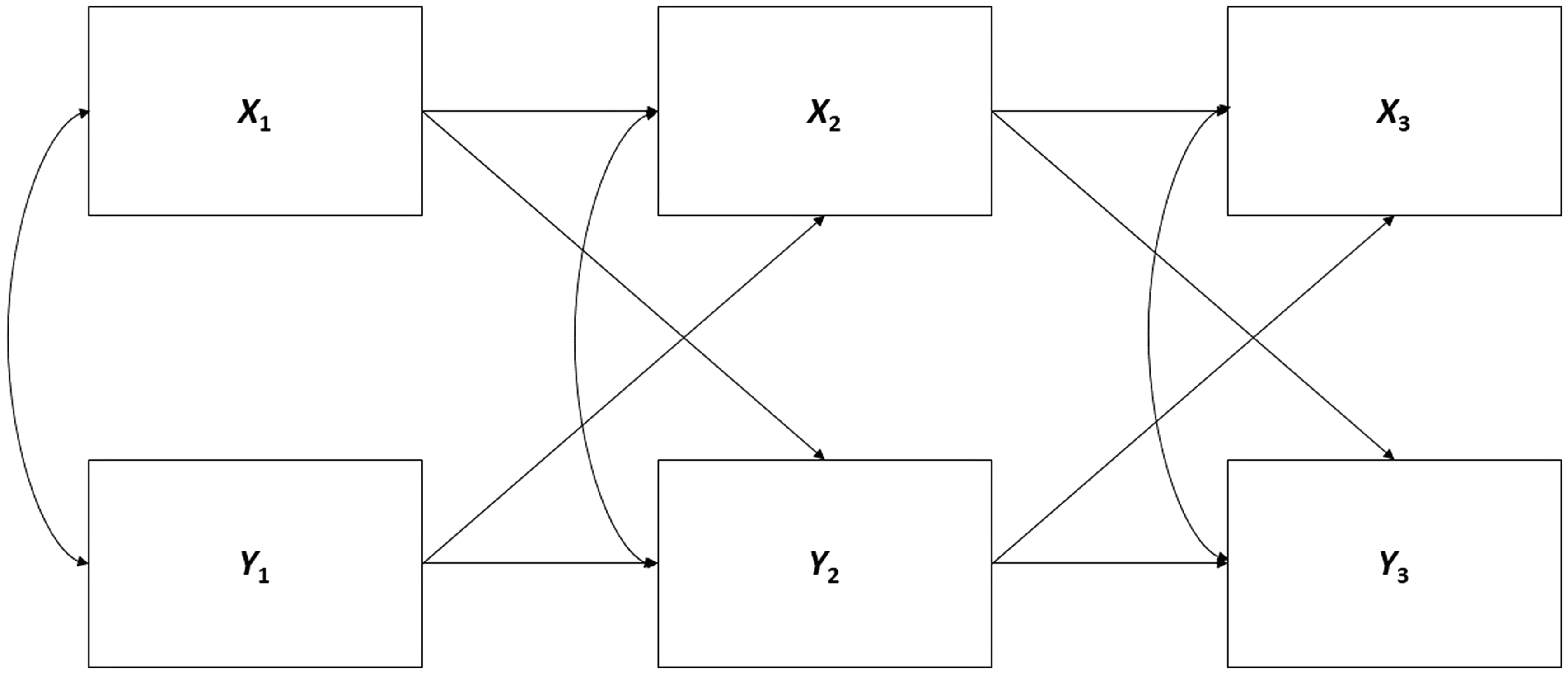
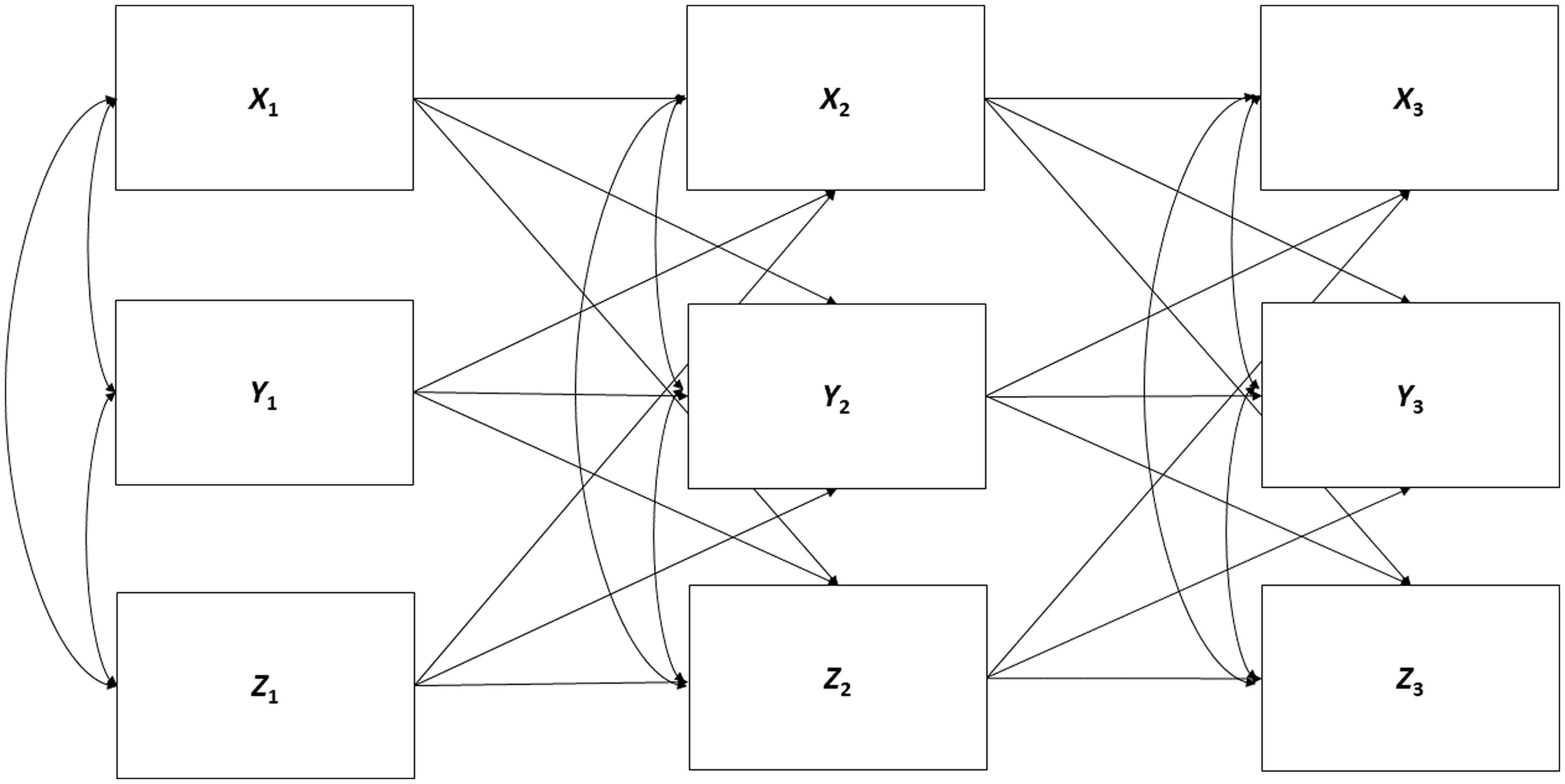
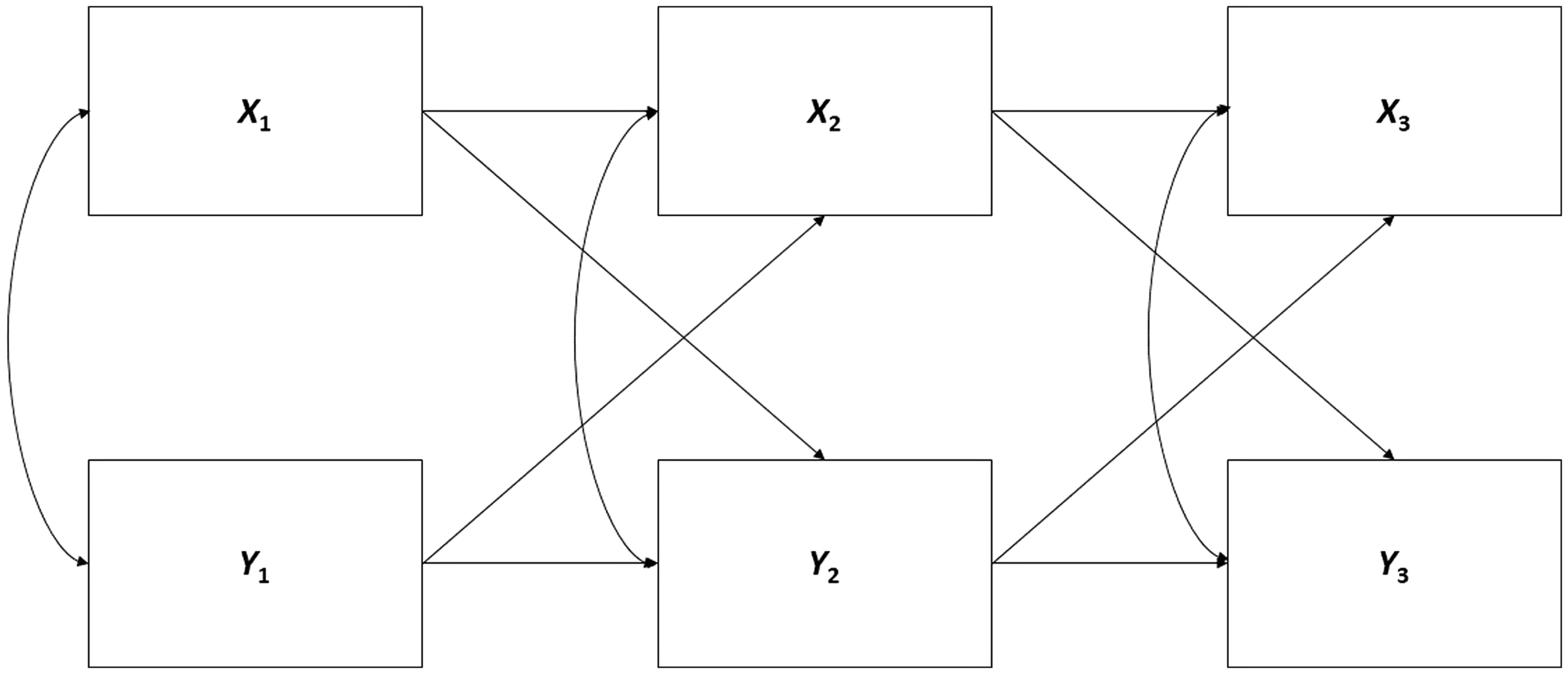
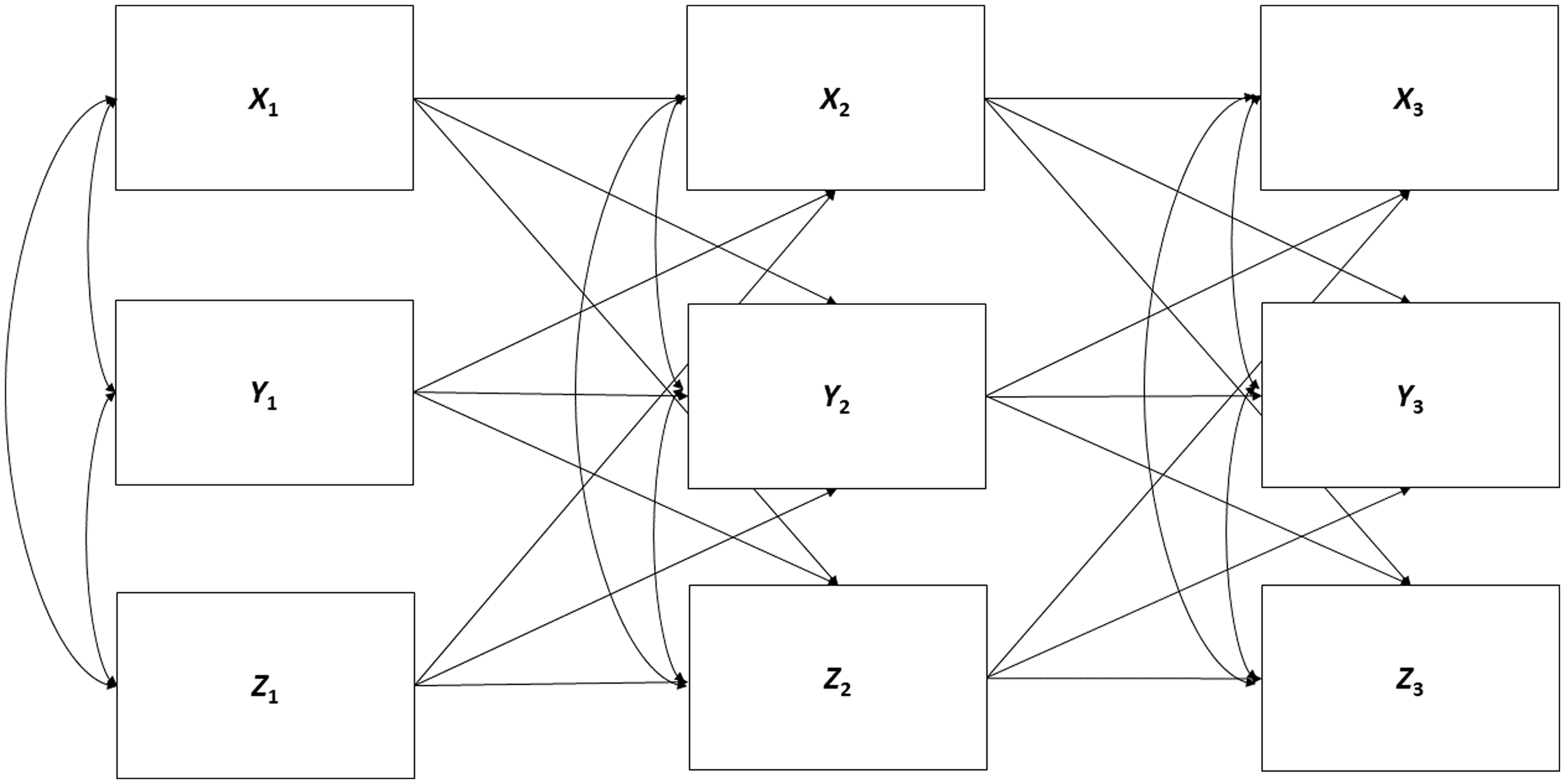
Data preparation was conducted in STATA MP 17 (StataCorp, 2021), analysis was conducted in Mplus 8.6 using the “mlr” estimator (Muthén & Muthén, Reference Muthén and Muthén1998-Reference Muthén and Muthén2017). Model comparisons were conducted as instructed on the Mplus website. A series of CLPMs were computed to assess longitudinal bidirectional relationships between adversity scores and psychosocial outcomes: internalizing and externalizing problems, delinquency, and life satisfaction. Specifically, CLPMs were run modeling cumulative adversities and outcomes (see Figure 1 for conceptual model), and CLPMs were modeled including both adversity subtypes (i.e. non-household risks, household risks) and outcomes (see Figure 2 for conceptual model). Standardized beta coefficients were calculated and reported. A recent set of guidelines recommended that for cross-lagged effects benchmark values of .03, .07, and .12 (small, medium, and large effects) could be used to aid interpretation (Orth et al., Reference Orth, Meier, Bühler, Dapp, Krauss, Messerli and Robins2022). We used full information maximum likelihood estimation, via the robust maximum likelihood estimator in Mplus to handle missing data. Variables all had <10% missing values with the exception of “sibling victimisation,” which was treated as not missing at random. Where participants indicated they did not have a sibling, missing sibling victimization items were coded as 0. Extreme values (more than three standard deviations from the mean) were winsorised. For each model, fit indices were reported: root mean square error of approximation where values should be below .1 (Kenny et al., Reference Kenny, Kaniskan and McCoach2015), comparative fit index which should be above .95 (Hu & Bentler, Reference Hu and Bentler1999), Tucker Lewis index which should be above .9 (Bentler & Bonett, Reference Bentler and Bonett1980), and standardized root mean square residual, which should be below .06 (Hu & Bentler, Reference Hu and Bentler1999).
Cross-lagged panel model where X is cumulative adversities and Y is the putative ‘outcome’. Note. This figure denotes the elements of a cross-lagged panel model which includes autoregressive effects (e.g. from X 1 to X 2), cross-lagged paths (e.g. from X 1 to Y 2), and correlations (e.g. from X 1 to Y 1).
Cross-lagged panel model where X is community adversities, Y is household adversities, and Z is the putative ‘outcome’. Note. This figure denotes the elements of a cross-lagged panel model which includes autoregressive effects (e.g. from X 1 to X 2), cross-lagged paths (e.g. from X 1 to Y 2), and correlations (e.g from X 1 to Y 1).
Results
Levels of adversity from childhood to adolescence
The level of adversity at each timepoint and for each measure of adversity is presented in Table 2. Cumulative adversity scores decreased from childhood to early adolescence, t(645) = 5.316, p < .001, and early to mid-adolescence t(645) = 2.744, p = .006. Non-household adversities decreased from childhood to early adolescence t(645) = 7.086, p < .001, and early adolescence to mid-adolescence t(645) = 3.95, p < .001. However, household adversities were not significantly different from childhood to early adolescence t(645) = 1.845, p = .066, or early adolescence to mid-adolescence t(645) = .951, p = .342.
Relationship between cumulative adversity and psychosocial outcomes: from childhood to adolescence
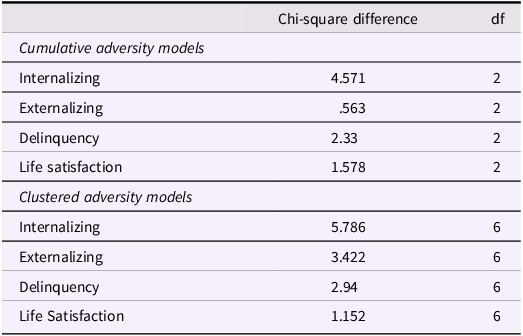
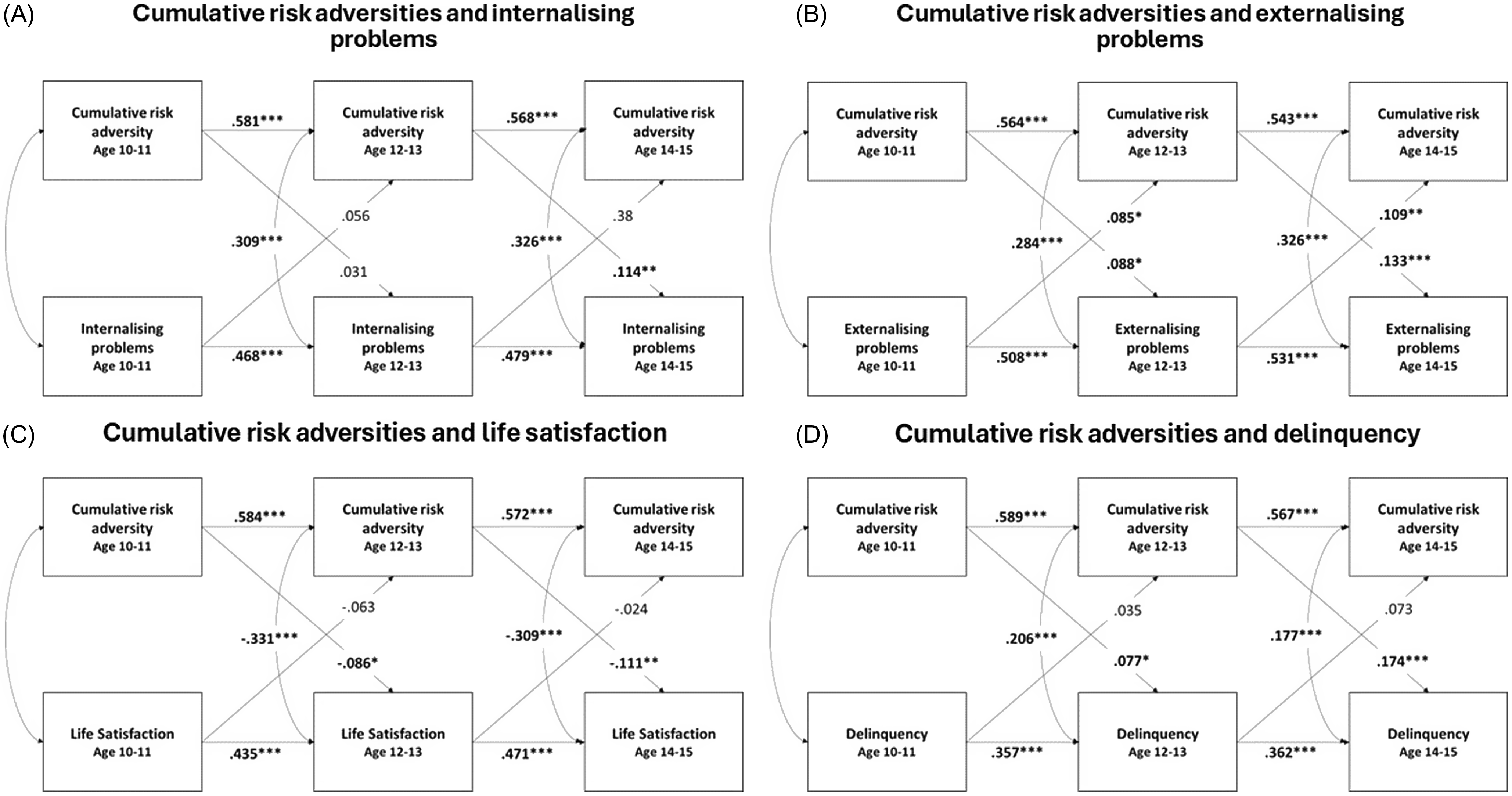
Four CLPMs modeling the relationship between cumulative adversities and measures of psychosocial outcomes were run at timepoints T1-3 (ages 10−11, 12−13, and 14−15). Table 3 shows the model fit indices for these models. Chi-square difference tests were run to compare the fit of models where paths were either constrained to be equal across time or free to vary. The results of the chi-square difference tests indicate that the models with fixed paths fit better for all models (see Table 4), which suggests that the relationships between cumulative adversities and psychosocial outcomes is relatively stable across childhood, early, and mid-adolescence. Figure 3 presents the results of four CLPMs modeling the relationships between cumulative adversities and A) internalizing problems, B) externalizing problems, C) life satisfaction, and D) delinquency.
Fit of cross-lagged panel models for cumulative adversity models by outcome

Note. Autoregressive paths were constrained to be equal across time. Degrees of freedom = 6*. All Chi-square values significant at p < .001.
Chi-square difference tests results
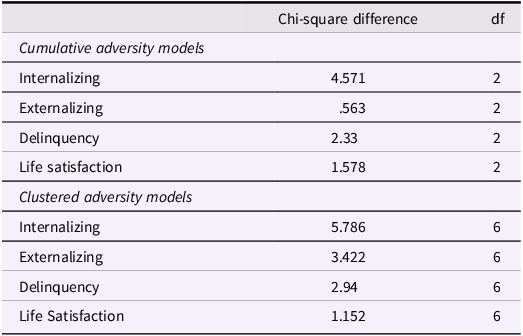
Note. The critical value for cumulative adversity models was 5.991, chi-square difference values below this critical value indicate that the fully constrained model was not a significantly worse fit. The critical value for adversity subtype models was 12.592, chi-square difference values below the critical value indicate that the fully constrained model was not a significantly worse fit.
The association between cumulative adversities and psychosocial outcomes using cross-lagged panel models. Note. Model (A) denotes standardised beta coefficients in the relationship between cumulative risk adversities and internalising problems; (B) denotes standardised beta coefficients in the relationship between adversities and externalising problems; (C) denotes standardised beta coefficients in the relationship between adversities and life satisfaction problems; (D) denotes standardised beta coefficients in the relationship between adversities and delinquency. Models were run where the autoregressive paths were constrained to be equal across timepoints. p ≤ .05*, p < .001**, p < .001***.
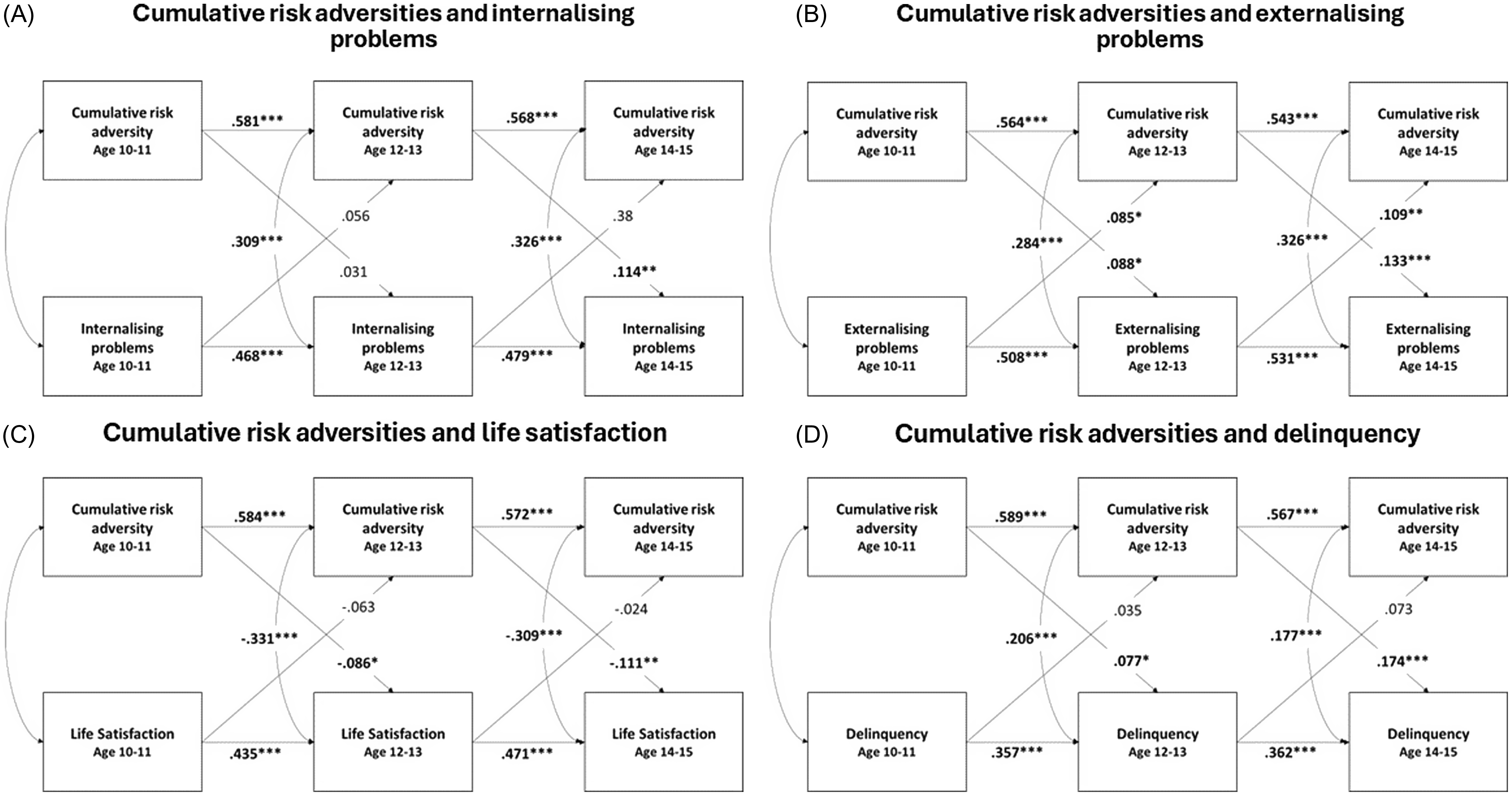
As expected, the models showed that cumulative adversities in childhood (age 10−11) strongly predicted the presence of greater levels of cumulative adversities in early (age 12−13) and mid-adolescence (age 14−15). Cumulative adversities in childhood and early adolescence significantly predicted higher levels of externalizing problems at a medium to large effect (Figure 3B), delinquency with a medium to large effect (Figure 3D), and lower levels of life satisfaction with a medium effect (Figure 3C). In contrast, cumulative adversities at early adolescence, but not childhood, significantly predicted greater levels of internalising problems in mid-adolescence with a medium effect (Figure 3A). Bidirectional relationships were evident such that higher levels of externalising problems significantly predicted higher levels of cumulative adversity with a medium effect (Figure 3B). The relationships between cumulative adversity and internalising problems, life satisfaction, and delinquency were all unidirectional.
The relationships between non-household and household adversities and psychosocial outcomes: from childhood to adolescence
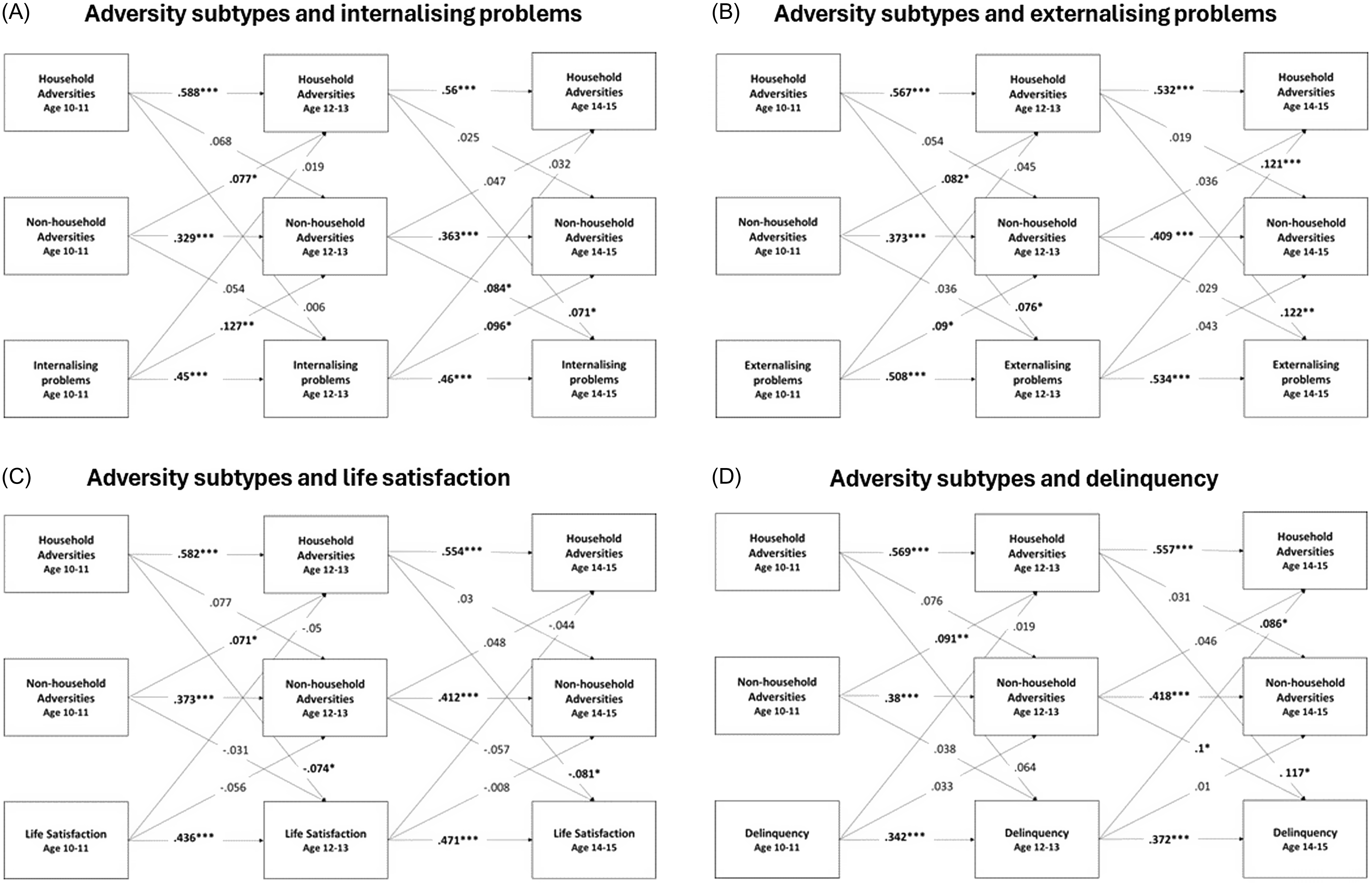
To examine whether the non-household adversity score and household adversity score contribute differently to psychosocial outcomes and the impact at different ages, four CLPMs were modeled including both non-household and household adversity subtypes and psychosocial outcomes between ages 10 and 15. Table 5 presents fit indices for these models. The results of chi-square difference tests were identical to the previous models (see Table 4); all tests suggest that the relationships between adversities and psychosocial outcomes is relatively stable across childhood, early, and mid-adolescence models. Figure 4 presents the results of four CLPMs modelling the relationships between non-household adversities and household adversities and A) internalising problems, B) externalising problems, C) life satisfaction, and D) delinquency.
Fit of cross-lagged panel models for adversity subtype models by outcome

Note. Autoregressive paths were constrained to be equal across time. Degrees of freedom = 12*. All Chi-square values significant at p < .001.
The association between adversity subtypes and psychosocial outcomes using cross-lagged panel models. Note. Model (A) denotes standardised beta coefficients in the relationship between household adversities, community adversities, and internalising problems; (B) denotes standardised beta coefficients in the relationship between household adversities, community adversities, and externalising problems; (C) denotes standardised beta coefficients in the relationship between household adversities, community adversities, and life satisfaction problems; (D) denotes standardised beta coefficients in the relationship between household adversities, community adversities, and delinquency. Models were run where the autoregressive paths were constrained to be equal across timepoints. Concurrent correlations have been omitted for clarity. p ≤ .05*, p < .01**, p < .001***.
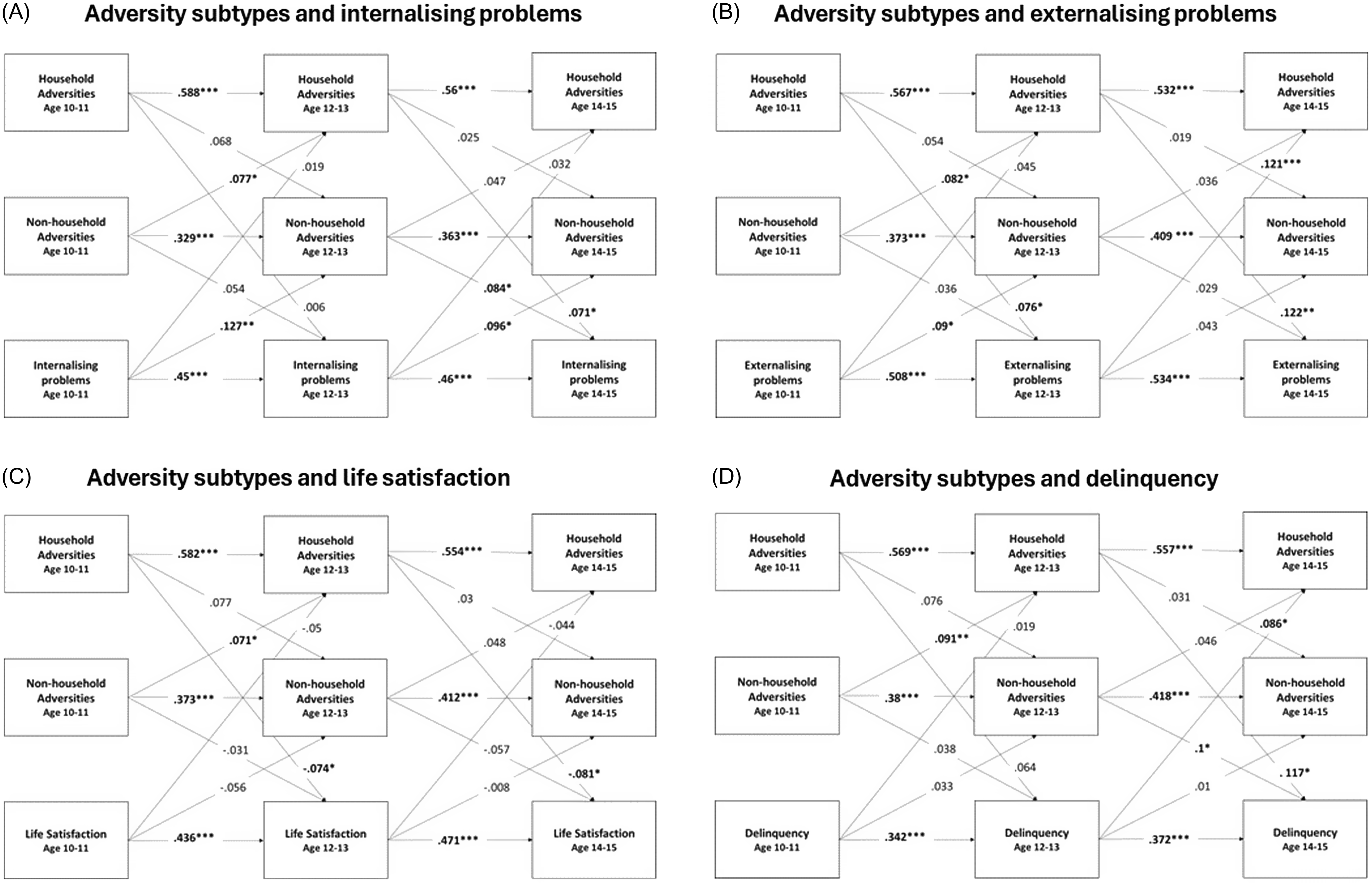
As expected, autoregressive paths were strong from childhood to early- and mid-adolescence. In all models, higher levels of non-household adversities at childhood unidirectionally predicted household adversities in early adolescence (Figures 4A to 4D). While this was not a primary aim of the analysis the consistency in this relationship bears noting.
Internalizing problems were predicted by both non-household and household adversities (Figure 4A). The model showed that higher levels of non-household and household adversities in early adolescence predicted higher levels of internalizing problems in mid-adolescence respectively. Both non-household and household adversities had a medium effect size indicating that both predict internalizing problems at a relatively similar magnitude. However, neither type of adversity significantly predicted higher levels of internalizing problems from childhood to early adolescence, which reflects the findings of the cumulative adversity model. There was some evidence of bidirectionality, such that higher levels of internalizing problems predicted non-household adversities from childhood to early adolescence and from early to mid-adolescence.
Greater externalizing problems were uniquely predicted by household adversities (Figure 4B). Higher levels of household adversity in childhood and early adolescence predicted higher levels of externalizing problems in early adolescence and mid-adolescence respectively. The effect size strengthened from medium to large over time. The model also revealed a bidirectional relationship in adolescence; levels of externalizing problems during early adolescence predicted household adversities in mid-adolescence. Notably, higher levels of externalizing problems in childhood predicted non-household adversities at early adolescence, but this was a unidirectional relationship.
Life satisfaction was uniquely predicted by household adversities (Figure 4C) such that higher levels of household adversities during childhood and early adolescence predicted lower levels of life satisfaction at early adolescence and mid-adolescence respectively. The magnitude of these effects was medium. These effects were unidirectional, such that life satisfaction did not predict household adversities.
Delinquency was significantly predicted by both non-household and household adversities from early adolescence to mid-adolescence (Figure 4D). Specifically, higher levels of household and non-household adversities during childhood predicted higher levels of delinquency in early adolescence. Both effects were of a medium magnitude, although the effect of household adversities slightly larger. The model also revealed bidirectional effects such that levels of delinquency at early adolescence predicted household adversities and mid-adolescence.
Discussion
This study had two main objectives. First, it analyzed levels of cumulative adversity and adversity subtypes to understand their varying impacts on psychosocial outcomes (i.e., internalizing problems, externalizing problems, life satisfaction, delinquency). Second, the study investigated the dynamic bidirectional longitudinal relationships between adversities and psychosocial outcomes during critical transitional phases, spanning childhood, early adolescence, and mid-adolescence. Greater levels of cumulative adversity predicted worse internalizing and externalizing problems, life satisfaction, and delinquency, consistent with the wider literature showing that higher levels of adversities during development are linked to poorer psychosocial outcomes (e.g. Hughes et al., Reference Hughes, Bellis, Hardcastle, Sethi, Butchart, Mikton, Jones and Dunne2017; Sahle et al., Reference Sahle, Reavley, Li, Morgan, Yap, Reupert and Jorm2021). However, our findings are based on additional forms of adversity not normally accounted for when compared to previous studies, which demonstrates that a broad constellation of adversities are important to the development of psychosocial problems. Additionally, our results revealed distinct contributions of household and non-household subtypes of adversity to psychosocial outcomes, indicating that different forms of adversity are associated with specific outcomes. For instance, the relationship between adversities and internalizing problems seems best explained by non-household adversities, whereas the relationships between adversities and externalizing problems and life satisfaction was best explained by household adversities. For delinquency, both household and non-household adversities were important predictors. Moreover, internalizing problems, externalizing problems, life satisfaction, and delinquency all predicted greater levels of adversity to some degree which demonstrates the key finding that the relationship between childhood adversities and psychosocial outcomes is bidirectional.
When considering cumulative adversities alone, the broad pattern of findings demonstrates that a greater level of adversity predicts all psychosocial outcomes in a unidirectional manner. All these effects are medium to large and are in the expected direction. However, when considering the separate effects of household and non-household adversities, distinct patterns emerge. Household adversities predict externalizing problems and life satisfaction throughout childhood to mid-adolescence, and predict delinquency and internalizing problems in adolescence only. Whereas non-household adversities predict internalizing problems, externalizing problems, and delinquency in adolescence only. This could be due to the greater emphasis on peers as individuals begin to become more independent from parents and caregivers (see Sroufe & Rutter, Reference Sroufe and Rutter1984). An additional layer of complexity to these relationships indicates that the relationships between household adversities and externalizing problems and delinquency, as well as the relationships between non-household adversities and internalizing and externalizing problems are all bidirectional to some degree. Taken together, these findings build on previous findings that suggest distinct effects of clusters of adversities. For instance, our findings support previous literature which demonstrates that non-household adversities are more closely related to problems in adolescence than childhood (Turner et al., Reference Turner, Finkelhor, Mitchell, Jones and Henly2020). However, our findings also demonstrate the continued importance of household adversities into adolescence, which was not apparent in Turner et al.’s (Reference Turner, Finkelhor, Mitchell, Jones and Henly2020) study. This may be because our study focused on psychosocial problems rather than trauma symptoms, and there may be different pathways associated with trauma symptoms compared to psychosocial problems. For instance, household challenges such as low income and maternal mental health problems have been identified as risk factors for bullying perpetration (Chow et al., Reference Chow, Pingualt and Baldwin2022), and chaotic households have been linked to the development of delinquency and antisocial behaviors both cross-sectionally (Bonner et al., Reference Bonner, DeLisi, Jones-Johnson, Caudill and Trulson2020) and longitudinally (Wang et al., Reference Wang, Deater-Deckard, Petrill and Thompson2012). The household adversities subtype may have continued importance for the development of behavioral and emotional problems throughout development, while adversities experienced outside of the household produce a stronger effect as the young person transitions into adolescence. Further studies should investigate this using bidirectional data which can control for the effects of adversities within and outside of the household. One potential mechanism is that intrafamilial victimization may increase feelings of betrayal which subsequently result in behavioral problems (Debowska et al., Reference Debowska, Boduszek, Sherretts, Willmott and Jones2018), which could be explored in future studies.
The impact of household adversities on externalizing problems and delinquency was more pronounced during the transition from early to mid-adolescence compared to the earlier phase from childhood to early adolescence. This suggests that household adversities may exert a stronger influence on the manifestation of behavioral issues during mid-adolescence. This contrasts with findings from Turner et al. (Reference Turner, Finkelhor, Mitchell, Jones and Henly2020) but partially supports Pollman et al. (Reference Pollmann, Fritz, Barker and Fuhrmann2022). In contrast to Turner et al. (Reference Turner, Finkelhor, Mitchell, Jones and Henly2020), both Pollman et al. (Reference Pollmann, Fritz, Barker and Fuhrmann2022) and this current study performed longitudinal analysis, which might explain the discrepancies. Nevertheless, the reason for the varying risks associated with non-household and household adversities during these stages remains uncertain. Belsky et al. (Reference Belsky, Steinberg and Draper1991) suggested that adversities could provoke insecure attachment, which might subsequently explain the relationship between stressors and internalizing and externalizing problems. Few studies have longitudinally investigated attachment anxiety and internalizing problems, but one systematic review has illustrated this relationship (Lam et al., Reference Lam, Rai and Lam2019). While we have no measure of attachment in our study, one interpretation of our findings is that insecure attachment has played a role in the enduring effect of household adversities on these psychosocial problems. Alternatively, different adversities may exert distinct effects on neural development that implicates social cognition and behavior during sensitive developmental periods (McLaughlin et al., Reference McLaughlin, Sheridan and Lambert2014; Uhlhaas et al., Reference Uhlhaas, Davey, Mehta, Shah, Torous, Allen, Avenevoli, Bella-Awusah, Chanen, Chen, Correll, Do, Fisher, Frangou, Hickie, Keshavan, Konrad, Lee, Liu, Luna, McGorry, Meyer-Lindenberg, Nordentoft, Öngür, Patton, Paus, Reininghaus, Sawa, Schoenbaum, Schumann, Srihari, Susser, Verma, Woo, Yang, Yung and Wood2023). Future studies should seek to test these hypotheses using prospective data. This deeper understanding will contribute valuable insights to guide targeted interventions and preventive strategies aimed at mitigating the detrimental consequences of adversities on individuals, particularly during critical stages of development.
A key aspect of our study was the modeling of adversities and psychosocial outcomes using the cross-lagged approach, which facilitates exploration of bidirectional relationships, moving beyond the simplistic view of unidirectional longitudinal effects. Our findings highlight the dynamic bidirectional relationships between household adversities and behavioral problems (i.e., externalizing problems and delinquency), as well as the bidirectional relationships between non-household adversities and internalizing and externalizing problems. Notably, internalizing problems in childhood had a large effect on non-household adversities at early adolescence, and this effect persisted with a medium effect into mid-adolescence. As the non-household adversities included in this study reflected bullying victimization and adverse neighborhood, it could be interpreted that more emotional problems in childhood make an individual particularly vulnerable to bullies and other hazards in their wider environment. Indeed, a meta-analysis found that internalizing problems are a predictor of bullying victimization (Kljakovic & Hunt, Reference Kljakovic and Hunt2016). Meanwhile, externalizing problems and delinquency predicted greater household adversities from early to mid-adolescence. As these psychosocial problems construe anti-social type behaviors, it could be interpreted that elevated anti-social behaviors at this developmental period provoke a response or change in the rearing environment which manifests itself as adversity. Indeed, it has been posited that disruptive or difficult behavior might provoke rearing conditions such as abuse (Belsky, Reference Belsky1993; Jaffee et al., Reference Jaffee, Strait and Odgers2012). Future studies should interrogate the bidirectional relationships between externalizing and delinquent behaviors and childhood adversities.
Speaking more broadly, these results build upon previous findings of cross-lagged panel analyses on child populations (Font & Berger, Reference Font and Berger2015; Zhang & Mersky, Reference Zhang and Mersky2020) by demonstrating bidirectional relationships between a broader set of adversities and psychosocial outcomes continue into adolescence. These findings emphasize the importance of understanding the effects of adversities and subtypes longitudinally. In particular, these findings lend support to the importance of early detection and intervention due to the typical onset of mental health issues beginning between ages 12 and 25 (Uhlhaas et al., Reference Uhlhaas, Davey, Mehta, Shah, Torous, Allen, Avenevoli, Bella-Awusah, Chanen, Chen, Correll, Do, Fisher, Frangou, Hickie, Keshavan, Konrad, Lee, Liu, Luna, McGorry, Meyer-Lindenberg, Nordentoft, Öngür, Patton, Paus, Reininghaus, Sawa, Schoenbaum, Schumann, Srihari, Susser, Verma, Woo, Yang, Yung and Wood2023). Taken alongside previous findings (i.e., Font & Berger, Reference Font and Berger2015; Zhang & Mersky, Reference Zhang and Mersky2020), our findings illustrate the importance of focusing on the developmental impacts of maltreatment and adversities and the cascading effects on psychosocial and mental health problems (Sroufe & Rutter, Reference Sroufe and Rutter1984). However, Zhang and Mersky (Reference Zhang and Mersky2020) found no significant relationship between ACEs and outcomes from age 9 to age 15, whereas our analyses did. This may be due to the longer lags between timepoints in the data used by Zhang and Mersky (age 9 to 15) compared to our study (2-year lags), which can cause effects to vary (Maxwell et al., Reference Maxwell, Cole and Mitchell2011) due to unstable estimation of effects. One potential explanation for disparate findings is that outcomes in mid-adolescence could be more closely influenced by adversities experienced in early adolescence than adversities in childhood, or that the broader adversities used in our study had a stronger effect on outcomes in adolescence compared to the ACEs used by Zhang and Mersky (Reference Zhang and Mersky2020). Future research should investigate the broad array of adversities that could be important to psychosocial problems in childhood and adolescence. Additionally, while our study used a sample from a general population household survey, Zhang and Mersky (Reference Zhang and Mersky2020) used a sample of children from low-income families for whom there could be different pathways to psychosocial outcomes (Devenish et al., Reference Devenish, Hooley and Mellor2017). Finally, a random intercept cross-lagged panel model (RI-CLPM) was utilized in their study, which may be a factor in different findings due to a slight difference in modeling variance (see Orth et al., Reference Orth, Clark, Donnellan and Robins2021). Differences in findings notwithstanding, consideration of bidirectional relationships highlights that a reduction of psychosocial problems could in turn lead to a reduction in childhood adversities, opening an important avenue for intervention strategies. For example, interventions designed to reduce internalizing problems such as anxiety and depressive disorders do have lasting effects (Pilling et al., Reference Pilling, Fonagy, Allison, Barnett, Campbell, Constantinou and Kendall2020) which may also reduce the likelihood of negative social relationships or bullying in adolescence.
Limitations and future directions
Despite the methodological strengths, it is important to consider these results in the context of pertinent limitations. Firstly, data collection began at age 10, which precludes investigation of relationships between adversities and psychosocial outcomes throughout early childhood. Given the results of our models, it might be expected that adversities would influence psychosocial outcomes throughout development and psychosocial outcomes would exert a reciprocal effect on exposure to adversity, but further studies are required to investigate this relationship more fully. Secondly, the subtypes of adversity were pre-defined based on similar studies, although other subtypes might be worth investigation such as independent and dependent subtypes (see Zavos et al., Reference Zavos, Dalton, Jayaweera, Harber-Aschan, Pannala, Adikari, Hatch, Siribaddana, Sumathipala, Hotopf and Rijsdijk2020). Thirdly, the most appropriate technique for modeling cross-lagged effects is unresolved. As other researchers have instead utilized the RI-CLPM (see Zhang & Mersky, Reference Zhang and Mersky2020), direct comparisons are difficult. Fourthly, we could not use a recognized measure of adversities which resulted in inconsistency in how variables were measured, and may contribute noise in the data. Additionally, some important adversities were omitted from analysis, either because they were not collected in this dataset (i.e. sexual abuse) or were only collected at one timepoint (i.e. physical abuse). This meant that our models of adversities relied on a broader set of adversities, some of which are not applicable to subgroups within our sample (e.g., sibling victimization). Nonetheless, our models still provide a novel contribution by demonstrating the impact of these lesser investigated adversities. Future research would benefit from collecting data on childhood adversities using recognized scales at multiple timepoints to more fully investigate the dynamic relationship between adversities and psychosocial outcomes throughout important developmental stages.
Conclusion
Modeling the dynamic effects of both cumulative and subtypes of adversity using longitudinal data during critical transitional phases of development, this study has made substantial contributions to the adversity literature. Findings demonstrate a clear association between cumulative adversities and psychosocial outcomes spanning from childhood to mid-adolescence. Subtypes of adversity exerted different effects on outcomes. Moreover, psychosocial problems had effects on exposure to adversities, highlighting a bidirectional relationship between adversities and psychosocial outcomes. These findings illustrate the importance of investigating bidirectional relationships when considering childhood adversities. Additionally, our findings are based on a broader set of adversities that are typically considered, which also demonstrates the need to understand just how broad a constellation of adversities should be investigated to best encapsulate the dynamic processes between adversities and the development of psychosocial problems throughout childhood and adolescence.
Acknowledgements
This work was funded by an Economic and Social Research Council grant (2100320) awarded to GH and supervized by AD, RR, DB, and LL. Understanding Society is an initiative funded by the Economic and Social Research Council and the data are distributed by the UK Data Service. We are extremely grateful to the UK Data Service and University of Essex Institute for Social and Economic Research for granting access to the dataset. For the purpose of open access, the author has applied a Creative Commons Attribution license (CC BY) to any Author Accepted Manuscript version arising from this submission. We would also like to thank the reviewers for their thoughtful and constructive comments, and time taken to review our work.
Competing interests
None to report.



 Open access

