




Introduction
Between c. 8000 and 1500 years ago, the south-western peninsula of Sulawesi was home to the Toalean hunter-gatherers, a group identified from characteristic archaeological assemblages first excavated in 1902 (Sarasin & Sarasin Reference Sarasin and Sarasin1905; Mulvaney & Soejono Reference Mulvaney and Soejono1970a & Reference Mulvaney and Soejonob; Glover Reference Glover1976). These assemblages contain distinctive Maros points—small stone projectile points with pressure-flaked serrations and indented bases (Perston et al. Reference Perston, Moore, Langley, Hakim, Oktaviana and Brumm2021)—alongside bone and tooth points, while backed microliths appear in later phases (Bulbeck et al. Reference Bulbeck, Pasqua and Lello2000; Bulbeck Reference Bulbeck, Keates and Pasveer2004; Olsen & Glover Reference Olsen, Glover, Keates and Pasveer2004; Suryatman et al. Reference Suryatman, Hakim, Mahmud, Fakhri, Burhan, Oktaviana, Saiful and Syahdar2019; Perston et al. Reference Perston, Moore, Langley, Hakim, Oktaviana and Brumm2021). The terminal phase of the Toalean technoculture remains poorly dated, but a period of co-existence with the Austronesian-speaking ‘Neolithic’ societies that first spread into Wallacea around 4000 years ago is likely (Bulbeck et al. Reference Bulbeck, Pasqua and Lello2000; Bulbeck Reference Bulbeck, Keates and Pasveer2004).
To date, the Toalean technoculture has only been recovered from an area of roughly 10 000km2 in South Sulawesi, comprising six per cent of the Indonesian island (McCarthy Reference McCarthy, Chasen and Tweedie1940; van Heekeren Reference Van Heekeren1952; Mulvaney Reference Mulvaney1975; Bulbeck et al. Reference Bulbeck, Pasqua and Lello2000; Bulbeck Reference Bulbeck, Keates and Pasveer2004; Bellwood Reference Bellwood2013, Reference Bellwood2017; Fillios & Taçon Reference Fillios and Taçon2016). Most of these Toalean assemblages have been excavated from limestone caves and rock shelters in the Maros-Pangkep karsts (Bulbeck Reference Bulbeck, Keates and Pasveer2004). Owing to the long and narrow morphology of Sulawesi's southern ‘arm’, occupation sites in the central mountain spine were never more than 50km from the nearest coastline. Nevertheless, Toalean assemblages are characterised by the exploitation of inland terrestrial resources; while the zooarchaeological record suggests a broad-spectrum economy, the endemic Sulawesi warty pig (Sus celebensis, weighing 40–85kg) was the most commonly hunted prey (Simons & Bulbeck Reference Simons, Bulbeck and Keates2004). With the exception of shellfish harvested from estuarine and other near-coastal zones, there are few indications of consistent exploitation of marine fauna (Bulbeck et al. Reference Bulbeck, Pasqua and Lello2000; Bulbeck Reference Bulbeck, Keates and Pasveer2004; Simons & Bulbeck Reference Simons, Bulbeck and Keates2004).
Recent excavations at Leang Panninge and Leang Bulu’ Sipong 1 (Figure 1) have each yielded a single perforated shark tooth from Toalean contexts dated to 7000–5000 cal BP. These are the earliest modified shark teeth to have been found on Sulawesi and their broad similarity in overall shape to the Maros points that characterise Toalean assemblages proposes interesting questions around this serrated form (Figure 2f). Given the apparent preference for inland terrestrial resources, the presence of shark teeth within Toalean contexts is unusual. To explore the potential purpose of these artefacts, we present the results of use-wear and residue analyses on both teeth. Combining these results with insights gained from ethnographic comparisons and experimental reproductions of hafted shark-teeth blades indicates that these artefacts were employed to cut flesh but were not suitable for extended or intensive use. The investigation of these unique artefacts substantially expands our understanding of both Toalean technology and the use of shark teeth across the wider Asia-Pacific region.

Figure 1. Map with (inset) the location of Leang Panninge and Leang Bulu’ Sipong 1 (image by K. Newman).
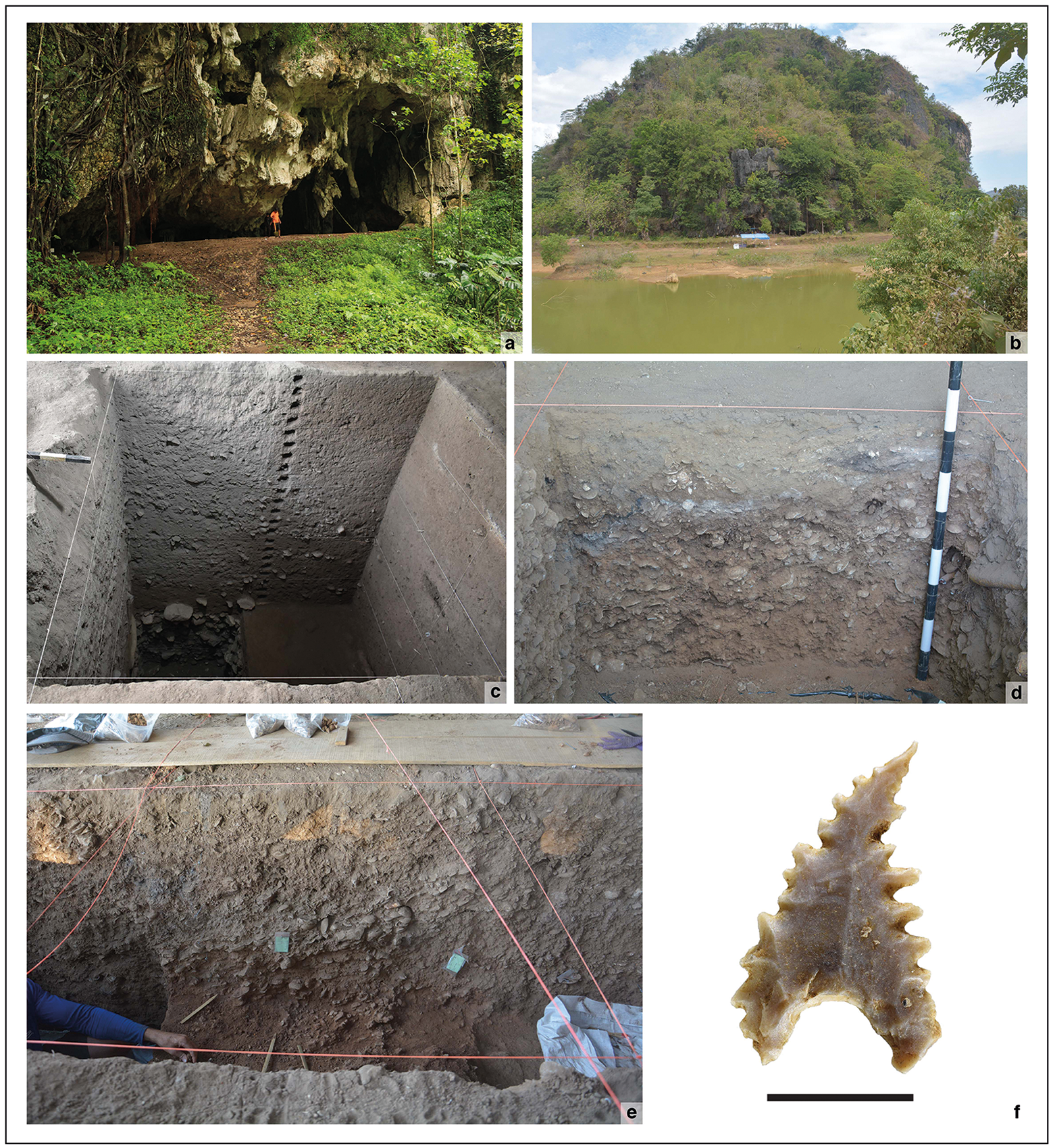
Figure 2. Archaeological contexts of the perforated shark teeth: a) Leang Panninge cave; b) cave entrance at Leang Bulu’ Sipong 1, at the foot of the isolated limestone karst tower; c) stratigraphic profile, Leang Panninge (2019); d–e) stratigraphic profiles, Leang Bulu’ Sipong 1 (2018); f) Maros point excavated from Leang Bulu’ Sipong 1 (Square T9S1) above the Toalean-associated layer that yielded the shark tooth (scale bar is 10mm) (photographs and image compilation by Y. Perston).
Materials and methods
The shark-tooth artefacts and their contexts
Two perforated shark-tooth artefacts were recovered from Toalean contexts during excavations as part of a joint Indonesian-Australian archaeological research programme. The artefacts, described here for the first time, are identified as the teeth of tiger sharks (Galeocerdo cuvier) based on their distinctive morphology. The first tooth was excavated at Leang Panninge in 2019, a large limestone karst cave located in the Mallawa district in easternmost Maros (Hasanuddin 2017; Carlhoff et al. Reference Carlhoff2021; Figure 1). The Indonesian-Australian team exposed a sequence of undisturbed and well-stratified archaeological deposits to a depth of 3m, without reaching bedrock (Carlhoff et al. Reference Carlhoff2021; Figure 2). Layer 1 (dated c. 1500 cal BP) contained a mix of Austronesian pottery sherds and Toalean backed microliths. Below this was a sequence of pre-ceramic Toalean occupation deposits (Layers 2–4) that accumulated between approximately 7900 and 3700 cal BP. No Toalean artefacts were found in the cultural layers below (Layer 5, c. 9400–8700 cal BP, and Layers 6–8, as yet undated; Carlhoff et al. Reference Carlhoff2021). The perforated shark tooth was recovered from square S17T7 in Layer 4, the earliest Toalean occupation deposit, at roughly the same depth (1.80–1.85m) as a rare Toalean burial dated to 7300–7200 cal BP that provided material for aDNA analysis (Carlhoff et al. Reference Carlhoff2021). Layer 4 comprised a silty clay containing a rich Toalean assemblage, including numerous Maros points. A burnt Canarium sp. seed recovered from the same spit and in the same layer as the shark tooth (Spit 38, Layer 4) yielded an AMS radiocarbon age of 7166–6977 cal BP (D-AMS 035758) at 95.4% probability (Carlhoff et al. Reference Carlhoff2021). This result and other AMS dates obtained from charcoal samples and burnt seeds in Layer 4 lead us to infer a time range of c. 7000–5000 cal BP for the Leang Panninge shark tooth.
The second perforated shark-tooth artefact was recovered from Leang Bulu’ Sipong 1, a small limestone cave in the lowland karst area of Pangkep (Figure 1). Indonesian-Australian excavations in 2018 recovered the shark tooth in association with Toalean artefacts at a depth of 0.9–1m below the surface in Spit 9 of Square T9S1 (Figure 2). Stratigraphic mixing of the uppermost deposit is evident from two ‘modern’ radiocarbon dates returned on charcoal collected from Spits 3 and 4. Below these near-surface levels, the Toalean deposit showed evidence for ancient anthropogenic disturbance and reworking. The shark tooth belongs to an occupation deposit of unambiguous Toalean association, and a charcoal sample collected from Spit 8 (0.8–0.9m below surface), just above the find location of the shark tooth, gives a radiocarbon age of 6920–6780 cal BP (Wk-14158) at 95.4% probability. This suggests that the Leang Bulu’ Sipong 1 tooth potentially belongs to the same timespan as the Leang Panninge specimen.
Use-wear and residue analysis
Each tooth underwent minimal handling and only gentle washing in fresh water to remove adhering sediment before transport to Griffith University. The artefacts were first examined non-invasively using a Zeiss Stemi 508 stereomicroscope fitted with an Axiom 105 camera, as well as an Olympus DSX1000 digital microscope, to identify patterns of microwear. Metrics were collected using Mitutoyo CD-6" digital callipers. Next, in order to determine the presence of residues and characterise the material, a Fourier Transform Infrared (FTIR) spectroscopy study was conducted using a Spotlight 400 infrared microscope (PerkinElmer) in combination with the Spectrum 3 FTIR (PerkinElmer). The FTIR spectra were acquired between 4000cm–1 and 650cm−1 with a resolution of 8cm−1 using the SpectrumIMAGE software. Spectra from multiple locations were generated and analysed with the Spectrum MultiSearch software and National Institute of Standards and Technology spectral database.
Each tooth was then subjected to more invasive residue analysis, in this case the removal of residues onto pre-cleaned microscope slides using an ultra-purified water pipette guided by a Dino-Lite microscope. This procedure was targeted, with most residues left in situ on the artefact surface. High-powered microscopy (200–400×) of the residues was completed using a Leitz Dialux 22 microscope with polarising capability. A Tucsen ISH 500 camera was used to photograph lifted residues in plane, part polarised and cross polarised light at magnifications of 250× and 400×.
Experimental use-wear analysis
To distinguish traces of wear produced anthropogenically from that accrued during the life of the animal, we examined a sample of unaltered tiger shark teeth. Previously, Becker and Chamberlain (Reference Becker and Chamberlain2012: 112) had classified damage to serrated shark teeth from a sample of 50 jaws belonging to great white shark (Carchaodon carcharias), bull shark (Carcharhinus leucas) and tiger shark (Galeocerdo cuvier) in four categories: labial damage on the tooth cusp apex; labial damage on the mesial edge; lingual damage on the tooth cusp apex; and lingual damage on the mesial edge (Figure 3). Our own examination of 250 individual, unmodified tiger shark teeth bought from an ethical supplier for this study found a similar distribution of damage, with approximately 40 per cent of the teeth displaying some form of damage (from minuscule flakes to larger breakage of the apical cusp). Analogous damage was also observed on three sets of intact tiger shark jaws curated at the Queensland Museum.
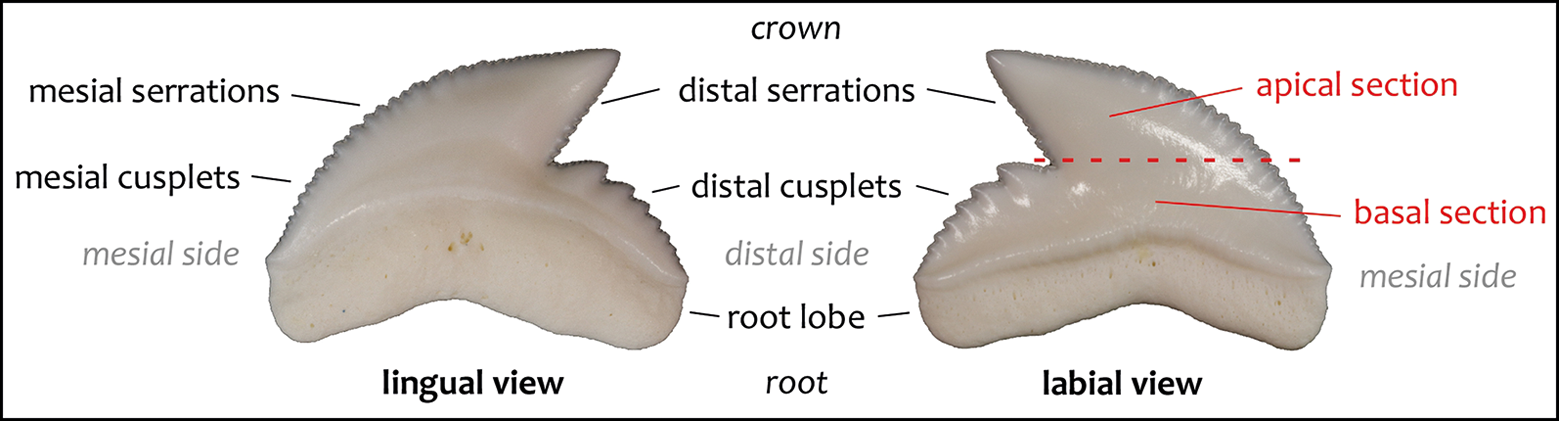
Figure 3. Terms for describing serrated shark teeth, shown here on a modern tiger shark (Galeocerdo cuvier) tooth (figure by M. Langley).
Ethnographic examples suggest that shark teeth perforated through the root are, and were, most commonly used to make knives and fighting tools, with teeth hafted one below another in a series (Edge-Partington Reference Edge-Partington1896; Roth Reference Roth1904; Murdoch Reference Murdoch1923; Dodge Reference Dodge1939; Martin et al. Reference Martin, Quimby and Collier1947; Borhegyi Reference Borhegyi1961; Maude & Maude Reference Maude and Maude1981; Illidge Reference Illidge2002). To examine the accumulation of damage to hafted teeth during use, we made three such tools using modern tiger shark teeth that exhibited no prior damage (see online supplementary material (OSM), Section 4.2 for full details). To understand what kinds of damage shark-tooth tools accrue, we conducted a small experiment. For each of the three replica tools, two teeth were perforated and hafted to a plywood shaft, fitting snugly into a groove made to house the basal section (see OSM Figure S5). Cotton twine was then passed through the perforations to tie them down. To secure the teeth further, we used a commercial superglue to fill the groove around the tooth base. The use of modern materials was deemed suitable for this experiment as the primary focus was the use-wear formed on the apical section of the shark teeth.
One tool was used to scrape fresh bamboo, the second to butcher a leg of uncooked pork and the third in the striking manner of a fighting knife. As expected, the shark-tooth edges were efficient for cutting softer surfaces. The tool used to butcher the raw pork easily managed this task, but it developed significant chipping and crushing wear to the apex and mesial serrations despite being used for fewer than 30 minutes. The tool used to scrape bamboo similarly developed wear after 20 minutes, the mesial serrations wearing down to an almost flat aspect. Finally, the tool used as a fighting knife—which we repeatedly struck into a leg of fresh pork using a swift and forceful down-and-slicing motion—created deep, long gashes in the flesh and fractured one of the shark teeth at the haft level on the 30th blow. The remaining tooth suffered pronounced chipping to the cusp apex (see OSM Figure S5). After use, each tooth was examined using the microscopes listed above. Results are comparable with patterns of use-wear reported from the experimental use of shark teeth as arrowheads and cutting, piercing, scraping and sawing tools (Gilson et al. Reference Gilson, Gates St-Pierre, Lominy and Lessa2021).
The Toalean tiger shark-tooth artefacts
The teeth of the tiger shark are distinctive to this species, their morphology consistent across both their upper and lower jaws (Figure 3). The teeth differ only in size, with the largest sitting in the anterior section and becoming progressively smaller towards the back of the jaw. The Sulawesi archaeological specimens are similar in size and are estimated to have each come from animals approximately 2m in length, that is, subadults close to adult size (see OSM Section 1.2). Both artefacts are in an excellent state of preservation, with surfaces clear of obscuring sediments, and have not been subject to post-depositional breakage. Anthropogenic alterations are clearly visible under low magnification, allowing for detailed traceological assessment (Figure 4).
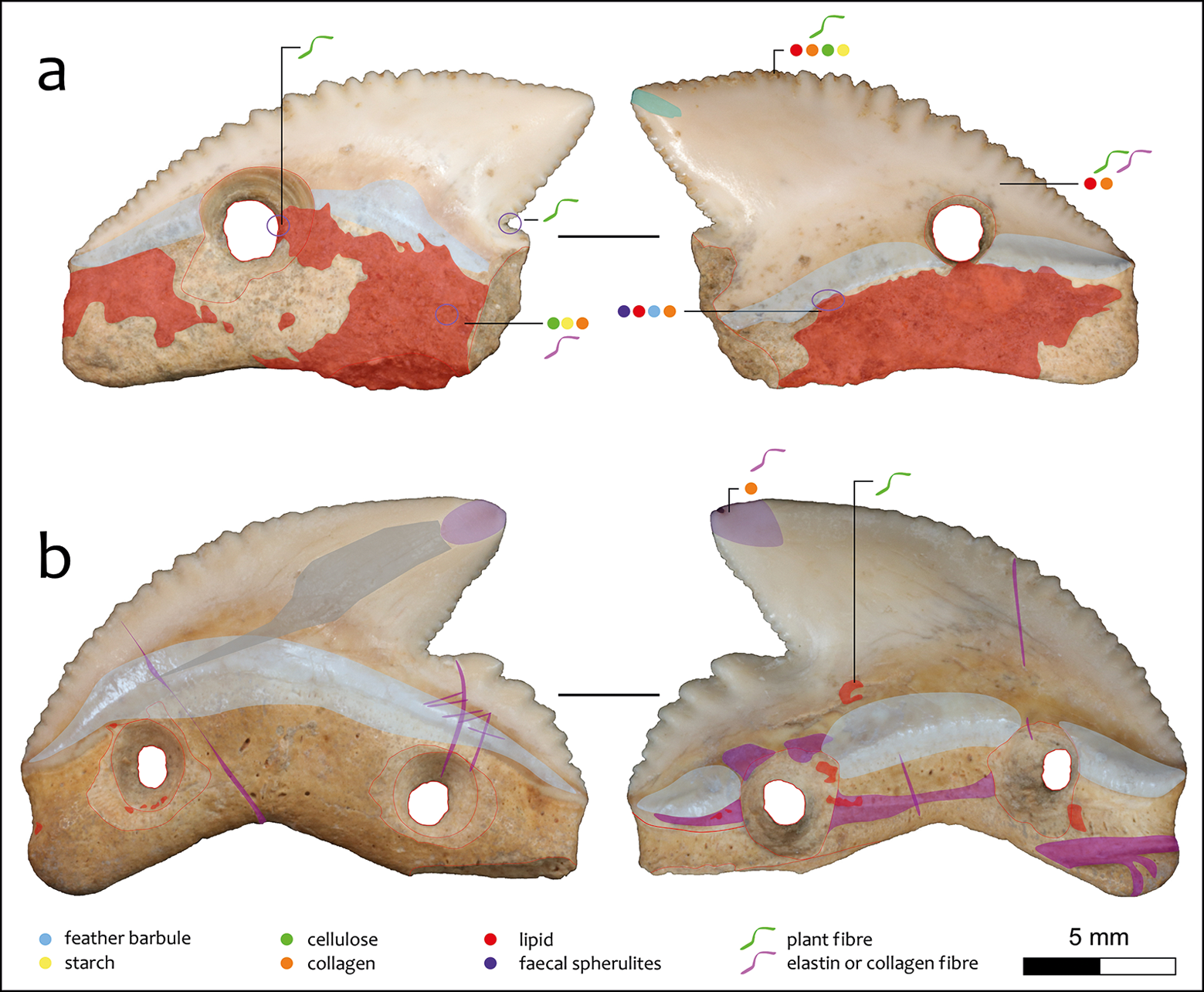
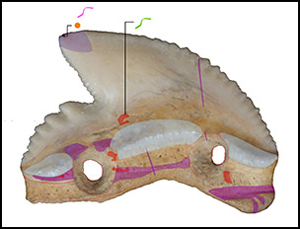
Figure 4. Distribution of anthropogenic manufacturing traces, use-wear and residues on the Leang Bulu’ Sipong 1 (a) and Leang Panninge (b) tiger shark-tooth artefacts. Red shading indicates the presence of adhesive residue with red colouring; light blue shading indicates bright polish; bright purple shading highlights grooves from ligatures; light purple shading highlights ground facets; aqua shading at the tooth tip indicates a large chip; and grey shading is a dense striation cluster (figure by M. Langley).
The Leang Panninge artefact has two bilaterally drilled perforations through the basal section of the tooth. The perforation walls exhibit concentric striations produced by a stone-tipped drill bit (Figure 5; see also OSM Figure S9). The edges of these perforations display wear from ligatures pulling down and to the sides of the tooth, as well as up towards the tooth shoulder. Notches and grooves leading from the perforation edges to these locations, as well as between the perforations themselves, are evident (Figures 4 & 5b & d). A red residue is associated with these features (Figure 4). Remnants of a cut notch also indicate that the distal side of the root lobe was removed before use (Figure 5). This created a flat surface, a common feature of archaeologically recovered shark-tooth tools (Cushing Reference Cushing1896; Furrey Reference Furrey1977; Charpentier et al. Reference Charpentier, Méry, Fortini and Pellé2009) that experimental reconstructions have shown to be important for the stable hafting of the teeth (Gilson et al. Reference Gilson, Gates St-Pierre, Lominy and Lessa2021). The presence of a damaged plant fibre adhering to the red stained area just above the basal ledge (Figure 5) gives an indication of the type of ligature used. A halo of bright polish across the basal ledge on both the lingual and labial surfaces is probably caused by the haft having covered the tooth up to this section (Figure 4). Striations associated with ligatures and coarse inclusions are found across this polish (see OSM Figure S11). All these traces testify to the use of tightly bound ligatures overlaid with an adhesive that included a red colourant.

Figure 5. Use-related features of the Leang Panninge shark tooth: a) ground facet (indicated by red arrowhead) and striations on the lingual surface; b) grooves between the perforation and tooth shoulder from ligatures; c) plant fibre associated with hafting; d) cut notches along the base and grooves from ligatures (both indicated by red arrowheads) on the labial surface. White scale bars = 1mm (image c by B. Stephenson; all other images by M. Langley).
We identified traces of use on the Leang Panninge tooth. A series of long, deep and sub-parallel striations are visible on the lingual side of the apical section, as are cup-shaped flakes (Figure 5a). Many of the mesial and distal serrations have worn down and a facet has been ground on both the lingual and labial faces of the apex, using a fine-grained tool (Figure 5a). This facet may have been produced to repair or otherwise resharpen the tooth. Residue analysis of the tip found collagen structures, which, together with the use-wear present, indicates that this tool is likely to have been used for piercing, cutting and scraping fresh flesh and bone, consistent with the experimental results from the pork butchery (Gilson et al. Reference Gilson, Gates St-Pierre, Lominy and Lessa2021).
The distal side of the Leang Bulu’ Sipong 1 tooth was broken in antiquity, possibly during use, and thus apparently resulting in its discard before it could develop the intensive wear observed on the Leang Panninge artefact. A single perforation survives, drilled unilaterally from the lingual surface with a stone-tipped drill (Figure 6a). It is impossible to determine whether there was originally a second perforation, as its likely location would be on the missing part of the tooth; its presence might be inferred from the fracture itself as perforations create weak points likely to cause breakage (Stiner et al. Reference Stiner, Kuhn and Gülec2013; Tejero et al. Reference Tejero, Bar-Oz, Bar-Yosef, Meshveliani, Jakeli, Matskevich, Pinhasi and Belfer-Cohen2021). As with the previous artefact, a large notch has been worn into the lower mesial side of the perforation edge, indicating tightly bound ligatures (Figure 4). Again, the presence of a damaged plant fibre adhering to the perforation wall suggests that the ligature was composed of plant material (Figure 6a & b). Plant and collagen fibres were also found just above the perforation on the labial surface and wedged into the shoulder of the tooth (Figures 4 & 6e). As on the Leang Panninge artefact, hafting was also assisted by the removal of the distal edge of the root lobe.
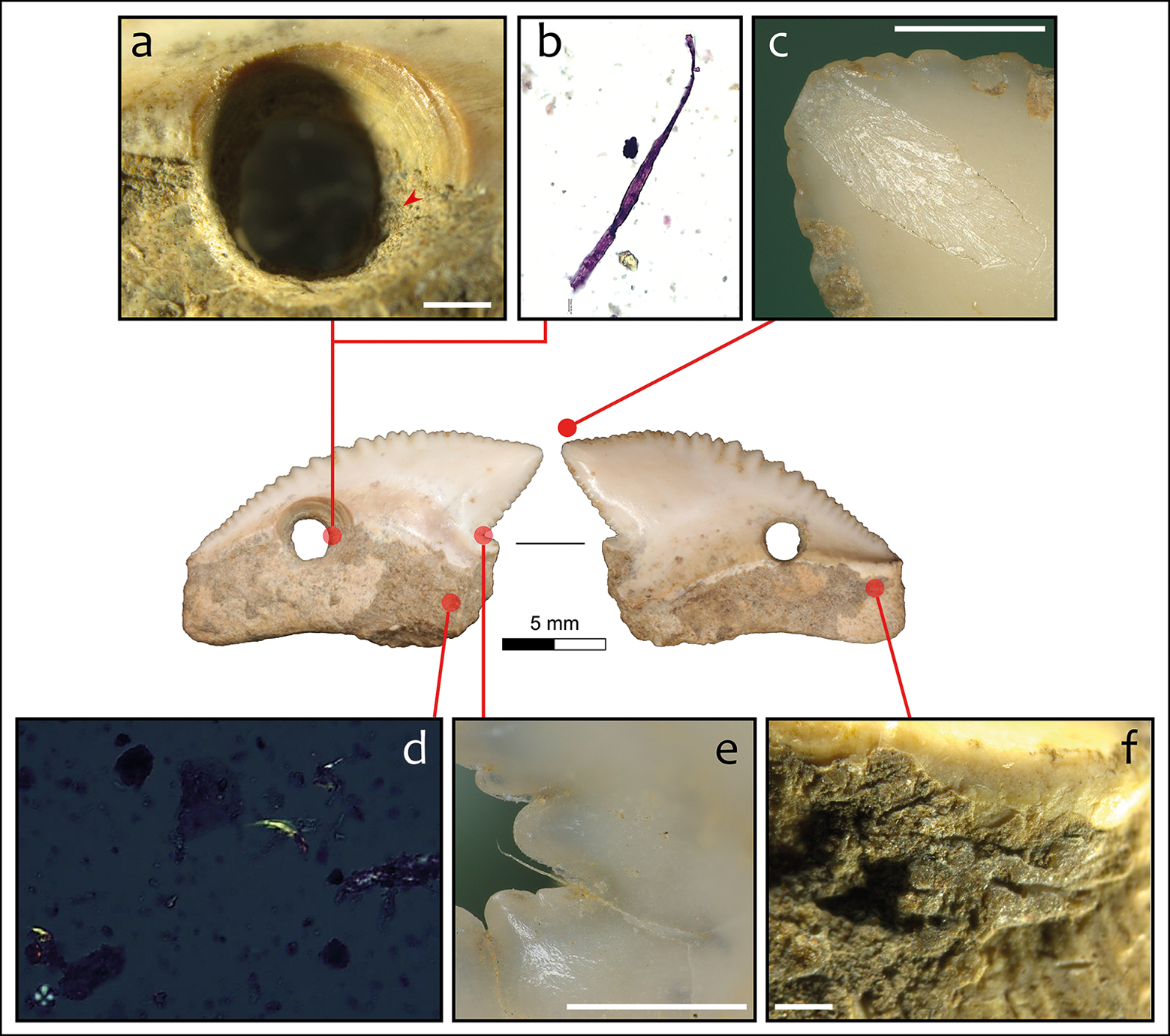
Figure 6. Use-related features of the Leang Bulu’ Sipong 1 shark tooth: a & b) location of plant fibre within the drilled perforation; c) long flake scar and residues on the labial surface; d) collagen and isolated starch granule; e) remnant of ligature fibre adhering to the tooth shoulder; f) remnant of adhesive used in hafting. White scale bars = 1 mm except for (e) which is 0.5mm (images b and d by B. Stephenson; all other images by M. Langley).
More evident on the Leang Bulu’ Sipong 1 artefact is the adhesive used to help secure the tooth within its haft. Almost the entire root lobe is covered with remnants of an adhesive which included a red colourant (Figures 4 & 6f). Microscopic analysis of this residue shows collagenous structures and amorphous cellulose, while FTIR indicates the presence of ozokerite (‘earth wax’). Together, these results suggest that the adhesive was probably a combination of mineral, plant and animal material (specifically muscle tissue, see OSM Section 5). Such mixing of materials has previously been observed in mastics dating to the Middle Stone Age in Africa (Wadley et al. Reference Wadley, Williamson and Lombard2004) and the Middle Palaeolithic in Europe (Boëda et al. Reference Boëda, Bonilauri, Connan, Jarvie, Mercier, Tobey, Valladas and Sakhel2008; Degano et al. Reference Degano, Soriano, Villa, Pollarolo, Lucejko, Jacobs, Douka, Vitagliano and Tozzi2019). Just above this residue, a hafting halo of bright polish indicates that about half of this tooth was covered by its haft, like the Leang Panninge specimen (Figure 4).
The mesial serrations display chipping and rounding, though not as severe as on the Leang Panninge tooth. Several shallow striations on both sides of the crown run from the tip, along with small cup-shaped flakes. Most obvious is the removal from the lingual surface of a large, shallow flake that stems from the apical tip (Figure 6c). Similar flaking damage was produced through impact and piercing actions observed in reproduction experiments of tiger shark teeth (Becker & Chamberlain Reference Becker and Chamberlain2012; see OSM Figure S5). This use-wear is thus consistent with piercing, cutting and scraping of flesh and bone (Gilson et al. Reference Gilson, Gates St-Pierre, Lominy and Lessa2021).
Residues accumulated between the serrations and within the chip scars along the cutting edges of the Leang Bulu’ Sipong 1 tooth (Figure 6c; see also OSM Figure S6). The analysis of residues from the apical serrations found lipids, amorphous cellulose and muscle tissue, damaged plant fibres, and an isolated starch granule. A lipid and plant fibre bundle as well as a collagen fibre were also found on the lower mesial side of the cutting edge (Figure 4; see also OSM Table S3). Residues accumulated during use also tend to become caught within the hafts of the tools; the analysis of one section of adhesive on the labial surface found a large collagen fibre bundle, part of a feather barbule, lipid structures and faecal spherulites (Figure 4; see also OSM Table S3). These residues are consistent with the results of use-wear analysis, indicating the cutting of animal and plant materials.
Discussion
The two perforated shark-tooth artefacts from Toalean contexts in South Sulawesi show a range of manufacture and use traces. While the recovery of modified and utilised shark teeth at coastal archaeological sites globally is not uncommon, such artefacts are generally restricted to contexts less than 5000 years old (see OSM Table S1). Some modified teeth have been recovered from older contexts: a solitary tiger shark tooth featuring a single perforation from Buang Merabak (New Ireland, Papua New Guinea) is dated to between c. 39 500 and 28 000 years ago (Leavesley Reference Leavesley2007); 11 teeth with single perforations from Kilu (Buka Island) are dated to between c. 9000 and 5000 years ago (Wicker Reference Wicker1990); and an unspecified number of teeth from Garivaldino (Brazil) is dated to between c. 9400 and 7200 years ago (Mentz Ribeiro & Torrano Ribeiro Reference Ribeiro, & C and Ribeiro2001). In these cases, the artefacts are interpreted as personal ornaments. Indeed, almost all shark-tooth artefacts recovered globally have thus far either been found in contexts demonstrating their use as adornments (e.g. in burials) or their alterations have been interpreted as indicative of an ornamental function (see OSM Table S1). This is the case for seven teeth with single perforations found in a context and of a date similar to that of our Sulawesi teeth in Pawon Cave (western Java, Indonesia), but which are yet to be published and require further analysis (Yondri Reference Yondri2017).
Our two Toalean shark-tooth artefacts, dated to c. 7000–5000 cal BP, present a different situation. Each was hafted and used as part of a composite cutting implement. Residue analysis suggests that the ligatures that bound the teeth were plant-based, while the adhesive agent may have been a mix of mineral, animal and plant components. Combined use-wear, residue and experimental analyses indicate that the teeth were used to pierce, cut and scrape flesh and bone, and that bird and plant material may also have been handled. While these residues may superficially suggest that Toalean people were using shark-tooth knives as everyday cutting implements, a review of the ethnographic, archaeological and experimental data finds this interpretation unlikely.
Numerous societies across the globe have integrated shark teeth into their material culture, with those living on coastlines (and actively fishing for sharks) more likely to incorporate greater numbers of teeth into a wider range of artefacts (see OSM Section 2). The ethnographic literature indicates that, when not used to adorn the human body, shark teeth were, almost universally, used to create blades for conflict or ritual. For example, the north Queensland fighting knife, one of the best known Australian Aboriginal fighting tools, has a single, long blade made from approximately 15 shark teeth placed one after the other, and was used to strike the flank or buttocks of an adversary (Roth Reference Roth1904). Weapons—including lances, knives and clubs—armed with shark teeth are known from mainland New Guinea and Micronesia (Edge-Partington Reference Edge-Partington1896), while lances formed part of the mourning costume in Tahiti (Illidge Reference Illidge2002). Further east, the peoples of Kiribati are renowned for their shark-tooth daggers, swords, spears and lances, which were used in highly ritualised, and often fatal, conflicts (Murdoch Reference Murdoch1923; Maude & Maude Reference Maude and Maude1981). In South America, Gapar de Espina in 1516 described how the coastal peoples of Panama, “had pikes and lances fashioned like pikes … studded for a distance of half a yard from the tip with the teeth of the shark and other fish” (cited in Charpentier et al. Reference Charpentier, Méry, Fortini and Pellé2009: 15). In Florida, shark teeth are known to have been embedded into long, straight wooden handles to make cudgels (Martin et al. Reference Martin, Quimby and Collier1947), while in western Asia a bull shark (Carcharhinus leucas) tooth projectile point was found embedded in the lumbar vertebrae of an adult individual buried at Ra’s al Hamra 5 in Oman (Santini Reference Santini, Tosi and Zarins2002).
Shark teeth found in Mayan and Mexican archaeological contexts are widely thought to have been used for ritualised bloodletting (Borhegyi Reference Borhegyi1961), and shark teeth are known to have been used as tattooing blades in Tonga, Aotearoa (New Zealand) and Kiribati (Roth Reference Roth1906; Drew et al. Reference Drew, Philipp and Westneat2013). In Hawai‘i, so-called ‘shark-tooth cutters’ were used as concealed weapons and for “cutting up dead chiefs and cleaning their bones preparatory to the customary burials” (Dodge Reference Dodge1939: 157). The well-preserved organic material culture of Florida appears to be the only setting in which shark-tooth tools are not specifically linked to conflict and/or ritual activities; there, shark-tooth blades were used as part of the woodcarving toolkit, an art which was preeminent in the region (Cushing Reference Cushing1896; Furrey Reference Furrey1977; Steinen Reference Steinen and Sears1982).
Our experiments found that tiger shark-tooth knives were equally effective in creating long, deep gashes in the skin when used to strike (as in fighting) as when butchering a leg of fresh pork. Indeed, the only negative aspect to the use of this material is that it becomes blunt relatively quickly. This wearing of the tooth edge is observed in live sharks, but a continual cycle of tooth replacement serves to keep ahead of the quickly accumulating damage to their primary teeth (Whitenack et al. Reference Whitenack, Simkins and Motta2011). This, as well as the sharks’ ability to inflict deep lacerations, probably explains why shark teeth were largely restricted to weapons for conflict and ritual activities in the ethnographic present and recent past.
To explore whether the Toalean shark teeth may have been part of a fighting knife (or similar weapon), several ethnographic implements from north Queensland and Aua Island (Papua New Guinea) were examined to compare design and use-wear (Figure 7; see also OSM Section 2.1). While it is not possible to determine whether the shark teeth arming the Queensland fighting knives were perforated before being fixed in resin adhesive, those from Aua Island each feature a centrally located perforation in their basal section. One Aua knife displays the dual use of ligature and adhesive. The perforations and cutting edges of these fighting tools all demonstrate use-wear consistent with that of our Toalean artefacts.

Figure 7. Example of a shark-tooth knife from Aua Island, Papua New Guinea (University of Queensland Anthropology Museum no. 1383). Red arrowheads highlight use-related wear. Note the ligatures passing through the perforations in each tooth and forming a diamond pattern along the haft (photograph of the knife courtesy of the University of Queensland Anthropology Museum; microscope images and figure by M. Langley).
We argue that our Toalean shark-teeth artefacts were more than everyday knives on the basis of: the traceological confirmation of hafting techniques; the results of residue and use-wear analyses suggesting that the shark teeth were used to cut and scrape flesh and bones but became blunt quickly; the preponderance of fighting and/or ritual use of shark-tooth blades in the immediate and wider surroundings of Sulawesi; and the consistency in design and use-wear between the archaeological teeth and ethnographic fighting tools. The flesh that these teeth cut could have been human, but this is conjectural at this stage. Whether they cut human or animal flesh, our two artefacts could provide the first evidence for the antiquity of a distinctive class of weaponry in the Asia-Pacific region. We do, however, suggest that ancient shark teeth previously found in the region should be re-examined to determine whether their interpretation as ornaments remains viable. In addition, as tiger shark corpses sink rather than float, and therefore almost never wash up on beaches (Borhegyi Reference Borhegyi1961; Baldridge Reference Baldridge1970), the acquisition of their teeth to produce artefacts hints at marine fishing and a seafaring capability for at least some Toalean groups. Finally, we draw attention to the morphological resemblance between the outline of tiger shark teeth and Maros points, especially the more asymmetrical points, and the denticulated margins that are characteristic of both (Figure 8). While this similarity may be coincidence, it could also indicate that Toalean people were drawn to using tiger shark teeth by their intriguing resemblance to their projectile points or vice versa.
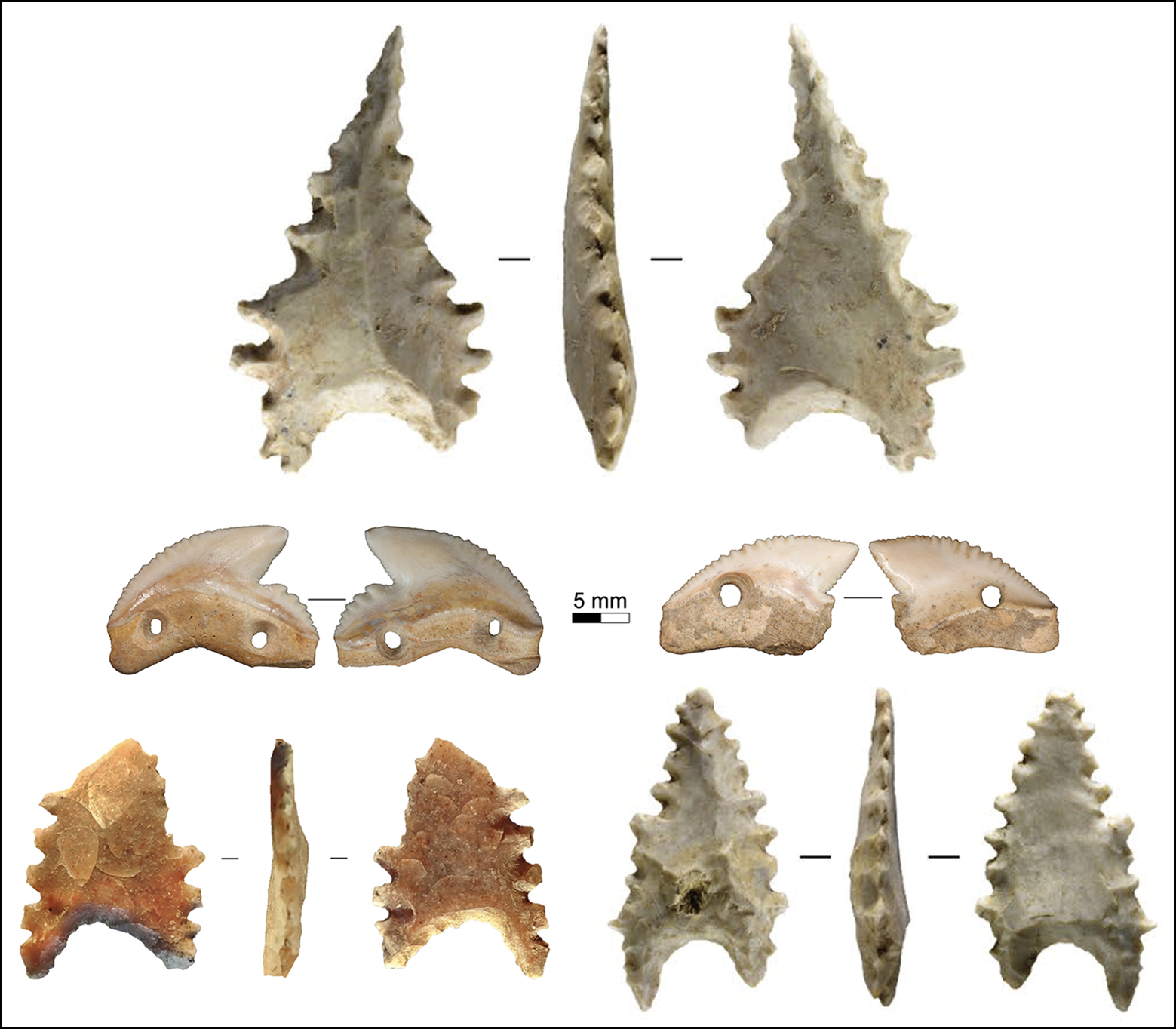
Figure 8. Comparison of the Toalean shark-tooth artefacts with examples of Maros points found at Leang Panninge (bottom left) and Leang Pajae (top and bottom right) (photographs of Maros points by Y. Perston; figure by M. Langley).
Conclusion
The discovery of two modified and utilised tiger shark teeth in Toalean contexts in Sulawesi expands our knowledge of the non-lithic material culture of these mid-Holocene hunter-gatherers of Indonesia. They also provide what could be the earliest evidence in the region for the use of shark teeth as components of hafted weapons, a use for which there are abundant ethnographic examples in the Asia-Pacific region. Indeed, comparison with archaeological and ethnographic datasets regarding the use of shark teeth globally finds that these artefacts were likely to have been linked to ritual and/or conflict activities, an aspect that archaeological research dedicated to Toalean society has hitherto been unable to document. The re-examination of similar finds from the region should throw further light on the manufacture and use of shark-tooth artefacts in Australasia and the wider Pacific region.
Acknowledgements
The research was authorised by the State Ministry of Research and Technology (RISTEK) and was conducted in collaboration with the Indonesian Research Centre for Archeometry, BRIN (formerly the Pusat Penelitian Arkeologi Nasional (ARKENAS)). Indonesian archaeologists and students involved in the fieldwork include F.N. Shalawat, A.A. Qalam, K.M. Prayoga, M. Sura, A. Belzoni, Isbahuddin, K.A. Anshari, Nur Ishan D., M.N. Taufik, M.A. Oka, Suryatman and A.M. Saiful. Australian doctoral students Y. Perston and K. Newman also participated. Local field assistants included Irwan, Amar and Hardin. A. Crowther assisted with palaeobotanical identifications and R. Wood advised on radiocarbon calibration. Photographs were taken by M. Langley unless otherwise specified.
Funding statement
The excavations at Leang Panninge and Leang Bulu’ Sipong 1 were funded by an Australian Research Council Future Fellowship awarded to Adam Brumm (FT160100119), along with financial support from Griffith University.
Supplementary material
To view supplementary material for this article, please visit https://doi.org/10.15184/aqy.2023.144.


 Open access

