





1 Introduction
Antiholomorphic dynamics is developing in parallel with holomorphic dynamics. The development of holomorphic dynamics has taken off from the fine study of the structure of the Mandelbrot set for quadratic polynomials by Douady and Hubbard [Reference Douady and HubbardDH84, Reference Douady and HubbardDH85]. The Mandelbrot set was further generalized to multibrot sets for polynomials of higher degree. However, in the cubic case, the multibrot is not locally connected. To further investigate the cubic case, Milnor studied real cubic polynomials in 1992 (see [Reference MilnorMi92]). There, a prototype for the behavior in the bitransitive case was the tricorn, which is the equivalent of the Mandelbrot set for the antiholomorphic map $z\mapsto \overline {z}^2+c$
. The generalization of the tricorn was the multicorn, which appears for
$z\mapsto \overline {z}^2+c$
. The generalization of the tricorn was the multicorn, which appears for $z\mapsto \overline {z}^d+c$
. This made the link between holomorphic and antiholomorphic dynamics, and led to an increasing interest in the latter.
$z\mapsto \overline {z}^d+c$
. This made the link between holomorphic and antiholomorphic dynamics, and led to an increasing interest in the latter.
Considering holomorphic dynamics, for instance, iterations of quadratic polynomials, the interesting behavior occurs close to the boundary of the Mandelbrot set. There, periodic points with rational multipliers (also called resonant periodic points) are dense and organize the global dynamics. The local study of these periodic points sheds some light on how this dynamics is organized.
In parallel, a whole chapter of mathematics developed around the classification problem for singularities in analytic dynamics. Écalle [Reference ÉcalleE85] and Voronin [Reference VoroninV81] classified resonant fixed points of germs of one-dimensional analytic diffeomorphisms
 $$ \begin{align} f(z) = \exp\bigg(\frac{2\pi i p}{q}\bigg)z+ z^{kq+1} + O(z^{kq+2})\end{align} $$
up to conjugacy (local changes of coordinates) and derived moduli spaces for these. The moduli are constructed as follows. While a simple formal normal form exists, the formal normalizing change of coordinate generically diverges. However, there exists almost unique normalizing changes of coordinates on sectors covering a punctured neighborhood of the fixed point. The modulus is given by the mismatch between these almost unique normalizing changes of coordinates. The moduli spaces are huge, namely functional spaces, thus highlighting the richness of the different geometric behaviors of these singularities. Explaining this richness came from two directions. To highlight this, let us focus on the simplest case of a double singular point, called a codimension $1$
parabolic point (
$1$
parabolic point ( $p=q=k=1$
in (1.1)). The normal form in this case is the time-one map of the flow of a vector field
$p=q=k=1$
in (1.1)). The normal form in this case is the time-one map of the flow of a vector field ${z^2}/({1+bz})\;({\partial }/{\partial z}) $
. Since a double fixed point can be seen as the merging of two simple fixed points, it is natural to unfold the germ of an analytic diffeomorphism in a family splitting the double fixed point into two simple fixed points. Two independent attempts to understand the dynamics developed in parallel. On the one hand, there were studies in the parameter directions in which the simple fixed points were linearizable (see for instance [Reference MartinetMa87, Reference GlutsyukGl01]). In the neighborhood of each fixed point, the diffeomorphism is analytically conjugate to the normal form given by the time-one map of the flow of a vector field
${z^2}/({1+bz})\;({\partial }/{\partial z}) $
. Since a double fixed point can be seen as the merging of two simple fixed points, it is natural to unfold the germ of an analytic diffeomorphism in a family splitting the double fixed point into two simple fixed points. Two independent attempts to understand the dynamics developed in parallel. On the one hand, there were studies in the parameter directions in which the simple fixed points were linearizable (see for instance [Reference MartinetMa87, Reference GlutsyukGl01]). In the neighborhood of each fixed point, the diffeomorphism is analytically conjugate to the normal form given by the time-one map of the flow of a vector field $({z^2-{\varepsilon }})/({1+b({\varepsilon })z})\;({\partial }/{\partial z}) $
. However, generically, the two normalizations do not match. The mismatch is a modulus of the unfolding for these parameter values and the limit of this mismatch when the fixed points merge together is the Écalle–Voronin modulus. This approach could not work in the parameter directions, where either at least one simple fixed point is not normalizable or the domains of normalizations have void intersections. A way through came from a visionary idea of Douady, namely, to normalize the system in some domains that contain sectors at the two fixed points and whose union covers a punctured neighborhood of the two fixed points. If the domains are appropriately chosen, then the normalizations are almost unique, thus allowing to unfold the moduli. This approach was first proposed in the thesis of Lavaurs [Reference LavaursL89] and normalizing coordinates were constructed by Shishikura [Reference ShishikuraS00]. The method could be generalized to cover all directions in parameter space and led to constructions of moduli for germs of unfoldings of parabolic points ([Reference Mardešić, Roussarie and RousseauMRR94] for the generic case and [Reference RibónRi08] for the general case). The generalization involves taking domains spiraling when approaching the fixed points. Furthermore, the moduli space was identified in [Reference Christopher and RousseauCR14].
$({z^2-{\varepsilon }})/({1+b({\varepsilon })z})\;({\partial }/{\partial z}) $
. However, generically, the two normalizations do not match. The mismatch is a modulus of the unfolding for these parameter values and the limit of this mismatch when the fixed points merge together is the Écalle–Voronin modulus. This approach could not work in the parameter directions, where either at least one simple fixed point is not normalizable or the domains of normalizations have void intersections. A way through came from a visionary idea of Douady, namely, to normalize the system in some domains that contain sectors at the two fixed points and whose union covers a punctured neighborhood of the two fixed points. If the domains are appropriately chosen, then the normalizations are almost unique, thus allowing to unfold the moduli. This approach was first proposed in the thesis of Lavaurs [Reference LavaursL89] and normalizing coordinates were constructed by Shishikura [Reference ShishikuraS00]. The method could be generalized to cover all directions in parameter space and led to constructions of moduli for germs of unfoldings of parabolic points ([Reference Mardešić, Roussarie and RousseauMRR94] for the generic case and [Reference RibónRi08] for the general case). The generalization involves taking domains spiraling when approaching the fixed points. Furthermore, the moduli space was identified in [Reference Christopher and RousseauCR14].
Generalizations to parabolic fixed points of multiplicity $k+1$
(that is, codimension k) were made possible again through the visionary ideas of Douady, who sensed that the structure of domains on which to perform the normalizations was linked to the dynamics of polynomial vector fields
$k+1$
(that is, codimension k) were made possible again through the visionary ideas of Douady, who sensed that the structure of domains on which to perform the normalizations was linked to the dynamics of polynomial vector fields $P(z) ({\partial }/{\partial z})$
on
$P(z) ({\partial }/{\partial z})$
on ${\mathbb C}$
. In that case, a full generic unfolding involves k independent parameters. The first step performed by Oudkerk [Reference OudkerkO99] covered some directions in parameter space. A few years later, the systematic study of the generic polynomial vector fields was finalized in [Reference Douady, Estrada and SentenacDES05]. Using these results, the methods of [Reference Mardešić, Roussarie and RousseauMRR94] can be generalized to cover the full parameter space. Again, almost unique normalizations exist on domains that have spiraling sectors attached to two fixed points. These can be used to define a modulus of analytic classification for generic germs of unfoldings of parabolic fixed points of codimension k [Reference RousseauRo15]. (Note that [Reference RibónRi08] treats the case of
${\mathbb C}$
. In that case, a full generic unfolding involves k independent parameters. The first step performed by Oudkerk [Reference OudkerkO99] covered some directions in parameter space. A few years later, the systematic study of the generic polynomial vector fields was finalized in [Reference Douady, Estrada and SentenacDES05]. Using these results, the methods of [Reference Mardešić, Roussarie and RousseauMRR94] can be generalized to cover the full parameter space. Again, almost unique normalizations exist on domains that have spiraling sectors attached to two fixed points. These can be used to define a modulus of analytic classification for generic germs of unfoldings of parabolic fixed points of codimension k [Reference RousseauRo15]. (Note that [Reference RibónRi08] treats the case of $1$
-parameter unfoldings.) Identifying the moduli space is still open for
$1$
-parameter unfoldings.) Identifying the moduli space is still open for $k>1$
.
$k>1$
.
A similar program can be carried for multiple fixed points (also called parabolic points) of germs of antiholomorphic diffeomorphisms
 $$ \begin{align} f(\overline{z}) = \overline{z}\pm \tfrac12 \overline{z}^{kq+1} + O(\overline{z}^{kq+2})\end{align} $$
and their unfoldings. The analytic classification of such germs was done in [Reference Godin and RousseauGR21]. The similarities with the holomorphic case come from the fact that the second iterate of an antiholomorphic map is holomorphic, and hence results on holomorphic parabolic points are relevant. The differences are at the parameter level. The holomorphic or antiholomorphic dependence of an antihomorphic diffeomorphism on parameters is not preserved by iteration. This comes from the fact that the condition for a multiple fixed point to have multiplicity $k+1$
has real codimension k and a generic unfolding depends real-analytically of k real parameters. The classification problem of codimension
$k+1$
has real codimension k and a generic unfolding depends real-analytically of k real parameters. The classification problem of codimension $1$
unfoldings (parabolic points of multiplicity
$1$
unfoldings (parabolic points of multiplicity $2$
) has been completely studied in [Reference Godin and RousseauGR23], including identifying the moduli space.
$2$
) has been completely studied in [Reference Godin and RousseauGR23], including identifying the moduli space.
In this paper, we consider the higher codimension k case. Usually, a conjugacy of parameterized families of dynamical systems involves a change of parameter, which governs which member of the first family is conjugate to which member of the second family. In a generic holomorphic unfolding of a parabolic germ, there is a choice of a canonical multi-parameter ${\varepsilon }=({\varepsilon }_0, \ldots , {\varepsilon }_{k-1})$
, which is unique up to the action of the rotation group of order k. A modulus of analytic classification for such a generic unfolding
${\varepsilon }=({\varepsilon }_0, \ldots , {\varepsilon }_{k-1})$
, which is unique up to the action of the rotation group of order k. A modulus of analytic classification for such a generic unfolding $g_{\varepsilon }$
is given by a measure of how much
$g_{\varepsilon }$
is given by a measure of how much $g_{\varepsilon }$
differs from its formal normal form given by the time one map
$g_{\varepsilon }$
differs from its formal normal form given by the time one map $v_{\varepsilon }^1$
of a vector field
$v_{\varepsilon }^1$
of a vector field
 $$ \begin{align}v_{\varepsilon}=\frac{z^{k+1} + {\varepsilon}_{k-1}z^{k-1} +\cdots+ {\varepsilon}_1 z + {\varepsilon}_0}{1+b({\varepsilon})z^k}\,\frac{\partial} {\partial z}.\end{align} $$
The normal form is invariant under $(z,{\varepsilon }_0, \ldots , {\varepsilon }_{k-1}) \mapsto (\tau z, \tau {\varepsilon }_0, \ldots , \tau ^{-(k-2)}{\varepsilon }_{k-1})$
, with
$(z,{\varepsilon }_0, \ldots , {\varepsilon }_{k-1}) \mapsto (\tau z, \tau {\varepsilon }_0, \ldots , \tau ^{-(k-2)}{\varepsilon }_{k-1})$
, with $\tau ^k=1$
. Additionally, in the particular case where
$\tau ^k=1$
. Additionally, in the particular case where $\overline {b({\varepsilon })}=b(\overline {\varepsilon })$
, then for real
$\overline {b({\varepsilon })}=b(\overline {\varepsilon })$
, then for real ${\varepsilon }$
, there are k invariant lines under the dynamics and each choice of canonical parameter is associated to an invariant line.
${\varepsilon }$
, there are k invariant lines under the dynamics and each choice of canonical parameter is associated to an invariant line.
In the antiholomorphic case, we consider generic unfoldings depending real-analytically on k real parameters. We show that for k odd, there is a unique choice of canonical parameters. For k even, the only freedom is the action on parameters of $z\mapsto -z$
. Hence (up to conjugating with
$z\mapsto -z$
. Hence (up to conjugating with $z\mapsto -z$
when k is even), any conjugacy between two unfoldings must preserve the canonical parameters. Moreover, a change of coordinate and move to the canonical parameters prepares the family to a form
$z\mapsto -z$
when k is even), any conjugacy between two unfoldings must preserve the canonical parameters. Moreover, a change of coordinate and move to the canonical parameters prepares the family to a form $f_{\varepsilon }$
naturally, compared with a formal normal form, where
$f_{\varepsilon }$
naturally, compared with a formal normal form, where ${\varepsilon }=({\varepsilon }_0, \ldots {\varepsilon }_{k-1})$
is a real-analytic multi-parameter. This normal form is given by
${\varepsilon }=({\varepsilon }_0, \ldots {\varepsilon }_{k-1})$
is a real-analytic multi-parameter. This normal form is given by $\sigma \circ v_{\varepsilon }^{1/2}$
, where
$\sigma \circ v_{\varepsilon }^{1/2}$
, where $v_{\varepsilon }$
is defined in (1.3) and
$v_{\varepsilon }$
is defined in (1.3) and $\sigma $
is the complex conjugation, and
$\sigma $
is the complex conjugation, and $b({\varepsilon })$
is always real. Note that this normal form has no rotational symmetry (except under
$b({\varepsilon })$
is always real. Note that this normal form has no rotational symmetry (except under $z\mapsto -z$
when k is even). Moreover, the real axis is the only invariant line and a symmetry axis for (1.3).
$z\mapsto -z$
when k is even). Moreover, the real axis is the only invariant line and a symmetry axis for (1.3).
In practice, to derive a modulus, it is useful to extend ${\varepsilon }$
to
${\varepsilon }$
to ${\mathbb C}^k$
and
${\mathbb C}^k$
and $f_{\varepsilon }$
antiholomorphically in the parameter. Then, the diffeomorphism
$f_{\varepsilon }$
antiholomorphically in the parameter. Then, the diffeomorphism $g_{\varepsilon }= f_{\overline {\varepsilon }}\circ f_{\varepsilon }$
is a holomorphic unfolding of a holomorphic parabolic point of codimension k depending holomorphically on the complex parameter
$g_{\varepsilon }= f_{\overline {\varepsilon }}\circ f_{\varepsilon }$
is a holomorphic unfolding of a holomorphic parabolic point of codimension k depending holomorphically on the complex parameter ${\varepsilon }\in {\mathbb C}^k$
. A modulus of analytic classification for
${\varepsilon }\in {\mathbb C}^k$
. A modulus of analytic classification for $g_{\varepsilon }$
is given by a measure of how much
$g_{\varepsilon }$
is given by a measure of how much $g_{\varepsilon }$
differs from its formal normal form. As a result, a modulus in the antiholomorphic case is obtained from the fact that two prepared families
$g_{\varepsilon }$
differs from its formal normal form. As a result, a modulus in the antiholomorphic case is obtained from the fact that two prepared families $f_{1,{\varepsilon }}$
and
$f_{1,{\varepsilon }}$
and $f_{2,{\varepsilon }}$
are analytically conjugate under a conjugacy tangent to the identity if and only if their associated ‘squares’ defined by
$f_{2,{\varepsilon }}$
are analytically conjugate under a conjugacy tangent to the identity if and only if their associated ‘squares’ defined by $g_{j,{\varepsilon }}= f_{j,\overline {\varepsilon }}\circ f_{j,{\varepsilon }}$
are holomorphically conjugate under a conjugacy tangent to the identity.
$g_{j,{\varepsilon }}= f_{j,\overline {\varepsilon }}\circ f_{j,{\varepsilon }}$
are holomorphically conjugate under a conjugacy tangent to the identity.
We then consider several applications. As a first one, we derive the necessary and sufficient condition for the existence of an invariant real analytic curve for real values of the parameters. Of course, this curve can be rectified to the real axis. In the second application, we consider the necessary and sufficient conditions under which a germ of a generic unfolding of a holomorphic parabolic germ $g_{\varepsilon }$
has an ‘antiholomorphic square root’, that is, can be decomposed as
$g_{\varepsilon }$
has an ‘antiholomorphic square root’, that is, can be decomposed as $g_{\varepsilon }= f_{\overline {\varepsilon }}\circ f_{\varepsilon }$
, with
$g_{\varepsilon }= f_{\overline {\varepsilon }}\circ f_{\varepsilon }$
, with $f_{\varepsilon }$
antiholomorphic. These conditions are just the unfoldings of the corresponding conditions for the germ at
$f_{\varepsilon }$
antiholomorphic. These conditions are just the unfoldings of the corresponding conditions for the germ at ${\varepsilon }=0$
given in [Reference Godin and RousseauGR21] and consist in some symmetry property of the modulus. As a particular case, we show that the quadratic family
${\varepsilon }=0$
given in [Reference Godin and RousseauGR21] and consist in some symmetry property of the modulus. As a particular case, we show that the quadratic family $g_{\varepsilon }(z)= z + z^2-{\varepsilon }$
has no antiholomorphic square root for small
$g_{\varepsilon }(z)= z + z^2-{\varepsilon }$
has no antiholomorphic square root for small ${\varepsilon }$
.
${\varepsilon }$
.
As a last application, we consider the map $\overline {z}^d+c$
for
$\overline {z}^d+c$
for $c\in C$
, and the associated multicorn for an integer
$c\in C$
, and the associated multicorn for an integer $d\geq 2$
. It is known that there are exactly
$d\geq 2$
. It is known that there are exactly $d+1$
values of c for which there exists a parabolic fixed point of codimension greater than
$d+1$
values of c for which there exists a parabolic fixed point of codimension greater than $1$
(that is, multiplicity greater than
$1$
(that is, multiplicity greater than $2$
). We show that these points have exact codimension 2 and that the family
$2$
). We show that these points have exact codimension 2 and that the family $\overline {z}^d+c$
is a generic unfolding of these points.
$\overline {z}^d+c$
is a generic unfolding of these points.
2 Preparation of the family
2.1 Generalities and notation
Notation 2.1.
-
(1) We denote by $T_a$
the translation by
$a\in {\mathbb C}$
.
$T_a$
the translation by
$a\in {\mathbb C}$
. -
(2) We denote by
$\sigma $
the complex conjugation
$z\mapsto \overline {z}$
. -
(3) We denote by
${\mathbb D}_r$
the disk of radius r.


Definition 2.2. A map f defined on a domain of ${\mathbb C}$
is antiholomorphic if
${\mathbb C}$
is antiholomorphic if ${\partial f}/{\partial z}=0$
, which is equivalent to
${\partial f}/{\partial z}=0$
, which is equivalent to $\sigma \circ f$
being holomorphic.
$\sigma \circ f$
being holomorphic.
Remark 2.3. Let $z_0$
be a fixed point of a antiholomorphic map f. Then, only
$z_0$
be a fixed point of a antiholomorphic map f. Then, only $|f'(z_0)|$
is an analytic invariant under analytic changes of coordinates.
$|f'(z_0)|$
is an analytic invariant under analytic changes of coordinates.
Definition 2.4. A multiple fixed point of finite multiplicity of a germ of a holomorphic or antiholomorphic diffeomorphism is called parabolic. The germ is said to be holomorphically parabolic or antiholomorphically parabolic.
Proposition 2.5. [Reference Godin and RousseauGR21]
Let $z_0$
be a parabolic fixed point of a germ of an antiholomorphic diffeomorphism. Then, there exists a holomorphic change of coordinate in the neighborhood of
$z_0$
be a parabolic fixed point of a germ of an antiholomorphic diffeomorphism. Then, there exists a holomorphic change of coordinate in the neighborhood of $z_0$
bringing the diffeomorphism to the form
$z_0$
bringing the diffeomorphism to the form
 $$ \begin{align*} f_0(z) = \begin{cases} \overline{z} +\dfrac12 \overline{z}^{k+1} +\bigg(\dfrac{k+1}8-\dfrac{b}2\bigg)\overline{z}^{2k+1}+ o(\overline{z}^{2k+1}), &k\:\text{odd},\\[6pt] \overline{z} \pm\dfrac12 \overline{z}^{k+1} + \bigg(\dfrac{k+1}8-\dfrac{b}2\bigg)\overline{z}^{2k+1}+ o(\overline{z}^{2k+1}), &k\:\text{even}, \end{cases}\end{align*} $$
with $b\in {\mathbb R}$
. The integer
$b\in {\mathbb R}$
. The integer $k>1$
is called the codimension and the number b is the formal invariant. The same k and b are the codimension and formal invariant of the holomorphic parabolic germ
$k>1$
is called the codimension and the number b is the formal invariant. The same k and b are the codimension and formal invariant of the holomorphic parabolic germ $g_0=f_0\circ f_0$
.
$g_0=f_0\circ f_0$
.
Remark 2.6. Note that when k is even, if we have the minus sign in $f_0$
, then we have the plus sign in
$f_0$
, then we have the plus sign in $f_0^{-1}$
. Hence, we limit ourselves to the plus sign.
$f_0^{-1}$
. Hence, we limit ourselves to the plus sign.
In this paper, we consider germs of families of antiholomorphic diffeomorphisms depending real-analytically on k real parameters and unfolding a parabolic germ of the form
 $$ \begin{align}f_0(z) = \overline{z} +\frac12 \overline{z}^{k+1} +\bigg(\frac{k+1}8-\frac{b}2\bigg)\overline{z}^{2k+1}+ o(\overline{z}^{2k+1}). \end{align} $$
The germs of families have the form
 $$ \begin{align} f_\eta(z) = \overline{z} +\sum_{j=0}^{k+1} a_j(\eta)\overline{z}^j+\frac12 \overline{z}^{k+1} + o(\overline{z}^{k+1}),\end{align} $$
with $a_j(0)=0$
and
$a_j(0)=0$
and $\eta = (\eta _0, \ldots , \eta _{k-1})\in ({\mathbb R}^k,0)$
.
$\eta = (\eta _0, \ldots , \eta _{k-1})\in ({\mathbb R}^k,0)$
.
Definition 2.7. The family (2.2) is generic if the change of parameters $\eta \mapsto (\mathrm {Re}(a_0), \ldots , \mathrm {Re}(a_{k-1}))$
is invertible.
$\eta \mapsto (\mathrm {Re}(a_0), \ldots , \mathrm {Re}(a_{k-1}))$
is invertible.
The second iterate $g_\eta =f_\eta \circ f_\eta $
is an unfolding of the holomorphic parabolic germ depending on k real parameters, but it will be useful to complexify the parameters. The following lemma is obvious.
$g_\eta =f_\eta \circ f_\eta $
is an unfolding of the holomorphic parabolic germ depending on k real parameters, but it will be useful to complexify the parameters. The following lemma is obvious.
Lemma 2.8. Let us complexify the parameters $\eta $
in
$\eta $
in $f_\eta $
in such a way that
$f_\eta $
in such a way that $f_\eta $
depends antiholomorphically on
$f_\eta $
depends antiholomorphically on $\eta $
(that is,
$\eta $
(that is,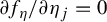 ${\partial f_\eta }/{\partial \eta _j}=0$
,
${\partial f_\eta }/{\partial \eta _j}=0$
, $j=0, \ldots , k-1$
). Then, the map
$j=0, \ldots , k-1$
). Then, the map $g_\eta $
defined for complex
$g_\eta $
defined for complex $\eta $
by
$\eta $
by
 $$ \begin{align} g_\eta = f_{\overline{\eta}}\circ f_\eta \end{align} $$
is a generic full unfolding of $g_0$
depending holomorphically on
$g_0$
depending holomorphically on $\eta \in ({\mathbb C}^k,0)$
.
$\eta \in ({\mathbb C}^k,0)$
.
Proof. Note that $g_\eta $
depends holomorphically on
$g_\eta $
depends holomorphically on $\eta $
. Moreover the
$\eta $
. Moreover the $a_j$
are antiholomorphic in
$a_j$
are antiholomorphic in $\eta $
, that is, functions
$\eta $
, that is, functions $a_j(\overline {\eta })$
. Then,
$a_j(\overline {\eta })$
. Then,
 $$ \begin{align*}g_\eta(z) = z +\sum_{j=0}^{k+1}(2\mathrm{Re}(a_j (\eta)) +o(\eta))z^j+z^{k+1}(1+ O(\eta)) + o(z^{k+1}),\end{align*} $$
from which the genericity follows.
However, for the time being, we continue with $\eta \in ({\mathbb R}^k,0)$
.
$\eta \in ({\mathbb R}^k,0)$
.
Lemma 2.9. Let f be an antiholomorphic diffeomorphism and $g=f\circ f$
be its second iterate. If
$g=f\circ f$
be its second iterate. If $z_0$
is a fixed point of f, then
$z_0$
is a fixed point of f, then $g'(z_0)\in {\mathbb R}_{\geq 0}$
. If
$g'(z_0)\in {\mathbb R}_{\geq 0}$
. If $\{z_1,z_2\}$
is a periodic orbit of period
$\{z_1,z_2\}$
is a periodic orbit of period $2$
of f, then
$2$
of f, then $g'(z_1)=\overline {g'(z_2)}$
.
$g'(z_1)=\overline {g'(z_2)}$
.
Proof. We have $g'(z_0)= f'(z_0)\overline {f'(z_0)}$
. Also,
$g'(z_0)= f'(z_0)\overline {f'(z_0)}$
. Also, $g'(z_1) = f'(z_2)\overline {f'(z_1)}$
and
$g'(z_1) = f'(z_2)\overline {f'(z_1)}$
and $g'(z_2) = f'(z_1)\overline {f'(z_2)}$
, from which the result follows.
$g'(z_2) = f'(z_1)\overline {f'(z_2)}$
, from which the result follows.
Corollary 2.10. Let $f_\eta $
be an unfolding of an antiholomorphic parabolic germ and let
$f_\eta $
be an unfolding of an antiholomorphic parabolic germ and let $g_\eta =f_{\overline {\eta }}\circ f_\eta $
be its second iterate. Then, its formal invariant
$g_\eta =f_{\overline {\eta }}\circ f_\eta $
be its second iterate. Then, its formal invariant $b(\eta )$
commutes with
$b(\eta )$
commutes with $\sigma $
.
$\sigma $
.
Proof. Let $z_0, \ldots , z_k$
be the fixed points and periodic points of period
$z_0, \ldots , z_k$
be the fixed points and periodic points of period $2$
of
$2$
of $f_\eta $
merging to the origin for
$f_\eta $
merging to the origin for $\eta =0$
: these are the fixed points of
$\eta =0$
: these are the fixed points of $g_\eta $
. It is known (see for instance [Reference RousseauRo15]) that
$g_\eta $
. It is known (see for instance [Reference RousseauRo15]) that $b(\eta )= \sum _{s=0}^{k} (1/{\log g_\eta '(z_s)})$
, which is real for real
$b(\eta )= \sum _{s=0}^{k} (1/{\log g_\eta '(z_s)})$
, which is real for real $\eta $
by Lemma 2.9.
$\eta $
by Lemma 2.9.
We want to classify germs of unfoldings of antiholomorphic parabolic germs under conjugacy by mix analytic fibered changes of coordinate and parameters.
Definition 2.11. A change of coordinate and parameter, $(z_1,\eta )\mapsto (z_2, {\varepsilon })=(H(z_1,\eta ), \phi (\eta ))$
, is mix analytic if:
$(z_1,\eta )\mapsto (z_2, {\varepsilon })=(H(z_1,\eta ), \phi (\eta ))$
, is mix analytic if:
-
• it is a diffeormorphism defined on a neighborhood
${\mathbb D}_r{\kern-1pt}\times{\kern-1pt} \prod _{\ell =0}^{k-1}(-\delta _\ell ,\delta _\ell )$
of
$0{\kern-1pt}\in{\kern-1pt} {\mathbb C}{\kern-1pt}\times{\kern-1pt} {\mathbb R}^k$
, where
${\mathbb D}_r$
is the disk of radius r; -
•
$\phi $
depends real-analytically of
$\eta $
; -
• H depends holomorphically on
$z_1$
and real-analytically on
$\eta $
.



Definition 2.12. Two germs $f_{1,\eta }$
and
$f_{1,\eta }$
and $f_{2,{\varepsilon }}$
of unfoldings of antiholomorphic parabolic germs are conjugate if there exists a mix analytic change of coordinate and parameters
$f_{2,{\varepsilon }}$
of unfoldings of antiholomorphic parabolic germs are conjugate if there exists a mix analytic change of coordinate and parameters $(z_1,\eta )\mapsto (z_2, {\varepsilon })=(H(z_1,\eta ), \phi (\eta ))$
defined on some
$(z_1,\eta )\mapsto (z_2, {\varepsilon })=(H(z_1,\eta ), \phi (\eta ))$
defined on some $R={\mathbb D}_r\times \prod _{\ell =0}^{k-1}(-\delta _\ell ,\delta _\ell )$
such that for all
$R={\mathbb D}_r\times \prod _{\ell =0}^{k-1}(-\delta _\ell ,\delta _\ell )$
such that for all $(z_1,\eta )\in R$
,
$(z_1,\eta )\in R$
,
 $$ \begin{align*}H(f_{1,\eta}(z_1),\eta)=f_{2,\phi(\eta)}(H(z_1,\eta)).\end{align*} $$
2.2 Preparing the family
Theorem 2.13. We consider a germ of a generic k-parameter family unfolding an antiholomorphic parabolic germ of the form (2.2). There exists a mix analytic (fibered) change of coordinate and parameters $(z,\eta )\mapsto (Z,{\varepsilon })$
transforming (2.2) to
$(z,\eta )\mapsto (Z,{\varepsilon })$
transforming (2.2) to
 $$ \begin{align*}F_{\varepsilon}(Z)=\overline{Z}+ P_{\varepsilon}(\overline{Z})(\tfrac12+Q_{\varepsilon}(\overline{Z})+P_{\varepsilon}(\overline{Z})R_{\varepsilon}(\overline{Z})),\end{align*} $$
where:
-
•
$P_{\varepsilon }(\overline {Z})= \overline {Z}^{k+1} +\sum _{j=0}^{k-1} {\varepsilon }_j\overline {Z}^j$
and
$Q_{\varepsilon }$
is a polynomial of degree at most k with real analytic coefficients in
${\varepsilon }$
; -
• if
$Z_1, \ldots , Z_{k+1}$
are the fixed points and periodic points of period 2 of
$F_{\varepsilon }$
, that is, the fixed points of
$G_{\varepsilon }=F_{\varepsilon }^{\circ 2}$
, then
$b({\varepsilon }):=\sum _{s=1}^{k+1} (1/{\log G_{\varepsilon }'(Z_s)})$
is real analytic with real values; -
• if
$v_{\varepsilon }{\kern-1pt}={\kern-1pt} {P_{\varepsilon }(Z)}/({1+b({\varepsilon })z^k})\,({\partial }/{\partial z})$
, then
$\log F_{\varepsilon }'(Z_s){\kern-1pt}={\kern-1pt}\frac 12\overline {v_{\varepsilon }'(Z_s)}$
for
$s{\kern-1pt}={\kern-1pt}1, \ldots , k+1$
.










Proof. Let us consider the fixed points of $f_\eta $
. Taking
$f_\eta $
. Taking $z= x+iy$
, this leads to the two equations
$z= x+iy$
, this leads to the two equations
 $$ \begin{align} 0 &= \sum_{j=0}^{k+1} \mathrm{Re}(a_j) ( x^j+y^2O(|x,y|^{j-2})) +\frac12x^{k+1}(1+O(\eta)+O(x)) +y^2O(|x,y|^{k-1})\nonumber \\&\quad+\sum_{j=1}^{k-1} \mathrm{Im}(a_j) y\,O(|x,y|^{j-1})+\cdots,\\0 &=-2y+ O(\eta) +o(|x,y|),\nonumber\end{align} $$
where coefficients of terms with negative exponent vanish. The second equation can be solved by the implicit function theorem, yielding $y=h(\eta ,x)= O(\eta )+o(x)$
, with h real analytic in
$y=h(\eta ,x)= O(\eta )+o(x)$
, with h real analytic in $(x,\eta )$
. Replacing this in the first equation yields
$(x,\eta )$
. Replacing this in the first equation yields
 $$ \begin{align}\begin{aligned}0&=\sum_{j=0}^{k} (\mathrm{Re}(a_j)+O(|a_0|,\ldots, |a_{j-1}|)+ o(\eta))x^j \\ &\quad+ \frac12(1+O(\eta))x^{k+1}+ o(x^{k+1}).\end{aligned}\end{align} $$
By the Weierstrass preparation theorem in the real analytic case, then (2.5) is equivalent to $P_{0,\eta }(x)=0$
, with
$P_{0,\eta }(x)=0$
, with $P_{0,\eta }$
a Weierstrass polynomial of the form
$P_{0,\eta }$
a Weierstrass polynomial of the form
 $$ \begin{align*}P_{0,\eta}(x) = \sum_{j=0}^k 2(\mathrm{Re}(a_j)+O(|a_0|,\ldots, |a_{j-1}|)+o(\eta))x^j +x^{k+1}.\end{align*} $$
We make the change of variable $z= z_1+ih(\eta ,z_1)$
, which sends the real axis in
$z= z_1+ih(\eta ,z_1)$
, which sends the real axis in $z_1$
-space to
$z_1$
-space to $y=h(x)$
in z-space. Let
$y=h(x)$
in z-space. Let $f_{1,\eta }$
be the expression of
$f_{1,\eta }$
be the expression of $f_\eta $
in the new variable
$f_\eta $
in the new variable $z_1$
. Then, all fixed points of
$z_1$
. Then, all fixed points of $f_{1,\eta }$
occur on the real line in
$f_{1,\eta }$
occur on the real line in $z_1$
-space. Moreover, if
$z_1$
-space. Moreover, if $z_1=x_1+iy_1$
, the equation for the fixed points of
$z_1=x_1+iy_1$
, the equation for the fixed points of $f_1$
has the same form as before:
$f_1$
has the same form as before: $y_1=0$
and
$y_1=0$
and
 $$ \begin{align*}0=P_{1,\eta}(x_1) = \sum_{j=0}^k 2(\mathrm{Re}(a_j)+O(|a_0|,\ldots, |a_{j-1}|)+o(\eta))x_1^j +x_1^{k+1}.\end{align*} $$
The next step is to make a translation by a real number $z_2= z_1+O(|a_0|,\ldots , |a_{k-1}|)+\mathrm {Re}(a_k)+o(\eta )$
transforming
$z_2= z_1+O(|a_0|,\ldots , |a_{k-1}|)+\mathrm {Re}(a_k)+o(\eta )$
transforming $P_{1,\eta }(x_1)$
to
$P_{1,\eta }(x_1)$
to
 $$ \begin{align*}P_{2,\eta}(x_2) = \sum_{j=0}^{k-1} \alpha_j(\eta)x_2^j +x_2^{k+1},\end{align*} $$
where $\alpha _j(\eta )= 2(\mathrm {Re}(a_j)+o(\eta )).$
Let
$\alpha _j(\eta )= 2(\mathrm {Re}(a_j)+o(\eta )).$
Let $\alpha = (\alpha _0, \ldots , \alpha _{k-1})$
. If the family is generic, the change of parameters
$\alpha = (\alpha _0, \ldots , \alpha _{k-1})$
. If the family is generic, the change of parameters $\eta \mapsto \alpha $
is invertible and we could as well take
$\eta \mapsto \alpha $
is invertible and we could as well take $\alpha $
as a new parameter. However, in practice, we will keep
$\alpha $
as a new parameter. However, in practice, we will keep $\eta $
.
$\eta $
.
When considering $f_\eta $
as a two-dimensional real diffeomorphism, the eigenvalues at a fixed point are two opposite real numbers
$f_\eta $
as a two-dimensional real diffeomorphism, the eigenvalues at a fixed point are two opposite real numbers $\pm \unicode{x3bb} $
and determined by a unique real number
$\pm \unicode{x3bb} $
and determined by a unique real number $\unicode{x3bb} $
(this corresponds to the fact that only the norm of
$\unicode{x3bb} $
(this corresponds to the fact that only the norm of $f_\eta '(\unicode{x3bb} )$
is intrinsic).
$f_\eta '(\unicode{x3bb} )$
is intrinsic).
If $f_{2,\eta }$
is the expression of
$f_{2,\eta }$
is the expression of $f_\eta $
in the variable
$f_\eta $
in the variable $z_2$
and
$z_2$
and $z_2=x_2+iy_2$
, then the fixed points of
$z_2=x_2+iy_2$
, then the fixed points of $f_{2,\eta }$
are the points
$f_{2,\eta }$
are the points $x_2+ i\cdot 0$
, where
$x_2+ i\cdot 0$
, where $x_2$
is a real solution of
$x_2$
is a real solution of $P_{2,\eta }(x_2)=0$
, and there exists an open set in
$P_{2,\eta }(x_2)=0$
, and there exists an open set in $\eta $
-space in which
$\eta $
-space in which $P_{2,\eta }$
has
$P_{2,\eta }$
has $k+1$
real roots corresponding to
$k+1$
real roots corresponding to $k+1$
fixed points of
$k+1$
fixed points of $f_{2,\eta }$
.
$f_{2,\eta }$
.
Let us now consider the equation $P_{2,\eta }(x_2)=0$
with
$P_{2,\eta }(x_2)=0$
with $x_2$
complex. Since the polynomial has real coefficients, then the complex roots occur in conjugate pairs. All solutions are also solutions of the equation
$x_2$
complex. Since the polynomial has real coefficients, then the complex roots occur in conjugate pairs. All solutions are also solutions of the equation $P_{2,\eta }(\overline {x}_2)=0$
. Taking
$P_{2,\eta }(\overline {x}_2)=0$
. Taking $z_2=x_2+i\cdot 0$
, these points correspond to solutions of
$z_2=x_2+i\cdot 0$
, these points correspond to solutions of $f_2(z_2) =\overline {z_2}$
. Hence, a pair of complex conjugate roots
$f_2(z_2) =\overline {z_2}$
. Hence, a pair of complex conjugate roots $(w,\overline {w})$
of
$(w,\overline {w})$
of $P_{2,\eta }$
corresponds to a periodic orbit of period
$P_{2,\eta }$
corresponds to a periodic orbit of period $2$
of
$2$
of $f_2$
.
$f_2$
.
Let us consider $g_{2,\eta } =f_{2,\eta }\circ f_{2,\eta }$
. Then,
$g_{2,\eta } =f_{2,\eta }\circ f_{2,\eta }$
. Then, $g_{2,\eta }$
is a k real parameter unfolding of a codimension k holomorphic parabolic germ, which always has
$g_{2,\eta }$
is a k real parameter unfolding of a codimension k holomorphic parabolic germ, which always has $k+1$
fixed points counting multiplicities. The equation for fixed points of
$k+1$
fixed points counting multiplicities. The equation for fixed points of $g_{2,\eta }$
is given by a Weierstrass polynomial
$g_{2,\eta }$
is given by a Weierstrass polynomial $p_{\eta }(z_2)$
depending real-analytically on
$p_{\eta }(z_2)$
depending real-analytically on $\eta $
. The fixed points of
$\eta $
. The fixed points of $g_{2,\eta }$
are either fixed points of
$g_{2,\eta }$
are either fixed points of $f_{2,\eta }$
or belong to pairs
$f_{2,\eta }$
or belong to pairs $(w,\overline {w})$
of periodic points of
$(w,\overline {w})$
of periodic points of $f_{2,\eta }$
with period
$f_{2,\eta }$
with period $2$
. Hence,
$2$
. Hence, $p_\eta $
has real coefficients when
$p_\eta $
has real coefficients when $\eta $
is real. It follows that
$\eta $
is real. It follows that $p_\eta \equiv P_{2,\eta }$
.
$p_\eta \equiv P_{2,\eta }$
.
Let us now write $g_{2,\eta }$
in the form
$g_{2,\eta }$
in the form
 $$ \begin{align*}g_{2,\eta}(z_2)= z_2+ P_{2,\eta}(z_2) (1+ q_\eta (z_2) + P_{2,\eta}(z_2) H_\eta(z_2)).\end{align*} $$
Let $w_1, \ldots , w_{k+1}$
be the fixed points of
$w_1, \ldots , w_{k+1}$
be the fixed points of $g_{2,\eta }$
. There exists a polynomial
$g_{2,\eta }$
. There exists a polynomial $S_\eta (z_2)$
degree at most k such that
$S_\eta (z_2)$
degree at most k such that
 $$ \begin{align*}\log(g_{2,\eta}'(w_j))= P_{2,\eta}'(w_j) (1+S_\eta(w_j)).\end{align*} $$
Indeed, when the $w_j$
are distinct, let
$w_j$
are distinct, let $M_j:={\log (g_{2,\eta }'(w_j))}/{P_{2,\eta }'(w_j)}-1$
. Then, such a polynomial
$M_j:={\log (g_{2,\eta }'(w_j))}/{P_{2,\eta }'(w_j)}-1$
. Then, such a polynomial $S_\eta (z_2)$
is found by the following Lagrange interpolation formula:
$S_\eta (z_2)$
is found by the following Lagrange interpolation formula:
 $$ \begin{align*}S_\eta(z_2)=-\frac{\left|\begin{array}{lllll}0&1&z_2&\cdots&z_2^k\\M_1&1&w_1&\cdots&w_1^k\\\vdots&\vdots&\vdots&\vdots&\vdots\\M_{k+1}&1&w_{k+1}&\cdots&w_{k+1}^k\end{array}\right|}{\left|\begin{array}{llll} 1&w_1&\cdots&w_1^k\\\vdots&\vdots&\vdots&\vdots\\1&w_{k+1}&\cdots&w_{k+1}^k\end{array}\right|}. \end{align*} $$
Here, $S_\eta $
depends analytically on
$S_\eta $
depends analytically on $\eta $
, since it is invariant under permutations of the
$\eta $
, since it is invariant under permutations of the $w_j$
. Moreover, limits exist when two fixed points coalesce. Extending
$w_j$
. Moreover, limits exist when two fixed points coalesce. Extending $\eta $
to complex values and using Hartogs’ theorem allows to conclude that limits exist when more than two fixed points coalesce. Since
$\eta $
to complex values and using Hartogs’ theorem allows to conclude that limits exist when more than two fixed points coalesce. Since $P_{2,\eta }$
has real coefficients, since the complex conjugate roots of
$P_{2,\eta }$
has real coefficients, since the complex conjugate roots of $P_{2,\eta }$
correspond to periodic points of period 2 of
$P_{2,\eta }$
correspond to periodic points of period 2 of $f_{2,\eta }$
and using Lemma 2.9, it follows that for each root
$f_{2,\eta }$
and using Lemma 2.9, it follows that for each root $w_j$
of
$w_j$
of $P_{2,\eta }$
, then
$P_{2,\eta }$
, then $\overline {w}_j$
is a root of
$\overline {w}_j$
is a root of $P_{2,\eta }$
and
$P_{2,\eta }$
and $\overline {M}_j:={\log (g_{2,\eta }'(\overline {w}_j))}/{P_{2,\eta }'(\overline {w}_j)}-1$
, and thus that
$\overline {M}_j:={\log (g_{2,\eta }'(\overline {w}_j))}/{P_{2,\eta }'(\overline {w}_j)}-1$
, and thus that $S_\eta $
has real coefficients.
$S_\eta $
has real coefficients.
Hence, the logarithms of the multipliers at the fixed points of $g_{2,\eta }$
are the eigenvalues at the singular points of the vector field
$g_{2,\eta }$
are the eigenvalues at the singular points of the vector field
 $$ \begin{align}\dot z_2=v_{\eta}(z_2) = P_{2,\eta}(z_2)(1+S_\eta(z_2)).\end{align} $$
By the variant of Kostov’s theorem valid for real analytic dependence on parameters [Reference Klimeš and RousseauKR20], there exists exactly k changes of coordinate and parameter $(z_2,\eta )\mapsto (z_3,{\varepsilon })$
transforming (2.6) to
$(z_2,\eta )\mapsto (z_3,{\varepsilon })$
transforming (2.6) to
 $$ \begin{align*}\dot z_3 = \frac{z_3^{k+1} +{\varepsilon}_{k-1} z_3^{k-1} +\cdots + {\varepsilon}_1z_3+{\varepsilon}_0}{1+b({\varepsilon})z_3^k}:=\frac{P_{\varepsilon}(z_3)}{1+b({\varepsilon})z_3^k}.\end{align*} $$
The k one-parameter families of changes of coordinates are obtained one from another using the action of the rotation group of order k on that vector field,
 $$ \begin{align*}(z_3, {\varepsilon}_{k-1}, \ldots, {\varepsilon}_1,{\varepsilon}_0)\mapsto (\tau z_3, \tau^{-k+2}{\varepsilon}_{k-1}, \ldots, {\varepsilon}_1,\tau {\varepsilon}_0),\end{align*} $$
where $\tau ^k=1$
. The one tangent to the identity preserves the real axis, which is a privileged direction for
$\tau ^k=1$
. The one tangent to the identity preserves the real axis, which is a privileged direction for $f_{3,\eta }$
(that is,
$f_{3,\eta }$
(that is, $f_{2,\eta }$
in the
$f_{2,\eta }$
in the $z_3$
variable). Hence, we choose a change of coordinate tangent to the identity (changes
$z_3$
variable). Hence, we choose a change of coordinate tangent to the identity (changes $z_3\mapsto -z_3$
are also allowed when k is even).
$z_3\mapsto -z_3$
are also allowed when k is even).
At this step, the map $g_{\varepsilon }$
is prepared. However, the map
$g_{\varepsilon }$
is prepared. However, the map $f_{3,{\varepsilon }}$
may not be prepared yet. Indeed, the derivatives of
$f_{3,{\varepsilon }}$
may not be prepared yet. Indeed, the derivatives of $f_{3,{\varepsilon }}$
are not intrinsic. Considering that solutions of
$f_{3,{\varepsilon }}$
are not intrinsic. Considering that solutions of $P_{\varepsilon }(z_3)=0$
are also solutions of
$P_{\varepsilon }(z_3)=0$
are also solutions of $P_{\varepsilon }(\overline {z}_3)=0$
and that these solutions are solutions of
$P_{\varepsilon }(\overline {z}_3)=0$
and that these solutions are solutions of $f_{3,{\varepsilon }}(z_3)=\overline {z}_3$
, then
$f_{3,{\varepsilon }}(z_3)=\overline {z}_3$
, then $f_{3,{\varepsilon }}$
has the form
$f_{3,{\varepsilon }}$
has the form
 $$ \begin{align*}f_{3,{\varepsilon}}(z_3)=\overline{z}_3+P_{\varepsilon}(\overline{z}_3)M({\varepsilon},\overline{z}_3).\end{align*} $$
By further dividing $M-\frac 12$
by
$M-\frac 12$
by $P_{\varepsilon }$
, namely
$P_{\varepsilon }$
, namely
 $$ \begin{align*}M({\varepsilon},z_3)= \frac12+\sum_{\ell=0}^k m_\ell({\varepsilon}) z_3^\ell +P_{\varepsilon}(z_3) N_{\varepsilon}(z_3), \end{align*} $$
this yields
 $$ \begin{align*}f_{3,{\varepsilon}}(z_3)=\overline{z}_3+P_{\varepsilon}(\overline{z}_3)\bigg( \frac12+\sum_{\ell=0}^k m_\ell({\varepsilon}) \overline{z}_3^\ell +P_{\varepsilon}(\overline{z}_3) N_{\varepsilon}(\overline{z}_3)\bigg).\end{align*} $$
If $w_1, \ldots , w_{k+1}$
are the solutions of
$w_1, \ldots , w_{k+1}$
are the solutions of $P_{\varepsilon }(z_3)=0$
, then
$P_{\varepsilon }(z_3)=0$
, then
 $$ \begin{align*}f_{3,{\varepsilon}}'(w_j)= 1+P_{\varepsilon}'(\overline{w}_j) \bigg( \frac12+\sum_{\ell=0}^k m_\ell({\varepsilon}) \overline{w}_j^\ell \bigg).\end{align*} $$
By Lemma 2.9, we already know that
 $$ \begin{align*}f_{3,{\varepsilon}}'(w_j)\overline{f_{3,{\varepsilon}}'(\overline{w}_j)}\in{\mathbb R}.\end{align*} $$
We look for a change of coordinate $Z=u_{\varepsilon }(z_3) = z_3+P_{\varepsilon }(z_3)(\sum _{\ell =0}^k D_\ell z_3^\ell )$
preserving the fixed points and periodic points of period
$Z=u_{\varepsilon }(z_3) = z_3+P_{\varepsilon }(z_3)(\sum _{\ell =0}^k D_\ell z_3^\ell )$
preserving the fixed points and periodic points of period $2$
of
$2$
of $f_{3,{\varepsilon }}$
so that if
$f_{3,{\varepsilon }}$
so that if $F_{\varepsilon }=u_{\varepsilon }\circ f_{3,{\varepsilon }}\circ u_{\varepsilon }^{-1}$
, then
$F_{\varepsilon }=u_{\varepsilon }\circ f_{3,{\varepsilon }}\circ u_{\varepsilon }^{-1}$
, then
 $$ \begin{align}F_{\varepsilon}'(w_j)=\overline{F_{\varepsilon}'(\overline{w}_j)}, \quad j=1, \ldots, k+1.\end{align} $$
Note that $F_{\varepsilon }(w_j)= \overline {w}_j$
. Hence,
$F_{\varepsilon }(w_j)= \overline {w}_j$
. Hence,
 $$ \begin{align*}F_{\varepsilon}'(w_j)= \frac{u_{\varepsilon}'(\overline{w}_j)}{\overline{u_{\varepsilon}'(w_j)}} f_{3,{\varepsilon}}'(w_j).\end{align*} $$
Hence, we ask that
 $$ \begin{align}u_{\varepsilon}'(w_j)= \overline{\sqrt{f_{3,{\varepsilon}}'(w_j)}}.\end{align} $$
If $w_j\in {\mathbb R}$
is a fixed point of
$w_j\in {\mathbb R}$
is a fixed point of $f_{3,{\varepsilon }}$
, then
$f_{3,{\varepsilon }}$
, then $F_{\varepsilon }'(w_j)=|f_{3,{\varepsilon }}'(w_j)|\in {\mathbb R}_{\geq 0}$
. If
$F_{\varepsilon }'(w_j)=|f_{3,{\varepsilon }}'(w_j)|\in {\mathbb R}_{\geq 0}$
. If $(w_j,\overline {w}_j)$
is a periodic orbit of period 2, then
$(w_j,\overline {w}_j)$
is a periodic orbit of period 2, then $F_{\varepsilon }'(w_j) =\overline {\sqrt {f_{3,{\varepsilon }}'(\overline {w}_j)}}\sqrt {f_{3,{\varepsilon }}'(w_j)}$
and
$F_{\varepsilon }'(w_j) =\overline {\sqrt {f_{3,{\varepsilon }}'(\overline {w}_j)}}\sqrt {f_{3,{\varepsilon }}'(w_j)}$
and $F_{\varepsilon }'(\overline {w}_j) =\sqrt {f_{3,{\varepsilon }}'(\overline {w}_j)}\overline {\sqrt {f_{3,{\varepsilon }}'(w_j)}}$
. Hence, F satisfies (2.7).
$F_{\varepsilon }'(\overline {w}_j) =\sqrt {f_{3,{\varepsilon }}'(\overline {w}_j)}\overline {\sqrt {f_{3,{\varepsilon }}'(w_j)}}$
. Hence, F satisfies (2.7).
We now need to prove that it is possible to construct u mix analytic satisfying (2.8).
Let $K_{\varepsilon }(z_3)=\sum _{\ell =0}^k D_\ell z_3^\ell $
. Then,
$K_{\varepsilon }(z_3)=\sum _{\ell =0}^k D_\ell z_3^\ell $
. Then, $u_{\varepsilon }'(w_j)= 1+P_{\varepsilon }'(w_j)K_{\varepsilon }(w_j)$
, while
$u_{\varepsilon }'(w_j)= 1+P_{\varepsilon }'(w_j)K_{\varepsilon }(w_j)$
, while
 $$ \begin{align*}\overline{\sqrt{f_{3,{\varepsilon}}'(w_j)}}= \sqrt{1+P_{\varepsilon}'(w_j)\bigg(\frac12+\sum_{\ell=0}^k \overline{m_\ell}({\varepsilon}) w_j^\ell\bigg) }:=1+P_{\varepsilon}'(w_j) \bigg( \frac14+V_{\varepsilon}(w_j)\bigg)\end{align*} $$
for some analytic function $V_{\varepsilon }$
. Hence,
$V_{\varepsilon }$
. Hence, $K_{\varepsilon }(w_j)=\tfrac 14 +V_{\varepsilon }(w_j):=W_j$
. For distinct
$K_{\varepsilon }(w_j)=\tfrac 14 +V_{\varepsilon }(w_j):=W_j$
. For distinct $w_j$
, the polynomial
$w_j$
, the polynomial $K_{\varepsilon }$
is given by a Lagrange interpolation formula
$K_{\varepsilon }$
is given by a Lagrange interpolation formula
 $$ \begin{align*}K_{\varepsilon}(z_3)=-\frac{\left|\begin{array}{lllll}0&1&z_3&\cdots&z_3^k\\W_1&1&w_1&\cdots&w_1^k\\\vdots&\vdots&\vdots&\vdots&\vdots\\W_{k+1}&1&w_{k+1}&\cdots&w_{k+1}^k\end{array}\right|}{\left|\begin{array}{llll} 1&w_1&\cdots&w_1^k\\\vdots&\vdots&\vdots&\vdots\\1&w_{k+1}&\cdots&w_{k+1}^k\end{array}\right|}. \end{align*} $$
Note that the conditions defining $K_{\varepsilon }$
are analytic in
$K_{\varepsilon }$
are analytic in ${\varepsilon }$
. Hence, it is possible to complexify
${\varepsilon }$
. Hence, it is possible to complexify ${\varepsilon }$
. The formula has a limit when two
${\varepsilon }$
. The formula has a limit when two $w_j$
coalesce. The limit also exists for the more degenerate cases by Hartogs’ theorem. Since the conditions are invariant under permutations of
$w_j$
coalesce. The limit also exists for the more degenerate cases by Hartogs’ theorem. Since the conditions are invariant under permutations of $w_j$
, the polynomial
$w_j$
, the polynomial $K_{\varepsilon }$
depends analytically on
$K_{\varepsilon }$
depends analytically on ${\varepsilon }$
by the symmetric function theorem.
${\varepsilon }$
by the symmetric function theorem.
Corollary 2.14. When k is odd, the canonical parameter of the prepared $f_{\varepsilon }$
is unique. When k is even, conjugating
$f_{\varepsilon }$
is unique. When k is even, conjugating $f_{\varepsilon }$
with
$f_{\varepsilon }$
with $L_{-1}(z) = -z$
yields a second prepared form
$L_{-1}(z) = -z$
yields a second prepared form $\hat {f}_{\hat {{\varepsilon }}}= L_{-1}\circ f_{\varepsilon }\circ L_{-1}$
with canonical parameter
$\hat {f}_{\hat {{\varepsilon }}}= L_{-1}\circ f_{\varepsilon }\circ L_{-1}$
with canonical parameter
 $$ \begin{align} \hat{{\varepsilon}}= ({\varepsilon}_{k-1}, -{\varepsilon}_{k-2}, \ldots, {\varepsilon}_1, -{\varepsilon}_0).\end{align} $$
3 Modulus of analytic classification
We now consider a germ of a generic antiholomorphic family unfolding a parabolic point of codimension k in prepared form
 $$ \begin{align}f_{\varepsilon}(z)=\overline{z}+ P_{\varepsilon}(\overline{z})(\tfrac12+Q_{\varepsilon}(\overline{z})+P_{\varepsilon}(\overline{z})R_{\varepsilon}(\overline{z})),\end{align} $$
as described in Theorem 2.13. As in Lemma 2.8, we complexify the parameter ${\varepsilon }$
in
${\varepsilon }$
in $({\mathbb C}^k,0)$
, we ask that
$({\mathbb C}^k,0)$
, we ask that $f_{\varepsilon }$
depends antiholomorphically on
$f_{\varepsilon }$
depends antiholomorphically on ${\varepsilon }$
, and we define the second iterate as in (2.3). Germs of generic analytic unfoldings of a holomorphic parabolic point of codimension k have been studied in [Reference RousseauRo15], and we will see that two prepared germs of antiholomorphic families
${\varepsilon }$
, and we define the second iterate as in (2.3). Germs of generic analytic unfoldings of a holomorphic parabolic point of codimension k have been studied in [Reference RousseauRo15], and we will see that two prepared germs of antiholomorphic families $f_{1,{\varepsilon }}$
and
$f_{1,{\varepsilon }}$
and $f_{2,{\varepsilon }}$
are conjugate under a conjugacy tangent to the identity depending real-analytically on
$f_{2,{\varepsilon }}$
are conjugate under a conjugacy tangent to the identity depending real-analytically on ${\varepsilon }\in ({\mathbb R}^k,0)$
if and only if the corresponding homolorphic families
${\varepsilon }\in ({\mathbb R}^k,0)$
if and only if the corresponding homolorphic families $g_{1,{\varepsilon }}= f_{1,\overline {\varepsilon }}\circ f_{1,{\varepsilon }}$
and
$g_{1,{\varepsilon }}= f_{1,\overline {\varepsilon }}\circ f_{1,{\varepsilon }}$
and $g_{2,{\varepsilon }}= f_{2,\overline {\varepsilon }}\circ f_{2,{\varepsilon }}$
, with complex analytic dependence on
$g_{2,{\varepsilon }}= f_{2,\overline {\varepsilon }}\circ f_{2,{\varepsilon }}$
, with complex analytic dependence on ${\varepsilon }\in ({\mathbb C}^k,0)$
, are analytically conjugate under a conjugacy tangent to the identity.
${\varepsilon }\in ({\mathbb C}^k,0)$
, are analytically conjugate under a conjugacy tangent to the identity.
For real ${\varepsilon }$
, the formal normal form of
${\varepsilon }$
, the formal normal form of $f_{\varepsilon }$
is given by
$f_{\varepsilon }$
is given by $\sigma \circ v_{\varepsilon }^{1/2}=v_{{\varepsilon }}^{1/2}\circ \sigma $
, where
$\sigma \circ v_{\varepsilon }^{1/2}=v_{{\varepsilon }}^{1/2}\circ \sigma $
, where $v_{\varepsilon }^{t}$
is the time t of the vector field
$v_{\varepsilon }^{t}$
is the time t of the vector field
 $$ \begin{align} v_{\varepsilon}= \frac{P_{\varepsilon}(z)}{1+b({\varepsilon})z^k}\,\frac{\partial}{\partial z}, \end{align} $$
and
 $$ \begin{align} P_{\varepsilon}(z)= z^{k+1} + \sum_{j=0}^{k-1} {\varepsilon}_jz^j. \end{align} $$
For complex values of ${\varepsilon }$
, we have to think of the formal normal form meaning that
${\varepsilon }$
, we have to think of the formal normal form meaning that
 $$ \begin{align}\hat{h}_{\overline{{\varepsilon}}}\circ f_{\varepsilon}\circ (\hat{h}_{\varepsilon})^{-1}= \sigma\circ v_{\varepsilon}^{1/2}=v_{\overline{{\varepsilon}}}^{1/2}\circ \sigma \end{align} $$
for some formal map $\hat {h}_{\varepsilon }$
.
$\hat {h}_{\varepsilon }$
.
We want to describe the dynamics of the germ of a family. In practice, this means describing the dynamics for z in a disk ${\mathbb D}_r$
of radius r for all values of the parameter in some polydisk
${\mathbb D}_r$
of radius r for all values of the parameter in some polydisk $|{\varepsilon }|<\rho $
. The general spirit is that if
$|{\varepsilon }|<\rho $
. The general spirit is that if $\rho $
is taken sufficiently small so that the fixed points stay bounded away from
$\rho $
is taken sufficiently small so that the fixed points stay bounded away from $\partial {\mathbb D}_r$
, for instance, in
$\partial {\mathbb D}_r$
, for instance, in ${\mathbb D}_{r/2}$
, then the dynamics is structurally stable in the neighborhood of
${\mathbb D}_{r/2}$
, then the dynamics is structurally stable in the neighborhood of $\partial {\mathbb D}_r$
, and this dynamics organizes the whole dynamics inside the disk. The modulus of analytic classification measures the obstruction to transforming analytically the family into the formal normal form. To construct the modulus, we transform the family almost uniquely to the normal form on (generalized) sectors in z-space. (Note that
$\partial {\mathbb D}_r$
, and this dynamics organizes the whole dynamics inside the disk. The modulus of analytic classification measures the obstruction to transforming analytically the family into the formal normal form. To construct the modulus, we transform the family almost uniquely to the normal form on (generalized) sectors in z-space. (Note that $f_{\varepsilon }$
sends one sector to a different sector.) In accordance with the general spirit just mentioned, these generalized sectors are constructed from the behavior around
$f_{\varepsilon }$
sends one sector to a different sector.) In accordance with the general spirit just mentioned, these generalized sectors are constructed from the behavior around $\partial {\mathbb D}_r$
and then following the dynamics inwards. Then, the modulus is given by the mismatch of the normalizing transformations. In the construction,
$\partial {\mathbb D}_r$
and then following the dynamics inwards. Then, the modulus is given by the mismatch of the normalizing transformations. In the construction, $2k$
generalized sectors are needed, if we add the additional constraint that the generalized sectors have a limit when
$2k$
generalized sectors are needed, if we add the additional constraint that the generalized sectors have a limit when ${\varepsilon }\to 0$
.
${\varepsilon }\to 0$
.
In practice, it is more natural to change the coordinate to the time coordinate of the vector field $v_{\varepsilon }$
, given by
$v_{\varepsilon }$
, given by
 $$ \begin{align*}Z_{\varepsilon}=\int\frac{1+b({\varepsilon})z^k}{P_{\varepsilon}(z)}\,dz.\end{align*} $$
In this new coordinate, $f_{\varepsilon }$
is transformed to
$f_{\varepsilon }$
is transformed to $F_{\varepsilon }= Z_{\overline {{\varepsilon }}}\circ f_{\varepsilon }\circ Z_{\varepsilon }^{-1}$
and the normal form to
$F_{\varepsilon }= Z_{\overline {{\varepsilon }}}\circ f_{\varepsilon }\circ Z_{\varepsilon }^{-1}$
and the normal form to $T_{1/2}\circ \Sigma ,$
where
$T_{1/2}\circ \Sigma ,$
where $\Sigma $
is a complex conjugation defined in the Riemann surface of the time coordinate by lifting
$\Sigma $
is a complex conjugation defined in the Riemann surface of the time coordinate by lifting $\sigma $
(see Definition 3.1 below) and
$\sigma $
(see Definition 3.1 below) and $T_{1/2}$
is the translation by
$T_{1/2}$
is the translation by $\tfrac 12$
(see Notation 2.1). Then, in the
$\tfrac 12$
(see Notation 2.1). Then, in the $Z_{\varepsilon }$
-coordinate, the sectors will correspond to the saturation by the dynamics of strips transversal to the horizontal direction, and we need to consider pairs of sectors for
$Z_{\varepsilon }$
-coordinate, the sectors will correspond to the saturation by the dynamics of strips transversal to the horizontal direction, and we need to consider pairs of sectors for $Z_{\varepsilon }$
and
$Z_{\varepsilon }$
and $Z_{\overline {{\varepsilon }}}$
.
$Z_{\overline {{\varepsilon }}}$
.
3.1 The time coordinate
$Z_{\varepsilon }$

The time coordinate $Z_{\varepsilon }$
is multivalued over the disk punctured at the fixed points and the image
$Z_{\varepsilon }$
is multivalued over the disk punctured at the fixed points and the image $Z_{\varepsilon }({\mathbb D}_r\setminus \{P_{\varepsilon }(z)=0\})$
is a complicated Riemann surface. In practice, we work with
$Z_{\varepsilon }({\mathbb D}_r\setminus \{P_{\varepsilon }(z)=0\})$
is a complicated Riemann surface. In practice, we work with $2k$
charts defined from
$2k$
charts defined from $\partial {\mathbb D}_r$
and going inwards. For
$\partial {\mathbb D}_r$
and going inwards. For $j=0,\pm 1, \ldots \pm k$
(with indices
$j=0,\pm 1, \ldots \pm k$
(with indices $(\mathrm {mod}\: 2k))$
, we define
$(\mathrm {mod}\: 2k))$
, we define
 $$ \begin{align*}Z_{{\varepsilon},j}(z) = \int_{\zeta_j}^z \frac{1+b({\varepsilon})z^k}{P_{\varepsilon}(z)} \,dz,\end{align*} $$
where $\zeta _0=r$
and, for
$\zeta _0=r$
and, for $j=\pm 1, \ldots , \pm k$
,
$j=\pm 1, \ldots , \pm k$
, $\zeta _j$
close to
$\zeta _j$
close to $\partial {\mathbb D}_r$
is defined by
$\partial {\mathbb D}_r$
is defined by $\int _{\gamma _j} ({1+b({\varepsilon })z^k})/ {P_{\varepsilon }(z)} \,dz= {2\pi i b({\varepsilon })}/{k}$
with
$\int _{\gamma _j} ({1+b({\varepsilon })z^k})/ {P_{\varepsilon }(z)} \,dz= {2\pi i b({\varepsilon })}/{k}$
with $\gamma _j$
an arc from
$\gamma _j$
an arc from $\zeta _{j-1}$
to
$\zeta _{j-1}$
to $\zeta _j$
located in the neighborhood of
$\zeta _j$
located in the neighborhood of $\partial {\mathbb D}_r$
. The chart for
$\partial {\mathbb D}_r$
. The chart for $Z_{{\varepsilon },j}$
contains the arc
$Z_{{\varepsilon },j}$
contains the arc $\{re^{i\theta }\mid \theta \in ({\pi j}/{k}-{\pi }/{2k}, {\pi j}/{k}+{\pi }/{2k})\}$
. In particular,
$\{re^{i\theta }\mid \theta \in ({\pi j}/{k}-{\pi }/{2k}, {\pi j}/{k}+{\pi }/{2k})\}$
. In particular,
 $$ \begin{align} Z_{{\varepsilon},j}(z) = Z_{{\varepsilon},j-1}(z) - \frac{2\pi i b({\varepsilon})}{k},\end{align} $$
where the indices are $(\mathrm {mod}\: 2k)$
.
$(\mathrm {mod}\: 2k)$
.
Each simple singular point $z_s$
of
$z_s$
of $v_{\varepsilon }$
has a non-zero period given by
$v_{\varepsilon }$
has a non-zero period given by $2\pi i \mathrm {Res} (({1+b({\varepsilon })z^k})/ {P_{\varepsilon }(z)}, z_s)$
. Moreover, the fixed points of
$2\pi i \mathrm {Res} (({1+b({\varepsilon })z^k})/ {P_{\varepsilon }(z)}, z_s)$
. Moreover, the fixed points of $f_{\varepsilon }$
are sent at infinity in directions which rotate when the parameter varies. Note that the periods of points are unbounded and have an infinite limit when two singular points merge together.
$f_{\varepsilon }$
are sent at infinity in directions which rotate when the parameter varies. Note that the periods of points are unbounded and have an infinite limit when two singular points merge together.
What is important is that the whole dynamics is organized by the structurally stable behavior in the neighborhood of $\partial D_r$
(see Figure 1). For sufficiently small
$\partial D_r$
(see Figure 1). For sufficiently small ${\varepsilon }$
, the image of
${\varepsilon }$
, the image of $\partial D_r$
is, roughly speaking, a k-covering of a curve close to a circle of radius
$\partial D_r$
is, roughly speaking, a k-covering of a curve close to a circle of radius $R=1/{kr^k}$
(there is an extra discrepancy of
$R=1/{kr^k}$
(there is an extra discrepancy of $2\pi i b({\varepsilon })$
, which is small compared with the radius R) and the interior of the disk is sent to a k-sheeted surface on the exterior of the image circle (but there is again an extra discrepancy of
$2\pi i b({\varepsilon })$
, which is small compared with the radius R) and the interior of the disk is sent to a k-sheeted surface on the exterior of the image circle (but there is again an extra discrepancy of $2\pi i b({\varepsilon })$
). The interior of the image circle is often called a hole. Because of the periods, there are sequences of holes on the Riemann surface of
$2\pi i b({\varepsilon })$
). The interior of the image circle is often called a hole. Because of the periods, there are sequences of holes on the Riemann surface of $Z_{\varepsilon }$
. In the limit
$Z_{\varepsilon }$
. In the limit ${\varepsilon }=0$
, only one hole remains, the principal hole, while the others have disappeared at infinity.
${\varepsilon }=0$
, only one hole remains, the principal hole, while the others have disappeared at infinity.
The $2k$
sectors near
$2k$
sectors near $\partial {\mathbb D}_r$
and the corresponding sectors in time space (colour online).
$\partial {\mathbb D}_r$
and the corresponding sectors in time space (colour online).

Definition 3.1. The complex conjugation $\sigma $
is lifted in the time coordinate to
$\sigma $
is lifted in the time coordinate to $\Sigma $
. For real
$\Sigma $
. For real ${\varepsilon }$
,
${\varepsilon }$
, $\Sigma $
is the usual complex conjugation in the coordinate
$\Sigma $
is the usual complex conjugation in the coordinate $Z_{0,{\varepsilon }}$
and is extended antiholomorphically over the Riemann surface of the time. It is then antiholomorphically extended in non-real
$Z_{0,{\varepsilon }}$
and is extended antiholomorphically over the Riemann surface of the time. It is then antiholomorphically extended in non-real ${\varepsilon }$
. If
${\varepsilon }$
. If $U_{{\varepsilon },j}$
is the image of
$U_{{\varepsilon },j}$
is the image of $Z_{{\varepsilon },j}$
, then
$Z_{{\varepsilon },j}$
, then $\Sigma : U_{{\varepsilon },j}\rightarrow U_{\overline {{\varepsilon }},-j}$
satisfies
$\Sigma : U_{{\varepsilon },j}\rightarrow U_{\overline {{\varepsilon }},-j}$
satisfies
 $$ \begin{align*}\Sigma \circ Z_{{\varepsilon},j}= Z_{\overline{{\varepsilon}},-j}\circ \sigma.\end{align*} $$
3.2 The
$2k$
sectors in z-space

The $2k$
sectors in z-space will be attached to
$2k$
sectors in z-space will be attached to $\partial {\mathbb D}_r$
as in Figure 1. In the generic case of simple singular points, their boundary will be given by (see Figure 2):
$\partial {\mathbb D}_r$
as in Figure 1. In the generic case of simple singular points, their boundary will be given by (see Figure 2):
-
• one arc
$\gamma $
along
$\partial {\mathbb D}_r$
containing
$\{re^{i\theta }\mid \theta \in ({\pi j}/{k}-{\pi }/{2k}, {\pi j}/{k}+{\pi }/{2k})\}$
for some j, as in Figure 1; -
• one arc from one end of
$\gamma $
to one singular point; -
• a second arc from the other end
$\gamma $
to a second singular point; -
• an arc between the two singular points.





The last three arcs will often be spiralling when approaching the singular points. All together, the $2k$
sectors provide a covering of
$2k$
sectors provide a covering of ${\mathbb D}_r\setminus \{P_{\varepsilon }(z)=0\}$
. Note the shape of the intersection of the four sectors in Figure 3.
${\mathbb D}_r\setminus \{P_{\varepsilon }(z)=0\}$
. Note the shape of the intersection of the four sectors in Figure 3.
The four sectors for $P_{\varepsilon }(z) =z^3+(({2+i})/{20})z+(({1+6i})/{30})e^{{i\pi }/4}$
(colour online).
$P_{\varepsilon }(z) =z^3+(({2+i})/{20})z+(({1+6i})/{30})e^{{i\pi }/4}$
(colour online).

The intersections of the four sectors of Figure 2: four intersection parts link a fixed point to the boundary and have a limit when the fixed points merge together. The two other parts (called gate sectors) link two fixed points and disappear when the two points merge together (colour online).

Because the singular points move around inside the disk, the $2k$
sectors cannot be defined depending continuously on the parameters in a uniform way in the parameter space. Hence, we will need to use a covering of the parameter space minus the discriminant set (where multiple fixed points occur) by
$2k$
sectors cannot be defined depending continuously on the parameters in a uniform way in the parameter space. Hence, we will need to use a covering of the parameter space minus the discriminant set (where multiple fixed points occur) by $C(k)={\binom {2k}{k}}/({k+1})$
simply connected sectoral domains. To describe these sectoral domains, we need to consider the dynamics of
$C(k)={\binom {2k}{k}}/({k+1})$
simply connected sectoral domains. To describe these sectoral domains, we need to consider the dynamics of ${w_{\varepsilon }= iv_{\varepsilon }}$
. However, in practice, it suffices to work with the polynomial vector field
${w_{\varepsilon }= iv_{\varepsilon }}$
. However, in practice, it suffices to work with the polynomial vector field $iP_{\varepsilon }(z)({\partial }/{\partial z})$
, which has the same fixed points as
$iP_{\varepsilon }(z)({\partial }/{\partial z})$
, which has the same fixed points as $w_{\varepsilon }$
and whose real-time trajectories inside
$w_{\varepsilon }$
and whose real-time trajectories inside ${\mathbb D}_r$
are close to those of
${\mathbb D}_r$
are close to those of $w_{\varepsilon }$
.
$w_{\varepsilon }$
.
The ‘generic’ polynomial vector fields have been described by Douady, Estrada, and Sentenac [Reference Douady, Estrada and SentenacDES05] (see §3.3 below). The sectoral domains are enlargements of the $C(k)$
generic strata of Douady, Estrada, and Sentenac [Reference Douady, Estrada and SentenacDES05] and cover the parameter space minus the discriminant set. The discriminant set has complex codimension 1. Hence, to secure conjugacy of the families over the full parameter space, it will be sufficient to describe a modulus outside the discriminant set, thus guaranteeing that two families with same modulus are conjugate over the complement of the discriminant set, and then to check that the conjugacy remains bounded when approaching the discriminant set.
$C(k)$
generic strata of Douady, Estrada, and Sentenac [Reference Douady, Estrada and SentenacDES05] and cover the parameter space minus the discriminant set. The discriminant set has complex codimension 1. Hence, to secure conjugacy of the families over the full parameter space, it will be sufficient to describe a modulus outside the discriminant set, thus guaranteeing that two families with same modulus are conjugate over the complement of the discriminant set, and then to check that the conjugacy remains bounded when approaching the discriminant set.
3.3 The work of Douady, Estrada, and Sentenac
The paper [Reference Douady, Estrada and SentenacDES05] classifies ‘generic’ monic polynomial vector fields $P_{\varepsilon }(z)({\partial }/{\partial z})$
up to affine transformations by means of an invariant composed of two parts: a combinatorial part and an analytic part given by a vector of
$P_{\varepsilon }(z)({\partial }/{\partial z})$
up to affine transformations by means of an invariant composed of two parts: a combinatorial part and an analytic part given by a vector of ${\mathbb H}^k$
. (The corresponding description for
${\mathbb H}^k$
. (The corresponding description for $iP_{\varepsilon }(z)({\partial }/{\partial z})$
follows through
$iP_{\varepsilon }(z)({\partial }/{\partial z})$
follows through $z\mapsto \tau z$
for
$z\mapsto \tau z$
for $\tau ^k=-i$
.)
$\tau ^k=-i$
.)
The dynamics of $P_{\varepsilon }(z)({\partial }/{\partial z})$
is governed by the pole at infinity and its
$P_{\varepsilon }(z)({\partial }/{\partial z})$
is governed by the pole at infinity and its $2k$
separatrices alternately stable and unstable (see Figure 4). Douady, Estrada, and Sentenac have studied the generic case where the singular points are simple and there is no homoclinic loop through infinity, which we call DES-generic. Under the DES-generic hypothesis, the separatrices land at the
$2k$
separatrices alternately stable and unstable (see Figure 4). Douady, Estrada, and Sentenac have studied the generic case where the singular points are simple and there is no homoclinic loop through infinity, which we call DES-generic. Under the DES-generic hypothesis, the separatrices land at the $k+1$
singular points, which are foci or nodes (the eigenvalue has a non-zero real part). Moreover, the singular points are linked by trajectories. Two trajectories joining two singular points are called equivalent if they have the same
$k+1$
singular points, which are foci or nodes (the eigenvalue has a non-zero real part). Moreover, the singular points are linked by trajectories. Two trajectories joining two singular points are called equivalent if they have the same $\alpha $
-limit and
$\alpha $
-limit and $\omega $
-limit points. The equivalence classes of trajectories can be considered as the edges of a tree graph with
$\omega $
-limit points. The equivalence classes of trajectories can be considered as the edges of a tree graph with $k+1$
vertices located at the fixed points. The combinatorial part of the Douady–Estrada–Sentenac invariant is given by the tree graph and the way to attach it to the separatrices (see Figure 5). There are
$k+1$
vertices located at the fixed points. The combinatorial part of the Douady–Estrada–Sentenac invariant is given by the tree graph and the way to attach it to the separatrices (see Figure 5). There are $C(k)$
different combinatorial parts, yielding
$C(k)$
different combinatorial parts, yielding $C(k)$
generic DES strata. Each DES stratum is parameterized by
$C(k)$
generic DES strata. Each DES stratum is parameterized by ${\mathbb H}^k$
.
${\mathbb H}^k$
.
The pole at infinity of $P_{\varepsilon }(z)({\partial }/{\partial z})$
and its separatrices organizing the dynamics in the neighborhood of
$P_{\varepsilon }(z)({\partial }/{\partial z})$
and its separatrices organizing the dynamics in the neighborhood of $\partial {\mathbb D}_r$
as in Figure 1.
$\partial {\mathbb D}_r$
as in Figure 1.

The tree graph and its attachment to the separatrices (colour online). (The figure is topological and the trajectories and separatrices could spiral when approaching the singular points.)

Exceptionally, some separatrices can merge by pairs, one stable, one unstable, in homoclinic loops through $\infty $
. A necessary condition for this to occur is that the sum of the periods of the singular points surrounded by the homoclinic loop is a real number. Generically, this occurs on hypersurfaces of real codimension 1, which separate the strata of DES-generic vector fields.
$\infty $
. A necessary condition for this to occur is that the sum of the periods of the singular points surrounded by the homoclinic loop is a real number. Generically, this occurs on hypersurfaces of real codimension 1, which separate the strata of DES-generic vector fields.
Apart from the multiple singular points, the homoclinic loops are the only bifurcations. In particular, there are no limit cycles and any singular point with a pure imaginary eigenvalue is a center surrounded by a homoclinic loop through infinity.
In the DES-generic case, the separatrices split the plane into k connected regions, each adherent to two fixed points, one attracting, one repelling (see Figure 6(a)). It is these connected regions for the vector field $iP_{\varepsilon }(z)({\partial }/{\partial z})$
that will be used to define the
$iP_{\varepsilon }(z)({\partial }/{\partial z})$
that will be used to define the $2k$
sectors.
$2k$
sectors.
Two connected regions determined by the separatrix graph $iP_{\varepsilon }(z)({\partial }/{\partial z})$
(colour online).
$iP_{\varepsilon }(z)({\partial }/{\partial z})$
(colour online).

A separatrix of a polynomial vector field making wide meandering before landing at a singular point and cutting the disk into parts (colour online).

3.4 The sectoral domains in parameter space
We want to describe the orbit space of a germ $f_{\varepsilon }$
and that of
$f_{\varepsilon }$
and that of $g_{\varepsilon }=f_{\overline {{\varepsilon }}}\circ f_{\varepsilon }$
. Since
$g_{\varepsilon }=f_{\overline {{\varepsilon }}}\circ f_{\varepsilon }$
. Since $g_{\varepsilon }$
is close to the time-one map of
$g_{\varepsilon }$
is close to the time-one map of $P_{\varepsilon }(z)({\partial }/{\partial z})$
, it is natural, to capture the orbits, to look at a transversal direction to the flow of
$P_{\varepsilon }(z)({\partial }/{\partial z})$
, it is natural, to capture the orbits, to look at a transversal direction to the flow of $P_{\varepsilon }(z)({\partial }/{\partial z})$
, and the most natural direction is the perpendicular direction.
$P_{\varepsilon }(z)({\partial }/{\partial z})$
, and the most natural direction is the perpendicular direction.
We consider the intersection of the regions bounded by the separatrices of $iP_{\varepsilon }(z)({\partial }/{\partial z})$
with the disk
$iP_{\varepsilon }(z)({\partial }/{\partial z})$
with the disk ${\mathbb D}_r$
. The easy situation is when each intersection is connected.
${\mathbb D}_r$
. The easy situation is when each intersection is connected.
In that case, any change of coordinate to the normal form on one of these regions of the disk in the sense of (3.4) will be unique up to post-composition with some map $v_{\overline {{\varepsilon }}}^t$
for some
$v_{\overline {{\varepsilon }}}^t$
for some $t\in {\mathbb R}$
. However, these connected regions will have a disconnected limit when the two fixed points merge together. Hence, to have good limit properties, we cut these regions into two (see Figure 6(b)), using a trajectory linking the two singular points. The regions can be sectorially enlarged near the singular points to provide an open cover of
$t\in {\mathbb R}$
. However, these connected regions will have a disconnected limit when the two fixed points merge together. Hence, to have good limit properties, we cut these regions into two (see Figure 6(b)), using a trajectory linking the two singular points. The regions can be sectorially enlarged near the singular points to provide an open cover of ${\mathbb D}_r\setminus \{P_{\varepsilon }(z)=0\}$
(see Figure 6(c)).
${\mathbb D}_r\setminus \{P_{\varepsilon }(z)=0\}$
(see Figure 6(c)).
The construction needs to be adapted when some intersections of the regions with ${\mathbb D}_r$
are disconnected. This occurs, for instance, when an eigenvalue at a singular point has a very small real part. Then, some separatrix makes wide meandering before landing at a singular point (see Figure 7). In that case, we need to adapt the construction by taking the boundaries of the regions given by piecewise trajectories of vector fields
${\mathbb D}_r$
are disconnected. This occurs, for instance, when an eigenvalue at a singular point has a very small real part. Then, some separatrix makes wide meandering before landing at a singular point (see Figure 7). In that case, we need to adapt the construction by taking the boundaries of the regions given by piecewise trajectories of vector fields $e^{i\alpha } P_{\varepsilon }(z)({\partial }/{\partial z})$
for a finite number of real values of
$e^{i\alpha } P_{\varepsilon }(z)({\partial }/{\partial z})$
for a finite number of real values of $\alpha $
bounded away from
$\alpha $
bounded away from $\pi {\mathbb Z}$
. In practice, this is done by changing to the time coordinate
$\pi {\mathbb Z}$
. In practice, this is done by changing to the time coordinate $t = \int ({dz}/{P_{\varepsilon }(z)})$
of the vector field
$t = \int ({dz}/{P_{\varepsilon }(z)})$
of the vector field ${dz}/{dt}=P_{\varepsilon }(z)$
. The regions will be infinite strips with piecewise linear boundaries. The bonus of this construction is that it can be extended for all non-DES-generic parameter values as long as the fixed points are simple. Then, we will be able to perform the construction everywhere on the complement of the discriminant set, that is, on a region of complex codimension 1.
${dz}/{dt}=P_{\varepsilon }(z)$
. The regions will be infinite strips with piecewise linear boundaries. The bonus of this construction is that it can be extended for all non-DES-generic parameter values as long as the fixed points are simple. Then, we will be able to perform the construction everywhere on the complement of the discriminant set, that is, on a region of complex codimension 1.
Definition 3.2. A sectoral domain is a simply connected domain in parameter space, which is an enlargement of a DES-stratum of the vector field $iP_{\varepsilon }(z)({\partial }/{\partial z})$
, on which it is possible to construct
$iP_{\varepsilon }(z)({\partial }/{\partial z})$
, on which it is possible to construct $2k$
sectors depending continuously on the parameter.
$2k$
sectors depending continuously on the parameter.
3.5 Sectors and translation domains
Definition 3.3. Let $F_{j,{\varepsilon }}:= Z_{-j,\overline {{\varepsilon }}}\circ f_{\varepsilon }\circ Z_{j,{\varepsilon }}^{-1}$
(respectively
$F_{j,{\varepsilon }}:= Z_{-j,\overline {{\varepsilon }}}\circ f_{\varepsilon }\circ Z_{j,{\varepsilon }}^{-1}$
(respectively $G_{j,{\varepsilon }}:= Z_{j,{\varepsilon }}\circ g_{\varepsilon }\circ Z_{j,{\varepsilon }}^{-1}$
) be the lifts of
$G_{j,{\varepsilon }}:= Z_{j,{\varepsilon }}\circ g_{\varepsilon }\circ Z_{j,{\varepsilon }}^{-1}$
) be the lifts of $f_{\varepsilon }$
(respectively
$f_{\varepsilon }$
(respectively $g_{\varepsilon }$
) in the charts in time coordinate.
$g_{\varepsilon }$
) in the charts in time coordinate.
Let $\Omega _s$
be a sectoral domain. We denote by
$\Omega _s$
be a sectoral domain. We denote by $S_{j,{\varepsilon },s}$
,
$S_{j,{\varepsilon },s}$
, $j=0,\pm 1, \ldots , \pm k$
, where indices are
$j=0,\pm 1, \ldots , \pm k$
, where indices are $(\mathrm {mod}\: 2k)$
, the
$(\mathrm {mod}\: 2k)$
, the $2k$
sectors associated to
$2k$
sectors associated to $\Omega _s$
to be constructed. They are inverse images of translation domains
$\Omega _s$
to be constructed. They are inverse images of translation domains $U_{j,{\varepsilon },s}$
,
$U_{j,{\varepsilon },s}$
, $j=0,\pm 1, \ldots , \pm k$
in the time coordinate, which are defined as follows. We first consider the particular values of
$j=0,\pm 1, \ldots , \pm k$
in the time coordinate, which are defined as follows. We first consider the particular values of $\Omega _s$
for which all singular points of
$\Omega _s$
for which all singular points of $iP_{\varepsilon }(z)$
are nodes. For these values, the holes in time space are all horizontal. Let
$iP_{\varepsilon }(z)$
are nodes. For these values, the holes in time space are all horizontal. Let ${\varepsilon }\in \Omega _s$
. It is known that
${\varepsilon }\in \Omega _s$
. It is known that $G_{j,{\varepsilon }}$
is close to the translation by
$G_{j,{\varepsilon }}$
is close to the translation by $1$
,
$1$
, $T_1$
(see for instance [Reference RousseauRo15, Proposition 4.1]). Let us take any vertical line
$T_1$
(see for instance [Reference RousseauRo15, Proposition 4.1]). Let us take any vertical line $\ell _{\varepsilon }$
to the left or right of the principal hole in the chart
$\ell _{\varepsilon }$
to the left or right of the principal hole in the chart $Z_{j,{\varepsilon }}$
such that:
$Z_{j,{\varepsilon }}$
such that:
-
(1) there are no other holes between
$\ell _{\varepsilon }$
and the principal hole; -
(2) the strip
$B_{\ell _{\varepsilon }}$
bounded by
$\ell _{\varepsilon }$
and
$G_{j,{\varepsilon }}(\ell _{\varepsilon })$
is included in the chart.


Then, the translation domain $U_{j,{\varepsilon },s}$
associated to the chart
$U_{j,{\varepsilon },s}$
associated to the chart $Z_{j,{\varepsilon }}$
is the saturation of the strip
$Z_{j,{\varepsilon }}$
is the saturation of the strip $B_{\ell _{\varepsilon }}$
by
$B_{\ell _{\varepsilon }}$
by $G_{j,{\varepsilon }}$
inside the chart. For the other values of
$G_{j,{\varepsilon }}$
inside the chart. For the other values of ${\varepsilon }\in \Omega _s$
, we may take for
${\varepsilon }\in \Omega _s$
, we may take for $\ell _{\varepsilon }$
any bi-infinite piecewise linear curve such that
$\ell _{\varepsilon }$
any bi-infinite piecewise linear curve such that $\ell _{\varepsilon }$
and
$\ell _{\varepsilon }$
and $G_{j,{\varepsilon }}(\ell _{\varepsilon })$
do not intersect, conditions (1) and (2) above are satisfied, and
$G_{j,{\varepsilon }}(\ell _{\varepsilon })$
do not intersect, conditions (1) and (2) above are satisfied, and $\ell _{\varepsilon }$
depends continuously on
$\ell _{\varepsilon }$
depends continuously on ${\varepsilon }$
(see Figure 8).
${\varepsilon }$
(see Figure 8).
Two strips on different sides of the fundamental hole. When there is a transition map, the slopes should be the same (bottom in the figure).

The sectors in z-space are simply $S_{j,{\varepsilon },s}=Z_{j,{\varepsilon }}^{-1}(U_{j,{\varepsilon },s})$
,
$S_{j,{\varepsilon },s}=Z_{j,{\varepsilon }}^{-1}(U_{j,{\varepsilon },s})$
, $j=0, \pm 1, \ldots , \pm k$
with indices
$j=0, \pm 1, \ldots , \pm k$
with indices $(\mathrm {mod}\: 2k)$
.
$(\mathrm {mod}\: 2k)$
.
3.5.1 Pairing sectoral domains
Proposition 3.4. It is possible to cover the complement of the discriminant set in parameter space with $C(k)$
sectoral domains. The size of sectoral domains can be chosen so that the image of a sectoral domain under
$C(k)$
sectoral domains. The size of sectoral domains can be chosen so that the image of a sectoral domain under ${\varepsilon }\mapsto \overline {{\varepsilon }}$
is again a sectoral domain. Then, sectoral domains can be either:
${\varepsilon }\mapsto \overline {{\varepsilon }}$
is again a sectoral domain. Then, sectoral domains can be either:
-
• invariant under
${\varepsilon }\mapsto \overline {{\varepsilon }}$
; -
• or grouped by symmetric pairs.

Proof. The proof can be found in [Reference RousseauRo15]. The last property comes from the fact that the coefficients of $P_{\varepsilon }(z)$
are real for real
$P_{\varepsilon }(z)$
are real for real ${\varepsilon }$
.
${\varepsilon }$
.
If $\Omega _s$
is a sectoral domain, then we denote by
$\Omega _s$
is a sectoral domain, then we denote by $\Omega _{\overline {s}}:=\overline {\Omega _s}$
its symmetric image. This yields an involution on the set of indices, which we denote by
$\Omega _{\overline {s}}:=\overline {\Omega _s}$
its symmetric image. This yields an involution on the set of indices, which we denote by $s\mapsto \overline {s}$
.
$s\mapsto \overline {s}$
.
3.6 The Fatou coordinates
Proposition 3.5. (Definition of Fatou coordinates)
Let $f_{\varepsilon }$
be a prepared germ of type (3.1). Let
$f_{\varepsilon }$
be a prepared germ of type (3.1). Let $F_{j,{\varepsilon }}$
be the lift of
$F_{j,{\varepsilon }}$
be the lift of $f_{\varepsilon }$
in the time coordinate
$f_{\varepsilon }$
in the time coordinate $Z_{j,{\varepsilon }}$
. Then, for all sectoral domains
$Z_{j,{\varepsilon }}$
. Then, for all sectoral domains $\Omega _s$
, if
$\Omega _s$
, if
 $$ \begin{align*} Q_{j,s} = \bigcup_{{\varepsilon}\in \Omega_s\cup\{0\}} \{{\varepsilon}\}\times U_{j,{\varepsilon},s}, \end{align*} $$ $j=0, \pm 1, \ldots , \pm k$
, then there exists families
$j=0, \pm 1, \ldots , \pm k$
, then there exists families $\{\Phi _{j,{\varepsilon },s}\}_{{\varepsilon }\in \Omega _s\cup \{0\}}$
of Fatou coordinates of
$\{\Phi _{j,{\varepsilon },s}\}_{{\varepsilon }\in \Omega _s\cup \{0\}}$
of Fatou coordinates of $f_{\varepsilon }$
defined on
$f_{\varepsilon }$
defined on $Q_{j,s}$
such that:
$Q_{j,s}$
such that:
-
•
(3.6)
$$ \begin{align} \Phi_{-j,\overline{{\varepsilon}}, \overline{s}}\circ F_{j,{\varepsilon}}\circ (\Phi_{j,{\varepsilon},s})^{-1} = \Sigma\circ{T_{\scriptscriptstyle{1\over 2}}}; \end{align} $$
-
•
$ \Phi _{j,{\varepsilon }, s}$
is holomorphic on
$\mathrm {int}(Q^{j,s})$
with continuous limit at
${\varepsilon }=0$
independent of s, i.e. where the convergence is uniform on compact sets and
$$ \begin{align*} \lim_{{\varepsilon}\to 0\atop {\varepsilon}\in \Omega_s} \Phi_{j,{\varepsilon},s} = \Phi_{j,0}, \end{align*} $$
$\Phi _{j,0}$
is a Fatou coordinate of
$f_0$
on
$U_{j,0}$
;
-
• the families are uniquely determined by
(3.7)where
$$ \begin{align} \overline{\Phi_{-j,\overline{{\varepsilon}},\overline{s}}(X_{-j,\overline{{\varepsilon}},\overline{s}})} + \Phi_{j,{\varepsilon},s}(X_{j,{\varepsilon},s}) = C_{j,{\varepsilon},s}, \end{align} $$
$X_{j,{\varepsilon },s}\in U_{j,{\varepsilon },s}$
and
$X_{-j,\overline {{\varepsilon }},\overline {s}}$
are base points,
$\sigma \circ C_{j,{\varepsilon },s}=C_{-j,\overline {{\varepsilon }},\overline {s}}$
, and both
$X_{j,{\varepsilon },s}$
and
$C_{j,{\varepsilon },s}$
are holomorphic in
${\varepsilon }\in \Omega _s$
with continuous limit at
${\varepsilon }=0$
.







Proof. We take $\widetilde {\Phi }_{j,{\varepsilon },s}$
as a Fatou coordinate for
$\widetilde {\Phi }_{j,{\varepsilon },s}$
as a Fatou coordinate for $G_{j,{\varepsilon }}$
satisfying
$G_{j,{\varepsilon }}$
satisfying $\widetilde {\Phi }_{j,{\varepsilon },s}\circ G_{j,{\varepsilon }} = T_1\circ \widetilde {\Phi }_{j,{\varepsilon },s}$
and depending analytically on
$\widetilde {\Phi }_{j,{\varepsilon },s}\circ G_{j,{\varepsilon }} = T_1\circ \widetilde {\Phi }_{j,{\varepsilon },s}$
and depending analytically on ${\varepsilon }$
with continuous limit at
${\varepsilon }$
with continuous limit at ${\varepsilon }=0$
. These are known to exist (see [Reference RousseauRo15]). One way to achieve the required dependence on
${\varepsilon }=0$
. These are known to exist (see [Reference RousseauRo15]). One way to achieve the required dependence on ${\varepsilon }$
is to take a base point
${\varepsilon }$
is to take a base point $X_{j,{\varepsilon },s}$
depending analytically on
$X_{j,{\varepsilon },s}$
depending analytically on ${\varepsilon }$
with continuous limit at
${\varepsilon }$
with continuous limit at ${\varepsilon }=0$
independent of s (a base point constant in
${\varepsilon }=0$
independent of s (a base point constant in ${\varepsilon }$
and s would work) and to ask that
${\varepsilon }$
and s would work) and to ask that $\widetilde {\Phi }_{j,{\varepsilon },s}(X_{j,{\varepsilon },s})=0$
.
$\widetilde {\Phi }_{j,{\varepsilon },s}(X_{j,{\varepsilon },s})=0$
.
Let $\widetilde {K}_{j,{\varepsilon },s}= \widetilde {\Phi }_{-j,\overline {{\varepsilon }},\overline {s}}\circ F_{j,{\varepsilon }}\circ (\widetilde {\Phi }_{j,{\varepsilon },s})^{-1}$
. Then,
$\widetilde {K}_{j,{\varepsilon },s}= \widetilde {\Phi }_{-j,\overline {{\varepsilon }},\overline {s}}\circ F_{j,{\varepsilon }}\circ (\widetilde {\Phi }_{j,{\varepsilon },s})^{-1}$
. Then, $\widetilde {K}_{j,{\varepsilon },s}$
is a diffeomorphism, which commutes with
$\widetilde {K}_{j,{\varepsilon },s}$
is a diffeomorphism, which commutes with $T_1$
. Quotienting by
$T_1$
. Quotienting by $T_1$
, yields that
$T_1$
, yields that $\widetilde {K}_{j,{\varepsilon },s}= \Sigma \circ T_{A_{j,{\varepsilon },s}}$
. Moreover,
$\widetilde {K}_{j,{\varepsilon },s}= \Sigma \circ T_{A_{j,{\varepsilon },s}}$
. Moreover, $\widetilde {K}_{-j,\overline {\varepsilon },\overline {s}}\circ \widetilde {K}_{j,{\varepsilon },s} =T_1$
, which yields
$\widetilde {K}_{-j,\overline {\varepsilon },\overline {s}}\circ \widetilde {K}_{j,{\varepsilon },s} =T_1$
, which yields $A_{j,{\varepsilon },s}+\overline {A_{-j,\overline {{\varepsilon }},\overline {s}}}=1$
. The result follows by letting
$A_{j,{\varepsilon },s}+\overline {A_{-j,\overline {{\varepsilon }},\overline {s}}}=1$
. The result follows by letting $\Phi _{j,{\varepsilon },s} = T_{-({\overline {A_{-j,\overline {{\varepsilon }},\overline {s}}}}/2)}\circ \widetilde {\Phi }_{j,{\varepsilon },s}$
and
$\Phi _{j,{\varepsilon },s} = T_{-({\overline {A_{-j,\overline {{\varepsilon }},\overline {s}}}}/2)}\circ \widetilde {\Phi }_{j,{\varepsilon },s}$
and $\Phi _{-j,\overline {\varepsilon },\overline {s}} = T_{-({\overline {A_{j,{\varepsilon },s}}}/2)}\circ \widetilde {\Phi }_{-j,\overline {\varepsilon },\overline {s}}$
(details as in [Reference Godin and RousseauGR23]).
$\Phi _{-j,\overline {\varepsilon },\overline {s}} = T_{-({\overline {A_{j,{\varepsilon },s}}}/2)}\circ \widetilde {\Phi }_{-j,\overline {\varepsilon },\overline {s}}$
(details as in [Reference Godin and RousseauGR23]).
Moreover, other Fatou coordinates satisfying (3.6) must have the form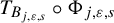 $T_{B_{j,{\varepsilon },s}}\circ \Phi _{j,{\varepsilon },s}$
with
$T_{B_{j,{\varepsilon },s}}\circ \Phi _{j,{\varepsilon },s}$
with $B_{j,{\varepsilon },s}=\overline {B_{-j,\overline {{\varepsilon }},\overline {s}}}$
. This changes
$B_{j,{\varepsilon },s}=\overline {B_{-j,\overline {{\varepsilon }},\overline {s}}}$
. This changes $ C_{j,{\varepsilon },s}:= \overline {\Phi _{-j,\overline {{\varepsilon }},\overline {s}}(X_{-j,\overline {{\varepsilon }},\overline {s}})} + \Phi _{j,{\varepsilon },s}(X_{j,{\varepsilon },s})$
to
$ C_{j,{\varepsilon },s}:= \overline {\Phi _{-j,\overline {{\varepsilon }},\overline {s}}(X_{-j,\overline {{\varepsilon }},\overline {s}})} + \Phi _{j,{\varepsilon },s}(X_{j,{\varepsilon },s})$
to $C_{j,{\varepsilon },s}+2 B_{j,{\varepsilon },s}$
.
$C_{j,{\varepsilon },s}+2 B_{j,{\varepsilon },s}$
.
3.7 Defining the modulus
Definition 3.6. Let $f_{\varepsilon }$
be a prepared germ of type (3.1), let
$f_{\varepsilon }$
be a prepared germ of type (3.1), let $\Omega _s$
be a sectoral domain, and let
$\Omega _s$
be a sectoral domain, and let $\{\Phi _{j,{\varepsilon },s}\}_{{\varepsilon }\in \Omega _s\cup \{0\}}$
,
$\{\Phi _{j,{\varepsilon },s}\}_{{\varepsilon }\in \Omega _s\cup \{0\}}$
, $j=0, \pm 1, \ldots , \pm k$
be associated Fatou coordinates. The
$j=0, \pm 1, \ldots , \pm k$
be associated Fatou coordinates. The $2k$
associated transition functions are the functions (see Figure 9)
$2k$
associated transition functions are the functions (see Figure 9)
 $$ \begin{align} \Psi_{\ell,{\varepsilon},s} = \begin{cases}\Phi_{\ell,{\varepsilon},s}\circ T_{-\mathrm{sgn}(\ell)({i\pi b({\varepsilon})}/{k})}\circ (\Phi_{\ell-1, {\varepsilon}, s})^{-1}, &\ell \:\text{odd},\\ \Phi_{\ell-1,{\varepsilon},s}\circ T_{\mathrm{sgn}(\ell)({i\pi b({\varepsilon})}/{k})} \circ (\Phi_{\ell, {\varepsilon}, s})^{-1}, &\ell \:\text{even},\end{cases}\end{align} $$ $\ell =\pm 1, \ldots , \pm k$
.
$\ell =\pm 1, \ldots , \pm k$
.
The transition functions (colour online).

Proposition 3.7. Let $f_{\varepsilon }$
be a prepared germ of type (3.1), let
$f_{\varepsilon }$
be a prepared germ of type (3.1), let $\Omega _s$
be a sectoral domain, and let
$\Omega _s$
be a sectoral domain, and let $\{\Psi _{\ell ,{\varepsilon },s}\}_{{\varepsilon }\in \Omega _s\cup \{0\}}$
,
$\{\Psi _{\ell ,{\varepsilon },s}\}_{{\varepsilon }\in \Omega _s\cup \{0\}}$
, $\ell =\pm 1, \ldots , \pm k$
, be associated transition functions. Then, we have the following:
$\ell =\pm 1, \ldots , \pm k$
, be associated transition functions. Then, we have the following:
-
(1)
$T_1\circ \Psi _{\ell ,{\varepsilon },s}= \Psi _{\ell ,{\varepsilon },s}\circ T_1$
; -
(2)
(3.9)In particular, all transition functions are determined by the ones for
$$ \begin{align}\Sigma\circ{T_{{1/2}}} \circ \Psi_{\ell,{\varepsilon},s}=\Psi_{-\ell,\overline{{\varepsilon}},\overline{s}}\circ \Sigma\circ{T_{{1/2}}}. \end{align} $$
$\ell>0$
.
-
(3) It is possible to choose Fatou coordinates so that the constant terms in the Fourier expansion of
$\{\Psi _{\ell ,{\varepsilon },s}\}_{{\varepsilon }\in \Omega _s\cup \{0\}}$
are given by (3.10)Such Fatou coordinates are called normalized and the corresponding transition functions are also called normalized.
$$ \begin{align} c_{\ell,{\varepsilon},s}=\mathrm{sgn}(\ell)(-1)^\ell\;\frac{i\pi b({\varepsilon})}{k}.\end{align} $$
-
(4) If
$\{\widetilde {\Psi }_{\ell ,{\varepsilon },s}\}_{{\varepsilon }\in \Omega _s\cup \{0\}}$
,
$\ell =\pm 1, \ldots , \pm k$
, are other transition functions associated to other normalized Fatou coordinates, then there exist
$B_{{\varepsilon },s}$
satisfying
$B_{{\varepsilon },s}=\overline {B_{\overline {{\varepsilon }},\overline {s}}}$
analytic in
${\varepsilon }\in \Omega _s$
with continuous limit at
${\varepsilon }=0$
such that (3.11)We say that the collections of normalized transition functions
$$ \begin{align} \widetilde{\Psi}_{\ell,{\varepsilon},s}= T_{-B_{{\varepsilon},s}}\circ \Psi_{\ell,{\varepsilon},s} \circ T_{B_{{\varepsilon},s}}.\end{align} $$
$\{\Psi _{1,{\varepsilon },s}, \ldots , \Psi _{k,{\varepsilon },s}\}_{{\varepsilon }\in \Omega _s\cup \{0\}}$
and
$\{\widetilde {\Psi }_{1,{\varepsilon },s}, \ldots , \widetilde {\Psi }_{k,{\varepsilon },s}\}_{{\varepsilon }\in \Omega _s\cup \{0\}}$
are equivalent and we write (3.12)
$$ \begin{align}\{\Psi_{1,{\varepsilon},s}, \ldots, \Psi_{k,{\varepsilon},s}\}_{{\varepsilon}\in\Omega_s\cup\{0\}}\equiv \{\widetilde{\Psi}_{1,{\varepsilon},s}, \ldots, \widetilde{\Psi}_{k,{\varepsilon},s}\}_{{\varepsilon}\in\Omega_s\cup\{0\}}.\end{align} $$
-
(5) When k is even, if
$f_{\varepsilon }$
is in prepared form and
$L_{-1}(z)=-z$
, then
$\hat {f}_{\tilde {{\varepsilon }}} =L_{-1} \circ f_{\varepsilon }\circ L_{-1} $
is also in prepared form for the canonical parameter
$\hat {{\varepsilon }}$
defined in (2.9). Let
$\Omega _{\hat {s}}$
be the image of
$\Omega _s$
under the map
${\varepsilon }\mapsto \hat {{\varepsilon }}$
. If
$\{\Psi _{\ell ,{\varepsilon },s}\}_{{\varepsilon }\in \Omega _s\cup \{0\}, \ell =1, \ldots , k}$
are normalized transition functions for
$f_{\varepsilon }$
and then
$$ \begin{align*}\widehat{\Psi}_{\ell, \hat{{\varepsilon}}, \hat{s}}= \Sigma\circ T_{1/2}\circ \Psi_{k+1-\ell,{\varepsilon},s}\circ \Sigma\circ T_{-1/2},\end{align*} $$
$\{\widehat {\Psi }_{1, \hat {{\varepsilon }}, \hat {s}}, \ldots , \widehat {\Psi }_{k, \hat {{\varepsilon }}, \hat {s}}\}_{\hat {{\varepsilon }}\in \Omega _{\hat {s}}\cup \{0\}}$
are normalized transition functions for
$\hat {f}_{\hat {{\varepsilon }}}$
. We write (3.13)
$$ \begin{align}( \{\Psi_{1,{\varepsilon},s}, \ldots,\Psi_{1,{\varepsilon},s} \}_{{\varepsilon}\in\Omega_s\cup\{0\}})\cong (\{\widehat{\Psi}_{1, \hat{{\varepsilon}}, \hat{s}}, \ldots, \widehat{\Psi}_{k, \hat{{\varepsilon}}, \hat{s}}\}_{\hat{{\varepsilon}}\in\Omega_{\hat{s}}\cup\{0\}}).\end{align} $$



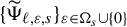

















Remark 3.8. Note that the constant terms $c_{\ell ,{\varepsilon },s}$
in (3.10) coincide precisely with the change of time coordinates
$c_{\ell ,{\varepsilon },s}$
in (3.10) coincide precisely with the change of time coordinates $Z_{j,{\varepsilon }}$
between the corresponding sectors in (3.5).
$Z_{j,{\varepsilon }}$
between the corresponding sectors in (3.5).
Definition 3.9. Let $f_{\varepsilon }$
be a prepared germ of type (3.1).
$f_{\varepsilon }$
be a prepared germ of type (3.1).
-
(1) For k odd, the modulus of
$f_{\varepsilon }$
is given by the
$(kC(k)+3)$
-tuple (3.14)where
$$ \begin{align} \mathcal{M}(f_{\varepsilon})=(k,{\varepsilon},b_{\varepsilon}, (\{\Psi_{1,{\varepsilon},s}, \ldots,\Psi_{k,{\varepsilon},s}\}_{{\varepsilon}\in\Omega_s\cup\{0\}})_s/\equiv ), \end{align} $$
$\{\Psi _{\ell ,{\varepsilon },s}\}_{{\varepsilon }\in \Omega _s\cup \{0\}}$
are the associated normalized transition functions to a sectoral domain
$\Omega _s$
. This is also the modulus of
$f_{\varepsilon }$
for k even under conjugacy tangent to the identity.
-
(2) For k even, the modulus of
$f_{\varepsilon }$
is given by the quotient of
$\mathcal {M}(f_{\varepsilon })$
by
$\cong $
: (3.15)where
$$ \begin{align} \mathcal{N}(f_{\varepsilon})=(k,{\varepsilon},b_{\varepsilon}, (\{\Psi_{1,{\varepsilon},s}, \ldots,\Psi_{k,{\varepsilon},s}\}_{{\varepsilon}\in\Omega_s\cup\{0\}})_s/\equiv )/\cong, \end{align} $$
$$ \begin{align*}&(k,{\varepsilon},b_{\varepsilon}, (\{\Psi_{1,{\varepsilon},s}, \ldots,\Psi_{k,{\varepsilon},s}\}_{\varepsilon\in\Omega_s\cup\{0\}})_s /\equiv ) \\&\quad \cong (k,\hat{{\varepsilon}},b_{\hat{{\varepsilon}}}, (\{\widehat{\Psi}_{1,\hat{{\varepsilon}},\hat{s}}, \ldots,\widehat{\Psi}_{k,\hat{{\varepsilon}},\hat{s}}\}_{\hat{\varepsilon}\in\Omega_{\hat{s}}\cup\{0\}})_{\hat{s}}/\equiv ).\end{align*} $$





3.8 The classification theorem
Theorem 3.10. Two prepared unfoldings of antiholomorphic parabolic germs of type (3.1) are analytically conjugate if and only if they have the same modulus.
Proof. If two families are analytically conjugate, then they obviously have the same modulus. Conversely, suppose that two prepared families $f_{\varepsilon }$
and
$f_{\varepsilon }$
and $\tilde {f}_{\tilde {{\varepsilon }}}$
have the same modulus. In the case where k is odd, then
$\tilde {f}_{\tilde {{\varepsilon }}}$
have the same modulus. In the case where k is odd, then ${\varepsilon }=\tilde {{\varepsilon }}$
by Corollary 2.14, and it is of course possible to suppose that their normalized transition functions are equal:
${\varepsilon }=\tilde {{\varepsilon }}$
by Corollary 2.14, and it is of course possible to suppose that their normalized transition functions are equal: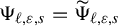 $\Psi _{\ell ,{\varepsilon },s}= \widetilde {\Psi }_{\ell ,{\varepsilon },s}$
. When k is even, the same is true, possibly after conjugating
$\Psi _{\ell ,{\varepsilon },s}= \widetilde {\Psi }_{\ell ,{\varepsilon },s}$
. When k is even, the same is true, possibly after conjugating $\tilde {f}_{\tilde {{\varepsilon }}}$
by
$\tilde {f}_{\tilde {{\varepsilon }}}$
by $L_{-1}$
, in which case, the new canonical parameter becomes
$L_{-1}$
, in which case, the new canonical parameter becomes $\hat {\tilde {{\varepsilon }}}= {\varepsilon }$
.
$\hat {\tilde {{\varepsilon }}}= {\varepsilon }$
.
Moreover, the Fatou coordinates have been chosen so that $\Psi _{\ell , 0,s}$
are independent of s. For
$\Psi _{\ell , 0,s}$
are independent of s. For ${\varepsilon }\in \Omega _s$
, a conjugacy is defined by
${\varepsilon }\in \Omega _s$
, a conjugacy is defined by
 $$ \begin{align*}H_{{\varepsilon},s}(z)= Z_{j,{\varepsilon}}^{-1} \circ (\widetilde{\Phi}_{j,{\varepsilon},s})^{-1}\circ \Phi_{j,{\varepsilon},s}\circ Z_{j,{\varepsilon}}, \quad j=0, \pm1, \ldots, \pm k,\end{align*} $$
where $\Phi _{j,{\varepsilon },s}$
and
$\Phi _{j,{\varepsilon },s}$
and $\widetilde {\Phi }_{j,{\varepsilon },s}$
are the normalized Fatou coordinates of
$\widetilde {\Phi }_{j,{\varepsilon },s}$
are the normalized Fatou coordinates of $f_{\varepsilon }$
and
$f_{\varepsilon }$
and $\tilde {f}_{\varepsilon }$
, respectively. We claim that
$\tilde {f}_{\varepsilon }$
, respectively. We claim that $H_{{\varepsilon },s}$
is well defined over
$H_{{\varepsilon },s}$
is well defined over ${\mathbb D}_r$
. Since the conjugacy we are constructing is also a conjugacy between
${\mathbb D}_r$
. Since the conjugacy we are constructing is also a conjugacy between $g_{\varepsilon }=f_{\overline {{\varepsilon }}}\circ f_{\varepsilon }$
and
$g_{\varepsilon }=f_{\overline {{\varepsilon }}}\circ f_{\varepsilon }$
and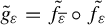 $\tilde {g}_{\varepsilon }=\tilde {f}_{\overline {{\varepsilon }}}\circ \tilde {f}_{\varepsilon }$
, and since full details have been given for the latter case in [Reference RousseauRo15], we explain the ideas and skip some details. The intersection of two sectors has connected components of two forms (see Figure 2):
$\tilde {g}_{\varepsilon }=\tilde {f}_{\overline {{\varepsilon }}}\circ \tilde {f}_{\varepsilon }$
, and since full details have been given for the latter case in [Reference RousseauRo15], we explain the ideas and skip some details. The intersection of two sectors has connected components of two forms (see Figure 2):
-
• subsectors from one fixed point of
$g_{\varepsilon }$
to the boundary: on such a subsector the result follows from (3.9); -
• subsectors joining two singular points, sometimes called gate sectors (the name comes from [Reference OudkerkO99]). The transition map between Fatou coordinates over a gate sector is a translation. The normalization of a transition map is such that this translation depends only on the normal form. Indeed, crossing a gate sector like along the blue thick line in Figure 10 is the same as turning around the singular points on one side of the blue thick line or on the other side (of course, in the appropriate direction) and taking into account the changes of time (3.5) from one sector to the next. Additionally, the period of a singular point
$z_n$
is
${2\pi i}/{g_{\varepsilon }'(z_n)}= {2\pi i}/{\tilde {g}_{\varepsilon }'(z_n)}$
. Hence, the translation given by the transition over of a gate sector is the same for
$f_{\varepsilon }$
and for
$\tilde {f}_{\varepsilon }$
.Figure 10The change of time of the crossing of a gate sector (in gray) from top to bottom along the blue thick line is the same as the change of time when turning around the singular points on the left in the positive direction, or turning around the singular points on the right in the negative direction and, in both cases, taking also into account the changes of time (3.5) from one sector to the next (colour online).





Now, suppose that $\Omega _s\cap \Omega _{s'}\neq \emptyset $
. Then,
$\Omega _s\cap \Omega _{s'}\neq \emptyset $
. Then, $H_{{\varepsilon },s'}^{-1} \circ H_{{\varepsilon },s}$
commutes with
$H_{{\varepsilon },s'}^{-1} \circ H_{{\varepsilon },s}$
commutes with $g_{\varepsilon }$
and is equal to the identity for
$g_{\varepsilon }$
and is equal to the identity for ${\varepsilon }=0$
. If the modulus is non-trivial (that is, not all transition functions are identically translations), then
${\varepsilon }=0$
. If the modulus is non-trivial (that is, not all transition functions are identically translations), then $H_{{\varepsilon },s'}^{-1} \circ H_{{\varepsilon },s} = g_\varepsilon^{\circ {m}/{n}}$
for some non-zero n independent of
$H_{{\varepsilon },s'}^{-1} \circ H_{{\varepsilon },s} = g_\varepsilon^{\circ {m}/{n}}$
for some non-zero n independent of ${\varepsilon }$
by Proposition 3.11 below. Since
${\varepsilon }$
by Proposition 3.11 below. Since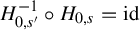 $H_{0,s'}^{-1}\circ H_{0,s}=\mathrm {id}$
because the
$H_{0,s'}^{-1}\circ H_{0,s}=\mathrm {id}$
because the $\Psi _{\ell , 0,s}$
are independent of s, then
$\Psi _{\ell , 0,s}$
are independent of s, then $m=0$
, and the
$m=0$
, and the $H_{{\varepsilon },s}$
are analytic extensions of each other when s varies and yield a uniform bounded conjugacy
$H_{{\varepsilon },s}$
are analytic extensions of each other when s varies and yield a uniform bounded conjugacy $H_{\varepsilon }$
outside the parameter values in the discriminant set. Hence, the conjugacy can be analytically extended to the discriminant set.
$H_{\varepsilon }$
outside the parameter values in the discriminant set. Hence, the conjugacy can be analytically extended to the discriminant set.
If the modulus is trivial, then the $H_{{\varepsilon },s}$
need to be corrected before being glued in a uniform way. Indeed,
$H_{{\varepsilon },s}$
need to be corrected before being glued in a uniform way. Indeed, $H_{{\varepsilon },s'}^{-1} \circ H_{{\varepsilon },s} = g_\varepsilon^{\circ t({\varepsilon })}$
for some real
$H_{{\varepsilon },s'}^{-1} \circ H_{{\varepsilon },s} = g_\varepsilon^{\circ t({\varepsilon })}$
for some real $t({\varepsilon })$
, which has the property that
$t({\varepsilon })$
, which has the property that $t(0)=0$
. We want to modify the normalized Fatou coordinates so as to force that
$t(0)=0$
. We want to modify the normalized Fatou coordinates so as to force that $t({\varepsilon })=0$
. This is done by choosing normalized Fatou coordinates with one fixed base point, for instance,
$t({\varepsilon })=0$
. This is done by choosing normalized Fatou coordinates with one fixed base point, for instance, $z=r$
(respectively
$z=r$
(respectively $z=r'$
) for
$z=r'$
) for $\Phi _{0,{\varepsilon },s}$
(respectively
$\Phi _{0,{\varepsilon },s}$
(respectively $\widetilde {\Phi }_{0,{\varepsilon },s}$
). Then,
$\widetilde {\Phi }_{0,{\varepsilon },s}$
). Then,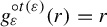 $g_\varepsilon^{\circ t({\varepsilon })}(r)=r$
, which yields
$g_\varepsilon^{\circ t({\varepsilon })}(r)=r$
, which yields $t({\varepsilon })=0$
since t is continuous and
$t({\varepsilon })=0$
since t is continuous and $t(0)=0$
.
$t(0)=0$
.
The following proposition is well known (see for instance [Reference RousseauRo15]).
Proposition 3.11. Let $g_{\varepsilon }$
be an unfolding of a holomorphic parabolic germ. Then:
$g_{\varepsilon }$
be an unfolding of a holomorphic parabolic germ. Then:
-
(1) either
$g_{\varepsilon }$
is conjugate to the normal form
$v_{\varepsilon }^1$
and any holomorphic family of diffeomorphisms
$h_{\varepsilon }$
commuting with
$g_{\varepsilon }$
has the form
$h_{\varepsilon }= g_{\varepsilon }^{\circ \alpha ({\varepsilon })}$
for
$\alpha ({\varepsilon })$
analytic; -
(2) or there exists
$q\in {\mathbb N}*$
such that any holomorphic family of diffeomorphisms
$h_{\varepsilon }$
commuting with
$g_{\varepsilon }$
has the form
$h_{\varepsilon }= g_{\varepsilon }^{\circ {p}/{q}}$
for some
$p\in {\mathbb Z}$
. In particular, if
$ \lim _{{\varepsilon }\to 0} h_{\varepsilon } = \mathrm {id}$
, then
$h_{\varepsilon }\equiv \mathrm {id}$
.




Proof. In each Fatou coordinate of $g_{\varepsilon }$
, then
$g_{\varepsilon }$
, then $h_{\varepsilon }$
commutes with
$h_{\varepsilon }$
commutes with $T_1$
, that is, is of the form
$T_1$
, that is, is of the form $T_{\alpha ({\varepsilon })}$
. For
$T_{\alpha ({\varepsilon })}$
. For $h_{\varepsilon }$
to be uniformly defined over
$h_{\varepsilon }$
to be uniformly defined over ${\mathbb D}_r$
, then
${\mathbb D}_r$
, then $T_{\alpha ({\varepsilon })}$
must commute with the transition functions. In case (1), the transition functions are translations and any translation commutes with them. In case (2), there is a maximum
$T_{\alpha ({\varepsilon })}$
must commute with the transition functions. In case (1), the transition functions are translations and any translation commutes with them. In case (2), there is a maximum $q\in {\mathbb N}$
such
$q\in {\mathbb N}$
such $T_{1/q}$
commutes with the transition functions. Then,
$T_{1/q}$
commutes with the transition functions. Then, $\alpha ({\varepsilon })= {p}/{q}$
is constant in
$\alpha ({\varepsilon })= {p}/{q}$
is constant in ${\varepsilon }$
.
${\varepsilon }$
.
Corollary 3.12. Two prepared families of type (3.1) are analytically conjugate under a conjugacy tangent to the identity if and only if their second iterates $g_{\varepsilon }$
and
$g_{\varepsilon }$
and $\tilde {g}_{\varepsilon }$
are analytically conjugate under a conjugacy tangent to the identity.
$\tilde {g}_{\varepsilon }$
are analytically conjugate under a conjugacy tangent to the identity.
Proof. One direction is obvious. For the other direction, it is important to use that $g_{\varepsilon }$
and
$g_{\varepsilon }$
and $\tilde {g}_{\varepsilon }$
have representatives of the modulus satisfying (3.9). Then, an equivalence between them constructed as in the proof of Theorem 3.10 (and hence tangent to the identity) yields an equivalence between
$\tilde {g}_{\varepsilon }$
have representatives of the modulus satisfying (3.9). Then, an equivalence between them constructed as in the proof of Theorem 3.10 (and hence tangent to the identity) yields an equivalence between $f_{\varepsilon }$
and
$f_{\varepsilon }$
and $\tilde {f}_{\varepsilon }$
.
$\tilde {f}_{\varepsilon }$
.
Corollary 3.13. A prepared family of type (3.1) is analytically conjugate to its normal form $\sigma _\circ v_{\varepsilon }^{1/2}$
if and only if all the transition maps
$\sigma _\circ v_{\varepsilon }^{1/2}$
if and only if all the transition maps $\Psi _{j,{\varepsilon },s}$
are translations.
$\Psi _{j,{\varepsilon },s}$
are translations.
4 Antiholomorphic parabolic unfolding with an invariant real analytic curve
4.1 The case
${\varepsilon }=0$

This case has been studied in [Reference Godin and RousseauGR21]. Suppose that an antiholomorphic parabolic germ $f_0$
keeps invariant a germ of a real analytic curve. This property is invariant under holomorphic conjugacy and can be read on the modulus. Indeed, modulo a conjugacy, we can suppose that
$f_0$
keeps invariant a germ of a real analytic curve. This property is invariant under holomorphic conjugacy and can be read on the modulus. Indeed, modulo a conjugacy, we can suppose that $f_0$
preserves the real axis, and hence commutes with
$f_0$
preserves the real axis, and hence commutes with $\sigma $
. This in turn implies that the transition maps satisfy
$\sigma $
. This in turn implies that the transition maps satisfy
 $$ \begin{align}\Sigma\circ \Psi_\ell= \Psi_{-\ell}\circ \Sigma.\end{align} $$
Together with (3.9), this yields that for all $\ell $
,
$\ell $
,
 $$ \begin{align} T_{1/2} \circ \Psi_\ell= \Psi_\ell\circ T_{1/2},\end{align} $$
which is precisely the condition for $g_0=f_0\circ f_0$
to have a holomorphic square root (see for instance [Reference IlyashenkoI93]). Indeed, this is natural since (4.1) yields that
$g_0=f_0\circ f_0$
to have a holomorphic square root (see for instance [Reference IlyashenkoI93]). Indeed, this is natural since (4.1) yields that $f_0$
commutes with
$f_0$
commutes with $\sigma $
and then that
$\sigma $
and then that $\sigma \circ f_0$
is a holomorphic square root of
$\sigma \circ f_0$
is a holomorphic square root of $g_0$
.
$g_0$
.
The converse is also true.
Theorem 4.1. [Reference Godin and RousseauGR21]
Let $f_0$
be an antiholomorphic parabolic germ. We have the equivalences:
$f_0$
be an antiholomorphic parabolic germ. We have the equivalences:


4.2 The unfolding
We now consider a prepared generic unfolding $f_{\varepsilon }$
of
$f_{\varepsilon }$
of $f_0$
. If we limit ourselves to real values of
$f_0$
. If we limit ourselves to real values of ${\varepsilon }$
, then it makes sense to have
${\varepsilon }$
, then it makes sense to have $f_{\varepsilon }$
preserving a germ of a real analytic curve, which is tangent to the real axis since
$f_{\varepsilon }$
preserving a germ of a real analytic curve, which is tangent to the real axis since $f_{\varepsilon }$
is prepared. If
$f_{\varepsilon }$
is prepared. If $z= x+iy$
, this germ of a real analytic curve has the form
$z= x+iy$
, this germ of a real analytic curve has the form $y= \alpha (x, {\varepsilon })= O(P_{\varepsilon }(x))$
, since the fixed points are real for real
$y= \alpha (x, {\varepsilon })= O(P_{\varepsilon }(x))$
, since the fixed points are real for real ${\varepsilon }$
and belong to the invariant curve. This yields a local holomorphic diffeomorphism
${\varepsilon }$
and belong to the invariant curve. This yields a local holomorphic diffeomorphism $z\mapsto \beta _{\varepsilon }(z)=z+ i\alpha (z,{\varepsilon })$
, which preserves the prepared character. Let us now consider
$z\mapsto \beta _{\varepsilon }(z)=z+ i\alpha (z,{\varepsilon })$
, which preserves the prepared character. Let us now consider $\tilde {f}_{\varepsilon }=\beta _{\varepsilon }^{-1} \circ f_{\varepsilon }\circ \beta _{\varepsilon }$
. Then, for real
$\tilde {f}_{\varepsilon }=\beta _{\varepsilon }^{-1} \circ f_{\varepsilon }\circ \beta _{\varepsilon }$
. Then, for real ${\varepsilon }$
,
${\varepsilon }$
, $\tilde {f}_{\varepsilon }$
sends a neighborhood of
$\tilde {f}_{\varepsilon }$
sends a neighborhood of $0$
on the real axis to the real axis. For complex
$0$
on the real axis to the real axis. For complex ${\varepsilon }$
, this yields
${\varepsilon }$
, this yields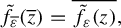 $\tilde {f}_{\overline {\varepsilon }}(\overline {z})= \overline {\tilde {f}_{\varepsilon }(z)},$
which in turn yields that
$\tilde {f}_{\overline {\varepsilon }}(\overline {z})= \overline {\tilde {f}_{\varepsilon }(z)},$
which in turn yields that $\tilde {g}_{\varepsilon }(z):=\tilde {f}_{\overline {\varepsilon }}\circ \tilde {f}_{\varepsilon }(z)= \overline {\tilde {f}_{\varepsilon }(\overline {\tilde {f}_{\varepsilon }(z)})}= (\sigma _\circ \tilde {f}_{\varepsilon })\circ (\sigma _\circ \tilde {f}_{\varepsilon })(z)$
, that is,
$\tilde {g}_{\varepsilon }(z):=\tilde {f}_{\overline {\varepsilon }}\circ \tilde {f}_{\varepsilon }(z)= \overline {\tilde {f}_{\varepsilon }(\overline {\tilde {f}_{\varepsilon }(z)})}= (\sigma _\circ \tilde {f}_{\varepsilon })\circ (\sigma _\circ \tilde {f}_{\varepsilon })(z)$
, that is, $\tilde {g}_{\varepsilon }$
has the holomorphic square root
$\tilde {g}_{\varepsilon }$
has the holomorphic square root $\sigma _\circ \tilde {f}_{\varepsilon }$
. Therefore,
$\sigma _\circ \tilde {f}_{\varepsilon }$
. Therefore, $g_{\varepsilon }=f_{\overline {\varepsilon }} \circ f_{\varepsilon }$
also has a holomorphic square root.
$g_{\varepsilon }=f_{\overline {\varepsilon }} \circ f_{\varepsilon }$
also has a holomorphic square root.
Hence, we have the following theorem.
Theorem 4.2. Let $f_{\varepsilon }$
be a prepared germ of an antiholomorphic parabolic unfolding. We have the following equivalences.
$f_{\varepsilon }$
be a prepared germ of an antiholomorphic parabolic unfolding. We have the following equivalences.
-
(1) For real values of
${\varepsilon }$
,
$f_{\varepsilon }$
preserves a germ of a real analytic curve depending real analytically on
${\varepsilon }$
. -
(2) The square
$g_{\varepsilon }=f_{\overline {\varepsilon }} \circ f_{\varepsilon }$
has a holomorphic square root tangent to the identity. -
(3) The modulus of
$f_{\varepsilon }$
satisfies (4.3)
$$ \begin{align} T_{1/2} \circ \Psi_{\ell,{\varepsilon},s}= \Psi_{\ell,{\varepsilon}, s} \circ T_{1/2}.\end{align} $$
-
(4) The modulus of
$f_{\varepsilon }$
satisfies (4.4)
$$ \begin{align}\Sigma\circ \Psi_{\ell,{\varepsilon},s}= \Psi_{-\ell, \overline{\varepsilon}, \overline{s}}\circ \Sigma.\end{align} $$





Proof. $(1)\Rightarrow (2)$
is shown above.
$(1)\Rightarrow (2)$
is shown above. $(2) \Rightarrow (3)$
. Let
$(2) \Rightarrow (3)$
. Let $h_{\varepsilon }$
be a holomorphic square root of
$h_{\varepsilon }$
be a holomorphic square root of $g_{\varepsilon }$
tangent to the identity. In particular,
$g_{\varepsilon }$
tangent to the identity. In particular, $h_{\varepsilon }$
sends (approximately) a sector
$h_{\varepsilon }$
sends (approximately) a sector $S_{j,{\varepsilon },s}$
to the same sector. Then,
$S_{j,{\varepsilon },s}$
to the same sector. Then, $ \Phi _{j,{\varepsilon },s}\circ Z_{j,{\varepsilon }}\circ h_{\varepsilon }\circ Z_{j,{\varepsilon }}^{-1} \circ \Phi _{j,{\varepsilon },s}^{-1}=T_{1/2}$
, and since
$ \Phi _{j,{\varepsilon },s}\circ Z_{j,{\varepsilon }}\circ h_{\varepsilon }\circ Z_{j,{\varepsilon }}^{-1} \circ \Phi _{j,{\varepsilon },s}^{-1}=T_{1/2}$
, and since $h_{\varepsilon }$
is globally defined, then
$h_{\varepsilon }$
is globally defined, then $T_{1/2}$
must commute with the
$T_{1/2}$
must commute with the $\Psi _{\ell ,{\varepsilon }, s}$
, yielding (4.3).
$\Psi _{\ell ,{\varepsilon }, s}$
, yielding (4.3). $(3) \Leftrightarrow (4)$
because of (3.9).
$(3) \Leftrightarrow (4)$
because of (3.9). $(4) \Rightarrow (1)$
. Let
$(4) \Rightarrow (1)$
. Let
 $$ \begin{align*}\zeta_{j,{\varepsilon},s} = Z_{-j,\overline{\varepsilon}}^{-1} \circ \Phi_{-j,\overline{\varepsilon},\overline{s}}^{-1} \circ \Sigma \circ \Phi_{j,{\varepsilon},s}\circ Z_{j,{\varepsilon}}.\end{align*} $$
First, note that $\zeta _{j,{\varepsilon },s}$
is well defined independently of the freedom on Fatou coordinates because of (3.7). Note that
$\zeta _{j,{\varepsilon },s}$
is well defined independently of the freedom on Fatou coordinates because of (3.7). Note that $\zeta _{j,{\varepsilon },s}$
is independent of j, yielding a well-defined
$\zeta _{j,{\varepsilon },s}$
is independent of j, yielding a well-defined $\zeta _{{\varepsilon },s}$
on
$\zeta _{{\varepsilon },s}$
on ${\mathbb D}_r\setminus \{P_{\varepsilon }(z)=0\}$
for
${\mathbb D}_r\setminus \{P_{\varepsilon }(z)=0\}$
for ${\varepsilon }\in \Omega _s$
. This follows from (4.4) on the intersection sectors to the boundary. On the gate sectors, joining two singular points, it follows from the proof of Theorem 3.10 that the translations
${\varepsilon }\in \Omega _s$
. This follows from (4.4) on the intersection sectors to the boundary. On the gate sectors, joining two singular points, it follows from the proof of Theorem 3.10 that the translations $\mathcal {T}_{\ell ,{\varepsilon },s}$
along gate sectors (crossed in symmetric directions with respect to the real axis for
$\mathcal {T}_{\ell ,{\varepsilon },s}$
along gate sectors (crossed in symmetric directions with respect to the real axis for $({\varepsilon },s)$
and
$({\varepsilon },s)$
and $(\overline {\varepsilon },\overline {s})$
) satisfy
$(\overline {\varepsilon },\overline {s})$
) satisfy $\mathcal {T}_{\ell ,{\varepsilon },s}\circ \Sigma = \Sigma \circ \mathcal {T}_{-\ell ,\overline {\varepsilon }, \overline {s}}$
.
$\mathcal {T}_{\ell ,{\varepsilon },s}\circ \Sigma = \Sigma \circ \mathcal {T}_{-\ell ,\overline {\varepsilon }, \overline {s}}$
.
Because $\zeta _{{\varepsilon },s}$
is bounded in the neighborhood of
$\zeta _{{\varepsilon },s}$
is bounded in the neighborhood of $P_{\varepsilon }(z)=0$
, it can be extended to this set. Moreover,
$P_{\varepsilon }(z)=0$
, it can be extended to this set. Moreover, $\zeta _{{\varepsilon },s}$
depends antiholomorphically on
$\zeta _{{\varepsilon },s}$
depends antiholomorphically on ${\varepsilon }$
and
${\varepsilon }$
and $\zeta _{\overline {\varepsilon },\overline {s}}\circ \zeta _{{\varepsilon },s}=\mathrm {id}$
.
$\zeta _{\overline {\varepsilon },\overline {s}}\circ \zeta _{{\varepsilon },s}=\mathrm {id}$
.
Since $T_{1/2}$
and
$T_{1/2}$
and $\Sigma $
commute, it follows from (4.4) and (3.9) that
$\Sigma $
commute, it follows from (4.4) and (3.9) that $\zeta _{{\varepsilon },s}\circ f_{\varepsilon }$
is a holomorphic square root of
$\zeta _{{\varepsilon },s}\circ f_{\varepsilon }$
is a holomorphic square root of $g_{\varepsilon }$
over
$g_{\varepsilon }$
over $\Omega _s$
, whose limit is tangent to the identity when
$\Omega _s$
, whose limit is tangent to the identity when ${\varepsilon }\to 0$
. On the intersection
${\varepsilon }\to 0$
. On the intersection $\Omega _s\circ \Omega _{s'}$
,
$\Omega _s\circ \Omega _{s'}$
, $\zeta _{{\varepsilon },s}\circ f_{\varepsilon }$
and
$\zeta _{{\varepsilon },s}\circ f_{\varepsilon }$
and $\zeta _{{\varepsilon },s'}\circ f_{\varepsilon }$
are two holomorphic square roots of
$\zeta _{{\varepsilon },s'}\circ f_{\varepsilon }$
are two holomorphic square roots of $g_{\varepsilon }$
, whose limit is tangent to the identity when
$g_{\varepsilon }$
, whose limit is tangent to the identity when ${\varepsilon }\to 0$
. By uniqueness of such square roots, we have
${\varepsilon }\to 0$
. By uniqueness of such square roots, we have $\zeta _{{\varepsilon },s}=\zeta _{{\varepsilon },s'}$
. Hence,
$\zeta _{{\varepsilon },s}=\zeta _{{\varepsilon },s'}$
. Hence, $\zeta _{\varepsilon }$
is uniformly defined outside the discriminant set and bounded there, yielding that it can be extended antiholomorphically to this set.
$\zeta _{\varepsilon }$
is uniformly defined outside the discriminant set and bounded there, yielding that it can be extended antiholomorphically to this set.
Now, restricting to real values of ${\varepsilon }$
,
${\varepsilon }$
, $\zeta _{\varepsilon }$
is an antiholomorphic involution depending real-analytically on
$\zeta _{\varepsilon }$
is an antiholomorphic involution depending real-analytically on ${\varepsilon }$
. Let us look at the equation of fixed points
${\varepsilon }$
. Let us look at the equation of fixed points $\zeta _{\varepsilon }(z)=z$
. Since
$\zeta _{\varepsilon }(z)=z$
. Since ${\zeta _0'(0)=1}$
, then letting
${\zeta _0'(0)=1}$
, then letting $z=x+iy$
, by the implicit function theorem, the equation for the imaginary parts yields
$z=x+iy$
, by the implicit function theorem, the equation for the imaginary parts yields $y-q({\varepsilon },x)=0$
, with q real-analytic in
$y-q({\varepsilon },x)=0$
, with q real-analytic in ${\varepsilon }$
and x. Let
${\varepsilon }$
and x. Let ${V(x,y,{\varepsilon })=0}$
be the equation for the real parts. Since
${V(x,y,{\varepsilon })=0}$
be the equation for the real parts. Since $\zeta _s$
is an involution, it has no isolated fixed points. Hence,
$\zeta _s$
is an involution, it has no isolated fixed points. Hence, $y-q({\varepsilon },x)$
divides
$y-q({\varepsilon },x)$
divides $V(x,y,{\varepsilon })$
. Let
$V(x,y,{\varepsilon })$
. Let $h_{\varepsilon }(z) = z+iq(z,{\varepsilon })$
. Then,
$h_{\varepsilon }(z) = z+iq(z,{\varepsilon })$
. Then, ${\chi _{\varepsilon }= h_{\varepsilon }^{-1}\circ \zeta _{\varepsilon }\circ h_{\varepsilon }}$
fixes the real axis. By the identity principle,
${\chi _{\varepsilon }= h_{\varepsilon }^{-1}\circ \zeta _{\varepsilon }\circ h_{\varepsilon }}$
fixes the real axis. By the identity principle, $\sigma \circ \chi _{\varepsilon }=\mathrm {id}$
, yielding that
$\sigma \circ \chi _{\varepsilon }=\mathrm {id}$
, yielding that $\chi _{\varepsilon }=\sigma $
and that
$\chi _{\varepsilon }=\sigma $
and that $\zeta _{\varepsilon }$
is the Schwarz reflection with respect to the analytic curve
$\zeta _{\varepsilon }$
is the Schwarz reflection with respect to the analytic curve $y=q({\varepsilon },x)$
. Let z be any fixed point of
$y=q({\varepsilon },x)$
. Let z be any fixed point of $\zeta _{\varepsilon }$
. Since
$\zeta _{\varepsilon }$
. Since $\zeta _{\varepsilon }$
and
$\zeta _{\varepsilon }$
and $f_{\varepsilon }$
commute, then
$f_{\varepsilon }$
commute, then $\zeta _{\varepsilon }(f_{\varepsilon }(z))=f_{\varepsilon }(z)$
, that is,
$\zeta _{\varepsilon }(f_{\varepsilon }(z))=f_{\varepsilon }(z)$
, that is, $f_{\varepsilon }(z)$
is also a fixed point of
$f_{\varepsilon }(z)$
is also a fixed point of $\zeta _{\varepsilon }$
. Hence, the curve
$\zeta _{\varepsilon }$
. Hence, the curve $y=q({\varepsilon },x)$
is invariant by
$y=q({\varepsilon },x)$
is invariant by $f_{\varepsilon }$
.
$f_{\varepsilon }$
.
5 Antiholomorphic square root of a germ of holomorphic parabolic unfolding
The formal normal form of a holomorphic parabolic germ is invariant under rotations of order k (modulo a reparameterization), while that of an antiholomorphic germ in prepared form has the real axis as a symmetry axis. Each invariance requires a quotient in the definition of the modulus of the corresponding parabolic germ or its unfoldings. For these respective quotients, we will need to use actions of the rotation group $R_k$
of order k and of the symmetry with respect to an axis
$R_k$
of order k and of the symmetry with respect to an axis $e^{i({\pi m}/{k})}{\mathbb R}$
on the set of indices
$e^{i({\pi m}/{k})}{\mathbb R}$
on the set of indices $\{\pm 1, \ldots , \pm k\}$
of the transition maps. We start by defining these actions.
$\{\pm 1, \ldots , \pm k\}$
of the transition maps. We start by defining these actions.
5.1 Actions on the set of indices
Definition 5.1.
-
• Let
$\iota : \{\pm 1, \ldots , \pm k\}\rightarrow \{1, \ldots 2k\}$
be defined as
$$ \begin{align*}\iota(j) = \begin{cases} j, &j>0,\\ 2k+1+j, &j<0.\end{cases} \end{align*} $$
-
• The rotation group
$R_k=\{r_0, r_2,\ldots , r_{2(k-1)}\}$
with
$r_m (w) = e^{i({\pi m}/{k})}w$
acts on the set of indices
$\pm 1, \ldots , \pm k$
as
$r_{2m}(j) = \iota ^{-1} (q(\iota (j)+2m))$
, where
$q(s)\in \{1, \ldots , 2k\}$
and
$q(s)$
is congruent to s (
$\mathrm {mod}\ 2k$
). (By abuse of notation,
$r_{2m}$
denotes both the rotation and its action on the set of indices.) -
• The symmetry
$\xi _0$
with respect to
${\mathbb R}$
on the set of indices
$\{\pm 1, \ldots , \pm k\}$
is defined as
$\xi _0(j)=-j$
. -
• The symmetry
$\xi _m$
with respect to the line
$e^{i({\pi m}/{k})}{\mathbb R}$
on the set of indices
$\{\pm 1, \ldots , \pm k\}$
is defined as
$\xi _m = r_m\circ \xi _0\circ r_{m}^{-1}$
for
$m=0, \ldots , k-1$
(see Figure 11).Figure 11For
$k=3$
, the symmetry condition on the indices with respect to the symmetry axis
$e^{{2\pi i}/{3}}{\mathbb R}$
is given by the involution
$\xi _2(1)=-3$
,
$\xi _2(2)=3$
,
$\xi _2(-1)= -2$
(colour online).


















5.2 The case
${\varepsilon }=0$

This case has been studied in [Reference Godin and RousseauGR21]. A holomorphic parabolic germ
 $$ \begin{align}g(z) = z + z^{k+1} + o(z^{k+1})\end{align} $$
has k formal antiholomorphic square roots of the form
 $$ \begin{align}f(\overline{z}) = e^{i({2\pi m}/{k})} \overline{z} +\tfrac12 e^{i({2\pi m}/{k})} \overline{z}^{k+1} + o(\overline{z}^{k+1}),\end{align} $$ $m=0, \ldots , k-1$
. Denoting
$m=0, \ldots , k-1$
. Denoting $\Psi _j=\Psi _{j,0,s}$
,
$\Psi _j=\Psi _{j,0,s}$
, $j=\pm 1, \ldots , \pm k$
, defined as in Definition 3.6, the analytic part of the modulus of g is composed of the
$j=\pm 1, \ldots , \pm k$
, defined as in Definition 3.6, the analytic part of the modulus of g is composed of the $2k$
-tuple of normalized transition functions
$2k$
-tuple of normalized transition functions $(\Psi _{1},\ldots , \Psi _{k}, \Psi _{-k}, \ldots , \Psi _{-1})$
quotiented by:
$(\Psi _{1},\ldots , \Psi _{k}, \Psi _{-k}, \ldots , \Psi _{-1})$
quotiented by:
-
• the action of
${\mathbb C}$
corresponding to conjugating all
$\Psi _{j}$
by translations
$T_c$
; -
• the action of the rotation group
$R_k$
of order k. The action of
$r_{2m}$
is given by
$(\Psi _{1},\ldots , \Psi _k,\Psi _{-k}\ldots , \Psi _{-1})\mapsto (\Psi _{r_{2m}(1)},\ldots , \Psi _{r_{2m}(k)},\Psi _{r_{2m}(-k)}\ldots , \Psi _{r_{2m}(-1)})$
.


Theorem 5.2. [Reference Godin and RousseauGR21]
The formal square root (5.2) is antiholomorphic if and only if the modulus satisfies a symmetry condition with respect to the symmetry axis $e^{i({\pi m}/{k})}{\mathbb R}$
. If
$e^{i({\pi m}/{k})}{\mathbb R}$
. If $\xi _m(j)$
is the symmetric index of j with respect to
$\xi _m(j)$
is the symmetric index of j with respect to $e^{i({\pi m}/{k})}{\mathbb R}$
, then this symmetry condition takes the form
$e^{i({\pi m}/{k})}{\mathbb R}$
, then this symmetry condition takes the form
 $$ \begin{align*}\Sigma\circ{T_{{1/2}}} \circ \Psi_j=\Psi_{\xi_m(j)}\circ \Sigma\circ{T_{{1/2}}} \end{align*} $$
for some representative of the modulus.
5.3 The unfolding case
Generic holomorphic unfoldings of a parabolic germ (5.1) have been studied in [Reference RousseauRo15]. They can also be put in a prepared form with canonical parameters
 $$ \begin{align} g_{\varepsilon}(z) = z + P_{\varepsilon}(z) (1 +M_{\varepsilon}(z) + P_{\varepsilon}(z)N_{\varepsilon}(z)),\end{align} $$
where $P_{\varepsilon }$
is defined in (3.3) and
$P_{\varepsilon }$
is defined in (3.3) and $M_{\varepsilon }$
is a polynomial in z of degree at most k.
$M_{\varepsilon }$
is a polynomial in z of degree at most k.
Sectoral domains can be defined as in Definition 3.2 and transition functions for each sectoral domain as in Definition 3.6.
Definition 5.3. Let $g_{\varepsilon }$
be a prepared germ of type (5.3). The modulus of
$g_{\varepsilon }$
be a prepared germ of type (5.3). The modulus of $g_{\varepsilon }$
is given by the equivalence class of
$g_{\varepsilon }$
is given by the equivalence class of $(3+2kC(k))$
-tuples (see Figure 9),
$(3+2kC(k))$
-tuples (see Figure 9),
 $$ \begin{align} \mathcal{M}(f_{\varepsilon})=(k,{\varepsilon},b_{\varepsilon}, ((\{\Psi_{\pm1,{\varepsilon},s}, \ldots,\Psi_{\pm k,{\varepsilon},s}\}_{{\varepsilon}\in\Omega_s\cup\{0\}})/\equiv)_s )/\cong, \end{align} $$
where $\{\Psi _{\ell ,{\varepsilon },s}\}_{{\varepsilon }\in \Omega _s\cup \{0\}}$
are the associated normalized transition functions to a sectoral domain
$\{\Psi _{\ell ,{\varepsilon },s}\}_{{\varepsilon }\in \Omega _s\cup \{0\}}$
are the associated normalized transition functions to a sectoral domain $\Omega _s$
and the equivalence definitions are defined as follows.
$\Omega _s$
and the equivalence definitions are defined as follows.
-
(1)
$\{\Psi _{\pm 1,{\varepsilon },s},\ldots ,\Psi _{\pm k,{\varepsilon },s} \}_{{\varepsilon }\in \Omega _s\cup \{0\}} \equiv \{\widetilde {\Psi }_{\pm 1,{\varepsilon },s},\ldots ,\widetilde {\Psi }_{\pm k,{\varepsilon },s}\}_{{\varepsilon }\in \Omega _s\cup \{0\}}$
if there exists
$B_{{\varepsilon },s}$
analytic in
${\varepsilon }\in \Omega _s$
with continuous limit at
${\varepsilon }=0$
such that
$$ \begin{align*} \widetilde{\Psi}_{\ell,{\varepsilon},s}= T_{-B_{{\varepsilon},s}}\circ \Psi_{\ell,{\varepsilon},s} \circ T_{B_{{\varepsilon},s}}.\end{align*} $$
-
(2) Let
$r_{2\ell }\in R_k$
,
$\ell =0, \ldots , k-1$
, act on
${\varepsilon }$
by Let
$$ \begin{align*}r_{2\ell}({\varepsilon}_{k-1}, \ldots, {\varepsilon}_1,{\varepsilon}_0)= ({\varepsilon}_{k-1}e^{-i({2\pi\ell(k-2)}/{k})}, \ldots, {\varepsilon}_1,{\varepsilon}_0e^{i({2\pi\ell}/{k})}).\end{align*} $$
$\Omega _{r_{2\ell }(s)}:= r_{2\ell }(\Omega _s)$
. Then,
$$ \begin{align*}\begin{aligned} &(k,{\varepsilon},b_{\varepsilon}, (\{\Psi_{1,{\varepsilon},s}, \Psi_{-1,{\varepsilon},s}, \ldots,\Psi_{k,{\varepsilon},s},\Psi_{-k,{\varepsilon},s}\}_{{\varepsilon}\in\Omega_s\cup\{0\}})_s)\\ &\quad\cong (k,r_{2\ell}({\varepsilon}),b_{r_{2\ell}({\varepsilon})}, (\{\Psi_{r_{2\ell}(1),r_{2\ell}({\varepsilon}),r_{2\ell}(s)}, \Psi_{\xi_{2\ell}(r_{2\ell}(1)),r_{2\ell}({\varepsilon}),r_{2\ell}(s)},\ldots,\\ &\qquad\qquad\qquad\qquad\qquad\Psi_{r_{2\ell}(k),r_{2\ell}({\varepsilon}),r_{2\ell}(s)}, \Psi_{\xi_{2\ell}(r_{2\ell}(k)),r_{2\ell}({\varepsilon}),r_{2\ell}(s)}\}_{{\varepsilon}\in\Omega_s\cup\{0\}})_s).\end{aligned}\end{align*} $$








Theorem 5.4. Let $g_{\varepsilon }$
be a prepared generic unfolding of a holomorphic parabolic germ of type (5.3). Then,
$g_{\varepsilon }$
be a prepared generic unfolding of a holomorphic parabolic germ of type (5.3). Then, $g_{\varepsilon }$
has an antiholomorphic square root
$g_{\varepsilon }$
has an antiholomorphic square root $f_{\varepsilon }$
(that is satisfying
$f_{\varepsilon }$
(that is satisfying ${f_{\overline {\varepsilon }}\circ f_{\varepsilon }= g_{\varepsilon }}$
), with
${f_{\overline {\varepsilon }}\circ f_{\varepsilon }= g_{\varepsilon }}$
), with $f_0$
of the form (5.2), if and only if a representative of the modulus (5.4) satisfies
$f_0$
of the form (5.2), if and only if a representative of the modulus (5.4) satisfies
 $$ \begin{align} \Sigma\circ{T_{{1/2}}} \circ \Psi_{\ell,{\varepsilon},s}=\Psi_{s_m(\ell),\overline{\varepsilon},\overline{s}}\circ \Sigma\circ{T_{{1/2}}}.\end{align} $$
Moreover, this antiholomorphic square root is unique unless the modulus is trivial, that is, $g_{\varepsilon }$
is conjugate to
$g_{\varepsilon }$
is conjugate to $v_{\varepsilon }^1$
. In the latter case, there exist an infinite number of square roots which are the conjugates of
$v_{\varepsilon }^1$
. In the latter case, there exist an infinite number of square roots which are the conjugates of $r_m\circ \sigma \circ v^{1/2+iy({\varepsilon })}\circ r_m^{-1}$
, with
$r_m\circ \sigma \circ v^{1/2+iy({\varepsilon })}\circ r_m^{-1}$
, with $y({\varepsilon })$
analytic and
$y({\varepsilon })$
analytic and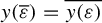 $y(\overline {\varepsilon })=\overline {y({\varepsilon })}$
.
$y(\overline {\varepsilon })=\overline {y({\varepsilon })}$
.
Proof. When the modulus is trivial, we can suppose that $g_{\varepsilon }= v_{\varepsilon }^1$
. Moreover,
$g_{\varepsilon }= v_{\varepsilon }^1$
. Moreover, $(r_m)^*(v_{\varepsilon })=(-1)^mv_{\varepsilon }$
. Hence, for m odd,
$(r_m)^*(v_{\varepsilon })=(-1)^mv_{\varepsilon }$
. Hence, for m odd, $r_m^{-1}\circ g_{\varepsilon }\circ r_m=v_{\varepsilon }^{-1}$
and in this case, we consider square roots of
$r_m^{-1}\circ g_{\varepsilon }\circ r_m=v_{\varepsilon }^{-1}$
and in this case, we consider square roots of $g_{\varepsilon }^{-1}$
. It therefore suffices to consider antiholomorphic square roots tangent to the identity. In the time coordinate (the
$g_{\varepsilon }^{-1}$
. It therefore suffices to consider antiholomorphic square roots tangent to the identity. In the time coordinate (the $Z_j$
-coordinate),
$Z_j$
-coordinate), $v_{\varepsilon }^1$
is given by
$v_{\varepsilon }^1$
is given by $T_1$
, and in the coordinate
$T_1$
, and in the coordinate $w= \mathrm {Exp}(-2\pi i Z)$
, it is given by the identity on
$w= \mathrm {Exp}(-2\pi i Z)$
, it is given by the identity on ${\mathbb C\mathbb P}^1$
. For real
${\mathbb C\mathbb P}^1$
. For real ${\varepsilon }$
, square roots in the w-coordinate must satisfy
${\varepsilon }$
, square roots in the w-coordinate must satisfy $\kappa _{\varepsilon }\circ \kappa _{\varepsilon }= \mathrm {id}$
. Moreover,
$\kappa _{\varepsilon }\circ \kappa _{\varepsilon }= \mathrm {id}$
. Moreover, $\kappa $
exchanges
$\kappa $
exchanges $0$
and
$0$
and $\infty $
. Hence,
$\infty $
. Hence, $\kappa = \delta \circ L$
for
$\kappa = \delta \circ L$
for $\delta (w) = 1/{\overline {w}}$
and L some linear transformation. Then, square roots in the
$\delta (w) = 1/{\overline {w}}$
and L some linear transformation. Then, square roots in the $Z_j$
-coordinates are of the form
$Z_j$
-coordinates are of the form $\Sigma \circ T_{a({\varepsilon })}$
, with
$\Sigma \circ T_{a({\varepsilon })}$
, with $a({\varepsilon })+\overline {a({\varepsilon })}=1$
, that is,
$a({\varepsilon })+\overline {a({\varepsilon })}=1$
, that is, $a({\varepsilon })=1/2+iy({\varepsilon })$
for some real function y depending real-analytically on
$a({\varepsilon })=1/2+iy({\varepsilon })$
for some real function y depending real-analytically on ${\varepsilon }$
. Hence, for real
${\varepsilon }$
. Hence, for real ${\varepsilon }$
, the square roots are given by
${\varepsilon }$
, the square roots are given by $r_m\circ \sigma \circ v^{1/2+iy({\varepsilon })}\circ r_m^{-1}$
, with
$r_m\circ \sigma \circ v^{1/2+iy({\varepsilon })}\circ r_m^{-1}$
, with $y({\varepsilon })$
real-analytic. The result follows by extending holomorphically
$y({\varepsilon })$
real-analytic. The result follows by extending holomorphically $y({\varepsilon })$
to the complex domain (thus yielding that the square root depends antiholomorphically on
$y({\varepsilon })$
to the complex domain (thus yielding that the square root depends antiholomorphically on ${\varepsilon }$
).
${\varepsilon }$
).
Let us now suppose that the modulus is not trivial. As a first reduction, let us rather consider $g_{1,{\varepsilon }}=r_m^{-1}\circ g_{\varepsilon }\circ r_m$
. Then, we can limit ourselves to the case
$g_{1,{\varepsilon }}=r_m^{-1}\circ g_{\varepsilon }\circ r_m$
. Then, we can limit ourselves to the case $m=0$
and
$m=0$
and ${\xi _0(j)=-j}$
. However, for m odd, then
${\xi _0(j)=-j}$
. However, for m odd, then $g_{1,0}'(z) = z-z^{k+1} + \cdots $
and a second reduction is needed. When k is odd, it suffices to conjugate with
$g_{1,0}'(z) = z-z^{k+1} + \cdots $
and a second reduction is needed. When k is odd, it suffices to conjugate with $z\mapsto -z$
. When k is even, the second reduction is to work with
$z\mapsto -z$
. When k is even, the second reduction is to work with $g_{2,{\varepsilon }}=g_{1,{\varepsilon }}^{-1}$
, which is in prepared form (5.3). Hence, we can limit ourselves to prove the theorem when
$g_{2,{\varepsilon }}=g_{1,{\varepsilon }}^{-1}$
, which is in prepared form (5.3). Hence, we can limit ourselves to prove the theorem when $m=0$
.
$m=0$
.
Let $\Omega _s$
be a sectoral domain and let
$\Omega _s$
be a sectoral domain and let $\Phi _{j,{\varepsilon },s}$
,
$\Phi _{j,{\varepsilon },s}$
, $j=0,\pm 1, \ldots , \pm k$
(with indices
$j=0,\pm 1, \ldots , \pm k$
(with indices $(\text {mod}\; 2k)$
) be corresponding normalized Fatou coordinates for which the transition functions satisfy (5.5). We define
$(\text {mod}\; 2k)$
) be corresponding normalized Fatou coordinates for which the transition functions satisfy (5.5). We define
 $$ \begin{align}f_{{\varepsilon},s}= Z_{\overline{\varepsilon},-j}^{-1}\circ \Phi_{-j,\overline{\varepsilon},\overline{s}}^{-1} \circ \Sigma\circ T_{1/2} \circ \Phi_{j,{\varepsilon},s}\circ Z_{{\varepsilon},j} \quad \text{on\ } S_{j,{\varepsilon},s}.\end{align} $$
Note that Fatou coordinates such that (5.5) is satisfied are determined up to left composition with $T_{a_s({\varepsilon })}$
such that
$T_{a_s({\varepsilon })}$
such that $a_{\overline {s}}(\overline {\varepsilon })=\overline {a_s({\varepsilon })}$
. Hence, the definition of
$a_{\overline {s}}(\overline {\varepsilon })=\overline {a_s({\varepsilon })}$
. Hence, the definition of $f_{{\varepsilon },s}$
is intrinsic and does not depend on the choice of Fatou coordinates. Moreover, the function
$f_{{\varepsilon },s}$
is intrinsic and does not depend on the choice of Fatou coordinates. Moreover, the function $f_{{\varepsilon },s}$
is well defined on
$f_{{\varepsilon },s}$
is well defined on ${\mathbb D}_r\setminus \{P_{\varepsilon }(z)=0\}$
. Indeed, (5.5) guarantees that it is well defined when crossing an intersection sector touching the boundary of the disk because of (5.5). Over a gate sector, it follows from the proofs of Theorems 3.10 and 4.2 that the translations
${\mathbb D}_r\setminus \{P_{\varepsilon }(z)=0\}$
. Indeed, (5.5) guarantees that it is well defined when crossing an intersection sector touching the boundary of the disk because of (5.5). Over a gate sector, it follows from the proofs of Theorems 3.10 and 4.2 that the translations $\mathcal {T}_{\ell ,{\varepsilon },s}$
satisfy
$\mathcal {T}_{\ell ,{\varepsilon },s}$
satisfy $\mathcal {T}_{\ell ,{\varepsilon },s}\circ \Sigma = \Sigma \circ \mathcal {T}_{-\ell ,\overline {\varepsilon }, \overline {s}}$
.
$\mathcal {T}_{\ell ,{\varepsilon },s}\circ \Sigma = \Sigma \circ \mathcal {T}_{-\ell ,\overline {\varepsilon }, \overline {s}}$
.
The map $f_{{\varepsilon },s}$
is bounded in the neighborhood of
$f_{{\varepsilon },s}$
is bounded in the neighborhood of $P_{\varepsilon }(z)=0$
and hence can be extended to that set.
$P_{\varepsilon }(z)=0$
and hence can be extended to that set.
We now need to show that different $f_{{\varepsilon },s}$
glue into a global
$f_{{\varepsilon },s}$
glue into a global $f_{\varepsilon }$
defined for
$f_{\varepsilon }$
defined for ${\varepsilon }$
outside the discriminant set in
${\varepsilon }$
outside the discriminant set in ${\varepsilon }$
-space.
${\varepsilon }$
-space.
It is of course possible to choose the Fatou coordinates respecting (3.7) so that $ \lim _{{\varepsilon }\to 0\atop {\varepsilon }\in \Omega _s} \Phi _{\ell ,{\varepsilon },s} =\Phi _{\ell ,0}$
is independent of s.
$ \lim _{{\varepsilon }\to 0\atop {\varepsilon }\in \Omega _s} \Phi _{\ell ,{\varepsilon },s} =\Phi _{\ell ,0}$
is independent of s.
Let us now consider $\Omega _s\cap \Omega _{s'}$
and let
$\Omega _s\cap \Omega _{s'}$
and let $h_{\varepsilon }= f_{{\varepsilon },s'}^{-1}\circ f_{{\varepsilon },s}$
. It commutes with
$h_{\varepsilon }= f_{{\varepsilon },s'}^{-1}\circ f_{{\varepsilon },s}$
. It commutes with $g_{\varepsilon }$
. Because the modulus is non-trivial and in view of Proposition 3.11, this means that
$g_{\varepsilon }$
. Because the modulus is non-trivial and in view of Proposition 3.11, this means that $h_{\varepsilon }= g_{\varepsilon }^{{p}/{q}}$
for some
$h_{\varepsilon }= g_{\varepsilon }^{{p}/{q}}$
for some ${p}/{q}\in {\mathbb Z}$
independent of
${p}/{q}\in {\mathbb Z}$
independent of ${\varepsilon }$
. Moreover, because of the limit property, then
${\varepsilon }$
. Moreover, because of the limit property, then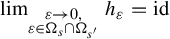 $\lim _{\substack {{\varepsilon }\to 0,\\ {\varepsilon }\in \Omega _s\cap \Omega _{s'}}} h_{\varepsilon }= \mathrm {id}$
. Hence,
$\lim _{\substack {{\varepsilon }\to 0,\\ {\varepsilon }\in \Omega _s\cap \Omega _{s'}}} h_{\varepsilon }= \mathrm {id}$
. Hence, ${p}/{q}=0$
and
${p}/{q}=0$
and $f_{{\varepsilon },s} = f_{{\varepsilon },s'}$
.
$f_{{\varepsilon },s} = f_{{\varepsilon },s'}$
.
Finally, $f_{\varepsilon }$
is bounded in the neighborhood of the discriminant set in
$f_{\varepsilon }$
is bounded in the neighborhood of the discriminant set in ${\varepsilon }$
-space and can be extended antiholomorphically there.
${\varepsilon }$
-space and can be extended antiholomorphically there.
Corollary 5.5. Let $g_{\varepsilon }$
be a prepared unfolding of a holomorphic parabolic germ of type (5.3) for which a representative of the modulus satisfies (5.5). Then,
$g_{\varepsilon }$
be a prepared unfolding of a holomorphic parabolic germ of type (5.3) for which a representative of the modulus satisfies (5.5). Then, $g_{\varepsilon }$
has a holomorphic square root and only
$g_{\varepsilon }$
has a holomorphic square root and only $g_{\varepsilon }$
has an invariant germ of a real analytic curve.
$g_{\varepsilon }$
has an invariant germ of a real analytic curve.
The chessboard associated to the Fatou set of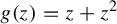 $g(z) = z+z^2$
. The critical point is the red square, the parabolic point is the green star. The orange disks show a representative of the critical point in the orbit space and its preimages under the transition maps
$g(z) = z+z^2$
. The critical point is the red square, the parabolic point is the green star. The orange disks show a representative of the critical point in the orbit space and its preimages under the transition maps $\psi _{\pm 1}$
(colour online). (Figure courtesy of Arnaud Chéritat).
$\psi _{\pm 1}$
(colour online). (Figure courtesy of Arnaud Chéritat).


5.4 Application to holomorphic quadratic germs
Theorem 5.6. The holomorphic quadratic parabolic germ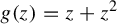 $g(z) = z+z^2$
has no antiholomorphic square root, nor does any of the
$g(z) = z+z^2$
has no antiholomorphic square root, nor does any of the $g_{\varepsilon }(z) = z+z^2-{\varepsilon }$
for small
$g_{\varepsilon }(z) = z+z^2-{\varepsilon }$
for small ${\varepsilon }$
.
${\varepsilon }$
.
Proof. By Theorem 5.4 and Corollary 5.5, since the real axis is invariant, g has a holomorphic square root $g_1$
if and only if g has an antiholomorphic square root
$g_1$
if and only if g has an antiholomorphic square root $f=\sigma \circ g_1$
. Suppose that g has a local holomorphic square root
$f=\sigma \circ g_1$
. Suppose that g has a local holomorphic square root $g_1$
. This means that the transition maps
$g_1$
. This means that the transition maps $\Psi _{\pm 1}$
satisfy (4.3). The global dynamics of g has been thoroughly studied in the literature and its Fatou set is well known: see for instance [Reference DouadyD94] and Figure 12. This dynamics is governed by the critical point at
$\Psi _{\pm 1}$
satisfy (4.3). The global dynamics of g has been thoroughly studied in the literature and its Fatou set is well known: see for instance [Reference DouadyD94] and Figure 12. This dynamics is governed by the critical point at $z_c=-\frac 12$
. Any face of the chessboard in Figure 12 is biholomophic to the upper half-plane, any corner belongs to either some
$z_c=-\frac 12$
. Any face of the chessboard in Figure 12 is biholomophic to the upper half-plane, any corner belongs to either some $g^{-n}(z_c)$
or
$g^{-n}(z_c)$
or $g^{-n}(0)$
for some
$g^{-n}(0)$
for some $n\in {\mathbb N}$
, and the union of the infinite set of corners and edges is the union of the
$n\in {\mathbb N}$
, and the union of the infinite set of corners and edges is the union of the $g^{-n}([-1, 0])$
for
$g^{-n}([-1, 0])$
for $n\in {\mathbb N}$
. What we are really interested in is the space of orbits, that is,
$n\in {\mathbb N}$
. What we are really interested in is the space of orbits, that is, ${\mathbb C}/g$
. Quotienting by the dynamics in z-space is the same as first quotienting by
${\mathbb C}/g$
. Quotienting by the dynamics in z-space is the same as first quotienting by $T_1$
in each Fatou coordinate and then quotienting by the transition maps. Quotienting by
$T_1$
in each Fatou coordinate and then quotienting by the transition maps. Quotienting by $T_1$
is the same as composing the Fatou coordinate with the change of coordinate
$T_1$
is the same as composing the Fatou coordinate with the change of coordinate $w= \exp (-2\pi i Z)$
. This transforms each codomain of a Fatou coordinate in
$w= \exp (-2\pi i Z)$
. This transforms each codomain of a Fatou coordinate in ${\mathbb C\mathbb P}^1\setminus \{0,\infty \}$
. The transition map
${\mathbb C\mathbb P}^1\setminus \{0,\infty \}$
. The transition map $\Psi _{-1}$
(respectively
$\Psi _{-1}$
(respectively $\Psi _1$
) is transformed into a germ of a holomorphic diffeomorphism
$\Psi _1$
) is transformed into a germ of a holomorphic diffeomorphism $\psi _{-1}$
(respectively
$\psi _{-1}$
(respectively $\psi _1$
) with a fixed point at the origin (respectively at
$\psi _1$
) with a fixed point at the origin (respectively at $\infty $
). The invariant real axis is transformed into the equator of
$\infty $
). The invariant real axis is transformed into the equator of ${\mathbb C\mathbb P}^1$
. It follows from the special geometry of g that the image of the extension of
${\mathbb C\mathbb P}^1$
. It follows from the special geometry of g that the image of the extension of $\psi _{-1}$
(respectively
$\psi _{-1}$
(respectively $\psi _1$
) contains the lower (respectively upper) hemisphere. Moreover, the equator contains a unique representative of the orbit of the critical point: this point is a critical value of both
$\psi _1$
) contains the lower (respectively upper) hemisphere. Moreover, the equator contains a unique representative of the orbit of the critical point: this point is a critical value of both $\psi _{\pm 1}$
on the boundary of their domain of univalence. Because of (4.4), it suffices to consider
$\psi _{\pm 1}$
on the boundary of their domain of univalence. Because of (4.4), it suffices to consider $\psi _{-1}$
. Now, g has a local holomorphic square root
$\psi _{-1}$
. Now, g has a local holomorphic square root $g_1$
if and only if
$g_1$
if and only if $\psi _{\pm 1}$
are odd functions, and moreover, this square root can be extended to the full domain covered by the Fatou coordinates. This means that
$\psi _{\pm 1}$
are odd functions, and moreover, this square root can be extended to the full domain covered by the Fatou coordinates. This means that $\psi _{-1}'$
is an even function with a non-vanishing constant term. We know that it has at least one critical point. Hence, it has at least two non-zero critical points of the form
$\psi _{-1}'$
is an even function with a non-vanishing constant term. We know that it has at least one critical point. Hence, it has at least two non-zero critical points of the form $\pm w_c\neq 0$
. Then,
$\pm w_c\neq 0$
. Then, $\psi _{-1}(\pm w_c)=\pm \psi _{-1} (w_c)$
, that is,
$\psi _{-1}(\pm w_c)=\pm \psi _{-1} (w_c)$
, that is, $\psi _{-1}$
has two distinct critical values if
$\psi _{-1}$
has two distinct critical values if $\psi _{-1} (w_c)\neq 0$
. This condition is satisfied, since geometrically,
$\psi _{-1} (w_c)\neq 0$
. This condition is satisfied, since geometrically, $w=0$
corresponds to the parabolic point and no preimages of the critical point are sent by g to the parabolic point, which is a contradiction. Hence, g has no local holomorphic square root
$w=0$
corresponds to the parabolic point and no preimages of the critical point are sent by g to the parabolic point, which is a contradiction. Hence, g has no local holomorphic square root $g_1$
.
$g_1$
.
If follows that the transition maps of g do not satisfy (4.3). Since the transition maps of $g_{\varepsilon }$
depend continuously on
$g_{\varepsilon }$
depend continuously on ${\varepsilon }$
, they do not satisfy (4.3), which is a necessary condition for
${\varepsilon }$
, they do not satisfy (4.3), which is a necessary condition for $g_{\varepsilon }$
to have a holomorphic square root.
$g_{\varepsilon }$
to have a holomorphic square root.
6 The multicorn families
It is shown in [Reference Hubbard and SchleicherHS14] that all parabolic points of the multicorn family $f_c(z)=\overline {z}^d +c$
have multiplicity
$f_c(z)=\overline {z}^d +c$
have multiplicity $1$
or
$1$
or $2$
. We give a second proof and add that the family is a generic unfolding around these points.
$2$
. We give a second proof and add that the family is a generic unfolding around these points.
Proposition 6.1. For $d\geq 2$
, the multicorn family
$d\geq 2$
, the multicorn family $f_c(z)=\overline {z}^d +c$
has
$f_c(z)=\overline {z}^d +c$
has $d+1$
values of c given by
$d+1$
values of c given by $c_\tau = (d+1)d^{-{d}/({d-1})}e^{i({\pi }/({d+1}))}\tau $
, where
$c_\tau = (d+1)d^{-{d}/({d-1})}e^{i({\pi }/({d+1}))}\tau $
, where $\tau ^{d+1}=1$
, for which the point
$\tau ^{d+1}=1$
, for which the point $z_\tau = d^{-1/({d-1})}e^{i({\pi }/({d+1}))}\tau $
is an antiholomorphic parabolic point of codimension 2. The family is generic around these points when considering the real and imaginary parts of c as parameters. The parabolic fixed points occurring for other parameter values of c have codimension
$z_\tau = d^{-1/({d-1})}e^{i({\pi }/({d+1}))}\tau $
is an antiholomorphic parabolic point of codimension 2. The family is generic around these points when considering the real and imaginary parts of c as parameters. The parabolic fixed points occurring for other parameter values of c have codimension $1$
and the
$1$
and the $2$
-parameter family contains a generic unfolding around these points.
$2$
-parameter family contains a generic unfolding around these points.
Proof. We let $d=k+1$
to use the same notation as in the rest of the paper. A parabolic point of codimension greater than 1 is one for which, under the form
$d=k+1$
to use the same notation as in the rest of the paper. A parabolic point of codimension greater than 1 is one for which, under the form $f_1(z_1)= \overline {z}_1 +a_2\overline {z}_1^2 + O(\overline {z_1}^3)$
, then
$f_1(z_1)= \overline {z}_1 +a_2\overline {z}_1^2 + O(\overline {z_1}^3)$
, then $a_2\in i{\mathbb R}$
. We look for a parabolic point
$a_2\in i{\mathbb R}$
. We look for a parabolic point $z_0$
, that is, a fixed point satisfying
$z_0$
, that is, a fixed point satisfying $f_{c_0}(z_0)=\overline {z}_0^{k+1} +c_0 =z_0$
and
$f_{c_0}(z_0)=\overline {z}_0^{k+1} +c_0 =z_0$
and $|f_{c_0}'(z_0)|=|(k+1)\overline {z}_0^k|=1$
for some
$|f_{c_0}'(z_0)|=|(k+1)\overline {z}_0^k|=1$
for some $c_0\in C$
. Then,
$c_0\in C$
. Then, $z_0= (k+1)^{-1/k} e^{i\theta }$
for some
$z_0= (k+1)^{-1/k} e^{i\theta }$
for some $\theta \in [0,2\pi ]$
, from which
$\theta \in [0,2\pi ]$
, from which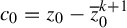 $c_0= z_0- \overline {z}_0^{k+1}$
. We localize at
$c_0= z_0- \overline {z}_0^{k+1}$
. We localize at $z_0$
by the change of variable
$z_0$
by the change of variable $Z=z-z_0$
. In the new variable, the function becomes
$Z=z-z_0$
. In the new variable, the function becomes
 $$ \begin{align*}F_{c_0}(Z)&= e^{-ik\theta} \overline{Z} + \frac{k(k+1)^{2/({k+1})}}2e^{-i(k-1)\theta}\overline{Z}^2\\&\quad+ \frac{k(k-1)(k+1)^{3/({k+1})}}6e^{-i(k-2)\theta}\overline{Z}^3+O(\overline{Z}^4).\end{align*} $$
We let $Z_1= e^{i({k\theta }/2)}Z$
. This transforms
$Z_1= e^{i({k\theta }/2)}Z$
. This transforms $F_{c_0}$
into
$F_{c_0}$
into
 $$ \begin{align*}\begin{aligned}F_{1, c_0}(Z_1)&= \overline{Z}_1 + \frac{k(k+1)^{2/({k+1})}}2e^{i(({k+2})/2)\theta}\overline{Z}_1^2\\ &\quad+ \frac{k(k-1)(k+1)^{3/({k+1})}}6e^{i(k+2)\theta}\overline{Z}_1^3+O(\overline{Z}_1^4).\end{aligned} \end{align*} $$
Then, $Z_1=0$
has codimension
$Z_1=0$
has codimension $1$
if
$1$
if $e^{i(({k+2})/2)\theta }\notin i {\mathbb R}$
(see for instance [Reference Godin and RousseauGR21]), and at least
$e^{i(({k+2})/2)\theta }\notin i {\mathbb R}$
(see for instance [Reference Godin and RousseauGR21]), and at least $2$
if
$2$
if $e^{i(({k+2})/2)\theta }\in i {\mathbb R}$
, that is,
$e^{i(({k+2})/2)\theta }\in i {\mathbb R}$
, that is, $\theta ={\pi }/({k+2})+{2m\pi }/({k+2})$
for
$\theta ={\pi }/({k+2})+{2m\pi }/({k+2})$
for $m\in {\mathbb Z}_{k+2}$
. In the latter case,
$m\in {\mathbb Z}_{k+2}$
. In the latter case, $\overline {z}_0^{k+1}$
is opposite to
$\overline {z}_0^{k+1}$
is opposite to $z_0$
and
$z_0$
and $c_0=z_0-\overline {z}_0^{k+1}= (k+2)(k+1)^{-({k+1})/k}e^{i({\pi }/({k+2}))}\tau $
for some
$c_0=z_0-\overline {z}_0^{k+1}= (k+2)(k+1)^{-({k+1})/k}e^{i({\pi }/({k+2}))}\tau $
for some $\tau $
satisfying
$\tau $
satisfying $\tau ^{k+2}=1$
.
$\tau ^{k+2}=1$
.
Note that $F_{1,c_0}(Z_1)= \overline {Z}_1+a_2\overline {Z}_1^2+a_3\overline {Z}_1^3+O(\overline {Z}_1^4)$
, with
$F_{1,c_0}(Z_1)= \overline {Z}_1+a_2\overline {Z}_1^2+a_3\overline {Z}_1^3+O(\overline {Z}_1^4)$
, with $a_2\in i{\mathbb R}$
and
$a_2\in i{\mathbb R}$
and $a_3\in {\mathbb R}_{\leq 0}$
. To check that the codimension is exactly 2, we get rid of the coefficient in
$a_3\in {\mathbb R}_{\leq 0}$
. To check that the codimension is exactly 2, we get rid of the coefficient in $\overline {Z}_1^2$
by means of the change of coordinate
$\overline {Z}_1^2$
by means of the change of coordinate $Z_1=Z_2+ ({a_2}/2)Z_2^2$
. This transforms
$Z_1=Z_2+ ({a_2}/2)Z_2^2$
. This transforms $F_{1,c_0}$
into
$F_{1,c_0}$
into $F_{2,c_0}(Z_2)=\overline {Z}_2+(a_3-a_2^2) \overline {Z}_2^3+O(\overline {Z}_2^4)$
. Then,
$F_{2,c_0}(Z_2)=\overline {Z}_2+(a_3-a_2^2) \overline {Z}_2^3+O(\overline {Z}_2^4)$
. Then,
 $$ \begin{align*}a_3-a_2^2=\frac{k(k+1)^{3/({k+1})}}{12}(3k(k+1)^{1/({k+1})}-2(k-1))>0.\end{align*} $$
We now consider the family in the neighborhood of $c_0$
, by taking
$c_0$
, by taking $c= c_0+{\varepsilon }$
. Then,
$c= c_0+{\varepsilon }$
. Then, $F_c(Z)= F_{c_0}(Z) +{\varepsilon }$
and
$F_c(Z)= F_{c_0}(Z) +{\varepsilon }$
and $F_{1,c}(Z_1)= F_{1,c_0}+{\varepsilon } e^{i({k\theta }/2)}$
. Finally, the change
$F_{1,c}(Z_1)= F_{1,c_0}+{\varepsilon } e^{i({k\theta }/2)}$
. Finally, the change $Z_1=Z_2+ ({a_2}/2)Z_2^2$
brings it to
$Z_1=Z_2+ ({a_2}/2)Z_2^2$
brings it to
 $$ \begin{align*}F_{2,c}(Z_2)= \eta_0+(1+\eta_1) \overline{Z}_2+ O(\eta)\overline{Z}_2^2+(a_3-a_2^2+O(\eta))\overline{Z}_2^3+O(\overline{Z}_2^4),\end{align*} $$
where $\eta _0=e^{i({k\theta }/2)} {\varepsilon } +o({\varepsilon })$
and
$\eta _0=e^{i({k\theta }/2)} {\varepsilon } +o({\varepsilon })$
and $\eta _1=-a_2\eta _0+o(\eta _0)$
. A further scaling
$\eta _1=-a_2\eta _0+o(\eta _0)$
. A further scaling $Z_2\mapsto rZ_2$
for some
$Z_2\mapsto rZ_2$
for some $r\in {\mathbb R}_{>0}$
would change
$r\in {\mathbb R}_{>0}$
would change $F_{2,{\varepsilon }}$
exactly to the form (2.2). The change of parameter
$F_{2,{\varepsilon }}$
exactly to the form (2.2). The change of parameter $(\mathrm {Re}({\varepsilon }),\mathrm {Im}({\varepsilon })) \mapsto (\mathrm {Re}(\eta _0),\mathrm {Re}(\eta _1))$
is invertible, since
$(\mathrm {Re}({\varepsilon }),\mathrm {Im}({\varepsilon })) \mapsto (\mathrm {Re}(\eta _0),\mathrm {Re}(\eta _1))$
is invertible, since $a_2\in i{\mathbb R}$
, from which the genericity of the family follows.
$a_2\in i{\mathbb R}$
, from which the genericity of the family follows.
In the codimension $1$
case, the corresponding change
$1$
case, the corresponding change $Z_1=Z_2+ i(\mathrm {Im (a_2)}/2)Z_2^2$
brings the family to the form
$Z_1=Z_2+ i(\mathrm {Im (a_2)}/2)Z_2^2$
brings the family to the form
 $$ \begin{align*}F_{2,c}(Z_2)= \eta_0+(\mathrm{Re} (a_2)+\eta_1) \overline{Z}_2+ O(\eta)\overline{Z}_2^2+(a_3-i a_2{\mathrm{Im}}( a_2)+O(\eta))\overline{Z}_2^3+O(\overline{Z}_2^4),\end{align*} $$
which is a $2$
-parameter unfolding containing a generic unfolding.
$2$
-parameter unfolding containing a generic unfolding.
Acknowledgements
The author is grateful to Arnaud Chéritat, Jonathan Godin and Martin Klimeš for stimulating discussions. The author is supported by NSERC in Canada.





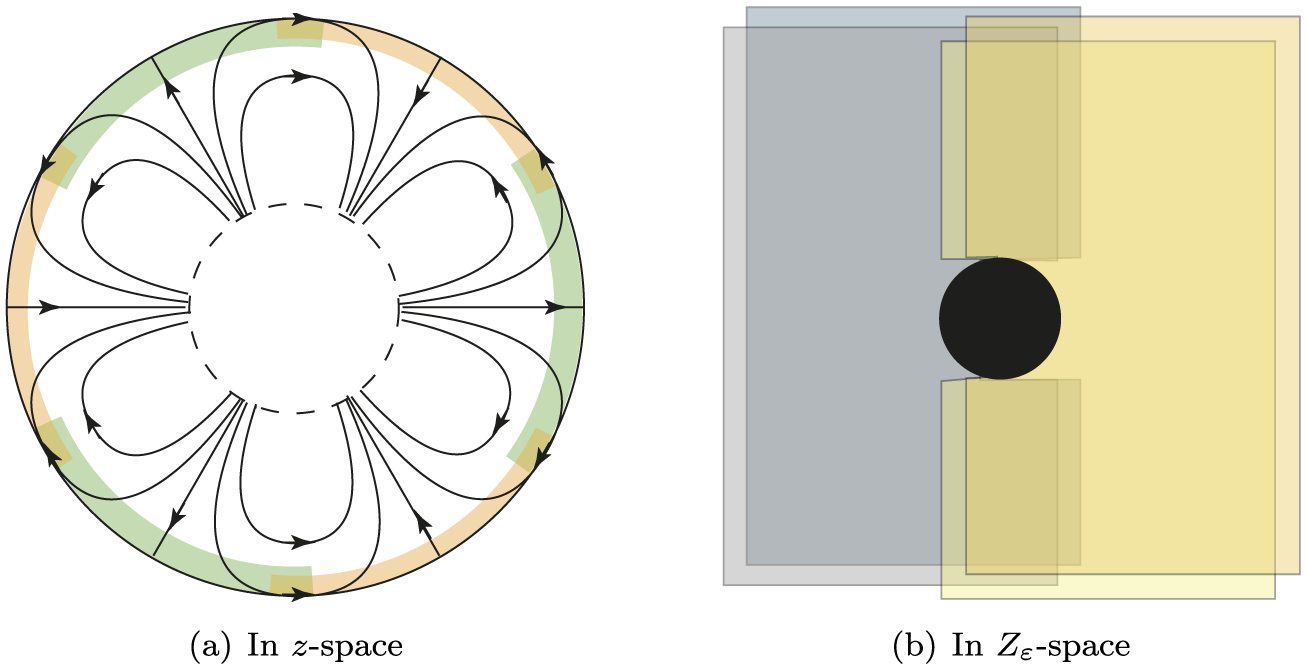


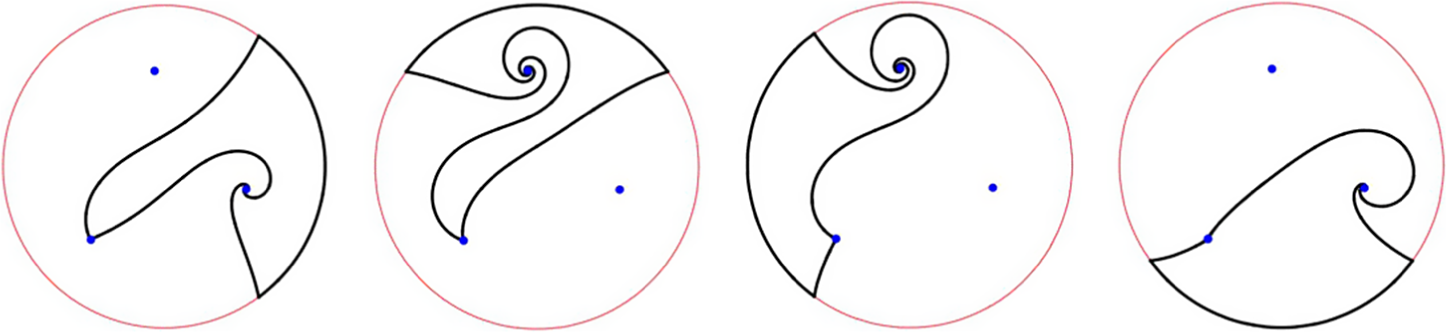

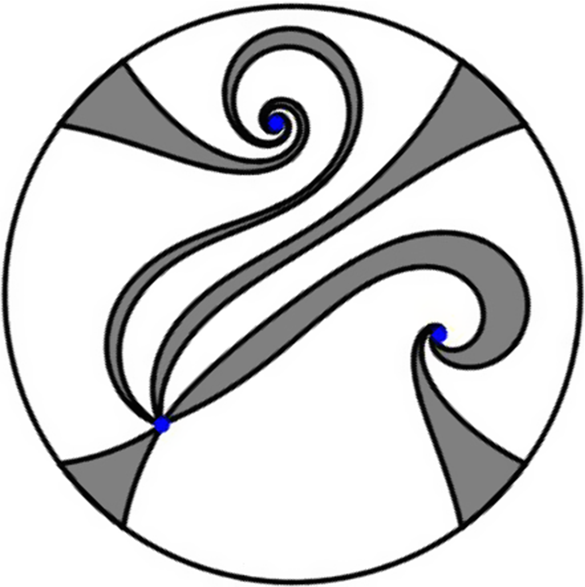
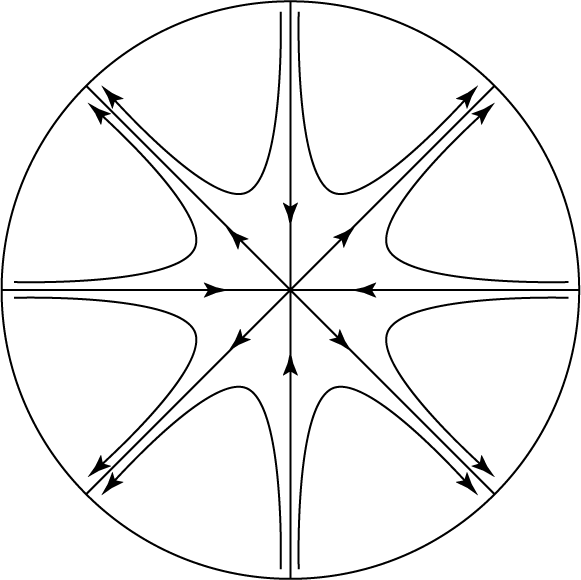


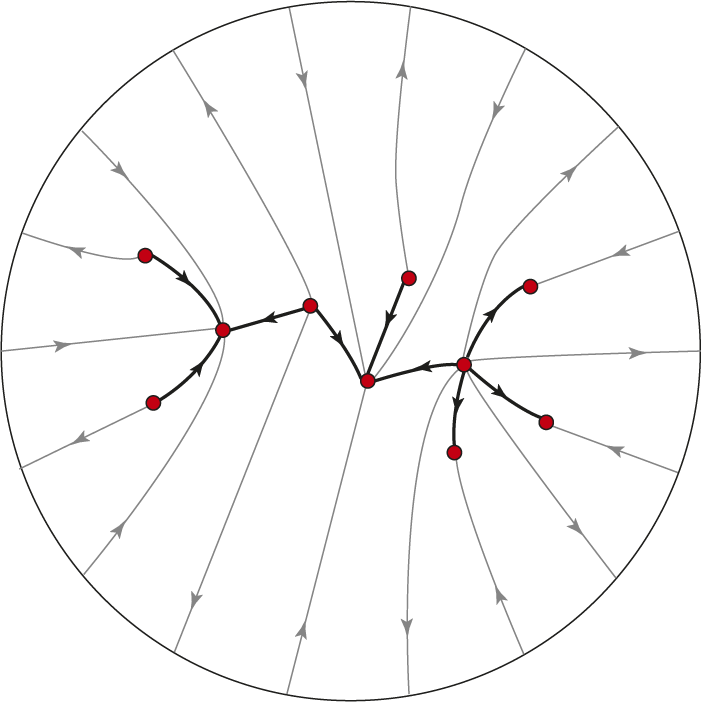
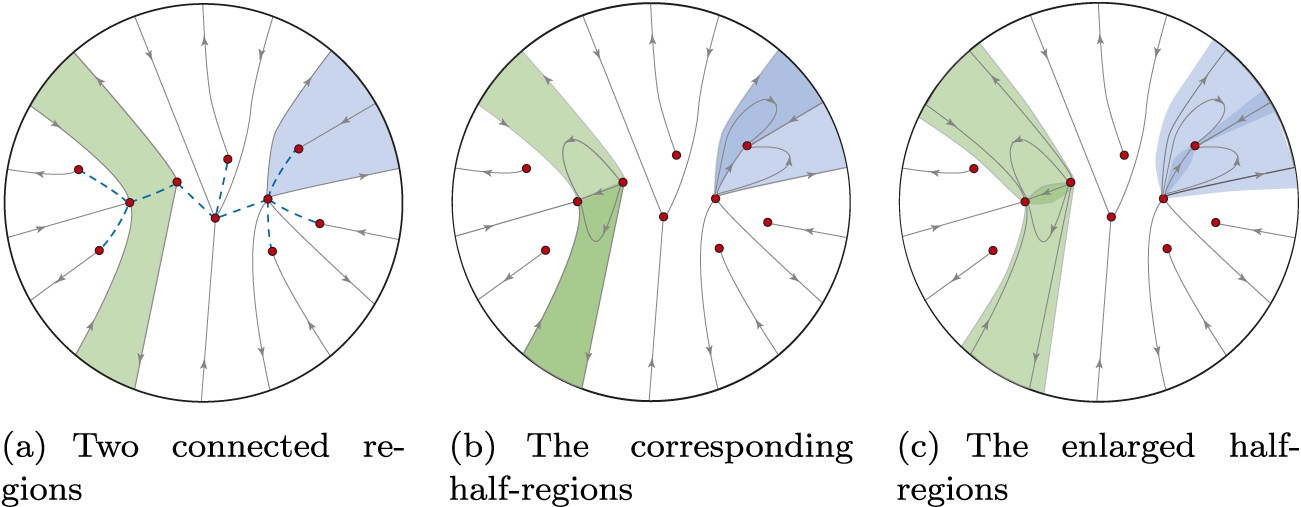

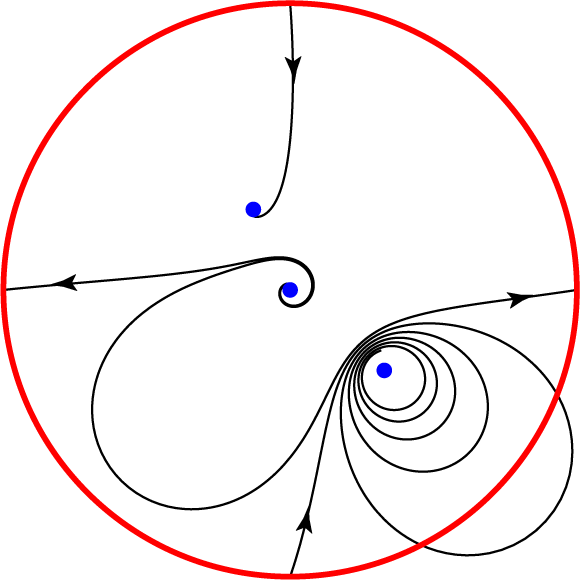
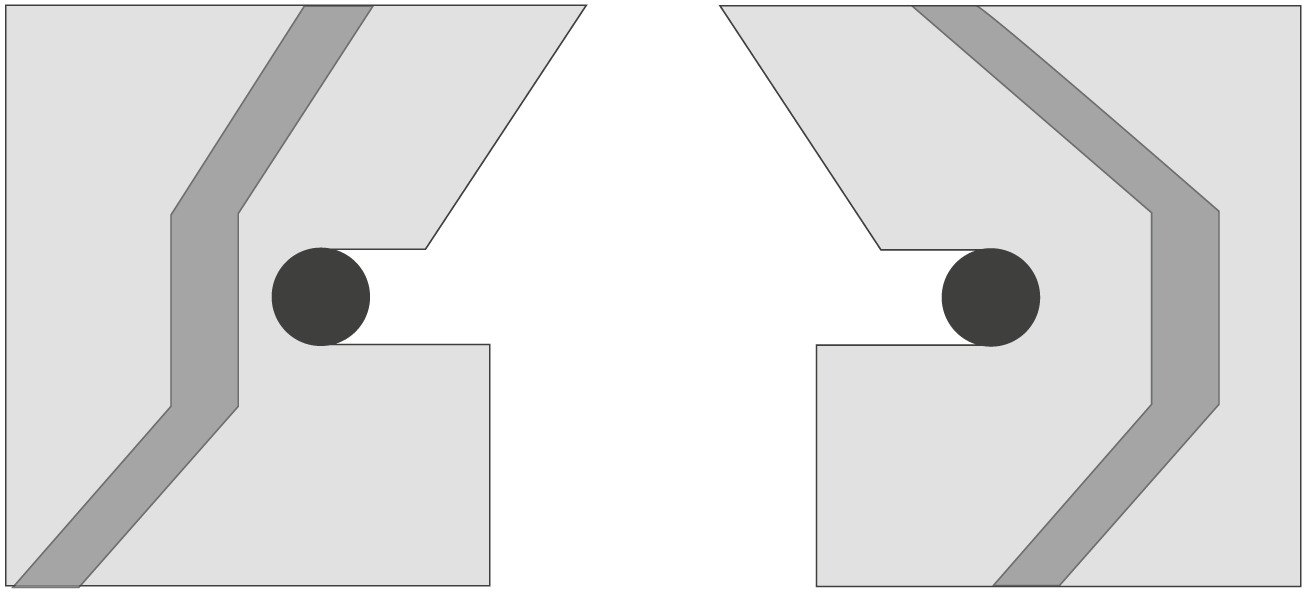
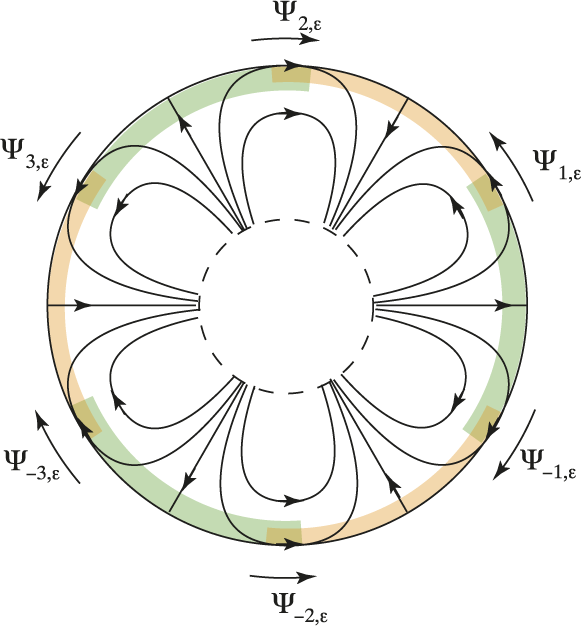
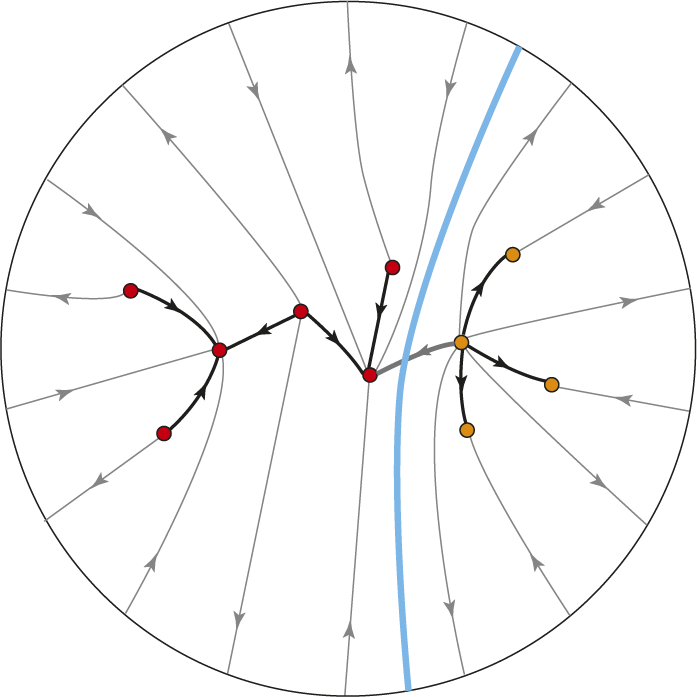
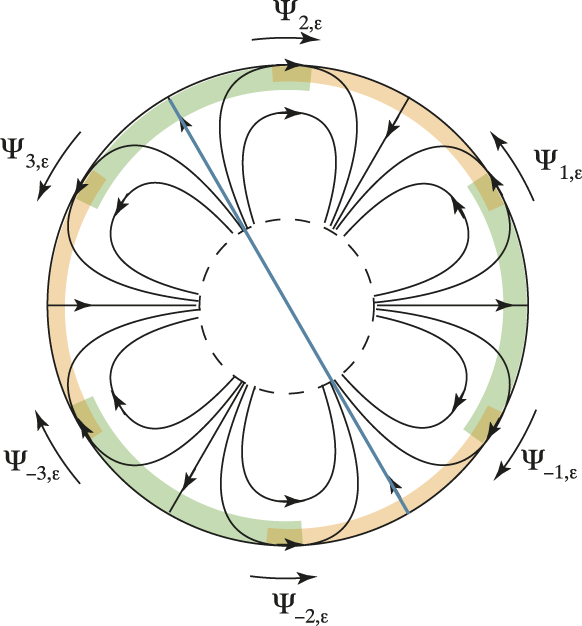


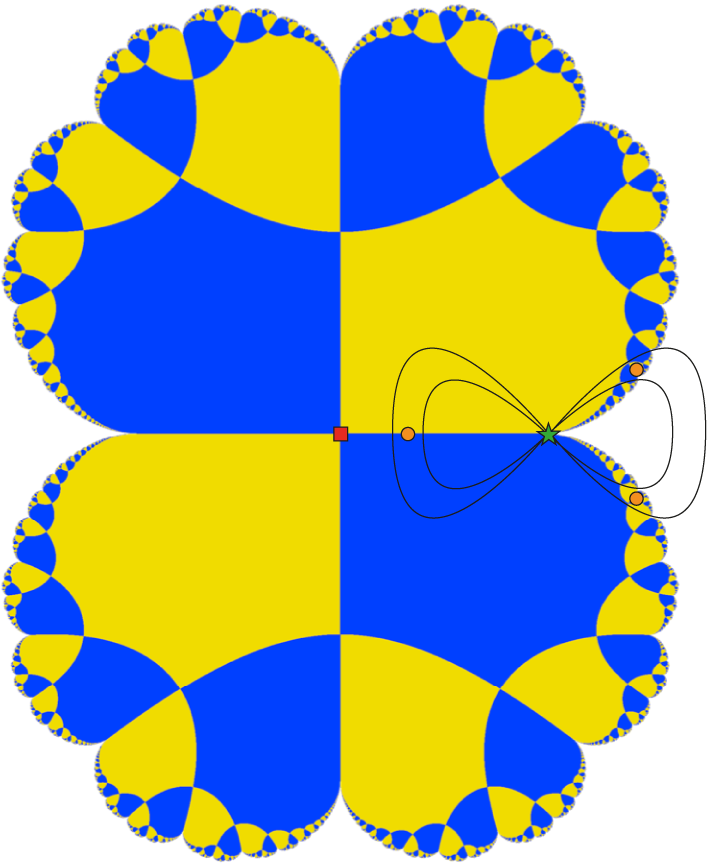


 Open access

