




1. Introduction
Various drivers can generate plasma wakes (Tajima & Dawson Reference Tajima and Dawson1979; Chen et al. Reference Chen, Dawson, Huff and Katsouleas1985; Shukla et al. Reference Shukla, Stenflo, Bingham, Bethe, Dawson and Mendonça1998). The multiplicity of potential drivers arises because different types of beams – whether collections of particles or electromagnetic fields – can interact with a plasma through an effective ponderomotive-type force. While the ponderomotive force is most commonly invoked for electromagnetic fields, the concept generalises to any field or particle ensemble with energy density $\mathcal{E}$
if the driver exerts a force
$\mathcal{E}$
if the driver exerts a force ${\boldsymbol F_{\mathrm{pond}}} \propto -\boldsymbol{\nabla }\mathcal{E}$
. For example, in the case of an optical laser (Tajima & Dawson Reference Tajima and Dawson1979; Esarey et al. Reference Esarey, Sprangle, Krall and Ting1996; Esarey, Schroeder & Leemans Reference Esarey, Schroeder and Leemans2009) or an X-ray laser (Zhang et al. Reference Zhang, Tajima, Farinella, Shin, Mourou, Wheeler, Taborek, Chen, Dollar and Shen2016; Svedung Wettervik, Gonoskov & Marklund Reference Svedung Wettervik, Gonoskov and Marklund2018)
${\boldsymbol F_{\mathrm{pond}}} \propto -\boldsymbol{\nabla }\mathcal{E}$
. For example, in the case of an optical laser (Tajima & Dawson Reference Tajima and Dawson1979; Esarey et al. Reference Esarey, Sprangle, Krall and Ting1996; Esarey, Schroeder & Leemans Reference Esarey, Schroeder and Leemans2009) or an X-ray laser (Zhang et al. Reference Zhang, Tajima, Farinella, Shin, Mourou, Wheeler, Taborek, Chen, Dollar and Shen2016; Svedung Wettervik, Gonoskov & Marklund Reference Svedung Wettervik, Gonoskov and Marklund2018) $\mathcal{E} \propto E^2$
with
$\mathcal{E} \propto E^2$
with $E$
the laser electric field. For a particle beam driver,
$E$
the laser electric field. For a particle beam driver, $\mathcal{E} \propto n_b$
where
$\mathcal{E} \propto n_b$
where $n_b$
is the number density of an electron beam (Chen et al. Reference Chen, Dawson, Huff and Katsouleas1985) and of a neutrino beam (Silva et al. Reference Silva, Bingham, Dawson, Mendonça and Shukla1999).
$n_b$
is the number density of an electron beam (Chen et al. Reference Chen, Dawson, Huff and Katsouleas1985) and of a neutrino beam (Silva et al. Reference Silva, Bingham, Dawson, Mendonça and Shukla1999).
The phase velocity of the plasma wake matches that of the driving disturbance and can approach the speed of light. When the wakefield amplitude is sufficiently large, background plasma electrons may become trapped and accelerated to relativistic energies. Tajima & Dawson (Reference Tajima and Dawson1979) first identified this mechanism as a potential alternative to radio-frequency cavities in conventional accelerators and proposed that plasma wakefields could also contribute to the acceleration of cosmic rays in astrophysical environments. Although intense coherent laser pulses are unlikely to occur naturally in astrophysical scenarios, quasi-coherent electromagnetic drivers can be produced in space. Examples that have been proposed include Alfvén shocks (Chen, Tajima & Takahashi Reference Chen, Tajima and Takahashi2002), relativistic shocks in which synchrotron maser instability generates upstream precursor waves (Hoshino Reference Hoshino2008; Kuramitsu et al. Reference Kuramitsu, Sakawa, Kato, Takabe and Hoshino2008), fast radio bursts (Petroff, Hessels & Lorimer Reference Petroff, Hessels and Lorimer2019) and monster shocks (Beloborodov Reference Beloborodov2023).
Recently, Del Gaudio et al. (Reference Del Gaudio, Fonseca, Silva and Grismayer2020a
) demonstrated that a non-ponderomotive mechanism can also drive plasma wakes. Electromagnetic drivers exert two distinct forces on plasma electrons: the familiar ponderomotive force and a second, here termed the Compton force, associated with classical radiation–reaction effects (Landau & Lifshitz Reference Landau and Lifshitz1975). For a monochromatic, collimated light beam, the Compton force is proportional to the energy density ${\boldsymbol F}_c = \sigma _T\mathcal{E}$
(Peyraud Reference Peyraud1968; Del Gaudio et al. Reference Del Gaudio, Fonseca, Silva and Grismayer2020a
), where
${\boldsymbol F}_c = \sigma _T\mathcal{E}$
(Peyraud Reference Peyraud1968; Del Gaudio et al. Reference Del Gaudio, Fonseca, Silva and Grismayer2020a
), where $\sigma _T$
is the Thomson cross-section. The Compton force exceeds the ponderomotive force for small wavelengths or very diluted plasmas, namely
$\sigma _T$
is the Thomson cross-section. The Compton force exceeds the ponderomotive force for small wavelengths or very diluted plasmas, namely $\lambda / r_0 \ll 7.7(r_e/r_0)^{1/4}$
, where
$\lambda / r_0 \ll 7.7(r_e/r_0)^{1/4}$
, where $r_0 = n_p^{-1/3}$
is the interparticle distance,
$r_0 = n_p^{-1/3}$
is the interparticle distance, $r_e$
the classical electron radius,
$r_e$
the classical electron radius, $\lambda$
the wavelength and
$\lambda$
the wavelength and $n_p$
the electron density.
$n_p$
the electron density.
The notion of ponderomotive force requires a quasi-classical electromagnetic field: the number of photons (of momentum $\hbar k$
with
$\hbar k$
with $k = 2\pi /\lambda$
) in a volume
$k = 2\pi /\lambda$
) in a volume $k^{-3}$
is large compared with unity, i.e.
$k^{-3}$
is large compared with unity, i.e. $E/E_s \gg \sqrt {\alpha }(\hbar k/mc)^2$
, where
$E/E_s \gg \sqrt {\alpha }(\hbar k/mc)^2$
, where $E$
is the electric field,
$E$
is the electric field, $E_s = m^2c^3/e\hbar \simeq 1.3 \times 10^{18}\,\mathrm{V\,m}^{-1}$
is the Schwinger field and
$E_s = m^2c^3/e\hbar \simeq 1.3 \times 10^{18}\,\mathrm{V\,m}^{-1}$
is the Schwinger field and $\alpha = e^2/\hbar c$
. One readily notes that when
$\alpha = e^2/\hbar c$
. One readily notes that when $\hbar k \sim mc$
, the field approaches
$\hbar k \sim mc$
, the field approaches $E_s$
; thus low-frequency fields are generally classical, while very high-frequency fields – if sufficiently weak – cannot be treated classically as discussed in Landau & Lifshitz (Reference Landau and Lifshitz1982).
$E_s$
; thus low-frequency fields are generally classical, while very high-frequency fields – if sufficiently weak – cannot be treated classically as discussed in Landau & Lifshitz (Reference Landau and Lifshitz1982).
If the interparticle distance $r_0$
is large compared with
$r_0$
is large compared with $k^{-1}$
, the dielectric description fails: photons instead Compton-scatter individual electrons in a dilute ionised gas. The electrons of the plasma are knocked by the photon burst of density
$k^{-1}$
, the dielectric description fails: photons instead Compton-scatter individual electrons in a dilute ionised gas. The electrons of the plasma are knocked by the photon burst of density $n_{\omega }$
at a frequency
$n_{\omega }$
at a frequency $\nu _C = (\sigma _Tn_{\omega }c)^{-1}$
. Therefore light sources composed of high-frequency photons propagating in tenuous plasma are likely to interact via Compton scattering with the plasma electrons.
$\nu _C = (\sigma _Tn_{\omega }c)^{-1}$
. Therefore light sources composed of high-frequency photons propagating in tenuous plasma are likely to interact via Compton scattering with the plasma electrons.
Astrophysical plasmas cover a large span of densities and radiation environments, making them a fertile ground for exploring Compton-driven wakefield acceleration. While the ponderomotive force has been traditionally considered (Chen et al. Reference Chen, Tajima and Takahashi2002), the Compton force can dominate in tenuous plasmas or at shorter wavelengths – conditions potentially met in various astrophysical settings. From the intergalactic medium ( $n_p \sim 0.01 \, \text{cm}^{-3}$
) to pulsar magnetospheres (
$n_p \sim 0.01 \, \text{cm}^{-3}$
) to pulsar magnetospheres ( $n_p \sim 10^{14}\,\text{cm}^{-3}$
), the interparticle distance often exceeds 10
$n_p \sim 10^{14}\,\text{cm}^{-3}$
), the interparticle distance often exceeds 10 $\unicode{x03BC}\rm m$
. Consequently, compact, energetic astrophysical objects can significantly influence their environments through interactions between radiation and plasma, resulting from the large amounts of non-thermal emission they produce. One example of conditions where the Compton force is relevant is associated with the Eddington limit; in the Thomson regime, this underlies the Eddington luminosity argument. As Blumenthal (Reference Blumenthal1974) demonstrated, the classical Eddington limit, derived assuming Thomson scattering, is modified at higher photon energies due to the Klein–Nishina cross-section. This can significantly alter the radiation pressure exerted on plasma in the vicinity of compact objects. Outflows from accretion disk systems, such as active galactic nuclei and binary systems, may be launched through direct radiation pressure or the Compton rocket (Odell Reference Odell1981; Phinney Reference Phinney1982; Henri & Pelletier Reference Henri and Pelletier1991). Radiative interactions can also lead to drag and deceleration, depending on the specific conditions (Li, Begelman & Chiueh Reference Li, Begelman and Chiueh1992). Madau & Thompson (Reference Madau and Thompson2000) further explored the radiative acceleration of plasmas in the Klein–Nishina regime, relevant to compact gamma-ray sources. Their work showed that in this regime, particles can be accelerated to asymptotic Lorentz factors at infinity much more rapidly than predicted by Thomson scattering, with a reduced radiation drag due to the relativistic effects on the scattering cross-section. The analysis by Madau & Thompson (Reference Madau and Thompson2000) also highlights the potential for ‘Compton afterburn’ – where random energy imparted to the plasma by gamma-rays is converted to bulk motion, supplementing the direct radiative force. Recent particle-in-cell (PIC) simulations by Faure et al. (Reference Faure, Tordeux, Gremillet and Lemoine2024) delve into the kinetic details of these interactions, revealing a more complex picture. They demonstrate that Compton scattering initially accelerates electrons, but the resulting charge separation also drives ions to relativistic speeds and accelerates other electrons backwards, beyond the driving photon energies. This intricate interplay, coupled with Weibel-type instabilities also shown in Martinez, Grismayer & Silva (Reference Martinez, Grismayer and Silva2021) and Fermi-like scattering, leads to forward-directed suprathermal electron tails, offering a refined understanding of particle acceleration in extreme radiation environments. The variety of astrophysical sources emitting energetic radiation, such as gamma-ray bursts or pulsars, makes it plausible that Compton-dominated wakefield acceleration is a common and astrophysically relevant process. The implications for particle acceleration in these environments warrant further investigation.
$\unicode{x03BC}\rm m$
. Consequently, compact, energetic astrophysical objects can significantly influence their environments through interactions between radiation and plasma, resulting from the large amounts of non-thermal emission they produce. One example of conditions where the Compton force is relevant is associated with the Eddington limit; in the Thomson regime, this underlies the Eddington luminosity argument. As Blumenthal (Reference Blumenthal1974) demonstrated, the classical Eddington limit, derived assuming Thomson scattering, is modified at higher photon energies due to the Klein–Nishina cross-section. This can significantly alter the radiation pressure exerted on plasma in the vicinity of compact objects. Outflows from accretion disk systems, such as active galactic nuclei and binary systems, may be launched through direct radiation pressure or the Compton rocket (Odell Reference Odell1981; Phinney Reference Phinney1982; Henri & Pelletier Reference Henri and Pelletier1991). Radiative interactions can also lead to drag and deceleration, depending on the specific conditions (Li, Begelman & Chiueh Reference Li, Begelman and Chiueh1992). Madau & Thompson (Reference Madau and Thompson2000) further explored the radiative acceleration of plasmas in the Klein–Nishina regime, relevant to compact gamma-ray sources. Their work showed that in this regime, particles can be accelerated to asymptotic Lorentz factors at infinity much more rapidly than predicted by Thomson scattering, with a reduced radiation drag due to the relativistic effects on the scattering cross-section. The analysis by Madau & Thompson (Reference Madau and Thompson2000) also highlights the potential for ‘Compton afterburn’ – where random energy imparted to the plasma by gamma-rays is converted to bulk motion, supplementing the direct radiative force. Recent particle-in-cell (PIC) simulations by Faure et al. (Reference Faure, Tordeux, Gremillet and Lemoine2024) delve into the kinetic details of these interactions, revealing a more complex picture. They demonstrate that Compton scattering initially accelerates electrons, but the resulting charge separation also drives ions to relativistic speeds and accelerates other electrons backwards, beyond the driving photon energies. This intricate interplay, coupled with Weibel-type instabilities also shown in Martinez, Grismayer & Silva (Reference Martinez, Grismayer and Silva2021) and Fermi-like scattering, leads to forward-directed suprathermal electron tails, offering a refined understanding of particle acceleration in extreme radiation environments. The variety of astrophysical sources emitting energetic radiation, such as gamma-ray bursts or pulsars, makes it plausible that Compton-dominated wakefield acceleration is a common and astrophysically relevant process. The implications for particle acceleration in these environments warrant further investigation.
In this article, we extend the one-dimensional linear theory developed in Del Gaudio et al. (Reference Del Gaudio, Fonseca, Silva and Grismayer2020a ) to the nonlinear regime. More specifically, we investigate theoretically and numerically the wake properties and the acceleration of electrons. The analytical results are systematically compared with the PIC code OSIRIS (Fonseca et al. Reference Fonseca2002), where a Compton scattering module has been implemented (Del Gaudio et al. Reference Del Gaudio, Grismayer, Fonseca and Silva2020b ). This paper is organised as follows. In § 2, we review the linear regime derived in a previous publication (Del Gaudio et al. Reference Del Gaudio, Fonseca, Silva and Grismayer2020a ), considering the cases of non-symmetric photon drivers that feature an uneven temporal profile with distinct rise and fall times, leading to asymmetric energy delivery. It allows for a more realistic modelling of complex plasma interactions driven by radiation pressure, with both practical and astrophysical relevance. Section 3 presents the one-dimensional analysis of the nonlinear regime. The acceleration of electrons in the nonlinear wake constitutes the focus of § 4. The results obtained in these sections are compared with two-dimensional simulations in § 5. Finally, in § 6 we state the conclusions and give more concrete numbers/examples about the astrophysical environments that are susceptible to match the conditions for Compton nonlinear wakes to occur.
2. Linear regime
The laser wakefield acceleration (LWFA) concept developed by Tajima & Dawson (Reference Tajima and Dawson1979) relies on a single short high-intensity laser pulse that drives a plasma wake. The wake is driven efficiently when the laser pulse length is of the order of the plasma wavelength $L \simeq \lambda _p$
, where
$L \simeq \lambda _p$
, where $\lambda _p = 2\pi c/\omega _p$
. It is reasonable to admit that symmetric and matched coherent or laser drivers can be fine-tuned in the laboratory, but are unlikely to occur in astrophysics. In astrophysical environments, an extremely wide range of frequencies can be generated. In this section, we review and expand on the linear theory developed in Del Gaudio et al. (Reference Del Gaudio, Fonseca, Silva and Grismayer2020a
), where the driver is composed of photons only interacting with electrons via Compton scattering, and extend it considering asymmetric and non-resonant drivers.
$\lambda _p = 2\pi c/\omega _p$
. It is reasonable to admit that symmetric and matched coherent or laser drivers can be fine-tuned in the laboratory, but are unlikely to occur in astrophysics. In astrophysical environments, an extremely wide range of frequencies can be generated. In this section, we review and expand on the linear theory developed in Del Gaudio et al. (Reference Del Gaudio, Fonseca, Silva and Grismayer2020a
), where the driver is composed of photons only interacting with electrons via Compton scattering, and extend it considering asymmetric and non-resonant drivers.
The linear theory previously developed by Del Gaudio et al. (Reference Del Gaudio, Fonseca, Silva and Grismayer2020a
) determines the wake amplitude for a symmetric photon burst if the energy density $\mathcal{E}$
remains small compared with
$\mathcal{E}$
remains small compared with $\mathcal{E}\ll eE_0/\sigma _T$
, where
$\mathcal{E}\ll eE_0/\sigma _T$
, where $E_0=mc\omega _p/e$
is the classical cold wave-breaking field for a wake with phase velocity close to the speed of light (Dawson Reference Dawson1959). The amplitude of the wake can be computed using the electron fluid equations, continuity for the density
$E_0=mc\omega _p/e$
is the classical cold wave-breaking field for a wake with phase velocity close to the speed of light (Dawson Reference Dawson1959). The amplitude of the wake can be computed using the electron fluid equations, continuity for the density $n$
, momentum for the fluid velocity
$n$
, momentum for the fluid velocity $\beta c$
and Poisson’s equation for the longitudinal field
$\beta c$
and Poisson’s equation for the longitudinal field $E_x$
. The averaged fluid force exerted by the photon burst is
$E_x$
. The averaged fluid force exerted by the photon burst is $\sigma _T\mathcal{E}$
. The set of equations reads
$\sigma _T\mathcal{E}$
. The set of equations reads
 \begin{align} \frac {\partial n}{\partial t} & = -c\frac {\partial }{\partial x} \left (n\beta \right )\! ,\\[-7pt]\nonumber\end{align}
 \begin{align} mc\frac {{\rm d} \beta }{{\rm d}t} & = -eE_x + \sigma _T\mathcal{E} ,\\[-7pt]\nonumber\end{align}
 \begin{align} \frac {\partial E_x}{\partial x} & = 4\pi e(n_p-n) ,\end{align}
where $n_p$
is the plasma density. The ions are assumed to be immobile. The linearised version of this set of equations is
$n_p$
is the plasma density. The ions are assumed to be immobile. The linearised version of this set of equations is
 \begin{align} \frac {\partial n_1}{\partial t} & = -cn_p\frac {\partial \beta _1}{\partial x} ,\\[-7pt]\nonumber\end{align}
 \begin{align} mc \frac {\partial \beta _1}{\partial t} & = -e E_x + \sigma _T\mathcal{E} ,\\[-7pt]\nonumber\end{align}
 \begin{align} \frac {\partial E_x}{\partial x} & = -4\pi e n_1 ,\end{align}
where the electron density is written as $n=n_p+n_1$
. The plasma is considered to be initially at rest, implying
$n=n_p+n_1$
. The plasma is considered to be initially at rest, implying $\beta =\beta _1$
. The change of variables
$\beta =\beta _1$
. The change of variables $\tau =\omega _p t$
,
$\tau =\omega _p t$
, $\xi = k_p(x-ct)=k_px-\tau$
,
$\xi = k_p(x-ct)=k_px-\tau$
, $k_p=\omega _p/c$
leads to
$k_p=\omega _p/c$
leads to
 \begin{align} \frac {\partial }{\partial \tau }\left (\frac {n_1}{n_p}\right )&= \frac {\partial }{\partial \xi }\left (\frac {n_1}{n_p}-\beta _1\right )\! ,\\[-7pt]\nonumber \end{align}
 \begin{align} \frac {\partial \beta _1}{\partial \tau }&=\frac {\partial \beta _1}{\partial \xi }-\frac {E_x}{E_0}+\frac {\sigma _T\mathcal{E}}{mc\omega _p} ,\\[-7pt]\nonumber\end{align}
 \begin{align} \frac {\partial }{\partial \xi }\left (\frac {E_x}{E_0}\right ) &= -\frac {n_1}{n_p} .\end{align}
The quasi-static approximation, commonly used in the theory of LWFA (Sprangle, Esarey & Ting Reference Sprangle, Esarey and Ting1990), neglects $\partial / \partial \tau$
in the electron fluid equations, which is valid when the driver evolution time is long compared with the transit time of the plasma through the driver, i.e.
$\partial / \partial \tau$
in the electron fluid equations, which is valid when the driver evolution time is long compared with the transit time of the plasma through the driver, i.e. $\omega \gg \omega _p$
for a laser of frequency
$\omega \gg \omega _p$
for a laser of frequency $\omega$
. In the case of an uncoherent photon driver (made of photons of frequency
$\omega$
. In the case of an uncoherent photon driver (made of photons of frequency $\omega$
and density
$\omega$
and density $n_{\omega }$
), the typical evolution time of the burst envelope is
$n_{\omega }$
), the typical evolution time of the burst envelope is $t_{\omega } = \nu _{\omega }^{-1} = (\sigma _Tn_pc)^{-1}$
. For a driver with arbitrary duration
$t_{\omega } = \nu _{\omega }^{-1} = (\sigma _Tn_pc)^{-1}$
. For a driver with arbitrary duration $\tau _d$
, we have
$\tau _d$
, we have $t_\omega \gg \tau _d$
, which is equivalent to
$t_\omega \gg \tau _d$
, which is equivalent to $n_p r_e^3 \ll (\omega _p \tau _d)^{-2}$
, a criterion that is generally satisfied for all astrophysical and laboratory plasmas. The equation for the electrostatic field is now
$n_p r_e^3 \ll (\omega _p \tau _d)^{-2}$
, a criterion that is generally satisfied for all astrophysical and laboratory plasmas. The equation for the electrostatic field is now
 \begin{equation} \left (\frac {\partial ^2}{\partial \xi ^2}+1\right ) E_x= \sigma _T\mathcal{E}. \end{equation}
The solution for the longitudinal field is given by the convolution of the source term with the Green function of the harmonic operator:
 \begin{equation} E_x=\sigma _T\mathcal{E}_0 \int _0^{-k_pL} \sin (\xi -s) f(s){\rm d}s, \end{equation}
where $\mathcal{E}(s)=\mathcal{E}_0f(s)$
,
$\mathcal{E}(s)=\mathcal{E}_0f(s)$
, $f$
being the bounded shape function of the driver, and
$f$
being the bounded shape function of the driver, and $L=c\tau _d$
is the length of the driver. Integration by parts of the integral
$L=c\tau _d$
is the length of the driver. Integration by parts of the integral $I=\int _0^{-k_pL}\,{\rm d}s$ $\sin (\xi -s) f(s)$
yields
$\sin (\xi -s) f(s)$
yields
 \begin{equation} I = \cos (\xi -s)f(s)\Big \lvert _0^{-k_pL}+\int _0^{-k_pL}\,{\rm d}s \cos (\xi -s) \frac {\partial f}{\partial s} , \end{equation}
where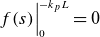 $f(s)\Big \lvert _0^{-k_pL}=0$
is imposed since
$f(s)\Big \lvert _0^{-k_pL}=0$
is imposed since $f$
is bounded. To understand the influence of the shape of the driver on the amplitude of the wake, we consider a driver of triangular shape characterised by a rise time
$f$
is bounded. To understand the influence of the shape of the driver on the amplitude of the wake, we consider a driver of triangular shape characterised by a rise time $RL/c$
and a fall length
$RL/c$
and a fall length $(1-R)L/c$
, where
$(1-R)L/c$
, where $R$
is the rise time normalised to
$R$
is the rise time normalised to $L/c$
. With the choice of
$L/c$
. With the choice of $f$
, the integral given by (2.12) has an exact solution:
$f$
, the integral given by (2.12) has an exact solution:
 \begin{align} I &= \frac {1}{k_p}\mathcal{A}\cos (\xi +\theta ),\\[-7pt]\nonumber\end{align}
 \begin{align} \mathcal{A} & = \sqrt {a^2+b^2} ,\\[-7pt]\nonumber \end{align}
 \begin{align} \theta & = \arctan (b/a) ,\end{align}
where
 \begin{align} a & = \frac {\cos (Rk_pL)-1}{Rk_pL}+\frac {\cos (k_pL)-\cos (Rk_pL)}{(1-R)k_pL} ,\\[-7pt]\nonumber \end{align}
 \begin{align} b & = \frac {\sin (Rk_pL)}{Rk_pL}+\frac {\sin (k_pL)-\sin (Rk_pL)}{(1-R)k_pL} .\end{align}
From (2.16) and (2.17), we observe that whenever $Rk_pL\lesssim 1$
or
$Rk_pL\lesssim 1$
or $(1-R)k_pL\lesssim 1$
, the wake amplitude
$(1-R)k_pL\lesssim 1$
, the wake amplitude $\mathcal{A}\sim 1$
and does not diminish with respect to
$\mathcal{A}\sim 1$
and does not diminish with respect to $k_pL$
, even for non-resonant long drivers
$k_pL$
, even for non-resonant long drivers $k_pL\gg 1$
. If instead
$k_pL\gg 1$
. If instead $Rk_pL\gg 1$
or
$Rk_pL\gg 1$
or $(1-R)k_pL\gg 1$
then
$(1-R)k_pL\gg 1$
then $\mathcal{A}\propto 1/k_pL$
.
$\mathcal{A}\propto 1/k_pL$
.
These scalings are shown in figure 1 where the amplitude of the function $\mathcal{A}$
is plotted as a function of
$\mathcal{A}$
is plotted as a function of $k_pL$
for two cases:
$k_pL$
for two cases: $Rk_pL\ll 1$
and
$Rk_pL\ll 1$
and $R=0.5$
. We have also verified these scalings with one-dimensional PIC simulations. The burst is composed of photons of energy
$R=0.5$
. We have also verified these scalings with one-dimensional PIC simulations. The burst is composed of photons of energy $\hbar \omega =0.001\, mc^2$
with
$\hbar \omega =0.001\, mc^2$
with $\mathcal{E}_0=0.01eE_0/\sigma _T$
propagating in a cold plasma of uniform density
$\mathcal{E}_0=0.01eE_0/\sigma _T$
propagating in a cold plasma of uniform density $n_p=1\, \mathrm{cm^{-3}}$
. The simulations are performed with a moving window
$n_p=1\, \mathrm{cm^{-3}}$
. The simulations are performed with a moving window $100\,d_e$
long (
$100\,d_e$
long ( $d_e = k_p^{-1}$
), with
$d_e = k_p^{-1}$
), with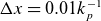 $\Delta x = 0.01k_p^{-1}$
, and
$\Delta x = 0.01k_p^{-1}$
, and $\Delta t = 0.0099\,\omega _p^{-1}$
. The number of particles in each cell is
$\Delta t = 0.0099\,\omega _p^{-1}$
. The number of particles in each cell is $100$
, and the burst is made of photons of energy
$100$
, and the burst is made of photons of energy $\hbar \omega =0.001\,mc^2$
with
$\hbar \omega =0.001\,mc^2$
with $\mathcal{E}_0=0.01eE_0/\sigma _T$
. Figure 2 shows the amplitude of the function
$\mathcal{E}_0=0.01eE_0/\sigma _T$
. Figure 2 shows the amplitude of the function $\mathcal{A}$
as a function of
$\mathcal{A}$
as a function of $R$
, given by (2.14) for
$R$
, given by (2.14) for $k_pL\simeq 47$
obtained from (2.14), in solid line, and from simulations, denoted by crosses, demonstrating the excellent agreement between theory and simulations.
$k_pL\simeq 47$
obtained from (2.14), in solid line, and from simulations, denoted by crosses, demonstrating the excellent agreement between theory and simulations.
Amplitude of the function $\mathcal{A}$
as a function of
$\mathcal{A}$
as a function of $k_pL$
given by (2.14) plotted in solid line for
$k_pL$
given by (2.14) plotted in solid line for $R = 10^{-8}$
in blue and for
$R = 10^{-8}$
in blue and for $R=0.5$
in black. For a long driver
$R=0.5$
in black. For a long driver $k_pL\gg 1$
, if
$k_pL\gg 1$
, if $Rk_pL\lesssim 1$
, the wake amplitude does not decrease. For a symmetric driver
$Rk_pL\lesssim 1$
, the wake amplitude does not decrease. For a symmetric driver $R=0.5$
, the wake amplitude falls as
$R=0.5$
, the wake amplitude falls as $\mathcal{A}\propto 1/k_pL$
, shown in dashed line.
$\mathcal{A}\propto 1/k_pL$
, shown in dashed line.

Figure 1. Long description
A line graph showing the amplitude of the function as a function of k p L for two different values of R. The x-axis represents k p L ranging from 0 to 100, and the y-axis represents the amplitude A (R, k p L) ranging from 0 to 2. The blue solid line represents R equals 10 to the power of negative 8, showing a pattern that starts at 2, oscillates, and stabilizes around 1. The black dashed line represents R equals 0.5, showing a pattern that starts at 2, oscillates, and decreases following the trend A proportional to 1 over k p L. The graph illustrates how the wake amplitude behaves differently for long and symmetric drivers. All values are approximated.
Amplitude of the function $\mathcal{A}$
as a function of
$\mathcal{A}$
as a function of $R$
given by (2.14) plotted in solid line for
$R$
given by (2.14) plotted in solid line for $k_pL\simeq 47$
. One-dimensional PIC simulation results are displayed with crosses, showing excellent agreement with the theoretical prediction for the maximum amplitude of the wake.
$k_pL\simeq 47$
. One-dimensional PIC simulation results are displayed with crosses, showing excellent agreement with the theoretical prediction for the maximum amplitude of the wake.

Figure 2. Long description
A line graph displays the amplitude of a function as a function of R, represented by a solid line. The graph includes data points marked with crosses, which represent one-dimensional PIC simulation results. The crosses align closely with the solid line, indicating excellent agreement between the simulation results and the theoretical prediction for the maximum amplitude of the wake. The x-axis is labeled R, ranging from 0 to 1, and the y-axis is labeled A(R, k_p, L ~ 47), ranging from 0 to 1.2. The graph shows two peaks at the edges and a trough in the middle, with the crosses closely following the solid line throughout the graph. All values are approximated.
3. Nonlinear regime
We consider now the case of a photon burst with an energy density sufficiently high to push electrons into relativistic motion. The nonlinear regime of plasma wakes, which has been extensively studied for laser drivers by Sprangle et al. (Reference Sprangle, Esarey and Ting1990) and Esarey et al. (Reference Esarey, Sprangle, Krall and Ting1996), is reached when the plasma electric field approaches the wave-breaking limit. In our case, the photon energy density must be capable of generating a wake amplitude $E_0$
– the photon energy density being of the order of
$E_0$
– the photon energy density being of the order of $\mathcal{E}_0 \sim eE_0/\sigma _T$
. Using the definition of
$\mathcal{E}_0 \sim eE_0/\sigma _T$
. Using the definition of $E_0$
, it corresponds to a photon energy density of
$E_0$
, it corresponds to a photon energy density of
 \begin{equation} \mathcal{E}_0 \sim 10^{12}\sqrt {n[\mathrm{cm^{-3}]}} \,\mathrm{erg\,cm^{-3}} \end{equation}
The amplitude of the Langmuir wake driven by the burst can be derived by solving the following system of equations:
 \begin{align} \frac {\partial n}{\partial t} & = -c\frac {\partial }{\partial x} \left (n\beta \right )\!, \nonumber\\[4pt] mc\frac {{\rm d} \gamma \beta }{{\rm d}t} & = -eE_x + \sigma _T\mathcal{E}\frac {1-\beta }{1+\beta }, \nonumber\\[4pt] \frac {\partial E_x}{\partial x} & = 4\pi e(n_p-n), \end{align}
where the momentum equation includes the relativistic fluid version of the Compton force, in the limit $\hbar \omega \ll\, mc^2$
. A version of the relativistic Compton force valid for all photon energies can be found in Blumenthal (Reference Blumenthal1974) and Faure et al. (Reference Faure, Tordeux, Gremillet and Lemoine2024). Rewriting (3.2) as a function of
$\hbar \omega \ll\, mc^2$
. A version of the relativistic Compton force valid for all photon energies can be found in Blumenthal (Reference Blumenthal1974) and Faure et al. (Reference Faure, Tordeux, Gremillet and Lemoine2024). Rewriting (3.2) as a function of $\tau$
and
$\tau$
and $\xi$
, and using the quasi-static approximation, we obtain
$\xi$
, and using the quasi-static approximation, we obtain
 \begin{align} \frac {\partial }{\partial \xi }\left (n(1-\beta )\right )& = 0,\nonumber\\[5pt]\frac {\partial }{\partial \xi }\left (\gamma (\beta -1)\right )& = \frac {E_x}{E_0}-\frac {\sigma _T\mathcal{E}}{eE_0}\frac {1-\beta }{1+\beta }, \nonumber\\[5pt] \frac {\partial }{\partial \xi }\left (\frac {E_x}{E_0}\right ) & = 1-\frac {n}{n_p}. \end{align}
The continuity equation implies $n(1-\beta )=n_p$
, and Poisson’s equation in (3.3) can thus be rewritten as
$n(1-\beta )=n_p$
, and Poisson’s equation in (3.3) can thus be rewritten as $\partial _{\xi }(E_x/E_0) = \beta /(\beta -1)$
. Deriving the momentum equation with respect to
$\partial _{\xi }(E_x/E_0) = \beta /(\beta -1)$
. Deriving the momentum equation with respect to $\xi$
and substituting into Poisson’s equation, we arrive at a second-order equation for
$\xi$
and substituting into Poisson’s equation, we arrive at a second-order equation for $\beta$
:
$\beta$
:
 \begin{equation} \frac {\partial ^2}{\partial \xi ^2} (\gamma (\beta -1)) +\frac {\beta }{1-\beta } + \frac {\partial }{\partial \xi } \left(\frac {\sigma _T\mathcal{E}}{eE_0} \frac {1-\beta }{1+\beta }\right)=0. \end{equation}
In the limit $\beta \ll 1$
, the linear theory is recovered. Poisson’s equation becomes
$\beta \ll 1$
, the linear theory is recovered. Poisson’s equation becomes $\partial _{\xi } (E_x/E_0) = -\beta$
, and the momentum equation (3.3) becomes
$\partial _{\xi } (E_x/E_0) = -\beta$
, and the momentum equation (3.3) becomes $\partial _{\xi ^2} \beta +\beta + \partial _{\xi }(\sigma _T\mathcal{E}/eE_0)= 0$
.
$\partial _{\xi ^2} \beta +\beta + \partial _{\xi }(\sigma _T\mathcal{E}/eE_0)= 0$
.
The nonlinear theory for the laser wakefield, reviewed by Esarey et al. (Reference Esarey, Sprangle, Krall and Ting1996), determines the maximum amplitude of a driven plasma wave. Behind the driver, where $\mathcal{E}=0$
, the conditions
$\mathcal{E}=0$
, the conditions $\partial _{\xi } (E_x/E_0)=\beta /(\beta -1)$
and
$\partial _{\xi } (E_x/E_0)=\beta /(\beta -1)$
and $\partial _{\xi }[\gamma (\beta -1)]=(E_x/E_0)$
hold. Simple algebra shows that these equations are equivalent to
$\partial _{\xi }[\gamma (\beta -1)]=(E_x/E_0)$
hold. Simple algebra shows that these equations are equivalent to $\partial _{\xi }(E_x/E_0)^2/2+\partial _{\xi }\gamma =0$
, which can be interpreted as an energy conservation law:
$\partial _{\xi }(E_x/E_0)^2/2+\partial _{\xi }\gamma =0$
, which can be interpreted as an energy conservation law:
 \begin{equation} \frac {1}{2}\frac {E_x^2}{E_0^2} + \gamma = \gamma _{m}, \end{equation}
where the $E_x^2$
term is the energy density stored in the field,
$E_x^2$
term is the energy density stored in the field, $\gamma$
is the normalised energy of the electron fluid and
$\gamma$
is the normalised energy of the electron fluid and $\gamma _{m}$
is a constant given by the maximum Lorentz factor of the electron fluid, when
$\gamma _{m}$
is a constant given by the maximum Lorentz factor of the electron fluid, when $E_x=0$
behind the driver. The field amplitude is maximum when the electron fluid is at rest,
$E_x=0$
behind the driver. The field amplitude is maximum when the electron fluid is at rest, $\gamma =1$
, leading to
$\gamma =1$
, leading to
 \begin{equation} E_{\mathrm{max}} = E_0\sqrt {2(\gamma _{m}-1)}. \end{equation}
This is the expression of the cold relativistic wave-breaking limit (Akhiezer & Polovin Reference Akhiezer and Polovin1956; Esarey et al. Reference Esarey, Sprangle, Krall and Ting1996) when $\gamma _{m} = \gamma _{\phi }$
, where
$\gamma _{m} = \gamma _{\phi }$
, where $\gamma _{\phi }$
is the relativistic factor associated with the phase velocity of the plasma wave. As already demonstrated in the previous work by Del Gaudio et al. (Reference Del Gaudio, Fonseca, Silva and Grismayer2020a
), and further discussed in this article, a collimated photon driver propagates at the vacuum speed of light inside the plasma, which implies
$\gamma _{\phi }$
is the relativistic factor associated with the phase velocity of the plasma wave. As already demonstrated in the previous work by Del Gaudio et al. (Reference Del Gaudio, Fonseca, Silva and Grismayer2020a
), and further discussed in this article, a collimated photon driver propagates at the vacuum speed of light inside the plasma, which implies $\gamma _{\phi }\rightarrow \infty$
. Nonetheless, the value of
$\gamma _{\phi }\rightarrow \infty$
. Nonetheless, the value of $E_{\mathrm{max}}$
and
$E_{\mathrm{max}}$
and $\gamma _{m}$
must be finite for a given finite photon energy density
$\gamma _{m}$
must be finite for a given finite photon energy density $\mathcal{E}_0$
.
$\mathcal{E}_0$
.
The amplitude of the electric field is determined by the Compton force. Incorporating relativistic fluid corrections introduces a velocity dependence into the driver force, necessitating an estimate of the factor $(1-\beta )/(1+\beta )$
. When
$(1-\beta )/(1+\beta )$
. When $\sigma _T\mathcal{E}_0 \gg eE_0$
, we may expect
$\sigma _T\mathcal{E}_0 \gg eE_0$
, we may expect $\beta$
to approach unity in the driver region. The Poisson equation becomes
$\beta$
to approach unity in the driver region. The Poisson equation becomes $\partial _{\xi } (E_x/E_0)\simeq 1/(\beta -1)$
, and we can then estimate the amplitude of the resulting wake by equating the field and the Compton force:
$\partial _{\xi } (E_x/E_0)\simeq 1/(\beta -1)$
, and we can then estimate the amplitude of the resulting wake by equating the field and the Compton force:
 \begin{equation} \frac {E_x}{E_0} \simeq \frac {\sigma _T\mathcal{E}}{eE_0} \frac {E_0}{2\partial _{\xi } E_x}, \end{equation}
which gives
 \begin{equation} \frac {E_{\mathrm{max}}^2}{E_0^2} \simeq \int _0^{\pi }\frac {\sigma _T\mathcal{E}}{eE_0}\,{\rm d}\xi . \end{equation}
In the case of a resonant driver with shape $\mathcal{E} =\mathcal{E}_0 \sin ^2(\xi /2)$
, we obtain that
$\mathcal{E} =\mathcal{E}_0 \sin ^2(\xi /2)$
, we obtain that
 \begin{equation} \frac {E_{\mathrm{max}}}{E_0} \simeq \sqrt {\pi \frac {\sigma _T\mathcal{E}_0}{eE_0}}. \end{equation}
This indicates that, unlike in the linear regime, the wake amplitude scales as the square root of the photon energy density. Using (3.6), we deduce that
 \begin{equation} \gamma _{m} \simeq \frac {\sigma _T\mathcal{E}_0}{eE_0} = \frac {\nu _c}{\omega _p}\frac {\hbar \omega }{mc^2}. \end{equation}
Amplitude of the wakefield (black) and normalised fluid momentum of the plasma electrons (blue) for a resonant driver with energy density of $\mathcal{E}_0=eE_0/\sigma _T$
. The simulation results are shown as a solid line, and the theory, the solution of (3.4), as a dashed line.
$\mathcal{E}_0=eE_0/\sigma _T$
. The simulation results are shown as a solid line, and the theory, the solution of (3.4), as a dashed line.

Figure 3. Long description
The line graph presents two sets of data: the amplitude of the wakefield in black and the normalized fluid momentum of plasma electrons in blue. The x-axis is labeled ’k_p x’ and ranges from 100 to 120. The y-axis ranges from -1.5 to 1.5. The solid lines represent simulation results, while the dashed lines represent theoretical solutions. The black solid and dashed lines show the wakefield amplitude, and the blue solid and dashed lines show the plasma electron momentum. The graph illustrates the interaction between these two variables over the given range of k_p x. All values are approximated.
Figure 3 shows the amplitude of the wakefield $E_x/E_0$
(in black lines) and the fluid momentum of the plasma electrons
$E_x/E_0$
(in black lines) and the fluid momentum of the plasma electrons $\gamma \beta$
(in blue lines) for a peak energy density
$\gamma \beta$
(in blue lines) for a peak energy density $\mathcal{E}_0=eE_0/\sigma _T$
. The maximum momentum of the electron fluid over the plasma oscillations is
$\mathcal{E}_0=eE_0/\sigma _T$
. The maximum momentum of the electron fluid over the plasma oscillations is $\gamma \beta \simeq 1$
, which implies a maximum Lorentz factor of
$\gamma \beta \simeq 1$
, which implies a maximum Lorentz factor of $\gamma _{\mathrm{max}}\simeq 1.4$
. We compared the numerical solution of (3.4) and the predictions of (3.6) and (3.10) with one-dimensional PIC simulations in the nonlinear regime
$\gamma _{\mathrm{max}}\simeq 1.4$
. We compared the numerical solution of (3.4) and the predictions of (3.6) and (3.10) with one-dimensional PIC simulations in the nonlinear regime $\sigma _T\mathcal{E}_0\sim eE_0$
. The simulations are performed with a moving window in a box
$\sigma _T\mathcal{E}_0\sim eE_0$
. The simulations are performed with a moving window in a box $24k_p^{-1}$
long, filled with a cold plasma of density
$24k_p^{-1}$
long, filled with a cold plasma of density $n_p=1\,\mathrm{cm^{-3}}$
. The spatial resolution is chosen to be
$n_p=1\,\mathrm{cm^{-3}}$
. The spatial resolution is chosen to be $\Delta x = 0.001k_p^{-1}$
, the time step
$\Delta x = 0.001k_p^{-1}$
, the time step $\Delta t = 0.00099\,\omega _p^{-1}$
and the number of particles per cell is
$\Delta t = 0.00099\,\omega _p^{-1}$
and the number of particles per cell is $30$
. The burst is composed of photons of energy
$30$
. The burst is composed of photons of energy $\hbar \omega =0.01\,mc^2$
, with a Gaussian shape
$\hbar \omega =0.01\,mc^2$
, with a Gaussian shape $\mathcal{E} =\mathcal{E}_0 \cos ^2(\pi \xi /L)$
,
$\mathcal{E} =\mathcal{E}_0 \cos ^2(\pi \xi /L)$
, $\xi \in [-L,0]$
, and is resonant
$\xi \in [-L,0]$
, and is resonant $L=\lambda _p$
(the duration of the burst is
$L=\lambda _p$
(the duration of the burst is $\tau _p=L/c \simeq 0.1\,\mathrm{ms}$
) to maximise the amplitude of the electric field.
$\tau _p=L/c \simeq 0.1\,\mathrm{ms}$
) to maximise the amplitude of the electric field.
Figure 4 illustrates the amplitude of the wakefield as a function of the peak energy density for a resonant driver. As expected, the results deviate from linear theory, represented by the dashed line. The nonlinear theory, described by (3.4) and shown with a solid line, aligns well with PIC simulation results, indicated by $(\diamond )$
. Additionally, the dot-dashed line corresponds to (3.6) with
$(\diamond )$
. Additionally, the dot-dashed line corresponds to (3.6) with $\gamma _{\mathrm{max}}$
obtained from (3.10), and it agrees with the numerical solution of (3.4). At higher energy densities, the theory increasingly diverges from simulation outcomes, which indicate that the kinetic effects – absent in cold-fluid models – become significant. The simulations seem to indicate that a portion of the driver energy is diverted into plasma thermal energy rather than solely contributing to electron fluid motion. Figure 5 depicts the wake’s wavelength as a function of the peak energy density
$\gamma _{\mathrm{max}}$
obtained from (3.10), and it agrees with the numerical solution of (3.4). At higher energy densities, the theory increasingly diverges from simulation outcomes, which indicate that the kinetic effects – absent in cold-fluid models – become significant. The simulations seem to indicate that a portion of the driver energy is diverted into plasma thermal energy rather than solely contributing to electron fluid motion. Figure 5 depicts the wake’s wavelength as a function of the peak energy density $\mathcal{E}_0 = eE_0/\sigma _T$
. The nonlinear theory (3.4) (solid line) agrees with PIC simulations (denoted by
$\mathcal{E}_0 = eE_0/\sigma _T$
. The nonlinear theory (3.4) (solid line) agrees with PIC simulations (denoted by $(\diamond )$
). As electron velocities approach relativistic speeds, plasma oscillations decrease in frequency (
$(\diamond )$
). As electron velocities approach relativistic speeds, plasma oscillations decrease in frequency ( $\omega _p \to \omega _p/\sqrt {\gamma _{m}}$
) and experience an increase in wavelength (
$\omega _p \to \omega _p/\sqrt {\gamma _{m}}$
) and experience an increase in wavelength ( $\lambda _p \to \sqrt {\gamma _{m}}\lambda _p$
), due to the relativistic increase in electron mass.
$\lambda _p \to \sqrt {\gamma _{m}}\lambda _p$
), due to the relativistic increase in electron mass.
Amplitude of the wakefield as a function of the driver energy density. Simulations are denoted with $(\diamond )$
. The numerical solution of (3.4) is shown as a solid line, (3.6) with
$(\diamond )$
. The numerical solution of (3.4) is shown as a solid line, (3.6) with $\gamma _{m}$
obtained from (3.10) as a dot-dashed line and linear theory as a dashed line.
$\gamma _{m}$
obtained from (3.10) as a dot-dashed line and linear theory as a dashed line.

Figure 4. Long description
A line graph showing the amplitude of the wakefield as a function of the driver energy density. The x-axis represents the driver energy density, ranging from 10^-2 to 10^2, and the y-axis represents the amplitude of the wakefield, ranging from 10^-2 to 10^1. Simulations are denoted by diamond markers. The numerical solution of equation 3.4 is shown as a solid line, equation 3.6 obtained from equation 3.10 as a dot-dashed line, and linear theory as a dashed line. The graph illustrates how different theoretical models and simulations compare in predicting the amplitude of the wakefield across a range of driver energy densities. All values are approximated.
Wavelength of the wake as a function of the driver energy density. Simulations are denoted with $(\diamond )$
. The solid line is
$(\diamond )$
. The solid line is $\sqrt {\gamma _{m}}\lambda _p$
with
$\sqrt {\gamma _{m}}\lambda _p$
with $\gamma _{m}$
given by (3.10).
$\gamma _{m}$
given by (3.10).

Figure 5. Long description
A line graph showing the wavelength of the wake as a function of the driver energy density. Simulations are denoted with diamond markers. The solid line represents the theoretical prediction given by equation 3.10. The x-axis is labeled with the driver energy density in logarithmic scale ranging from 0.1 to 100. The y-axis is labeled with the wavelength of the wake normalized to the plasma wavelength, ranging from 0 to 8. The graph shows an increasing trend in the wavelength as the driver energy density increases. All values are approximated.
4. Acceleration of leptons
Plasma wakes with phase velocities approaching the speed of light were first demonstrated experimentally by Clayton et al. (Reference Clayton, Joshi, Darrow and Umstadter1985) and shown to be effective and robust structures for accelerating electrons to ultra-relativistic energies by three research groups in 2004 (Faure et al. Reference Faure, Glinec, Pukhov, Kiselev, Gordienko, Lefebvre, Rousseau, Burgy and Malka2004; Geddes et al. Reference Geddes, Toth, van Tilborg, Esarey, Schroeder, Bruhwiler, Nieter, Cary and Leemans2004; Mangles et al. Reference Mangles2004) and later for positrons by Corde et al. (Reference Corde2015).
Accordingly, a natural application of our work – regarding plasma wakes driven by photon bursts via the Compton force – is the acceleration of electrons. At first glance, one might assume that insights from LWFA (Esarey et al. Reference Esarey, Sprangle, Krall and Ting1996; Esarey et al. Reference Esarey, Schroeder and Leemans2009) would suffice to allow conclusions about leptons acceleration through Compton scattering. However, there are notable differences that merit emphasis. In this section, we review the primary physical mechanisms known to limit electron acceleration – namely wake phase velocity, dephasing, driver diffraction and driver depletion. For each mechanism, we provide a quantitative analysis and compare the findings with the established results in the laser-driven wakefield context.
4.1. Collimated photon driver
Previous work by Del Gaudio et al. (Reference Del Gaudio, Fonseca, Silva and Grismayer2020a
) demonstrated that a radiation burst consisting of photons with wavelengths much shorter than the interparticle distance of plasma electrons does not experience light dispersion, as the concept of a dielectric medium does not apply here. In fact, these photons do not perceive the plasma as a macroscopic, collective medium but rather as a rarefied gas. They propagate at the speed of light between successive Compton scattering events, which gradually deplete the photon population within the burst. Consequently, a perfectly collimated photon burst travels at the speed of light through the plasma for a time $t \ll \nu _{\omega }^{-1}$
. This behaviour is fundamentally different from the propagation of a typical laser pulse, which travels at its group velocity. In an unmagnetised plasma, electromagnetic wave dispersion limits the Lorentz factor associated with the wave group velocity to
$t \ll \nu _{\omega }^{-1}$
. This behaviour is fundamentally different from the propagation of a typical laser pulse, which travels at its group velocity. In an unmagnetised plasma, electromagnetic wave dispersion limits the Lorentz factor associated with the wave group velocity to $\gamma _g = (1 - \beta _g^2)^{-1/2} = \omega / \omega _p$
, where
$\gamma _g = (1 - \beta _g^2)^{-1/2} = \omega / \omega _p$
, where $\beta _g c$
is the group velocity and
$\beta _g c$
is the group velocity and $\omega$
is the wave frequency. It is well established that an electrostatic wakefield excited by a laser driver exhibits a phase velocity
$\omega$
is the wave frequency. It is well established that an electrostatic wakefield excited by a laser driver exhibits a phase velocity $\beta _\phi = \beta _g$
. The phase velocity of the wake critically determines the maximum energy gain that an accelerated charged particle can achieve. During acceleration, a particle can reach velocities exceeding the wake phase velocity and consequently outrun the plasma wave. When this occurs, acceleration ceases, and the maximum attainable particle energy is limited by dephasing. The phenomena of trapping, acceleration and dephasing of charged particles have been extensively studied in one dimension (Esarey & Pilloff Reference Esarey and Pilloff1995; Esarey et al. Reference Esarey, Sprangle, Krall and Ting1996; Esarey et al. Reference Esarey, Schroeder and Leemans2009). In both linear and nonlinear regimes, the maximum Lorentz factor of an accelerated charge scales as
$\beta _\phi = \beta _g$
. The phase velocity of the wake critically determines the maximum energy gain that an accelerated charged particle can achieve. During acceleration, a particle can reach velocities exceeding the wake phase velocity and consequently outrun the plasma wave. When this occurs, acceleration ceases, and the maximum attainable particle energy is limited by dephasing. The phenomena of trapping, acceleration and dephasing of charged particles have been extensively studied in one dimension (Esarey & Pilloff Reference Esarey and Pilloff1995; Esarey et al. Reference Esarey, Sprangle, Krall and Ting1996; Esarey et al. Reference Esarey, Schroeder and Leemans2009). In both linear and nonlinear regimes, the maximum Lorentz factor of an accelerated charge scales as $\gamma _{\mathrm{max}} \propto \gamma _{\phi }^2$
.
$\gamma _{\mathrm{max}} \propto \gamma _{\phi }^2$
.
To examine the acceleration of electrons within the wake generated by a collimated photon burst, we initially neglect the depletion of the driver. The primary objective is to analyse the trapping conditions when the phase velocity equals the speed of light. In this scenario, an electron captured at the front of the accelerating region of the plasma wave cannot overtake the wave front at any subsequent time. Consequently, the electron will continuously accumulate a phase difference relative to the wake and eventually slip backwards, never outrunning the plasma wave. For simplicity, in the following model, the wake is assumed to have a square-shaped profile. Formally, the wakefield can be expressed as
 \begin{equation} E(x,t) = E_x\text{sign}\, [\sin (k_p(x-ct))]. \end{equation}
A more rigorous calculation can be carried out with a sine function, but it turns out to be cumbersome without changing the final result. The accelerating field $E_x$
is thus constant on half a wavelength, and as long as the electron does not slip back. The motion
$E_x$
is thus constant on half a wavelength, and as long as the electron does not slip back. The motion $X(T) = e|E_x| x(t)/mc^2$
of an electron injected at the front
$X(T) = e|E_x| x(t)/mc^2$
of an electron injected at the front $X_f$
at time
$X_f$
at time $T = e|E_x| t/mc=0$
with initial momentum
$T = e|E_x| t/mc=0$
with initial momentum $p_0=mc\sqrt {\gamma _0^2-1}$
can be derived analytically. The momentum evolves as
$p_0=mc\sqrt {\gamma _0^2-1}$
can be derived analytically. The momentum evolves as $p= e|E_x|t + p_0$
and the energy as
$p= e|E_x|t + p_0$
and the energy as $\gamma = \sqrt {1+(T+p_0/mc)^2}$
. Integrating the equation of motion leads to
$\gamma = \sqrt {1+(T+p_0/mc)^2}$
. Integrating the equation of motion leads to
 \begin{align} \frac {{\rm d}X}{{\rm d}T} & = \frac {T+p_0/mc}{\sqrt {1+\left (T+p_0/mc\right )^2}},\\[-10pt]\nonumber \end{align}
 \begin{align} X & = \sqrt {1+\left (T+p_0/mc\right )^2}-\gamma _0. \end{align}
The distance of the electron to the front of the acceleration region, which moves at the speed of light $X_f(T)=T$
, is
$X_f(T)=T$
, is $\Delta X(T)= X_f(T)-X(T)$
, or
$\Delta X(T)= X_f(T)-X(T)$
, or
 \begin{equation} \Delta X= T +\gamma _0 - \sqrt {1+\left (T+p_0/mc\right )^2}. \end{equation}
The acceleration persists until the phase-slip distance $l_\phi = mc^2 \Delta X/e|E_x|$
exceeds the length of the acceleration region, which we take to be half the plasma wavelength, i.e.
$l_\phi = mc^2 \Delta X/e|E_x|$
exceeds the length of the acceleration region, which we take to be half the plasma wavelength, i.e. $l_\phi \gt \lambda _p/2$
. Furthermore, over sufficiently long times, the distance
$l_\phi \gt \lambda _p/2$
. Furthermore, over sufficiently long times, the distance $\Delta X$
becomes effectively time-independent:
$\Delta X$
becomes effectively time-independent:
 \begin{equation} \Delta X^{\infty }=\lim _{T\rightarrow \infty } \Delta X=\gamma _0-p_0/mc. \end{equation}
This situation echoes the longitudinal invariance of an electron in a plane electromagnetic wave. If the asymptotic phase-slip distance $l_{\phi }^{\infty } = mc^2\Delta X^{\infty }/e|E_x|$
remains shorter than the length of the acceleration region (
$l_{\phi }^{\infty } = mc^2\Delta X^{\infty }/e|E_x|$
remains shorter than the length of the acceleration region ( $\lambda _p/2$
), the electron will become phase-locked with the wake. This implies that the worldline of the electron always remains outside the light cone of the rear boundary of the accelerating zone, as illustrated in figure 6. The phase-locking condition, expressed in terms of the electric field of the wave, is given by
$\lambda _p/2$
), the electron will become phase-locked with the wake. This implies that the worldline of the electron always remains outside the light cone of the rear boundary of the accelerating zone, as illustrated in figure 6. The phase-locking condition, expressed in terms of the electric field of the wave, is given by
 \begin{equation} \frac {|E_x|}{E_0} \gtrsim \frac {1}{\pi }\left (\gamma _0-\frac {p_0}{mc}\right ). \end{equation}
For an electron initially at rest, it reads $|E_x| \gtrsim E_0/\pi$
, which is rather constraining since the field should be of the order of the cold wave-breaking limit. The condition for trapping and phase locking is considerably lower for an ultra-relativistic injected electron
$|E_x| \gtrsim E_0/\pi$
, which is rather constraining since the field should be of the order of the cold wave-breaking limit. The condition for trapping and phase locking is considerably lower for an ultra-relativistic injected electron $\gamma _0 \gg 1$
, which amounts to
$\gamma _0 \gg 1$
, which amounts to $E_x \gt E_0/(2\pi \gamma _0)$
. We point out that these results are only valid for the special case
$E_x \gt E_0/(2\pi \gamma _0)$
. We point out that these results are only valid for the special case $\beta _{\phi } = 1$
. For LWFA,
$\beta _{\phi } = 1$
. For LWFA, $\beta _{\phi } = \beta _g \lt 1$
, although
$\beta _{\phi } = \beta _g \lt 1$
, although $\beta _g$
approaches unity for low plasma density or high frequency.
$\beta _g$
approaches unity for low plasma density or high frequency.
Example of phase-locking condition. The particle trajectory (solid line) converges to its asymptotic (dashed line) $T=X+\Delta X^{\infty }$
and will never enter the light cone of the rear of the accelerating zone (dot-dashed), set at
$T=X+\Delta X^{\infty }$
and will never enter the light cone of the rear of the accelerating zone (dot-dashed), set at $X=-2$
initially.
$X=-2$
initially.

Figure 6. Long description
A line graph illustrates the phase-locking condition. The x-axis ranges from -4 to 4, and the y-axis ranges from 0 to 6. The solid line represents the injected particle trajectory, which converges to the asymptote depicted by the dashed line. The dot-dashed line indicates the light cone of the rear of the accelerating zone, initially set at a specific point. The graph demonstrates how the particle trajectory approaches the asymptote and remains outside the light cone, indicating effective phase-locking. All values are approximated.
One-dimensional simulation of electron acceleration in a wake driven by Compton scattering. A resonant burst of energy density $\mathcal{E}=eE_0/\sigma _T$
with 50 keV photons propagates in a plasma of density
$\mathcal{E}=eE_0/\sigma _T$
with 50 keV photons propagates in a plasma of density $n_p=10^{18}\,\mathrm{cm^{-3}}$
. (a) Longitudinal momentum of the electrons
$n_p=10^{18}\,\mathrm{cm^{-3}}$
. (a) Longitudinal momentum of the electrons $p_x$
. (b) Longitudinal wakefield
$p_x$
. (b) Longitudinal wakefield $E_x$
(solid line) and photon driver density in arbitrary units (dashed line).
$E_x$
(solid line) and photon driver density in arbitrary units (dashed line).

Figure 7. Long description
The image contains two graphs. The top graph shows the longitudinal momentum of electrons in arbitrary units, with peaks around 55 and 60 on the x-axis. The bottom graph displays the longitudinal wakefield as a solid line and the photon driver density as a dashed line, both in arbitrary units. The x-axis for both graphs ranges from 50 to 70, representing the spatial dimension in units of kp x. The wakefield oscillates with peaks and troughs, while the photon driver density follows a similar pattern but with a phase shift.
We validated the electron acceleration process through PIC simulations. In these simulations, the photon burst consists of $5\times 10^5$
macro-photons, each with an energy of 50 keV, corresponding to the normalised amplitude
$5\times 10^5$
macro-photons, each with an energy of 50 keV, corresponding to the normalised amplitude $\mathcal{E}_0=eE_0/\sigma _T$
. The photons propagate along the
$\mathcal{E}_0=eE_0/\sigma _T$
. The photons propagate along the $x$
axis and interact with an initially cold plasma of density
$x$
axis and interact with an initially cold plasma of density $n_p=10^{18}\,\mathrm{cm^{-3}}$
, represented by 32 macro-electrons per simulation cell. The simulations employ a moving window of length
$n_p=10^{18}\,\mathrm{cm^{-3}}$
, represented by 32 macro-electrons per simulation cell. The simulations employ a moving window of length $24k_p^{-1}$
, discretised into 24 000 grid cells. The time step
$24k_p^{-1}$
, discretised into 24 000 grid cells. The time step $\Delta t$
is set to
$\Delta t$
is set to $(1 - 10^{-6}) \Delta x$
to minimise the numerical dispersion of the wake, thus ensuring Courant stability. Figure 7 displays the early stage of the acceleration process after a propagation distance of
$(1 - 10^{-6}) \Delta x$
to minimise the numerical dispersion of the wake, thus ensuring Courant stability. Figure 7 displays the early stage of the acceleration process after a propagation distance of $15 k_p^{-1}$
. Figure 7(a) shows the longitudinal momentum distribution of electrons, revealing characteristic signatures of trapping and acceleration near the rear of the wake. Figure 7(b) depicts the corresponding electrostatic field: the solid line represents the field behind the driver, shown by the dashed line. In this simulation, the measured wakefield amplitude is
$15 k_p^{-1}$
. Figure 7(a) shows the longitudinal momentum distribution of electrons, revealing characteristic signatures of trapping and acceleration near the rear of the wake. Figure 7(b) depicts the corresponding electrostatic field: the solid line represents the field behind the driver, shown by the dashed line. In this simulation, the measured wakefield amplitude is $E_{\mathrm{max}}=0.74 E_0$
, which aligns well with (3.4) that predicts
$E_{\mathrm{max}}=0.74 E_0$
, which aligns well with (3.4) that predicts $E_{\mathrm{max}}\simeq 0.78 E_0$
. Since the cold wave-breaking field is nearly reached, electrons can be trapped in the wake from rest, consistent with (4.6). A detailed examination of the simulation data indicates that the trapped particles do not precisely occupy the region of maximum field. Instead, the maximum accelerating field experienced by the trapped electrons is
$E_{\mathrm{max}}\simeq 0.78 E_0$
. Since the cold wave-breaking field is nearly reached, electrons can be trapped in the wake from rest, consistent with (4.6). A detailed examination of the simulation data indicates that the trapped particles do not precisely occupy the region of maximum field. Instead, the maximum accelerating field experienced by the trapped electrons is $E_{acc}=0.61 E_0$
. Additionally, simulations incorporating a
$E_{acc}=0.61 E_0$
. Additionally, simulations incorporating a $10\,\%$
energy spread in the photon driver were conducted; these show no significant impact on wake excitation or electron acceleration, as expected based on Del Gaudio et al. (Reference Del Gaudio, Fonseca, Silva and Grismayer2020a
).
$10\,\%$
energy spread in the photon driver were conducted; these show no significant impact on wake excitation or electron acceleration, as expected based on Del Gaudio et al. (Reference Del Gaudio, Fonseca, Silva and Grismayer2020a
).
The prospect of electrons remaining phase-locked indefinitely implies that dephasing may not constrain the maximum energy in a Compton wakefield accelerator, unlike in laser- or plasma-based schemes. However, this result is valid only for an idealised, non-evolving driver. For any realistic driver, multiple factors contribute to limiting the maximum achievable energy of an accelerated electron. In general, the maximum Lorentz factor can be expressed as
 \begin{equation} \gamma _{\mathrm{max}}\simeq \frac {E_x}{E_0}\frac {l_a}{d_e} ,\end{equation}
where $l_a$
is the length over which the electron can be accelerated. In the following sections, we examine the effects of driver depletion and diffraction.
$l_a$
is the length over which the electron can be accelerated. In the following sections, we examine the effects of driver depletion and diffraction.
4.2. Driver depletion
As the burst generates the plasma wake, the finite energy content of the driver is gradually depleted, which in turn impacts the sustainability of the plasma wake. In LWFA, it is well established that the laser pulse depletes as it drives the plasma wave. The pump depletion length $L_{pd}$
can be estimated by equating the initial laser energy to the energy transferred to the wakefield as shown by Esarey et al. (Reference Esarey, Sprangle, Krall and Ting1996, Reference Esarey, Schroeder and Leemans2009) and Shadwick, Schroeder & Esarey (Reference Shadwick, Schroeder and Esarey2009), which leads to
$L_{pd}$
can be estimated by equating the initial laser energy to the energy transferred to the wakefield as shown by Esarey et al. (Reference Esarey, Sprangle, Krall and Ting1996, Reference Esarey, Schroeder and Leemans2009) and Shadwick, Schroeder & Esarey (Reference Shadwick, Schroeder and Esarey2009), which leads to $L_{dp} \simeq (\lambda _p^3/\lambda )f(a_0)$
with
$L_{dp} \simeq (\lambda _p^3/\lambda )f(a_0)$
with $f(a_0) = 2/a_0^2$
if
$f(a_0) = 2/a_0^2$
if $a_0 \ll 1$
or
$a_0 \ll 1$
or $f(a_0) = \sqrt {2}/\pi a_0$
if
$f(a_0) = \sqrt {2}/\pi a_0$
if $a_0 \gg 1$
.
$a_0 \gg 1$
.
The photons that transfer momentum to the plasma electrons are deflected and eventually exit the driver. Similar to the laser case, significant electron acceleration can only occur within the characteristic depletion length of the driver. This length corresponds to the mean free path of a photon, given by $l_{dp} = (\sigma _T n_p)^{-1}$
. Consequently, the maximum Lorentz factor attainable is
$l_{dp} = (\sigma _T n_p)^{-1}$
. Consequently, the maximum Lorentz factor attainable is
 \begin{equation} \gamma _{\mathrm{max}}\sim \frac {E_x}{E_0}\frac {l_{dp}}{d_e}. \end{equation}
Maximum Lorentz factor $\gamma _{\mathrm{max}}$
as a function of the driver depletion length
$\gamma _{\mathrm{max}}$
as a function of the driver depletion length $l_d$
. Theory (dashed line) refers to the maximum field
$l_d$
. Theory (dashed line) refers to the maximum field $E=0.74 E_0$
. Simulations (crosses) with parameters:
$E=0.74 E_0$
. Simulations (crosses) with parameters: $\mathcal{E}=eE_0/\sigma _T$
, 50 keV photons and
$\mathcal{E}=eE_0/\sigma _T$
, 50 keV photons and $n_p=10^{18}\,\mathrm{cm^{-3}}$
. The depletion length has been artificially reduced (with a factor
$n_p=10^{18}\,\mathrm{cm^{-3}}$
. The depletion length has been artificially reduced (with a factor $M=10^6$
) to observe the saturation of the acceleration. The introduction of a
$M=10^6$
) to observe the saturation of the acceleration. The introduction of a $10\,\%$
energy spread in the photon driver (circles) shows no influence on the acceleration process.
$10\,\%$
energy spread in the photon driver (circles) shows no influence on the acceleration process.

For a dense plasma of density $n_p=10^{18}\,\mathrm{cm^{-3}}$
the electron inertial length is
$n_p=10^{18}\,\mathrm{cm^{-3}}$
the electron inertial length is $d_e\simeq 5.3\,\unicode{x03BC} \mathrm{m}$
and the depletion length would be
$d_e\simeq 5.3\,\unicode{x03BC} \mathrm{m}$
and the depletion length would be $l_{dp}\simeq 15.4\,\mathrm{km}$
. Conducting kinetic simulations across this vast scale separation is computationally unfeasible. To circumvent this limitation, we artificially increase the scattering cross-section by a factor
$l_{dp}\simeq 15.4\,\mathrm{km}$
. Conducting kinetic simulations across this vast scale separation is computationally unfeasible. To circumvent this limitation, we artificially increase the scattering cross-section by a factor $M=10^6$
, such that
$M=10^6$
, such that $\sigma _T \rightarrow M \sigma _T$
. This numerical rescaling enables us to observe the saturation of acceleration within a feasible simulation timeframe. Figure 8 illustrates the saturation of the maximum Lorentz factor
$\sigma _T \rightarrow M \sigma _T$
. This numerical rescaling enables us to observe the saturation of acceleration within a feasible simulation timeframe. Figure 8 illustrates the saturation of the maximum Lorentz factor $\gamma _{\mathrm{max}}$
measured after a propagation distance of approximately
$\gamma _{\mathrm{max}}$
measured after a propagation distance of approximately $l\simeq 2l_{dp}/d_e$
. The acceleration ceases when the electric field diminishes to a level where the accelerated particles can no longer stay phase-locked with the wake. Notably, the simulation results agree with our estimate, derived from (4.8), within a relative error of about
$l\simeq 2l_{dp}/d_e$
. The acceleration ceases when the electric field diminishes to a level where the accelerated particles can no longer stay phase-locked with the wake. Notably, the simulation results agree with our estimate, derived from (4.8), within a relative error of about $10\,\%$
.
$10\,\%$
.
4.3. Non-collimated driver
A spread in the transverse component of the photon distribution is another effect that limits the acceleration of electrons. If the driver is not collimated, its ensemble velocity is lower than the velocity of light and corresponds to the average velocity along the propagation direction $\hat {\boldsymbol{k}}_0$
. Assuming a Gaussian spread
$\hat {\boldsymbol{k}}_0$
. Assuming a Gaussian spread $\sigma$
in the transverse direction, the photon distribution function can be written as
$\sigma$
in the transverse direction, the photon distribution function can be written as
 \begin{eqnarray} \mathcal{N}({\boldsymbol{k}}) = \frac {1}{2\pi \sigma ^2}\exp \bigg(-\frac {{\boldsymbol{k}}^2_{\perp }}{2\sigma ^2}\bigg)\delta ({\boldsymbol{k}}_{\parallel }-{{\boldsymbol{k}}_0}). \end{eqnarray}
We define
 \begin{align} \langle \tan \alpha \rangle &= \int \,{\rm d}{\boldsymbol{k}} \frac {k_{\perp }}{k_{\parallel }}\mathcal{N}({\boldsymbol{k}}) \nonumber\\[3pt] &=\sqrt {\frac {\pi }{2}}\frac {\sigma }{k_0}. \end{align}
For $\sigma /k_0 \ll 1$
, the average angle is
$\sigma /k_0 \ll 1$
, the average angle is $\langle \alpha \rangle \simeq \sqrt {\pi /2}(\sigma /k_0)$
. The ensemble velocity along
$\langle \alpha \rangle \simeq \sqrt {\pi /2}(\sigma /k_0)$
. The ensemble velocity along ${\boldsymbol{k}}_0$
is related to
${\boldsymbol{k}}_0$
is related to $\alpha$
via
$\alpha$
via $\langle \beta _e\rangle = \langle \cos \alpha \rangle$
which gives for
$\langle \beta _e\rangle = \langle \cos \alpha \rangle$
which gives for $\alpha \ll 1$
 \begin{eqnarray} \langle \beta _e\rangle \simeq 1-\frac {1}{2}\langle \alpha ^2\rangle = 1-\frac {2}{\pi }\langle \alpha \rangle ^2. \end{eqnarray}
The simulations presented in this section are performed with a moving window $36k_p^{-1}$
long, with resolution
$36k_p^{-1}$
long, with resolution $\Delta x = 0.001\,d_e$
and time step
$\Delta x = 0.001\,d_e$
and time step $\Delta t = 0.00099\,\omega _p^{-1}$
. The number of particles per cell is
$\Delta t = 0.00099\,\omega _p^{-1}$
. The number of particles per cell is $30$
. The driver is composed of photons of energy
$30$
. The driver is composed of photons of energy $\hbar \omega =0.01\,mc^2$
with
$\hbar \omega =0.01\,mc^2$
with $\mathcal{E}_0=eE_0/\sigma _T$
and the distribution is initialised according to (4.9). The reference plasma density is always taken to be
$\mathcal{E}_0=eE_0/\sigma _T$
and the distribution is initialised according to (4.9). The reference plasma density is always taken to be $n_p=1\,\mathrm{cm^{-3}}$
.
$n_p=1\,\mathrm{cm^{-3}}$
.
Ensemble longitudinal velocity of the photon burst as a function of the divergence angle $\langle \alpha \rangle$
. Equation (4.11) is shown as a solid line and simulations as crosses.
$\langle \alpha \rangle$
. Equation (4.11) is shown as a solid line and simulations as crosses.

Figure 9. Long description
The line graph presents the ensemble longitudinal velocity of the photon burst as a function of the divergence angle. The x-axis represents the divergence angle on a logarithmic scale ranging from 10^-3 to 10^0. The y-axis represents the ensemble longitudinal velocity on a logarithmic scale ranging from 10^-6 to 10^0. The solid line represents Equation (4.11), and the crosses represent simulation data points. The graph shows a linear relationship between the divergence angle and the ensemble longitudinal velocity, with both the equation and the simulations closely aligned.
Maximum Lorentz factor as a function of $\langle \alpha \rangle$
given by dephasing. Simulations are shown as crosses and (4.7) as a solid line, where
$\langle \alpha \rangle$
given by dephasing. Simulations are shown as crosses and (4.7) as a solid line, where $l_a=l_{d}$
and
$l_a=l_{d}$
and $E_x = 0.61E_0$
corresponding to a resonant driver energy density of
$E_x = 0.61E_0$
corresponding to a resonant driver energy density of $\mathcal{E}_0=eE_0/\sigma _T$
.
$\mathcal{E}_0=eE_0/\sigma _T$
.

Figure 9 illustrates the ensemble longitudinal velocity of the photon burst, which aligns with the predictions of (4.11). As the driver’s energy is transferred to the plasma to excite the wake, the phase velocity of the wake $\beta _\phi$
is inherently equal to the ensemble velocity of the photon burst, i.e.
$\beta _\phi$
is inherently equal to the ensemble velocity of the photon burst, i.e. $\beta _\phi = \beta _e$
. In this scenario, electron acceleration would be limited by dephasing, analogous to the case in LWFA. The dephasing length for linear and mildly nonlinear wakes is approximately
$\beta _\phi = \beta _e$
. In this scenario, electron acceleration would be limited by dephasing, analogous to the case in LWFA. The dephasing length for linear and mildly nonlinear wakes is approximately $l_{d} \simeq \gamma _{\phi }^2\lambda _p$
(Tajima & Dawson Reference Tajima and Dawson1979; Esarey & Pilloff Reference Esarey and Pilloff1995), where
$l_{d} \simeq \gamma _{\phi }^2\lambda _p$
(Tajima & Dawson Reference Tajima and Dawson1979; Esarey & Pilloff Reference Esarey and Pilloff1995), where $\gamma _\phi$
is the Lorentz factor associated with the wake phase velocity. Using (4.11) leads to
$\gamma _\phi$
is the Lorentz factor associated with the wake phase velocity. Using (4.11) leads to $\gamma _{\phi }^2=(\pi /4)/\langle \alpha \rangle ^2$
, which gives
$\gamma _{\phi }^2=(\pi /4)/\langle \alpha \rangle ^2$
, which gives
 \begin{equation} l_{d}\simeq \frac {\pi }{4}\frac {\lambda _p}{\langle \alpha \rangle ^2}. \end{equation}
Figure 10 shows the maximum Lorentz factor as a function of dephasing, with simulations as crosses and a solid line representing the theoretical model from (4.7) and (4.12).
We emphasise that dephasing occurs systematically in laser plasma accelerators, even with non-evolving pulses. In contrast, for Compton-driven wakes, dephasing effects are only significant when the driver deviates from ideal conditions.
5. Two-dimensional effects
The one-dimensional theory and simulations of Compton wakes assume that the photon driver has an arbitrarily large transverse extent. However, the longitudinal properties of these wakes should remain valid as long as the driver’s width exceeds its length. It is well known from laser wakefield theory that finite beam width introduces focusing fields in the wake, and in the limit of the blowout regime, the wake adopts a bubble-shaped structure as first observed by Pukhov & Meyer-ter Vehn (Reference Pukhov and Meyer-ter Vehn2002), and further investigated in depth theoretically (Lu et al. Reference Lu, Huang, Zhou, Mori and Katsouleas2006) and numerically (Lu et al. Reference Lu, Tzoufras, Joshi, Tsung, Mori, Vieira, Fonseca and Silva2007). This regime is considered optimal for electron acceleration but requires precise tuning of the laser pulse profile with the plasma density. Consequently, such conditions are unlikely to be readily achievable outside controlled laboratory settings. A similar reasoning could be applied to a photon driver. Nonetheless, for the sake of curiosity, it is legitimate to question whether the properties of two-dimensional wakes generated by laser pulses differ from those produced by photon drivers. To explore this, we numerically investigate two-dimensional wake structures generated by various photon drivers, varying both the amplitude and the transverse width, in both the linear and nonlinear regimes. For simplicity, we restrict our study to collimated photon drivers. In the case of laser-driven plasma wakes, the transverse fields can generally be estimated from the longitudinal fields using the Panofsky–Wenzel theorem (Panofsky & Wenzel Reference Panofsky and Wenzel1956), assuming electrons are primarily accelerated along the longitudinal direction and are sufficiently relativistic. In two-dimensional Cartesian geometry, and in the limit where $\beta _x \to 1$
, the theorem states that
$\beta _x \to 1$
, the theorem states that $\partial _{\xi }(E_y-B_z) \simeq \partial _y E_x$
. As we will see, the theorem does not hold for a Compton-driven wake.
$\partial _{\xi }(E_y-B_z) \simeq \partial _y E_x$
. As we will see, the theorem does not hold for a Compton-driven wake.
5.1. Two-dimensional linear regime
The two-dimensional simulations are performed in a moving window $50d_e\times 30d_e$
long and wide, respectively, with resolution
$50d_e\times 30d_e$
long and wide, respectively, with resolution $\Delta x = 0.01 d_e$
and time step
$\Delta x = 0.01 d_e$
and time step $\Delta t = 0.007\omega _p^{-1}$
. The number of particles in each cell is
$\Delta t = 0.007\omega _p^{-1}$
. The number of particles in each cell is $256$
. The driver is always resonant and composed of photons of energy in the range
$256$
. The driver is always resonant and composed of photons of energy in the range $\hbar \omega =(0.001{-}0.01) mc^2$
, and the reference plasma density is
$\hbar \omega =(0.001{-}0.01) mc^2$
, and the reference plasma density is $n_p=1\,\mathrm{cm^{-3}}$
. All the figures show: (a) the plasma density, (b) the longitudinal electric field and (c) the total transverse field.
$n_p=1\,\mathrm{cm^{-3}}$
. All the figures show: (a) the plasma density, (b) the longitudinal electric field and (c) the total transverse field.
The simulations with an infinite width are performed with periodic boundary conditions. Figure 11 corresponds to a driver in the linear regime $\mathcal{E}_0=0.01\,eE_0/\sigma _T$
. In this regime, the amplitude of the wake is
$\mathcal{E}_0=0.01\,eE_0/\sigma _T$
. In this regime, the amplitude of the wake is $E_x = (\pi /2)\sigma _T\mathcal{E}_0/e$
, which gives
$E_x = (\pi /2)\sigma _T\mathcal{E}_0/e$
, which gives $E_x/E_0 = (\pi /2)\times 10^{-2}$
for the parameter of the simulation, which is in agreement with figure 11(b). The transverse fields shown in figure 11(c) vanish as expected in the linear regime for an infinitely wide driver since
$E_x/E_0 = (\pi /2)\times 10^{-2}$
for the parameter of the simulation, which is in agreement with figure 11(b). The transverse fields shown in figure 11(c) vanish as expected in the linear regime for an infinitely wide driver since $\partial _y E_x = 0$
.
$\partial _y E_x = 0$
.
For a round photon driver that possesses in both longitudinal and transverse directions an identical density profile:
 \begin{equation} \mathcal{E}(x,y,t)= \mathcal{E}_0\sin ^2(\xi /2)\cos ^2(\pi y/L_y), \end{equation}
with $\xi = k_p(x-ct) \in [-2\pi ,0]$
,
$\xi = k_p(x-ct) \in [-2\pi ,0]$
, $y \in [-L_y/2,L_y/2]$
and
$y \in [-L_y/2,L_y/2]$
and $L_y = 2\pi /k_p$
. Figure 12 shows the key properties of the wake. In the linear theory of LWFA (
$L_y = 2\pi /k_p$
. Figure 12 shows the key properties of the wake. In the linear theory of LWFA ( $a_0 \ll 1$
), Esarey et al. (Reference Esarey, Schroeder and Leemans2009) summarise the following scalings:
$a_0 \ll 1$
), Esarey et al. (Reference Esarey, Schroeder and Leemans2009) summarise the following scalings: $E_x \sim E_y \propto a_0^2$
and
$E_x \sim E_y \propto a_0^2$
and $B_z \propto a_0^4$
and one could expect
$B_z \propto a_0^4$
and one could expect $E_x \sim E_y \propto \mathcal{E}_0$
and
$E_x \sim E_y \propto \mathcal{E}_0$
and $B_z \propto \mathcal{E}_0^2$
. The longitudinal electric field retains the one-dimensional form within the driver envelope, approximately,
$B_z \propto \mathcal{E}_0^2$
. The longitudinal electric field retains the one-dimensional form within the driver envelope, approximately, $E_x \simeq (\sigma _T \mathcal{E}_0/e)\sin (\xi )\cos ^2(\pi y/L_y)$
. Although
$E_x \simeq (\sigma _T \mathcal{E}_0/e)\sin (\xi )\cos ^2(\pi y/L_y)$
. Although $E_y$
can be estimated by the transverse derivative of
$E_y$
can be estimated by the transverse derivative of $E_x$
, i.e.
$E_x$
, i.e. $E_y \simeq k_p^{-1}\int {d}_{\xi } \partial _y E_x$
, the magnetic field exhibits a distinct structure. Part of the longitudinal current produced when photons scatter off fresh plasma is redirected transversely owing to the stochastic character of the Compton force, producing a DC current component resembling the return currents on either side of the driver. The AC part of the current obeys
$E_y \simeq k_p^{-1}\int {d}_{\xi } \partial _y E_x$
, the magnetic field exhibits a distinct structure. Part of the longitudinal current produced when photons scatter off fresh plasma is redirected transversely owing to the stochastic character of the Compton force, producing a DC current component resembling the return currents on either side of the driver. The AC part of the current obeys $\partial _{\xi }E_x \simeq 4\pi J_{AC}/\omega _p$
, and the DC part
$\partial _{\xi }E_x \simeq 4\pi J_{AC}/\omega _p$
, and the DC part $\langle J_x \rangle _x = J_{DC} = \partial _y B_z/(4\pi c)$
. Consequently,
$\langle J_x \rangle _x = J_{DC} = \partial _y B_z/(4\pi c)$
. Consequently, $B_z$
is bipolar with a magnitude comparable to
$B_z$
is bipolar with a magnitude comparable to $E_y$
, which explains the observed
$E_y$
, which explains the observed $B_z$
morphology. The DC contribution of
$B_z$
morphology. The DC contribution of $B_z$
produces an offset such that
$B_z$
produces an offset such that $\langle E_y-B_z\rangle _{x} \neq 0$
. For wider beams, the average DC current vanishes, and the imbalance is not observed.
$\langle E_y-B_z\rangle _{x} \neq 0$
. For wider beams, the average DC current vanishes, and the imbalance is not observed.
Two-dimensional simulation of Compton wakefield linear regime ( $\mathcal{E}_0=0.01$ $eE_0/\sigma _T$
) with driver transverse size
$eE_0/\sigma _T$
) with driver transverse size $L_y\gg \lambda _p$
.
$L_y\gg \lambda _p$
.

Figure 11. Long description
The image contains three graphs. The first graph displays plasma electron density with a color scale ranging from -1.1 to -0.9. The second graph shows the longitudinal electric field with a color scale from -0.02 to 0.02. The third graph illustrates the transverse focusing field on a relativistic charge with a color scale from -5 x 10^-4 to 5 x 10^-4. Each graph has axes labeled with y/d_e on the vertical axis and ξ on the horizontal axis. The plasma electron density graph shows variations in density, the longitudinal electric field graph shows alternating red and blue stripes indicating electric field variations, and the transverse focusing field graph shows a relatively uniform distribution with slight variations.
Two-dimensional simulation of Compton wakefield linear regime ( $\mathcal{E}_0=0.01$ $eE_0/\sigma _T$
) with driver transverse size
$eE_0/\sigma _T$
) with driver transverse size $L_y\simeq \lambda _p$
.
$L_y\simeq \lambda _p$
.

Figure 12. Long description
The image contains three graphs showing plasma wake characteristics with different drivers. The first graph displays plasma electron density, with the y-axis labeled as y/d_e and the x-axis labeled as ξ. The density values range from -1.1 to -0.9. The second graph illustrates the longitudinal electric field, with the y-axis labeled as y/d_e and the x-axis labeled as ξ. The electric field values range from -0.02 to 0.02. The third graph shows the transverse focusing field on a relativistic charge, with the y-axis labeled as y/d_e and the x-axis labeled as ξ. The field values range from -0.02 to 0.02. Each graph provides insights into the interaction of different types of beams with plasma, highlighting the effective ponderomotive-type force exerted by various drivers.
5.2. Two-dimensional nonlinear regime
As stated earlier in the article, nonlinear wakes are excited when $\mathcal{E}_0 \sim eE_0/\sigma _T$
. Using the same parameter set as before, we excited a nonlinear wake with a finite-width photon driver shown in figure 13. We have added a fourth subfigure that illustrates the DC current, which is more pronounced in the presence of nonlinear wakes. The previously proposed explanation for the emergence of a DC magnetic component remains valid, and the net transverse field acting on a relativistic electron is therefore always focusing. The characteristic bubble morphology familiar from LWFA is only partially reproduced. Because the Compton driving force acts predominantly along the longitudinal coordinate
$\mathcal{E}_0 \sim eE_0/\sigma _T$
. Using the same parameter set as before, we excited a nonlinear wake with a finite-width photon driver shown in figure 13. We have added a fourth subfigure that illustrates the DC current, which is more pronounced in the presence of nonlinear wakes. The previously proposed explanation for the emergence of a DC magnetic component remains valid, and the net transverse field acting on a relativistic electron is therefore always focusing. The characteristic bubble morphology familiar from LWFA is only partially reproduced. Because the Compton driving force acts predominantly along the longitudinal coordinate $\xi$
, whereas a laser ponderomotive force displaces the electron fluid comparably in longitudinal and transverse directions, the resulting electron cavity is more elongated.
$\xi$
, whereas a laser ponderomotive force displaces the electron fluid comparably in longitudinal and transverse directions, the resulting electron cavity is more elongated.
Two-dimensional simulation of Compton wakefield nonlinear regime ( $\mathcal{E}_0=eE_0/\sigma _T$
) with driver transverse size
$\mathcal{E}_0=eE_0/\sigma _T$
) with driver transverse size $L_y\simeq \lambda _p$
.
$L_y\simeq \lambda _p$
.

Figure 13. Long description
The image contains four separate graphs. The first graph displays plasma electron density with varying values represented by different shades of gray. The second graph illustrates the longitudinal electric field using a color gradient from red to blue. The third graph shows the transverse focusing field with a similar color gradient. The fourth graph represents the longitudinal electron current, also using a red-to-blue color gradient. Each graph has its own color scale on the right side, indicating the range of values. The x-axis is labeled with the variable xi, and the y-axis is labeled with the variable y divided by de.
6. Discussion and conclusions
6.1. Summary
In this work, we have explored the generation of plasma wakes by non-ponderomotive drivers, specifically photon bursts where the dominant interaction is Compton scattering. This regime is realised when the photon wavelength is much smaller than the interparticle distance but still exceeds the Compton wavelength $\lambda _C$
. When
$\lambda _C$
. When $\lambda \lt \lambda _C$
, the momentum transfer becomes significant, allowing the electrons to be driven to relativistic velocities and effectively stream with the photons. We reviewed the linear theory for photon-burst-driven wakes and extended it to non-symmetric drivers. Our findings indicate that plasma waves can attain amplitudes comparable to those driven resonantly, with
$\lambda \lt \lambda _C$
, the momentum transfer becomes significant, allowing the electrons to be driven to relativistic velocities and effectively stream with the photons. We reviewed the linear theory for photon-burst-driven wakes and extended it to non-symmetric drivers. Our findings indicate that plasma waves can attain amplitudes comparable to those driven resonantly, with $E \sim \sigma _T \mathcal{E}/e$
, provided the photon burst’s onset and decay occur over lengths of the order of the resonant length. As detailed in our prior work (Del Gaudio et al. Reference Del Gaudio, Fonseca, Silva and Grismayer2020a
), well-defined linear wakes are observable when
$E \sim \sigma _T \mathcal{E}/e$
, provided the photon burst’s onset and decay occur over lengths of the order of the resonant length. As detailed in our prior work (Del Gaudio et al. Reference Del Gaudio, Fonseca, Silva and Grismayer2020a
), well-defined linear wakes are observable when $\nu _c \gt \omega _p$
. The criteria for nonlinear Langmuir wake formation mirror those established for laser or particle drivers, notably when
$\nu _c \gt \omega _p$
. The criteria for nonlinear Langmuir wake formation mirror those established for laser or particle drivers, notably when $\mathcal{E}_0 \gtrsim eE_0/\sigma _T$
. Interestingly, even in extreme conditions where
$\mathcal{E}_0 \gtrsim eE_0/\sigma _T$
. Interestingly, even in extreme conditions where $\mathcal{E}_0 \gg eE_0/\sigma _T$
, the wake amplitude remains proportional to the energy density, as for the linear theory. Acceleration in Compton wakes presents several important characteristics: (i) for a hypothetical perfectly collimated driver,Footnote
1
the wake propagates at exactly the speed of light; (ii) electrons can phase-lock within the wake, though the photon driver’s depletion length ultimately limits their acceleration; and (iii) non-collimated drivers introduce an effective subluminal phase velocity, with acceleration constrained by the corresponding dephasing length. Our two-dimensional simulations revealed additional nuanced behaviours: although the longitudinal component of the wake aligns well with one-dimensional predictions, the transverse fields differ markedly from those observed in conventional laser wakefields. This discrepancy stems from the plasma response to the driver, which induces a longitudinal current along the axis and results in a DC magnetic field buildup behind the wake. Consequently, the transverse fields are consistently focused at all positions within the wake, highlighting a unique feature of this regime.
$\mathcal{E}_0 \gg eE_0/\sigma _T$
, the wake amplitude remains proportional to the energy density, as for the linear theory. Acceleration in Compton wakes presents several important characteristics: (i) for a hypothetical perfectly collimated driver,Footnote
1
the wake propagates at exactly the speed of light; (ii) electrons can phase-lock within the wake, though the photon driver’s depletion length ultimately limits their acceleration; and (iii) non-collimated drivers introduce an effective subluminal phase velocity, with acceleration constrained by the corresponding dephasing length. Our two-dimensional simulations revealed additional nuanced behaviours: although the longitudinal component of the wake aligns well with one-dimensional predictions, the transverse fields differ markedly from those observed in conventional laser wakefields. This discrepancy stems from the plasma response to the driver, which induces a longitudinal current along the axis and results in a DC magnetic field buildup behind the wake. Consequently, the transverse fields are consistently focused at all positions within the wake, highlighting a unique feature of this regime.
6.2. Compton wakes in the laboratory and in astrophysics
The possible observation of Compton wakes in the laboratory requires high-frequency photons and a driver with a length of the order of the plasma wavelength. The maximum photon energy density for an X-ray free-electron laser is typically of the order of $10^{12}\,\mathrm{erg\,cm^{-3}}$
. Equation (3.1) reveals that the nonlinear regime could only be accessible for extremely low-density plasmas (
$10^{12}\,\mathrm{erg\,cm^{-3}}$
. Equation (3.1) reveals that the nonlinear regime could only be accessible for extremely low-density plasmas ( $n_p \sim \mathrm{cm^{-3}}$
). The plasma would have to be several kilometres long, which makes this nonlinear behaviour out of reach in the laboratory with current technology. As discussed in our previous work, linear Compton wakes may be observed in the future for a plasma density
$n_p \sim \mathrm{cm^{-3}}$
). The plasma would have to be several kilometres long, which makes this nonlinear behaviour out of reach in the laboratory with current technology. As discussed in our previous work, linear Compton wakes may be observed in the future for a plasma density $n_p \sim \mathrm{10^{17}\,cm^{-3}}$
with a non-resonant driver of length
$n_p \sim \mathrm{10^{17}\,cm^{-3}}$
with a non-resonant driver of length $L / \lambda _p=10$
(duration of 40 fs), and 100 eV X-rays. The required energy density would be
$L / \lambda _p=10$
(duration of 40 fs), and 100 eV X-rays. The required energy density would be $\mathcal{E} \sim 10^{16}\,\mathrm{erg\,cm}^{-3}$
, and the total energy of the driver would be a few joules, which is still orders of magnitude above the energy of an X-ray free-electron laser.
$\mathcal{E} \sim 10^{16}\,\mathrm{erg\,cm}^{-3}$
, and the total energy of the driver would be a few joules, which is still orders of magnitude above the energy of an X-ray free-electron laser.
Whereas low-density and very long plasmas are hard to produce in the laboratory, they are naturally present in the interstellar medium. We should therefore determine whether the observed extreme luminosities could potentially correspond to a photon energy density capable of driving nonlinear Compton wakes. Considering a spherical object of radius $r_0$
and surface
$r_0$
and surface $4\pi r_0^2$
, the luminosity and the radiation energy density are related by
$4\pi r_0^2$
, the luminosity and the radiation energy density are related by
 \begin{align} \mathcal{E}= \frac {\mathcal{L}}{4\pi r_0^2c} \sim 10^{14}\frac {\mathcal{L}[\mathcal{L}_{edd}]}{r_0^2[10^6 \mathrm{cm}]} \mathrm{erg\,cm^{-3}}. \end{align}
Comparing this expression with (3.1) indicates that radiation from extremely luminous compact objects $\mathcal{L} \gg \mathcal{L}_{edd} \sim 10^{38}\, \mathrm{erg\,s}^{-1}$
, propagating into low–density plasmas, can drive the development of nonlinear plasma wakes. The acceleration efficiency follows from the scaling derived in § 4. Equation (4.8) with
$\mathcal{L} \gg \mathcal{L}_{edd} \sim 10^{38}\, \mathrm{erg\,s}^{-1}$
, propagating into low–density plasmas, can drive the development of nonlinear plasma wakes. The acceleration efficiency follows from the scaling derived in § 4. Equation (4.8) with $E_x \sim E_0$
can be expressed as
$E_x \sim E_0$
can be expressed as $\gamma _{\mathrm{max}} \sim (n_pr_e^3)^{-1/2}$
, which applied to a plasma of
$\gamma _{\mathrm{max}} \sim (n_pr_e^3)^{-1/2}$
, which applied to a plasma of $n_p \sim \mathrm{cm^{-3}}$
yields unphysically large Lorentz factors of
$n_p \sim \mathrm{cm^{-3}}$
yields unphysically large Lorentz factors of $10^{21}$
. More realistically, the photon burst should have an energy density that decreases during the propagation due to geometric dilution of the photon surface,
$10^{21}$
. More realistically, the photon burst should have an energy density that decreases during the propagation due to geometric dilution of the photon surface, $\mathcal{E} \sim \mathcal{E}_0r_0/(r_0+ct)^2$
, which reduces the attainable Lorentz factor to
$\mathcal{E} \sim \mathcal{E}_0r_0/(r_0+ct)^2$
, which reduces the attainable Lorentz factor to
 \begin{equation} \gamma _{\mathrm{max}} \sim \frac {r_0}{d_e} = r_0[10^6 \mathrm{cm}]\sqrt {n_p[\mathrm{cm^{-3}}]}. \end{equation}
Maximum acceleration efficiency is achieved for resonant drivers, implying that for very tenuous plasmas, the photon-burst duration must be shorter than a few milliseconds.
Acknowledgements
We acknowledge valuable discussions with Dr P. Bilbao and Professor A. Spitkovsky. The authors acknowledge the anonymous referee for pointing out the correct formula for the relativistic Compton force.
Editor Victor Malka thanks the referees for their advice in evaluating this article.
Funding
This work was supported by the European Research Council under grant no. 695088 (ERC-2015-AdG) and by the Portuguese Foundation for Science and Technology (FCT) through grant no. PD/BD/114323/2016 within the framework of the Advanced Program in Plasma Science and Engineering (APPLAuSE, FCT grant no. PD/00505/2012), and the project X-MASER-2022.02230.PTDC. We also acknowledge PRACE and Euro HPC for providing access to the MareNostrum supercomputing resources in Spain. Computational simulations were conducted on the IST cluster in Portugal and the MareNostrum supercomputer in Spain.
Declaration of interests
The authors report no conflict of interest.
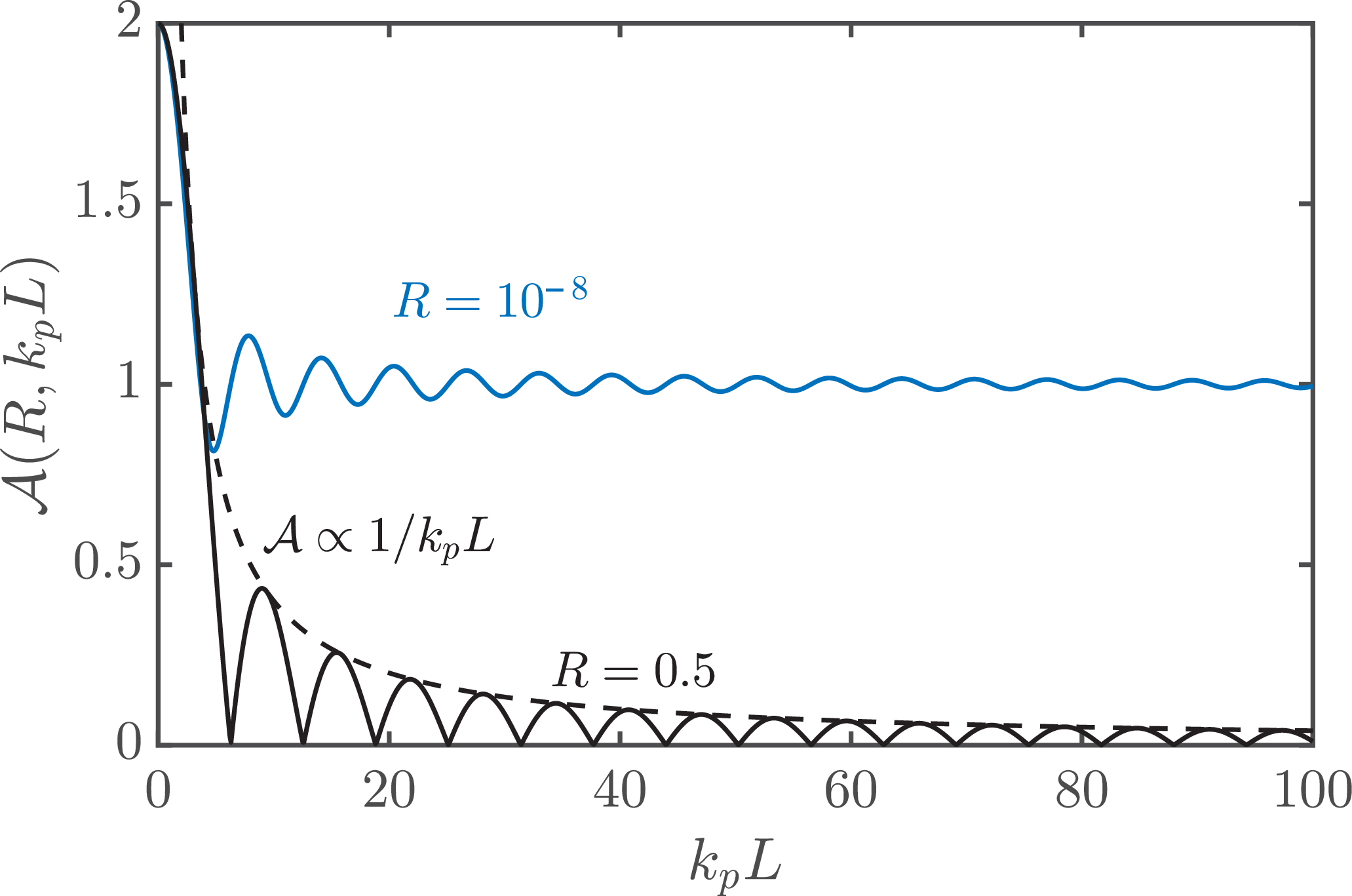
 A
A kpL
kpL R=10−8
 R=0.5
R=0.5 kpL≫1
kpL≫1 RkpL≲1
 R=0.5
R=0.5 A∝1/kpL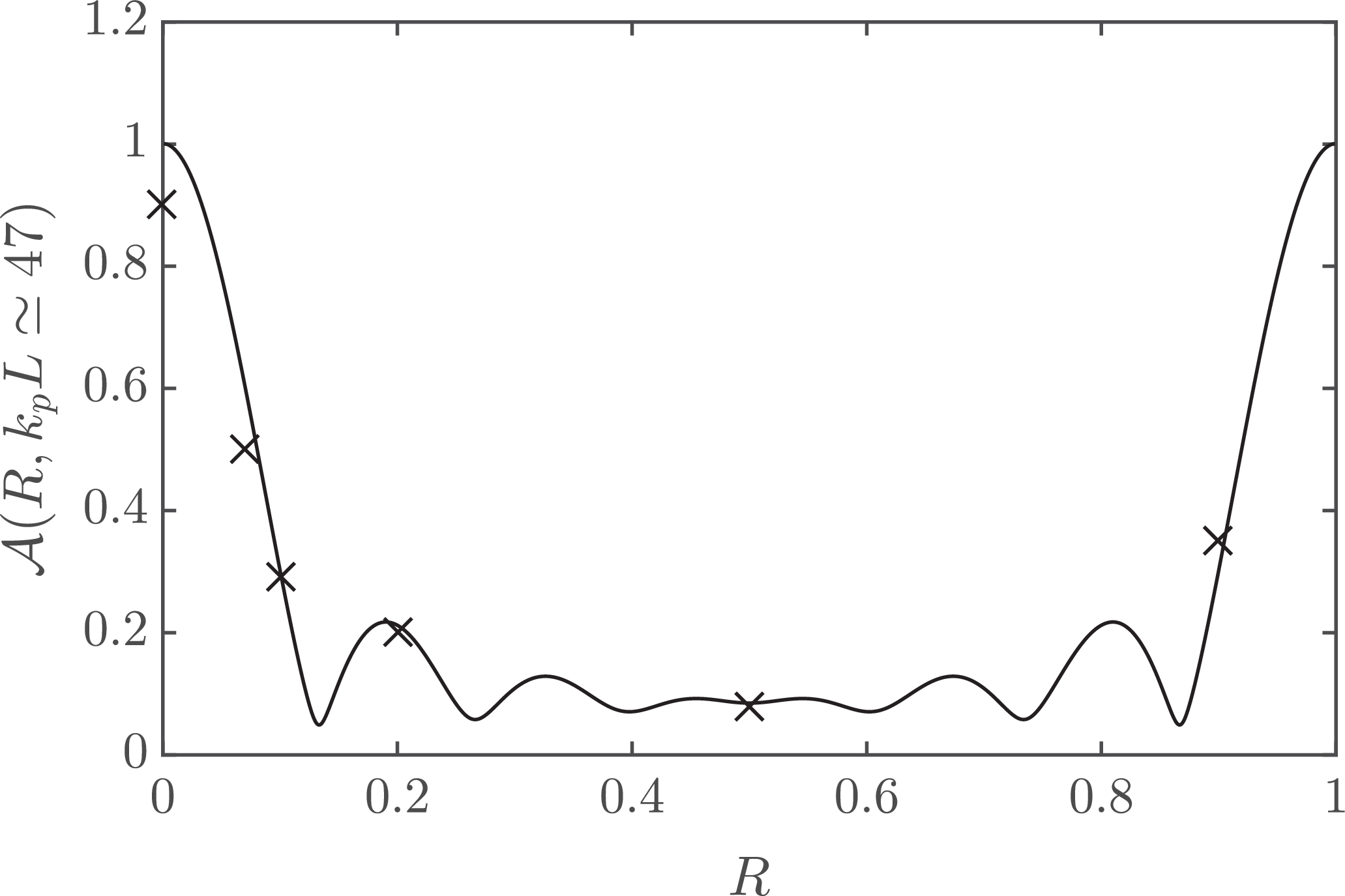
 A
A R
R kpL≃47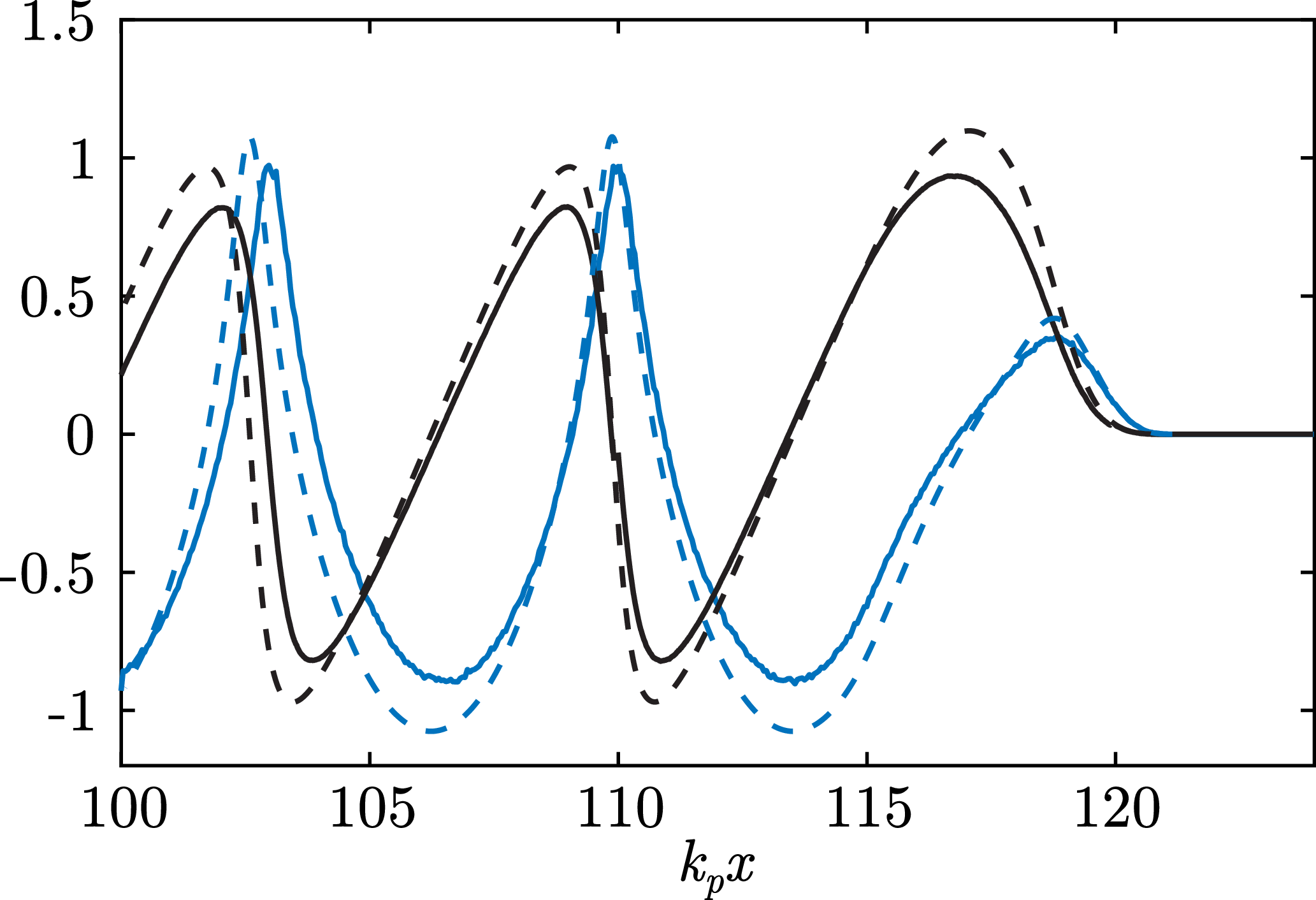
 E0=eE0/σT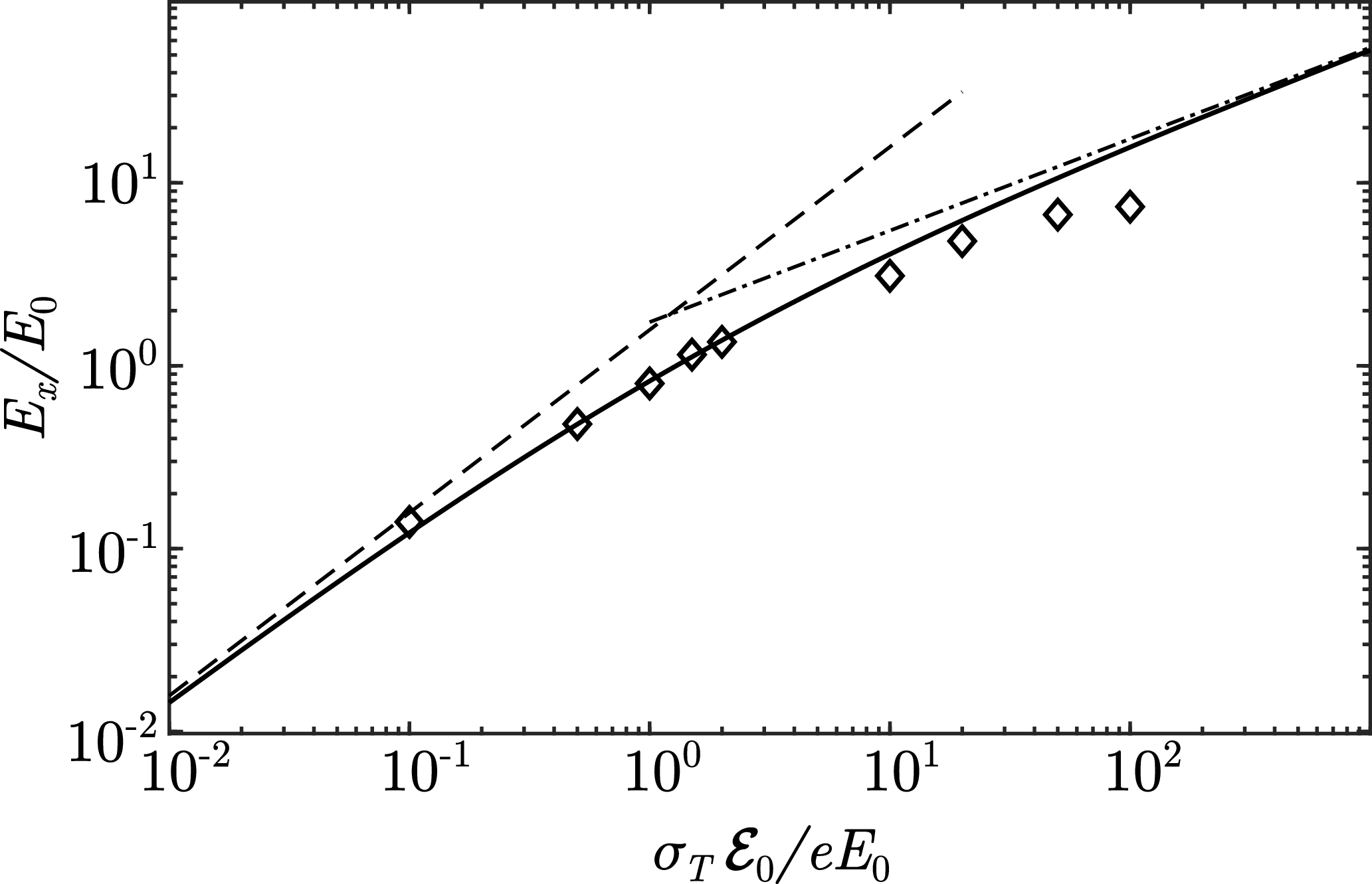
 (⋄)
(⋄) γm
γm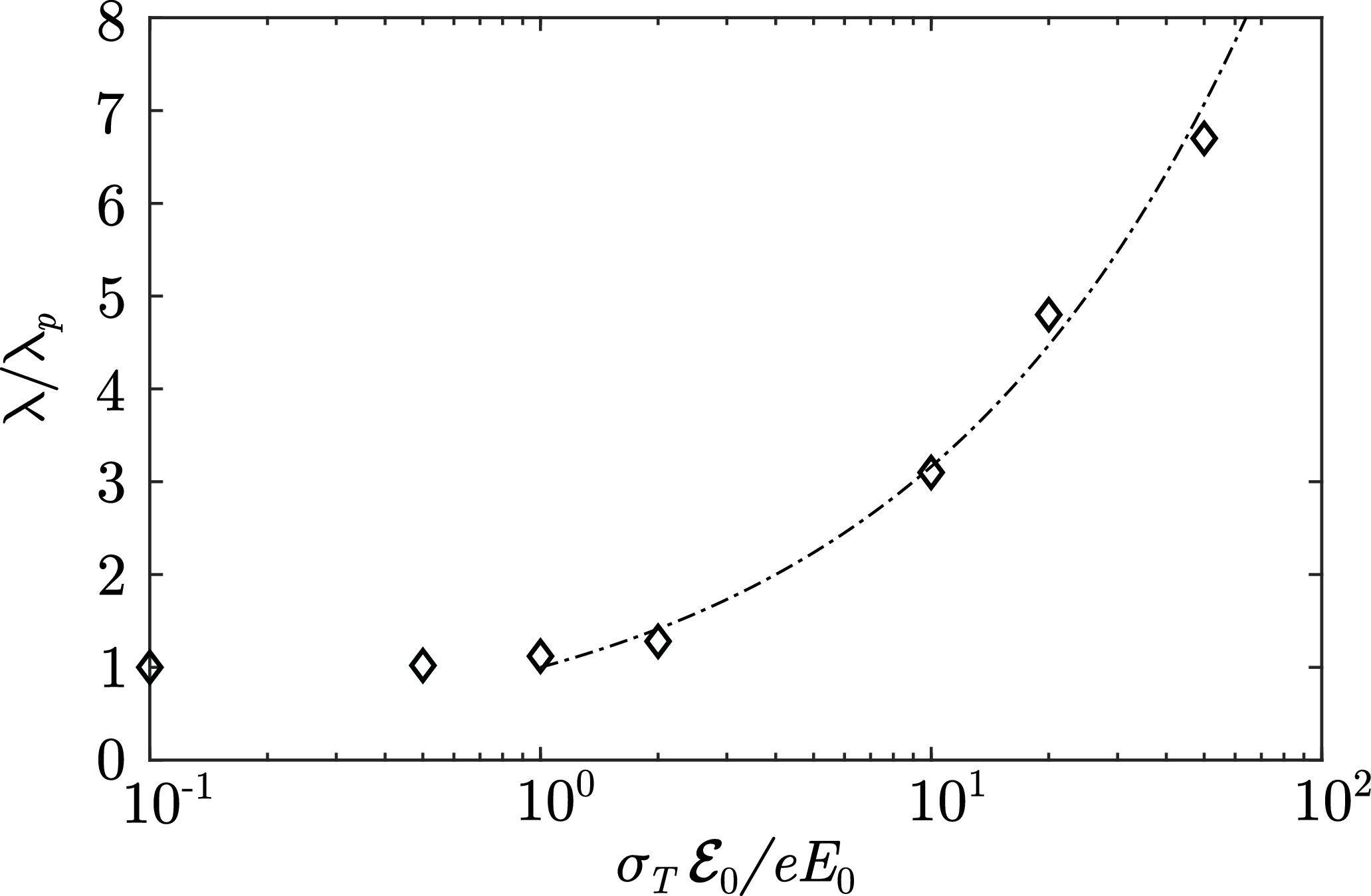
 (⋄)
(⋄) γmλp
γmλp γm
γm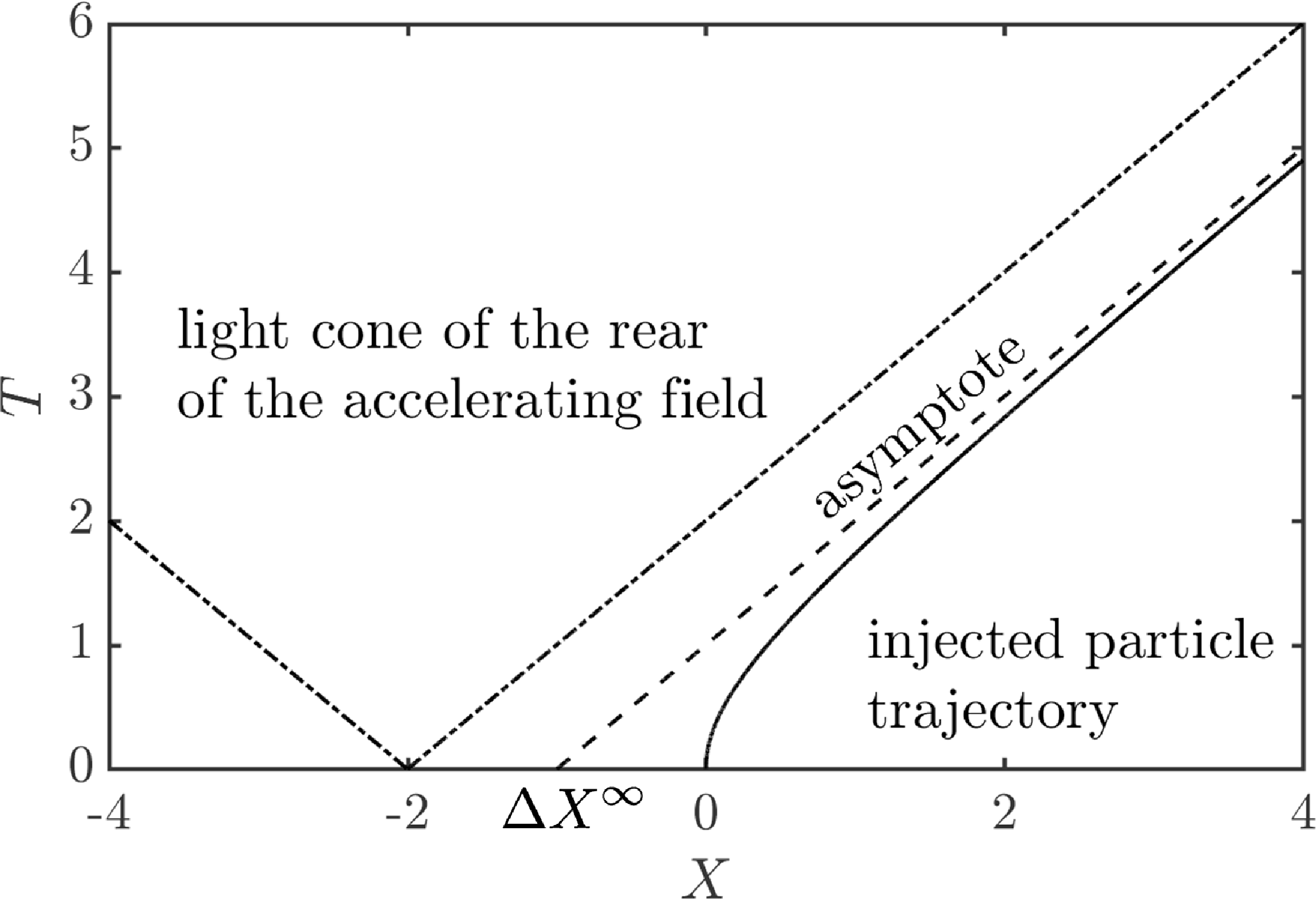
 T=X+ΔX∞
 X=−2
X=−2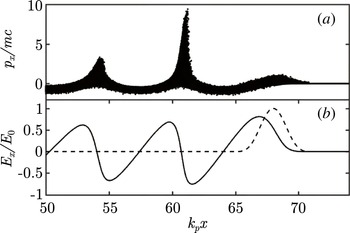
 E=eE0/σT
 np=1018cm−3
 px
px Ex
Ex
 γmax
γmax ld
ld E=0.74E0
 E=eE0/σT
 np=1018cm−3
 M=106
M=106 10%
10%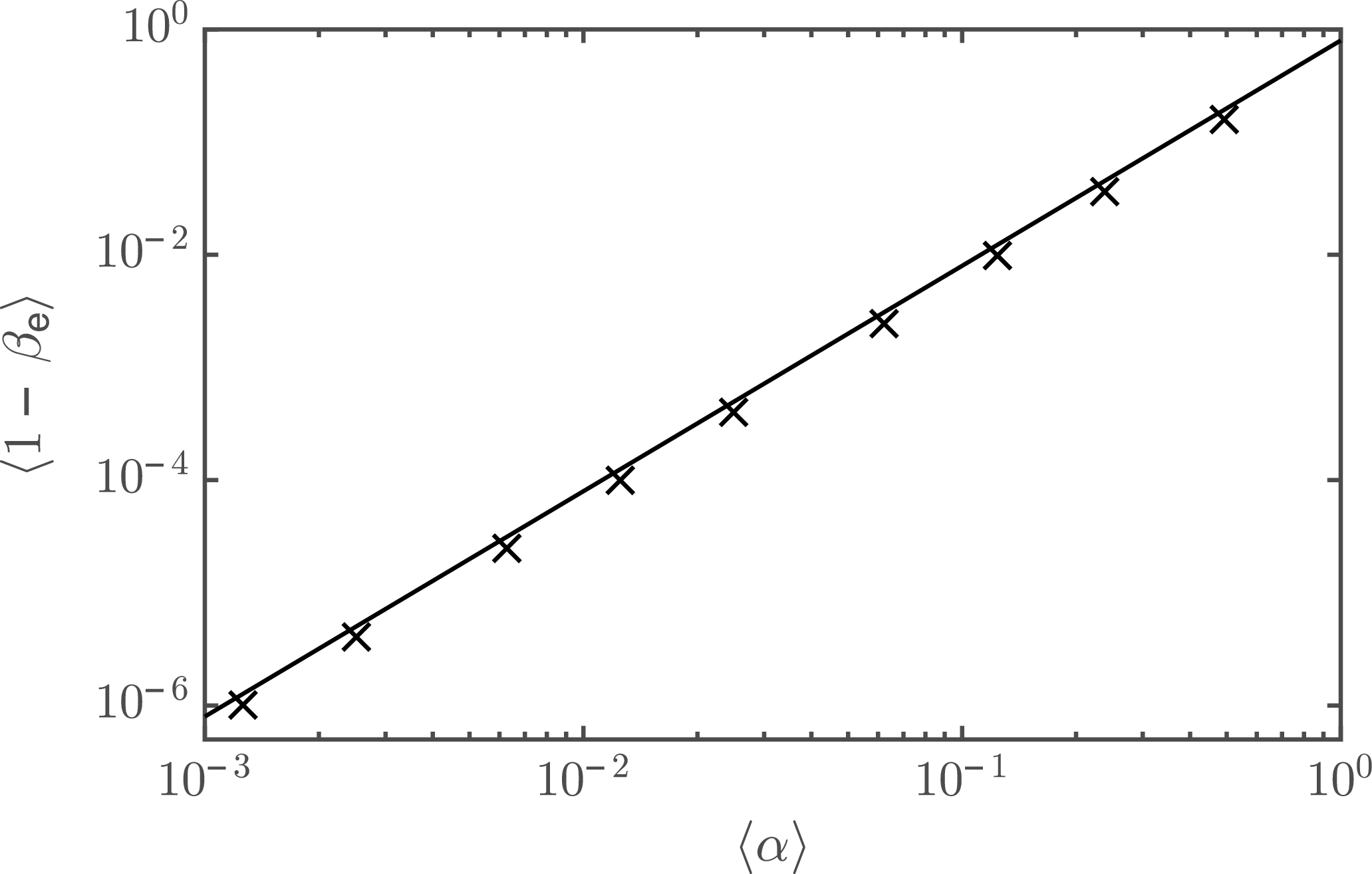
 ⟨α⟩
⟨α⟩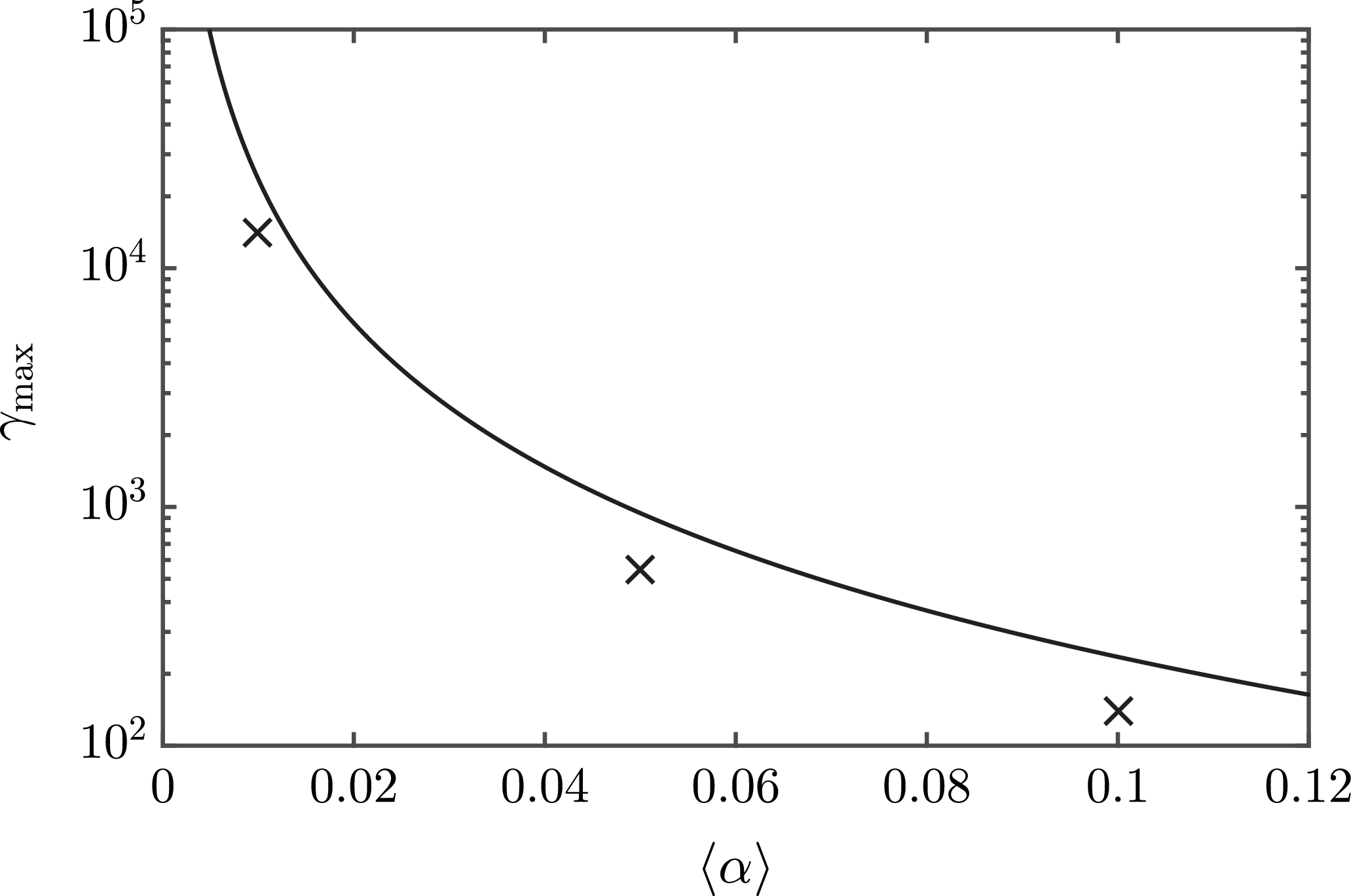
 ⟨α⟩
⟨α⟩ la=ld
la=ld Ex=0.61E0
 E0=eE0/σT
 E0=0.01
 eE0/σT
 Ly≫λp
Ly≫λp
 E0=0.01
 eE0/σT
 Ly≃λp
Ly≃λp
 E0=eE0/σT
 Ly≃λp
Ly≃λp
 Open access

