


1. Introduction
Design, as a discipline, has evolved in parallel with humanity’s social, economic, and cultural transformations, emerging as a field that synthesizes functionality, aesthetics, and strategy, among others. It originated during the Industrial Revolution, a period defined by specialization and mechanized production, where its primary role was to optimize processes and respond to the dynamics of supply and demand in emerging economies. At that time, designers were perceived as facilitators of consumption, focusing on the creation of utilitarian objects that embodied technical innovation and social status. However, the rampant consumerism of the 20th century, coupled with growing pressure on natural resources, profoundly altered the expectations placed on the discipline.
The Anthropocene, defined by the irreversible impacts of human activity on the planet, has compelled design to confront the consequences of its actions, such as environmental degradation, social inequality, and biodiversity loss (Reference BarutzkiBarutzki, 2018). This context has challenged traditional production models and driven a redefinition of the purpose of design. From Papanek’s ideas to Escobar’s perspectives, design has evolved to be recognized both as a key contributor to past issues and as a transformative tool for change. This change is grounded in the need to live in harmony with the planet and with both human and non-human beings that inhabit it (Reference WahlWahl, 2006).
To achieve meaningful transformation, it is essential to move from theoretical discussions to concrete actions. This requires preparing future design professionals to take an active role as change agents, capable of addressing complex problems with a responsible and regenerative perspective. Educating designers with this vision will contribute to a more balanced and sustainable future, aligning the practice of design with the needs of contemporary social and environmental systems.
The paper is structured to provide a comprehensive exploration of Regenerative Responsibility (RR) as a framework for design education. It begins by examining the transition from sustainability to regenerative design, analyzing key differences and their broader implications for systemic transformation. Following this, the concept of RR is introduced, detailing its core epistemological pillars. The discussion then moves into the strategic integration of RR into design education, outlining principles, actions, and educational methodologies that facilitate its implementation. To ground these concepts in practice, a case study is presented, demonstrating how regenerative design principles can be applied in an educational setting. Finally, the paper concludes with an analysis of the challenges and opportunities associated with implementing RR, along with recommendations for future research.
1.1. Method
This research employed a conceptual approach to review relevant literature. A systematic literature review was carried out to gather insights into the topic of design education and sustainability. The process began with an extensive search across various academic sources and databases, followed by a more focused exploration of key journals within the design discipline.
A literature review on regenerative design must include not only conventional academic sources but also perspectives that challenge dominant design models, this approach enables not only theoretical analysis but also a situated understanding of regeneration in practice This study follows a qualitative approach, combining literature review, case study analysis, and theoretical synthesis to establish the foundation of RR as an educational framework.
By integrating conceptual analysis and case-based insights, this study aims to provide a structured yet adaptable model for embedding regenerative responsibility into design education.
1.2. Contribution of this research
This paper introduces RR as a conceptual framework for design education, addressing the urgent need for sustainability and ethical practices. By consolidating key theories in regenerative design, sustainability, and pedagogy, it provides a comprehensive model that integrates ethics, systems thinking, and regeneration into the core of design education. The paper proposes innovative strategies such as project-based learning, ethical reflection, and interdisciplinary approaches to prepare future designers as agents of systemic change capable of addressing complex societal and environmental challenges. Furthermore, it aligns design education with global sustainability goals, emphasizing its potential to foster broader systemic transformation. By offering a conceptual foundation and identifying directions for future research, this paper situates RR as a critical contribution to advancing design education and practice.
2. Transitioning from sustainable to regenerative design
The shift from sustainability to regenerative practices reflects an evolution in design philosophy that addresses the growing urgency of environmental and societal challenges. Sustainability, while crucial, focuses primarily on minimizing harm and maintaining existing conditions. Regenerative practices, by contrast, aim to actively restore ecosystems, renew social structures, and enhance the overall health of interconnected systems. This transition recognizes that mitigating negative impacts is insufficient; instead, design must foster systemic health and resilience across ecological, social, and economic dimensions (Reference Mang and ReedMang & Reed, 2012). While sustainability traditionally emphasized metrics like carbon neutrality and waste reduction, regenerative practices redefine success by prioritizing contributions to biodiversity, carbon sequestration, and social equity. This approach requires a fundamental rethinking of design methodologies, emphasizing systemic thinking, co-creation, and interdisciplinary collaboration. Designers must shift from being reactive problem-solvers to proactive change agents, fostering a future where human activity supports the regeneration of natural systems and the well-being of all (Reference WardenWarden, 2021). The educational implications of this transition are profound. Future designers must be equipped not only with technical skills but also with a deep understanding of ethics, systems thinking, and the interconnectedness of human and non-human systems. By embedding these principles into design curricula, we can empower students to become agents of change, fostering a regenerative future that reimagines the relationship between design and planetary health. This evolution, grounded in responsibility and action, aligns design with the broader goals of regeneration and systemic well-being (Reference GuzowskiGuzowski, 2011).
Contrast of technical system design and living system design (Reference Mang and ReedMang & Reed, 2013)

3. Regenerative Responsibility
The practice of design encompasses a broad range of areas and approaches but has recently centered on regeneration and ethics. In the realm of ethics, design is often associated with creativity and innovation, aiming to ensure that all outputs are novel and original. It incorporates behaviors that embody values such as integrity, confidentiality, respect, and, most importantly, responsibility. However, there is a need to broaden the ethical vision to include decision-making in the actions carried out by designers, fostering a responsible practice within the discipline. Regarding regeneration, recent perspectives driven by the urgency to restore systems affected by environmental and social crises have linked design to the capacity to revitalize resources, ecosystems, and communities. This approach emphasizes practices that not only reduce negative impacts but also generate positive ones. It moves beyond environmental conservation by integrating social, cultural, economic, and political dimensions to design systems that actively contribute to the flourishing of their surroundings. Designing responsibly and regeneratively involves methodologies and tools that encourage deep reflection on the systemic impact of design. These tools cultivate a conscious attitude among designers, promoting iterative project processes that evaluate not only outcomes but also their potential to restore and strengthen the systems in which they operate.
The act of designing is inherently regenerative; it involves reflecting on how the designed object should not only respect the environment but also contribute to revitalizing social, cultural, economic, gender-related, and other dynamics impacting the context in which it will be used. Regenerative design imagines solutions that give back more to the system than they take, restoring its balance and enabling its positive evolution. In this era, design education must emphasize two fundamental pillars: responsibility and regeneration. These elements are not merely theoretical but are essential components for developing professionals with a philosophy that values restoration and projects toward desirable futures. This approach aims to prepare designers who are aware of the potential negative consequences of poor design and are committed to regenerating systems through their creative practices. In this context, the term Regenerative Responsibility (RR) emerges as an actionable stance within the field of design.
RR represents the integration of these two concepts, forming a comprehensive education that fosters a designer’s sensitivity toward their environment and equips them to make decisions benefiting all elements of a system. It is understood as a commitment undertaken by designers, both in their academic formation and professional practice, to address challenges by generating solutions that not only resolve them but also promote ethical and regenerative values oriented toward the well-being of both human and non-human entities.
It is crucial that this concept is introduced naturally and organically into the education of students—not as a label or checkbox item in the curriculum but as an iterative constant woven into every course within design programs. Designers must become agents of change, recognizing their discipline as a tool to preserve, regenerate, and nurture everything that has been considered lost or at risk.
As a concept, RR refers to the practice of integrating environmental, social, and economic considerations in a balanced and interconnected way across various fields, such as design, education, and professional practice. It involves minimizing negative environmental impacts, maximizing the long-term quality and value of designed products or systems, promoting ethical and socially responsible practices, and ensuring long-term commercial viability and profitability, all with the overarching goal of contributing to the well-being of society and the planet.
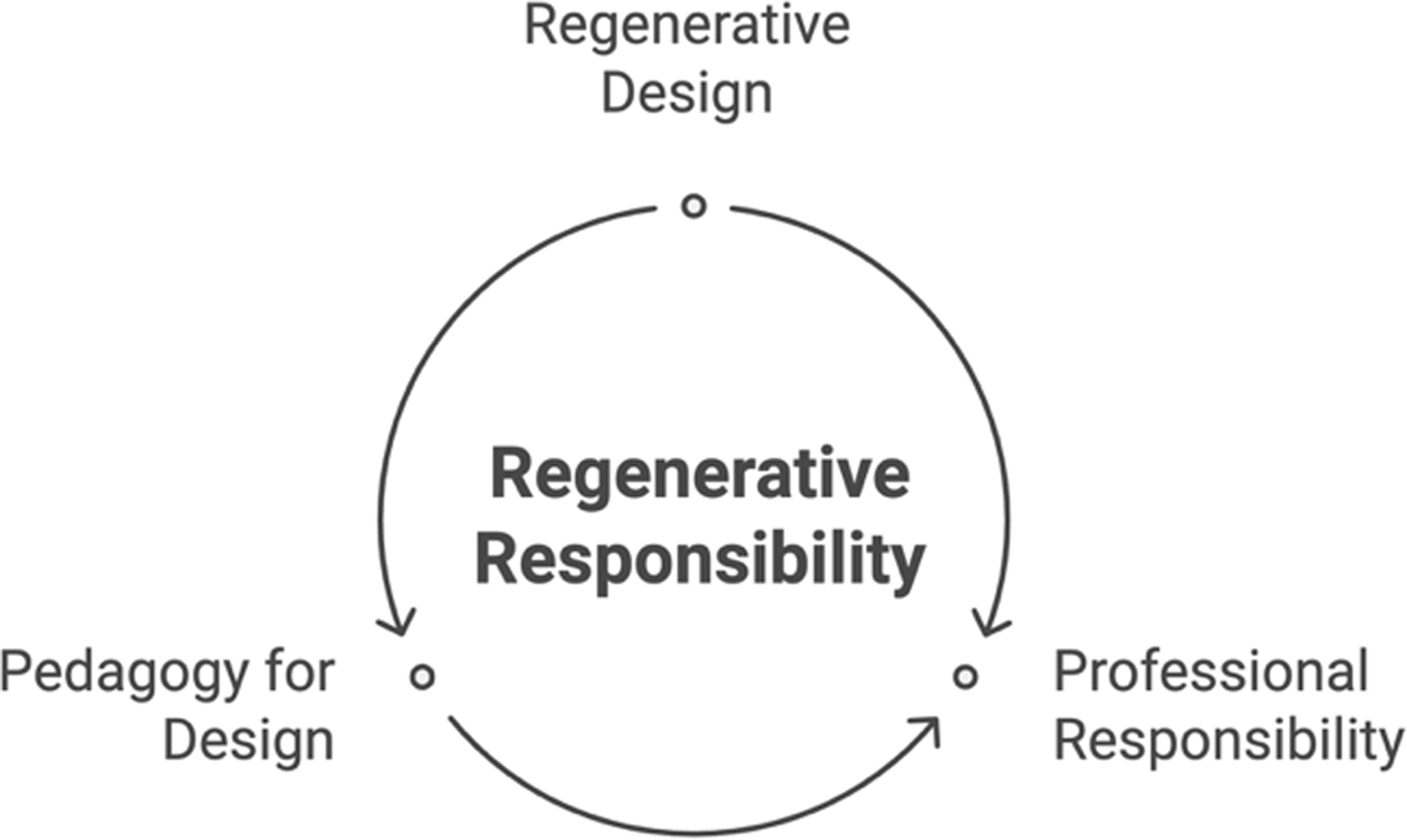
RR is grounded on three fundamental epistemological pillars that provide the basis for its conceptual framework and practical application: Regenerative Design, Professional Responsibility, and Pedagogy for Design. These pillars represent interconnected domains of knowledge and practice, each playing a vital role in shaping the principles and actions that define RR. Together, they offer a comprehensive perspective that integrates the ethical, regenerative, and educational dimensions of design, ensuring a holistic approach to addressing contemporary challenges in the discipline. Each pillar serves as a cornerstone, contributing uniquely to the articulation and implementation of RR in both academic and professional contexts.
Foundations of Regenerative Responsibility

3.1. Regenerative design
Regenerative design extends beyond the goals of sustainability to actively restore and improve the systems it interacts with. It emphasizes the interconnectedness of ecological, social, and economic systems, positioning design as a practice that generates positive impacts rather than merely minimizing harm. This approach arises from the recognition that addressing global challenges such as climate change, resource depletion, and social inequalities requires solutions that contribute to the regeneration and vitality of the systems involved (Reference WahlWahl, 2006).
At its foundation, regenerative design relies on systemic thinking, which considers every design decision as part of a broader network of relationships and processes. This perspective allows designers to develop solutions that align with and enhance the ecological and social contexts in which they are implemented. Moving away from linear methodologies that often prioritize short-term results, regenerative design employs circular and adaptive processes that remain effective and relevant as conditions change over time. A defining aspect of regenerative design is its focus on place-based solutions. By considering the unique environmental, cultural, and social characteristics of a specific location, designers can create interventions that address immediate needs while fostering the long-term health of the ecosystem and the community (Reference WahlWahl, 2016). This approach ensures that designs are deeply integrated into their context, promoting resilience and local engagement, also emphasizes positive contributions to natural and human systems. Examples include restoring biodiversity, enhancing water and air quality, revitalizing degraded ecosystems, and strengthening social structures. It encourages the use of renewable materials, adaptable technologies, and processes that replenish resources rather than depleting them. In doing so, it redefines traditional metrics of success, moving away from efficiency and profitability toward measures of ecological restoration, social equity, and systemic health.
In the field of design, regenerative principles guide the creation of products and systems that contribute more to the environment than they extract. For instance, products designed with modularity and repairability in mind can extend their life cycle, reduce waste, and promote circular economies (Reference KalantidouKalantidou, 2015). Manufacturing practices can also adopt renewable energy sources and minimize resource consumption, further aligning with the objectives of regeneration. Regenerative design also holds significant implications for design education. Preparing future designers to embrace these principles requires fostering an understanding of systems thinking, ethical considerations, and collaborative methodologies. Embedding these concepts in design curricula equips students to approach their work with the awareness and skills necessary to address complex challenges and create meaningful change.
Regenerative design cannot be disconnected from the economic dynamics that sustain it. Manzini argues that the regenerative economy must move away from centralized production models and shift towards distributed systems where local production, resource optimization, and community collaboration form the basis of a viable economic model. Examples such as FabLabs and circular economies demonstrate that regeneration does not solely depend on large investments but rather on the ability to organize local value networks. These systems allow the positive impact of design to be sustained over time, fostering economic autonomy and social resilience (Manzini, 2015).
3.2. Professional responsibility
Designers occupy a crucial role in addressing the ethical and societal implications of their work, ensuring that design processes and outcomes contribute positively to the complex systems they impact. Professional responsibility in design involves a nuanced understanding of how moral and ethical considerations intersect with the practical application of design (César González Ochoa, 2023). This responsibility extends beyond fulfilling functional requirements, incorporating values of inclusivity, sustainability, and equity into every stage of the design process (Garduño, 2018).
Ethical practice in design demands a commitment to systemic thinking, where decisions are evaluated not only for their immediate impact but also for their long-term consequences on social and environmental systems. This approach aligns with the shift from designing for individual user needs to considering a broader network of stakeholders, including more-than-human entities (Edwards & Pettersen, 2023). The acknowledgment of these interconnected systems highlights the designer’s role as a mediator who balances diverse and often conflicting interests.
A significant aspect of professional responsibility is the emphasis on transparency and accountability in decision-making. Designers are challenged to anticipate the ethical dilemmas that may arise in their work, such as those related to environmental degradation, social inequality, and technological misuse. As discussed in the evolving discourse on the “new design conscience,” this requires moving beyond traditional problem-solving methodologies to embrace practices that foster social and environmental justice (Reference RampinoRampino, 2022).
Education is pivotal in embedding professional responsibility within the design discipline. Through curricula that prioritize ethical reflection, interdisciplinary collaboration, and systems thinking, future designers can be equipped to navigate the complex moral landscapes of contemporary practice. This education fosters critical awareness, empowering designers to envision and implement solutions that align with principles of equity, sustainability, and regeneration.
3.3. Pedagogy for design
Design education is a cornerstone of shaping the future of the discipline, influencing how designers think, create, and act within complex systems. As the challenges facing society and the environment grow increasingly interconnected, pedagogy for design must evolve to prepare students to engage with these complexities. This involves fostering not only technical proficiency but also a deep understanding of ethical considerations, systemic impacts, and the potential of design to contribute positively to global challenges. By integrating experiential learning, critical reflection, and interdisciplinary collaboration, design education can cultivate professionals who approach their work with responsibility, creativity, and adaptability. To enable the implementation of Regenerative Responsibility in a teaching-learning process, three pedagogical methods were considered. Their approach facilitates the integration of the desired perspective, allowing students to incorporate this mindset into their academic development and eventually apply it in their professional practice.
Universal Design for Learning (UDL) proposes flexible educational environments that remove barriers through diversity in representation, action, and engagement, supported by technologies that promote equity and creativity while integrating DEI (Diversity, Equity, and Inclusion) into the teaching and learning process. This approach encourages students and educators to adapt processes according to individual needs, employing inclusive strategies that foster innovation and problem-solving (Alba Pastor, 2016).
Emergent Design, based on Complex Systems and Rhizomes, envisions dynamic and non-hierarchical teaching environments capable of adapting to unpredictable contexts. It relies on iteration and collective experimentation, promoting co-creation and continuous learning. This model emphasizes flexibility and challenges rigid structures while aligning pedagogical goals with design processes through adaptive technological tools (Reference CavalloCavallo, 2000).
Regenerative Pedagogy rethinks educational relationships by connecting learning to social and environmental regeneration. It encourages context-specific projects that integrate local knowledge and diverse perspectives, emphasizing the importance of educating for sustainability and coexistence in an interdependent world. This approach highlights regeneration as a key tool for design, aimed at restoring and revitalizing social and ecological systems, with a focus on diversity and shared responsibility (Moreno Castañeda, 2022).
The pedagogy of regenerative design should prioritize expanding capabilities rather than merely transmitting technical knowledge. Design has the potential to become a tool for freedom, provided it focuses on strengthening community autonomy and the agency of emerging designers. From this perspective, design education should shift toward active methodologies, where students engage in co-design processes and experiential learning.
A relevant model in this regard is the Aalto LAB approach, where students work directly with communities to develop regenerative solutions. This approach ensures that regeneration is not only a theoretical goal but also a tangible practice situated in real-world contexts (Garduño, 2018).
4. Regenerative Responsibility as a strategy for design education
The proposed educational approach for teaching and learning Regenerative Responsibility in Design is based on the integration of regenerative principles, transformative pedagogy, and project-oriented tools aimed at preparing designers who not only address contemporary needs but also contribute to the revitalization of social, ecological, and cultural systems. Design faces global challenges such as the environmental crisis and social inequality. In this context, Regenerative Responsibility emerges as a transversal axis in education to reconfigure the discipline, shifting from a reactive to a proactive approach, where designers take on the role of agents of regeneration.
To achieve this, Regenerative Responsibility is supported by a set of principles that provide a framework for understanding and broadening the academic practice. Additionally, specific actions are proposed for both educators and students to undertake during a project. Finally, a series of educational strategies are outlined to ensure the goals of a project oriented toward Regenerative Responsibility are effectively achieved.
4.1. Regenerative Responsibility principles
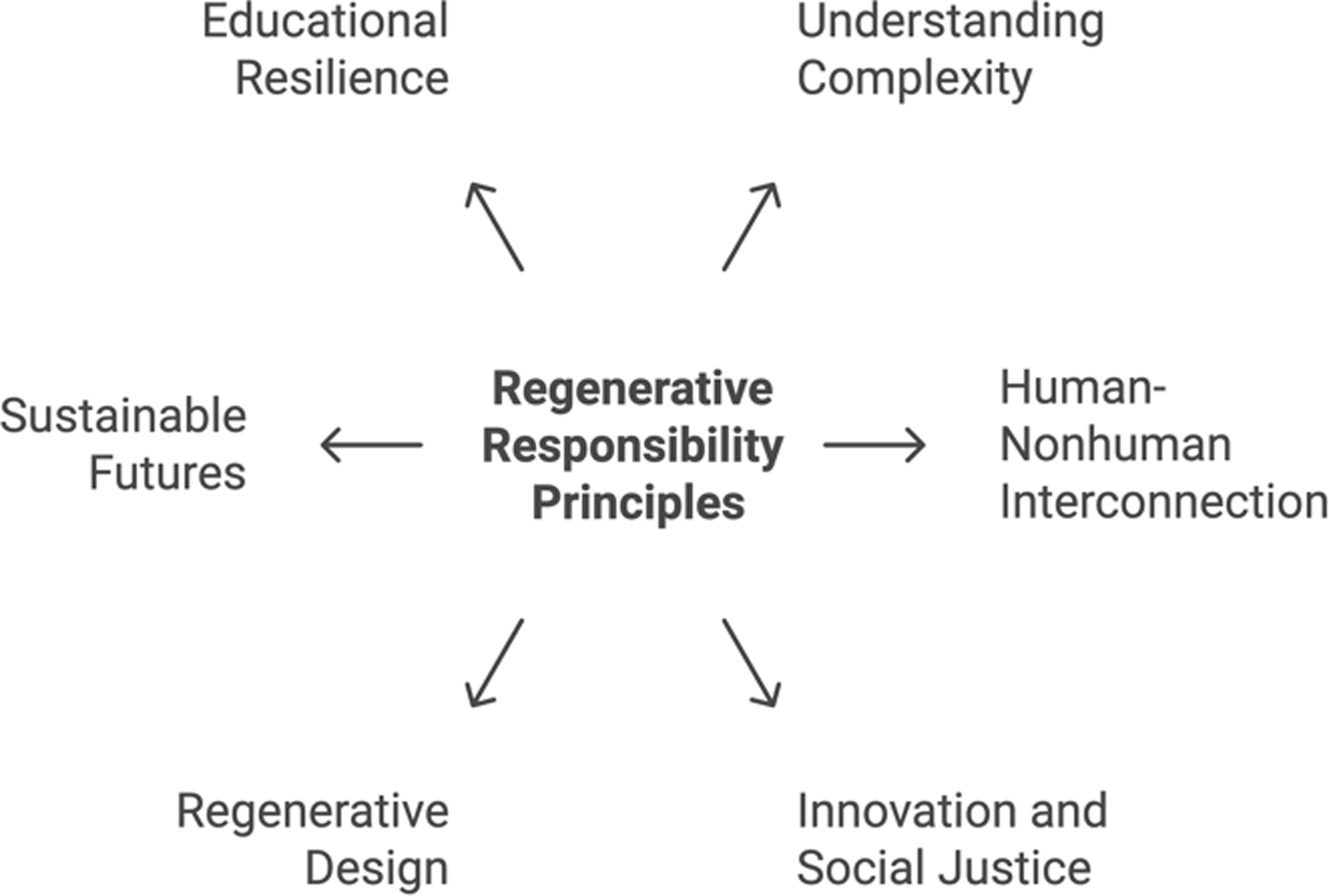
To formulate Regenerative Responsibility, the following principles must be considered:
1. Understanding Complexity: A deep understanding of the inherent complexity of ecological, social, and economic challenges. Designers must adopt a systems-thinking approach that accounts for the multiple interconnections and feedback loops within systems.
2. Human-Nonhuman Interconnection: Recognition that humans do not operate in isolation but are deeply interconnected with the nonhuman systems and entities surrounding them.
3. Innovation and Social Justice: Innovation must be understood not only from a technological perspective but also from a social one. Social innovation involves collaborating with communities to co-create solutions that address their needs and promote social justice and shared well-being.
4. Regenerative Design: Design as an active process of regenerating natural and social systems. Regeneration involves restoring and revitalizing damaged ecosystems and communities affected by industrial and economic activities.
5. Sustainable Futures: A focus on projecting toward desirable futures by not only addressing present challenges but also anticipating future obstacles and designing strategies to transition toward a more sustainable future. This approach emphasizes proactive design rather than merely reacting to existing problems.
6. Educational Resilience: Designing pedagogical practices and learning environments that foster equity, systems thinking, and the restoration of communities and ecosystems. This transforms education into a driver of change toward a more sustainable and interconnected future, preparing designers to act as agents of regenerative change.
Regenerative Responsibility principles

4.2. Regenerative Responsibility actions
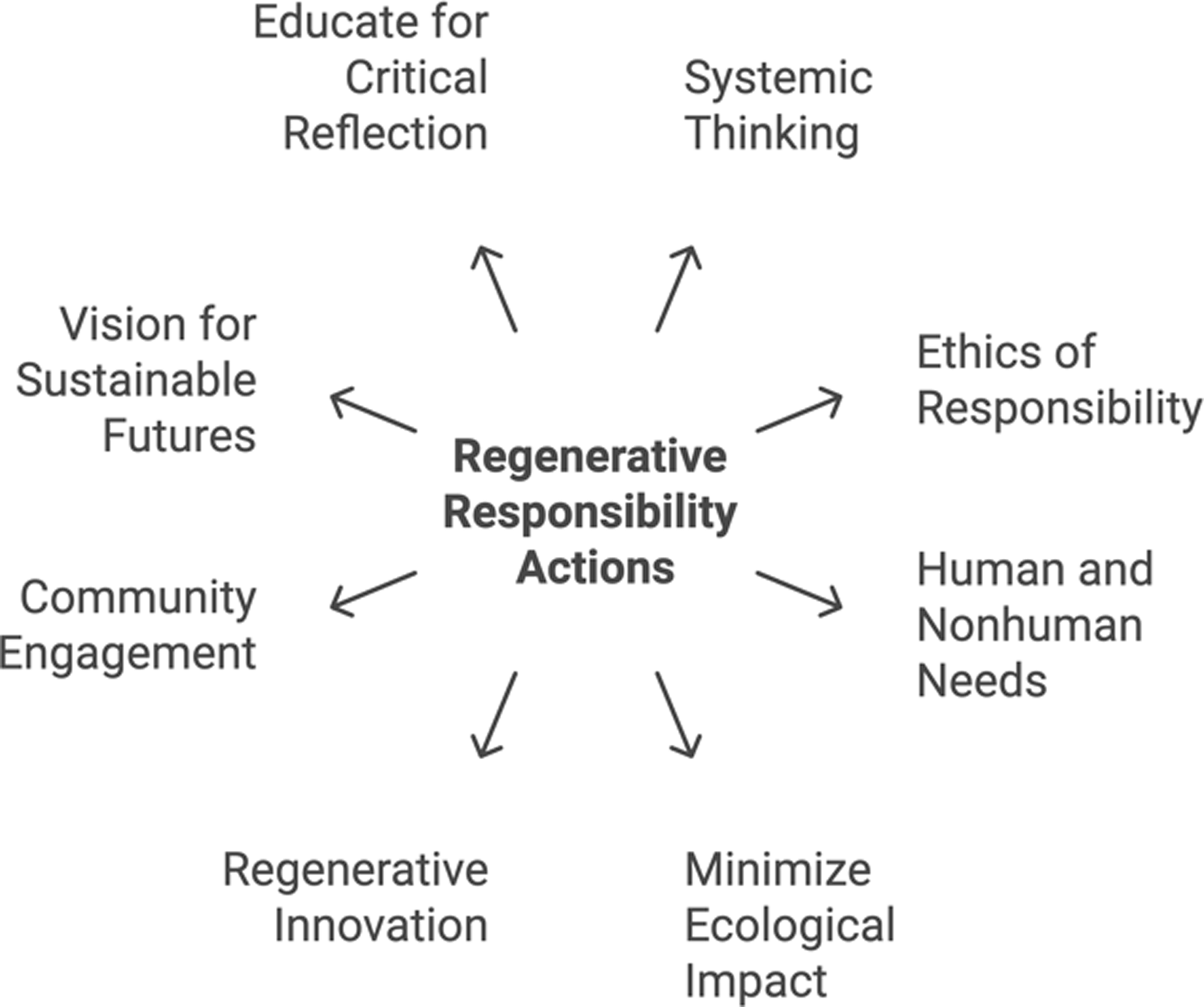
It is proposed that the following actions should be incorporated into a practice with a focus on Regenerative Responsibility:
1. Think Systemically: Recognize that each design decision impacts a broader system, including social, ecological, and economic aspects.
2. Adopt an Ethics of Responsibility: Understand the ethical implications of design decisions and consider social justice and the well-being of vulnerable communities.
3. Design for Human and Nonhuman Needs: Account for the needs not only of people but also of ecosystems and nonhuman entities.
4. Minimize Ecological Impact: From the outset, aim to reduce the use of nonrenewable materials, energy, and resources. Design with the product’s lifecycle in mind, from production to disposal or reuse.
5. Promote Regenerative Innovation: Go beyond reducing environmental harm to design products and services that regenerate ecosystems and communities.
6. Engage the Community in Design: Learn to co-create with the people for whom the design is intended. Collaborate with communities to ensure their voices are heard and reflected in the proposed solutions.
7. Develop a Vision for Sustainable Futures: Project how designs will impact the future, imagine desirable futures, and work to make them a reality.
8. Educate for Critical Reflection: Cultivate the practice of self-reflection by constantly analyzing whether what is being learned and designed aligns with principles of sustainability and ethical responsibility.
Regenerative Responsibility actions

4.3. Regenerative Responsibility educational strategies
From an academic perspective, implementing a focus on Regenerative Responsibility in design requires the following teaching-learning strategies:
1. Regenerative Project-Based Learning (RPBL): Incorporate collaborative and multidisciplinary projects aimed at addressing complex social and environmental challenges. These projects should encourage co-creation with local communities, integrating their knowledge and contexts into the solutions.
2. Flexibility in Educational Processes: Develop educational activities that allow for diverse forms of interaction, ensuring inclusive and adaptive representation. This flexibility enables course objectives to be quickly adjusted based on classroom dynamics and the needs of the surrounding environment.
3. Co-creation in the Educational Environment: Foster co-design within multidisciplinary teams to promote horizontal collaboration among students, educators, and the community. This approach enables dynamic, innovative, and regenerative solutions that respond to real-world needs.
4. Iterative Design and Learning from Mistakes: Engage students in activities that emphasize experimentation and constant redesign, framing mistakes as opportunities for improvement and learning. This approach reinforces resilience and adaptability in future designers.
5. Inclusion and Active Participation: Create activities that consider the individual and collective interests of students, fostering diverse and meaningful participation in projects.
6. Technologies for Regenerative Design: Integrate emerging technological tools to minimize environmental impact and explore sustainable and regenerative solutions from the conceptual phase. Use collaborative learning platforms to facilitate co-creation and collective work.
7. Continuous and Participatory Assessment: Design inclusive rubrics to evaluate both the technical quality of projects and their social and environmental impact. Implement participatory feedback cycles to incorporate input from end users, communities, and experts.
Educational strategies for Regenerative Responsibility

5. Case study
Regenerative design should not remain a theoretical concept but should be applied in real-world contexts. A compelling example of this approach is Dyalogo, a regenerative design laboratory that fosters collaboration between designers, communities, and organizations to develop sustainable and context-based solutions (DYA - Design Your Action, 2025). Dyalogo’s initiatives include participatory design processes that integrate local knowledge, fostering environmental restoration and social equity. By emphasizing co-creation, the laboratory ensures that solutions are not externally imposed but rather emerge organically from the needs and capacities of the communities involved. This model demonstrates how regenerative design can be both an ecological and a social strategy, reinforcing local resilience while generating long-term benefits.
6. Conclusions
6.1. Challenges
The transition to a regenerative design model requires not only changes in professional practice but also a deep transformation of the epistemological and ontological paradigms of design (Reference EscobarEscobar, 2017) argues that contemporary design remains anchored in the logic of Western development, imposing homogeneous solutions that ignore cultural and ecological diversity. From this perspective, regeneration involves not only restoring ecosystems but also enabling the emergence of multiple forms of knowledge and existence, these considerations highlight the need to reformulate design methodologies to include qualitative and long-term evaluation frameworks.
6.2. Summary
The proposed educational approach for teaching and learning Regenerative Responsibility in Design is based on the integration of regenerative principles, fostering pedagogy, and project-based tools aimed at preparing designers who not only address contemporary needs but also contribute to the revitalization of social, ecological, and cultural systems. Design, as a discipline, faces global challenges such as the environmental crisis and social inequality. In response, Regenerative Responsibility emerges as a transversal axis in education to reconfigure the discipline, shifting from a reactive approach to a proactive one, where designers take on the role of agents of regeneration.
6.3. Future research
As an educational proposal, the development of a Regenerative Responsibility Laboratory is being considered in collaboration with students and faculty from Tecnológico de Monterrey, Campus Querétaro. This initiative aims to explore and co-create regenerative solutions tailored to local needs. The laboratory will serve as an experimental space where participants work on real-world projects addressing specific contextual challenges, such as restoring degraded ecosystems, regenerating social dynamics in vulnerable communities, and implementing circular economic practices in local productive sectors.
Acknowledgements
The authors would like to acknowledge the financial support of Tecnologico de Monterrey, Mexico, in the production of this work and to the School of Architecture, Art and Design Research Group “Advanced Design Processes for Sustainable Transformation” for the insights and encouraging this initiative.



 Open access

