




1 Introduction
Several earlier studies (Breuer & Geluykens Reference Breuer, Geluykens, Kraft and Geluykens2007; Flöck Reference Flöck2016: 139; Murphy & De Felice Reference Murphy and De Felice2019) have found that British English (BrE) speakers use please in directives at twice the rate of American English (AmE) speakers. Those studies have collected instances of request-directives, then counted how many include please. Rather than starting with directives, this study starts from a lexical search for the word please in the Corpus of Global Web-based English (GloWbE; Davies Reference Davies2013). The aims of this research are:
-
(a) to identify contexts in which the pragmatic marker please occurs;
-
(b) to measure British and American usage of please in these contexts;
-
(c) to evaluate whether web-based English gives different insights into please than have been available from previous studies; and
-
(d) to hypothesize about the reasons for any differences found in the British and American data.
The lexical-search method and the online dataset give a broader view of the kinds of speech acts please occurs in and contribute further insights on why please patterns differently in these two major varieties of English. The next section briefly reviews past work on please. Section 3 introduces the GloWbE corpus and the frequency of please in its US and GB subcorpora. Section 4 describes how weFootnote 2 sampled and coded datasets and later used a survey to corroborate parts of that coding process. Section 5 reports on the similarities and differences in the sampled datasets, and section 6 further reflects on the major differences in please in British and American GloWbE before summarizing the findings.
2 About please
2.1 What is please?
Please is described as a request marker (e.g. House Reference House, Blum-Kulka, House and Kasper1989), a discourse marker (e.g. Biber et al. Reference Biber, Johansson, Leech, Conrad and Finegan1999), a pragmatic marker (e.g. Wichmann Reference Wichmann2004) and a lexical mitigating device (Aijmer Reference Aijmer1996), among other things. Added to a non-imperative form, please resolves ambiguity by forcing a directive interpretation, as in (1) and (2):


This would seem to indicate that please can make non-imperatives into directives – but this is not always the case. Please is infelicitous in less conventional, more indirect directive forms, as in (3). As Butler notes, ‘the more transparent the speech act, the less restricted are its patterns of co-occurrence with please’ (Reference Butler1982: 75).

This leaves please to be categorized as a politeness marker (indeed, ‘the most obvious example of a politeness marker in English’ – Watts Reference Watts2003: 83). However, there is little agreement on what being a politeness marker means or what it means specifically for please. Brown & Levinson (Reference Brown and Levinson1987: 101) state that an on-record request ‘may be softened by negative-politeness respect terms, or by please’, skirting the issue of whether please addresses negative face. For Hartford & Bardovi-Harlig, in a study of American students’ emails to faculty, ‘Please indicates some faint possibility that the request might not be granted’ but ‘does not serve as a strong enough mitigator to soften the force of the Imperative’ (Reference Hartford, Bardovi-Harlig and Bouton1996: 59).
Furthermore, this ‘politeness marker’ is not always polite. Entries for adverb/interjection please in thirteen English dictionaries (surveyed in Murphy Reference Murphy2019) include nine distinct lexicographical senses for it, six of which are noted as marking politeness (e.g. ‘used in polite requests for action’, ‘used in polite acceptance of an offer’) and three of which are not (Murphy Reference Murphy2019: 72):
-
(a) ‘used to add force or urgency to a request’: Please shut up already!
-
(b) ‘used to express disapproval/request to stop an action’: Dana, please!
-
(c) ‘used to express incredulity/dismissal’: Oh please. No one believes that.
The (a) ‘force/urgency’ sense does not seem to stem from please being a politeness marker; instead it is better explained if we consider please a request marker. As a request marker added to utterances that are already transparently requests, please can be seen as adding force to the directive. Senses (b) and (c) can be interpreted as extensions of the ‘urgency’ usage – though another approach would be to see them as ironic, or mock-polite, usages of ‘polite’ please.
2.2 Observations on please in American and British English
Pragmatic marker please is a Late Modern English development, derived from expressions involving the verb to please. While pragmatic marker please is clearly not a verb, ‘traditional grammars cannot deal with please at all, since by all syntactic tests it is unique’ (Stubbs Reference Stubbs1983: 71). In examples like (1b) and (2b), it is usually considered to be an adverb, though it is also used as an interjection.
The first (Oxford English Dictionary 2023) (OED) citation of adverbial please is from a letter sent from Virginia to London in 1771, a few years before the American Revolution. (See Faya Cerqueiro Reference Faya Cerqueiro2013 for a more complete history.) This timing would easily allow for transatlantic differences in the use and understanding of please to arise. Studies that have compared please in British and American English have found different rates of usage in requests, but most have not considered whether differences in the meaning or function of please might underlie those differences. Some insight into the underlying differences in please’s significance come from non-comparative studies of the individual varieties, which make contradictory claims about the use and force of please.
Studies of please in American contexts have tended to conclude that please marks more ‘difficult’ requests – those involving discrepancies in social power between requester and requestee and/or notable imposition (e.g. Ervin-Tripp Reference Ervin-Tripp1976; Leopold Reference Leopold2015). An American study of request compliance found please to be counterproductive in a low-imposition context with a stranger (Firmin et al. Reference Firmin, Iezzi and Vaughn2004), ostensibly because please was perceived as inappropriately formal or ‘pleading’. A companion study (Vaughn et al. Reference Vaughn, Firmin and Hwang2009) found please much more effective in a higher-stakes context, in line with the expectation that please marks non-routine requests in AmE. In US studies comparing spoken and written requests, please was almost exclusively found in writing (see Pufahl Bax Reference Pufahl Bax1986, on spoken versus office-memo requests, and Carlo & Yoo Reference Carlo and Yoo2007, on in-person versus online-chat library reference requests).
Studies in British contexts, on the other hand, tend to conclude that please is a ‘routine’ part of everyday, low-stakes requests (e.g. House Reference House, Blum-Kulka, House and Kasper1989; Barron Reference Barron, Schneider and Barron2008; Wichmann Reference Wichmann2004; Leech Reference Leech2014). In these studies, please ‘occurs in situations where the imposition is either minimal or socially sanctioned’, meaning ‘that it only occurs when there is very little “face-work” to be done’ (Wichmann Reference Wichmann2004: 1544). Culpeper & Gillings (Reference Culpeper, Gillings, Brezina, Love and Aijmer2018) found similar rates of please usage in the North and South of England, despite the common perception of different politeness cultures in the two regions.
The ‘routineness’ of British please usage might explain why comparative speech-act studies have found please to be twice as frequent in British English as American, whether in experimental discourse-completion tasks (Breuer & Geluykens Reference Breuer, Geluykens, Kraft and Geluykens2007), in corpora of spoken English (Flöck Reference Flöck2016), or in emails (Murphy & De Felice Reference Murphy and De Felice2019). In Murphy & De Felice’s study, British please (in contrast to American please) was characteristically found in highly formulaic contexts in which the directive involves very little or no imposition on the recipient (e.g. Please see attached, Please accept my thanks), indicating usage that is more politic (non-salient behavior ‘directed toward the goal of establishing and/or maintaining equilibrium’; Watts Reference Watts2003: 20) than polite (salient behavior, beyond what is minimally appropriate). In contrast, American please showed weaker patterns of usage in the email data, suggesting that AmE please might be more sensitive to the social context of use.
In lexical, rather than speech-act, studies, the picture is more mixed. Biber et al. (Reference Biber, Johansson, Leech, Conrad and Finegan1999) found twice as many tokens of BrE please in the Longman Spoken English Corpus, but Jucker & Landert (Reference Jucker and Landert2023), searching the Movie Corpus (1930–2019), found AmE and BrE please varies much less overall, with AmE please surpassing BrE in relative number in the 2010s. In the Brown family of corpora (published English, 1931–2006), Paul Baker found a 1.2:1 ratio of BrE to AmE im/polite please, with increasing use of adverbial please in both varieties (Reference Baker2017). He concludes that ‘British English appear[s] to have a more complicated relationship to please’ because he finds more British cases that ‘implied (restrained) rudeness, sarcasm or humour’ (p. 234) – though notably these seem to involve uses of the verb please (in the expression if you please), rather than the adverb/interjection studied here. Baker notes that please usage in BrE has particularly increased since the 1930s in ‘written instructional texts’, such as instructions on how to contact a magazine publisher: Please state clearly in the subject line what your email relates to (p. 233).
Collectively, past studies of British and American please usage teach us three things. First, and unsurprisingly, the character of a corpus influences the pleases we find. Second, while please may have the same use-potential across AmE and BrE, please seems more ‘consequential’ in AmE and more ‘routine’ in BrE. Finally, while more BrE than AmE requests seem to have please, transatlantic rates of please usage generally vary less in corpus-wide lexical searches than in searches of requests, suggesting that please has other, less accounted-for uses.
3 British and American please in the GloWbE corpus
As a pragmatic/politeness marker, please’s natural habitat is interaction. While corpora of spoken language offer the most interactional types of data, they are typically small and often include only very particular types of interactions. This study requires a large number of instances of please from a similar (preferably recent) time frame, in a variety of communicative contexts, tagged for national dialect. The Corpus of Global Web-based English (GloWbE; Davies Reference Davies2013) meets these criteria to various extents, as discussed in section 3.1. The rest of this section gives an overview of please and its variants in the GB and US subcorpora of GloWbE (henceforth GB corpus, US corpus).
3.1 The GloWbE corpus
The GloWbE corpus consists of 1.9 billion words in passages collected from 1.8 million webpages in late 2012. The passages were derived by searching for highly frequent English 3-grams (e.g. and from the) and saving 800 to 1,000 links for each (Biber et al. Reference Biber, Egbert and Davies2015: 16–17) in websites from twenty countries. This study concentrates on just two: the United States (US) and the United Kingdom (labeled GB in GloWbE), each containing around 386 million words. Nation is the only social variable recorded directly for GloWbE sources and the only one considered here.
A search for please in GloWbE gives over 185,000 instances from American and British websites. In comparison, spoken corpora tend to be much smaller and specific to one nation. The Santa Barbara Corpus of Spoken American English, for instance, contains fewer than 250,000 words, and only 51 of these are please (Du Bois et al. Reference Du Bois, Chafe, Meyer, Thompson, Englebretson and Martey2000–Reference Du Bois, Chafe, Meyer, Thompson, Englebretson and Martey5). ICE-GB has only 88 instances of please in its 600,000 words (see Wichmann Reference Wichmann2004). The 11.5-million-word Spoken BNC2014, which consists of mostly informal conversations, has over 2,000 tokens of please (see Islentyeva et al. Reference Islentyeva, Pesendorfer and Tolochin2023), but a comparable American corpus is not currently available. In contrast, GloWbE allows for direct comparison of British and American English data that were collected at the same time using the same methods.
While web data are not necessarily interactional, GloWbE contains more interactive text styles than most other corpora of written English. (See Biber et al. Reference Biber, Egbert and Davies2015 for a breakdown.) GloWbE offers online discontinuous polylogues (see Marcoccia Reference Marcoccia2004) between individuals, for instance on discussion boards, in replies to narrative texts and their authors (e.g. the comment section on a blog), appeals to a readership (e.g. by the author of a blog) and invitations to interact with the site itself (e.g. Please click here).
We can question whether GloWbE’s national subcorpora reflect the specific Englishes of those nations. GloWbE’s architects relied on the availability of region-limited searches through Google for setting up the national subcorpora and report that they ‘have yet to find a single website [in GloWbE] whose country has not been correctly identified by Google’ (Davies & Fuchs Reference Davies and Fuchs2015: 5). Of course, locating a site is not the same as locating the English on it. The corpus contains quoted material, and interactional websites might attract international commenters. Writers in either country may have acquired their English elsewhere and/or as an additional language. To try to estimate the extent of international posting on nation-tagged websites in GloWbE, I performed a small spelling experiment, taking advantage of the particular Americanness of u-less spellings color, tumor and neighbor (Murphy Reference Murphy2015a); from that I concluded that it is reasonable to assume that 10–15 percent of writers in the GB and US subcorpora are non-nationals. Differences between British and American please in GloWbE may therefore be undercounted in the following due to the presence of other-variety writers.
3.2 Please in GB and US GloWbE
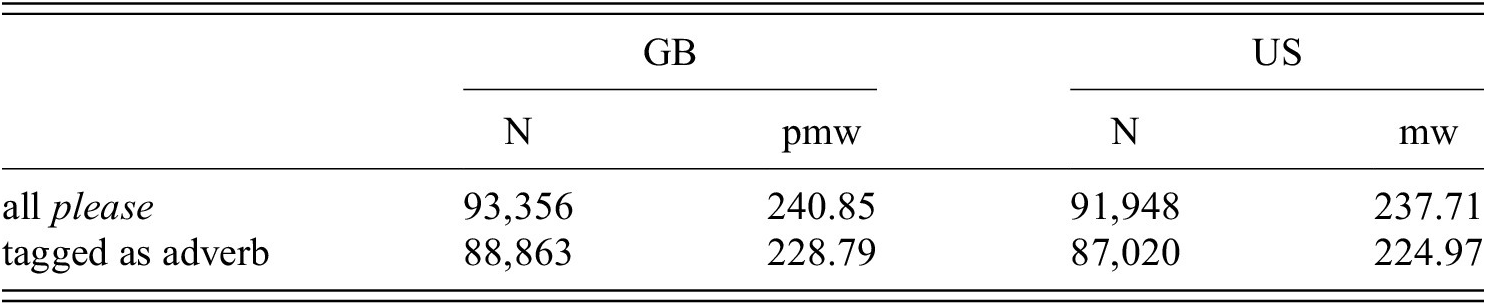
Some key characteristics of GloWbE please are immediately clear. As discussed in section 2.2, Biber et al. (Reference Biber, Johansson, Leech, Conrad and Finegan1999), Breuer & Geluykens (Reference Breuer, Geluykens, Kraft and Geluykens2007), Flöck (Reference Flöck2016) and Murphy & De Felice (Reference Murphy and De Felice2019) have all found please to be twice as frequent in British English as in American. In contrast, GloWbE shows no such imbalance; each national corpus had over 90,000 instances of please, with over 87,000 tagged as adverb. Table 1 shows the raw and relative (per million words) numbers of please tokens. The GB corpus has 1.5 percent more please than the US corpus and 2.1 percent more that are tagged as adverbs – though it must be noted that GloWbE’s part-of-speech tagging is not entirely reliable for this word.
AmE and BrE please per million words in GloWbE

One possible explanation for the GB/US similarity in GloWbE is the lexical rather than speech-act-driven nature of the methodology: the GloWbE data include any usage of please, not just those that occur in sincere directives, as was the case for many of the studies cited above. The other possibility is that the data type matters: the similarity of please distribution in GloWbE could reflect (a) the broad range of genres found in an internet corpus and (b) the public, rather than personal, nature of the interactions, as compared to spoken and email corpora.
Orthographic variants of please are also present in GloWbE: we found 284 instances across the GB and US corpora, representing 81 non-standard forms of four types: pseudo-phonetic (pleez), elongated (pleaaaaasssse), epenthetic (puh-lease) and abbreviated (pls). These represent a small proportion the ‘please’ data, and so they are set aside from the current analysis (but are discussed in Murphy & Cahill, Reference Murphy and Cahillin prep.).
4 How please is used in GB and US GloWbE
4.1 Sampling and coding
We used the search tools on English-corpora.org to generate random samples of 1,000 contexts containing please from the US and GB sections of GloWbE. (Because many verb pleases had been mis-tagged as adverbs, we did not make use of the available part-of-speech tagging.) We then took 800 items from each thousand for coding, manually removing items that:
-
• were duplicates,
-
• contained verb please,
-
• consisted of biblical, literary, or song-lyric quotations, or
-
• indicated that the writer was not a user of the target dialect (i.e. referred to their non-target nationality or contained other-variety spellings or lexical items).
As items were removed, we replenished the US and GB 800 with remaining items from the original set of 1,000.Footnote 3
Once the sample had been selected, the items were coded on multiple dimensions. For this article, the relevant dimensions are act-type, whose values are introduced in section 4.2, and grammatical type, negation and lexical verb, discussed in section 5.3. Coding was done by the author and paid student assistants trained by the author. Initially, we coded a random 10 percent of the data from each sample separately and compared outcomes, refining the definitions of the categories where they proved less reliable. From then, where a coder found the example or the category values ambiguous, she marked it for later discussion and decision. These were reviewed by the author to ensure consistent application of the codes throughout the sample. Where necessary, we sought more context at the excerpt’s original website. If that was no longer available, the item was replaced by another from the sample remainder.
4.2 Act-type categories
In a pilot project (Murphy Reference Murphy2015b), we tested a range of act-type categories, from which the current category set was developed.Footnote 4 The definitions of the twelve act-types relied partly on who benefits from the outcome of the please directive: the writer, the addressee, or no one. Table 2 describes each act-type with illustrative examples from GloWbE, as well as showing the benefactor supercategories. These are further described below.
Act-types by benefactor

The writer-benefiting category includes the prototypical directive type, the request, in which the writer directs the addressee to do something for the writer’s benefit.Footnote 5 The permission and acceptance categories reflect slightly different relationships between writer, addressee and action, but both still relate to actions that benefit the please-writer. Some of the prayer cases (including the example in table 2) can be read as facetious, in that the writer probably does not sincerely believe that a higher power can or will help them. Still, we categorized these as writer-benefiting because the writer asks for something they presumably want and because determining which prayers were sincere was beyond our means.
The addressee-benefiting categories include advice, where the writer suggests an action the addressee could take to improve their situation, and instruction, where the writer spells out steps the addressee should take to do something the addressee purportedly wants to do. The other addressee-benefiting categories involve imperatives with non-directive illocutionary force. In an offer, the writer commits their willingness to do something for or give something to the addressee, usually with an expression like feel free to or don’t hesitate to. information uses the imperative form of a mental verb (e.g. know, note, be aware) to assert the proposition that follows. Polimp (polite imperative) uses the imperative form to offer thanks, congratulations, apology (etc.). This can take the form of requesting permission (Please allow me to thank you) or requesting that the addressee receive the polite act (Please accept my thanks).
The final supercategory, ‘no benefit’, includes those items that could not be categorized as sincere or polite directives. The facetious category includes please directives that request (sometimes impossible) actions that are not sincerely expected and that neither benefit nor harm anyone. The other two no-benefactor categories, prod and dismissal, include mock-polite (Culpeper Reference Culpeper1996) uses of please, which require particular care in coding.
The prod category includes directives used in an argumentative context that appear to be confrontational rather than indicating sincere requests for things the writer can reasonably expect from the addressee. These include demands that the addressee educate themselves on a matter they have just addressed, that they employ better reasoning than they’ve just displayed, or that they do something unpleasant to themselves. Prods are very often accompanied by crude language, as in (4), sarcastic use of deferential language or other negative politeness mechanisms, as in (5) and (6), or emphatic markers, such as capitalization or repetition of please, as in (7):


The coders were instructed to mark directives as prod if ‘the writer is being rude/argumentative/trolling. The please is not an act of politeness.’ This makes it the most subjective category, both for the participants in the encounter and for us as coders. We therefore approached it conservatively, coding prod candidates as request if we thought a non-prod interpretation was reasonably available. We followed up with a survey to assess our coding (see section 4.3).
In using dismissal please, the writer takes a stance relative to an assertion that ostensibly preceded it. Dismissal please can reject the content or implication of the interlocutor’s previous turn, as in (8), or it may echo or question a previous actual or implied statement, as in (9)–(10).


Prod please is similar to dismissal please in that it is often used in rejecting the interlocutor or their argument. We distinguished prod and dismissal by whether they co-occur with an imperative form. For example, (11) seems to dismiss something in the previous comment (especially because it is preceded by Oh); however, we coded it prod because it is presented as part of the sentence that contains the imperative spare us the drama.

Analysis of these categories in the two datasets begins in section 5. But first, the following subsection presents corroborative evidence for our subjective decisions.
4.3 Corroborative survey
Notwithstanding the double-coding process described in section 4.1, determining act-types was the most subjective aspect of data-coding. Therefore, to test the act-type categories, we surveyed speakers of the target dialects. Each participant in the online survey received a randomly chosen twelve items from a bank of 78 selected from our corpus sample (39 each from the American and British datasets). They rated each item using a five-point Likert scale ranging from 1 ‘definitely polite’ to 5 ‘definitely not polite’. Figure 1 shows the instructions for using the Likert scale.
Survey instructions

The items selected for the survey overrepresent the categories that include insincere or unfulfillable directives (prod, dismissal, prayer) in order to check the reliability of our coding of these decontextualized passages. We were particularly interested in whether participants categorized our request and prod items as polite and impolite respectively, since these share the conventional surface forms of request-directives. Selection of sentences was mostly random within those categories, but we replaced some randomly chosen affirmative requests with negative ones in order to test whether telling people not to do things affected perceptions of politeness (see section 5.3.2). In the end, the final set included 55 affirmative and 23 negative examples (across all act-types), including 10 affirmative and 8 negative requests and 14 affirmative and 12 negative prods.Footnote 6 Survey participants were recruited via the author’s professional and institutional social media channels. In total 1,325 people who identified themselves as American adults and 1,293 who identified as British adults completed the survey over twenty-four days in early 2023, giving about 385 judgments per item.Footnote 7
The higher the average score, the more respondents interpreted an item as ‘definitely not polite’. The most ‘not-polite’ category was dismissal, averaging 3.84 (of a possible 5), confirming a default interpretation of impoliteness for dismissal please. This was followed by prod at 3.70.Footnote 8 The high scores for dismissal and prod contrast with all other categories, which averaged 1.80; the request category averaged 2.02. The survey results therefore support the coders’ interpretations of prod versus request.
5 Where and why please is used on British and American websites
5.1 Act-types and benefactors in the GloWbE sample
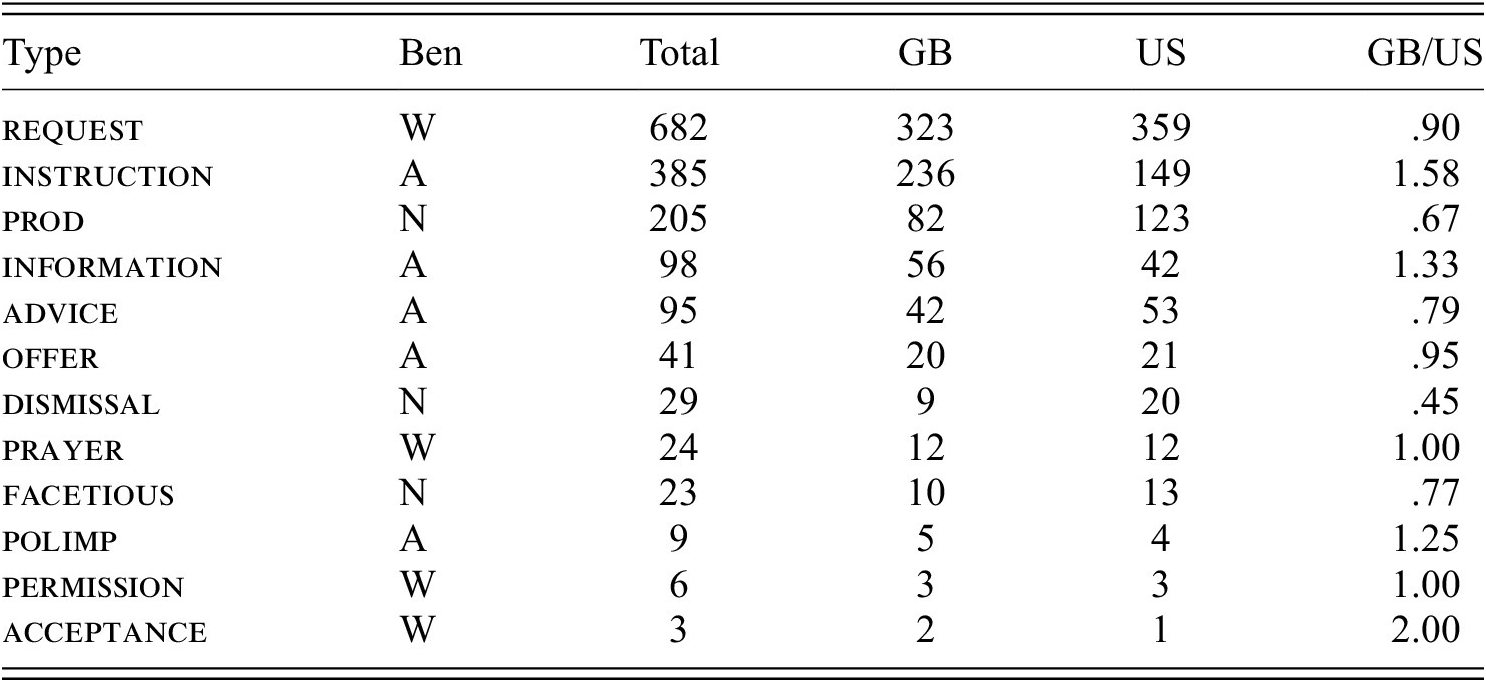
What are writers in GloWbE doing when they use please? Table 3 shows the numbers of each act-type in each sample, indicating in the second column which benefactor supercategory each belongs to: W(riter), A(ddressee), or N(one). The final column divides the GB count by the US count to give an initial sense of how much each type varies in the sample (above 1 skews British, below 1 skews American).
Prevalence of act-types for the British and American please tokens

The top three act-types in table 3 dominate the three benefactor supercategories, while those at the bottom are too small on their own to draw many conclusions from. Figure 2 recasts the numbers for the top three categories as percentages of the 800 items in each variety’s dataset.
Top-ranking act-types in GloWbE sample

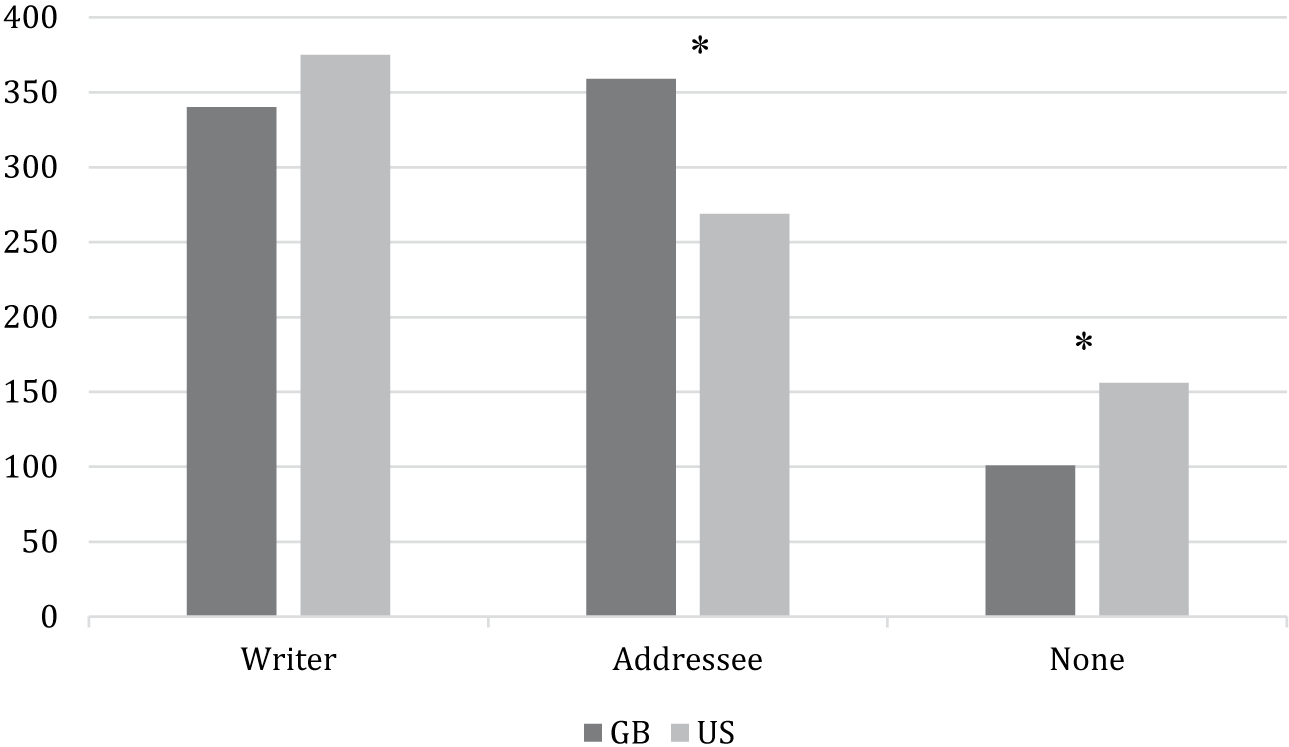
Figure 3 collapses the act-types into benefactor supercategories. A Pearson Chi-square test showed that the relation between these categories was significant (X2 (2, N = 1600) = 26.672, p = <.001). The standard residual of X2 showed that the addressee-benefactor and no-benefactor categories contributed most to the difference (mirroring each other with scores of -2.5 and 2.5, respectively). These are therefore marked * in the figure.
Prevalence of act-types for the British and American please tokens

5.2 Imposition and please in transatlantic context
We did not code for the level of imposition or inherent face-risk in each please directive – to do so would have introduced much more subjectivity into the coding scheme. We also did not account for issues like power differential and social distance because the information was unavailable. (Most web interaction involves people unknown to one another, and so power differential would be difficult to judge in any case.) But as a rough-grained approach, the categories themselves can be graded for their face-risk potential, as in table 4.
The ‘potentially high-stakes’ categories may threaten positive face, negative face, or both. Asking someone to do something they were not already doing (request, advice) is a threat to their negative face – and potentially their positive face, if the directive implicitly criticizes the addressee for not having acted already. Others are explicitly intended to damage face (prod, dismissal). The potentially low-stakes categories may:
-
• ask the reader to do something they wanted or were expecting to do anyhow (instruction, acceptance, offer),
-
• use imperative forms to achieve non-directive (and not impolite) aims (polimp, information),
-
• ask for very little (e.g. permission Footnote 9),
-
• not expect the reader to act on the directive (prayer, facetious Footnote 10).
Classification of act categories by face-risk potential

That approximation of face-risk potential aligns with the statistically ‘more British’ and ‘more American’ please act-types. The statistical difference between the British and American datasets is significant overall for the high versus low risk-potential categories: X2(2, N=1600) = 27.911, p <.001. Table 5 orders the act-types by standardized residuals of the Chi-square test. This measure indicates the strength of the category’s contribution to the result. (Standardized residuals ≥2 indicate categories that are more than two standard deviations from the mean.) For the purposes of these statistics, the very small low-risk-potential categories (permission, acceptance and polimp) are combined.
Prevalence of act-types for the British and American please tokens

The high-risk-potential categories skew American (in keeping with the findings of Murphy & De Felice Reference Murphy and De Felice2019). The differentiation of risk categories might indicate why advice was the exception to the generalization that addressee-benefiting categories skew British (table 3): advice-giving is not the kind of routine, no-risk context typical of most addressee-benefiting categories.
5.3 Formal contexts of please
This section examines the clauses that accompany please (or not) in terms of their grammatical form (section 5.3.1) and negativity and other markers of ‘prohibition’ (section 5.3.2) and whether these interact with nationality or act-type.
5.3.1 Clause types
The grammatical contexts of GloWbE please contrast sharply with please directives in Murphy & De Felice’s email study (2019). There please occurred exclusively in imperatives and interrogatives, although the 1,350 email requests in that study also included declaratives, conditional statements and sentence fragments. In contrast, the GloWbE data has please in a broader range of grammatical contexts, exemplified in table 6 and compared (with some collapse of similar categories) in table 7.Footnote 11 While the GloWbE sample shows more variety in grammatical type, it has more homogeneity in grammatical tokens. Around 88 percent of GloWbE please occurs in imperatives, and only about 6 percent in questions – unlike in email where more than a third appeared in questions.
Grammatical types

Percentage of grammatical contexts for please: GloWbE versus email

Though each study concerns asynchronous, written, computer-mediated communication, the text-type effects are remarkable – and explainable. The email corpora contain messages from individuals to other individuals with whom they had an existing relationship or hope of a future one. Please is thus used in asking acquaintances to do something and expecting they will probably do it; not doing the action would have interpersonal and/or professional repercussions. The mitigating effect of the interrogative form is therefore useful. Could you please come to my office? is more natural and gentler than the imperative Please come to my office – a message that might sound threatening if it came from your boss or presumptuous if it came from your assistant. But on a website, the author is often an organization or an anonymized individual and the addressee is often an unknown public, often without means to respond verbally. For that reason, Please click here is more appropriate on websites than Could you please click here?
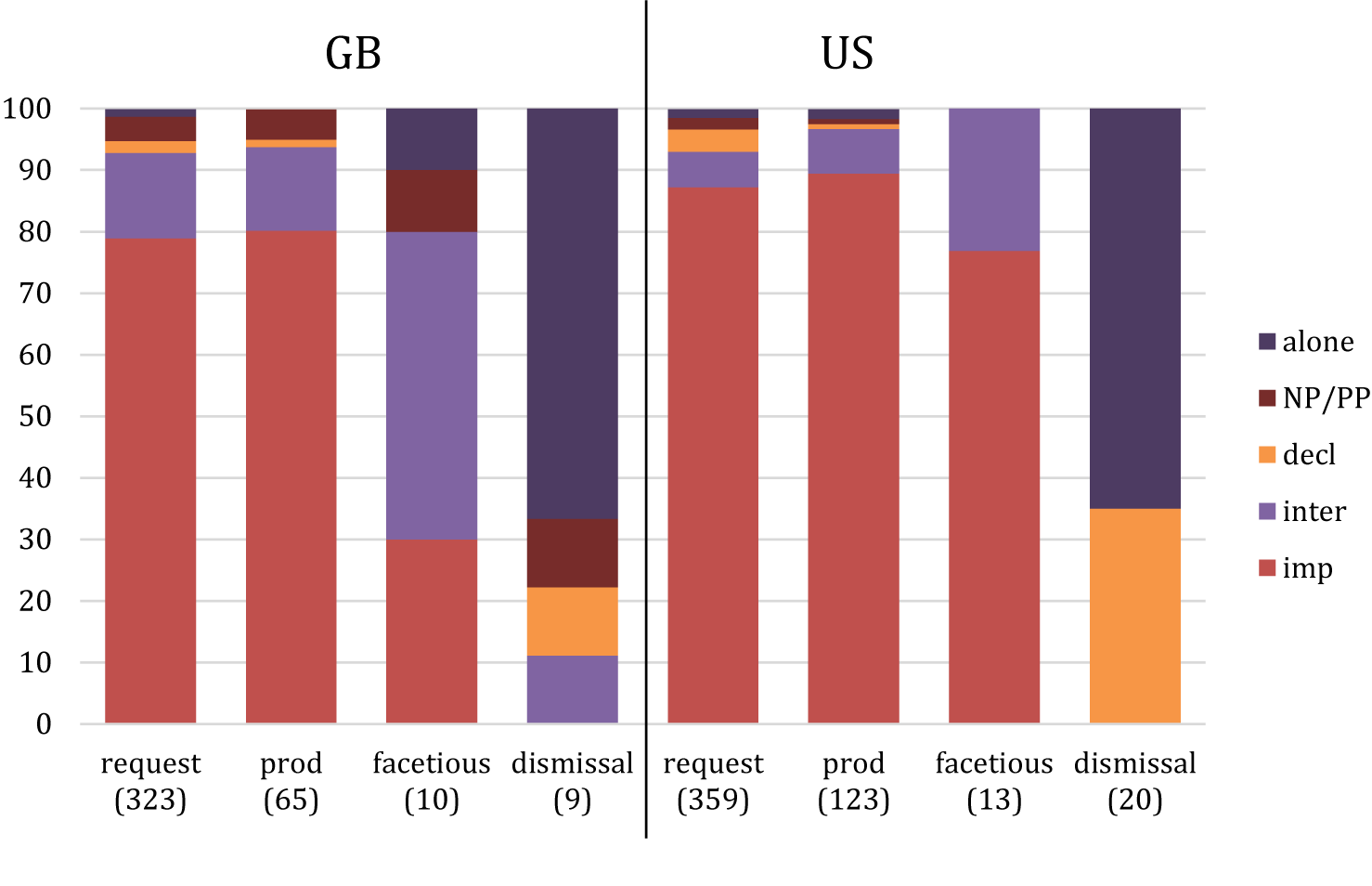
Figure 4 shows how grammatical form relates to some act-types. It omits the smallest categories (permission, acceptance, polimp, prayer), as well as those that were found only or almost only (99 percent) in imperative form (advice, instruction, offer, information). The GB corpus has more interrogatives in all act-type categories than the US corpus does. This aligns with Murphy & De Felice’s (Reference Murphy and De Felice2019) observation that BrE uses please in modal questions at much higher rates than AmE does, with greater formulaicness.
Proportion of please clause type by act-type

Of particular interest in figure 4 are request and prod acts and whether grammatical context could help distinguish them. The answer, for this data, is ‘no’. request and prod occur in imperative and non-imperative forms at similar rates within each national variety. This supports the view that prod is a mock-polite version of request, with speakers of each variety accurately echoing sincere requests in their sarcastic ones.
The dismissal category stands apart by design: non-imperative status differentiated dismissal from prod (section 4.2). In both samples, dismissal please most often stands alone: separated (by period, exclamation mark, or turn break) from the sentence it dismisses and/or the writer’s explanation of their dismissiveness. Leech (Reference Leech2014: 162) notes that the use of stand-alone please ‘can be an insistent reinforcement of the directive’. In the GloWbE samples, stand-alone please is hardly used in directives at all.
5.3.2 Prohibition with British and American please
A request to not do something might feel more face-threatening than a request to do something, in that a request like Don’t do that or Stop doing that may presuppose that the addressee is already committing some disapproved-of act. In the Spoken BNC2014, Islentyeva et al. (Reference Islentyeva, Pesendorfer and Tolochin2023) found that please frequently co-occurred with don’t when it was used to express sincere urgency or ironic irritation. In the spoken ICE-GB corpus, Wichmann (Reference Wichmann2004) found proportionally more negated commands in the private sphere, where social distance and power differences were smaller, indicating that negated directives might be riskier to perform. Since AmE please seems to align with riskier situations, it makes sense to ask whether ‘prohibiting’ directives differ transatlantically.
To investigate this, we noted any cases where the please-modified action was negated, as in (12), and any directives where the lexical verb had an inherent sense of ‘stop’ or ‘avoid’, as in (13). Collectively the contexts containing negation or lexical-prohibition verbs can be called prohibitions.


Table 8 shows the total numbers of ostensibly ‘prohibitive’ directives in each corpus. While the US has a higher proportion of negated contexts, the relationship between corpus and prohibition is not significant on a Chi-square test (p=.189). The table also shows proportions of prohibition in the benefactor-type and risk-potential supercategories and the three most frequent act-types.
Percentages of please with prohibitive directives

In both corpora, prohibition is more common in high-risk categories and no-benefactor categories. Among the act-types, prod is most often prohibitive, and so the US sample’s overall greater proportion of prohibitions can be attributed to its greater proportion of prod contexts. Prohibition may have been a factor in the coders labeling the act as prod, though it’s worth noting that negated prods and requests were not judged as less ‘polite’ than non-negated in the corroborative survey (section 4.3).
6 Discussion and conclusions
Our knowledge about interactional words like please is only as rich as the range of contexts in which we examine them. The GloWbE corpus allows for new observations on transatlantic please use. Previous studies have tended to report that BrE directives include please twice as often as AmE ones do (section 2.2). This might have predicted that GloWbE GB would have more non-verb instances of please than GloWbE US, but instead we found similar numbers of please in the two varieties (table 1). In samples of these corpora, the prototypical directive type, the speaker/writer-benefiting request, accounted for 44.9 percent of US please usage versus 40.4 percent in the GB sample (figure 2), indicating that the primary use of please in both varieties is as a request mitigator.
We furthermore saw that on the web, please is primarily used with imperative forms (figure 4), in all act-types except dismissal, which is non-imperative by definition. While imperatives attract please, not all imperatives express prototypically negative-face-threatening requests, and such non-prototypical imperatives are where we find the greatest AmE/BrE differences. The story they tell falls in line with, and expands on, suggestions in our email study (Murphy & De Felice Reference Murphy and De Felice2019).
6.1 Politic please
In Murphy & De Felice’s email study (2019), please was nearly mandatory in BrE imperatives, and half as common in AmE imperatives. Much of the difference could be found in ‘low- or no-imposition’ speech acts, which included the addressee-benefiting act-types from the present study: instruction, information, polimp (please accept my thanks) and offer, which includes extensions of permission (please feel free to ask). This multiplicity of functions of please-imperatives contradicts Fraser’s claim that ‘[w]hen please occurs before an imperative structure, it signals that the speaker intends the utterance to be taken as a request, and only a request’ (Reference Fraser1996: 174) as well as Stubbs’ claim that please ‘cannot co-occur with statements, promises, offers, invitations, threats, and so on’ (Reference Stubbs1983:72).
For instance, in the relevant contexts, it is natural to interpret the imperative in (14) as an act of informing, in (15) as an act of congratulating and in (16) as an invitation (in our coding, an offer):


Please is only appropriate in these contexts because of the use of the imperative form (cf. #These guides are subject to change, please). The present lexical study did not examine please-less forms, and it’s important to keep in mind that the greater presence of please in such contexts in one culture does not entail more please-less imperative alternatives in the other. For example, Murphy & De Felice (Reference Murphy and De Felice2019) found Please find attached twenty times in their BrE email corpus, but only twice in the AmE corpus. The equivalent please-less imperative (Find attached) was not found at all, and non-imperative alternatives (such as I’ve attached the report) are available.Footnote 13
That said, the second largest category of please in the GloWbE samples was the instruction act-type, which is directive in nature and therefore commonly expressed in imperative form. This act-type accounts for most of the difference between GB and US in the potentially-low-stakes and the addressee-benefiting supercategories. The greater rate of BrE instruction please on the internet echoes Baker’s finding of increased use of please in published written instructions in BrE since the late twentieth century (2017: 233).Footnote 14 Table 9 shows the please+verb combinations that account for 5 percent or more of the instruction examples in the GloWbE samples. This repetitive, politic use of please in particular website contexts might be considered a type of ritual-frame-indicating expression (Kádár & House Reference Kádár and House2020).
Twograms accounting for at least 5 percent of instruction contexts

Overall, the greater GB proportion of please use in addressee-benefiting categories like instruction and information is consonant with past work (section 2.2) characterizing please in BrE as marking ‘routine’ requests with little need for face-work.
6.2 Confrontational please
Studying please in a web corpus gives insights into its insincere and impolite uses, which are understandably missed in the speech-act literature. Like any ‘polite’ expression, please can be used ironically to communicate something other than politeness. Aijmer (Reference Aijmer2015), for example, finds ample use of impolite and mock-polite please in the COLT corpus of London teenage speech, where it is used for rapport-building and to distinguish teen communicative styles from adult styles. The world-wide web, however, offers a context of less-direct interaction, where writers interact with people they don’t know in person (and perhaps cannot identify). The paralinguistic and contextual cues are more limited, and the writers may have anonymity. Thus insincere uses of please in GloWbE are often used to denigrate others rather than to build rapport, although playful insincerity is also found. These uses can be considered mock-polite: ‘the use of politeness strategies that are obviously insincere’ (Culpeper Reference Culpeper1996: 356) ‘leading to an implicature of impoliteness’ (Taylor Reference Taylor2016: 3). Fedriani (Reference Fedriani2019) reports very similar use of per favore in an Italian web corpus – though with much higher rates of dismissive and impolite usage than found for English please here.
The argumentative prod usage was the third-largest category overall in both samples but occurred one-third more in the US sample. The other mock-polite use of please is dismissal, in which please expresses ‘incredulity or exasperation’ (OED).Footnote 15 This act-type is formally distinguishable from other uses of please, in that it accompanies or reacts to non-imperative utterances and is often prefaced by oh (and in AmE, following African American English, also child cf. (9) above).Footnote 16 This act-type is therefore the least ambiguous. Examples of it were found in both samples and were assessed as most ‘definitely not polite’ by survey respondents of both countries (see section 4.3). For this act-type, the US sample has more than double the instances of the GB (table 3). Studying the characteristics of blog writing, Myers (Reference Myers2010) found that adverbs, especially in sentence-initial position, ‘can signal a contrastive relation to previous comments’ (p. 270), that conversational particles ‘can be used to enact disagreement’ (p. 271) and that ironic quotation was often used to undermine opposing positions (p. 273). Dismissal please, as a conversational particle derived from an adverb that often precedes ironic quotation, is thus a ‘triple threat’ in marking online disagreement.
These numbers indicate that Americans are more likely than Britons to encounter please in argumentative contexts, at least on the web.Footnote 17 The greater rate of mock please usage in the US sample seems in line with please marking greater face-threats in AmE than in BrE. As discussed in section 2.2, American sincere ‘polite’ use of please seems more at home with greater power differentials, formality (writing rather than speech), or greater imposition. Using please to ‘prod’ or ‘dismiss’ an interlocutor involves assuming an authoritative stance in performing a highly face-threatening act. Mock usage of please, then, seems to echo sincere AmE polite usage in implying a power differential.
6.3 Summary and conclusions
While please occurs most in high-risk-potential contexts in both datasets, the gap between high and low is greater in the US sample: about 58 percent high in GB and 70 percent in US. Although Murphy & De Felice’s study (Reference Murphy2019) categorizes please uses differently, the finding is the same: using please in low-risk contexts is more characteristically British than American.
In contrast, previous studies of American requests, particularly those that have considered power relations or request compliance, have found that please may be more apt in AmE where the interaction is riskier. American please seems less bleached of its ability to address face wants, and therefore the US corpus has greater proportions of please in those categories where the writer intends to affect face: in the mitigation of true face threats in requests and advice and in attacks on face in prods and dismissals.
Despite the observed differences, the potential for transatlantic miscommunication involving please is slight; the differences lie in the relative proportions rather than the types of acts involving please. British and American survey participants agreed on which please contexts were polite or not-polite (section 4.3) and dominant uses of please (request, instruction, prod) were the same.
Still, it is not uncommon to find complaints (or simply puzzled observations) from non-Americans that ‘Americans don’t say please’ – which is to say, Americans don’t say please in contexts where it is conventional in other varieties of English.Footnote 18 Meanwhile, American observations that ‘please no longer feels like a polite word’ seem to be on the rise. For instance, American cultural critic Walker Mimms (Reference Mimms2023) wonders ‘How please stopped being polite’: ‘The word can brilliantly convey anger, irony, passive aggression, condescension, formality, or desperation – all without a hint of true politeness.’ (See also Trawick-Smith Reference Trawick-Smith2012.) The observations of please in this study of GloWbE confirm that there is something in those lay (first-order politeness) beliefs about please and politeness.








 Open access

