





Flexible, context-sensitive self-regulation is widely considered to be a capacity at the core of healthy human development (McClelland et al., Reference McClelland, Geldhof, Cameron and Wanless2015). Three decades ago, Cicchetti and colleagues argued that self-regulation skills across different domains–not just behavioral and emotional regulation skills, but also cognitive and interpersonal – are important aspects of social competence in school-age children (Cicchetti, Reference Cicchetti and R. A.1990; Shields et al., Reference Shields, Cicchetti and Ryan1994). Despite these long-standing integrative perspectives on child development and self-regulation by Cicchetti and other like-minded developmental psychologists (e.g., Cicchetti, Reference Cicchetti and R. A.1990; Shields et al., Reference Shields, Cicchetti and Ryan1994, Sroufe, Reference Sroufe2013), research on patterns and interrelationships of self-regulation skills across different domains and how they contribute together to the child’s holistic development has remained scant, barring a more comprehensive understanding of child development. In recognition of this persistent gap, Alan Sroufe (Reference Sroufe2013), one of Dante Cicchetti’s most important mentors, posed two challenges for the field to address in an essay on the future of the field of developmental psychopathology: (a) to fully understand the development of self-regulation over childhood and adolescence and (b) to evolve a lexicon of variation in patterns of self-regulation with regard to their manifestation at each age. In today’s world, a fuller understanding of the development of self-regulation requires rigorous comparative cross-cultural research on self-regulation in non-WEIRD (western, educated, industrialized, rich, democratic) contexts, especially in very low-income and conflict-affected countries. As Cicchetti and colleagues have frequently and persuasively argued, it also requires an analysis of the complex patterning (or “organization”) of self-regulatory processes across the various domains and stages of development: cognitive, emotional, behavioral, and interpersonal (Cicchetti et al., Reference Cicchetti, Ganiban and Barnett1991; Cicchetti, Reference Cicchetti and R. A.1990; Shields et al., Reference Shields, Cicchetti and Ryan1994).
Over the last decade, progress has been made on the first task; we understand more about how self-regulation within specific domains develop, notably cognitive, emotional, behavioral, and interpersonal regulation. For instance, we now know with confidence that specific aspects of self-regulation develop throughout childhood, that they are predictive of future adaptation in school and life (McClelland et al., Reference McClelland, Geldhof, Cameron and Wanless2015), and that they also are malleable and responsive to interventions (Pandey et al., Reference Pandey, Hale, Das, Goddings, Blakemore and Viner2018). But despite Cicchetti’s leadership in articulating organizational and integrative perspectives on development (Cicchetti, Reference Cicchetti and R. A.1990; Shields et al., Reference Shields, Cicchetti and Ryan1994), less progress has been made on evolving a lexicon of variations in organized patterns of self-regulation across key developmental domains. Similarly, the emotional well-being of children is also at the core of their healthy development. It is mostly studied as a mental health outcome and is often omitted in the understanding of the development of self-regulation, despite its clear relevance to children’s ability to modulate/regulate cognition, emotion, and behaviors (Ellis & Moore, Reference Ellis, Moore, Dalgleish and Power1999; Eysenck & Calvo, Reference Eysenck and Calvo1992).
To date, most of the research on children’s self-regulation has been conducted in stable, high- and middle-income countries, especially the U.S. (But see e.g., Chen et al., Reference Chen, Panter-Brick, Hadfield, Dajani, Hamoudi and Sheridan2019; Kim et al., Reference Kim, Brown, Tubbs Dolan, Sheridan and Aber2020; Scharpf et al., Reference Scharpf, Mueller and Hecker2022 for research conducted in non-WEIRD contexts). It has also adopted a variable-centered (nomothetic) approach to the conceptualization and operationalization of self-regulation (but see e.g., Denham et al., Reference Denham, Bassett, Mincic, Kalb, Way, Wyatt and Segal2012; Granziera et al., Reference Granziera, Collie, Martin and Nassar2023). In this descriptive and hypothesis-generating study, we address these current limitations to the literature: by investigating self-regulatory processes and emotional well-being among school-age children whose families have fled Syria due to extended civil conflict and now live as refugees in northern and eastern Lebanon; and by adopting a person-centered (idiographic) and organizational approach to describing within-sample differences in the organization (or patterning) of self-regulation skills and emotional well-being and their contextual and experiential correlates.
In the remainder of this introduction, we will (a) introduce several issues in the conceptualization and manifestation of self-regulation and emotional well-being that are of particular relevance to this study, (b) discuss the value of adopting a person-centered approach to understanding profiles of self-regulation and emotional well-being, (c) selectively review the literature on self-regulation and emotional well-being in children affected by armed conflict and protracted crises and (d) discuss child characteristics and experiences (risk factors) that could be associated with children’s patterns of self-regulation and emotional well-being.
Conceptualizing and measuring self-regulation and emotional well-being
In our view, self-regulation should not be conceived of as a single psychological “trait,” defined as a unidimensional characteristic that remains stable across time and context. Rather, we adopt a “dynamic adaptive developmental systems” conceptualization of self-regulation similar to Cicchetti (Reference Cicchetti and R. A.1990)’s and Sroufe (Reference Sroufe2013)’s organizational approach and Mischel and colleagues’ cognitive affective processing systems approach (Mischel & Ayduk, Reference Mischel and Ayduk2011; Mischel & Shoda, Reference Mischel and Shoda1995). In these complementary approaches, self-regulation is conceived as a complex, multi-componential phenomenon that requires the active coordination of a diverse set of specific self-regulatory skills in response to children’s environments. The specific self-regulation skills on which we focus in this study include those from the cognitive, behavioral, interpersonal, and emotional subdomains of psychological development. In contrast, emotional well-being (e.g., positive and negative affect) is conceived as a relatively more stable (trait-like) phenomenon (Watson & Walker, Reference Watson and Walker1996). We identified and chose these domains and subdomains of functioning both guided by current theory and by research on self-regulation and emotional well-being (Koch et al., Reference Koch, Ehring and Liedl2020; Nickerson et al., Reference Nickerson, Bryant, Schnyder, Schick, Mueller and Morina2015) within the available data collected for an evaluation of a comprehensive SEL intervention, designed and implemented by an international NGO to improve Syrian refugee children’s academic and social-emotional learning (Kim et al., Reference Kim, Brown, Tubbs Dolan, Gjicali, Deitz, Prieto Bayona and Aber2023).
Modeling the co-manifestation of self-regulation and emotional well-being: taking a person-centered (idiographic) approach
Complementing variable-centered (nomothetic) approaches that we used in the impact evaluation of 5-Component SEL on specific regulatory skills and emotional well-being (Kim et al., Reference Kim, Brown, Tubbs Dolan, Gjicali, Deitz, Prieto Bayona and Aber2023), we wished to investigate whether and how Syrian refugee children in Lebanese schools may differ in patterns of self-regulation and emotional well-being. As argued by Mischel (Reference Mischel2004), as well as by Sroufe (Reference Sroufe2013) and Cicchetti and colleagues (Cicchetti et al., Reference Cicchetti, Ganiban and Barnett1991; Cicchetti, Reference Cicchetti and R. A.1990; Shields et al., Reference Shields, Cicchetti and Ryan1994), individual differences in cognitive-affective-behavioral processing arise from distinct ways that the person processes and understands situations, reflecting the person’s psychosocial and biological histories. In turn, these patterns of processing characterize each individual in the form of stable, distinctive profiles of variability in patterns of functioning, signifying that the individual behaviors are expressions of underlying, more fundamental, characteristics and dispositions of the individual interacting with the environment.
Recent efforts to examine profiles of variability in self-regulation and emotional well-being have yielded a small number of Classes or Profiles: for example, underregulated/regulated/overregulated relationships (Sameroff & Emde, Reference Sameroff and Emde1989) or SEL Risk/SEL Competent-Expressive/SEL Competent-Restrained children (Denham et al., Reference Denham, Bassett, Mincic, Kalb, Way, Wyatt and Segal2012) and patterns of positive and negative affect (Robertson et al., Reference Robertson, Zarit, Duncan, Rovine and Femia2007). We suspect that the relatively small number of profiles identified in most of these earlier studies is due to the relatively small number of domains assessed, the relatively small sample size, and/or conducting the studies in Western, Educated, Industrial, Rich, Democratic (WEIRD), and stable countries. In this study we ask the question, are there different homogeneous groups underlying the apparent heterogeneity of the sample? Thus, we propose to use latent profile analysis (LPA) to contribute to the development of distinct patterns across the domains of self-regulation skills and emotional well-being among the Syrian refugee children who participated in the study.
Self-regulation and emotional well-being in children affected by armed conflicts and protracted crises
Decades of extensive research on executive function, primarily conducted in WEIRD, stable contexts, has established that self-regulatory skills across various domains and contexts are strong predictors of academic, mental health, and other life outcomes (Aldao et al., Reference Aldao, Nolen-Hoeksema and Schweizer2010; Goldsmith et al., Reference Goldsmith, Chesney, Heath and Barlow2013; McClelland et al., Reference McClelland, Cameron, Connor, Farris, Jewkes and Morrison2007; Seligowski et al., Reference Seligowski, Lee, Bardeen and Orcutt2015; Spiegel et al., Reference Spiegel, Goodrich, Morris, Osborne and Lonigan2021; Wray et al., Reference Wray, Kowalski, Mpondo, Ochaeta, Belleza, DiGirolamo, Waford, Richter, Lee, Scerif, Stein, Stein and COHORTSBlanch2020). However, such evidence remains scarce for children in underrepresented populations affected by armed conflicts and protracted crises, despite rapidly increasing research in non-WEIRD contexts (Kim et al., Reference Kim, Deitz, Aber, Durlak, Domitrovich and Mahoney2024). In addition, the existing literature on self-regulation and social and emotional skills exists largely separate from the body of literature on mental health and emotional well-being among the crisis-affected population, due to diverging discipline-specific research foci and to intervention approaches governed by different government ministries or humanitarian “sectors,” e.g., health vs. education (Kim et al., Reference Kim, Brown, Tubbs Dolan, Sheridan and Aber2020; Kim et al., Reference Kim, Deitz, Aber, Durlak, Domitrovich and Mahoney2024)
Emerging research with conflict-affected populations from non-WEIRD contexts does seem to be aligned with the existing evidence of the benefits of self-regulation in the WEIRD contexts. Specifically, cognitive regulation (i.e., executive function) skills were found to be predictive of later academic skills among Syrian refugee children in Lebanon (Kim et al., Reference Kim, Brown, Tubbs Dolan, Sheridan and Aber2020); and Boko Haram-affected children in Niger (Kim et al., Reference Kim, Wu and Aberin preparation). Similar findings of associations between EF and later academic outcomes have been reported in studies conducted in relatively stable, low- and middle-income countries, including Kenya (Willoughby et al., Reference Willoughby, Piper, Oyanga and King2019), Ghana (Suntheimer et al., Reference Suntheimer, Wolf, Sulik, Avornyo and Obradović2022; Wolf & McCoy, Reference Wolf and McCoy2019), and Côte d’Ivoire (Finch et al., Reference Finch, Wolf and Lichand2022). Children affected by conflict and violence generally have greater difficulty developing executive function, as shown in studies with children affected by political violence in Palestine (Buckner & Kim, Reference Buckner and Kim2012), Nigerian refugee children compared to Nigerien local children in Niger (Kim et al., under advanced review) and refugee children compared to local children in Switzerland (Franck & Delage, Reference Franck and Delage2022). However, some studies show no difference in cognitive regulation between refugees and non-refugee populations as in a study with Syrian refugee and local Jordanian children (Chen et al., Reference Chen, Panter-Brick, Hadfield, Dajani, Hamoudi and Sheridan2019).
Emotional and behavioral regulation also seems to play a significant role in conflict-affected children’s outcomes. Evidence suggests that emotion regulation difficulties may contribute to psychopathology in refugee populations, including PTSD, depression, anxiety, and social impairment (Koch et al., Reference Koch, Ehring and Liedl2020) and mediate the relationship between refugee experiences (trauma exposure, post-migration living difficulties) and psychological outcomes (PTSD, depression, anger) (Nickerson et al., Reference Nickerson, Bryant, Schnyder, Schick, Mueller and Morina2015). In addition, conflict-affected children’s behavioral regulation skills are associated with academic outcomes (Kim et al., Reference Kim, Brown, Tubbs Dolan, Sheridan and Aber2020; Kim et al., Reference Kim, Wu and Aberin preparation; Willoughby et al., Reference Willoughby, Piper, Oyanga and King2019). Exposure to war and trauma is generally associated with increased aggression, antisocial behavior, behavioral problems, and emotion dysregulation, indicating potential difficulties regulating emotions and behaviors among conflict-affected populations (Keresteš, Reference Keresteš2006; Khamis, Reference Khamis2019; Qouta et al., Reference Qouta, Punamäki, Miller and El-Sarraj2008). There is also some evidence that different types of war-related experiences are differentially related to different forms of psychopathology, e.g., witnessing violence with externalizing problems and experiencing loss of family members with internalizing problems (Macksoud & Aber, Reference Macksoud and Aber1996).
The interpersonal dimension of self-regulation among conflict-affected children has been of particular interest in the clinical literature. A robust body of evidence suggests that exposure to political conflict and violence is consistently associated with interpersonal aggression and antisocial behavior, while predicting reduced levels of prosocial behavior and interpersonal trust (Boxer et al., Reference Boxer, Huesmann, Dubow, Landau, Gvirsman, Shikaki and Ginges2013; Cummings et al., Reference Cummings, Merrilees, Schermerhorn, Goeke-Morey, Shirlow and Cairns2010a, Reference Cummings, Schermerhorn, Merrilees, Goeke-Morey, Shirlow and Cairns2010b; Dubow et al., Reference Dubow, Boxer, Huesmann, Shikaki, Landau, Gvirsman and Ginges2009; Dubow et al., Reference Dubow, Huesmann, Boxer, Smith, Landau, Dvir Gvirsman and Shikaki2019; Qouta et al., Reference Qouta, Punamäki, Miller and El-Sarraj2008; Song et al., Reference Song, Song and Malti2023). However, emerging evidence suggests developmental differences in social development, with unique prosocial behavior patterns and motivations due to their unique conflict-related experiences (Macksoud & Aber, Reference Macksoud and Aber1996; Malti et al., Reference Malti, Galarneau, Zhang, Myatt and Yavuz2021) and experiences of violence, in some circumstances, may promote inter-group cooperation and empathy (Hartman & Morse, Reference Hartman and Morse2020).
The stress and resulting emotional toll of fleeing violence while navigating new and foreign daily challenges can be overwhelming for child refugees affecting their mental health and emotional well-being (Reed et al., Reference Reed, Fazel, Jones, Panter-Brick and Stein2012). While the mental health difficulties among many Syrian refugee children are well-documented, the degree and the patterns of which they experience mental health challenges vary greatly (Eruyar et al., Reference Eruyar, Maltby and Vostanis2018; Sirin & Roger-Sirin, Reference Sirin and Rogers-Sirin2015). Related concentration problems, ruminating thoughts, and decreased self-efficacy may interfere with cognitive regulation functions, such as attention and working memory (Ellis & Moore, Reference Ellis, Moore, Dalgleish and Power1999; Eysenck & Calvo, Reference Eysenck and Calvo1992), as well as emotional and behavioral dysregulation (Khamis, Reference Khamis2019). Given the prevalence of the challenges to emotional well-being among Syrian refugee children, and the emerging evidence that their emotional state may interfere with or support self-regulation functions (Ellis & Moore, Reference Ellis, Moore, Dalgleish and Power1999; Eysenck & Calvo, Reference Eysenck and Calvo1992; Khamis, Reference Khamis2019), understanding how emotional tendencies and states among refugee children co-manifest with various domains of self-regulation may be valuable to inform intervention design to holistically support refugee children’s well-being and development.
Child characteristics and experiences that may help explain variability in patterns of self-regulation and emotional well-being
Child development and adaptation in any setting are deeply shaped by and interact with their personal and demographic characteristics as well as characteristics of their surroundings and life experiences. For refugee children, many of whom have experienced severe adversity and interruptions to their normative developmental circumstances, these characteristics and life experiences may be even more salient in how their development of self-regulation competencies manifests, and responds and adapts to varying and changing demands. Therefore, identifying salient demographic and experiential factors associated with patterns of self-regulation and emotional well-being is helpful to better understand patterns of variability of self-regulation and emotional well-being of refugee children as well as to inform the design and implementation of interventions to support these children’s well-being and development.
In addition to demographic characteristics such as age and gender, a host of pre-, peri-, and post-settlement risk and protective factors unique to or more salient to the refugee population have been explored in relation to refugee children’s self-regulation development (Kim et al., Reference Kim, Brown, Tubbs Dolan, Sheridan and Aber2020, Reference Kim, Brown, Tubbs Dolan, Gjicali, Deitz, Prieto Bayona and Aber2023; Reed et al., Reference Reed, Fazel, Jones, Panter-Brick and Stein2012). Specifically, exposure to violence and conflict across contexts, including exposure to war and political violence, family conflict, and school victimization, has been shown to predict children’s self-regulation and emotional well-being (Çelik & İçduygu, Reference Çelik and İçduygu2019; Arakelyan & Ager, Reference Arakelyan and Ager2021; Boxer et al., Reference Boxer, Huesmann, Dubow, Landau, Gvirsman, Shikaki and Ginges2013; Choummanivong et al., Reference Choummanivong, Poole and Cooper2014; Dubow et al., Reference Dubow, Boxer, Huesmann, Shikaki, Landau, Gvirsman and Ginges2009; Keresteš, Reference Keresteš2006; Khamis, Reference Khamis2019; Macksoud & Aber, Reference Macksoud and Aber1996; Qouta et al., Reference Qouta, Punamäki, Miller and El-Sarraj2008; Shuayb et al., Reference Shuayb, Makkouk and Tuttunji2014). These experiences may have additive effects on children’s overall self-regulation and well-being. But how exposure to violence and conflict in different contexts is associated with self-regulation and emotional well-being varies depending on specific outcomes and domains of interest (Dubow et al., Reference Dubow, Boxer, Huesmann, Shikaki, Landau, Gvirsman and Ginges2009; Kim et al., Reference Kim, Brown, Tubbs Dolan, Gjicali, Deitz, Prieto Bayona and Aber2023), and as a result, may contribute to unique patterns of self-regulatory functioning and development across domains among conflict-affected child population.
Beyond exposure to war-related violence and conflict, the daily stressors that refugee children experience in schools and learning environments as well as at home and community are salient factors shaping their self-regulation development and well-being (Chen et al., Reference Chen, Panter-Brick, Hadfield, Dajani, Hamoudi and Sheridan2019; Kim et al., Reference Kim, Brown, Tubbs Dolan, Sheridan and Aber2020; Reed et al., Reference Reed, Fazel, Jones, Panter-Brick and Stein2012). In schools, Syrian refugee children often experience bullying and victimization from Lebanese teachers and children. They also receive limited support for their various academic and social-emotional needs, partly originating from interrupted schooling and displacement due to forced migration, as well as fragmented and inconsistent policies for enrollment and grade-level placement (Kim et al., Reference Kim, Brown, Tubbs Dolan, Sheridan and Aber2020; Shuayb et al., Reference Shuayb, Makkouk and Tuttunji2014). At home and in their settlement communities, their individual, household, and community factors, such as health and disability, engaging in child labor, length of displacement, poverty and livelihoods, living conditions, and residential mobility define proximal social and material conditions of daily refugee life. These risk factors have been shown to uniquely predict children’s self-regulation skills and emotional well-being across various domains above and beyond direct exposure to violence (Chen et al., Reference Chen, Panter-Brick, Hadfield, Dajani, Hamoudi and Sheridan2019; Kim et al., Reference Kim, Brown, Tubbs Dolan, Gjicali, Deitz, Prieto Bayona and Aber2023; Miller & Rasmussen, Reference Miller and Rasmussen2010).
Current study
Informed by the organizational perspective of Cicchetti (Shields et al., Reference Shields, Cicchetti and Ryan1994) and Sroufe (Reference Sroufe2013) and the cognitive-affective-processing perspective of Mischel (Reference Mischel2004), this study aims to take an exploratory person-centered and organizational approach to (1) identify empirically and conceptually meaningful variation in the organization of self-regulation skills and emotional well-being across various developmental domains among Syrian refugee school-aged children in Lebanon; and (2) identify salient demographic and experiential factors that may be associated with the profiles of self-regulation and emotional well-being. The findings from this investigation can inform (a) the development of a person-centered approach to conceptualizing, measuring, and promoting self-regulatory skills across developmental domains, assessment methods, and ecological contexts, while accounting for the specificity of the culture and context in terms of goals, expectations, values, and function of social and emotional skills; and (b) the design and implementation of interventions to improve self-regulation and emotional well-being that address the unique needs of children with varying profiles of social and emotional competencies and adaptation in the context of conflict and crisis.
Data and participants
This study leverages baseline data from 2,132 school-aged Syrian refugee children collected as a part of a larger randomized controlled trial that evaluated the impact of the Five-Component Social and Emotional Learning (5CSEL) curriculum (Kim et al., Reference Kim, Brown, Tubbs Dolan, Gjicali, Deitz, Prieto Bayona and Aber2023). The 5CSEL was implemented during the academic year 2017–2018 by the International Rescue Committee, embedded within their non-formal remedial education tutoring program designed to offer retention support for Syrian refugee children enrolled in second-shift public schools in Lebanon, called Tutoring in a Healing Classroom (HCT).
This HCT program was deployed across 57 locations (32 in the Bekaa Valley; 25 in Akkar), offered in rented facilities proximate to public schools and refugee communities (50 sites), or purpose-built tent schools within refugee informal tent settlements (7 sites). Children in all 57 sites and 170 classrooms (N = 4,289) were offered the HCT program, and children enrolled in the randomly selected 29 sites were also offered an additional 5CSEL program. See Kim et al. (Reference Kim, Brown, Tubbs Dolan, Gjicali, Deitz, Prieto Bayona and Aber2023) for the description of the research design and full sample description for the 5CSEL evaluation study.
To balance the requirement of comprehensive process and outcome assessments with the need to reduce the assessment burden on students, a subset of measures administered for the larger evaluation study were divided into two measure “packages,” A and B, and assessed with randomly selected half of the children in each classroom across all sites; a smaller set of priority measures (Core Package) was administered with all participants. This study includes participants who were assessed on Package A (N = 2,132), which included measures of executive function (a measure of self-regulation) and internalizing symptoms (a measure of emotional well-being), both of which were key variables of interest in this study.
The participants were gender-balanced (50% female) and comprised children aged between 5 and 16 years (M = 9.24 years, SD = 2.36 years; 90% of the children were between 6 and 12 years). All children were enrolled in Lebanese public schools from first to seventh grades (M = 2.95, SD = 1.69; 96% in grades 1–6). At the time of the study, these children had been residing in Lebanon for an average of 4.12 years (SD = 1.51 years). The study also revealed that over 88% of the Syrian refugee families were living in extreme poverty, as defined by the United Nations High Commissioner for Refugees 2013 criteria of a total income of less than $2.87 per person per day. See Table 1 for descriptive information about the children’s demographic and experiential characteristics.
Descriptive statistics of the demographic and experiential characteristics

Measures
In our study, we employed 18 indicators captured using seven measures to evaluate self-regulation and social and emotional well-being across four primary domains: Cognitive regulation, emotional-behavioral regulation, interpersonal regulation, and emotional well-being. These measures encompassed a variety of reporting methods, including teacher report, performance-based assessment, assessor-report, and hypothetical scenario-based assessment. All measures were tested for their reliability, validity, and measurement invariance across gender, age, and treatment conditions. Further psychometric information on these measures with the current sample is available in Kim et al. (Reference Kim, Gjicali and Wu2020).
Cognitive regulation measures
Two measures were used to capture cognitive regulation: a game-based measure capturing children’s working memory and inhibitory control performance, and a teacher report of children’s overall executive function in classrooms. A tablet-based game, the Rapid Assessment of Cognitive and Emotional Regulation (RACER: Ford et al., Reference Ford, Kim, Brown, Aber and Sheridan2019) was used to capture working memory and inhibitory control performance. RACER demonstrated good accuracy and reliability with 5- to 16-year-olds in Lebanon and Niger (Ford et al., Reference Ford, Kim, Brown, Aber and Sheridan2019) and has been used in Ghana, Bangladesh, and Ethiopia. Working memory was measured using a version of the Spatial Delayed Match to Sample task (Goldman-Rakic, Reference Goldman-Rakic1996), consisting of delay trials with 2000-millisecond delay and no-delay trials. In each trial, a respondent was shown a white screen with one, two, or three black dots. After a delay (or no delay), children were asked to tap the location(s) of the dot(s) in a blank screen. The average accuracy (distance between the touch and the dot locations) across delay trials was regressed on that of no-delay trials to generate working memory scores.
Inhibitory control was measured using a game based on the Simon Task (Simon & Rudell, Reference Simon and Rudell1967), comprised of same- and opposite-side trials. On the same-side trials, a pink dot appears, and the children are asked to touch the dot as fast as possible. On the opposite-side trials, a yellow-and-black striped dot appears, and children are asked to touch the opposite side of the screen as fast as possible. Reaction time is recorded in each trial, and an inhibitory control score was calculated by regressing the average opposite-side trial reaction time on the average same-side trial reaction time.
For ease of interpretation, both scores were reversed so that a higher score signifies higher performance; then standardized using baseline mean and standard deviation.
In addition, the Working Memory Functioning subscale of the Teacher Observation of Learners Social and Emotional Learning (TOOLSEL: Kim et al., Reference Kim, Gjicali, Wu and Tubbs Dolan2021) was used to reflect teachers’ assessment of the children’s executive function. This scale consists of four items such as “Remember lists or items” and “Follow multi-step instructions.” Model-based estimates of internal consistency were high, ω=.91.
Emotional and behavioral regulation measures
Emotional and behavioral regulation dimension was measured by three subscales of teacher report of children’s SEL, TOOLSEL (Kim et al., Reference Kim, Gjicali, Wu and Tubbs Dolan2021) and assessor-report of behavioral regulation measure, the Self-Regulation Assessment-Assessor Report (SRA-AR: Smith-Donald et al., Reference Smith-Donald, Raver, Hayes and Richardson2007). Specifically, Emotional and Behavioral Regulation subscale of TOOLSEL (Kim et al., Reference Kim, Gjicali, Wu and Tubbs Dolan2021) included eight items that captured teacher reports of children’s self-regulation skills such as “waits to be called on,” “uses self-control techniques” and “controls temper” (ω = .97). The Prosocial Behavior and Academic Engagement scale consisted of six items such as “works hard” and “shows empathy and compassion” (ω = .95), and the Social Problems scale consisted of four items including “fights” and “is rejected by classmates” (ω=.89).
In addition, children’s behavioral regulation was rated by assessors using the Self-Regulation Assessment-Assessor Report (SRA-AR: Smith-Donald et al., Reference Smith-Donald, Raver, Hayes and Richardson2007). We used a shortened 13-item version that had shown strong evidence of reliability and validity with Syrian refugee children in Lebanon (Wu et al., Reference Wu, Gjicali, Kim and Tubbs Dolan2020). At the end of each child-direct assessment session, assessors rated each child’s behaviors that are indicative of behavioral regulation, goal-orientation, and persistence displayed during the assessment period (e.g., “careful, interested in accuracy,” “sustains concentration; willing to try repetitive tasks,” “shows pleasure in accomplishment and active task mastery”). Each item was scored on a four-point scale, with higher scores indicating better behavioral regulation. The internal consistency was high (ω = .97–.98).
Interpersonal regulation measures
Interpersonal regulation involves complex social information processing and responses, including cognitive, emotional, and behavioral skills and reactions to specific interpersonal situations. We used the Social Emotional Response and Information Scenarios (SERAIS: Kim & Tubbs Dolan, Reference Kim and Tubbs Dolan2019), which is a scenario-based assessment developed to capture such skills and responses. Specifically, SERAIS measures four dimensions of interpersonal regulation competencies in seven subscales: hostile attribution bias, emotion orientation (negative emotions, feeling [less] calm), negative emotion dysregulation, and interpersonal negotiation strategies (aggressive responses, appeal to authority, resolution-oriented strategies). These competencies are assessed using six ambiguous social conflict situation scenarios presented in short vignettes. Following each vignette, a child is asked about the intent of the provocateur in the story and how they would react (e.g., avoid confrontation, communicate their perspectives to the other, ask teachers for help, and react with verbal or physical aggression). All seven subscales had evidence of good internal reliability (ω=.88–.97).
Emotional well-being measures
Positive and negative affect
A measure capturing children’s positive and negative affect was assembled from the four items of the Positive and Negative Affect Schedule-Child (Ebesutani et al., Reference Ebesutani, Regan, Smith, Reise, Higa-McMillan and Chorpita2012: “happy,” “mad,” “scared,” “sad”) and all five items from the WHO-5 Well-Being Index (Topp et al., Reference Topp, Østergaard, Søndergaard and Bech2015: e.g., “cheerful and in good spirits,” “calm and relaxed”). Children were asked to what degree (1=never to 5=always) they felt each emotional state in the past two weeks. The nine items generated two factors: positive affect (ω=.82) and negative affect (ω=.75–.80).
Internalizing symptoms
The Mood and Feelings Questionnaire (MFQ: Angold et al., Reference Angold, Costello, Messer, Pickles, Winder and Silver1995) is a 13-item measure of child internalizing symptoms. The Arabic version has been validated with five- to 15-year-olds in Lebanon (Tavitian et al., Reference Tavitian, Atwi, Bawab, Hariz, Zeinoun, Khani and Maalouf2014). MFQ asks a child about their feelings or behaviors in the past two weeks, e.g., “I didn’t enjoy anything at all,” “I cried a lot,” on a three-point scale (1=Not True, 2=Sometimes, 3=True). Internal reliability with the current sample was ω=.88-.91.
Demographic and experiential correlates
A set of predictors was included to identify salient demographic and experiential factors potentially associated with the children’s profiles. These predictors included demographic characteristics such as gender, public school grade level, and region they currently reside (Akkar/North or Bekaa/South regions) collected through administrative data. In addition, we included a series of variables reflective of refugee children’s experiences in post-settlement contexts, collected through child and caregiver surveys, as well as direct assessments to determine their academic competency level (Annual Status of Education Report: Banerji et al., Reference Banerji, Bhattacharjea and Wadhwa2013). These included children’s exposure to conflict experiences such as war violence, family conflict, school victimization, which were collected via child and parent surveys. We also included a series of school-related risk and protective factors, such as being older or younger for grade level (age-for-grade), academic competency level, interrupted schooling due to displacement and migration, and whether they attended Lebanese public school the previous year or not. In addition, child and household risk and protective factors were considered, including years lived in Lebanon, child disability, child labor, perceived community safety, extreme poverty status, caregiver employment, subjective wealth, housing and living circumstances, and residential mobility. Lastly, given this study was conducted with children attending remedial education program, we controlled for program-specific covariates and their remedial education program teacher characteristics. See Table 1 for details of these variables and its descriptive statistics.
Analytical strategy
Latent profile analysis
A series of LPA (Spurk et al., Reference Spurk, Hirschi, Wang, Valero and Kauffeld2020) were conducted identify patterns of self-regulation and social and emotional well-being among the Syrian refugee children in Lebanon. Using Mplus Version 8.3 (Muthén & Muthén, Reference Muthén1998–2019), we estimated LPA models with three to 10 profiles, each with two specifications: unrestricted and restricted. Unrestricted models allowed the variances and covariance matrix within each model to be estimated independently across different profiles without restrictions. The restricted models specified variances and covariance matrices to be proportional across the profiles within the model for parsimony and simplified estimation (Gibson, Reference Gibson1959). All models were estimated using the full information maximum likelihood estimation approach, which accounts for missing information and produces equivalent results to multiply imputed data and to those from the analysis of complete data (Lee & Shi, Reference Lee and Shi2021). We took the recommended method of using multiple starting values (500) to find the global solutions (i.e., global maximum instead of local maximum) and replicating the best log-likelihood value in at least two final-stage solutions (Berlin et al., Reference Berlin, Williams and Parra2014).
Given the arbitrary cutoffs and complexity involved in decision-making in the LPA (Molenaar & von Eye, Reference Molenaar and von Eye1994), we considered multiple fit indices along with theories on profiles of self-regulation and SEL development (e.g., Denham et al., Reference Denham, Bassett, Mincic, Kalb, Way, Wyatt and Segal2012) in making the final decisions on the best models, following Ram & Grimm (Reference Ram and Grimm2009)’s decision steps. First, we examined whether the parameter estimates were out of bounds (e.g., negative variances) and attempted to eliminate these issues by reformulating the models in combination with theoretical considerations. Second, we compared the information criteria from competing models (Bayesian Information Criterion (BIC); Akaike Information Criterion; Sample-size adjusted BIC) (Nylund et al., Reference Nylund, Asparouhov and Muthén2007). Third, we evaluated and compared the probability of individuals being classified into one profile or another across different models based on their entropy statistics (Jedidi et al., Reference Jedidi, Ramaswamy and Desarbo1993). Higher values of entropy (>.80) indicate there is better separation between the latent profiles (Muthén, Reference Muthén2004). Fourth, we conducted Likelihood Ratio Tests between the model of interest and models with fewer profiles (Vuong, Reference Vuong1989). Finally, we plotted the mean trajectories from the best model and provided empirical and theoretical justifications for the profiles.
Once we selected the LPA model with acceptable solutions, with acceptable model fit and with empirically and theoretically justifiable profiles, we employed Vermunt’s 3-step method to predict profile membership using child-, household- and school-level factors (Vermunt, Reference Vermunt2017). This technique accounts for classification errors present in the naïve 3-step approach, where each individual’s profile assignment is used as manifest variables predicted by other factors. Vermunt’s 3-step approach first fits a mixture model to profile indicator variables, then assigns cases to profiles based on posterior probabilities. In the third step, which sets it apart from the naïve 3-step approach, treats the assigned class as a nominal latent profile indicator, unaffected by classification inaccuracies. This method resembles an approach to correcting for unreliability in structural equation modeling when only a single continuous measure is accessible for a latent factor of interest: we attempted to measure the latent variable (true profile) using a single observed indicator (assigned profile) that contains classification errors (Bakk et al., Reference Bakk, Tekle and Vermunt2013).
Results
Our study goals are to (1) take a person-centered approach to identify empirically and conceptually meaningful variation in patterns of self-regulation skills and emotional well-being across developmental domains among school-aged Syrian refugee children in Lebanon; and (2) identify salient demographic and experiential factors that are associated with the patterns. Table 2 presents the descriptive information for all self-regulation and emotional well-being variables. Bivariate correlation estimates across these variables are presented in Table 3.
Descriptive statistics of self-regulation and emotional well-being indicators
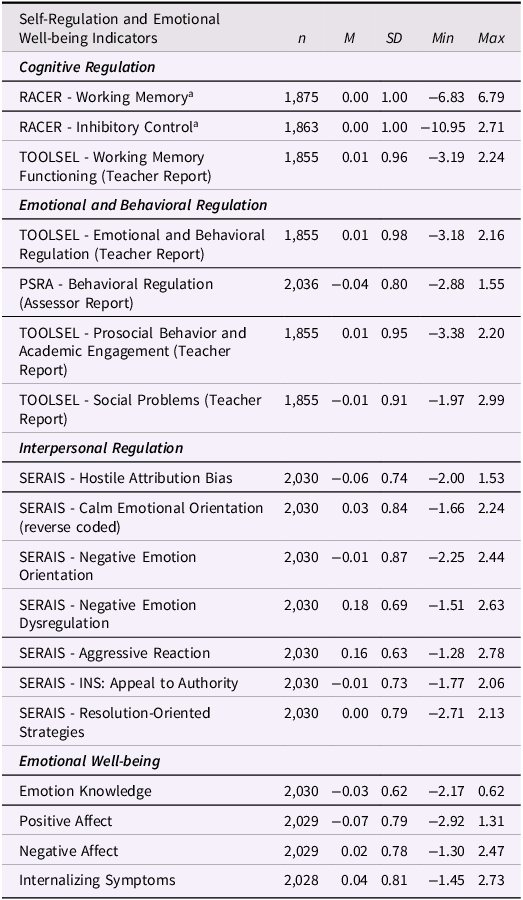
Note. All self-regulation and social and emotional adaptation scores presented here (except Rapid Assessment of Cognitive and Emotional Regulation [RACER] scores) were obtained from confirmatory factor analysis models that provided strong validity and reliability evidence for each measure and construct as well as cross-time and treatment-control group measurement invariance. See Authors (2020) for more details. These scores were used for subsequent Latent profile analysis and predictive analysis.
aRACER working memory and inhibitory control scores were calculated according to the scoring procedure described in Ford et al. (Reference Ford, Kim, Brown, Aber and Sheridan2019), and standardized using mean and standard deviation of the sample.
Correlation matrix across self-regulation and emotional well-being indicators

Note. * p < .05, ** p < .01, *** p < .001.
Profiles of self-regulation and emotional well-being among Syrian refugee children
We examined Syrian refugee children’s patterns of self-regulation and emotional well-being across 18 variables including: three cognitive regulation indicators (performance-based working memory and inhibitory control, teacher report working memory functioning); four emotional and behavioral regulation skills (teacher-report emotional and behavioral regulation, teacher-report prosocial behavior and academic engagement, teacher-report social problems, and assessor-report behavioral regulation); seven interpersonal regulation skills assessed in response to hypothetical scenarios (hostile attribution bias, calm emotion orientation (reverse coded), negative emotion orientation, negative emotion dysregulation, aggressive reaction, interpersonal negotiation strategy-appeal to authority, interpersonal negotiation strategy-resolution-oriented strategies); and four emotional well-being indicators (emotion knowledge, positive affect, negative affect, internalizing problems).
A series of latent profile analyses were run to identify profiles of Syrian refugee children with varying patterns of self-regulation and well-being across the 18 self-regulation and emotional well-being variables tested. We tested both unrestricted and restricted models yielding three to ten profiles and examined the model fit indices, distributions and probabilities, and mean differences for the empirical and theoretical justifications for each model, following the decision steps developed by Ram & Grimm (Reference Ram and Grimm2009) as described in the methods section.
As illustrated in Table 4, across all models tested three to ten profiles, the unrestricted models surpassed the performance of the restricted models. However, a gradual decrease is observed in all fit indices as the number of profiles increases, without any discernible inflection point (see Online Supplement Figure A). The model with seven profiles exhibits the second-highest entropy value at 0.853, only marginally surpassed by the entropy value of 0.854 found in the unrestricted model with ten profiles. Upon weighing the interpretability of the profiles against the model’s parsimony, we determined that the unrestricted model with seven profiles was the best solution.
Latent profile analysis model fit indices for both unrestricted and restricted models, three through ten clusters

Profile characteristics
Average scores of self-regulation and emotional well-being indicators for each of the resulting seven profile solutions are illustrated in Figure 1, and means and variances of these scores per profile are presented in Table 5. Based on the average scores of self-regulation and emotional well-being indicators for each profile, and whether they are statistically significantly different compared to the grand mean level score of the whole sample of each indicator, we identified, labeled, and described the seven distinct profiles of self-regulation and emotional well-being functioning patterns below.
The seven self-regulation and emotional well-being profiles found in Syrian refugee children in Lebanon.

Means and variances of the seven self-regulation and emotional well-being latent profiles

Note. All scores are standardized for ease of interpretation. p values are for the difference test of the mean of each profile from the grand mean of the full sample.
Profile 1: happy and positive (11% of the sample)
Profile 1 represented children who were characterized by well-regulated and positive emotions, especially in the interpersonal domain. Specifically, when faced with a hypothetical social situation that can lead to potential conflict, these children were much less likely to interpret the situation as hostile, did not experience and express negative emotions, and were able to maintain calm in such situations. As a result, they were much less likely to respond in such situations with any aggressive or resolution-oriented approach. They were also notable in their affects, reporting significantly higher levels of positive affect whereas reporting significantly lower in negative affect and internalizing symptoms than their peers. Otherwise, these children scored about average on other cognitive regulation and emotional and behavioral regulation dimensions.
Profile 2: poorly regulated (9%)
Profile 2 children were characterized by poor cognitive, behavioral, and interpersonal regulation skills across assessment contexts. Specifically, these children had the lowest level of executive function skills captured by the performance-based measure, and teachers rated them significantly lower in their cognitive, emotional, behavioral, and social regulatory dimensions across the board and significantly higher levels of social problems in classrooms. In a hypothetical interpersonal context, however, these children were not significantly different from the average level, except for reporting significantly high levels of aggressive reaction to potentially conflictual social situations. They also scored the lowest on emotion knowledge assessment, although not significantly different in their reports of positive and negative affect and internalizing symptoms.
Profile 3: sensitive to interpersonal conflict/otherwise regulated (21%)
Profile 3 children showed mostly above-average levels of cognitive, as well as emotional and behavioral regulation skills across the measures and contexts, and an average level of emotional well-being. However, when faced with potentially conflictual social situations, they were significantly more likely to interpret the situation as hostile, experience negative emotions, and have difficulties maintaining calm. Perhaps as a result, they were significantly more likely to express their negative emotions and react in an aggressive manner. They were also more likely to make steps using any interpersonal strategies available to them (e.g., appeal to authority, resolution-oriented strategies) to resolve the perceived social conflict.
Profile 4: troubled in classrooms (13%)
Profile 4 children were characterized by notably low ratings of their regulation and adaptation skills in classrooms by their teachers. While all other dimensions of regulation skills and emotional well-being were either not significantly different from or were close to the average level, their teachers rated their cognitive, emotional, behavioral, and social regulation skills to be the lowest, while also reporting high levels of social problems they observed in classrooms. In contrast, these children scored in the average range on the performance-based measure of cognitive regulation and in the assessor observation of behavioral regulation.
Profile 5: well-regulated/emotionally-adjusted (14%)
Profile 5 represented children who were relatively well-regulated and adjusted across different domains, measures, and contexts. They scored higher than average on both performance-based and teacher-rated cognitive regulation skills, as well as in teacher- and assessor-report emotional and behavioral regulation skills, with significantly lower-than-average social problems. In hypothetical social conflict situations, they showed about average levels of hostile attribution bias, emotional responses, and use of resolution-oriented strategies while reporting lower-than-average levels of negative emotion dysregulation and aggressive reaction, and a tendency to rely on appealing to authority to resolve social conflict. They also displayed higher-than-average emotion knowledge and low levels of internalized symptoms, while reporting average levels of positive and negative affect. Given this profile represents children who are relatively well-adjusted across the board, we use this profile as a reference to compare other profiles against in the subsequent analysis.
Profile 6: moody and frustrated (23%)
Profile 6 was characterized mostly by their negative emotional experience and expressions. Specifically, these children were more likely to express dysregulated negative emotions and aggressive reactions to potentially conflictual social situations, despite an average level of hostile attribution bias and negative emotion orientation. Similar to Profile 3, they were also more likely to make steps using any interpersonal strategies available to them (e.g., appeal to authority, resolution-oriented strategies) to resolve the perceived social conflict. They also reported the highest levels of negative affect and internalizing symptoms. Their teachers reported somewhat lower-than-average levels of cognitive, emotional, and behavioral regulation skills and higher-than-average social problems. Their cognitive inhibitory control skills measured by the performance-based tool were higher than average, but performance-based working memory and observer-reported behavioral regulation skills were not different from the overall average.
Profile 7: teachers’ favorites (8%)
Profile 7 is represented by very high ratings of their cognitive, behavioral and emotional regulation skills by their teachers. While the performance-based and assessor-reported ratings of their cognitive and behavioral skills were above average, teacher ratings on these children were notably high across domains of regulation, with the highest working memory functioning, emotional and behavioral regulation, and prosocial behavior and academic engagement, and lowest ratings of social problems. Their interpersonal regulation and emotional well-being were not significantly different from the average level.
Predictors of the profiles of self-regulation and social and emotional adaptation
We selected Profile 5: Well-regulated/Emotionally-adjusted profile to serve as the reference group because this profile had the pattern of regulatory skills and emotional well-being across the majority of the constructs. Table 6 presents estimates of demographic and experiential characteristics predicting the membership of each of the six latent profiles compared to Profile 5. Figure 2 presents a graphic representation of the comparison of each profile with Profile 5.
Demographic and experiential factors associated with profiles note. The red bars indicate that the estimate is significantly different from zero (p < .05), suggesting the demographic/experiential factor is significantly predictive of the specific profile membership compared to the reference profile 5. See Table 6 for the estimates, standard errors, and p values.

Role of demographic and experiential characteristics in predicting profile membership, compared to Profile 5: Well-regulated/Emotionally-adjusted

Demographic predictors
Gender distinguished three out of six profiles compared to profile 5. Specifically, boys had a higher probability of being associated with Profile 2: Poorly regulated and Profile 4: Troubled in classrooms; while girls were more likely to be associated with Profile 7: Teachers’ favorites, compared to Profile 5. We also found that children in lower grade levels were more likely to be associated with higher probabilities of being assigned to both Profile 2: Poorly regulated and Profile 7: Teachers’ favorites compared to Profile 5.
Exposure to conflict experiences
Children who reported higher levels of victimization in schools (from peer bullying and maltreatment from teachers) had a higher probability of having self-regulation and emotional well-being patterns characterized by Profile 2: Poorly regulated, Profile 3: Sensitive to interpersonal conflict/Otherwise regulated, Profile 4: Troubled in classrooms, and Profile 6: Moody and frustrated, compared to Profile 5: Well-regulated/Emotionally-adjusted. Surprisingly, exposure to war violence and family conflict were not associated with different profiles.
School-related risk and protective factors
Children who are older than expected for the grade level were more likely to be assigned to Profile 2: Poorly regulated, Profile 3: Sensitive to interpersonal conflict/Otherwise regulated, and Profile 6: Moody and frustrated, when compared to the probability to be in Profile 5: Well-regulated/Emotionally-adjusted. Academic competency level assessed on the remedial education programing screening test also significantly distinguished Profile 2 and 7 from Profile 5, in that children who are likely to have Profile 2: Poorly regulated had lower academic competency level; and Profile 7: Teachers’ favorites were likely to be associated with higher competency level. Interrupted schooling and previous year attendance to Lebanese public schools did not distinguish profiles.
Child and household risk and protective factors
Few variables in child and household risk and protective factors were associated with the children’s profiles. As an exception, children whose household met the extreme poverty criteria (income less than $2.87 per person per day) were more likely to have Profile 6: Moody and frustrated profile compared to Profile 5: Well-regulated/Emotionally-adjusted. In addition, children whose caregivers reported engaging in paid work were more likely to be in Profile 4: Troubled in classrooms profile than in Profile 5: Well-regulated/Emotionally-adjusted.
Discussion
In this study, we sought to explore empirically and conceptually meaningful variability in patterns of self-regulation and emotional well-being in a highly underrepresented and vulnerable group of children, Syrian refugee school-aged children in Lebanon. We were motivated by: Cicchetti (Reference Cicchetti and R. A.1990)’s call to better understand the self-regulation and emotional well-being of children facing adversity e.g. Syrian refugee children and by Sroufe’s (Reference Sroufe2013)’s decade-old challenge to the field of developmental psychopathology to “develop a lexicon of variability in patterns of self-regulation.” This motivation was further reinforced by Mischel (Reference Mischel2004)’s search for “clear, strong regularities in behavior that characterize each individual in the form of stable, distinct patterns of variability,” or what Mischel called “personal signatures” in functioning. Our empirical findings identified seven distinct profiles of functioning across four domains—cognitive regulation, emotional-behavioral regulation, interpersonal regulation, and emotional well-being—thereby extending the current understanding of variability in child development under duress.
The distribution of these profiles within our sample revealed significant variability: “Teachers’ Favorites” and “Poorly Regulated” encompassed smaller fractions of the sample (8% and 9%, respectively), in contrast to the more prevalent “Moody and Frustrated (23%)” and “Sensitive to Interpersonal Conflict/Otherwise Regulated (21%)” profiles. Two of the Profiles consistently demonstrated positive (Well-regulated and Adjusted, 14%) or negative (Moody and Frustrated, 23%) functioning across all the measured domains. But five of the profiles accounting for 62% of the sample of children had mixed profiles, relatively strong in some domains but average or weak in others. These heterogeneities, in terms of the number of profiles and variabilities across domains within profiles, challenge the traditional homogenous view of child development in conflict settings. When one takes an organizational, person-centered, and context-sensitive view of Syrian refugee children’s development, it potentially reveals the complexity inherent in developmental processes in adverse circumstances. Indeed, these five profiles with mixed patterns were likely to have been obscured if a purely nomothetic (variable-centered) approach was adopted. These are more profiles and more complexity in the profiles than found in most of the few person-centered studies of self-regulation and emotional well-being conducted to date. This is potentially due to the number of different domains and constructs of self-regulation and emotional well-being examined, and/or reflecting the unique patterns of development among Syrian refugee children who experienced forced migration and facing challenging post-settlement environments. Hence, we provisionally conclude that these profiles are empirically meaningful.
But are they conceptually meaningful? Do they begin to constitute a “lexicon of variability in patterns of self-regulation” or of “personal signatures”? Without good answers to these questions, LPA remains a purely descriptive exercise. These questions about conceptual meaning can be addressed in a number of different ways. First, are the profiles face-valid? We began to answer the question of face validity by providing both narrative interpretations of the patterns we observed and the short summary labels for each profile Are we capturing essential aspects of children’s distinct patterns of self-regulation and emotional well-being with short descriptors like “Moody and frustrated” or “Sensitive to interpersonal conflict.” Or are we oversimplifying? We have confidence in the face validity of the longer narrative interpretations we provided earlier in the results section since they are faithful descriptions of the empirical findings from our data. These interpretations provide a level of complexity that supports the face validity of the profiles.
The face validity question can also can be answered by asking, “do we know and strive to educate and support children in Lebanese schools who sound like they have these various profiles of relative strengths and weaknesses? We believe the answer is likely to be yes. But until these findings are replicated, the validity of these profiles should be treated as tentative and open to debate among researchers and educators. In addition, we caution against the use of the short descriptors, and even the longer narrative interpretations for labeling and attributing certain “traits” to specific types of children. Rather, it should be used only as a snapshot for understanding various patterns across self-regulation and emotional well-being captured at the moment in time. As Cicchetti (Reference Cicchetti and R. A.1990) has emphasized in the development of the organization perspective, each child may experience different patterns and pace of changes over time across domains. Also, it is important to be reminded that the patterns of each profile captured by this study are indeed “average levels” within the profile—each child associated with a profile has a different degree of similarity to the “average” characteristics of the profile.
The conceptual meaning and construct validity of the profiles also can be further developed via analyses of the profiles’ postdictive, concurrent, and predictive validity which we discuss next.
A second aim of this study was to examine associations between children’s self-regulation and emotional profile membership and their demographic and experiential characteristics. As Mischel and colleagues (Mischel & Ayduk, Reference Mischel and Ayduk2011; Mischel & Shoda, Reference Mischel and Shoda1995) observed, distinct ways that a child processes and understands situations reflect their psychosocial and biological histories. Among the four sets of background predictors we measured, surprisingly few child/household risk and protective factors predicted the patterns of self-regulation and emotional well-being. In comparison, demographic characteristics (especially gender), conflict exposure (notably school victimization), and school-related risks (especially age-for-grade) were most successful in predicting children who were in the “Well-regulated and emotionally-adjusted” profile vs. in the other six profiles.
Two sets of findings are noteworthy. First, no background characteristics predicted membership in Profile 5 (Well-regulated/Emotionally-adjusted) vs. Profile 1 (Happy and Positive). It appears that these children with these two profiles are most successful in their regulation and well-being. In contrast, 5 of the 9 demographic, conflict exposure, and school victimization measures predicted membership in Profile 5 (Emotionally-adjusted) vs. Profile 2 (Poorly regulated). Specifically, children who: were boys, in the earlier grade levels; experienced victimization in school; were older than their peers in their grade level; and were less competent in basic math and Arabic literacy were more likely to be associated with Profile 2. Each of these factors has been identified as a risk indicator for poor regulation in numerous studies over the last several decades, but usually in high-income countries and rarely with as extensive a set of control variables.
The second set of findings points to the importance of school experiences in the self-regulation and emotional well-being of Syrian refugee children in Lebanese schools. Specifically, of the conflict exposure variables, only school victimization experience predicts the likelihood for children to be associated with all four profiles that are relatively poorly regulated and/or experience negative affect/emotions compared to the reference group (Profile 5) – Profile 2: Poorly regulated, Profile 3: Sensitive to social conflict/Otherwise regulated, Profile 4: Troubled in classrooms, Profile 6: Moody and frustrated. In Lebanon at the time of data collection, Syrian children attended the same school as Lebanese children, sometimes in the same classroom but most often in separate classrooms/shifts. However, qualitative research with Syrian refugee children and families has well-documented systematic bullying and victimization of Syrian refugee children by Lebanese peers and teachers. For example, Shuayb and colleagues (2014) describe the Syrian children’s experience of discrimination, harassment, and physical and verbal abuse from teachers and Lebanese students in schools as well as in commutes to and from schools. Such fear and experience of victimization in the school environment affect their physical and psychological well-being, and some Syrian families choose to withdraw their children from schools in fear of victimization (Shuayb et al., Reference Shuayb, Makkouk and Tuttunji2014). This is aligned with our finding that school victimization is a clear and frequent predictor of memberships in the relatively poorly regulated and/or emotionally struggling profiles.
Other school experiences beyond school victimization also emerged as a salient predictor of the self-regulation and emotional well-being profiles. Specifically, being old for one’s grade – i.e., being placed in a lower grade level than expected for their age, also differentiates between the “well-regulated” profile and three relatively poorly regulated and/or emotionally struggling profiles: Profile 2: Poorly regulated, Profile 3: Sensitive to social conflict/Otherwise regulated, and Profile 6: Moody and frustrated. In addition, lower academic proficiency was associated with the membership of Profile 2: Poorly regulated, and higher academic proficiency predicted the membership to Profile 7: Teachers’ favorites, compared to Profile 5: Well-regulated and emotionally-adjusted children. Being old for their grade level has been previously identified as a key marker for executive function, behavioral regulation, and academic proficiency for Syrian children in Lebanon (Kim et al., Reference Kim, Brown, Tubbs Dolan, Sheridan and Aber2020), and could indicate that a child has faced an increased level of adversity and interruption to his/her academic learning and social and emotional development and well-being prior to entering Lebanese public schools. It also may indicate that children in lower grade classrooms without same-age peers may not provide developmentally appropriate learning environments, resulting in a further interruption in their self-regulatory capacities and leaving the children frustrated and in a moody emotional state. Teachers may play a role in shaping the expression and perception of self-regulation and emotions, as they may perceive and respond better to students they see as more academically competent and not falling behind their age level. Based on these findings, we believe that the 7 profiles of self-regulation and emotional well-being show provisional, partial postdictive validity.
There are several potential implications of our adopting this approach to understanding patterns of self-regulation and emotional well-being for the future of developmental psychopathology research and informed practices which we wish to call out. First, the approach can lay the groundwork for a systematic comparative research agenda on self-regulation and emotional well-being across ages and cultures. Just as descriptive research on attachment behaviors led over time to insights into the organization and meaning of those behaviors into constructs of secure and insecure patterns of attachment and its advantage/disadvantage for children in current and future adaptation across age and cultural contexts (e.g., Koehn & Kerns, Reference Koehn and Kerns2018; Fraley, Reference Fraley2002), so too might the descriptive research on patterns of self-regulatory behaviors and emotional well-being lead to insights into the organization and meaning of the self-regulatory system.
Second, this approach may prove useful in understanding the differential manifestation of self-regulatory behaviors and skills in different contexts. As our findings indicate, expression of self-regulation and emotions are domain- and context-specific, likely reflecting different biological dispositions, support systems, and life experiences. This variability of expression of self-regulatory and emotional dispositions across domains and contexts provides developmental psychopathology with a different framework of understanding children’s self-regulation and emotional adjustment as bi-directional interactions between the individual, with specific dispositions and histories, and the environment, providing conditions to express or suppress expressions of self-regulation skills and emotions. Specifically, this approach can help us to identify and focus on approaches to improve the conditions the children are faced with, especially in the school contexts and learning environment that are salient in discriminating these profiles (e.g., school victimization).
Finally, the variability of the patterns of self-regulation and emotional well-being found in this study can inform the further development of tailored intervention approaches to better support conflict-affected children in classrooms (Malti et al., Reference Malti, Noam, Beelmann and Sommer2018). If we no longer view self-regulation and emotional well-being as unidimensional traits but rather as a complex, dynamic patterning of domain-specific regulatory skills interacting with contexts (Cicchetti & Aber, Reference Cicchetti and Aber1998), it provides ample opportunities to identify new hypotheses about how to design and implement tailored and scalable classroom-based interventions. For example, one may consider combining universal SEL programing with tailored supports for different domains, instead of a tiered system where “high-risk” children are screened into a more intensive support. One can consider designing a universal SEL intervention with additional support for social-cognitive skills (e.g., hostile attribution bias, conflict resolution skills) for children who are sensitive to social conflict but otherwise relatively well-regulated; while providing additional mental health support for children with “Moody and Frustrated” profile within a larger program. Given these observable patterns of self-regulation and emotional well-being, it is clear that the “one size fits all” approach may not work for everyone – nor does the unidimensional “tiered” intervention paradigm for higher-risk populations. Instead, the diverse needs of the children across different profiles may be best met by an approach where an array of adaptive interventions to support different domains of development and contexts that can be flexibly deployed and added to a larger support system/programming that addresses holistic learning and well-being for all children.
The generalizability and interpretation of the findings are limited by its data and methodological limitations. It is a descriptive and hypothesis-informing study, so no inferences of causal direction should be made. It is a study based on data collected for an impact evaluation and was not specifically designed for the purposes to which we put the data. The lack of data on children’s and the families’ experience pre- and peri-migration to Lebanon, as well as more nuanced information on parenting, the public school learning environment, and the community context reduced the sensitivity of our analysis of the postdictive validity of the profiles of self-regulation and emotional well-being that we identified.
Nonetheless, this study takes a first step in exploring the value of an organizational, person-centered idiographic approach to understanding patterns of self-regulation and emotional well-being in refugee children exposed to armed conflict and displacement. We hope that over time this approach will mature to the point where, we can examine the relationship among (a) profiles of self-regulation and emotional well-being that are common and unique across cultures, contexts, and conditions of children learn and develop in, (b) the biology underlying these complex processes and (c) the nature and quality of children’s daily interactions with peers and teachers and with their learning strategies in the classroom. These goals can be achieved with future comparative studies that examine the commonalities and specificities of these profiles within and across samples from different regions and conflict and crisis conditions, and that explore relationships with psychobiological and neurophysical processes using longitudinal data. Such exploration allows the examination of the systems’ dynamics, temporal stability, or predictive validity of the profiles over the transition from childhood to adolescence. This comprehensive approach will deepen our understanding of the development of self-regulation and emotional well-being of children in crisis contexts.
Supplementary material
The supplementary material for this article can be found at https://doi.org/10.1017/S0954579424001202.
Acknowledgment
The research reported here would not be possible without key collaborating organizations and individuals’ dedication, commitment, and goodwill. We wish to thank: The International Rescue Committee, especially Jennifer Sklar, Rebecca Fernandes, Paul Frisoli, Autumn Brown, Kayla Hoyer, Erin Byrne, Silvia Diazgranados Ferrans, Jeannie Annan, Sarah Smith at its Education Unit and Research, Evaluation and Learning Unit in New York City; and education, research, and monitoring-and-evaluation staff in Lebanon, Mahmoud Bwary, Adham El Outa, Samer Houshaimi, and Anas Tahhan all of whom played particularly integral roles for this paper. We also thank Patrick Anker at New York University’s Global TIES for Children for data support. In addition, we also would like to thank our collaborators, Stephanie Jones and Harvard EASEL Lab, and Margaret Sheridan and Peter Halpin at the University of North Carolina at Chapel Hill for their programmatic and analytic input and collaboration. Finally, we wish to express our gratitude to the Syrian children, parents, and their communities, as well as the Healing Classrooms teachers in Lebanon, for allowing us to engage and learn from them in this work.
Funding statement
The program implementation and impact evaluation of Healing Classrooms in Lebanon was funded by Dubai Cares. In addition, we would like to thank the Spencer Foundation and Porticus Foundation for the direct financial support that enabled the larger study of which this paper is a part. We also thank the New York University Abu Dhabi Research Institute for core funding to the New York University Global TIES for Children center, which provided support for staff and activities that directly contributed to the research presented here.
Competing interests
None.


 Open access

