

Flint is created by lightning from the gods, lightning’s sound helps Maya kings cross to the underworld, and temples are living mountains where the gods reside (Harrison-Buck Reference Harrison-Buck and Hendon2018; Kapusta Reference Kapusta2022; Stuart and Houston Reference Stuart and Houston1994). Technical and ritual aspects of Ancient Maya technological practice are entangled (Horowitz et al. Reference Horowitz, Brown, Yaeger and Cap2024; Kennington Reference Kennington2019). This entanglement is demonstrated in lithic forms, manifestations of the physical and spiritual world, which undergo processes during their creation that imbue them with great power (Agurcia et al. Reference Agurcia Fasquelle, Sheets and Taube2016).
These lithic forms, colloquially called eccentrics, were first recovered from caches and burials during archaeological investigations of the early twentieth century (Joyce Reference Joyce1932; Kidder Reference Kidder, Alfred1947). Though often referred to as eccentric flints (Awe et al. Reference Awe and Helmke2019; Joyce Reference Joyce1932), these objects are produced from obsidian and chert (Cackler et al. Reference Cackler, Glascock, Neff, Iceland, Pyburn, Hudler, Hester and Chiarulli1999; Hester and Shafer Reference Hester and Shafer1984), which are compositionally and structurally different (Luedtke Reference Luedtke1994). Specialized crafts like eccentrics allowed the ancient Maya to distinguish elite from nonelite through quantity and quality of forms, as well as the elite to compete with others of the same or similar status (Aoyama Reference Aoyama2006). Beyond tools of wealth differentiation, eccentrics were objects of great power meant to create and preserve sacred spaces (Agurcia et al. Reference Agurcia Fasquelle, Sheets and Taube2016). Artisan behavior has been the topic of study for decades (see Sheets et al. Reference Sheets, Anthony, Breternitz, Brose, Chatterjee, Compton and Cook1975), and more recent studies have focused on connections between lithic crafting communities and ritual practice (Inomata Reference Inomata2001; Kwoka et al. Reference Kwoka, Hanratty and Guderjan2019; Titmus and Woods Reference Titmus, Woods and Hirth2003).
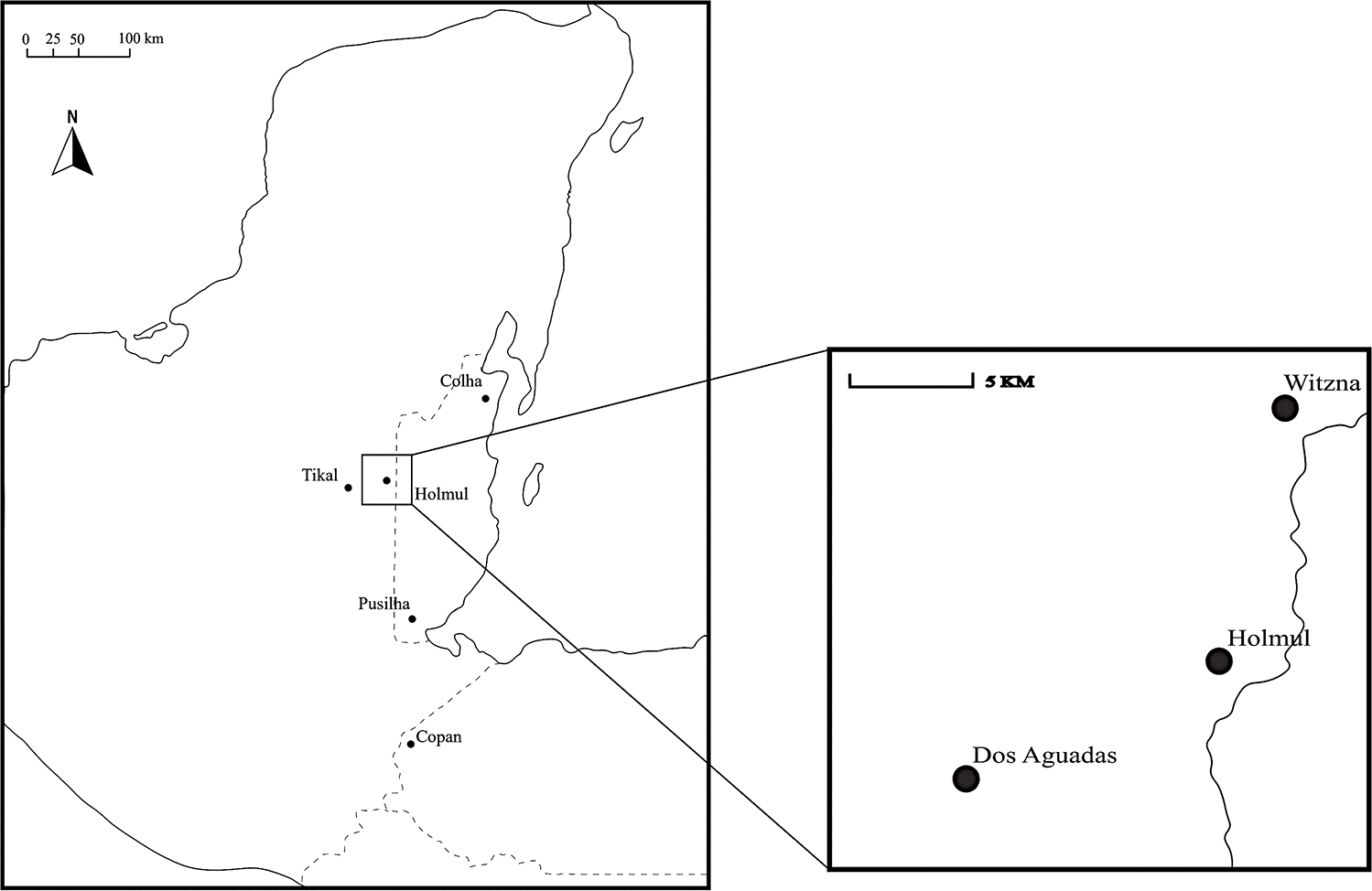
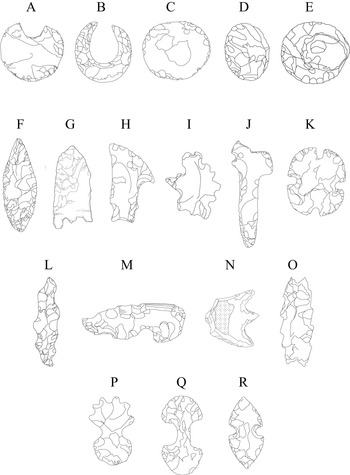
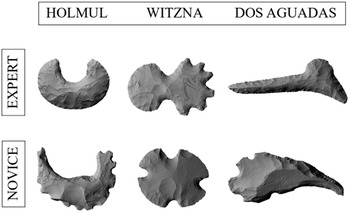
Here we report the results of a preliminary examination of eccentric assemblages from three sites in the Holmul area: Holmul, Witzna, and Dos Aguadas (Figure 1; Table 1). The ritual deposition of eccentrics at these sites spans centuries (Supplementary Material 1). Despite little distance between them, raw material, iconographic choices (Figure 2), and producer skill level (Figure 3) vary considerably. We build our eccentric form identification on the work of previous publications (see Iannone Reference Iannone1992a, Reference Iannone, Awe and Campbell1992b; Stemp et al. Reference Stemp and Awe2024). Additional figures, illustrations, contexts, and metrics of the eccentrics discussed here may be found online in Supplementary Materials 1 and 2.
Map of Holmul region and spatial organization of sites relative to one another.

Eccentric forms of the Holmul region: A. Crescent/Crescent Moon, B. Extreme Crescent, C. Noncrescent Celestial/Full Moon, D. Spherical/Sun, E. Negative Space, F. Laurel Leaf Biface, G. Point, H. Weaponry, I. Effigy Deity, J. Scepter, K. K’IN Glyph (day), L. Snake, M. Mammal, N. Tridentate/Centipede Jaws, O. Centipede, P. Arachnid, Q. Bone, and R. Composite Form (any eccentric that combines two or more forms).

Examples of skill level variability in eccentric production. Contexts include HOL.T.93.107.04.04, HOL.T.93.107.04.08, WIT.L.12.09.04.06, WIT.L.12.09.04.08, DAG.02.05.04.04, and DAG.02.03.04.04.

Eccentric Type and Skill Assessment by Site and Eccentric Number (Skill Equation 1 = (LW/T)F; Skill Equation 2 = (L/T)F; Skill Equation 3 = T/F; L = Length, W = Width, T = Thickness, F = Flaked. E = Expert Skill Level, M = Moderate Skill Level, N = Novice Skill Level ${\%}$).

The Holmul Region
Holmul, Witzna, and Dos Aguadas are located in northeastern Petén, Guatemala, near the modern border of Belize. Holmul occupation spans the Early Middle Preclassic through the Late and Terminal Classic periods, from circa 1100 BC until circa AD 1050 (Figure 1). Witzna, 14 km north of Holmul, is a capital of Classic period kingdoms with a similar occupation history. Dos Aguadas is a midsize Late Preclassic city located 7.5 km southwest of Holmul. Although the population at Dos Aguadas boomed in the Late Preclassic, the site’s eccentrics date to the Terminal Classic period when the center experienced a second peak in ritual activity (Estrada-Belli Reference Estrada-Belli2012).
Skill
Skill level in lithic production has been addressed within and outside of Mesoamerica (Bamforth and Finlay Reference Bamforth and Finlay2008; Eerkens Reference Eerkens2000; Goldstein Reference Goldstein2018; Liu et al. Reference Liu, Khreisheh, Stout and Pargeter2023; Mahaney Reference Mahaney2014; Monaco Reference Monaco2019; Pargeter et al. Reference Pargeter, Khreisheh and Stout2019; Proffitt et al. Reference Proffitt, Bargallo and de la Torre2021; Stout Reference Stout2002; Torres and Baena Preysler Reference Torres and Preysler2020). Experimental studies and archaeological analyses use length, width, thickness, or a combination of these metrics to determine skill (Baena Preysler et al. Reference Baena Preysler, Navas and Sharon2018; Ortiz and Baena Reference Ortiz and Baena2017; Pargeter et al. Reference Pargeter, Khreisheh and Stout2019). Additionally, Titmus and Woods (Reference Titmus, Woods and Hirth2003) use the complexity of form to note skill.
We determine skill level using variables previously outlined in the literature, including eccentric length, width, and thickness (L, W, T). We add percentage of eccentric surface flaked (F), which corresponds to the ability to continue thinning an eccentric, either with pressure flaking or indirect percussion, without it breaking. Three values are calculated to determine skill using these variables. The first equation, (LW/T)F, focuses on the overall dimensions and the percentage of an eccentric without remnant dorsal or ventral surface. The second equation, (L/T)F, denotes skill in the ability to complete an eccentric without a bending or perverse fracture. The third equation, T/F, identifies the ability to thin an eccentric without it breaking.
Ranges are assigned based on how data clusters for each equation. Qualitative skill is assigned based on the first author’s flintknapping experience independently of the three equations. Values are then compared across categories.
Holmul eccentrics exhibit the widest range of skill level (Figure 3). Skill levels in Holmul caches range from novice to master, often appearing in caches together. We interpret this as direct evidence of learning the physical mechanisms of flintknapping as well as the forms that are ideologically significant in regional histories.
Witzna eccentrics demonstrate the highest level of craftsmanship (Figure 3). It is unclear whether Witzna’s proximity to the North Belize Chert Bearing Zone may have facilitated access to better practice through greater raw material availability. Nevertheless, Witzna eccentrics do not exhibit starkly different abilities. It is possible based on the current absence of excavated lithic production areas that some Witzna eccentrics were produced elsewhere, such as Colha, and procured through regional trade or gift networks, though at this time concrete evidence of that is lacking (Hester and Shafer Reference Hester and Shafer1994; Hruby Reference Hruby2024; Paling Reference Paling2016).
Dos Aguadas eccentrics, like those of Holmul, demonstrate both master and apprentice skill levels (Figure 3). Nonetheless, the average thickness of eccentrics at Dos Aguadas is greater in relation to eccentric length. Additionally, though bifacial flaking is attempted on nearly all eccentrics, the number of termination errors is higher than master-level eccentrics at Holmul and Witzna. Dos Aguadas lithic masters had moderate skill relative to other lithic specialists in the region.
The eccentrics of Building D of Group I at Holmul attest to a practice of including chipped stone offerings produced by master and apprentice alike. Novice made forms are not well thinned and exhibit higher percentages of remnant ventral and dorsal surface. Many apprentice-made eccentrics mirror the forms of master-made eccentrics. Thus, both deposits demonstrate the generational transmission of knowledge in both form and method.
Discussion
The present report aims to contribute to the study of Maya eccentrics in two significant ways. It offers the first summary of these artifacts and their contexts from three archaeological sites in the Holmul region. This is an essential step to incorporate regional data into a broader comparative framework for the Maya region and Mesoamerica. The second most significant contribution of this report is revealing the social context of Maya eccentric production. That eccentrics of varying skill levels were included in ceremonial contexts highlights the significance of the crafting community, not just the craft.
The temporal span of eccentric production and deposition in the Holmul region demonstrates the generational transfer of knowledge throughout centuries of ritual lithic production. This study is a first step toward understanding chert and obsidian eccentrics of the Holmul region, the kinds of knowledge required to make them, and how Maya religious practice and lithic practice were entangled over time.
Acknowledgments
Research at Holmul and La Sufricaya was authorized by Guatemala’s Ministry of Culture and Sports and supported by grants from the Pacunam, Hitz, Maya Archaeology Initiative, Alphawood Foundation, National Science Foundation (#2023648), and Society for American Archaeology (SAA H. and T. King Grant #202006). Additional institutional support came from Tulane University and the University of Alabama Graduate Council. We would also like to thank Consejo Nacional de Areas Protegidas de Guatemala for allowing access to the Maya Biosphere Reserve and to Sociedad Civil Arbol Verde for their support of fieldwork at Holmul. The eccentric lithics in this article were recovered by the archaeologists and workers of the Holmul Archaeological Project, including Francisco Estrada-Belli, Mauricio Diaz García, Berenice García Vázquez, Marta Perea, and Josué Calvo. This report grew out of an SAA annual meeting session, chaired by Geoffrey Braswell. We profoundly appreciate the input from the session participants and the editorial effort that went into turning this presentation into a report in a special section.
Funding Statement
This work is supported by the National Science Foundation (Grant #2023648), the Society for American Archaeology (SAA H. and T. King Grant #202006), and the University of Alabama Graduate Council.
Data Availability Statement
Data are available in the published sources cited within. Project reports for the Holmul Archaeological Project are available at https://liberalarts.tulane.edu/mari/research-education/holmul/research.
Competing Interests
The authors declare none.
Supplementary Material
The supplementary material for this article can be found at https://doi.org/10.1017/laq.2025.10156.
Supplemental Material 1. Eccentric Images and Illustrations (figures).
Supplemental Material 2. Eccentric context descriptions (text).


 Open access

