


Access and provision of mental health services to black and minority ethnic groups in the UK has been the subject of extensive Government consultation in recent years1, 2. Current policies for the general population include the blanket administration of the Edinburgh Postnatal Depression Screening Questionnaire (EPDS) by health visitors as an initial tool for identifying women at risk of postnatal depression (PND)Reference Halligan and Donaldson3. However, the EPDS screening questionnaire has not been well validated within black and minority ethnic groups1. The EPDS has been found to be unsatisfactory for use among ethnic minority groups, even when applied by link workers who are matched ethnically and linguistically to the cultural group that they work withReference Adams and Sobowale4, Reference Sobowale5. Health visitors have reported that the word ‘depression’ is non-existent in many ethnic languages, and that initiating discussions about feelings during the postnatal period can be difficultReference Adams and Sobowale4, Reference Sobowale5. Recently, the Community Practitioners and Health Visitors Association (CPHVA) piloted a picture booklet to elicit feelings about mood as an alternative to the EPDS. Following the pilot scheme and evaluation, and positive feedback from mothers, this resource is now recommended by the CPHVA for use with women from ethnic minoritiesReference Adams and Sobowale4, Reference Sobowale5.
Typical features of PND may include low or sad mood states and loss of interest and pleasure. Many predictors of PND are associated with social adversity rather than with any biological traitsReference Cooper and Murray6. Factors strongly associated with PND include a past history of psychiatric disorder (usually depression), poor marital relationship, lack of social support and recent stressful life eventsReference Nielsen, Videbech, Hedegaard, Dalby Salvig and Secher7. Social status, family income and occupational status of the mother are only weakly associated with PNDReference Cooper and Murray6.
Several authors have advocated research into maternal mental health across different culturesReference Kumar8 in order to improve our understanding of the risk factors for depression. It has been suggested that for women of South Asian ethnicity, problems of communication, isolation, loneliness and cultural conflicts can be compounded by feelings of guilt, inadequacy and depressionReference McAvoy and Donaldson9. Cultural and linguistic differences may hinder the detection and treatment of PND among South Asian communitiesReference Thompson10. Muslim mothers living in extended families have been reported to display unusually high levels of depression and anxietyReference Sonuga-Barke, Mistry and Qureshi11. UK women of South Asian descent who were born in India or East Africa have a 40% higher suicide rate than women born in England and WalesReference Bhugra, Baldwin, Desai and Jacob12. However, there is a further danger of developing cultural stereotypes about factors associated with depression among South Asian womenReference Burr13. Likewise, cultural and religious differences, as well as specific feeding practices, within Bangladeshi, Pakistani and Indian ethnic communities require considerationReference Ingram, Johnson and Hamid14.
The aim of the present study was to examine the experiences of Bangladeshi and Pakistani women during the postnatal period and to explore the factors associated with mental well-being. In particular, the survey aimed to determine whether there were any associations between maternal mental health and infant feeding practices. In addition, the study reports on women’s experiences during childbirth, delivery and postpartum.
Methods
This study was conducted in the West End of Newcastle, one of the most socially and economically deprived areas in the country. Sure Start Westgate area comprises Elswick and parts of West City, Moorside and Wingrove wards with a total population of approximately 13 000. Twenty-five per cent of the population are of South Asian ethnicity compared with 6% nationally. Under the ranking scheme of the Index of Multiple Deprivation (IMD 2000), Elswick ward is within the top 50 most deprived areas of the nation (36 out of 8414 areas)Reference Noble, Smith, Penhale, Wright, Dibbon and Owen15.
Ethical permission for the study was obtained from the Northumberland and Tyne and Wear Local Research Ethics Committee. Sure Start Westgate has Caldicott Guardian permission, which enabled the local mental health worker to access information required for sample identification. The consent form for women outlined the aims and objectives of the study and was translated into Bengali and Urdu. These were given to the women one week prior to the interview. No interview was conducted without informed consent.
The sample comprised women of South Asian ethnicity who had had a baby within the last 2 years. Eligible women were identified through the Sure Start registration. At the time of the survey, 207 eligible South Asian women were resident in the area, of whom 121 were Bangladeshi, eight Indian and 78 Pakistani. A target sample of 100 women (48% of the eligible population) was set, but due to a number of missed appointments a total of 86 interviews were conducted.
Prior to interview, the participants were informed by letter and/or telephone. Subject to being granted permission, interviews were conducted at the mothers’ homes. Interviews with Bengali/Sylheti speakers were conducted by the researcher (S.Z.N.) whose first language is Bengali. Interviews in other languages were facilitated by either interpreters or Sure Start health team members with proficiency in the required language who accompanied the researcher. The same researcher conducted all interviews.
The interview questionnaire covered the background characteristics of women (occupation, education, household members, country of birth, religious identity and others), followed by a series of five questions on maternal mood, then a set of questions on the experiences of women during their pregnancy and postnatal period, particularly in relation to the access and provision of health services. Women were asked how they fed their infant. Breast-feeding was defined as infants receiving breast milk only, with or without supplementary foods or drinks from cups. Formula feeding was defined as women who bottle fed their infants with formula milk and who had not breast-fed at any stage. Mixed feeding was defined as women who both breast-fed and bottle-fed using formula milk.
Mood detection
Five questions were taken from the picture booklet published by the CPHVA for the identification of women with PNDReference Adams and Sobowale4. The pictures from the booklet which accompany each question were used during the interview. Responses to questions were coded as ‘yes’ or ‘no’. As well as examining responses to individual questions, a sum of the scores of the five questions relating to PND was computed (range 0 to 5), where 0 indicates there were no negative mood responses to any of the questions and 5 indicates a negative mood response to every question.
Following these questions, women were asked about practices after child birth, sources of support and information, whether they had heard of the term ‘postnatal depression’ and where they would seek help for feelings of depression.
Statistical analysis
Statistical analyses were performed using SPSS version 14.0 (SPSS Inc.). Education was divided into three categories: no schooling or left school before the age of 16 years; left school at 16 years of age; and left education at 18 years of age or higher. Father’s occupation was classified as: unemployed; unskilled work; skilled worker; and business owner or professional. For statistical analysis, the latter two categories were combined because of small sample sizes. Ethnicity was Pakistani, Bangladeshi or Indian. As Indian ethnicity was a small category (n = 2), this was combined with Pakistani ethnicity for most analyses. Mother’s place of birth was categorised as UK or overseas. Net family income was grouped as: <£200 per week; £200–<£300 per week; £300–<£400 per week; and >£400 per week. Only one household reported an income of >£400 per week, so the last two categories were combined. Feeding was categorised as breast milk, formula milk or mixed feeding.
Results
Background characteristics
Self-identified ethnicity was 65% Bangladeshi, 33% Pakistani and 2% Indian. Two-thirds (63%) of the women were born in Bangladesh, 19% were born in Pakistan and 19% were born in the UK. All but one woman identified themselves as Muslim. The mean (standard deviation) age of the women was 28.1 (4.93) years and that of their infant at the time of the interview was 0.65 (0.56) years.
Thirty-six per cent of the women in the study could not understand English; a further 30% understood spoken English but could not read or write in English. The remainder described their English as excellent or very good. In this sample, 44% of women had at least one adult relative living with them other than their husband. While 92% of women attended an antenatal check-up, only 15% of women had attended antenatal classes. Most women were not employed (91%); four women (4.6%) worked in skilled or unskilled occupations and four women (4.6%) had professional occupations.
Associations between infant feeding and maternal characteristics
Women were grouped according to the method of feeding at the time of the interview. As this was a cross-sectional survey, age-related changes in feeding method may have been a confounding effect. However, within the sample, there was no difference in the mean age of the child within each of the feeding groups (mean age 0.69, 0.52 and 0.78 years for breast-fed, formula-fed and mixed feeding groups, respectively; F = 1.7, P = not significant (NS)).
Pakistani women had a higher prevalence of breast-feeding than women of Bangladeshi ethnicity (47% vs. 18%,  , P < 0.005, breast-fed vs. mixed and formula combined). Table 1 shows that the proportion of breast-fed babies was higher in males than females (39% vs. 17%, respectively); however, this did not reach statistical significance when analysed as three feeding groups (
 , P = NS). With formula-fed and mixed-fed babies combined, the percentage of infants who were breast-fed was slightly higher in males than in females (
 , P < 0.05). Gender differences were further examined by asking the mother whether she was happy with the gender of her child. The responses showed that 34% of mothers with girls were upset about the gender of their child, compared with 18% of mothers with boys (
 , P < 0.001).
Prevalence of breast-feeding according to maternal characteristics

NS – not significant.
Values are %, where % represents the percentage within each row.
Method of infant feeding was examined in relation to self-reported physical health status to test for confounding (i.e. if women were unable to breast-feed because of poor physical health). There was no evidence that poor health prevented breast-feeding as the women who breast-fed were less likely to report their health as good or excellent and more likely to report their health as poor (good or excellent health was 46%, 56% and 82%, for breast-, mixed- and formula-feeding mothers, respectively;  , P = 0.011).
Table 1 shows that neither maternal education nor occupation of the father was associated with the method of infant feeding. Household income also showed no association with the method of infant feeding. Women were asked about the health of their child. Only 10% of mothers described their infant’s health as ‘not so good’ or ‘poor’. The remainder described their child’s health as good or excellent. There were no differences in the reported child health status (good or excellent) within each feeding group ( , P = NS).
Univariate associations with mood responses
Maternal mood response was not associated with the age of her infant (independent t-tests, P = NS for all individual mood responses) nor with the sex of the infant (P = NS for all individual mood responses). Individual responses to mood questions were not associated with father’s occupation, household income or Bangladeshi/Pakistani ethnicity (results not shown).
Table 2 shows the responses to the individual mood questions according to the method of infant feeding. Enjoyment of everyday activities was higher among women who breast-fed only (P = 0.028); whereas feeling sad or crying during pregnancy was lower among breast-feeding women (P = 0.005), as was not sleeping well (P = 0.003) and feeling that everything was too much (P = 0.039), compared with women who used formula or mixed feeding. The number of women reporting aches or pains did not differ among the feeding groups. The responses to all five questions were summed (range from 0 to 5) to provide a maternal mood score. A high score represents more negative mood responses. Table 2 shows that the mean mood score was significantly lower (better) for women who breast-fed than for women using formula or mixed feeding (P < 0.001). Post hoc tests showed significant differences in mean score between breast-feeding and formula-feeding mothers (P < 0.05) and between breast-feeding and mixed-feeding mothers (P < 0.05).
Method of infant feeding and maternal mood responses

SD – standard deviation.
Values are % (n), where % represents the percentage within each feeding method.
*, **denotes pairs of groups significantly different at P < 0.05.
Table 3 presents the univariate associations between mean mood score (summed response to all five mood questions) and covariates. Only maternal education (P = 0.005), level of understanding of English (P = 0.003) and method of infant feeding (P < 0.001) were associated with the mean mood score of mothers.
Univariate associations with mean mood score (range 0–5)Footnote *

SD – standard deviation; NS – not significant.
* Where score is calculated from the number of negative mood responses to five mood detection questions.
† Means compared by t-test and one-way analysis of variance.
Multivariate analyses
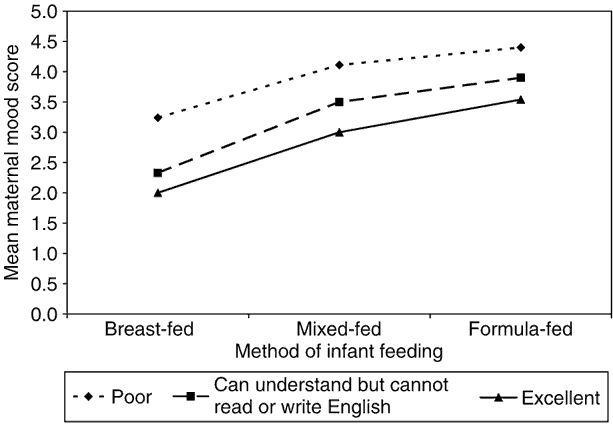
Two-way analyses of variance were performed on the mean maternal mood score according to mother’s education and method of infant feeding. Because of the strong association between knowledge of English and years of education ( , P < 0.001), the two variables could not be entered simultaneously. Figure 1 shows the mean maternal mood scores according to method of infant feeding for women with excellent, good and poor understanding of English. After controlling for English language, the mean difference in score between breast-feeding and formula-feeding mothers was 1.47 (confidence interval (CI) 0.81–2.13, P < 0.001). The mean difference between breast-feeding and mixed-feeding mothers was 1.12 (CI 0.39–1.86, P = 0.003). The same analysis was then repeated with maternal education and method of infant feeding. Maternal mood varied according to maternal education (F = 3.54, P < 0.05) and method of infant feeding (F = 6.96, P = 0.002). After controlling for maternal education, post hoc tests showed that mothers who breast-fed had significantly lower (better) scores than those who formula-fed (mean difference 1.47, CI 0.82–2.12, P < 0.001) and those who used mixed feeding (mean difference 1.12, CI 0.40–1.84, P < 0.003).
Mean maternal mental health score by level of understanding of English
Experiences before, during and after childbirth
Religious and cultural traditions were strong in this sample of women. Eighty-four per cent of the households had performed the Islamic naming ceremony (akika) for their child; 40% had called Islamic prayers (azan) after the birth of their child; 91% shaved the baby’s head after the birth; and 46% of mothers stayed at home for the first 40 days after the birth. There was no association between traditional practices and any of the responses to the questions on mood.
When asked whether they had heard of the term ‘postnatal depression’, 65% of the women said they had not. However, many women who had not heard of PND recognised the description of signs and symptoms when given by the interviewer. When asked where they had heard about PND, 70% named health professionals and 10% mentioned friends and relatives.
When asked about the underlying causes of PND, 52% described it as a mental health condition. However, more than one-third of the mothers felt that PND was due to black magic (e.g. jadu or jinn) or an act of god, and the remainder said they were unsure of the cause of PND. Women born overseas were more likely than women born in the UK to believe that PND was attributable to bad luck (48% vs. 6.6%, P = 0.003) or an act of god (47% vs. 19%, P < 0.005).
Women were asked about possible sources of help for PND. Seventy-two per cent of the women stated that help should be sought from religious leaders, 66% suggested health professionals, 30% from alternative medicine and 27% from friends and family (more than one response given).
Women were asked whether they would talk to anyone if they felt sad or unhappy. Twenty-eight per cent of women said ‘yes’ and the rest (72%) said that they do not discuss their unhappiness with anybody. Of those who said they did discuss their unhappiness, 54% discussed it with husbands and 46% with female relatives.
Access to health professionals
When asked where they obtained advice or information during pregnancy, childbirth or postnatally, 38.4% of women gained this from female relatives and 31.4% from health professionals. Similarly, when asked whose advice they followed the most, 54.7% of women said advice from female relatives and 24.4% followed advice from health professionals. Both responses demonstrate the important influence of female relatives. Women were asked about their experiences of health-care provision during pregnancy and childbirth. Thirteen per cent said their stay in hospital was excellent, 40% felt it was good, 43% felt it was ‘not so good’ and 3.5% said it was bad. In terms of women’s own evaluation, 57% of women said that they mostly or partially understood what health services staff told them and 58% of women thought that their views had been mostly or partially understood by the health professional staff. Only 14% of women felt that they had access to a health professional who could understand the religion and culture of the mother, while 85% expressed a desire to have access to such a health professional. Seventy-one per cent of the mothers would have preferred to speak to someone who could understand their language without the use of an interpreter.
Associations between attendance at antenatal class, presence of female relatives in the home and traditional practices surrounding childbirth were examined in relation to maternal mood scores. No significant associations were found.
Discussion
Information on the predictors of postnatal mental health among women of Bangladeshi and Pakistani ethnic origin is scarce. This survey, therefore, provides some insight into the mental well-being of women after childbirth. Women had significantly better (happier) mood responses if they breast-fed only, if their knowledge of English was excellent, or they had been educated up to the age of 18 years or more.
The mood profiles obtained from this survey can only be taken as a crude indicator of potential risk for PND for several reasons. First, the interviewer was not trained to diagnose PND nor qualified to make referrals. Second, research has shown that self-reported screening tools for PND yield a higher rate of positive cases than clinical interview methodsReference O’Hara and Swain16. Third, some negative mood states could be due to long-term or background depression and not specifically PND. Finally, the survey did not employ the EPDS questionnaire because it has been shown not to apply well to women of minority ethnic groups1, Reference Adams and Sobowale4. Instead, the questions employed were taken from the booklet currently recommended by the CPHVA. Overall, the prevalence of low mood from this survey is likely to be an overestimate in comparison with clinical assessment.
Having acknowledged the potential sources of overreporting, the high rate of negative responses is still notable. Among women who formula-fed, 76% said they had not enjoyed day-to-day activities, 81% said they had felt sad or been crying, 73% had not been sleeping well and 86% felt that everything was too much since having their baby.
The potential for breast-feeding to mitigate against low mood state has been established in previous studies; in a study of 2375 women, not breast-feeding was significantly associated with EPDS scores >12 with an odds ratio of 1.52Reference Warner, Appleby, Whitton and Faragher17. There are no comparable data, however, on UK women of Bangladeshi or Pakistani ethnicity. The present study did not record information on the labour or type of delivery, an area which is sometimes implicated as a risk factor for PND. A previous study among a predominantly white sample of women, however, showed that neither emergency Caesarean section nor assisted vaginal delivery was associated with an increased risk of PNDReference Patel, Murphy and Peters18.
As a cross-sectional survey, this study lacks information on the duration of breast-feeding and on the timing of introduction of solid foods. From the present analysis women who used a combination of formula and breast milk were more similar to formula-feeding mothers in their mood profiles. Further studies on the reasons for mixed feeding and the timing of introduction of formula milk are required to understand why this is so. Prospective longitudinal studies are also needed to ascertain the direction of association between breast-feeding and maternal mental health. Breast-feeding may have direct or indirect effects on maternal mental health or, conversely, the mood state of the mother may influence the choice of feeding method. Mother–child interactions tend to be impaired among women with PNDReference Cooper and Murray6. This, in turn, may influence the initiation or continuation of breast-feeding. PND can have long-term influences on social, cognitive and intellectual development of childrenReference Cooper and Murray6. For this reason, the benefits of exclusive breast-feeding19 may be of particular importance to infants whose mothers have PND.
The prevalence of breast-feeding in the current study is higher than previously reported rates from a national survey. Thomas and AveryReference Thomas and Avery20 observed a breast-feeding prevalence at 5 months of age of 6% and 9% in women of Bangladeshi and Pakistani ethnicity, respectively, compared with 17% and 47% in the present study.
This study showed some evidence of higher rates of breast-feeding among boys and a degree of preference for male infants (sons), but it is important to note that the gender of the infant had no association with maternal mood responses. There is no published evidence in the UK that the gender of the child is associated with PND among women of South Asian ethnicity.
As a small-scale project, this study has grouped together women with heterogeneous backgrounds in terms of their country of birth, length of time in the UK, knowledge of English and ethnic identity. Future studies should take an in-depth approach to studying maternal mental health within a single ethnic grouping, focusing particularly among women born overseas and those with limited knowledge of the English language.
The associations between knowledge of English language, level of education and the method of infant feeding with mood responses are of particular relevance in trying to develop programmes which will identify and support women who are at risk of PND.
Acknowledgements
We wish to acknowledge Jane Johnston and Margaret Bronkston of Newcastle Primary Care Trust for assisting with the development of this project.



