


Identifying Jizhong
The Yue (越) State, a major power in the Lower Yangzi region during the late Spring and Autumn and early Warring States periods (sixth–fourth centuries BC), occupies an important place in the history of Bronze Age China. Yue political centres and urban sites are frequently referenced in ancient Chinese documents but, to date, no urban remains associated with this period have been excavated within the borders of ancient Yue. The 2024 excavation of the Jizhong site in the foothills of Mount Kuaiji in Shaoxing City, Zhejiang Province (Figures 1 & 2), provides the first such evidence.
Location of the Jizhong site within the modern and ancient Shaoxing City (AD 581–1912) (figure by Xingyi Wang).

The central excavation area at Jizhong (photograph by Shuaikun Ge).

The excavation at the Jizhong site, covering an area of over 3000m2, has revealed more than 80 archaeological features, most dating to the Warring States through Han Dynasty periods (c. 475 BC–AD 220). Jizhong was likely active as an urban space prior to the destruction of Yue (c. 333 BC) and maintained a significant position during the centuries after. Explicit administrative references to the Han Dynasty Commandery capital of ‘Kuaiji’ and ‘Shanyin’ are identified on seals and wooden slips recovered during the excavation (Figure 3).
a) Clay sealing bearing the inscription “Seal of the Assistant Magistrate of Shanyin”; b) wooden slip inscribed with “Disciple Zhang Long of Kuaiji, arriving at the gate, styled Bolong of Shanyin”; c) brick with stamp, reading “Wall of Kuaiji Commandery” (photograph by Shuaikun Ge).

Rice and a developed subsistence economy
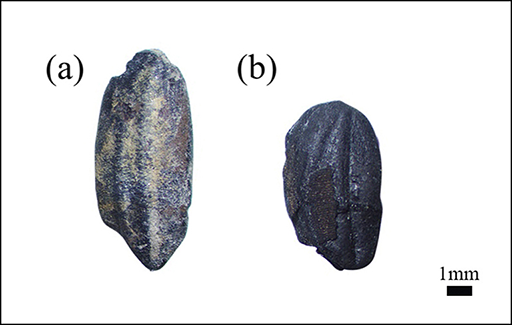
Forty-one charred rice grains recovered from excavation trench T0201 provide initial evidence for the expected rice-based subsistence economy. Morphological observations indicate differences between rice grains from Jizhong and earlier Lower Yangzi urban spaces, such as Liangzhu (Figure 4). Jizhong grains appear larger and plumper but grain morphology alone is insufficient to determine domestication status because definitive assessment requires the identification of non-shattering spikelet-base scars and/or quantitative phytolith statistics. Given the limited sample size, we treat this comparison as preliminary.
Comparative rice grains from Jizhong (a) and Liangzhu (b), showing morphological differences in domestication phases (photograph by Pengfei Sheng).

Full domestication of rice in the Lower Yangzi probably occurred closer to 4000 BC following a long period of cultivation and foraging (Fuller et al. Reference Fuller2007). Findings from Jizhong are compatible with mature agriculture and organised land management/crop selection, suggesting Jizhong co-ordinated well with the surrounding rural areas. In addition, architectural features such as wells and areas of high-density seed concentration suggest that agriculture and urban development were newly combined. We therefore hypothesise that, compared with Liangzhu, the settlement pattern at Jizhong was more complex and food production was integrated into a broader system of spatial planning and administrative organisation.
Further archaeobotanical remains and dietary diversity at Jizhong
Archaeobotanical investigations have identified macro-remains from 18 types of plants at Jizhong (Figure 5): Oryza sativa (rice), Rumex (dock), Cucumis melo (melon), Polygonaceae (knotweed), Cayratia japonica, Cyperaceae (sedge), Chenopodiaceae (goosefoot), Sambucus chinensis (Chinese elder), Adiantum capillus-veneris (maidenhair fern), Prunus persica (peach), Pterocarya (Chinese wingnut), Humulus scandens (common hop), Prunus mume (Chinese plum), Trapa natans (water caltrop), Prunus salicina (plum), Lagenaria siceraria (bottle gourd), Mosla scabra (purplish field mosla) and Oxalis corniculata (creeping wood sorrel). This diversity reflects a complex ecological and subsistence environment, likely shaped by systematic cultivation, local resource management and expanding dietary demands associated with urban life.
Plant macro-remains excavated at Jizhong: a) rice; b) dock; c) melon; d) knotweed; e) Cayratia japonica; f) sedge; g) goosefoot; h) Chinese elder; i) maidenhair fern; j) peach; k) Chinese wingnut; l) reed canary grass; m) Chinese plum; n) water caltrop; o) plum; p) bottle gourd; q) Mosla; r) wood sorrel (photograph by Pengfei Sheng).

Among the plant remains recovered, the bottle gourd stands out for its abundance and versatility. This annual climbing plant has been widely used since its domestication (c. 10 000 BP) for food, storage, music and flotation. A total of 296 bottle gourd seeds were recovered at Jizhong, indicating deliberate cultivation, storage or use rather than accidental deposition. The durable rind of this gourd makes it ideal for containers, instruments and flotation devices in wetland societies, while the flesh contributes to the local diet. Its presence at Jizhong reflects a broader pattern observed across the Lower Yangzi region, where such remains have been frequently documented since the Neolithic (9000 BP) (Fuller et al. Reference Fuller2010; An & Zhang Reference An and Zhang2023).
Identification of seasonal fruit tree seeds, including peach, plum, Chinese plum (mei) and melon, indicate that the population of Jizhong not only relied on staple crops like rice but also consumed a variety of fruits. Peach, one of the earliest cultivated fruit trees in China, was especially abundant. Maturing in the summer, peaches were probably first cultivated in the Middle Neolithic (7000–5000 BP) period and were used not only for food but also for winemaking, ritual offerings and gift exchange. Peach pits recovered from Tianluoshan (Zhejiang, 7000–6500 BP) indicate early cultivation in the Lower Yangzi region (Zheng et al. Reference Zheng2014). Their presence at Jizhong highlights both the diversity of the diet and the maturity of horticulture.
Chinese plum is also notable among the fruit remains. This small, sour fruit ripens in late winter to early spring and has long played a role in Chinese food and medicine. While archaeobotanical evidence for early cultivation is limited, its use since the Neolithic seems likely (Moore & Yoneda Reference Moore and Yoneda2022) and its presence at Jizhong suggests seasonal collection and possible management.
Taken together, the archaeobotanical assemblage suggests inhabitants at Jizhong consciously diversified their foodways. This may have ensured that an elite diet was enjoyed by a local community, attached to the state of Yue and later Commandery. A burgeoning urban and rural economy may have seen this diet spread among Zhejiang areas, laying the foundation for the later economic strength of the Lower Yangzi region.
Future research prospects
Excavations at Jizhong provide us with a glimpse of the great potential for pre-dynastic and early-dynastic period urban archaeology around the Lower Yangzi region. Future work will employ a variety of integrated analytical techniques—including a more comprehensive study of zooarchaeology, stable isotopes, ancient proteins and ancient DNA—to better highlight the complex ramifications of the new urban form emerging at Jizhong and around the Hangzhou Bay area. These methods will aid in improving our comprehension of population dynamics, environmental adaptation and agricultural practices at the Jizhong site as well as more broadly across the Lower Yangzi region.
Acknowledgements
Pengfei Sheng thanks Zixi Chen for invaluable help with the study.
Funding statement
This work was supported by the National Natural Science Foundation of China (42407596).
Author contributions: CRediT categories
Xingyi Wang: Formal analysis-Equal, Writing - original draft-Equal; Longbin Li: Resources-Equal, Writing - review & editing-Equal; Shuaikun Ge: Resources-Equal, Writing - original draft-Equal; Yifeng Lou: Resources-Equal; Edward Allen: Writing - review & editing-Equal; Pengfei Sheng: Writing - review & editing-Equal.




 Open access

