




Introduction
Land use change has a major impact on biodiversity loss worldwide, with specific relevance in the tropics where it is predicted to have a ten times larger effect than all other drivers of biodiversity loss such as climate change (Sala et al., Reference Sala, Huber-Sanwald, Mooney, III, Laura, Huenneke, Juan J. Armesto, Berlow, Jackson, Wall, Ann Kinzig, Janine Bloomfield, Rodolfo Dirzo and David M. Lodge2000; Donald et al., Reference Donald, Sanderson, Burfield and van Bommel2006; Bellard et al., Reference Bellard, Leclerc, Leroy, Bakkenes, Veloz, Thuiller and Courchamp2014). The most common forms of land use change in the tropics are related to agricultural development or expansion, such as large-scale forest conversion for livestock-based agriculture in Latin America (Lambin et al., Reference Lambin, Geist and Lepers2003). However, agricultural landscapes are essential for food production, particularly given the expected increase in agricultural product demand (Bongaarts, Reference Bongaarts and Islam1996). Here, biodiversity plays a crucial role in sustaining human life and ecosystem services (Jose, Reference Jose2012), and biodiversity loss could be mitigated through conservation efforts in agricultural landscapes (Hughes et al., Reference Hughes, Daily and Ehrlich2002; McNeely and Scherr, Reference McNeely and Scherr2003; Kremen and Merenlender, Reference Kremen and Merenlender2018).
Agricultural landscapes are embedded in complex, social-ecological systems (Ostrom, Reference Ostrom2009). The idea of ‘working lands conservation’ is seen as a complement to protected areas and aims to preserve biodiversity while assuring the production of goods and services for humanity (Kremen and Merenlender, Reference Kremen and Merenlender2018). For conservation efforts to be effective in human-dominated landscapes, it is crucial to identify the complex linkages between social and ecological processes (Redpath et al., Reference Redpath, Young, Evely, Adams, Sutherland, Whitehouse, Amar, Lambert, Linnell, Watt and Gutiérrez2013; Benitez-Capistros et al., Reference Benitez-Capistros, Camperio, Hugé, Dahdouh-Guebas and Koedam2018). Public or stakeholder engagement in conservation efforts from their initiation is the key to successful long-term conservation projects. An engaged public can result in more effective, accepted and increased compliance with conservation measures (Menzel and Teng, Reference Menzel and Teng2010; Sawchuk et al., Reference Sawchuk, Beaudreau, Tonnes and Fluharty2015), especially when predictors or motivators of local stakeholders for participation are understood (Hobbs, Reference Hobbs2012; Greiner, Reference Greiner2015).
As a first step toward public engagement, understanding farmers' perceptions toward wildlife is crucial for informing successful conservation projects. For example, a study by Kross et al. (Reference Kross, Ingram, Long and Niles2018) found that farmer perceptions toward birds and bats predicted their actions to deter or attract said species on their farms. In Europe, Guillem and Barnes (Reference Guillem and Barnes2013) investigated behavioral intentions of farmers with respect to preservation of bird life and found that although they held strong values toward bird conservation on their land, a misinterpretation of the ecological requirements needed for bird conservation resulted in low levels of participation in voluntary agri-environment schemes, which rely on farmer uptake and implementation (Lastra-Bravo et al., Reference Lastra-Bravo, Hubbard, Garrod and Tolón-Becerra2015; de Krom, Reference de Krom2017). Furthermore, perceptions in different farmer groups can vary widely resulting in different management actions toward wildlife (McCracken et al., Reference McCracken, Woodcock, Lobley, Pywell, Saratsi, Swetnam, Mortimer, Harris, Winter, Hinsley and Bullock2015). For example, in one study, fruit farmers viewed perching birds more negatively than farmers who grew other crops and as a result they were more likely to deter birds on their farms and were less likely to perceive beneficial services of birds (Kross et al., Reference Kross, Ingram, Long and Niles2018; but see Jacobson et al., Reference Jacobson, Sieving, Jones and Doorn2003). Understanding these perceptions can allow for the tailoring of conservation schemes or actions to different farmer groups or areas and increase their effectiveness.
The Galapagos archipelago is globally recognized as a biodiversity hotspot having retained 95% of its original species (Bensted-Smith, Reference Bensted-Smith2002; González et al., Reference González, Montes, Rodríguez and Tapia2008). Nevertheless, in recent years, ecological degradation has accelerated as there has been a shift toward economic development (at odds with long-term conservation) resulting in increased anthropogenic pressures (González et al., Reference González, Montes, Rodríguez and Tapia2008). This is especially true on the inhabited islands where there has been a faster rate of decline in some populations of native and endemic species (Bensted-Smith, Reference Bensted-Smith2002). Rapid declines of native landbirds in the last 20 years have been witnessed in the Galapagos landbirds, with the largest decline observed in agricultural areas (Dvorak et al., Reference Dvorak, Fessl, Nemeth, Kleindorfer and Tebbich2012; Fessl et al., Reference Fessl, Anchundia, Carrión, Cimadom, Cotin, Cunninghame, Dvorak, Mosquera, Nemeth, Sevilla, Tebbich, Wendelin and Causton2017; Geladi et al., Reference Geladi, Henry, Mauchamp, Couenberg and Fessl2021). In Santa Cruz, the most modified and populated island (Epler, Reference Epler2007), five out of eight landbirds studied in the agricultural zone have significantly declined between 1997 and 2015 (Dvorak et al., Reference Dvorak, Fessl, Nemeth, Kleindorfer and Tebbich2012; Fessl et al., Reference Fessl, Anchundia, Carrión, Cimadom, Cotin, Cunninghame, Dvorak, Mosquera, Nemeth, Sevilla, Tebbich, Wendelin and Causton2017).
Conservation actions to protect landbirds in agricultural areas of the Galapagos islands, specifically increasing forest patches of native trees, are urgently needed (Geladi et al., Reference Geladi, Henry, Mauchamp, Couenberg and Fessl2021). Stakeholder engagement will be critical as agricultural property in Galapagos is private and increasing native tree patches will depend on the willingness of Galapagos farmers. Here, our objective was to gain a preliminary understanding of landbird–farmer interactions in the agricultural zone of Santa Cruz, Galapagos. More specifically, we sought to understand farmers' perceptions of landbirds, knowledge of landbirds and interest in learning more about landbirds. We expected fruit and vegetable farmers to have more negative views of landbirds compared to other farmer groups (coffee and pasture) due to increased crop predation (Kross et al., Reference Kross, Ingram, Long and Niles2018). Understanding the current context of farmer–landbird interactions can help improve understanding of how to better engage farmer stakeholders in biodiversity conservation on farmlands. We use our results to discuss the potential of a landbird conservation plan in the agricultural zone of Santa Cruz.
Methods
Study site
Santa Cruz Island is the second largest island in the Galapagos Archipelago (986 km2) about 1000 km west of the Ecuadorian coast. It hosts the largest human population of the Galapagos islands (~12,000 out of 25,000 inhabitants; Epler, Reference Epler2007; Taylor et al., Reference Taylor, Hardner and Stewart2009; Toral-Granda et al., Reference Toral-Granda, Causton, Jäger, Trueman, Izurieta, Araujo, Cruz, Zander, Izurieta and Garnett2017). This is reflected in the landscape as it is the second-most modified island by human activities, and has the largest agricultural zone (114.2 km2 or 11.6% of the island; Watson et al., Reference Watson, Trueman, Tufet, Henderson and Atkinson2010; Jiménez-Uzcátegui et al., Reference Jiménez-Uzcátegui, Wiedenfeld, Valle, Vargas, Piedrahita, Muñoz- and Alava2019).
Santa Cruz Island is commonly divided into four altitudinal vegetation zones: (1) arid zone (0–120 m; 723.2 km2); (2) transition zone (120–300 m; 99.2 km2); (3) Scalesia zone (300–650 m; 1.8 km2) and (4) fern zone (above 650 m; 17.7 km2; Wiggins and Porter, Reference Wiggins and Porter1971; Dvorak et al., Reference Dvorak, Fessl, Nemeth, Kleindorfer and Tebbich2012). The agricultural zone (~120–550 m elevation) comprises what used to be the Scalesia zone, as well as parts of the transition and fern zones (Hamann, Reference Hamann, Bramwell and Caujapé-Castells2011; Dvorak et al., Reference Dvorak, Fessl, Nemeth, Kleindorfer and Tebbich2012). The Scalesia forest historically found within the Scalesia zone is a structurally unique forest with important habitat for landbirds, particularly forest-dependent landbirds, and has been reduced to an estimated 1.1% of its original extent (Mauchamp and Atkinson, Reference Mauchamp and Atkinson2010).
Santa Cruz has two main seasons: (1) the hot season (January–May) which consists of elevated sea and air temperatures and sporadic but heavy rainfall in the lowlands and highlands; and (2) the cool season (June–December), also known by the locals as the ‘garúa’ season, with cooler temperatures and relatively consistent precipitation in the highlands and almost none in the lowlands (Trueman and D'Ozouville, Reference Trueman and D'Ozouville2010).
We interviewed farmers from across the agricultural zone which included the following townships (from east to west): El Cascajo, El Camote, Media Luna, Bellavista, Los Guayabillos, El Occidente, El Carmen, Santa Rosa and Salasaca (Fig. 1). Spatial heterogeneity in abiotic factors (e.g., soil structure, elevation, microclimates) across the island structured agricultural practices: farms in the east focus primarily on fruit and vegetable agriculture transitioning to increased coffee production in the center, and pasture lands (or cattle farming) toward the west and north.
Santa Cruz agricultural zone map. A map of the agricultural zone of Santa Cruz Island, Galapagos Archipelago. All sectors of the agricultural zone have been labeled and land uses within each zone are defined in the legend. Map sourced from SIGTIERRAS (2011).

Semi-structured interviews
We conducted a total of 38 semi-structured interviews with residents of the agricultural zone of Santa Cruz to characterize the relationship between farmers and landbirds in Galapagos. Exact farmer population size is unknown, however there are 357 agricultural production units which are either individual farms or land from different farms combined, keeping in mind not all farmland is in use (abandoned farms) (Jäger et al., Reference Jäger, Crespo, Abad, Llerena and Couenberg2019). Semi-structured interviews were deemed the most appropriate method as standard questions asked to all interviewees allowed for comparison between interviews and provided quality data, while the flexibility of follow-up questions, prompts and comments created a comfortable and open environment which allowed for a better expression of the interviewees, and a better understanding by the interviewer (Benitez-Capistros et al., Reference Benitez-Capistros, Camperio, Hugé, Dahdouh-Guebas and Koedam2018; Young et al., Reference Young, Rose, Mumby, Benitez-Capistros, Derrick, Finch, Garcia, Home, Marwaha, Morgans, Parkinson, Shah, Wilson and Mukherjee2018). Semi-structured interviewees were also deemed appropriate by the Ministry of Agriculture (MAG) who requested shorter-style interviews to not over-burden farmers with longer, in-depth interviews.
All interviews took place between February and April 2019, were conducted in Spanish, the primary language of the farmers, by a single interviewer, who was fluent in Spanish. The interviewer relied on written field notes recorded during the interview exclusively unless the farmer agreed to have the interview tape-recorded. Still, tape-recordings were only used to verify information collected through written field notes. This approach acted as a check on the accuracy of field notes, and a comparison review of notes and recordings resulted in a near perfect match. Before the interview, the subject was informed that the interviewer was working with the Ministerio de Agricultura y Ganadería of Ecuador (MAG; in English: Ecuadorian Ministry of Agriculture and Livestock) and the Charles Darwin Foundation (CDF). The interviewer also explained that the intent of the survey was to gain an understanding of the farmers' perspectives on birds, including whether and how the birds harm their crops and interventions they took to prevent crop destruction. The interviewer further described they were attempting to discern which birds are found in the agricultural zone and how agricultural structures influence their abundance and diversity (Geladi et al., Reference Geladi, Henry, Mauchamp, Couenberg and Fessl2021). Generally, if requested by the interviewee, more details about the project and knowledge about bird community on their farms were given post-interview. During the interview, the interviewer gave neutral responses and avoided asking leading questions so as not to influence their responses (Seidman, Reference Seidman1998).
Of the 38 interviews, 34 interviewees were identified through the MAG, meaning a MAG technician introduced the interviewer to the interviewee, and four interviewees were approached directly by the interviewer at the local market (see ‘Results’ for characterization of sample of interviewees). Our approach was a purposeful random sampling, where interviewees were sampled among farmers that already have a good working relationship with MAG (Welsh and Rivers, Reference Welsh and Rivers2011; Patton, Reference Patton2014). While all farmers in Galapagos are registered with the MAG, some have a closer working relationship with MAG and accept technical advice while others prefer to farm more independently. We believe that the MAG-introduced farmers are the most relevant group of stakeholders to gather information from as their closer working relationship with MAG opens more communication channels which makes them prime initial targets for proposed conservation actions. We do not believe their relationship with MAG would influence their perceptions of landbirds or answers to our questions as their relationship with MAG is primarily related to receiving technical farming advice, not conservation.
The interviews were divided into two sections (see Appendix A.1). In the first, we gathered general information of the interviewer and farm including the: title of interviewee on farm, experience of interviewee on farm, size of farm, main activity of the farm (e.g., pastoral, agricultural, coffee, tourist, etc.), crops harvested on farm, tools and machinery used, non-bird pest issues and forms of chemical and biological pest control methods used. The second section focused on the interaction between farmers and landbirds. We asked farmers' general opinion of landbirds. More specifically, we asked farmers whether they considered finches a pest and if so, how, and when they affected their crops. We also inquired about different methods farmers used to mitigate finch damage, and if they would be interested in learning more about landbirds and discussing how to better protect their crops with other farmers in an organized setting (e.g., workshops). Finally, to understand their level of knowledge of the landbirds, the interviewer showed images of four bird species to the farmers (both insectivorous and granivorous birds, all potentially occurring on their lands); and, for each image, asked the farmer if they recognized the species, if this bird damaged their crops and if they knew the birds' diet. The birds shown were: small ground-finch (Geospiza fuliginosa; mainly seed feeder), small tree-finch (Camarhynchus parvulus; seed and insect feeder), yellow warbler (Setophaga petechia aureola; mainly insectivorous) and Galapagos flycatcher (Myiarchus magnirostris; insectivorous).
Ethics statement
This study was part of the Galapagos Landbird Plan, implemented jointly by the Charles Darwin Foundation and the Galapagos National Park Directorate with the permit PC-01-18. Research permit providers in Galapagos (Galapagos National Park, Charles Darwin Foundation) do not have specific ethics committees or institutional review boards. Permission to conduct the interviews was granted by the Ministerio de Agricultura y Ganadería (MAG; in English: Ministry of Agriculture and Livestock). For the interviewees identified by the MAG, the interviewee was introduced by a trusted technician of MAG who briefly explained the project and asked for verbal consent of the interviewee to return at a later date to conduct the interview and visit their farm. During the subsequent visit (or initial introduction for those approached at the market) verbal consent was re-obtained from each interviewee. Each participant was informed verbally, prior to the interview, that their participation was completely voluntary, their personal details were confidential and they had the option to refuse to answer any questions. To safeguard their privacy, participant's personal information was safeguarded on a digital datasheet on a password-protected computer and their identity was never divulged.
Data analysis
Analysis of variables
The interviewer coded and analyzed the interview data. All responses to interview questions that did not have pre-determined categories were sorted to create either binary, categorical or continuous variables (see Appendix A.2 for more details). For categorical questions that did not have pre-defined categories, if it was quantitative data, groups were created, and if it was qualitative data, themes were identified into which the data were then categorized (Ryan and Bernard, Reference Ryan and Bernard2003; Marshall and Rossman, Reference Marshall and Rossman2016). For example, size of farms was grouped into four categories: (1) 1 ha or less (small); (2) 2–5 ha (medium); (3) 6–15 ha (large); (4) 15+ ha (very large). As a further example, themes were identified in response to general views on landbirds (Table 1). All responses were placed into one or more of the following themes.
Themes extracted from farmers follow-up answers to whether they have a positive, negative or neutral view of landbirds (‘Can you explain why?’)

These themes were then categorized into the type of ecosystem service referenced and the type of benefit or value perceived by farmers (Chan et al., Reference Chan, Satterfield and Goldstein2012; Belaire et al., Reference Belaire, Westphal, Whelan and Minor2015). Examples of direct quotes (translated by I. Geladi) are provided as well. Note that participants can associate more than one service to birds, where ‘total #’ refers to the number of times the benefit or value came up.
a Chan et al. (Reference Chan, Satterfield and Goldstein2012).
b Belaire et al. (Reference Belaire, Westphal, Whelan and Minor2015).
c Echeverri et al. (Reference Echeverri, Naidoo, Karp, Chan and Zhao2019).
d Millennium Ecosystem Assessment (2005).
For qualitative questions where making categories or themes did not make sense, a list of all responses was created. For example, when asked what crops farmers grow on their farm, we made a comprehensive list of all vegetables and fruit. We also created comprehensive lists for tools used on the farms, chemical controls used, how finches affected their crops, which crops finches affected, if and what techniques they used to deter or otherwise deal with finches being plagues and what they appreciated or liked about landbirds.
Finally, a knowledge score was created for each interviewee based on their answers to questions where interviewees were shown images and asked to say whether they recognized four common bird species and knew if they affected their crops and/or what they ate (see Appendix A.1). Since there were four species and two questions for each bird species, a total score out of eight was given and then converted into a percentage as a way to evaluate their knowledge of landbirds in the agricultural zone.
Statistical approaches
A combined approach of descriptive statistics and inferential statistics was used. Descriptive statistics consisted of percentages, averages, ranges and means. Inferential statistics were used to test for significant relationships between variables. Chi-square goodness of fit tests were used to determine if farmer responses departed from random response. To test for a relationship between farm size and farm type, a one-way analysis of variance (ANOVA) was used and followed up with a post-hoc Tukey's test to determine where the differences lie between groups. A Kruskal–Wallis test was used to determine if knowledge level explained the general view of landbirds as well as if knowledge levels differed between farm types. A Mann–Whitney U test was used to test if there is a relationship between the knowledge farmers had and their perception of finches being pests. All analyses were done in R (R Core Team, Reference R2018).
Results
General description of farmers and farm
Of the 38 interviewees, 21 interviewees were male and 17 were female. Most of the people interviewed were the owners of the farms (n = 26), with the rest being paid workers (n = 7), family members (n = 4) or friends (n = 1). Twenty-two of the farms were owned by males and 16 of the farms were owned by females. Twenty-six of the 38 interviewees had been working on their farm for over 10 years. The median farm size was 3.0 + 95% CI [1.6–7.0] hectares with farms ranging between 0.18 and 70 ha. Main farm use explained the difference between farm sizes (ANOVA, F 2,22 = 9.622, P < 0.001) where pasture farms (n = 3) were the largest with a median size of 30.0 ha (range = 8.5–70.0 ha), followed by coffee farms (n = 5) with a median size of 15.0 ha (range = 2.0–68.0 ha) and fruit and vegetable farms (n = 17) were the smallest with a median size of 2.0 ha (range = 0.18–15.0 ha). Fruit and vegetable farms differed from both pasture and coffee farms (post-hoc Tukey's HSD test, respectively P < 0.001 and P = 0.01). Most interviewees were predominantly fruit and vegetable farmers (n = 23) compared to coffee (n = 9) and pasture (n = 6) farmers. This skewed representation of interviewees (based on farmer type) reflects the higher number of fruit and vegetable farms, since these are smaller but more numerous.
Although each farm had a predominant use (fruit and vegetable, coffee or pasture), most farms also had secondary uses including poultry (n = 12), fruits (n = 11), vegetables (n = 10), pig farming (n = 9), coffee (n = 8), pasture (n = 4), forestry (n = 1) and tourism (n = 1). All farms practiced mixed agriculture (albeit to different extents) and the variety of fruit and vegetables grown of farms was extensive: arugula, avocado, bananas, beans, broccoli, cabbage, cacao, carrot, celery, chard, citrus, corn, herbs (e.g., cilantro, parsley, etc.), melon, Norwegian pears, onions, peas, peppers, pineapple, plantain, pumpkin, sugar cane, tomato, watermelon and yucca.
All farmers used manual tools (e.g., machete, shovel, axe, rake, etc.) and 83.8% of workers used some sort of machinery. The most common machinery used were grass cutters (n = 26) and chain saws (n = 25). Other machinery used included motor pumps (n = 8) and machinery to process coffee beans (e.g., coffee pulpers) (n = 2). There was no large machinery or heavy equipment used on any of the farms.
When asked if farmers had problems with pests such as ants, rats and invasive blackberry (Rubus niveus) on their farms (n = 37), 91.9% replied they have problems with ants; 81.1% had problems with rats and 37.8% had problems with invasive blackberry. Other pests mentioned by farmers included sauco (Cestrum auriculatum), guava trees (Psidium guajava), wasps, fungi, fruit flies and coffee borer beetles (Hypothenemus hampei). One interviewee did not comment.
Farmers’ perception of birds
Of the farmers, 65.8% had a positive view of birds, 21.1% had a neutral view and 13.2% had a negative view (n = 38; Fig. 2a). A chi-square goodness of fit test revealed a significant departure of farmer results from random response (n = 38; χ2 = 18.37, df = 2, P < 0.001), with the excess being in favor of a positive view of birds. When asked why, there was a variety of different answers which were first categorized into themes and subsequently into ecosystem service types and benefit, value or effect type (Table 1). Many farmers with neutral views often had an understanding that there are various bird species, some of which are harmful but others which are not. Finally, all interviewees who reported a negative view of birds (Fig. 2a) said this was due to birds being harmful to their crops.
Farmers’ opinion on landbirds. Panel (a) shows the general perception of landbirds by farmers in Santa Cruz. The three response options were in regard to the question: ‘In general, what is your opinion about birds? Would you say you see birds in a positive, neutral or negative light?’. Panel (b) shows farmers specific perception of finches being a pest to their crops. The question was phrased as following: ‘Do you have problems with the finches?’ with the follow-up question if not understood being: ‘Do they bother you?’

Farmer perspectives varied between different farm types. Farmers from coffee plantations or pasture all had a positive (77.8 and 22.2% respectively) or neutral view (22.2 and 50% respectively) of birds. In predominantly fruit and vegetable farms, farmer perspectives were non-random and favored a positive view of birds (n = 23; χ2 = 10.78, df = 2, P = 0.005). In total, 65.2% of interviewees had a positive view of birds, 21.7% had a negative view and 13.1% had a neutral view of birds.
How landbirds affect farmers
Of all 15 bird species in the agricultural zone in Galapagos (Geladi et al., Reference Geladi, Henry, Mauchamp, Couenberg and Fessl2021), it is only the plant and seed eating landbirds which would be expected to affect crops negatively, most of which are finches. Particularly, the small ground-finch is the main problem on farms, with the small tree-finch sometimes joining small ground-finch groups (B. Fessl, 2019, pers. obs.). There was also a report by one farmer that Galapagos mockingbirds (Mimus parvulus) also raided their crops on their farm, but this is yet to be confirmed. Furthermore, it is important to note that farmers refer to all smaller landbirds generally as ‘finches’, regardless of whether they are finches or a different family.
Independent of their general opinion of birds discussed in the previous section, we asked farmers whether they had any issues with finches (referring to all smaller landbirds, see above). A little over half of the farmers (52.6%) perceived landbirds to cause disturbances to them on their farms (see Fig. 2b). However, farmer responses for this question must be cautiously considered as they did not deviate from random response (n = 38; χ2 = 0.105, df = 1, P = 0.746). Of the fruit and vegetable farms (n = 23), 56.5% found finches to be bothersome, of coffee farms (n = 9) only 44.5% and of pasture farms (n = 6) 50.0% had problems with finches. However, it is important to remember that many farms, although having a predominant farm use, also had secondary uses meaning finch disturbance is not necessarily linked to the predominant land use. This was the case for coffee and pasture farms as farmers did not consider finches to directly affect coffee crops or cattle (see Fig. 3). Also, those that described finches as not being bothersome (47.4%) were not necessarily unaffected by finches, other options include having found a way to live in harmony with them or simply having accepted the damages they caused as a ‘natural occurrence’ and not perceiving this as a disturbance. Furthermore, some interviewees who perceived birds as a pest commented that other pests, such as fungus and coffee borer beetles, were of much greater concern.
Crops affected by finches. List of crops which were affected by finches in the agricultural zone of Santa Cruz as reported by interviewees (no. of interviewees is out of a total of 38 people interviewed).
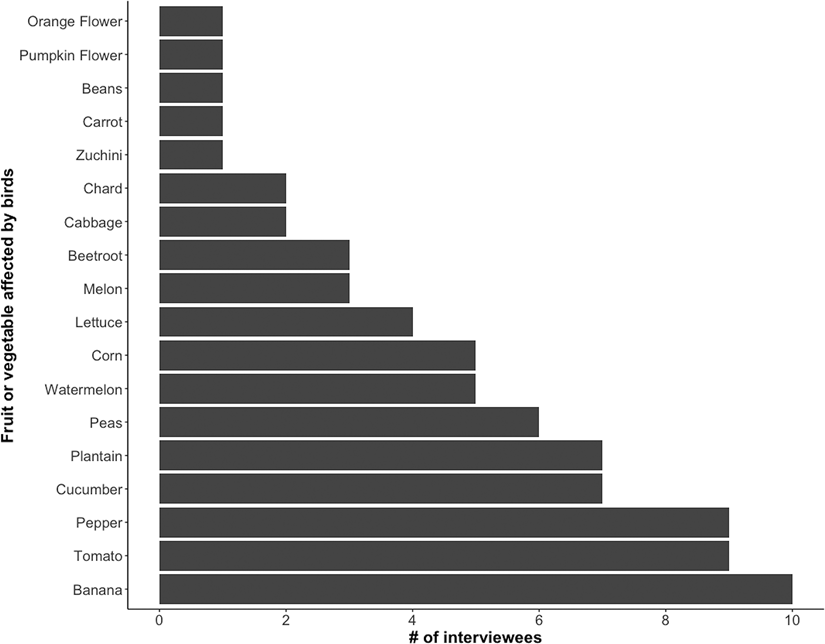
The primary way finches were reported to affect crops (n = 26) was through cutting the stem of young plants (shortly after transplantation) (69.2%). They also affected the actual fruit or vegetable (53.8%) and ate the seeds (34.6%). A common interpretation was that the finches’ ultimate objective to affect their crops was to seek water. Other ways in which finches affected crops were through eating the leaves of fruit/vegetables including eating lettuce leaves to suck out water (26.9%), and cutting off or eating the flowers of certain crops (e.g., orange and pumpkin) (11.5%). A range of crops were reported to be affected by birds with the most common being bananas, tomatoes, peppers, cucumbers and plantains (see Fig. 3).
Farmers perceived a difference in what period of the year landbirds did the most damage (n = 26; χ2 = 10.64, df = 2, P = 0.005). The period of the year in which birds most affected their crops was perceived to be during the ‘garúa’ season between April and October (61.5%). However, 15.4% of farmers did report finch disturbance predominantly during summer months (November through April, which corresponds roughly to the bird breeding season); and 19.2% said they did not know or were simply not specific.
How farmers address bird disturbances
Farmers reported using a variety of methods with varying measures of success in attempt to mitigate damage landbirds caused on their farms. The most effective protection against birds was the use of shade houses; all people that had shade houses, 29.7% of farmers interviewed (n = 37), confirmed that if covered properly, they effectively helped keep out birds and protect their crops. However, these were reported to be expensive and unaffordable for most people. Moreover, the principal reason people had shade houses was for temperature stability to allow for year-round production, not to protect against the birds; crop protection from birds was viewed by farmers as an added benefit.
The most commonly reported practices (Fig. 4) which helped prevent crop destruction (although to varying degrees) were putting (1) water (n = 7) and (2) food (n = 6; e.g., corn, yucca) for the birds to drink and eat instead of foraging on their crops. These two practices were said to lessen the damage but not prevent it. (3) The protection of seedbeds with nets (n = 6 specified during interviews, however this was observed on most farms) was reported to be extremely effective, although this only protected plants when they were very young (still vulnerable when transplanted). (4) After transplantation, the use of nets was another common practice, specifically for tomatoes, peppers and chard; five individuals reported this as being helpful and one as ineffective. A technique described as being very helpful was (5) protecting young plants when transplanted through using cones or tubes around the stem until the plants were large enough so the birds could no longer affect them (n = 4). These cones or tubes were made of various materials including plastic bowls, bottles or bamboo tubes. Specifically, one farmer stressed that through combining the use of bamboo tubes and putting out water in bowls he was able to fully mitigate all problems he used to have with the birds. (6) Another strategy used was simply to plant more to account for the number of crops one would expect to lose to the birds – respondents reported that this worked well (n = 5). Two individuals specifically observed what plants the birds preferentially fed or obtained food from and planted more of this specific crop or tree. For example, one individual planted more Scalesia as birds were seen to be feeding mostly in these endemic trees, presumably due to higher abundance of invertebrates in the tree. Another individual noticed they preferred chard to lettuce, so they planted more chard. (7) The use of surrounding dry herbs to cover the young and recently transplanted crops to hide them from the birds was another technique used – however this had limited success (n = 2). (8) Although very ineffective, walking through their crops to scare birds was another method mentioned (n = 2).
Word Cloud depicting all reported techniques farmers described they use to mitigate bird damage to crops. Responses were categorized into the groups represented in the Word Cloud and are shown by size, largest being the most commonly mentioned and smallest the least commonly mentioned, and color, each n corresponds to its own color. Levels of success reported have not been considered in this Word Cloud.

Finally, other methods reported were: (9) fumigating plants with insecticides which reportedly gives off a strong odor which birds don't like (n = 1); (10) capturing birds and removing some of their feathers before releasing them again to send a message out to the other birds not to come near (said to be quite effective but required a lot of effort) (n = 1); (11) using plastic red tapes waving in the wind; however this only worked for a few days until the birds got used to it (n = 1) and (12) using a scarecrow, which was said to be very ineffective (n = 1). Lastly, five farmers mentioned that years ago, cassette tapes were used as noisemakers to scare off the birds and were quite effective. However, seeing as cassette tapes are no longer sold, their use had subsided.
When asked if the use of poison for birds was a common practice in Santa Cruz, and if they knew if other people used it, four people said that years ago (between 1.5 and 8 years ago) poison was commonly used but currently people do not use poison for various reasons. These reasons included: unavailability of the products (n = 2), prohibition by the Agencia de Regulación y Control de la Bioseguirdad y Cuarantena para Galápagos (ABG; in English: Biosafety and Quarantine Regulation and Control Agency for Galapagos; n = 2) and poisons being ineffective (n = 3). However, some people did admit to knowing other people who still poison birds (n = 2); while others simply responded that they did not know what methods others employed (n = 3).
Use of pesticides: how farmers can be affecting birds
The use of pesticides is a common way to combat pests, predominantly ants, insects and rats, in the agricultural zone of Galapagos. In total, 94.3% of interviewees used pesticides (n = 35), with insecticides being more common than herbicides and fungicides. The most commonly used pesticides were Cyperpac ® (n = 8) and Bala ® (n = 6) against ants and caterpillars and millipedes (both) as well as Klerat ® (n = 9) and Racumin ® (n = 6) against rats. However, there was a wide variety of other pesticides mentioned including (but not limited to) Esterpac ® (n = 2), Tordon ® (n = 1) and Karate ® (n = 2). Concerningly, often people did not know or remember which pesticides they were using. When asked, people would often struggle to remember the name or try to find their pesticide bottles.
Some people displayed knowledge about the negative effects pesticides can have (i.e., some insecticides kill non-target organisms); and 23.7% of farmers said they do not use ‘many’ pesticides (n = 38), however, ‘many’ was not quantified or explained. Also, 15.8% mentioned using home remedies as well as manual clearing of weeds as effective measures of control. There were also comments about the availability of certain pesticides, such as SiegePro ® (known as Amdro ® in the USA): a pesticide used against ants which is no longer available in stores although was reported to be much more effective than current options. In total, 55.3% of farmers said that they had a problem with plagues year-round (n = 38). However, 31.6% of farmers said it varied throughout the year depending on various reasons such as the season, flowering of coffee plants and farm conditions.
General level of knowledge of landbirds
When asked if farmers could identify the finch types that affect their crops and provide descriptions (n = 21), 28.6% of interviewees either did not know or simply said ‘the finch’, 28.6% of interviewees knew there was more than one species of finch but could not provide a description, 38.1% of interviewees knew there was more than one species and attempted to give a description between the different types, and finally, only one interviewee (4.7%) showed more precise knowledge between the different species using local names and descriptions.
In response to the four different landbird pictures shown (see Methods), people were able to identify the birds correctly to varying degrees (right blue bar, Fig. 5a). Although not all knew all the birds' respective diets (left salmon bar, Fig. 5a), 81.8% of interviewees were able to correctly identify the food/crops eaten of at least three birds shown. The bird they had the most trouble identifying was the small tree-finch (C. parvulus). When adding the scores of the bird identification and food/crops eaten we calculate the overall score which we divided by the total possible score of 8 to obtain the percentage (Fig. 5b). This shows that overall, farmers had a high level of knowledge of the four different types of birds tested and how these affected their plants, since the median score was 87.5%.
Knowledge exhibited by interviewees about landbirds. Panel (a) shows bird diet and identification scores of farmers. Bird diet scores (left bar, salmon colored) reflect farmers ability to correctly identify if the species were harmful to crops or correct knowledge of what they ate. Bird identification (right bar, blue colored) reflects farmers’ ability to recognize four different landbirds species when shown an image. Panel (b) shows the overall knowledge score which was calculated through adding the bird identification score and food/crops eaten score and dividing it by the total.

We explored if there were relationships related to the knowledge farmers had about landbirds. We found there was no significant difference (KW = 1.29, df = 2, P = 0.524) between their total knowledge level and their general view of landbirds (positive, neutral, negative). That is, knowledgeable farmers were no more likely than less knowledgeable farmers to like or dislike landbirds. Secondly, farmers with more problems with finches were more knowledgeable about them (median = 87.5%) than those with less knowledge (median = 81.25%; U = 111.5, P = 0.037). Finally, there was no difference between levels of knowledge and farm types (KW = 2.54, df = 2, P = 0.282).
Farmer interest in our study
To gage the interest of Santa Cruz farmers to learn more about landbirds and help them find techniques to mitigate damage done by finches in a way that could benefit both finches and people, we asked if they would be interested in attending a discussion on this topic. A chi-square goodness of fit test revealed that farmer responses were non-random (n = 34; χ2 = 11.53, df = 2, P = 0.003). In fact, 58.8% expressed interest, 26.3% said they did not think this necessary or were not interested and 11.8% said may be they were interested.
Discussion
Landbird–farmer interactions
Overall, there was a positive or neutral view of landbirds in the agricultural community of Santa Cruz. Farmers associated landbirds with a variety of ecosystem services including cultural services (joy, aesthetic, heritage, employment), regulating services (pest control) and supporting services (soil fertilization) (Table 1; Millennium Ecosystem Assessment, 2005). These positive associations showed promise for continued future collaborations to conserve and enhance biodiversity in this area. Nevertheless, farmers also reported finches being problematic on their farms. This was due to one reason, which was consistently reported by farmers throughout the entire agricultural zone: landbirds were reported to raid crops. The main cited problems were that finches would cut the stems of young plants during germination and early maturation of crops, a similar problem encountered in other parts of the world (Bruggers et al., Reference Bruggers, Rodriguez and Zaccagnini1998; Coleman and Spurr, Reference Coleman and Spurr2001), as well as that they would affect the actual fruit or vegetable. Nevertheless, a majority positive or neutral view of landbirds despite the negative impacts of specific bird species farmers reported indicates farmers had an understanding of the complexity of the Galapagos bird community: rather than categorizing all birds as bad because of these negative effects, they either understood (1) that although some birds cause damages, there are other birds who do not whom they do appreciate; and/or (2) they valued the ecosystem services provided by birds (Table 1) over the disservices. This understanding by farmers is promising for potential future conservation work.
A noteworthy observation was that although most farms were small-scale farmers within their land use types, pasture farms were the largest followed by coffee farms, and fruit and vegetable farms were quite small. The size order follows the same order of overall perception of farmers toward landbirds where pasture and coffee farmers had no negative perception of landbirds and fruit and vegetable farmers did (as expected). This can have important implications since it means that if we wanted to target the largest percentage of land, we should target pasture farmers, who also have no current problem with landbirds. However, this claim should be strengthened with further testing due to our relatively smaller sample sizes of interviewees from predominantly coffee and pasture farms. Geladi et al. (Reference Geladi, Henry, Mauchamp, Couenberg and Fessl2021) found that planting trees, preferably forest patches, will have the largest positive effect on landbird diversity and abundance. Silvopastoral practices are also known to have positive effects for livestock such as increased shade and supplemental feed (Schroth et al., Reference Schroth, da Fonseca, Harvey, Gascon, Vasconcelos and Izac2004). Therefore, there is tremendous potential for conservation in pastoral farms in Galapagos for the following reasons: (1) they are most degraded landscapes (Geladi et al., Reference Geladi, Henry, Mauchamp, Couenberg and Fessl2021) and (2) the largest landscapes; (3) conserving landbirds through tree planting is likely to also benefit livestock and (4) pastoral farmers have no negative perception toward landbirds. However, other factors such as habitat suitability (e.g., soil fertility for reforestation) would also need to be considered.
Farmers had some knowledge about birds which is promising for conservation work as it is another way of showing interest in the nature around them and provides a basis for further developing their interest. However, most farmers could not name (even with local names) or describe the different finch species off the top of their head and generally referred to them as ‘finches’. We recognize that the knowledge score we used was a very rudimentary measure since of the four birds chosen, two are quite distinct thus easier to recognize (yellow warbler and Galapagos flycatcher), and between the more similar looking birds (small ground-finch and small tree-finch) there was no way to verify that farmers actually knew the difference. Many also reported recognizing only one sex. Nevertheless, farmers did report they knew the difference in the pictures and most were able to accurately describe their diets thus suggesting that farmers have a basic knowledge of landbirds (median score 87.5%). We further found that more knowledgeable farmers had more problems with finches, although there was no relationship between knowledge of farmers and their general view of landbirds. We think this could be due to a few reasons. First, it might be because farmers who have problems with birds pay more attention to them due to their interactions, thus become more knowledgeable. Secondly, it might be linked to farm-type where farmers who spend more time outside tending their fields, such as fruit and vegetable farmers, come into contact more frequently with landbirds thus are more knowledgeable.
When specifically asked about interest in learning more about birds and crop protection from birds, 74% of farmers expressed (potential) interest. However, these results need to be interpreted with caution as there might be some bias since the farmers interviewed had working relationships with MAG, meaning they are more inclined to be open to external collaborations, and we purposefully sampled those types of farmers.
Finally, farming in Galapagos was found to be non-intensive, diverse (no monoculture) and small-scale managed by various types of farmers (smallholders). This can facilitate our goal toward molding a more diverse working landscape (Castillo and Toledo, Reference Castillo and Toledo2006; Harvey et al., Reference Harvey, Komar, Chazdon, Ferguson, Finegan, Griffith, Martínez-Ramos, Morales, Nigh, Soto-Pinto, Van Breugel and Wishnie2008) as it has been shown that small farmers are more likely to know their land intimately, retain traditional practices and grow food for nearby consumption rather than export, which was exactly the case we found for farmers in Galapagos (Nazarea, Reference Nazarea2006; Harvey et al., Reference Harvey, Komar, Chazdon, Ferguson, Finegan, Griffith, Martínez-Ramos, Morales, Nigh, Soto-Pinto, Van Breugel and Wishnie2008). For example, almost all the labor remains manual with the only two commonly used machines being a grass cutter and a chain saw. However, this does not mean farmers will necessarily be willing to adopt conservation measures on their land, especially since small-scale farmers are often more limited in land and might thus be more hesitant to set aside non-productive land for conservation. This will likely also depend on their primary occupation as some farmers in Galapagos are also involved in other occupations such as tourism, but others are not. We thus recommend a more in-depth study of farmers' motivations and barriers to adopt conservation practices on their farms in Galapagos.
Important components for a landbird conservation plan
Planting more trees, particularly native trees, is needed to aid bird conservation in the agricultural zone of Galapagos (Geladi et al., Reference Geladi, Henry, Mauchamp, Couenberg and Fessl2021). Close collaboration with farmers and understanding farmers’ perspectives, willingness, drivers and barriers to aiding landbird conservation and planting trees on their farms is necessary to form a successful landbird conservation plan (Rare and the Behavioural Insights Team, 2019). Our study provides a basic understanding of the farmer–landbird relationship in the agricultural zone but we suggest further studies to better understand their willingness to be actively involved in landbird conservation and also in planting trees.
Furthermore, it is important to listen to farmer concerns and help them address these. In our study, farmers expressed that their main concern with landbird conservation was the damage birds caused to their crops. However, to our knowledge, damages to crops by birds have never been studied or quantified in Galapagos. This lack of knowledge also limits the possibility to assess the relevance of a compensation program for crop damages, a technique often adopted in conservation (Watve et al., Reference Watve, Patel, Bayani and Patil2016). We expect finches will cause most damage during the ‘garúa’ season, as most farmers reported (61.5%), since this is when small ground-finches stray in big groups through the island (B. Fessl, pers. obs.). However, there might be other damages to different crops happening throughout the year (depending on crop rotation cycle) which would explain the variance in farmer perception of the period of the year landbirds caused most crop damage. We highly recommend a more in-depth study on landbird disservices in the agricultural zone of Galapagos.
Current methods being used by farmers to control damage done to their crops by birds largely fell into the solution categories of ‘exclusion’ (netting and using tubes to shield plant stems) or ‘habitat manipulation’ through offering food and water as decoys and planting decoy crops (Conover, Reference Conover1982; Bomford and Sinclair, Reference Bomford and Sinclair2002). Farmers reported a wide variety of methods being used for crop protection with variable perceptions of success: some farmers described feeling helpless against bird pests while others reported they had successfully found viable solutions. We realized (and confirmed with farmers) this issue has not been spoken about and discussion of solutions and techniques between farmers was missing. We recommend organizing workshops with the MAG to facilitate knowledge sharing between farmers on bird deterrent practices. We also believe these workshops would be a good opportunity to build on farmers’ current knowledge of landbirds and provide them with tools (e.g., booklet, condensed bird guide) to learn how to identify birds which might increase interest in bird awareness and thus conservation. We further recommend methodological experimentation within farms to identify the most effective and viable techniques for farmers to better manage bird pests.
The high use of pesticides and the uncertainty with which farmers answered this question, often not remembering the name of the pesticides they used, is another important issue which needs addressing. Although agrochemicals are an important management tool on farms, pesticides can often have negative consequences on biodiversity, bird health and even human health (Boatman et al., Reference Boatman, Brickle, Hart, Milsom, Morris, Murray, Murray and Robertson2004; Geiger et al., Reference Geiger, Bengtsson, Berendse, Weisser, Emmerson, Morales, Ceryngier, Liira, Bommarco, Bretagnolle, Plantegenest, Clement, Dennis, Palmer, Juan, Fischer, Goedhart and Inchausti2010; Chiron et al., Reference Chiron, Chargé, Julliard, Jiguet and Muratet2014; Nicolopoulou-Stamati et al., Reference Nicolopoulou-Stamati, Maipas, Kotampasi, Stamatis and Hens2016; Kumar and Kumar, Reference Kumar, Kumar, Kumar, Kumar, Singh and Kumar2019). Furthermore, a recent study found a high misuse of pesticides in farms on Santa Cruz thus reducing their effectiveness (Jäger et al., Reference Jäger, Crespo, Abad, Llerena and Couenberg2019). We therefore reiterate Jäger et al.'s (Reference Jäger, Crespo, Abad, Llerena and Couenberg2019) suggestions to provide better training on pesticide use and recommend including a component to inform farmers of possible effects to them and wildlife so that spraying is applied in an effective manner only when necessary (Alavanja et al., Reference Alavanja, Sandler, Mcmaster, Zahm, Mcdonnell, Lynch, Penn, Rothman, Dosemeci, Bond and Blair1996; Boatman et al., Reference Boatman, Brickle, Hart, Milsom, Morris, Murray, Murray and Robertson2004).
Conclusion
Our study provides a fundamental insight into the social-ecological context of farmer–landbird relationships in Santa Cruz Galapagos, which can be used to inform and build off for further studies. Overall, there was a positive interest among farmers in Santa Cruz to learn more about Galapagos landbirds and aid their conservation. This implies there is promise in working together with stakeholders toward designing and implementing effective landbird conservation actions in the agricultural zone of Santa Cruz. Given our findings, we recognize the benefit of, and call for, continued research to: (1) understand the socio-economic implications of bird damages to farmers; (2) address non-bird pest issues, such as with the coffee borer beetle. There are limited studies which examine both insects and bird activity in agroecosystems despite many linkages between the two (Peisley et al., Reference Peisley, Saunders and Luck2015). Future studies should assess the perceived and actual ranking of bird damages relative to all other damages (e.g., extreme weather events, introduced insects, beetle). We recognize the need for such a study in the agricultural zone of Galapagos, as the economics will be closely tied and damage to crops from insects might be of bigger concern to some farmers than birds; (3) quantify and more deeply understand the ecosystem services and disservices landbirds may provide to farmers. Such a study would help understand the greater role landbirds play in the agricultural zone, could help motivate farmers and could help identify possible conservation measures. For example, to identify appropriate bird exclusion measures which will provide positive results (e.g., netting vs protective tubes), we also need to understand ecosystem services other landbirds may be providing which may be affected by this exclusion (e.g., pest control); and (4) lastly, a more in-depth understanding of farmers willingness to participate in landbird conservation and their willingness to plant trees in the agricultural zone, and drivers and barriers thereof, is needed to appropriately integrate their vision and collaboration in a conservation project in the agricultural zone.
Supplementary material
The supplementary material for this article can be found at https://doi.org/10.1017/S1742170522000229
Acknowledgments
We gratefully acknowledge the assistance of the Ministerio de Agricultura y Ganadería, particularly René Ramirez, Toño Rueda and Ricky Tenorio. We thank David Anchundia, Heinke Jäger and Carolina Carrión from the Charles Darwin Foundation. We also thank the 38 interviewees who made this study possible. The research was supported by the Charles Darwin Foundation and Erasmus Mundus through the TROPIMUNDO Program Country Scholarship. Further funding came from Galápagos Conservancy, International Community Foundation with a grant awarded by The Leona M. and Harry B. Helmsley Charitable Trust and Lindblad Expeditions-National Geographic. This study was part of the Galápagos Landbird Plan, implemented jointly by the Charles Darwin Foundation and the Galápagos National Park Directorate with the permit PC-01-18. This publication is contribution number 2463 of the Charles Darwin Foundation for the Galapagos Islands. We gratefully acknowledge the Charles Darwin Foundation and the Galapagos National Park for their collaboration.
Author contributions
Ilke Geladi: conceptualization, methodology, formal analysis, investigation, visualization, writing – original draft preparation. Pierre-Yves Henry: conceptualization, writing – review and editing, supervision. Paulina Couenberg: conceptualization, investigation, project administration. Rick Welsh: methodology, writing – review and editing, supervision. Birgit Fessl: conceptualization, methodology, writing – review and editing, supervision.
Financial support
This study was funded by Galapagos Conservancy, International Community Foundation with a grant awarded by The Leona M. and Harry B. Helmsley Charitable Trust and Lindblad Expeditions-National Geographic as well as the TROPIMUNDO Program Country Scholarship. Funding sources were not involved in study design, writing or submission of article for publication.
Conflict of interest
The authors declare that they have no known competing financial interests or personal relationships that could have appeared to influence the work reported in this paper.


 Open access

