




Non-technical Summary
Predators regularly attack their prey unsuccessfully, but the cause of failure is often difficult to determine in the fossil record. We report on drill holes in the shells of two Neogene bivalves from the Netherlands in which the drilling gastropod predators did not make effective use of their sensory capabilities to distinguish dead from live prey. These holes, which we call reverse drill holes, were produced from the inner side of the bivalve prey's shell. We propose that chemical cues from live prey directly around the dead shell stimulated the gastropods to make these mistakes. Hunger is another hypothesis for reverse drilling behavior. These holes are the earliest documented instances of reverse gastropod drill holes in the fossil record. In the two assemblages examined, reverse drill holes are rare, accounting for less than 1% of all drill holes, in contrast to other forms of unsuccessful predation, such as incomplete drill holes and multiply-drilled specimens. This finding suggests that the predator's sensory and decision-making processes were typically effective at differentiating between live and dead prey.
Introduction
Attacks by predators are commonly unsuccessful. For example, in a study across a wide variety of animals, only 19% of prey species were attacked by predators with an efficiency of 90% or more (Vermeij, Reference Vermeij1982). A failed attack could be due to: (1) interruption by other predators and competitors or abiotic factors; (2) escape due to the prey's active or passive defense mechanisms (Klompmaker et al., Reference Klompmaker, Kelley, Chattopadhyay, Clements, Huntley and Kowalewski2019, for review); and/or (3) poor decision-making by the predator in selecting the prey individual or the site of attack (= mistaken predation). Distinguishing among these factors to infer the cause of failure is often difficult.
One predator-prey system in which unsuccessful attacks can be readily quantified in modern and ancient ecosystems is predatory gastropods drilling a variety of shelly prey (e.g., Kabat, Reference Kabat1990; Kowalewski, Reference Kowalewski1993, table 1; Kelley and Hansen, Reference Kelley, Hansen, Kelley, Kowalewski and Hansen2003; Klompmaker et al., Reference Klompmaker, Portell, Lad and Kowalewski2015, and references therein). Examples of failed predation by naticid and muricid predators include incomplete drill holes and specimens with multiple drill holes. From the Cretaceous and Cenozoic record in the US Coastal Plain, the percentage of drilled specimens that have more than one drill hole present ranges from 0–15%, whereas the percentage of drill holes that do not completely penetrate the prey's shell varies from 1–20% for large samples (Kelley et al., Reference Kelley, Hansen, Graham and Huntoon2001; Kelley and Hansen, Reference Kelley and Hansen2006). Similar occurrences were found for other Meso-Cenozoic drilling predator systems (e.g., Sawyer and Zuschin, Reference Sawyer and Zuschin2010, Reference Sawyer and Zuschin2011; Mondal et al., Reference Mondal, Goswami and Bardhan2017; Harper et al., Reference Harper, Crame and Sogot2018; Goswami et al., Reference Goswami, Das, Bardhan and Paul2021; Karapunar et al., Reference Karapunar, Werner, Simonsen, Bade, Lücke, Rebbe, Schubert and Rojas2023).
The causes for failed drilling attacks can be manifold. Prey shell thickness is a primary factor because a predator might not be physically able to drill through a shell that is thicker than the maximum drilling depth capacity of the predator (Carriker and Van Zandt, Reference Carriker, Van Zandt, Winn and Olla1972). Disturbance of the drilling process by competitors (Chattopadhyay and Baumiller, Reference Chattopadhyay and Baumiller2007; Hutchings and Herbert, Reference Hutchings and Herbert2013), effective escape behavior of the prey (Kitchell et al., Reference Kitchell, Boggs, Rice, Kitchell, Hoffman and Martinell1986), or abiotic factors such as storms can also result in incomplete drill holes. Multiply-drilled specimens with complete and/or incomplete drill holes might be related to predators not always initiating the drilling process in already existing holes (but see Carriker, Reference Carriker1955, and Brown and Alexander, Reference Brown and Alexander1994, for muricids).
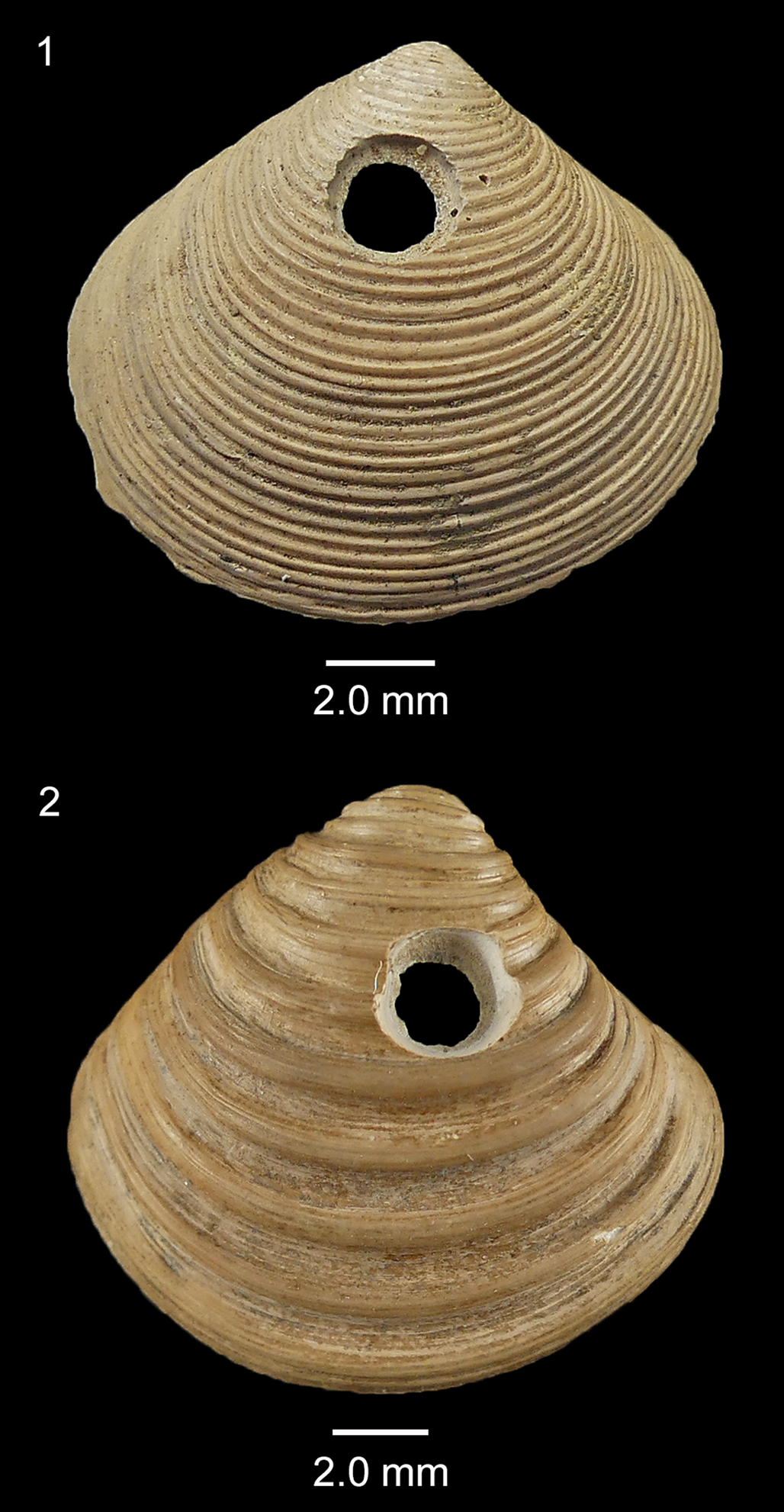
Drill holes penetrating the prey's shell from the inside out, which we call reverse drill holes, are highly remarkable instances of unequivocal failure for which only the predator is responsible (i.e., mistaken predation). Although cylindrical drill holes are known (Oichnus simplex Bromley, Reference Bromley1981), the diameter of many gastropod-produced drill holes is larger on the starting side of the drill hole for holes fully penetrating the shell (e.g., Kabat, Reference Kabat1990, and many more), normally the outer shell surface for bivalves (Fig. 1) and many other shelly invertebrates. In such cases, it is easy to infer from which side—the inside or the outside of the shell—the drill hole was produced. Occasional descriptions of such reverse drill holes attributed to gastropods have been briefly mentioned for modern bivalves (Carriker, Reference Carriker1955; Hancock, Reference Hancock1959; Dietl and Alexander, Reference Dietl and Alexander1995; see also Jansen, Reference Jansen2019, for an example of a possible reverse drill hole in a Miocene pectinid bivalve attributed to an octopodoid attack). Here, we present the first report of reverse gastropod drill holes in the fossil record, quantify their commonness relative to other types of failed drilling predation, and discuss the identity of the predators and why they might have produced such holes.
Bivalves with common gastropod drill holes attributable to Oichnus paraboloides Bromley, Reference Bromley1981, produced from the outside (convex side) of the shell. (1) A valve of Astarte incerta Wood, Reference Wood1850, from the lower Pliocene Oosterhout Formation of Langenboom in the Netherlands (MAB 14080) exhibiting a naticid drill hole. (2) A valve of Astarte goldfussi Hinsch, Reference Hinsch1952, from the lower to middle Miocene Miste Bed (Aalten Member, Breda Formation) of Miste in the Netherlands (RGM.607538.c) exhibiting a naticid drill hole.
Materials and methods
The two bivalve specimens discussed in this study were discovered by chance while studying the Langenboom and Miste assemblages for different paleoecological purposes (Klompmaker, Reference Klompmaker2009; Klompmaker and Kelley, Reference Klompmaker and Kelley2015). The Langenboom (or Mill) sandpit (51.701°N, 5.7491°E; WGS84) in the Netherlands has yielded mollusks of mostly early Pliocene age assigned to the Oosterhout Formation (Wijnker et al., Reference Wijnker, Bor, Wesselingh, Munsterman, Brinkhuis, Burger, Vonhof, Post, Hoedemaekers, Janse and Taverne2008; Klompmaker, Reference Klompmaker2009). We examined drilled valves of a Pliocene bivalve assemblage consisting of 2,241 valves (including 341 valves of Astarte incerta Wood, Reference Wood1850), reposited in the Oertijdmuseum that were collected by AAK in ca. 2006 via controlled sampling using an inner sieve mesh size of 2.5 mm (Klompmaker, Reference Klompmaker2009, table 1). For the Miste locality near Winterswijk in the Netherlands, we examined a sample of A. goldfussi Hinsch, Reference Hinsch1952, valves collected by Arie W. Janssen in 1971 at the Miste-1 (Berenschot) excavation (51.935°N, 6.670°E; WGS84) from the lower to middle Miocene (Hemmoorian = upper Burdigalian to lower Langhian) sediments assigned to the Miste Bed, Aalten Member, Groote Heide Formation (personal communication to AAK, Ronald Pouwer, 8 January 2024; Van den Bosch et al., Reference Van den Bosch, Cadee and Janssen1975; Janssen, Reference Janssen1984; Munsterman et al., Reference Munsterman, Van den Bosch, Wesselingh, Helwerda and Busschers2024). Specimens of A. goldfussi originated from the Hiatella arctica acme Biozone or the base of the Astarte radiata acme Biozone within the Miste Bed. Because the A. goldfussi specimens were part of the Naturalis Biodiversity Center collection prior to our study, the precise collecting method used is unknown to us, but the presence of 2–3 mm sized valves in the sample suggests the use of a sieve with a small mesh size. All ~2,000 valves checked for drill holes came from one sample of A. goldfussi (RGM.607538) from which the specimen with the reverse drill hole was split and given a new museum number.
To estimate how common reverse drill holes are, we divided the number of reverse drill holes in each sample by the total number of drill holes for the whole bivalve assemblage (Langenboom only) and separately for the species in which the reverse drill hole occurred. We also evaluated the rarity of reverse drill holes relative to other types of failed drilling predation in bivalves, e.g., multiply-drilled specimens and incomplete drill holes for the two assemblages. We calculated the percentage of all drill holes that occurred in multiply drilled specimens (= MULT; Kelley et al., Reference Kelley, Hansen, Graham and Huntoon2001) and that were incomplete (= prey effectiveness; Vermeij, Reference Vermeij1987). The results for MULT are minimum estimates because missing matching valves could have contained a drill hole. For all analyses, we used prey valves with entire to near entire margins to be able to observe all drill holes, and we focused on circular drill holes (Oichnus paraboloides Bromley, Reference Bromley1981, and O. simplex) inferred to be of gastropod origin; one oval hole (O. ovalis Bromley, Reference Bromley1993) inferred to be produced by an octopodoid in Astarte goldfussi (RGM.607538.d) was excluded. Drilled valves were cleaned as needed to assess whether drill holes were complete or incomplete.
Repositories and institutional abbreviations
The figured specimens and the restudied assemblages are reposited in the Oertijdmuseum (Boxtel, The Netherlands, MAB) and the Naturalis Biodiversity Center (Leiden, The Netherlands, RGM).
Results
Pliocene specimen
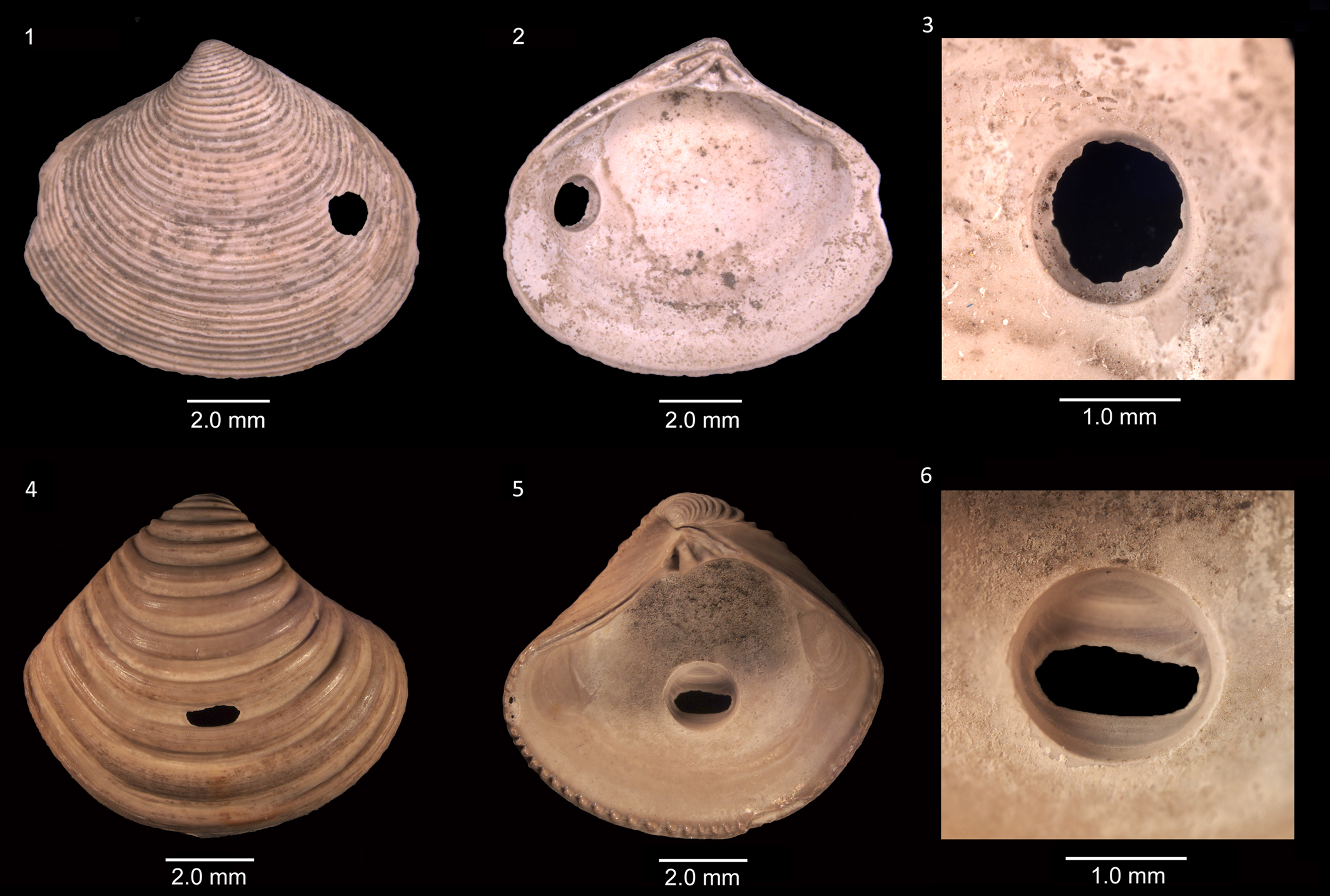
Drill holes produced from the outside of the prey's shell are commonly found in Astarte incerta (see Klompmaker, Reference Klompmaker2008, figs. 4, 8–10) from the Langenboom assemblage, but one specimen of this species contains a reverse drill hole: the largest diameter of the drill hole (1.4 mm) is found on the inner side of the shell (Fig. 2.1–2.3). The parabolic cross-sectional shape is best classified as Oichnus paraboloides.
(1–3) A valve of Astarte incerta Wood, Reference Wood1850, from the lower Pliocene Oosterhout Formation of Langenboom in the Netherlands (MAB 4685) exhibiting a reverse naticid drill hole. Views: outer (1), inner (2), and detail (3). (4–6) A valve of Astarte goldfussi Hinsch, Reference Hinsch1952, from the lower to middle Miocene Miste Bed (Aalten Member, Breda Formation) of Miste in the Netherlands (RGM.783230) exhibiting a reverse drill hole. Views: outer (4), inner (5), and detail (6).
The percentage of reverse drill holes of all drill holes is 0.6% (1/156) for Astarte incerta and 0.3% (1/341) for the whole bivalve assemblage (see Appendix 1). The percentage of drill holes that occurs in multiply-drilled specimens is 2.6% (4/156) in A. incerta and 1.8% (6/341) for the whole bivalve assemblage. Incomplete drill holes make up 1.3% (2/156) of drill holes in A. incerta and 2.1% (7/341) for the whole bivalve assemblage.
Miocene specimen
Specimens of the bivalve Astarte goldfussi from the Miste locality regularly exhibit a drill hole produced from the outside of the shell (Klompmaker and Kelley, Reference Klompmaker and Kelley2015, fig. 1c–f). However, one specimen of A. goldfussi contains a reverse drill hole that is 1.65 mm wide (Fig. 2.4–2.6), assigned to Oichnus isp. indet. An obvious beveled edge cannot be found at the widest diameter of the drill hole. The central part of the wall appears straight. Because the drill hole does not completely penetrate the shell, the morphology of the lower portion of the drill hole might not be indicative of the morphology of a complete drill hole, hampering assignment to an ichnospecies.
The following data (see also Appendix 1) pertain to Astarte goldfussi only because bivalve assemblage-level data were not obtained because sampling strategies are unknown. The percentage of reverse drill holes of all drill holes is 0.3% (1/305), the percentage of all drill holes that occurs in multiply-drilled specimens is 5.2% (16/305), and incomplete drill holes make up 10.8% (33/305) of drill holes.
Discussion
Identity of the reverse drill-hole producer
Among drilling gastropods, Klompmaker (Reference Klompmaker2009) only found naticids in the studied Langenboom samples, with nearly all drill-hole traces preserved in co-occurring shell-bearing invertebrate prey also having been attributed to naticids (Klompmaker, Reference Klompmaker2009, Reference Klompmaker2011, Reference Klompmaker2012; Klompmaker et al., Reference Klompmaker, Karasawa, Portell, Fraaije and Ando2013). Naticids usually plough through the sediment (Kabat, Reference Kabat1990; Kelley and Hansen, Reference Kelley, Hansen, Kelley, Kowalewski and Hansen2003), although they can be found on the surface occasionally (Kelley and Hansen, Reference Kelley, Hansen, Kelley, Kowalewski and Hansen2003; Pahari et al., Reference Pahari, Mondal, Bardhan, Sarkar, Saha and Buragohain2016). Astartids are also known to be (shallow) burrowers (e.g., Seilacher, Reference Seilacher1990; Damborenea and Manceñido, Reference Damborenea and Manceñido2005). Thus, the habitat overlap of Astarte incerta and naticids, the abundance of naticids in the assemblage, and the parabolic cross-sectional shape of the drill hole combined suggest that the reverse drill hole is highly likely to be of naticid origin, and represents the first report of this behavior in the family.
Specimens of Astarte goldfussi most likely were shallow, infaunal burrowers vulnerable to both muricids and naticids, both abundantly present in the Miocene sediments at Miste (Janssen, Reference Janssen1984). Muricids are epifaunal drillers, although they also can shallowly dig for prey (Kelley and Hansen, Reference Kelley, Hansen, Kelley, Kowalewski and Hansen2003). The incompleteness of the drill hole, the fact that muricid and naticid drill holes can have overlapping morphologies (compare Kitchell et al., Reference Kitchell, Boggs, Kitchell and Rice1981, fig. 5 and Radwin and Wells, Reference Radwin and Wells1968, figs. 12–18), and the abundance of muricids and naticids in the same assemblage precludes attribution of this reverse drill hole to a particular gastropod group.
First fossil reverse gastropod drill holes
Some reports briefly mentioned reverse gastropod drill holes in extant bivalves. Dietl and Alexander (Reference Dietl and Alexander1995) reported on an empty valve of the bivalve Chione elevata (Say, Reference Say1822) with a reverse drill hole. Hancock (Reference Hancock1959) briefly mentioned that rare reverse drill holes, probably produced by Urosalpinx cinerea (Say, Reference Say1822), were found among well-stocked beds of oysters, probably Ostrea edulis Linnaeus, Reference Linnaeus1758. Finally, Carriker (Reference Carriker1955) described that the muricid oyster drill U. cinerea sometimes missed living oysters—probably Crassostrea virginica (Gmelin, Reference Gmelin and Gmelin1791)—and drilled instead into empty shells beneath, perhaps producing reverse drill holes. The specimens herein showcase the first instances from the fossil record of this gastropod behavior.
Possible reasons for reverse drill holes
Why did some gastropods drill from the inner side of the shell? Carnivorous gastropods locate their food through chemical cues in the water column (chemoreception) and mechanoreception, making use of vibrations to detect prey (e.g., Carriker, Reference Carriker1955; Morton, Reference Morton1960; Kohn, Reference Kohn1961; Kitching and Pearson, Reference Kitching and Pearson1981; Croll, Reference Croll1983; Chase, Reference Chase2002). Because the specimens herein were dead when drilled, mechanoreception to locate these shells can be excluded. One explanation for the occurrence of reverse drill holes could be that ill or diseased predators lost their capability to distinguish live from dead prey. This hypothesis is, however, unlikely because observations of dying naticids under experimental conditions indicate that they usually do not drill, probably because the drilling process is metabolically costly (personal observation, GPD, 2015). Chemical cues from nearby living potential prey could serve as an explanation. Based on the reports by Carriker (Reference Carriker1955) and Hancock (Reference Hancock1959), Carriker and Yochelson (Reference Carriker and Yochelson1968) hypothesized that the high amount of ectocrines (chemical cues released into the environment) and the close proximity of valves of many different oyster specimens could explain the reverse drill holes made by muricids in oyster valves. Similarly, Carriker and Van Zandt (Reference Carriker, Van Zandt, Winn and Olla1972) mentioned that an oyster drill (Muricidae) can penetrate the valve of a dead oyster when triggered by a chemical cue escaping from the gaped valves of an actively feeding prey individual. Although the reverse-drilled astartid valves described herein did not live in clusters of cemented specimens like some oysters do, the density of astartid specimens within the bottom can be high today (up to a few hundreds of individuals/m2; e.g., Sejr et al., Reference Sejr, Jensen and Rysgaard2000; Skazina et al., Reference Skazina, Sofronova and Khaitov2013) and was likely high too for the studied assemblages because of the high relative abundance of astartids in the bivalve assemblages of Langenboom and Miste (Janssen, Reference Janssen1984; Klompmaker, Reference Klompmaker2009). Therefore, we hypothesize that well-mixed chemical cues emanating from dense aggregations of living prey could have confused foraging predators (i.e., interfered with their search behavior) and stimulated them to initiate the drilling process on empty valves.
Although the chemosensory searching capacity for prey by drilling predators might have been hindered by well-mixed prey chemical cues, shifting to secondary sensory cues (e.g., tactile information) to make prey choice decisions does not seem to have offset such effects. Predators did not detect the smooth surface (relative to the ornamented outer side) and concave shape of the inner side of the prey's valve, which would have been a tactile cue signaling that the prey was dead and should be abandoned (assuming predators were adapted to differentiate between shell shapes). Still, the relative value of a secondary stimulus in eliciting a drilling response in the predator might also depend upon context. For instance, predators might use tactile information differently based on internal context (e.g., motivation). Given the slow drilling rate of 0.01–0.02 mm/hr for modern naticid and muricid drillers (Carriker, Reference Carriker1955; Carriker and Van Zandt, Reference Carriker, Van Zandt, Winn and Olla1972; Kitchell et al., Reference Kitchell, Boggs, Kitchell and Rice1981; Chattopadhyay and Baumiller, Reference Chattopadhyay and Baumiller2009), instances of mistaken predation were costly energetically. If a drilling predator was strongly motivated to undergo the energetically costly and time-consuming process of acquiring food due to hunger, it might have made decisions more rapidly and relied less on secondary tactile cues when a primary cue (i.e., chemical information) was obscured or unavailable. This scenario presents an alternative (albeit not mutually exclusive) hypothesis to explain reverse drilling behavior. However, we stress that reverse holes were rare in the two assemblages studied (< 1% of drill holes), implying that the driller's sensory and decision-making processes were generally reliable at distinguishing dead from live prey. The rarity of such reverse drill holes refutes claims that naticids cannot distinguish between live and dead specimens (Hoffman et al. Reference Hoffman, Pisera and Ryszkiewicz1974; Stanton and Nelson Reference Stanton and Nelson1980; Pek and Mikuláš, Reference Pek and Mikuláš1996, p. 112). Instead, more support is found for Kitchell et al. (Reference Kitchell, Boggs, Rice, Kitchell, Hoffman and Martinell1986, p. 297), who argued that “naticid predators can readily distinguish live prey from empty shells,” but with some exceptions.
Comparison to other types of failed drilling predation
Various authors have reported on multiply-drilled specimens and incomplete drill holes in mollusks produced by predatory gastropods in study systems from different regions and geological ages (e.g., Kelley et al., Reference Kelley, Hansen, Graham and Huntoon2001; Kelley and Hansen, Reference Kelley and Hansen2006; Sawyer and Zuschin, Reference Sawyer and Zuschin2010, Reference Sawyer and Zuschin2011; Mondal et al., Reference Mondal, Goswami and Bardhan2017; Harper et al., Reference Harper, Crame and Sogot2018; Goswami et al., Reference Goswami, Das, Bardhan and Paul2021). Although there are exceptions (see Kelley and Hansen, Reference Kelley, Hansen, Kelley, Kowalewski and Hansen2003; Chattopadhyay and Baumiller, Reference Chattopadhyay and Baumiller2007; Hutchings and Herbert, Reference Hutchings and Herbert2013), such holes are often considered as evidence of failed predation (e.g., Vermeij, Reference Vermeij1987; Kelley and Hansen, Reference Kelley, Hansen, Kelley, Kowalewski and Hansen2003). Multiply-drilled specimens and incomplete drill holes that represent evidence of failed predation do not always equate to mistaken predation by the predator as for reverse drill holes. Incomplete drill holes are mistakes if a predator selected a prey too large for it to handle or too thick to penetrate, but not if a driller was interrupted by another predator or by an environmental disturbance (e.g., storm). The creation of a second drill hole in a prey shell would be the predator's mistake if the prey shell was empty, having already been drilled by another predator or if the same driller abandoned its initial drilling site and started another drill hole, but not if a driller was interrupted by a competitor that initiated drilling at another site. Unfortunately, it is difficult to quantify what proportions of incomplete drill holes and drill holes in multiply-drilled specimens represent mistaken predation attempts. However, the commonness of these types of predation relative to reverse drill holes within the same assemblages indicates that reverse drill holes likely are rarer than mistaken predation via incomplete drill holes and holes in multiply-drilled specimens for both assemblages.
Another type of unequivocal mistaken predation was reported from the Langenboom locality previously. Gaemers and Langeveld (Reference Gaemers and Langeveld2015) attributed very low percentages of incomplete drill holes (generally < 0.4% of all otoliths within large samples) found in fish otoliths to naticids that mistook them for tellinid bivalves initially, then discovered their mistake and aborted all drill holes well before full penetration. This value is comparable to the frequency of reverse drill holes that we report herein.
The occurrence of reverse drill holes in bivalve prey begs the question of whether complete drill holes that were initiated through the outer side of valves by predators could also have been produced in already dead bivalves. Such instances of mistaken predation, although probably uncommon like reverse drill holes, would be considered successful drill holes when studying death and fossil assemblages. Unlike reverse drill holes, however, identification of such behavior solely from the dead, empty remains of drilled prey is not possible. If such behavior is confirmed with observations of living predator-prey interactions, some drilling intensities might have been slightly overestimated when interpreted as successful predation.
Future research on reverse drill holes could focus on when such holes first appeared in the fossil record; their frequency through time, also relative to other types of failed predation within assemblages; and/or whether such holes are restricted to prey taxa living in dense aggregations.
Conclusions
Drill holes initiated from the inner side of the shell were found in two Plio- and Miocene bivalves from the Netherlands. These holes represent the first examples of reverse gastropod drill holes from the fossil record.
Predatory gastropods mistakenly produced these reverse drill holes by not making effective use of the senses of chemoreception and mechanoreception. We hypothesize that chemical cues from living specimens directly around empty valves and/or hunger could have stimulated the drilling predators to initiate these reverse drill holes.
Reverse drill holes are rare in the two assemblages studied (< 1% of drill holes), less frequent than other types of failed predation (incomplete drill holes and drill holes in multiply-drilled specimens in the same assemblages). This result implies that the driller's sensory and decision-making processes were generally reliable at distinguishing dead from live prey.
Acknowledgments
We thank G. Cadée (Royal Netherlands Institute for Sea Research, The Netherlands) for reading a very early draft of the manuscript. Museum collection access and museum numbers were provided by R. Pouwer of the Naturalis Biodiversity Center (Leiden, The Netherlands) as well as J. Wallaard and R. Fraaije of the Oertijdmuseum (Boxtel, The Netherlands). We thank Naturalis Biodiversity Center via F. Wesselingh and R. Pouwer for providing equipment for specimen photography. We thank S. Gordillo (Universidad Nacional de Córdoba, Argentina), E. Harper (Cambridge University, England), B. Karapunar (University of Leeds, England), and P. Kelley (University of North Carolina Wilmington, USA) for very useful reviews of an earlier draft.
Declaration of competing interests
The authors declare none.
Data availability statement
Data available (Appendix 1) from the Zenodo Digital Repository: https://doi.org/10.5281/zenodo.12574952.


 Open access

