


Archaeologists interested in early Americans have known of the Powars II site (48PL330) since the late 1980s because it is a rich source of high-quality red ocher, a mineral that appears frequently in early North American sites, and contains rare artifacts such as beads and incised bone, as well as a remarkable abundance of early Paleoindian spear points, stone tools, and worked bone (Morrow Reference Morrow and Trubitt2016; Stafford et al. Reference Stafford, Frison, Stanford and Zeimens2003). Archaeologists were excluded from the privately owned site for the past 25 years, so Powars II has remained an intriguing but poorly understood Paleoindian archaeological site. However, a change in ownership allowed fieldwork to resume between 2014 and 2016, which resulted in the salvage of around 7,000 artifacts eroded from the intact portion of the site. This study presents insights gained from Powars II after these salvage excavations. We find that (1) the assemblage is dominated by Clovis points typical of the far Northern Plains and that almost all of them exhibit damage typical of use during hunts; (2) the biface and flake assemblages are characteristic of Clovis preform production, confirming that weaponry was produced on the site; (3) the site contains a previously unrecognized blade industry from which large flake tools were produced; (4) we can now present the first radiocarbon ages from the site, determined directly from two bone tools; and (5) the site contains a previously unknown toolstone source buried beneath historic fill only 130 m from the Powars II site from which many of the Clovis points and blades were produced.
Background on the Powars II Site and Recent Salvage Excavations
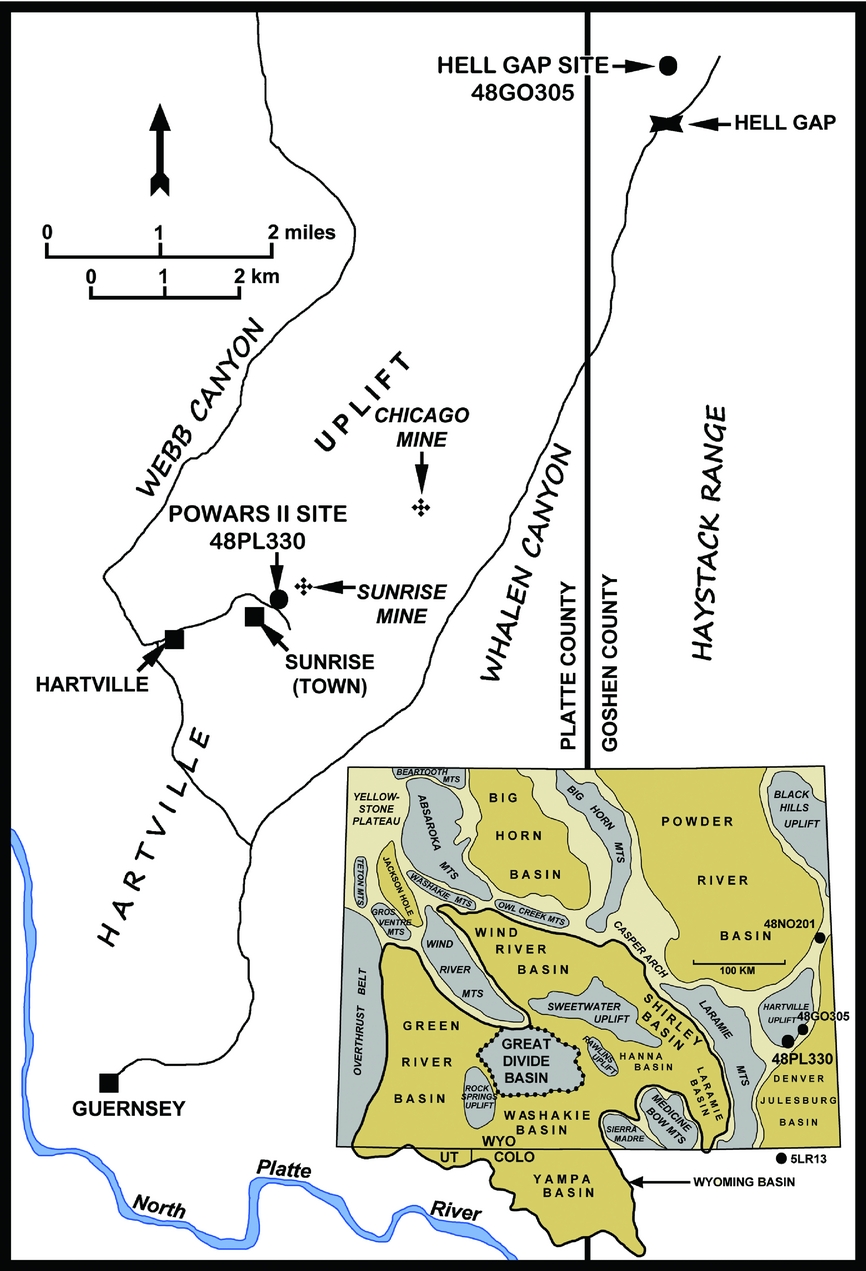
Red ocher is present in a relatively large number of early Paleoindian sites in North America, and the Powars II site (48PL330), located in the Hartville Uplift of southeast Wyoming (Figure 1), is the only known source of red ocher associated with Paleoindian artifacts (Stafford et al. Reference Stafford, Frison, Stanford and Zeimens2003; Tankersley et al. Reference Tankersley, Tankersley, Shafer, Hess, Benz, Rudolph Turner, Stafford, Zeimens and Frison1995). The circumstances surrounding the discovery of Powars II are summarized elsewhere (Stafford et al. Reference Stafford, Frison, Stanford and Zeimens2003). In short, after being collected by Wayne Powars in the early twentieth century and revealed to archaeologists in the 1980s, the site was almost destroyed during mine reclamation in 1986 (Figure 2a) but was saved in part by efforts of archaeologists, who briefly documented the site over several days in 1986.
Uplifts and basins in Wyoming and location of the Powars II Paleoindian red ocher quarry (48PL330) in the Hartville Uplift.
(a) Location of the Powars II red ocher quarry relative to earthmoving equipment on the day of the initial site visit by archaeologists in 1986. (b) View to the west at the Powars II site in July 1986 from the valley bottom. Arrow points to the 1-×-2-m test made at that time. (c) Schematic annotation of panel b denoting major surface characteristics at Powars II.

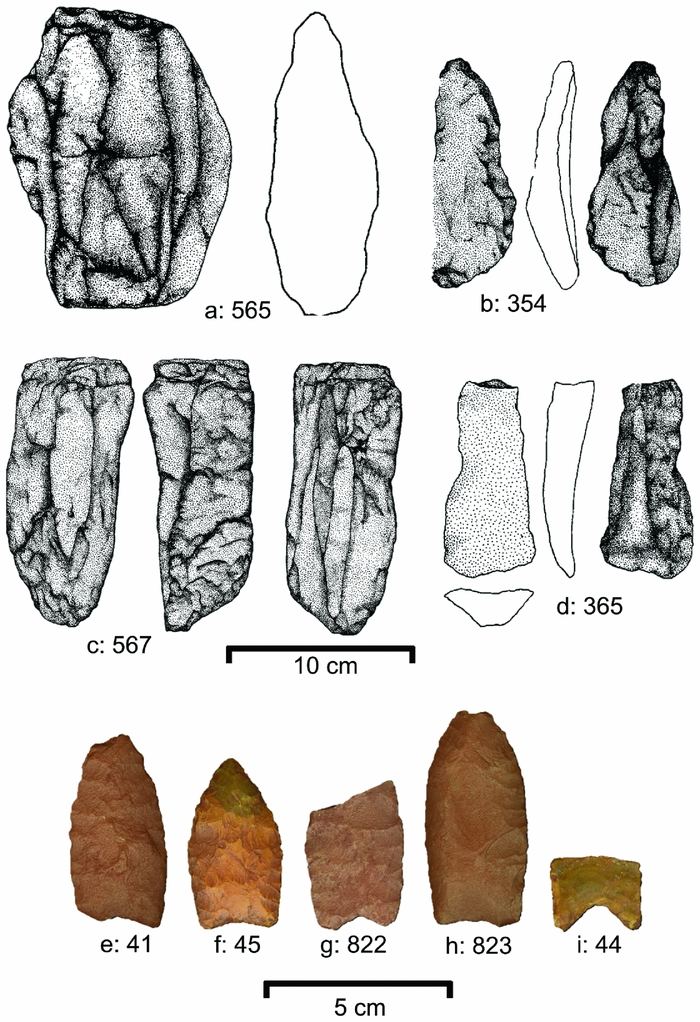
Most previously known artifacts were collected from the redeposited surface below the intact portion of the site in 1986. Frison and others placed a 1 × 2 m trench on the east side of the intact portion of the site in 1986 (arrow in Figure 2b; Stafford et al. Reference Stafford, Frison, Stanford and Zeimens2003:Figure 3), confirming the presence of intact deposits containing diagnostic Clovis artifacts (Figure 3d–g, i) of a little over a meter deep that lie directly on sloping schist bedrock (Figure 2b). Additionally, Stanley Ahler noticed a Clovis projectile point partially exposed in the profile of the 1986 test trench during a brief site visit in 1988 (Figure 3h). Until recent (2017) excavations (not reported here), the artifacts in Figure 3 were the only diagnostic artifacts recovered from the intact portion of the site.
(a, c) Blade cores, (b, d) blades, and (e–i) Clovis points recovered in the 1986 1 × 2 m test (a–d illustrations by Tyson Arnold). Catalog numbers noted.
We began our reinvestigation in 2014 with salvage excavation to recover all artifacts known to be out of context before further investigation of the remaining in situ deposits. Salvage work first involved the removal of vegetation on the talus slope below the site and along the north edge of the roadbed below the site (Figure 2c). We then screened all redeposited talus deposits through 1/4-inch mesh until reaching bedrock or the modern surface of the valley floor. The eroded deposits have likely been disturbed many times by various historic activities on the valley floor after their initial removal from in situ deposits. Attesting to this, salvage excavations revealed diagnostic Paleoindian artifacts interspersed with historic glass, metal, sawed bone, and other historic detritus. Most notably, we found a Clovis point inside a historic mine adit revealed through salvage excavation.
The 2014–2016 salvage excavations yielded around 7,000 artifacts from an area of around 350 m2 and in places over a meter deep. The work produced projectile points diagnostic of Clovis, Goshen, Folsom, Midland, Agate Basin, Hell Gap, and Alberta cultural complexes along with a large tool and flake assemblage that for the most part cannot be assigned to specific Paleoindian cultural complexes. Clovis artifacts dominate the diagnostic cultural material.
The Clovis Projectile Point Assemblage
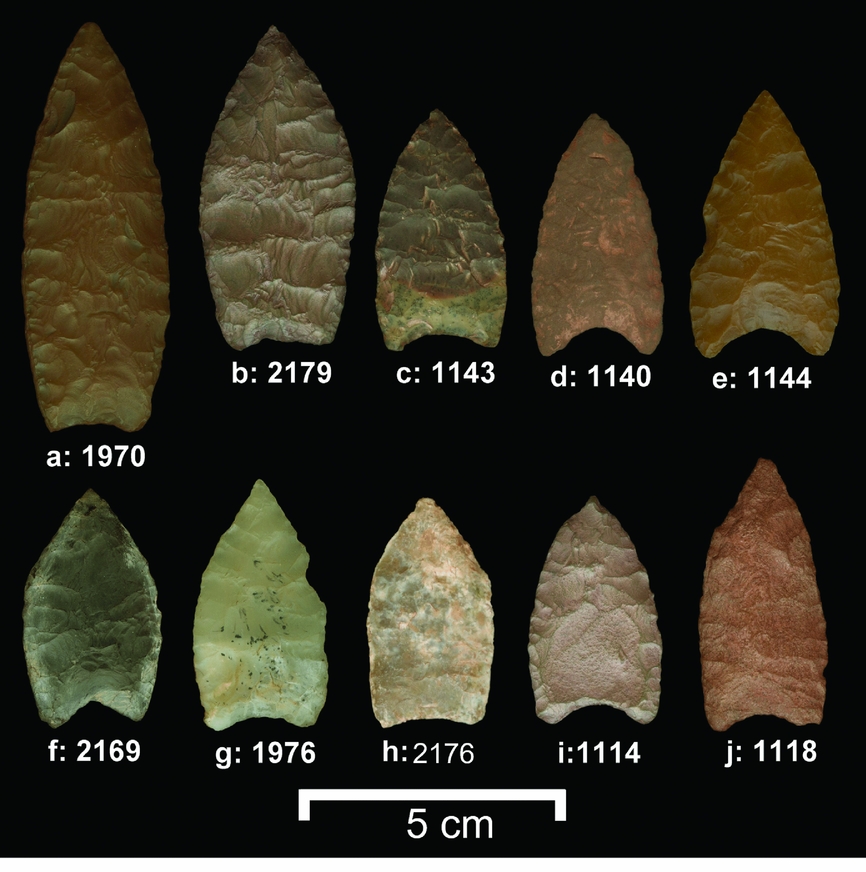
Salvage excavations at Powars II produced a total of 53 Clovis projectile points (e.g., Figures 4 and 5), in addition to the five recovered during the 1980s. Wayne Powars collected at least six other Clovis points (Stafford et al. Reference Stafford, Frison, Stanford and Zeimens2003:Figure 4a–e). In this section, we summarize the Powars II Clovis points, first, in terms of their morphological affinities to other early Paleoindian points and, second, in terms of the distinctive types of damage observed on the Powars II points.
(a–j Clovis points recovered during salvage excavations between 2014 and 2016. Catalog numbers noted.
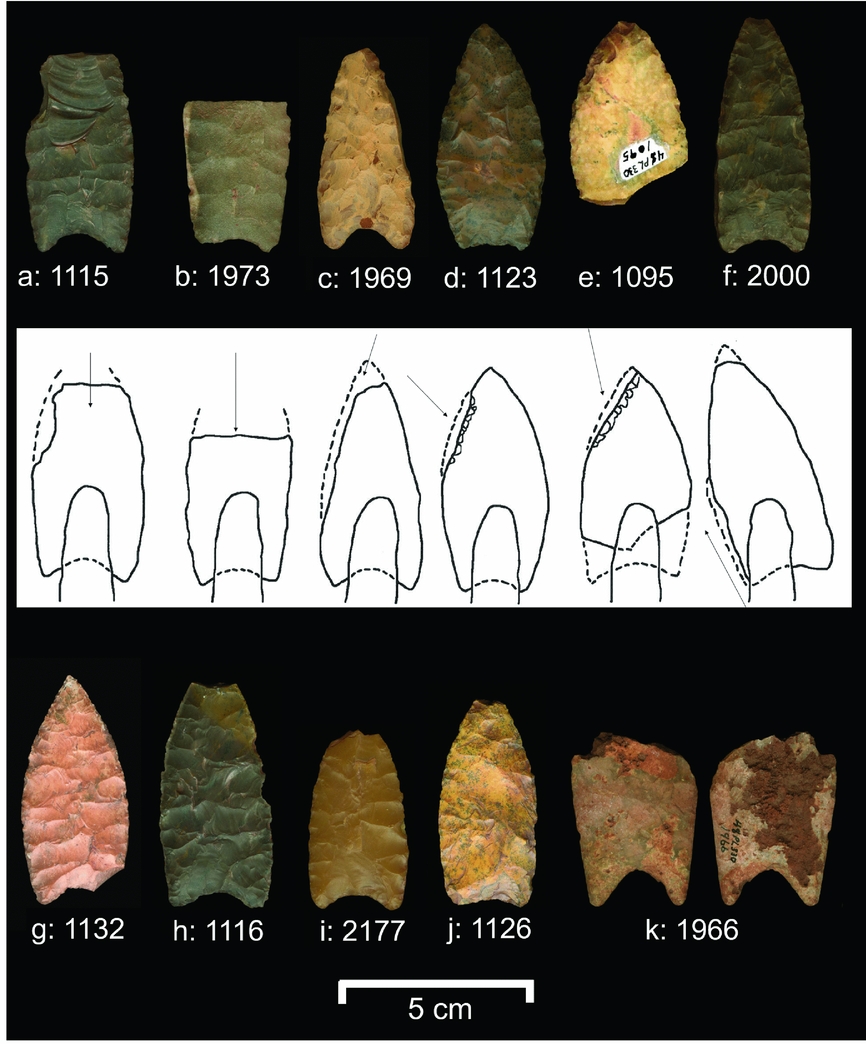
(a–k) Clovis points with impact fractures from salvage excavation between 2014 and 2016; a–f are accompanied by schematic illustrations. Catalog numbers noted.
Although the Clovis points from Powars II exhibit a wide range of forms (e.g., Figure 5c, k; Stafford et al. Reference Stafford, Frison, Stanford and Zeimens2003:Figure 4k), the majority fall within a narrow range of variation generally comparable to “western Clovis” forms (Buchanan et al. Reference Buchanan, O'Brien and Collard2014; Morrow and Morrow Reference Morrow, Morrow, Clark and Collins2002) and specifically comparable to “stubby” Clovis points, which are primarily recognized from the Northern Plains of Montana, Alberta, and Saskatchewan (Dawe and Kornfeld Reference Dawe and Kornfeld2017; Gryba Reference Gryba, Clark and Collins2002; Ives et al. Reference Ives, Froese, Supernant, Yanicki, Graf, Ketron and Waters2013; Wormington and Forbis Reference Wormington and Forbis1965). Similarities include the following: (a) They are relatively short, perhaps as a result of reworking (see below; Figures 4 and 5); (b) they exhibit comedial to transmedial flaking that is commonly oriented at oblique angles near the tips of short points (e.g., Figure 4c–i); (c) they sometimes retain large bifacial thinning scars on their faces from a prior reduction stage (e.g., Figure 4f, i); and (d) they are most often minimally fluted and/or basally thinned (Figures 4 and 5; for comparisons, see Gryba Reference Gryba, Clark and Collins2002:118–128; Wormington and Forbis Reference Wormington and Forbis1965:Figures 19, 27, and 37). Most interestingly, the Powars II points are comparable in size and shape to Clovis points from the Wally's Beach site (DhPg-8), Alberta, that tested positive for horse protein (Kooyman et al. Reference Kooyman, Newman, Cluney, Lobb, Tolman, McNeil and Hills2001), suggesting that these forms were produced at a time prior to end-Pleistocene faunal extinction ca. 12,800 cal BP, even if they are poorly dated at present. Recent large-scale analyses of Clovis points corroborate the similarity between Powars II and sites to its north by showing that Powars II is located within a Clovis-aged Northern Plains subregion that extends from roughly northern Colorado in the south to the US border to the north and is defined by both raw material networks (Buchanan et al. Reference Buchanan, Hamilton, David Kilby and Gingerich2016) and projectile point shapes (Buchanan et al. Reference Buchanan, O'Brien and Collard2014).
We must also acknowledge the similarities between the Powars II Clovis points and Goshen points from the Hell Gap site (48GO305; Bradley Reference Bradley, Kornfeld, Lou Larson and Frison2009). First, the bases of many Powars II Clovis points are comparable to those on Hell Gap site Goshen points, both the variety observed on the type specimen, characterized by a shallow basal concavity and slight ears (Bradley Reference Bradley, Kornfeld, Lou Larson and Frison2009:Figure 17.3b; Kornfeld and Larson Reference Kornfeld, Lou Larson, Kornfeld, Lou Larson and Frison2009:Figure 1.3), and the variety with a deeper, more V-shaped basal concavity (Bradley Reference Bradley, Kornfeld, Lou Larson and Frison2009:Figure 17.3c). Second, Powars II Clovis points with minimal reworking often exhibit the parallel, comedial flaking (e.g., Figures 4b and 5a, g–h) typical of Goshen points from Hell Gap (e.g., Bradley Reference Bradley, Kornfeld, Lou Larson and Frison2009:Figure 17.3) and elsewhere (Bradley and Frison Reference Bradley, Frison and Frison1996). This raises the possibility that many of the “stubby” Clovis points from Powars II and locations farther north could be reworked Goshen points that no longer retain evidence of parallel, comedial flaking. In a recent evaluation of the Hell Gap site chronology, Pelton et al. (Reference Pelton, Kornfeld, Lou Larson and Minckley2017) present a Clovis-aged date for the Goshen component at Hell Gap of ca. 12,800 cal BP, so perhaps the Hell Gap site's Goshen component is best conceptualized as a Northern Plains Clovis variant that is also present at Powars II. Radiocarbon dates from the intact portion of the Powars II site should help resolve this issue.
Due to their large numbers and association with red ocher, we considered the possibility that the Powars II Clovis points were derived from a cache (e.g., Butler Reference Butler1963; Gramley Reference Gramley1993; Lahren and Bonnichsen Reference Lahren and Bonnichsen1974). However, Clovis artifacts from caches are often complete and sometimes unused, whereas those from Powars II are all obviously used (Stafford et al. Reference Stafford, Frison, Stanford and Zeimens2003:77). Upon examining them, we determined that the point damage patterns observed at Powars II closely resemble the impact damage on points recovered from hunting sites, specifically Paleoindian bison kills (Frison Reference Frison1974; Frison and Stanford Reference Frison and Stanford1982; Frison and Todd Reference Frison and Todd1987; Stanford Reference Stanford, Davis and Wilson1978) and mammoth kills (Frison and Todd Reference Frison and Todd1986; Haury et al. Reference Haury, Sayles and Wasley1959) familiar to us. Experiments using thrusting spears and projectiles add to the information acquired from animal kill sites (Frison Reference Frison, Frison and Stanford1989; Huckell Reference Huckell1982), and in the following we present specific comparisons with these studies to establish that many of the Powars II Clovis points were used during hunts.
Twenty-four of the Clovis points recovered during salvage excavations and two from the 1986 test demonstrate light to moderate damage that we think would have allowed restoration to a functional condition, and 10 were undamaged. Four from salvage work and one from the 1986 test are proximal ends reworked to form complete points. In addition, nine distal ends may be fragments of completed Clovis points. Details of the Clovis projectile points are presented in Table 1.
Clovis Projectile Point Attributes from the Powars II Site.

a CP = complete or nearly complete; PR = proximal end; DS = distal end; CS = center section.
b Q = quartzite; C = chert; P = porcellanite.
The most common form of damage is bend breaks, which probably occurred when points were forced to rapidly change direction after entry into animals. This is well demonstrated on Clovis points from the Powars II site (Figures 3g, i, and 5b, k). Similar evidence was observed on Hell Gap points from the Casper bison kill (48NA304; Frison Reference Frison1974:71–84) and on Hell Gap points from the Jones-Miller site (5YM8; Stanford Reference Stanford, Davis and Wilson1978:Figures 10.2–10.4). This type of damage has also been demonstrated experimentally with a Clovis point replica on a freshly killed African elephant (Frison Reference Frison1989:Figure 9). Direct impact on the flat side of a rib using an atlatl and dart (Frison Reference Frison1991:Figure 3.6) destroyed both wooden and lithic components.
There are several types of distal point fractures that result from impact damage. One type results in a flute-like scar on one face of the projectile point, present on one point from Powars II (Figure 5a). Comparable damage is present on a Casper site Hell Gap point (Frison Reference Frison1974:Figure 1.42e), an Agate Basin point from the Agate Basin site (48NO301; Frison and Stanford Reference Frison and Stanford1982: Figures 2.59c–d and 2.60a–b), and an Eden point from the Horner site (48PA29; Bradley and Frison Reference Bradley, Frison, Frison and Todd1987:Figures 6.9a–c and 6.10a). At Powars II, another form of distal flake removal occurred due to what was probably contact with a solid object at an angle, which produced several flake removals on one side of the distal end along with intersecting bend breaks on the proximal end (Figure 5e). This kind of impact damage appears on two other points from Powars II, suggesting that it could be a common, if poorly understood, way for stone projectiles to fracture. A final form of distal fracture (Figure 5c) removed the distal tip and resulted in a burin-like spall on a blade edge that traveled over half of the distance toward the basal corner.
Another type of impact damage on Powars II points resulted in crushing of the distal end (Figure 5i) and, as demonstrated in experiments on freshly killed elephants and bison, was most likely caused by attempted entry of the point at an angle that caused the hide to “bunch up” thickly enough that the point could not penetrate it (Frison Reference Frison1989; Huckell Reference Huckell1982). In these situations, enough forward movement of the projectile allowed crushing of the tip rather than severe damage from direct impact with a bone.
Yet another kind of impact damage occurs when the point penetrates for a short distance and a blade edge contacts a rib or other bone, which can remove several flakes or a section of the distal blade edge (Figure 5d). Comparable damage is present on points from the Lehner mammoth kill site (EE:12:1; Haury, Sayles, and Wasley Reference Haury, Sayles and Wasley1959:Figures 12 and 13j), on Cody complex points from the Horner site (Bradley and Frison Reference Bradley, Frison, Frison and Todd1987:Figures 6.9a–c and 6.10a), and on Casper bison kill site points (Frison Reference Frison1974:Figure 1.41). Unless other damage occurs at the same time, such as snapping off part of the distal end (Figure 5h, j) and/or corners (Figure 5g), the projectile point can remain functional with only minor repair.
On rare occasions, the point was forced sideways in the hafting element, breaking the sinew binding, forcing a corner of the point against the haft element, and causing burin-like spalls originating at a corner of the base for a distance distally along a blade edge (e.g., Figure 5f).
Many points were discarded in the Powars II ocher quarry prior to being completely exhausted. As at most animal kills, some points remain undamaged (Figures 3f and 4a–d, i–j), and some were broken transversely with enough remaining to rework into points (e.g., Figures 3f and 4e–h). Three other points demonstrate distal tips with alternate beveling (Figure 4i–j), which may have been an innovative way to improve entry into the animal. Experimentally, this is an easy way to restore the penetrating ability of a point with minor damage on the distal end.
We think that this body of evidence related to impact damage is sufficient to support the notion that most Powars II Clovis points were used during hunts. If correct, it implies that the points were recovered from hunts and then discarded at Powars II, which was certainly not an animal kill site. At the least, this interpretation implies the presence of nearby Clovis-age animal kills. Extending our inference, we repeat Stafford and colleagues’ (Reference Stafford, Frison, Stanford and Zeimens2003:88) suggestion that the presence of used weaponry at Powars II may be good evidence for some form of hunting ritual wherein used weaponry was “exchanged” for red ocher.
Biface Reduction and Preform Production
Clovis biface reduction is a newly realized site activity well documented at Powars II, as evidenced by discarded preforms and bifacial thinning flakes. We have recovered 33 complete and broken preforms (Figure 6; Table 2) and 284 bifacial thinning flakes, which likely represent projectile point production. Both preforms and flakes span nearly the entirety of the bifacial reduction sequence, from early-stage bifacial reduction to nearly complete points, and most preforms appear to have been discarded due to some flaw encountered during bifacial reduction that could not be fixed.
(a–j) Clovis preforms from the Powars II site. Catalog numbers noted.

Clovis Preform Attributes from the Powars II Site.
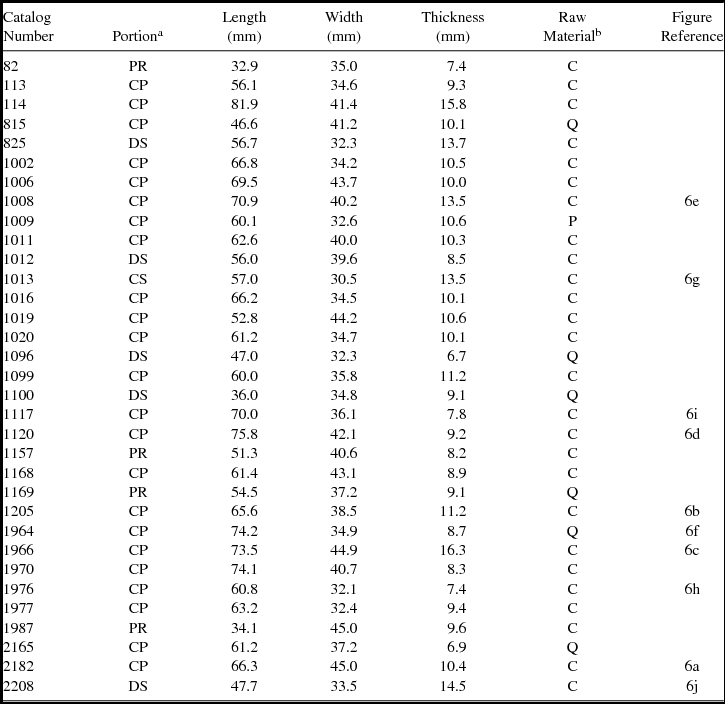
a PR = proximal end; CP = complete or nearly complete; DS = distal end; CS = center section.
b C = chert; Q = quartzite; P = porcellanite.
The earliest-stage preform is a large flake with several small flakes removed near the striking platform (Figure 6a). At least five preforms are in an early thinning stage (e.g., Figure 6b–c), with some flake scars resulting from near overshot flakes, and at least 12 more demonstrate further reduction (e.g., Figure 6d–e). At least four preforms are in advanced stages of completion (Figure 6f–i), requiring only minor thinning for completion, but most (Figure 6f–h) exhibit some minor flaw that prevented further reduction. Vugs, some lined with crystals, are a common cause of internal flaws. A crystal pocket in an early-stage perform was entirely enclosed and was exposed when a thinning flake penetrated one side (Figure 6j).
Most of the preforms from Powars II fit well within the stages proposed by Morrow (Reference Morrow1995) at the Ready/Lincoln Hills site (11JY46) in Illinois, as well as those presented by Waters and Jennings (Reference Waters and Jennings2015) for the Hogeye Clovis cache. However, there is more emphasis on preform fluting elsewhere than on the Powars II preforms. There is no evidence that Clovis points were finished at the Powars II site, because there are no final-stage point production failures, although many of the complete or nearly complete preforms could have easily been transformed into projectile points with minimal edge preparation.
The bifacial thinning flake assemblage complements the preform assemblage well. There is one full overshot flake in the assemblage (Supplemental Figure 1c), and 37 flakes are identified as partial overshot flakes by the criteria of Waters, Pevny, and Carlson (Reference Waters, Pevny and Carlson2011; Supplemental Figure 1a–b). Other notable types of bifacial thinning flakes include tabular core reduction flakes (n = 91; Supplemental Figure 1d–e), which are created during early-stage bifacial reduction of tabular raw material packages, and edge collapse flakes (n = 33; Supplemental Figure 1f–g), which are mistakenly created during bifacial reduction when the objective biface is struck too far into its margin and both sides of it are removed. The preforms and bifacial thinning flakes together suggest that local raw materials were transported into the site as early-stage bifaces, reduced to late-stage preforms on the site, and then removed for completion into finished projectile points elsewhere.
Blade Technology
Although Stafford (Reference Stafford1990) reported tools made on blades from Powars II, the recognition that the site contains a formal blade industry is a new insight informed by inquiry into Clovis blade technology during the past two decades (e.g., Collins Reference Collins1999). Blade technology is evident at Powars II in the form of cores, core maintenance flakes, unmodified blades, and modified blade tools, suggesting that a range of blade reduction stages occurred on-site.
In addition to the two blade cores and three blades recovered in 1986 (Figure 3a–d), two wedge-shaped cores (e.g., Figure 7a), a conical core with the core tablet removed but with no subsequent blade removals (Figure 7b), and a depleted or nearly depleted blade core (Figure 7c) were recovered during salvage excavations. The conical core was used bidirectionally and appears to have been abandoned after an attempted blade removal failed and resulted in an uncorrectable step fracture on the core's face (Figure 7b). The pointed end also appears to have been used as a hammer or crushing implement. One wedge-shaped core was sharpened unilaterally on the distal end to form an edge (Figure 7a) that bears hammerstone or crushing use-wear. We identified at least three core tablet flakes (Figure 7d–f) and four blade core maintenance flakes from the site, all from the 1986 collection. One edge of one of the core tablet flakes (Figure 7e) is retouched.
(a–c) Blade cores and (d–f) core tablet flakes from the Powars II site. Catalog numbers noted.
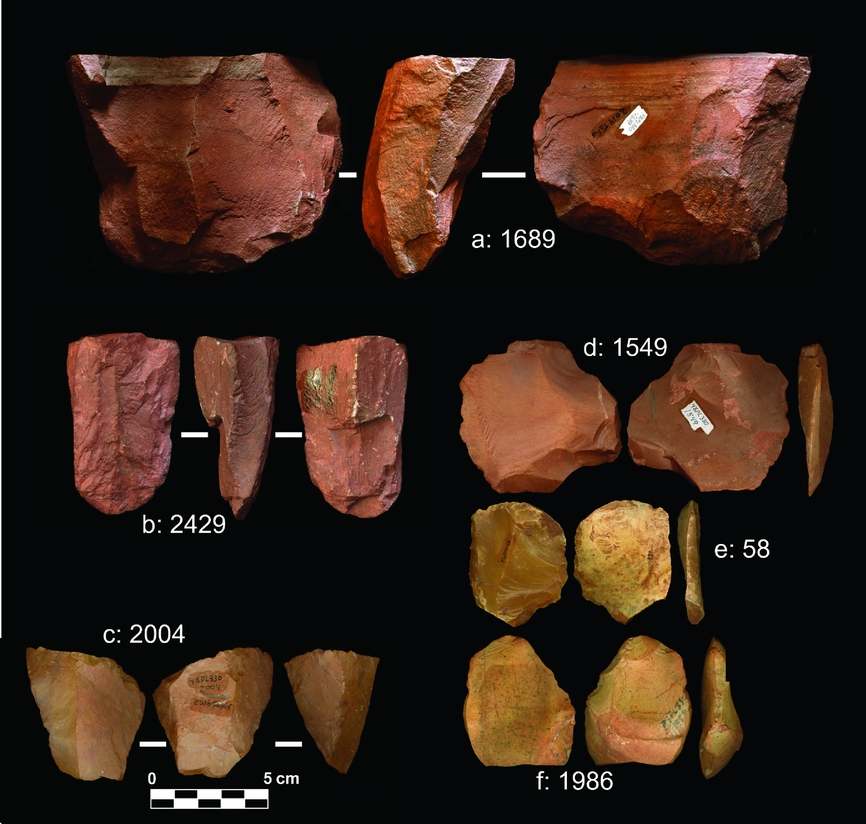
We identified 175 unmodified blades in the salvage excavation flake assemblage. Forty-five blades are “prismatic” blades with a triangular cross section, while others (n = 102) have blade attributes such as longitudinal, parallel flake scars and platforms in line with their long axis but exhibit trapezoidal or other cross-section shapes (Supplemental Figure 1h–i). There are 28 blades identified as microblades (Supplemental Figure 1j), but as with comparable artifacts from the Gault site (Bradley et al. Reference Bradley, Collins and Hemmings2010), it is not known whether they are derived from a formal microblade industry or are by-products of some other lithic reduction trajectory.
We recovered at least 32 tools made on blades, which exhibit a wide range of variation resulting from edge retouch and use. The most common forms of edge retouch form gravers (Figure 8c, k) and concave spokeshave margins (Figure 8e, j). Use retouch is highly variable, from light use retouch (Figure 8h) to heavy use retouch resulting in step fracturing of margins (Figure 8b, l) and tools that exhibit a combination of these (Figure 8a).
(a–l) Blade tools from the Powars II site (illustrations by Steve Wallmann). Catalog numbers noted.
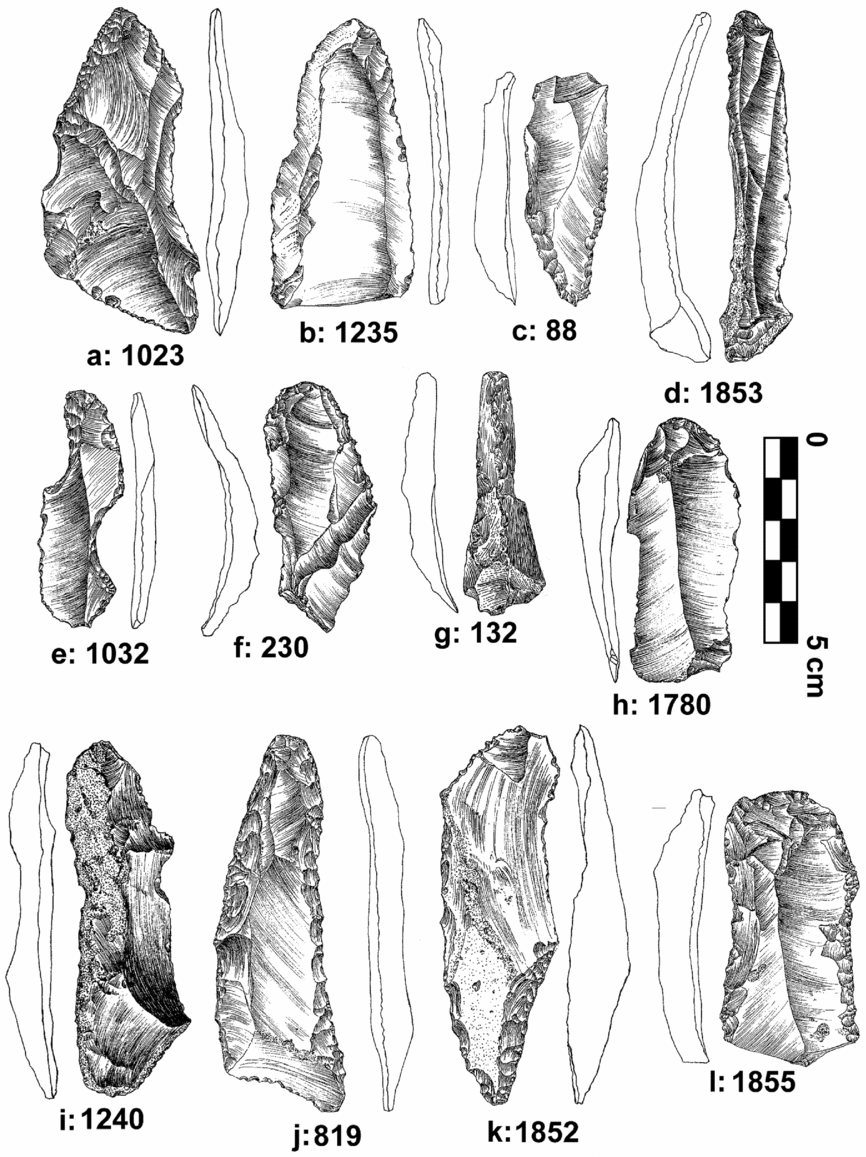
Several blade tools retain classic hallmarks of blade technology. Three are cortical blade tools with cortex on one edge and wear on the opposite (e.g., Figure 8i). One blade (Figure 8g) has what Stafford describes as a “use crushed ridge” (Reference Stafford1990:50), which may alternatively be a crested blade created during blade core reduction. Two blades (Figure 8d, f) are markedly curved, suggesting that they were removed toward the final stages of conical blade core reduction (Collins Reference Collins1999).
Blades may have been produced at Powars II to aid in the red ocher extraction process in some way, but considering the wide diversity of modifications on blades, they may also have been used for other tasks on-site. For example, the presence of spokeshaves combined with evidence for weaponry production suggests that some blade tools may have been used to produce wood or bone components of the weaponry assemblage.
Flakes
Salvage excavations recovered 6,119 chipped-stone flakes, totaling 11.32 kg, in addition to the 463 reported by Stafford (Reference Stafford1990). We have already discussed aspects of the blade and bifacial thinning flakes, and here we summarize major attributes of flake size, raw material, and burning.
An initial size sorting of flakes smaller and larger than 2.5 cm suggests that they largely represent mid-stage reduction. We compared flake size with that from the Gault Clovis quarry assemblage (Pevny Reference Pevny2009; Waters, Pevny, and Carlson Reference Waters, Pevny and Carlson2011), and two complementary aspects of Powars II flake size differ from the Gault site to suggest mid-stage reduction. First, there are significantly more flakes greater than 2.5 cm long from the Powars II site (n = 1,772; 29%) compared with Gault (controlling for screen size; χ2 = 1,745; df = 1; p < 0.05), or alternatively, significantly fewer flakes less than 2.5 cm long. Second, flakes greater than 2.5 cm are less than half the size (by mass) than those from the Gault site (4.7 g at Powars II and 10 g at Gault), which is largely due to the absence of very large, cortical flakes typically produced during quarrying. Given that there are relatively many large flakes but that the large flakes are relatively thin, the Powars II flakes appear to represent mid-stage lithic reduction activities between primary quarrying and final-stage tool production, which is consistent with the previously discussed preform assemblage and with Stafford's (Reference Stafford1990:51–56) flake analysis.
The flakes are overwhelmingly dominated by raw materials procured within a local radius of the site, with 60% of the assemblage composed of dendritic “Hartville Uplift chert” (local to the site) and another 14% from the Powars II toolstone quarry, detailed below. There is also a small amount of metaquartzite, other unidentified cherts, and a raw material tentatively identified as metabasalt, each of which could potentially be from local sources, pending further raw material survey. The only possible exotic raw material identified in the flake assemblage is a single potential Knife River Flint flake from central North Dakota.
Finally, it is notable that very few of the flakes (0.03%) are burned. Considering the small number of burned artifacts, there were likely few fires present at the Powars II site, and by extension one might surmise that the site was not a camp.
Bone Objects and Radiocarbon Dates
Two pieces of bone could be opposite ends of a polished bone rod. One (Supplemental Figure 2d) is rounded on the complete end, and the other (Supplemental Figure 2e) has a single tapered end. A direct accelerator mass spectrometry date on the tapered end is 9250 ± 30 14C BP (Beta-442511; bone carbonate; δ13C = −7.5‰), which has a 2σ calibrated age range of 10,489–10,356 cal BP (IntCal 2013). Upon analysis, this object appeared devoid of collagen, and the lab analyst suggested that it may have been “cremated,” thus explaining why bone carbonate was dated. Two other polished bone rod fragments refit to form one end (Supplemental Figure 2c), and one piece yielded an accelerator mass spectrometry age of 8920 ± 30 14C BP (Beta-445766; bone collagen; δ13C = −14.2‰), which has a 2σ calibrated age range of 10,158–9965 cal BP (IntCal 2013). The dates on these objects are slightly younger than expected given that most of the diagnostic projectile points are Clovis; but we did recover an Alberta point from the site (see below), and these dates are consistent with ages on Alberta/Cody complex sites, which also contain bone technologies similar to those from Clovis sites (Holen and Holen Reference Holen and Holen2009; Ives et al. Reference Ives, Froese, Collins and Brock2014; compare to Lahren and Bonnichsen Reference Lahren and Bonnichsen1974). More dates using more refined methods will be determined on material from contexts with better provenience, but these initial attempts to date the site at least confirm that Paleoindian-aged bone is preserved in the site and that previously reported bone objects (Stafford et al. Reference Stafford, Frison, Stanford and Zeimens2003:83–84) are likely to be Paleoindian-aged as well.
Another object is a midsection of a bone rod with a semicircular cross section (Supplemental Figure 2a), with the flattened side showing coarse abrading marks. One fragment of long-bone has a rounded and flattened end (Supplemental Figure 2b). The opposite end is missing, and wear striations parallel to the long axis of the tool are present on one side of the flattened end. A section of a rib, probably Bison sp., has intense wear on the ventral side of a transverse break. It is nearly identical to a rib fragment found on the day the site was discovered in 1986 (Stafford Reference Stafford1990:Figure 3.14a).
Several poorly preserved and unidentified fragments of medium and large animal long-bone were recovered. The exception is the proximal half of a left metatarsal, probably Bison sp., that was broken at an angle with what appears to have been a green bone break. Finally, there are many small (less than 3 cm maximum length), heavily weathered bone fragments in the salvage excavation assemblage. These fragments may have broken in place, but we note the possibility that they are detritus related to bone tool production, given the presence of broken bone tools in the assemblage, the relative paucity of unmodified bone potentially related to subsistence, and the fact that bone tools are characteristic of Clovis technology (Bradley, Collins, and Hemmings Reference Bradley, Collins and Hemmings2010).
Post-Clovis Evidence at Powars II
Although Clovis provides most of the evidence of Paleoindian activity at the Powars II site, salvage excavations produced several other Paleoindian diagnostics. A classic Goshen point was recovered in two recently broken pieces (Figure 9a), and an additional point base exhibits comparable Goshen production techniques. The proximal end of a Folsom point from Powars II was broken transversely (Figure 9b), and another distal end exhibits impact damage comparable to that on a Clovis point (Figure 5c), along with a transverse break near the midsection (Figure 9c). Four other Folsom points are midsection fragments.
(a–n) Paleoindian artifacts of post-Clovis age from the Powars II site. Catalog numbers noted.

The only refitted biface in the Powars II chipped stone assemblage bears little resemblance to other bifaces from the site but resembles three bifaces from the Folsom level at the Agate Basin site (Frison Reference Frison, Frison and Stanford1982:Figure 25a–c) and another at the Hanson Folsom site (48BH329; Frison and Bradley Reference Frison and Bradley1980:Figure 24). The artifact is a thin (5.1 mm) chert biface (Figure 9n) with well-controlled wide percussion flake scars. It broke as the result of a perverse fracture caused by an internal flaw in the raw material. Well-controlled pressure flaking is present with possible light tool use on most of the edges. Differential weathering is evident on both pieces, suggesting that it broke prehistorically.
The salvage excavations produced three nearly complete Midland points that demonstrate pressure flaking and parallel blade edges with very fine bilateral retouch along with impact damage on distal ends (Figure 9d–f). One proximal end shows the exceptionally fine and well-executed blade edge pressure flaking diagnostic of Midland (Figure 9f).
Four Agate Basin projectile points are broken transversely near the base and show minor impact damage on distal ends (e.g., Figure 9g–h). An additional Agate Basin point is complete but with a broken and reworked distal end, and six additional point bases were broken transversely in a manner similar to Clovis points. Four relatively long and narrow preforms could be related to the Agate Basin complex (e.g., Figure 9l–m).
We recovered two complete but distally reworked Hell Gap projectile points (e.g., Figure 9j) and three proximal ends broken transversely from impact (e.g., Figure 9i), along with one late-stage Hell Gap perform. We also recovered a single Alberta point (Figure 9k). We did not recover any Scottsbluff, Eden, or more recent Late Paleoindian diagnostics during salvage excavations.
Except for the complete Goshen point (Figure 9a) and the Alberta point (Figure 9k), the damage to the post-Clovis projectile points is remarkably similar to that in the Clovis assemblage. This leads us to propose that all Powars II site Paleoindians were involved in similar activities related to ocher procurement and weaponry discard.
A Chert and Quartzite Toolstone Source at Powars II
We suspected from the beginning of our work at Powars II that the toolstone used at the site was not all derived from common, Mississippian-aged deposits found throughout the Hartville Uplift. This proved to be the case in 2015, when a backhoe trench exposed a chert and quartzite source buried under more than a meter of railroad ballast across the drainage from the Powars II site.
The toolstone occurs in the form of nodules of chert and quartzite with thick crusts buried in a relatively soft, red sediment matrix, as opposed to the limestone formations where Hartville Uplift cherts normally occur. The nodules vary from fist-sized up to possibly a ton and larger in many color combinations from translucent to opaque that can only be observed by first removing the thick external crusts (Supplemental Figure 3a). Some quartzite is very fine-grained and requires magnification to distinguish it from chert. Cherts and quartzites from this toolstone source are distinctive enough in color and texture to identify them in blades and Clovis points from Powars II, which is located only 130 m away from the toolstone source. Further, we excavated a small test in the quarry area and discovered blade cores (Supplemental Figure 3b–e) and several blades (e.g., Supplemental Figure 3f–g), which further suggests that Clovis flintknappers used the quarry. We also recovered several large cortex removal flakes, the largest of which (7.4 kg) demonstrates a thick crust on the dorsal side and multicolored chert on the ventral side (Supplemental Figure 3a).
The Powars II toolstone appears to be a primary deposit closely related to ore bodies. In fact, some of the cherts and quartzites contain reddish veins of iron that penetrate throughout the material. Had these materials been brought in from another source, it seems likely that most of the soft and crumbly matrix would have fallen away during transport. A photograph dated to 1903 shows what appears to be a deposit of nodules of toolstone in their present location and is a strong indication that they were not moved there by historic mining activities.
There are several exposures of iron ore along a road cut through the hills near Sunrise, Wyoming, and mining exploration also exposed a large iron ore deposit in a hillside near the Chicago mine (Figure 1). Examination of these exposures revealed that the iron ore body is contained in a rust-colored matrix that contains chert and quartzite similar to the Powars II quarry.
There is a geologic hydrothermal process that forms gossans that are often associated with iron ore deposits and have been documented near the Sunrise mining area (Ball Reference Ball1906; Hausel Reference Hausel1989:67–72; Snyder Reference Snyder1980:5). Gossans produce a rust-colored material and often contain minerals such as hematite, copper, limonite, malachite, chrysocolla, and kaolinite (Taylor Reference Taylor2011:33–76), all of which occur in the Powars II toolstone quarry matrix. The gossan process can also produce chert (Koski Reference Koski2012:186). Use of this hypothesis to explain the geologic context of the Powars II toolstone quarry is worthy of further consideration. At present, we rely largely on visual criteria to identify the materials, but both mineral and chemical analyses are needed.
Conclusions
Lacking both reliable stratigraphy and radiocarbon dates with good provenience, we have thus far relied on projectile point typology to establish a chronology of Paleoindian presence at the Powars II red ocher procurement site. We recognize Clovis as the oldest occupation, defined by two kinds of lithic technology. One is a core and blade technology employed to produce tools used at the quarry site, and the other is a biface technology used to produce projectile point preforms. Points were collected from kill sites and deposited at the quarry after use. Other tools made on large flakes and blades were also discarded at the quarry, but for now we suspect that these tools were produced, used, and discarded at Powars II in conjunction with ocher quarrying or other production tasks specific to the site, given their bias toward spokeshaves and use-retouched margins to the near exclusion of other stone tool types such as endscrapers.
Although projectile point discard in the quarry may have simply been a function of routine weaponry maintenance, the fact that many retained some amount of remaining utility suggests the possibility that points were ritually discarded at the quarry site. Hunting, which is typically described as a “secular” activity, was likely surrounded by suites of rituals both before and after hunts by Clovis foragers:
How “secular” is a hunt anyway? . . . From the acquisition of the stone and other raw materials to the culturally specified manufacture of tools and objects, to the location, propitiation, processing, sharing and tasting of prey, to the maintenance and refurbishment of needed equipment, the hunting of animals by Paleoindians consisted of a series of activities or ritualizations that comprised a successful strategy for over one thousand years despite dramatic shifts in climate and floral and faunal communities [Morrow Reference Morrow and Trubitt2016: 63–64].
Morrow's characterization of Paleoindian ritual describes Powars II well, where we have evidence for both pre-hunt activities, as exemplified by preform and blade production, and post-hunt ritual, as exemplified by discarded, used weaponry. Although these activities could have been undertaken anywhere, the procurement of high-quality red ocher (Supplemental Figure 3h) appears to have been the driving force behind the Paleoindian presence at the Powars II site. The prehistoric use of red ocher has been explored (e.g., Roper Reference Roper1991; Wreschner Reference Wreschner1980), but the Powars II site is the only known site where a large diagnostic Paleoindian projectile point assemblage has been recovered in context with a red ocher procurement site. Consequently, ongoing investigations into undisturbed deposits at Powars II will in many ways define archaeological understanding of early American ritualism.
Acknowledgments
We would first and foremost like to acknowledge the property owner of the Powars II site, John Voigt, for access and his continuing commitment to the site. Many dozens of volunteers and private donors contributed their time and money to the site, and we thank them all for their generosity. No permits were required to accomplish this work.
Data Availability Statement
The artifacts described in this study are housed at the University of Wyoming Department of Anthropology, Laramie, Wyoming, and the Western History Center, Lingle, Wyoming. Analyses of these items are ongoing.
Supplemental Materials
For supplementary material accompanying this report visit https://doi.org/10.1017/aaq.2018.11.
Supplemental Figure 1. (a–j) Examples of flake types identified at the Powars II site (photos by Alexander Craib).
Supplemental Figure 2. (a–e) Worked bone objects from the Powars II site.
Supplemental Figure 3. Raw material from the Powars II site: (a) cortex removal flake from a chert nodule from the toolstone quarry; (b–e) blade cores from the toolstone quarry; (f–g) blades from the toolstone quarry; (h) specularite iron nodule from the Powars II red ocher source. Catalog numbers noted.



