




Introduction
Music is an essential subject in the primary education curriculum, and improvisation has been lauded by both educators and researchers as a core musical activity. A musical improvisation is an act of creation without prior agreement or planning, also described as a spontaneous musical endeavour (Whitcomb, Reference WHITCOMB2013). Improvisation has a significant impact on the development of creativity, higher-order thinking skills, cognition, and confidence (Chandler, Reference CHANDLER2018; Navarro Ramón & Chacón-López, Reference NAVARRO RAMÓN and CHACÓN-LÓPEZ2021; Siljamäki & Kanellopoulos, Reference SILJAMÄKI and KANELLOPOULOS2020; Wing et al., Reference WING, PIAW and CHANG2014).
Using an ethnographic research design, Burnard (Reference BURNARD2002) examined the meaning of improvisation among 18 twelve-year-old children through observations, interviews, and analysis of recorded improvisations, and found that group improvisation supported creativity, social engagement, and the development of musical identity. Drawing on questionnaire data from 3,820 Swedish adults, Theorell et al. (Reference THEORELL, LENNARTSSON, MADISON, MOSING and ULLÉN2015) examined the long-term effects of childhood music education and found that engagement in activities such as improvisation was a significant determinant of whether individuals continued to sing or play an instrument in adulthood. Using Webster’s Measure of Creative Thinking in Music (MCTM II) (Webster, Reference WEBSTER1987, Reference WEBSTER1994), Navarro Ramón and Chacón-López (Reference NAVARRO RAMÓN and CHACÓN-LÓPEZ2021) examined the effectiveness of an improvisation workshop with 17 children aged 8–11 and reported improvements in students’ musical creativity. The authors show the impact of improvisation on the development of creative thinking in children in music. Furthermore, improvisation has been added to the national recommendations as part of the music education curricula, such as in the US (Whitcomb, Reference WHITCOMB2013); the UK (Koutsoupidou, Reference KOUTSOUPIDOU2005); China (Ministry of Education of the People’s Republic of China, 2011); and many European countries (Larsson & Georgii-Hemming, Reference LARSSON and GEORGII-HEMMING2019).
Nonetheless, a lack of improvisation in musical classrooms has been reported. There are three main reasons for this situation. First, music teachers have reported a lack of knowledge about teaching improvisation. This relates to teachers’ professional training, as the absence of improvisation in music teacher education has been shown to influence pre-service teachers’ (i.e., teachers in training who have not yet started in a formal teaching position) confidence in incorporating improvisation activities into their teaching (Piazza & Talbot, Reference PIAZZA and TALBOT2021). Additionally, Koutsoupidou (Reference KOUTSOUPIDOU2005) found that teachers who use improvisation tend to be older, have more teaching experience, and have specialist music qualifications, which indicates that younger or inexperienced teachers, especially those who have not received professional music training, may feel less equipped to teach improvisation. Furthermore, limited time, classroom space, and inadequate instruments hinder the use of improvisation activities by music teachers (Bogojević & Pance, Reference BOGOJEVIĆ and PANCE2022; Makris et al., Reference MAKRIS, WELCH and HIMONIDES2021).
A systematic review by Larsson and Georgii-Hemming (Reference LARSSON and GEORGII-HEMMING2019) examined the literature about improvisation in general music education published between 2000 and 2015. They argued that ‘improvisation is an underdeveloped field’ (p. 49). Of the studies identified, only 20 empirical studies met their inclusion criteria, focusing on improvisation in primary or secondary general music classrooms and drawing on methods such as classroom observations, interviews, or case studies. Among these studies, most of the authors involved students’ learning of improvisation, while others examined the relationship between musical development and age. They also highlighted the limited number of studies focusing on teachers’ perspectives and experiences of improvisation in classroom practice.
Aim of this study
In summary, although the literature has explored the benefits of improvisation to children’s musical and cognitive development, curriculum integration across different countries, and barriers to implementation in classrooms, there remains a lack of research examining teachers’ actual experiences and pedagogical approaches when teaching improvisation in primary music education. In this study, we collected in-depth data through semi-structured interviews, classroom observations, and field notes to provide evidence-based insights into improvisation activities in class and teachers’ perspectives on improvisation in Dutch primary education. Only when we understand music teachers’ perspectives on improvisation can we develop activities to foster teachers’ use of improvisation activities in class and foster students’ learning (Sawyer, Reference SAWYER2004). The following two research questions (RQs) are addressed:
RQ1: How do teachers implement improvisation activities in class?
RQ2: How do teachers evaluate improvisation activities in class?
Method
Research context and participant
In the Netherlands, schools follow a set of national ‘core objectives’ – goals that indicate what primary schools should focus on in the development of their pupils. Schools are allowed to decide for themselves how to achieve these core objectives.
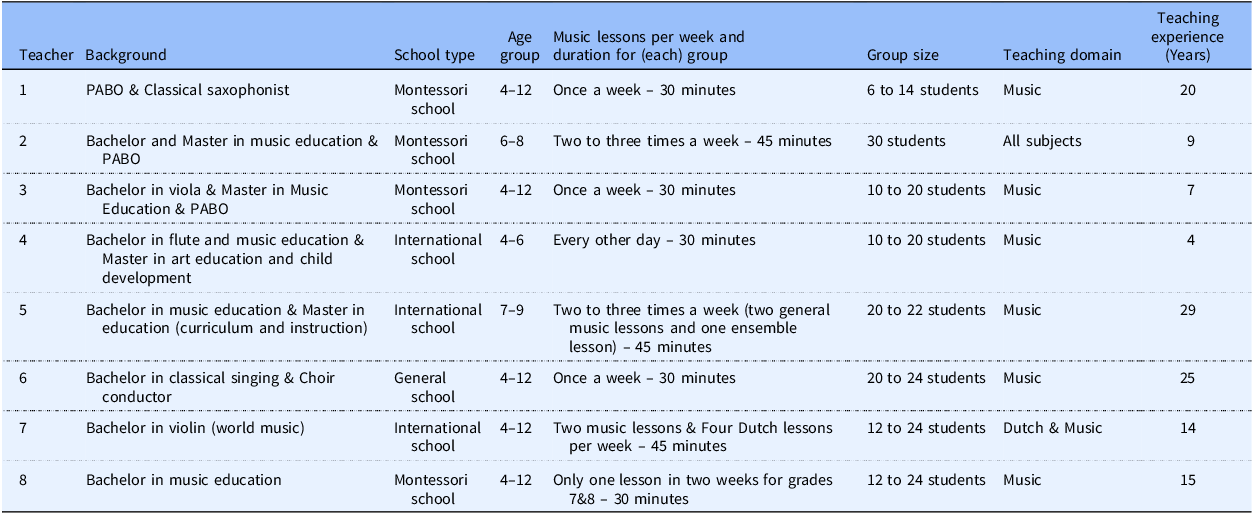
To study improvisation in primary music classrooms, this study involved eight Dutch primary school teachers (labelled T1 to T8), consisting of seven females and one male. They were recruited based on the combination of the following criteria: (1) teaching music lessons in primary school and (2) having professional music backgrounds. Gender identity was not deemed a relevant factor for teachers’ use of improvisation activities in class, and therefore, in this study, all references to participating teachers are using feminine pronouns. Their average teaching experience was 15.38 years (SD = 8.23). The schools were in both urban and suburban areas, providing a diverse range of educational environments. Table 1 shows the characteristics of participating teachers, including their education, the type of schools where they teach, the age group of their current teaching, the frequency and duration of the music lesson, and their teaching domain and teaching experience.
Characteristics of participating teachers

Table 1. Long description
The table presents detailed characteristics of eight Dutch primary school teachers participating in a study on improvisation in music classrooms. It includes information on their background, school type, age group of students, frequency and duration of music lessons, group size, teaching domain, and teaching experience. The table has eight rows, each representing a different teacher, and nine columns detailing various attributes. For instance, Teacher 1 is a PABO and classical saxophonist teaching at a Montessori school for students aged 4 to 12, with music lessons once a week for 30 minutes, and a group size of 6 to 14 students. Teacher 2 has a Bachelor and Master in music education and PABO, teaching at a Montessori school for students aged 6 to 8, with two to three music lessons per week lasting 45 minutes, and a group size of 30 students. The table highlights the diverse educational backgrounds and teaching experiences of the participants, ranging from 4 to 29 years, and the varied structures of their music lessons.
1. PABO is a teacher training programme in the Netherlands. It is a bachelor-level programme that equips students with the knowledge and abilities necessary to teach all primary school subjects.
2. Montessori is a common school in the Netherlands that follows the educational philosophy of Maria Montessori (1870–1952), an Italian educationalist. Mixed-age classrooms are an identifying characteristic of this school, where students of various ages learn together and from each other.
The teachers had different types of music education backgrounds from higher education in different countries. Besides undergraduate and graduate education, six participated in music teacher education programmes. The teachers taught in three types of schools: Montessori schools, international schools, and general schools. While most teachers only taught music, Teacher2 was the only general teacher who taught all subjects, including music, to a single class with a cohort of 30 students. In contrast, the other teachers taught multiple grades.
Data collection
Qualitative methods were adopted to explore teachers’ self-perceptions and classroom practices related to musical improvisation. A multi-source inductive design was used, drawing on semi-structured interviews, classroom observations, and field notes. This combination allowed us to examine how teachers implemented improvisation in practice and how they interpreted its pedagogical value. To ensure validity, the observation and field-note data were triangulated with the interview data.
Ethical approval for this study was obtained through the internal review procedures of the first author’s institution. All teachers were informed about the purpose of the study and provided informed consent. The involvement was entirely voluntary, and anonymity was guaranteed as a condition of participation consent.
Classroom observation and field notes
Classroom observations provided in-depth descriptions of how improvisation was enacted during primary music lessons, including teachers’ repertoire of improvisation activities and how they valued student learning during these activities. During all observations, detailed field notes were taken to capture instructional sequences, students’ responses, and contextual features of the lessons. Voice recordings and photographs of the classroom setting (e.g., instrument and space) were also collected with consent. Observation length varied depending on teachers’ schedules. Seven teachers were observed for three to six lessons (90–150 minutes for each participant), and one generalist teacher was observed for a single 45-minute lesson.
Semi-structured interviews
Prior to the formal data collection, two pilot interviews with Dutch primary teachers were conducted to refine the interview protocol and ensure the clarity and relevance of the questions. During the data collection, seven interviews were conducted directly after the classroom observation in the school building, and one interview was conducted online due to a schedule conflict. All interviews were audio-recorded with consent and conducted in English.
The interviews explored teachers’ interpretations and classroom use of improvisation (e.g., creative activities used, perceived benefits and challenges, strategies for implementation, and approaches to evaluating students’ improvisation). These topics are aligned to understand how teachers implement and make sense of improvisation in their teaching. A full interview guide is provided in Appendix A.
Coding procedures and analysis
To answer the RQs, we applied coding and analysis to guide the inductive thematic analysis for the eight interviews (Braun & Clarke, Reference BRAUN and CLARKE2006). After the recorded interviews were transcribed verbatim and anonymised, we carefully examined the transcribed text, first reading it in-depth to become acquainted with the material. Next, the data analysis was conducted using NVivo 12. The initial stage of analysis was to identify relevant text fragments and label those with identifiable codes. Following the initial labelling, the labels were merged based on the thematic similarities of the common concerns. For instance, labels such as ‘improve creativity’, ‘more expressive’ and ‘build confidence’ all underpin the category ‘personal development’. Several rounds of re-reading and discussion were necessary until no new labels were found and the subcategories were confirmed. Finally, 21 subcategories emerged from the data through the systematic analysis.
Meanwhile, observations and field notes were analysed based on the framework of Gruenhagen & Whitcomb (Reference GRUENHAGEN and WHITCOMB2014), accompanied by improvisation activities mentioned by teachers during the interview. The activities were grouped into three subcategories: vocal activity, instrument activity, and other activity. To ensure validity, observational data and field notes were triangulated with interview responses to provide a comprehensive understanding of the situation of improvisation in the classroom. Likewise, the observation and field notes provided resources to interpret the improvisation activities in class and to converse about them with participating teachers during interviews.
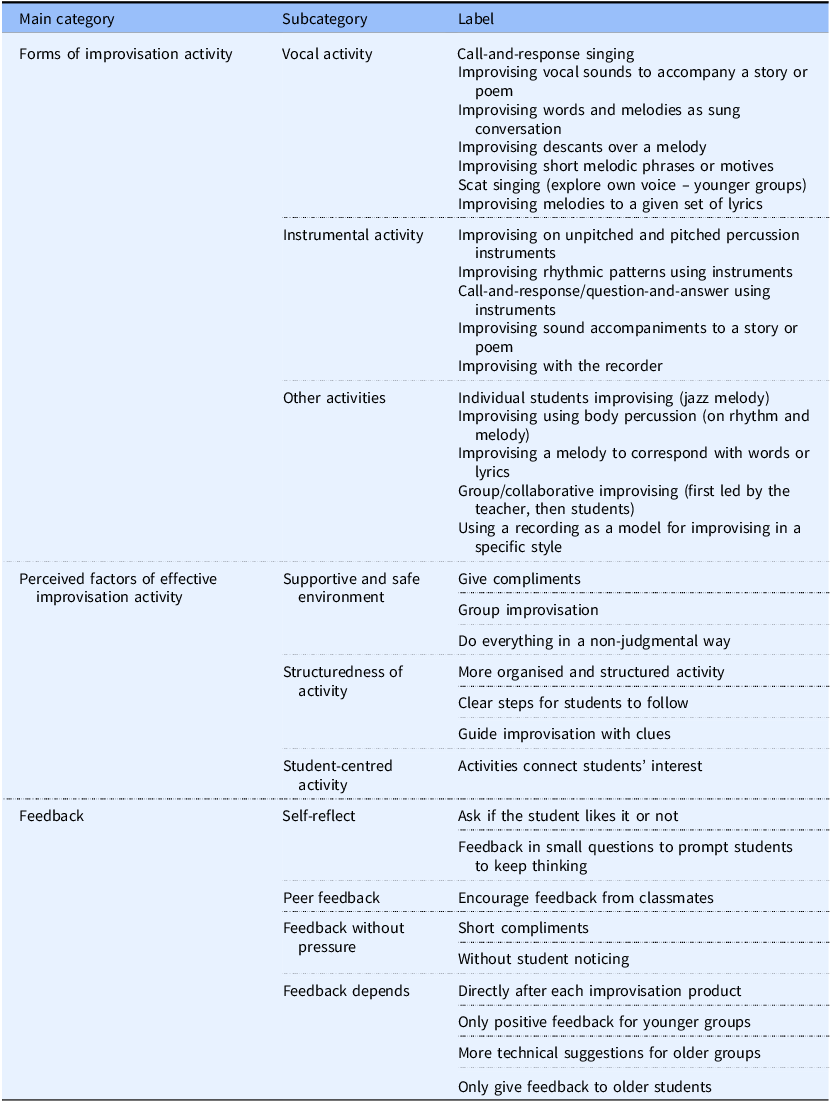
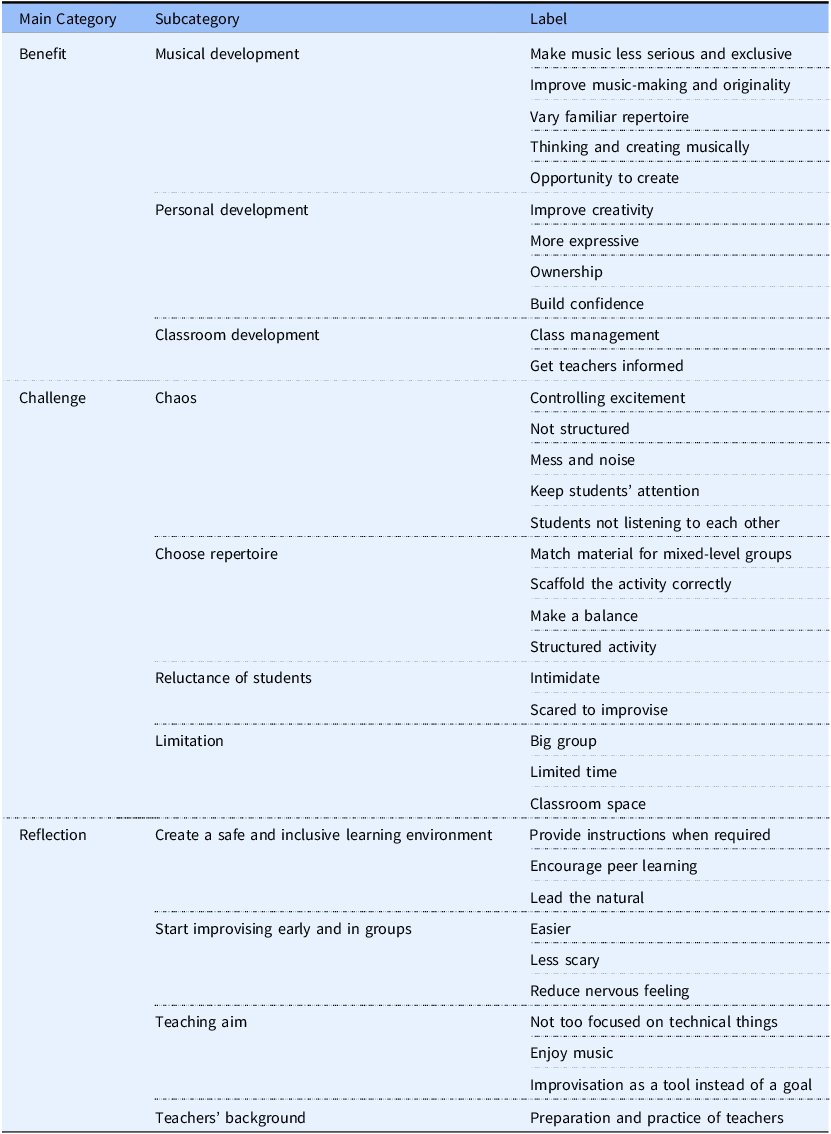
The subcategories, grouped into six main categories, describe the aspects of implementation and evaluation of improvisation activities in class perceived by primary music teachers. The main categories were distinguished and clustered into the two main themes to answer the two RQs: implementation: (1) forms of improvisation activity, (2) perceived effectiveness of improvisation activity, and (3) feedback; evaluation: (4) benefit, (5) challenge, and (6) reflection (Tables 2 and 3).
Teachers’ perspectives on the implementation of improvisation activities

Table 2. Long description
A table categorizing teachers’ perspectives on improvisation activities in music class. The table is divided into two main themes: implementation and evaluation. Implementation includes three main categories: forms of improvisation activity, perceived effectiveness of improvisation activity, and feedback. Evaluation includes three main categories: benefit, challenge, and reflection. Forms of improvisation activity are further divided into vocal activity, instrumental activity, and other activities. Vocal activity includes call-and-response singing, improvising vocal sounds, improvising words and melodies, improvising descants, improvising melodic phrases, scat singing, and improvising melodies to lyrics. Instrumental activity includes improvising on unpitched and pitched percussion instruments, improvising rhythmic patterns, call-and-response using instruments, improvising sound accompaniments, and improvising with the recorder. Other activities include individual students improvising, improvising using body percussion, improvising melodies to words, group improvising, and using a recording as a model. Perceived effectiveness of improvisation activity includes supportive and safe environment, structuredness of activity, and student-centered activity. Supportive and safe environment includes giving compliments, group improvisation, and non-judgmental activities. Structuredness of activity includes more organized and structured activities, clear steps for students, and guided improvisation. Student-centered activity includes connecting activities to students’ interests. Feedback includes self-reflect, peer feedback, feedback without pressure, and feedback depends. Self-reflect includes asking if the student likes it, feedback in small questions, and encouraging feedback from classmates. Feedback without pressure includes short compliments and without student noticing. Feedback depends includes directly after each improvisation product, only positive feedback for younger groups, more technical suggestions for older groups, and only giving feedback to older students.
Teachers’ perspective on the evaluation of improvisation activity

Table 3. Long description
The table categorizes aspects of implementing and evaluating improvisation activities in primary music classes by teachers. It includes six main categories: Benefit, Challenge, and Reflection. Each main category is further divided into subcategories. Benefit includes Musical development, Personal development, and Classroom development. Challenge includes Chaos, Choose repertoire, Reluctance of students, and Limitation. Reflection includes Create a safe and inclusive learning environment, Start improvising early and in groups, Teaching aim, and Teachers’ background. Each subcategory lists specific labels describing the aspects of implementation and evaluation. The table provides a structured overview of how teachers perceive the effectiveness and challenges of improvisation activities in their classrooms.
Findings
In Table 2, we present teachers’ perspectives on the implementation of improvisation to address RQ1; in Table 3, teachers’ perspectives on the evaluation of improvisation are summarised to address RQ2.
Implementation of improvisation activity
The teachers in this study reported including improvisation activities in their music classes to varying extents. Some teachers had only recently begun to engage with improvisation in their own musical practice or had used improvisation activities in class only occasionally, while others had used them frequently. One teacher reported that she seldom applied improvisation activities in her lessons due to a lack of suitable improvisation repertoire, explaining that she was still developing confidence with improvisation herself. She said, ‘I have to learn it for myself before I feel free to do it [improvisation] with my students’ (T1). Three other teachers explained that they were early-career teachers or had limited time to apply improvisation activities. Other teachers had more experience and were, therefore, more fluent with improvisation activities. For example, one teacher mentioned using self-written poetry as a starting point for musical improvisation, helping students to enter a shared narrative context and understand improvisation as a process of freely generating ideas before moving into singing or sound-making, within a non-judgmental classroom setting.
Forms of improvisation activity
The analysis of all data sources provided a full understanding of the breadth of improvisation activities that participants applied in their lessons. Teachers described specific and detailed improvisational activities, including their plan and goal to include these activities. All teachers adapted singing for improvisation activities as they considered it readily accessible and natural. All teachers conducted the call-and-response singing during our observations as a learning technique. Some teachers did this at the beginning of the lesson for greetings and name-singing, while others used it to practice rhythm patterns.
Four teachers (T3, 4, 7, and 8) instructed students (especially lower grades) to engage in scatting improvisation according to predefined themes, such as weather and animals. Scatting or scat singing is a vocal improvisation of singing spontaneous melodies and rhythms with nonsense syllables and noises (Edwards, Reference EDWARDS2002, p. 622). Some teachers added variations that were conducted by the teacher and selected students. One teacher explained, ‘I often use improvisation with the voice. They (the students) can try all kinds of stuff and explore their voice and what to do (T8)’. Another commonly used activity was to improvise based on a four-bar familiar song or melody. Teacher3 and Teacher6 used this activity during the observations. In this activity, students improvise one bar while others sing the other three fixed bars.
Teacher5 introduced her frequent use of improvisation activities, including (1) asking students to improvise vocally based on given pitches when learning a tonality; (2) vocal improvisation based on a familiar song and end on a specific note (e.g., ‘do or la’), which provides a framework for exploring different tonalities and musical keys; (3) introducing Orff instruments and asking students to choose an instrument and improvising based on a given story. During observation, Teacher5 briefed the students on the instruments and then encouraged students to actively participate by choosing their own instruments and exploring the instruments. In addition, the teacher prompted them to perform and utilise iPads to record their improvisations in pairs. This interactive session allowed both teachers and parents to review or assess the improvisation afterwards. This was the only application of learning technology in class during the improvisation activity observed.
From observations, six teachers incorporated instruments into their improvisation activities, including both pitched and unpitched instruments, such as guitar, xylophone, djembe, and other handheld rhythm instruments. Three teachers, however, faced a dilemma as students were fascinated by the sounds of the instruments, but the noise disturbance became problematic in the classroom. Additionally, some schools had limited access to instruments: ‘Children want to play the real instruments, but it’s hard in primary school because schools are too small and don’t have instruments’ (T6). During observation, Teacher7 introduced the xylophone to students. After a brief explanation, she asked students to improvise on a few notes, mentioning that improvisation is also an excellent way to encourage students’ exploration. Another teacher expressed the belief that improvising on instruments would be less intimidating for students:
Vocal improvisation is complicated for little kids, and it’s so personal. It’s less personal to play it on an instrument. […] It makes risk-taking a little easier. (T5)
One teacher often used different instruments to create diverse possibilities and variations to attract students’ attention and make them more focused in class; however, ‘changing instruments can also lead to noise, chaos, and disappointments’ (T2).
Besides singing and instrument playing, movement or dancing is a regularly used activity for improvisation. Seven teachers mentioned they improvise on movement, some of them combined with rhythm, such as body percussion in a group setting. Movement makes students less reluctant to improvise when performing:
I set them in groups, and they can make a movement on music with the group and then show it to the class. […] I improvise with movements a lot because they [students] don’t find that so scary. (T3)
According to the teachers, movement improvisation appeared more accessible for students, as it allowed the whole class to improvise simultaneously without producing sound, suggesting that success in a silent, low-risk context may build confidence for more challenging musical improvisation later. One teacher led ‘Stop Dance’ in her five music lessons, and students in all classes were very engaged during this activity, as we observed. In this activity, students perform movements while listening to the music. When the music stops, students stop dancing and show their movements to their classmates:
They feel the music while they dance, so they feel the flow of the music. […] I think that’s also easier because it doesn’t make noise. […] The chaos is okay because every child can, at the same time, do their own improvisation. (T8)
Perceived factors of effective improvisation activity
The teachers mentioned three factors that contribute to the effective implementation of improvisation activity in class: a supportive and safe environment, scaffolding, and student-centred activity. Teachers emphasised creating a supportive environment and giving compliments, which is effective when implementing improvisation activities. Teachers believed that a secure environment is the foundation of any improvisation activity. To make students feel uninhibited to improvise, a teacher tried to do ‘everything in a non-judgmental way’ (T6), while another teacher always ‘gives a lot of compliments’ (T1) to encourage students. Two teachers found it compelling to improvise in groups to reduce students’ reluctance, for instance:
‘Let’s sing on ‘Hm’ so the other children can hear it!’. They cannot hear who is singing what, so they are not scared. Then, as a class, they created a beautiful harmony together, and I love that, it stands out as something they also like. (T3)
Half of the teachers identified the importance of scaffolding – structured activities with clear steps as the most effective, as they found them helpful in improvisation. Providing clues and guidance to students, rather than leaving them to free improvisation, made the activities more accessible to accept.
I scaffolded them correctly, so when I made sure that the steps were there for them to be successful, I checked them step by step to see if there were problems fixing them along the way. (T5)
However, finding the balance between structure and freedom in improvisation is challenging for teachers. Some teachers described a developmental progress, starting with structured activities (as discussed in the section on Challenge) and gradually allowing greater freedom over time. Others emphasised incorporating stress-free improvisation activities to encourage independent exploration while reducing direct instruction by teachers. Teachers lauded the nature of improvisation and provided more space to foster creative retention and self-directed learning. For instance, Teacher8 mentioned that ‘every human is born with the capability to improvise or create something, and so they do this all the time’.
Moreover, the importance of choosing student-centred activities or materials was emphasised, as this attracts their attention and focus, which ensures that students remain engaged and motivated throughout the learning process.
First grade is very interested in a story they’re creating right now. So, that gives me a little bit of room to be [creative]. Then, the characters’ names can become rhythmic pieces that they can do, like chants. And I know they will be interested in it because they’re interested in the story. So, anything that is connected to their lives. (T4)
Feedback
All the teachers mentioned that they give feedback to students during improvisation activities, and the way they give feedback varies. For example, Teacher7 noted that she always provided feedback directly after each improvisation session. While Teacher1 only gave feedback to older groups, Teacher8 only gave positive feedback to younger groups and more technical suggestions for older groups. Positive and constructive feedback, such as compliments, helps students build confidence. Knowing their efforts are recognised and valued encouraged them to take risks and explore their creativity further. To create a safe and supportive environment, Teacher7 always gave feedback carefully, without students noticing. This approach prevented the improvisation from becoming a ‘fixed thing’ due to direct feedback. As Teacher7 noted, ‘When you feel judged, you cannot be creative’. At the same time, students also get bored with structures. However, it is essential to avoid making the structure too rigid, as students can get bored with repetitive patterns.
Feedback guides students in exploring improvisation, offering them direction to improve specific aspects. It enables students to improve their skills and enhance their musical abilities more efficiently. The following teacher believed that students need to experience feedback to improve:
Students don’t get better without feedback. It’s not free for all. […] Experiences are great, but you can have experiences with feedback and concrete concepts or goals you’re working towards. (T5)
In addition to feedback from educators, four teachers welcomed input from students, both from self-reflection and feedback from their classmates. It facilitated further improvement, increased class engagement, and fostered a supportive learning environment. A teacher mentioned giving feedback in the form of questions to encourage students to think:
I think kids who are sitting around listening should also provide feedback. I often do it like, ‘Did you hear this? Did you hear that?’ And as the kids get more advanced, it’s like, ‘Are we using steps? Are we not? Are we taking too many leaps? What makes a good melody? Why don’t we like that sound? What makes it good?’ (T5)
Self-reflection is an essential part of the learning process, as it allows students to integrate feedback, identify their strengths and imperfections, and think critically about their music-making. Teacher4 mostly gave feedback right after the improvisation product:
When a pattern has come out nicely, I like to use it as an example for others and to self-reflect about their actions. […] I like to give them some hints that can help them when they return to the activity to make it better. (T4)
Although all teachers have provided feedback on improvisation activities, their methods differ in three key dimensions. First, the nature of feedback varies with the age of students. Teachers always focus on active reinforcement for young students (4–7 years old), while older students (8–12 years old) receive more technical and critical guidance. Secondly, the timing and clarity of feedback vary depending on the teaching concept. Some teachers gave direct feedback immediately after each performance, while others more subtly integrated feedback into the whole process of the activity to maintain improvisation and avoid students’ sense of being judged. Third, there are differences in feedback sources. Half of the teachers actively introduced peer feedback and student self-reflection through questioning techniques, while others mainly provided teacher-led feedback. No common assessment criteria emerged across teachers. Instead, each teacher used their evaluation method based on the specific situation, student characteristics, and learning objectives of each improvisation activity.
Evaluation of improvisation activity
Benefit
All teachers mentioned that improvisation activities make music less exclusive, vary familiar repertoires, and make students think and create musically. For personal improvement, all teacher participants confirmed the validity of improvisation in fostering creativity. Two teachers believed that humans are born with creativity, and teachers simply need to facilitate it in a non-judgmental way and provide more space for students to explore it:
Improvisation can improve children’s creativity, but I think it’s more about giving them the space, and they can already do it. It’s more important to inspire them and say, ‘This is cool what you’re doing,’ and ‘It’s nice, try again or try something else.’ (T8)
To assist children in discovering ways to express themselves, two teachers suggested expanding improvisation beyond music and incorporating other forms of expression, such as drawing. Improvisation also empowers students by giving them ownership over their musical creations, encouraging them to become more expressive. Teacher5 highlighted this by saying, ‘I think it is a nice way for kids to be able to express themselves and take ownership of what they do, and they shouldn’t just be little robots’. This statement underscores the need to foster individuality and creativity in students. Through improvisation, students are not simply following instructions but actively engaging in the creative process, which allows them to express their unique ideas and emotions, as reflected in Teacher5’s emphasis on ownership and individual expression. This approach improves their musical skills and promotes personal development and confidence (Wright & Kanellopoulos, Reference WRIGHT and KANELLOPOULOS2010), helping them develop a sense of agency and self-worth in their learning journey.
While improvisation can offer many benefits, one teacher observed some challenges. Improvisation led some students to feel intimidated and scared during the activity. The solution to this problem was to try improvisation at early ages, to combine both solo and group settings, to start with movement and easy singing sessions, and to build up the improvisation progression slowly:
Children can be intimidated by improvisation or get scared to do it, and I think it has the opposite effect. And it doesn’t make them feel free, but it makes them feel scared to perform. So, I often combine it with small parts of solo singing. (T3)
According to some teachers, improvisation can enhance the creation of conducive learning environments and be a tool to assess students’ musicianship, aural skills, and cognitive development. It fosters a positive group environment. ‘They are very effective for class management, and for the environment in the group, they all accept each other more easily. They’re used to listening to each other. (T2)’. Furthermore, teachers mentioned that improvisation offers students opportunities for self-expression, providing teachers with insights into their developmental stages:
It can give a lot of opportunities just to express what’s inside of you, and it also can inform you about where that student is developmentally. […] When you see an improvisation activity, you can see where this student is musically or where the student is in terms of body awareness. (T4)
Challenge
While many participating teachers had positive attitudes toward improvisation, we noticed some teachers struggled to maintain order in the classroom during improvisation activities. Seven teachers specifically noted difficulties in controlling students’ excitement, as well as their tendency to become distracted during individual improvisations. This often resulted in a loss of focus and a chaotic classroom environment. Thus, improvisation activities were seen as both a potential enhancement and a burden to classroom management, depending on the dynamics of the group. For instance, ‘If we tried to improvise all at the same time, it doesn’t work. You can only let one child improvise, and that means that the others must wait’ (T8). The cause of the chaos problem related to the limited time of music lessons also appeared to be a challenge, especially because of the limited chance for instrumental playing:
They are so excited when they play instruments because they have limited time to do that. […] And I must lead them. That’s very challenging, and I must learn that they don’t only make noise, but they make music. (T1)
Nevertheless, several teachers demonstrated effective strategies to address these challenges through structured improvisation approaches. Teacher5 started with limited pitch materials: ‘I take all the bars off and give them two notes’, and gradually expanded the tonal materials when students gained confidence. She also set melodic improvisation on rhythmic frameworks: ‘A lot of melodic improvisation will be based on a rhythm. I take a poem or some sort of rhyme that they can use to sort of hang their melody on’. Furthermore, she proposed connecting improvisation to newly learned music concepts: ‘When we’re learning, for example, a tone set…one of the activities we’ll do is improvisation where ‘do’ is one of the notes they can use’, ensuring that improvisation activities serve the concept development rather than a disorderly exploration. Other teachers also provided complementary strategies, including providing harmonic or rhythmic ostinatos (T6), turn-taking improvisation instead of simultaneous improvisation (T3, T8), and using movement improvisation (T8). As Teacher4 noted, ‘The structure must be clear […] you can improvise within that form’. These findings suggest that chaos relates to unstructured rather than structured improvisation.
Three teachers mentioned it was hard for them to find materials or activities that suited all the levels of students. Teacher3 taught students in mixed age groups at school: ‘I have three levels together in the class […], and that makes it difficult because, for example, group three is not as far in improvisation as group five’. The teachers at the international school were facing a similar challenge. One teacher mentioned that it is important to maintain a balance in finding the right activity to suit the personalities of different students. Another teacher noted that if she scaffolds the activities well by finding a suitable difficulty level, her students are more likely to be successful in those activities:
For example, a lot of melodic improvisation you do will be based on a rhythm. I take a poem or some sort of rhyme that they can use to sort of hang their melody on. Then, we just work on the aspects of melodic improvisation. The challenges arise oftentimes if I’ve made the activity too difficult for them. (T5)
Two teachers mentioned that their students are scared to improvise. For instance, ‘Some students are just scared to do it. So, we need to do it in a non-judgmental way’ (T7). One reason is that ‘they get insecure over what they’re doing, which is logical’ (T3). This teacher tries to make her students dare to make mistakes by framing that ‘mistakes are non-existent in improvisation’. Moreover, limited time was another challenge mentioned by half of the teachers, which made them have no time to focus on just one concept or activity. When implementing improvisation activities, one teacher found that maintaining good classroom discipline was time-consuming.
Reflection
Six teachers advocated for investing in a safe and supportive classroom environment. There were some comments on starting improvisation activities at an early age to reduce nervous feelings, especially by improvising with smaller numbers of students and implementing group improvisation. A teacher explicitly stated that experience with improvisation herself was necessary before using improvisation activities in the classroom with students. Despite pursuing perfection, a teacher prioritised creativity over perfection when doing improvisation activities, even though it came up messy and time-consuming. It is about individual preferences and priorities:
If you want something that is just super structured, it takes a lot of time […] Then everybody does this until it is perfect. […] And I give up that part of perfectionism for more creativity. But maybe for other teachers, it is more important that they have their [students] completely professional in one piece and that they sing it with the clearest head voice. It’s just like, where would you want your priority to be? (T4)
Half of the teachers reported that they could not cover all the musical concepts during time-limited music lessons in primary schools. Improvisation was incorporated by making students enjoy the music rather than prioritising improvisation itself. In other words, improvisation was used as a tool to enhance musical enjoyment, not as the primary objective of the lessons. The main goal was always to enable students to enjoy the music:
Keep the interest level high for kids, and ensure they’re engaged and enjoying what they’re doing because it doesn’t matter how good they are. (T5)
Discussion
This study aimed to provide evidence-based insights into the current situation and teachers’ implementation and evaluation of improvisation activities in Dutch primary school settings. We collected in-depth data through semi-structured interviews, classroom observations, and field notes to answer the RQs on teachers’ perspectives on improvisation activities. This section will address the theoretical and practical implications of our findings.
Implementation of improvisation activity
The first RQ sought to characterise how music teachers apply improvisation activities in class and their intentions. The result indicates that all the teachers in this study mentioned they were applying improvisation in their music lessons for various reasons.
The results from the study clarified the understanding of music teachers’ utilisation of musical improvisation in primary schools. It indicated that music teachers are convinced of the importance of improvisation, similar to the advocacy of improvisation by researchers and educators in the past decades. All the teachers in this study shared how they implement creative activities, although some of them were still learning to use improvisation in class or had limited time to do so. Previous studies have revealed that improvisation is a tool to develop both musical and non-musical skills in various forms, such as vocal, instrumental, rhythm, or adherence to pulse (Gruenhagen & Whitcomb, Reference GRUENHAGEN and WHITCOMB2014; Larsson & Georgii-Hemming, Reference LARSSON and GEORGII-HEMMING2019; Whitcomb, Reference WHITCOMB2013). Our findings confirmed that these are the commonly used forms of improvisation activities in primary music classrooms, aligning with the findings from Gruenhagen and Whitcomb (Reference GRUENHAGEN and WHITCOMB2014), who found that call-and-response singing, improvising on percussion instruments, and improvising rhythmic patterns are the most commonly used activities. Many teachers use call-and-response singing activities in their classrooms.
When conducting improvisation activities in the classroom, teachers stated that providing a safe and supportive environment and scaffolding structured, suitable activities were important factors contributing to effective improvisation activities. The importance of a safe environment to reduce students’ reluctance and fear has been indicated in previous studies (Gruenhagen & Whitcomb, Reference GRUENHAGEN and WHITCOMB2014; Hickey, Reference HICKEY2015; Koutsoupidou, Reference KOUTSOUPIDOU2005; Whitcomb, Reference WHITCOMB2013). Furthermore, a safe environment is crucial in improvisation and other forms of creative activities, such as composition (Devaney, Reference DEVANEY2023).
Teachers emphasised that scaffolding structured activities aligns with the developmental approach to teaching improvisation proposed by Kratus (Reference KRATUS1991, Reference KRATUS1995), who advocates that gradually providing structured parameters and sequencing introduction before expecting students to engage in free improvisation. Our research further presents that teachers often face challenges in balancing structure with creative freedom. As mentioned by Kratus (Reference KRATUS1991), ‘growing with improvisation’, where the degree of guidance is gradually adjusted as learners develop.
Many teachers mentioned that choosing structured and suitable improvisation activities can lead to more success in their teaching when they follow this approach. Furthermore, we conclude that teachers could employ more student-centred activities, such as those activities that connect students’ interests and daily lives, to stimulate improvisation and make it more accessible, which aligns with the conclusions of Silseth and Erstad (Reference SILSETH and ERSTAD2022), who argued the validity of taking leisure activities as a resource to make students concentrate on the lessons.
Feedback is an essential part of the improvisation activity. This study supports evidence from previous observations (e.g., Gruenhagen & Whitcomb, Reference GRUENHAGEN and WHITCOMB2014; Rozman, Reference ROZMAN2009), such as teachers giving feedback after their students’ improvisation. Most teachers gave feedback directly after their students improvised. Some teachers gave short compliments, while others only gave feedback to older groups. Feedback from peers and self-reflection by students were encouraged. This finding is consistent with that of Beegle (Reference BEEGLE2010, p. 225), who argued that those kinds of feedback allow students to ‘verbally communicate their ideas to the group, reflect and evaluate, and make musical choices’. Giving feedback in the form of questions can also stimulate students’ thinking and help with the improvement of the improvisation product.
Evaluation of improvisation activity
In the current study, the evaluation of improvisation activities is related to benefit, challenge, and reflection. Teachers emphasised the benefits of improvisation for musical skills development, personal growth, and the creation of conducive learning environments. For instance, improvisation allows for thinking and creating musically and makes music feel less severe and exclusive. The finding echoes Wright and Kanellopoulos (Reference WRIGHT and KANELLOPOULOS2010), who encouraged students to create music in their own way and have a more personal relationship between students and music. All teachers from the current study described that improvisation could foster creativity, findings supported by previous work (e.g., Koutsoupidou & Hargreaves, Reference KOUTSOUPIDOU and HARGREAVES2009; Navarro Ramón & Chacón-López, Reference NAVARRO RAMÓN and CHACÓN-LÓPEZ2021).
Moreover, teachers believed improvisation brings more expression and ownership and builds confidence. While some teachers indicated that improvisation activities can create chaos, an interesting finding is that these activities can also improve group dynamics and provide valuable insights for teachers. These results align with Azzara (Reference AZZARA1999), who found that improvisation can be a tool to ‘measure and evaluate students’ musicianship and aural skills’.
Despite improvisation’s benefits, teachers face challenges when applying improvisation to music education in their classrooms. Chaos is likely the most significantly impacted aspect among difficulties in choosing appropriate repertoire, dealing with student reluctance, and managing time limitations, group size, and classroom space. It can be challenging to maintain the attention of all students during solo improvisation by one student, particularly in more extensive group settings. Additionally, some schools may have limited time and instruments, and students may quickly become excited when playing instruments, making it difficult for teachers to maintain classroom discipline. Due to limited teaching tools, like systematic guidance on improvisation activities, teachers may struggle to find a suitable repertoire to scaffold the activity, especially when teaching mixed-level groups.
Furthermore, some students may be timid or reluctant to improvise in front of their classmates. The study also identified limitations in terms of timing, group size, and classroom space. These limitations add to findings obtained in earlier studies, such as Devaney (Reference DEVANEY2023), who also reported the limited time of composition. Similar results were reported by Bogojević and Pance (Reference BOGOJEVIĆ and PANCE2022), who surveyed teachers in Slovenian and Montenegrin primary schools and found that the limitation of time, instruments, and creative pedagogy significantly impacted the completion of creative musical tasks.
Our findings indicate that teachers need to create a safe and supportive learning environment when students improvise and provide feedback when required. Moreover, during the process, teachers should achieve a delicate balance between allowing freedom and setting limits to prevent the constraint of students’ creativity (Lage-Gómez & Cremades-Andreu, Reference LAGE-GÓMEZ and CREMADES-ANDREU2019). This result is consistent with Beegle (Reference BEEGLE2010), who also confirmed that teachers need to find a balance between autonomy and structure when leading improvisation activities. Similar findings were also reported by Coulson and Burke (Reference COULSON and BURKE2013), who suggested that teachers need to be aware of their modelling of improvisation, as they found that students are more likely to take risks when they have confidence in improvising. Furthermore, we found that students can also learn from improvisation products created by their peers.
A finding of this study shows that some teachers believe that it is better to start improvisation with younger age groups and in group settings to reduce students’ anxiety when improvising. This result is consistent with a literature review (Chandler, Reference CHANDLER2018), which described that students’ improvisation skills increase with age. Teachers indicated that, rather than making improvisation a primary goal, they use it as a tool to stimulate more possibilities in music learning (Hickey, Reference HICKEY2009, Reference HICKEY2015). In this process, teachers would prefer to allow students to create and give them ownership to let them enjoy music instead of focusing on technical things. Furthermore, teachers who had just started to lead improvisation activities in their classrooms had just begun to learn to improvise themselves. This finding confirms that teaching content is associated with teachers’ experience (Gruenhagen & Whitcomb, Reference GRUENHAGEN and WHITCOMB2014; Koutsoupidou, Reference KOUTSOUPIDOU2005).
Limitations and future research
The small sample (N = 8) of music teachers provides an in-depth insight into teachers’ perspectives on improvisation in classroom practice, but potentially limits the breadth of applicability of the conclusions for other contexts. In future research, a combination of qualitative and quantitative research with teachers working in diverse contexts and with a variety of students could be conducted to further examine the teachers’ perspectives on implications and evaluation of improvisation activities. In this study, we purposefully focused on teachers’ perspectives of improvisation in class in primary education. Additional investigations could extend this focus by examining students’ reactions to and experiences with improvisation activities by, for example, exploring how students perceive, engage with, and respond to improvisation in classroom settings. Future studies could also investigate whether teachers’ perceptions of improvisation are consistent with the perceptions of their students. Furthermore, later works could examine the relationship between specific teaching methods and quantifiable changes in students’ improvisation skills.
Additionally, conducting similar research in higher education would be valuable, as primary music teachers are graduates from higher education, such as conservatories or music teacher education programmes. Similarly, studying improvisation activities in secondary education schools will also provide insight into the teaching and learning of students of a different age group. Both this study and previous work indicate that there is a relationship between teachers’ experience with improvisation and their teaching approach to improvisation activities in their classrooms. The improvisation expertise developed in their higher education programmes can help teachers to be better prepared for leading improvisation activities later in their careers.
Practical implications
The findings provide practical insights derived from the practical experience of teachers in implementing improvisation in primary music classes. The findings of this research have implications for future teaching practice. First, despite the primary focus of this study on improvisation, similarities have been found in previous studies that focus on creative activity and composition (e.g., Devaney, Reference DEVANEY2023; Rozman, Reference ROZMAN2009). Similar findings highlight improvisation and composition as under-practised activities in the primary and secondary schools’ music curriculum. Fortunately, this is an emerging field with a growing body of literature. It is worth noting that teachers and researchers seeking knowledge about improvisation can also refer to literature on creative activity and composition.
Creating a supportive and safe environment for students when improvising can make teaching improvisation activities more successful. Teachers who model improvisation more frequently can positively affect students’ creation process, making them feel more confident and encouraging them to take risks in their improvisations. To alleviate any fear or apprehension among students, teachers can start with improvisation activities in a group setting, beginning with early age groups. It is essential, however, to keep the group size manageable, as larger groups can lead to decreased attention and difficulty in listening to each other, potentially resulting in chaos.
Concerning the reported lack of improvisation training, some earlier studies have provided practical guidance for teachers who want to conduct improvisation activities in their lessons (e.g., Beegle, Reference BEEGLE2010; Monk, Reference MONK2013; Whitcomb, Reference WHITCOMB2013). Feedback during the process of improvisation is essential. Moreover, feedback can be provided in the form of questions on the level of self-regulation to encourage students to keep thinking and reflecting on the improvisation process. Group feedback and guided peer reviews from classmates, rather than plain instruction by the teacher, can further promote self-reflection of students on their improvisation activities. For teachers, improvisation can also serve as a tool to assess and evaluate students’ musicianship and aural skills. For schools and curriculum designers, we argue for allocating adequate time in the curriculum for students and teachers to explore and develop their musical ideas to foster creativity and improve musical skills.
Concluding remarks
This paper contributes to the understanding of the value of improvisation in primary music education, exploring teachers’ implementation and evaluation of improvisation activities. Through the systematic analysis of interview transcripts and classroom observations, we investigated teachers’ perspectives on improvisation activity in the classroom. In general, the amount of time spent on improvisation in class depends on teachers’ musical background, experience with improvisation, time constraints, classroom space, and student group size. Improvisation on voice and instruments is likely the most used activity in the classroom. Also, the combination of movement, lyrics, and other art forms is identified in this study. All teachers confirmed the positive effects of improvisation, such as improving creativity, taking ownership, building confidence, and making music less serious and exclusive. Furthermore, teachers noted that their students would enjoy the improvisation activity more when teachers create a supportive and safe environment, scaffold clear steps for students to follow, and use components that connect to students’ interests.
Funding Statement
This work was supported by the China Scholarship Council [grant number 202207720094].
Appendix A
Interview guide
-
Can you describe your current teaching situation? (e.g., grade levels, number of students, weekly lesson frequency)
-
Which specific pedagogical approaches do you use (e.g., Orff, Kodály)?
-
Which creative activities do you use in your class, and why? (e.g., composition, improvisation)
-
How do you incorporate improvisation activities into your lessons?
-
What challenges do you and your students face when implementing improvisation activities?
-
Which improvisation activities do you find work well for your students, and why?
-
How do you think improvisation activities influence your students, if at all?
-
Do you evaluate students’ improvisation products or provide feedback?
-
◦ If yes, how?
-
◦ If not, why?
-
-
Which pedagogical approaches for teaching improvisation would you recommend?
-
Are there any themes or experiences that we didn’t address that you believe are essential for this interview?
-
Do you have anything to add or clarify?

 Open access

