





1 Introduction
High-power fiber-based femtosecond (fs) lasers are widely used in many application areas, including material processing, spectroscopy, medical surgery and metrology, due to their excellent advantages such as immunity to generated heat, high efficiency, good beam quality and a compact configuration. However, fiber-based fs lasers suffer from strong nonlinear effects (for example, self-phase modulation (SPM) and stimulated Raman scattering (SRS)) and potential catastrophic damage due to their small core size and long device length, limiting the achievable output power and pulse energy. A great deal of effort has been devoted to overcoming these limitations, including the use of photonic crystal fibers (PCFs) or tapered fibers, coherent beam combining and so on[ Reference Alkeskjold, Laurila, Weirich, Johansen, Olausson, Lumholt, Noordegraaf, Maack and Jakobsen1– Reference Hanna, Guichard, Zaouter, Papadopoulos, Druon and Georges10]. These methods enable the generation of higher-energy fs pulses, but at the expense of increased complexity and high cost. An alternative approach is to operate a high-repetition-rate fs laser in burst mode[ Reference Liu, Wu, Wen, Lin, Wang, Guan, Qiao, Guo, Wang, Wei and Yang11– Reference Gui, Yao, Gao, Pang, Zhou and Leng25]. In particular, burst mode operation using a multi-gigahertz (GHz) femtosecond laser, which delivers tens to hundreds of ultrashort pulses within a nanosecond- or picosecond-duration burst period, can produce burst pulses with an output energy of several tens or even hundreds of microjoules[ Reference Metzner, Lickschat and Weißmantel14– Reference Žemaitis, Gečys and Gedvilas16]. Moreover, when the intra-pulse interval is shorter than the thermal relaxation time (~1 μs), the temperature of the target material can be sophisticatedly controlled by adjusting the number of pulses in a burst, resulting in a decrease in the ablation threshold and an increase in ablation efficiency[ Reference Metzner, Lickschat and Weißmantel14– Reference Žemaitis, Gečys and Gedvilas16]. Therefore, it can maximize material processing yield due to the high peak power of fs laser pulses, while minimizing thermal damage[ Reference Kerse, Kalaycıoğlu, Elahi, Cetin, Kesim, Akçaalan, Yavas, Asik, Oktem, Hoogland, Holzwarth and Ilday17– Reference Bonamis, Audouard, Hönninger, Lopez, Mishchick, Mottay and Manek-Hönninger19]. Furthermore, pulse stacking of high-repetition-rate pulses enables a much higher single pulse energy to be achieved[ Reference Yang, Liu, Abulikemu, Wang, Wang and Zhang20,21] .
A few research groups have reported all-fiberized fs laser systems with average powers exceeding 1 kW at high repetition rates. Wan et al. [ Reference Wan, Yang and Liu22] reported fs laser outputs of 1.05 kW average power and 1.05 mJ pulse energy at a repetition rate of 69 MHz, but they employed a rod-type Yb-doped PCF amplifier with an ultra large-mode-area core of 100 μm in a free-space pumping configuration. In 2023, Xiu et al. [ Reference Xiu, Fan, Lin, Wang, Hao, Wen, Chen, Wang, Wei and Yang23] demonstrated all-fiberized fs Yb fiber master-oscillator power-amplifier (MOPA) systems delivering 1200 W of fs output power and, more recently[ Reference Xiu, Fan, Wang, Wang, Lin, Wei and Yang24], 2000 W at 1.39 GHz. However, their compression efficiency was relatively low, less than 73%, and the pulse width was relatively long, more than 800 fs, due to strong nonlinear optical (NLO) effects in fibers. Moreover, the center wavelength of their seed laser systems was 1064 nm, which is neither suitable for typical mode-locked Yb fiber lasers operating near 1030 nm, nor compatible with power scaling using an additional Yb-doped solid gain medium, such as ytterbium-doped yttrium aluminum garnet (Yb:YAG), ytterbium-doped potassium gadolinium tungstate (Yb:KGW) or ytterbium-doped calcium aluminum gadolinium oxide (Yb:CALGO). Gui et al. [ Reference Gui, Yao, Gao, Pang, Zhou and Leng25] also reported an average output power of 1593 W (before compression) at approximately 1030 nm, but their system employed a non-polarization-maintaining Yb-doped fiber as the main amplifier, resulting in a substantial loss of the amplified output power, nearly half, during pulse compression.
Here, we report a high-power, high-efficiency Yb-doped fiber MOPA system that delivers over 1 kW of fs laser output power at a repetition rate of 1.83 GHz. A mode-locked Yb fiber laser at 1030 nm, followed by a five-stage repetition-rate multiplier, was amplified through a three-stage all-polarization-maintaining (PM) Yb fiber amplifier, yielding a compressed fs output power of 1.06 kW at 1.83 GHz. In addition, significantly improved pulse compression was achieved by spectral reshaping and additional pulse stretching of the seed signal, leading to a pulse duration of 275 fs at the maximum output power. To the best of our knowledge, this is the shortest pulse width reported from a fs fiber MOPA system with an output power exceeding 1 kW.
2 Experiments and results
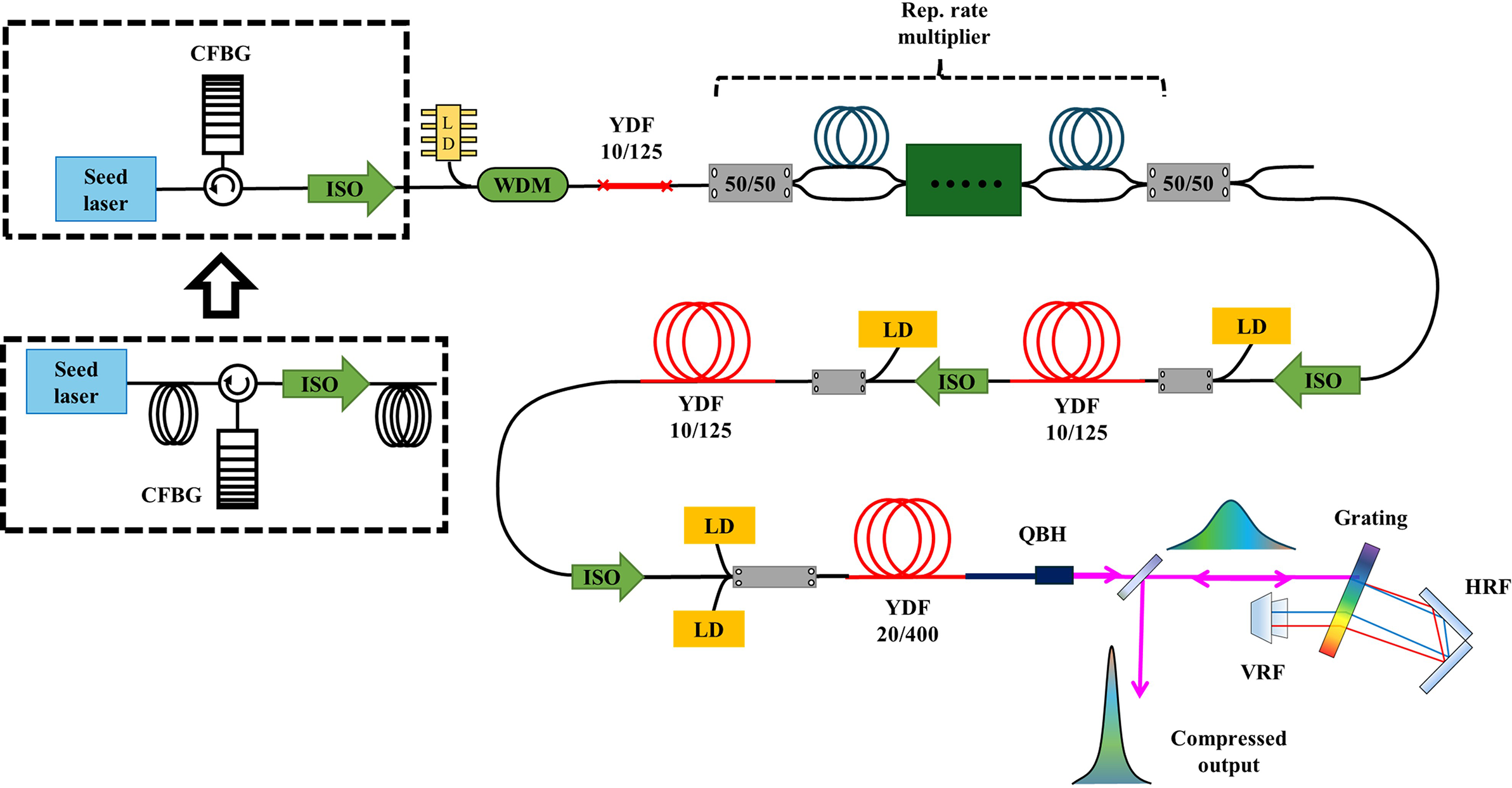
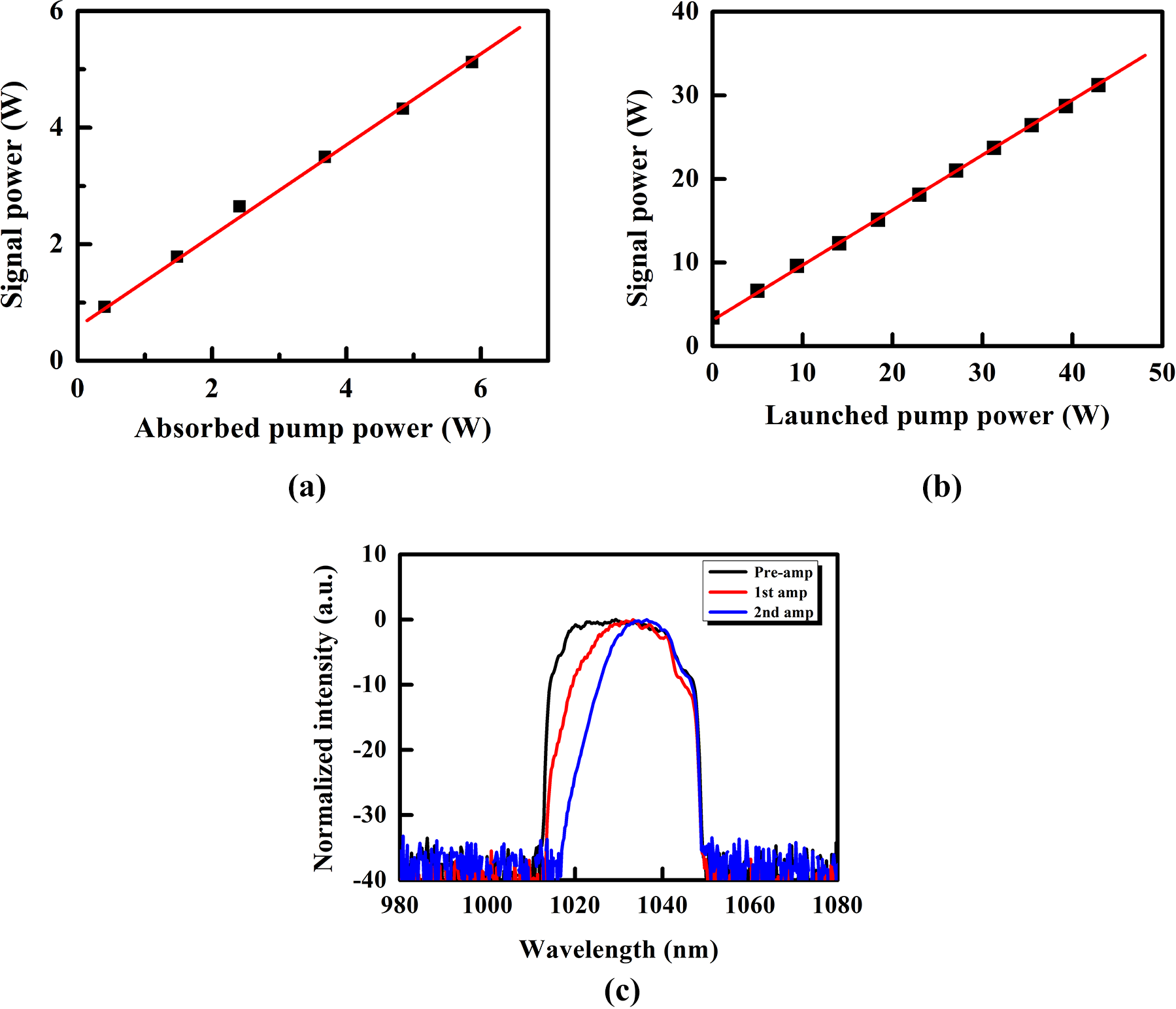
A schematic diagram of the Yb fiber-based MOPA setup is shown in Figure 1. Our fs MOPA system is composed of a mode-locked seed source, a pulse stretcher, a Yb-doped fiber pre-amplifier, a five-stage repetition-rate multiplier and three Yb-doped fiber amplifier stages. A mode-locked Yb-doped fiber laser centered at 1030 nm was used as a seed source (FPL-M4UFF-HAY-01; Calmar Laser, United States). The seed laser had 130 mW of average output power with a pulse duration of 1.5 ps and the spectral bandwidth (full width at half maximum) of approximately 22 nm at a repetition rate of 57.1 MHz. The mode-locked output pulses were stretched using a chirped fiber Bragg grating (CFBG) with the second- and third-order group velocity dispersion parameters (β 2 and β 3) of 9.95 ps2 and –0.044 ps3, respectively. Before the CFBG, the signal bandwidth increased to approximately 30 nm due to SPM in the delivery fibers, and the stretched pulse width was theoretically calculated to be approximately 530 ps. The stretched pulse signal was amplified in a core-pumped Yb fiber pre-amplifier after the isolator, yielding an output power of 211 mW for an absorbed pump power of 480 mW at 976 nm. The spectral bandwidth of the signal narrowed to 23.8 nm due to signal reabsorption and the gain narrowing (Figure 2(c)). The output was then coupled to a five-stage repetition-rate multiplier, thereby multiplying the repetition rate of the seed signal by a factor of 32, that is, 1.83 GHz. Each repetition-rate multiplier had a Mach–Zehnder interferometer configuration employing two 2×2 fused-fiber couplers with a splitting ratio of 50/50 connected by two passive fiber arms of different lengths. The fiber lengths were carefully chosen so that the pulse in one arm experienced a delay equal to half of the input pulse interval relative to the pulse in the other arm. The single-cladding PM passive fiber used in the multiplier stage had a core of 10 μm diameter surrounded by cladding of a 125 μm diameter. The laser pulses multiplied to 1.83 GHz were coupled to three Yb fiber amplifier stages after another isolator. The signal power incident on the first amplifier stage was only approximately 60 mW due to insertion losses in the multipliers and isolators. The first and second amplifiers employed the same double-clad PM Yb-doped fiber (Yb1200 10/125 DC-PM, nLight) as a gain medium, which had a Yb-doped core with a 10 μm diameter (numerical aperture (NA) 0.08) and a pure silica inner-cladding with a 125 μm diameter (NA 0.48). Pump light was provided by fiber-coupled laser diodes (LDs) wavelength-locked at 976 nm. Although the absorption coefficient of the used Yb fiber was 7.4 dB/m at 976 nm, we chose relatively short lengths of the Yb fibers, approximately 1 m and approximately 1.5 m in the first and second amplifier stages, respectively, to achieve robust amplification near 1030 nm. Figures 2(a) and 2(b) show the amplified output powers versus the absorbed pump powers for the first and second Yb fiber amplifiers. The first and second amplifiers yielded amplified output powers of 5.1 and 31 W for absorbed pump power of 5.9 W and launched pump power of 43 W, corresponding to slope efficiencies of 76% and 65%, respectively. Although relatively short lengths of Yb-doped fibers were used in these amplifiers, the center wavelength of the laser signal slightly red-shifted from 1030.0 to 1035.6 nm in the amplifier since signal reabsorption in the Yb-doped fiber is more pronounced in the short wavelength regime. The spectral bandwidth also narrowed from 23.8 to 12.2 nm due to reabsorption and gain narrowing in the Yb fibers, as shown in Figure 2(c).
Schematic diagram of the experimental setup. The seed part (dotted) would be later replaced by the modified one (lower) to reshape the spectrum and the pulse width of the seed signal. CFBG, chirped fiber Bragg grating; ISO, isolator; WDM, wavelength division multiplexer; YDF, Yb-doped fiber; LD, laser diode; QBH, quartz block head; HRF, horizontal roof mirror; VRF, vertical roof mirror.

Output characteristics of the first and second amplifiers. Output power as a function of absorbed pump power for (a) the first amplifier and (b) the second amplifier. (c) Spectral evolution of the laser signal from the pre-amplifier to the first and the second amplifier stages.

The main amplifier employed a double-cladding PM Yb-doped large-mode-area fiber fabricated by Taihan Fiberoptics (TFO-PLMA-YDF-DC-20/400) with a Yb-doped core of a 20 μm diameter (0.065 NA) and a pure silica inner-cladding of a 400 μm diameter (0.48 NA). The amplifier was pumped by six fiber-coupled LDs of 400 W power at 976 nm. Although the absorption coefficient of the Yb fiber was approximately 1.5 dB/m at 976 nm, the length of the Yb fiber used was approximately 5 m to minimize reabsorption of the laser signal and ensure robust high-power laser operation in the short wavelength regime near 1030 nm. For a longer Yb fiber of approximately 6 m, a significant increase in amplified spontaneous emission was observed before the output power reached 1 kW. A quartz block head was connected at the end of the amplifier to deliver the high-power fs laser beam.
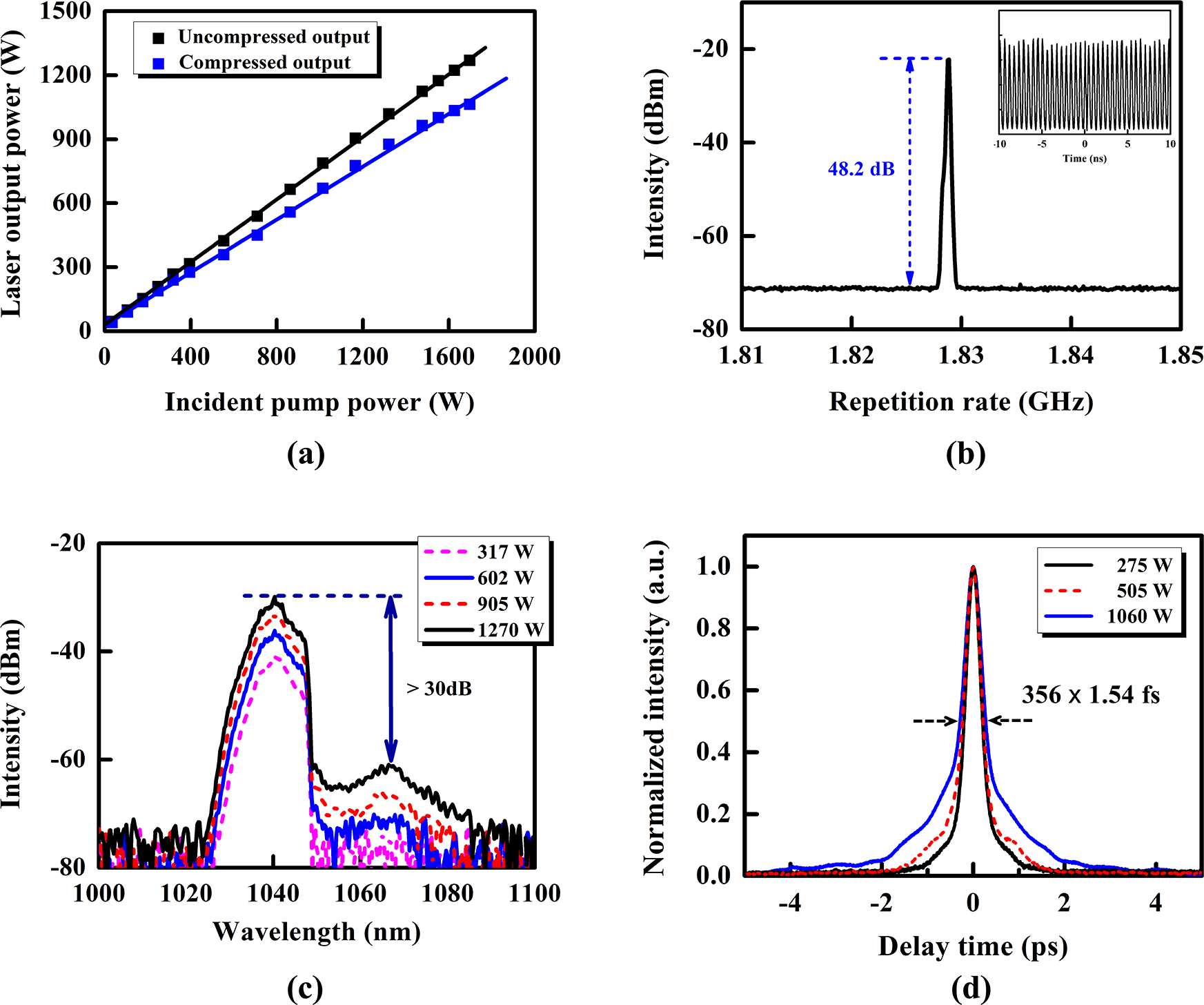
Under this configuration, the fs laser signal was amplified up to an output power of 1271 W for an incident pump power of 1697 W, corresponding to a slope efficiency of 74.3%, as shown in Figure 3(a). The radio frequency (RF) spectrum of the compressed output in Figure 3(b) confirms a repetition rate of 1.83 GHz with a high signal-to-noise ratio (SNR) of more than 48.2 dB. The SNR was slightly degraded compared to the seed source (>60 dB) in the multiple amplifier stages because the small-signal gain is stronger for weaker signals. However, it was sufficiently high for most applications requiring high-power lasers. Due to imperfections of 2×2 couplers with different fiber length arms, it is not possible to achieve exact doubling of pulse repetition rates with equal pulse amplitudes, inducing pulse-to-pulse timing jitter and amplitude fluctuations. However, GHz-repetition-rate fs lasers are typically operated in burst mode comprising tens or hundreds of pulses separated by sub-nanosecond intervals. Thus, these pulse-to-pulse timing jitter and amplitude fluctuations can be neglected for most applications of GHz-repetition-rate fs lasers, particularly laser material processing associated with thermal processes. Figure 3(c) shows the output spectra at different output powers, confirming that amplified spontaneous emission was well suppressed by more than 30 dB. SRS near 1090 nm was also not observed in Figure 3(c). The center wavelength was 1040 nm and its spectral bandwidth was further narrowed from 12.2 to 5.8 nm in the main amplifier. The beam quality was found to be less than 1.3 in both the x- and y-axes at all power levels, proving that the diffraction-limited beam quality was well preserved. The measured polarization extinction ratio was 14.7 dB, indicating that the amplified output beam had a high degree of linear polarization. The amplified pulse width was measured to be approximately 267 ps at the maximum power with the aid of a homemade autocorrelator designed for long-range pulse width measurements.
Output characteristics of the main amplifier and the compressor: (a) amplified and compressed output powers as a function of incident pump power in the main amplifier; (b) RF spectrum (inset: pulse train); (c) amplified output spectra at different amplified output powers; (d) autocorrelation traces of the compressed pulses at different compressed powers.

The amplified output pulses were compressed by a pulse compressor, comprising a transmission holographic grating and two roof mirrors (Figure 1). The transmission grating blazed at 1030 nm had 1250 lines/mm. Figure 3(a) also shows the compressed output power, along with the amplified output power, as a function of the incident pump power in the main amplifier. The maximum compressed signal power was 1.06 kW for an incident signal power of 1.27 kW, corresponding to a compression efficiency of 83.8% at 1.83 GHz. The average pulse energy at maximum power was calculated to be 580 nJ. The compressed pulse shapes at different output powers, measured by an autocorrelator (PulseCheck 150, APE-Berlin), are shown in Figure 3(d). No significant NLO effects were observed at low output powers, and the measured pulse width was 267 fs at 280 W. As the output power increased, the wing part in the autocorrelator traces increased prominently due to accumulated NLO effects, especially SPM, leading to broadened pulse widths to 297 and 356 fs at output powers of 530 and 1.06 kW, respectively. Thus, a shorter pulse duration is expected if the NLO effects can be reduced or properly compensated. The long-term stability measured at the maximum power was 0.15% (root-mean-square), confirming robust operation.
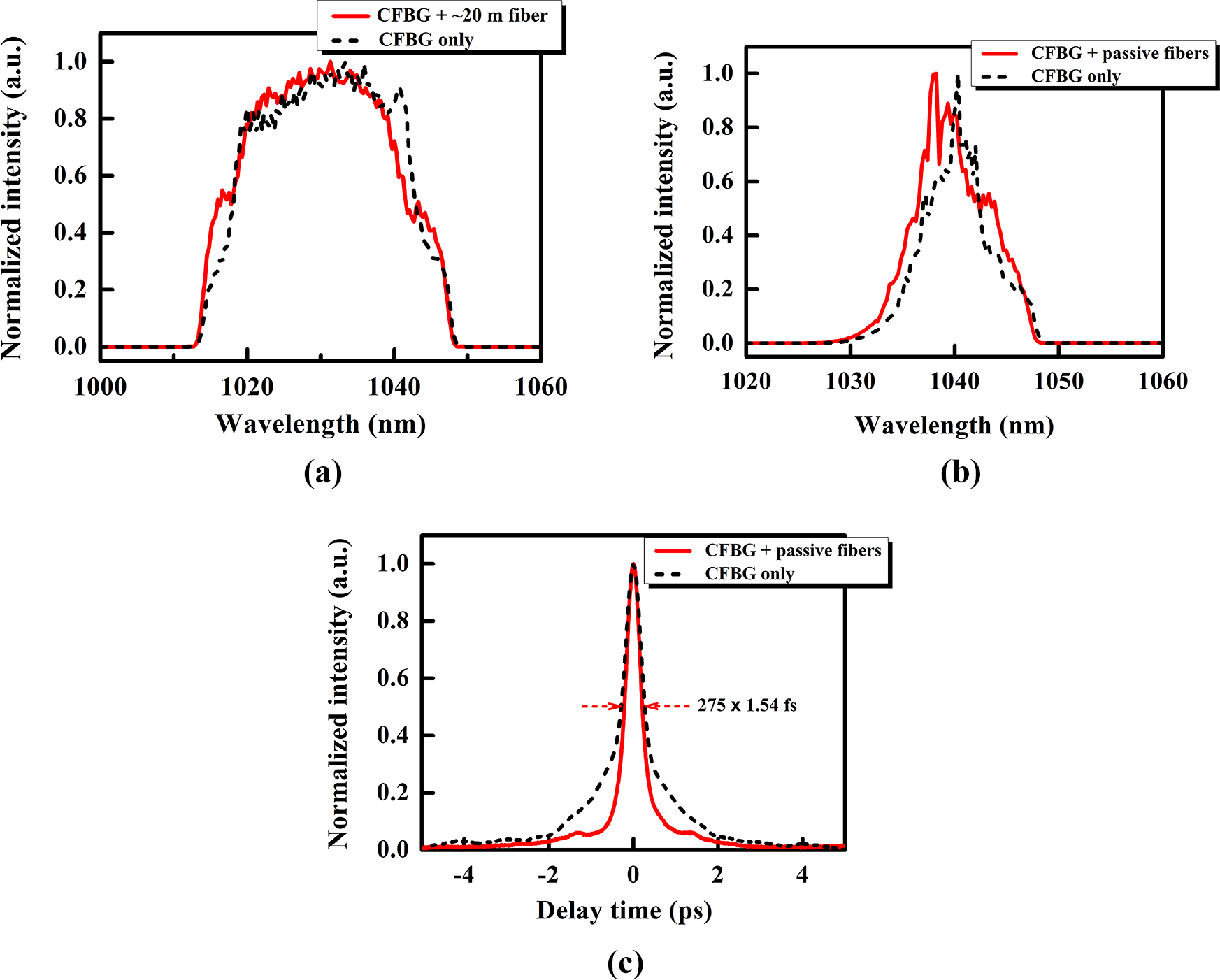
In order to achieve a better compressed pulse shape, we first spliced approximately 20 m of the passive fiber (PM980) before the CFBG, as shown in the lower box of Figure 1. The modified spectrum after introducing this passive fiber is shown in Figure 4(a), illustrating that the spectrum was slightly broadened and became more parabolic. The small side peaks are typical spectral modulations induced by SPM[ Reference Schimpf, Limpert and Tünnermann26, Reference Gee and Mielke27]. The spectral evolution to the parabolic profile due to the passive fiber has been well discussed in Refs. [Reference Finot, Provost, Petropoulos and Richardson28,Reference Boscolo, Latkin and Turitsyn29] and the parabolic spectral profile associated with linear chirp is very important for optimized pulse compression[ Reference Finot, Provost, Petropoulos and Richardson28– Reference Chang, Cheng, Sun, Peng, Yu, You, Wang and Wang32]. In addition, we spliced approximately 120 m of passive fiber with a 10 μm core after the CFBG to provide additional stretching of the seed pulse, resulting in the calculated pulse width from 530 to 640 ps and mitigating NLO effects during signal propagation. This additional passive fiber after the CFBG did not affect the spectrum because the peak power was significantly lower than that before the CFBG. Despite modification of the seed source, the amplification in the amplifier chains was almost the same as that achieved with the former seed. Figure 4(b) compares the amplified output spectrum of the MOPA system with the modified seed source to that of the former system. It is shown that the spectrum for the modified seed source became more symmetrical and exhibited a broadened bandwidth of 7.8 nm at the maximum output power of 1.27 kW. The spectrum was slightly broadened compared to that of the former system due to SPM induced in the additional passive fiber before the CFBG. As a result, we could achieve a significantly improved pulse compression with substantially reduced sidelobes compared to the former system, as shown in Figure 4(c). The resultant compressed pulse width was 275 fs, comparable to those at low power levels where NLO effects were negligible. It is also worth mentioning that no thermally induced mode instability was observed at any power level.
Output characteristics of the Yb fiber MOPA with the modified seed source. (a) Output spectra at the CFBG, (b) output spectra at the main Yb fiber amplifier, and (c) autocorrelation traces of the compressed pulses with and without additional passive fibers.

To understand the impact of the modified seed source on pulse compression, we numerically calculated the B-integral and a compressed pulse shape based on the nonlinear Schrodinger equation. The B-integral can be calculated by the following equation:
 $$\begin{align}B=\frac{2\pi }{\lambda}\int {n}_2\;I(z)\; \mathrm{d}z,\end{align}$$
where n 2 is the nonlinear refractive index and I(z) is the signal intensity in the beam axis, which can be obtained by numerically solving the following nonlinear Schrodinger equation:
 $$\begin{align}\frac{\partial A}{\partial z}=\left[\left(-\frac{i{\beta}_2}{2}\frac{\partial^2}{\partial {T}^2}+\frac{\beta_3}{6}\frac{\partial^3}{{\partial T}^3}\right)+ i\gamma {\left|A\right|}^2+{g}_0{\Omega}_{\omega }{\Omega}_T\right]A,\end{align}$$
where A is the amplitude, ${\beta}_2$
is the second-order group velocity dispersion,
${\beta}_2$
is the second-order group velocity dispersion, ${\beta}_3$
is the third-order dispersion coefficient, T is the normalized time scale to the initial pulse width,
${\beta}_3$
is the third-order dispersion coefficient, T is the normalized time scale to the initial pulse width, $\gamma$
is the nonlinear parameter,
$\gamma$
is the nonlinear parameter, ${g}_0$
is the gain,
${g}_0$
is the gain, ${\Omega}_{\omega }$
is the gain spectral function and
${\Omega}_{\omega }$
is the gain spectral function and ${\Omega}_T$
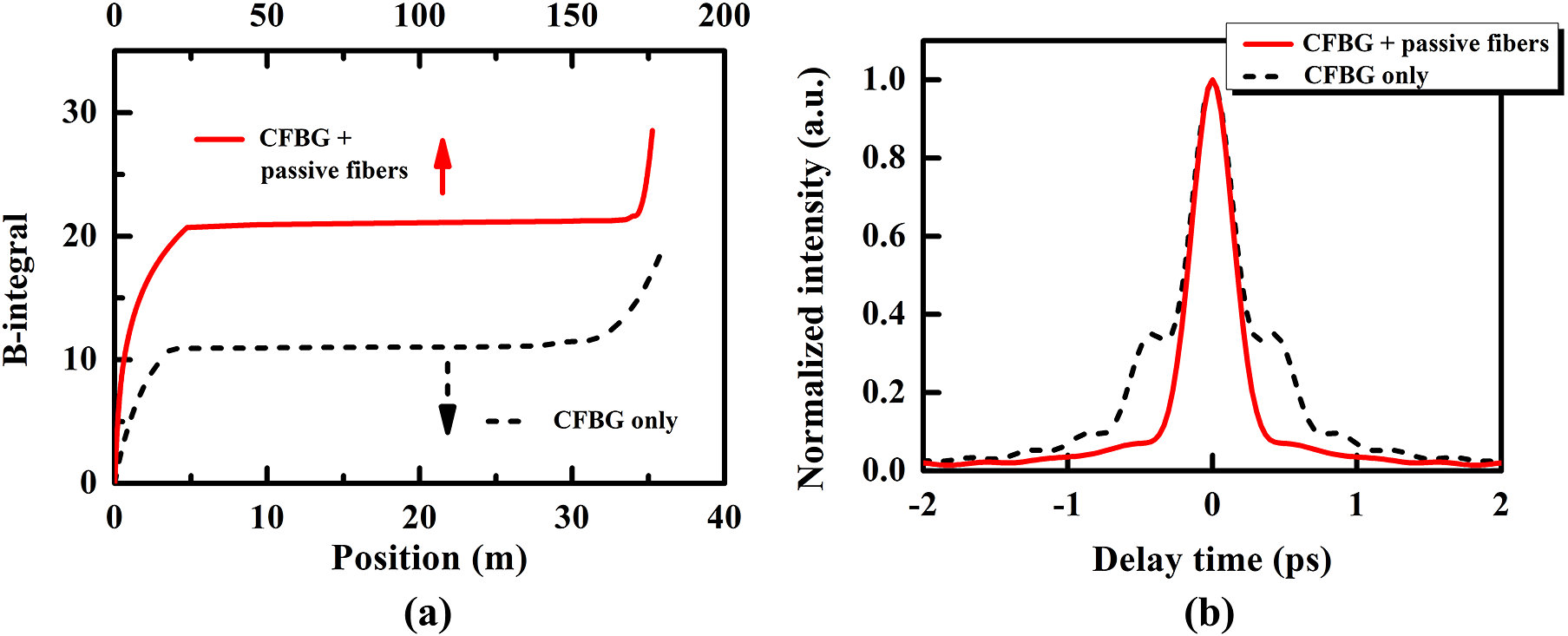
is the gain saturation function. Here, we used the measured values as the initial seed conditions and neglected SRS, which was well suppressed, as shown in Figure 3(c). Figure 5(a) shows the B-integral evolution along the propagation calculated by numerically solving Equations (1) and (2). Owing to the increased fiber length, the modified MOPA system exhibits a significantly higher B-integral compared with the former system. However, the theoretical pulse shapes in Figure 5(b) show that the latter MOPA system produces a much better compressed pulse shape with fewer sidelobes compared to the former system. These results demonstrate that an optimized spectral profile and a longer stretched pulse width are more critical than accumulated NLO effects, that is, the B-integral, in our system to achieve fs pulses with a near-transform-limited pulse shape. In particular, a parabolic spectral profile with linear chirp is critical to achieve improved pulse compression in high-power fiber MOPA systems with broad bandwidth. Using a longer passive fiber allows for longer pulse width and broader spectral bandwidth, which can lead to improved pulse compression. However, compressing such pulses would require a larger grating and wider roof mirrors, which are not available in our current system. We expect a higher pulse energy and improved pulse shape by employing a larger compressor along with longer passive fibers, which is the subject of ongoing work. Therefore, fs pulses with a higher pulse energy and a higher peak power can be realized by introducing a passive fiber of optimized length at an appropriate position to facilitate spectral shaping and additional pulse stretching.
${\Omega}_T$
is the gain saturation function. Here, we used the measured values as the initial seed conditions and neglected SRS, which was well suppressed, as shown in Figure 3(c). Figure 5(a) shows the B-integral evolution along the propagation calculated by numerically solving Equations (1) and (2). Owing to the increased fiber length, the modified MOPA system exhibits a significantly higher B-integral compared with the former system. However, the theoretical pulse shapes in Figure 5(b) show that the latter MOPA system produces a much better compressed pulse shape with fewer sidelobes compared to the former system. These results demonstrate that an optimized spectral profile and a longer stretched pulse width are more critical than accumulated NLO effects, that is, the B-integral, in our system to achieve fs pulses with a near-transform-limited pulse shape. In particular, a parabolic spectral profile with linear chirp is critical to achieve improved pulse compression in high-power fiber MOPA systems with broad bandwidth. Using a longer passive fiber allows for longer pulse width and broader spectral bandwidth, which can lead to improved pulse compression. However, compressing such pulses would require a larger grating and wider roof mirrors, which are not available in our current system. We expect a higher pulse energy and improved pulse shape by employing a larger compressor along with longer passive fibers, which is the subject of ongoing work. Therefore, fs pulses with a higher pulse energy and a higher peak power can be realized by introducing a passive fiber of optimized length at an appropriate position to facilitate spectral shaping and additional pulse stretching.
Theoretical simulations of (a) the B-integrals and (b) the compressed pulse shapes.

3 Conclusions
We have successfully demonstrated a high-power, high-efficiency Yb-doped fiber MOPA system delivering over 1 kW of fs laser output power at a repetition rate of 1.83 GHz. By employing a fiber-based chirped pulse amplification configuration comprising a repetition-rate multiplier and a multi-stage Yb-doped fiber amplifier, stable femtosecond laser pulse amplification was achieved, yielding a compressed output power of 1.06 kW with a pulse duration of 365 fs, corresponding to an average pulse energy of 580 nJ. Furthermore, we have also demonstrated both experimentally and theoretically that spectral reshaping toward a parabolic profile, accompanied by additional pulse stretching, enables significantly improved pulse compression despite higher accumulated NLO effects, yielding a pulse duration of 275 fs with significantly reduced sidelobes at the maximum output power. Therefore, we expect that our all-fiber MOPA system can provide a strong platform for femtosecond lasers used in industrial and scientific applications requiring high average power, excellent beam quality and long-term stability.
Acknowledgements
This work was supported by the Korea Institute of Machinery and Materials (KIMM) institutional program (NK255B). We gratefully acknowledge Taihan Fiberoptics Co., Ltd., for providing the high-power diode lasers and large-mode-area Yb-doped fibers used in this work.

 Open access

