


1. Introduction
1.1. Context
In the still relevant version of ICD (ICD10, F64*; Gender Identity Disorders), transgenderism is considered a mental illness, including a large spectrum of disorders. This raises two main challenges in day-to-day practice. First, the label of mental illness itself is a source of stigmatisation, which, in turn, affects transgender health [Reference Cruz1]. Second, in almost all countries, access to care is dependent upon receiving an official psychiatric diagnosis. This raises questions about the ethics of requiring psychiatric diagnoses before transgender people can obtain medical treatment and hormonal-chirurgical reassignment [2–Reference Thomas and Espineira4]. But to our knowledge, in some countries, including France, the medical process can be successfully engaged without considering a psychiatric diagnosis as a prerequisite.
Evidence that would support depsychiatrising would demonstrate that essential features of gender identity disorders, namely psychological distress and functional impairment, are neither necessary nor sufficient. It was initially confirmed by Robles et al. [Reference Robles, Fresán, Vega-Ramírez, Cruz-Islas and Rodríguez-Pérez5] in Mexico, and then by Campbell et al. [Reference Campbell, Fresán, Addinall, Böhmke, Grobler and Marais6] in South-Africa, who observed that distress and dysfunction were not reported by everyone (no necessity) and were related more to experienced violence or rejection than to transgender identity itself (no sufficiency). Thus the aim of the research was to replicate the original Mexican study in a different cultural and medical context, specifically within a transgender population receiving transgender related care in a French primary care setting independent from mental health services.
1.2. From ICD-10 to ICD-11
In the tenth revision of the International Classification of Diseases (ICD-10), “transgenderism” was named “transsexualism”, defined as the desire to live and be accepted as a member of the opposite sex, and considered an example of “gender identity disorders” (for the evolution of the ICD, see [Reference Drescher, Cohen-Kettenis and Winter7, Reference Reed, Drescher, Krueger, Atalla, Cochran and First8]). For the ICD-11 version, the Department of Mental Health and Substance, in collaboration with the Department of Reproductive Health, suggested renaming transgender identity to “gender incongruence”, to remove it from the chapter of mental and
behavioral disorders and to put it in a new category titled “Conditions related to sexual health” [Reference Drescher, Cohen-Kettenis and Winter7]. Reclassifying transgender diagnoses would be less stigmatising while maintaining access to medical care [Reference Drescher9, Reference Reucher10].
In June 2018, the WHO publicly adopted this proposition, and abandoned “opposite sex” or “anatomic sex” in favor of “experienced gender” and “assigned sex”. These changes reflect the evolution of clinical, theoretical, and social views. They also challenge the importance of language as a source of stigmatisation, including in the setting of scientific publications [Reference Reed11]. Moreover, because the ICD is an international standard and language is not free from culture, the labeling of categories must be questioned [Reference Reed12]. A direct translation from the English labeling might not be appropriate, and phrasing should be discussed with all stakeholders, especially transgender people.
1.3. A multi-level stigmatisation: some French illustrations [Reference Schembri13, Reference SOS Homophobie14]
Stigmatisation results not only from being a transgender person, but also from the psychiatrisation of the diagnosis. It can occur at both structural and interpersonal levels and may be internalized as self-stigmas [Reference Hughto, Reisner and Pachankis15]. Moreover, not only experiencing but also expecting rejection may have negative mental or psychological consequences [Reference Frost, Lehavot and Meyer16, Reference Rood, Reisner, Surace, Puckett, Maroney and Pantalone17] and, as for most stigmatised minority groups, coping strategies are not always adaptive [Reference Miller, Major, Heattheron, Kleck, Hebl and Hull18].
Considering transgenderism a mental health issue denies some human rights. For instance, in France, until the beginning of 2016, it was difficult to obtain a sex change from the courts, because this change was made on the basis of psychiatric and medical attestations, and was still based on a binary definition of transidentity. Moreover, courts may rule against transgender people in child custody cases on the basis of transgenderism being a mental disorder. Changing marital status was also difficult before the new law on marriage equality (2013), which opened marriage to same-sex people, enabling transwomen or transmen to get married or to remain married with the same person after transition.
1.4. Escaping psychiatry in the medical care process: a French innovative medical center
The MDS (Maison Dispersée de Santé), located in Lille (France), supports transgender people in their transition process, in close collaboration with local associations. The core idea is to provide access to support and care, especially hormone therapy, without the need for a psychiatric diagnosis. This initiative started with people who were refused hormonal treatment by health services and resorted to self-medication. This pragmatic and innovative position gives MDS a pioneering position in the depsychiatrisation of transgenderism [19]. The number of users (16–80 years old) increased from 94 in September 2015 to 264 in February 2017, illustrating the success of the structure.
The care protocol at the MDS differs from the typical French protocol in several ways: there is no long diagnostic and prognostic evaluation phase and psychiatric follow-up is not required; there is no inclusion selection, and no obligation for the user to accept medical decisions. It is close to the WPATH’s standards of care [20], in that it is respectful of the person. However, informed consent is sought by giving appropriate information related to own transition process. The people who come to request hormone therapy are considered like any others who submit a request for care. This does not extend to surgery access. In such a case, they have to conform to a hospital’s protocol, or have surgery abroad if they have sufficient financial resources.
1.5. Objectives
One important issue in the debate regarding depsychiatrisation is the validity of diagnosis essential features, i.e. psychological distress and functional disability. As argued by some authors [Reference De Cuypere, Jannes and Rubens21, Reference Zucker, Bradley, Owen-Anderson, Kibblewhite, Wood and Singh22], and confirmed by others [Reference Robles, Fresán, Vega-Ramírez, Cruz-Islas and Rodríguez-Pérez5], even if these features are commonly experienced by transgender people, they are not universal and are reported only by a small portion of those seeking treatment [Reference Carroll23, Reference Seil24]. Moreover, they can relate to factors other than trans-identity, in particular the social environment responsible for stigmatisation.
In this context, in line with the WHO’s recommendations and in agreement with the work of Robles et al. [Reference Robles, Fresán, Vega-Ramírez, Cruz-Islas and Rodríguez-Pérez5], the main objective of this study was to examine in a specific psychiatry-free French context,
1. If all transgender people report having experienced psychological distress or functional disability (as ICD-10 requires).
2. If psychological distress and functional disability can result from factors other than gender identity, in particular rejection of, and violence against, transgender people.
The secondary objective was to examine whether the use of health care services for the transformation of the body was related to factors other than gender identity such as distress, dysfunction, rejection or violence.
Finally, new to this study, we examined the phrasing of gender change (for additional data, see [Reference Roelandt, Askevis-Leherpeux, Desmons and De la Chenelière25]).
2. Methods
2.1. Background
The research program was conducted after a meeting organized at The French University “Paris-Sorbonne” (2010), with the participation of transgender people, representatives of transgender associations, members of the French WHO CC and members of the “Medicine, Science, Health and Society” research group. Communications were published in a special issue of L’information Psychiatrique (2011), titled Troubles liés au genre (gender related disorders) (see also [Reference Espineira26]). Following this meeting, the project was monitored by a participative steering committee, the Trans Collective and the MDS. All participants received constant updates until the edition of the WHO CC report.
2.2. Participants
The study took place in 2017, before the release of the latest edition of the ICD (June 2018). Seventy-two people aged 18–50 volunteered and signed an informed consent. They were currently attending, or had until recently attended, the MDS.
2.3. Materials
2.3.1. Main questionnaire
The main questionnaire, available on request, was translated and adapted from the one used by Robles et al. [Reference Robles, Fresán, Vega-Ramírez, Cruz-Islas and Rodríguez-Pérez5] in Mexico. It included two types of questions: information about the population (sociodemographic data and history of gender identity) and retrospective questions about experiences of gender incongruence, rejection, violence, distress and dysfunction.
Retrospective questions referred to a given period of time, called the Index Period, during which gender incongruence, distress and dysfunction may have been particularly prominent [Reference Steensma, Biemond, De Boer and Cohen-Kettenis27]. It was defined as the age the participants became aware that they might be transgender and perhaps might need to do something about it. They were introduced as follows: “Now, I'm going to ask you a few questions about the particular feelings and thoughts you had at this time (Index Period). I am not asking how you feel or think now, but how you remember you felt or thought during that particular time in your life. Do not try to interpret your experience through what you know and what has happened to you since then; just try to tell me about your thoughts and feelings at that time”. The participants were questioned on the following topics:
Gender category: Current identity, Birth category.
Use of health care services
Trans-identity (dichotomous answers and/or ratings): Experience of discomfort due to secondary sexual characteristics, changes made to become closer to the desired gender, and desire to be considered a member of that gender.
Psychological distress: experience and intensity, and means used to face it.
Functional disability : experience and intensity [Reference Sheehan28], across three domains: family, social, work or school
Social Rejection and Violence related to gender identity, and from whom
2.3.2. Additional question
“According to you, which terms would best designate gender change?”
2.4. Statistical analyses
Sixty-nine participants were included in analyses. The remaining three, defined themselves as queer, i.e. outside of binary gender categorization, were too few to be considered as a group.
Descriptive statistics were calculated, and Chi-square analyses or independent sample t-tests were used for comparison purposes. Analyses were performed with SPSS-X version 20 for Windows.
3. Results
3.1. Population
The mean age of the sample was 27.7 (SD = 9.6, range = 18–50) years, with more than half of the participants having been assigned a male sex at birth (60.9%; n = 42). At the time of the study, 73.9% (n = 51) were single, 37.7% (n = 26) were gainfully employed and 31.9% (n = 22) were full-time students.
As seen in Table 1, on average, participants reported they first became aware of their transgender identity and considered their options for gender transition at 9.2 years of age, and were aware of secondary sex characteristics at 12.8 years of age. A high percentage of participants reported having used some health service for body transformation at some point in their lives (82.6%; n = 57). Among these, all received hormone treatment, initiated at an average age of 24.8 years, and 91.2% (n = 52) with medical supervision. Only 33.3% (n = 23) reported having received surgery, the first one reported at age of 27.3 years. Compared with transwomen, transmen reported younger ages when they received hormone treatment (M = 21.2, vs. M = 27.3 years; t(67) = 2.9, p = 0.005) and surgery (M = 23.1 vs. M = 31.2 years, t(67) = 2.3, p = 0.03).
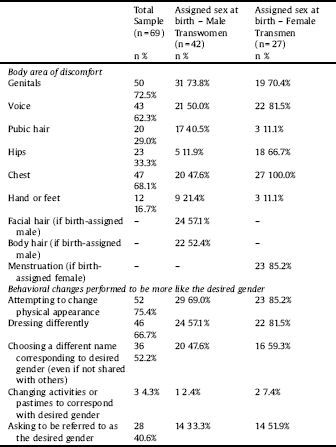
Participants reported having experienced an intense level of desire to be a different gender than the one assigned at birth, M = 4.8 (SD = 1.0; range 3–6), where a score of 6 represents the most intense level. All participants reported discomfort with several aspects of their bodies and a desire to make a variety of changes to make themselves more similar to their desired gender (Table 2). More participants assigned a female sex at birth, compared to those assigned a male one, expressed discomfort with voice (χ2(1) = 6.9, p = 0.008, Fisher = 0.01), hips (χ2(1) = 22.1, p < 0.001, Fisher<0.001) and chest (χ2(1) = 20.7, p < 0.001, Fisher<0.001) and changed their way of dress (χ2(1) = 4.3, p = 0.03, Fisher = 0.04), while more participants assigned a male sex at birth, compared to those assigned a female one, expressed discomfort with pubic hair χ2(1) = 6.8, p = 0.009, Fisher = 0.01).
3.2. Experience of social rejection and violence
More than half of the participants (55.1%, n = 38) reported having experienced social rejection related to their gender identity during the index period, most commonly by schoolmates or coworkers (71.0%, n = 27), followed by family members (57.8%, n = 22) and friends (26.3%, n = 10). The most common form of rejection from family members and friends was being treated with indifference or being ignored (31.8%, n = 7 and 44.4%, n = 4), while rejection by schoolmates or coworkers was with verbal or physical aggression (37.5%, n = 9).
Violence related to their gender identity was experienced by 46.4% (n = 32) of the participants. Among these, all reported having suffered psychological violence, followed by physical violence (53.1%, n = 17) and sexual violence (28.1%, n = 9). Economic and workplace/school violence were the least frequently reported (25.0%; n = 8 for each). Violence was mostly perpetrated by family members (53.1%, n = 17) or by a person well known to the participant (friend, colleague, neighbor) (40.6%, n = 13).
A similar proportion of transwomen and transmen reported having experienced social rejection in general (54.8%, n = 23 vs 55.6%, n = 15; χ 2(1) = 0.004, p = 0.94) and violence (47.6%, n = 20 vs. 44.4%, n = 12; χ 2(1) = 0.06, p = 0.79). More transmen experienced rejection from friends than did transwomen (25.9%, n = 7 vs 7.1%, n = 3; χ 2(1) = 4.6, p = 0.03, Fisher = 0.04).
3.3. Gender identity, use of health services, violence and rejection based on distress and functional disabilities
A high percentage of participants (88.4%, n = 61) reported having experienced psychological distress related to their gender identity. Among those participants, the most common reports of distress included depressive symptoms (72.1%, n = 44), suicide ideation or attempt (37.7%, n = 23) and symptoms of anxiety (36.1%, n = 22). On a scale from 0 to 100, the average level of distress among those who reported it was high (M = 78.2, SD = 16.9; range 30–100). A total of 23.0% (n = 14) of those who experienced distress reported distancing themselves from others, and 21.3% (n = 13) engaging in self-destructive behaviors (fighting, abusing substances, and attempting suicide). Only 36.1% (n = 22) reported having received specialized psychological or psychiatric treatment, and half of these (n = 11) found the treatment to be beneficial. Differences between participants who reported and those who did not report distress associated with their gender identity are shown in Table 3.
A similar proportion of transmen (96.3%; n = 26) and transwomen (83.3%; n = 35) reported having experienced distress. A higher proportion of male sex at birth participants who experienced discomfort with facial/body hair reported distress. Also, participants who reported distress had significantly higher levels of work/scholastic dysfunction.
Dysfunction related to experienced gender identity was reported by 85.5% (n = 59) of the sample. Social and work/scholastic dysfunction were the most frequently reported (71.0%, n = 49 for each), while family dysfunction was reported by 44.9% (n = 31) of individuals. Average level of dysfunction (10-point scale) was moderate for social dysfunction (M = 5.2; SD = 3.4; range 0–10) and work/scholastic dysfunction (M = 4.9; SD = 3.3; range 0–10) and low for family dysfunction (M = 3.3, SD = 3.5, range 0–10). Dysfunction attributed to gender identity was similarly reported by transwomen (83.3%; n = 35) and transmen (88.9%; n = 24). Participants who experienced dysfunction also reported more experiences of rejection by schoolmates/coworkers.
Demographic features, use of health services for body transformation and ages related to transidentity and body transformation according to current gender identity (Women vs. Men).
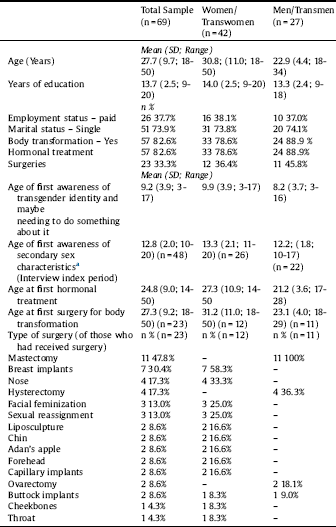
Note: " Transwomen" refers to people whose sex assigned at birth was male and who made a transition to a female identity, and vice versa for "Transmen".
a Based on subjects whose first age of awareness of transgender identity was at the age of 12 or less.
A higher proportion of participants who used health services for body transformation had gainful employment, and asked to be referred to as the desired gender. Experiences of rejection, violence and level of dysfunction did not vary as a function of body transformation.
3.4. Appropriate word(s) to designate gender change
Analysis was focused on two aspects:
The reference term, i.e. what is changed: gender, sex, identity, unspecified.
The change term: trans*, transition, dysphoria, incongruence, other terms.
Discomfort with body aspects and behavioral changes performed during interview index period to be more like the desired gender, according to assigned sex at birth.
A majority (74.6%, n = 53) mentioned a reference term. Among them, the most frequent one was gender (66%, n = 35) followed by identity (30.2%, n = 16) (Table 4).
The change term most often mentioned was “trans” (40.8%, n = 29), followed by “dysphoria” (14.1%, n = 10) and “transition” (12.7%, n = 9).
4. Discussion
The current released version of the ICD 11 renamed “transgender identity” to “gender incongruence”, removed it from the chapter of mental and behavioral disorders to a new one titled “Conditions related to sexual health”, and revised the diagnostic guidelines. The rationale was that psychological distress and functional impairment do not have to be considered diagnostic requirements anymore, and may be associated with social factors such as stigmatisation, rejection, and violence resulting from transgender status and its psychiatrisation. This was initially confirmed by Robles et al. [Reference Robles, Fresán, Vega-Ramírez, Cruz-Islas and Rodríguez-Pérez5] in Mexico, where transgender-related health services are delivered in a Specialised Clinic of a Psychiatric Institute.
Thus, the objectives of the French study were the same as the Mexican study using the same method but within a primary care center. We also wanted to examine whether the use of health services for the transformation of the body was related to distress, dysfunction, and/or rejection and violence. Finally, we questioned participants about their preferred terminology to express the idea of “gender change”.
Gender identity features, use of health services for boy transformation, violence and rejection related to distress and dysfunction.
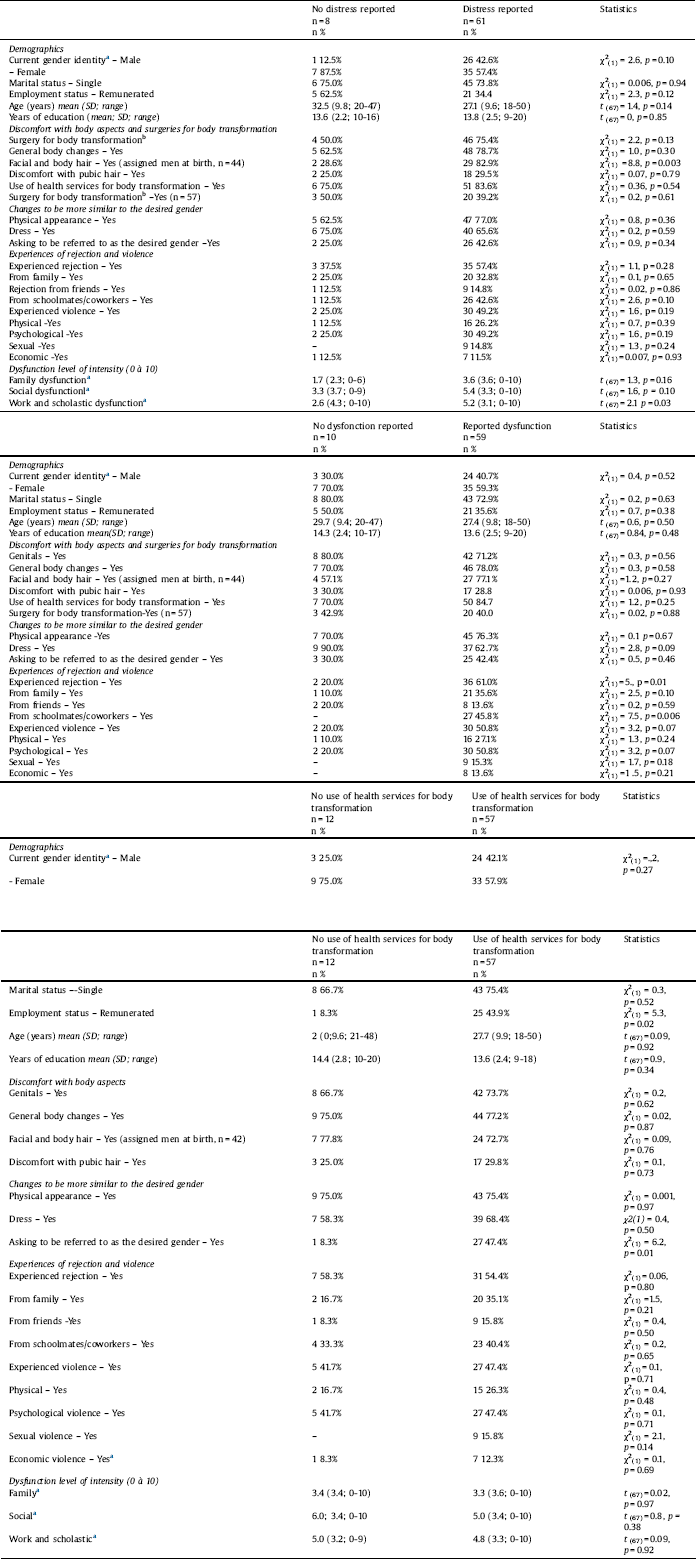
a Based on adaptation of the Sheehan Disability Scale (1996).
Approximately half participants reported social rejection, mostly by classmates or colleagues, and family members. They also experienced violence during their adolescence, primarily psychological in nature.
Appropriate words (n; %) to rephrase gender change, as a function of reference and change terms (n = 71).
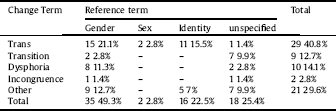
Note: Some participants did not answer the question and others gave multiple answers.
More importantly, most of them, but not all of them, reported having experienced psychological distress and dysfunction. Moreover, reported violence, especially from schoolmates, and level of work and/or scholastic rejection, were higher when participants experienced dysfunction.
The use of health services was unrelated to distress, dysfunction, and/or rejection and violence.
A observed in Robles’s study [Reference Robles, Fresán, Vega-Ramírez, Cruz-Islas and Rodríguez-Pérez5], distress and dysfunction were not always reported by transgender people and thus, should not be required for the diagnosis. It supports the placement of transgenderism outside the category of “Mental and Behavioral Disorders”. Nevertheless, we ought to remember that depsychiatrisation does not mean demedicalisation. The protocol initiated by the MDS shows that it is possible to care for transgender people without requiring a psychiatric diagnosis. This contributes to shorten the transition process and make it easier to live with.
Another important question relates to the phrasing of the diagnosis. Even if “sex” and “gender” are replaced by “assigned sex” and “experienced gender”, the definitions do not incorporate the idea that some people define themselves as “variant”, and describe change as a process rather than in binary terms. Results showed that a majority of participants suggested the use of the prefix “trans*” or the word “transition”, instead of “incongruence” or “dysphoria”, arguing against a binary conception. Moreover, these results question whether the ICD should refer to the person, their state until their transition, or to the transition process itself.
The study presents some shortcomings. First, participants were recruited on a voluntary basis in a specific health service. Thus, the results might not be representative of the French transgender population. What is most important is to observe that the relation between social environment and distress or dysfunction does not appear to depend on country [Reference Robles, Fresán, Vega-Ramírez, Cruz-Islas and Rodríguez-Pérez5, Reference Campbell, Fresán, Addinall, Böhmke, Grobler and Marais6, Reference Robles29]. Moreover, the study is an opportunity to show that medical care of transgender people can be offered without requiring a psychiatric diagnosis.
Secondly, for statistical reasons, the analyses could not include people who identified as “queer” due to their low number (n = 3), probably resulting from the choice of the MDS as the research site. Consequently, these results might not reflect the reality of their experience and future research should close this gap in knowledge. In the meantime, future ICD definitions should take this reality into account and be as inclusive as possible in regards to people who identify outside of binary gender.
Finally, one may object that data are based on retrospective interviews. However, while often influenced by emotional context, this procedure is largely used in social psychological studies on the self and autobiographic memory [Reference Baumeister, Gilbert, Fiske and Lindzey30].
Despite these limitations, one can hope that depsychiatrisation of transgenderism will transfer the standards by which we decide who can receive medical care away from mental health diagnoses in favor of human rights. This is especially relevant in France where transgender people can begin their transition, including legally changing their gender, before resorting to the health care system.
5. Conclusion
Results do not support a psychiatric or binary conception of transgenderism. Psychological distress and functional impairment were not reported by every participant, and may result from rejection and violence coming from coworkers and schoolmates. This should be conveyed by the chosen label for ICD-11 and therefore questions the proposition of "gender incongruence".
Moreover, labeling and defining the diagnosis should not be limited to the medical point of view but should also take into account human rights, and cultural, linguistic, legal, and social perspectives.
Acknowledgements
The present study received financial support from the Direction Générale de la Santé (DGS), and the Maison Dispersée de Santé (MDS).
The authors are grateful to Dr Riff for his availability and kind help, to transgender people who agreed to participate in the pre-test and the study, as well as to the transgender associations who have all made contributions to this study (Association Nationale Transgenre (ANT); Association Beaumont Continental (ABC); C'est Pas Mon Genre; J’en suis - j’y reste; En-Trans; Espace Santé Trans (EST).
The authors would also like to thank Patrice Desmons (CCOMS, France) for his deep involvement in the elaboration of the protocol, Silvia d’Oca (University of Cagliari, Italy) for her help on additional questions analysis, and Brian Hofer for proofreading.


 Open access


Comments
No Comments have been published for this article.