

Introduction
The archaeological site of Amzabegovo (also published under the names of: Anza, Anzabegovo or Barutnica) is located on the Barutnica meadow near the eponymous village of Amzabegovo (municipality of Sveti Nikole), in the Ovče Pole Plain within the catchment area of the middle Vardar and its tributaries, in today’s Republic of North Macedonia (41° 48′ 39.89″ N, 21° 59′ 38.92″ E) (Figure 1). It is a prehistoric settlement mound of the ‘tell’ type, formed over time through the accumulation of Neolithic building debris, alongside remains of a Roman settlement. The site is both eponymous and co-definitive of the Amzabegovo–Vršnik group, whose material culture is found throughout the Neolithic in the north-western and eastern regions of present-day North Macedonia (Fidanoski Reference Fidanoski, Naumov, Findanoski, Tolevski and Ivkovska2009; Reference Fidanoski, Kozłowski and Kaczanowska2019; Garašanin Reference Garašanin and Benac1979; Reference Garašanin1998; Krauß Reference Krauß, Šuteková, Pavúk, Kalábková and Kovár2010; Parzinger Reference Parzinger1993; Sanev Reference Sanev and Koco1994). This key site has been archaeologically explored since the 1960s, most extensively during the American and Yugoslav fieldwork campaigns between 1969 and 1970. The American excavations, led by Marija Gimbutas, produced a significant set of radiocarbon dates.
Amzabegovo. Geographical location of the archaeological site (map: A. Ballmer, Wikimedia Commons).

Figure 1 Long description
The map highlights the location of the archaeological site of Amzabegovo, also known as Anza, Anzabegovo, or Barutnica, situated on the Barutnica meadow near the village of Amzabegovo in the municipality of Sveti Nikole. This site is within the Ove Pole Plain in the catchment area of the middle Vardar River and its tributaries, located in the Republic of North Macedonia. The map includes surrounding countries such as Kosovo, Serbia, Bulgaria, Albania, and Greece, providing a broader geographical context. A star marker indicates the precise location of Amzabegovo. The map also features rivers, mountains, and other geographical features, with a scale bar at the bottom for distance measurement.
While the primary aim of this report is to present 50 new AMS radiocarbon dates recovered from recently excavated Neolithic settlement contexts, we also seek, where possible, to generally reassess previously published legacy dates.
The Yugoslav and American excavations (1960–1970)
The site was discovered in 1960 and initially explored in several trenches on its southern edge (Korošeć Reference Korošeć, Benac, Novak, Garašanin and Tasić1971; Korošeć & Korošeć Reference Korošeć and Korošeć1973). Between 1969 and 1970, two further areas of the settlement mound were extensively excavated and studied using a multidisciplinary approach, one by a U.S. team led by Marija Gimbutas (University of California, Los Angeles), and the other by a Yugoslav team led by Milutin Garašanin (University of Belgrade). The two excavations took place independently, following different methodological approaches, and were also documented, evaluated, and published separately (American excavations: Gimbutas Reference Gimbutas1972; Reference Gimbutas1974; Reference Gimbutas1976; Yugoslav excavations: Garašanin Reference Garašanin, Benac, Novak, Garašanin and Tasić1971; Reference Garašanin1974; Reference Garašanin and Boardman1982; Garašanin et al. Reference Garašanin, Sanev and Garašanin2009). As a result, it is difficult to correlate the findings from these two excavations, despite them being located just a few dozen metres apart (cf. Table 3).
In her excavations, Gimbutas identified four Neolithic settlement phases (Anza-I to Anza-IV), each represented by multiple habitation levels. These comprise post-built structures with clay floors and walls, fireplaces, pits serving various functions, and a significant quantity of artefacts, particularly pottery (Gimbutas Reference Gimbutas1972; Reference Gimbutas1974; Reference Gimbutas1976).
The ‘Anza series’: Gimbutas’ (then) groundbreaking radiocarbon dataset
Gimbutas was one of the leading advocates for radiocarbon-based chronologies at a time when the method was still new to the field and somewhat controversial (Bánffy Reference Bánffy2022; Ehrich Reference Ehrich1965a; Reference Ehrich and Ehrich1965b; Elster Reference Elster, Hamilton, Whitehouse and Wright2007; Reference Elster2021; Evans & Rasson Reference Evans and Rasson1984; Ferguson et al. Reference Ferguson, Gimbutas and Suess1976; Gimbutas Reference Gimbutas1973; Rasson Reference Rasson, Coltofean, Arnold and Bartosiewicz2025). She obtained 14C dates for many sites she excavated, including Amzabegovo. In the 1970s, the Mt Soledad Radiocarbon Laboratory at La Jolla conducted a series of measurements – the ‘Anza series’ – on wood charcoal samples from various stratigraphic units (Bien & Pandolfi Reference Bien and Pandolfi1972; Gimbutas Reference Gimbutas1976; Linick Reference Linick1977). Gimbutas also commissioned the radiocarbon dating of a charcoal sample and two bone samples from Garašanin’s excavations at Amzabegovo. The charcoal sample was dated by the Mt Soledad/La Jolla laboratory (Linick Reference Linick1977), and the two others by the UCLA laboratory (Ferguson et al. Reference Ferguson, Gimbutas and Suess1976; Gimbutas Reference Gimbutas1976). With a total of 30 radiocarbon dates, Amzabegovo was, at the time, one of the most consistently dated Neolithic settlements in the Balkans (outside Greece), providing absolute chronological markers for its occupation and distinct typologically identifiable horizons between c. 6200/6100 and 5200 cal BC (Gimbutas Reference Gimbutas1974; Reference Gimbutas1976). This also contributed to the establishment of key chronological reference points for the regional Neolithic. In this context, Amzabegovo’s role as a ‘yardstick’ – as Gimbutas (Reference Gimbutas1974) termed it– has proven to be something of a self-fulfilling prophecy.
Already in the 1970s, the excavation techniques employed by Gimbutas at Amzabegovo, along with the results – particularly the radiocarbon dates – were vehemently criticised. Despite the occasionally inappropriate tone of the criticism, some of the underlying points, particularly those regarding the 14C dates, are legitimate (Milojčić Reference Milojčić1978; Nandris Reference Nandris1979; Thissen Reference Thissen, Hiller and Nikolov2000). There are indeed striking inconsistencies between the published data (Ferguson et al. Reference Ferguson, Gimbutas and Suess1976; Gimbutas Reference Gimbutas1972; Reference Gimbutas1974; Reference Gimbutas1976; cf. dating reports by Bien & Pandolfi Reference Bien and Pandolfi1972; Linick Reference Linick1977). Moreover, several of her statements regarding the archaeological contexts of the sample material are ambiguous or even contradictory. All of this continues to hinder the comprehensibility of the Amzabegovo radiocarbon dates.
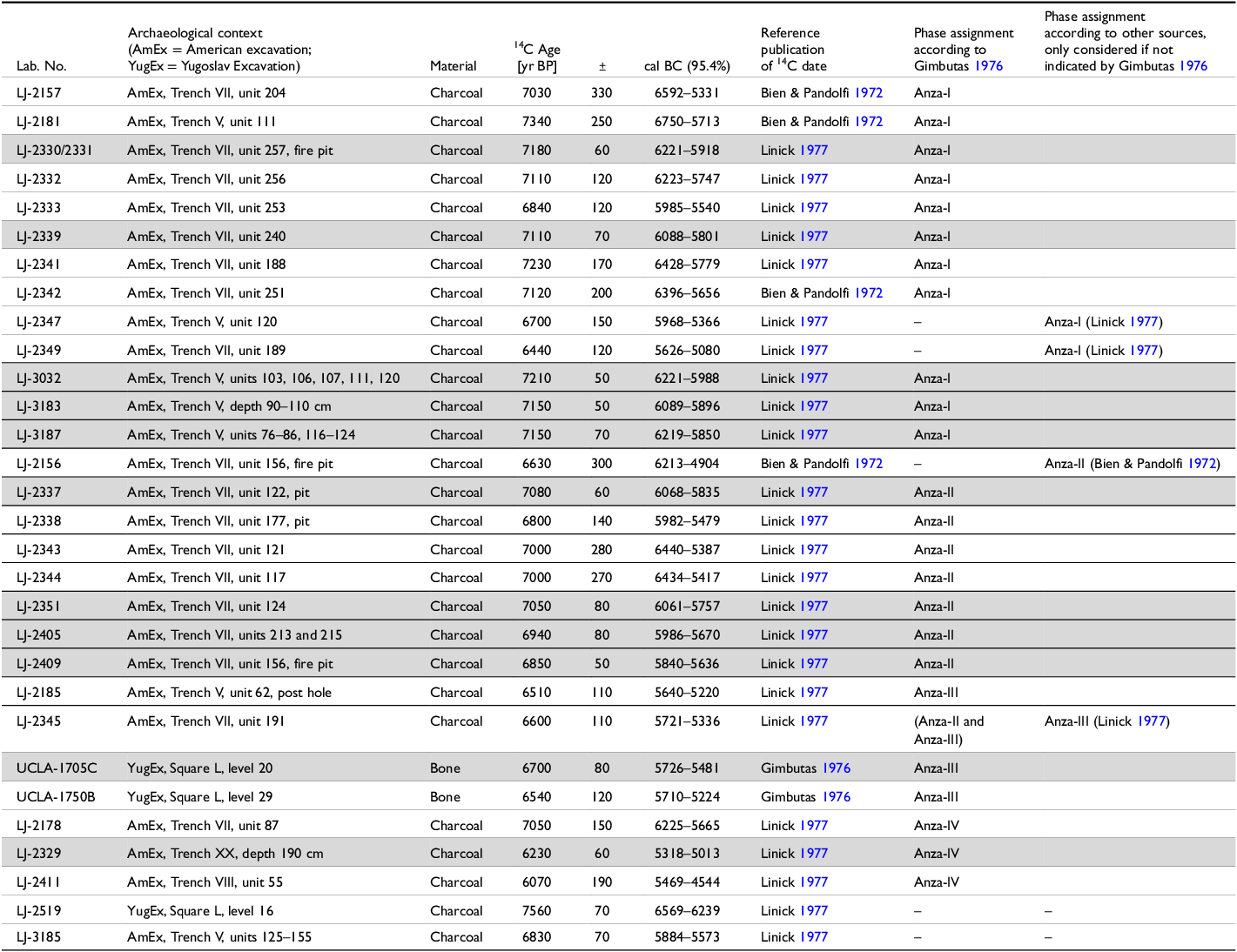
Specifically, there are considerable discrepancies between the data published in Radiocarbon (Bien & Pandolfi Reference Bien and Pandolfi1972; Linick Reference Linick1977) and those presented by Gimbutas (Reference Gimbutas1974; Reference Gimbutas1976) and Wesley Ferguson et al. (Reference Ferguson, Gimbutas and Suess1976) in terms of laboratory numbers, measured values, standard deviations, and phase assignments. Table 1 lists Gimbutas’ radiocarbon dates (mainly from the American and two from the Yugoslav excavations), following the information published in Radiocarbon (Bien & Pandolfi Reference Bien and Pandolfi1972; Linick Reference Linick1977) concerning laboratory numbers, measured values, and standard deviations.Footnote 1 With regard to the archaeological phase attribution of the samples and dates, we follow Gimbutas (Reference Gimbutas1976), which we consider her final interpretative framework. This differs from the phase assignments published in Radiocarbon, which were most likely provisional. For reasons that remain unclear, five dates published in Radiocarbon were not included in Gimbutas’ final evaluation (Gimbutas Reference Gimbutas1976). In three cases (LJ-2156, LJ-2347, and LJ-2349) we rely on Gimbutas’ tentative phase assignments (indicated by Bien & Pandolfi Reference Bien and Pandolfi1972; Linick Reference Linick1977). The phase assignment of two dates (LJ-2519 and LJ-3185) remains unknown (Linick Reference Linick1977). Of the three dates from Garašanin’s excavations (UCLA-1705C, UCLA-1705B, and LJ-2519), the first two were correlated with Anza-III by Gimbutas herself (Gimbutas Reference Gimbutas1976); the archaeological context of LJ-2519, which dates to a radiocarbon age of 7560 ± 70 yr BP and was described by Timothy Linick (Reference Linick1977) as the ‘oldest of any Anza sample’, remains unknown. He assigns it to Garašanin’s ‘level 16’, which, based on the published information, cannot be reliably correlated with Gimbutas’ stratigraphy. Gimbutas does not mention Garašanin’s level 16 at all.
Amzabegovo. List of Gimbutas’ radiocarbon dates (mainly from the American and in two cases from the Yugoslav excavations of 1969–1970). Dates as published in Radiocarbon (Bien & Pandolfi Reference Bien and Pandolfi1972; Linick Reference Linick1977), phase assignments as published there and by Gimbutas (Reference Gimbutas1976). Ordered by phase and laboratory number. Calibrated using the OxCal 4.4.4 software (Bronk Ramsey Reference Bronk Ramsey2009a) and the IntCal20 dataset (Reimer et al. Reference Reimer and Talamo2020). Grey-shaded: dates with phase attribution and standard deviations of ≤ 80 years

Table 1 Long description
The table presents radiocarbon dates from the Amzabegovo archaeological site, detailing lab numbers, material type, age in years, calibrated BC dates, reference publications, phase assignments according to Gimbutas 1976, and phase assignments according to other sources. The table includes 35 rows and 7 columns, with columns for lab number, archaeological context, material, radiocarbon age, calibrated BC dates, reference publication of the radiocarbon date, phase assignment according to Gimbutas 1976, and phase assignment according to other sources. Notable trends include multiple entries for Anza-I and Anza-II phases, with charcoal being the primary material analyzed. The table also highlights discrepancies in phase assignments between different sources.
Given these considerations, 28 of Gimbutas’ radiocarbon dates can be assigned to the site occupation phases. Of these, 11 exhibit standard deviations of ≤80 years, a value generally regarded as an acceptable threshold for drawing reliable chronological inferences.
The recent excavations (2019 onwards)
In 2019, new excavations were initiated by Darko Stojanovski in collaboration with the Municipal Museum of Sveti Nikole, North Macedonia (Stojanovski Reference Stojanovski2022). An initial trench (Trench 1) was dug in the central part of the site, which had remained unaffected by previous archaeological interventions (Figure 2). Today, the excavation extends over an area of 200 m2; however, it is only in Trench 1 that the full stratigraphic sequence of the tell (more than 4 m deep) has been exposed. The upper section of the trench covers 9 m2, while the Early Neolithic layers in the lower part were excavated over an area of 2 m2.
Amzabegovo. Orthophotography of the archaeological site. A) Overview of the settlement area. Shaded area: estimated extent of the settlement; grey areas: excavations 1960–1970; red square: recent excavations since 2019. B) recent excavations since 2019. Trench 1 is located in square C3 (photos: D. Stojanovski, H. Talevski 2022).

Figure 2 Long description
The image consists of two parts: an aerial orthophotography of the archaeological site of Amzabegovo and a detailed view of recent excavations. The first part (a) provides an overview of the settlement area, with a shaded region indicating the estimated extent of the settlement. Grey areas mark excavations conducted between 1960 and 1970, and a red square highlights recent excavations since 2019. The second part (b) focuses on the recent excavations, with a grid overlay showing specific squares and trenches, particularly Trench 1 located in square C3. The image captures the historical and archaeological significance of the site, which includes Neolithic and Roman settlement remains.
In total, 19 occupation and depositional layers of varying thickness were documented, reflecting settlement and abandonment events of differing duration. Based on preliminary analysis of the material culture, these are grouped into seven successive Neolithic settlement phases, from Phase AMZ 1 (basal, earliest) to AMZ 7 (uppermost, latest) (Stojanovski Reference Stojanovski2022).
Pottery assemblages allow correlation with established typochronological stages (cf. Fidanoski Reference Fidanoski, Naumov, Findanoski, Tolevski and Ivkovska2009; Garašanin Reference Garašanin and Benac1979; Reference Garašanin1998; Krauß Reference Krauß, Šuteková, Pavúk, Kalábková and Kovár2010; Reference Krauß2023; Parzinger Reference Parzinger1993; Sanev Reference Sanev and Koco1994): AMZ 1 predates the Amzabegovo–Vršnik complex; AMZ 2–5 correspond to Amzabegovo–Vršnik I–IV; and AMZ 6–7 show Vinča elements (cf. Table 3). At manuscript completion, analysis of high-resolution stratigraphy and the material record was ongoing; their full presentation therefore lies beyond the scope of this report. The settlement phases – defined as sequences of occupation episodes of varying duration within the same cultural horizon – can nevertheless be regarded as robust.
Materials and methods
Samples
In the absence of other suitable material, 50 wood charcoal fragments from Trench 1 of the new excavations were selected for radiocarbon dating. All samples were retrieved by hand-picking during the 2019–2021 field campaigns from stratigraphically undisturbed settlement features associated with Neolithic phases AMZ 1–5.
As the charcoal was not identified to wood species, the sample material could consist of potentially long-lived wood and could be subject to the so-called ‘old wood effect’ (e.g. Bowman Reference Bowman1990). Consequently, the individual dates indicate a TPQ. As will be shown, a considerable number of samples from different archaeological features display remarkably consistent 14C ages within each phase, forming tightly clustered groups. This suggests that the discrepancy is likely minor and on the order of only a few decades, since a more substantial offset would be reflected in greater variation among the 14C determinations. A future Bayesian outlier analysis may help address the methodological challenges inherent in dating charcoal fragments (Bayliss Reference Bayliss2007; Bayliss & Bronk Ramsey Reference Bayliss, Bronk Ramsey, Buck and Millard2004; Bronk Ramsey Reference Bronk Ramsey2009a; Reference Bronk Ramsey2009b; Reference Bronk Ramsey2024).
Sample treatment and radiocarbon dating procedure
The samples were treated and analysed at the Curt-Engelhorn-Center Archaeometry (CEZA) in Mannheim (sample identifier: MAMS) by sequential washes with acid and base solutions (A-B-A method) in order to remove any contaminants adhering to the surface of the sample material. Subsequently, the cleaned material was combusted in an elemental analyser (MicroCube by Elementar) to CO2 which was then reduced to graphite using special graphitisation equipment (AGE3 by IonPlus). The graphite was analysed using an accelerator mass-spectrometer (AMS) together with standard materials.
Calibration
We used OxCal v.4.4.4 software (Bronk Ramsey Reference Bronk Ramsey2009a; Reference Bronk Ramsey2009b; Reference Bronk Ramsey2024) and the IntCal20 calibration curve (Reimer et al. Reference Reimer and Talamo2020) for calibration. Beyond the calibration of single radiocarbon determinations, phase-based summed probability distributions (SPDs) are incorporated in the Discussion section to provide an overview of the dataset’s chronological structure. A Bayesian approach is currently premature, given the incomplete state of the stratigraphic and material evidence required for a robust model.
Results
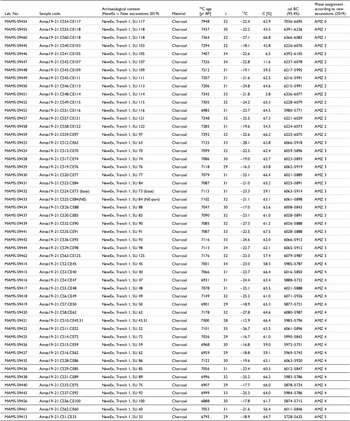
All 50 samples from the recent excavations contained sufficient carbon for radiocarbon analysis (Table 2). Figure 3 presents all new data in calibrated form. Phases are ordered chronologically according to the stratigraphic sequence, with dates arranged sequentially within each phase.
Amzabegovo. List of 50 new AMS radiocarbon dates from Trench 1 (2019). Ordered by phase and laboratory number. Calibrated using the OxCal 4.4.4 software (Bronk Ramsey Reference Bronk Ramsey2009a) and the IntCal20 dataset (Reimer et al. Reference Reimer and Talamo2020)

Table 2 Long description
The table presents 50 new AMS radiocarbon dates from Trench 1 at Amzabegovo, ordered by phase and laboratory number. Each entry includes the sample code, archaeological context, material, carbon age with standard deviation, calibrated age range, and assignment according to new excavations. The data is calibrated using the OxCal 4.4.4 software and the IntCal20 dataset. The table is structured with columns for sample code, archaeological context, material, carbon age, calibrated age range, and phase assignment. Notable entries include various charcoal samples from different trenches and phases, with carbon ages ranging from approximately 32 to 9670 years before present and calibrated age ranges spanning from 32 to 9670 years BC.
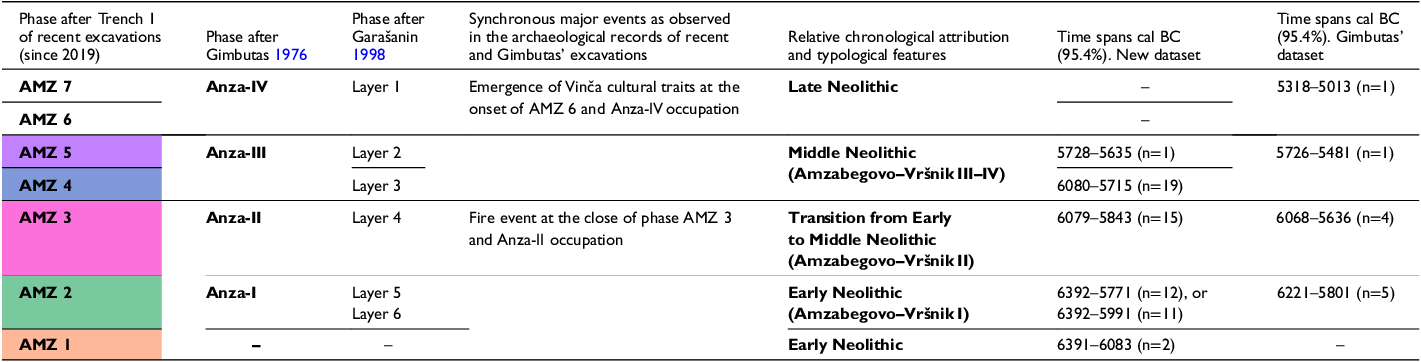
Amzabegovo. Archaeological phases recorded in Trench 1 (2019) compared with those identified by Gimbutas (Reference Gimbutas1976). Garašanin’s (Reference Garašanin1998) phasing is tentatively correlated for reference. Colours follow the scheme applied in Figures 3 and 4. The correlations are informed by preliminary excavation data, including typochronological attribution of the pottery to the Amzabegovo–Vršnik I–IV and Vinča stages, as well as evidence for a major settlement fire at the end of phase AMZ 3≈Anza-II. Absolute date ranges for Trench 1 derive from the new dataset presented in Table 2. The date ranges assigned to Gimbutas’ phases are derived from the determinations listed in Table 1 (including only dates securely attributed to archaeological phases and with standard deviations of ≤ 80 years [n = 11])

Table 3 Long description
The table presents a comparison of archaeological phases recorded in Trench 1 of the Amzabegovo site from recent excavations since 2019, alongside phases identified by Gimbutas and Garašanin in the 1970s. It includes seven rows and six columns, detailing phases, layers, major events, chronological attributions, and time spans in calendar years BC. Notable phases include AMZ 7 and AMZ 6, associated with the Late Neolithic period and the emergence of Vinča cultural traits. AMZ 5, AMZ 4, and AMZ 3 are linked to the Middle Neolithic period, with a significant fire event marking the end of AMZ 3. AMZ 2 and AMZ 1 are attributed to the Early Neolithic period. The table also provides time spans for these phases based on new datasets and Gimbutas’ dataset, highlighting the chronological attribution of pottery to the Amzabegovo-Vršnik stages and Vinča stages.
Amzabegovo. Calibrated radiocarbon ages for 50 charcoal samples from Trench 1 (2019) using the OxCal 4.4.4 software (Bronk Ramsey Reference Bronk Ramsey2009a) and the IntCal20 dataset (Reimer et al. Reference Reimer and Talamo2020). Based on data in Table 2. Code in Supplementary Material S1. Colours correspond to the archaeological phases and follow the scheme applied in Table 3.

Figure 3 Long description
The line graph presents calibrated radiocarbon ages for 50 charcoal samples from Trench 1 at the archaeological site of Amzabegovo. The x-axis represents the calibrated date in calendar years before common era (calBC), ranging from 7500 to 5500. The y-axis lists the radiocarbon dates labeled as R_Date MAMS followed by a unique identifier for each sample. Each data point is represented by a colored distribution curve, with colors corresponding to different archaeological phases as indicated in the scheme applied in Table 3. The graph shows multiple overlapping and distinct peaks, illustrating the variation in radiocarbon dates across the samples. The data points are spread across the timeline, with some concentrations around specific periods, reflecting the chronological distribution of the samples. All values are approximated.
Amzabegovo. Summed probability distributions. The plots illustrate the maximum calibrated ranges of the new radiocarbon determinations grouped by archaeological phase: Sum AMZ 1 = 308 years (n=2); Sum AMZ 2 = 621 years (n=12), or Sum AMZ 2 = 401 years if the potential outlier MAMS-59453 is omitted (n=11); Sum AMZ 3 = 236 years (n=15); Sum AMZ 4 = 365 years (n=19); Sum AMZ 5 = 93 years (n=1). Based on data in Table 2. Colours correspond to the archaeological phases and follow the scheme applied in Table 3.

Figure 4 Long description
The line graph displays summed probability distributions of radiocarbon determinations grouped by archaeological phases at Amzabegovo. The x-axis represents calibrated dates ranging from 5600 to 6800 calBC. The y-axis lists the archaeological phases: Sum AMZ 1, Sum AMZ 2, Sum AMZ 2 (without MAMS-59453), Sum AMZ 3, Sum AMZ 4, and Sum AMZ 5. Each phase is represented by a distinct colored line: orange for Sum AMZ 1, green for Sum AMZ 2, light green for Sum AMZ 2 (without MAMS-59453), red for Sum AMZ 3, blue for Sum AMZ 4, and purple for Sum AMZ 5. The graph illustrates the maximum calibrated ranges of the new radiocarbon determinations for each phase, with Sum AMZ 1 spanning 308 years, Sum AMZ 2 spanning 621 years, Sum AMZ 2 (without MAMS-59453) spanning 401 years, Sum AMZ 3 spanning 236 years, Sum AMZ 4 spanning 365 years, and Sum AMZ 5 spanning 93 years. All values are approximated.
Phase AMZ 0 (1 new date)
The calibrated date of MAMS-59454 (7036–6695 cal BC [95.4%]) falls on a plateau in the 14C curve between c. 7000 and 6700 cal BC, explaining its extended dating range. The age is notably old and shows no correspondence with the dates from phase AMZ 1.
Phase AMZ 1 (2 new dates)
The two determinations from the earliest settlement phase span the interval 6391–6083 cal BC (95.4%). Measurement MAMS-59460 falls within a section of the 14C calibration curve characterised by a minor plateau and a wiggle, which accounts for its distinct probability distribution.
Phase AMZ 2 (12 new dates)
The determinations from phase AMZ 2 yield calibrated 14C ages ranging from 6392 to 5771 cal BC (95.4%). As the calibrated range of MAMS-59453 does not overlap with the remaining eleven determinations, it can be considered a potential outlier of currently unknown origin. When this date is omitted from this phase, the overall calibrated span of AMZ 2 is reduced to 6392–5991 cal BC (95.4%).
Phase AMZ 3 (15 new dates)
Phase AMZ 3 is characterised by a series of closely corresponding dates ranging from 6079 to 5843 cal BC (95.4%). The bimodality observed in the majority of calibrated dates corresponds to variations in the 14C calibration curve around 6000–5900 cal BC.
Phase AMZ 4 (19 new dates)
The determinations from phase AMZ 4 span 6080–5715 cal BC (95.4%). As in phase AMZ 3, the bimodal distribution of calibrated ages reflects fluctuations in the 14C calibration curve around 6000–5900 cal BC.
Phase AMZ 5 (1 new date)
Phase AMZ 5 is supported by only one radiocarbon determination (5728–5634 cal BC, 95.4%), which post-dates the range established for phase AMZ 4.
Discussion
The radiocarbon dates from phases AMZ 1–5 indicate a largely continuous occupation sequence spanning the Early and Middle Neolithic, with the earliest possible onset around 6390 cal BC (95.4%) and the latest calibrated age falling between 5728 and 5634 cal BC (95.4%).
Based on the new dataset, the summed calibration plots in Figure 4 not only illustrate the differing durations of the individual phase time ranges but, more importantly, clearly show shifts in the peaks of the probability distributions between phases. This shift is most pronounced between phases AMZ 2 and AMZ 3, while AMZ 1 and AMZ 5 are represented by too few data points. AMZ 3 and AMZ 4 display a marked chronological overlap, which may stem either from inaccuracies in the attribution of archaeological structures or from a genuine temporal continuity between the two phases. This issue can only be clarified through detailed archaeological evidence from the excavation. The summed probability distributions must be interpreted with caution, since uneven sample representation and varying contextual attributions may lead to a misleading perception of temporal density.
Gimbutas’ legacy dates in light of the new AMS dataset
There are no direct stratigraphic links between Gimbutas’ trenches and the recent Trench 1. Stratigraphic sequences can differ even between adjacent excavation areas as a result of settlement dynamics, preservation circumstances, and variation in excavation methods and interpretive approaches. A comparative assessment of the phase sequences is nevertheless possible based on preliminary observations from the recent excavations. The attempted correlation between Gimbutas’ Anza-phases and the new site phasing is shown in Table 3.
The recent excavations have identified an initial occupation phase, designated AMZ 1 (Stojanovski Reference Stojanovski2022), which has no equivalent in Gimbutas’ sequence. The earliest phase represented in both stratigraphic sequences – and therefore directly comparable – is AMZ 2, corresponding to Anza-I. This correlation is supported by the attribution of the pottery to the typochronological stage Amzabegovo–Vršnik I. In summary, the new radiocarbon data broadly support the general correspondence between the AMZ phases and Gimbutas’ Anza sequence, although the legacy dates tend to begin slightly later and, in some cases, to extend the ranges defined by the new AMS dataset. The later phases (Anza III–IV) are each represented by only a single determination from the earlier excavations, limiting chronological resolution and precluding firm conclusions.
Owing to the methodological limitations of the original fieldwork and the imbalance in sample numbers between the legacy and recent radiocarbon datasets, a direct comparison remains challenging. Nevertheless, it is worth retaining the results of the earlier investigations as part of the broader chronological discussion rather than discarding them entirely.
Amzabegovo and the Early Neolithic
The earliest date of 7036–6695 cal BC (95.4%) (MAMS-59454) from the new dataset is difficult to interpret, as it cannot be linked to archaeological features or artefacts and appears disconnected from the other dates. The charcoal may derive from redeposited material from an unexcavated area, potentially indicating earlier occupation, or reflect a single episode of fire use prior to permanent settlement. Alternatively, it could represent a natural fire event, such as a lightning strike or a wildfire.
In the 1976 monograph, Gimbutas dated the beginning of occupation at Amzabegovo to around 6200/6100 cal BC. Her earlier suggestion of a settlement start around 6500 cal BC (Gimbutas Reference Gimbutas1974) is likely based on thermoluminescence measurements of four pottery sherds from the Anza-Ib phase, which were initially included in the chronology.
In the recent excavations, a settlement phase designated AMZ 1 has been identified, which typochronologically precedes Gimbutas’ Anza-I. Although the subsoil was reached in both the earlier and the recent excavation campaigns, the stratigraphy in the two excavation areas appears to differ, either due to preservation-related factors, or, more plausibly, reflecting distinct settlement extents at different stages of site development. In the recent Trench 1, phase AMZ 1 is represented by only a few stratigraphic units within an area of approximately 2 m2, associated with two radiocarbon samples. Radiocarbon determination MAMS-59455 from AMZ 1 indicates that occupation may have begun as early as 6391–6236 cal BC (95.4%). In this regard, while the early date 6569–6239 cal BC (95.4%) (7560 ± 70 yr BP [LJ-2519]) from the Yugoslav excavations (cf. Table 1) (Linick Reference Linick1977) cannot be securely correlated with any of the phases defined by Gimbutas or identified in the recent excavations, it does overlap with the chronological range of AMZ 1.
The onset of the subsequent Early Neolithic phase AMZ 2 is covered by determinations MAMS-59446 (6392–6105 cal BC [95.4%]) and MAMS-59451 (6336–6077 cal BC [95.4%]). The new dataset indicates an earlier start of this phase than is suggested by Gimbutas’ series, which places the beginning of Anza-I at approximately 6200 cal BC. It is unclear if this discrepancy results from improved measurement methodologies, sample selection, or, in fact, the spatial dynamics of intra-settlement occupation.
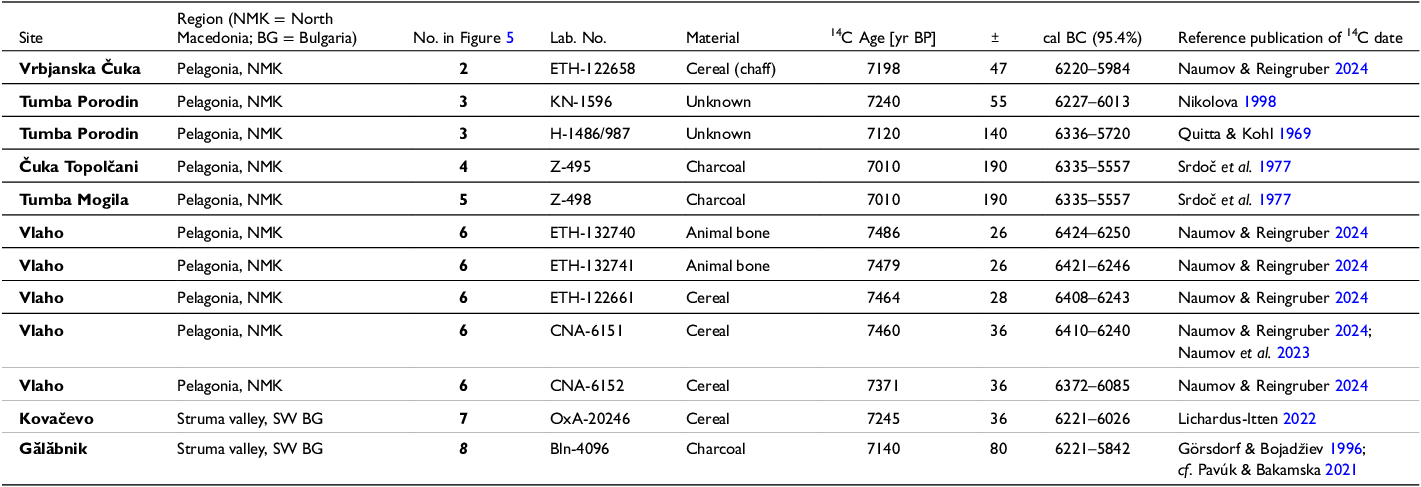
To date, reliable evidence for the absolute chronology of the earliest Neolithic settlements in the Vardar region and neighbouring areas remains scarce. Most radiocarbon dates from Early Neolithic contexts in the Pelagonian Plain and the Vardar catchment of North Macedonia fall around 6000 cal BC or later (cf. Krauß Reference Krauß2023; Naumov & Reingruber Reference Naumov and Reingruber2024). However, two earlier dates beginning around 6200 cal BC are known from the Pelagonian tell settlements of Tumba Porodin (KN-1596) and Vrbjanska Čuka (Table 4; Figure 5). The relatively early determinations from Tumba Porodin (H-1486/987), Čuka Topolčani, and Tumba Mogila are legacy measurements of limited reliability, owing to their large standard deviations and their isolated position within the site records (Table 4; Figure 5). Recently, a small high-quality series of five 14C determinations on animal bones and charred cereal grains was obtained from the Early Neolithic settlement of Vlaho in south-eastern central Pelagonia, dating to approximately 6400–6100 cal BC (Table 4; Figure 5). In adjacent south-western Bulgaria, the Early Neolithic sites of Kovačevo and Gălăbnik, both potentially beginning around 6200 cal BC, provide important chronological reference points for the expansion of the Neolithic along the Struma River (Table 4; Figure 5) (cf. Krauß Reference Krauß2023).
List of the earliest currently available radiocarbon dates from Early Neolithic settlement contexts in Pelagonia and the Struma Valley, predating 6000 cal BC. Ordered by mention in text. Calibrated using the OxCal 4.4.4 software (Bronk Ramsey Reference Bronk Ramsey2009a) and the IntCal20 dataset (Reimer et al. Reference Reimer and Talamo2020)

Table 4 Long description
The table presents the earliest radiocarbon dates from Early Neolithic settlement contexts in Pelagonia and the Struma Valley, predating 6000 cal BC. It includes details such as site names, regions, figure numbers, laboratory numbers, materials dated, radiocarbon ages, calibrated dates, and reference publications. The table has 10 rows and 8 columns. Column headers include Site, Region, No. in Figure 5, Lab. No., Material, 14C Age [yr BP], cal BC (95.4 percentage), and Reference publication of 14C date. Notable sites include Vrbjanska Čuka, Tumba Porodin, Čuka Topolčani, Tumba Mogila, Vlaho, and Kovačevo. The dates range from approximately 7486 to 7010 years before present, with calibrated dates spanning from around 6424 to 5557 cal BC. The table highlights the chronological reference points for the expansion of the Neolithic along the Struma River and in the Pelagonian Plain.
Sites with Earliest Neolithic radiocarbon dates referenced in the text. 1 Amzabegovo; 2 Vrbjanska Čuka; 3 Tumba Porodin; 4 Čuka Topolčani; 5 Tumba Mogila; 6 Vlaho; 7 Kovačevo; 8 Gălăbnik (map: A. Ballmer, Wikimedia Commons).

Figure 5 Long description
The map displays the geographic locations of archaeological sites with Earliest Neolithic radiocarbon dates in North Macedonia and Bulgaria. Key sites are marked with numbers and include Amzabegovo, Vrbjanska Čuka, Tumba Porodin, Čuka Topolčani, Tumba Mogila, Vlaho, Kovačevo, and Gălăbnik. The map highlights the Oveče Pole plain and the Vardar river, providing a visual representation of the distribution of these significant archaeological findings.
Against this backdrop, Amzabegovo currently provides the most consistently dated Early Neolithic occupation sequence in the catchment area. According to Raiko Krauß’ comprehensive study (Krauß Reference Krauß2023), the southern Balkan Peninsula, encompassing present-day Albania, North Macedonia, and the Struma catchment in south-western Bulgaria, saw the emergence of the first Neolithic settlements from c. 6200 cal BC onward. The new radiocarbon dates from Amzabegovo phases AMZ 1 and AMZ 2 extend the timeframe and enhance the resolution of this scenario, as they demonstrate that by 6391–6236 cal BC (95.4%), the Neolithic may already have spread to the Ovče Pole Plain, on the northern edge of this area (Krauß Reference Krauß2023; Krauß et al. Reference Krauß, Marinova, Brue and Weninger2017; Reingruber Reference Reingruber, Tasić, Urem-Kotsou and Burić2020; Reingruber & Thissen Reference Reingruber, Thissen and Lichter2005; Reingruber et al. Reference Reingruber, Toufexis, Kyparissi-Apostolika, Anetakis, Maniatis and Facorellis2017). The initial introduction of Neolithic lifeways into the Vardar catchment must be attributed to groups whose material culture and practices suggest connections to both the Marmara region and northern Greece (Krauß Reference Krauß2023; Krauß et al. Reference Krauß, Marinova, Brue and Weninger2017). Although no Mesolithic presence has so far been identified in the Ovče Pole region, local Late Mesolithic populations may have contributed to the successful adaptation of Neolithic lifeways by incoming farming groups, for example through knowledge of subsistence practices suited to the markedly colder winter conditions of the Balkans (Bánffy Reference Bánffy, Whittle, Pollard and Geaney2023; Bánffy & Whittle Reference Bánffy and Whittle2024; Krauß et al. Reference Krauß, Marinova, Brue and Weninger2017). According to the available evidence in the region, an initial Neolithic phase of relatively small-scale incursions was followed some three centuries later, after 6000 cal BC, by a more extensive settlement of the landscape (Krauß Reference Krauß2023).
Conclusion
The new dataset confirms that the onset of Neolithic settlement activity in the Ovče Pole region is conceivable from 6391–6236 cal BC (95.4%). It becomes evident that, at this early stage, the Neolithic had already reached the northern periphery of Krauß’ (Reference Krauß2023) ‘Neolithisation Zone 3’, covering present-day Albania, North Macedonia, and the Struma River valley. However, questions remain regarding the detailed dynamics, the origins of the first settlers, and their possible relationship to the local Mesolithic populations.
The full potential of large AMS datasets, including charcoal samples, will unfold once they are analysed alongside the archaeological data. The new 14C results suggest that Gimbutas’ early radiocarbon dataset should not be entirely disregarded; rather, it should be incorporated into integrated modelling to refine our understanding. The data presented here need to be further corroborated through the ongoing analysis of archaeological features and material assemblages from the site. In a broader perspective, the systematic chronological study of settlement sequences across the region will shed new light on the dynamics of the temporal, spatial, and cultural transformations that shaped the emergence and development of the Neolithic in the northern Aegean and the Balkans.
Supplementary material
To view supplementary material for this article, please visit https://doi.org/10.1017/ppr.2026.10085
Acknowledgements
The excavations since 2019 have been hosted by the Municipal Museum of Sveti Nikole and funded by the Ministry of Culture and Tourism of North Macedonia. The authors wish to express their sincere gratitude to Agathe Reingruber (Berlin), Jonas von Felten (Bern), Ellen Druffel (Irvine), Raiko Krauß (Tübingen), Judith A. Rasson, Johannes Reich (Bern), and Susanne Rutishauser (Bern) for their invaluable support in various capacities. Darko Stojanovski thanks the core team of the Amzabegovo fieldwork: Andrej Mačkovski, Stefanija Stojanovska, Dejan Georgiev, Sašo Kiroski, Kristijan Blaževski, Ivan Sarašov, and Igor Gjorgioski, and all the other participants over the years.
Funding Statement
The new radiocarbon dates were funded by the Gerda Henkel Foundation, Düsseldorf (beneficiary A. Ballmer, project Redating Amzabegovo [RedA], Grant no. AZ 33/V/22).






 Open access

