


It has been claimed that there is a specific Nordic leadership style [characterized by] delegation of power and responsibility to employees, as well as a high degree of consensus-seeking where every employee’s voice is important, [and] stresses the necessity of cooperation.
This chapter examines how Nordic leadership norms at the individual level reflect and reinforce the cooperative underpinnings of Nordic capitalism. These Nordic leadership norms – characterized by cooperation, consensus-building, power-sharing, and collaborative decision-making – have proven more effective at addressing wicked problems like those represented by the Sustainable Development Goals. Moreover, these leadership norms are essential to the functioning of the Nordic tripartite model, where ongoing cooperation between labor, business, and government requires leaders skilled in building consensus across diverse stakeholder groups.
Individual-level analysis alone cannot explain societal-level outcomes. Subsequent chapters explore organizational-level and societal-level factors to paint a more complete picture of Nordic capitalism. By examining how individuals exercise leadership in the Nordic context, we gain crucial insights into how Nordic capitalism functions and how it has achieved its comparatively strong progress toward sustainable development.
What Is Leadership?
Leadership is often debated, and arriving at an agreed-upon leadership definition is not straightforward. Renowned leadership scholar Joseph Bass stated, “There are about as many different definitions of leadership as there are persons who have attempted to define the concept.”Footnote 1 The proliferation of leadership definitions is partly because the word leadership has two distinct meanings: (1) a position of authority or a specific role at the top of a hierarchy (e.g., the “Leadership Team” composed of the CEO and C-suite) or (2) a process (i.e., something you do).Footnote 2
This chapter focuses on leadership as a process. Anyone can exercise leadership; one need not be in a formal leadership position to practice the leadership process. Leadership scholar Joseph Rost provides a useful definition of leadership as a process. He defined leadership as “an influence relationship among leaders and followers who intend real changes that reflect their mutual purposes.”Footnote 3 Rost’s definition allows for a blurring of formal roles where, at any given time, a leader can become a follower, and a follower can become a leader.
Leadership is more commonly considered in terms of process in the Nordics rather than a position of formal authority, whereby Rost’s definition provides a useful basis for defining leadership in the Nordic context. Nordic organizational hierarchies are generally flatter, formal roles are less pronounced, and individuals have a high degree of autonomy. In the book Business Leadership and Culture, Björn Bjerke wrote, “In Scandinavia, greater importance is attached to turning leadership into a process and a matter of cooperation, rather than a role or a quality.”Footnote 4 Most everyone is expected to exercise leadership when the situation demands it, irrespective of their position.Footnote 5
Rost’s definition of leadership emphasizes the essential concept of mutual purpose. In this view, leadership is more than just influencing others; leadership involves fostering a shared sense of purpose. Such ideas of leadership directly connect to considerations of leadership as “framing,” as the leadership scholar Gail Fairhurst has developed.Footnote 6 Establishing a shared view of mutual purpose among many stakeholders involves leadership processes such as negotiation and consensus-building, which focus on clarifying the group’s higher order purpose.
Much ink has been spilled considering whether Hitler, Stalin, or other nefarious figures throughout history demonstrated leadership. These individuals influenced millions of people. Does that represent leadership? These debates are effectively about purpose – whether purpose matters if we call something “leadership.”
In my view, leadership is (i.e., descriptive) and should be (i.e., normative) rooted in ethical considerations.Footnote 7 I have been informed deeply by my experiences studying leadership across the Nordic context and through my ongoing conversations with Mads Øvlisen, the former CEO of Novo Nordisk. I would, therefore, categorize the actions of Hitler, Stalin, and others who pursue a purpose that harms the common good as unethical coercion – not leadership.
Therefore, the question is not merely “What is leadership?” but rather “What is good leadership?” Here, the word “good” has a dual meaning: (1) Effective and (2) Contributing to the common good. Figure 5.1 illustrates that good leadership requires both effectiveness and a purpose aligned with the common good.
Good leadership?
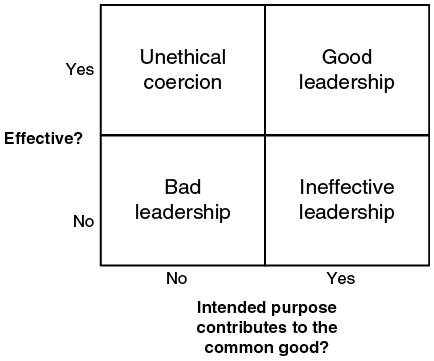
Figure 5.1 Long description
Two cross two matrix categorizes types of leadership based on two dimensions:
The Vertical axis, left side: Effective? with options Yes on the top row and No on the bottom row.
The Horizontal axis bottom: Intended Purpose Contributes to the Common Good? with No in the left column and Yes in the right column. Each of the four quadrants contains a leadership type:
1. Top-left quadrant: Yes, effective; No, common good: Unethical Coercion
2. Top-right quadrant: Yes, effective, Yes, common good: Good Leadership
3. Bottom-left quadrant No effective, No common good: Bad Leadership
4. Bottom-right quadrant No effective, Yes common good: Ineffective Leadership
The diagram is used to illustrate that good leadership requires both effectiveness and alignment with the common good. Leadership that is effective but not aligned with ethical goals is labeled as unethical coercion.
The “common good” refers to conditions, outcomes, or resources that benefit members of a community or society, enhancing the well-being of individuals as a collective rather than focusing on the advantage of specific groups or individuals at the expense of others. The concept of the common good has its roots in ancient Greek philosophy. It has been a central theme in various ethical, social, and political discussions throughout history, from the works of Plato and Aristotle to contemporary debates. Balancing individual freedoms with the needs and well-being of the community or society is a key challenge in realizing the common good.Footnote 8
In sum, we can define good leadership as an influence relationship between leaders and followers (where a follower can become a leader and vice versa) who intend to effect real changes that reflect their mutual purposes – and each purpose contributes to the common good.
Considering this leadership definition, we can prosperously use the Sustainable Development Goals as a “purpose compass” because each SDG represents a consideration for the common good. SDG #1 “No Poverty,” SDG #3 “Good Health and Wellbeing,” SDG #4 “Quality Education,” SDG #13 “Climate Action,” and so on, all the SDGs share the common feature that they are various expressions of the common good.
Therefore, aligning the purpose to the SDGs helps to ensure alignment with the common good. However, tensions can readily arise in the pursuit of the common good. Alignment to one SDG may conflict with another. The pursuit of SDG #8 “Decent Work and Economic Growth” could negatively impact SDG# 14 “Life Below Water” or SDG #15 “Life on Land” if the associated economic activities cause environmental harm. The common good is a concept subject to varying interpretations, where achieving it often involves navigating inherent tensions and disagreements among stakeholders with different values and priorities. Good leadership is necessary to address the tensions that can arise and build consensus about the actions to take.
Wicked Problems
The SDGs share another feature: Each of the SDGs represents a wicked problem.
The concept of wicked problems was launched on the global stage by Horst Rittel and Melvin Webber, two University of California, Berkeley, professors, in their classic 1973 article, “Dilemmas in a General Theory of Planning.”Footnote 9 A wicked problem is described as extremely difficult – if not nearly impossible – to solve because of its complexity, the uncertainty of potential solutions, the lack of a defined stopping point, the commingling of the wicked problem with other problems (which can be wicked problems in their own right), and the need for cooperation among actors who may have never collaborated before.
Wicked problems are often profoundly values-laden and situated within ongoing ethical debates contributing to their challenging nature. Some groups may have different beliefs about the problem because they subscribe to different values or schools of ethical thought that result in contrary opinions about what is “right” or “wrong.”
As a result, wicked problems often involve disagreements about whether there is even a problem in the first place.Footnote 10 For example, SDG #5 “Gender Equality” has the mission statement to “Achieve gender equality and empower all women and girls.” Iceland is routinely cited as achieving the world’s highest levels of gender equality, topping WEF’s Global Gender Gap Index in each of the seventeen years since the report’s inception in 2009. Nevertheless, much work remains to be done, even in Iceland, because women are measured at only 92.6 percent (2025) parity to men across a suite of dimensions, including economic empowerment.Footnote 11 However, some groups may deny that gender inequality is a problem in the first place. Similarly, the wicked problem of climate change, SDG #13 “Climate Action,” is even more challenging as some groups deny it is a problem in the first place.Footnote 12
Rittel and Webber contrast wicked problems with “tame problems.” Tame problems are not necessarily easy to solve but they are solvable through proven means. Solving tame problems became central to modern management education following the Industrial Revolution – challenges suited to quantification, standardization, and efficiency. Optimizing factory production, streamlining logistics, or solving a complex equation are all tame problems. Even putting a person on the moon, while extraordinarily difficult, qualified as a tame problem because it could be addressed through scientific and technical methods with clear endpoints.
As industrialization advanced, the world’s challenges were increasingly treated as tame problems – issues to be solved through rational planning, measurable outcomes, and techniques taught in industrial engineering and MBA programs. Henry Ford, widely celebrated as an American hero of efficiency, embodied this approach. His deployment of Taylorism remains a staple of management education and is still held up as a success story. Rittel and Webber wrote:
During the industrial age, the idea of planning, in common with the idea of professionalism, was dominated by the pervasive idea of efficiency. Drawn from 18th-century physics, classical economics and the principle of least means, efficiency was seen as a condition in which a specified task could be performed with low inputs of resources. This has been a powerful idea. It has long been the guiding concept of civil engineering, the scientific management movement, much of contemporary operations research, and it still pervades modern government and industry.Footnote 13
While important efficiency advancements of historic proportions were unquestionably being made, Rittel and Webber were troubled by what they felt was a growing arrogance among a professional class that believed that all problems could be solved through rationalization, planning, and more efficiency. Rittel and Webber utilized the problem of poverty as a different problem from the tame problems.
Poverty is a wicked problem made all the more wicked because it is commingled with other wicked problems. With a wicked problem, it is difficult to know where the problem starts and ends and even how to define the problems at hand. Poverty was a different kind of problem than what the efficiency professionals who emerged from the industrial revolution had grown accustomed to solving. Rittel and Webber wrote:
Consider, for example, what would be necessary in identifying the nature of the poverty problem. Does poverty mean low income? Yes, in part. But what are the determinants of low income? Is it deficiency of the national and regional economies, or is it deficiencies of cognitive and occupational skills within the labor force? If the latter, the problem statement and the problem “solution” must encompass the educational process. But, then, where within the educational system does the real problem lie? What, then, might it mean to “improve the educational system”? Or does the poverty problem reside in the deficient physical and mental health?Footnote 14
Today, we also know the problem of poverty as SDG #1 “No Poverty.” Within this short excerpt, Rittel and Webb connect several SDGs, each of which is a wicked problem in its own right. They begin with SDG #1 “No Poverty.” In discussing low income, they connect it with SDG #8 “Decent Work and Economic Growth.” They then contact that wicked to education, thereby moving into the realm of SDG #4 “Quality Education.” They also raise the specter of physical and mental health issues, which is SDG #3 “Good Health and Well-Being,” as connected to poverty. Rittel and Webb demonstrate how the wicked problems represented by the SDG are deeply commingled and exceedingly difficult, if not impossible, to definitively “solve.”
Wicked Problems Demand Cooperation
Leadership scholar Keith Grint provides crucial insights into how different types of problems demand different leadership responses. In his influential article “Problems, Problems, Problems: The Social Construction of Leadership,” Grint categorizes problems as critical, tame, or wicked – each requiring a distinct approach. His central question is deceptively simply: What is good leadership for the problem at hand?Footnote 15
Critical problems call for a commander response. These are urgent, high-stakes situations – the building is on fire – where there’s no time for deliberation and the leader must provide a decisive answer for what to do.
Tame problems, Grint explains, are best addressed through management: planning, organizing, and applying proven solutions to well-defined challenges. Increasing factory production, creating transportation timetables, building bridges, and designing computers are all examples of tame problems – complex challenges that can be solved through technical expertise and established procedures. These are the problems that emerged alongside industrialization and respond well to Taylorism and the efficiency techniques taught in industrial engineering and MBA programs.
Wicked problems, by contrast, require a fundamentally different approach. These problems are deeply intertwined with other issues, shaped by conflicting values, and resistant to clear solutions. They demand leadership grounded in humility and cooperation. As Grint notes, the more wicked the problem, the greater the “requirement for collaborative resolution.” Wicked problems may not have definitive solutions, but they can be approached constructively through asking better questions and engaging others in the search for shared, workable paths forward.
This distinction matters because leaders often misdiagnose the problem type. Too frequently, leaders default to a commander or management approach not because it is suited to the problem, but because it is the response they’re most comfortable delivering. A leader who declares, “I have the answer,” in the face of a wicked problem may be acting on preference, not accurate assessment. Treating wicked problems as tame or critical risks overconfidence – and poor outcomes. Progress on wicked problems requires the humility to admit no single actor holds the answer, and that constructive action depends on asking good questions and fostering real cooperation
Nordic Leadership Norms: Cooperation at the Core
As we shift attention to leadership norms in the Nordic context, I detail how cooperation is at the core of Nordic leadership, supported by several closely related leadership norms. A norm is a shared rule about acceptable or unacceptable social behavior. Norms can be thought of as a tendency or a cultural default position.
I draw upon comparative leadership scholarship, including the Global Leadership and Organizational Behavior Effectiveness (GLOBE) study, and my own experiences and scholarship comparing leadership approaches in Nordic and US contexts. As will become apparent, norms of Nordic leadership are particularly well suited to addressing sustainability challenges given the “increasing requirement for collaborative resolution” to address wicked problems.
Norms of Cooperation
Leadership scholarship is performed by management scholars studying organizations. Given that expectations for cooperation so deeply permeate Nordic culture, it feels odd to call it out as a norm unique to the act of leadership. But on a comparative level, like the Nordics vis-à-vis the US, expectations for cooperation is readily apparent defining aspect of Nordic leadership.
Expectations for cooperation permeate all facets of Nordic society, evident from the youngest ages. Children are taught in childcare about democratic principles and resolving conflicts by leveraging cooperation and consensus-building. In grown-up venues, like negotiations between employers and labor unions, cooperative relationships are built upon trust and long-term mutual interests.Footnote 16 Perhaps not surprisingly, individuals from the Nordics are routinely sought on the global stage as effective and trustworthy peace brokers, able to establish a cooperative posture between various actors in the most conflict-ridden circumstances.
In the book Return of the Vikings, Chris Shern and Henrik Jeberg emphasize the central role of cooperation throughout Nordic life, drawing upon their comparative experiences, each working and living in the Nordics and the US. They offer that “collaboration and cooperation are effective in the workplace and in coalition politics in the Nordics because they come naturally. This way of thinking and acting is what people have known all their lives.”Footnote 17 The authors contrast US norms, describing how competition is routinely celebrated and embraced.
Bjerke emphasizes that Nordic cooperation is achieved through consensus-building and effective negotiation: “The typified Scandinavian business leader is a negotiator. Scandinavian top managers stress that their most important ability is to obtain results in cooperation with the employees, combined with their ability to negotiate.”Footnote 18 Bjerke further describes, “They are not autocratic, but use a delegating and participatory style; use power if necessary, but then based on legitimacy; consult their subordinates; look for cooperation, compromises, and consensus; are collective individuals.”Footnote 19 This seemingly contradictory idea of “collective individuals” took my American mind a long time to grasp.
Individuals throughout the US and Nordics value individual freedom and autonomy. Still, the Nordics maintain that individual freedom is more effectively achieved by considering the collective We, whereas the US embraces the Me as the means.
Like many cross-cultural leadership writings, the Nordic Leadership report relies heavily on the work of social psychologist Geert Hofstede. Hofstede constructed the masculine–feminine cultural dimension against which tendencies for (or against) cooperation and consensus-building are measured.Footnote 20 The Nordic nations were deemed the most feminine societies globally. The US resides in the masculine zone.Footnote 21 The Nordic Leadership report provides this useful characterization of Hofstede’s masculine–feminine cultural dimension:
Masculinity represents a preference in society for performance, heroism, determination, and materialistic rewards for success. Femininity stands for a preference for cooperation, modesty, care of the weak, and quality of life. These opposing pairs can also be described such that society, in the first case, is more inclined to competition or, in the second case, is more oriented to consensus.Footnote 22
In Sustainability Leadership, Henrik Henriksson and Elaine Weidman Grunewald connect cooperation and consensus-building across Nordic societies to the global sustainability leadership role the Nordics has assumed, emphasizing the important role of leadership to establish a mutual purpose, and steering activities toward addressing that purpose.Footnote 23
Norms of Modesty
Modesty is one of the more immediately observable norms of Nordic leadership. The need for “saving face” is rejected as a conspicuous act of self-promotion. In the Nordics, effective leadership requires leaders to look a bit foolish from time to time – not have all the answers – and to be able to laugh at themselves in a self-deprecating manner. The GLOBE study is arguably the most extensive cross-cultural comparative leadership study ever undertaken. Leadership norms related to modesty are discussed within comparisons of self-protective leadership:
It is apparent that the Nordic Europe cluster is characterized by its extremely low ranking for Self-Protective leadership. Being self-centered, status conscious, face saving, and inducing conflict are attributes seen as extremely inhibiting to effective leadership.Footnote 24
When discussing the norm of modesty in Nordic leadership, individuals commonly reference Janteloven – a term derived from Aksel Sandemose’s 1933 satirical novel En flyktning krysser sitt spor (A Fugitive Crosses His Tracks). Originally conceived as a critique of small-town social control mechanisms, with the core principle “you’re not to think you are more important than anybody else,” Janteloven’s cultural interpretation has evolved. While Sandemose intended to illuminate the oppressive aspects of social conformity, contemporary Nordic discourse has reframed janteloven more positively as an expression of social solidarity and collective responsibility.
Contemporary scholarship discusses Janteloven’s paradoxical role in Nordic organizational culture. While potentially constraining individual excellence through what has been termed “tall-poppy syndrome,” the norm simultaneously facilitates cooperation by suppressing displays of individual superiority that might impede collective action.Footnote 25 Organizational behavior research suggests that reduced status differentiation enhances information sharing and trust formation, critical components for effective stakeholder cooperation.
The norm of modesty (not worrying about “saving face”) is essential to effectively tackle wicked problems since these problems come with far more questions than answers. Revisiting Grint’s figure, we see that the more wicked a problem is, the more uncertainty about its solution. Asking questions is essential to better understanding potential courses of action. If concerned about saving face, one will be less likely to expose one’s lack of an answer by asking questions – and ultimately less likely to act.
Norms of Humanism
Ideals of humanism run deep in Nordic culture and are readily apparent in Nordic leadership. Humanism is “a democratic and ethical life stance that affirms that human beings have the right and responsibility to give meaning and shape to their own lives. Humanism stands for building a more humane society through an ethics based on values in a spirit of reason and free inquiry through human capabilities.”Footnote 26
Humanism has not been explicitly called out as a leadership norm in prior scholarship, to my knowledge, but it is merited. In their report, The Nordic Perspective, the Nordic Council of Ministers wrote, “Compassion, tolerance, and conviction about the equal value of all people” are central to a Nordic approach to the world.Footnote 27
When studying leadership in the Nordics, I saw individuals like Marianne Barner of IKEA and Mads Øvlisen of Novo Nordisk practice a humanistic leadership approach. Barner was the key architect and implementer of the humanistic policies IKEA established for its supply chain in the 1990s–2000s, including “what is in the best interest of the child” if one ever encountered the potential for child labor in a supply chain.Footnote 28 At the time, many American-based firms facing pressures to address child labor in their supply chains adopted a rather simplistic compliance approach of dropping a supplier if child labor allegations arose for fear of consumer backlash and potential boycotts. However, as described in What Works for Working Children, this reaction can result in worse working conditions for a child laborer, including child prostitution.Footnote 29
Through Barner’s leadership, IKEA developed procedures and a code of conduct to address the root causes of child labor and take action in the child’s best interest, resulting in the IWAY (for “IKEA Way”) standard of requirements for environmental, social, and working conditions. Harvard Business Review has since featured Barner as the protagonist of one of the most well-known Harvard case studies of responsible business leadership challenges. The case demonstrates how deep-seated reverence for humanism was embedded in the leadership shown by Barner and IKEA.Footnote 30
Norms of Democracy
The Nordic region demonstrates a long-standing commitment to the ideals of democracy. Democratic ideals can be found in every aspect of society, including leadership. Democracy is fundamentally about the dispersion of power; the Nordic leadership norm of democracy is directly related to the norm to disperse power throughout the organization. Bjerke referred to this leadership approach in the Nordics as “non-authoritative” leadership.
The Nordic leadership norm of democracy and embracing the stakeholder approach are two sides of the same coin. The stakeholder approach represents an effort to extend democratic participation and disperse power. Swedish management scholar Eric Rhenman, a longtime champion of industrial democracy, was an originator of the stakeholder concept.
The first time “stakeholder” appeared in management literature anywhere in the world was in Rhenman’s classic 1968 book Industrial Democracy and Industrial Management.Footnote 31 Rhenman connected the practice of democratic leadership with improved efficiency and greater equality of opportunities for employees:
First, it is expected that democratic measures will arouse the employee’s interest and cooperation. Secondly, it is hoped that if employees have a greater part in running the business, it will be easier to tap their resources of experience, knowledge and ideas. In the long run, this should provide the employees themselves with greater opportunities for personal development and education.Footnote 32
Rhenman connected his prescriptions for power dispersion to the broader debate between capitalism versus communism. He critiqued Marx’s assertion that capital owners and laborers were necessarily in conflict: “From the early days of industrialization and of the labor movement, conflict between employer and employee has been a marked social phenomenon … In his criticism of eighteenth-century capitalism, Marx was one of a motley company of writers, all extreme as himself, who in their different ways regarded conflict as something fundamental and explosive.”Footnote 33
In Management in Scandinavia, authors Jette Schramm-Nielsen, Peter Lawrence, and Karl Henrik Sivesind described how the Nordic leadership norm of democracy is a product of culture and policy.Footnote 34 They summarize Nordic leadership as “characterized by informality, equality, and restraint” that takes a “consensual, participative, and inclusive approach to decision making and change implementation.” The authors emphasize that Nordic leadership involves “a reluctance by most managers to articulate their power, an inclination to reasonableness and quiet persuasion, rather than to charismatic dominance.”Footnote 35 They further connect the Nordic leadership democracy norm with efficiency, stating that the Nordics “have developed a management style which is extraordinarily participative and process-oriented without losing the battle for efficiency.”Footnote 36
Norms of Pragmatism, Critical Thinking, Systems Thinking, and Stewardship
While the following norms of pragmatism, critical thinking, systems thinking, and stewardship are not well established in the leadership scholarship, through my own experiences, I am convinced of their importance to more fully describe Nordic leadership.
Pragmatism is deeply embedded in Nordic leadership. A pragmatic approach involves collecting and considering empirical evidence (data) to determine what works, then adjusting as needed to do more of what works and less of what does not. Bjerke summarized this approach as “rational and practical”: “Scandinavians prefer systematic, rational, and detailed problem-solving, where decisions may not necessarily come fast, but where problems are well penetrated when decisions are taken.”Footnote 37
Nordic governmental agencies demonstrate “a voracious appetite for data,”Footnote 38 and Nordic companies can say the same. In the Nordics, leadership depends heavily upon the merits of the rational argument and its supporting facts. Nordic leadership is strikingly less charismatic than in the US, where showmanship is more greatly valued. In the Nordics, facts and data matter most in influencing others to take action.
The pragmatic leadership approach often leads to cooperation that spans traditional boundaries when such partnerships are of mutual benefit. Strong engagement and cooperation can be readily observed among Nordic companies, labor unions, government, universities, and research institutions.Footnote 39 The collaborative relationships between company management and labor unions are essential in a Nordic context and directly supported by the pragmatism leadership norm.Footnote 40
Critical thinking is pervasive in Nordic culture and, in my view, represents a unique Nordic leadership norm. Critical thinking is “the systematic evaluation or formulation of beliefs, or statements, by rational standards,”Footnote 41 and therefore related to pragmatism. Nordic educational systems emphasize critical thinking through specific pedagogical practices, including mandatory oral examinations where students must defend their analytical positions and extensive use of problem-based learning approaches.Footnote 42
When I began teaching business school students in the Nordics, I was caught a bit off guard by many of my students’ capacity and predisposition for critically examining the readings I had assigned. While my US students were more likely to treat my assigned readings, from the Harvard Business Review, as a suite of “facts,” my Nordic students, by contrast, often picked apart the arguments within the articles, suggesting they were not sufficiently supported with sound empirical evidence or appropriate logic. Perhaps not surprisingly, Nordic countries perform conspicuously well in country-level measurements of critical thinking, like the Media Literacy Index that assesses a populace’s potential for resilience to “post-truth” politics and “fake news.”Footnote 43
I am unaware of any formal cross-cultural academic study that draws out Nordic leadership as demonstrating comparatively more substantial critical thinking. However, when I encountered Donald Schön’s book The Reflective Practitioner,Footnote 44 I found that he described what I had observed in the Nordics. The reflective practitioner exercises critical thinking as a central component of leadership, emphasizing the ability to reflect critically on one’s actions to engage in continuous learning. Critical thinking is a fundamental aspect of Nordic leadership.
Through my Nordic experiences, I became aware of the capacity to identify systemic problems and address them with effective systems. In contrast, I came to recognize a tendency in the US to push systems-level problems down to the individual in a reductionist approach. I found systems thinking to be a dominant leadership approach in the Nordics.
The reductionist approach that can be witnessed in the US arguably stems from a school of management developed and deployed in the Industrial Revolution; problems were considered solvable through rational means that involved reducing a problem to its elements and solving each more minor problem. Rittel and Webber poked holes in this “one-size-fit-all” approach by claiming that while a reductionist approach might work well to solve tame problems, wicked problems are different and require a view toward the overall system, to consider the “whole.”
Nordic educational systems connect directly to systems thinking and committed consideration for the whole. Denmark, with its traditions of the folkehøjskole (folk school) centering on the philosophical idea of Bildung, is a good example (Chapter 4).Footnote 45 In 2020, David Brooks wrote in the New York Times about the Nordic approach of educating the whole person:Footnote 46
They look at education differently than we do. The German word they used to describe their approach, Bildung, doesn’t even have an English equivalent. It means the complete moral, emotional, intellectual and civic transformation of the person. It was based on the idea that if people were going to be able to handle and contribute to an emerging industrial society, they would need more complex inner lives …
… The idea was to create in the mind of the student a sense of wider circles of belonging – from family to town to nation – and an eagerness to assume shared responsibility for the whole.
The world is a system, and everything is connected – sustainability challenges are interconnected with other challenges.
The Nordic leadership norm, stewardship, serves as a helpful summation of all the Nordic leadership norms. Stewardship implies a self-imposed responsibility to care for something or someone for a considerable time. A stewardship approach focuses on value creation. In contrast, an extractive approach happens when one extracts as much value as possible. For a manager, this may mean extracting as much time and effort as possible from their direct reports. For a CEO or influential shareholder, this may mean extracting as much financial profit as possible from their company. An extractive approach tends to have a short-term perspective, whereas a stewardship approach emphasizes the longer term.
I realized stewardship was a fundamental norm of Nordic leadership through my engagements with Mads Øvlisen of Novo Nordisk. Øvlisen led the initiative during his tenure as CEO to change Novo Nordisk’s articles of association to explicitly express a corporate purpose “to conduct its activities in a financially, environmentally, and socially responsible way” consistent with a stewardship approach.Footnote 47 I saw this tendency to embrace a stewardship approach with many Nordic leaders who worked hard to establish the structures to ensure better long-term success for their organizations.
Can Nordic Leadership Solve Every Problem?
Nordic leadership norms are well suited to tackle wicked problems like those of the SDGs. But that does not mean command and management responses are less important.
The video “Swedishness,” shown at the 2013 Eurovision Contest in Malmö, Sweden, humorously depicts what could happen if a “typical” Nordic leadership response of cooperation and consensus-building was applied to a critical problem. The scene begins with the commander of a Swedish battalion calling upon his troops to attack, but the situation quickly devolves:
Battle scene. Tanks. Fire.
narrator: What’s interesting is, the Swedes are an extremely equal people. There are no hierarchies here. The Swedes prefer a so-called flat organization. [Pans to soldiers in the middle of a war scene.]
commander: We attack on my command!
soldier (unnamed): Yes, Captain!
commander: That is, if you feel like it. I mean, I don’t have to decide everything all the time. Do you want to make a decision?
soldier (unnamed): Oh, maybe it’s Ingrid’s turn. [Turns to another soldier.] Ingrid! Ingrid! Do you want to attack? [Bomb goes off; everyone covers heads.] Do you want to attack?
soldier (ingrid): I think we should have a group discussion about this.
commander: That’s a good idea!
soldier (unnamed): We should bring in Lars, then.
commander: Yes.
soldier (unnamed): Lars? Do you want to attack? [Covers head as a bullet flies by.]
This scene humorously highlights that while Nordic leadership thrives in cooperative settings, some urgent situations may require a more decisive, top-down commander approach. In keeping with Grint’s leadership offerings, the problem must first be considered to determine the most appropriate leadership response.
Nordic leadership will not solve every problem. Nevertheless, it presents a compelling alternative to the dominant top-down, command-style leadership models that dominated twentieth-century US management teachings to address complex, interconnected challenges more effectively.
Nordic Leadership in the World
Nordic leadership norms are increasingly recognized beyond the Nordic region as offering a compelling alternative to the leadership models traditionally taught in many American business schools. As calls grow to reorient management education toward societal stewardship and stakeholder engagement rather than solely focusing on shareholder primacy, Nordic business schools are uniquely positioned to lead this shift. They draw upon leadership styles long promoted in a Nordic context emphasizing trust, collaboration, and long-term responsibility, and are now moving to articulate these approaches more explicitly. One such effort is the Nordic Nine, developed by Copenhagen Business School, where I completed my PhD.
The Nordic Nine outlines a set of leadership capabilities that reflect Nordic commitments to cooperation, modesty, stewardship, critical thinking, and democratic engagement. One of these capabilities – “You are competitive in business and compassionate in society” – captures the dual commitment to individual performance and collective well-being that defines Nordic leadership. Others emphasize ethical reflection, responsibility toward future generations, and learning as a mutual process.Footnote 48
In this sense, the Nordic Nine responds to American business school critiques from Andrew Hoffman at the University of Michigan, who argues that business education is “broken” and must shift to train “stewards of the market.” Hoffman’s leadership vision aligns closely with the leadership norms promoted in Nordic societies and explicitly advanced by Copenhagen Business School through the Nordic Nine, which seeks to cultivate leaders capable of engaging complexity with humility, shared purpose, and a long-term view of value creation.Footnote 49
In 2024, several practitioners and scholars of Nordic leadership penned the “Nordic Leadership Manifesto,” a compelling call that underscores the significant potential Nordic leadership offers to the world. The manifesto criticizes traditional management models rooted in Taylorism, as put into practice by Henry Ford, which tend to treat individuals solely as means in an assembly-line approach and prioritize profit maximization. Instead, the Nordic Leadership Manifesto advocates for the dispersion of power and top-down control, aligning more closely with democratic ideals and leadership approaches in the Nordic context. Drawing upon the philosophical groundwork laid by Grundtvig, whose ideas of “nation building from below” emphasized the cultivation of a well-informed and engaged citizenry, the manifesto calls for leadership to be reconceived as a collective practice rooted in community. By emphasizing the cooperative and consensus-driven norms of Nordic leadership, the manifesto proposes that the Nordics can become the epicenter for a global management revolution, effectively rethinking leadership to tackle global challenges represented by the SDGs and to shape a sustainable and hopeful future.Footnote 50
Parting Reflections
Nordic leadership, deeply embedded in cooperation and consensus-building, more effectively addresses wicked problems like those represented by the SDGs. The Nordic leadership approach contributes to the Nordic region’s strong performance in meeting these goals and offers good examples whose potential application transcends regional boundaries. This approach is consistent with democratic ideals, distributing power widely across society to enhance responsiveness and accountability.
Leaders (and anyone practicing leadership) worldwide can adopt Nordic leadership principles, regardless of their cultural context. Many leaders have a default style that shapes their response to challenges; however, Nordic leadership emphasizes the importance of adapting one’s approach by carefully considering the problems at hand. This flexibility is crucial, not just for the SDGs, where cooperation and consensus are often more effective than top-down directives, but also in urgent global crises.
The Danish response to the Covid-19 pandemic illustrates how Nordic leadership norms can facilitate swift, decisive action based on established trust and collective agreement. Under Prime Minister Mette Frederiksen, Denmark’s early and comprehensive measures – closing borders, shutting schools, prohibiting large gatherings, and implementing supportive financial packages – demonstrated how effectively such leadership can minimize the impact of crises.
As wicked problems like those posed by the SDGs grow more urgent, so does the need for leadership to evolve into a process that mobilizes cooperation, builds consensus, and enables decisive action. The capacity to forge deep trust among stakeholders before crises arise is essential for rapid and effective responses. Nordic leadership offers pivotal lessons for navigating complex challenges and achieving more sustainable outcomes.
By pitting individuals [and companies] against one another within the survival-of-the-fittest atmosphere, narrators of the traditional approach to capitalism foster the notion of competition as a prerequisite to capitalist society … The focus on competition rather than cooperation is mistaken.
Great problems demand great solutions, rationally achieved by cooperation.
Nordic companies demonstrate a distinct approach to stakeholder cooperation that has proven effective in addressing complex sustainability challenges. The cooperative Nordic business ethos forms the foundation of what R. Edward Freeman and I term the “Nordic cooperative advantage” – defined as the “general tendency for companies in a Nordic context to implement a value-creating strategy based on cooperating with their stakeholders that results in robust value creation for the companies and their stakeholders.”Footnote 1
Tackling sustainability challenges like those represented by the SDGs demands effective stakeholder engagement, and the willingness and ability of Nordic companies to cooperate with their stakeholders has produced remarkable results in sustainability performance. Denmark-based firms have been recognized as the “World’s Most Sustainable Company” five times between 2005 and 2024 in the Global 100 list – more than any other nation, despite Denmark’s small size.Footnote 2 The 2024 Time and Statista list included 12 percent Nordic-based companies versus 23 percent US-based firms in its top 500. Adjusted for size, Nordic companies were over five times more likely to be recognized for their sustainability performances.Footnote 3
The Nordic approach distinguishes itself by embedding cooperation into corporate practice rather than treating stakeholder engagement as merely additive to strategy. This distinction, rooted in unique historical and institutional developments, produces comparatively strong sustainability outcomes.
Theoretical Foundations: The Rhenman Stakeholder Framework
The Swedish Institute for Administrative Research (SIAR) formalized the theoretical foundations of Nordic stakeholder engagement in the early 1960s, articulating principles embedded in Nordic business culture.Footnote 4 Under Eric Rhenman’s leadership, SIAR developed conceptions of cooperative business-society relationships taught across the Nordic region and beyond. The institute’s influence attracted global thought leaders like Henry Mintzberg, who later described this period as “a kind of golden age in Swedish management writing.”Footnote 5
Rhenman’s 1964 work Företagsdemokrati och Företagsorganisation introduced the Swedish term interessent (meaning “somebody having an interest”).Footnote 6 When this work was translated and published in English in 1968 as Industrial Democracy and Democracy Management, interessent was explicitly translated to “stakeholder,” marking the first appearance of the term. “Stakeholder” appeared in management literature accessible to scholars worldwide, predating any American publications.Footnote 7
The Rhenman Stakeholder Framework
Rhenman’s stakeholder framework departed from the corporate-centric view of business by conceptualizing the firm as a network of mutually dependent relationships. His stakeholder map – first published in Swedish in 1964 (see Figure 6.1) and translated into English in 1968 (see Figure 6.2) – was the first visualization of a stakeholder map to appear in management literature worldwide.
Stakeholder map (Rhenman, 1964).
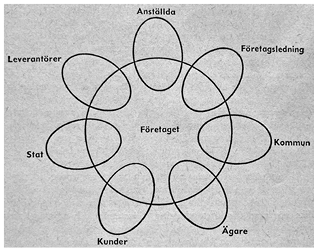
Figure 6.1 Long description
This conceptual diagram is the original 1964 stakeholder map developed by Eric Rhenman. It consists of eight interlocking ovals arranged in a circular formation around a central oval labeled Företaget, the company.
Surrounding the company are the following stakeholder groups, clockwise from top:
- Anställda, employees in English
- Företagsledning, corporate management in English
- Kommun, municipality in English
- Ägare, owners in English
- Kunder, customers in English
- Stat, state in English
- Leverantörer, suppliers in English
Each stakeholder group is shown in an oval that overlaps partially with the central company oval and with its neighboring ovals, visually representing the interdependence between the company and its various stakeholders, as well as among the stakeholders themselves. This non-hierarchical and interconnected layout reflects Rhenman’s Nordic stakeholder philosophy, emphasizing mutual responsibility and cooperation rather than competition.
Stakeholder map (Rhenman, 1968).
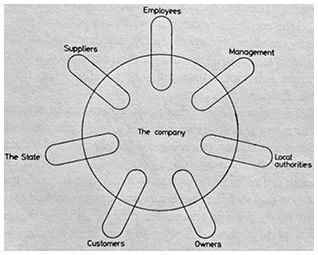
Figure 6.2 Long description
Conceptual diagram presents Eric Rhenman’s 1968 stakeholder map. A large circle labeled The company is placed at the center. Radiating outward from the central circle are seven capsule-shaped ovals, each partially overlapping with the company and pointing outward toward labeled stakeholder groups.
Clockwise from the top:
- Employees
- Management
- Local authorities
- Owners
- Customers
- The State
- Suppliers
Each stakeholder is connected to the company with partial overlap, suggesting mutual dependency. The design reflects a circular, nonhierarchical arrangement, visually underscoring the idea that stakeholders and the company are interdependent rather than the company being dominant or separate.
This visualization preserves the cooperative ethos of Rhenman’s 1964 version while offering a cleaner, more symmetrical layout adapted for the English-language publication Industrial Democracy and Democracy Management.
Rhenman’s stakeholder maps depicted the company and its stakeholders through a series of overlapping ellipses, visually emphasizing the interdependence and mutual interests between the firm and its stakeholders. Rather than placing the corporation at the center of a hub-and-spoke model, as most subsequent visualizations would do, Rhenman’s framework portrayed an interconnected network where the company existed as one node within a broader web of relationships.
This visualization reflected core Nordic cultural values, emphasizing cooperation and mutual interdependence over hierarchy and competition. Throughout the 1960s, 1970s, and 1980s, Rhenman’s stakeholder framework achieved what scholars have termed “hegemonic status” in Nordic management academia, fundamentally shaping how Nordic companies approached stakeholder relationships.Footnote 8 Rhenman’s theoretical contributions emerged from and reinforced distinctly Nordic cultural values prioritizing cooperation over competition.
The 1979 publication of Porter’s “Five Forces” model highlighted the stark contrast between Nordic and American approaches. While Rhenman emphasized cooperation and mutual value creation, Porter’s deeply influential framework cast stakeholders as competitive threats to be managed. This fundamental difference shaped how managers viewed relationships with suppliers and employees – as either cooperative partners or sources of competitive tension.
This stark contrast in approaches reflected deeper cultural and philosophical differences in how businesses understood their stakeholder relationships. While Porter’s model reinforced an adversarial mindset, Rhenman’s framework suggested that stakeholder relationships represent opportunities for collaborative problem-solving and shared value creation.
Nordic versus US Corporate Models: Key Structural Differences
The Nordic cooperative advantage stems from institutional structures and cultural norms that differ from the US model in power distribution, long-term orientation, and stakeholder relations. These differences explain why voluntary US commitments to stakeholder capitalism often fail.
While US governance concentrates power in shareholders and executives, Nordic structures distribute it across stakeholders through three mechanisms: enterprise foundations buffering market pressures, codetermined governance giving labor formal voice, and institutionalized stakeholder engagement processes.
The long-term orientation between these corporate models reveals another crucial distinction. US companies operate under intense capital market pressures for quarterly performance metrics, leading to what management scholars have termed “short-termism.” In contrast, Nordic companies benefit from institutional structures – particularly enterprise foundations – that buffer against such short-term pressures. These foundations, holding majority voting rights in perpetuity, enable corporate governance oriented toward long-term value creation and sustainable business practices. This institutional protection, combined with cultural expectations of corporate stewardship, facilitates the pursuit of ambitious sustainability initiatives that short-term market pressures might otherwise curtail.
The models further diverge in their fundamental conceptualization of stakeholder relationships. US companies, influenced by Porter’s competitive forces framework, traditionally approach stakeholder relationships through a lens of power dynamics and potential conflict. Nordic companies, drawing from Rhenman’s theoretical foundations, institutionalize stakeholder cooperation through formal mechanisms and cultural norms that emphasize mutual value creation. This orientation toward cooperative stakeholder engagement helps explain the documented outperformance of Nordic companies on quantitative sustainability metrics compared to their US counterparts.
Nordic Companies: Stakeholder Approach in Practice
The theoretical principles of the Nordic cooperative advantage – institutional support for stakeholder engagement, cultural norms favoring cooperation, and structures enabling long-term thinking – manifest distinctly in corporate practice. The following case studies illustrate how these principles translate into organizational behavior and strategic decision-making. Each case demonstrates different aspects of how Nordic institutional structures and cultural norms enable companies to pursue stakeholder cooperation more effectively than their global counterparts. Particularly noteworthy is how these companies connect stakeholder engagement to concrete sustainability outcomes aligned with the SDGs.
The case selection reflects three key considerations: sector diversity and associated sustainability challenges, distinctive manifestations of stakeholder cooperation, and contributions to specific SDGs. We begin with Ramboll, which exemplifies the core elements of Nordic capitalism discussed throughout this book. The subsequent cases then explore specific aspects of the Nordic cooperative advantage in greater detail.
Rambøll
Denmark-based Ramboll exemplifies Nordic stakeholder cooperation through both structure and practice. The company is almost entirely owned by the Ramboll Foundation, an enterprise foundation ownership model common across the Nordic region that supports long-term value creation anchored in ethical commitments. As the Ramboll Foundation affirms in Our Legacy, it is “deeply rooted in the Nordic tradition,” a tradition of social cohesion, equality, trust, and respect for human dignity. These values reflect the humanistic outlook of Ramboll’s founders, Børge Johannes Rambøll and Johan Georg Hannemann, who believed business should serve society and its employees.Footnote 9 Through an approach of “purposeful ownership,” the Ramboll Foundation safeguards the company’s long-term orientation while embedding it in a higher-order purpose of responsibility, providing an archetypal example of the Nordic cooperative advantage.Footnote 10
Ramboll’s ownership structure through the Ramboll Foundation enables the patient capital and long-term orientation characteristic of Nordic firms. The foundation describes this as “purposeful ownership,” which helps buffer against short-term market pressures, allowing Ramboll to make decisions aligned with its expressed purpose of creating “sustainable societies where people and nature flourish.” The foundation structure supports Ramboll’s commitment to reinvesting profits into research, employee welfare, and sustainability initiatives rather than maximizing short-term shareholder returns.Footnote 11
Democracy is embedded in Ramboll’s governance structure, with employees having direct representation on the board through democratic elections. This reflects the Nordic understanding that capitalism functions better when power is distributed throughout an organization rather than concentrated at the top. Through this democratic structure, employees have a meaningful voice in strategic decisions that affect both their work and the company’s broader societal impact.
The company’s approach to sustainability exemplifies how democratic capitalism can effectively address complex challenges through stakeholder cooperation. Rather than treating sustainability as an add-on CSR initiative, Ramboll has embedded sustainability throughout its business model and operations through four “Unifying Sustainability Themes”: decarbonization for net zero, resilient societies and livability, resource management and circular economy, and biodiversity and ecosystems. These themes directly support multiple SDGs, including SDG #11 “Sustainable Cities and Communities,” SDG #13 “Climate Action,” and SDG #15 “Life on Land.” Its “Partner for Sustainable Change” strategy demonstrates how companies can systematically engage stakeholders to drive progress on these sustainability goals while maintaining business success. For example, Ramboll actively works to decarbonize industries, improve infrastructure resilience, and restore ecosystems while generating strong financial returns.
Ramboll’s humanistic leadership approach manifests in how it engages employees and broader society. The company emphasizes creating an inclusive workplace with a sense of belonging that reflects its commitment to society. This approach connects to Nordic leadership norms of cooperation, democracy, and power-sharing. Ramboll’s Nordic-rooted approach and structure are emerging as a source of inspiration beyond the region, showing how principles of cooperation, inclusivity, and long-termism – reinforced by the enterprise foundation ownership model – can inform firms globally. While grounded in the Nordic tradition, these values and this ownership model can be adapted and applied in diverse contexts around the world.Footnote 12
The company’s success – growing to over 18,000 employees while maintaining its Nordic values – demonstrates how stakeholder-centered Nordic capitalism can scale internationally while advancing sustainable development. As we examine other Nordic companies, Ramboll provides a compelling example of how Nordic cultural values, ownership structures, and leadership practices combine to enable both business success and societal progress.
IKEA
While Rambøll demonstrates the comprehensive integration of Nordic stakeholder principles, IKEA shows how these principles can be applied to specific global challenges. The company’s evolution illustrates three key manifestations of the Nordic cooperative advantage: Its flat-pack design innovation (1956), its systematic approach to addressing child labor through stakeholder partnerships, and its circular economy initiatives developed through collaborative innovation.Footnote 13
In the 1990s, when confronting the potential of child labor supply chains, IKEA recognized it lacked the competencies and credibility to address this challenge alone. It initiated cooperative partnerships with NGOs like Save the Children, governmental agencies like UNICEF, and suppliers. The Harvard case study “IKEA’s Global Sourcing Challenge” documents how IKEA tackled these issues through its commitment to stakeholder cooperation. Its efforts directly support SDG #8 “Decent Work and Economic Growth.”
Facing criticism about throwaway culture in the 2010s, IKEA committed to full circularity by 2030, partnering with the Ellen MacArthur Foundation and launching its Buy Back & Resell program. This transformation extends to responsible sourcing: as a founding member of the Forest Stewardship Council (FSC), IKEA achieved 98 percent FSC-certified or recycled wood usage by 2020. These initiatives directly support SDG #12 “Responsible Consumption and Production” and SDG #13 “Climate Action.”Footnote 14
LEGO
Founded in 1932 in Billund, Denmark, LEGO revolutionized toy manufacturing with the introduction of its interlocking brick system in 1958, for which the US patent is shown in Figure 6.3, a system that remains compatible across generations.
LEGO US Patent.

Figure 6.3 Long description
This U.S. patent diagram, filed July 28, 1958, and granted on October 24, 1961, Patent No. 3,005,282, illustrates the design of LEGO's interlocking brick system.
- Left panel, which is figure 1: A perspective view shows a rectangular brick with eight cylindrical studs on top and three internal tubes extending downward. The studs are labeled 21, and the internal tubes are labeled 22. The underside of the brick includes the familiar hollow structure that allows for secure interlocking with other bricks.
- Right panel, which is figure 2: A top-down sectional view of the same brick shows the spatial layout of the three internal tubes labeled 22, aligned beneath the top studs labeled 21. The outlines of eight top studs are also faintly visible, reinforcing the brick's regular 2x4 layout. The diagram is labeled G. K. Christiansen as the inventor and titled Toy Building Brick. It visually documents the engineering of LEGO's foundational design, which remains compatible across generations.
LEGO was born out of a broader Nordic cultural tradition that places high value on childhood as a protected and formative stage of life. Across the Nordic region, play is recognized as a vital foundation for cognitive, social, and emotional development. This ethos is embedded in LEGO’s very name – leg godt, meaning “play well” – and is aligned with Nordic ideals of supporting a good childhood.Footnote 15
LEGO’s approach to innovation and stakeholder engagement reflects core elements of Nordic business culture. This is particularly evident in three key areas: its child-centered development philosophy, its open approach to innovation, and its engagement with critics as partners. The Mindstorms case exemplifies this approach to stakeholder engagement.
When LEGO launched its Mindstorms robotics series in 1998, a hacker cracked the console’s code and posted it, prompting negative commentary on LEGO’s online platform. Rather than issuing lawsuits and shutting down its online platform, LEGO engaged with stakeholders – hackers and customers alike – to create value together.Footnote 16 LEGO adopted an approach of Open Innovation, where external contributors are invited into the innovation process through cooperative engagement and mutual value creation.Footnote 17 This catalyzed a dynamic ecosystem of user-generated content, educational tools, and entrepreneurial activity – and contributed to significant successes for the company.Footnote 18
LEGO products have since become foundational in many schools and learning environments, reinforcing the company’s alignment with SDG #4: Quality Education. In 2020, Forbes declared, “LEGO is probably the biggest education company on Earth,”Footnote 19 and LEGO consistently ranks at the top of corporate responsibility rankings.Footnote 20
Norsk Hydro
Founded in 1905, Norsk Hydro exemplifies the transformation of potentially adversarial relationships into partnerships addressing complex challenges. Operating in regions with significant human rights challenges, the company rejected the typical Western extractive approach in favor of a sustainable operating model emphasizing community engagement.
In 2002, Rolf Lunheim, Norsk Hydro Vice President of Corporate Social Responsibility (CSR), established an innovative partnership with Amnesty International. These organizations shared the goal of improving human rights conditions within the communities in which Norsk Hydro operates. Amnesty International offered Norsk Hydro its expertise by training employees on effectively handling human rights dilemmas in these communities.
Respecting human rights cuts across virtually all the SDGs,Footnote 21 and Norsk Hydro’s partnership with Amnesty International ensures it holds itself accountable to these goals. The current Norsk Hydro CEO describes Amnesty International as a “sparring partner” with whom the company “can discuss the dilemmas we face in a constructive way.”Footnote 22
Coop Danmark
Established in 1896, Coop Danmark has become Denmark’s largest consumer goods retailer, serving one-third of Danish households as members. Its cooperative structure embeds stakeholder principles through democratic ownership and control, with employees frequently participating as members.
Since the mid 1800s, cooperatives have been widely used across the Nordics to organize for-profit companies. The success, scale, and pervasiveness of Nordic cooperatives were the focus of US authors Frederic Howe in Denmark: A Cooperative Commonwealth (1921) and Denmark: The Coöperative Way (1936), and Childs in Sweden: The Middle Way (1936; Chapter 4). Howe remarked that “power is diffused” in Denmark and attributed cooperatives’ pervasiveness as a fundamental reason. He contrasted this to the US with its ever-increasing number of large corporations, accumulating increased concentrations of power and operating in an extractive manner to maximize shareholder profits.Footnote 23 Upon reading Childs’s book, US President Franklin D. Roosevelt sent a presidential commission to the Nordics in 1936 to study cooperatives’ role and draw potential lessons to inform American capitalism. Roosevelt was concerned about the growing concentration of power among a few large US corporations. He saw the cooperative structure as a promising means to disperse power throughout society consistent with democratic principles.Footnote 24
Coop Danmark’s cooperative approach with suppliers challenges traditional extractive relationships. While Western corporations typically source raw materials cheaply from developing regions and perform profitable value-added activities in their home countries, Coop Danmark seeks to create value with supplier communities. This represents a fundamental shift from extractive to cooperative supply chain relationships. In 2011, it began piloting several initiatives in partnership with raw material suppliers – farmers and small-scale cooperatives – in various locations across Africa to determine how it could encourage more value-added activities “at the source.” Coop Danmark recognized the power dimensions of the supply chain where the small farmers had little to no power compared to the large multinational corporations that were purchasing their raw materials. As a democratically organized cooperative, Coop Danmark wanted to address this and support the communities from which their products originated. It also desired to shorten its value chains, increase quality, and strengthen supplier relations through heightened cooperation.
In 2015, Coop Danmark established the African Coffee Roasters organization in collaboration with Kenyan coffee cooperatives, local NGOs, the Danish Embassy, and the Industrialization Fund for Developing Countries. In 2016, this organization built its first roasting facility and began commercial production as Kenya’s certified organic coffee roasting facility. As of 2018, this facility represented $8 million of value-added activities performed in Kenya, directly supporting SDG #8 “Decent Work and Economic Growth.”Footnote 25
After facing significant financial challenges, in 2024, Coop Danmark restructured its ownership in partnership with OK amba, another Danish cooperative. OK became the majority shareholder while Coop Danmark retained its cooperative character through shared governance with Coop amba. This alliance secured the necessary capital for Coop Danmark to continue its operations while maintaining its commitments to democratic ownership and stakeholder engagement.
Carlsberg
Carlsberg is a Danish brewery founded near Copenhagen in 1847 by J. C. Jacobsen. Named for Jacobsen’s son Carl, Carlsberg has become the world’s fourth-largest beer company.Footnote 26 Innovation, cooperation, and openness are keys to its success. In 1883, Emil Christian Hansen, head of the Carlsberg Research Laboratory’s physiology department, made a groundbreaking discovery that led to radical innovations in the brewing industry. Previously, brewing beer often resulted in undrinkable concoctions due to a certain amount of wild yeast in the pitching yeast. Hansen developed a method to isolate a single cell of good yeast and propagated it to make quality beer from every brew. This process would become known as Saccharomyces Carlsbergensis. Beer sickness was a widespread problem, and Carlsberg elected to give away the pure yeast to other local brewers. (This openness directly benefited the launch of new technology in a completely different field: insulin production.)
But Carlsberg did not rest on its laurels of scientific advancement. In 1909, Danish chemist Søren Peter Lauritz Sørensen developed the pH scale, which measures whether a substance is acidic or basic, at Carlsberg Laboratory. A phenomenal development to ensure beer consistency and quality, Carlsberg elected to share the pH scale with the world.Footnote 27 It did not have a business case for doing so – sharing would not lead to more profits in the foreseeable future or provide a competitive advantage – but Carlsberg recognized the significant societal benefits elsewhere, so it shared its scientific development. While making a business case would likely not have been possible then, Carlsberg Laboratory has since become world renowned, attracting the best scientific talent globally.
Presently, Carlsberg continues to innovate in the same spirit of cooperation. In 2015, Flemming Besenbacher, Chairman of the Carlsberg Foundation, publicly announced at the WEF in Davos that Carlsberg would attempt to develop a fully biodegradable paper beer bottle. Carlsberg knew that 40 percent of its carbon footprint was related to packaging materials and that incremental changes to existing packaging would not significantly reduce it. Besenbacher displayed a pilot fiber bottle at the WEF to make a public commitment without knowing how Carlsberg would produce a market-ready bottle – he just knew they had to do it. Facing numerous innovation challenges in developing such a package to ensure food safety, shelf life, withstanding pressure, and biodegradability,Footnote 28 Carlsberg looked for partners.
Carlsberg is not alone in having the bulk of its carbon footprint from packaging, which directly relates to SDG #12 “Responsible Consumption and Production” and SDG #13 “Climate Action.” Instead of looking to “own” resultant innovations, Carlsberg desired to lead the development of a sustainable package that could be used across the entire industry. Therefore, Carlsberg invited worldwide collaboration partners to help create a new sustainable bottle in the spirit of Open Innovation.Footnote 29
Open Innovation is contrasted with the competitive “go it alone” approach characterized by many corporate R&D departments and associated laboratories shrouded in secrecy. Carlsberg developed a partnership with innovation experts ecoXpac and Danish Technical University, supported by Innovation Fund Denmark. Soon after, packaging company BillerudKorsnäs joined the efforts, resulting in the paper bottle company Paboco® – a joint venture between BillerudKorsnäs and bottle-manufacturing specialist Alpla. Paboco® enabled more partners to join the efforts, including The Coca-Cola Company, The Absolut Company, and L’Oréal, thus significantly increasing the potential impact.Footnote 30
Chesbrough, Marcel Bogers, and I coauthored a case study using the Carlsberg example to define the concept of “Sustainable Open Innovation.”Footnote 31 Maximizing profits was not a primary driver behind Carlsberg’s efforts to develop the green fiber bottle. Instead, the company adopted a long-term stewardship approach. Carlsberg is a publicly traded corporation with a unique governance structure in which the associated Carlsberg foundation holds majority voting rights in perpetuity. The Carlberg foundation ownership structure enables Carlsberg to take a much longer-term view than typical US public corporations.Footnote 32
Novo Nordisk
Novo Nordisk, the world’s largest insulin producer, emerged from the 1989 merger of two Danish firms established in the 1920s. Now headquartered near Copenhagen, the company leads in diabetes care and stakeholder engagement. In 2012, Corporate Knights named it the most sustainable company in the world.Footnote 33
Novo Nordisk’s work with the innovative Cities Changing Diabetes took the stakeholder approach to a new level. Rather than focusing solely on treatment, the company partnered with cities to prevent diabetes before it occurs. Cities Changing Diabetes is a global partnership initiated by Novo Nordisk that brings together city governments, public health institutions, and community organizations to address the root causes of chronic diseases like type 2 diabetes. Rather than focusing solely on treatment, the initiative targets social and environmental factors that shape urban health outcomes and supports lifestyle changes through measures like healthier food options and increased opportunities for physical activity.
A company operating under a shareholder-centric model would likely avoid such efforts, fearing they could undermine short-term profitability, as Novo Nordisk makes the bulk of its profits selling insulin. However, by adopting a stakeholder approach, Novo Nordisk focuses on how its core competencies can create value for stakeholders first. In doing so, it fosters stronger collaborations with stakeholders that present the potential to realize new business opportunities in the future as a service provider for better health rather than solely a product seller.
In 2024, Cities Changing Diabetes was renamed Cities for Better Health to mark the program’s ten-year anniversary and to reflect its expanded focus beyond diabetes to broader chronic disease prevention and health equity in urban communities.
A majority of Novo Nordisk’s voting rights are held in perpetuity by an associated enterprise foundation, the Novo Foundation, as is the case with Carlsberg. Such a structure to enable longer-term thinking by protecting against the ills of short-termism enable these companies to experiment with approaches that may not have clear immediate term business cases. In its 2024 article, “Why Are Nordic Companies So Successful?” The Economist identified the enterprise foundation ownership model as a primary reason for Novo Nordisk and other Nordic firms’ success it makes it easier for management to invest in their respective companies’ long-term success.Footnote 34
Novo Nordisk’s A shares carry ten times the voting rights of B shares; the Novo Nordisk Foundation holds 75 percent of the company’s voting rights and 28 percent of its market value, giving it majority control. The company remains accountable to the stock market while benefiting from a stable, long-term owner. The Foundation’s mission is to provide “a stable basis” for Novo Nordisk, protecting management from the ills of short-termism and enabling greater discretion to pursue initiatives that serve the long-term interests of both the company and society.
Ørsted
The Danish-based energy company Ørsted is a global leader in renewable energy. Ørsted was named the world’s most sustainable company in 2020 by Corporate Knights Global 100,Footnote 35 and it regularly ranks as the most sustainable energy company. Ørsted is the first energy company globally to have its net-zero greenhouse gas (GHG) commitment validated by the Science Based Targets initiative.Footnote 36
Ørsted reduced GHG emissions by 96 percent by 2023 compared to the base year 2006.Footnote 37 In Denmark alone, Ørsted accounts for more than half of the country’s GHG emission reductions from 2006 to 2018.Footnote 38 Ørsted directly supports Denmark’s strong national-level performances in SDG #7 “Affordable and Clean Energy,” which aims to ensure access to affordable, reliable, sustainable, and modern energy for all, and directly supports its efforts in SDG #13 “Climate Action” focusing on climate action.
Ørsted’s rapid sustainability transition is nothing short of revolutionary. It demonstrates what can be achieved by a company in relatively short order when a commitment is made, and a good strategy is developed and executed. Former Ørsted CEO Mads Nipper remarked, “In the late 2000s we were one of the most coal intensive power generators in Europe with an expanding oil and gas production business. But we took a strategic decision to become a green energy company, as we were convinced it was the right approach strategically, financially and environmentally.”Footnote 39
Ørsted put its money where its sustainability mouth was. It phased out all capital expenditures (CAPEX) funds in legacy business investments in fossil fuel-based energy production. CAPEX is the money a company deploys to acquire, upgrade, and maintain its physical assets, including property, plants, buildings, technology, and equipment. Ørsted committed itself to a strategic path where CAPEX is now nearly 100 percent invested in renewable energy production. As direct result, Ørsted’s carbon efficiency gains are dramatic: from 462 grams CO2 per kWh in 2006 to 58 grams in 2021, with a projected 10 grams by 2025 – representing a 98 percent reduction in emissions per energy unit.Footnote 40
The largest source of greenhouse gas emissions from human activities is burning fossil fuels, with energy production and consumption accounting for 73 percent of the world’s GHG emissions (industry 24 percent, buildings 18 percent, transport 16 percent).Footnote 41 Ørsted’s dramatic efficiency improvements directly address the need for a significant worldwide reduction in CO2.
When Ørsted embarked upon its green energy transition almost two decades ago, it had to take a leap of faith and commit to a revolutionary transition without knowing how to achieve it. In 2021, Ørsted published the White Paper Our Green Business Transformation: What We Did and Lessons Learned.Footnote 42 It includes seven key lessons.
Lesson number one is: “Confront your reality.” Ørsted embraced that the world is changing and needs changing; therefore, Ørsted must change. Ørsted defined a sustainable vision, engaged and cooperated with its many stakeholders, achieved alignment around its sustainable vision, and mobilized action. Considering Porter’s Five Forces terminology, Ørsted did not approach its “buyers” or “suppliers” or any of its other many stakeholders primarily as competitors. Instead, Ørsted’s approach was firmly rooted in cooperation consistent with the Nordic cooperative advantage.
The Danish government established smart policy Ørsted describes as vitally important for its transition to green energy. The policies enacted in Denmark created the markets that encouraged innovation and future-oriented technologies and drove efficiencies that fueled Ørsted’s transition from its fossil-fuel past. Markets are not immutable natural laws like gravity (Chapter 3), but are constructed through policies and reflections of the actors in society with the power to influence such policies. From Ørsted’s reflections on lessons learned:
Ørsted was able to undergo its green transformation, and learn these lessons, partly due to the existence of a supportive policy environment. In particular, there was sufficient visibility and certainty of offshore wind policy support and capacity volumes to allow investment and innovation at scale, which led to a virtuous cycle of technology maturity and reducing costs. The success of such an ‘ambition loop’ is an additional policy learning that could be applied to other technologies and industries.Footnote 43
The Danish government needed to institute smart policies that established the markets necessary to drive innovations and efficiencies. Today, Ørsted is positioned as the global leader in green energy production. As the world of ESG (environmental, social, and governance) investing continues to mature, Ørsted will enjoy significant profits as a by-product of its sustainability commitments. The strategic decision to transition to green energy production was a long-term play for Ørsted. Attention to short-term profit maximization would have prevented Ørsted from making the long-term investments necessary to achieve its status as a global sustainability leader.
Volvo
Swedish automotive company Volvo pioneered safety innovations, including the three-point seatbelt, as shown in the original US patent in Figure 6.4. This innovation is considered the world’s most important traffic safety development and is estimated to have saved more than one million lives since its launch in 1959.Footnote 44 Volvo immediately realized the potential societal benefits of its innovation if it were rapidly adopted across the automobile industry. So, rather than consider its innovation a “competitive advantage,” Volvo shared it with all automakers (similar to Carlsberg with the PH scale).
Volvo 3 Point Seatbelt US Patent.

Figure 6.4 Long description
This U.S. patent diagram, filed August 17, 1959, and granted July 10, 1962, Patent No. 3,043,625, illustrates the original design for the 3-point seatbelt developed by Swedish engineer Nils Bohlin at Volvo.
The drawing features a driver seated in a car, wearing a shoulder and lap belt combination. The belt system extends diagonally across the torso and horizontally across the pelvis, securing into a central locking mechanism near the seat base.
The belt’s attachment points, guiding mechanisms, and buckle system are labeled with reference numbers, highlighting the integrated design that allowed for both comfort and security. For instance, labels 5 and 6 refer to the upper belt anchor point on the car frame, and 13 represents the shoulder harness extending across the chest.
This visualization documents Volvo’s safety innovation, which was openly shared with the auto industry to accelerate adoption and maximize societal benefit, an act that has saved over a million lives and remains a defining example of corporate responsibility.
While Volvo typically protects its innovations, it determined that the societal benefits of the three-point seatbelt were too significant to restrict. By forgoing potential short-term competitive advantages and profits, Volvo demonstrated a cooperative approach that ultimately enhanced its global reputation as a leader in safety. This decision has contributed to both the company’s market position and its organizational culture, where safety innovation remains a source of pride among employees.
… and Many, Many More
Many more compelling Nordic companies exist dedicated to a stakeholder approach and demonstrating strong sustainability performances. Danish-based Vestas is the world’s largest wind turbine company and was named the world’s most sustainable company in 2022 by Corporate Knights, just ahead of Ørsted at #2. Danish-based Chr. Hansen Holding – producer of natural solutions for food, beverage, nutritional, pharmaceutical, and agricultural industries – held the distinction of Corporate Knights most sustainable company in 2019,Footnote 45 and took second place in 2020. Neste (Finland), always near the top of the Corporate Knights list, has developed renewable diesel fuel reducing GHG emissions by about 90 percent, and sustainable aviation fuel reducing GHG emissions by about 80 percent compared to fossil fuels. Skandinavisk (Denmark), a certified B Corp in the fragrance and personal care industry, is another standout. Skandinavisk’s vision reads as an ode to the Nordic region – describing it as a place where trust, equality, respect, life balance, and “everyday moments of shared happiness” reflect a deliberate way of living in harmony with nature and with one another.Footnote 46 EQT (Sweden) similarly expresses how its Nordic heritage has shaped its stewardship approach to business, unique for the private equity industry with a reputation for being extractive corporate raiders. Grundfos (Denmark), Houdini (Sweden), Ericsson (Sweden), MAX Burgers (Sweden), Novonesis (Denmark), Storebrand (Norway), Tetra Pak (Sweden), and Too Good to Go (Denmark) are further examples of leading Nordic companies worthy of further exploration, among so many more.Footnote 47
These company examples reveal several consistent patterns in how Nordic institutional structures enable superior stakeholder engagement and sustainability performance. First, they show how enterprise foundations enable longer-term strategic horizons. Second, they demonstrate how institutionalized stakeholder engagement processes lead to more innovative solutions to complex challenges. Third, they illustrate how distributed power structures facilitate more effective cooperation with diverse stakeholder groups.
The success of these approaches raises important questions about the role of language and cultural frameworks in enabling stakeholder cooperation. While institutional structures provide the foundation, the way organizations conceptualize and discuss stakeholder relationships plays a crucial role in enabling effective cooperation.
Language and Metaphors
Nordic companies’ language reflects cultural norms that shape corporate behavior. While American firms default to competitive and military metaphors, Nordic companies distinguish when cooperation or competition serves best. For sustainability challenges requiring collaboration, they typically refer to industry players as “peers” rather than “competitors,” revealing a distinct conception of business relationships.Footnote 48
Metaphors We Live By shows how such language choices shape thinking and action. While warfare metaphors foster adversarial mindsets toward stakeholders, cooperative language creates institutional environments that favor collaboration, enabling more effective responses to sustainability challenges.Footnote 49
Beyond Corporate Social Responsibility
The Nordic stakeholder approach fundamentally differs from American CSR. Where CSR often serves as a voluntary add-on, the Norwegian concept of samfunnsansvar embeds stakeholder engagement within core institutional structures, revealing how context shapes corporate responsibility.
The distinction emerges clearly in the Norwegian concept of samfunnsansvar, which offers important theoretical insights into how institutional contexts shape corporate responsibility. The following analysis of this concept, drawing from my ongoing conversations with Norsk Hydro’s Vice President of Corporate Social Responsibility, Rolf Lunheim, while I was a US Fulbright Scholar to Norway in 2005–2006, illuminates the crucial differences between US and Nordic approaches to corporate responsibility.
Rolf told me about the traditional Norwegian expression, samfunnsansvar, used before the CSR expression started to gain traction in the Nordics. He translated samfunnsansvar as “the responsibility of business in society.”Footnote 50 He explained to me Norsk Hydro’s cooperative partnership with Amnesty International to tackle human rights challenges and how this helped fulfill the company’s societal responsibility. Samfunnsansvar was not like CSR in the US, he said, which he described as most often a sideshow to how a company goes about making its money. Rolf said US CSR often focuses on philanthropy, like when an oil company donates to the local youth soccer league or organizes a volunteer effort to clean up a park. He explained that the ongoing cooperation with Amnesty International changed how Norsk Hydro did business and engaged with stakeholders, allowing it to serve societal interests better.
Samfunnsansvar is about a company’s commitment to ongoing stakeholder engagement. It establishes the structures and processes to disperse power. According to Rolf, it is not fully democratic, yet it represents a significant step toward operating more democratically than the usual American approach.
The academic article, “Ye Olde CSR: The Historic Roots of Corporate Social Responsibility in Norway,” by Øyvind Ihlen and Heidi von Weltzien Hoivik supports Rolf’s offerings.Footnote 51 The authors document that the expression CSR was not explicitly mentioned in a Norwegian newspaper until 1999. Samfunnsansvar remains a better descriptor for how Norwegian companies consider their role in society than CSR. The authors explain how Norwegian companies see themselves as situated within society amongst a constellation of stakeholders. They contrast the Nordic approach with a US tendency for companies and business leaders to discuss the business sector as somehow operating separately from society. In the US, discussions are often framed as business and society, which implies a separation, in contrast to Nordic discussions framed as business in society. The authors highlight how the language differs: “One can distinguish between countries when looking at how companies view their interdependence, either as ‘business in society’ or ‘business and society.’”
Samfunnsansvar rejects the separation thesis at the societal level. The separation thesis has been traditionally discussed between the individual and organizational levels, rejecting the idea that individuals can somehow detach their ethics from what they do at the organizational level – that is to say, the companies at which they work. Samfunnsansvar moves it to the societal level, rejecting the separation between business and society.Footnote 52 This is reflected in how Nordic companies see themselves as situated within society amongst a constellation of stakeholders. They contrast with the US tendency for companies and business leaders to discuss the business sector as somehow operating separately from society. In the US, discussions are often framed as business and society, which implies a separation, in contrast to Nordic discussions framed as business in society.
Samfunnsansvar extends far beyond US philanthropic CSR, encompassing fundamental business responsibilities like “responsible tax.” The Nordic expectation that companies pay their fair share – backed by public pressure – starkly contrasts with US corporate tax practices and illustrates deeper differences in how business responsibility is conceived.
Large corporations in the US frequently pay no taxes with relatively little public outcry. For example, despite posting substantial profits, Amazon, Chevron, General Motors, Haliburton, and IBM paid $0 in federal taxes in 2018. Years of lobbying efforts by US big business interests, like the Business Roundtable, have successfully slashed taxes paid. Many self-described capitalists in the US maintain that low to no taxes are a hallmark of capitalism.Footnote 53
US corporations show off their corporate philanthropic acts. However, these donations are significantly less than the taxes they would pay if they were paying even what an individual would pay commensurate with their earnings. In his book Supercapitalism, Robert Reich suggests determining how responsible a company is by paying attention to its public policy and lobbying efforts – not its CSR efforts. Many US companies direct their lobbying efforts to reduce or eliminate taxes paid.Footnote 54 Furthermore, US philanthropy has no democratic accountability because executives and their associated foundations direct the money to their choosing. As Rolf pointed out to me, these are not democratically elected public officials, and the democratic deficit in society grows, the more philanthropy is relied upon to serve the public’s needs.Footnote 55
Structuring the Stakeholder Approach
When the most influential voices of American capitalism called for US companies to shift from the shareholder to the stakeholder approach in 2019 at the Business Roundtable, they were essentially calling for US companies to act more like Nordic companies. But polite requests to change behavior are not enough. The Nordic experience demonstrates that achieving stakeholder capitalism requires both cultural and structural changes.
Many well-intentioned US business leaders committed to stakeholder-driven companies ultimately failed. O’Toole chronicles these stories in The Enlightened Capitalists, where “Strong ethical compasses guided their decision making with regard to meeting the diverse needs of their constituencies: customers, employees, shareholders, suppliers, host communities, the broader society and the natural environment.” For US companies, O’Toole argues, attempting to serve stakeholders beyond shareholders is like swimming upstream – American capitalism’s current eventually pulls most toward shareholder primacy.Footnote 56
Patagonia is widely heralded as an exceptional case of a stakeholder approach in US business. Its environmental stewardship and comprehensive employee benefits – from paid parental leave to childcare to assurances of living wages – demonstrate stakeholder commitment in practice.Footnote 57
Patagonia’s founder, Yvon Chouinard, is a primary reason why Patagonia is a stakeholder company. His book, The Responsible Company: What We’ve Learned from Patagonia’s First 40 Years, with coauthor Vincent Stanley, chronicles Patagonia’s efforts to adhere to a stakeholder approach (Chapter 4).Footnote 58 Patagonia has voluntarily assumed greater responsibilities for its stakeholders, which includes assuming short-term financial burdens to protect the natural environment and offering benefits to employees that bring high costs. Under Chouinard’s watch, Patagonia became the exceptional fish swimming upstream against the current of American capitalism.
But why must a company swim against the current to be a stakeholder company? In its 2019 declaration that the corporation’s purpose must change from shareholder primacy to the stakeholder approach, the Business Roundtable’s association of US CEOs acknowledged that a change is needed (, Chapters 2–4).Footnote 59
To realize sustainable capitalism, the company’s purpose must be to create value for its stakeholders in a manner that supports sustainable development, which means meeting the needs of the present without compromising the ability of future generations to meet their own needs. Realizing sustainable capitalism involves practicing stakeholder capitalism.
We have a choice ahead to achieve that necessary shift of corporate purpose. We can hold up a company like Patagonia as an example of a stakeholder company and attempt to convince US companies to swim upstream against the current of American capitalism. However, as O’Toole chronicled, we are not likely to achieve stakeholder capitalism en masse; with history as our guide, most companies will ultimately fail. Or, we can focus on the current of the stream. Rather than expend efforts to get every fish to be that exceptional case, like Patagonia, we can consider why the current flows in the direction of shareholder capitalism. Why not direct the stream’s current toward stakeholder capitalism, whereby every fish follows a stakeholder approach by default?
The stakeholder approach is not achieved in the Nordics through volunteerism and philanthropy but, instead, it is structured. Policy changes are necessary for structuring the stakeholder approach – and here, the Business Roundtable and US business leaders can look to the historical developments of the Nordics. Throughout the twentieth century, Nordic business leaders and pro-business conservatives have been champions of stakeholder capitalism, actively working to ensure fair wages are paid to employees and systems are in place to support the well-being of all Nordic citizens. Nordic business leaders were initially pressured by threats of socialism in the late 1800s, into the early 1900s. They would realize for themselves the benefits that come from being part of building a society that works for everyone, not just the powerful few. In her 2020 book, Reimagining Capitalism, Henderson highlights successes in Denmark and lessons for the US, particularly emphasizing the active role that Danish business leaders played in supporting the stakeholder approach, including strong labor unions and democratic principles.Footnote 60
Yes, you read that correctly: Big business in Denmark actively worked to help establish a strong and effective organization for labor unions. The result was the national collective bargaining system that has served business interests well across the Nordics through an efficient structuring of conflict resolution. Furthermore, the Danish business community and conservatives saw the benefits of a well-functioning, educated labor pool and not tying healthcare to employment. Labor economist and historian Walter Galenson’s book, The World’s Strongest Trade Unions: The Scandinavian Labor Movement, documented the benefits of trade unions to Nordic societies.Footnote 61 Galenson noted in 1998 that approximately 90 percent of Swedish employees were members of a labor union, compared with 15 percent in the US.
Nordic business leaders have worked to avoid saddling Nordic companies with demands that would take attention away from their core business activities. Furthermore, Nordic policymakers desired a more flexible workforce where laborers were not at risk of clinging to a job for “benefits” but were continually training and could change employers or become entrepreneurs without fear of losing benefits. Stakeholder capitalism in the Nordics works so well, thanks to the ongoing support of Nordic business leaders. Anu Partanen and Trevor Corson made this point in their 2019 New York Times special feature “Finland Is a Capitalist Paradise” (Chapter 4):Footnote 62
The Nordic nations as a whole, including a majority of their business elites, have arrived at a simple formula: Capitalism works better if employees get paid decent wages and are supported by high-quality, democratically accountable public services that enable everyone to live healthy, dignified lives and to enjoy real equality of opportunity for themselves and their children. For us, that has meant an increase in our personal freedoms and our political rights – not the other way around.
If US companies and their leaders supported paying their fair share of taxes – rather than evading and fighting taxes at every turn – and demanded efficient public services for those precious tax dollars, US society could benefit dramatically. Writing of the importance of paying one’s fair share of taxes, Ørsted CEO Mads Nipper offered:
5,340,426,528 DKK (~$850 million). This is the corporate tax paid by Ørsted in Denmark in 2019. Let there be no doubt that the single most important contribution of our company is to be a global catalyst for a world that runs entirely on green energy, but one of the many other important societal contributions of companies like ours is tax.Footnote 63
These essential words by a Nordic business leader to advocate for simply paying one’s fair share of taxes would be near revolutionary for a US business leader to proclaim.
Nordic leadership in sustainability is supported through the efficient delivery of universal programs directly addressing many SDGs. Universal access to healthcare directly supports SDG #3 “Good Health and Well-Being.” Universally subsidized childcare and universal access to education through university directly supports SDG #4 “Quality Education.” Importantly, these universal programs depend on the vibrant Nordic economies and availability of good jobs, directly tied to SDG #8 “Decent Work and Economic Growth.”
The success of the Nordic model stems from companies and their business leaders acknowledging their civic duties, including paying their fair share of taxes. This reciprocal relationship strengthens the Nordic social contract: Businesses invest in the society that nurtures them, while the society creates an environment where businesses can thrive sustainably.
The Nordic model features uniquely cooperative labor relations, with about 70 percent union membership reflecting deep-rooted collective bargaining culture. Unlike contentious US labor relations, Nordic unions and employers maintain continuous dialogue and mutual respect, ensuring more equitable distribution of prosperity.
The enterprise foundation ownership model is a vital element of Nordic stakeholder capitalism, providing structural support for long-term thinking and stakeholder orientation. This ownership structure, where foundations hold majority voting rights in perpetuity, creates systematic insulation from short-term market pressures. Controlling over 70 percent of Denmark’s stock exchange capitalization and extending to private firms, these foundations enable companies like Novo Nordisk, Carlsberg, and Ramboll to prioritize long-term stakeholder interests over short-term financial pressures. This institutional feature directly contributes to Nordic companies’ superior sustainability performance.
Parting Reflections
The Nordic cooperative advantage demonstrates that effective stakeholder capitalism requires both structural foundations and cultural support. The contrast between American capitalism’s profit maximization and Nordic companies’ stakeholder orientation reveals three key insights:
First, meaningful stakeholder cooperation demands robust democratic structures, not just good intentions. Nordic companies engage with stakeholders through formalized dialogue processes and governance structures, including employee board representation and enterprise foundation ownership. These structures also buffer against the ills of short-termism, which can prevent meaningful stakeholder engagement. This stakeholder cooperation fundamentally depends on dispersed power. The Nordic cooperative advantage emerges from business environments where power is distributed through strong labor unions and universal social safety nets, where employees are not dependent on employers for basic needs like healthcare. This balanced distribution of power creates conditions for constructive cooperation.
Second, language reflects and also profoundly shapes business behavior and culture. American business discourse centers upon hypercompetitive language, including a prevalence of warfare metaphors that depict the world as a series of zero-sum affairs, needlessly emphasizing conflict. Nordic companies tend to frame interactions through cooperative paradigms, such as discussing industry peers and employer–labor union relationships framed in a cooperative spirit. Sustainability challenges demand effective cooperation, which the cooperative language and cooperative strategic posture of Nordic companies help facilitate.
Third, the purpose of the firm has fundamentally different definitions in American versus Nordic capitalism. The so-called Friedman doctrine, which defines the firm’s purpose solely as maximizing profits for shareholders, has been a cornerstone of American capitalism rooted in neoliberalism since the 1980s. In Nordic capitalism, the firm’s purpose is to create value for its stakeholders.
Corporations are a primary tool of capitalism, and Nordic companies corporations offer a compelling benchmark for their American counterparts. Yet they, too, must continue to evolve to meet the lofty demands of realizing sustainable capitalism. While the Nordic stakeholder-oriented approach moves us closer to that goal, fully realizing sustainable capitalism requires an even more ambitious definition of the firm’s purpose: to create value for its stakeholders within planetary boundaries. This definition aligns with the dual imperatives of sustainable development – meeting the needs of the present while safeguarding the ability of future generations to meet their own needs.
I feel that the American Dream can be achieved best in the Nordic countries, where every child, no matter their background or the background of their families, can become anything.
We can have democracy in this country, or we can have great wealth concentrated in the hands of a few, but we can’t have both.
Having explored Nordic capitalism at the individual level (Chapter 5) and organizational level (Chapter 6), this chapter shifts to the societal level through the lens of the American Dream – an ideal rooted in freedom, equal opportunity, and upward mobility.Footnote 1 Finnish Prime Minister Sanna Marin’s striking claim that the American Dream may be “achieved best in the Nordic countries” invites us to examine how American and Nordic capitalism translate shared aspirations into very different realities. In doing so, we explore contrasting views of freedom, the role of public institutions, and what it takes to make opportunity real for all.
Isaiah Berlin’s distinction between negative and positive freedom is central to understanding these differences. This framework helps us analyze how different forms of capitalism balance individual liberty and societal well-being. Negative freedom refers to “freedom from” – the absence of interference, particularly from government regulation or taxation. Positive freedom, by contrast, is “freedom to” – the ability to access opportunities or essential services such as healthcare, paid parental leave, or affordable education.
In his 2024 book On Freedom, Timothy Snyder observes, “Negative freedom is our (American) common sense.”Footnote 2 Nordic societies, by contrast, prioritize expanding positive freedoms.Footnote 3
Conflicts between negative and positive freedoms arise when expanding one requires limiting the other. For instance, ensuring universal access to clean water – a positive freedom – may require regulations restricting businesses’ negative freedom to operate without interference. Similarly, funding universal healthcare through taxation requires balancing the negative freedom from taxation with the positive freedom of universal access to care.
Examining how American and Nordic societies navigate the balance between negative and positive freedoms – and whose freedoms take precedence in moments of conflict – offers a powerful lens for understanding the defining characteristics of American and Nordic capitalism, respectively. This theoretical framework of negative and positive freedoms has been widely applied in political philosophy and institutional analysis,Footnote 4 providing a useful conceptual framework for comparing different varieties of capitalism.
The American Dream
Few expressions are as widely known, frequently invoked, and open to interpretation (and exploitation) as the “American Dream.” It has been a central theme in some of the most impactful pieces of American rhetoric, from Martin Luther King Jr.’s impassioned “Letter from Birmingham Jail,”Footnote 5 to the speeches of President Reagan.Footnote 6 “Has the American Dream Been Achieved at the Expense of the American Negro?” served as the title for the legendary 1965 debate between James Baldwin and William F. Buckley.Footnote 7 This question underscores the deep complexities and varied interpretations of the American Dream, highlighting its role as both an aspirational ideal and a subject of scrutiny.
The expression “American Dream” is not confined to the US, as indicated by the Finnish Prime Minister’s opening quote, but its definition is subject to debate. Insofar as the American Dream represents the promise of a good quality of life for current and future generations, it is consistent with sustainable development. However, the American Dream has many different connotations.
So, what exactly is the American Dream?
Jim Cullen describes the American Dream as the US “national motto” – a set of ideals promising that anyone, regardless of background, can realize their potential through hard work. At its heart are freedom, upward mobility, and equal opportunity.Footnote 8
The expression American Dream was first penned in 1931 by James Truslow Adams. He described it as “life should be better and richer and fuller for everyone, with opportunity for each according to ability or achievement.”Footnote 9 Adams continued, describing how the American Dream was a worldwide source of inspiration, stating, “a better, richer, and happier life for all our citizens of every rank, which is the greatest contribution we have made to the thought and welfare of the world. That dream or hope has been present from the start [of the US].”Footnote 10
Inherent to the American Dream is a sense of optimism – a profound hope that has deep historical roots. Within his famed Democracy in America manuscript from the 1830s, the Frenchman Alexis de Tocqueville wrote “the charm of anticipated success” was a central quality of the young US. While the American Dream as a term did not rise in popularity until a century later, Tocqueville had tapped into the “can do” spirit of the American ethos that he did not experience in Europe at that time where monarchies and aristocracies predetermined the lot in life at birth for most people.Footnote 11
According to Cullen, the “major moral underpinning” of the American Dream is that “everyone is eligible … At some visceral level, virtually all of us need to believe that equality is one of the core values of everyday American life, that it promises to extend to everyone.”Footnote 12 “Everyone is eligible” does not require equality of outcome.Footnote 13 Instead, it means equality of opportunity for everyone to flourish and realize their full potential.
U.S. Treasury Secretary Scott Bessent challenged a more recent conflation of consumerism with the American Dream in a 2025 speech on trade policy. “Access to cheap goods is not the essence of the American Dream,” he declared. “The American Dream is rooted in the concept that any citizen can achieve prosperity, upward mobility, and economic security.”Footnote 14 His statement emphasized that upward mobility – not consumer access – defines the American Dream’s core promise.
This focus on social mobility aligns with WEF’s Global Social Mobility Index, which measures precisely what the American Dream promises: equality of opportunity. The index evaluates how effectively different nations deliver “equally shared opportunities” and ensure “an equal and meritocratic footing irrespective of socio-economic background, geographic location, gender or origin.”Footnote 15 The WEF’s Global Social Mobility Index could justifiably be called the American Dream Index – yet ironically, the Nordic countries top the list, with the US ranked 27th, between Lithuania and Spain.
In the WEF’s 2020 report, all five Nordic countries claimed the top spots, with Denmark, Norway, Finland, Sweden, and Iceland ranking first through 5th, respectively, as shown in Table 7.1. The US, by contrast, ranked 27th.Footnote 16 These findings are reinforced by researchers Mattia Fochesato and Samuel Bowles, who conclude that “in terms of economic and social success, it matters less who your parents are in the Nordic economies” – suggesting that Nordic capitalism may be more effective than American capitalism at delivering on the American Dream’s central promise of opportunity for all.Footnote 17
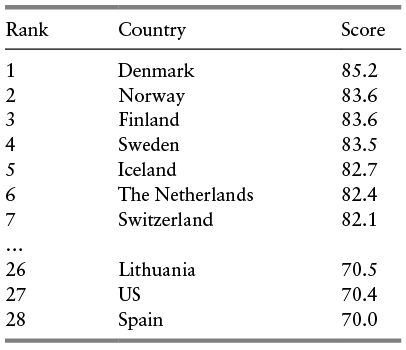
Table 7.1 Long description
Table has three columns that list the Rank, Country, and Score. The top seven-ranked countries are as follows. Denmark: rank 1, score 85.2. Norway: 2 and 83.6. Finland: 3 and 83.6. Sweden: 4 and 83.5. Iceland: 5 and 82.7. The Netherlands: 6 and 82.4. Switzerland: 7 and 82.1. The table then skips to ranks 26 through 28, which are as follows. Lithuania: 26 and 70.5. United States: 27 and 70.4. Spain: 28 and 70.0.
While equality of opportunity is the focus of the American Dream – not equality of outcome – the two are related. When power and wealth become hyper-concentrated in society, and the gulf between rich and poor widens beyond a reasonable range, equality of opportunity can become compromised, and the American Dream is not a reality for everyone.
What is a reasonable range of economic inequality? When researchers Michael Norton and Dan Ariely presented actual levels of wealth inequality by country to US residents, as depicted in Figure 7.1, but without revealing the country’s name. Of the respondents, 92 percent expressed preference for the level of wealth inequality that corresponded to Sweden. Only 8 percent expressed a preference for a level of wealth inequality in the US.Footnote 18 Their 2011 study, published in Perspectives on Psychological Science, represented the first large-scale empirical investigation of Americans’ preferences regarding wealth distribution compared to actual levels of inequality.
Share of wealth by quintile: US and Sweden.
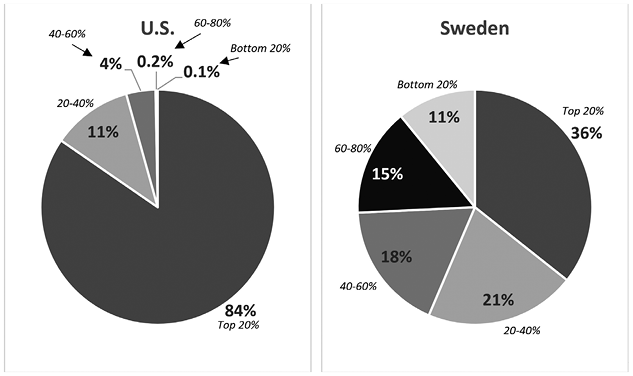
Figure 7.1 Long description
Figure presents two pie charts comparing the distribution of national wealth across five income quintiles in the United States and Sweden. In the U.S. chart, the top 20% of earners hold 84% of the total wealth. The next 20% is in the second quintile, which holds 11%, followed by 4% for the middle quintile, 0.2% for the fourth quintile, and just 0.1% for the bottom 20%. In stark contrast, Sweden’s chart shows a more even distribution: the top 20% holds 36%, the second quintile holds 21%, the middle quintile holds 18%, the fourth quintile holds 15%, and the bottom 20% holds 11%. The visual highlights the extreme concentration of wealth in the U.S. compared to Sweden’s more equitable distribution.
In an Atlantic article titled “Americans Want to Live in a Much More Equal Country (They Just Don’t Realize It),”Footnote 19 Ariely explained how the vast majority of people in the US, regardless of political affiliation, income, and gender, prefer a distribution of wealth that “is very different from what we have and from what we think we have.” He writes:
Americans are actually in agreement about wanting a more equal distribution of wealth. In fact, the vast majority of Americans prefer a distribution of wealth more equal than what exists in Sweden, which is often placed rhetorically at the extreme far left in terms of political ideology – embraced by liberals as an ideal society and disparaged by conservatives as an overreaching socialist nanny state.
The US and Sweden each have significant levels of inequality, but strikingly different is that the bottom half of US citizens have virtually nothing. In contrast, the bottom half of Swedish citizens are doing okay. Norton and Ariely’s figure above shows that the bottom 40 percent of US citizens hold 0 percent of the nation’s wealth.
Extreme inequality in the US is not by accident but is the result of deliberate policy choices. During the Reagan administration, US tax rates were slashed in the 1980s, disproportionately for the wealthiest US citizens. The result is that the middle and lower economic classes paid a much more significant percentage of taxes in the US than before.
The neoliberal ideology presented a promise of “trickle-down economics,” implying that cutting taxes for the richest will spur economic growth, boost employment, and therefore flow down to the benefit of many people. However, the promise is proven untrue. In their 2022 Socio-economic Review paper “The Economic Consequences of Major Tax Cuts for the Rich,” David Hope and Julian Limberg show that in OECD nations from 1965 to 2015, tax cuts for the wealthiest lead to higher income inequality in the short and medium term, and do not have a significant effect on spurring economic growth or reducing unemployment as promised. They summarize, “Our results therefore provide strong evidence against the influential political–economic idea that tax cuts for the rich ‘trickle down’ to boost the wider economy.”Footnote 20
In the US, tax policies have increasingly been shaped by wealthy interests operating outside democratic accountability. Through strategies like “Buy, Borrow, Die” and specialized loopholes, wealthy individuals can leverage tax-advantaged investments and asset-based borrowing to reduce their tax rates to near zero, facilitating massive wealth transfer across generations. This system, designed through lobbying and political influence rather than democratic deliberation, undermines both economic efficiency and democratic governance.Footnote 21
US tax policies have created numerous loopholes that enable wealth concentration and intergenerational transfer with minimal taxation. A striking example is Harold Hamm, who in 2022 transferred over $11 billion to his children largely tax-free through carefully structured transactions that avoided the 40 percent estate tax.Footnote 22 Such legal maneuvers, available only to the wealthiest, demonstrate how US tax policy undermines equality of opportunity.
The American Dream narrative is powerful – and one many US residents hold as central to the American identity. However, it can be exploited by a powerful few who leverage it as mythology without supporting it with the concrete actions necessary to make it a reality for every American.
“If Americans want to live the American Dream, they should go to Denmark,” remarked Richard Wilkinson, summarizing the data he and Kate Pickett analyzed for their book, The Spirit Level: Why Greater Equality Makes Societies Stronger.Footnote 23 Whether in Denmark, Sweden, or anywhere else in the Nordics, the evidence is compelling that most people in the US prefer the Nordic reality – they do not know it.Footnote 24
Freedom
“The American Dream is closely bound up with freedom,” wrote Cullen.Footnote 25 The expression “Land of the Free” is enshrined in the US national anthem, followed immediately by “and the home of the brave,” indicating that freedom and the courageous fight go hand in hand. In the US, freedom is commonly discussed in terms of freedom from some enemy – whether that enemy is represented by a foreign threat or domestic intrusion.
In the Nordics, however, freedom is not often discussed in terms of fighting and achieving freedom from some imagined enemy; rather, it is more commonly discussed in terms of freedom to do something. That is not to say Nordic nations do not understand the reality of bloodshed. During the twentieth century, roughly the same number of Finns died fighting the Soviet Union as US citizens died fighting in Korea and Vietnam (and Finland is only one-sixtieth the population of the US).Footnote 26 However, freedom is more likely discussed in the Nordics as something enabled through systems like universal education, healthcare, paid parental leaves, and support for older adults, which represent foundational elements of the Nordic model.
The Nordic approach to freedom is perhaps best illustrated through the considerations of children. Children in Nordic societies often experience a significantly higher level of freedom and independence than their counterparts in the US, reflected in various aspects of their daily lives and the social policies that support these freedoms. Children across Nordic societies commonly have the freedom to walk or bike to school and play outside unsupervised from a young age. These freedoms are enabled by safe, well-planned urban environments with bicycle lanes separate from car lanes. In contrast, concerns about safety and a more car-centric culture in the US often mean children are less likely to experience these freedoms. Nordic countries provide heavily subsidized childcare and preschool programs to ensure all children can access early childhood education. Relatedly, Nordic countries are known for their generous parental leave policies, allowing parents to spend significant time with their children during the early years without risking financial instability. Nordic countries’ comprehensive social welfare systems provide a safety net that includes healthcare, education, and social services that contribute to a society where children, regardless of their family’s financial status, can access services that ensure their well-being and development.
Ensuring the freedoms of future generations demands we consider future generations as part of the “We.” Nordic pro-business politicians and business leaders embrace the responsibility to consider future generations. Danish parliamentary and cabinet member Marie Bjerre, member of the pro-market, pro-business political party Venstre, stated in 2022, “I believe fighting for the climate is core to [pro-market, pro-business] politics. Because fighting for a better climate is part of a freedom agenda. It is about fighting for freedom and giving the same possibilities we had to the next generation. Also, it is our duty to not leave a heavy climate debt to the next generation.”Footnote 27
Former Swedish Prime Minister Olof Palme (1969–1976, 1982–1986) emphasized that expanding freedom for every member of society was the foundational rationale for building the Nordic model. While speaking at Stanford University in the US in 1977, he explained:
I am speaking here today as a Swedish social democrat … We regard ourselves as a freedom movement … To us freedom means the removal of obstacles for the individual to develop her or his personality, the removal of injustices that quench our best yearnings for a better future, to quote one of my predecessors. We stress common responsibility and a sense of community above egoism and rugged individualism.Footnote 28
Freedom is not just an American ideal but also a Nordic one. However, views on how freedom is best enabled are dramatically different in the US than in the Nordics.
Nordic Theory of Love
Freedom is necessary to experience authentic love and friendship. This idea is the heart of the Nordic Theory of Love, a concept first articulated by Swedish scholars Lars Trägårdh and Henrik Berggren as the Swedish Theory of Love and later expanded by Anu Partanen to the Nordic Theory of Love (Chapters 4 and 6).Footnote 29 Trägårdh and Berggren’s Swedish Theory of Love argues that Swedes, while fiercely individualistic, achieve freedom through state support rather than family dependency.Footnote 30
Freedom is not achieved alone; we almost always depend upon support from elsewhere to secure freedom. Trägårdh and Berggren’s theory is that Swedes achieve individual freedom by combining the individual and State. This “statist individualism” can be seen in the State programs – healthcare, education, and so on – that Nordic countries hold as freedom enablers for the individual.
US citizens, by contrast, commonly achieve freedom through their families. Accessing healthcare and education in the US is often secured through one’s family, such as getting healthcare through a parent or spouse’s healthcare plan or relying upon a parent to pay tuition. In the States, women’s freedoms are also diminished by tending disproportionately to the home and childrearing; in the process, women become increasingly financially dependent on the men in their families. We could extend Trägårdh and Berggren’s nomenclature to call the US approach “familistic individualism,” where the individual secures freedom through one’s family.
Living in the US shaped Trägårdh’s view that the absence of social safety nets makes many US residents excessively dependent upon their families – parents, husbands, or rich uncles. Trägårdh and Berggren stress how freedom-limiting the US approach is for individuals, particularly those who do not win the birth lottery.Footnote 31
“Americans talk so much about freedom but have such little idea how little freedom they actually have,” a Danish exchange student told me at Copenhagen Business School. She was struck by how US students needed parental permission to change majors because their families paid tuition. “I can make my own choices without asking permission,” she noted, acknowledging that while Danes pay higher taxes for universal education, the freedom it provides is worth the cost. This contrast became vivid when I advised a UC Berkeley student to take the History of American Capitalism course. I said I thought he would appreciate the professor, who had authored the book Accounting for Slavery: Masters and Management.Footnote 32 He replied that the course sounded fascinating, but “My dad pays my tuition, and he would never let me take it.”
Before 1970, in-state students paid no tuition at University of California, Berkeley.Footnote 33 Fast forward fifty years, and four years of in-state tuition costs over $60,000.Footnote 34 UC Berkeley is a public university, but the financial burden has shifted to individual students paying increasingly higher tuition and widespread reliance upon philanthropic endeavors. (Reflecting upon her experiences as Chancellor of University of California, Berkeley, outgoing Chancellor Carol Christ remarked, “In the 1970s at Berkeley, there was no expectation that the chancellor was involved significantly in fundraising. Generally, we were generously supported by the state. Now, fundraising is probably the biggest part of my job.”Footnote 35) For most students, increased tuition means increased dependence on their families. For prospective students whose families cannot provide the necessary support, the choice is to either take on significant debt or forego attending a university altogether.
When parents fund their adult children’s education and expenses, the relationship transforms from one of guidance to patronage, often extending into middle age. This financial dependency, coupled with potential future inheritance, can turn family relationships into transactional negotiations. Whether one acknowledges it or not, the freedom achieved through dependency upon family charity is a reality of US life. In contrast, the Nordic focus has been on expanding freedom for everyone, irrespective of family, and honestly acknowledging that we do not secure freedom entirely by ourselves.
Freedom: Positive and Negative
Few thinkers have contributed more to ideas about freedom than Latvian-born theorist Isaiah Berlin. Berlin’s family moved to Saint Petersburg, Russia, in 1909 when he was six. Witnessing the events of the 1917 October Revolution from their apartment window and feeling increased oppression as the Bolsheviks ascended to power, Berlin’s family later left for England in 1921.
As discussed earlier, Berlin’s distinction between negative and positive freedom provides a valuable lens. The Nordic model’s expansion of positive freedom – access to education, healthcare, childcare, and the natural world – underscores its alignment with Berlin’s trajectory of positive liberty.Footnote 36 The continued expansion of positive freedoms is the foundation of the Nordic model. The “core of Nordic modernity,” wrote Bo Stråth in Egalitarianism in Scandinavia, “mainly follows Berlin’s trajectory of positive freedom.”Footnote 37
Through democratic processes, Nordic societies establish and maintain efficient universal systems that ensure citizens’ access to essential services such as medical care and education. These systems are funded through income taxes supported by vibrant market economies, demonstrating how democracy and capitalism can work hand in hand. Democratic oversight helps keep these systems efficient and accountable while expanding positive freedoms for all citizens. This practical coupling of democratic processes with market dynamics makes Nordic societies powerful examples of democratic capitalism in action, increasing the likelihood that more citizens can flourish.
Positive freedom extends into property rights in the Nordics. Given how central property rights are to capitalism, this merits particular attention. Allemansrätten (Swedish) or Allemannsretten (Norwegian) translates to “everyman’s right,” referring to laws across the Nordics that ensure everyone has the freedom to hike, camp, and forage for berries and mushrooms on all lands, including privately owned (provided you stay five hundred feet from anyone’s home).
Also known as freedom-to-roam laws, the official website of Visit Norway explains, “The main rules are easy: Be considerate and thoughtful. Don’t damage nature and other surroundings. Leave the landscape as you would want to find it.” to roam represents “a traditional right from ancient times, and from 1957 it has also been part of the Outdoor Recreation Act. It ensures that everybody gets to experience nature, even in larger privately owned areas.”Footnote 38 In 2017, Sweden listed the entire country on Airbnb – bookable without fee – thanks to its constitutional right to roam. This stands in sharp contrast to US signage threatening violence against trespassers, revealing radically different views on property and public access.Footnote 39
The expansion of the freedom for everybody to roam entails a reduction of negative freedom for landowners whose freedom from having people roam on their land.Footnote 40 The tradeoff that Nordic societies have accepted is that the expansion of positive freedoms for everybody is worth a reasonable reduction of negative freedoms for property owners. In stark contrast, Walmart sells signs in the US stating, “No Trespassing. No Soliciting. Violators will be shot,”Footnote 41 and “Private Property. No Trespassing. We do not call 911,” with an image of a gun, heavily implying that property owners have the freedom to shoot (and kill) anyone who comes onto their property.Footnote 42 Such signs would be absurd in the Nordics and considered a gross violation of custom and law.Footnote 43
In contrast, the US has focused primarily on expanding negative freedoms throughout its history. Freedom in the US is frequently prioritized for individuals with power and property. Stråth writes, “the American dream of a society of equals often came close to the negative freedom as defined by Berlin … negative freedom is the freedom to do whatever one wants and becomes in the end a question of power.”Footnote 44 In Berlin’s words, “freedom for the wolves has often meant death to the sheep.”Footnote 45
There’s US history to consider, where the freedom to own another human being as property represented one of the most egregious examples of expanding negative freedom for a powerful few. When slavery was legal in the US, slavery advocates argued that abolishing slavery violated slaveholders’ freedom. The pro-slavery position supported the expansion of negative freedom for owners of slaves, advocating that they should have freedom from being interfered with by others to own human beings as property (consistent with the proprietarian ideology laid out in Chapter 4). Of course, such a position required a complete disregard for the freedoms of enslaved people.Footnote 46 Tocqueville observed the propensity in the young US to grant an expansion of negative freedom for the powerful few, even at the cost of eradicating freedoms for others: “They want equality in liberty, and if they cannot have it, they still want it in slavery.”Footnote 47
When assessing the claim that the US is the freest nation in the world, one could also ask freedom for whom?
Returning to the contentious matter of guns, Adults in the US have considerable freedom to own military-grade assault weapons, like the AR-15. Gun rights advocates in the US often frame the issue in terms of freedom from a tyrannical government, invoking an excerpt from the Second Amendment, “the right of the people to keep and bear arms, shall not be infringed.” Upon turning eighteen, the age of adulthood in the US, the Uvalde killer legally purchased two AR-15-style weapons that he used in the killings just two days later.
Adults in Nordic nations have the freedom to own guns – just not military-grade weapons. Finland routinely ranks among the highest levels of gun ownership in the world, with 32 guns per 100 people. Norway is close behind with 29 guns per 100 people. (The US consistently ranks first in the world with 120 guns per 100 people.Footnote 48) However, civilian ownership of military-grade weapons is illegal across all Nordic nations. Therefore, adults in the Nordic nations have comparatively less freedom than their American adult counterparts to own and shoot military weapons as civilians.
However, concerning children, given the comparatively few military-grade weapons in circulation among Nordic citizens, children in Nordic nations enjoy greater freedom to go to school without fear that military-grade weapons could be present. The concept of freedom for children in a school setting usually involves a safe environment for learning and personal growth. Therefore, children in the US enjoy comparatively less freedom in this regard. Active shooter drills are now commonplace across US schools, resulting in increased anxiety, stress, and depression among children.Footnote 49 In this case of considering freedom for whom, the US appears to effectively prioritize the freedom of adults to own military-grade assault weapons, and the Nordics appear to effectively prioritize the freedom of children to live without fear of encountering military-grade assault weapons.
Leaky Buckets: Reducing Negative Freedom
Taxes represent a reduction in negative freedoms, as they are mandatory, reducing one’s freedom from coercion. Economists have long used a “leaky bucket” metaphor as a visual for how collecting taxes addresses issues of inequality, implying that all efforts to address inequality inevitably result in inefficiencies.
According to Arthur Okun (Chapters 2 and 3), efficiency is reduced when individuals receive universal benefits because they now have reduced incentives to work. The individuals paying increased taxes have reduced incentives to work since high taxes mean they keep less money. Additionally, administrative efforts must collect the taxes and direct the collected tax revenues wherever they go. According to Okun, collecting taxes to address inequality will always reduce efficiency, just as water is continuously lost from a leaky bucket.Footnote 50
The leaky bucket metaphor has had significant staying power, influencing how US economists think about inequality and the role of taxes in the US.
Efficient Hand Pumps: Increasing Positive Freedom
The leaky bucket metaphor fails to acknowledge that inequalities, when allowed to grow excessively, can impose their own efficiency costs on society. Trickle-down economics has also been extensively evaluated and found unsupported by empirical evidence. As Robert Reich summarizes, “Trickle-down economics is a cruel hoax.”Footnote 51
An “efficient hand pump” is a counter-metaphor to the leaky bucket, and this one is more suitable for describing the Nordics. A leaky bucket implies a subservient relationship, where the poor continually depend upon the rich to bring them water (and much water will be spilled along the way). In contrast, an efficient hand pump represents a commitment to increasing the freedom of individuals who can pump their water without dependency upon others. Installing and maintaining efficient hand pumps throughout society increases freedom for individuals who work hard to get their own water. The efficient hand pump metaphor aligns with insights from institutional economics, which demonstrate that well-designed universal systems can improve efficiency across society. Figure 7.2 contrasts two metaphors – the leaky bucket and the efficient hand pump.Footnote 52
Leaky bucket versus efficient hand pump.

Figure 7.2 Long description
Image shows two line drawings placed side by side. On the left is a wooden bucket with two handles; water is leaking from a hole near the base, forming a puddle beneath it. On the right is a manual hand pump with a curved handle and a spout, from which a single drop of water is falling. The background is blank.
This metaphor can be extended further: Imagine if every individual had to dig their own well and install their own handpump to access water. Some would succeed through tremendous individual effort, while others might fail despite working equally hard due to hitting bedrock or lacking proper tools. Meanwhile, some individuals inherit fully functioning wells from their families, allowing them to access water with minimal effort. Those with inherited wells might look down on others struggling to build theirs, labeling them as lazy or undeserving – ignoring the vast difference in starting positions.
This scenario mirrors how many Americans access essential services, such as healthcare and education. Some must build their access from scratch, often facing nearly insurmountable obstacles, while others inherit access through family wealth and connections. The resulting system is not only deeply inefficient at a societal level – with countless individuals expending enormous effort to duplicate infrastructure – but it also undermines the American Dream’s promise of equal opportunity. Just as it would be more efficient to build a water system serving everyone, universal access to education and healthcare through public systems represents a more efficient approach than requiring each individual or family to secure access independently.
When the expressed purpose for collecting taxes is to expand positive freedoms for all citizens to access such essential services as medical care and education, and taxes are used efficiently to achieve said purposes, the overall societal-level efficiencies can be increased.Footnote 53 In these cases, a society may willingly choose a reasonable reduction in negative freedom (paying higher taxes) to secure a meaningful increase in positive freedoms (access to medical care and education).
Nordic citizens expect the value of the services they access will outweigh the taxes they pay. Nordic societies are responsive to citizens. Should citizens reject “leaky hand pumps” (i.e., if a service or program were inefficient), it must be improved or eliminated.
Universal access to education through university for all Nordic citizens has proven an efficient hand pump. Universal access to quality healthcare paid parental leave, and subsidized childcare ensures every child gets a good start, expanding their positive freedoms. Access to medical care – including preventative care – is an efficient hand pump to ensure sustained health that will serve the individual well into the future. (Finland’s under-five child mortality rate is 1.7 per 1,000 live births – the lowest in the world; the US is 6.53.Footnote 54)
The Nordic model can be seen as a collection of efficient hand pumps positioned throughout society that all citizens have the right to access. Nordic societies’ universal services result in efficiency gains at the societal level.
In the Nordics, the State is expected to expand the positive freedoms of every citizen. The state is discussed as an extension of the Nordic people, a mechanism for coordinating efforts and establishing efficient systems to address problems more significant than any individual or local group can effectively address. In the US, the State is characterized as the enemy, which has the impact of diminishing the negative freedoms of its citizens.
I have realized that many people in the US do not realize how inefficient US society is. US citizens often accumulate overwhelming out-of-pocket costs in the march toward paying fewer taxes. People still need healthcare and education, and US citizens pay for these services at levels higher than citizens of other nations pay in taxes. Partanen summarized:
All this talk of tax rates is primarily meaningless unless we spell out what people get in return for their money. The very high-quality and reliable services that Nordic citizens get in return for their taxes – including: universal public healthcare, affordable day care, universal free education, generous sick pay, year-long paid parental leaves, pensions, and the like – can easily incur additional tens of thousands, if not hundreds of thousands, of dollars in after-tax expense for Americans.
Bottom line: For middle-class people, the amount of disposable income you end up with in the United States versus in a Nordic country can be very similar in the end, or even turn out to be a better deal in a Nordic country.Footnote 55
Partanen’s words echo those of Olof Palme, who contrasted Swedish experiences with the US while speaking at Stanford University in the 1970s.
We pay very high taxes, much higher than in the US. But when I hear what you have to pay to keep your children in college or for a hospital bill, I sometimes wonder whether the difference is so large, after all. It is easy to claim that taxes are a limitation of personal freedom. But again, you face the question of whose freedom? In order to answer that question, you have to investigate for what purposes the revenue is used.Footnote 56
Public Libraries as Efficient Hand Pumps
Public libraries offer a clear example of an efficient hand pump – modest public investments that yield substantial returns while expanding positive freedom. A meta-analysis of library valuation studies found that every dollar invested in public libraries returns approximately four dollars in benefits.Footnote 57 Capital investments in libraries have also been associated with measurable improvements in children’s reading achievement in nearby schools, representing a cost-effective means of supporting literacy and educational development.Footnote 58
Public libraries help fulfill the American Dream by offering universal access to books, the Internet, and educational resources – giving individuals the chance to put in the hard work of learning and take greater ownership of their future.
Nordic countries lead the world in public library investment, with Finland and Denmark routinely topping international rankings. “Scandinavian libraries are in a league of their own,” one journalist observed.Footnote 59 Helsinki’s Oodi Library exemplifies how such investments advance positive freedom. Situated directly across from the Finnish Parliament, Oodi offers books, recording studios, maker spaces, meeting rooms, and exhibition galleries – freely accessible to all. It functions as both a civic commons and a cultural hub: an open, democratic space where citizens of all backgrounds can access tools for learning, creativity, and community engagement.
While bicycling through Copenhagen with Danish Minister of Transportation Benny Engelbrecht in 2022, we passed a local library where he paused to reflect on his childhood. Raised in a family of modest means, he recalled spending countless hours inside, reading everything he could. That library, he said, opened up his world and set him on the path to becoming a Minister in the Danish Parliament. His story is one of many that illustrate how public libraries function as efficient hand pumps – institutions that offer every child, regardless of background, the opportunity to explore, learn, and imagine new possibilities. Nordic societies invest heavily in universal access to institutions like public libraries that advance the promise of the American Dream for more children and citizens.
Beyond demonstrating the efficiency of public investment, libraries also challenge the notion that state involvement inevitably crowds out private enterprise. Though publicly funded, Nordic libraries have not diminished private book ownership or undermined the publishing industry. On the contrary, Nordic households are often filled with books, and the region’s publishing sector remains robust. Public libraries ensure universal access while preserving individual choice – citizens can rely on public services and build personal collections, while the private publishing market thrives.
This familiar example of library access illustrates the pragmatic blend of public and private efforts in Nordic universal healthcare. Just as individuals may borrow books from a public library while purchasing their own for their private collection, Nordic citizens have access to publicly funded healthcare and the option to buy supplemental private insurance. Universal access coexists productively with choice in the marketplace, establishing a shared foundation for all while allowing individuals to tailor services, whether in literature or healthcare, to their personal needs and preferences.
Corrosion of an Efficient Hand Pump: Public Universities in the US
Public universities are American Dream factories. Built through democratically accountable investments, public universities expanded opportunity for millions of Americans and generated the research that made the US a global innovation powerhouse in the twentieth century. Institutions like the University of California, Berkeley, and the University of Wisconsin–Madison became global talent magnets – educating millions while producing groundbreaking discoveries that shaped the world. These universities anchor larger public university systems – the University of California with ten campuses and the University of Wisconsin with thirteen – together educating millions who have realized the American Dream of upward mobility. I am one such beneficiary – a University of Wisconsin–Madison graduate who, now at the University of California, Berkeley, sees firsthand the opportunities these great public universities continue to provide.
Landmark research analyzing data from over 30 million college students found that public universities such as University of California, Berkeley, and University of Wisconsin–Madison rank among the most effective institutions for intergenerational economic advancement in US history.Footnote 60 The University of California, Berkeley, is a standout American Dream factory, enrolling large numbers of low-income and first-generation students and routinely welcoming community college transfers – a stark contrast to its private peers in the Ivy League. At the most elite private universities in the US, legacy status – often tied to parental alumni connections and financial contributions – increases an applicant’s odds of admission by more than threefold.Footnote 61 Public universities like UC Berkeley explicitly prohibit such practices, reinforcing their role as meritocratic engines of social mobility in contrast to the legacy preferences and donor-driven advantages that shape admissions at many elite private American universities.
Moreover, the research of public universities directly contributes to economic progress, creating conditions in which more individuals can realize the American Dream. A particularly striking example is UC Berkeley: Its innovations in science and technology were indispensable to the emergence of Silicon Valley as a global hub of innovation. Silicon Valley as we know it today could not have emerged without UC Berkeley.Footnote 62
Yet the efficient hand pumps of America’s public university systems are corroding, as decades of state disinvestment have forced many universities to rely increasingly on private funding and tuition hikes. In recent years, many US universities have also faced heightened federal political pressure that threatens to further erode what made the US a global innovation powerhouse and talent magnet.
Summer Job Tuition Index: A Measure of Social Mobility
In 1960, a student could pay for four years at the University of Wisconsin–Madison with just two summers of full-time minimum-wage work. By 1970, it required three. When I attended in the mid 1990s, it took six summers – still within reach, as I worked full-time each summer from age sixteen through graduation and earned a degree with little debt. By 2020, however, the figure had doubled to twelve summers, as shown in Table 7.2, often resulting in dependence on one’s family or assuming significant debt. If current trends continue, by 2045, it will take twenty-four summers of minimum-wage work to cover the cost of four years of tuition.
| University of Wisconsin | 1960 | 1970 | 1995 | 2020 |
|---|---|---|---|---|
| Tuition/year | $220 | $508 | $3,070 | $10,766 |
| Tuition/year × 4 years | $880 | $2,032 | $12,280 | $43,064 |
| $/hour (min. wage) | $1.00 | $1.45 | $4.25 | $7.25 |
| $/summer job (12 weeks × 40 hours) | $480 | $696 | $2,040 | $3,480 |
| Summer Job Tuition Index (# of summers) | 2 | 3 | 6 | 12 |
The steady rise of the Summer Job Tuition Index – the number of full-time summers at minimum wage required to pay for four years of in-state tuition – reveals the erosion of educational opportunity at America’s public universities and the narrowing of freedom for those without wealth.
As a student, I cleaned pit toilets at a Wisconsin state park during summer. It was unappealing work, but I chose it willingly because it allowed me to pay my tuition. A few years later, I was working as an industrial engineer at IBM. I was realizing the American Dream. That trajectory reflected the American promise: That hard work leads to upward mobility. Today, no amount of pit-toilet cleaning over summer breaks could generate enough income to cover tuition at most public universities.
By contrast, the Summer Job Tuition Index in the Nordic countries is effectively zero because public universities are fully funded through taxation. One can debate whether zero tuition is appropriate in the US context, but it is indisputable that access to public university education has become out of reach for many Americans.
Restoring credibility to the promise that hard work enables upward mobility requires lowering this index to a more reasonable level. This could be achieved through a combination of reduced tuition and higher wages. Had the minimum wage kept pace with US productivity growth from the 1960s to 2020 – as it had from the 1930s through the 1960s – it would have reached $21.45/hour by 2020 (see Chapter 3). The Summer Job Tuition Index would fall to four summers at that wage level. Combine that with a 50 percent reduction in tuition, and we would return to the two-summer level seen in 1960.
In recognition of the unsustainable nature of the current path, the University of Wisconsin introduced a tuition-free program in 2018 for students from families with annual incomes of less than $56,000. The initiative highlights key contrasts between American and Nordic approaches to higher education. Eligibility is based on family income rather than individual status, reflecting the US expectation that even adult students remain financially tied to their families. The program is also means-tested rather than universal – a model the Nordic countries abandoned in the 1950s to reduce stigma and protect social programs from political volatility. Finally, it is funded through philanthropy rather than public taxation, whereas Nordic nations treat higher education as a publicly funded good.Footnote 63
Deliberately Corroding Public Universities
The University of Wisconsin system illustrates the growing role of private funding in public higher education – and the corresponding erosion of democratic practices. Following political contributions from John Menard Jr. to Wisconsin Governor Scott Walker’s 2011 campaign, Walker enacted significant tax cuts that benefited Menard while sharply reducing public funding for the University of Wisconsin system. Soon after, the Menard Family Foundation and the Charles Koch Foundation emerged as major donors to the university. This sequence effectively transformed personal tax savings into privately directed university funding, accompanied by conditions that included influence over faculty hiring, curriculum content, and student data collection. These arrangements gave private donors unprecedented influence over academic discourse and institutional governance, further concentrating power in society.Footnote 64
The weakening of the University of Wisconsin system exemplifies how American capitalism is devolving into oligarchic capitalism, where wealthy private interests systematically undermine democratic institutions while expanding their control. This erosion is especially tragic given that public universities have long served as engines of social mobility.
A broader pattern emerges: private wealth first weakens public institutions through political influence and then reasserts control through philanthropic intervention. The cycle is instructive. Billionaire Menard used his wealth to influence political power by funding Governor Walker’s campaign. Walker, in turn, enacted tax cuts that favored Menards Corporation while slashing state support for public universities – a textbook case of concentrated wealth shaping public policy to entrench itself. Menard, alongside the Charles Koch Foundation, then returned as a philanthropist, offering a fraction of his tax savings back to the now-underfunded university system – but with strings attached. These included influence over curriculum and programming, shifting public universities further from their democratic mission.
The establishment of the Menard Center for Constitutional Studies at the University of Wisconsin–Eau Claire in 2020 exemplifies this dynamic. Through the donation, Menard gained significant influence over the university’s academic programming. His stated intent was “to create new speaker forums and series that provide multiple points of view.”Footnote 65 Yet university officials are left to interpret the subtext: continued funding likely depends on ensuring that these “multiple views” align with the ideological preferences of major donors such as Menard and Koch. While no explicit quid pro quo is proven, the University of Wisconsin–Eau Claire awarded Menard its first-ever honorary doctorate for “lifetime achievement” – a gesture that raises serious questions about the growing entanglement of donor influence.Footnote 66
Similarly, the Menard Center for the Study of Institutions and Innovation was established at the University of Wisconsin–Stout in 2019, again funded jointly by Menard and the Charles Koch Foundation. In 2022, the Center launched a system-wide survey on “First Amendment Free Speech Rights, Viewpoint Diversity, and Self-Censorship,” illustrating how privately funded initiatives can shape the terms of academic debate. Academic critics argued that the survey’s design appeared intended to produce findings that would justify further privatization of public education – culminating in the resignation of the University of Wisconsin–Whitewater’s chancellor in protest.Footnote 67
This incident reflects a broader pattern documented by scholars: Private funding of public universities often comes with conditions that shape faculty hiring, curriculum design, and institutional governance.
The divergent trajectories of American and Nordic capitalism are on full display. While American capitalism has increasingly evolved into an oligarchic model, where private wealth exerts growing influence over public institutions, Nordic democratic capitalism maintains institutional independence through robust public funding and democratic accountability. As Anand Giridharadas argues in Winners Take All, relying on philanthropic “winners” to fund essential public institutions poses a fundamental threat to democratic governance. The Nordic model offers an alternative: one in which transparent, tax-funded support ensures that public institutions serve the common good – not private interests.Footnote 68
Reliably Good Defaults Expand Freedom
The Nordic model provides reliably good default options – universal healthcare, high-quality education, safe transportation – that reduce stress and expand freedom. I could not fully appreciate the liberating effect of these defaults until I lived in the Nordics. In contrast, Americans have grown accustomed to constant anxiety, forced to fight for basic services that should be guaranteed.
When Finnish journalist Anu Partanen moved to the US, she described, “It’s hard to exaggerate how fundamentally the loss of health insurance destroyed my sense of personal security and well-being.”Footnote 69 Some might argue she had more freedom in America – she could “choose” from many insurance options – but the burden of navigating complex markets did not constitute freedom for Partanen. A lottery of poorly structured choices is no substitute for a well-designed, efficient default.
Psychologist Barry Schwartz’s The Paradox of Choice illustrates how excessive choice can overwhelm rather than liberate. Having to make constant decisions in complex systems – especially when opting out leads to personal or financial collapse – undermines freedom.Footnote 70 Few of us are healthcare experts or can reliably predict the risk of a family member getting sick or injured in the upcoming year. We are prone to select a plan that is too small (“I’m never going to get sick”) or too big (incurring excessively high premiums), depending upon our personality types and risk appetite.
Nudge Theory, developed by Nobel laureate Richard Thaler, demonstrates that well-designed defaults can improve outcomes without limiting choice. Automatic enrollment in retirement savings plans, for example, boosts long-term financial security while preserving individual freedom. Thaler and co-author Cass Sunstein argue that nudges promote better decisions at a systems level and expand individual freedoms.Footnote 71
The Nordics embed such nudges into daily life. In Copenhagen, even on rainy days, biking remains the most convenient form of transport because systems are designed to make it so. Exercise, health, and environmental benefits flow from infrastructure choices. Healthcare, too, is universal: Everyone has access to a solid baseline of care, and additional coverage is available on the market. Sarah and I chose the default, and it worked well – with no stressful insurance shopping required.
Creating good defaults requires systems thinking, democratic legitimacy, and economic efficiency. In Nordic societies, transparent public processes, not private interests, shape critical systems like healthcare and education. This ensures both effectiveness and trust. In contrast, the US often relies on market mechanisms that undermine democratic accountability and deliver suboptimal results. The Nordic experience shows that defaults, when designed thoughtfully with transparent, democratic oversight, can expand individual and societal-level freedom.
Freedom through Nordic Flexicurity
The Nordic model’s flexicurity system demonstrates how democratic capitalism can balance worker protection with economic dynamism. Unlike American capitalism, which often pits workers against employers, Nordic flexicurity emerged through democratic processes that recognize both as essential stakeholders. Its practical benefits become clear when comparing how different systems handle layoffs.
The 2008 PBS documentary Unnatural Causes illustrates how conceptions of “We” shape societal responses. When Electrolux closed factories in both Sweden and the US, the contrast was stark. Swedish workers received two years of paid retraining at 80 percent of their salary through coordinated programs involving government, unions, and employers. In Greenville, Michigan, American workers were left asking, “What happens to those people?” – a question that reveals the absence of collective responsibility.
Within months, many in the US faced depleted savings, lost health insurance, and growing uncertainty. One worker remarked, “I’ve always worked for everything I have, and now I can’t do anything.” In Sweden, where systems are built on what psychologist Rick Price calls “a sense of shared social responsibility,” workers transitioned to new careers and maintained stability.Footnote 72
A 2015 follow-up documented the long-term effects. Swedish workers had largely rebuilt their lives. Greenville, by contrast, was devastated – its downtown hollowed out, with former factory workers in low-wage retail jobs. The contrast highlights how Nordic flexicurity – by embedding economic adaptability within a framework of collective responsibility – better serves both individuals and society.Footnote 73
Trust: The Nordic Gold
The concept of social trust as institutional capital builds upon Putnam’s offerings on social capital and institutional performance,Footnote 74 providing a framework for understanding how Nordic societies maintain their distinctive form of capitalism.
“The Nordic region has the highest levels of social trust in the world, which benefits the economy, individuals, and society as a whole,” begins the 2017 Nordic Council of Ministers report Trust: The Nordic Gold by Ulf Andreasson.Footnote 75 This trust, built through democratic institutions and transparent governance, enables more efficient economic coordination while reinforcing democratic legitimacy – a virtuous cycle that distinguishes Nordic democratic capitalism from oligarchic forms.
The cooperative leadership norms (Chapter 5) and stakeholder-focused business practices (Chapter 6) both depend on and reinforce the high levels of trust that characterize Nordic societies. The Nordic model requires this foundation of trust to function effectively. This trust extends beyond individual relationships to encompass institutional trust – confidence in government institutions, businesses, and social systems. The high levels of transparency and democratic accountability discussed in previous chapters help maintain this institutional trust. Furthermore, the cooperative leadership norms explored in Chapter 5 both depend on and reinforce this culture of trust. “It is difficult to imagine societal models like those in the Nordic countries if citizens do not trust that other citizens also contribute to the economy through the tax system and that public authorities manage tax revenues fairly and efficiently, free from corruption.”Footnote 76 Andreasson succinctly summarizes a challenge for US citizens peering at the Nordic model to consider what lessons may be drawn.
The Nordic model builds trust among its residents. Universally subsidized childcare means every child can access high-quality childcare, regardless of their family situation. And because of it, children from families of very different backgrounds and means are more likely to be together. Because of that, parents from very different backgrounds and different means are more likely to come together and connect through the common project of their children’s well-being. In Nordic countries, children whose parents are corporate CEOs, janitors, unemployed persons, or university students can likely be in the same childcare program because of universally subsidized childcare. Through their daily interactions at drop-off and pickup and friendships with their children, these individuals from very different places can get to know one another and build trust, strengthening the social fabric of society.
Rawls and Nordic Capitalism
Nordic capitalism reflects many of the philosophical principles articulated by John Rawls, one of the twentieth century’s most influential political theorists.Footnote 77 Rawls’ central argument – that a just society must be designed as if we did not know our position within it – reflects Nordic institutional arrangements. His famous “veil of ignorance” thought experiment, where individuals design rules without knowing whether they will be born rich or poor, advantaged or disadvantaged, offers a powerful normative justification for universal programs and broad-based opportunity.Footnote 78
The veil of ignorance can also be understood as a philosophical rendering of the American Dream. At its core, the American Dream promises that anyone – regardless of background – should have a fair chance to fulfill their potential through hard work and determination. Rawls’ framework simply asks for the design of a society that delivers on that promise. The Nordic countries, in many ways, come closer to realizing this vision than the US itself. His framework also provides moral grounding for sustainable capitalism through its implications for intergenerational justice: designing policies and institutions behind a veil of ignorance means accepting the possibility of being born into the future – into a world facing the escalating consequences of climate change.
Rawls described a just society as a “property-owning democracy” – a vision that shares core features with democratic capitalism, but with a stronger emphasis on preventing the concentration of wealth and power. In such a system, economic power and opportunity are widely dispersed rather than concentrated in the hands of a few.Footnote 79 Nordic capitalism reflects this vision, emphasizing universal public goods, robust education systems, social mobility, and corporate forms like enterprise foundation-owned companies that diffuse economic control and prioritize long-term societal benefit over shareholder primacy. In doing so, it expands the circle of “We” to include current stakeholders and future generations.
Parting Reflections
The American Dream is a defining mythology of the US, though the extent to which it reflects reality remains subject to debate. It offers a powerful potential to unite society around shared aspirations, but this potential depends on how effectively the Dream is translated into concrete institutions that support social mobility and the broader conditions associated with opportunity and flourishing.
The Nordic region, too, has its own mythologies. In Denmark, Norse mythology helped shape national identity, most notably through the influence of Grundtvig. His enduring articulation of “freedom for Loke as well as for Thor,” from his 1832 poem “Frihed, Lighed og Brodersind” (“Freedom, Equality, and Brotherhood”), captures the tension between negative and positive freedoms that Isaiah Berlin would later theorize. Drawing from Norse mythology, Grundtvig invoked Thor, a symbol of strength and order, alongside Loke, a figure of disruption and relative weakness, to argue that true democracy must protect both the powerful and the dissenting. Freedom, he insisted, must extend across the full spectrum of society. His vision reflected a sophisticated balance: safeguarding negative freedoms by protecting dissenting voices, while building robust institutions that expand positive freedoms for all – thus fostering a collective sense of We.Footnote 80
The Nordic countries’ success in realizing Grundtvig’s inclusive vision stands in stark contrast to recent American experience. American capitalism has increasingly narrowed its sense of We by prioritizing negative freedoms that benefit the powerful few, often dismissing efforts to reduce inequality as inefficient “leaky buckets.” In contrast, Nordic societies have expanded their sense of We through universal systems that promote positive freedoms. Like efficient hand pumps, these systems enable all citizens to independently access essential resources such as education and healthcare, prompting deeper reflection on the meaning of freedom and how it might best be expanded for all.
Making the American Dream an American reality – and truly fulfilling the promise of the US as the Land of the Free – requires institutions that foster positive freedom, advancing both individual opportunity and collective well-being. Public universities like the University of California, Berkeley, University of Wisconsin–Madison, and many others across the US have served as American Dream factories, propelling millions of low-income students into higher economic brackets while attracting top talent from around the world. Yet their ongoing erosion offers a cautionary tale.
The Nordic experience shows how national mythology, when grounded in strong inclusive institutions and coupled with a commitment to pragmatically doing the hard work, can transform aspirational ideals into meaningful opportunity for all citizens.
Many people, especially in the US, see countries like Sweden or Norway or Finland as role models – we have such a clean energy sector, and so on. That may be true, but we are not role models. Sweden is one of the top 10 countries in the world when it comes to the highest ecological footprints.
The Nordic nations represent a conspicuous contradiction. They are exalted as global benchmarks for sustainability – including in much of this book – yet, like all wealthy OECD nations, their levels of consumption far exceed what the planet can regenerate. This gap between ambition and reality is a defining critique of Nordic capitalism. This chapter examines Nordic overconsumption and other critiques to highlight where reforms are needed as part of the broader ambition to realize sustainable capitalism.
Critiques of Nordic Capitalism
Among American audiences, critiques of the Nordic model typically begin with “Yeah, but” – a phrase that sometimes precedes legitimate challenges and sometimes masks reflexive dismissal. This chapter examines both types, exploring what each reveals about Nordic capitalism’s limitations and possibilities.
Yeah, but the Nordics Overconsume
While Nordic countries are celebrated for their commitment to sustainability, their per capita ecological footprints rank among the highest in the world, alongside other developed OECD nations. This critique highlights a crucial distinction: the difference between system design and system outcomes. Nordic capitalism’s institutional design may offer valuable lessons despite its present unsustainable consumption patterns. As scientists studying planetary boundaries concluded in 2025, “There are currently no countries that achieve good social outcomes while staying within their fair share of planetary boundaries.”Footnote 1
Nordic societies’ excessive consumption illustrates what ecological economists like Herman Daly have termed the “growth-sustainability paradox.” This paradox, where economic growth in developed nations increasingly conflicts with planetary boundaries, presents a fundamental challenge to both Nordic and American models of capitalism. The Nordics’ violation of planetary boundaries despite their environmental consciousness demonstrates how deeply growth imperatives are embedded in modern economic systems. If everyone consumed like the average Nordic citizen, we would need almost four Earths to keep up with consumption.Footnote 2 Critiques of the Nordics for overconsumption are well-founded, like the critique levied by Greta Thunberg at the start of this chapter.
Overconsumption by Nordic societies violates the second half of the definition of sustainable development: “without compromising the ability of future generations to meet their own needs.” Overconsumption steals from future generations. The problem of overconsumption exists across all developed economies represented by the OECD nations. Given the excessively high consumption patterns among the wealthiest individuals, overconsumption is pronounced in societies with heightened levels of inequality (Chapter 2).
Despite their overconsumption – a serious challenge that Thunberg rightly criticizes – the Nordics present a promising path forward for other advanced economies. While Nordic nations currently violate the second half of sustainable development’s definition by consuming beyond planetary boundaries, they are uniquely positioned to address this challenge precisely because they have effectively met the first half: “development that meets the needs of the present.” This achievement provides the social and political stability needed to tackle overconsumption. In SDG terms, the Nordics are effectively meeting SDG #1 “No Poverty,” SDG #2 “Zero Hunger,” SDG #3 “Good Health and Well-Being,” SDG #4 “Quality Education,” SDG #5 “Gender Equality,” and SDG #6 “Clean Water and Sanitation.” The US cannot claim that. Basic needs such as food, healthcare, education, and clean water are routinely unmet for millions of Americans, including many children.Footnote 3
By effectively meeting the needs of the present, the Nordics are better positioned to address problems of overconsumption. When the basic needs of the present generation go unmet, and vast swaths of a population are effectively operating in survival mode, sufficiently considering the well-being of future generations is far less likely. As Paul Farmer asserted, “It’s my conviction that poverty and inequality are the two ranking problems facing our crowded and beautiful planet – not the only problems, but perhaps the most severe, and two that, if addressed, could bring us a little closer to tackling some of the other ones.”Footnote 4
In his article, “The Dark Side of the Nordic Model,” Jason Hickel summarized,
Nordic countries have it right when it comes to public healthcare, education and progressive social democracy, but they need to dramatically reduce their consumption if they are to stand as a beacon for the rest of the world in the twenty-first century. The good news is that all of this can be accomplished while improving human welfare and advancing the cause of social democracy. But it ultimately requires shifting to a different kind of economy – one not organized around endless GDP growth.Footnote 5
This tension between social democratic achievements and ecological limits reveals a fundamental theoretical challenge in sustainable development: How can societies maintain high levels of human well-being while operating within planetary boundaries? The Nordic experience suggests that social democracy may provide crucial institutional foundations for addressing this challenge. Three key theoretical mechanisms link social democratic institutions to environmental sustainability.
First, by reducing economic insecurity through universal social programs, social democracies create the political space needed for long-term environmental planning. When basic needs are met, citizens and policymakers can focus on longer-term challenges like climate change rather than immediate survival concerns. Second, the strong democratic institutions and traditions of social consensus-building in social democracies facilitate the kind of collective action needed to address environmental challenges. The same institutional frameworks that enabled Nordic countries to negotiate labor–capital compromises in the twentieth century now help them build agreement around environmental policies. Third, social democratic emphasis on public goods and market regulation provides tools for addressing market failures around environmental externalities. The Nordic willingness to use state capacity to shape markets aligns with the interventions needed for environmental protection.
The fixation on GDP growth represents one of the starkest differences between American and Nordic capitalism, illustrating how these theoretical mechanisms play out in practice. While GDP growth has become almost religious doctrine in American economic policy – “one stat to rule them all” – Nordic nations maintain a more nuanced relationship with this metric. Ironically, even Simon Kuznets, the American economist who invented GDP and was later awarded the Nobel Memorial Prize in Economics, warned against using GDP to measure societal well-being. Yet while America embraced GDP growth as its primary economic objective, Nordic nations demonstrated that prosperity doesn’t require sacrificing everything at the altar of GDP growth. Their experience suggests that sustainable development requires moving beyond this single-minded focus on growth to consider a broader array of social and environmental metrics.Footnote 6, Footnote 7
The Nordics are assuming a leadership position among the advanced economies through a three-pronged policy approach: first, implementing market-based mechanisms like carbon taxes; second, investing in circular economy initiatives that decouple growth from resource use; and third, developing new metrics beyond GDP to measure societal progress. This comprehensive policy framework, while still evolving, offers important lessons for other nations grappling with sustainability challenges.
Notably, the Nordics are betting on democracy to address sustainability challenges – and it’s a smart bet. “Inequality and climate change are the twin challenges of our time, and more democracy is the answer to both,” offered The Sum of Us author Heather McGhee in the book All We Can Save: Truth, Courage, and Solutions for the Climate Crisis.Footnote 8 Returning to Kate Raworth’s concept of doughnut economics (Chapter 2), the Nordics live above the hole of the doughnut, which is to say, above the collection of lower control limits. The Nordics are now making significant strides to establish policies to ensure they live below the upper control limits representing the planetary boundaries.
The Nordics have demonstrated a commitment to democracy and a strong belief that robust democracies are needed to address our greatest sustainability challenges.Footnote 9
Yeah, but Aging Populations Are Breaking the Nordic Welfare Systems
Demographic aging presents a critical test case for Nordic welfare states’ adaptability and resilience. Empirical evidence suggests a systematic erosion of eldercare infrastructure: Sweden’s care home capacity contracted by 25 percent between 2000 and 2015, while access rates for octogenarians declined from 20 percent to 11 percent by 2020. Meanwhile, waiting times for care home placement increased from fifty-one to sixty-four days, with municipalities citing resource constraints.Footnote 10 Access to eldercare has become more restrictive, with higher threshold requirements for assistance than two decades ago. The result is increasing privatization and reliance on informal care networks – more people must either pay for private services or rely on family members for care.Footnote 11
The Nordics have attempted to address the aging population challenge through various means. Their family-friendly policies, including generous parental leave and subsidized childcare, help maintain higher fertility rates than many developed nations. While still below replacement level, birth rates in Sweden, Norway, and Denmark typically exceed those of other wealthy countries. High female labor force participation also helps maintain the tax base needed for social programs. However, these measures alone may prove insufficient.
Demographic aging has exposed fundamental contradictions in Nordic policy approaches. Even as Denmark implements increasingly restrictive refugee policies and Sweden dramatically cuts refugee acceptance, their economies increasingly depend on immigrant labor. This demographic reality has created an inherent tension: while population aging and labor market needs suggest increasing immigration, political pressures push toward restriction.Footnote 12
The demographic challenge represents a crucial test case for Nordic capitalism’s adaptive capacity in the twenty-first century. These pressures create fundamental contradictions: While demographic and labor market needs suggest a need for more immigration, political pressures push toward restriction. The coming decades will reveal whether Nordic capitalism can maintain its universal aspirations while navigating between these competing imperatives.
Yeah, but the Nordics Are Small
Population size differences between the US and Nordic nations present an obvious challenge for comparative analysis. With 330 million inhabitants, the US is over fifty times larger than Denmark (6 million) and more than ten times larger than all Nordic nations combined (28 million). This dramatic scale difference is frequently cited as reason to dismiss Nordic experiences as irrelevant to US policy challenges.
However, this objection overlooks how comparative analysis can operate at multiple levels of social organization. While “small state studies” have long demonstrated how smaller nations can offer valuable insights for larger ones, the Nordic region presents particularly rich learning opportunities across various units of analysis.Footnote 13 Organizations of similar scale can be meaningfully compared regardless of national context, as evidenced by decades of successful cross-border business benchmarking. Cities face comparable challenges in delivering services and improving quality of life whether situated in Minnesota or Norway, Wyoming or Iceland, or California or Sweden. The key to effective learning lies not in exact matching of scale, but in identifying relevant points of comparison and specific domains where innovation has produced demonstrable results.
My own experience with cross-national learning offers an instructive parallel, not at the city level but at the organizational level – comparing practices between Toyota and IBM. Early in my career as an industrial engineer, I was among countless professionals worldwide captivated by Japan’s remarkable advances of the 1970s–1990s, particularly Toyota’s innovations (Chapter 2). Despite Japan having only one-third the US population and being far more demographically homogeneous, the collective fascination with Toyota’s methods proved well founded. At IBM, I found that approaching Toyota’s practices with curiosity rather than skepticism about contextual differences enabled me to adapt their principles to create significant operational improvements in a very different organizational setting. This experience, shared by countless other efficiency professionals who successfully adapted Japanese methods to Western contexts, demonstrated how thoughtful benchmarking across seemingly distinct contexts can drive meaningful innovation.
Benchmarking the Nordics and applying lessons learned in the US should not be different. Nordic nations, Nordic cities, and Nordic companies (like those featured in Chapter 6) each afford excellent benchmarking opportunities, each at differing units of analysis.
The value derived from comparative analysis often reflects the mindset brought to the exercise. Approaching other societies’ experiences with skepticism and dismissiveness ensures no learning will occur. Conversely, examining different contexts with curiosity and humility – while maintaining analytical rigor – can yield valuable insights for policy innovation. The Nordic experience, properly understood, offers precisely such an opportunity for thoughtful adaptation rather than wholesale adoption.
Case for Benchmarking Nordic Nations and Applying Lessons at the American State Level
Nordic nations are similar to a mid sized American state. The average Nordic nation is approximately 5.5 million people, comparable in size to Wisconsin or Minnesota, the twentieth- and twenty-second-most populated states, and therefore falls somewhere in the middle of the fifty US states in terms of population.Footnote 14 Wisconsin’s real gross domestic product (GDP) is $349 billion,Footnote 15 and Minnesota’s is $383 billion, which also places them in the range of a Nordic nation, as shown in Table 8.1.Footnote 16
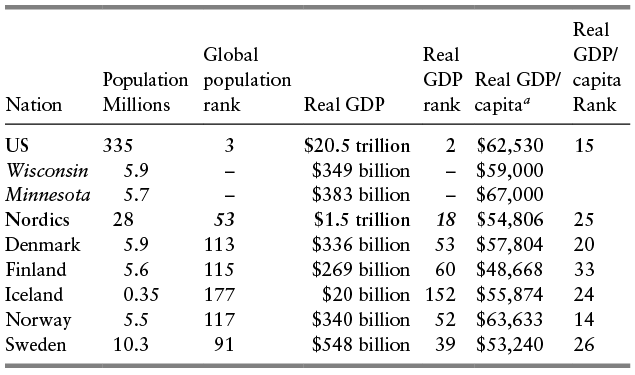
Table 8.1 Long description
Table has seven columns that list nation, population, global population rank, real GDP, real GDP rank, real GDP per capita, and real GDP per capita rank. The data from the table are as follows. US: 335 million, 3, 20.5 trillion dollars, 2, 62,530 dollars, and 15. Wisconsin: 5.9 million, blank, 349 billion dollars, blank, 59,000 dollars, and blank. Minnesota: 5.7 million, blank, 383 billion dollars, blank, 67,000 dollars, and blank. Nordics: 28 million, 53, 1.5 trillion dollars, 18, 54,806 dollars, and 25. Denmark: 5.9 million, 113 336 billion dollars, 57,804 dollars, and 20. Finland: 5.6 million, 115 269 billion dollars, 60, 48,668 dollars, and 33. Iceland: 0.35 million, 177, 20 billion dollars, 152, 55,874 dollars, and 24. Norway: 5.5 million, 117, 340 billion dollars, 52, 63,633 dollars, and 14. Sweden: 10.3, 91, 548 billion dollars, 39, 53,240 dollars, and 26.
Note:
a Bear in mind, real GDP per capita is an average. As the saying goes, the person with their head in the oven and feet in the icebox is, on average, a bit warm. So, too, the extreme concentration of wealth and income in America skews GDP per capita figures upward, even though they may not reflect the wealth or income of the “average” person. (See Chapter 7.)
Given these similarities, Nordic nations offer highly relevant benchmarks for US states. Rather than waiting for federal reforms, states can act as living laboratories – testing and adapting ideas already proven effective in similarly sized and economically comparable societies.
Consider education: Finland routinely ranks at the top of global educational performance measurements.Footnote 17 But that was not the case just two generations ago. “In 1951, the future of Finland was predicted to be ‘grey and dreary,’ but the Finns were tenacious,” wrote Danny Dorling and Annika Koljonen in their book Finntopia. “Finland’s postwar recovery and its capacity to establish itself as a serious country depended on the transformation of its (now world-renowned) education system.”Footnote 18 Finland regularly tops the EIU’s Worldwide Educating for the Future Index (WEFFI).Footnote 19 “Finland has become, in 100 years as a nation-state, one of the world’s benchmarks for quality in school education … The world of education follows what happens in Finland,” remarked Eduardo Andere in his 2020 treatise, The Future of Schools and Teacher Education: How Far Ahead is Finland?Footnote 20
Given that education in the US is primarily organized at the state level, Finland offers valuable lessons for individual states. Finland’s educational policies and their effective implementation have significantly contributed to the nation’s strong performance on SDGs. More specifically, the targets for SDG #4 “Quality Education,” include the following for which Finland performs exceptionally well: Target 4.1, which ensures that all children complete free, equitable, and quality primary and secondary education leading to relevant and effective learning outcomes; Target 4.2, which ensures that all children have access to quality early childhood development and pre-primary education so they are ready for primary education; and Target 4.3, which ensures equal access for all women and men to affordable and quality technical, vocational, and tertiary education, including university.
Let’s consider how Nordic countries manage healthcare. Sweden and Denmark spend only about 10 percent of GDP on universal healthcare compared to the US, which spends about 17 percent, yet the overall health outcomes for Swedes and Danes are just as good (if not better). US healthcare is hyper-inefficient, meaning US states have much to learn from their Nordic counterparts about efficiently delivering healthcare services.
In addition to being hyper-inefficient, healthcare in the US is highly inequitable. 4.3 million children ages 0–18 years are without access to healthcare.Footnote 21 One million children in Texas alone do not have access to healthcare, representing 13 percent of all Texas children, the highest percentage of any US state (15,000 Wyoming children, 11 percent; 161,000 Arizona children, 9 percent; 18,000 Alaskan children, 9 percent; 15,000 North Dakotan children, 8 percent; and 343,000 Florida children, 8 percent, do not have access to healthcare).Footnote 22 Access to healthcare is a fundamental element of freedom, whereas not having access to healthcare represents a significant deficiency of freedom. Zero children across the Nordics are without access to healthcare, meaning Nordic children enjoy significantly greater freedom than their US counterparts.
Access to healthcare directly supports SDG #3 “Good Health and Well-Being.” Target 3.8 measures the degree to which every member of society has access to quality essential healthcare services. Some states are already experimenting with Nordic-style policies and seeing success. We previously reviewed how Minnesota established a state-level policy in 1976, the Minnesota Comprehensive Health Association (MCHA), to ensure every Minnesotan had access to healthcare, which my family utilized when we were denied healthcare (Chapter 1). At just 3 percent (42,000 children), Minnesota has the second-lowest percentage of children without access to healthcare of any US state. Massachusetts has the lowest percentage at 2 percent (22,000 children), thanks to passing the similarly styled MassHealth Children’s Health Insurance Program.
Consider renewable energy: About 80 percent of Denmark’s electricity consumption comes from renewable sources – including wind, solar, hydro, and biomass,Footnote 23 compared to about 20 percent in the US.Footnote 24 Regarding wind energy, about half – and rising – of Denmark’s electricity is generated through wind power.Footnote 25 Denmark produces more wind energy per capita than any other OECD country, almost twice as much as the runner-up among industrialized countries.Footnote 26 Danish wind turbines generated sixty-eight percent of Denmark’s electricity consumption during the month of January 2022.Footnote 27 The US, by contrast, produces only about 8 percent of its electricity consumption through wind power.
Denmark shows that transitioning from fossil fuel to renewable energy can occur rapidly and bring incredible benefits. However, transitioning from fossil fuels to renewables does not magically occur; it demands smart policy and investment.Footnote 28
After the oil crisis of 1973, Denmark began investing in wind energy. Its successful transition to mostly renewable energy has ensured energy independence from foreign energy sources, meaning greater freedom for Denmark and its citizens. Wind energy is democratic energy. Unlike fossil fuels, wind energy is not subject to oligarchic forces, nor is it associated with geopolitical threats recently exemplified by Russia’s war on Ukraine and its withholding of fossil fuel supplies to Germany. Wind energy disperses power in the world more consistent with democratic ideals. Denmark is not at the mercy of geopolitics associated with fossil fuels and thus has strengthened its resilience in the face of future oil crises.
Denmark’s rapid wind energy development directly contributes to its strength in SDG #7 “Affordable and Clean Energy,” Target 7.2, increasing its share of renewable energy in the global energy mix. It also positions Denmark to assume a leadership position in SDG #13 “Climate Action.” While the US lags significantly behind Denmark, Iowa generates about half its electricity consumption through wind, showing that US states can do the same.Footnote 29 Denmark’s investments in wind energy are more intensive, directly contributing to its strength in SDG #8 “Decent Work and Economic Growth.” Denmark demonstrates solid performances in Target 8.3, promoting development-oriented policies that support productive activities, decent job creation, entrepreneurship, creativity, and innovation, and Target 8.5, achieving full and productive employment and decent work for all. Instead of desperately clinging to the jobs of a fossil-fuel past, the Nordics are investing in opportunities for a sustainable future. Denmark enjoys a robust base of employment tied to wind energy and is creating future-oriented industries with the likes of Vestas and Ørsted.
Consider democracy: Nordic nations are routinely cited as global democracy leaders. One component of a strong democracy is high voter turnout. Whereas only 55 percent of eligible voters cast their votes in the US 2016 presidential election, and a record-breaking 67 percent in the 2020 presidential election, over 80 percent of eligible citizens typically vote in Sweden and Denmark.Footnote 30, Footnote 31 US elections are overseen at the state level, another reason to consider what can be learned from Nordic nations given their comparable size. Nordic nations have established systems to ensure better voter turnout, like automatic voter registration, supported across political lines.Footnote 32
Furthermore, Nordic nations are global leaders in media literacy, having invested efforts to develop critical thinking to combat misinformation and unfounded conspiracy theories. Finland has a countrywide media literacy program at all levels of education and scores as the top European country for media-related critical thinking, with Denmark ranked number two.Footnote 33 Finnish educators develop pedagogical skills for teaching to encourage students to detect unsubstantiated claims and logical fallacies. The EIU’s WEFFI emphasizes the need for advanced critical thinking – with the capacity to readily identify and reject lies and logical fallacies – as vital for strengthening democracies worldwide. “With nativism, populism, and similar forces on the march, students must acquire the skills to fight back.”Footnote 34 Nordic educational systems are structured to do exactly that.
The list goes on of strong performances by Nordic nations that the US may prosperously benchmark for consideration at the state level. In virtually all the Nordic examples, we find evidence of smart policies enacted through democratic means, investments in public goods, transparency and good governance, systems thinking, and the continued pursuit of increased efficiency rooted in facts and logical discourse. None of the Nordic successes magically happened; they resulted from deliberate choices and a willingness to apply systems thinking to address systemic problems.
Case for Benchmarking Nordic Cities and Applying Lessons at the City Level
While national-level comparisons between the US and Nordic countries can seem overwhelming given their different scales and contexts, city-level comparisons offer more immediately actionable insights. Nordic cities of similar size to their US counterparts have achieved remarkable progress on pressing urban challenges – from homelessness to transportation safety to sustainable mobility. Their successes demonstrate how local governments can implement effective solutions to seemingly intractable problems.
Consider Helsinki, a Finnish city similar in size to Las Vegas or Detroit (~650,000), and its remarkable advances in nearly eradicating homelessness.Footnote 35 The underlying philosophy of Helsinki’s approach is to humanize the life of the homeless and build a system based on the “Housing First” principle, where housing is deemed a universal right. The program has proven to be a remarkably efficient use of public investment with overall savings to society of about $10,000 per year for every person who is no longer homeless.Footnote 36 This work directly supports SDG #11 “Sustainable Cities and Communities,” Target 11.1, ensuring access for all to adequate, safe, and affordable housing. By prioritizing the basic need for shelter, Helsinki not only enhances the quality of life for its residents but also demonstrates the broader societal and economic benefits of addressing essential social needs through targeted public policies.
Consider Oslo, a Norwegian capital city with roughly the same population as Washington DC (~700,000), and how it achieved zero bicycling deaths and one automobile death in 2019. Helsinki also achieved zero pedestrian deaths in 2019 for the first time since records began in 1960, and down from an average of twenty to thirty deaths annually in the 1990s.Footnote 37 Meanwhile, rates of pedestrians killed by cars has soared across US cities.Footnote 38
Establishing safe transportation systems in cities sums up to safer transportation at the national level, something the US is in desperate need of improvement. According to OECD from 2021, US inhabitants are starkly more likely killed in vehicular road accidents than in the Nordics: 9 times more likely to Norway, 6 times to Sweden, 5 times to Denmark and Iceland, and 3 times to Finland. (And for a measure closer to home, 3 times to Canada.)Footnote 39 The transportation safety achievements by Nordic cities directly support SDG #3 “Good Health and Well-Being,” Target 3.6, halving the number of global deaths and injuries from traffic accidents.
Consider Copenhagen, a city with just over 600,000 citizens and about the size of Portland that has achieved over 60 percent commuter rate by bicycle. Copenhagen in the 1970s was just as car-centric as any US city, and today proves that dramatic change is possible when there is a willingness and desire for change.Footnote 40 Portland is regarded as the US bicycling mecca, but with only about 6 percent of bicycle commuters, its ridership is a magnitude lower than Copenhagen.Footnote 41 “Copenhagenizing,” as it is called for cities to learn from Copenhagen to apply a systems-thinking approach to build pedestrian and bicycle-centric cities, supports SDG #11 “Sustainable Cities and Communities,” Target 11.2, ensuring access to safe, affordable, accessible, and sustainable transport systems for all.Footnote 42
Yeah, but the Nordics Are Homogenous
The frequent dismissal of Nordic achievements on the basis of demographic homogeneity – whether real or perceived – merits careful examination. During the widespread benchmarking of Japanese manufacturing efficiency in the 1990s, Japan’s homogeneity was rarely, if ever, cited as a barrier to learning in the US. Yet the same characteristic is routinely invoked to discount the relevance of Nordic achievements in sustainability and societal well-being.
Benchmarking is about learning from top performers. Japan, often ranked as the world’s most or second-most homogeneous country, served as a global reference point for manufacturing excellence in the 1990s. Japanese practices were presented as the gold standard in my industrial engineering education. I and countless other efficiency professionals successfully applied benchmarking lessons from Japan in the more heterogeneous context of the US.
As discussed in Chapter 2, effective benchmarking begins with curiosity. It starts by identifying strong performers and studying how they achieve their results. Contextual differences matter, but they are best considered after understanding the drivers of performance. To begin with disqualifying differences is to short-circuit the learning process before it begins.
To be sure, the Nordic region and the US differ in many ways, including levels of demographic diversity. Nordic countries routinely measure as more homogeneous than the US. However, causal claims that demographic homogeneity explains national sustainability performance – such as those implied in the frequent “yeah, but they’re homogeneous” responses to Nordic leadership in the SDGs – do not hold up to empirical scrutiny. Many homogeneous nations worldwide do not exhibit strong sustainability performance.
The 2021 edition of the SDG Index ranked homogeneous countries such as Japan, South Korea, Argentina, Haiti, and Australia at #18, #28, #52, #150, and #35, respectively. More heterogeneous countries like Belgium, Canada, Chad, Nigeria, and Switzerland ranked #5, #16, #163, #160, and #21, respectively. The US ranked #32. This distribution reveals no discernible correlation between demographic homogeneity and SDG performance, suggesting that other factors – particularly institutional structures and policy choices – more plausibly explain variation in outcomes.
One may reasonably ask whether homogeneity can help enable or inhibit the processes that lead to these institutional structures and policies.Footnote 43 That is a wise and worthwhile line of inquiry. But such questions should follow, not precede, the benchmarking of the policies and practices in question – approached with genuine curiosity rather than used as a pretext for dismissal. For example, one might begin by investigating the impacts of carbon taxes, universally subsidized childcare, or efficient urban bicycle infrastructure on sustainability outcomes and societal well-being. After examining these policies and practices with curiosity, one can then productively consider how contextual factors – such as differences in demographic homogeneity – might influence efforts to implement them elsewhere.
In my view, invocations of Nordic homogeneity in US policy debates often reflect anxieties about social fragmentation more than genuine efforts at comparative analysis. These deflections warrant close scrutiny, particularly given the US’s distinct historical context. Frequently, the homogeneity critique serves to mask a deeper assumption: that the US is simply too divided to adopt universal policies that have promoted cohesion and well-being elsewhere. A more constructive approach would confront these divisions directly – especially those rooted in racial and economic inequality – rather than dismissing the Nordic experience as irrelevant. Indeed, we may well find that policies proven effective in the Nordics – such as universally subsidized childcare – could contribute to mending the social fabric of the US.
Yeah, but Inequalities Are Rising in the Nordics
Despite their reputation for equality, Nordic countries haven’t been immune to the global trend of rising economic inequality. This development presents a crucial test for the Nordic model: can its strong social welfare systems adapt to twenty-first-century pressures? Global economic forces and domestic policy shifts toward market liberalization have begun eroding some welfare benefits, leading to patterns familiar to Americans: increased wealth concentration at the top and wage stagnation for middle and lower-income brackets. Yet unlike in the US, Nordic societies retain the democratic institutions and social solidarity needed to address these challenges.
While income inequality has increased in Nordic countries since the 1980s, their Gini coefficients remain among the lowest in the OECD. As of 2020, Denmark (0.28), Norway (0.26), and Finland (0.27) maintained significantly lower inequality than the US (0.38), while sustaining robust social protections that help prevent the extreme inequality seen in other developed nations.Footnote 44
Tax policies in the Nordics, traditionally progressive with higher rates on higher wage earners, have recently seen adjustments that favor higher income earners, exacerbating inequality. The concentration of wealth has also led to increased visibility of poverty and social exclusion, challenging the Nordic model’s ability to mediate income disparities effectively. Discussions around reforming the tax system to be more equitable are ongoing, with significant public and political debate.
Moreover, technological advancements and globalization have led to job polarization, where high-skill and low-skill jobs increase, but those in the middle diminish. This economic shift has left certain population segments behind, particularly those with lower educational backgrounds, increasing the socioeconomic divides. Nordic countries are actively exploring educational reforms and continuous learning programs to equip their citizens to better meet the demands of a changing economy.
Yeah, but Racial Inequalities Present a Stark Contradiction to the Egalitarian Image of Nordic Societies
Nordic societies’ celebrated reputation for egalitarianism can contrast with their more complex record on racial equality and inclusion – a reality that challenges idealized portrayals of these nations as egalitarian utopias.
In 1966, Dr. Martin Luther King Jr. lauded Sweden for its efforts to address racial injustices, stating, “Never before has a nation come forth with such total commitment to our cause. Truly, Sweden is a nation with a conscience.”Footnote 45 A few years later, American historian Robert Weisbord examined this perception more systematically, asking, “Scandinavia: A Racial Utopia?”Footnote 46 While such praise may reflect genuine Nordic commitments to racial justice, these assessments likely served more as critiques of American racial inequality than as comprehensive examinations of racism within Nordic societies.
Indeed, Sweden’s and the broader Nordic region’s actual record on racial issues proves far more complex. Despite its reputation for equality, racism persists in Swedish society, manifesting in both institutional barriers and everyday discrimination, as the critical examination within the pages Even in Sweden describe.Footnote 47 Swedish citizens who have experienced racial discrimination would likely challenge such idealized portrayals as King and others have offered. Jason Diakité’s memoir, A Drop of Midnight, provides a poignant personal example, detailing his encounters with racism in modern Sweden that challenge depictions of Sweden as having achieved racial harmony.Footnote 48
Recent years have seen a growing recognition of structural racism across Nordic societies. Studies document persistent disparities in employment, housing, and education outcomes for racial minorities and immigrants. The rise of far-right political movements, particularly in response to immigration, has forced these nations to confront uncomfortable truths about racism. While Nordic nations have implemented various anti-discrimination policies, their effectiveness remains limited by what critics have termed “Nordic exceptionalism” – a self-congratulatory tendency to view racism as a problem that exists elsewhere while remaining blind to discrimination at home. This mindset, scholars argue, actually impedes progress on racial equity by making it harder to acknowledge and address systemic racism within Nordic societies.Footnote 49
The entrenchment of racial assumptions in Nordic societies manifests even in everyday language. Consider the Danish expression “ikke vær så blåøjet” (don’t be so blue-eyed), meaning don’t be so naive. While ostensibly just an idiom, the expression reveals how whiteness – symbolized by blue eyes – has become synonymous with innocence and purity in Nordic cultural consciousness. This linguistic naturalization of whiteness as purity parallels what Toni Morrison explored in The Bluest Eye, where coded associations reveal deeper societal beliefs about race.Footnote 50 The persistence of such expressions in everyday Nordic language illustrates how racial assumptions can remain embedded in society even as official policies promote equality.
However, acknowledging these shortcomings should not obscure an important, outcome of Nordic universal systems. While not designed specifically to address racial discrimination, universal welfare systems are arguably among the most effective tools for reducing racial inequities. Speaking to a US audience, Martin Luther King Jr. emphasized his belief in universal access to healthcare to address racial discrimination. “Of all the forms of inequality, injustice in health is the most shocking and inhumane.”Footnote 51 The Nordic approach to healthcare, education, and social services – making them universal rather than allocated according to the marketplace – provides crucial protections for marginalized communities. While the administration of these systems remains imperfect,Footnote 52 their universal structure helps prevent racial disparities while proving more politically resilient than means-tested alternatives.
Looking ahead, Nordic societies face a critical challenge in developing more sophisticated approaches to addressing racial inequalities. The US, due to its history as a society founded on domestic slavery – where racial categorization became fundamentally tied to the institution of slavery, and descendants of enslaved people remain marked by race as American citizens today – has been forced to confront racism more directly, albeit imperfectly.Footnote 53 Nordic nations, whose involvement in slavery occurred primarily through foreign trade rather than on domestic soil, have maintained a “colorblind” approach that obscures rather than addresses discrimination.Footnote 54
How Nordic societies navigate these fundamental challenges – maintaining their commitment to universal welfare while developing more effective approaches to combat systemic racism – may determine whether their version of capitalism can be considered a viable model for diverse societies seeking to address economic and racial inequalities.
Yeah, but Nordic Capitalism Is Decreasingly Relevant in a Multipolar World Where Power Shifts from West to East
Nordic capitalism faces multifaceted challenges stemming from European integration and shifting global economic and power dynamics. As the EU has increasingly embraced a neoliberal agenda since the 1990s, Nordic nations find their policy autonomy increasingly constrained, especially concerning social welfare systems. Denmark’s renowned flexicurity model has come under strain from EU labor market regulations, while Sweden’s collective bargaining system has faced legal challenges with shareholder interests increasingly prioritized over labor rights.
Additionally, the global economic center of gravity is shifting eastward, with Asia’s emerging economies gaining prominence. With China’s GDP surpassing the entire EU’s in terms of purchasing power parity and projections indicating India will become the world’s third-largest economy by 2030 behind China and the US, the small, open economies of the Nordic countries are exposed to unprecedented competitive pressures. The viability of their high-wage, high-tax model is being tested as emerging economies enhance their production and innovation capabilities.
While critics argue that Nordic capitalism thrived during a period dominated by Western economic supremacy and might struggle in a diversifying global landscape, such views may overlook the region’s historical adaptability and tradition of good governance rooted in strong democratic practices.
Given their small domestic markets, Nordic nations have necessarily maintained an international orientation. Nordic companies and economies have long needed to venture beyond their borders, developing deep expertise in building globally competitive enterprises capable of thriving amid economic turbulence. This outward orientation and good governance practices have fostered remarkable adaptability in the face of global economic shifts.
By fostering education, innovation, and social cohesion through democratic means, Nordic nations have demonstrated remarkable resilience in economic transitions. Their pioneering efforts in sustainability and stakeholder capitalism, developed through transparent and democratically accountable processes, may position them advantageously as international focus increasingly turns towards climate action and social equity.
The relevance of Nordic capitalism in this shifting global landscape lies not in its size but in its potential to inspire evolution in larger economies, particularly the US. While Nordic nations represent just a small fraction of global GDP, their demonstrated ability to balance market efficiency with social welfare offers valuable lessons as nations worldwide grapple with sustainability challenges. As power continues to shift from West to East, the US remains a dominant global force, and its response to sustainability challenges in coming decades will significantly impact whether pressing global challenges – from climate change to rising inequality – are effectively addressed.
Yeah, but Trust in the Nordics Is Eroding
The rising rates of disability benefits in Norway present a critical challenge to the social trust underpinning Nordic capitalism. With approximately 10 percent of working-age adults receiving disability support – far exceeding OECD averages – research by Knut Røed shows that regional variations reflect cultural norms more than health conditions, raising questions about the sustainability of universal welfare systems.Footnote 55
This challenge strikes at the heart of what researchers call “Nordic gold” – the high levels of social trust that enable Nordic capitalism to function. This concept of trust as social capital has been central to institutional theory,Footnote 56 with research suggesting that universal welfare systems may generate rather than deplete such social resources. When too many people are perceived as taking advantage of the system, it can undermine public support for universal welfare programs and weaken the social contract between citizens and the state. As we have seen, this trust is fundamental to the Nordic Theory of Love, where authentic relationships depend upon reduced dependencies enabled by universal systems.
The disability support challenge also reveals tensions in Nordic capitalism’s promise of combining economic efficiency with social security. While the system aims to protect vulnerable citizens, extensive benefits may create disincentives to work that ultimately threaten economic sustainability.
Looking ahead, maintaining social trust will be crucial for Nordic capitalism’s continued success. The system’s effectiveness depends on citizens believing that most people contribute fairly and use benefits appropriately. If trust erodes – whether through actual abuse or perceived misuse of welfare systems – it could trigger a downward spiral where diminishing public support leads to program cuts, potentially undermining the universal nature of Nordic welfare systems that has proven key to their success. The challenge for Nordic societies will be to maintain their commitment to universal welfare while ensuring systems are not subject to abuse that could erode the trust upon which they depend.
Yeah, but Nordic Welfare States Depend on Strict Immigration Control
A contentious critique of Nordic capitalism concerns the tension between maintaining universal welfare systems and managing immigration. Nordic politicians, particularly in Denmark, argue that maintaining their comprehensive welfare states requires restricting immigration. This position has drawn criticism from American progressives who view it as betraying humanitarian values. The tension reveals a fundamental challenge: can universal welfare systems coexist with high immigration levels?
Sweden’s experience offers a sobering case study. Following conflicts in Syria and elsewhere in the early 2010s, Sweden accepted more immigrants per capita than any other European nation, reflecting its humanitarian aspirations. Prime Minister Stefan Löfven, in 2015, declared, “My Europe accepts people fleeing from war, with solidarity and in cooperation. My Europe does not build walls, we help out when the need is great,” highlighting Sweden’s lofty aspirations for humanitarian immigration policies.Footnote 57 However, the subsequent challenges – including high unemployment rates among immigrant populations and increased urban violence fueled in part by Sweden’s inability to sufficiently integrate immigrants into Swedish society – provided ammunition for right-wing groups like the Sweden Democrats, whose political influence has grown significantly. These internal pressures led to a significant policy shift by 2017, when Löfven pledged that Sweden would “never go back” to the prior levels of mass immigration following a failed asylum seeker’s involvement in a truck attack that killed four people in Stockholm.Footnote 58 Other Nordic nations cite Sweden’s experiences as justification for more restrictive immigration policies, highlighting the complex relationship between immigration, social cohesion, and the sustainability of universal welfare systems.Footnote 59
Denmark’s Social Democrats, led by Prime Minister Mette Frederiksen, maintain that their restrictive immigration stance is not merely tactical but fundamental to preserving the Nordic model. They argue that extensive welfare systems require high levels of social trust and cohesion, which they believe can be strained by rapid demographic change. This position has proven politically successful – Denmark has largely avoided the rise of far-right parties seen elsewhere in Europe while maintaining its comprehensive welfare state.Footnote 60
Critics contend this stance represents a moral failure, placing national welfare above global humanitarian obligations. They argue it reflects an ethnocentric solidarity conception that contradicts progressive inclusion and multiculturalism values. The controversy is particularly acute among American progressives who view the Nordic nations as role models for social democracy but find their immigration policies difficult to reconcile with progressive values.
This critique raises profound questions about the future viability of Nordic capitalism in a world increasingly shaped by climate change and conflict, likely leading to unprecedented human displacement. As these pressures mount, can the Nordic model evolve to become more inclusive while maintaining its distinctive features? Central to this inquiry is whether maintaining universal welfare systems necessitates tight immigration controls. How should Nordic nations balance their robust domestic social commitments with their global moral obligations?
Currently, Nordic nations commonly lead globally in humanitarian aid and peacekeeping efforts – endeavors that depend on strong domestic institutions and political stability. Their reliable democratic institutions enable their consistent and predictable engagements with international allies, providing a vitally important stabilizing force in a turbulent world. The predictable, stabilizing role of the Nordics is particularly crucial as the US’s domestic political volatility has rendered it a less dependable partner, affecting historical alliances and international stability. But are these efforts enough?
As climate change and potential conflicts are likely to drive unprecedented human displacement in the upcoming decades, how well Nordic societies navigate the simultaneous demands on domestic institutions and international obligations will shape whether Nordic capitalism is ultimately viewed as a compelling model for other nations seeking to balance domestic social solidarity with global responsibilities.
Yeah, but Nordic Capitalism Is Still Just Capitalism: Why Not Abandon Capitalism Altogether?
A common critique of this book’s premise comes from those who argue that examining Nordic capitalism misses a more fundamental point: Perhaps we should abandon capitalism entirely. This perspective, whether advocating for socialism or other alternatives, deserves serious consideration. While this book focuses on evolving capitalism toward sustainability, it is worth examining why I maintain that properly structured capitalist systems offer the most promising path forward.
Capitalism’s capacity for efficient resource allocation and innovation, when properly regulated through democratic processes, represents a powerful tool for addressing sustainability challenges. A key insight from Nordic capitalism is that markets function best when power is sufficiently dispersed – a principle it shares with democracy. Both systems require preventing excessive concentration of power, whether economic or political, to operate effectively. This constructive tension between democratic and market forces, when properly balanced, can drive innovation while ensuring broader societal benefits.
Critics rightly point to alternatives. Socialist models emphasize collective ownership and planned economies to ensure equitable distribution and prevent exploitation. Socialist perspectives have helped shape Nordic capitalism’s strong labor protections and universal welfare systems. The challenge is how to embed markets within strong democratic institutions that can direct their power toward sustainable development. Nordic capitalism demonstrates how this can work: maintaining dynamic markets while using democratic processes to ensure their benefits are widely shared and aligned with sustainability goals.
This book, therefore, focuses on how capitalism can be transformed to realize sustainable development rather than replaced altogether. The Nordic experience shows how market economies can be structured to serve broader societal goals while maintaining efficiency advantages. Their example suggests that the path to sustainability lies not in abandoning capitalism but in strengthening democratic institutions to ensure markets serve the common good.
However, this evolution of capitalism must be informed by wisdom from other traditions, including indigenous approaches that offer profound insights about humanity’s relationship with the natural world. Traditional indigenous understanding of circular systems – where little is wasted and plant and animal life is respected – has begun inspiring modern circular economy concepts. Their deep respect for all living things, including animals and plants, and recognition of humanity’s role as stewards rather than nature owners provides crucial guidance for developing sustainable practices. The Nordic “freedom to roam” laws (allemannsretten), which balance private property rights with public access to nature, reflect some of these indigenous principles about humanity’s relationship with the natural world.
As we transform capitalism to meet today’s sustainability challenges, indigenous wisdom is likely to become relied upon for inspiring necessary changes.
Yeah, but Historical Context and Institutional Complexity Matter
Institutional economists, including Kathleen Thelen and Wolfgang Streeck, raise a fundamental challenge to replicating Nordic capitalism: its success depends on a complex web of institutions that evolved together over generations.Footnote 61 The Nordic model’s effectiveness emerges from the intricate interplay of mutually reinforcing systems – labor markets, education, welfare policies, and more – developed and refined through decades of democratic negotiation and adjustment. This deep institutional interdependence makes simply transplanting Nordic practices into different contexts particularly challenging.
Peter Hall and David Soskice’s co-edited Varieties of Capitalism framework further suggests that Nordic institutions function effectively precisely because they operate as a coherent system.Footnote 62 Attempting to transplant the entire system into different institutional contexts may fail and potentially destabilize existing institutional arrangements. For instance, strong labor unions work effectively in the Nordic context because employer associations and state mediation balance them – a tripartite arrangement that took generations to develop.
The institutional architecture of Nordic capitalism is embedded within broader geopolitical constraints. Streeck’s analysis demonstrates how these nations’ position within the global economic order has been instrumental to their success: Their capacity to sustain comprehensive welfare states while functioning as small, export-oriented economies has historically relied on the military security and market access provided by larger powers, particularly the US.Footnote 63
While these institutional arguments compellingly challenge attempts at wholesale system transfer of “the Nordic model,” they strengthen the case for careful experimentation with individual elements of Nordic capitalism. Individual US states, for instance, could experiment with specific Nordic policies without threatening broader institutional stability to the nation. Universal subsidized childcare offers a prime example – a state could implement such a program independently, much as states have historically served as “laboratories of democracy” for testing new policies.Footnote 64 The success of such programs could then inform broader adoption, allowing for gradual, organic institutional evolution rather than wholesale system transfer. Indeed, this approach aligns with how Nordic innovations historically developed – through pragmatic experimentation and gradual expansion of successful programs.
Dismissiveness Can Be Denial
I’ve come to see that at least some of the many “yeah, but” remarks I encounter from US citizens are akin to willful denial. It is not that the US could not prosperously learn from the Nordics; it is just that many in the US do not want to. Many individuals in the US seem to perceive any challenge to the idea of US superiority as a threat. Denial becomes the path of immediate comfort.
Instead of denying the reality of others’ relative successes, potential lessons should be seen as an opportunity to improve the US. Benchmarking exercises represent a competition with oneself to improve. Given the highly competitive US spirit, I believe inquiries can be constructively reframed in competitive terms to challenge and improve the US for the benefit of people in the US.
General Motors ran the “No Way, Norway” ad during Super Bowl LV in 2021, which humorously displayed America’s competitive-fueled approach to challenging itself.Footnote 65 The ad begins with actor and comedian Will Ferrell asking, “Did you know that Norway sells way more electric cars per capita than the US?” Over half of the new cars sold in Norway in 2020 were electric vehicles (EVs), compared to just 2 percent in the US.Footnote 66 Ferrell begrudgingly laughs and says, “Norway,” then punches his fist through a globe in a rage. “Well, I won’t stand for it … We’re going to crush those lugers. Crush them! Let’s go, America!”
Instead of embracing Ferrell’s competitive zeal and acknowledging the US can improve, many chose the “yeah, but” path of denial. The General Motors advertisement was met by a loud chorus of deniers who took to social media. One such message on Twitter stated:
That’s nice but …
Norway: Population 5.3 million
USA: Population 328.2 million
Norway: 148,729 square miles
USA: 3.8 million square miles
Norway: 57,754 miles of road
USA: 4.2 million miles of road
The statement implies the US is beyond compare to a nation like Norway. While the US and Norway are certainly very different places, the dismissal represents a logical fallacy related to the nirvana fallacy. The nirvana fallacy is also described as the fallacy of demanding impossible perfection.Footnote 67 Here, we see a particular variant of the nirvana fallacy: the fallacy of demanding the impossibly perfect comparison. When a body of empirical evidence is not presented through a US frame of reference with nearly perfect comparability to the US, I have seen a tendency for individuals to frequently dismiss the evidence, focusing instead on the differences between the US and whatever context is presented (skipping the first three benchmarking steps described in Chapter 2).
Each critique offers an opportunity for improvement when approached with generosity and a willingness to strengthen the underlying arguments. Perhaps the critique can help highlight how the global sustainability challenges faced are much more significant than what could be addressed by EV sales in a small nation like Norway. Norway represents just a blip compared to the world’s largest consuming nation: the US.Footnote 68
Furthermore, transitioning fossil-fuel automobiles to EVs represents just a blip to achieve necessary sustainability needs on a global scale. Fossil-fuel automobiles must be eliminated, but reliance upon automobiles as the primary means of transportation must also be overcome. Automobiles – fossil fuel or EV – are inefficient to move large numbers of people. That means we need massive increases in public transportation systems, including trains, metros, buses, bicycling, pedestrian infrastructure, and accommodations for elderly and disabled citizens.Footnote 69 Instead of fixating on shifting from fossil-fuel automobiles to 100 percent EVs, we must see the transition from fossil fuel vehicles to EVs as a sliver of the solution and raise our gaze to the overall transportation system and its effects on society.Footnote 70
Nevertheless, Norway’s rapid transition to EVs is a fascinating story that may serve as an excellent case for how to go about establishing policies that can result in major systemic transformations. As recently as 2011, Norway had about the same EV sales percentage as the US when both nations were near zero percent. What did Norway do between 2011 and 2020 to shoot from almost 0 to over 50 percent of EV sales, with a realistic target of achieving 100 percent by 2025?Footnote 71 The answer lies in an innovative mixture of policy measures (tax incentives, market mechanisms like EV parking spots, and reduced toll fees) and investments in public transportation systems. The famous Norwegian pop band, a-ha, responsible for the hit “Take on Me,” my favorite song as a kid, is also bizarrely at the center of the story. In the 1990s, members of a-ha drove around Norway in an electric-converted Fiat Panda. Norway’s regulations did not accommodate registering EVs, so a-ha members drove without paying costly road tolls, parked illegally, and ignored every citation received. The Norwegian police impounded their car and auctioned it off, but a-ha was there to repurchase it. The stunt attracted massive media attention. A-ha’s antics directly led to Norway exempting EVs from road tolls and establishing several other EV tax advantages.Footnote 72
Norway’s rapid transition to EVs stems not from its size but from systematic policy design.Footnote 73
Yeah, but the Nordics Don’t Innovate
Critics in the US often dismiss the Nordic countries as lacking innovation. This view was plainly expressed during my 2019 testimony before the U.S. House Small and Medium-Sized Business Committee, when Representative Jim Hagdorn proclaimed that the US is the source of virtually all global innovation, and that the rest of the world merely steals from the US.Footnote 74
The US has undoubtedly produced numerous transformative innovations. But it is far from alone. Nordic countries have given rise to widely adopted advances – from Volvo’s life-saving three-point seatbelt to the iconic LEGO brick, and more recently, Bluetooth, named after Viking king Harald “Blátǫnn” Gormsson, who united Denmark and Norway much as the technology unites communication protocols.Footnote 75 These are not isolated cases. The Nordics consistently perform at the top of global innovation rankings: Sweden placed #2 in the 2024 Global Innovation Index, ahead of the US at #3, with Finland (#7) and Denmark (#10) also ranked among the global leaders.Footnote 76
Furthermore, Nordic societies excel at systematic improvement through expert benchmarking: they consistently identify proven solutions from around the world, adapt them effectively to their local context, and implement them to benefit their entire population. However, this only begins to describe the Nordic approach to innovation. As Nina Witoszek and Atle Midttun wrote in Sustainable Modernity and the Architecture of the ‘Well-Being Society’:
The Nordic model has borrowed vastly from other traditions, including British Parliamentarianism, the ideals of the French Revolution, and the visions of the [U.S.] founding fathers. Even the green growth agenda, which the Nordic countries have taken on board in the 21st century, was first strongly advocated in South Korea before it was embraced in the global North.Footnote 77
Scandinavian Airlines’ 2020 commercial, “What is truly Scandinavian?”Footnote 78 nicely sums up the successes of effective Nordic benchmarking. “We are proud of our Scandinavian heritage. Many of the things we call Scandinavian today were brought here and refined by curious, open-minded, and innovative Scandinavians.” The dialogue reads as a manifesto for effective benchmarking:
What is truly Scandinavian? Absolutely nothing. Everything is copied.
Our democracy? Credit goes to Greece.
Parental leave? Thank you, Switzerland.
The iconic Scandinavian windmills were actually invented in Persia.
And we made the German bicycle a staple of our cities …
America, thank you for taking the first steps in empowering the women’s rights movement …
We’re no better than our Viking ancestors. We take everything we like on our trips abroad, adjust it a little bit, and voilà! It’s a unique Scandinavian thing …
In a way, Scandinavia was brought here – piece by piece. By everyday people who found the best of our home, away from home.
Rather than primarily concern us whether an idea was “invented here,” of greater importance for a society’s well-being is the capacity to identify the best ideas from around the world – those ideas proven to make life better for people – and successfully put those ideas into practice. As Open Innovation expert Henry Chesbrough often says, you don’t have to invent it to be innovative with it. Embracing an approach of continuous benchmarking and adapting proven ideas from elsewhere requires a healthy dose of humility, curiosity, and creativity.
The US can furthermore draw a valuable lesson from the Nordics to see innovation beyond the technological variety and extend it into public policy. Daron Acemoglu and James Robinson’s book, The Narrow Corridor: States, Societies, and the Fate of Liberty emphasizes that the policy and institutional innovations of the state, and the cooperative interactions fostered between business, labor unions, and the state, are of central importance in measuring the successes of the Nordic model.
The real institutional innovation in Sweden, and subsequently in other Scandinavian nations, was not just creating a more interventionist, redistributive state but doing so under the auspices of a coalition including businesses and the great majority of workers organized in politically active trade unions, which imposed tight shackles on the states.
On the one hand, the involvement of business, including the biggest corporations in Sweden, meant that the Swedish welfare state never went in the direction of wholesale nationalization of industries or abrogation of markets. On the other hand, the pivotal role that trade unions played in this process enabled a much greater popular participation in politics, stacking the cards against the hijacking of the now more powerful state institutions by elite interests.Footnote 79
Nordic societies excel at systematic improvement through expert benchmarking: they identify proven solutions globally, adapt them effectively locally, and implement them to benefit their entire population. Their success stems not from claiming to invent everything, but from their pragmatic willingness to learn from and improve upon others’ innovations.
Yeah, but They Don’t Have Any Harvards
This brings us to perhaps the most revealing of the “yeah, but” dismissals. Whether citing Harvards or Stanfords, Amazons or Facebooks, or the world’s wealthiest individuals, critics of Nordic societies invariably point to the absence of such exceptionalism as evidence of these societies’ limitations. But this criticism reveals more about American values than Nordic shortcomings.
The degree to which I hear this particular “yeah, but” reveals something about the mindsets of individuals in the US versus our Nordic counterparts, differences in how “success” is defined, and differing views of purpose.
Society is a system, but many in the US focus on individual elements. When an individual element of US society is deemed exceptional, like a Harvard, a billionaire, or some mega-corporation, many in the US tend to showcase that element and claim that the overall US system is exceptional. By contrast, there may not be as many exceptional elements within Nordic society – no Harvard, per se – but the many elements within Nordic societies are consistently good.
Establishing consistently good elements throughout Nordic societies has resulted in an overall system that is nothing short of exceptional. Good schools for everyone, not just elite schools for some and poor schools for many others. Good healthcare for everyone, not just exceptional healthcare for some, while millions of others go without healthcare. While those from the US may boast about exceptional elements within US society, as an overall system, the shortcomings of US society are apparent.
The Nordic approach reveals a profound difference in how societies can define success. While American capitalism celebrates individual excellence and exceptional achievement, Nordic capitalism pursues what I call the Nordic Theory of the Exceptionally Good – the idea that a society succeeds when it ensures consistently high quality of life for everyone, rather than exceptional opportunities for a few. This theory, deeply connected to the Nordic concept of lagom, produces a paradoxical result: by focusing on making things consistently good for everyone rather than exceptional for some, Nordic societies achieve exceptional outcomes at the societal level. Their educational systems may not produce a Harvard, but they produce the world’s highest literacy rates. Their healthcare systems may not house the world’s most advanced private hospitals, but they ensure universal access to high-quality care. This systematic pursuit of the consistently good over the individually exceptional represents perhaps the most important lesson Nordic capitalism offers other nations.
The way Norway approaches access to sports is symbolic of its overall societal approach. At the 2022 Winter Olympics, Norway won the most gold and total medals of any country. Why? “There just seems to be a lot more emphasis on including everybody,” said Atle McGrath, a twenty-one-year-old Norwegian Alpine skier, in the February 20, 2022 New York Times article, “It’s Norway’s Games Again. What’s Its Secret?”
Norway is committed to ensuring that all Norwegian children have access to good opportunities in sports – skiing and beyond. Norway’s universal commitments to children are expressed in its “Children’s Rights in Sports” document, “with a focus on participation and socialization rather than hardcore competition.”Footnote 80 Everyone in Norway at the individual level has access to consistently good resources – they may not be exceptional, but they are consistently good for everyone. And the outcomes at a societal level are nothing short of exceptional.
When I talk to friends and colleagues in the Nordics, many remark on the juxtaposition of American exceptionalism directly alongside US society’s shocking extremes and cruelty. US society is out of balance. They wonder how the US can have Amazon and Facebook and such opulence in Silicon Valley, yet such cruel living conditions within view … rampant homeless encampments and extreme poverty nearby. My Danish friend Bjarne has lived in US for several years, and he succinctly summed up how denial is central to the US experience: “When I return from Denmark to the US, I have to put back on my American blinders just to function.”
Many of us wear American blinders to survive in the US. But to improve the US, the blinders must be removed, and problems must be faced head-on. Redefining success would be a helpful place to start, shifting a collective gaze from some of the exceptional elements within US society and instead adopting a societal-level view to consider how exceptional a society can be when most everyone can have it good.
Yeah, but Nordic Welfare Systems Depend on US Military Protection
Since World War II, Nordic nations have consistently expressed gratitude to the US for its vital role in military protection in maintaining regional security. Norway, Denmark, and Iceland joined NATO as founding members in 1949, aligning with Western democratic powers under American leadership to countervail the Soviet Union threat.
However, critics contend that the sustainability of Nordic welfare states is dependent upon US military protection. The argument goes that by spending less on defense, Nordic societies can spend more on social programs. Indeed, while Nordic countries traditionally maintain military budgets around 1.5 percent of GDP – significantly lower than US expenditures exceeding 3 percent – this perspective overlooks several key factors.
First, a considerable portion of US military spending is driven by US policy choices in domains one may argue are unnecessary. The wars in Iraq and Afghanistan cost the US military trillions, and arguably without bolstering global stability. Second, the recent geopolitical shifts, including Finland and Sweden’s 2024 accession to NATO and escalated military budgets across the Nordics, like Norway’s substantial support for Ukraine in 2025, underscore a growing commitment to shared military responsibilities. Third, Nordic nations contribute to global stability through their extensive involvement in diplomatic engagement, peacekeeping missions, and consensus-building efforts, which have cemented their reputation as reliable mediators of international cooperation. Their emphasis on dialogue and mutual understanding over confrontation often yields superior returns for global security, irrespective of whether they can be measured through a military budget.
Furthermore, the argument does not account for the pronounced efficiency differences in social spending between the Nordics and the US. For instance, the US allocates about 17 percent of its GDP to healthcare, significantly outstripping the 10 percent expended by Nordic nations, while achieving worse outcomes – with shorter life expectancies and significantly higher infant mortality rates.Footnote 81 This disparity suggests that the effectiveness of Nordic social systems stems more from their design of efficient, democratically accountable institutions than from reduced military spending. If the US were to achieve Nordic levels of healthcare efficiency, the savings would exceed three times the US military budget.
Nordic capitalism demonstrates how market efficiency improves when power is effectively dispersed rather than concentrated among oligarchic interests. Their healthcare system exemplifies this principle: Built on democratic oversight and transparent governance, it prevents the accumulation of market power that characterizes the US system. As Bradley and Taylor conclude in their systematic analysis of global healthcare systems, “Americans have overlooked the true healthcare stars of the world… Sweden, Denmark, and Norway truly outperform the US … The Scandinavian approach has consistently achieved the best health outcomes in the world at a reasonable cost.”Footnote 82
Thus, the efficacy of Nordic welfare systems stems not from reduced military expenditure but from institutional structures that enhance market efficiency through democratic accountability and power dispersion – a model that consistently delivers superior outcomes at lower costs.
Critics might counter that Nordic healthcare efficiencies stem from their smaller scale – an argument addressed earlier in this chapter. While individual US states could theoretically implement universal healthcare programs, offering significant advantages to businesses currently burdened with healthcare administration, such reforms face substantial political obstacles. Even with compelling evidence that Nordic citizens’ tax contributions toward healthcare result in lower personal expenditure than Americans’ out-of-pocket costs, the transition to tax-funded universal healthcare represents a paradigmatic shift many Americans remain reluctant to embrace. This resistance persists despite clear evidence that such systems could reduce costs while expanding access.
At this point in discussions with American audiences, one might turn their “Yeah, but” rhetoric back upon them: “Yeah, but perhaps Americans do not have the ability to build more efficient systems.” This provocation often proves helpful in provoking insightful discourse, appealing to the American competitive identity, and challenging deeply held beliefs about American exceptionalism.
Parting Reflections
A critical examination of Nordic societies reveals fundamental contradictions that challenge any idealized characterizations of Nordic capitalism. Most significantly, their ecological footprint – requiring multiple Earths’ worth of regenerative capacity if globally adopted – represents a profound disconnect between their sustainability aspirations and consumption practices. Nordic societies simultaneously confront mounting institutional pressures from rising inequality, persisting racial discrimination, immigration integration challenges, and demographic strains on their welfare systems.
These contradictions do not negate the value of studying Nordic capitalism. Rather, they show how highly democratic societies navigate the complex tensions and trade-offs inherent in pursuing sustainable development. Their imperfect but substantive progress offers relevant lessons for other nations seeking to advance sustainability within democratic frameworks.
“We arrogantly believe that we have everything to teach other nations and nothing to learn from them,” remarked Dr. Martin Luther King Jr. from the steps of Sproul Hall at UC Berkeley in 1967.Footnote 83 More than half a century later, this criticism remains acutely relevant. The “yeah, but” dismissals of Nordic comparative successes reflect not just skepticism but a more profound resistance to learning from others – a resistance that threatens both American progress and global sustainability.
When we dismiss the experiences of other nations through reflexive “yeah, but” responses, we don’t just miss opportunities for improvement – we actively choose ignorance over knowledge, ideology over evidence, and isolation over collaboration. In an era of global sustainability challenges, such willful blindness becomes increasingly dangerous.
George Orwell understood this danger. When describing his dystopian future in 1984, he identified the death of curiosity as a key marker of totalitarianism: “There will be no curiosity, no enjoyment of the process of life.” All that remains “will be the intoxication of power, constantly increasing and constantly growing subtler. Always, at every moment, there will be the thrill of victory, the sensation of trampling on an enemy who is helpless. If you want a picture of the future, imagine a boot stamping on a human face – forever.”Footnote 84
Orwell later clarified that 1984 was not a prediction but a warning: “The moral to be drawn from this dangerous nightmare situation is simple: Don’t let it happen. It depends on you.” His words remind us that maintaining curiosity – the willingness to learn from others and question our assumptions – is essential for preserving both democracy and hope.Footnote 85
The Nordic nations, for all their imperfections, demonstrate what becomes possible when societies remain open to learning from others while maintaining democratic processes. As Thunberg reminds us, these nations fall short of their own ambitious goals, particularly regarding consumption and planetary boundaries. Yet their willingness to acknowledge these shortcomings and work toward solutions through democratic means offers crucial lessons for societies worldwide.
The path to sustainability requires neither authoritarian control nor technological silver bullets, but rather the patient work of building social consensus and implementing proven solutions. This work demands curiosity – the kind that looks past easy dismissals to find transferable lessons and sees learning from others as a source of strength, not a sign of weakness.
By approaching the Nordic experience with an openness and genuine curiosity rather than defensive dismissals, we can begin to imagine and create more sustainable societies – including in the US. The choice between learning and dismissal, between curiosity and defensive rejection denial, ultimately shapes the kind of future we can build together.
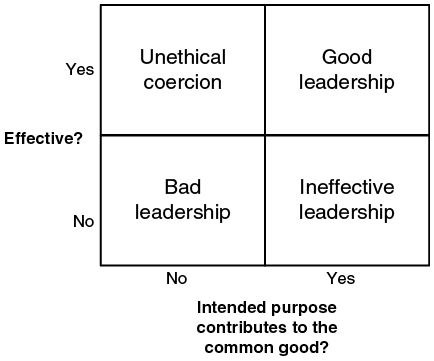
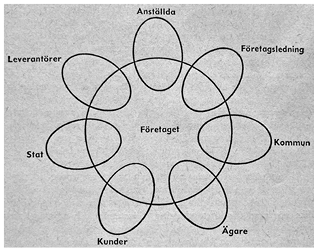
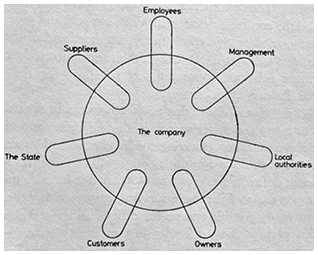


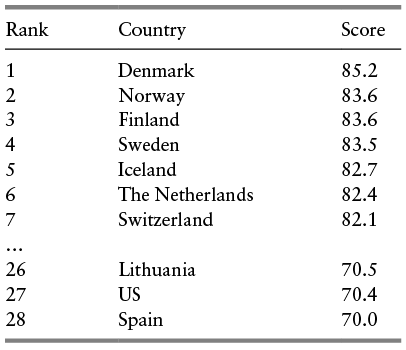
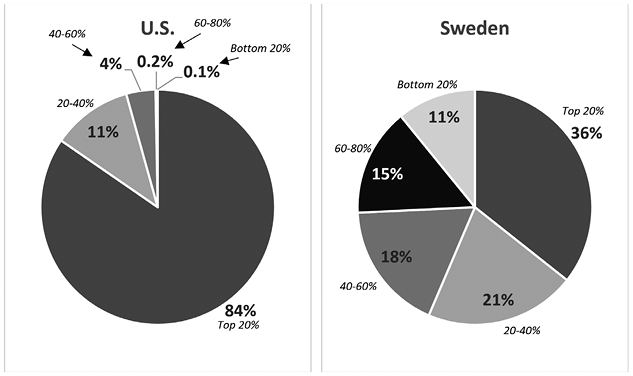

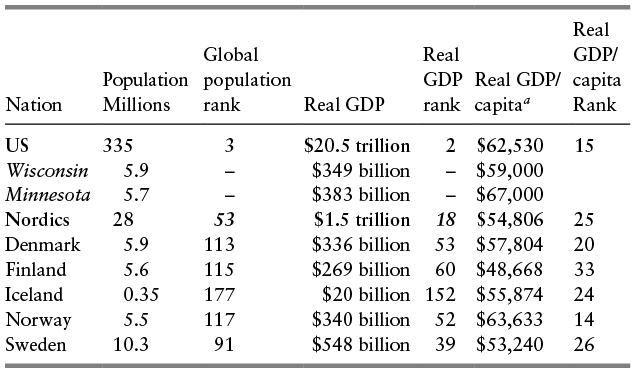

 Open access