


This paper contains supplementary material that can be found online at http://journals.cambridge.org
Introduction
Reeves's pheasant Syrmaticus reevesii, endemic to central China, is categorized as Vulnerable on the IUCN Red List (IUCN, 2012) and as a national second-level protected species (State Council, 1988). It was once widely distributed and relatively common (Cheng et al., Reference Cheng, Tan, Lu, Tang, Bao and Li1978). However, because of illegal hunting, habitat loss and fragmentation (Xu et al., Reference Xu, Wu, Li, Lu, Liu and He1991, Reference Xu, Yin, Zhang, Zhang and Gao1995; MacKinnon et al., Reference MacKinnon, Meng, Carey, Zhu and Melville1996; Zheng & Wang, Reference Zheng and Wang1998), some populations have been extirpated and the species' range has become divided into eastern and western regions (Zheng & Wang, Reference Zheng and Wang1998; Collar et al., Reference Collar, Andreev, Chan, Crosby, Subramanya and Tobias2001). Reeves's pheasant is sensitive to expansion of development and there is no space for the species to shift its range in central China, especially with the high degree of habitat fragmentation in this area (Zheng & Wang, Reference Zheng and Wang1998). Previous surveys (Xu et al., Reference Xu, Yin, Lei, Ding, Liu and Yu1996; Ma et al., Reference Ma, Zhang, Wang, Liu, Chen and Zhuo2009) have indicated declines in the distribution and population density of Reeves's pheasant but these surveys did not cover the entire range of the species or lacked accurate data.
In the study reported here we conducted a large-scale and intensive survey of Reeves's pheasant from April 2011 to April 2012. We aimed to: (1) ascertain the current distribution and population status of Reeves's pheasant in China, (2) identify the challenges for its conservation, and (3) provide recommendations for appropriate conservation measures.
Study area
The survey covered the entire post-1980 range in which Reeves's pheasant was known to occur in central China (Anhui, Guizhou, Henan, Hubei, Hunan and Shaanxi provinces and Chongqing municipality; Fig. 1; Zheng & Wang, Reference Zheng and Wang1998). This region is normally subject to the south-east subtropical monsoon, resulting in abundant precipitation and a moderate mean air temperature (Zhao et al., Reference Zhao, Chen, Tian and Xie2005). The natural vegetation of the region is evergreen broadleaf forest, deciduous broadleaf forest, or mixed conifer and broadleaf forest (Cheng et al., Reference Cheng, Tan, Lu, Tang, Bao and Li1978; Wu et al., Reference Wu, Li and Xu1991, Reference Wu, Li and Wang1994; Xu et al., Reference Xu, Wu, Li, Lu, Liu and He1991). In addition to Reeves's pheasant, sympatric pheasants in this region include the ring-necked Phasianus colchicus, golden Chrysolophus pictus and koklass Pucrasia macrolopha pheasants, Temminck's tragopan Tragopan temminckii and five other species of Galliformes (Zheng, Reference Zheng2011).
The locations of sites surveyed for Reeves's pheasant Syrmaticus reevesii, indicating signs of presence and where the species appears to have been extirpated (some symbols represent more than one site). The rectangle on the inset indicates the location of the main map in China.

Methods
We collected data on the historical distribution of Reeves's pheasant (Cheng et al., Reference Cheng, Tan, Lu, Tang, Bao and Li1978; Xu et al., Reference Xu, Wu, Li, Lu, Liu and He1991; Zheng & Wang, Reference Zheng and Wang1998; Collar et al., Reference Collar, Andreev, Chan, Crosby, Subramanya and Tobias2001) and on the current distribution, using interviews and field surveys. Personnel of provincial forestry departments responsible for wildlife conservation and management provided a general outline of the distribution of the species in each of the seven provinces/municipality. We then consulted staff of relevant county forestry bureaus to obtain more detailed information on the species, obtaining such information for 78 counties (71% of the 110 counties in which the species was known post-1980; Zheng & Wang, Reference Zheng and Wang1998; Collar et al., Reference Collar, Andreev, Chan, Crosby, Subramanya and Tobias2001). In 60 of these counties we identified 78 candidate sites for further enquiries, and disregarded seven counties for which there was convincing evidence the species was extirpated. The 78 sites represented the best habitat for the survival of the pheasant in these counties; the distance between sites was at least 20 km, reducing spatial autocorrelation (Dormann et al., Reference Dormann, McPherson, Araujo, Bivand, Bolliger and Carl2007). From interviews with four local researchers familiar with Reeves's pheasant we obtained information on 11 more sites (Supplementary Table S1). Finally, we interviewed local residents to gather preliminary information on the status of and possible threats to Reeves's pheasant. When conducting interviews with village heads, elders and hunters, we verified the ability of the interviewees to identify Reeves's pheasant by showing them photographs of males of Reeves's, ring-necked, golden and koklass pheasants and Temminck's tragopan. In determining which sites to survey we only included information from interviewees who identified Reeves's pheasant correctly. Where there was no evidence of Reeves's pheasant for > 10 years and no habitat suitable for the species we considered it to be locally extirpated (Harrison, Reference Harrison1991). During the surveys additional informal interviews were conducted to reaffirm findings.
We identified 43 sites for field surveys, for which we used the protocols employed by previous studies in the same area (Zhang, Reference Zhang2004; Liu, Reference Liu2006). Line transect sampling was used to estimate the density of Reeves's pheasant. Transects of 850–3,600 m length across altitudes of 160–2,150 m were distributed randomly within survey sites and located using a global positioning system. We surveyed a fixed width of 50 m each side of the transects and within this assessed abundance by sightings, sound of wing-whirring displays and occurrence of moulted feathers. If two moulted feathers were found at least 300 m apart, we considered them as two independent individuals, given the home range size of Reeves's pheasant (Xu et al., Reference Xu, Zhang, Sun, Zheng, Wang and Zhang2009). Any evidence of poaching or illegal hunting (e.g. poachers, electric power lines set above the ground to kill passing wildlife, or traps encountered), and habitat loss or habitat fragmentation, was also recorded along the transects.
We calculated population density as the number of pheasants seen along a transect divided by the area of the transect (length x 100 m; Bibby, Reference Bibby2000), and used Mann–Whitney U tests to compare densities between protected and non-protected areas. We used paired sample t-tests to test the difference in population density between 2011–2012 and 2003–2005 (Zhang, Reference Zhang2004; Liu, Reference Liu2006), as the values met the assumptions of a normal distribution. We classified the threats (indicated during interviews or observed along the transects) in each site and then ranked the main threats based on the percentage of survey sites with the corresponding threat. We used an α level of P < 0.05 for all statistical tests, which were performed with STATISTICA v. 10.0 (StatSoft, Tulsa, USA).
Results
To obtain general information about the status of Reeves's pheasant we interviewed 20 personnel of provincial and county forestry sectors, 50 personnel of nature reserves and forest parks, 35 heads of local village committees, 184 elders, and 44 hunters. The pheasant has disappeared from 46% (n = 41) of the sites investigated, especially in the south-west of the western regions (Fig. 1, Table 1), and has been extirpated for 10–15, 16–25 and > 25 years at 14, 16 and 11 sites, respectively. Only half (n = 39) of the counties we surveyed had evidence of presence of the species. The interviews also indicated that Reeves's pheasant has declined at 46 sites (Supplementary Table S1).
Number of candidate sites (of 89 surveyed) where Reeves's pheasant Syrmaticus reevesii has declined, disappeared, or is stable, and the main threats or causes of extinction in the six provinces and one municipality in the post-1980 range of the species in central China.
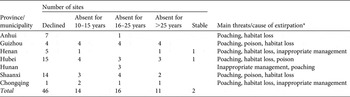
*Only the three main factors are listed; for full details of threats, see Supplementary Table S1.
We walked a total of 250.3 km along 209 line transects and recorded 197 individual Reeves's pheasant at 43 sites in 32 counties (Table 2). The pheasant occurred in 60% of protected areas (n = 40) and 50% of non-protected areas (n = 38) surveyed. Population densities in protected areas were higher than those in non-protected areas (Mann–Whitney U Test, Z = −2.092, df = 42, P < 0.05), and significantly lower in eight protected areas compared to 2003–2005 (paired sample t-test, t = −4.66, df = 7, P < 0.01; Fig. 2).
The population density of Reeves's pheasant in 2003–2005 (Zhang, Reference Zhang2004; Liu, Reference Liu2006) and in 2011–2012 (this survey). NR, Nature Reserve; FF, Forest Farm.

The number of sites and line transects and total length of transects surveyed in the provinces in which there was convincing evidence of the presence of Reeves's pheasant, with number of individual pheasants detected, population density, and number of sites with evidence of poaching (including the number of electric fences, hunters or traps found or observed).

Approximately 83, 26 and 20% of the surveyed sites had direct evidence of poaching, habitat loss and use of poison, respectively, but the extent of threats varied between sites (Supplementary Table S1). Along our line transects we found 172 snares, 26 electric fences and 20 poachers at 36 (83%) sites (Table 2).
Discussion
Distribution and population status
Reeves's pheasant was widely distributed in central China in the relatively recent past (Cheng et al., Reference Cheng, Tan, Lu, Tang, Bao and Li1978). However, we did not find any evidence of its presence in almost half of the candidate sites. In particular, we only confirmed the presence of this pheasant in four, isolated, sites of the 16 sites in Guizhou province where Reeves's pheasant had been recorded previously (Wu & Xu, Reference Wu and Xu1987; Wu et al., Reference Wu, Li and Xu1991). Our findings can be interpreted conservatively as demonstrating a decline in the population of this species. Given the continued human population increase and considering the social and economic development plans for these areas (Lu & Deng, Reference Lu and Deng2011), it is reasonable to assume that the range of this pheasant could become further restricted.
Although it is more difficult to clarify the status of a species than to determine its distribution (Brickle et al., Reference Brickle, Duckworth, Tordoff, Poole, Timmins and McGowan2008), our results indicated declines of Reeves's pheasant at most surveyed sites. The population in the Tuoda Nature Reserve was c. 240 during 1991–1994 (Yu et al., Reference Yu, Jiang, Li and Li2011) but we recorded only one Reeves's pheasant in 2012. Declines have also occurred in some protected areas.
Threats
Poaching is a key threat to wildlife in developing countries (McGowan, Reference McGowan, Mainka and Trivedi2002). It not only affects the survival of pheasant species but also reduces other wildlife populations and biodiversity (Li et al., Reference Li, Huang, Ding, Tang and Wood2007). The long tail feathers of the male Reeves's pheasant are widely used for the decoration of Chinese opera costumes (Cheng et al., Reference Cheng, Tan, Lu, Tang, Bao and Li1978) and consequently a great number of Reeves's pheasants are hunted (Supplementary Table S2). The harvest of tail feathers from males was still occurring in Henan, Hubei and Anhui provinces during our survey (Supplementary Table S2). People in rural areas were not familiar with national wildlife conservation policies and, for example, did not know of the importance of Reeves's pheasant. Although the government has carried out public outreach programmes most of these have been in small towns, and it has been difficult to disseminate appropriate messages to rural and remote areas (Zhang et al., Reference Zhang, Hua and Sun2008). Overlap and conflicts in wildlife conservation and management between government departments (e.g. Xu et al., Reference Xu, Zhang, Liu and McGowan2012) have also exacerbated these problems.
Most Galliformes are sensitive to habitat destruction, and their populations decrease following loss of suitable habitat (Wang et al., Reference Wang, Ren, He and Zhu2008). Reeves's pheasant prefers habitats with large trees and extensive canopy cover and sparse undergrowth (Xu et al., Reference Xu, Wu, Li, Lu, Liu and He1991, Reference Xu, Zhang, Zhang and Zheng2002, Reference Xu, Zhang, Zheng, Zhang, Sun and McGowan2007; Wu et al., Reference Wu, Li and Wang1994). However, the increasing human population and booming economy in China since 1980 has led to increased deforestation (Li, Reference Li2004). The Chinese government has initiated forest conservation programmes, most notably after the Yangtze River flood in 1998, but forest degradation caused by inappropriate exploitation remains a serious threat (Liao, Reference Liao1999; Li, Reference Li2004). For example, the population density of Reeves's pheasant at Xianjuding forest farm, a site we surveyed, declined from 15.10 to 6.59 per km2 when the mature forest was logged for commercial purposes (Zhang, Reference Zhang, Ding, Ding and Zheng2004). Subsequent habitat fragmentation is a further threat (Fahrig, Reference Fahrig2002). It reduces the area of suitable habitat and affects the movement of the pheasant, and higher predation at habitat edges may lead to further population reduction (Chalfoun et al., Reference Chalfoun, Thompson and Ratnaswamy2002; Fahrig, Reference Fahrig2003).
Farmers in China deliberately poison Galliformes to prevent them from eating crop seeds (Zhang et al., Reference Zhang, Ding, Ding and Zheng2003). Our survey indicated that poison was used in particular in the dry western region, which is only suitable for planting corn and beans. Planting of these crops was coincident with a shortage of food for pheasants before the breeding season (Johnsgard, Reference Johnsgard1999).
Management implications
Because of the Vulnerable status and rapidly declining population of Reeves's pheasant, the Chinese government and relevant international organizations (IUCN, Zheng & Wang, Reference Zheng and Wang1998; World Pheasant Association, McGowan et al., Reference McGowan, Zhang and Zhang2009) have taken measures to protect the species. However, the conservation framework was based on population and distribution data from the 1980s and, as a result, some conservation measures may no longer be appropriate.
The government is upgrading wildlife conservation policies; e.g. National Biodiversity Strategies and Action Plans in China 2011–2030 (Ministry of Environmental Protection, 2010) and The 12th 5-Year Plan on Wildlife Conservation and Nature Reserve Management in China (State Forestry Administration, 2012). Changes include revising threatened species lists, public outreach, amending the Law of Wildlife Conservation, and drafting legislation on nature reserves. To provide the foundation for future conservation of Reeves's pheasant we propose, based on our findings, that the species should be upgraded to a first-grade nationally protected species. We also recommend that its status on the IUCN Red List should be changed to Endangered, based on criterion A2acd (i.e. population reduction of ≥ 50% over the last 10 years, with direct observation (a), decline of Extent of Occurrence (c), and overexploitation (d) (IUCN, 2001).
As Reeves's pheasant is important to people, its effective conservation needs to include a sensitive combination of community development, education, habitat management and law enforcement (He et al., Reference He, García-Perea, Li and Wei2004; Liang et al., Reference Liang, Cai and Yang2006; Li et al., Reference Li, Huang, Ding, Tang and Wood2007). To improve public awareness, relevant community outreach needs to be developed and implemented in a manner that is accessible to rural populations. Poaching and poisoning should be banned and economic compensation should be provided to farmers who suffer when their crops are eaten by this pheasant (State Forestry Administration, 2012).
Establishment of protected areas, especially nature reserves, has been fundamental to wildlife conservation in China (Xu et al., Reference Xu, Zhang, Liu and McGowan2012). However, management policies are often incompatible with the objectives of nature reserves, including inappropriate regulations (Xu & Melick, Reference Xu and Melick2006), limited capacity, improper reserve management techniques, and inappropriate budget allocations (Quan et al., Reference Quan, Ouyang, Xu and Miao2011). Improving the management effectiveness of nature reserves is therefore a priority for biodiversity conservation (Ministry of Environmental Protection, 2010; State Forestry Administration, 2012). Promoting management of nature reserves will be beneficial to biodiversity conservation in China, and improving management of the reserves for Reeves's pheasant will protect both this pheasant and its habitat.
Acknowledgements
This research was supported by the Forestry Commonwealth Programmes (No. 200904003), the National Science and Technology Ministry (2008BAC39B05), the National Natural Science Foundation (No. 31172115), a grant from the State Forestry Administration and the 985 Project of Beijing Normal University. We thank the Forestry Departments of Anhui, Hubei, Guizhou and Shaanxi Provinces for permission and support for the surveys, the local residents, authorities and nature reserve managers for providing us with data and assistance, and Yang Liu and anonymous reviewers for valuable comments and suggestions.
Biographical sketches
Chunfa Zhou is studying the habitat, distribution and status of Reeves's pheasant. Jiliang Xu is a member of the IUCN Species Survival Commission Pheasant Specialist Group, with interests in research on threatened pheasant species, nature reserve design and management, and biodiversity conservation policy. Zhengwang Zhang is the Vice President of the China Ornithological Society and his research interests focus on the ecology of rare and threatened Galliformes, conservation biology and the spatial and temporal distribution patterns of waterbirds.



