




In the mid- to late 1830s, a series of events at London theaters signaled the start of a period of dynamic collaboration between working-class radical movements and the popular stage. Held in support of the most important political prisoners of the Reform Bill era, so-called “benefit” evenings raised money for the families of the Dorchester Labourers, six agricultural workers sentenced in March 1834 to seven years of penal transportation for their efforts to form a labor union. The unionists’ case became a cause célèbre, prompting a nationwide campaign to secure their release. Ultimately successful, this agitation included mass demonstrations, petitions that collected hundreds of thousands of signatures, advocacy inside Parliament, and, on the cultural front, three performances held at the South London Surrey and Victoria Theaters and another at the East End Pavilion.Footnote 1 These occasions marked a crucial moment in early Victorian drama when commercial venues, defying statutory censorship, became willing to ally themselves with radical protest. Jane Moody, David Worrall, Jacky Bratton, and others have demonstrated the highly politicized nature of performance in the 1820s and 1830s. During these decades, debates about franchise expansion animated plays’ subject matter while stimulating efforts to abolish the century-old patent monopoly, which restricted performances of tragedy and comedy to select houses possessing a royal patent.Footnote 2 Criticism of this legislation drew on broader critiques of privilege, thus linking political and theatrical reform. Benefit nights for the labourers evidence still deeper connections between popular theater and social movements, a set of relationships that continued into the 1840s when establishments hosted at least two dozen events in support of Chartism, the agitation for democratic rights.Footnote 3
The labourers’ benefit nights made support for the poor a political question, because the Dorchester Labourers’ Committee framed its fundraising as a rebuke of the state's neglect of the workers’ families. Economically vulnerable in ordinary times, these families fell into perilous circumstances at the loss of the labourers’ income, a condition exacerbated by local magistrates' subsequent denial of “all parochial aid” because of the households' connection to the incipient union.Footnote 4 The Owenite socialist journal the Crisis posed the question starkly: “Who is to take charge of the widows and the orphans? For our patriot rulers will suffer them to starve. Their only dependence is upon the poor, industrious, oppressed operatives of England. These have little to spare; but out of that little they will administer to their necessities.”Footnote 5 In this charged context, the theatrical evenings modeled mutual support arising out of the twinned crises of state repression and social austerity. They imagined and attempted to instantiate, to borrow Judith Butler's poignant formulation, “the possibility of community on the basis of vulnerability and loss.”Footnote 6 Notably, three of the four benefits staged nautical melodramas—plays about people exposed to extreme danger in far-flung settings and at home. Like the events themselves, these dramas explored themes of interdependence and communal care as they narrated how catastrophe might be righted.
A recent “infrastructural turn” in performance studies provides useful categories for thinking about the labourers’ benefits. Across an array of projects, scholars have focused attention on the social systems necessary for artistic endeavors and the ways performance explores relationships “of reciprocity and inter-reliance.”Footnote 7 These themes emerge in coverage of the prisoners’ benefits in the radical press, which highlights infrastructural issues in ways atypical for the era's journalism but resonant with such newspapers’ interest in questions of labor, collaboration, and material need. In particular, reports stress the way the events depended on the efforts of the Dorchester Labourers’ Committee (a group discussed in detail below). For the final performance in October 1839, a subcommittee of six members of this body—including a Mr. Gray, a tin-plate worker, and a Mr. Andrews, a carpenter—took charge of organizing work.Footnote 8 Other activists, including members of the rope-maker, type-founder, and cooper unions, participated by selling tickets and generating interest within their organizations. Besides finding a locale, the committee arranged advertising on handbills and in both mainstream and movement papers. Notably, advertisements staked out the class nature of the events by addressing playgoers as “Fellow-workmen” and “Members of Trade Societies.”Footnote 9 Beyond such self-definition, the politicized culture of London unions refracted the nights’ meaning for attendees. At an evening to raise money for the son of a deceased stonemason, verses by Chartist dramatist John Watkins described the benefit in terms of mutual support rather than the vertical relations of charity: “He lost his mother and his father too; / But found the want of both supplied by you. / . . . No titled crowns around your brows may shine, / But there Philanthropy beams more divine!”Footnote 10
In this context, the benefit nights should be understood as an attempt to embody new forms of relationality that could challenge the logic of austerity and economic liberalism represented by the New Poor Law of 1834 and the state's simultaneous assault on unions. An advertisement for the final performance framed the act of assembling on the prisoners' behalf as a rejection of Whig efforts “to break up your unions and trade societies, and render you hopeless and helpless.”Footnote 11 Performances thus promoted the recognition of laboring people's shared exposure to economic deprivation and political repression while suggesting an ethos of mutual care as the necessary response to this condition.Footnote 12
This paper explores why the benefits turned to one of early Victorian era's most popular dramatic forms—nautical melodrama—as an appropriate vehicle to advance such a vision. Theaters’ involvement in the labourers’ case was fitting because stage melodrama had provided an idiom with which to understand the legal repression the unionists suffered and because the campaign for their pardon relied on highly theatricalized street protests. Beyond these broad facts, melodrama provided a medium through which to explore the relationship between vulnerability and political transformation. In particular, the genre's fantastical endings, at once utopic and shadowed by catastrophe, resonated with the predicament labor confronted in the 1830s. Melodramas discern, I argue, a radical potential in deprivation as crises become the occasion of reimagining the social world and ordinary people's place within it. In an analogous fashion, the movement for the labourers sought to allay the material needs of the prisoners’ families but simultaneously articulated broader political aspirations, aiming ultimately at overturning the system of oligarchic rule under which the labourers were immiserated and condemned.
Traditions of Theatrical Support
The labourers’ benefit nights fit into a pattern of working-class self-help conducted through theatrical events. By the mid-1830s, unions, friendly societies, and other working-class organizations had developed traditions of hosting performances at commercial venues as means of fundraising, opportunities for conviviality, and methods of publicity and propaganda.Footnote 13 In some sense, such evenings represented an extension of fundraising for charitable causes, a regular feature of early Victorian playgoing. The month of the unionists’ arrest, for instance, the Victoria staged James Sheridan Knowles's The Wife (1833) “in Aid of the Funds of the United Britons’ Benevolent Society, for Distributing Bread & Coals to the Poor.”Footnote 14 Benefit nights for actors and other theater workers were also integral to the industry's structure; performers relied on sharing the receipts of one or more productions per year as a substantial fraction of their salaries. Lacking unions until the twentieth century, theater employees practiced a form of mutual aid through benefit nights, which frequently featured actors, musicians, and dancers from several establishments volunteering their services. If political organizations built on these traditions of charity and mutual support, however, they also transformed their meaning. Using the guise of philanthropy, the Dorchester Labourers’ Committee and like groups raised funds for such controversial purposes as strikes, legal expenses, and prisoners’ families, causes that flew in the face of censors’ and licensing magistrates’ efforts to keep politics off the stage. Finally, benefit evenings formed part of the performative culture labor unions and political groups fostered. From initiation rites to meetings and protests to the funerals of members, activists instantiated shared identity and common purpose in rituals that relied on choreographed movement, declamatory speaking, music, uniforms, insignia, and other visual elements.
Melodrama and the Dorchester Labourers
Connected by bonds of family, religion, and occupation, the Dorchester labourers were a tightly knit group.Footnote 15 They included the Loveless brothers George and James; father and son Thomas and John Standfield, who were related by marriage to the Lovelesses; and James Hammett and James Brine. All were arrested in February 1834 for violating the Unlawful Oaths Act of 1797 by administering secret oaths as part of union initiation ceremonies. Inspired by Owenite socialist ideals as well as by a tradition of radical dissent—George and James Loveless were Methodist lay ministers—the workers had formed the union the previous autumn in response to the reduction of wages to near-starvation levels. The early 1830s witnessed significant labor mobilization, including strike waves and renewed efforts at “general unionism”—the formation of broad associations linking workers across industries. The Dorset labourers’ Friendly Society of Agricultural Labourers was part of the most significant of such efforts, the Owenite Grand National Consolidated Trades Union (hereafter GNCTU), which enrolled tens of thousands in London and elsewhere, including women and agricultural workers, groups often excluded in previous labor campaigns.
In this context, the punitive sentence the labourers received was viewed as an attack on the right to form unions at all, which had been secured a decade previous with the repeal of the Combination Acts. The perceived injustice of the Dorchester case “called forth displays of trade union solidarity on a huge scale.”Footnote 16 Meetings throughout England included one estimated at a “full 100,000 working men” on the Newcastle town moor and a mass procession to the Home Office in London on April 21, 1834.Footnote 17 As the Poor Man's Guardian put it, “The sentence on the Dorsetshire labourers has roused the whole country. The indignation excited by it is not confined to the breasts of the Unionists; it animates the whole labouring population.”Footnote 18 The sentence and resulting protests marked an epoch in British political history. Unions mooted the possibility of a general strike in the event the government failed to pardon the workers, and the Crisis expressed a widespread belief that the agitation for the labourers might lead to a more general conflagration: “the united voices of a nation, we hope, will deliver them, or consign the present arbitrary system of government to everlasting execration.”Footnote 19
The revolutionary ambitions of spring 1834, however, were decisively checked by the summer when strikes supported by the GNCTU—of Derby silk workers and London tailors—went down to defeat. The union itself collapsed by the end of the year. Nevertheless, the campaign for the labourers was victorious—the men received pardons in March 1836 and returned to England in 1837 and 1838. The Dorchester Labourers’ Committee, a London-based organization made up of union activists, proved instrumental in securing this triumph. While campaigning for the prisoners’ release, the committee raised over £1,900 for the labourers and their families, from contributions by unions and individuals and the proceeds of a number of cultural events, including a concert in Walworth, a ball organized by “the Female Society [of] Friends of the Oppressed,” of which radical infidel lecturer Eliza Sharples was a member, and a celebratory dinner upon the labourers’ return.Footnote 20 The benefit nights at the Surrey Theater in December 1835 and at the Victoria in September 1836 netted over £45 and £49, respectively, and a second benefit at the Victoria in October 1839, following the labourers’ homecoming, was more successful still, though the evening at the Pavilion in December 1836 lost £8, seemingly because a portion of the proceeds on ticket sales of a “well attended” performance were never returned.Footnote 21 Although these sums represented only a fraction of the nearly ₤2,000 raised for the labourers, the benefits functioned as gatherings on the prisoners’ behalf during years when public meetings for them had become rare while the “farewell benefit” of 1839 served as a public celebration of the movement's victory. As many activists involved in the labourers’ cause, moreover, became participants in the Chartist movement, the evenings forged connections between the theater industry and working-class radicalism that ensured drama would remain a visible part of London protest in the following decades.
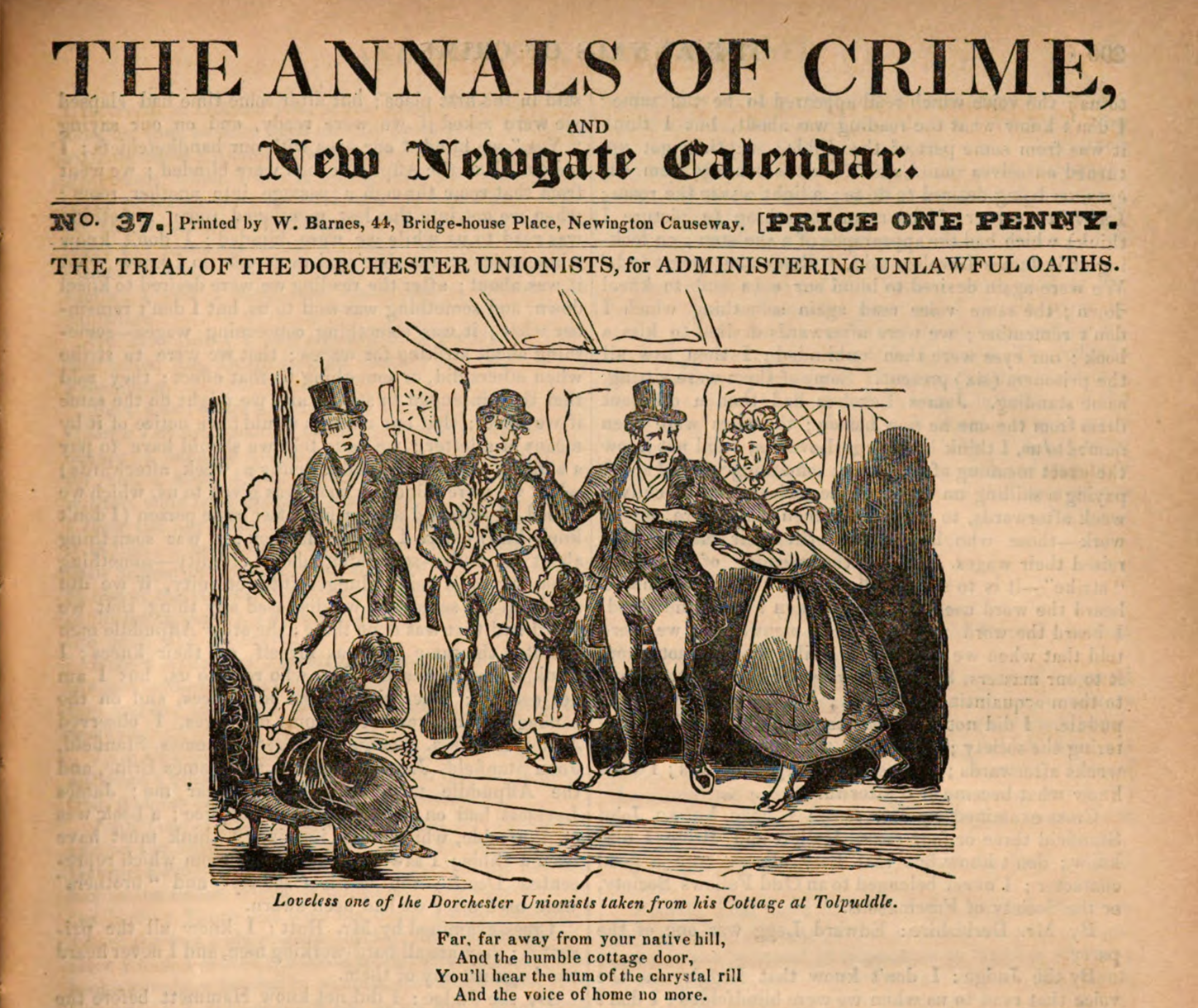
In addition to performances raising funds and generating publicity, theater left its imprint on the campaign in other ways: illustrations of the labourers borrowed from the iconography of the stage (fig. 1); a theatrical sensibility shaped protest marches; and melodramatic tropes framed accounts of the prisoners’ travails. Dominating the stage for much of the nineteenth century, melodrama was a complex genre that evolved as fashions shifted between gothic, imperial, nautical, and domestic modes. Ascendant by the 1830s, the latter subgenres were notable for their focus on everyday life and working-class characters, their democratic sensibilities, and their staging of crisis. Critics from Elaine Hadley onward have shown, furthermore, how nineteenth-century political discourse operated in a melodramatic mode, relying on a rhetoric of virtue and vice, heightened emotional language, and plots of familial separation and return.Footnote 22 Alerted to these tendencies, affinities shared between accounts of the labourers and contemporary theater become evident. First, events were figured as an assault on working-class life and so bear resemblance to the crises depicted by domestic drama, where families are routinely threatened with unemployment, eviction, the seduction of daughters, the impressment or imprisonment of sons, and a host of other calamities. In 1834 the radical journalist Henry Hetherington evoked the broken homes of melodrama when he described a visit to Dinniah Standfield: “when I reflected upon the circumstances that she had a husband, a son under twenty and two brothers, all unjustly and cruelly torn from her, . . . I could not help ejaculating a curse upon the unfeeling masters who had inflicted such misery and desolation upon these poor people.”Footnote 23
Annals of Crime and New Newgate Calendar, May 17, 1834.
If radical accounts of the case cast the labourers as virtuous heroes and their female relations as persecuted heroines, they figured the ruling class as predatory, censuring in particular the judge who presided at trial and the Whig ministers who refused the labourers’ pardon. The image of the law as arbitrary, capricious, and corrupt was a further set of associations linking such narratives with late Georgian and early Victorian drama, in which courts are shown as institutions serving the powerful, rather than places of impartial justice. Of many possible examples, James Hart's nightmarish Mary Le More (Victoria, 1838) stands out. Here, an upright farmer falsely accused of murder declares, “I was wounded in the cottage and dragged to trial if trial that can be called where the judges, with black rancour in their hearts assemble but to condemn. Justice is not only blinded in our courts, but the scales of equality torn from her hand.”Footnote 24 The furor around the labourers’ case may well have influenced such representations—indeed, Mary Le More was performed at a benefit evening for the Glasgow cotton spinners, unionists whose imprisonment drew comparisons with the earlier case.Footnote 25 MP and medical reformer Thomas Wakley articulated a common belief when he claimed the Dorchester men's sentence illustrated how “You have two weights, and two measures; and, for the same fact, one man is acquitted, another condemned,” an allusion to the circumstance that organizations such as the Masons routinely performed secret oaths with no threat of prosecution.Footnote 26 Particularly galling was the obscurity of the “almost forgotten” statute the labourers putatively violated.Footnote 27 The Unlawful Oaths Acts of 1797 was enacted in the wake of that year's mutinies as part of the repression of British Jacobinism.Footnote 28 Since unionization was legal by the 1830s, however, the law appeared obsolete. As the “chaplain to the Metropolitan Trades Unions” Arthur Wade put it, “it appears, from the decision of the judge, that the law is capable of being stretched to any extent; it is like a net, which may be cast over all the land, and involve in its meshes any individual who may be obnoxious to the party in power.”Footnote 29
All this is very much the stuff of melodrama, where opaque and inflexible legal structures threaten people for committing crimes that are hardly crimes at all. The most famous instance of the law gone awry occurs in Douglas Jerrold's Black Ey'd Susan from 1829 (Surrey).Footnote 30 In the play's climactic crisis, the sailor William, returning from sea, stops a sexual assault against his wife but in so doing unwittingly commits mutiny, for Susan's persecutor is William's commanding officer, Captain Crosstree. The sailor is miraculously saved when his discharge papers surface on the drowned corpse of Susan's villainous uncle, proving he was in fact not under Crosstree's command at the time of the altercation. For Carolyn Williams, this episode illustrates the self-ironizing impulse of the genre's endings: “the transformations of melodrama can be as sudden and implausible as the magical transformations of pantomime and extravaganza. They imagine a retroactive reconstruction of social identity that is illogical, impossible, or, at the very least, highly improbable.”Footnote 31 In the labourers’ case, however, the “retroactive reconstruction of social identity” was reversed. Magistrates posted warnings against swearing oaths in late February 1834, then arrested the men for having conducted union rituals the previous December.Footnote 32 Under the diabolical rule of the demiurgic Whigs, not the providential order of melodrama, innocent actions were retroactively transformed into felonies.
“What a glorious structure is the law!” Radicalism and Nautical Melodrama
The first three benefits for the labourers all featured nautical melodramas, although they occurred at three different theaters—at the south bank Surrey in December 1835, the Surrey's local rival the Victoria in September 1836, and the Pavilion in Whitechapel in December 1836. A staple of the nineteenth-century stage, nautical plays reached the peak of their popularity in the 1820s and 1830s.Footnote 33 Whereas earlier in the century nautical dramas unambiguously celebrated the accomplishments of the British military, by the 1830s the genre had assimilated the preoccupations of domestic drama by representing abuses in the navy and social ills on land. In this way, even as nautical melodramas continued to express a measure of “patriotic pride,” they simultaneously functioned as vehicles for social critique.Footnote 34 Still, the politics of the genre remained mixed, varying according to playwright, play, and venue. Andrew Campbell's Rule Britannia, for example, opened at Sadler's Wells the year of the labourers’ pardon (1836). Set in the Napoleonic wars, the play continued Sadler's Wells’ tradition of patriotic spectacles that extended back to an 1806 reenactment of the British victory at Trafalgar.Footnote 35 After defeating murderous Jacobins, loyal sailors eulogize the anthem of the title: “Freedom composed the words, Victory the music, and Humanity steered the pen!”Footnote 36
John Thomas Haines's nautical dramas confronted social issues in a decidedly more critical fashion. His runaway success My Poll and My Partner Joe (Surrey, 1835), for example, takes up eviction and impressment, showing life in Britain and in the navy shaped by hierarchical class structures. The labourers’ December 1835 benefit mounted this play alongside James Sheridan Knowles's William Tell, a quasihistorical drama that emphasizes violence and coercion as features of unjust rule and features the liberation of a prisoner as a prelude to revolution (Drury Lane, 1825). Although part of the Surrey's standing repertoire (playing the ninety-first time in a remarkable six-month run), My Poll and My Partner Joe would have resonated with the unionists’ circumstances.Footnote 37 It concerns a man's impressment, eventual return from sea, and discovery that his best friend and fiancée have wed because both believed him dead. As Robert Burroughs points out, the play depends upon the irony of impressed sailors fighting the slave trade, thus exploring the relationship between various forms of unfree labor. The play's third act, however, undermines “the subversiveness of the first . . . by reasserting the national, racial and gendered superiority of the sailor.”Footnote 38 In a sequence that participates in the national self-congratulation of the post-Abolition moment, the protagonist and his shipmates defeat French pirates and liberate obsequiously grateful Africans. Nevertheless, the context of the labourers’ benefit would have troubled this resolution by calling to mind yet another kind of coerced labor. As transportees worked under brutal conditions on chain gangs or were “sold” to settler-colonist farmers and ranchers, comparisons between enslaved and prisoner labor were common. Indeed, George Loveless's memoir likens transportation to “slavery, and that of the worst description” and includes an episode in which he argues that slavery cannot be considered abolished in the empire while penal labor continues.Footnote 39
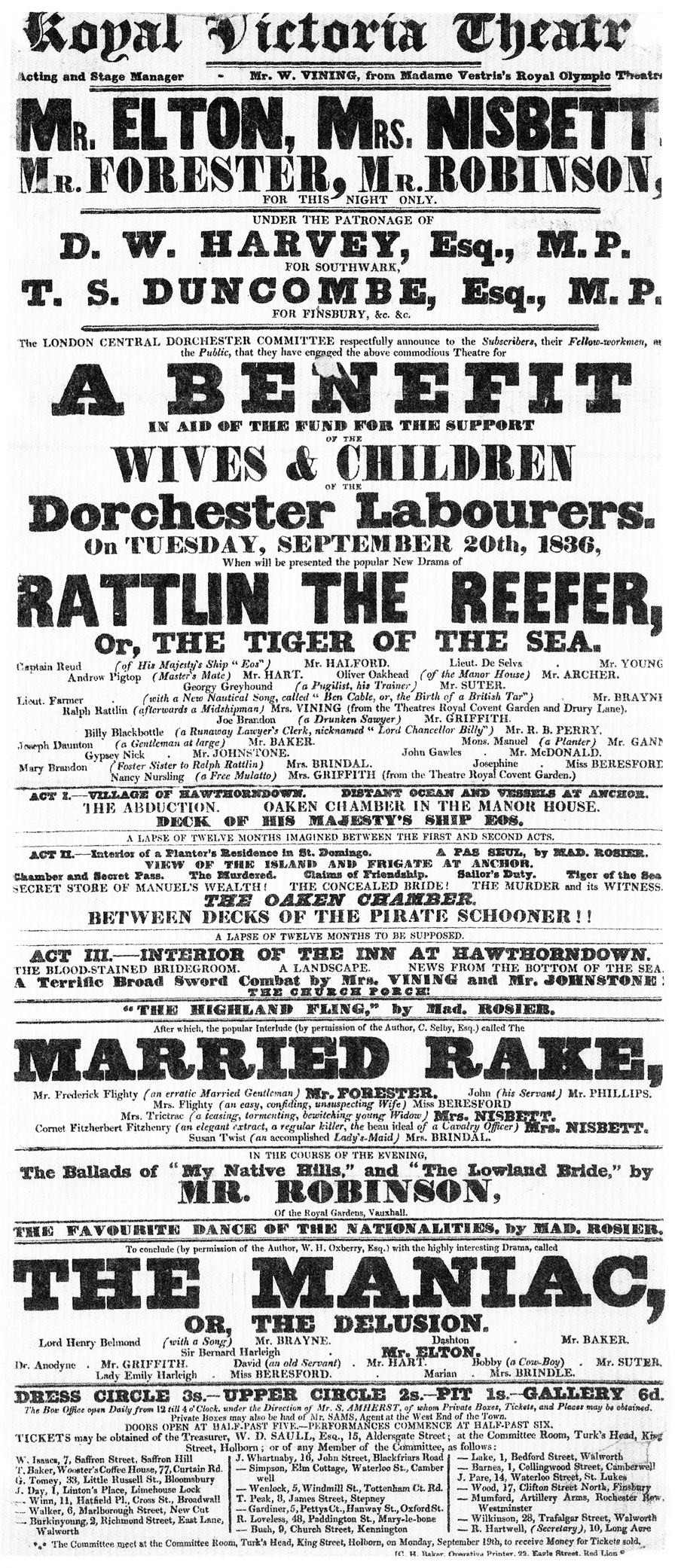
Like My Poll and My Partner Joe, Haines's Rattlin the Reefer; or, The Tiger of the Sea! (Victoria, 1836) explores slavery, poverty, and life in the navy. One month into a successful run, it featured at the Victoria for the second benefit for the labourers’ families, which, according to a reporter from Hetherington's radical London Dispatch, was “crowded to the very ceiling” (fig. 2). Lending respectability to the event, the reforming MP Daniel Whittle Harvey and the radical politician Thomas Slingsby Duncombe served as the night's patrons, a feature common at benefit evenings for performers or charities.Footnote 40 Still, the Dispatch underlined the working-class character of the audience, noting that “in looking round the dress circle, it appeared to us, that in aid of a good cause, ‘not many mighty are called.’”Footnote 41 Rattlin the Reefer was the kind of “lurid and sensational melodrama” that earned the Victoria the nickname “the Blood Tub.”Footnote 42 The concluding act witnesses no fewer than three characters who return from the dead alongside “a Terrific Broad Sword Combat by Mrs. Vining,” who played the hero in a breeches role.Footnote 43 The conclusion also brings to light a number of unknown or disguised identities. The hero, long thought drowned, returns, discovers the secret of his upper-class birth, reveals that the local squire is in fact a pirate, and prevents his adopted sister's marriage with her “Blood-Stained Bridegroom.”Footnote 44
Playbill for the Labourers’ Benefit on September 20, 1836, British Library Playbills 176.
Yet for all its sensational content, Rattlin the Reefer spoke to the labourers’ ordeal. Like My Poll and My Partner Joe, the play dramatizes the violence of impressment, calling to mind the prisoners’ forced passage to distant colonies. More broadly, it depicts an impoverished milieu ruled by a grasping elite. The device of the squire's secret identity likely derived from Isaac Pocock's The Miller and His Men (Covent Garden, 1813), in which a hard-driving capitalist covertly leads a band of brigands—Haines himself had played Pocock's hero in an 1828 performance of the play at the Manchester Theatre Royal.Footnote 45 But even as Rattlin the Reefer imagines class antagonism in phantasmagoric terms, it makes clear that quotidian institutions perpetuate poverty. The lawyer's clerk Billy Blackbottle, whose legal jargon resembles the patois of the stage tar, ironizes the law through excessive praise. The Dispatch remarked how this character was read contextually by the benefit's attendees: “As a large portion of the audience was composed of men who abhorred oppression, every allusion condemnatory of the system which had doomed their expatriated fellow-labourers to cruel and illegal punishment was received with loud applause. The humourous ejaculation ‘What a glorious structure is the law!’ with which Billy Blackbottle terminated his repeated exposure of . . . legal monstrocities . . . appeared to give the audience great satisfaction.”Footnote 46 In light of the overlay of the labourers’ tribulations with those of the hero's, the latter's homecoming should be thought of as expressing, to quote Louis James, “a desire, not for the conservative status quo, but for a redemptive restoration of justice and harmony.”Footnote 47 In the context of the campaign for the labourers, a foundling's noble birth articulated a claim for a social legacy for working-class people that the benefit itself sought to fulfill in place of the neglectful and hostile state.
Taken together, the endings of these plays disclose a dialectic between vulnerability and transformation characteristic of many melodramas. Critics have noted how the endings of early Victorian drama seem to revel in their “sheer improbability.”Footnote 48 Michael Slater proposes that Douglas Jerrold subverts his conclusions with “grotesquely improbable” devices while Carolyn Williams remarks that the genre's “far-fetched” dénouements register “the difficulty of creating new forms of social organization.”Footnote 49 At the same time, Williams discerns in “melodrama's vast project of imagining how justice might prevail” a “socially constructive” impulse that extends beyond offering audiences compensatory wish fulfillment.Footnote 50 In this light, the conclusions of Haines's dramas appear as exercises in utopian imagination, a kind of “subjunctive mode” in Raymond Williams's sense. For Williams, Dickens's endings introduce “a perspective which is not socially or politically available. It is a hypothesis of a perspective, a feeling, a force, which he knows not to be in the existing balance of forces.”Footnote 51 Similarly, the gap between Haines's endings and what precedes them indict the established order's logic by encouraging the audience to imagine how society might be radically different.
Melodrama's endings, then, stand in opposition to the nightmare scenarios characters endure; they function as a negation of existing conditions while offering a vision of “justice and harmony” restored.Footnote 52 The context of the labourers’ benefits, however, suggests a second relationship between catastrophe and melodramatic peripeteia. Notably, in both Haines's plays the hero's loved ones mistakenly mourn his death, a scenario found throughout the genre. In Rattlin the Reefer, the sailor Ralph is variously believed killed by gunshot, drowned, and devoured by sharks. While the hero's absence imperils the heroine, his loss discloses and activates new relationships. In particular, Ralph's disappearance sets in motion events that dissipate the “mystery about his birth,” revealing him the rightful heir of Ralph Rateline.Footnote 53 Similarly, in Black Ey'd Susan the community rallies around the heroine in William's absence as she is beset by creditors and sexually predatory suitors.
These plays’ focus on loss and recovery mirrors the work political benefit nights performed. As we have seen, the movement on behalf of the labourers publicized their travails to foster a sense of shared vulnerability, to mobilize support for their “widows” and “orphans,” and to provide a basis for imagining broader social change. In these multisided functions, the benefits stand as an example of the political potential of mourning as theorized by Judith Butler. Writing about differential exposures to violence in the contemporary world, Butler hypothesizes how grief, instead of simply isolating the bereft, might furnish “a sense of political community of a complex order”: “[in experiences of loss], something about who we are is revealed, something that delineates the ties we have to others, that shows us that these ties constitute what we are, ties or bonds that compose us.”Footnote 54 As we have seen, the labourers’ campaign was catalyzed by loss—of beloved family members and union comrades—and by the sense of threat the men's sentences provoked. The GNCTU hoped, however, that recognizing the shared nature of that danger would forge connections capable of initiating political and economic transformation. Innumerable melodramas delineate something similar—their crises lead to the revelation of new “relational ties” while compelling us “to take stock of our interdependence.”Footnote 55 In dramatizing the link between vulnerability and community, melodrama thus offered a powerful means of meditating on dilemmas working people confronted in the austerity and repression of the 1830s. The theatrical benefit nights likewise instantiated this crucial theme, demonstrating how new bonds might come about in the face of deprivation and violence.
“To awake from such a vision”: Mutiny at the Nore and the Melodramatic Happy End
That the Surrey and Victoria could stage works from their active repertoires to support causes célèbres indexes the way politics saturated 1830s theater. At the December 1836 benefit at the East End Pavilion, the situation was somewhat different. There, the plays had not been performed in months or years, suggesting organizers chose them for their relevance. Nevertheless, the evening again featured a nautical melodrama. Douglas Jerrold's Mutiny at the Nore (Pavilion, 1830) premiered one year after Jerrold's Black Ey'd Susan took London by storm. As the play's title implies, it dramatizes the events of 1797 when thousands of sailors on ships at the Nore anchorage in the Thames estuary mutinied over low pay and harsh naval discipline. The mutiny took a revolutionary turn when sailors connected to the United Irishmen and London Corresponding Society came out in support of Jacobin France. The play melodramatizes the mutiny by personalizing the conflict between the tyrannical Captain Arlington and the play's tragic hero, Richard Parker, the “so-called Admiral of the Floating Republic,” a real figure, who was hung alongside twenty-eight others after the mutiny's suppression.Footnote 56 Jealous of the midshipman for his marriage to a woman the captain loved, Arlington has Parker demoted and “flogged round the fleet” for the theft of a watch, although evidence eventually proves him innocent.
At the Pavilion benefit, the play would have taken on charged meaning because of the use of the Unlawful Oaths Act in prosecuting the labourers. As previously detailed, members of the labourers’ campaign asserted the injustice of applying a law passed in response to the mutinies of the late 1790s to persons engaged in legal activity.Footnote 57 The benefit performance, on the other hand, proudly affiliated the labourers with the mutineers, placing them in a revolutionary tradition while transvaluing the negative judgment of the mutiny. The selection of John Howard Payne's republican tragedy Brutus; or, The Fall of Tarquin (Covent Garden, 1818) as the night's afterpiece strengthened the evening's embrace of revolutionary politics.
The matter, however, is not so straightforward. Jerrold's play has been the subject of justifiable controversy for its ambivalent treatment of the mutiny. Frederick Burwick argues that while Jerrold makes Parker a “heroic martyr,” the play renders its conflict in ultimately “personal” terms, which obscures the revolutionary politics of the historical events.Footnote 58 Jeffrey Cox goes further, seeing Jerrold's play and nautical melodrama writ large as part of “England's post-Napoleonic ‘cold war’ against revolution and reform.”Footnote 59 The play's conclusion has drawn particular scrutiny. Here, moments before Parker's execution, the doomed rebel insists on his own loyalty to the navy and the Crown, pledging his infant son to the Admiralty and toasting “health to my king, and God bless him! Confusion to his enemies, and salvation to my soul!”Footnote 60 This toast ran so against the earlier depiction of Parker that spectators at the Coburg (later the Victoria) hissed the speech and Leigh Hunt's Tatler singled it out for criticism: “The man is made actually to glory in being the victim of a naval code.”Footnote 61
Jerrold's ending, however, is complicated by the fact that the play represents the mutiny arising in part from a similar spectacle of punishment, Parker's being “flogged round the fleet.” And if Jerrold emphasizes the limited nature of the sailors’ demands, he depicts the revolutionary implications of their project. They repeatedly insist on equality with their officers, as when Jack Morris tells a captain, “If you would be safe, be quiet: you are not now upon the quarter-deck, you are with your equals. . . . Ay, with men standing up for their rights!”Footnote 62 Such language qualifies Burwick's claim that Jerrold “[expunges] completely all reference to the ‘Floating Republic’ and the Rights of Man.”Footnote 63 Indeed, Parker himself declares that “the spirit of man is roused and walks abroad, and cries for vengeance!”Footnote 64 Jerrold also instantiates the mutineers’ democratic commitments in the institutions they create. The play stages the rebels’ court of delegates as an egalitarian body and makes clear Parker speaks as an elected leader.Footnote 65 One might even recover an oppositional kernel in Parker's final speech. The condemned prisoner tells his comrades to “Remember what we have struggled for; be loyal to your king, faithful to your country, and just to yourselves.”Footnote 66 If these imperatives are not simply contradictory, one might see them as part of a redefinition of patriotism, in which, paradoxically, what constitutes loyalty to king and fidelity to country is armed struggle against an unjust system. Contemporaries certainly worried about the potential subversiveness of the play. The Liverpool Standard remarked that “it gave to that celebrated mutineer the character of a high-minded and ill-used patriot, which it would be difficult to imagine could ever have been licensed . . . unless for the express purpose of destroying instead of upholding our sacred authority, and the preservation of order and good government.”Footnote 67
Nevertheless, the ending of Mutiny at the Nore presents a puzzle in terms of the labourers’ benefits—why would the organizers select a melodrama nearly unique for its lack of a happy ending when the prisoners had received full pardons nine months before and would soon return to England? Though no documentary evidence sheds light on the committee's motives, the choice suggests additional resonances between melodrama and radical politics in the 1830s. As Jane Moody describes, Jerrold sending Parker to his death turns from an “overwhelming” tradition of melodramatic peripeteia, an “expectation” established in countless plays, not least in Black Ey'd Susan where William is rescued from a situation paralleling Parker's.Footnote 68 Indeed, Jerrold emphasizes the profundity of his violation by repeatedly holding out the possibility of the happy ending, only to deny it at the last. In conversations and dreams, characters envision escape and life in peaceful anonymity in a “little cottage by [a] riverside.”Footnote 69 But history will not be appeased. “To awake from such a vision,” Parker's wife, Mary, laments, “to such a horrible reality”—and Jerrold evidently meant his audience to feel a like contrast.Footnote 70 Jerrold's dénouement, however, makes clear the fragility of the genre's happy endings. Just as the catastrophic ending of Mutiny contains the unfulfilled promise of transformation, melodrama's familiar conclusions are haunted by and depend upon calamity; the alternative worlds they imagine arise out of loss. This sense of historical contingency, of defeat and victory braided together, may well have appealed to the Dorchester Labourers’ Committee. In the heady days of April 1834, the GNCTU's journal the Pioneer could predict that when the labourers “return from transportation, they will find small occasion for secret combinations and illegal oaths,” because it envisioned they would discover a country radically changed by the struggle to restore their liberty.Footnote 71 By late 1836, however, it was clear that notwithstanding the prisoners’ hard-won pardons, the labourers would reenter a society still riven by precarity, inequality, and repression.
The Infrastructures of Popular Theater
The political benefit nights, finally, suggest the myriad institutional and material realities that determined theatrical experience, showing how dramatic texts are shaped by various agents with “conflicting values and contradictory loyalties.”Footnote 72 As discussed above, members of the Dorchester Labourers’ Committee crucially influenced the events. In some cases, the political affiliations of actors may also have led them to take part in the stagings. The fact that E. W. Elton, who was active in organizing efforts by actors to form an association for mutual support, volunteered for multiple programs (playing William Tell at the Surrey benefit), and that actors from several theaters joined him for the latter, offers a glimpse of the radical sympathies of certain early Victorian performers.Footnote 73
Theatrical authorities and local magistrates, however, also shaped the evenings—and indeed all early Victorian theater—in their roles as censors and licensing officials. Although these functionaries fail to enter the documentary record for the events in 1835 and 1836, they directly influenced the “farewell benefit” of October 8, 1839. The last of the evenings, this event celebrated the labourers’ homecoming, their return secured by the long-standing efforts on their behalf. But the labourers’ committee sought out the Victoria only after the proprietor of the Eagle-Tavern, which was connected to the vaudeville theater the Grecian Saloon, reneged on his promise of the use of the establishment “for fear of [losing] his licence.”Footnote 74 Censorship pressed on the evening in more extraordinary ways as well. “The great attraction of the night,” as the Charter newspaper put it, was the welcoming onstage of four of the returned exiles accompanied by the chairperson of the labourers’ committee, George Tomey. Appearing at last before their supporters, the protagonists of this long-drawn-out drama “stood in a row in the centre of the stage, and . . . were greeted with one of the most enthusiastic bursts of approbation ever heard, within these walls since the memorable appearance of Macready as ‘Virginius,’ on the occasion of . . . Sheridan Knowles's farewell benefit. The majority of the audience rose, whilst the pittites hurled gilded wreaths of ever-green . . . upon the stage.”Footnote 75 James Loveless, “a thin pale-looking individual,” expressed his thanks, “but his agitation was so great that he was quite overcome, and his voice all but left him.” John Standfield spoke next and, possessing “a little more nerve than his friend . . . [thanked] his audience for the support he had received ever since he fell under ‘the claws of his oppressors,’ at which there was a perfect hurricane of applause. He was determined, he said, to bear all the attacks of tyranny with as great fortitude as he had done his transportation, (applause). He thanked the Dorchester committee for their unceasing exertions, and the public for their generosity, and expressed his conviction that, whenever any great object was to be attained, they needed nothing but union—a determined union to achieve it (tremendous applause).” At this point, however, Standfield was interrupted when unidentified persons in the wings began to beckon him off. After momentary confusion, he stepped back “only just in time to save himself from being crashed with the heavy curtain, which descended with great velocity, to the astonishment and indignation of all present.” The Charter traced the circumstance to Whig censorship: “The ‘liberal government’ . . . has so . . . succeeded in terrifying all whose avocations depend upon a licence . . . that whether at a theatre or a public house, this sort of treatment has become common.”Footnote 76
This incident makes clear how the heterotopic nature of performance allowed the expression of a wider range of ideas than could be openly addressed to audiences. After all, plays staged on the labourers’ behalf included a dramatization of the most famous mutiny in British history, a tragedy concerning a Roman uprising, a drama about a legendary Swiss rebel, and a naval melodrama that mercilessly satirized the law. At the same time, the ex-prisoners’ treatment underlines the remarkable nature of the collaboration between protest campaigns and London theaters by highlighting the risks establishments assumed by participating in such events at all. Part of a policed cultural sphere, theaters nevertheless made themselves available to political groups in an era when the right to assembly remained deeply contested. As financial calculations, or gambits to create future goodwill with the public, the evenings index the radicalism of a significant section of 1830s playgoers. At the same time, political benefit nights promoted a set of values consistent with much early Victorian drama. In particular, melodrama found an ethos of care and mutual support in shared vulnerability and common experiences of loss, so offering persecuted working-class movements, and the men and women who composed them, a richly imaginative resource for advancing their campaigns.


 Open access

