


The Chinese pangolin Manis pentadactyla is categorized as Critically Endangered on the IUCN Red List and is one of the most traded mammals globally, yet there is limited knowledge of the species’ status throughout its range (Challender et al., Reference Challender, Wu, Kaspal, Khatiwada, Ghose and Ching-Min Sun2019). Most studies of the Chinese pangolin have relied on indirect sign surveys, which only provide information on matters such as habitat preferences and burrow density, and could be subject to observer bias (Khwaja et al., Reference Khwaja, Buchan, Wearn, Bantlin, Bernard and Bitariho2019; Willcox et al., Reference Willcox, Nash, Trageser, Kim, Hywood and Connelly2019). The lack of detailed information on the species has hindered efforts to identify priority populations and implement appropriate conservation strategies.
Recent evidence suggests Nepal is both a source and transit location for the illegal pangolin trade (Paudel et al., Reference Paudel, Acharya, Baral, Heinen and Jnawali2020; Bashyal et al., Reference Bashyal, Shrestha, Dhakal, Khanal and Shrestha2021; Suwal et al., Reference Suwal, Gurung and Pei2023). Approximately 94% of the potential habitat for the Chinese pangolin in Nepal lies outside protected areas, primarily in community forests (Sharma et al., Reference Sharma, Rimal, Zhang, Sharma, Poudyal and Maharjan2020b). In the district of Kavrepalanchok, Bagmati province, these forests could provide important habitat for the Chinese pangolin, although this district has become a significant hub for illegal pangolin trade (Bashyal et al., Reference Bashyal, Shrestha, Dhakal, Khanal and Shrestha2021). Chinese pangolins have been reported from some community forests in Kavrepalanchok, through indirect sign surveys (Shrestha et al., Reference Shrestha, Bashyal, Rijal, Shrestha, Shrestha and Shrestha2021), but no photographic or video records have previously been reported. Here we provide the first camera-trap records of the Chinese pangolin, including details of activity patterns and behaviours, in community forests in Panauti Municipality, Kavrepalanchok (Fig. 1).
Panauti Municipality, showing the 25 600 × 600 m grid squares in which we conducted camera-trap surveys, and the 11 squares in which we recorded the Chinese pangolin Manis pentadactyla. Each such grid square was divided into 0.01 km2 plots (see text for details).
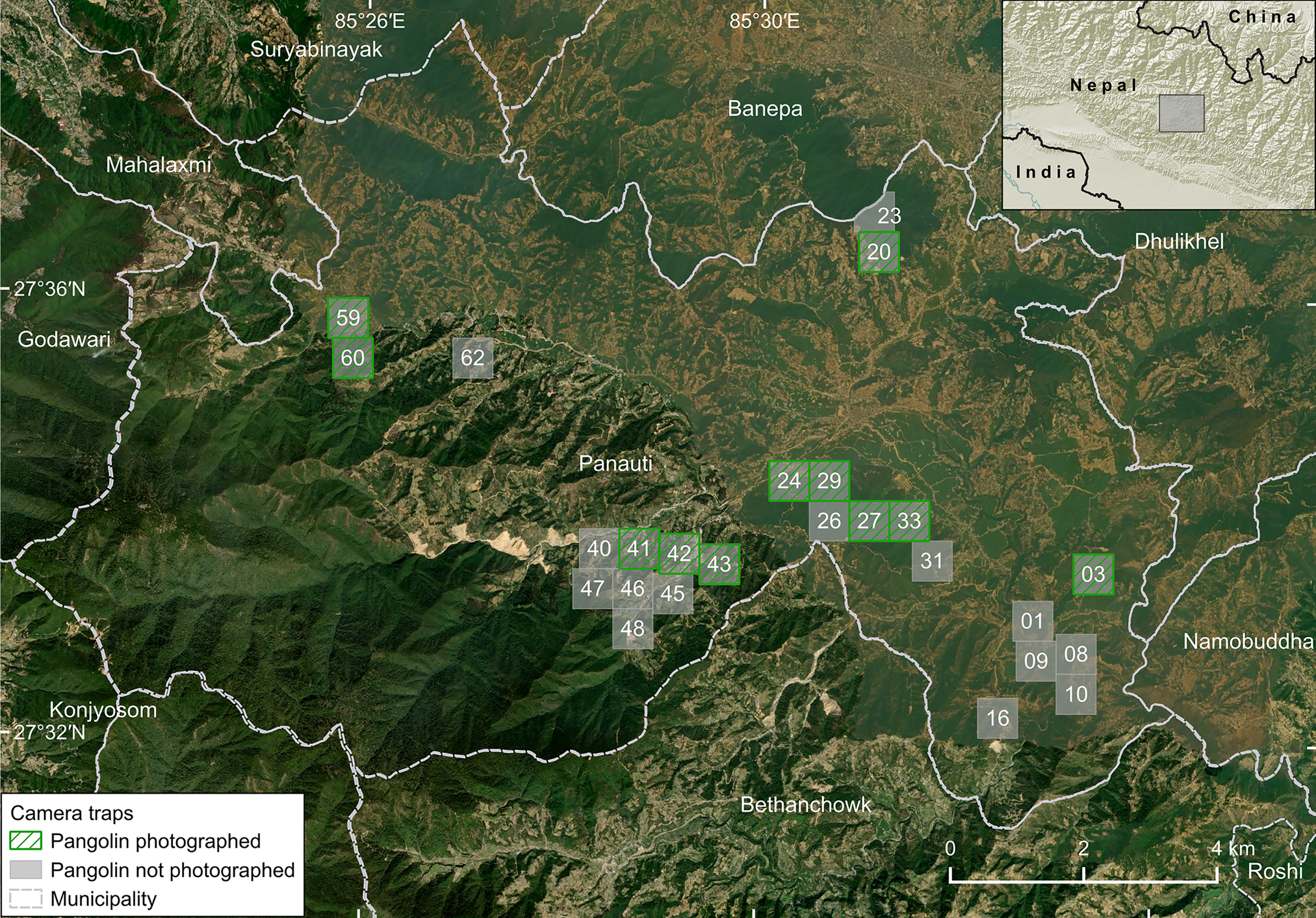
We considered 26 community forests, c. 43% of the community forests of Panauti Municipality, as potentially suitable for a camera-trap survey, and conducted the survey in 20 of these, based on our observations of indirect pangolin signs, during September 2022–February 2023 (Fig. 1). The 118 km2 municipality lies at 1,340–2,782 m altitude, and 78 km2 is forest. Using QGIS 3.22 (QGIS Development Team, 2023) we overlaid 25 600 × 600 m squares (0.36 km2, the approximate home range of the Chinese pangolin; Lu, Reference Lu2005) on the forested area, and within each square we overlaid a grid of 36 100 × 100 m plots. We did not survey areas with inaccessible, steep slopes or those over 2,000 m as pangolins are unlikely to use such locations (DNPWC & DoF, 2018). We randomly chose three of the plots within each square for foot surveys. In these we searched for indirect signs of pangolins such as footprints, tracks and burrows. At burrows where we observed pangolin signs or tracks, we positioned an unbaited camera trap facing the entrance, on a nearby tree or on a pole, 30–50 cm above the ground. Six Browning Strike Force Apex (Browning Trail Cameras, USA), three Stealth Cam P14 (Stealth Cam, USA) and one Bushnell HD (Bushnell Outdoor Products, USA) cameras were set to record 10-sec videos. All 10 camera traps operated for at least 10 days. We deployed nine cameras across three squares for at least 10 days at a time (three cameras in each of the three plots in a square). The remaining camera was rotated among the three squares, and functioned as a backup in case of technical problems. After surveying a set of three squares, the cameras were deployed in three new squares. This rotation was continued until all 25 squares had been surveyed. After the survey, camera traps were retrieved and videos were downloaded and archived, noting the dates and locations of any videos of pangolins. Only the Chinese pangolin was recorded (the Indian pangolin Manis crassicaudata also occurs in Nepal), identified by its distinctive external ears, small scales on the head, and soft, off-white hair on the underside and face (Wu et al., Reference Wu, Sun, Zhang, Yu, Ades, Suwal, Jiang, Challender, Nash and Waterman2020).
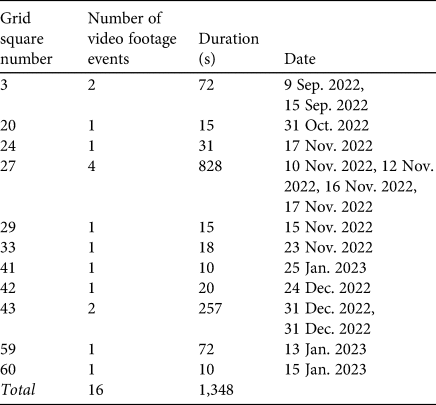
We walked a total of 38.4 km searching for indirect signs such as pugmarks, scats and scratch marks, and identifying burrows to set up camera-traps. A total of 75 100 × 100 m plots across the 25 600 × 600 m squares (i.e. three plots per square) were surveyed, resulting in a total of 803 trap-days. A total of 16 independent Chinese pangolin events, defined as pangolin activity documented by a camera trap, with a minimum 60-minute interval between triggers (Rovero & Zimmermann, Reference Rovero, Zimmermann, Rovero and Zimmermann2016; Matthews et al., Reference Matthews, Nixon, von Hardenberg and Geary2023), were recorded in 13 plots within 11 of the 25 squares (Fig. 1, Table 1). As it is not possible to identify individual Chinese pangolins from camera-trap images or videos, we could not determine the number of pangolins captured. These captures were in six of the 20 community forests surveyed (Birta, Chaleshwori, Chunkhani, Dhungandada, Indreshwori and Simle Bheer; Plate 1). This is the first camera-trap evidence of the presence of the Chinese pangolin in these areas. On average, it took 1.6 days for a camera trap to record a Chinese pangolin. In the total of 22.47 minutes of video footage, Chinese pangolins had a peak of activity between 18.00 and 1.00.
Independent Chinese pangolin Manis pentadactyla video footage events recorded in 11 of the 25 surveyed grid squares in community forests in Panauti Municipality, Kavrepalanchok district, Nepal (Fig. 1), with grid square number, number of events, duration and dates.
Camera-trap video stills of the Chinese pangolin Manis pentadactyla from community forests in Panauti Municipality, Kavrepalanchok district, Nepal (Fig. 1).
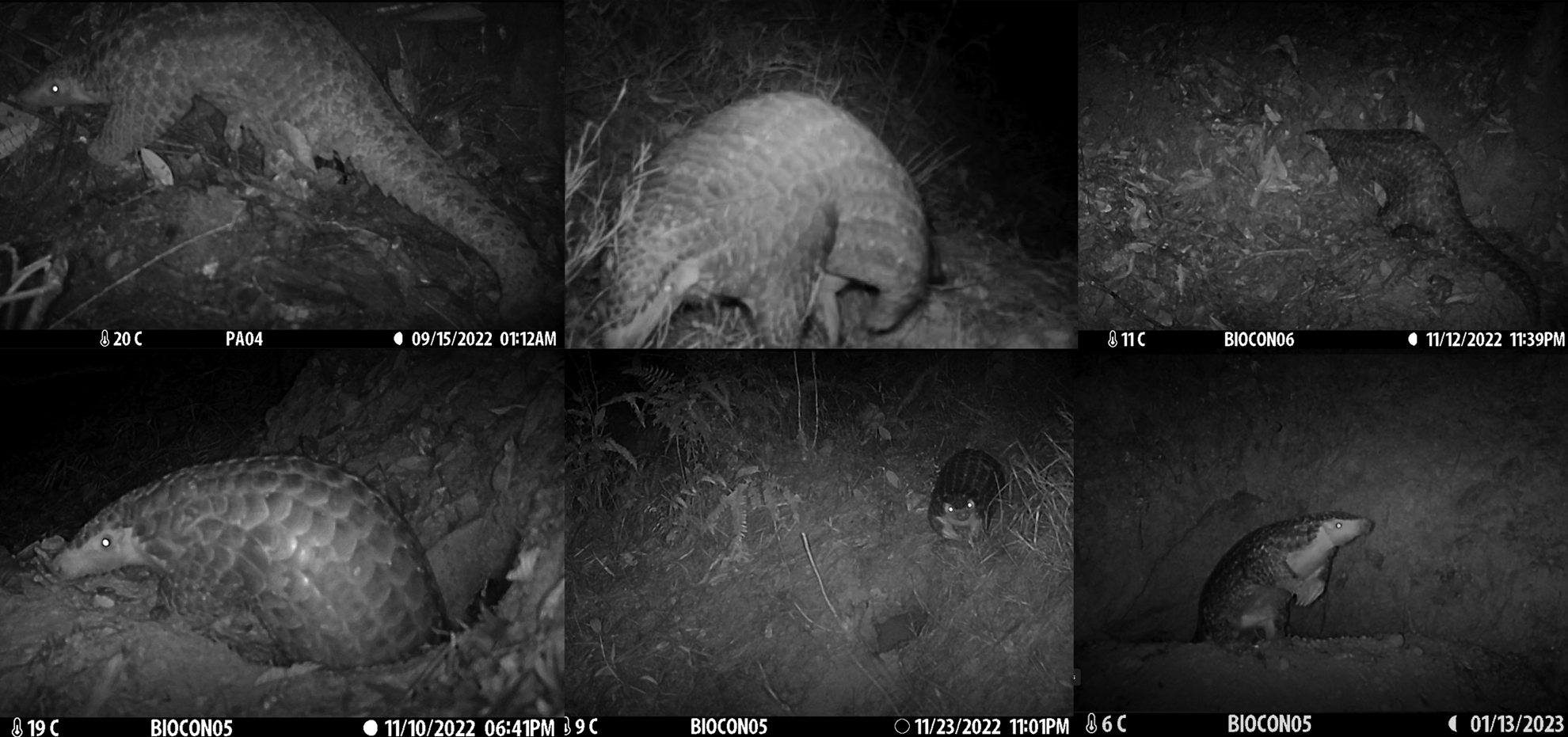
Camera-trap videos captured Chinese pangolins approaching, looking inside and entering burrows (often leaving shortly afterwards), exiting burrows tail- or head-first, and in two instances entering a burrow but not emerging. Pangolins were twice recorded collecting plant material, which they accumulated between their ventral side and limbs and then dragged inside the burrow, entering tail first. One pangolin spent 14 minutes digging in a pre-existing burrow, accumulating soil material between its ventral part and limbs, and eventually exiting the burrow tail-first with the soil. It then left the burrow. In one video, a pangolin emerged from its burrow in a quadrupedal manner, engaged in bipedal sniffing, and then returned to the burrow. Masked palm civets Paguma larvata and yellow-throated martens Martes flavigula were recorded in Chinese pangolin burrows, indicating potential use of pangolin burrows by other species. In addition to the Chinese pangolin we obtained videos of nine other mammal species (Supplementary Table 1, Supplementary Plate 1).
Our camera-trap survey in Panauti Municipality confirmed the presence of the Chinese pangolin in the community forests of Kavrepalanchok, and provided information on the activity patterns and behaviour of the species. Although the Chinese pangolin has been recorded by camera traps in other regions of Nepal (Dhital et al., Reference Dhital, Paudel, Thapa, Bleisch, Shrestha and Koju2020; Khatiwada et al., Reference Khatiwada, Wright, Kunkel, Khatiwada, Waterman and Bhattarai2022), use of camera traps to study the species in Nepal is uncommon. Our findings indicate that camera traps are a useful tool for studying the rare, elusive and largely nocturnal Chinese pangolin, and facilitates identification of the species in areas where both the Chinese and Indian pangolins occur. We are now using data from camera-trap surveys to gain a better understanding of Chinese pangolins in the study area and more widely through occupancy modelling.
Acknowledgements
We thank The Rufford Foundation, Society for Conservation Biology and Idea Wild for funding this project; Narayan Prasad Koju for identifying species; and the Division Forest Office and the participating community forests of Panauti Municipality for help and support.
Author contributions
Study design: NS, SS, AB; fieldwork: NS, SRP; data analysis: NS, SS, AB; writing: NS, AB; revision: all authors.
Conflicts of interest
None.
Ethical standards
This research was conducted with permission from the Division Forest Office, Kavrepalanchok, followed appropriate ethical standards for camera trapping (Sharma et al., Reference Sharma, Fiechter, George, Young, Alexander and Bijoor2020a), and abided by the Oryx guidelines on ethical standards. The cameras only recorded wildlife.
Data availability
The data supporting the findings of this study are available from the corresponding author, AB, upon reasonable request.


 Open access

