





Introduction
Throughout evolutionary history, ecological relationships between taxa have enabled the coevolution of distantly related organisms, resulting in an evolutionary trade-off between specialization to one niche with high efficiency or adaptation to several niches with lower efficiency (Brodie and Brodie, Reference Brodie and Brodie1999). The first scenario may trigger arms races, the intensity of which can cause speciation to occur at the same rate in both groups of interacting organisms (Brodie and Brodie, Reference Brodie and Brodie1999; Page, Reference Page2003), a phenomenon known as cospeciation. For studies of antagonistic cospeciation, and the driving forces of accelerated evolutionary rates predicted by the Red Queen hypothesis (Hamilton, Reference Hamilton1980; Page, Reference Page2003), phylogenies of interacting parasites and hosts have long offered a testable model system (Page, Reference Page2003; Brockhurst and Koskella, Reference Brockhurst and Koskella2013; de Vienne et al., Reference de Vienne, Refrégier, López-Villavicencio, Tellier, Hood and Giraud2013). In situations where parasites display strict host specificity through cospeciation, the dynamics of the host–parasite arms race can be explored to understand how constant change in the 2 groups allows them to coexist while overcoming each other's novel evolutionary adaptations (Van Valen, Reference Van Valen1973; Hamilton, Reference Hamilton1980). Cospeciation, however, is not simply synonymous with parasite specialization; host-switching, duplication, sorting events and inertia can also shape the cospeciation process. Host-switching occurs when a parasite successfully infects and adapts to a novel host, diverging from its original form, whereas duplication occurs when a parasite diverges and speciates within its original host (Filipiak, Reference Filipiak2016). Sorting events occur when a parasite becomes extinct within a host species, and inertia occurs when hosts speciate but the parasite fails to diverge (Filipiak, Reference Filipiak2016).
If host–parasite interactions were determined solely by cospeciation, then the phylogenetic branching patterns and timing of lineage divergence in the parasite would match those of the host (Fahrenholz's rule; Brooks, Reference Brooks1979). Based upon this rule, it is possible to apply cost-based analyses to comparisons of topological distances between parasite and host phylogenies, allowing us to investigate additional ecological mechanisms affecting the host–parasite relationship, including host switching, independent speciation and extinction (Page, Reference Page2003; Ricklefs et al., Reference Ricklefs, Fallon and Bermingham2004; de Vienne et al., Reference de Vienne, Refrégier, López-Villavicencio, Tellier, Hood and Giraud2013). Coevolutionary analyses work exclusively on the assumption that congruent host–parasite phylogenies suggest cospeciation, while incongruent phylogenies suggest alternate mechanisms (Brooks et al., Reference Brooks, McLennan and McLennan1991; Page, Reference Page2003). Additionally, host–parasite interactions are a powerful system for investigating both molecular and macroevolutionary relationships, as well as for investigating local adaptation (Page, Reference Page2003). Despite this, few studies have attempted to investigate how parasites diverge with their hosts within restricted geographic domains.
Malaria and malaria-like parasites are an excellent model for inferring both ecological and coevolutionary relationships due to the presence of malarial parasites on all continents except on Antarctica (Valkiūnas, Reference Valkiūnas2005), and their adaptation to a diverse range of vertebrate hosts (Lauron et al., Reference Lauron, Loiseau, Bowie, Spicer, Smith, Melo and Sehgal2015). In both mammals and birds, there is evidence of cospeciation of haemosporidian blood parasites (Ricklefs and Fallon, Reference Ricklefs and Fallon2002; Garamszegi, Reference Garamszegi2009), including the causative agents of malaria (Plasmodium spp.; Lauron et al., Reference Lauron, Loiseau, Bowie, Spicer, Smith, Melo and Sehgal2015). In particular, the interactions between Plasmodium spp. and malaria-like Haemoproteus spp. and their avian hosts provide a key system for investigating the coevolution of hosts and their parasites (Waldenström et al., Reference Waldenström, Bensch, Hasselquist and Östman2004).
Traditional studies have found a high level of host specificity of Haemoproteus spp. with avian hosts (Bennett et al., Reference Bennett, Peirce and Earlé1994), suggesting coevolution by cospeciation. However, recent contributions have found that while cospeciation can occur, host switching and parasite extinction are more potent drivers of Haemoproteus diversification (Ricklefs et al., Reference Ricklefs, Fallon and Bermingham2004; Ciloglu et al., Reference Ciloglu, Ellis, Duc, Downing, Inci and Bensch2020). Individual parasite lineages and local adaptations vary to such an extent that global cospeciation may not be prevalent; instead, different regions may display unique levels of cospeciation and host switching, based on the localized prevalence of lineages and diversity of hosts (Forbes et al., Reference Forbes, Muma and Smith2002). Phylogenies built from mitochondrial cytochrome-b sequences have shown that Haemoproteus lineages are able to move between hosts of different genera or even different families, depending on the presence and diversity of available hosts (Bensch et al., Reference Bensch, Stjernman, Hasselquist, Östman, Hansson, Westerdahl and Pinheiro2000).
Here, we assess the extent of cospeciation and host-switching between Haemoproteus parasites and passerine hosts from the British Isles. We selected avian haemosporidians as the model system because of their sheer diversity and widespread distribution, which may have facilitated high host–parasite cospeciation and local adaptation. The British Isles are relatively under-sampled from an avian haemoparasite perspective, with only 13 Haemoproteus lineages from 6 host species previously recorded in the MalAvi database (accessed 04/01/21; Bensch et al., Reference Bensch, Hellgren and Pérez-Tris2009). Here, we sample British passerines more extensively, with a focus on local inferences of co-phylogeny across all detected host–parasite associations, to test the relative importance of 5 potential drivers of co-phylogeny (cospeciation, host-switching, duplication, sorting events and inertia) using both distance-based and event-based methods. We then test the implications of removing both infrequently sampled lineages and generalist lineages, for our interpretation of the drivers of co-phylogeny.
Materials and methods
Sample sites
Bird blood samples were collected from sites in the east of the UK: in Essex and Norfolk (April–July 2014) and in Lincolnshire (2017 and 2018) as part of wider studies on passerine Haemosporidia prevalence. Three sites in Essex were near Tolleshunt D'Arcy (51°77′N, 0°79′E), Marks Tey (51°88′N, 0°79′E) and Silver End (51°85′N, 0°62′E); 1 site in Norfolk was near Hilgay (52°56′N, 0°39′E) (Dunn et al., Reference Dunn, Stockdale, Moorhouse-Gann, McCubbin, Hipperson, Morris, Grice and Symondson2018); 4 sites in Lincolnshire were near Potterhanworth (53°11′N, 0°25′W), Glentham (53°31′N, 0°22′W), Eagle (53°11′N, 0°41′W) and North Carlton (53°13′N, 0°31′W) (Parsa et al., Reference Parsa, Bayley, Bell, Dodd, Morris, Roberts, Wawman, Clegg and Dunn2023). At all sites, birds were caught using mist nets in the areas of scrub and woodland surrounded by arable farmland. Each bird was fitted with a unique British Trust for Ornithology metal ring. Under Home Office licence, a small blood sample (~50 μL) was collected from each bird by venepuncture of the brachial vein, conveyed into a capillary tube, collected into an Eppendorf tube and stored at −20°C until DNA extraction.
Parasite detection
DNA was extracted from blood using DNeasy blood and tissue kits (Qiagen, Manchester, UK) following the manufacturer's instructions. Samples were screened for the presence of haemosporidian parasites (Plasmodium, Haemoproteus and Leucocytozoon) using polymerase chain reactions (PCRs) with primers targeting fragments of the mtDNA cytochrome-b gene. Each sample was tested with 3 primer sets, each using the same forward primer (UNIVF 5′-CAYATAYTAAGAGAAYTATGGAG-3′) and a different reverse primer (UNIVR1: 5′-GCATTATATCWGGATGWGNTAATGG-3′; UNIVR2: 5′-ARAGGAGTARCATATCTATCWAC-3′; UNIVR3: 5′-ATAGAAAGMYAAGAAATACCATTC-3′) (Drovetski et al., Reference Drovetski, Aghayan, Mata, Lopes, Mode, Harvey and Voelker2014). Reactions were carried out in 10 μL reaction volumes containing 5 μL QIAGEN Mastermix PCR buffer (final concentration 3 mm MgCl2; Qiagen, Manchester, UK), 0.2 μL each primer (10 mm), 3.6 μL RNase-free water and 1 μL template DNA. For positive and negative controls, the 1 μL template DNA was replaced with 1 μL an avian DNA sample with known infection, and 1 μL RNase-free water, respectively. Controls were produced separately for each PCR run to confirm amplification had been successful and that contamination had not occurred. The PCR protocol involved denaturation at 95°C for 15 min followed by 42 cycles of denaturation at 94°C for 30 s, annealing for 30 s at primer-specific temperatures (UNIVR1: 54°C; UNIVR2: 52°C; UNIVR3: 53°C) and 45 s extension at 72°C, and a final terminal extension at 72°C for 10 min. PCR protocols were carried out using a BioRad T100 Thermal Cycler (BioRad, Hercules, CA, USA). PCR products were visualized on a 1% agarose gel stained with GelRed (Cambridge Bioscience, Cambridge, UK). Positive samples with low DNA content based on gel imaging were purified using QIAquick PCR purification kits following the manufacturer's instructions (Qiagen, Manchester, UK). All samples were then sent for bidirectional sequencing by Macrogen Europe (Amsterdam, Netherlands).
Host and parasite sequence data
Sequences were analysed in MEGA X (Kumar et al., Reference Kumar, Stecher, Li, Knyaz and Tamura2018) and identified using the BLAST algorithm (Zhang et al., Reference Zhang, Schwartz, Wagner and Miller2000) and the avian haemosporidian database MalAvi 2.3.8 (Bensch et al., Reference Bensch, Hellgren and Pérez-Tris2009). Lineages which differed from known lineages by at least 1 base pair were named by association to the MalAvi lineage with the closest matching sequence. Where multiple novel lineages were found to be similar (but not identical) to the same existing lineage, their similarities to the existing lineage have been marked with a number to denote different lineages (e.g. A-like1 would represent a new lineage with a similar sequence to lineage A, whereas A-like2 represents a separate lineage also similar to A). All sequences were then aligned using CLUSTAL W (Larkin et al., Reference Larkin, Blackshields, Brown, Chenna, McGettigan, McWilliam, Valentin, Wallace, Wilm, Lopez, Thompson, Gibson and Higgins2007) prior to phylogenetic analyses. Due to the unknown scale at which local host–parasite processes might operate, the data were checked for any evidence of spatially distinct host–parasite interactions between the groups of sites and found no strong evidence for differing dominant lineage composition (i.e. host species sampled in both locations did not differ in dominant parasite lineages), so merging data from sites could be justified. Sequence data of the mtDNA cytochrome-b gene from 23 British passerine species were collected based on GenBank (accession numbers provided in Appendix A) to construct the host phylogeny. Final alignments consisted of 708 bp for hosts, and 479 bp for parasites.
Phylogenetic and statistical analyses
Bayesian phylogenetic reconstructions of parasites and hosts were generated using BEAST v1.10.4 (Papastamoulis et al., Reference Papastamoulis, Furukawa, Rhijn, Bromley, Bignell and Rattray2020). jModelTest v2.1.10 (Darriba et al., Reference Darriba, Taboada, Doallo and Posada2012; Suchard et al., Reference Suchard, Lemey, Baele, Ayres, Drummond and Rambaut2018) determined that a generalized time reversible substitution model with Gamma distribution and a proportion of invariant sites was the best suitable nucleotide substitution model for both host and parasite alignments. Priors were defined using the BEAUTi v1.10.4 (Suchard et al., Reference Suchard, Lemey, Baele, Ayres, Drummond and Rambaut2018) interface, including a strict clock and Yule speciation process for the parasite phylogeny (Galen and Witt, Reference Galen and Witt2014) and an uncorrelated relaxed clock and Yule speciation process for the host phylogeny (Prum et al., Reference Prum, Berv, Dornburg, Field, Townsend, Lemmon and Lemmon2015). Markov chain Monte Carlo simulations were run with chain length = 10 000 000 and 10% burn-in. Convergence of parameters and their effective sample size were checked in Tracer v1.7.1 (Rambaut et al., Reference Rambaut, Drummond, Xie, Baele and Suchard2018) and a maximum clade credibility tree was computed in Tree Annotator v1.10.4 (Larkin et al., Reference Larkin, Blackshields, Brown, Chenna, McGettigan, McWilliam, Valentin, Wallace, Wilm, Lopez, Thompson, Gibson and Higgins2007).
Co-phylogenetic analyses
To test for congruence between host and parasite phylogenies, we used both the ParaFit function in ‘ape’ (Legendre et al., Reference Legendre, Desdevises and Bazin2002) and the PACo function in ‘paco’ (Hutchinson et al., Reference Hutchinson, Cagua, Balbuena, Stouffer and Poisot2017) in R 3.5.2 (R Core Team, 2021). These are both distance-based functions that test the null hypothesis that host and parasite phylogenies are independent from one another (i.e. the interacting groups speciated independently) and were favoured as they allow for different numbers of host and parasite terminal taxa. In ParaFit, we completed this analysis once for the full dataset, again with all rare (singly occurring) lineages removed, and then we conducted a sensitivity analysis by individually removing each parasite lineage in turn. Where parasites had only a single host, the host was also removed.
An event-based tree-reconciliation co-phylogenetic analysis was carried out using Jane 4.01 (Conow et al., Reference Conow, Fielder, Ovadia and Libeskind-Hadas2010). We ran 11 different models with different cost schemes, as recommended by Benovics et al. (Reference Benovics, Desdevises, Šanda, Vukić and Šimková2020) and detailed in Table 1, in order to address a previously criticized disadvantage of cost-based analyses (de Vienne et al., Reference de Vienne, Refrégier, López-Villavicencio, Tellier, Hood and Giraud2013). We set a population size of 100, running for 500 generations. We then compared the total cost of each most parsimonious solution against 1000 random permutations of both the parasite phylogeny and host–parasite tip mapping to infer the likelihood that the phylogenies are likely to have arisen by chance, or suggest a co-phylogenetic relationship. This additional analysis was designed to assess the likelihood of differing ecological events being inferred from differing cost parameters.
Outputs of co-phylogenetic analyses from Jane, using 11 models with different cost schemes

* Significant at P < 0.05.
Host specificity indices
First, when investigating host–parasite relationships as local scales, we must consider whether the richness of parasite lineages results from the number of hosts sampled. Thus, we assessed the relationship between host sample size and parasite richness (number of lineages) using a general linear regression model in R 3.5.2 (R Core Team, 2021).
To classify parasite lineages as specialists or generalists, we use 2 measures of host specificity suggested by Poulin et al. (Reference Poulin, Krasnov and Mouillot2011), both of which take into account the phylogenetic relatedness between multiple host species. The first examines phylogenetic distinctiveness among host species (SPDi), which is independent from the number of host species used by a parasite (Clarke and Warwick, Reference Clarke and Warwick2001), using distance matrices. To implement this calculation we used the taxondive function in the vegan package (Oksanen et al., Reference Oksanen, Blanchet, Friendly, Kindt, Legendre, McGlinn, Minchin, O'Hara, Simpson, Solymos, Stevens, Szoecs and Wagner2017) in R. The second index quantifies phylogenetic diversity of host species (PDi) using Faith's phylogenetic diversity, which incorporates host species richness into the phylogenetic diversity index (Faith, Reference Faith1992). To implement this, we used the pd function in the picante package (Kembel et al., Reference Kembel, Cowan, Helmus, Cornwell, Morlon, Ackerly, Blomberg and Webb2010) in R. For both indices, higher values represent more generalist parasite lineages. Both indices only function for parasite lineages found in 2 or more hosts, and thus were used to rank specificity in only the most generalist lineages. Parasite lineages which were found in only a single host species show maximum specificity and thus were considered specialists for discussion purposes.
Results
As part of the aforementioned wider study, a total of 464 blood samples from 32 passerine species (Appendix A) were screened for haemosporidian infection (Plasmodium, Haemoproteus and Leucocytozoon), of which 268 (58%) tested positive for infection. For this analysis, 108 parasite sequences were isolated from 23 host species, representing 30 lineages of Haemoproteus (for details of host–parasite associations, see Fig. 1). Nine of these sequences were not present in the MalAvi database, and so represent new lineages. Twenty-three of the 30 Haemoproteus lineages were found in only 1 host species (specialist lineages) and of those, 17 were found in only 1 individual (rare lineages). The blackcap (Sylvia atricapilla) displayed the highest parasite richness and the highest parasite specificity with 7 different lineages, 6 of which were found exclusively in this species.
Tanglegram of passerine (left) and Haemoproteus (right) phylogenies with association lines and posterior probabilities. Details of phylogenetic reconstruction are provided in the ‘Materials and methods’ section.

Tests for co-phylogeny
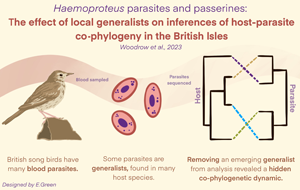
To test for co-phylogeny, the ParaFit function in the ape package (Legendre et al., Reference Legendre, Desdevises and Bazin2002) and the PACo function in the paco package (Hutchinson et al., Reference Hutchinson, Cagua, Balbuena, Stouffer and Poisot2017) in R 3.5.2 (R Core Team, 2021) were used. When all lineages were used in analysis, the ParaFitGlobal test found no support for co-phylogeny (P = 0.245, based on 999 random permutations; n = 30 lineages). Additionally, this test found no support for co-phylogeny when all singly detected parasite lineages were removed from the dataset (P = 0.293, based on 999 random permutations; n = 13 lineages; Appendix B). However, when only the generalist parasite CARCHL01 was removed, the test found support for co-phylogeny (P = 0.003, based on 999 random permutations; n = 29 lineages). The PACo analysis revealed that the observed best-fit Procrustean super-impositions were lower than the randomized distributions for both the full dataset and the dataset when the generalist lineage was removed (Fig. 2). This indicates that the co-evolutionary relationship between parasite and host is stronger than the same for any ensemble of network randomizations in the null model, indicating co-phylogeny (Hutchinson et al., Reference Hutchinson, Cagua, Balbuena, Stouffer and Poisot2017). When the generalist is removed, the association becomes stronger (lower Procrustes residual) in both the observed best-fit Procrustean super-impositions and the randomized distributions, indicating that the generalist lineage is changing our inferences of the strength of the association. Sensitivity analysis revealed that removal of other parasites resulted in great variation in the global P value (Fig. 3), but only the removal of the generalist lineage produced a significant co-phylogenetic inference.
PACo analysis for host–parasite phylogenetic independence. The observed best-fit Procrustean super-impositions (vertical dotted lines) are lower than the randomized distributions (histograms) for both the full dataset (black), and the dataset when the generalist lineage is removed (red), indicating the co-evolutionary relationship between parasite and host is stronger than the same for any ensemble of network randomizations in the null model. However, when the generalist is removed, the association becomes stronger (lower Procrustes residual) in both the observed best-fit Procrustean super-impositions and the randomized distributions. Histogram bins = 100, smooth line through histograms = means.

Sensitivity analysis, showing the effect of removing each individual parasite lineage on the ParaFit global P value. Black line at 0 represents the global P value when the full dataset is used (P = 0.245). Red line indicates the point at which the change in P value indicates a statistically significant coevolutionary inference (P < 0.05).

Inferring ecological interactions
Once the generalist parasite had been removed from the dataset, the ecological interactions that may have occurred to facilitate coevolution of parasite and host lineages could be investigated. Event-based tree-reconciliation co-phylogenetic analyses were carried out using Jane 4.01 (Conow et al., Reference Conow, Fielder, Ovadia and Libeskind-Hadas2010). Differing from ParaFit and PACo, Jane allows for cost-based inferences of the potential interactions between parasite and host lineages that could have facilitated coevolution. From the 11 different cost schemes applied for co-phylogenetic reconstructions in Jane, all the default models had equally high occurrences of duplication, host switch and loss events. The least cost models provided by Jane were the Treefitter model of co-phylogeny that was adjusted for host switching (cost = 63), and the codivergence-adjusted Treefitter model (cost = 67). Across all 11 models, duplication and host switching, and loss, seem to be the most important drivers of parasite speciation. The duplication-prohibited, host-switch prohibitive and sorting-prohibited models resulted in high numbers of loss events and represented scenarios with the greatest costs; supporting inferences of host switching and loss as major parasite speciation mechanisms in this avian haemosporidian system. However, the duplication-prohibited model was the only scenario whereby global costs were not statistically significant. Across the other models, loss was almost always the most important factor in the model, followed by host-switching. The only exception to this was the failure to diverse prohibitive model, whereby the high cost of failure to diverge outweighed the contributions of loss or host-switching. In the model assuming equal weights of the costs of each cospeciation event, loss remained the most important factor, followed by host-switching and failure to diverge.
Host specificity indices
Both measures of host phylogenetic distinctiveness and host phylogenetic diversity confirmed that the most generalist lineage in our dataset was CARCHL01, with both indices for CARCHL01 nearly double that of the next most generalist lineage (Table 2). Comparison between preliminary host and parasite phylogenies (Fig. 1) indicated the presence of a single highly generalist lineage, CARCHL01, present in 8 different host species. There was also no observed relationship between parasite richness and host sample size (t = 0.312, P = 0.758).
Measures of phylogenetic distinctiveness (SPDi) and phylogenetic diversity (PDi) for all parasite lineages with more than 1 host species (Poulin et al., Reference Poulin, Krasnov and Mouillot2011)

Higher values of both metrics represent more generalist lineages.
Discussion
High degrees of host–parasite specificity are hallmarks of coevolutionary relationships (Ricklefs and Fallon, Reference Ricklefs and Fallon2002). In this study, this specificity was initially suggested by a high proportion of unique lineages, but a global test of co-phylogeny using ParaFit and PACo on both the full dataset and the dataset excluding rare lineages suggested that passerine and Haemoproteus phylogenies are independent from one another. However, when the most generalist lineage identified by the parasite specificity index (CARCHL01) was removed from the dataset, the analysis revealed a stronger co-phylogenetic relationship between parasites and hosts. This effect was not retrieved following the removal of any other parasite lineage, indicating the generalist was masking the relationship. Event-cost-based analysis suggested that once the generalist is removed, the host and parasite lineages display a co-phylogenetic relationship, because the costs of the association were significantly lower in the observed data than in the random permutations of both the parasite tree and the host–parasite association mapping. This analysis also suggested that cospeciation is not a common mode of parasite proliferation in this system. Instead, it is the duplication of parasite lineages and the switching between hosts which has facilitated the coevolution of these groups. Failure of the parasite lineages to diverge between hosts on multiple occasions, as suggested by cost-based analyses, also support reduced cospeciation in this system (Hamilton, Reference Hamilton1980; Brockhurst and Koskella, Reference Brockhurst and Koskella2013). Altering the cost of cospeciation had no great effect on the results, suggesting that the cost-based method is more reliable for inferring parasite proliferation events in the history of a host–parasite association than previously assumed (de Vienne et al., Reference de Vienne, Refrégier, López-Villavicencio, Tellier, Hood and Giraud2013). These results do not support previous findings that cospeciation is a common mode of parasite proliferation in an avian Haemosporidia system (Ricklefs and Fallon, Reference Ricklefs and Fallon2002), but instead agree with more recent contributions that host-switching and a lack of divergence of parasites is responsible for the observed relationships.
These data also support the hypothesis that different regions display unique levels of co-phylogeny, or local adaptation (Forbes et al., Reference Forbes, Muma and Smith2002; Ricklefs et al., Reference Ricklefs, Fallon and Bermingham2004). Sensitivity analyses reveal that inferences of local parasite–host co-phylogeny can easily change with the level of sampling of the local system, with greatly varied global P values when any single parasite lineage is removed (Fig. 3). This idea of local specificity is also exemplified in the finding of a Haemoproteus parasite in a wren (Troglodytes troglodytes), of which the MalAvi database reports only 2 examples (Bensch et al., Reference Bensch, Hellgren and Pérez-Tris2009; Ellis et al., Reference Ellis, Huang, Westerdahl, Jönsson, Hasselquist, Neto, Nilsson, Nilsson, Hegemann, Hellgren and Bensch2020). It is possible either that such low frequencies of this parasite may be in circulation that detection is very low as in this case; or that locally, this parasite has adapted to infect a higher proportion of its hosts. Either way, with any analyses of this kind, many rare lineages, potentially unique to the local system, may be present yet undiscovered. Such rare lineages must be uncovered in local systems to more accurately represent any co-phylogenetic inference. Potential local adaptation may further be influenced by factors such as variation in anthropogenic food provisioning, by which placement of rural bird feeders results in variation in the proximity and density of heterospecific hosts (Moyers et al., Reference Moyers, Adelman, Farine, Thomason and Hawley2018). This may alter the likelihood of parasite transmission and proliferation of dominant lineages, due to the frequent placement of feeders near areas of scrub and stagnant water (J. C. Dunn, personal observation); ideal for the developmental needs of the vectors of haemosporidian parasites (Conte et al., Reference Conte, Goffredo, Ippoliti and Meiswinkel2007).
This idea of differing heterospecific compositions influencing host–parasite systems is also supported by the result that parasites proliferate in this system by host switching, perhaps as a product of increased heterogeneous vector-feeding tendencies resulting from increased interactions with novel hosts (Lauron et al., Reference Lauron, Loiseau, Bowie, Spicer, Smith, Melo and Sehgal2015). The UK is home to over 30 species of mosquito (Snow, Reference Snow1990), and there remains limited evidence as to which parasite lineages different mosquito species are able to successfully transmit (Dunn, in prep). Other vectors, such as biting midges (Culicoides spp.) and flatflies (Hippoboscidae), of which even less is known, are linked to Haemoproteus transmission (Valkiūnas, Reference Valkiūnas2005) and there is a general lack of knowledge of these transmission networks (Pérez-Tris et al., Reference Pérez-Tris, Hellgren, Križanauskienė, Waldenström, Secondi, Bonneaud, Fjeldså, Hasselquist and Bensch2007). These vector species are also coevolving with parasites and avian hosts through their role as the definitive host, and will thus drive many aspects of parasite/host life histories (Hurd, Reference Hurd2003). Additionally, vectors can transfer parasite sporozoites into the bloodstream of avian hosts that may not be suitable for proliferation of a transmissible infection. As PCR analysis is able to pick up the DNA of these sporozoites (Valkiūnas et al., Reference Valkiūnas, Iezhova, Loiseau and Sehgal2009), it is not often possible to confirm competent hosts for parasite lineages without microscopy. Although this limits the potential inferences of a purely molecular investigation, the presence of CARCHL01 gametocytes in all detected host species in this study has been confirmed through microscopy, to rule out PCR contamination as an answer to the generalist definition of CARCHL01 (Armour et al., in prep).
The high degree of blackcap parasite endemism is not unique to these data. Previous findings suggest that sympatric speciation within the blackcap is occurring as a result of ecological variation between parasite lineages, such as transmission rates and vector specificity (Bensch et al., Reference Bensch, Pérez-Tris, Waldenström and Hellgren2004; Pérez-Tris et al., Reference Pérez-Tris, Hellgren, Križanauskienė, Waldenström, Secondi, Bonneaud, Fjeldså, Hasselquist and Bensch2007). These differences in ecology and life histories have allowed for differential exploitation of the host, allowing for speciation without host switching (Schluter, Reference Schluter2000; Pérez-Tris et al., Reference Pérez-Tris, Hellgren, Križanauskienė, Waldenström, Secondi, Bonneaud, Fjeldså, Hasselquist and Bensch2007), and supports the hypothesis of interspecific variation in parasite diversification rates. Additionally, genetic distance matrices using cytochrome-b have suggested that cytochrome-b nucleotide divergence occurs around 3 times slower in parasites than in hosts (Ricklefs and Fallon, Reference Ricklefs and Fallon2002; de Vienne et al., Reference de Vienne, Refrégier, López-Villavicencio, Tellier, Hood and Giraud2013), which would strengthen the hypothesis that it is more efficient for the parasite to proliferate by mechanisms other than cospeciation, as parasite and host rates of evolution are not temporally homogenous (Hafner et al., Reference Hafner, Sudman, Villablanca, Spradling, Demastes and Nadler1994; Page et al., Reference Page, Lee, Becher, Griffiths and Clayton1998; Ricklefs et al., Reference Ricklefs, Fallon and Bermingham2004). It has also been found that parasite clades with mtDNA sequence divergence as little as 0.5% may be found in different hosts (Ricklefs et al., Reference Ricklefs, Fallon and Bermingham2004), further suggesting that the most common mode of inter-host parasite proliferation may be host switching rather than cospeciation. Alternatively, one may argue that these data provide an observation of a cryptic population dynamic, in which rapid evolution of the parasite is masking the true host–parasite interaction (Yoshida et al., Reference Yoshida, Ellner, Jones, Bohannan, Lenski and Hairston2007). This is plausible given that CARCHL01 was not observed in 2014–2017 (from n = 43 sequences) but constituted 18% of sequences in 2018 (n = 65). It could also be that the potential emergence of this generalist was detectable at more of a local level than the British Isles, as it was present at the Lincolnshire sites but not at the Essex/Norfolk sites. Although in other regions CARCHL01 is thought to be a finch specialist, the data suggest it to be a local generalist, supporting the observation that parasite lineages can be found in different host species in different locations [e.g. DUNNO01 found in Emberiza citrinella elsewhere in the UK (Dunn et al., Reference Dunn, Goodman, Benton and Hamer2014); but not found in E. citrinella in this study, despite being highly prevalent in Prunella modularis].
It is important to note that the data collected in this study will be only a subset of local Haemoproteus lineages and passerine species, and further sampling may refine the coevolutionary dynamic (Pérez-Tris et al., Reference Pérez-Tris, Hellgren, Križanauskienė, Waldenström, Secondi, Bonneaud, Fjeldså, Hasselquist and Bensch2007). Although this could be used to explain the high blackcap parasite endemism, as we sampled from 41 blackcaps, we sampled from similar numbers of blue tit (42), dunnock (37), whitethroat (35) and blackbird (37), but did not observe a similar level of parasite endemism. Similarly, we sampled only 1 garden warbler (Sylvia borin), but this provided a unique lineage. We also found that host sample size does not display any statistically significant relationship with parasite richness, thus we believe that screening for such endemic parasite lineages at local spatial ranges is a viable method for the future studies. However, the frequencies of inferred evolutionary events such as cospeciation and host-switching are also likely to display variation depending on the level of sampling. Therefore, it would be helpful to conduct new investigations by further developing the local dataset, and to collect further information on the environmental characters which could influence parasite transmission. Comparing this local pattern to others gleaned from other regions will provide a circumspect evaluation of the influence that biogeographical factors, environmental conditions (Wolinska and King, Reference Wolinska and King2009; Drovetski et al., Reference Drovetski, Aghayan, Mata, Lopes, Mode, Harvey and Voelker2014), anthropogenic food provisioning or nesting densities exert on local parasite prevalence. The monitoring of the dynamics of parasite–host associations over time, and the variation in such associations at the local level, is vital to understanding the specialist–generalist definitions of parasite lineages, and unmasking hidden coevolutionary dynamics.
Data availability
DNA sequences created in this study are available at GenBank (accession codes MT299243–MT299288). GenBank accessions for the sequences used to create the host phylogenetic tree are provided in Appendix A. R code for ParaFit test available upon request, but also freely available in the R CRAN repository under the package ‘Ape’.
Acknowledgements
We thank Alex Ball and Kerry Skelhorn for assistance with sample collections in Essex and Norfolk, which were jointly funded by the RSPB and Natural England through the Action for Birds in England partnership. We are grateful to Sandi Willows-Munro, and 2 anonymous referees for their input on earlier versions of our work.
Author's contribution
All authors contributed to editing and revising the manuscript. C. W. carried out phylogenetic analyses and wrote the initial draft. C. W., A. T. R., R. F. and A. H. carried out laboratory analysis. M. R. assisted with phylogenetic analyses and K. C. H. facilitated field data collection. J. C. D. collected samples in the field, designed the study and oversaw analyses.
Financial support
All laboratory analyses were funded by a University of Lincoln start-up grant and Royal Society Research Grant RG170086 to J. C. D.
Competing interest
None.
Ethical standards
Blood samples were collected under Home Office (ASPA) Licence, following ethical approval from the University of Leeds Animal Welfare and Ethical Review Committee, and the University of Lincoln Animal Ethics Committee. Birds were caught and handled under licence from the British Trust for Ornithology.
Appendix A
Host sample sizes used in study (not including species which did not pick up a Haemosporidia infection), and GenBank accession codes for host sequence data of the mtDNA cytochrome-b gene used for analyses

Appendix B
Individual host–parasite associations and their contributions to the ParaFit P value before and after removal of CARCHL01


 Open access

