


Introduction
Protoporphyrinogen oxidase (PPO)-inhibiting herbicide-resistant Palmer amaranth was first confirmed in 2011 and is now widespread throughout the crop-producing region of Arkansas (Salas et al. Reference Salas, Burgos, Tranel, Singh, Glasgow, Scott and Nichols2016; Varanasi et al. Reference Varanasi, Brabham, Norsworthy, Nie, Young, Houston, Barber and Scott2018b). The resistant populations in this area mostly possess a target-site resistance to all PPO-inhibiting herbicides, as well as resistance to other common herbicides suchas glyphosate and acetolactate synthase (ALS)-inhibiting chemistries (Heap Reference Heap2019; Varanasi et al. Reference Varanasi, Brabham, Norsworthy, Nie, Young, Houston, Barber and Scott2018b). Some populations of PPO-resistant Palmer amaranth have been noted as being harder to control with other herbicides that are effective on PPO-susceptible Palmer amaranth (Houston et al. Reference Houston, Norsworthy, Barber and Brabham2019; Schwartz-Lazaro et al. Reference Schwartz-Lazaro, Norsworthy, Scott and Barber2017; Steckel Reference Steckel2018).
In 2018, metabolic resistance of Palmer amaranth to fomesafen was confirmed in Arkansas (Varanasi et al. Reference Varanasi, Brabham and Norsworthy2018a). Subsequently, metabolic resistance to the very-long-chain fatty acid inhibitor S-metolachlor was also identified in Arkansas (Brabham et al. Reference Brabham, Norsworthy, Houston, Varanasi and Barber2019). While no mechanisms of resistance to dicamba have been identified in Arkansas Palmer amaranth, the discovery of metabolic resistance mechanisms to other herbicides in Arkansas suggests that metabolic resistance to more herbicide sites of action could be building (Yu and Powles Reference Yu and Powles2014).
Dicamba-resistant cotton was released for commercial use in 2015 and dicamba-resistant soybean was released in 2016. With the release of these new varieties, certain label restrictions were required for the products approved for use in these cropping systems to limit the off-target movement of dicamba to sensitive species. These limitations include nozzle type and spray volume specifications, among others (Anonymous 2018a, 2018b).
Herbicide application is influenced by application pressure, orifice size, nozzle design, and characteristics of the spray solution. The droplet sizes a nozzle produces are commonly classified by the volume median diameter (VMD), or Dv50 of spray droplets, which is the value of the median size of spray droplets produced (i.e., 50% of droplets are larger and 50% are smaller than this value). Increasing VMD can contribute to decreased particle drift when herbicides are applied, but in turn, it can decrease the efficacy of some herbicides (Meyer et al. Reference Meyer, Norsworthy, Kruger and Barber2016). Another way to classify droplets produced by a nozzle is by examining the relative span (RS) of the droplet spectrum. The RS is a unitless measurement that represents the total variation in droplet sizes produced by a nozzle, where a smaller number indicates less variation in droplet size. Herbicide droplet size can also be affected by the product being applied in the spray solution (Mueller and Womac Reference Mueller and Womac1997). When comparing the VMD of applications of glyphosate, glufosinate, and paraquat, Etheridge et al. (Reference Etheridge, Womac and Mueller1999) determined that a smaller VMD was generated by glufosinate than the other two chemicals. Chemical mixtures can also play a role in altering the VMD of a spray solution. When glufosinate was applied alone with a Turbo TeeJet Induction (TTI) 11004 nozzle, a VMD of 617 µm was produced, but when glufosinate was mixed with glyphosate and dicamba and applied with the same nozzle type, a VMD of 877 µm was produced (Meyer et al. Reference Meyer, Norsworthy, Kruger and Barber2015).
Nozzles are designed to control spray angle, spray pattern, droplet size, and solution flow rate as precisely as possible. Nozzles are available that produce a variety of spray patterns, in a variety of orifice sizes (Anonymous 2014). Increased droplet size can be obtained by increasing the orifice size for any given nozzle (Nuyttens et al. Reference Nuyttens, Baetens, De Schampheleire and Sonck2007). In order to increase droplet size without altering orifice size or spray pressure, nozzles with an inlet above the orifice are produced. These are typically referred to as air induction or venturi-type nozzles and work by essentially impregnating spray droplets with air, making them larger and less likely to drift (Etheridge et al. Reference Etheridge, Womac and Mueller1999, Reference Etheridge, Hart, Hayes and Mueller2001).
When water is sprayed through an AirMix 110015 nozzle at 276 kPa, a droplet size classification of medium (VMD 236–340 µm) is produced. At the same pressure with a TTI 110015 nozzle, a droplet size classification of ultra-coarse (VMD >665 µm) is produced. Daggupati (Reference Daggupati2007) found that AirMix 11003 nozzles covered 2.8, 4.6, and 6.9 percentage points more total ground area than TTI 11003 nozzles at 207, 276, and 344 kPa, respectively. Meyer et al. (Reference Meyer, Norsworthy, Kruger and Barber2015) demonstrated that mixtures of dicamba and glyphosate do not vary from droplet size classifications obtained with water for two Venturi-type nozzles, one specifically being the TTI nozzle. Meyer et al. (Reference Meyer, Norsworthy, Kruger and Barber2015) also found that increasing carrier volume from 94 to 187 L ha−1 increased spray coverage of a dicamba + glyphosate solution by 7% when averaged over three nozzle types.
Although not as important for the control of horizontally structured broadleaf weeds, smaller droplets adhere better to upright grasses, and therefore provide better control (Etheridge et al. Reference Etheridge, Hart, Hayes and Mueller2001; McKinlay et al. Reference McKinlay, Ashford and Ford1974). Droplet size also plays a vital role in control levels provided by contact herbicides. When glufosinate and paraquat were applied to broadleaf signalgrass [Urochloa platyphylla (Munro ex C. Wright) R.D. Webster] and common cocklebur (Xanthium strumarium L.) with air induction (AI) nozzles (coarser droplets) and flat-fan nozzles (finer droplets), decreased control was noted in treatments where AI nozzles were used (Etheridge et al. Reference Etheridge, Hart, Hayes and Mueller2001). McKinlay et al. (Reference McKinlay, Ashford and Ford1974) observed decreased paraquat efficacy on common sunflower (Helianthus annuus L.) as VMD increased. Meyer et al. (Reference Meyer, Norsworthy, Kruger and Barber2015) also observed a decrease in control of Palmer amaranth, hemp sesbania [Sesbania herbacea (Mill.) McVaugh], velvetleaf (Abutilon theophrasti Medik.), and barnyardgrass [Echinochloa crus-galli (L.) P. Beauv.] with glufosinate as droplet size increased. Conflicting conclusions exist on the effect of droplet size and synthectic auxin efficacy. 2,4-D efficacy has been shown to decrease with increases in VMD (McKinlay et al. Reference McKinlay, Brandt, Morse and Ashford1972). These are similar findings to those reported by Ennis and Williamson (Reference Ennis and Williamson1963) and Way (Reference Way1969), who observed that synthetic auxin efficacy increased as droplet size decreased. Meyer et al. (Reference Meyer, Norsworthy, Kruger and Barber2015), however, noted no difference in efficacy of dicamba on Palmer amaranth, hemp sesbania, velvetleaf, and prickly sida (Sida spinosa L.) across VMD values ranging from 340 to 756 µm.
Another factor that can influence efficacy of a foliar-applied herbicide is the carrier volume, or amount of herbicide solution being applied per hectare (Knoche Reference Knoche1994). Creech et al. (Reference Creech, Henry, Werle, Sandell, Hewitt and Kruger2015) observed no difference in control of Amaranthus spp. when glyphosate was applied at 70, 94, 140, and 187 L ha−1. However, in the same study, efficacy of 2,4-D on Amaranthus spp. and soybean increased with increases in carrier volume (Creech et al. Reference Creech, Henry, Werle, Sandell, Hewitt and Kruger2015), which is similar to findings by Smith (Reference Smith1946). When dicamba was applied postemergence to actively growing weeds, Butts et al. (Reference Butts, Samples, Franca, Dodds, Reynolds, Adams, Zollinger, Howatt, Fritz, Hoffmann and Kruger2018) observed a greater effect of droplet size on weed mortality with a carrier volume of 47 L ha−1 than when dicamba was applied at a carrier volume of 187 L ha−1. Because weed control can be affected by a variety of application factors and a metabolic resistance mechanism has been discovered in Arkansas Palmer amaranth, the objective of this research was to determine whether there were differences in control of Palmer amaranth between two populations when spray parameters were varied.
Materials and Methods
On-farm field experiments were conducted in Marion, AR, on a Dubbs silt loam (fine-silty, mixed, active, thermic Typic Hapludalfs) with a PPO-resistant population of Palmer amaranth and at the Lon Mann Cotton Research Station (LMCRS) near Marianna, AR, on a Zachary soil (fine-silty, mixed, active, thermic Typic Albaqualfs) with a PPO-susceptible population of Palmer amaranth in 2017 and 2018. The objective was to compare the efficacy of dicamba on two populations of Palmer amaranth when it is applied according to varying spray parameters. No crop was planted at either location in 2017. In 2018, cotton cultivar Deltapine® 1518B2XF (Bayer CropScience, St. Louis, MO) was planted at both locations at 9.8 seeds m−1 of row with 96-cm row spacing to provide a crop canopy. Because cotton grows slowly in the early vegetative stages (personal observation) and no preemergence herbicide was used, cotton canopy had no impact on Palmer amaranth emergence or control. Plots for all experiments were 3.9 m wide by 9.1 m long, with only the center 1.95 m receiving herbicide applications, creating a weedy check between plots.
Experiments were designed as a simple randomized complete block with three factors for each location in each year. Factors evaluated were nozzle type, carrier volume, and dicamba rate, with a nontreated control included for the basis of comparison. The previously mentioned factors were considered fixed effects, while block and year were considered random effects. When population is taken into account as a fixed effect, the experiment becomes a split plot, four-factor factorial, with population being the whole plot factor and nozzle type, carrier volume, and dicamba rate being the split plot factors.
All herbicide treatments were applied to 15- to 20-cmtall Palmer amaranth using a Bowman Mudmaster (Bowman Manufacturing, Newport, AR) calibrated to deliver 140 L ha−1 at 4.8 km h−1 or 70 L ha−1 at 9.6 km h−1 with 276 kPa of pressure. Nozzle types evaluated were AirMix® 110015 (Greenleaf Technologies, Covingtion, LA) and TTI 110015 (TeeJet Technologies, Wheaton, IL), all at 48-cm nozzle spacing. Note that neither nozzle is approved for use on current dicamba labels (Anonymous 2018a, 2018b). The dicamba herbicide Engenia® (BASF Corporation, Florham Park, NJ) was applied at 560 g ae ha−1 or 1,120 g ae ha−1 in combination with glyphosate (Roundup PowerMAX® II herbicide, Bayer CropScience, St. Louis, MO) at 870 g ae ha−1. At both sites, 80% to 90% of Palmer amaranth was GR (data not shown). Spray characteristics for each nozzle, herbicide, and carrier volume combination are displayed in Table 1. Plots were rated 14 and 21 days after application (DAA) for Palmer amaranth control on a scale of 0 to 100, with 0 being no Palmer amaranth injury and 100 being death of all Palmer amaranth. Densities of live Palmer amaranth m−2 were also estimated at 21 DAA by counting the number of living Palmer amaranth in two 0.5-m−2 quadrats placed randomly in each plot.
Mean spray characteristics as influenced by dicamba rate, nozzle type, and carrier volume.a,b,c,d

a Data are reported as means followed by the standard error of the mean.
b All treatments contained glyphosate at a rate of 870 g ae ha−1
c Abbreviations: Dv10, 10% of droplets are smaller than this value; Dv50, 50% of droplets are smaller than this value; Dv90, 90% of droplets are smaller than this value; SE, standard error; TTI, Turbo TeeJet Induction.
d All nozzles used were 110015 orifice size.
Droplet size spectra for each nozzle, carrier volume, and herbicide combination were analyzed in a low-speed wind tunnel at the University of Nebraska-Lincoln West Central Research and Extension Center in North Platte, NE. Laser diffraction was used to detect particle size distribution with a Sympatec Helos Vario KR particle size analyzer (Sympatec GmbH, Clausthal-Zellerfeld, Germany) equipped with an R7 lens. To analyze the width of the nozzle plume, a 121 linear actuator was used to move the nozzle across the laser. The laser was positioned 30 cm from the tip of the nozzle in a low-speed wind tunnel with speeds of 24 km h−1 during testing. The same spray solutions were evaluated through the same nozzles in the wind tunnel that were evaluated in field experiments. Each treatment was replicated three times in accordance with American Society of Agricultural and Biological Engineers standard S572.1.
Statistical Analysis
Means were separated using ANOVA via the GLIMMIX procedure in SAS 9.4 (SAS Institute Inc., Cary, NC). A beta distribution was assumed for Palmer amaranth control and relative density of Palmer amaranth (Gbur et al. Reference Gbur, Stroup, McCarter, Durham, Young, Christman, West and Kramer2012). Palmer amaranth densities were measured relative to the nontreated control to account for differences in natural weed density between experimental locations. Mean separation was based on Fisher’s protected LSD (P = 0.05).
Results and Discussion
The effect of year was not significant for this experiment (P = 0.4653); therefore, data across years were analyzed together. Both Palmer amaranth control at 14 and 21 DAT and Palmer amaranth density 21 DAT were influenced by several two-way interactions and main effects (Table 2).

Palmer Amaranth Control
Palmer amaranth control 14 DAT was influenced by main effects of nozzle type and carrier volume; two-way interactions between population and carrier volume, and nozzle type and carrier volume; and a three-way interaction between population, nozzle type, and carrier volume (Table 2). Means for the interaction between nozzle type and carrier volume 14 DAT were consistent with the later evaluation but are not displayed (Tables 2 and 3). Control of PPO-susceptible Palmer amaranth was 97% when dicamba was applied with AirMix nozzles at 140 L ha−1, which was 14 percentage points higher than the same combination on PPO-resistant Palmer amaranth (Table 3). While the remaining three nozzle and carrier volume combinations do not control PPO-susceptible Palmer amaranth at different levels than any nozzle and carrier volume combination controls PPO-resistant Palmer amaranth, there is an overall trend of greater control of PPO-susceptible Palmer amaranth that can be observed (Table 3).
Palmer amaranth control as influenced by significant interactions of population × nozzle type × carrier volume and nozzle type × carrier volume.a,b

a Abbreviations: DAT, days after treatment; LMCRS, Lon Mann Cotton Research Station near Marianna, AR,
b Means within a column followed by the same letter are not different according to Fisher’s protected LSD at (P = 0.05). Means for nonsignificant interactions of Population × Carrier volume 21 DAT and Nozzle type × Carrier volume 14 DAT presented for informational purposes.
By 21 DAT, similar control was observed for the interaction of population × carrier volume, but control levels were not significantly different (Tables 2 and 3). The interaction between nozzle type and carrier volume was not significant at P = 0.05 14 DAT. There was a tendency (P = 0.0517), however, for Palmer amaranth control to be 5 to 6 percentage points higher with AirMix nozzles at 140 L ha−1 than with other nozzle type and carrier volume combinations 14 DAT (Table 3). Greater control was likely observed with AirMix nozzles at 140 L ha−1 because they produced smaller droplets (VMD = 360 µm) than TTI nozzles at the same carrier volume (VMD = 727 µm), and therefore provided greater coverage of the leaf surface (Table 1).
A main effect of carrier volume and an interaction between nozzle type and carrier volume were significant 21 DAT (Table 2). At this timing, applications made with AirMix nozzles at 140 L ha−1 (VMD = 360 µm) controlled Palmer amaranth 94%, whereas applications made with TTI nozzles controlled Palmer amaranth 90% and 89% at 70 L ha−1 (VMD = 688 µm) and 140 L ha−1 (VMD = 727 µm), respectively (Tables 1 and 3). These results indicate that carrier volume was more important for Palmer amaranth control in this experiment when smaller droplets were being produced. Meyer et al. (Reference Meyer, Norsworthy, Kruger and Barber2016) observed greater control of glyphosate-resistant Palmer amaranth with dicamba + glyphosate at 94 L ha−1 (VMD = 385 µm) than at 187 L ha−1 (VMD = 487 µm), but droplet size for the TTI nozzles was smaller than that observed here.
Palmer Amaranth Density
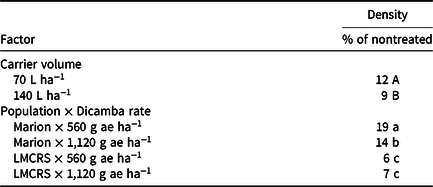
Relative densities of Palmer amaranth 21 DAT were influenced by main effects of population and carrier volume, and an interaction between population and dicamba rate (Table 2). Averaged over all other factors, densities of Palmer amaranth relative to the nontreated were 2 percentage points lower when dicamba was applied with AirMix nozzles (9%) than TTI nozzles (11%), suggesting the smaller droplets produced by AirMix nozzles (VMD = 336 to 362 µm), compared to TTI nozzles (VMD = 683 to 734 µm), probably increased dicamba absorption by the plants (Tables 1 and 4).
Palmer amaranth relative density 21 days after treatment as influenced by main effects of nozzle type and carrier volume, and the interaction of population × dicamba rate.a,b
a Densities of Palmer amaranth in nontreated plots were as follows: Marion 2017, 31 plants m−2; LMCRS 2017, 40 plants m−2; Marion 2018, 51 plants m−2; LMCRS 2018:,36 plants m−2.
b Abbreviations: TTI, Turbo TeeJet Induction; LMCRS, Lon Mann Cotton Research Station near Marianna, AR.
c Means within a column followed by the same letter are not different according to Fisher’s protected LSD at (P = 0.05).
For the main effect of carrier volume, treatments applied at 140 L ha−1 reduced Palmer amaranth densities to 9% relative to the nontreated, whereas treatments applied at 70 L ha−1 reduced densities to 12% relative to the nontreated (Table 4). The influence of carrier volume suggests that applying dicamba at 140 L ha−1 allows for greater coverage of the treated area than a carrier volume of 70 L ha−1, again placing more dicamba on the leaf surface. The significant effects of nozzle type and carrier volume for relative Palmer amaranth density reflect the significant interaction between nozzle type and carrier volume for weed control 21 DAT, in that AirMix nozzles at 140 L ha−1 provided greater control than all other nozzle type and carrier volume combinations due to greater coverage and smaller droplet sizes being produced (Tables 1, 3, and 4).
For the interaction between population and dicamba rate, the PPO-susceptible population at LMCRS was unaffected by dicamba rate. At this population, only 6% and 7% of treated Palmer amaranth, relative to the nontreated, survived dicamba application at 560 g ae ha−1 and 1120 g ae ha−1, respectively (Table 4). Dicamba at 560 g ae ha−1 was likely so effective at LMCRS that no differences in density could be observed between the two rates. However, at Marion, with PPO-resistant Palmer amaranth, 19% of treated Palmer amaranth survived a dicamba application at 560 g ae ha−1, and 14% of treated Palmer amaranth survived dicamba applied at 1,120 g ae ha−1 (Table 4). Although the Palmer amaranth at Marion appeared to be controlled at comparable levels to those at LMCRS 21 DAT based on visible control ratings, relative density data indicate that Palmer amaranth at Marion was more difficult to kill. Differences in weed densities between the two locations suggest that the Palmer amaranth population at Marion is more tolerant to dicamba than at LMCRS. Previous studies conducted at Marion also noted lower than expected control levels and density reduction with 560 g ae ha−1 of dicamba (Houston et al. Reference Houston, Norsworthy, Barber and Brabham2019). Schwartz-Lazaro et al. (Reference Schwartz-Lazaro, Norsworthy, Scott and Barber2017) found that PPO-resistant Palmer amaranth populations from around the state of Arkansas were less sensitive to dicamba in the greenhouse than PPO-susceptible populations. These findings are not unlike other research that suggests that multiple postemergence applications of dicamba may be required to control PPO-resistant Palmer amaranth (Steckel Reference Steckel2018).
Practical Implications
In this experiment, carrier volume was the most important factor in Palmer amaranth control with dicamba. In general, treatments applied at a carrier volume of 140 L ha−1 provided better control of Palmer amaranth than treatments applied at 70 L ha−1, regardless of other factors. AirMix nozzles provided higher levels of Palmer amaranth mortality than did TTI nozzles, likely due to the smaller droplet size. However, current dicamba labels approved for postemergence use state that dicamba must be applied through nozzles that produce extremely coarse or larger droplets for Engenia® and ultra-coarse droplets for Xtendimax™ (Anonymous 2018a, 2018b). By increasing carrier volume, applicators can mitigate reduced levels of weed control caused by using a nozzle producing coarser droplets.
Special attention should be paid to Palmer amaranth mortality with dicamba in fields where PPO-resistance is suspected. Metabolic resistance to S-metolachlor was recently confirmed in the Marion population and it is possible that this metabolic resistance could be the cause of reduced mortality of Palmer amaranth treated with dicamba at this location (Brabham et al. Reference Brabham, Norsworthy, Houston, Varanasi and Barber2019). Because PPO-resistant populations have proven to be harder to control with dicamba, other weed control methods may need to be employed. Following best management practices to mitigate resistance is recommended to control PPO-resistant Palmer amaranth (Norsworthy et al. Reference Norsworthy, Ward, Shaw, Llewellyn, Nichols, Webster, Bradley, Frisvold, Powles, Burgos and Witt2012).
Acknowledgments
No external funding was received to support this research. No conflicts of interest have been declared.


 Open access

